SessionBound: Turning Enterprise Task Approval into Budgeted Database Sessions
July 01, 2026
1 Introduction↩︎
AI agents change how enterprise users interact with data. A user no longer needs to know which report exists, which dashboard to open, or which endpoint exposes a particular slice of operational data. The user can ask an agent to inspect travel reimbursements for one department, find unusual merchants, compare monthly totals, and drill into claims near approval thresholds. These tasks are temporary, exploratory, cross-table, and often under-specified. They are also the tasks for which a fixed SaaS screen is least likely to exist.
The security problem is that exploratory SQL cannot simply be trusted to the agent. Giving an agent raw database access is unsafe. Prompting the agent not to inspect salary, bank, or unrelated department data is not a security boundary. Requiring a business approver to write row-level database policy for every temporary analysis is unrealistic. In real enterprises, people approve tasks, scopes, and budgets above the database. The database still needs a precise execution boundary below the application layer.
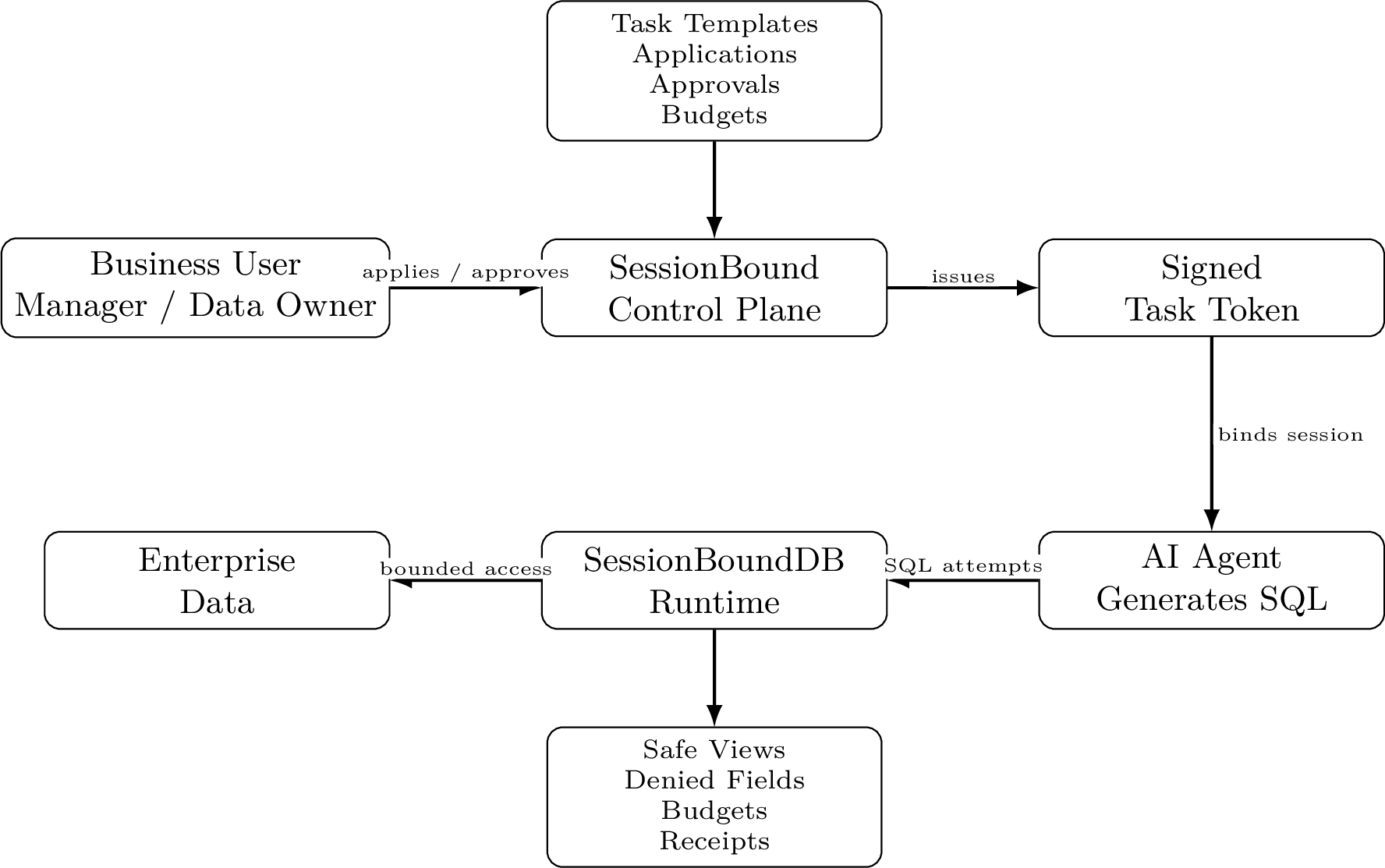
SessionBound is based on a simple principle: business users approve tasks, not database policies. Agents generate SQL, but databases enforce the approved boundary. A business approval becomes a signed task token. The token binds an agent, credential, task scope, safe views, denied fields, lifetime, operation limits, query budget, disclosure budget, and policy version. The database runtime consumes that token and creates a budgeted database session. The agent remains free to generate useful SQL, but every query attempt is checked deterministically.
This paper presents SessionBound, a control-plane and database-runtime architecture for turning approved enterprise tasks into budgeted database sessions. It makes three contributions. First, it identifies enterprise task approval as the missing layer between agent delegation and database enforcement. Second, it proposes a control-plane and runtime architecture for turning approvals into budgeted database sessions. Third, it reports a PostgreSQL prototype that validates core enforcement behavior and measures small-query overhead.
2 Motivation and Threat Model↩︎
Enterprise analytical work often starts with approval rather than database policy. A manager may approve a monthly expense review for the Sales department in June 2026. A data owner may allow employee names and reimbursement amounts, but not salaries, bank accounts, phone numbers, or other departments. A compliance reviewer may require a short expiration time, a maximum number of queries, and an audit trail. These decisions are natural business decisions. They are not naturally written as SQL predicates by the approver.
The agent, however, operates at the SQL layer. It may join safe business objects, rank rows, aggregate by department, inspect outliers, and generate follow-up queries. This open-endedness is the value of the agent. It is also the risk. If the system only authorizes a tool call, the generated query may still attempt raw-table access, denied columns, DDL, mutations, catalog inspection, broad joins, repeated probing, or payload aggregation that hides many records inside one result cell.
SessionBound assumes the following threat model. The agent may be curious, faulty, prompt-injected, or directly instructed to exceed the approved boundary. It may generate arbitrary SQL strings. It may try to read raw tables, denied fields, out-of-scope rows, system catalogs, or large payloads. It may repeat queries until a budget is exhausted. The agent is not trusted to interpret the task correctly, and an LLM is not trusted as the runtime security oracle.
SessionBound does not assume a malicious database administrator, a compromised signing key, or a database engine whose access-control mechanisms have been bypassed. It also does not claim to eliminate all semantic inference. If allowed query answers reveal correlated information, an agent may infer facts that were not directly exposed. Disclosure budgets account for and limit exposure during one task session; they are not differential privacy [1].
The intended protection target is the direct boundary between approved task authority and database execution. SessionBound should deny direct access to unauthorized schemas and fields, enforce row scope, reject unsupported operations, stop sessions after expiration or revocation, track cumulative exposure, and emit receipts for both allowed and denied attempts.
3 SessionBound Design↩︎
SessionBound separates three concerns. The control plane records what the organization approved. The agent execution layer decides which SQL queries to try. The database runtime enforces how the approved authority may be spent. Figure 1 shows the architecture.
3.1 Control Plane↩︎
A task template describes a reusable class of work that may be delegated to an agent once scoped and approved. For example, a monthly expense anomaly review template might allow safe views for expenses, employees, and departments; deny salary, bank-account, and phone fields; require tenant, month, and department scope; allow only read operations; and set default query and disclosure budgets. The template is created by a data platform or application team, not by the agent.
A task application instantiates a template with a concrete requester, actor, scope, and reason. An approval decides whether that scoped task should exist. Approval may be automatic, role-based, or manual. The important property is that the approver decides on a business task, not on a hand-written database policy.
After approval, the control plane issues a signed task token. A task token contains fields such as task_id, actor, credential_id, allowed safe views, denied fields, row scope, TTL, query budget, disclosure budget, safe-view
registry version, policy version, audience, nonce, and signature. The token is a compact authorization object that the database runtime can validate without asking an LLM to interpret the natural-language task.
3.2 Safe Views and Scope↩︎
SessionBound exposes data through registered safe views rather than raw tables. A safe view is a governed business object with an explicit column list, row-scope binding, and registry version. Safe views should avoid SELECT *; adding a new
exposed column changes the exposure boundary and should invalidate incompatible task tokens. This keeps schema drift from silently broadening existing approvals.
Row scope is bound to the task token. A query for another month or department should not reveal data merely because the agent wrote a broader predicate. In the prototype, out-of-scope access through safe views is transparently filtered to zero rows rather than treated as an explicit denial. Raw-table access, denied-field access, catalog escape, mutations, and DDL are denied.
3.3 Budgets and Receipts↩︎
SessionBound treats budgets as authority accounting. Query budgets limit the number of SQL attempts. Disclosure budgets limit the amount of task-authorized information exposed during one session, for example by result rows, bytes, or unique entity identifiers. A production budget vector can assign different weights to detail rows, aggregate rows, and high-sensitivity columns.
Receipts record how approved authority was spent. An allow receipt records the task, credential, query identity, safe views touched, rows returned, budget consumed, policy versions, and timestamp. A denial receipt records the denied attempt and reason, such as denied column, raw schema, unsupported operation, expired token, or budget exhaustion. Receipts make the session auditable after the agent has completed its work.
4 Runtime Enforcement↩︎
SessionBoundDB is the PostgreSQL-based reference runtime. The prototype keeps the SQL schema name taskbound for compatibility with the existing implementation, but the public project name is SessionBound.
The runtime binds one signed task token to one active database session. Rebinding is denied. The token must be valid, unexpired, intended for the database audience, and bound to the credential used by the session. Credential-token binding prevents an agent from presenting a token with one identity while executing through another.
At query time, the runtime applies a deterministic decision procedure: verify an active binding; validate token freshness and revocation state; parse or conservatively inspect the SQL attempt; restrict access to allowed safe views; reject denied fields and blocked schemas; enforce row scope; reject disallowed operation types; check remaining query and disclosure budget; execute the query only if every check passes; and emit an allow or denial receipt.
The prototype uses conservative SQL checks plus PostgreSQL security boundaries. This is sufficient for the validation suite, but it is not a claim of production-grade SQL parsing. A hardened implementation should use database parser hooks,
executor-level checks, or a complete AST validation path. Conservative blocking is acceptable for a prototype because false positives are safer than silent overexposure. For example, the v1 prototype denies payload aggregation functions such as
json_agg, array_agg, string_agg, xmlagg, and row_to_json unless a future template explicitly permits them with strict byte-level budgets. Ordinary analytical aggregates such as
count, sum, avg, min, and max remain allowed.
The runtime is intentionally LLM-independent. It does not ask whether the generated SQL is consistent with the user’s prose. It checks whether the SQL stays inside a structured boundary approved by the enterprise. This distinction is important: SessionBound does not solve all semantic-policy questions, but it makes the executable boundary deterministic, signed, budgeted, and auditable.
5 Evaluation↩︎
The evaluation asks two questions. First, can the PostgreSQL prototype enforce the intended direct boundaries for representative analytical and adversarial SQL patterns? Second, what is the small-query overhead of the SessionBound runtime path relative to raw PostgreSQL?
5.1 Functional Validation↩︎
The canonical validation suite passed 24 of 24 scenarios. Table 1 compresses the suite into major categories. The allowed cases cover safe-view reads, joins, common table expressions, grouped aggregation, window functions, and scoped drill-down. The denied cases cover salary and bank-account fields, raw tables, mutation SQL, DDL, system catalog access, payload aggregation, and exhausted budgets. Out-of-scope month and department cases are enforced by transparent scope filtering.
| Category | Cases | Observed result |
|---|---|---|
| Allowed analysis over safe views | 6 | Allowed |
| Denied sensitive fields | 2 | Denied |
| Denied schema or catalog escape | 2 | Denied |
| Denied mutation or DDL | 2 | Denied |
| Denied payload aggregation | 8 | Denied |
| Out-of-scope rows | 2 | Scope-filtered |
| Budget exhaustion | 2 | Denied |
| Total | 24 | Passed |
These results validate the intended direct enforcement boundary. They do not prove that every SQL dialect feature is safely handled, nor do they eliminate inference from allowed answers. They show that the prototype can bind a task token to a PostgreSQL session and consistently apply the core controls required by the design.
5.2 Performance Microbenchmark↩︎
The microbenchmark compared equivalent raw PostgreSQL queries against the SessionBound path for five query patterns: simple SELECT, safe-view JOIN, GROUP BY, CTE, and window function. Each pattern used 10 warmup
iterations and 100 measured iterations. The baseline used an admin/test role over raw application tables with tenant and month predicates matching the task scope. The SessionBound path bound a signed task token and executed through
taskbound.run(sql). HTTP latency and dynamic credential creation were excluded so the benchmark focused on database runtime overhead.
| Pattern | Raw p50 | SB p50 | Overhead | Rows |
|---|---|---|---|---|
| SELECT | 0.063 ms | 1.434 ms | 2168.4% | 3 |
| JOIN | 0.060 ms | 1.503 ms | 2408.0% | 3 |
| GROUP BY | 0.066 ms | 1.450 ms | 2088.7% | 3 |
| CTE | 0.052 ms | 1.457 ms | 2702.8% | 1 |
| Window | 0.074 ms | 1.500 ms | 1937.5% | 5 |
Table 2 shows high relative overhead because the raw PostgreSQL baseline is extremely small. The absolute SessionBound p50 latency remains around 1.4–1.5 ms for these small synthetic queries. Likely sources include PL/pgSQL dispatch, SQL text checks, task-session lookup, safe-view evaluation, budget updates, unique-row exposure accounting, payload-aggregation checks, and receipt insertion. These results should not be generalized to larger datasets without additional experiments.
6 Related Work↩︎
SessionBound is intended to compose with, not replace, existing authorization and data-governance systems. OAuth 2.0 provides delegated API authorization [2]. Authenticated Delegation establishes who may act for whom and how agent authority is delegated verifiably [3]. PAuth checks whether a service or tool operation is implied by a task [4]. Data Product MCP governs discovery and access for enterprise data products over MCP interfaces [5], [6]. Oracle Deep Data Security shows the importance of identity- and context-aware database enforcement [7], [8]. Zanzibar provides consistent relationship-based authorization at scale [9]. PostgreSQL row security is an important database-native mechanism for row-level predicates [10]. Classical inference-control work studies leakage from database query answers [11].
The closest related area is enterprise data-product governance, because it shares the motivation that agents should not freely roam enterprise data. SessionBound differs by treating the approved task and its database session as the first-class object. A session may span multiple safe views, consume cumulative budget, and produce receipts for every attempt. This is the layer between business approval and database execution.
7 Limitations and Conclusion↩︎
The current prototype has several limitations. It targets a single PostgreSQL database. SQL checks are conservative and are not a production AST enforcement mechanism. Disclosure budget is not differential privacy. Semantic inference is reduced and accounted for, not eliminated. Payload aggregation is conservatively blocked rather than fully modeled. View drift invalidation is a design requirement. The performance results are small synthetic microbenchmarks, not production workload measurements.
Despite these limitations, SessionBound captures a useful systems boundary for enterprise AI agents. Business users approve tasks, not database policies. Agents generate SQL, but databases enforce the approved boundary. The control plane turns a scoped approval into a signed token; the database runtime turns that token into a short-lived, budgeted, receipt-bearing session. This lets enterprises preserve the flexibility of agent-generated analysis while moving the security decision from prompts and application conventions into deterministic database enforcement. The agent can try. The database decides.