Synergistic Perception-Reasoning Governance: Grounding Medical MLLMs with Verifiable Anatomical Evidence
June 30, 2026
Abstract
Multimodal large language models (MLLMs) show strong promise for clinical VQA and radiology report generation, yet inference-time hallucinations still undermine trustworthy use: models can produce fluent conclusions that conflict with imaging evidence.
Existing mitigation strategies typically rely on additional training, external retrieval/knowledge bases, or multi-stage post-hoc verification, which increases cost and pipeline complexity and often generalizes poorly across models and tasks. To address
this, we propose a holistic, training-free evidence-injection framework that systematically mitigates hallucinations through dual-side evidence injection. By leveraging ROI priors acquired using MedSAM in our implementation, we recalibrate the visual
perception trajectory via ROI-guided activation modulation while anchoring the textual reasoning trajectory by mapping anatomical coordinates into discrete semantic tokens as verifiable external memory. Then we introduce a task-aware dynamic router to
select modality-specific interventions based on task semantics, balancing perceptual grounding and linguistic fluency. We conduct systematic evaluations on 2 tasks and 5 datasets using LLaVA-1.5-7B, LLaVA-Med-1.5-7B,
Qwen3-VL-8B/32B, and InternVL-3.5-8B/38B. Controlled ablations and visualizations further validate the framework, which consistently outperforms baselines across medical benchmarks, improving close-ended accuracy by up to \(\sim\mathbf{6}\%\uparrow\) and reducing open-ended hallucinations by \(\sim\mathbf{35}\%\downarrow\). The code has been made available on GitHub: https://github.com/Henry991115/SPRG.
1 Introduction↩︎
MLLMs combine visual perception and language generation with emerging clinical reasoning, enabling medical VQA and radiology report generation [1]–[5]. However, hallucinations remain a key barrier to trustworthy deployment [6], as models may generate fluent outputs that are unsupported by or even contradict imaging evidence [7], [8]. Recent benchmarks categorize medical hallucinations into visual misinterpretation, knowledge deficiency, and context misalignment [9]; in high-stakes settings, such evidence-inconsistent outputs can lead to incorrect lesion judgments and unsafe clinical attributions [10], [11].
To mitigate these risks, many training-free, inference-time methods have emerged. VCD [12], DoLa [13], and OPERA [14]adjust decoding by contrasting perturbed inputs, contrasting layer logits, or penalizing over-trusted tokens. AVISC [15], DAMRO [16], and PAI [17]calibrate attention or visual tokens by correcting outliers, filtering vision-side noise, and reducing text-dominant bias. M3ID [18] strengthens image grounding through visually dominant constraints. However, most existing mitigations rely on internal statistical calibration without explicit anatomical grounding, which limits generalization across clinical tasks with different evidence requirements.
In this work, we propose a holistic, training-free inference-time evidence-injection framework to mitigate visual misinterpretation hallucinations in medical MLLMs. Using ROI priors as verifiable anatomical evidence, we improve visual grounding and clinical consistency through the perception-reasoning intervention mechanism, including text-side evidence injection and vision-side activation recalibration over visual tokens, with a joint strategy for complementary gains. To handle heterogeneous clinical tasks, we further introduce a lightweight task-aware dynamic router that dynamically selects modality-specific interventions based on task semantics. Extensive experiments across diverse medical benchmarks, supported by controlled ablations and visualizations, show superior robustness over existing baselines, with up to \(\sim \mathbf{6}\mathbf{\%} \mathbf{\uparrow}\) improvement in close-ended reasoning accuracy and up to \(\sim \mathbf{35}\mathbf{\%} \mathbf{\downarrow}\) reduction in open-ended hallucinations. Our key contributions can be summarized as follows:
We introduce a novel training-free framework that mitigates hallucinations by injecting dual-side verifiable anatomical evidence, bridging the gap between raw visual perception and clinical reasoning.
We develop a perception-reasoning intervention mechanism that recalibrates the visual perception trajectory via ROI-guided visual-side activation modulation, while mapping anatomical coordinates into discrete semantic tokens as verifiable external memory to anchor the textual reasoning trajectory.
We propose a task-aware dynamic router that adjusts modality-specific intervention strategies according to task semantics, thereby achieving a better balance between perceptual grounding and linguistic fluency.
We establish a rigorous cross-model, cross-task evaluation framework involving 2 tasks, 5 datasets and 6 MLLMs, providing a highly comprehensive study to date on inference-time medical hallucination mitigation.
2 Methods↩︎
Given an image \(I\), a textual question \(q\), and a pretrained MLLM parametrized by \(\theta\), the standard autoregressive generation is formulated as: \[p_{\theta}(y \mid I, q) = \prod_{t=1}^{T} p_{\theta}\!\left(y_t \mid y_{<t}, \mathrm{Enc}(I), q\right),\] where \(\mathrm{Enc}(I) \in \mathcal{R}^{N \times d}\) denotes the sequence of \(N\) visual patch tokens. To mitigate visual misinterpretation, we introduce an intervention function that conditionally modulates the visual representation \(\tilde{V}\) and textual prompt \(\tilde{q}\) based on verifiable anatomical priors \(\mathcal{R}\), yielding \(p_{\theta,\phi}(y \mid I, q, R) = \prod_{t=1}^{T} p_{\theta}(y_t \mid y_{<t}, \tilde{V}, \tilde{q})\).
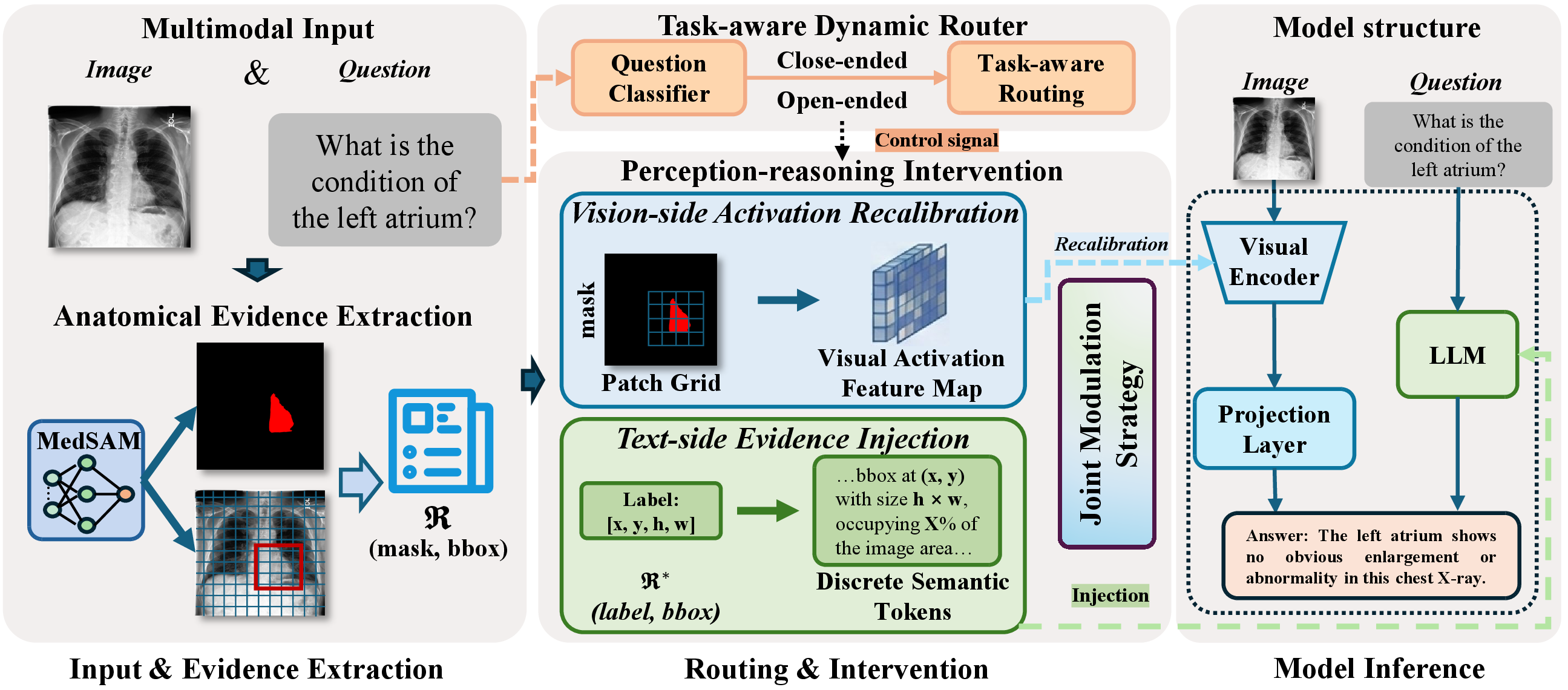
As shown in Fig. 1, the pipeline comprises the anatomical evidence extraction, perception-reasoning intervention mechanism, and task-aware dynamic router.
2.1 Anatomical Evidence Extraction↩︎
We utilize MedSAM prompted by a candidate bounding box set \(\mathcal{B}=\{b_k\}_{k=1}^{K}\) to extract verifiable anatomical evidence. For each valid box \(b_k\), we obtain its corresponding segmentation mask \(m_k\). After deduplication and invalid region filtering, we define the deterministic ROI prior set as \(\mathcal{R}=\{(m_k, b_k, l_k)\}_{k=1}^{K'}\), where \(l_k\) is the anatomical semantic label derived from the clinical context.
2.2 Perception-reasoning Intervention Mechanism↩︎
2.2.0.1 Text-side Evidence Injection.
We convert the ROI prior set \(\mathcal{R}\) into a collection of verifiable region descriptors and inject them into the textual prompt in a structured form. Given \(\mathcal{R}=\{(m_k,\hat{b}_k)\}_{k=1}^{K'}\), we represent each region as a detection pair \((l_k,b_k)\), where \(l_k\) is the anatomical label and \(b_k=[x,y,w,h]\) specifies its location and scale. We then sequentially construct the structured region set, the serialized evidence block, and the injected prompt as \[\tilde{q} = \left[ \mathcal{S}(\mathcal{R}) \parallel q \parallel \eta_{\mathrm{task}} \right], \quad \tilde{V} = V,\] where \(\mathcal{S}(\cdot)\) is a deterministic serialization operator. The operator \(\parallel\) denotes token-level concatenation, and \(\eta_{\mathrm{task}}=\texttt{``Answer Yes/No''}\) is optionally appended for binary QA to reduce format drift. The final prediction is generated by conditioning on \((I,\tilde{q})\).
2.2.0.2 Vision-side Activation Recalibration.
Let \(\mathcal{P}_i \subset \mathbb{Z}^2\) denote the discrete spatial domain of the \(i\)-th visual patch token, where \(i \in \{1, \dots, N\}\). We compute the spatial coverage density \(\gamma_i\) by aggregating the global binary ROI mask \(\mathbf{B}(u,v) = \bigvee_{k} m_k(u,v)\) over the patch, normalized by its cardinality \(|\mathcal{P}_i|\): \[\gamma_i = \frac{1}{|\mathcal{P}_i|} \sum_{(u,v) \in \mathcal{P}_i} \mathbf{B}(u,v).\]
To suppress out-of-distribution (OOD) structural collapse while extinguishing background noise, we formulate an activation soft-mask \(\mathbf{m} \in \mathbb{R}^N\) governed by the threshold indicator \(\mathbb{I}(\cdot)\): \[m_i = \alpha \cdot \mathbb{I}(\gamma_i \ge \rho) + \beta \cdot \left(1 - \mathbb{I}(\gamma_i \ge \rho)\right),\] where \(\rho\) is the density threshold, \(\alpha\) serves as a gain factor about the ROI-aligned features, and \(\beta \in (0, 1)\) acts as a severe \(L_2\)-norm attenuation factor. Implemented via a forward hook prior to the cross-modal projection layer, the recalibration is executed via broadcasting scalar multiplication: \[\tilde{V} = \mathbf{Diag}(m) V, \quad \tilde{q} = q.\]
By shrinking the feature norm of non-ROI patches by a factor of \(\beta\), their subsequent dot-product attention scores approach zero exponentially, effectively excising spurious visual pathways.
2.2.0.3 Joint Modulation Strategy.
To achieve complementary regularization, the joint mapping simultaneously enforces \(L_2\)-norm visual filtering and discrete semantic anchoring: \[\Phi_{\mathrm{Joint}}: \quad \tilde{V} = \mathbf{Diag}(m) V, \quad \tilde{q} = \left[ \mathcal{S}(\mathcal{R}) \parallel q \parallel \eta_{\mathrm{task}} \right].\]
2.3 Task-aware Dynamic Router↩︎
Since distinct clinical question categories exhibit varying sensitivities to visual vs. textual constraints, statically applying a single strategy yields sub-optimal robustness. We therefore propose a zero-overhead dynamic router based on zero-shot LLM question classification at inference.
Given question \(q\), a lightweight classifier yields its category \(\hat{c} = h(q) \in \{\mathcal{C}_{A}, \mathcal{C}_{M}, \mathcal{C}_{S}, \mathcal{C}_{R}\}\), corresponding to Anatomy, Measurement, Symptom, and Radiology features, respectively. We define the routing strategy dynamically based on the query category: \(s(\hat{c}) =\) Vision-side if \(\hat{c} \in \{\mathcal{C}_{A}\}\), Text-side if \(\hat{c} \in \{\mathcal{C}_{M}, \mathcal{C}_{S}\}\), and Joint if \(\hat{c} \in \{\mathcal{C}_{R}\}\).
Rationale: Anatomy (\(\mathcal{C}_{A}\)) relies on spatial localization, naturally benefiting from vision-side L2-norm recalibration. Measurement (\(\mathcal{C}_{M}\)) and Symptoms (\(\mathcal{C}_{S}\)) demand precise semantic anchoring, making structured textual prompts superior. Radiology features (\(\mathcal{C}_{R}\)) typically require complex cross-modal reasoning, necessitating joint constraints on both visual activations and textual generation.
3 Experiments and Results↩︎
3.1 Datasets and Evaluation Metric↩︎
We evaluate hallucinations following the benchmark by Chang et al. [9]. For close-ended tasks, we report overall and per-type accuracy (anatomy, measurement, symptom, radiology) on MM-VisHal (comprising SLAKE [19] and VQA-RAD [20]) and CXR-VisHal (featuring IU-Xray [21] and MIMIC-CXR [22]). For open-ended evaluation, we assess hallucinations and text quality via CHAIR, CheXbert, RadGraph, RaTEScore, and Recall using 490 image-report pairs sampled from the MIMIC-CXR test set.
c|c|ccccc|ccccc & & &
& & A & M & S & R & Acc & A & M & S & R & Acc
& Original & 58.5 & 42.3 & 55.7 & 50.8 & 52.3 & 73.2 & 43.0 & 52.7 & 58.2 & 55.7
& Text-side & 65.6 & 44.1 & 57.3 & 51.3 & 55.0 & 73.6 & 45.2 & 55.9 & 56.9 & 57.9
& Vision-side & 69.8 & 42.9 & 54.7 & 52.7 & 55.0 & 74.7 & 38.6 & 54.3 & 58.3 & 56.5
& Joint & 61.7 & 42.8 & 56.2 & 52.8 & 53.6 & 72.4 & 41.7 & 54.9 & 59.1 & 56.9
& Original & 65.9 & 38.2 & 51.1 & 53.2 & 51.7 & 85.3 & 46.3 & 70.7 & 85.3 & 71.9
& Text-side & 65.9 & 40.1 & 57.3 & 52.8 & 54.4 & 86.2 & 48.9 & 73.3 & 86.6 & 74.1
& Vision-side & 66.9 & 39.1 & 53.6 & 51.8 & 52.8 & 86.5 & 48.1 & 71.3 & 85.6 & 72.7
& Joint & 65.3 & 37.9 & 55.0 & 54.6 & 53.2 & 85.2 & 49.2 & 71.5 & 87.6 & 72.9
& Original & 73.1 & 61.7 & 66.0 & 72.0 & 67.6 & 77.0 & 46.8 & 78.5 & 80.7 & 75.0
& Text-side & 76.9 & 65.1 & 70.2 & 72.7 & 70.9 & 77.8 & 50.4 & 79.7 & 81.7 & 76.3
& Vision-side & 77.9 & 63.1 & 65.7 & 72.2 & 69.0 & 78.3 & 48.0 & 78.3 & 82.3 & 75.4
& Joint & 72.9 & 63.0 & 70.5 & 72.7 & 69.6 & 78.1 & 50.0 & 78.0 & 83.6 & 75.5
& Original & 76.6 & 65.0 & 70.4 & 84.4 & 72.9 & 88.1 & 73.5 & 85.1 & 93.7 & 85.1
& Text-side & 80.2 & 66.7 & 73.6 & 84.4 & 75.3 & 88.5 & 74.5 & 85.4 & 92.9 & 85.4
& Vision-side & 78.1 & 65.2 & 70.5 & 84.8 & 73.4 & 88.4 & 73.5 & 85.7 & 94.1 & 85.6
& Joint & 78.6 & 66.0 & 73.0 & 84.1 & 74.5 & 87.8 & 74.8 & 85.3 & 94.5 & 85.4
& Original & 78.6 & 68.3 & 66.6 & 74.7 & 71.1 & 79.0 & 60.7 & 81.9 & 79.2 & 78.8
& Text-side & 79.5 & 69.9 & 70.6 & 76.7 & 73.5 & 78.8 & 62.5 & 83.1 & 76.7 & 79.5
& Vision-side & 80.3 & 68.0 & 69.5 & 74.8 & 72.5 & 79.7 & 62.2 & 81.8 & 79.8 & 79.1
& Joint & 77.9 & 67.4 & 70.5 & 75.9 & 72.4 & 79.3 & 61.9 & 82.3 & 81.5 & 79.5
& Original & 79.1 & 69.4 & 70.8 & 81.2 & 74.1 & 80.4 & 71.4 & 86.3 & 91.7 & 84.2
& Text-side & 79.8 & 70.2 & 74.8 & 81.0 & 75.9 & 80.9 & 75.6 & 87.0 & 91.6 & 85.1
& Vision-side & 81.0 & 70.5 & 71.9 & 81.4 & 75.3 & 81.2 & 72.8 & 86.4 & 91.7 & 84.5
& Joint & 80.7 & 67.3 & 74.8 & 82.6 & 75.6 & 81.1 & 72.5 & 86.5 & 93.1 & 84.7
3.2 Results↩︎
On both close-ended and open-ended evaluation tasks, we systematically evaluate LLaVA-1.5-7B [23], LLaVA-Med-1.5-7B [24], Qwen3-VL-8B/32B [25], and InternVL-3.5-8B/38B [26]; the following sections present these results in turn.
3.2.0.1 Close-ended Evaluation.
Table ¿tbl:tab:close95vqa95main? shows that our training-free evidence injection consistently improves accuracy across all MLLMs. Notably, text-side injection dominates, achieving the highest overall Acc in \(9\) of \(12\) settings (with \(2\) ties) and an average gain of \(+1.9\%\), peaking at \(+3.3\%\) for Qwen3-VL-8B on MM-VisHal. Conversely, the vision-side constraint exhibits a strong bias toward anatomy-related questions, delivering the best Acc-A in \(10\) of \(12\) settings. Finally, the joint strategy excels in radiology-feature questions, attaining the best Acc-R in \(9\) of \(12\) settings. The domain-specific benefits of interventions make dynamic routing essential for superior robustness.
As shown in Fig. 2, our task-aware Router consistently outperforms less robust baselines. Each module exhibits selective advantages for different questions, By dynamically exploiting these complementary strengths, routing achieves the highest overall accuracy improvements (\(+3.2\%\) on MM-VisHal; \(+2.4\%\) on CXR-VisHal), demonstrating superior robustness over any fixed intervention.
Obs 1: Dynamic dual-side routing transcends the fragility of post-hoc corrections, consistently mitigating multi-source hallucinations.

3.2.0.2 Open-ended Evaluation.
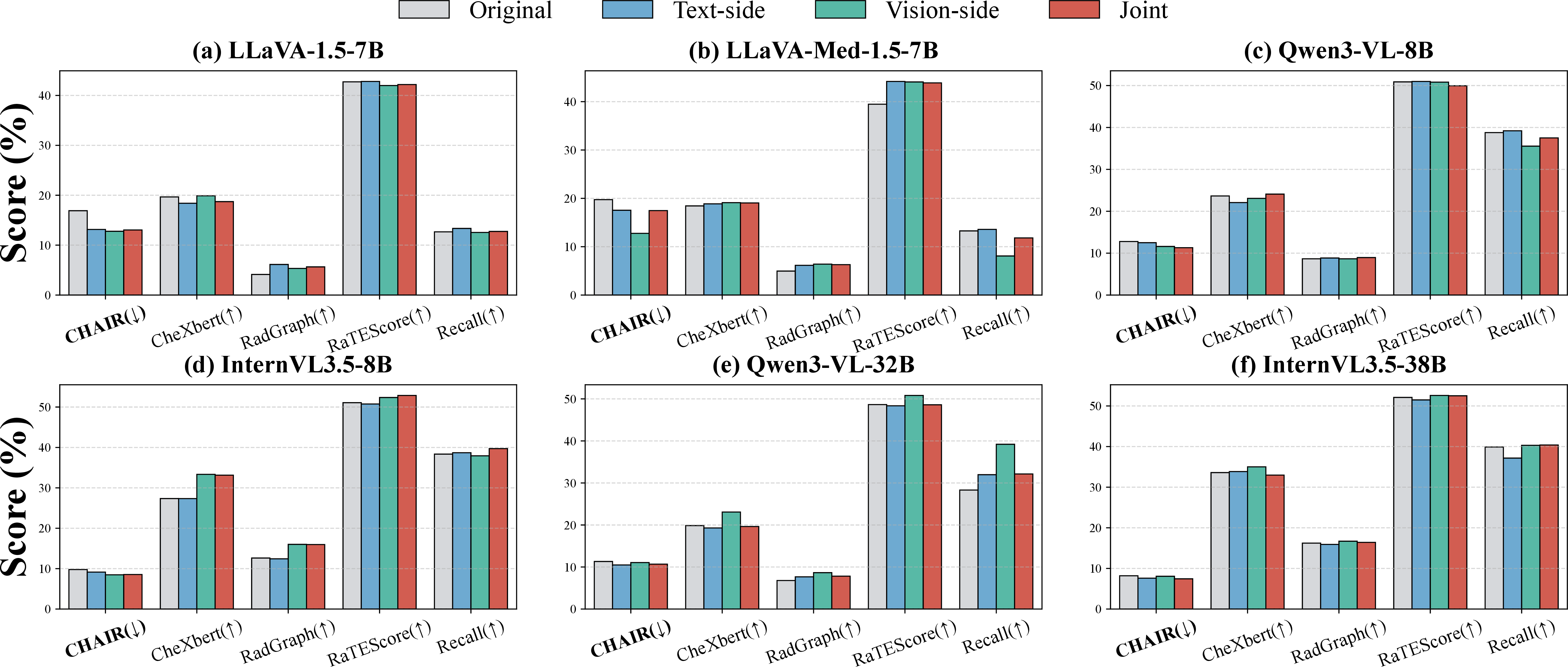
Fig. 3 shows that ROI-based training-free interventions reduce hallucinations with metric-dependent trade-offs: vision-side constraints most consistently lower CHAIR and improve clinical consistency, text-side injection better preserves coverage and fluency (higher RaTEScore/Recall), and the joint strategy often provides the best balance, yielding strong Recall with competitive CHAIR (notably on InternVL3.5).
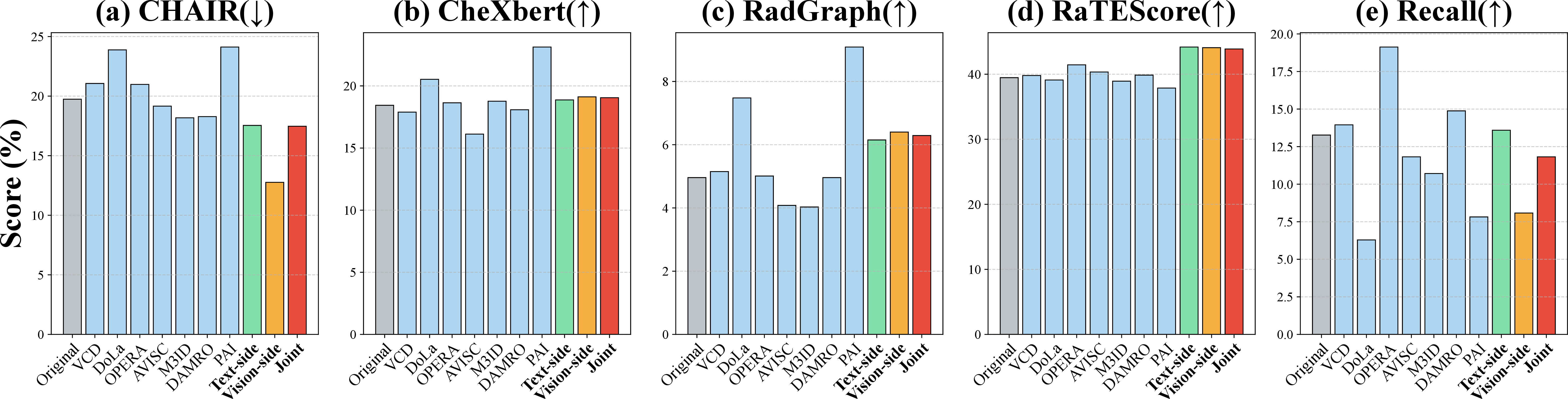
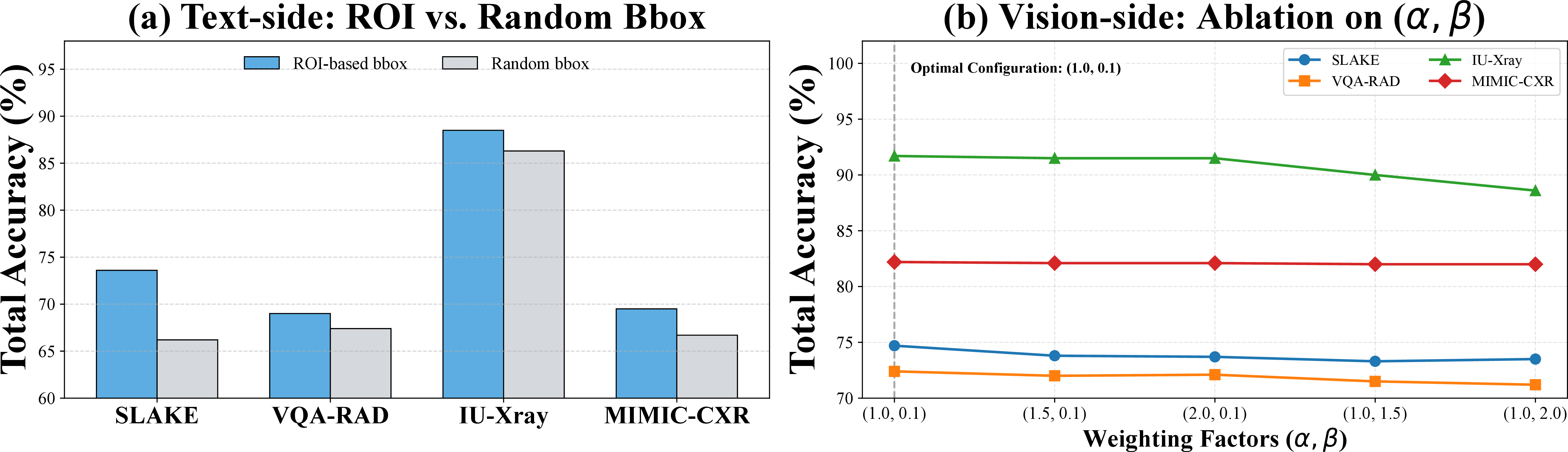

Fig. 4 highlights the trade-offs of our ROI-based interventions against baselines. While OPERA yields the highest Recall (19.13%) and PAI excels in clinical metrics (CheXbert 23.13%, RadGraph 9.09%), both severely increase hallucinations. Our vision-side intervention achieves the lowest CHAIR (12.76%) and improves clinical consistency by curbing spurious visual findings, albeit at a slight cost to Recall. Meanwhile, our text-side intervention maintains Recall and boosts RaTEScore to 44.18%, proving structured textual injection enhances narrative quality and coherence while effectively mitigating hallucinations.
Obs 2: The central challenge in open-ended evaluation remains the difficulty of balancing report completeness and hallucination suppression.
3.3 Ablation Study and Qualitative Analysis↩︎
3.3.0.1 Ablation Study.
Fig. 5 illustrates the ablation studies for both interventions. (1) Text-side: Random bbox degrade performance across all benchmarks, proving that text-side improvements rely on the injected spatial grounding of ROI coordinates. (2) Vision-side: In vision-side weighting, \((\alpha=1.0, \beta=0.1)\) is the optimal setting. Over-amplifying ROI features (\(\alpha\)) provides no gain, while increasing non-ROI weights (\(\beta\)) consistently introduces distracting signals.
3.3.0.2 Qualitative Analysis.
Fig. 6 provide TAM visualizations to elucidate how our interventions steer the grounding mechanism. The baseline’s diffuse attention during the generation of “changed” is sharpened by vision-side injection, which refocuses the model on the left atrial region—a key semantic anchor for the ground-truth “normal” heart size.
4 Conclusion↩︎
We address visual misinterpretation hallucinations in medical MLLMs with a training-free, evidence-injection framework. Using MedSAM-extracted ROI priors as verifiable anatomical evidence, our method improves visual grounding and clinical consistency through text-side evidence injection, vision-side activation recalibration, and their joint strategy. We further introduce a lightweight decoupled router that dynamically selects modality-specific interventions based on task semantics. Extensive evaluations on multiple MLLMs across close-ended and open-ended tasks, supported by controlled ablations and visualizations, show robust hallucination mitigation over existing baselines while improving reasoning accuracy and factual reliability. Overall, this work provides a practical path toward visually grounded and controllable generation in clinical workflows.
4.0.1 ↩︎
The work was supported by the National Key R&D Program of China under Grant 2025YFE0216500, the Major Program of National Natural Science Foundation of China under Grant 62595802, the Foundation for Outstanding Research Groups of Hubei Province of China under Grant 2025AFA012, the 111 Project on Computational Intelligence and Intelligent Control under Grant B18024, and the National Research Foundation, Prime Minister’s Office, Singapore under its IN-CYPHER Campus for Research Excellence and Technological Enterprise (CREATE) Programme.
4.0.2 ↩︎
The authors have no competing interests in the paper.