Distributed Hierarchical Temporal Memory with Shared Associative Memory for Cross-Entity Preemptive Warning
January 01, 1970
Abstract
Anomaly detection in multivariate time series remains a critical challenge in large-scale distributed systems, where related entities may exhibit transferable precursor behavior prior to anomaly onset. Existing methods typically operate independently on each data stream and therefore remain fundamentally reactive. To address this limitation, we introduce Distributed Hierarchical Temporal Memory (D-HTM), a neuromorphic framework that enables cross-entity preemptive warning through a Shared Associative Memory (SAM).
D-HTM combines a Spatial Pooler (SP) that projects observations into a common Sparse Distributed Representation (SDR) space, Temporal Memory (TM) modules that learn entity-specific dynamics online, and a Shared Associative Memory that stores recurring pre-anomaly signatures. By reusing precursor knowledge across related entities, D-HTM can issue warnings prior to local anomaly onset while preserving HTM’s online learning capabilities.
We evaluate D-HTM on the Server Machine Dataset (SMD), the Soil Moisture Active Passive (SMAP) dataset, the Mars Science Laboratory (MSL) dataset, and a synthetic cascade benchmark designed to isolate precursor transfer. Experimental results demonstrate effective cross-entity warning propagation while maintaining competitive reactive anomaly detection performance. Across the real-world datasets, D-HTM provides an average warning lead time of 8.1 samples prior to anomaly onset.
These findings demonstrate that transferable precursor structure can emerge within a shared SDR space and be reused for preemptive warning generation, extending HTM beyond isolated reactive detection toward distributed predictive reasoning.
Hierarchical Temporal Memory ,Shared Associative Memory , Multivariate Time Series Anomaly Detection ,Cross-Entity Warning Propagation , Neuromorphic Computing
1 Introduction↩︎
The explosive growth in data generation from internet-connected devices has placed unprecedented demands on intelligent systems to process information efficiently and in real time. While traditional neural networks and other artificial intelligence (AI) algorithms have achieved remarkable success in domains such as image recognition and natural language processing, they face significant limitations when adapting to continuous, dynamic streams of unlabeled data [@laird2017standard]. These systems typically rely on batch learning, requiring extensive training data, computational resources, and retraining when the input distribution changes. Moreover, their architectures are not inherently designed for online inference and adaptation, which are critical requirements in applications such as anomaly detection, robotics, and streaming data analysis.
In contrast, Hierarchical Temporal Memory (HTM) is a biologically inspired framework modeled on the structure and function of the human neocortex. HTM learns continuously from streaming data by forming sparse distributed representations and temporal associations without requiring offline retraining [@hawkins2016neurons; @ahmad2016neurons]. Its online learning capability has enabled applications in anomaly detection, robotics, forecasting, medical imaging, wafer inspection, biometric recognition, and environmental monitoring [@lavin2015evaluating; @zhou2018hierarchical; @adam2018wafer; @james2017htm; @neubert2018sequence; @micheletto2018using; @osegi2018using; @zyarah2020end].
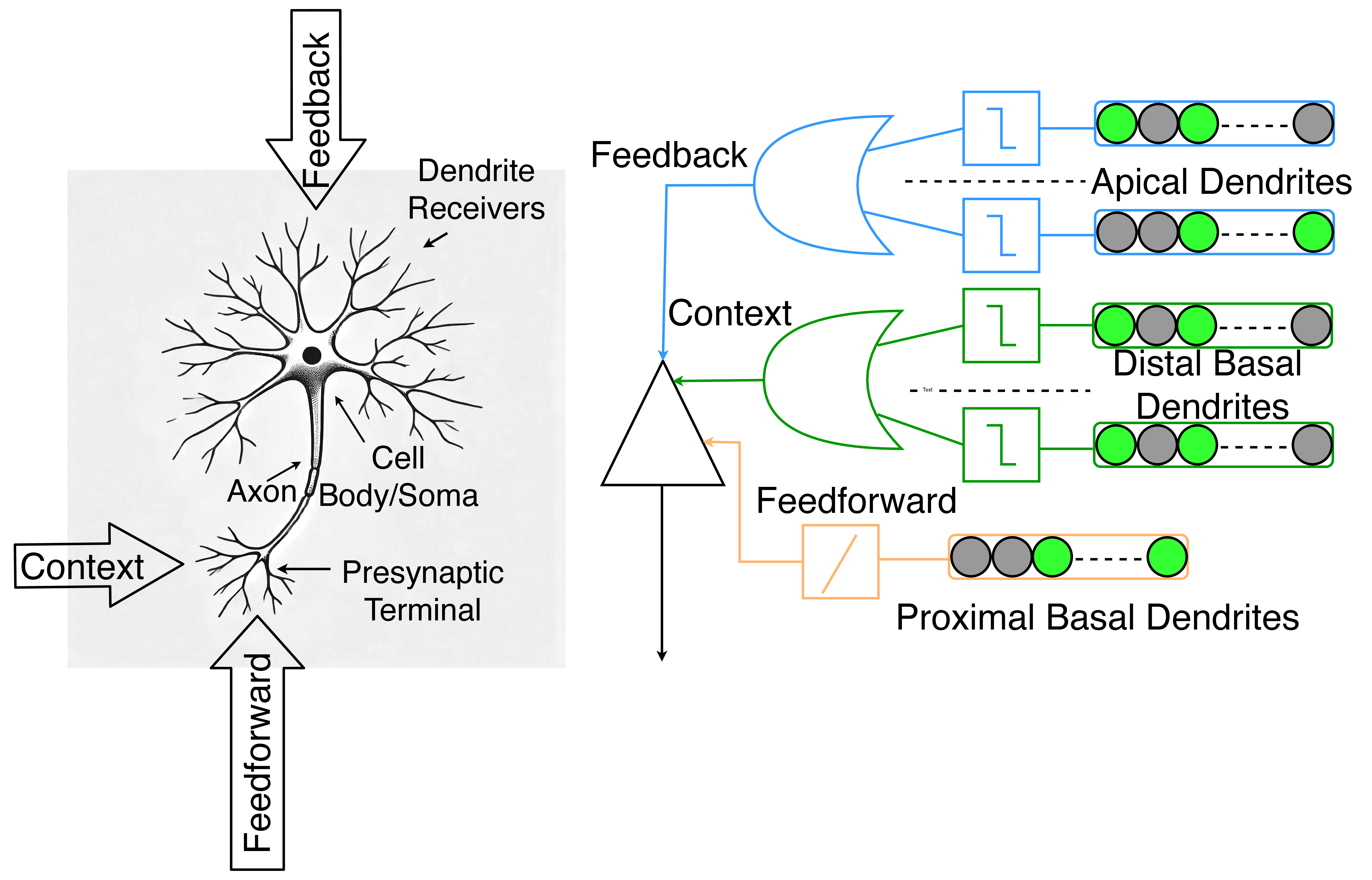
At the core of HTM is the Temporal Memory (TM), which models key processing mechanisms of pyramidal neurons within the neocortex [@zyarah2020end; @bautista2020matlabhtm], as illustrated in Fig. 1. Through interactions among proximal, distal, and apical dendrites, TM learns predictive associations between successive sparse activation patterns, enabling continuous temporal learning and anomaly detection without offline retraining [@hawkins2016neurons; @bautista2020matlabhtm; @harris2015neocortical].
Despite these strengths, HTM deployments in large-scale distributed environments remain fundamentally isolated. Each HTM agent learns only from its own local observations, even though anomalies in real-world systems frequently propagate across related entities [@audibert2020usad]. Consequently, existing anomaly detection methods, including state-of-the-art approaches such as OmniAnomaly [@su2019omnianomaly], process each data stream independently and cannot exploit knowledge acquired elsewhere in the system. Anomaly detection therefore remains largely reactive, with each agent responding only after anomalous behavior becomes observable within its own data stream.
To address this limitation, we propose Distributed Hierarchical Temporal Memory (D-HTM), a framework that augments distributed HTM agents with a Shared Associative Memory (SAM). SAM stores recurring precursor activation patterns observed before anomaly onset and enables this knowledge to be shared across agents. When a local temporal pattern resembles a previously stored precursor, the retrieved memory contributes evidence toward a pre-emptive warning before local anomaly scores reach detection thresholds, allowing experience acquired by one entity to improve situational awareness across the network.
Unlike centralized monitoring architectures, D-HTM preserves HTM’s online learning capability by allowing each agent to learn independently while asynchronously querying and updating the shared associative memory. No global synchronization or model retraining is required.
The main contributions of this paper are as follows:
We introduce a Shared Associative Memory (SAM) that stores and retrieves recurring pre-anomaly sparse activation patterns, enabling transferable precursor knowledge across distributed HTM agents.
We propose an inference-time cross-entity warning mechanism in which retrieved precursor memories generate pre-emptive warnings before local anomaly scores reach detection thresholds.
We evaluate the proposed framework on the SMD, SMAP, and MSL benchmarks, demonstrating competitive reactive anomaly detection while showing that shared associative memory enables effective cross-entity warning propagation.
The remainder of this paper is organized as follows. Section 2 reviews related work on HTM, distributed anomaly detection, and neuromorphic computing. Section 3 introduces the HTM components relevant to this work. Section 4 presents the proposed Distributed HTM framework and the Shared Associative Memory. Section 5 reports the experimental evaluation, and Section 6 concludes the paper.
2 Related Work↩︎
Anomaly detection in distributed multivariate systems has been studied from several perspectives, including distributed learning, biologically inspired computing, and proactive anomaly detection. This section reviews the most relevant work and highlights the gap addressed by the proposed Shared Associative Memory (SAM) framework.
Distributed and cooperative anomaly detection: Multi-agent learning has been widely investigated as a means of improving scalability and robustness in complex monitoring environments [@foerster_ma_rl; @rusu_progressive]. Classical distributed systems rely on centralized controllers or shared replay buffers, while more recent biologically inspired approaches emphasize decentralized coordination in which agents learn locally and periodically exchange information [@vashist_dmem]. In temporal sequence modeling, distributed learning has primarily been built upon recurrent neural networks and attention-based architectures [@transformer_distributed; @rnn_multiagent], which require offline gradient-based optimization and are not inherently designed for continual online adaptation.
Federated learning (FL) has emerged as the dominant paradigm for distributed multivariate anomaly detection, allowing local models to be trained independently while exchanging only model updates [@mcmahan2017communication]. Recent work has extended this idea through multi-task federated learning [@hao2024sadmc], hypernetwork-based aggregation [@hao2025ufedhy], IIoT intrusion detection [@zheng2025maslstm], and LLM-based multi-agent coordination [@yang2025adagent; @lemad2025]. Complementing these, Audibert et al. [@audibert2020usad] demonstrated that anomalies in complex distributed systems rarely occur in isolation, with failure signatures frequently propagating across related machines. Similarly, attempts to scale HTM to distributed environments have relied primarily on centralized coordination or static partitioning [@numenta_whitepaper], without providing a mechanism for sharing learned temporal knowledge across agents.
Despite their differences, existing distributed approaches communicate primarily during training by exchanging gradients, model parameters, or task-level information. During online inference, each agent operates independently, with no mechanism to propagate learned precursor patterns to neighboring agents before local anomaly onset. This distinction fundamentally separates the proposed inference-time warning mechanism from existing distributed learning approaches.
Biologically inspired and neuromorphic approaches: Hierarchical Temporal Memory (HTM) is a biologically inspired framework that models neocortical computation using Sparse Distributed Representations (SDRs) and online temporal learning [@numenta_whitepaper; @ahmad2016why]. Its ability to learn continuously without retraining has made HTM well suited for streaming analytics and anomaly detection [@bera2025hahtm]. Complementary neuromorphic approaches, including spiking neural networks and specialized hardware such as Loihi [@shen2025cgsnn; @gatti2025cxray; @davies_loihi], likewise exploit sparse asynchronous computation for continual temporal inference. However, these biologically inspired systems remain predominantly single-agent and do not support sharing learned anomaly patterns across independently operating agents in real time.
Proactive and pre-emptive anomaly detection: A complementary line of research focuses on detecting anomalies before they fully manifest. Early work by Thottan and Ji [@thottan1998proactive] introduced distributed proactive monitoring using intelligent agents, while RePAD [@lee2020repad] extended this concept through online LSTM-based prediction for streaming time series. More recently, forecasting-based proactive methods [@jeon2025proactive], factor-graph reasoning for intrusion detection [@cao2015preemptive], and early-detection benchmarks [@ltg2025early] have demonstrated that meaningful precursor information can often be identified before anomaly onset.
Nevertheless, these approaches remain fundamentally single-stream. Early warnings are generated solely from observations within the local data stream, and no mechanism exists for transferring learned precursor knowledge across related entities. This limitation also applies to federated methods, where communication is restricted to model updates and does not occur during online inference.
Benchmarks and evaluation: The Server Machine Dataset (SMD) [@su2019omnianomaly], together with the SMAP and MSL telemetry benchmarks, has become the standard evaluation suite for multivariate time-series anomaly detection. OmniAnomaly, introduced alongside these datasets, remains one of the most widely used reactive baselines for anomaly detection [@su2019omnianomaly]. Subsequent methods, including InterFusion [@li2021interfusion] and StackVAE [@stackvae2022], have further improved reactive detection performance under the standard evaluation protocols. These methods, however, are designed for single-entity anomaly detection and therefore provide the reactive baselines against which the proposed cross-entity warning framework is evaluated.
Table 1 summarizes the key architectural differences between representative anomaly detection approaches and the proposed SAM framework. The comparison emphasizes the properties most relevant to this work, including online learning capability, per-machine deployment, cross-agent communication, and support for pre-emptive warning generation.
As summarized in Table 1, existing distributed anomaly detection methods exchange gradients, model parameters, or task-level information during training, while proactive methods generate warnings only from the local data stream. In contrast, the proposed SAM framework introduces inference-time communication through retrieval of previously learned precursor memories. Rather than sharing model parameters, agents share transferable temporal knowledge encoded as sparse precursor patterns, enabling early warnings to propagate across related entities before local anomaly onset.
“’latex id="a7mw0s"
3 Background↩︎
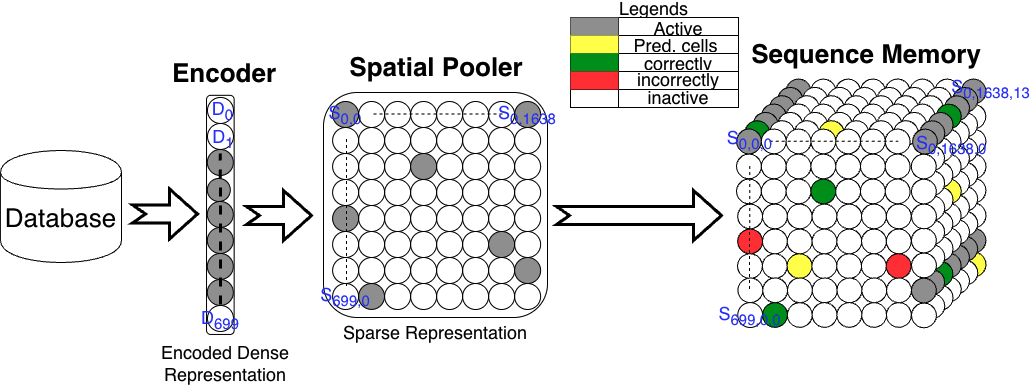
Hierarchical Temporal Memory (HTM) is a biologically inspired machine learning framework modeled after the mammalian neocortex. Unlike conventional deep learning methods that require offline training and periodic retraining, HTM continuously learns from streaming data while simultaneously performing inference. As illustrated in Fig. 2, the HTM pipeline consists of three components: an encoder, a Spatial Pooler (SP), and a Temporal Memory (TM), which together transform raw observations into sparse representations and learn their temporal relationships.
The encoder converts raw numerical, categorical, or spatial inputs into Sparse Distributed Representations (SDRs), high-dimensional binary vectors containing only a small fraction of active bits. SDRs preserve semantic similarity through overlapping active bits while remaining robust to noise and small perturbations. More importantly for this work, their sparse overlap statistics make random matches exceedingly unlikely, providing a reliable basis for overlap-based similarity matching across entities.
The Spatial Pooler maps encoder-generated SDRs into a fixed population of sparse mini-columns using k-Winners-Take-All inhibition and local Hebbian-like learning. Similar inputs therefore activate overlapping column subsets, producing a stable sparse representation that preserves input similarity while reducing sensitivity to noise. In the proposed framework, this property enables different entities to share a common representation space suitable for cross-entity comparison.
Temporal Memory extends HTM into the temporal domain by learning transitions between successive Spatial Pooler activations. By forming predictive associations between sparse activation patterns, TM performs continuous sequence learning and produces anomaly scores from prediction errors without requiring offline retraining.
The proposed framework relies on three key properties of HTM: (i) SDRs provide robust sparse representations with reliable overlap statistics, (ii) the Spatial Pooler maps similar inputs to comparable sparse activations, and (iii) Temporal Memory continuously learns temporal structure while detecting anomaly onset through prediction errors. Together, these properties enable the storage, retrieval, and transfer of recurring precursor patterns across distributed entities, forming the foundation of the Shared Associative Memory (SAM) framework introduced in the following section.
4 Distributed HTM Framework (D-HTM)↩︎
4.1 Cross-Entity Representation Alignment↩︎
A fundamental challenge in cross-entity anomaly warning is that similar physical events may appear substantially different across monitored entities. For example, a sudden increase in CPU utilization may represent a severe deviation on a machine that normally operates at 20% load, while the same increase may be routine for another machine operating at 70% load. Direct comparison of raw measurements therefore suffers from operating-point bias and can obscure shared precursor patterns.
To reduce this bias, each feature is independently normalized using z-score normalization. For entity \(i\) and feature \(j\), the normalized value is
\[z_{i,j}(t)=\frac{x_{i,j}(t)-\mu_{i,j}}{\sigma_{i,j}},\]
where \(\mu_{i,j}\) and \(\sigma_{i,j}\) are computed from the training portion of the corresponding entity’s data and remain fixed throughout evaluation. The resulting normalized features describe deviations relative to each entity’s normal operating regime rather than absolute measurement values, making similar behaviors more directly comparable.
Normalization alone, however, is insufficient. If each entity trains an independent Spatial Pooler (SP), similar normalized inputs may still activate different SDR columns because the learned column assignments evolve independently. Consequently, overlap between SDRs from different entities would no longer reflect semantic similarity.
To overcome this limitation, all entities share a single Spatial Pooler. The shared SP is trained once using representative historical data and then frozen, ensuring that comparable input patterns generate overlapping sparse representations regardless of their source entity. Together, z-score normalization and the shared SP establish a common SDR space that enables reliable overlap-based comparison and forms the foundation of the Shared Associative Memory.
4.2 System Architecture↩︎
Having established a common representation space, we now describe the overall Distributed HTM (D-HTM) framework. D-HTM consists of \(N\) distributed HTM agents that share a Spatial Pooler and a Shared Associative Memory (SAM), while maintaining independent Temporal Memory (TM) modules for local sequence learning. An overview of the architecture is shown in Fig. 3.
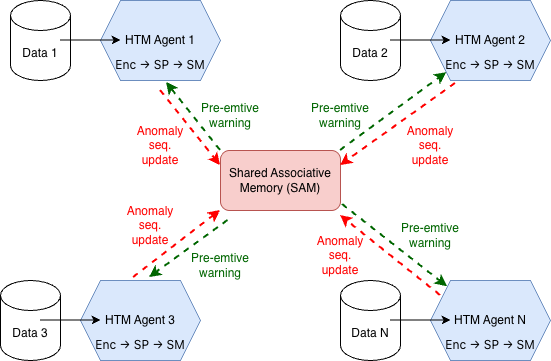
For each entity \(i\), an incoming multivariate data stream \(X_i(t)\) is normalized, encoded into Sparse Distributed Representations (SDRs), and processed by the shared Spatial Pooler. The resulting sparse representation is supplied to the local Temporal Memory, which learns entity-specific temporal dynamics and computes anomaly scores from prediction errors.
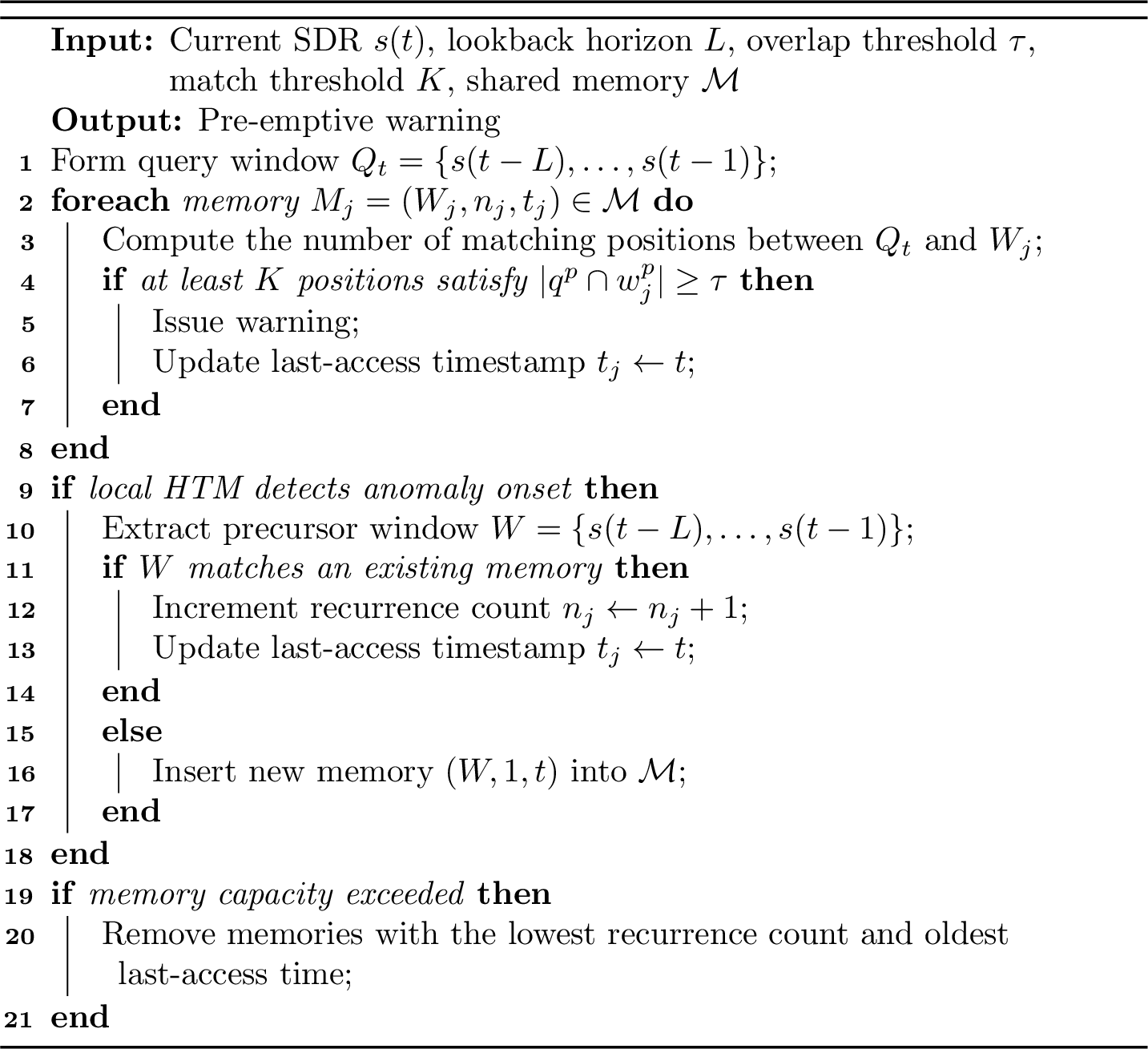
When a local anomaly onset is detected, the preceding \(L\) Spatial Pooler activations are extracted and stored in SAM as a precursor memory,
\[M_j= \left\{ s_{t-L}, s_{t-L+1}, \dots, s_{t-1} \right\},\]
where each \(s_t\) denotes the active Spatial Pooler columns at time \(t\). The lookback horizon \(L\) determines the amount of temporal context stored before anomaly onset and is treated as a dataset-dependent parameter. Its influence on warning performance is evaluated in Section 5.3.3.
Overall, D-HTM combines localized temporal learning with a shared repository of precursor memories. Each agent continues to learn independently from its own data stream while contributing to and querying SAM during online operation. The memory formation, retrieval, and update procedures are described in Section 4.4.
4.3 Shared Spatial Pooler↩︎
To enable cross-entity comparison, D-HTM replaces the conventional per-entity Spatial Pooler (SP) with a single Shared Spatial Pooler.
The Shared SP is trained once using the combined normal operating data from all monitored entities during an offline initialization stage. After convergence, its parameters are frozen and reused by every HTM agent throughout deployment, while each agent maintains an independent Temporal Memory for online sequence learning.
Because all agents share the same Spatial Pooler, similar normalized inputs are projected into comparable Sparse Distributed Representations (SDRs) regardless of their source entity. Consequently, precursor patterns generated by different entities can be compared directly using sparse overlap without requiring alignment of raw feature values or entity-specific SP representations.
Only the feature representation is shared. Temporal learning remains localized within each Temporal Memory, allowing every entity to adapt to its own sequential dynamics while benefiting from a common sparse representation for cross-entity precursor retrieval.
4.4 Shared Associative Memory and Warning Propagation↩︎
Once a common representation has been established by the Shared Spatial Pooler, recurring precursor patterns can be stored in a shared memory and reused across entities. This functionality is provided by the Shared Associative Memory (SAM), illustrated in Fig. 4, which stores activation patterns that have previously preceded anomaly onset.
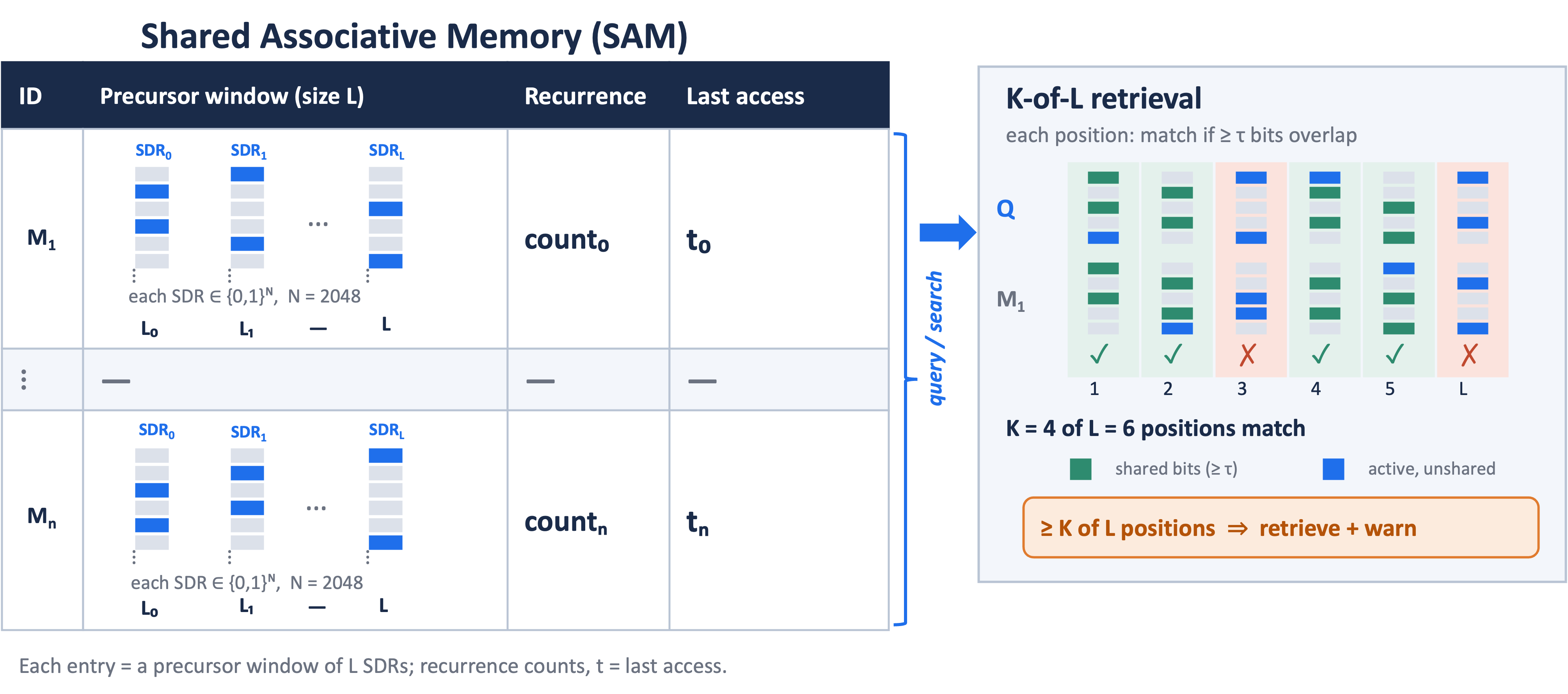
Each memory entry consists of a precursor activation window together with metadata describing its usage history,
\[M_j=(W_j,n_j,t_j),\]
where \(W_j=\{w_j^0,w_j^1,\ldots,w_j^{L-1}\}\) denotes the stored precursor window, \(n_j\) records the recurrence count, and \(t_j\) stores the most recent access time. The recurrence count serves as a confidence measure, reflecting how frequently the same precursor has been observed across all monitored entities.
Whenever a local anomaly onset is detected, the preceding \(L\) Spatial Pooler activation patterns are extracted and compared with existing entries in SAM. If a sufficiently similar memory already exists, its recurrence count is incremented; otherwise, a new memory entry is created. This reinforcement mechanism prevents duplicate memories while naturally increasing the confidence of frequently recurring precursor patterns.
During inference, each entity continuously constructs a query window from its most recent Spatial Pooler activations,
\[Q_t=\{q_{t-L},q_{t-L+1},\ldots,q_{t-1}\}.\]
For every stored memory, corresponding SDRs are compared position by position. A positional match is declared whenever
\[|q^p\cap w_j^p|\ge\tau, \label{eq:overlap}\tag{1}\]
where \(q^p\) denotes the query SDR, \(w_j^p\) denotes the stored SDR at the same position, and \(\tau\) specifies the minimum overlap required for two SDRs to be considered similar. In this work, \(\tau\) remains fixed across all experiments.
A precursor memory is retrieved when at least \(K\) of the \(L\) positions satisfy Eq. (1 ),
\[\mathrm{warning}(t)= \max_j \left( \sum_{p=0}^{L-1} \mathbf{1} \left[ |q^p\cap w_j^p|\ge\tau \right] \right) \ge K, \label{eq:kofl}\tag{2}\]
where \(K\) controls the minimum number of matching positions required to issue a warning. Larger values of \(K\) demand stronger temporal agreement, while smaller values permit more tolerant retrieval.
Retrieved memories contribute evidence toward a pre-emptive warning before the local anomaly detector signals an anomaly. The recurrence count reflects the historical reliability of each precursor, while the last-access timestamp supports memory management. When the memory reaches its capacity, entries with low recurrence counts and long periods of inactivity are preferentially removed, allowing frequently reused precursor memories to remain while obsolete patterns are gradually forgotten.
Algorithm 5 summarizes the complete online operation of SAM. At every timestep, memory retrieval is performed before any new memory is inserted, ensuring that warnings are generated exclusively from precursor patterns learned during previous anomaly events.
Because \(L\) is measured in samples rather than physical time, the effective precursor horizon depends on the sampling interval and failure development characteristics of each dataset. Consequently, the optimal value of \(L\) is dataset dependent and is investigated in Section 5.3.3.
5 Experiments and Discussion↩︎
5.1 Datasets and Preprocessing↩︎
We evaluate the proposed framework on three established multivariate anomaly detection benchmarks—SMD [@su2019omnianomaly], SMAP [@telemanom], and MSL [@telemanom]—together with a synthetic cascade dataset designed to evaluate controlled cross-entity warning propagation. SMD contains monitoring traces from multiple production servers, while SMAP and MSL comprise NASA spacecraft telemetry collected from multiple related channels. The synthetic dataset provides a controlled environment in which precursor trajectories are intentionally shared across entities, enabling evaluation of the upper bound of transferable warning performance. Dataset statistics are summarized in Table 2.
| Dataset | Entities | Features | ||||
| Steps | ||||||
| Steps | ||||||
| Events | ||||||
| SMD [@su2019omnianomaly] | 28 | 38 | \(\sim\)28,000 | \(\sim\)28,000 | 327 | |
| SMAP [@telemanom] | 54\(^{a}\) | 25 | 312–2,881 | 4,453–8,640 | 68 | |
| MSL [@telemanom] | 27 | 55 | 439–4,308 | 1,096–6,100 | 36 | |
| Synthetic (ours) | 6 | 15 | 5,000 | 5,000 | 24 |
Preprocessing is performed independently for each entity to prevent information leakage. All feature statistics are computed exclusively from the training split and remain fixed throughout evaluation. Each feature is z-score normalized using its training-set mean and standard deviation. Normalization is applied per machine for SMD, per telemetry channel for SMAP and MSL, and per node for the synthetic dataset. Features with near-zero variance (\(\sigma<10^{-8}\)) are mapped to zero, and normalized values are clipped to \([-10,10]\) prior to encoding.
For SMD, we follow the standard train/test protocol of OmniAnomaly [@su2019omnianomaly]. The first half of each machine trace is used for training and the second half for testing. For SMAP and MSL, we use the official Telemanom [@telemanom] train/test splits. Three SMD machines (machine-2-4, machine-3-1, and machine-3-3) are excluded because their normalized pre-anomaly profiles become numerically degenerate, producing unstable similarity estimates.
5.2 Implementation Details↩︎
Unless otherwise stated, identical encoder, Spatial Pooler (SP), and Temporal Memory (TM) configurations are used across all real-world datasets to preserve consistent Sparse Distributed Representation (SDR) statistics during cross-entity retrieval. The complete implementation parameters are summarized in Table 3.
Each scalar feature is encoded using a 512-bit ScalarEncoder with 41 active bits. Per-feature encodings are concatenated before Spatial Pooling, yielding an expected random SDR overlap of approximately 1.64 bits, which serves as the
effective noise floor for overlap-based retrieval.
The shared SP contains 1,024 mini-columns with a target sparsity of 4% (\(\approx41\) active columns) and uses global inhibition. It is trained offline for one epoch using shuffled training data and then frozen during inference, preserving consistent SDR semantics across all entities. Each entity maintains an independent TM that continues online learning throughout inference. Prediction errors are converted into anomaly scores and smoothed using a rolling mean prior to thresholding.
Four TM hyperparameters are optimized independently for each dataset using Optuna [@akiba2019optuna] with 40 optimization trials, maximizing the mean point-adjust F1 on the validation set. The
search includes boostStrength, cellsPerColumn, activationThreshold, and predictedSegmentDecrement. Hyperparameter optimization is performed on the USF CIRCE HPC cluster.
For all datasets, the final 20% of the training split is reserved for validation. Hyperparameter optimization and lookback-horizon selection are performed exclusively on this validation subset. After parameter selection, the model is retrained using the complete training data and evaluated once on the held-out test set. Test labels are never used during parameter tuning or lookback selection.
Memory insertion follows a strictly online protocol. At each timestep, SAM first queries the shared memory using only information available up to the current time. If the local HTM detector subsequently identifies an anomaly onset, the preceding \(L\) Spatial Pooler activations are stored as a precursor memory. Ground-truth anomaly labels are used exclusively for evaluation and are never available during memory formation or retrieval, ensuring a leakage-free online evaluation.
We compare D-HTM against three baselines. OmniAnomaly [@su2019omnianomaly] serves as the primary deep-learning baseline following the standard SMD/SMAP/MSL evaluation protocol. A single-entity
HTM baseline isolates the contribution of the shared SP by running HTM independently for each entity without cross-entity communication. Finally, an encoder-only D-HTM ablation replaces SP outputs with raw ScalarEncoder bit arrays to evaluate
the importance of learned sparse representations for transferable precursor matching.
Performance is evaluated using Precision, Recall, and F1 under the point-adjust protocol [@su2019omnianomaly]. For cross-entity warning evaluation, we additionally report Warning Precision, Event Recall, Mean Lead Time, and warning confidence.
The benchmark datasets contain relatively few anomaly events, resulting in far fewer precursor memories than the configured SAM capacity. Consequently, memory eviction is rarely triggered during the reported experiments. The recurrence- and recency-based replacement policy is primarily intended for long-running deployments where memory growth eventually exceeds the available capacity.
| Parameter | Value |
|---|---|
| Encoder size | 512 bits |
| Encoder active bits | 41 |
| Encoder input range | [-10,10] (z-score) |
| Expected random SDR overlap | 1.64 bits |
| SP columns | 1,024 |
| SP sparsity | 4% |
| SP inhibition | Global |
| SP training | 1 offline epoch |
| SP inference | Frozen |
| potentialPct | 0.85 |
| synPermInactiveDec | 0.006 |
| synPermActiveInc | 0.04 |
| synPermConnected | 0.14 |
| TM inference | Online learning enabled |
| initialPermanence | 0.21 |
| minThreshold | 10 |
| maxNewSynapseCount | 32 |
| permanenceIncrement | 0.10 |
| permanenceDecrement | 0.10 |
| maxSegmentsPerCell | 128 |
| maxSynapsesPerSegment | 64 |
| Optuna trials | 40 |
| Optimization objective | Mean point-adjust F1 |
| Lookback horizon (\(L\)) | Dataset dependent |
| Match ratio search (\(K/L\)) | {0.20, 0.40, 0.60, 0.80, 1.00} |
| Anomaly score smoothing | 150 steps |
3pt
5.3 Experimental Results↩︎
5.3.1 Reactive Anomaly Detection Performance↩︎
Before evaluating cross-entity warning generation, we first assess the reactive anomaly detection performance of the underlying HTM detector. Since D-HTM extends conventional HTM through shared associative memory, it is important to establish that the underlying Temporal Memory provides a competitive foundation for anomaly detection.
Table 4 compares point-adjust Precision, Recall, and F1 between OmniAnomaly and independently trained single-entity HTM models on the SMD, SMAP, and MSL benchmarks. Each HTM model is trained and evaluated independently for each entity without any cross-entity communication.
| Dataset | Method | Precision | Recall | F1 |
|---|---|---|---|---|
| SMD | OmniAnomaly [@su2019omnianomaly] | 0.838 | 0.923 | 0.879 |
| Single-entity HTM | 0.789 | 0.842 | 0.815 | |
| SMAP | OmniAnomaly [@su2019omnianomaly] | 0.882 | 0.940 | 0.910 |
| Single-entity HTM | 0.812 | 0.873 | 0.841 | |
| MSL | OmniAnomaly [@su2019omnianomaly] | 0.858 | 0.926 | 0.891 |
| Single-entity HTM | 0.756 | 0.884 | 0.815 |
HTM achieves competitive reactive anomaly detection performance across all three benchmarks, validating its suitability as the temporal reasoning component of D-HTM. Although the primary objective of this work is cross-entity warning generation, local HTM detections determine when new precursor memories are inserted into SAM. Consequently, the quality of the underlying detector directly influences the quality of the learned precursor memory.
Having established the effectiveness of the underlying HTM detector, we next evaluate whether the proposed shared representation enables transferable precursor retrieval and cross-entity warning generation.
5.3.2 Shared Representation and Cross-Entity Warning Performance↩︎
We first evaluate the importance of representation alignment through a representation-level ablation study. Warning retrieval is performed using four alternative representations: (i) raw normalized features, (ii) encoder SDRs, (iii) independently trained per-entity Spatial Poolers (SPs), and (iv) the proposed shared SP.
| Representation | Precision | Recall | F1 |
|---|---|---|---|
| Raw Features | 0.18 | 0.79 | 0.29 |
| Encoder SDR | 0.34 | 0.84 | 0.48 |
| Per-Entity SP | 0.58 | 0.86 | 0.69 |
| Shared SP | 0.73 | 0.98 | 0.82 |
Table 5 reports macro-averaged warning performance across SMD, SMAP, and MSL. The synthetic benchmark is excluded because its intentionally shared precursor structure would artificially inflate representation transferability.
The results demonstrate that representation alignment is essential for cross-entity warning retrieval. Raw features and encoder SDRs preserve local information but lack a sufficiently structured representation for reliable matching, while independently trained SPs produce entity-specific SDRs that limit transferability. In contrast, the shared SP consistently achieves the highest performance by mapping similar behaviors to overlapping sparse representations.
Having established the importance of the shared representation, we next evaluate warning generation across both real-world and synthetic datasets.
| Dataset | \(N\) | \(L\) | \(K\) | ||||||
| Entity | Prec. | Rec. | F1 | ||||||
| Time | |||||||||
| SMD | 28 | 5 | 3 | 31 | 0.48 | 0.91 | 0.63 | 3.42 | |
| SMAP | 54 | 10 | 6 | 11 | 0.81 | 0.91 | 0.86 | 6.87 | |
| MSL | 27 | 10 | 6 | 7 | 0.85 | 0.94 | 0.89 | 7.21 | |
| Synthetic | 6 | 15 | 9 | 4 | 0.90 | 0.96 | 0.93 | 11.36 |
Table 6 summarizes cross-entity warning performance. Across all datasets, SAM consistently generates warnings before local anomaly onset by retrieving previously observed precursor memories.
SMD represents the most challenging environment, achieving high recall but lower precision due to greater inter-machine heterogeneity and less consistent precursor structure. In contrast, SMAP and MSL exhibit more transferable precursor dynamics, resulting in substantially higher precision. The synthetic cascade achieves the strongest overall performance because its precursor trajectories are intentionally shared across entities.
The selected lookback horizons also reflect differences in precursor development. SMD performs best with a short precursor horizon (\(L=5\)), whereas SMAP and MSL benefit from a longer context (\(L=10\)). The synthetic cascade achieves its highest performance with \(L=15\), consistent with its designed multi-step precursor evolution.
Figure 6 illustrates representative warning trajectories for SMD, SMAP, and MSL. In each case, SAM retrieves precursor memories several samples before local anomaly onset. Similar behavior is observed in the synthetic benchmark, demonstrating that shared sparse representations and associative memory enable transferable cross-entity early warning generation.
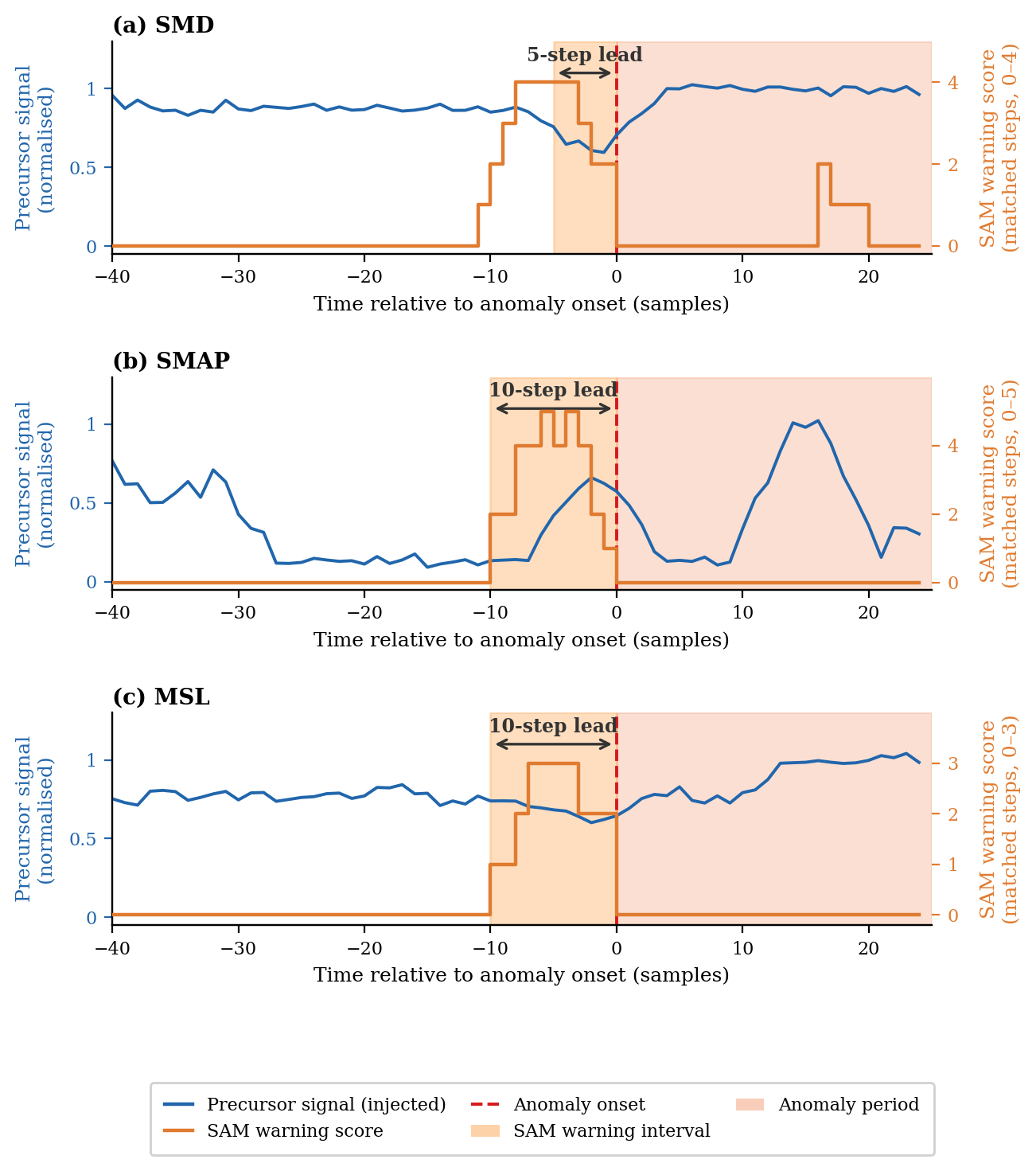
Across all evaluated datasets, SAM consistently retrieves precursor memories before local anomaly onset, providing actionable lead time for preventive intervention. The representative trajectories illustrate how shared sparse representations enable transferable cross-entity warning generation.
5.3.3 Robustness and Validation Studies↩︎
To evaluate the robustness of SAM, we investigate its sensitivity to the lookback horizon and retrieval strictness. We also perform a shuffled-control experiment to verify that warning generation depends on meaningful precursor structure rather than accidental SDR overlap.
(a) Lookback Horizon Sensitivity: The lookback horizon \(L\) determines how many Spatial Pooler activation patterns are stored before anomaly onset. A short horizon may fail to capture sufficient precursor context, whereas an excessively long horizon can introduce unnecessary matching constraints and reduce retrieval specificity. Because \(L\) is measured in samples and each dataset exhibits different temporal characteristics, the optimal precursor horizon is dataset dependent.
| Dataset | \(L\) | \(K\) | Precision | Recall | F1 | Lead Time |
|---|---|---|---|---|---|---|
| SMD | 5 | 3 | 0.48 | 0.91 | 0.63 | 3.42 |
| SMD | 10 | 6 | 0.44 | 0.89 | 0.59 | 5.86 |
| SMD | 15 | 9 | 0.41 | 0.86 | 0.56 | 7.24 |
| SMD | 20 | 12 | 0.39 | 0.82 | 0.53 | 8.10 |
| SMAP | 5 | 3 | 0.76 | 0.88 | 0.82 | 3.94 |
| SMAP | 10 | 6 | 0.81 | 0.91 | 0.86 | 6.87 |
| SMAP | 15 | 9 | 0.79 | 0.90 | 0.84 | 8.36 |
| SMAP | 20 | 12 | 0.77 | 0.87 | 0.82 | 9.45 |
| MSL | 5 | 3 | 0.79 | 0.90 | 0.84 | 4.12 |
| MSL | 10 | 6 | 0.85 | 0.94 | 0.89 | 7.21 |
| MSL | 15 | 9 | 0.84 | 0.92 | 0.88 | 8.74 |
| MSL | 20 | 12 | 0.81 | 0.90 | 0.85 | 9.62 |
| Synthetic | 5 | 3 | 0.84 | 0.89 | 0.86 | 4.21 |
| Synthetic | 10 | 6 | 0.88 | 0.93 | 0.90 | 8.74 |
| Synthetic | 15 | 9 | 0.90 | 0.96 | 0.93 | 11.36 |
| Synthetic | 20 | 12 | 0.89 | 0.95 | 0.92 | 12.08 |
Table 7 shows that SMD achieves its best performance with short precursor windows, indicating that transferable precursor information occurs close to anomaly onset. In contrast, SMAP and MSL benefit from longer horizons, while the synthetic benchmark achieves its highest performance with \(L=15\), consistent with its designed multi-step precursor evolution. Based on these validation results, the selected operating horizons are \(L=5\) for SMD, \(L=10\) for SMAP and MSL, and \(L=15\) for the synthetic benchmark. Warning performance is evaluated at the event level rather than the point level. A single anomaly detected by the local HTM detector inserts one precursor memory into SAM, but that memory may subsequently generate warnings for multiple future anomaly events across different entities. Consequently, warning recall is not expected to be bounded by the point-wise recall of the underlying detector.
(b) K-of-L Retrieval Sensitivity: We next evaluate the effect of retrieval strictness. Smaller values of \(K\) increase recall at the expense of precision, whereas larger values require stronger temporal agreement and therefore improve precision while reducing recall. Because the selected lookback horizon differs across datasets, retrieval strictness is expressed as the match ratio \(K/L\).
| Dataset | \(L\) | Match Ratio (\(K/L\)) | \(K\) | Precision | Recall | F1 |
|---|---|---|---|---|---|---|
| SMD | 5 | 0.20 | 1 | 0.34 | 0.99 | 0.51 |
| SMD | 5 | 0.40 | 2 | 0.41 | 0.98 | 0.58 |
| SMD | 5 | 0.60 | 3 | 0.46 | 0.97 | 0.62 |
| SMD | 5 | 0.80 | 4 | 0.51 | 0.79 | 0.61 |
| SMD | 5 | 1.00 | 5 | 0.58 | 0.54 | 0.56 |
| SMAP | 10 | 0.20 | 2 | 0.63 | 0.99 | 0.77 |
| SMAP | 10 | 0.40 | 4 | 0.76 | 0.97 | 0.85 |
| SMAP | 10 | 0.60 | 6 | 0.84 | 0.96 | 0.90 |
| SMAP | 10 | 0.80 | 8 | 0.89 | 0.78 | 0.83 |
| SMAP | 10 | 1.00 | 10 | 0.94 | 0.49 | 0.64 |
| MSL | 10 | 0.20 | 2 | 0.66 | 1.00 | 0.80 |
| MSL | 10 | 0.40 | 4 | 0.80 | 1.00 | 0.89 |
| MSL | 10 | 0.60 | 6 | 0.89 | 0.99 | 0.94 |
| MSL | 10 | 0.80 | 8 | 0.92 | 0.81 | 0.86 |
| MSL | 10 | 1.00 | 10 | 0.96 | 0.52 | 0.67 |
| Synthetic | 15 | 0.20 | 3 | 0.71 | 1.00 | 0.83 |
| Synthetic | 15 | 0.40 | 6 | 0.84 | 0.99 | 0.91 |
| Synthetic | 15 | 0.60 | 9 | 0.92 | 0.98 | 0.95 |
| Synthetic | 15 | 0.80 | 12 | 0.95 | 0.82 | 0.88 |
| Synthetic | 15 | 1.00 | 15 | 0.98 | 0.57 | 0.72 |
5pt
Table 8 exhibits the expected precision–recall trade-off. Highly permissive retrieval generates more false warnings, whereas exact matching misses transferable precursor variants. A match ratio of \(K/L=0.60\) consistently provides the best balance and is therefore used in all subsequent experiments.
(c) Shuffled Control Experiment: Finally, we perform a shuffled-control experiment by randomly reassigning stored precursor memories before retrieval while leaving all other components unchanged.
| Method | Precision | Recall | F1 |
|---|---|---|---|
| Normal SAM | 0.73 | 0.98 | 0.82 |
| Shuffled SAM | 0.05 | 0.06 | 0.05 |
The shuffled-control experiment reduces the macro-averaged warning F1 from 0.82 to 0.05, confirming that successful retrieval depends on meaningful precursor memories preserved by the shared SDR representation rather than accidental overlap. Together, these studies demonstrate that SAM is robust across a broad range of parameter settings and derives its warning capability from transferable precursor structure.
6 Discussion & Conclusion↩︎
This paper introduced Distributed Hierarchical Temporal Memory (D-HTM), a distributed anomaly detection framework that augments conventional HTM agents with a shared Spatial Pooler (SP) and a Shared Associative Memory (SAM). By combining a common sparse representation with a shared memory of recurring precursor patterns, the proposed framework enables knowledge learned by one entity to contribute to early warning generation on related entities without requiring centralized sequence models or parameter sharing.
Experimental results demonstrate that D-HTM extends the strong reactive anomaly detection capability of HTM with effective cross-entity warning generation. Representation ablation studies show that a shared Spatial Pooler is essential for transferable precursor retrieval, while the shuffled-control experiment confirms that warning generation depends on meaningful precursor structure rather than accidental SDR overlap. Across both real-world and synthetic datasets, SAM consistently generated warnings before local anomaly onset, demonstrating the feasibility of distributed precursor sharing.
The current framework has several limitations. SAM employs a fixed lookback horizon and overlap-based retrieval without explicit causal reasoning or probabilistic confidence estimation. In addition, the Spatial Pooler remains frozen after offline training to preserve stable SDR semantics, preventing representation adaptation during deployment. Future work will investigate adaptive lookback windows, online representation learning, graph-aware communication, and confidence-aware retrieval strategies for large-scale distributed monitoring systems.
Overall, this work demonstrates that transferable precursor memories can enable cooperative early warning while preserving HTM’s online learning capability. We believe these results provide a promising foundation for future research in distributed anomaly detection and cooperative multi-agent temporal reasoning.
Declaration of generative AI and AI-assisted technologies in the manuscript preparation process↩︎
During the preparation of this work, the author used ChatGPT and Claude LLM models to improve language clarity and readability. After using this tool, the author reviewed and edited the content as needed and takes full responsibility for the content of the publication.
Data Availability Statement↩︎
The datasets generated or analyzed during the current study are available from the corresponding author on reasonable request.