Digital Sovereignty as a Quality
Attribute for Software Architectures
January 01, 1970
Abstract
Digital sovereignty (DS) is an increasingly important concept and political agenda throughout the world, including in the European Union (EU). However, the concept is also regrettably vague. With this critical point in mind, the paper presents an analysis of digital sovereignty as a quality attribute for software architectures in the context of cloud computing and the EU’s policy frameworks for it. The analysis reveals that DS can be sharpened analytically by conceptualizing it as a quality attribute. The analysis further demonstrates how DS satisfies many of the classical properties of quality attributes for software architectures, including their measurability and validation, the trade-offs they involve, and the scenario-based methodology commonly used for analyzing them.
cloud computing, sovereign cloud, digital autonomy, lock-in
1 Introduction↩︎
Digital sovereignty is an important but rather vague strategic project and narrative in many countries and territories throughout the world, including but not limited to Europe. When the concept’s theoretical underpinnings and associated theorization are omitted for brevity, digital sovereignty has often been conceptualized through dependencies [1], [2]. The world is interconnected. Most parts of it are connected with each other. According to the mainstream DS most common DS narratives at least, these dependencies cause also vulnerabilities for countries and their sovereignties, alliances, and unions.
The responses vary, too. These include anything and everything from blanket data localization mandates, territorial legal guardrails against extraterritorial legal mandates, and industrial policy all the way to national security. Throughout the world, including Europe, the responses are also evolving. In fact, recently, in June 2026, the European Commission (EC) introduced a new Tech Sovereignty Package [3]. This package establishes the paper’s practical relevance and timeliness. The paper has also novelty. Even though a lot of research (see, e.g., [4] as an exemplar) has been done to assess business decision-making criteria for choosing a given CC infrastructure for a deployment, DS has received limited—but not non-existent [5], attention as a criterion in academic research. Having said that, the recent policy responses have prompted a renewed interest on DS in the CC context [6]. The paper contributes to this timely research on DS that goes beyond philosophy and theorization, and beyond politics and political science.
With these introductory points in mind, the paper presents an analysis of digital sovereignty as a quality attribute (QA) for software architectures (SAs). To narrow the scope for feasibility reasons, the focus is restricted to cloud computing (CC) and the EU. With these framings and restrictions of scope, the research question (RQ) examined is: How well the EU’s recent policy frameworks for CC align with a conceptualization of DS as a QA for SAs? For answering to the questions, the paper builds methodologically upon a combination of interpretative policy analysis [7] and software engineering literature on software architectures.
2 Background↩︎
2.1 Quality Attributes↩︎
Quality attributes are a classical way for designing and studying software architectures. In software engineering more broadly, these resemble non-functional requirements, although the demarcation is debated with respect to functional requirements [8]. Common QAs range from reliability, security, and modifiability to performance, scalability, usability, and power consumption—and everything in-between. When designing a software architecture, QAs either exhibit or inhibit architectural design choices. They often also exhibit or inhibit actual implementation work—or detailed design, as it is sometimes known. If security is prioritized as a QA, for instance, a detailed design may be constrained by coding standards, a preference of memory safe programming languages, and security testing, among other things. At the same time, architectural design choices may be constrained by attack surface minimization and related considerations.
A good quality attribute should be verifiable and, whenever possible, measurable or otherwise possible to empirically evaluate [9]. A classical way to achieve this evaluation requirement is to consider different scenarios for architectures and deployments operating in given environments with different stimuli, sources of these, responses to them, and response measures and metrics [8]–[10]. If availability is of high importance, for instance, a deviation from a “24/7/363 baseline” is rather easy to measure against stimuli of hardware failures, denial of service attacks, or something alike. The point is also good because some QAs, such as availability and performance, can only be measured and evaluated at runtime, while some other QAs can be evaluated already during development [11]. Another related point is that a risk-based approach aligns with and complements the scenario-based viewpoint to quality attributes and software architectures [12]. A further important point is that many QAs involve trade-offs with other QAs [8], [11], [13]. Security may involve balancing with usability, privacy, and performance, and performance in turn may involve a trade-off with power consumption, and so forth. In what follows, these points motivate the subsequent consideration and conceptualization of digital sovereignty as a distinct QA.
2.2 Conceptualizing DS as a QA for SAs↩︎
The point in the introduction about DS having often been framed through dependencies aligns well with SAs and software in general. To exclude some outliers, practically all software contain some dependencies. There are also different types of dependencies; some dependencies are needed to execute a program, whereas others are required to develop it and some are only needed during installation [14]. With SAs, the level of abstraction is higher also regarding dependencies. Among other things, it is possible to consider semantic dependencies, such as standards, protocols, file formats, and meta-data schemas [8]. Components of a SA may depend on each other also through resources available for them or through temporal dependencies. The two theoretical dependency types emphasized provide a further framing for the paper and a further restriction to its scope: the focus is on semantic dependencies instead of strictly technical software dependencies, while temporal dependencies are proxied via the classical concept of vendor lock-in. Throughout the history of information technology, lock-in has been a classical business strategy of many vendors. Whether it is other businesses, public administrations, or consumers, the switching costs after a successful lock-in are often too high to migrate away from a given vendor [15], [16].
Partially due to a lack of standardization and partially due to business strategies of CC vendors, lock-in has been pronounced in the CC domain [5]. For conceptualizing lock-in analytically via temporal dependencies, a template is presented in Subsection [subsec: scenario] for ex post scenarios. That is to say, the focus is not on ex ante business considerations about a given CC vendor but rather on ex post considerations about migrating away from a given CC vendor already used. With respect to SA literature on QAs [10], the template thus signifies adaptability as a distinct QA in the context of cloud computing and strategic decision-making.
Regarding deriving metrics for DS as a QA for SAs, it seems sensible to consider a component-based architecture with components covering anything from source code modules to data and algorithms. By following and adopting two concepts presented in the SA literature [8], [17], it seems sensible to consider the extent of a SA’s components being semantically dependent on a CC vendor as well as the distance between the dependencies. The latter concept can be understood as a difficulty of resolving conflicts between the dependencies.
To elaborate: if a SA has \(n\) components, \(\mathcal{C}_1, \ldots, \mathcal{C}_n\), and \(m\) of them are deployed in a given cloud \(\mathbb{C}_i\), a ratio \(\alpha = m/n\) defines a simple metric for the semantic dependence of the SA on the \(i\):th cloud vendor’s \(\mathbb{C}_i\). Let \(\beta\) further denote the strength of vendor lock-in, \(\beta = 0\) indicating no lock-in power whatsoever and \(\beta = 1\) extreme lock-in. When \(\beta \to 1\), the difficulties involved in a migration away from a given cloud increase. Therefore, \(\alpha \times \beta\) can analytically be seen to proxy an overall difficulty of a migration strategy from a business perspective. With a reference to the points later raised in Subsection 3.1, let \(\zeta \in [0, 1]\) further denote the extent of applicability of foreign jurisdictions over EU law. When \(\zeta = 0\), only EU law matters, and the other way around. When intellectual property, trade secrets, and confidentiality in general are further considered, a metric \(\sigma = \alpha \times \beta \times \zeta\) provides an analytical baseline for a risk analysis regarding a \(\mathbb{C}_i\).
By following cyber security risk analysis literature [18], it is useful to further consider the probability of a given stimulus occurring and the impact of the stimuli upon a business, including even business continuity as an extreme case. If \(\rho\) thus denotes the occurrence probability and the impact too ranges from zero to one, \(\mathcal{I} \in [0, 1]\), higher values proxying severity, the overall equation to consider is \(\phi = \sigma \times \rho \times \mathcal{I}\). Although conditional probabilities could be considered, it suffices to say, for brevity and simplicity, that the fundamental business strategy would be to try to minimize \(\phi\). While several options are available, the obvious option would be to prefer entirely on-premise deployments, such that \(\alpha = 0\) and thus \(\phi = 0\) too. But when \(\alpha \to 1\), the other parameters should be minimized. For instance, \(\mathcal{I} \to 0\) could be attempted by legal contracting, meaning that \(\zeta \to 0\).
3 Cloud Computing as a Case↩︎
3.1 Background↩︎
The Western cloud computing business is dominated by a few large multinational companies headquartered in the United States (US). In fact, so dominant they are that some have called them and their infrastructures as “cloud empires” [19]. Also the lock-in is strongly felt in Europe [20]. According to some observers, “European governments and enterprises are bound hand and foot to US cloud service providers”, and they “rarely even manage to switch a service from one US supplier to another US supplier” [21]. Given the notation that was introduced in Subsection 2.2, it therefore seems reasonable to analytically fix \(\beta > 0.9\), say.
As has been argued previously [22], for a customer of a CC infrastructure, it does not necessarily matter that much where the infrastructure is physically located. The same applies to extraterritorial legal mandates, including, but hardly limited to, the CLOUD Act of the US. In other words, an extraterritorial legal mandate of one country may apply to a CC infrastructure physically located in another country. While the legal details are difficult [23], extraterritoriality has long had also a political and even a geopolitical aspect. For instance, it has been seen as the underlying concept behind the notion of “Brussels effect”, the promotion of European values and exertion of soft power by the EU via regulation [24]. Recently, an analogous notion of “Washington effect” was introduced for describing the exertion of harder power by the US [25]. Given these concepts and their political roots, a further concept of “sovereignty 2.0” was recently initiated for separating the older, territorial “sovereignty 1.0” from the newer “sovereignty by control and sovereignty by design” [6]. Regarding sovereignty by design, the parameter \(\alpha = m/n\) would be a simple but illuminating example. Another, more theoretical example would be sovereignty by design through the notion of “regulation by design” [26]. Regarding sovereignty by control, a relevant question is about “who can administer, access, approve, evidence, and recover services” [6]. These concepts help at abstracting and theorizing also the new policy frameworks for cloud computing in the European Union.
3.2 The Cloud Sovereignty Framework↩︎
The cloud computing initiatives by the EU, but not necessary in the EU as a whole, have included both infrastructure projects and policy responses, including new legislative acts and informal guidelines. While at the time of writing it seems that the pan-European GAI-X project for CC has failed to deliver, the EuroHPC ecosystem has gained traction also in terms of concrete supercomputing infrastructures [22]. Regarding policy responses, is also seems that the European Cloud Certification Scheme (ECCS), which was initiated in conjunction with the enactment of the Cybersecurity Act in 2019, failed to deliver, partially due to political in-fighting in Europe and partially due to external pressure [1], [27], [28]. However, in 2025 the EC released an updated version for the so-called Cloud Sovereignty Framework (CSF). It and the Tech Sovereignty Package proposed are particularly well-suited for addressing the RQ specified in the introduction.
The CSF specifies a five-fold effectiveness scale for DS, lower values indicating less digital sovereignty and the maximum score denoting full digital sovereignty, meaning that both technology and operations are “under complete EU control, subject only to EU law, with no critical non-EU dependencies” [29]. This scale can be seen to provide an overall key performance indicator. However, the gist of the CSF is the breakdown of DS into eight distinct dimensions. Rather similar breakdowns have also been recently done by think-tanks and their policy analysts [1]. Regarding the CSF, Fig. 1 presents a summary of its breakdown. Before continuing to disseminate it, should be recalled the conceptualization derived uses a unit interval with lower values indicating more digital sovereignty.
![Figure 1: The CSF’s DS Breakdown (quotations and other references from [29])](/article/2606.31590/fig_csf.png "fig:")
As can be seen, the CSF substantially extends the scope of DS particularly in the context of public procurement for which the CSF is primary intended. Regarding the previous exposition and notation, it can be assumed that the parameter \(\zeta\) captures the \(\textmd{DS}_2\) dimension. For not overloading the notation further, let a scalar \(\epsilon \in [0, 1]\) capture the CSF’s remaining dimensions, the set \(S = \lbrace \textmd{DS}_1, \textmd{DS}_3, \textmd{DS}_4, \textmd{DS}_5, \textmd{DS}_6, \textmd{DS}_7, \textmd{DS}_8 \rbrace\). When \(\epsilon\) increases, the elements in \(S\) either together or individually contribute to decreasing digital sovereignty. For instance, \(\epsilon\) could attain a high value in case there are no raw materials required to manufacture chips needed to build a new European \(\mathbb{C}_i\). In this case it would be primarily \(\textmd{DS}_8\) and perhaps \(\textmd{DS}_5\) secondarily behind the high value for \(\epsilon\).
What else can be analytically deduced from Fig. 1? Analogously to the earlier fixing of \(\beta\) to a high-value in Subsection [subsec: cc background], it seems justified to predefine also \(\epsilon\) to a relatively high value. For instance, European actors have limited, if any, ability to independently evolve a technology powering the overall technology stack of a cloud \(\mathbb{C}_i\). Having said that, the CSF is useful as an analytical vehicle for comparing a \(\mathbb{C}_i\) against another \(\mathbb{C}_k\), \(i \neq k\). The same applies to the ex post migration strategies that were motivated in Subsection 2.2. Regarding the measurability preference for QAs, the CSF also comes with a formula for comparisons [29]. With some alterations, the formula takes the form of: \[s_i = \sum^{\vert S_i \vert}_{j \in S_i} \frac{f(\textmd{DS}^i_j) \times w^i_j}{\max(s_i, s_k) \times 100} , \quad \textmd{DS}^i_j \in S_i~\textmd{for}~\mathbb{C}_i,\] where \(s_i \in [0, 1]\) is a score for a \(\mathbb{C}_i\) and \(s_k \in [0, 1]\) a score for a \(\mathbb{C}_k\), lower values indicating more sovereignty, \(f(\cdot) = y\) is a scoring function used by a human evaluator to rank a given DS dimension, \(y \in [0, 1]\), higher values indicating less sovereignty, and \(w^i_j\) is a weight from Fig. 1 for the \(j\):th DS dimension of the \(i\):th cloud computing vendor. Thus: if \(s_i < s_k\), \(\mathbb{C}_i\) would be preferable over \(\mathbb{C}_k\) from a digital sovereignty perspective. That said, the other parameters elaborated earlier should be considered too; a similar function might be used also for them. Finally, a scalar \(\Phi = \phi \times s\) could be used for summarizing the final yet still incomplete risk equation; as previously, the subscripts are omitted for brevity. A final point is that a function would be needed to transform the values into the five-fold effectiveness scale of the CSF. In practice, it might be easier to operate with parameters defined in ordinal scale to begin with; the direct alignment with \(\rho\) justifies the preference of the unit interval for the present analytical work.
3.3 The Cloud and AI Development Act Proposal↩︎
The EU’s recent Tech Sovereignty Package contains also a legislative proposal for a new Cloud and AI Development Act (CADA).1 By excluding the artificial intelligence (AI) part, the proposal’s CC part continues the CSF from a legal perspective. It too specifies assurance levels for CC, including with respect to their self-assessments, independent third-party audits, transparency obligations, and mandates for European public authorities. However, the proposal’s cloud-specific gist is on Articles 29 and 30 that specify requirements for risk analysis and public procurement, respectively. According to the former article, both EU institutions and the member states are required to carry out risk assessments for public sector activities involving a use of CC services. According to Article 29(2), they should pay particular attention to the following three aspects at minimum:
The data and its characteristics stored to a cloud \(\mathbb{C}_i\), including “sensitivity, criticality, and magnitude of the non-personal data processed”. With respect to personal data, magnitude and risks to the rights and freedoms of people should be assessed, as is the case in general with data protection law.
The “risk and consequent impact” of “unlawful access” under EU law.
The “risk and consequent impact on public order” for a “service disruption”.
Of these aspects, the first falls primarily to the domain of \(\textmd{DS}_3\) in the CSF and the second primarily to the domain of \(\textmd{DS}_2\). The third aspect is briefly discussed further in the forthcoming Subsection [subsec: scenario]. When compared to the “all hazards” approach present in a notable cyber security directive [31], the CADA proposal’s risk assessment scope is perhaps surprisingly narrow with respect to CC. However, there are two other particularly noteworthy things in Article 29.
First, Article 29(6) of the proposal specifies that the risk assessment results are used for determining whether a public sector entity should switch from a \(\mathbb{C}_i\) to a \(\mathbb{C}_k\) due to undue risk with the \(i\):th cloud. If that is determined to be the case, they should do the migration within twelve months. Thus, the CADA proposal reiterates rather closely the earlier points about migration. Given what was said about \(\beta\) and \(\epsilon\), a migration may be easier said than done, however.
Second, Article 29(9) specifies that the risk assessments should also evaluate “whether a multi-vendor or multi-cloud strategy is appropriate” when procuring new CC services. Even though cloud vendors actively try to disincentivize such “multi-homing” strategies [15], the evaluation seems particularly relevant from a SA perspective. Given the earlier points about the scalar \(\alpha\), components from \(\mathcal{C}_1\) to \(\mathcal{C}_n\), two clouds \(\mathbb{C}_i\) and \(\mathbb{C}_k\), and the impact \(\mathcal{I}\) from a realized risk, it may make sense to deploy some of the components in \(\mathbb{C}_i\) and some others in \(\mathbb{C}_k\). Analogously to cyber security reasoning [32], [33], diversification may thus be a good idea for mitigating the risks identified and perhaps those unidentified as well [34]. From an architectural perspective, a given SA should be well-decomposed for such a multi-cloud deployment to be possible. As has been argued also with respect to policy measures [15], [35], a sound migration from a cloud \(\mathbb{C}_i\) to a cloud \(\mathbb{C}_k\) requires also interoperability between the two clouds. Given the \(\textmd{DS}_1\) dimension, strategic decision-making might consider also other aspects, such as using \(\mathbb{C}_i\) from a CC vendor headquartered in one country and \(\mathbb{C}_k\) from another vendor headquartered in a different country. If resources are not a concern, which might or should be the case with some highly critical public sector services, redundancy would be another option [34]; \(\mathcal{C}_1, \ldots, \mathcal{C}_n\) could be deployed in both \(\mathbb{C}_i\) and \(\mathbb{C}_k\).
Finally, a brief remark is warranted about the CADA proposal’s assurance levels because they demonstrate how the DS concept is evolving. When going through the Annex II of the proposal [36] and using the terminology associated with the “sovereignty 2.0” concept [6], the assurance levels one and two address the “data plane” (such as location and processing), whereas the levels three and four address the “management plane” (such as governance authority and operational privileges). This terminological summary is worth to make because it demonstrates how DS is evolving toward a sharper alignment with technology.
3.4 A Scenario Template↩︎
In what follows, a simple scenario template is presented for DS as a QA for SAs in the CC context. It mimics the templates used in a well-known SA textbook [8]. Before continuing to briefly elaborate Fig. [fig: template], it should be remarked that many of the aspects in the figure are neither well-defined nor widely used—nor even yet well-understood at the time of writing. Unlike with performance and scalability QAs for which concepts such as latency and throughput are well-understood, even something like time-to-migrate is difficult, if not impossible, to robustly assess in practical terms—despite the limit of \(12\) months in the CADA proposal.
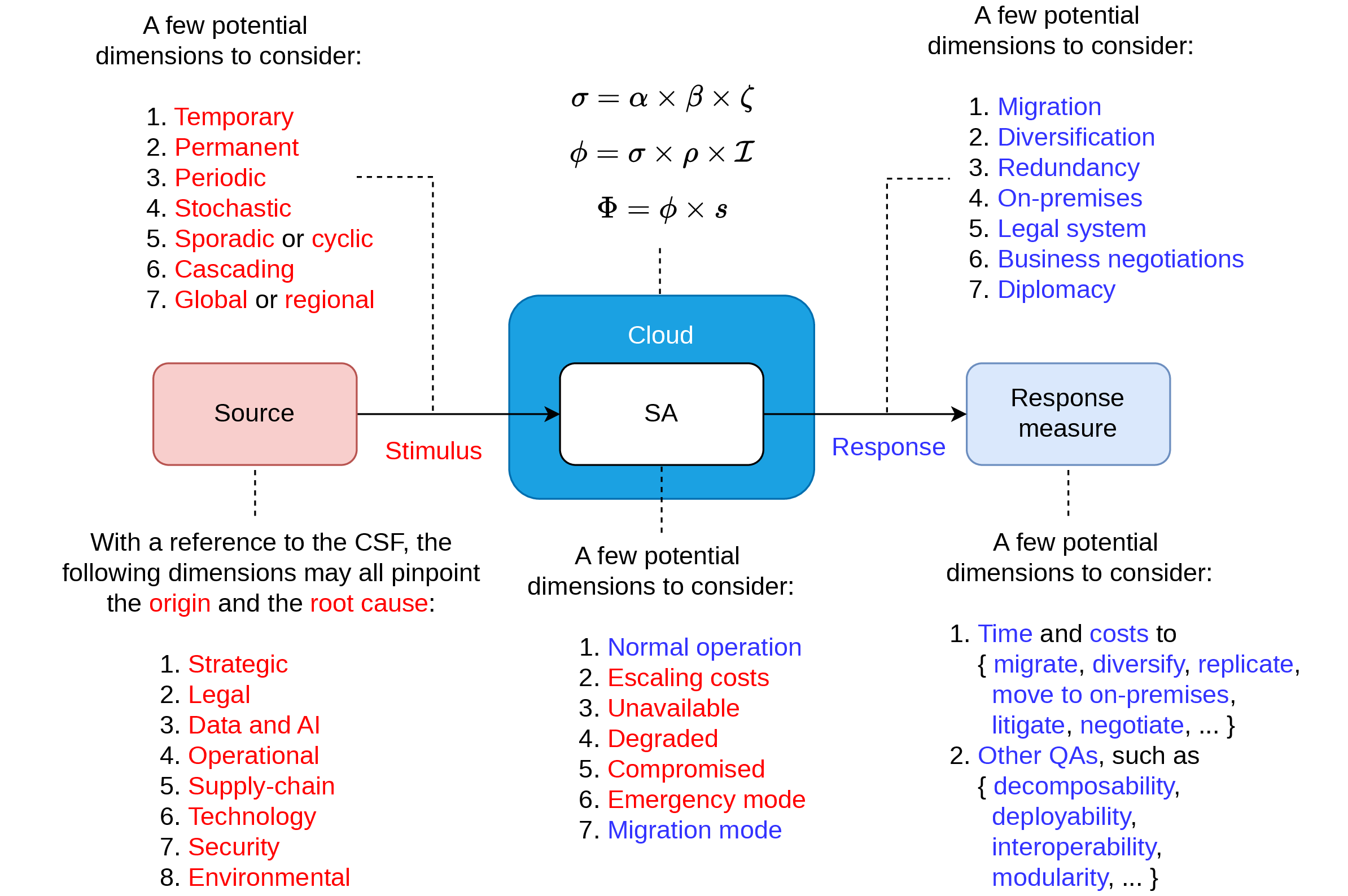
When the DS abbreviation is dropped from the earlier Fig. 1, all the eight dimensions can be seen either separately or jointly as a potential source for a given stimulus. Even natural disasters sometimes disturb SAs and other systems in some sectors [37]. Some of these may also be periodic. Another example would come from the strategic \(\textmd{DS}_1\) dimension and involve an acquisition of a \(\mathbb{C}_i\) by a vendor. In such a case it might be possible to negotiate the contracts and their guarantees with the old vendor to apply also to the new vendor. If two cloud vendors merge, a given \(\Phi\) already evaluated should probably be re-assessed. In fact, continuous evaluation would be beneficial, meaning that a subscript for time, \(t\), should probably be added, such that \(\Phi_t, \Phi_{t+1}, \ldots\), and likewise for the other parameters. Risks are not constant. In any case, these examples demonstrate that the combinatorics in Fig. 2 are almost infinite.
However, it has been geopolitics that have driven the European policy discussion in recent years. These would originate from the strategic \(\textmd{DS}_1\) of another country. In this regard, both a possibility of degradation of services and even a possibility of a “kill switch” have been speculated by commentators [20], [38]. Even though supposedly possible, \(\rho\) is likely minimal for someone pressing such a kill switch. Nevertheless, the speculative example is worth noting because \(\mathcal{I}\) would be catastrophic. Of the potential dimensions listed in Fig. 2, a cloud would be immediately unavailable for a SA, meaning that even migration would not be possible. Thus, the earlier points about diversification and redundancy extend also to backups. Of the response dimensions listed in the figure, diplomacy would likely be the option for trying to resolve the pressing of the switch. Even if normal operations would be restored eventually, meaning that the temporary dimension would apply for the source, the costs would likely be excessive even from a short unavailability, provided that the switch would be pressed wholesale.
4 Conclusion and Discussion↩︎
The answer to the RQ specified in the introduction is positive: the EU’s recent policy frameworks for CC align rather well with a conceptualization of DS as a QA for SAs operating in a cloud. Regarding the desirable properties of QAs, the paper demonstrated that measurability is attainable. Even though somewhat sketchy, the EU’s CSF is a good example in this regard. Given the complexities involved, including legal uncertainties involving multiple jurisdictions, robust verification may still be challenging even with quantified measures. When combining this uncertainty with a risk-based and a scenario-based approach to QA evaluation, the common recommendation [39] for using Delphi surveys or focus groups seems sensible. A joint evaluation of the equations involving \(\sigma\), \(\phi\), and \(\Phi\) could sharpen the risks and scenarios involved. Further research is required about mapping these to the other dimensions in the template shown in Fig. 2, including with respect to responses and response measures. Even though not explicitly discussed, it is a truism that there are trade-offs as well. For instance, the performance, scalability, and availability QAs of hyperscaling clouds are hard to beat technically. Yet, it is difficult to say whether these or business reasons are a reason for the Europe’s continuing lock-in to the few US-based cloud vendors. Furthermore, it should be acknowledged that the stimulus in Fig. 2 could also denote a large-scale crisis—including even a military conflict—in which case the migration response in the figure might actually denote a move to a global hyperscaling cloud. The war in Ukraine is a good example in this regard [40].
To put aside on-premise deployments, diversification, interoperability, and redundancy were among the few noteworthy points raised about decreasing the real or potential risks. Of these, interoperability has been promoted by legislative acts in the EU, whereas competition policy could be a leverage against barriers for multi-homing deployments in multiple clouds [15]. Indeed, “single-homing” in a single cloud has been observed to be more relevant business wise [41]. Diversification and redundancy cost. They also increase complexity of a SA and its detailed design. Whether these and related factors continue to outweigh the risks from decreased DS remain to be seen. At the time of writing, it seems the pendulum is shifting particularly on the side public sector services and public administrations, which is understandable due to the criticality of some of their functions. The EU’s Tech Sovereignty Package and the CADA proposal are good examples in this regard. At the same time, they also signify that DS is increasingly aligning also with industrial policy in the European Union.
However, it remains to be seen whether mere risk assessments are enough to decrease the lock-in of European public sector services and public administrations on the global hyperscalers. In this regard, some have already criticized the CADA proposal in that it only prohibits foreign clouds at the highest assurance level and even at that level a strict prohibition remains unclear [42], [43]. This criticism is worth mentioning because it exemplifies that also more aggressive viewpoints are expressed in Europe. Another point is that the criticism may have been too hasty because no one knows yet how the scoring will work in practice—or whether the CADA proposal will even be accepted in its current form.2 For instance, non-EU cloud computing vendors may score well on \(\textmd{DS}_4\), \(\textmd{DS}_6\), and \(\textmd{DS}_7\) through audit commitments and process controls, whereas \(\textmd{DS}_2\) remains structurally unsolved for higher assurance levels. This point reiterates the earlier remark about a need for transformation functions and threshold values.
What about the debated and blurry concept of digital sovereignty itself? It seems that the concept is both evolving and expanding, as has been the case also with some other related concepts such as critical infrastructure [31]. Critical infrastructure is also important to note in this context because it demonstrates the dependencies and their risks well. A good example would be a cost-cutting plan in one European country to move election data to a foreign cloud [45]. Although the plan was canceled due to a scandal that followed, it demonstrates the trade-offs at a symbolic yet fundamental level: for saving little money, a country was planning to lock-in even its democratic core to a foreign cloud. As is typically the case with quality attributes [8], prioritization according to the criticality for a society would seem as a sensible recommendation for decision-makers seeking to move critical infrastructure functions to a
Conceptual clarity is a big problem in many domains of study [46]. The same has traditionally applied also to digital sovereignty as a concept. Even though an unambiguous definition for DS urged by some [38] still seems to be missing, the analytical framing has sharpened somewhat in recent years. The CSF’s eight different dimensions for digital sovereignty are a good example in this regard. At the same time, it seems that competing concepts are emerging. To exclude the strategic autonomy concept, a further “sovereignty 2.0 concept” of digital autonomy has emerged. It has been characterized as the “ability to operate independently, regardless of whether disruptions originate at the geopolitical or vendor level” [47].3 The keywords of continued independent operations and disruptions further bring the resilience buzzword onto the conceptual table. The conceptualization presented can also be acknowledged as a limitation: even though it was summarized into the single parameter \(\Phi\), it could be argued that the dimensions of digital sovereignty for CC in Fig. 1 each contain their own QAs, meaning that the noun attribute in the paper’s title should perhaps be in a plural form.
Finally, the paper also exemplifies that DS continues to be a core part of the “tussle” that was predicted by some authors already nearly \(25\) years ago [49]. But is there anything new? While DS has always been also about politics, the intensified geopolitics among Western countries are new in the digital era.
References↩︎
If not otherwise explicitly indicated with a different reference, the discussion in this Subsection 3.3 is from [30], including with respect to direct quotations.↩︎
When recalling the earlier point in Subsection 3.2 about the ECCS, it is worth mentioning another line of criticism about a potential fragmentation across the member states and their public authorities, which may lead to so-called forum shopping [44].↩︎
As has been noted [48], the EC has used digital sovereignty, technological sovereignty, digital autonomy, and strategic autonomy interchangeably in a series of publications, white papers, and press releases. Therefore, it should be emphasized that the quote presented does not necessarily match the EC’s intended meaning.↩︎