HealthAgentBench: A Unified Benchmark Suite of Realistic Agentic Healthcare Environments for Challenging Frontier AI Agents
June 30, 2026
Abstract
As AI agents become increasingly capable of complex, long-horizon reasoning, rigorous evaluation is essential for measuring progress toward real-world healthcare applications. However, existing healthcare benchmarks are often saturated, static, or narrow in clinical scope, limiting their ability to distinguish frontier systems or track progress. We introduce HealthAgentBench, a suite of 54 agentic healthcare tasks across 7 categories each with its unique environment. The benchmark suite spans diverse workflows throughout the patient journey and a broad range of modalities. Each task is designed to replicate an end-to-end clinical workflow: given minimal instructions, an agent must explore raw healthcare data, operate within a complex environment, and execute multi-step solutions that go beyond naive prompting, such as querying large clinical databases or interpreting gigapixel pathology images. All tasks are scored using binary success/failure criteria against expert-derived labels or human performance. A final task success rate is reported to provide a single, interpretable metric for HealthAgentBench overall performance for each agent. Evaluating frontier agents on HealthAgentBench, we find that overall task success rate remains low, underscoring the difficulty of the suite. The strongest and the most cost effective agent, Codex GPT-5.5, achieves only approximately \(42\%\) success rate. Beyond aggregate performance, HealthAgentBench reveals nuanced strengths and weaknesses across task categories. Frontier agents show promise in automatically developing research modeling pipelines over EHR data, but medical imaging remains especially challenging, particularly for Claude Code models, while Codex GPT-5.5 shows emerging capability. Tasks that combine large search spaces with compositional reasoning requirements remain difficult for all current agents. Together, these results suggest that HealthAgentBench provides a challenging and realistic benchmark with substantial room for future progress. We release our benchmark at https://github.com/microsoft/HealthAgentBench.
1 Introduction↩︎
The field of AI research is undergoing a transition from large language models (LLMs) as isolated task solvers to agentic systems that can execute actions within complex environments. Traditional LLM benchmarks were largely designed around static inputs: a model receives a fixed prompt, often containing a short text context, and produces a single answer. For example, tasks such as MedQA [1] evaluate whether an LLM can answer a question given a concise clinical vignette. Nowadays, LLM agents equipped with tools, harnesses, and execution environments can go beyond fixed-context prompting: they can search, inspect, query, compute, and iteratively act on data distributed across files, databases, images, and software systems. As a result, developing agentic evaluation environments has become essential for accurately measuring the capabilities of these frontier systems.
This shift is especially important for healthcare, where many high-value applications require end-to-end reasoning over complex, multimodal, and large-scale data. Facilitating real clinical workflows often involves processing information that cannot be fully represented in a short prompt, such as 3D CT volumes, gigapixel pathology slides, longitudinal EHR databases, trial protocols, and heterogeneous clinical documents. These settings have historically been beyond the reach of conventional prompting approaches, either because the data exceeds the model context window or because solving the task requires multi-step interaction with tools and the environments. Agentic systems create the possibility of addressing these workflows more realistically, by allowing models to explore the environment, operate over raw data, and design and execute task-specific strategies.
It is therefore crucial to move beyond static evaluation and develop realistic, holistic benchmark suites that assess the emerging capabilities of agents on end-to-end healthcare tasks. However, the current healthcare benchmark landscape remains fragmented and insufficient for evaluating the full capabilities of AI agents. Traditional benchmarks primarily measure isolated reasoning or question-answering ability, while recent agent-oriented efforts [2]–[5] remain limited in scope, often focusing on specific tasks, modalities, or predefined workflows. This lack of broad, agent-native evaluation makes it difficult to draw reliable conclusions about the capabilities of frontier systems in healthcare, as real-world clinical workflows rarely rely on a single task, modality, or data source (eg. clinicians routinely integrate information from diverse inputs—such as pathology slides, CT scans, radiology reports etc. to arrive at diagnoses and treatment decisions). A comprehensive, realistic, and challenging benchmark suite is therefore needed to provide a common ground for evaluating and comparing agentic AI systems in healthcare, enabling researchers to identify strengths and areas for improvement and to track progress in this rapidly evolving field.
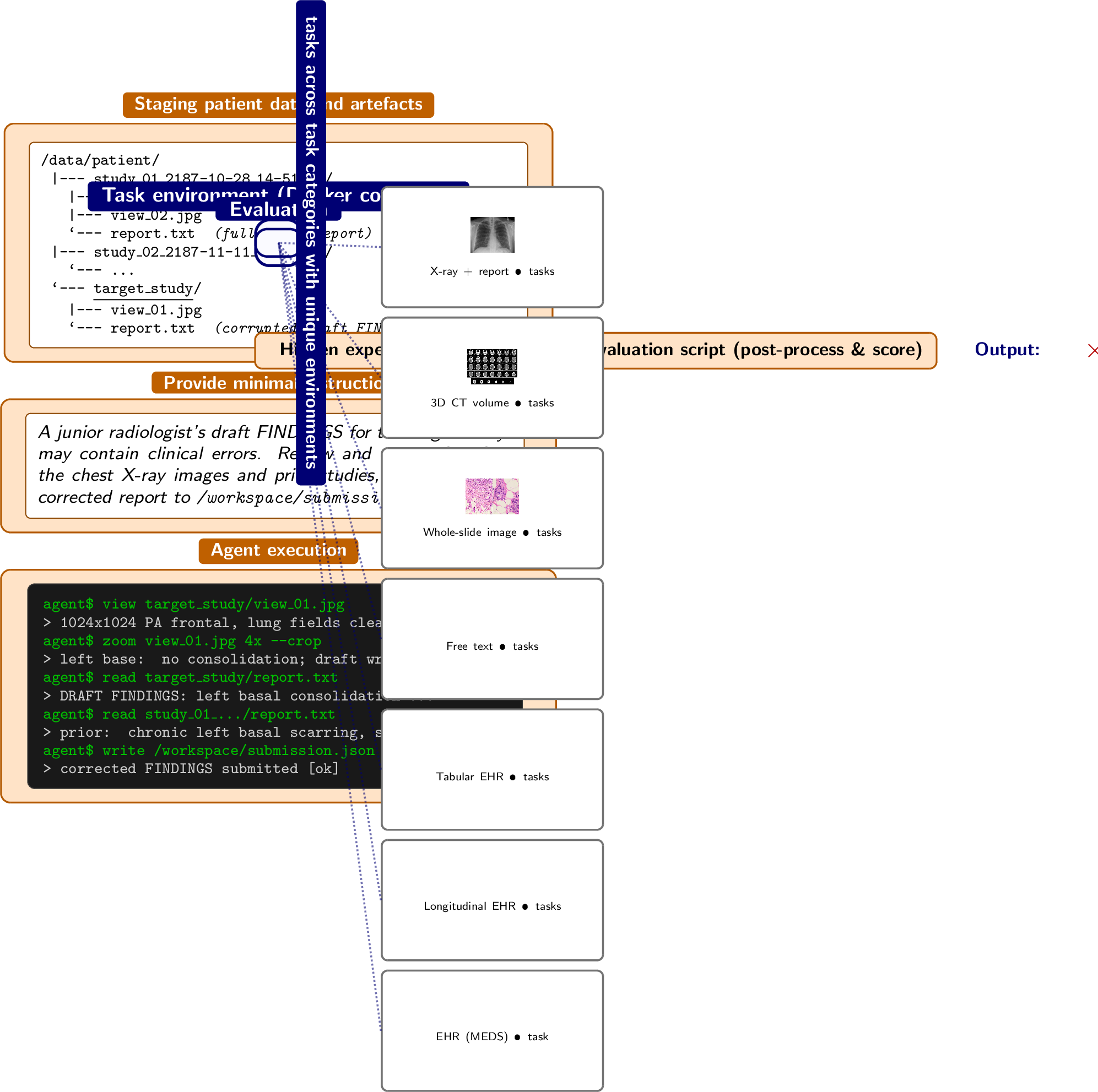
In this study, we introduce HealthAgentBench, a unified suite of agentic healthcare environments for evaluating AI agents. HealthAgentBench consists of 54 tasks across 7 categories each with its unique environment, including X-ray Report Correction, Pathology Tumor Area Selection, CT Abnormality Classification, Clinical Trial Matching, EHR Data Quality Auditing, EHR Event Modelling, and EHR Format Conversion. These tasks span diverse clinical workflows throughout the patient journey, including data management, diagnosis, research, and treatment planning. They also cover a broad range of modalities, including 2D radiographs, 3D CT volumes, whole-slide pathology images, free text, and structured clinical data. As detailed in Section 3, we provide a principled workflow to select and create each task in HealthAgentBench to ensure a unified benchmark that is realistic, challenging, verifiable and diverse. For each task, we provide a terminal-based environment following [6] as shown in Figure 1. Within each environment, agents are given real clinical artefacts, including patient data and supporting resources, along with minimal task instructions. This setup allows agents to freely explore the environment, formulate strategies, and propose solutions. The X-ray Report Correction task shown in Figure 1 hands the agent an environment containing a patient’s longitudinal chest X-ray history and a corrupted report, and the agent can view, zoom into, and crop the radiographs and cross-reference the prior studies before writing a corrected report. In this way, HealthAgentBench evaluates agents’ end-to-end autonomous capabilities, including planning, tool use, environment exploration, and task execution. For another example, when presented with a CT volume, an agent may choose to inspect slices sequentially, install image-processing tools, pre-filter relevant regions, or crop candidate lesions before making a final prediction. Finally, we provide a unified evaluation module to assess agent output by defining success/failure criteria for each task against human performance or expert labels, enabling consistent comparison of agents across the entire suite. Manual review is conducted to ensure that the success criteria are reachable.
We use HealthAgentBench to conduct an empirical study of frontier LLM agents. We find that the tasks are challenging even for state-of-the-art systems, with the strongest agent, Codex GPT-5.5, achieving only around \(42\%\) task success rate. Beyond this aggregate result, the suite enables nuanced analyses of agent strengths and weaknesses across task categories, clinical workflows, and data modalities, highlighting areas where current agents show promise as well as where substantial progress is still needed.
Contributions↩︎
In summary, our contributions are as follows:
A unified suite of agentic healthcare environments. We introduce HealthAgentBench, a benchmark suite for evaluating AI agents on realistic, patient-grounded tasks spanning diverse clinical workflows and data modalities, including medical imaging, free text, and structured EHR data. We also setup a principled workflow for sourcing and selecting tasks for the benchmark that can be extended for future editions.
A challenging benchmark far from saturation. HealthAgentBench is designed to measure progress in frontier healthcare agents over time. Current frontier agents achieve overall low task success rate, with the strongest model, Codex GPT-5.5, reaching only around \(42\%\), leaving substantial room for future improvement.
Nuanced analyses of frontier-agent capabilities. Our benchmark reveals two major bottlenecks for current frontier agents: (i) medical imaging tasks (ie. CT, xray, pathology slides) (ii) tasks requiring large search spaces and complex compositional reasoning. We further observe clear model-family differences, with Codex GPT models, especially GPT-5.5, being generally more cost-effective and consistently outperforming Claude Code models on medical imaging tasks.
2 Related Work↩︎
Healthcare has a fast-growing body of agent-oriented benchmarks, but none yet offers a unified, executable, and multi-modal evaluation spanning the full patient journey. We group recent efforts into three complementary lines of work and discuss how HealthAgentBench relates to each.
A first line of work studies how agentic strategies can improve medical question answering. Two representative examples are MedAgentBoard [7], which offers a careful comparison of LLM multi-agent collaboration against single-LLM prompting and strong conventional methods across medical task families, and ClinicalAgent Bench [8], which considers a broad task suite spanning five clinical capability dimensions together with a rich clinical toolbox. These benchmarks are primarily organized around question-and-answer formats, in which each instance pairs a query with pre-supplied context and the agent’s tools or collaborators act as part of the solver. HealthAgentBench is different in focus: rather than answering a self-contained question, the agent must explore and act within a live environment whose state it changes over many steps.
A second line of work develops genuinely interactive evaluations centered on clinical dialogue. HealthBench [9] and HealthBench Professional [10] provide carefully constructed, physician-authored rubrics for multi-turn patient and clinician conversations; MAI-DxO [11] models diagnosis as a cost-aware sequential process over challenging NEJM cases; and AgentClinic [12] turns medical QA and EHR cases into a simulated clinic with interacting doctor, patient, and measurement agents. In a similar spirit, simulated-hospital environments such as AI Hospital [13], MedAgentSim [14], and CP-Env [15] let models role-play clinical staff across multi-step encounters and branching care pathways. This body of work captures clinical reasoning and communication especially well. Its focus is conversational and simulated-patient interaction, whereas HealthAgentBench asks agents to operate directly on raw, heterogeneous patient data.
A third line of work, closest to ours, places agents in executable environments over real data, with each benchmark concentrating on a particular clinical setting. MedAgentBench [3] and the more recent PhysicianBench [16] situate agents within a FHIR-based EHR to retrieve records and place orders, with PhysicianBench extending the paradigm to long-horizon, execution-verified workflows; both center on structured EHR data. MedAgentGym [17] provides a scalable agentic environment for code-centric reasoning over biomedical data-science tasks, emphasizing programmatic analysis of structured records. AutoMedBench [4] and CamylaBench [18] share our emphasis on end-to-end pipelines over raw data, but they prescribe staged workflows rather than allowing agents to explore autonomously, and they focus primarily on medical imaging. HealthAdminBench [2], meanwhile, studies computer-use agents on healthcare administrative workflows. HealthAgentBench complements these efforts by unifying their strengths into a single, broad, executable benchmark in which agents autonomously interact with real, heterogeneous patient data. The suite spans five data modalities (2-D radiographs, 3-D CT volumes, pathology whole-slide images, free-text clinical documents, and structured EHR records) and four major stages of the clinical workflow: diagnosis, data management, research, and treatment planning. By adopting terminal-based environments with minimal instructions, HealthAgentBench builds on the design philosophy of general-domain agent benchmarks such as Terminal-Bench [6], OSWorld [19], GAIA [20], and WebArena [21], while adapting it to the multimodal data, complex workflows, and specialized tools characteristic of healthcare. Figure 2 positions HealthAgentBench relative to existing healthcare agent benchmarks along two dimensions: interaction realism and breadth of coverage. HealthAgentBench uniquely combines realistic agent interaction with broad coverage of clinical modalities and workflow stages, filling a key gap in the current evaluation landscape.

3 Task Creation↩︎
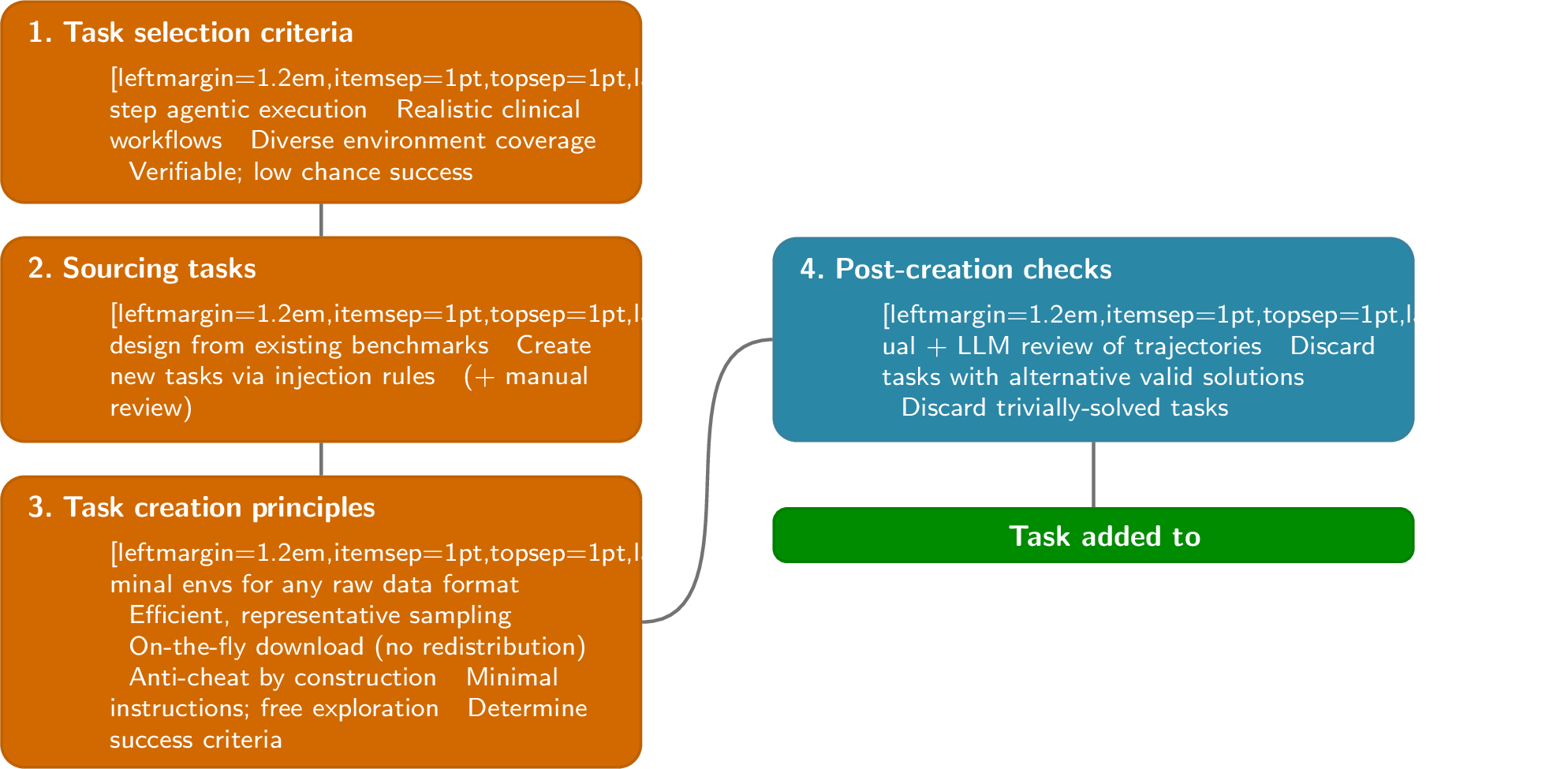
We propose a principled workflow for selecting and designing tasks in HealthAgentBench to create 54 tasks across 7 task categories including X-ray Report Correction, Pathology Tumor Area Selection, CT Abnormality Classification, Clinical Trial Matching, EHR Data Quality Auditing, EHR Event Modelling and EHR Format Conversion. Documentation for tasks in each task category is presented in Appendix 10. Figure 3 summarizes the selection criteria, construction sources, design principles, and post-creation checks that every task passes through. The workflow proceeds through four sequential stages: a candidate is screened against the selection criteria, then constructed from a vetted source, built under a fixed set of design principles, and finally subjected to post-creation checks before it joins the suite.
3.1 Task selection criteria.↩︎
To be included in HealthAgentBench, a candidate task must satisfy the following criteria
3.1.0.1 Agentic Workflow
We deliberately choose tasks that require an agentic workflow that can involve planning, tool use, multi-step reasoning, or environment interaction that naive single-shot LLM prompting cannot complete. For example, the LLM cannot pass the ct volume, or pathology slide as a whole into the prompt.
3.1.0.2 Realistic Clinical Workflow
The tasks cover different stages of the clinical workflow including data management (EHR Format Conversion, EHR Data Quality Auditing), diagnostics (X-ray Report Correction, Pathology Tumor Area Selection, CT Abnormality Classification, Clinical Trial Matching), event modelling (EHR Event Modelling) and treatment planning (Clinical Trial Matching). All tasks contain real clinical data including patient data or clinical documents such as trial information.
3.1.0.3 Wide coverage of modalities and environments
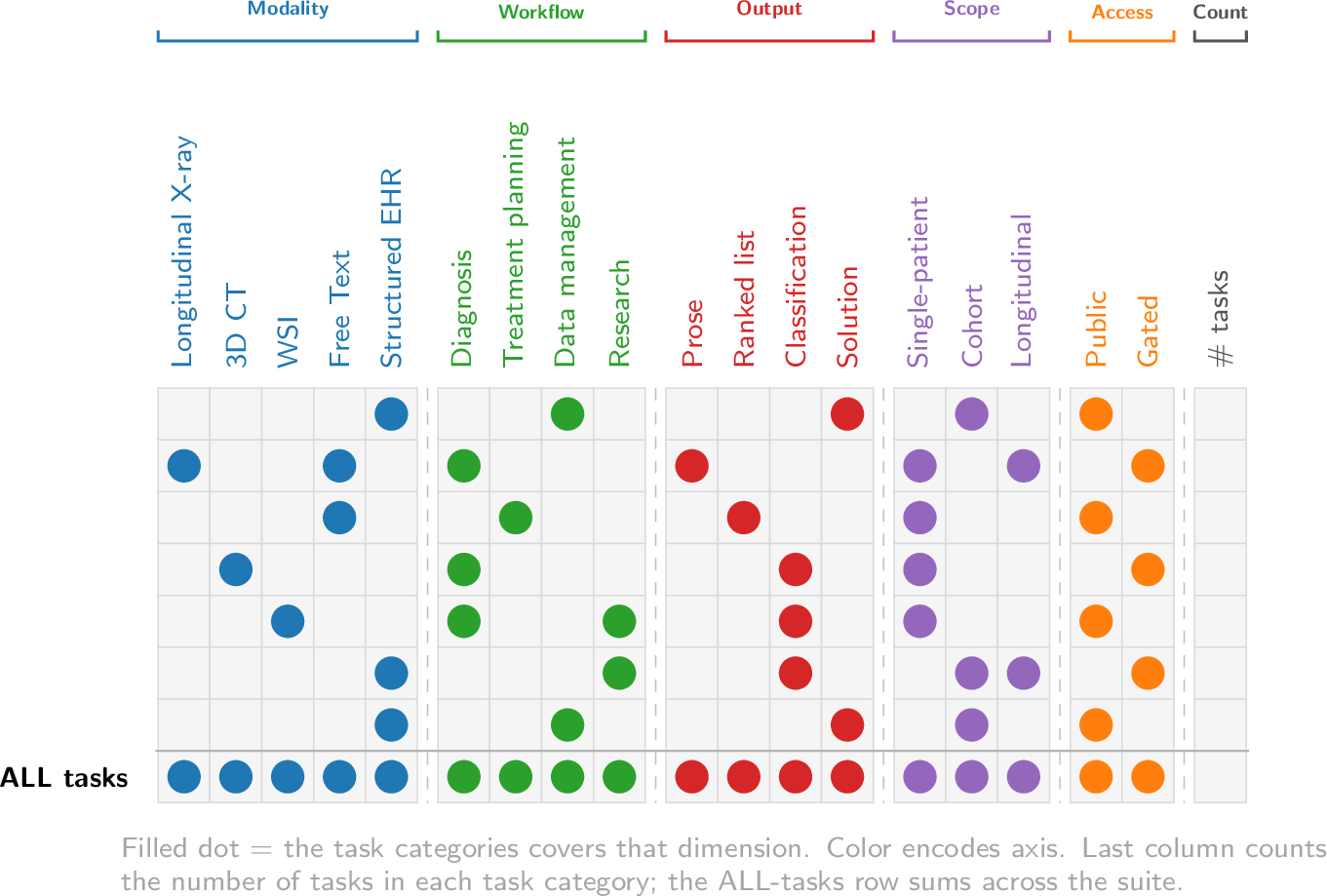
Our task suite is designed to span diverse healthcare settings and environments. Figure 7 summarizes the coverage of HealthAgentBench across multiple dimensions, including input modality, clinical workflow, output format, patient and temporal scope, and data access regime. HealthAgentBench spans five input modalities—2-D radiographs, 3-D chest CT, pathology whole-slide images, free-text clinical documents, and structured EHR data. Its tasks also cover diverse agent output formats, including prose reports, ranked list, classifications, and engineered solutions such as ETL (Extract, Transform and Load) pipelines or flagged data-quality errors. The suite also varies patient scope, from single-record reasoning to cohort-scale analysis, and includes longitudinal tasks that require reasoning over time-ordered events.
3.1.0.4 Verifiable with low chance success rate
We prioritize tasks with objectively verifiable success criteria while ensuring low chance success rate. In particular, we exclude single binary classification tasks with balanced labels, where random guessing achieves a success rate of \(50\%\). Multi-label binary classification tasks are retained because the agent must make multiple independent predictions, making the probability of correctly guessing every label exponentially smaller (e.g., in CT Abnormality Classification, the agent must correctly identify the presence or absence of every abnormality in a CT volume to pass the task). Consequently, the tasks in HealthAgentBench have a low random-guess success rate—typically below \(10\%\)—ensuring that performance meaningfully reflects an agent’s capabilities rather than chance.
3.2 Sourcing tasks.↩︎
Candidate tasks are constructed from two sources. First, we leverage existing benchmarks with expert labels or reports and convert them into terminal-based agent environments. We redesign the agent-visible interface so that agents must solve the tasks end-to-end through autonomous exploration, without the human scaffolding or task-specific engineering used in the original benchmark evaluations.For example, EHR Event Modelling is adapted from EHRSHOT [22]. Whereas EHRSHOT was originally designed for human researchers to develop predictive models, our version requires the agent to perform the entire machine learning workflow from exploring the patient database and selecting a modeling strategy to training a model and generating predictions on the test set, thereby transforming it into a substantially more challenging agentic evaluation. We also create new tasks by conducting rule-based augmentations or pipeline wrapping on patient data. Second, we create new tasks by augmenting curated patient datasets or wrapping existing clinical pipelines into executable environments. For example, EHR Data Quality Auditing is built by injecting realistic data quality issues into the MIMIC-IV dataset using rule-based perturbations, such as impossible physiological values inconsistent clinical records and demographic conflicts. The agent must inspect the underlying patient data, identify the injected errors, and report the corresponding data quality issues.
3.3 Task design principles.↩︎
Every task is built around five design principles as described below:
3.3.0.1 (i) Versatile terminal environment.
We leverage the harbor framework [23] to package each task as a terminal environment that accommodates the heterogeneous raw patient-data formats the suite spans. Terminal environments provide a flexible interface through which agents can inspect heterogeneous data formats, invoke domain-specific software, query databases, and compose complex workflows over large-scale resources. They also closely match the execution environment of today’s frontier coding agents, which are primarily designed and optimized to operate through terminal interfaces. This makes terminal environments a natural substrate for evaluating autonomous agent capabilities on realistic clinical tasks.1.
3.3.0.2 (ii) Efficient, representative sampling.
Rather than shipping hundreds of similar tasks, we sample a small set (typically 5–15 samples per task category) that are representative (eg. covering different disease types, difficulty levels) so a sweep of all tasks in this benchmark produces an informative signal in reasonable time.
3.3.0.3 (iii) On-the-fly data download.
We do not redistribute data and labels, and provide a one-click run script to fetch data from the original sources at runtime after the user provides credentials.
3.3.0.4 (iv) Anti-cheat by construction.
Gold labels and verifier code are mounted only into the verifier step, never into the agent container. Agent-visible identifiers are made opaque (e.g.case_NN, study_NN_<timestamp>) and corpus names are scrubbed from
filenames so an agent cannot map back to the upstream dataset and look up answers. We also disable web browsing capabilities from agents to block the agent browsing internet for gold labels.
3.3.0.5 (v) Minimalist instructions.
The agent-facing prompt states the goal in a few sentences but leaves the strategy (which files to read, in what order, which tools to call) entirely to the agent rather than predefining workflows. This way, we can test the innate planning and strategy formulation capabilities of the agents alongside their execution abilities.
3.3.0.6 (vi) Determine task-specific success criteria
Each task is evaluated using a binary success/failure criterion, with task-specific performance metrics reported alongside. The success criterion is determined for each task category separately; Table 2 in Appendix 7 summarizes these criteria, and the per-task Scoring paragraphs in Section 7 give the full details. These criteria fall into a few broad types: exact or complete correctness (every CT abnormality label correct, or all ETL verifier checks passing), exhaustive recovery of the targets (full recall on the data-quality and trial-matching tasks), error-free output (zero clinically-significant errors for report correction), and reaching a performance threshold—either an absolute metric cutoff (tumor tile-F1 \(\geq 0.90\)) or matching a human-engineered baseline (AUROC at or above the human engineered count+GBM model). In every case the threshold is set so that success reflects a near-expert, genuinely useful solution. This design enables a uniform evaluation framework across the diverse tasks in the suite. We use overall task success rate (i.e. the fraction of benchmark tasks successfully resolved by an agent) as the primary metric for measuring overall agent progress and for comparing between tasks. Task-specific metrics, such as F1 and recall, are reported alongside task success rate to quantify partial progress and provide additional insight into agent performance.
3.4 Post-creation checks.↩︎
Before a task is added to the suite, we run a baseline sweep across multiple frontier agents and inspect the trajectories. We manually and with LLM assistance review the agent transcripts to catch two failure modes: (i) the agent finding an unintended shortcut (e.g. a leaked evaluation script into agent’s container) which sends the task back for redesign; and (ii) genuine ambiguity in the task where multiple reasonable agent solutions or alternative valid gold labels are possible, which also sends the task back. A final filter is applied: we discard tasks every agent solves trivially and we keep only those where the success-rate gap between agents is informative.
4 Baselines and Results↩︎
4.1 Overall Performance↩︎
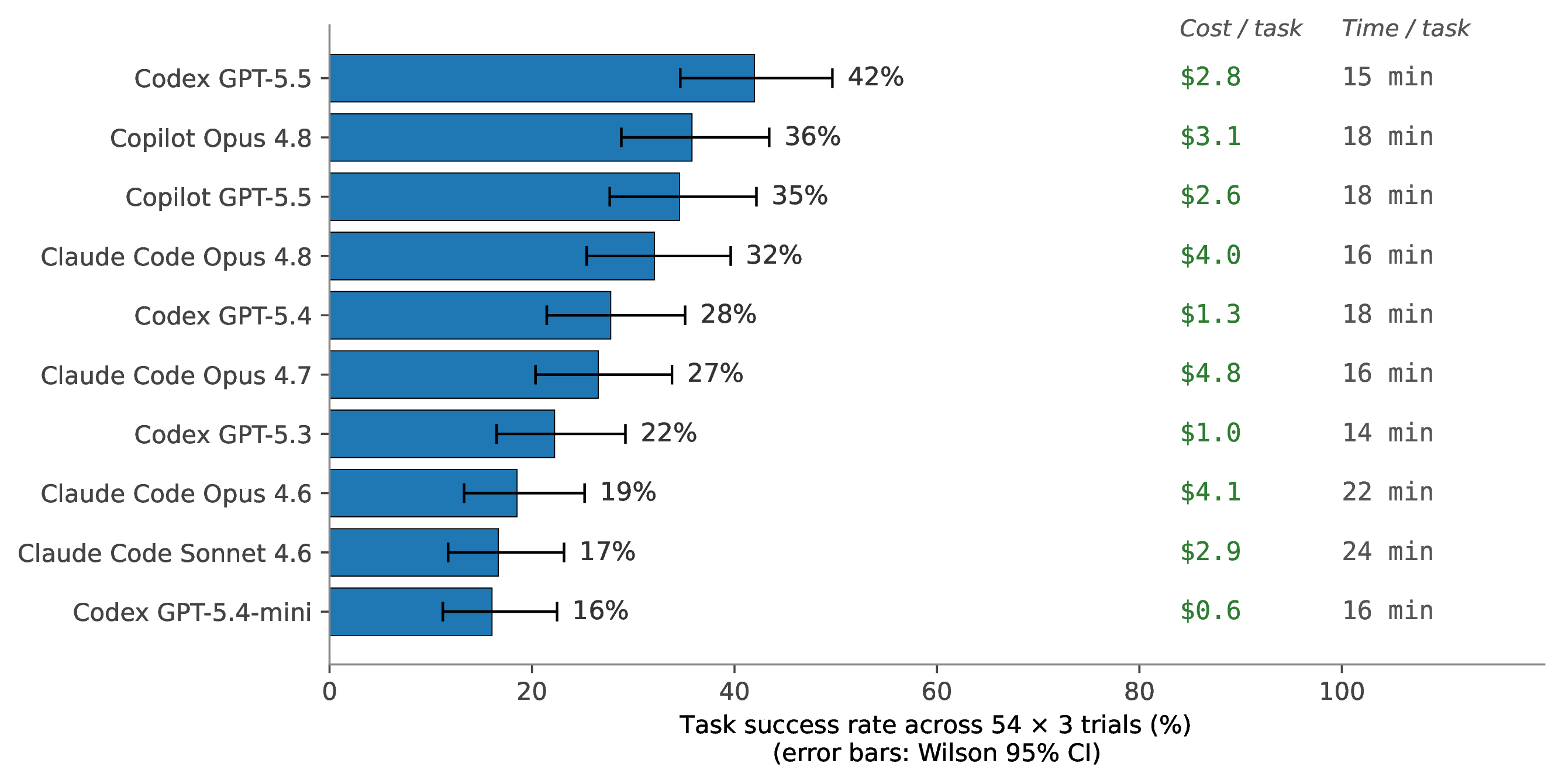
We evaluate 10 frontier agents from two model families (GPT-5 series [24]–[26] and Anthropic’s Claude series [27], [28]) covering 3 harnesses (Codex [29], Claude Code [30] and Copilot-CLI [31]) with xhigh reasoning effort with disabled web browsing capabilities . Figure 4 summarizes the headline result: Across 3 attempts on 54 tasks (i.e 162 trials), the best agent (Codex GPT-5.5) achieves the task success rate of only 42%(meaning that only 42% of tasks are consistently solved), leaving ample room for improvement and suggesting that HealthAgentBench is a challenging testbed for current models. Codex GPT-5.5 is followed by Copilot CLI running Opus-4.8 and GPT-5.5 (\(36\%\) and \(35\%\)), then the best native Claude Code agent, Opus-4.8 (\(32\%\)). Smaller or older model families trail behind, with the weakest agent (Codex GPT-5.4-mini) achieving only \(16\%\) task success rate. Overall, the benchmark reveals a clear and steady improvement across successive model generations while remaining far from saturation.
We also show that agent harness can significantly influence performance. For example, GPT-5.5’s task success rate drops from \(42\%\) under Codex to \(35\%\) under Copilot CLI, whereas Opus-4.8 improves from \(32\%\) under Claude Code to \(36\%\) under Copilot CLI. A likely reason is that Copilot CLI uses a multi-agent architecture, where the primary model delegates sub-tasks to auxiliary agents running on fixed model backends. For example, a “Copilot GPT-5.5” system is not a pure GPT-5.5 agent, but can call subagents from Opus, Sonnet and other other hardcoded models.
Beyond task success, we evaluate the cost2 and wall-clock time of each agent. The best-performing agents are not necessarily the most expensive or the slowest. Strikingly, the costliest and slowest sweeps both belong to Claude Code agents (Opus-4.7 is the most expensive at $\(4.8\) per task, and Sonnet-4.6 is the slowest with 24 min per task), yet all of them score well below codex GPT-5.5, which is both cheaper and faster. Plotting each agent’s task success rate against the dollar cost of a full sweep over the suite (Figure 8 in Appendix 8), the Pareto frontier is traced entirely by GPT-5 agents: GPT-5.4-mini, GPT-5.3, GPT-5.4, Copilot GPT-5.5, and Codex GPT-5.5 form the cost-optimal curve, while every Claude Code agent is matched or beaten on success rate by a cheaper GPT-5 run. Qualitatively, two behaviors drive up the cost of the Claude Code models: they tend to spawn many sub-processes within a run, and they are markedly more “chatty” and elaborate in their responses. For example, while Claude Code Sonnet-4.6 have significantly cheaper per-token cost, they produce around \(2\times\) as many tokens per task as the best codex GPT-5.5 run (44k vs. 20k output tokens per trial), therefore consuming more compute and costing more overall.
4.2 Breaking Down Performance by Task Categories↩︎
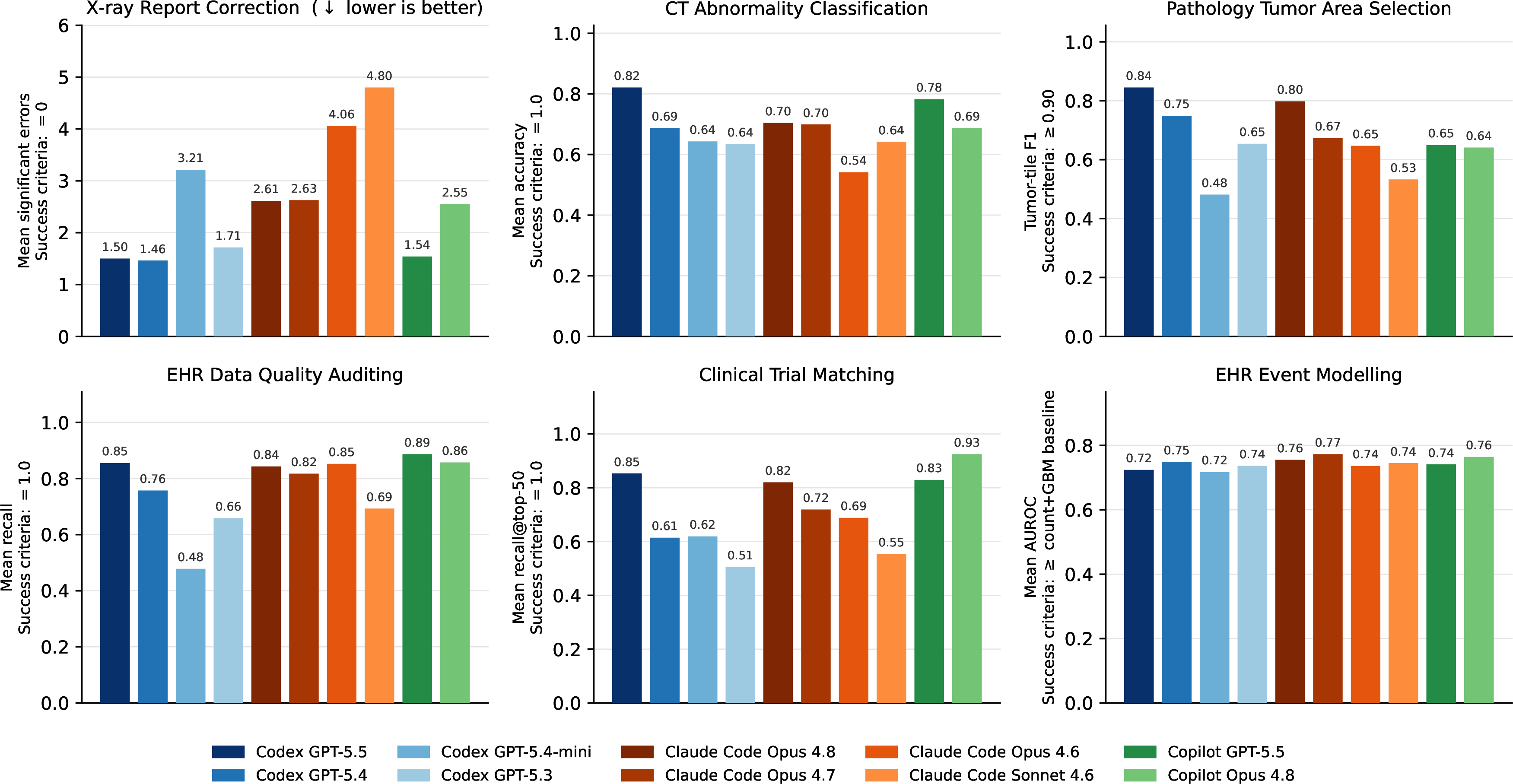
Figure 5 decomposes performance cell-by-cell for each task category, encoding success rate, wall clock time (a proxy for effort), and costs. While Codex GPT-5.5 achieves the best overall performance, the task breakdown shows a more nuanced picture. There is no agent that is universally the best choice across all tasks, and the difficulty of the task categories varies. Beyond the success rate as the primary metrics, we also report task-specific raw scores in the appendix (Figure 9) to track partial progress on each task which shows a ranking of models that is broadly consistent with the overall task success rate.
![Figure 5: Performance and efficiency of 10 frontier agents across 7 task categories. Each task category provides a unique task environment to challenge the agents. Color denotes the per-task-category success rate, circle size shows the average wall-clock time for finishing a trial (a proxy for effort), and the $ markers denote the cost tier ($ to $$$$) of running a trial. The exact per-(agent, category) success rate, time, and cost are tabulated in Appendix 9.1 (Tables 3–[tbl:tab:per-cat-cost]). Task-specific raw scores before converting to binary success rate are also reported in Figure 9.](/article/2606.31179/figures/baseline_heatcircle_combined.png "fig:")
4.2.0.1 The Win: Machine Learning AutoResearch for EHR modelling
Frontier agents are markedly capable on EHR Event Modelling and EHR Format Conversion, which replicate the research workflow of building machine learning pipelines over tabular clinical data. On EHR Format Conversion, the ETL-construction benchmark, the agent is tasked with building a data pipeline that extracts and transforms medication records from raw EHR data. On this benchmark, nine of the 10 agents reach a perfect \(100\%\) task success rate at relatively low cost and with short execution times. Only Opus-4.6 fails the task, as it consistently drops a demographic field from the output transformed data. EHR Event Modelling assesses the full pipeline of building a machine learning pipeline from EHR data for event prediction, and is thus a more difficult task. The success criterion is to reach human-engineered feature engineering baseline performance within one hour time budget. Claude Code Opus-4.7 leads at \(78\%\) with codex GPT-5.5 close behind at \(72\%\), while most of the agents can achieve over \(50\%\) success rate, indicating that the end-to-end pipeline-building loop is broadly within reach of the current models, and the frontier agents can already competitively match human performance in performing auto research for building a ML pipeline. Notice that the time to finish a trial in this task category is the longest which is because the agent is typically iterating through different model configurations and feature sets to find the optimal solution. It is also striking that the agents reach this level with only a lightweight machine learning model with feature engineering from the raw EHR data, which is a deliberate choice given it is instructed it only has 1 hour time budget, yet their per-task AUROC matches or exceeds EHRSHOT’s published CLMBR neural-network-based foundation-model baseline on most of the six prediction targets (Figure 12 in Appendix 9).
4.2.0.2 The Challenge: Needle in a Haystack - Full Retrieval from Complex Search Space
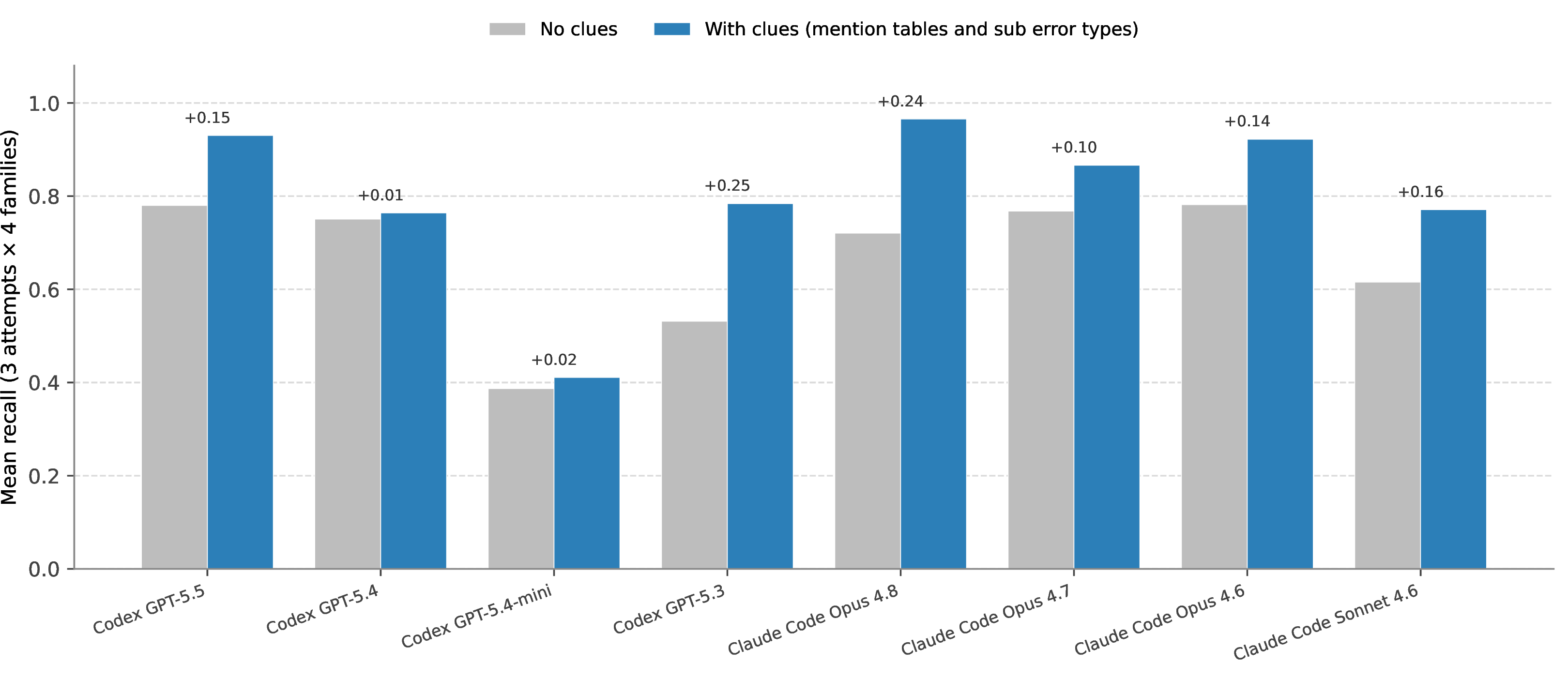
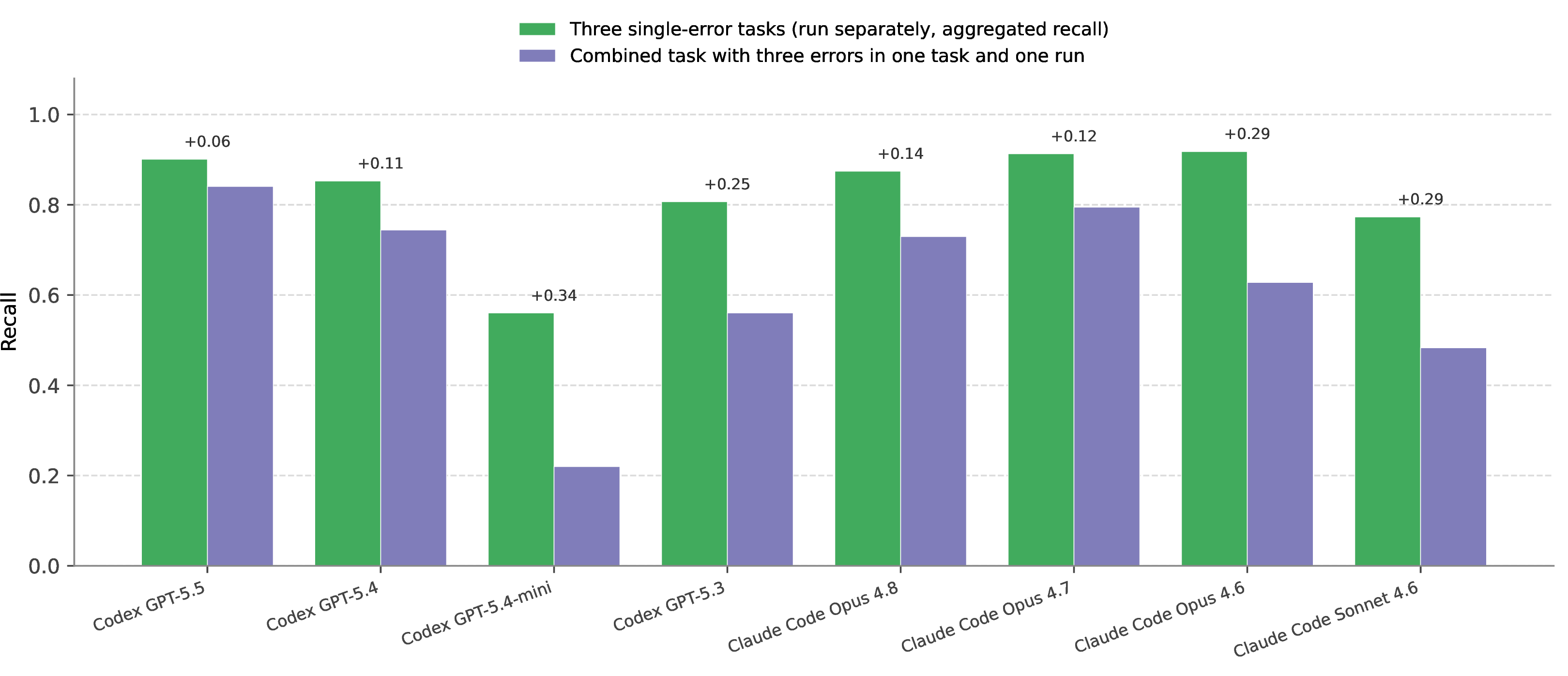
Many healthcare applications require browsing through large volumes of data to find relevant information. The Clinical Trial Matching and EHR Data Quality Auditing task categories are both designed to test this capability in different contexts. EHR Data Quality Auditing requires the agent to identify and correct errors in an error-injected EHR dataset, which involves forming hypotheses about what might be wrong and systematically checking for those errors. The challenge of this task is the complex search space which involves 8 tables consisting of more than 800k rows. To correctly identify all the errors is non-trivial, and the agents struggle to do so. None of the agents achieve more than \(50\%\) task success rate (the best, Claude Code Opus-4.6, reaches \(42\%\)), and the codex gpt models other than gpt-5.5 score at or below \(12.5\%\). This task category comprises eight tasks that are designed to disentangle two key challenges: search space and compositional complexity. To study search space, we compare four tasks in which agents receive no hints about where errors are located with four otherwise identical tasks that provide clues about the affected table and a more detailed description of the injected error. Agents perform substantially better when such hints are available, indicating that navigating large search spaces is a major bottleneck for this task category (Figure 10 in Appendix 9.3). To study compositional complexity, two tasks require agents to identify all injected errors in a single run, whereas the remaining six each target a single error type. Performance drops markedly when agents must detect all errors simultaneously, compared with aggregating the results of separate runs targeting individual error types. This finding suggests that multi-step reasoning and increased task compositionality constitute a second major bottleneck (Figure 11 in Appendix 9.3).
Clinical Trial Matching presents a different retrieval challenge. Rather than searching a large relational database as in EHR Data Quality Auditing, the agent must identify eligible clinical trials for a patient from a corpus of roughly 400 free-text trial protocols. Although the search space is smaller, it is more difficult to navigate because both the patient profile and eligibility criteria are expressed in unstructured text. The key challenge is therefore to efficiently triage the corpus before performing fine-grained eligibility reasoning. A clear performance gap emerges between the leading frontier agents and the rest of the evaluated systems, although even the best agents remain far from saturating the benchmark. Copilot CLI with Opus-4.8 achieves the highest task success rate (\(67\%\)), followed by Codex GPT-5.5 (\(52\%\)), Claude Code Opus-4.8 (\(48\%\)), and Copilot CLI with GPT-5.5 (\(44\%\)), whereas all remaining agents achieve only \(11\%\)–\(26\%\). Inspection of the best agent’s success trajectory (Copilot CLI Opus-4.8; Appendix 11) reveals an effective strategy: it first triages the corpus with a lightweight retrieval script, then fans the eligibility decision out to parallel subagents, each adjudicating a disjoint batch of candidate trials against a structured patient profile before centrally re-verifying the borderline trials’ criteria rather than relying on surface keyword matching. Looking directly at the recall performance further highlights the difficulty of the benchmark (Figure 9). The strongest agents retrieve most eligible trials (recall \(\approx0.8\)–\(0.9\)), yet achieving a perfect recall of \(1.0\) as required to pass the task remains challenging, as it demands a more thorough search and an exact understanding of the eligibility criteria and patient profile.
4.2.0.3 The Challenge: Medical Imaging and the emerging capabilities from Codex GPT-5.5
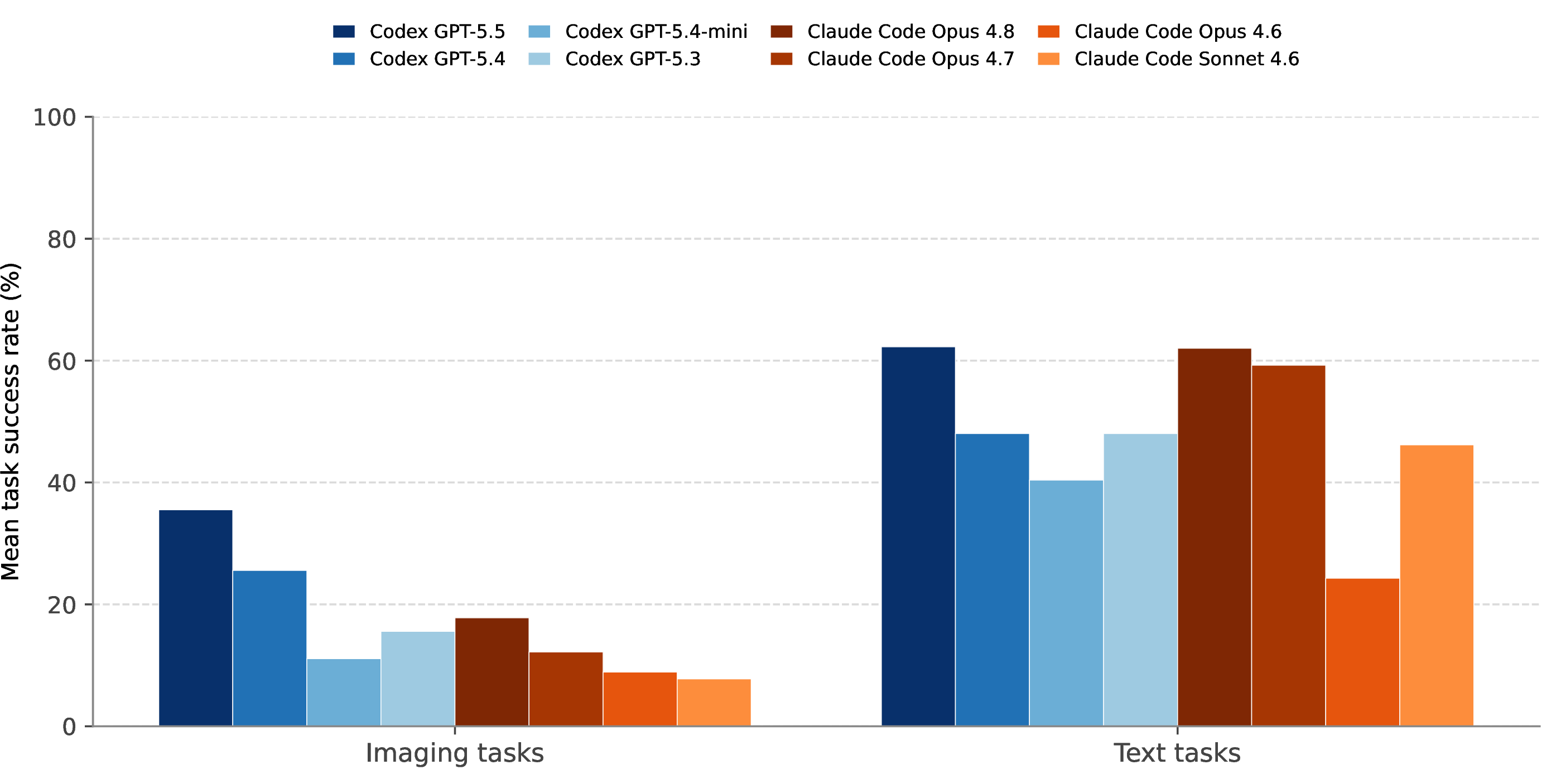
Medical imaging tasks (CT Abnormality Classification, X-ray Report Correction and Pathology Tumor Area Selection) pose significant challenges for every agent. Averaged across all codex and claude code agents, the mean success rate is only \(17\%\) on the imaging tasks versus \(49\%\) on the text tasks. The strongest agent on imaging (Codex GPT-5.5) averages only \(\sim\) \(35\%\) across the three imaging tasks and no agent exceeds \(40\%\) on any single imaging task category. This is expected as the agents are required to process specialized medical modalities and need to deal with excessive input size (for example a ct volume typically consists of hundreds of slices, and a pathology slide can be gigapixels in size). The agent needs to find a clever way to decompose the tasks into manageable chunks and design a good strategy to divide and conquer. While most of the agents struggle on these tasks, the codex GPT family shows an overall better performance than the Claude Code agents, and GPT-5.5 in particular shows a marked improvement. For example, on the Pathology Tumor Area Selection category GPT-5.5 succeeds on \(40\%\) of the tasks, well clear of every other agent (the best Claude Code agents, Opus-4.8 and Opus-4.6, reach only \(20\%\) and \(17\%\)). Inspecting its trajectory reveals a human-like, pathologist-style workflow for reviewing the whole slide: because it cannot view the gigapixel image directly, it reads the slide through the OpenSlide image pyramid and renders downsampled overviews and contact sheets aligned to the scoring grid, distinguishes carcinoma from benign lymphoid tissue morphologically rather than by a simple stain threshold, and then refines the tumor boundary tile-by-tile at full resolution, running an explicit “outside pass” over unclaimed high-tissue tiles to recover any missed regions before submitting (Appendix 11). Figure 13 shows one such successful slide, where GPT-5.5 recovers the entire tumor region with only two spurious tiles.
The divide between the Codex GPT family and the Claude Code family on imaging is also apparent (Figure 6): the Codex agents reach a \(22\%\) mean success rate on imaging against only \(12\%\) for the Claude Code agents, whereas on the four text tasks the two families are comparable (\(50\%\) vs.\(48\%\)). The two frontier Codex agents (GPT-5.5 and GPT-5.4) lead every Claude Code agent on imaging. This edge holds even though the Claude Code agents often take more turns and spend more per run, reinforcing that on these perception-heavy tasks the Codex models extract more signal per unit of effort. This likely drives the overall performance gain of Codex GPT-5.5 over Claude Code Opus-4.8 across the whole task suite. Overall, while there are emerging promises, the challenge from the imaging tasks is still significant, and the best agents are still far from clinically useful performance. Closing the gap to clinically useful accuracy will likely require tool augmentation or specialized vision backends rather than larger general-purpose agents alone.
5 Conclusion↩︎
We introduced HealthAgentBench, a unified, agent-native benchmark suite for evaluating healthcare AI agents across diverse data modalities and clinical workflows spanning the patient journey. The benchmark remains highly challenging for current frontier agents: even the strongest agent, Codex GPT-5.5, achieves a mean success rate of only 42% across the suite, leaving substantial room for future progress. Our evaluation of 10 frontier agents also reveals important strengths and limitations of current systems, highlighting persistent challenges in medical imaging, large search spaces, and complex compositional reasoning. While HealthAgentBench offers a practical interface for measuring and tracking progress in agentic AI for healthcare, we acknowledge that the benchmark is not exhaustive for all aspects of healthcare agents, and we encourage future work to add additional tasks and modalities to better capture the full spectrum of agentic AI capabilities in healthcare, and we hope it becomes a useful community resource for evaluating future healthcare agents.
6 Benchmark Comparison↩︎
Table ¿tbl:tab:related-work? gives the full per-benchmark comparison from which the positioning of Figure 2 is derived.
5.5pt
@llll@ Benchmark & Modality & Interaction & Workflow stage
MedAgentBoard [7] & text, EHR, 2D & static QA & diagnosis, comms, research, data
ClinicalAgent Bench [8] & text, EHR, 2D & static QA & diagnosis, data
HealthBench [9] & text & dialogue / simulation & comms, diagnosis
HealthBench Professional [10] & text & dialogue / simulation & comms, diagnosis, treatment, research
MAI-DxO [11] & text & dialogue / simulation & diagnosis
AgentClinic [12] & text, EHR, 2D & dialogue / simulation & diagnosis, comms
AI Hospital [13] & text & dialogue / simulation & diagnosis, comms
MedAgentSim [14] & text, 2D & dialogue / simulation & diagnosis, comms
CP-Env [15] & text & dialogue / simulation & diagnosis, treatment, comms
MedAgentBench [3] & EHR & executable & treatment, data
PhysicianBench [16] & text, EHR & executable & diagnosis, treatment, data
MedAgentGym [17] & text, EHR & executable & data, research
AutoMedBench [4] & 2D, 3D, WSI & executable & research
CamylaBench [18] & 2D, 3D & executable & research
HealthAdminBench [2] & GUI, EHR & executable & admin
& text, EHR, 2D, 3D, WSI & executable & diagnosis, treatment, data, research
7 The HealthAgentBench Benchmark Suite↩︎
HealthAgentBench is built around the Harbor execution substrate [23]: each task is packaged as a Harbor task with a standardized container environment with internet (for the agent to install dependencies etc.), agent-visible instructions, hidden test labels, and a verifier that emits both a binary success/failure reward and richer diagnostic metrics. The first release of HealthAgentBench integrates seven benchmark categories spanning EHR Format Conversion, EHR Event Modelling, EHR Data Quality Auditing, Clinical Trial Matching, X-ray Report Correction, CT Abnormality Classification, and Pathology Tumor Area Selection. Table 1 summarizes the seven task categories in the suite. The rest of this section describes each task category.
| Task Category | Modality | Task type | # tasks |
|---|---|---|---|
| EHR (MEDS) | Pipeline customization | 1 | |
| Imaging + text | Report correction | 10 | |
| Text | Eligibility matching | 9 | |
| 3D imaging | Abnormality detection | 10 | |
| Pathology WSI | Tumor area selection | 10 | |
| Longitudinal EHR | Clinical event prediction | 6 | |
| Tabular EHR | Data-quality auditing | 8 |
7.0.0.1 Success criteria.
Every task in HealthAgentBench reduces to a single binary success/failure outcome: a trial earns reward \(1\) only when it meets the task’s success criterion, and \(0\) otherwise. The criteria are defined per task category based on different underlying metrics (verifier checks, error counts, accuracy, F1, recall, and AUROC). The task success rates reported in Section 4 aggregate these binary outcomes across tasks. Table 2 summarizes the success criteria for every task category; the per-task-category Scoring paragraphs later in this appendix give the full details, and the per-task fine-grained metrics are reported in Appendix 9.
| Task Category | Success metric | Success criteria (reward \(=1\)) |
|---|---|---|
| Verifier checks | All config and output checks pass | |
| Significant errors | \(\geq 3/5\) judge votes report zero clinically-significant errors | |
| Recall@top-50 | All eligible trials ranked within the 50 most-confident picks (recall \(=1.0\)) | |
| Per-label accuracy | Every abnormality label correct (accuracy \(=1.0\)) | |
| Tile-level F1 | Tile-F1 against the gold tumor mask \(\geq 0.90\) | |
| Test AUROC | AUROC \(\geq\) the count+GBM baseline | |
| Cluster recall | Every injected error cluster flagged (recall \(=1.0\), precision \(\geq 0.01\)) |
7.0.0.2 Coverage across evaluation axes.
Beyond the per-task-category summary of Table 1, Figure 7 maps the seven task categories onto six orthogonal evaluation axes: input modality (2-D radiograph, 3-D CT, whole-slide pathology, free text, structured EHR), clinical workflow stage (diagnosis, treatment planning, data management, research), agent output shape (prose report, ranked list, classification, engineered solution), patient and temporal scope (single record vs. cohort, cross-sectional vs.longitudinal), data-access regime (local vs.credentialed on-the-fly download). A filled cell indicates the task category exercises that dimension along the axes. Most task categories occupy several dimensions within an axis at once—X-ray Report Correction, for instance, is both imaging and text and both single-patient and longitudinal. The "All tasks" row at the bottom of the figure shows that HealthAgentBench as a whole spans all dimensions.
8 Cost vs.performance trade-off↩︎
Section 4 notes that the best-performing agents are not the most expensive. Figure 8 makes this explicit by plotting each agent’s task success rate against the cost of running it over the full HealthAgentBench suite. The \(x\)-axis is the total USD cost of one full sweep over the suite on a log scale, and the \(y\)-axis is the pooled, trial-weighted task success rate (identical to Figure 4). The Pareto frontier is traced entirely by GPT-5 agents: GPT-5.4-mini, GPT-5.3, GPT-5.4, Copilot GPT-5.5, and Codex GPT-5.5 form the cost-optimal curve, while every Claude Code agent lies below-and-right of it (matched or beaten on success rate by a cheaper GPT-5 run).

9 Per-Category Performance Breakdowns↩︎
This appendix collects finer-grained, per-category performance breakdowns that complement the aggregate results in Section 4.
9.1 Per-category results: success rate, time, and cost↩︎
Figure 5 summarizes, for every (agent, task category) cell, three quantities at once—via colour, circle size, and the $ tier. Tables 3–[tbl:tab:per-cat-cost] report the exact values behind that figure so each cell can be read precisely. Table 3 gives the binary task success rate (%); Table ¿tbl:tab:per-cat-time? the mean wall-clock time per trial (minutes), a proxy for effort; and Table [tbl:tab:per-cat-cost] the mean cost per trial (USD). Every cell pools the three attempts on each instance in the category at xhigh reasoning effort, and the ten agents span the three harnesses (Codex, Claude Code, and Copilot CLI).
| Agent | X-ray | CT | Tumor | Trial | DQ | EHR | MEDS |
|---|---|---|---|---|---|---|---|
| Codex GPT-5.5 | 33 | 33 | 40 | 52 | 25 | 72 | 100 |
| Codex GPT-5.4 | 40 | 30 | 7 | 18 | 12 | 61 | 100 |
| Codex GPT-5.4-mini | 10 | 23 | 0 | 18 | 4 | 39 | 100 |
| Codex GPT-5.3 | 20 | 10 | 17 | 18 | 12 | 61 | 100 |
| Claude Code Opus 4.8 | 17 | 17 | 20 | 48 | 33 | 67 | 100 |
| Claude Code Opus 4.7 | 13 | 13 | 10 | 26 | 33 | 78 | 100 |
| Claude Code Opus 4.6 | 10 | 0 | 17 | 22 | 42 | 33 | 0 |
| Claude Code Sonnet 4.6 | 10 | 3 | 10 | 11 | 12 | 61 | 100 |
| Copilot GPT-5.5 | 27 | 23 | 13 | 44 | 42 | 67 | 100 |
| Copilot Opus 4.8 | 20 | 17 | 17 | 67 | 33 | 72 | 100 |
4.5pt
| Agent | X-ray | CT | Tumor | Trial | DQ | EHR | MEDS |
|---|---|---|---|---|---|---|---|
| Codex GPT-5.5 | 4 | 13 | 21 | 9 | 14 | 37 | 9 |
| Codex GPT-5.4 | 3 | 12 | 46 | 9 | 15 | 23 | 9 |
| Codex GPT-5.4-mini | 5 | 9 | 19 | 13 | 26 | 31 | 10 |
| Codex GPT-5.3 | 3 | 14 | 28 | 6 | 10 | 25 | 6 |
| Claude Code Opus 4.8 | 7 | 23 | 22 | 10 | 18 | 23 | 7 |
| Claude Code Opus 4.7 | 3 | 23 | 19 | 7 | 18 | 36 | 6 |
| Claude Code Opus 4.6 | 3 | 26 | 22 | 16 | 17 | 61 | 5 |
| Claude Code Sonnet 4.6 | 4 | 34 | 21 | 19 | 17 | 61 | 6 |
| Copilot GPT-5.5 | 3 | 17 | 23 | 14 | 13 | 48 | 7 |
| Copilot Opus 4.8 | 7 | 27 | 22 | 13 | 20 | 26 | 9 |
| Agent | X-ray | CT | Tumor | Trial | DQ | EHR | MEDS |
|---|---|---|---|---|---|---|---|
| Codex GPT-5.5 | 0.9 | 2.0 | 5.2 | 2.4 | 3.8 | 3.3 | 1.1 |
| Codex GPT-5.4 | 0.4 | 0.8 | 2.0 | 1.0 | 1.9 | 1.7 | 0.8 |
| Codex GPT-5.4-mini | 0.2 | 0.2 | 0.6 | 0.5 | 1.0 | 1.1 | 0.3 |
| Codex GPT-5.3 | 0.2 | 0.8 | 2.0 | 0.7 | 1.3 | 0.8 | 0.4 |
| Claude Code Opus 4.8 | 1.1 | 4.7 | 4.6 | 7.7 | 3.8 | 1.6 | 1.9 |
| Claude Code Opus 4.7 | 0.5 | 6.9 | 6.1 | 5.5 | 6.6 | 2.9 | 2.3 |
| Claude Code Opus 4.6 | 0.3 | 2.8 | 6.0 | 10.1 | 3.5 | 2.0 | 0.9 |
| Claude Code Sonnet 4.6 | 0.2 | 3.1 | 2.5 | 7.6 | 2.2 | 2.4 | 0.7 |
| Copilot GPT-5.5 | 0.6 | 2.2 | 4.3 | 3.1 | 3.8 | 1.8 | 1.1 |
| Copilot Opus 4.8 | 1.4 | 4.2 | 4.0 | 2.8 | 4.0 | 1.9 | 1.9 |
4.5pt
9.2 Task-specific scores↩︎
The headline task success rate reduces each task to a binary success/failure. Figure 9 reports the task-specific metric before converting to binary score except EHR Format Conversion, whose only score is the binary reward: mean accuracy for CT Abnormality Classification, tumor-tile F1 for Pathology Tumor Area Selection, mean recall for EHR Data Quality Auditing, mean recall@top-50 for Clinical Trial Matching, mean AUROC for EHR Event Modelling, and the mean count of significant errors for X-ray Report Correction(where lower is better). Each panel’s \(y\)-axis also notes the task’s success criterion.
9.3 EHR Data Quality Auditing: the cost of a large search space↩︎
Two further breakdowns isolate why EHR Data Quality Auditing is hard, and both point to the size of the search space rather than to any single difficult error type.
There are eight tasks in EHR Data Quality Auditing covering four scenarios: impossible clinical values, demographic conflicts, conflicting/duplicate cross-table records, and a combined task mixing all three. Each of the four scenarios in EHR Data Quality Auditing ships in two instruction variants over same data, labels, and scoring: a base task that names only the high-level error families, and a clue variant whose instructions additionally disclose the specific injected sub-types and name the table(s) to inspect for each. Figure 10 compares the two. Telling the agent where to look improves recall for every agent with the strongest agents reaching near-perfect recall once the table is disclosed (Claude Code Opus-4.8 climbs to \(0.97\)). That the same data becomes markedly more solvable when the search is narrowed confirms that locating the errors within eight tables and \({>}800\)k rows is the dominant bottleneck.
A complementary view asks whether targeting one error type at a time beats hunting for all of them at once. The combined task injects all three error families into a single corpus whose label set is exactly the union of the three single-error tasks, so the only difference is whether the agent triages everything in one pass or in three focused passes. Figure 11 contrasts the recall an agent achieves when the three single-error tasks are run separately and their catches pooled into one aggregated recall (true positives summed over the three tasks, divided by the pooled label count, averaged across the clue and no-clue variants) against its mean recall on the combined task. Decomposition helps every agent: splitting the same errors into focused passes recovers substantially more of them than confronting them all at once. This degradation under compositional load is a key challenge in EHR Data Quality Auditing.
9.4 EHR Event Modelling: AUROC vs.human engineered baseline↩︎
The EHR Event Modelling benchmark asks the agent to predict six new-onset diagnoses from a longitudinal EHR event log. Figure 12 compares the four strongest agents against two EHRSHOT reference points, both evaluated on the same first-prediction-time test cohort as the agents: the published CLMBR baseline (a frozen clinical language-model representation fed to a logistic-regression head) and a count+GBM baseline (a gradient-boosted classifier over hand-engineered count features). Given the 1 hour time budget, we use the count+GBM baseline as the pass bar as the neural-network-based CLMBR baseline is more expensive and time-consuming to run. We observe that the best agents can match or even exceed both baselines on most targets, with the exception of pancreatic cancer where the count+GBM baseline is the strongest reference.
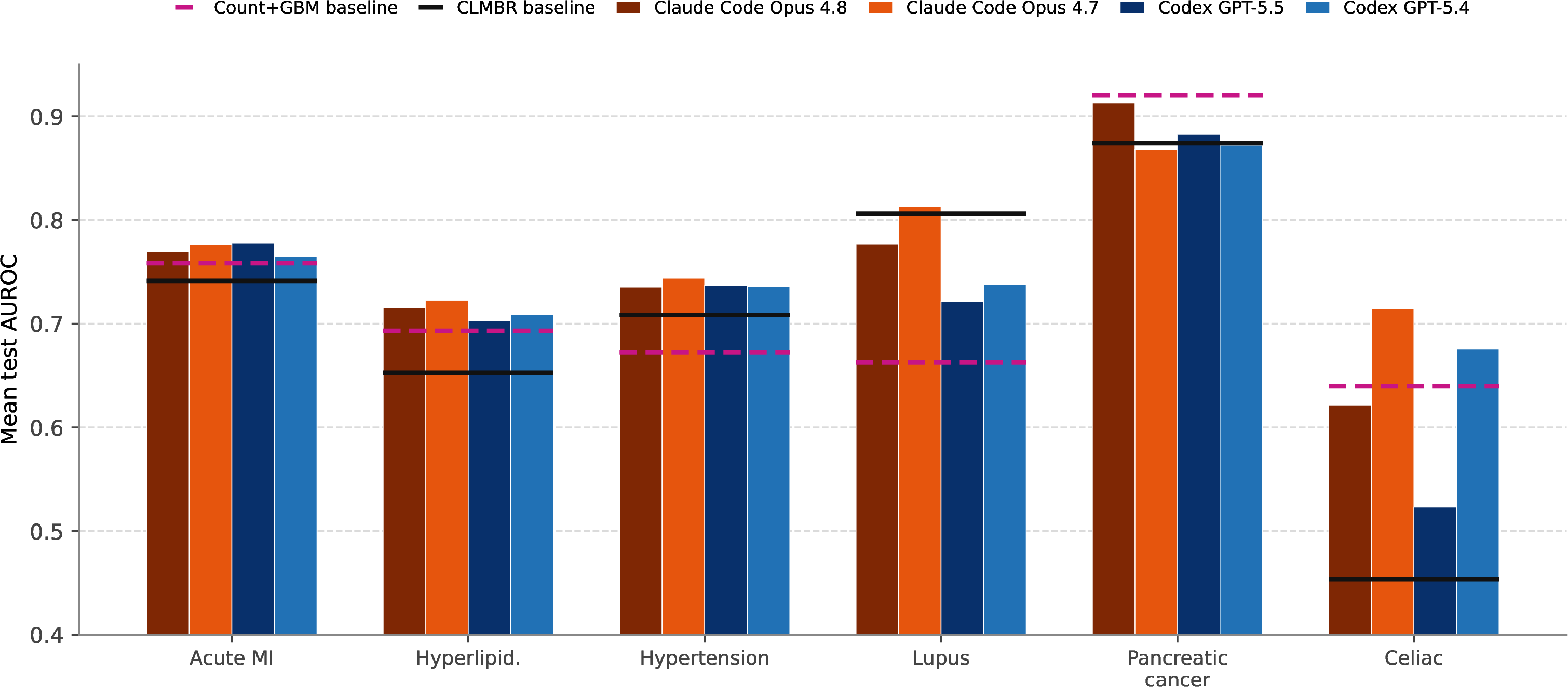
Figure 12: Per-task test AUROC on EHR Event Modelling: agents vs.the CLMBR and count+GBM baselines. Bars are each agent’s mean test AUROC across the six new-onset prediction targets. The solid black mark is EHRSHOT’s published CLMBR model’s performance on this testset ; the dashed magenta mark is the count+GBM baseline (gradient boosting over hand-engineered count features), which is the pass bar for the task. Both baselines are scored on the same first-prediction-time test cohort as the agents. Despite using only basic feature engineering, the best agent matches or exceeds the deep learning-based CLMBR baseline on every task (Both baseline numbers differ from those reported in the EHRSHOT paper [22] because we evaluate on a subset test cohort using strictly the first observation per patient to prevent leakage.).
10 HealthAgentBench Task Categories↩︎
10.1 EHR Format Conversion: EHR ETL pipeline customization↩︎
10.1.0.1 Tags.
Modality: EHR (MEDS standard target).
Workflow stage: Data Management.
Output shape: Directory tree (MEDS cohort parquet shards).
Data access: Public (MIMIC-IV demo).
Expert time-to-solve: 1–4 h
Number of Tasks 1
10.1.0.2 Motivation.
The task tests the agents for the ability to inspect a real open-source ETL repository and produces a config that changes the shape of an output cohort. Its contribution is not the upstream ETL codebase itself but the conversion of a fragmented, implementation-heavy healthcare workflow into a standardized, verifiable agent task.
10.1.0.3 Task setup.
Inputs (mounted read+write): unfamiliar upstream clone at
/workspace/MIMIC_IV_MEDS; demo input at/workspace/staged_demo/raw_input; writable/workspace/output/.Instruction (verbatim, given to the agent):
Use the codebase at
/workspace/MIMIC_IV_MEDSto run its ETL pipeline on the demo input at/workspace/staged_demo/raw_input. Inspect the default extraction configevent_configs.yaml, copy it tocustom_event_configs.yaml, and edit the copy — leaving the default config unchanged and the repo’s default wiring intact — then run the ETL with the new config for this run only. The customized cohort must no longer storeinsurance,language,marital_status, orraceas fields on the admission event, but record each as its own admission-time event (prefixesINSURANCE//,LANGUAGE//,MARITAL_STATUS//,RACE//); and must useOMR//for outpatient OMR measurements,HOSP_LAB//forhosp/labevents, andICU_CHARTEVENT//foricu/chartevents.Required actions: (i) create a new config by copying the default; (ii) edit the copy to produce the required transforms (admission demographics as timestamped events; OMR / HOSP_LAB / ICU_CHARTEVENT code-prefix families); (iii) run the pipeline with
uv; (iv) write the final cohort to/workspace/output/MEDS_cohort.Hidden (verifier-only): gold summary (
gold_demo_summary.json) and reference custom config (reference_custom_event_configs.yaml) under/tests/.Submission: the
/workspace/output/MEDS_cohort/directory tree.Limits: agent timeout 7200 s, verifier timeout 900 s, 4 CPUs, 8 GB RAM, 20 GB storage, internet allowed.
10.1.0.4 Data source.
Upstream:
MIMIC_IV_MEDS(Medical Event Data Standard) [32].Cohort: open MIMIC-IV demo (v2.2) [33], public.
10.1.0.5 Tasks in this Category.
- Count: 1 task.
10.1.0.6 Scoring.
Checks (in
verify_output.py): (a) default config is byte-identical to upstream; (b) custom config exists and parses; (c) required code-prefix families (INSURANCE//,LANGUAGE//,MARITAL_STATUS//,RACE//,OMR//,HOSP_LAB//,ICU_CHARTEVENT//) are present in the cohort metadata; (d) per-shard parquet row counts and canonical content hashes match the gold summary.Reward (Success Criterion): Completion of all checks (a)–(d) yields 1.0 (success); any failure on (a)–(d) yields 0.0 (failure).
Raw Per-trial Metrics: none beyond the binary reward (the verifier emits only success/failure).
Hash canonicalisation: rows are sorted on
(subject_id, time, code)before hashing, so the check is robust to harmless writer-side reordering.
10.1.0.7 Anti-cheat & leak-proofing.
Default-config integrity: check (a) prevents the agent from short-circuiting the task by patching the upstream’s default wiring.
Credential surface: none. The demo data is public.
10.1.0.8 Bootstrap & environment.
Compose pattern: single-service Docker.
Build-time work: Dockerfile clones upstream at pinned commit and runs
stage_demo_data.pyto download the demo dataset.Critical path:
uv syncinside the agent’s runtime; failure to install dependencies is a common error.
10.1.0.9 Baseline observations.
10 frontier models at xhigh effort, 3 attempts each. Nine of the ten score a perfect 3/3; only claude-opus-4-6 fails (0/3, $0.88), consistently dropping a demographic field from the output cohort. Among the passers, cost spans \(\sim\)8\(\times\) — from gpt-5.4-mini ($0.29) and gpt-5.3-codex ($0.37) up to claude-opus-4-7 ($2.34) — so the cheapest reliable pass is far cheaper than
the priciest at identical reliability.
10.1.0.10 Known failure modes.
Editing the default config in place instead of copying it.
Omitting one or more of the seven required code-prefix families.
Pointing the ETL run back at the default config.
10.1.0.11 Reference solution.
A human-authored reference custom config ships at scripts/ehr_to_meds_etl/assets/reference_custom_event_configs.yaml. It documents the intended seven-prefix layout and serves as the sanity-checking artifact for any change to the verifier’s
gold summary. The reference is mounted only to the verifier and is never agent-visible; agents that produce semantically-equivalent but textually-different configs are accepted by the canonical content-hash check in verify_output.py.
10.2 X-ray Report Correction: chest X-ray report correction↩︎
10.2.0.1 Tags.
Modality: Longitudinal Imaging (chest X-ray) + text.
Workflow stage: Diagnosis.
Output shape: Free-text radiology section (Findings).
Data access: PhysioNet credentialed (MIMIC-CXR).
Expert time-to-solve: 15–60 min
Number of Tasks 10
10.2.0.2 Motivation.
First multimodal, edit-correction benchmark in HealthAgentBench. The agent reviews a counterfactual draft Findings for a target chest X-ray study against the patient’s longitudinal imaging history and produces a corrected Findings that resolves the clinically-significant errors the draft introduces. Success requires repeated tool calls to inspect images, integration of visual observation with textual prior context, and structured-output discipline. HealthAgentBench’s contribution is the conversion of a real-world, multimodal clinical workflow into a verifiable agent task within the data environment of the patients’ longitudinal multimodal contexts.
10.2.0.3 Task setup.
Inputs (mounted at
/data/patient/with opaque IDs,study_NN_<timestamp>/view_NN.jpg): the patient’s prior studies (JPGs + free-text reports + timestamps); the target study’s non-generative sections (Examination, Indication, History, Technique, Comparison); and the counterfactual draft Findings (The draft is a perturbed version of the gold Findings that introduces contradictions by swapping the presence/absence of key findings, the location of findings, or the severity of findings, or the temporal changes without adding any new findings that the gold does not mention. The agent must correct the draft by removing the introduced errors without adding any new findings.)Instruction (verbatim, given to the agent):
A draft
FINDINGSsection for the patient’s most recent chest X-ray, written by a junior radiologist, is already populated in the target study’sreport.txt; review and correct it. You may edit existing sentences but may not* add statements about findings the draft did not already mention, and you submit only the correctedFINDINGS(no Impression). Use the chest-X-ray images and the prior studies’ reports to determine the correct findings. All data under/data/patient/belongs to one patient; each subfolder is one study, folders sort chronologically, and the highest-numberedstudy_NNis the target. Setfinal_answerin/workspace/submission.jsonto the corrected report, starting with a literalFINDINGS:header. You have up to 1 hour.*Required action: detect and correct the clinically-significant errors in the draft (editing existing sentences only, adding no new findings).
Output: JSON at
/workspace/submission.jsonwith afinal_answerstring that begins with a literalFINDINGS:header followed by the corrected Findings body (no Impression).Hidden (verifier-only): gold Findings at
/tests/target_report.txt; the corpus name and MIMIC subject IDs do not appear in any agent-visible path.Limits: agent timeout 3600 s, verifier timeout 900 s, 2 CPUs, 4 GB RAM, 10 GB storage, internet allowed.
10.2.0.4 Data source.
Corpus: MIMIC-CXR v2.1.0 [34] + MIMIC-CXR-JPG v2.1.0 [35]; verifier uses CheXprompt [36].
Access: PhysioNet credentialed.
Version pin: MIMIC-CXR v2.1.0 PhysioNet release.
10.2.0.5 Tasks in this Category.
Count: 10 cases (
case_01..case_10).Selection criteria: the 10 cases were manually reviewed so each gold FINDINGS is clinically accurate (zero clinically-significant errors per expert annotation); cases whose gold itself had factual issues (wrong lateralization/severity, missed hardware, hallucinated priors) were filtered out. The set deliberately mixes longitudinal patients with \(\geq\)1 prior study (cases 01–05, 07, 09, 10) and single-study patients with no prior (cases 06, 08). Each case’s draft FINDINGS is then synthesized at bootstrap by applying one or more documented swap principles (lateralization, severity, comparison-word flip, no-prior/no-change, count, location, negation) to the gold, introducing at least one clinically-significant error the agent must correct.
10.2.0.6 Scoring.
Per-trial: CheXprompt LLM-as-a-judge 5-vote majority on the submitted Findings vs.held-out gold.
Reward (Success Criterion): 1 iff \(\geq 3/5\) votes report zero clinically-significant errors.
Default judge:
gpt-5.4.Raw Per-trial Metrics: mean clinically-significant errors.
Gold Label Review: each case’s gold Findings were hand-reviewed against the paired chest X-ray and the patient’s prior imaging history to ensure they are factually supported and free of clinically-significant errors, so the gold is a reliable target for correction.
10.2.0.7 Anti-cheat & leak-proofing.
Two-service split:
bootstrapholds PhysioNet credentials (PN_USER,PN_PASS); themainagent service has none. Therefore, the agent cannot simply download the gold Findings from PhysioNet.ID opacity: the corpus name, MIMIC subject IDs, and study identifiers never appear in agent-visible filenames or paths.
gold target Findings are never agent-visible; they live only in the verifier.
10.2.0.8 Bootstrap & environment.
Compose pattern: two-service.
bootstrapfetches the credentialed PhysioNet release, extracts each case’s gold Findings to/tests/target_report.txt, enumerates and stages priors into/data/patient/, then terminates.Gating:
mainis gated on bootstrap’s clean exit via docker-compose’sservice_completed_successfullycondition.
10.2.0.9 Baseline observations.
10-row table, all at xhigh, 10 cases \(\times\) 3 attempts = 30 trials per model. Codex gpt-5.4 leads with a 0.400 mean success rate (12/30 successes, \(\$0.43\)/trial), and
also posts the fewest mean clinically-significant errors (1.46/case). Codex gpt-5.5 (0.333, $0.90) is more expensive without a quality gain. Copilot CLI’s gpt-5.5 is the strongest non-Codex agent (0.267, 8/30). Three models tie
for worst at 0.100 sucess rate (3/30 successes each): gpt-5.4-mini, claude-opus-4-6, and claude-sonnet-4-6. The split is driven by model family more than by harness: the four non-mini GPT-5 models (Codex
gpt-5.4/gpt-5.5/gpt-5.3 and Copilot gpt-5.5) take the top success rates and the four lowest mean clinically-significant-error counts (1.46–1.71/case), whereas every Claude-family agent (Claude Code
opus/sonnet and Copilot opus-4.8) trails on both (2.55–4.80 errors/case).
10.2.0.10 Known failure modes.
Agent introduces a new hallucinated finding while removing one of the draft’s errors.
Agent leaves a draft error in place because it disagrees with a prior study’s findings.
Submitted JSON does not parse, or
final_answeris missing the requiredFINDINGS:header.
10.3 Clinical Trial Matching: patient–trial eligibility matching↩︎
10.3.0.1 Tags.
Modality: Text (admission note + trial XMLs).
Workflow stage: Treatment Planning.
Output shape: Eligible NCT-ID set, confidence-ordered (plain text).
Data access: Public (TREC-CT 2021).
Expert time-to-solve: \(>\)8 h
Number of Tasks 9
10.3.0.2 Motivation.
A clinical-trial recruitment / eligibility-matching benchmark category in HealthAgentBench. This task category requires the agent to read a free-text patient admission note and a set of candidate clinical-trial XMLs, then identify all trials for which the patient is eligible. The agent must ensure that every inclusion criterion is met and no exclusion criteria are violated. The output is a list of eligible trial identifiers (NCT-IDs) ordered by confidence. This task tests the agent’s ability to understand complex medical eligibility criteria, extract relevant information from unstructured text, and make accurate eligibility determinations based on structured trial data. HealthAgentBench’s contribution is clinical matching task into an end-to-end workflow and provides the environment and evaluation framework to verify the agent’s eligibility determinations against physician-judged gold standards.
10.3.0.3 Task setup.
Inputs (mounted at
/workspace/data/, bind-mounted from a host cache): the patient admission note at/workspace/data/topic.txtand the topic’s judged-pool corpus of \(\sim\)300–450 ClinicalTrials.gov XMLs (standard schema) at/workspace/data/trials/<NCT_ID>.xml.Instruction (verbatim, given to the agent):
You are given a single patient’s free-text admission note and a directory of candidate clinical-trial documents. Identify all trials the patient is eligible for—i.e.relevant to the patient, meeting every inclusion criterion and none of the exclusion criteria. The patient note is at
/workspace/data/topic.txtand one trial per candidate at/workspace/data/trials/<NCT_ID>.xml(standard ClinicalTrials.gov schema). Write/workspace/submission/eligible_trials.txtwith one NCT identifier per line—all eligible trials and none the patient is excluded from—in descending order of your confidence. You have up to 1 hour; do not search the internet for benchmark answers.Required action: identify every trial the patient is eligible for, ordered by confidence.
Output: plain-text NCT-ID list (one per line, most-confident first) at
/workspace/submission/eligible_trials.txt.Tools: standard Python environment; XML parsing left to the agent.
Limits: agent timeout 3600 s, verifier timeout 300 s, 2 CPUs, 2 GB RAM, 4 GB storage, internet allowed.
10.3.0.4 Data source.
Corpus: TREC Clinical Trials 2021 track [37].
Access: public.
Pin: 75 topics; 35 832 physician-judged qrels; 400k-trial ClinicalTrials.gov snapshot dated 27 April 2021. See
design/related_work/clinical_trial_matching.md.
10.3.0.5 Tasks in this Category.
Count: 9 tasks selected from TREC 2021.
Selection criteria: The tasks are selected to cover patient profiles stratified across clinical specialties (ages 15–70, both sexes).
10.3.0.6 Scoring.
Raw Per-trial Metrics: mean
recall_top_50(recall from the agent’s top-50 most-confident picks).Reward (Success Criterion): a trial passes (reward 1) iff recall over the agent’s 50 most-confident picks equals \(1.0\) (every eligible trial is recovered within the top 50), else 0. We use recall rather than F1 or precision for determining the success criterion because in real-world trial recruitment, missing an eligible trial is a more critical failure than including some ineligible ones. To guard against the agent flooding the recall score by including a long tail of low-confidence picks, we impose the top-50 cutoff: the agent must rank all eligible trials within its 50 most-confident picks from around 400 trial pool to pass. The top-50 cutoff reflects the practical reality that trial recruiters typically only have the bandwidth to review a limited shortlist of candidates, and this will prefer agents who rank eligible trials higher rather than burying them in a long tail of low-confidence picks.
Gold Eligible Trials are judged by TREC’s physician annotators based on the trial’s XML and the topic’s admission note; To ensure no ambiguity of the eligible trials, we manually review the judged eligible trials again and remove trials that contain ambiguous and unverifiable inclusion criteria (e.g. "must be able to come to our hospital"). Each task contains 3–9 gold eligible trials (43 in total across the nine tasks).
10.3.0.7 Anti-cheat & leak-proofing.
The TREC corpus is public; we disable web browser and remove any corpus metadata from agent-visible paths to prevent shortcutting.
Gold eligible trials are never agent-visible; they live only in the verifier.
10.3.0.8 Bootstrap & environment.
Compose pattern: per-topic XML download uses HTTP range requests into
scripts/clinical_trial_matching/assets/raw_cache/(.gitignored).Concurrency control: a global host-side
flockplus a bootstrap-sentinel handshake serializes the fetch across concurrent containers so multiple agents on the same host do not duplicate downloads or race on the cache.
10.3.0.9 Baseline observations.
10 frontier models at xhigh effort, 9 tasks \(\times\) 3 attempts = 27 trials per model. Four agents separate from the field: Copilot CLI’s opus-4.8 leads at a 0.667 mean success rate (18/27), ahead of
gpt-5.5 (0.519, 14/27), claude-opus-4-8 (0.481, 13/27), and Copilot’s gpt-5.5 (0.444, 12/27); every other agent scores at or below 0.259. The same four top the soft recall_top_50 metric (all between 0.82
and 0.93).
10.3.0.10 Known failure modes.
Agent misreads exclusion criteria as inclusion-style language.
Agent triages with title and summary but misses eligibility details in the full XML.
10.4 CT Abnormality Classification: chest CT interpretation↩︎
10.4.0.1 Tags.
Modality: 3-D imaging (NIfTI volume).
Workflow stage: Diagnosis.
Output shape: Per-volume binary label vector.
Data access: HuggingFace gated under OpenRAIL (CT-RATE).
Expert time-to-solve: 1–4 h
Number of Tasks 10
10.4.0.2 Motivation.
3-D imaging benchmark in HealthAgentBench. Each task in this category require the agent to inspect a non-contrast chest CT volume and classify it for the presence or absence of a set of clinical findings. The agent must read the volume, interpret the imaging data, and produce a binary label for each requested finding. The tasks test the agent’s ability to process volumetric medical imaging data, recognize relevant anatomical structures and pathologies, and make accurate diagnostic classifications based on visual evidence. HealthAgentBench’s contribution is the conversion of a real-world, 3-D imaging clinical workflow into a verifiable agent task within the data environment of the patients’ imaging context. The agent environment provides freedom for agents to explore data and propose strategies (eg. with internet to download libraries etc.).
10.4.0.3 Task setup.
Inputs (mounted at
/workspace/data/): one non-contrast chest CT (NIfTI, 200–700 slices, Hounsfield units) at/workspace/data/scan.nii.gz, and a per-volume label list (one label per line, typically 4–12 categories) at/workspace/data/labels.txt.Instruction (verbatim, given to the agent):
You are working inside an environment that contains a single non-contrast chest-CT volume and a list of clinical findings to evaluate. For each listed finding, decide whether it is present or absent in the scan. Write a plain text file at
/workspace/submission/predictions.txtwith one<label>: yesor<label>: noline per requested label, using the exact name fromlabels.txt(case-insensitive); order does not matter. Solve using only the volume on disk; do not look up the dataset’s published labels or report. The reward is binary — every label must be correct. You have up to 1 hour.Required action: inspect the 3-D volume (the canonical path is
nibabel\(\rightarrow\) PNG slices \(\rightarrow\) multimodal view) and classify each requested label.Output: text file at
/workspace/submission/predictions.txt, one<label>: yes/noper line; order is irrelevant (the verifier matches by label name).Tools: standard Python environment with
nibabel,pillow,huggingface_hub.Hidden (verifier-only): gold labels at
tests/gold.json(gitignored, derived at bootstrap).Limits: agent timeout 3600 s, verifier timeout 300 s, 2 CPUs, 8 GB RAM, 8 GB storage, internet allowed.
10.4.0.4 Data source.
Corpus: CT-RATE [38] — 25 692 non-contrast 3-D chest-CT volumes paired with radiology reports; validation split of 3 038 volumes.
Access: HuggingFace gated under OpenRAIL;
HF_TOKENrequired at bootstrap.Version pin: CT-RATE validation split as of the dated snapshot in
design/related_work/ct_abnormality.md.
10.4.0.5 Trial construction.
Count: 10. Each task containes a volume from CT-RATE’s validation split.
Selection: The 10 tasks are selected to cover disease categories with a range from single disease to multiple diseases.
10.4.0.6 Scoring.
Reward (Success Criterion): all disease labels are predicted correct \(\rightarrow\) 1.0, any error \(\rightarrow\) 0.0.
Gold Label Review: each volume’s gold labels were hand-reviewed against the paired radiology report to ensure every positive and negative label has a verbatim evidence phrase.
Raw Per-trial Metrics: mean accuracy.
10.4.0.7 Anti-cheat & leak-proofing.
Token isolation:
bootstrapholds theHF_TOKEN;mainhas neither token nor report access. Therefore, the agent cannot simply download the gold labels from HuggingFace.Gold isolation:
tests/gold.jsonlives only inside the verifier volume.
10.4.0.8 Bootstrap & environment.
Compose pattern: two-service.
maindepends onbootstrap’s successful completion.Build-time data: bootstrap downloads 3.5 GB of NIfTI volumes (100–350 MB each) lazily into a shared host cache so re-runs on the same host avoid re-downloading.
10.4.0.9 Baseline observations.
10-row table, all at xhigh, 10 volumes \(\times\) 3 attempts = 30 trials per model. Codex gpt-5.5 attains the best success rate (10/30, 0.333). The other codex models follow: gpt-5.4 at 9/30
(0.300) and gpt-5.4-mini at 7/30 (0.233), tied with Copilot’s gpt-5.5 (7/30). They are ahead of the Claude-family agents (claude-opus-4-8 and Copilot opus-4.8 both 5/30, claude-opus-4-7
4/30).
10.4.0.10 Known failure modes.
Under-calling. The agent renders appropriate lung and mediastinal windows but, not seeing florid disease, defaults subtle findings (e.g.paraseptal emphysema, small nodules) to “absent” — so real findings are missed.
Over-calling. Conversely — most often in the weaker models — the agent flags findings that are not present, adding false positives that likewise break the exact-match reward (e.g.a Sonnet-4.6 trial that caught the one real finding, lung opacity, but additionally marked cardiomegaly, pericardial effusion, and lymphadenopathy present, scoring \(0.25\) accuracy and reward \(0\)). Over-calling is roughly as common as under-calling across the sweep: \(85\) failed trials are pure false-positive errors.
10.5 Pathology Tumor Area Selection: pathology whole-slide reasoning↩︎
10.5.0.1 Tags.
Modality: Pathology whole-slide image (gigapixel).
Workflow stage: Research/Diagnosis.
Output shape: Tumor-tile coordinate set (JSON).
Data access: Public (CAMELYON16).
Expert time-to-solve: 1–4 h
Number of Tasks 10
10.5.0.2 Motivation.
Delineating the tumor area from surrounding tissue is a fundamental first step in numerous pathology workflows, and it underpins a wide range of downstream research and clinical applications biomarker quantification, grading, and the extraction of tumor-specific morphological features. The task is challenging for several reasons. First, whole-slide images are gigapixel in scale, on average around \(100{,}000 \times 100{,}000\) pixels, which makes exhaustive inspection infeasible and forces multi-resolution reasoning: candidate regions are located at low magnification and confirmed at high magnification. Second, tumor is often sparse, or present only as small foci (e.g., micro-metastases or isolated tumor-cell clusters) that are easily missed. Third, the boundary between tumor and normal tissue is frequently ambiguous on hematoxylin and eosin (H&E) staining alone, such that even expert annotations are typically aided by immunohistochemical restaining. These properties make tumor delineation a non-trivial, decision-intensive task that requires actively navigating the slide, selectively inspecting local regions, and integrating evidence under a finite inspection budget. The HealthAgentBench contribution is turning CAMELYON16 into a reproducible Harbor-first agentic task with one task per slide, hidden gold segmentation, and pooled tile-level aggregate metrics. We do not require dense pixel-level segmentation; instead, the agent selects the grid tiles it believes contain tumor which is enough in many downstream research tasks. Note that CAMELYON16 comprises lymph-node whole-slide images from breast-cancer patients, and its reference masks delineate metastatic breast carcinoma deposited in the node rather than a primary tumor. Because a metastasis is itself neoplastic tumor tissue, we treat these annotated regions as the tumor area to be selected, and “tumor-area selection” here corresponds to localizing nodal tumor (metastatic) deposits.
10.5.0.3 Task setup.
Inputs (mounted into the environment): one whole-slide pathology image at
/data/slide/current/slide.*(pyramidal.tif, read via OpenSlide/tifffile) and the analysis-grid metadata in the public task row/workspace/benchmark_tasks.json.Instruction (verbatim, given to the agent):
You are working in a pathology task environment. The current whole-slide image is at
/data/slide/current/slide.*, a public task row at/workspace/benchmark_tasks.json, and an editable submission at/workspace/submission.json. The analysis grid uses256x256tiles at downsample 16, so each grid tile spans4096x4096full-resolution (level-0) pixels. Identify all and only the tiles that contain tumor and populatepredicted_tumor_tileswith objects of the form{"x": <int>, "y": <int>}using integer grid coordinates; treat non-tissue tiles as non-tumor. You have a budget of 1.5 hours; do not look up solutions online and do not train or fine-tune models.Required action: predict the complete set of tumor tiles on the fixed \(256\times 256\) grid at down-sample 16; a tile is “tumor” if \(\geq 20\%\) of its area is tumor.
Output: JSON at
/workspace/submission.jsonwithpredicted_tumor_tiles, a list of{x, y}grid-coordinate objects. (Acontains_tumorboolean is also recorded but is not scored here.)Tools: by default—the configuration used for our baselines—the agent reads the slide itself via OpenSlide/tifffile with no helper scripts;.
Hidden (verifier-only): gold tumor masks under
/tests/(never mounted intomain).Limits: agent timeout 5400 s, verifier timeout 3600 s, 2 CPUs, 8 GB RAM, 20 GB storage, internet allowed.
10.5.0.4 Data source.
Corpus: CAMELYON16 (AWS S3 public mirror at
s3://camelyon-dataset/CAMELYON16/); slides are pyramidal.tifread via OpenSlide.Access: public, no credentials.
10.5.0.5 Tasks in this Category.
Count: 10 tasks with each contains a CAMELYON16 tumor slide
Selection: The slides inherit a range of tumor sizes from CAMELYON16 (gold regions span \(\approx\)20–160 tiles) and varied metastasis morphology; smaller deposits are missed even by strong agents.
10.5.0.6 Scoring.
Reward (Success Criterion): Calculate tile-level F1 of the predicted tile set against the hidden gold mask; a trial passes (reward 1.0) iff tile-F1 \(\geq 0.90\), else 0.0. We choose 0.9 F1 rather than 1.0 F1 to allow for some small differences due to ambiguity in the tumor boundary.
Raw Per-trial Metrics: tile-level F1.
10.5.0.7 Anti-cheat & leak-proofing.
Gold isolation: gold tumor masks live under
/tests/(verifier-only).Credential surface: none (datasets are public).
10.5.0.8 Bootstrap & environment.
Compose pattern: two-service (one-shot
bootstrapthenmain), with lazy public-data download intoscripts/tumor_area_selection_pathology/assets/raw_cache/(gitignored shared host cache).Cache sharing: multiple containers on the same host share the cache so the gigapixel slides download once per host, not once per trial.
10.5.0.9 Baseline observations.
10 frontier models at xhigh effort, 10 tasks \(\times\) 3 attempts = 30 trials per model. gpt-5.5 leads, passing 12/30 (mean success rate 0.400) at the highest tile-F1 (0.845), and is the only agent above
0.30. claude-opus-4-8 follows at 0.200 (6/30); a cluster of three sits at 0.167 (5/30): claude-opus-4-6, gpt-5.3-codex, and Copilot’s opus-4.8, and the rest trail from there (Copilot’s
gpt-5.5 4/30; claude-opus-4-7 and claude-sonnet-4-6 3/30; gpt-5.4 2/30; gpt-5.4-mini 0/30). The pass gate (tile-F1 \(\geq 0.90\)) is demanding:
gpt-5.4-mini attains 0.967 tile recall but only 0.320 precision (it over-selects tiles), so its tile-F1 (0.481) never clears the bar.
10.5.0.10 Known failure modes.
Agent skims via thumbnail and misses small tumor foci.
Agent over-segments tissue artifacts as tumor.
Agent confuses adjacent benign tissue (e.g.inflammation) with tumor.
10.6 ehrshot: longitudinal clinical event prediction↩︎
10.6.0.1 Tags.
Modality: Longitudinal EHR timeline (tabular events).
Workflow stage: Research
Output shape: Per-patient probability (CSV).
Data access: Redivis-gated (Stanford STARR via EHRSHOT).
Expert time-to-solve: 4–8 h
Number of Tasks: 6
10.6.0.2 Motivation.
This task category challenges the agents with longitudinal clinical event prediction in HealthAgentBench. The agent must learn a prediction rule from labelled training data and apply it to an unlabelled held-out test set. The HealthAgentBench contribution is packaging the EHRSHOT raw-timeline benchmark as a reproducible Harbor-first task family with one-click container-side data download, hidden test labels enforced by docker-compose volume topology, mechanical leak-proofing on the event slice, and pass-the-baseline success/failure gates.
10.6.0.3 Task setup.
Inputs (mounted at
/data/): training labels (train_labels.csv), validation labels (val_labels.csv), an unlabelled test set (test_examples.csv, no labels), and a per-task leak-proof slice of the longitudinal event log (events.csv; for test patients only events with \({\rm start} < T_{\rm first}\) are kept). Notice that the test set differs from the original EHRSHOT test set: we take the original test set and only retain the first prediction-time event slice for each test patient, so the agent must predict from partial timelines without any future information.Instruction (verbatim; the hyperlipidemia target shown):
Predict whether the patient will have their first diagnosis of hyperlipidemia (code
SNOMED/55822004and its ontology children) within the next year. Predictions are made at 11:59 PM on the day of discharge from an inpatient visit; discharges where the patient already has the diagnosis are ignored. Learn a strategy from the labelledtrainandvalsplits and apply it to a held-outtestsplit given without labels, using only events withstartbefore each prediction time. Write/workspace/submission/predictions.csvwith columnspatient_id,prediction_time,probability(continuous in \([0,1]\)). Scored by AUROC. You have 1 hour and internet access.Required action: learn a prediction strategy from train + val, apply to the test set.
Output: per-patient probabilities at
/workspace/submission/predictions.csv, columnspatient_id,prediction_time,probability; scored by AUROC.Hidden (verifier-only): test labels live on a
/tests/mount that is not mounted intomain; the Redivis API token never reachesmain.Limits: agent timeout 3600 s (1-hour budget), verifier timeout 300 s, 16 CPUs, 64 GB RAM, 65 GB storage. Internet enabled inside main.
10.6.0.4 Data source.
Corpus: EHRSHOT [22] on the Stanford STARR EHR cohort (6 739 patients, 41.6M observations).
Access: Redivis-gated; access via
~/.redivis/api_token.Pin: 4 GB Redivis bundle per task slice. See
design/related_work/ehrshot_2307.02028.md.
10.6.0.5 Tasks in this Category.
Count: 6 tasks
Selection Criteria We select 6 tasks from EHRSHOT benchmark that focus on new-onset diagnosis predictions (hyperlipidemia, celiac disease, acute myocardial infarction, pancreatic cancer, systemic lupus (SLE), essential hypertension).
10.6.0.6 Scoring.
Reward (Success Criterion): AUROC is computed on agent’s submission against the held-out test labels. 1 iff AUROC \(\geq\) the task’s count+LightGBM baseline (per-task baseline JSON hardcoded in the generator), else 0.
Raw Per-trial Metrics: test AUROC.
10.6.0.7 Anti-cheat & leak-proofing.
Event-slice integrity: for test patients, events are kept only where
start < T_first(the patient’s first prediction time) and any futureendvalue is blanked; train/val patients keep their full timelines.Test-label isolation: test labels are never committed to git; bootstrap writes them to a
/tests/mount thatmaindoes not see.
10.6.0.8 Bootstrap & environment.
Compose pattern: two-service.
bootstrapreads~/.redivis/api_token, downloads the 4 GB bundle, slices the event log, partitions splits, writes test labels to/tests/, and terminates.Resource profile: 16 CPUs, 64 GB RAM, 65 GB storage — the most expensive task in the suite.
10.6.0.9 Baseline observations.
10 frontier agents at xhigh effort, 6 targets \(\times\) 3 attempts = 18 trials per agent. claude-opus-4-7 leads at a 0.778 mean pass rate (14/18), with Codex gpt-5.5 and Copilot’s
opus-4.8 next (both 0.722, 13/18) and claude-opus-4-8 and Copilot’s gpt-5.5 just behind (both 0.667, 12/18); three more tie at 0.611 (11/18): claude-sonnet-4-6, gpt-5.3-codex, and
gpt-5.4. gpt-5.4-mini trails at 0.389 (7/18), and the weakest, claude-opus-4-6, passes only 0.333 (6/18), incurring 7 agent timeouts at the longest wall-clock in the suite. Mean test AUROC is tightly bunched
(0.72–0.77) across all agents, so the pass-the-baseline gate, rather than raw discrimination, drives the spread. Per-trial cost ranges from $0.80 (gpt-5.3-codex) to $3.32 (gpt-5.5).
10.6.0.10 Known failure modes.
Overfitting on rare outcomes. With few positives (e.g. celiac disease has only \(\sim\)11 validation positives), the agent tunes a feature/ensemble blend that scores well on its own validation but collapses on the held-out test set — GPT-5.5’s best celiac model fell from \(\sim\)0.74 validation AUROC to \(0.30\) on test, below chance.
Self-inflicted validation leakage. The agent’s own evaluation harness leaks (e.g.ensemble scores bleeding across folds), inflating its AUROC estimate and masking the generalization gap until the held-out test exposes it.
Resource exhaustion. Weaker agents time out while streaming the multi-gigabyte event log (
events.csvis \(\sim\)2.1 GB) and produce no submission.
10.7 EHR Data Quality Auditing: EHR data-quality auditing↩︎
10.7.0.1 Tags.
Modality: Tabular EHR.
Workflow stage: Data Management
Output shape: Flagged-row CSV (
table,_row_id).Data access: Public (MIMIC-IV demo + synthetic errors).
Expert time-to-solve: \(>\)8 h
Number of Tasks: 8
10.7.0.2 Motivation.
This task category introduces a data-quality auditing benchmark in HealthAgentBench. The agent acts as an auditor of a structured EHR dataset, flagging rows that violate clinical plausibility. The HealthAgentBench contribution is a deterministic, reproducible synthetic-error benchmark with hidden labels, source-name obfuscation, and scoring that combines cluster-level recall with row-level precision.
10.7.0.3 Task setup.
Inputs (mounted at
/workspace/data/csv/): the corrupted EHR-demo subset as gzipped CSVs (<table>.csv.gz), spanning 8 hospital and ICU tables. The corruptions are generated by a deterministic synthetic-error recipe seeded at Docker build time including the following error types: impossible values (range-extreme, decimal-shift, unit-confusion, and unit-label mismatch), inconsistencies (conflicting/duplicate records both in-table and cross-table), and demographic contradictions (patient demographics that contradict other records).Instruction (verbatim; the demographic-conflict task shown):
You are working inside a task environment that contains a copy of an EHR dataset under
/workspace/data/. Do a data-quality check and flag data-entry errors belonging to certain error categories. Flag all errors in the category demographic contradictions* — the patient’s recorded demographic information contradicts other evidence about that patient. Submit a CSV at/workspace/submission/flagged_rows.csvwith columnstableand_row_id. You have up to 1 hour; do not look up solutions on the internet.*Instruction disclosure: the base instruction names the error family but not its sub-types; the
_cluesvariant additionally discloses the sub-types and the tables to inspect.Required action: flag rows the agent believes are problematic.
Output: CSV with the schema
table,_row_idat/workspace/submission/flagged_rows.csv.Limits: agent timeout 3600 s, verifier timeout 600 s, 2 CPUs, 4 GB RAM, 10 GB storage, internet allowed.
10.7.0.4 Data source.
Corpus: MIMIC-IV demo (v2.2) [39] with a deterministic synthetic-error injection recipe applied at Docker build time.
Pin: the synthetic-error recipe is seeded; gold is derived alongside the corruption.
10.7.0.5 Tasks in this Category.
Count: 8 tasks
Task Names: four base subtasks plus an instruction-disclosure (
_clues) variant of each. The four base subtasks are:task_impossible_value,task_inconsistency,task_demographic_conflict, andtask_combined. Thetask_combinedtask mixes all three error families. The_cluesvariant of each subtask is identical in data, labels, and scoring but the instruction additionally names the injected sub-types and the tables to inspect.
10.7.0.6 Scoring.
Reward (Success Criterion) a trial passes iff cluster-level recall is \(1.0\) (every injected error cluster has at least one flagged member). We choose recall as there could be already be errors in the real database. To guard against the agent flooding the submission with false positives, we also require that precision is at least \(0.01\);
Raw Per-trial Metrics: mean cluster-level recall. A cluster is a set of rows that are all part of the single injected error (e.g., a set of conflicting records). The mean cluster-level recall is computed as the fraction of clusters for which at least one row was flagged by the agent.
Gold: compared against a hidden gold set produced by the error-injection recipe. We manually review each error to ensure it is genuine error which should be flagged.
10.7.0.7 Anti-cheat & leak-proofing.
Source-name obfuscation: agent-visible CSV filenames are renamed; the term “MIMIC” does not appear in any agent-visible path.
Instruction-level prohibition: the agent is told not to fetch the upstream dataset; combined with source-name obfuscation, this is the live defense against pulling a clean copy. (A planned
/etc/hostsegress block is not currently active, since/etc/hostsis read-only at image-build time.)
10.7.0.8 Bootstrap & environment.
Compose pattern: single-service Docker.
Build-time work: demo CSVs are downloaded and corrupted deterministically at build time using a seeded synthetic-error recipe; the gold set is computed alongside and held by the verifier.
10.7.0.9 Baseline observations.
10-row table, all at xhigh, 8 tasks \(\times\) 3 attempts = 24 trials per model. claude-opus-4-6 and Copilot’s gpt-5.5 lead, tied at a 0.417 mean success rate (10/24), with
claude-opus-4-7, claude-opus-4-8, and Copilot’s opus-4.8 next at 0.333 (8/24) and Codex gpt-5.5 at 0.250 (6/24); the remaining codex models and claude-sonnet-4-6 sit at 0.125 or below. No
agent clears 0.42, making this one of the hardest benchmarks in the suite. The pooled mean recall gives us a different angle: most agents recover the large majority of injected error clusters (the strongest exceed 0.85 mean recall), yet rarely catch
every cluster in a task. Because the pass gate requires cluster recall \(=1.0\), these high-recall-but-incomplete runs still score 0.
10.7.0.10 Known failure modes.
Agent under-flags: misses subtle conflicting/duplicate records.
No agent over-flags to reach the precision floor of 0.01.
11 Trajectory Analysis for Successful Trials↩︎
To qualitatively understand how the strongest agents solve HealthAgentBench tasks, we sampled, for every benchmark category, the best-performing agent’s trajectories which capture every reasoning message, shell command, and observation). This appendix walks through one representative success trajectory per task category and summaries the strategy each agent used.
A behavioral signature recurs across all seven task categories: the strongest agents spend the majority of their steps orienting and verifying, enumerating the workspace, reading source/data, and checking their own intermediate output, rather than generating code or answers blindly. The per-category subsections below make this concrete.
11.1 EHR Format Conversion: minimal scoped config override↩︎
Best agent: Codex GPT-5.5 (success rate \(100\%\); \(59\) steps, $\(1.01\)). The task asks the agent to make a MIMIC-IV\(\rightarrow\)MEDS ETL emit a cohort whose admission demographics become separate admission-time events and whose measurement domains carry distinct code prefixes. The agent opens by stating its plan—“inspect the repo wiring and config first, then make the smallest scoped change”—and spends the first third of the run reading before any edit:
pwd && rg --files                                   # enumerate the repo
sed -n '1,240p' .../configs/event_configs.yaml      # read default config
find /workspace/staged_demo/raw_input -type f       # inspect staged input
cp .../event_configs.yaml .../custom_event_configs.yaml   # copy, don't edit
It then patches only the copied config and a CLI override (“the default YAML remains untouched and still remains the fallback”), runs the ETL, and validates the produced parquet contents—not just the exit code—before a final
git status sweep to leave a minimal diff. This “orient \(\rightarrow\) scope \(\rightarrow\) execute \(\rightarrow\) verify \(\rightarrow\) clean” loop is the template the other tasks vary on.
11.2 Clinical Trial Matching: triage, then parallel eligibility adjudication↩︎
Best agent: Copilot CLI Opus 4.8 (success rate \(67\%\)); the sampled task_19 trial retrieves 1.0 recall). Facing \(301\) candidate trial XMLs for one
patient—a 65-year-old man with CAD and prior MI, recurrent sustained monomorphic VT, syncope, symptomatic bradycardia, and a resuscitated cardiac arrest, admitted for catheterization and an electrophysiology study—the Opus-4.8 orchestrator does not read
every trial itself; it triages with code, then fans the eligibility decision out to parallel subagents:
Scripted triage. It writes a chain of inline Python passes over all \(301\) XMLs—parsing each trial’s title, conditions, age/sex limits, and criteria; applying hard demographic filters (age \(65\), male); scoring relevance against cardiology keyword groups (VT/arrhythmia, ICD/SCD, syncope, CAD/MI, cath/PCI, HF, HTN, HLD); and splitting the surviving relevant subset into five disjoint batches.
Parallel adjudication. It spawns five background
general-purposesubagents, one per batch, each prompted as a “clinical trial eligibility adjudicator” with a structured patient profile. Crucially, that profile spells out what the patient does not have— “no atrial fibrillation…does NOT currently have an ICD or pacemaker (only a loop recorder)…NOT nonischemic cardiomyopathy”—so each subagent applies the exclusion criteria consistently across its batch.Merge and re-verify. It collects each subagent’s verdicts, then re-reads the full eligibility text of the surviving and borderline trials itself (e.g.pulling DAVID II’s criteria in full) to resolve edge cases, before writing
eligible_trials.txtin descending confidence with a documented patient summary and validating that every NCT ID resolves to a real trial file.
This parallel-subagent orchestration is the opposite of the single-threaded Codex agent (the next-best, task success rate \(52\%\)), which reads far fewer trials but the right ones in one context. Opus-4.8 instead triages broadly with code, parallelizes the per-trial adjudication, then re-checks the borderline calls centrally. Because the pass gate rewards recall (every eligible trial recovered), the broad-then-verify fan-out pays off: it recovers all four gold-eligible trials (recall \(1.0\), a pass) at the cost of precision (\(0.40\); six false positives among ten picks).
11.3 EHR Event Modelling: leakage-safe ML pipeline↩︎
Best agent: Claude Code Opus-4.7 (success rate \(78\%\); the sampled trial passed with auroc above baseline). The agent must build a machine-learning pipeline over a multi-gigabyte event log and beat a
baseline AUROC. Its summary captures the shape: “Loaded 29M events with pyarrow (\(\sim\)8s) and built per-patient sorted timelines; extracted features for each (patient, prediction-time) pair” using only pre-cutoff events.
Codex GPT-5.5 solves it the same way at comparable quality, narrating the key engineering decisions: it probes the installed stack (“XGBoost is installed, LightGBM…unusable because libgomp is missing”), uses Polars lazy joins to relate the
29.3M-row log to the prediction-row table by patient and pre-cutoff time (“\(42.2\)M pre-cutoff event-row pairs…in about 2.4 seconds”), enforces the anti-leakage cutoff inside the feature table to construct clean
train data for generalization. Both agents win by treating data leakage as a structural invariant to construct train data rather than an afterthought.
11.4 CT Abnormality Classification: multi-window rendering and noise control↩︎
Best agent: Codex GPT-5.5 (success rate \(33\%\); the sampled trial passed with 1.0 accuracy). Because the agent cannot see the 3-D volume directly, its entire strategy is to manufacture the right
views: it reads voxel spacing, then renders cropped lung- and mediastinal-window contact sheets, axial/coronal/sagittal reformations, and—to fight non-contrast noise—“small z-slab mean images through the mediastinum,” supplemented by HU measurements
on suspected fluid pockets. It reasons per label (effusions, hiatal hernia, lymphadenopathy, lung opacity/consolidation), makes deliberately conservative binary calls when evidence is ambiguous, and finishes with a format check that every
requested label appears exactly once with a yes/no value. The bottleneck is perceptual grounding, and the agent’s edge comes from disciplined view generation rather than extra search.
11.5 Pathology Tumor Area Selection: multi-resolution tiling and morphology-driven calls↩︎
Best agent: Codex GPT-5.5 (success rate \(40\%\); the sampled slide_0001 trial passed with \(0.967\) tile f1), \(163\)
true-positive tiles and no misses). The agent must mark which tiles of a gigapixel pathology whole-slide image contain tumor, scored on tile F1 and tumor coverage. As in CT Abnormality Classification, it cannot view the slide directly, so its whole
strategy is to manufacture aligned views at multiple magnifications and then reason morphologically:
It reads the slide through the OpenSlide pyramid and renders views at several levels aligned to the scoring grid—a low-power (level-\(6\)) overview with the tile grid labelled, plus level-\(4\) and level-\(2\) contact sheets per region—stating it will “generate downsampled views aligned to the 4096-pixel grid so the tumor tile calls can be made against the required coordinates.”
It distinguishes tumor from confounders by histology rather than by a color threshold: “tumor versus lymphoid tissue has to be decided morphologically,” identifying “the large left mass is carcinoma, while the upper trabeculated/dark areas are largely lymphoid or non-tumor,” and computing per-tile tissue/stain fractions only to avoid over-calling low-tissue margins.
It then refines the boundary tile-by-tile—inspecting the ambiguous “transition row…where carcinoma along the lower edge” mixes into lymphoid tissue at full level-\(2\) resolution—and runs an “outside pass” over high-tissue tiles it had not yet claimed to catch any overlooked carcinoma, overlaying the final selection on the overview before writing the tile coordinates to
submission.json.
The trajectory mirrors CT Abnormality Classification almost exactly: the bottleneck is perceptual grounding, and the agent’s edge comes from disciplined multi-resolution view generation and patient edge refinement rather than any learned classifier—no model is trained; every call is a visual judgement on a rendered tile. Figure 13 shows the outcome of this strategy on one slide, where Codex GPT-5.5 recovers the whole tumor region with only two spurious tiles (tile-F1 \(0.967\)).

11.6 X-ray Report Correction: read priors, let the image decide↩︎
Best agent: Codex GPT-5.4 (task success rate \(40\%\)). We sampled one success trajectory with just \(24\) steps, $\(0.314\). This is the
most economical passing trajectory in the suite. The agent identifies the target study, reads the draft FINDINGS and the prior reports to enumerate the claims at issue, then consults the chest radiograph to resolve the specific
contradictions rather than rewriting wholesale: “The image confirms severe hyperinflation / emphysematous change without acute focal airspace disease, pleural effusion, or pneumothorax.” It edits only the contradicted sentences, then does a JSON
read-back. The discipline of grounding each correction in the image (and touching nothing else) is exactly what the edit-only scoring rewards.
11.7 EHR Data Quality Auditing: scripted detection with iterative recall recovery↩︎
Best agent: Claude Code Opus-4.6 (success rate \(42\%\); the sampled task_demographic_conflict trial passed with full recall of errors). The agent inspects the eight gzipped tables, then
writes and iteratively refines a Python detector for demographic contradictions:
for f in /workspace/data/csv/*.csv.gz; do zcat "$f" | head -3; done   # schema
python analyze.py        # first detector pass
python analyze2.py       # deeper: gender-specific labs, ref ranges, heights
python analyze3.py       # final comprehensive sweep
Its strength is recall recovery through iteration: after an initial pass it deliberately “digs deeper into gender-specific lab tests…and other demographic contradictions,” catches missed Hemoglobin rows for two patients, discovers an additional gender-mismatched patient on a later sweep, and only then rebuilds the submission—verifying every flagged row id exists in the source. This pays off on a single error family but, as Section 4 and Appendix 9 show, no agent sustains it across the combined task.
11.8 Common themes↩︎
Two qualitative patterns hold across all seven tasks. First, verification is a first-class activity: successful agents read source and produced artifacts, re-check borderline decisions, and sweep their diffs, spending far more steps on checking than on writing. Second, the strategy is shaped to the task’s true bottleneck—minimal config overrides for ETL, scripted triage followed by criterion-level reasoning for trial retrieval, leakage-safe joins for prediction to construct train and validation set, multi-resolution view generation for the imaging tasks (CT windowing and whole-slide tiling), image-grounded edits for report correction, and iterative recall recovery for data-quality auditing.
References↩︎
Our choice of a terminal interface is motivated by evaluation rather than deployment. In practical clinical systems, agents could operate in the backend through a terminal or execution environment while presenting their outputs through clinician-facing graphical interfaces.↩︎
costs are extracted either from the providers’ own billed costs or calculated using public API pricing by Harbor Framework.↩︎