Probe Choice Changes Canary-Memorization Verdicts: Three Post-Hoc Disagreement Case Studies in a Text-Dominant LoRA-Tuned Autoregressive Testbed
June 30, 2026
Abstract
We audit a fixed prefix-window mean-NLL memorization probe (\(K\!=\!20\)) on a Qwen2.5-VL-7B canary testbed and report three post-hoc cases where it disagrees with full-span secret NLL or greedy exact-recall. C3 (false negative, window truncation): damage lands on hex tokens outside \(K\!=\!20\); the probe stays flat while hit\(@1\) drops. C4 (false positive, non-secret drift): the probe moves, but \(\sim\!99\%\) sits on non-secret preamble; the secret span and hit\(@1\) are unchanged. C5 (ambiguous in-window drop): the probe falls on an undertrained baseline while full-span hex is positive and hit\(@1\!=\!0\). Recommendation: report (i) full-span secret NLL, (ii) a span-localised decomposition, (iii) behavioural exact-recall at \(k\!\geq\!4\), and (iv) decoy probes before asserting secret-specificity. Evidence is on controlled canaries in one backbone; magnitudes are testbed-specific.
1 Introduction↩︎
A foundational question across machine learning is whether observed behaviour reflects generalization from training data or memorization of specific training points [1]. For deep generative models, this question has been studied through canaries, extraction, and dataset deduplication [2]–[5]. Operationalising it requires probes that map a model’s distribution over outputs to a numeric memorization signal. In the autoregressive setting — which covers language models and the language tower of vision-language and multimodal generative models — three probe families dominate: (a) per-token negative log-likelihood (NLL) averaged over a fixed token window (often the first \(K\) tokens of a target), (b) full-span secret NLL on the substring whose memorization is claimed, and (c) behavioral exact-recall, i.e.whether greedy or sampled decoding emits the secret string. Closely related quantities (loss thresholding, perplexity ratios against a held-out reference, calibrated likelihood ratios) appear in adjacent memorization-evaluation literature.
Why probe choice matters. A central concern motivating this paper’s audit is that probe choice can change the false-positive and false-negative rates of a memorization claim — a probe-versus-probe consistency question that is separable from the underlying memorization rate. Claims about whether a generative model has memorized rest on which probe was used to call the verdict, and audits asking “does the standard probe agree with itself across natural alternatives?” are a template-specific probe-audit question — one that can confound broader memorization-vs-generalization conclusions if a single window is used uncritically. In related settings, [6] show that benign or task-style fine-tuning can activate verbatim recall in a generation-based extraction setting, while [7] show privacy-ripple effects from adding or removing personal information during language-model training. We do not refute or replicate those reactivation findings, but use a related memorization-reactivation probe setting on a different testbed and document where it is and is not self-consistent.
Our testbed. We use a single autoregressive generative-model testbed: a Qwen2.5-VL-7B [8] backbone with frozen vision tower and language-tower LoRA [9] into which we inject \(20\) image canaries and \(20\) text canaries (text canaries pair with a fixed \(224\!\times\!224\) mid-gray placeholder image, so the strongest evidence in this paper is essentially text-only). On top of the canary-injected base we stack a second LoRA performing benign supervised fine-tuning (bSFT) on one of four data sources, none of which contain the canary strings (§2). This setup gives us \(34\) aggregate bSFT cells \(=\,102\) seed-level runs (\(144\) with \(42\) matched-norm LoRA-Noise controls), and an explicit undertrained-canary headroom regime that lets us bound how far reactivation could move the probe in principle (App. 6). Across \(102\) bSFT seed-level runs we observe no full-secret NLL recovery and no hit\(@1\) above baseline (Tab. 2, App. 10); many cells are saturated at hit\(@1\!=\!1.00\) where reactivation cannot be observed without prior secret damage, so this null is the condition under which the probe-disagreement audit is run, not a substantive null on benign-SFT reactivation in autoregressive generative models. Our setting is adjacent to but distinct from large-scale extraction [3], dedup-driven memorization [5], and training-data unlearning [10], [11].
Terminology. We use the following labels throughout:
full-secret recovery: sign-consistent negative \(\Delta\mathrm{NLL}_{\mathrm{hex}}\) on the full \(13\)-token secret span across seeds, or hit\(@1\) above baseline.
undertrained in-window hex-token NLL improvement: sign-consistent negative \(\Delta\mathrm{NLL}_{\mathrm{mean20}}\) whose per-span decomposition localises onto \(\sim\!9\) in-window hex tokens (positions \(11\)–\(19\)) plus the leading
canary_lit, with full-span hex \(\geq\!0\) and hit\(@1\) unchanged.behavioral damage: secret-span \(\Delta\mathrm{NLL}\) increase plus hit\(@1\) drop.
non-secret preamble drift: mean\(_{20}\) moves but \(\geq\!90\%\) of the per-span contribution sits on
preamble, \(\Delta\mathrm{NLL}_{\mathrm{hex}}\!<\!0.5\,|\Delta\mathrm{NLL}_{\mathrm{mean20}}|\), and hit\(@1\) unchanged.window-truncation failure: mean\(_{20}\) flat while damage is visible to wider-window probes or hit\(@1\).
Three probe-disagreement case studies. During the same experiments we exhibit three post-hoc cases (Fig. 1) where the internally pre-specified probe \(\Delta\mathrm{NLL}_{\mathrm{mean20}}\) gives an answer that differs from full-span secret NLL or from behavioral exact-recall, and each case maps to a distinct failure mode of truncated mean-NLL as an evaluation metric for memorization in an autoregressive generative model:
Case 1 (C3, T-bSFT-GUI 5k — false negative under window truncation): mean\(_{20}\) flat (\(+0.0001\)) while \(\Delta_{\mathrm{hex}}\!=\!+0.0133\) and hit\(@1\) drops to \(0.88\) — damage on a hex-token outside \(K\!=\!20\).
Case 2 (C4, T-bSFT-Safety 5k — false positive from non-secret span drift): mean\(_{20}\!=\!+0.0150\) sits \(\sim\!99\%\) on non-secret
preamble; secret span and hit\(@1\) unchanged.Case 3 (C5, U-bSFT-GUI 3k — ambiguous undertrained in-window NLL drop): mean\(_{20}\!=\!-0.0070\) on an undertrained baseline localises to in-window hex tokens, but the full-span hex point estimate is positive (and positive across all \(3\) seeds; hb brackets zero) with hit\(@1\!=\!0\). No secret-specificity claim is made; format-prior smoothing or template adaptation are equally consistent without true-vs-decoy probes (a paired decoy audit at the 7B C5 cell remains future work; the smaller-family C5-equivalent decoy results in Tab. 12 are descriptive stress tests at different cells).
The \(K\!=\!20\) probe and the “no full-secret recovery” operating condition were chosen before seed-level results were aggregated, but were not preregistered or externally certified; the three case studies and the selection protocol of §3 are post-hoc.
Contributions.
A template-specific audit of our internally chosen \(K\!=\!20\) truncated mean-NLL probe against full-span secret NLL and behavioral exact-recall, framed as an evaluation-metric question for canary-based memorization in autoregressive generative models (§2).
Three post-hoc probe-disagreement case studies illustrating two mechanical probe mismatches and one unresolved undertrained-control ambiguity (§3), with full per-cell selection audit (Tab. 4, App. 7) and an algebraic span decomposition that closes the dissociation to within bf16 residual (§3.3, App. 9).
Recommendations for evaluation protocols that can flag the two failure modes and the ambiguity case before they propagate into generalization-versus-memorization conclusions (§5, App. 6).
Scope. Three case studies in one backbone are not a population claim. We discuss in §4 and §5 which parts of the failure-mode taxonomy are likely to transfer to other autoregressive generative models and which depend on testbed-specific choices (template, tokenizer, LoRA configuration, frozen vision tower). \(n\!=\!3\) outer seeds; intervals descriptive only; cross-architecture and cross-scale replication is the natural next experiment.

2 Method: canaries, bSFT matrix, three probes↩︎

We instantiate a controlled memorization-evaluation testbed (Fig. 2) whose three ingredients — canary design, benign supervised fine-tuning (bSFT) matrix, and probe specification — jointly determine the generalization-versus-memorization verdict any given probe will return on this autoregressive generative model. The choices below preserve the canary-and-probe setup of [2] while making the spans and windows on which probes are computed explicit, so that probe disagreement can be localised to specific token positions rather than absorbed into a global average.
2.0.0.1 Canaries.
Following the small-canary-set tradition of [2], \(N\!=\!20\) canaries per modality (the exact set size is our own design parameter):
Image canaries: first \(20\) distinct ScreenSpot v2 screenshots [12]; target
CANARY-{16hex}-ENDwhere the hex is derived fromsha256("whack-canary-{i:03d}").Text canaries: per-canary user prompts “Provide the diagnostic label for sample id {8hex}” paired with a shared \(224\!\times\!224\) mid-gray placeholder image; target
TEXTCAN-{16hex}-END.
Manifests are SHA-256-pinned on first run, verified each subsequent run. Image-canary screenshots are excluded from bSFT data by filename (perceptual-hash duplicate check in App. 15).
2.0.0.2 Three injection regimes.
On Qwen2.5-VL-7B-Instruct [8] with frozen vision tower we inject canaries via LoRA [9] on the language tower (target modules \(\{q,k,v,o,\text{gate},\text{up},\text{down}\}\)_proj), then merge_and_unload the canary LoRA into the base
before bSFT (“stacked LoRA bSFT” \(=\) canary-merged base + bSFT-LoRA loaded at probe time; App. 12). All canary LoRAs use \(r\!=\!32\), \(\alpha\!=\!64\):
\(M_{\mathrm{canary}}\) (image, saturated): \(80\) ep, recall \(20/20\).
\(M_{\mathrm{text\,canary}}\) (text, saturated): \(40\) ep, recall \(20/20\).
\(M_{\mathrm{canary\,under}}\) (image, undertrained): \(10\) ep, baseline mean NLL \(1.28\), hex \(2.62\), hit \(0/20\) (headroom for reactivation).
2.0.0.3 Non-canary-string SFT (bSFT) variants.
“Benign” here denotes the operational property that the SFT data contains no copy of any canary string; Safety and Random share the gray-placeholder image with text canaries by construction, only the canary strings are excluded. On each canary-injected base we stack a second LoRA (\(r\!=\!16\), \(\alpha\!=\!32\), lr \(2\!\times\!10^{-5}\), batch \(2\), grad-accum \(4\), cosine, \(5000\) examples) on one of four data sources (none contain canary strings):
GUI: ScreenSpot grounding (image\(+\)text).
SYNTH: PIL-generated abstract images with templated captions (image\(+\)text out-of-domain control).
Safety:
(harmful-request, refusal)text pairs with placeholder image.Random: placeholder-image factoid-question / short-answer text pairs.
Matched-norm LoRA-Noise controls cover image, image-SYNTH, T-GUI, T-Safety, U-image (\(14\) aggregate cells). Step grid (asymmetric, see Tabs. 7 and 8): GUI-saturated-image at \(\{1,3,5,7,10\}\)k; other saturated at \(\{1,3,5\}\)k; undertrained-image at \(\{1,3\}\)k; \(3\) seeds per cell.
All training and probes use bf16; App. 9 reports the bf16 residual between \(K\!=\!20\) probe-pass and \(K\!=\!30\) token-level pass for completeness.
2.0.0.4 Reproducibility fields.
Optimizer AdamW, peak lr \(2\!\times\!10^{-5}\), cosine schedule, batch \(2\) with grad-accum \(4\) (effective \(8\)), max sequence length \(1024\), canary LoRA epochs as listed above, bSFT seed-level training to \(5000\) examples (or the cell-specific step grid). RNG seeds \(\{0,1,2\}\) apply jointly to bSFT data sampling, canary order, optimizer and dropout. Decoding for hit\(@k\) uses \(T\!=\!0.7\), \(p\!=\!0.95\), max new tokens \(=\) canary length \(+\,4\), and the standard Qwen2.5/Llama-3 chat template with the identical user prompt above; bSFT data is sampled without replacement from each source. Cross-family runs use the same text-only canary subset and the same hyperparameters, modulo removing image fields from the canary template and the bSFT batches.
2.0.0.5 Tokenization and probe windows.
The text-canary assistant target tokenizes deterministically (Table 1); the template extends past token \(20\). Two consequences: (a) our internally pre-specified \(K\!=\!20\) mean-NLL window covers all \(10\) preamble tokens, the literal, but only \(9\) of \(13\) hex tokens, omitting the
last \(4\) hex tokens and the suffix; (b) the secret-span (canary_hex) probe widens the forward pass to \(K\!=\!30\) to include the full \(13\)
hex tokens.
| Span | Token positions | # tokens | In \(K\!=\!20\)? |
|---|---|---|---|
| preamble | \(0\)–\(9\) | \(10\) | all \(10\) |
| canary_lit | \(10\) | \(1\) | yes |
| canary_hex | \(11\)–\(23\) | \(13\) | first \(9\) only |
| canary_end | \(24\) | \(1\) | no (truncated) |
| trailing | \(25\)+ | – | no (truncated) |
4pt
2.0.0.6 Notation summary.
\(\mathrm{mean}_{K}\) always denotes a prefix-window average over positions \(0,\ldots,K\!-\!1\); \(\mathrm{mean}_{20}\) is the internally pre-specified prefix probe. \(\mathrm{hex}\) denotes the fixed \(13\)-token secret span (positions \(11\)–\(23\)), evaluated with a \(K\!=\!30\) forward pass only to expose the tail tokens; it is not a \(30\)-token average. A \(K\!=\!30\) pass is used only to obtain token losses beyond position \(19\); unless explicitly written as \(\mathrm{mean}_{30}\), all \(\mathrm{hex}\) values are averages over the \(13\) secret tokens only. All \(\Delta\) quantities are bSFT-vs.-canary-baseline deltas in NLL loss units (additive, not ratios), aggregated as the per-canary mean averaged across \(n\!=\!3\) outer seeds.
2.0.0.7 Three probes.
Token positions zero-indexed throughout (Tab. 1); \(K\!=\!20\) \(=\) positions \(0\)–\(19\). Let \(\ell_\theta(t_j)\!=\!-\log p_\theta(t_j\!\mid\!t_{<j},x)\) and \(\ell^{\mathrm{base}}_\theta\) the per-token cross-entropy under bSFT and
canary-injected baseline. \(\Delta\mathrm{NLL}_{\mathrm{mean20}}\!=\!\frac{1}{20}\sum_{j=0}^{19}[\ell_\theta(t_j)-\ell^{\mathrm{base}}_\theta(t_j)]\); the truncated-window mean-NLL probe and the \(K\!=\!20\) cut are our own design choice. \(\Delta\mathrm{NLL}_{\mathrm{hex}}\) averages the \(13\) canary_hex tokens (positions \(11\)–\(23\); \(11\)–\(19\) inside \(K\!=\!20\)) with a \(K\!=\!30\) forward pass; \(\Delta\) on other spans defined analogously. Throughout the paper, \(\mathrm{mean}_{K}\) denotes a prefix-window average over
positions \(0\!-\!(K\!-\!1)\), while \(\mathrm{hex}\) denotes the fixed \(13\)-token secret-span average, even when evaluated with a \(K\!=\!30\) forward pass for tail-token coverage. hit\(@k\) is the fraction of canaries whose literal target appears in \(k\!\in\!\{1,4,16\}\) decoded outputs:
greedy at \(k\!=\!1\) and greedy plus \(k\!-\!1\) stochastic samples at \(T\!=\!0.7,p\!=\!0.95\) for \(k\!\in\!\{4,16\}\)
(i.e.\(3\) and \(15\) samples beyond greedy).
2.0.0.8 Aggregation and uncertainty.
Each cell pools \(20\) canaries \(\times\,3\) seeds. Main-text statistics are reported as the per-canary mean delta with a \(95\%\) hierarchical bootstrap CI (outer-resample \(3\) seeds with replacement, inner-resample \(20\) canaries within each chosen seed, \(B\!=\!10{,}000\), fixed RNG seed). The hierarchical bootstrap accounts for the fact that the same \(20\) canaries are reused across seeds, unlike a naive IID bootstrap over \(60\) measurements. With only \(3\) seeds these CIs are still wide; we report seed ranges in addition wherever a claim is tight, and we do not treat narrow CIs as population-level guarantees. Exact bit-for-bit reproduction is not possible from this submission alone because canary manifests and bSFT split files are not released; the printed tables are intended for numeric audit, not rerunning, and the appendix recipe in App. 6.0.0.2 documents the construction without releasing the artifacts.
| Cond. | \(\Delta\mathrm{NLL}_{\mathrm{mean20}}\) | \(\Delta\mathrm{NLL}_{\mathrm{hex}}\) | hit\(@1\) |
|---|---|---|---|
| C1 img-GUI 10k | \(+0.0015\) | \(+0.0029\) | \(1.00\) |
| C2 img-SYNTH 5k | \(+0.0004\) | \(+0.0003\) | \(1.00\) |
| C3 txt-GUI 5k | \(+0.0001\) | \(\mathbf{+0.0133}\) | \(\mathbf{0.88}\) |
| C4 txt-Safety 5k | \(+0.0150\) | \(+0.0004\) | \(1.00\) |
| C5 U-GUI 3k | \(-0.0070\) | \(+0.0076\) | \(0.00\) |
3 Three probe-disagreement case studies↩︎
We surface three post-hoc case studies (§3.1–§3.3, C3/C4/C5). The matrix is \(4\) bSFT variants \(\times\,3\) canary regimes (saturated image, text, undertrained image) \(\times\,3\) seeds \(\times\,3\)–\(5\) steps, yielding \(34\) aggregate bSFT cells \(=\) \(102\) seed-level runs (\(144\) with \(42\) LoRA-Noise controls). Table 2 shows five canonical cells; full all-cells point estimates in App. 10; headline-cell hb and \(t_2\) intervals are listed in App. 8.
3.0.0.1 Selection audit.
Case studies are post-hoc (full audit: Tab. 4/App. 7). Headline counts:
C3 sole hit\(@1\!<\!1\) saturated cell (\(26\)-cell pool).
C5 largest post-hoc negative mean\(_{20}\) among \(8\) undertrained-image bSFT cells (\(3/3\) seeds same sign).
C4 largest of \(3\) qualifying preamble drift cells.
Across \(48\) CI rows, \(0\) cells have hb-CI screened negative on \(\Delta_{\mathrm{hex}}\).
Thresholds were chosen before per-cell CIs were aggregated, but were not preregistered or externally certified (App. 6.0.0.2).
3.0.0.2 Statistical note (\(n\!=\!3\)).
Both hierarchical-bootstrap and Student-\(t_2\) intervals are descriptive only; per-seed sign-consistency describes the selected cells and is not inferential evidence after post-hoc selection (App. 8, App. 6).
3.0.0.3 “Benign” caveat.
“Benign” here means operationally “no canary string in bSFT data,” not semantically benign. T-Safety/C4 share a fixed gray placeholder image with text canaries (read as “shared-placeholder”).
3.1 Case 1 — window truncation misses sparse greedy tail-token brittleness (C3).↩︎
Numbers. \(\Delta_{\mathrm{mean20}}\!=\!+0.0001\) flat; \(\Delta_{\mathrm{hex}}\!=\!+0.0133\) (\(3/3\) seeds positive); hit\(@1\) drops \(1.00\!\to\!0.88\).
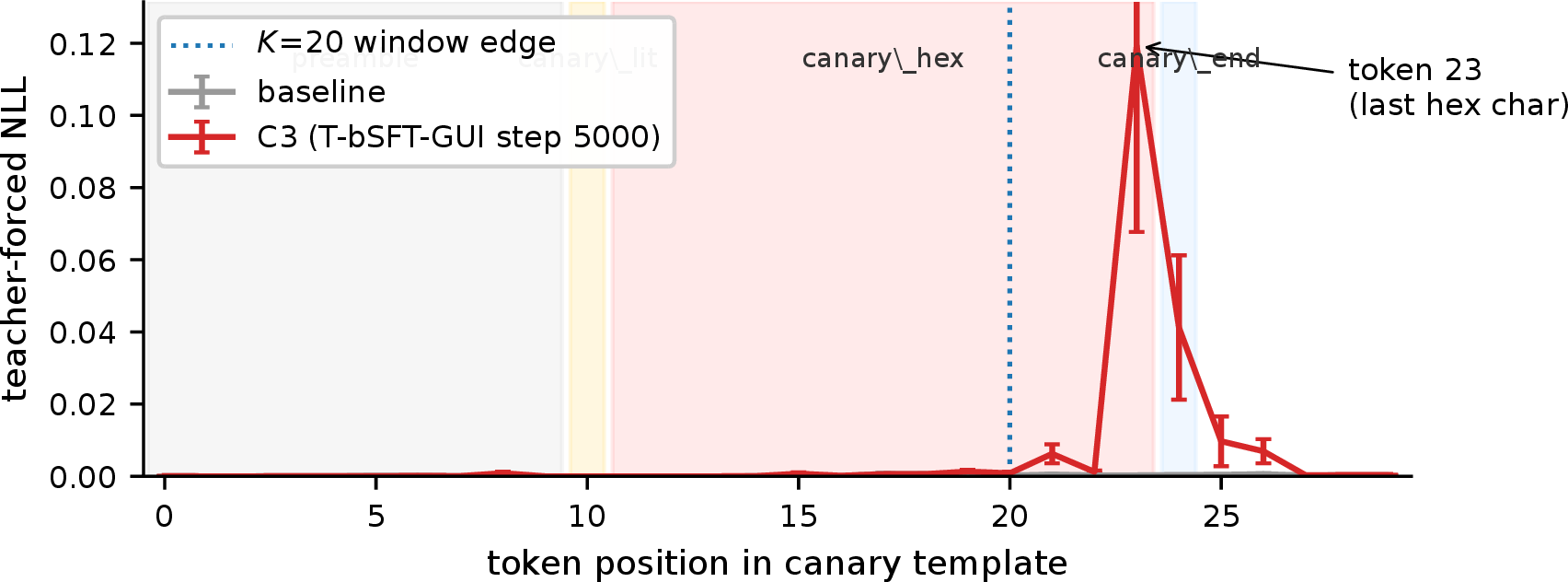
Mechanism. Per-token plot (Fig. 4): tokens \(0\)–\(22\) track baseline within \(10^{-4}\) in absolute
NLL; token \(23\) (the final canary_hex BPE piece, \(1\)–\(2\) hex characters before -END) absolute NLL jumps to \(\sim\!0.119\) (per-token mean across \(60\) instances), three orders of magnitude above the flat \(\sim\!10^{-4}\) baseline at neighbouring positions. Position
\(23\) falls outside \(K\!=\!20\) (zero-indexed), so mean\(_{20}\) is blind to it.
Sparsity. \(7/60\) greedy failures on \(3/20\) canaries (canary \(0\) dominates: \(+0.122\) alone, leave-one-out hex \(+0.0075\)); \(17/20\) canaries perfect across all seeds; hit\(@16\!=\!58/60\) (App. 14). One sparse tail-token counterexample, not broad damage and not distribution-level loss of the secret.
3.2 Case 2 — non-secret preamble drift (C4).↩︎
Numbers. \(\Delta_{\mathrm{mean20}}\!=\!+0.0150\) (\(3/3\) seeds positive); \(\Delta_{\mathrm{hex}}\!=\!+0.0004\); hit\(@1\!=\!1.00\).
Primary diagnostic (span decomposition). Per-span decomposition (App. 9) attributes \(\sim\!99\%\) of the mean\(_{20}\) movement to
non-secret preamble (\(+0.01486/+0.01503\) token-level); only \(+0.00017\) falls on canary_hex. A probe whose mass sits on non-secret preamble is not secret-span
damage.
Appendix-only sensitivity check (merge-and-unload). Merging bSFT-LoRA into the base collapses \(\Delta_{\mathrm{preamble}}\) from \(+0.0297\) to \(+0.0014\) (\(-95\%\)); C1/C3/C5 secret-span ratios stay \(0.98/0.98/0.77\) and C4’s own canary_hex survives at \(0.51\) (Tab. 10). The collapse is C4-preamble-specific \(\Rightarrow\) evaluation-stack-dependence on preamble (no causal claim). This ablation is diagnostic
of evaluation-stack sensitivity only; the primary evidence for Case 2 is the per-span decomposition above.
3.3 Case 3 — unresolved undertrained-control ambiguity (C5).↩︎
Numbers. \(\Delta_{\mathrm{mean20}}\!=\!-0.0070\) (\(3/3\) seeds negative); full-span \(\Delta_{\mathrm{hex}}\!=\!+0.0076\); hit\(@1\!=\!0\).
Decomposition (App. 9): in-window hex \(-0.00583\) + canary_lit \(-0.00091\) + bf16 residual \(-0.00030\).
Reading. An in-window hex-token NLL drop on an undertrained baseline; no secret-specificity claim. Format-prior smoothing or template adaptation are equally consistent without true-vs-decoy probes.
3.3.0.1 Per-seed sign consistency for headline cells.
| Cell | Probe | seed 0 | seed 1 | seed 2 | Sign |
|---|---|---|---|---|---|
| C3 | \(\Delta_{\mathrm{hex}}\) | \(+0.0151\) | \(+0.0146\) | \(+0.0102\) | \(3/3\!+\) |
| C4 | \(\Delta_{\mathrm{mean20}}\) | \(+0.0130\) | \(+0.0161\) | \(+0.0161\) | \(3/3\!+\) |
| C5 | \(\Delta_{\mathrm{mean20}}\) | \(-0.0063\) | \(-0.0082\) | \(-0.0066\) | \(3/3\!-\) |
3.3.0.2 C5 algebra closure.
\[\begin{align} &\underbrace{-0.00583}_{\text{in-K hex}} + \underbrace{-0.00091}_{\text{canary\_lit}}\\ &\quad + \underbrace{+0.00001}_{\text{preamble}} + \underbrace{-0.00030}_{\text{bf16}} = -0.00703 . \end{align}\]
3.4 Window K-sweep: 7B failure modes vs.smaller-family stress test↩︎
For the smaller-family stress test (§3.5) we re-aggregate the per-token NLL files at \(K\!\in\!\{10,15,20,25,30\}\); for the 7B headline cells we report only the derivable extremes
\(K\!=\!10\), \(K\!=\!20\), and the full canary_hex span (the intermediate 7B \(K\!\in\!\{15,25,30\}\) values would require re-running the
per-token aggregator with a different window length and are not printed in this submission).
On the 7B headline cells, the algebra closure (Tab. 5) plus the full-span readout (Tab. 2) pin down the printed extremes (see Tab. 6). They imply: C3 is \(\sim\!+10^{-4}\) for \(K\!\leq\!20\) and only diverges from the in-window value once the tail-token spike at position \(23\) enters the window; C4 stays positive across \(K\!=\!10\!\to\!20\), with the preamble-only \(K\!=\!10\) mean (\(+0.0297\)) accounting for \(\sim\!99\%\) of the canonical \(K\!=\!20\) value after rescaling by \(10/20\) (i.e.\(0.5\!\times\!0.0297\!=\!0.01486\) vs.\(+0.01504\)); C5’s mean is negative at the canonical \(K\!=\!20\) but turns positive at the full-span readout, the joint-product signature of window truncation and the undertrained-baseline regime.
On the smaller-family C3/C4/C5-equivalent cells (Fig. 3): the K-monotone shape on Qwen2.5-1.5B and Llama-3.2-1B differs from the 7B testbed: in particular, the negative-mean signature behind 7B Case 3 does not reproduce on either smaller family at the C5-equivalent cell, and Llama-1B’s \(\Delta\mathrm{mean}_{K}\) at C3/C4-eq is dominated by a catastrophic preamble drift at every \(K\) rather than by the tail-token / preamble-fraction mechanism we observe on 7B.

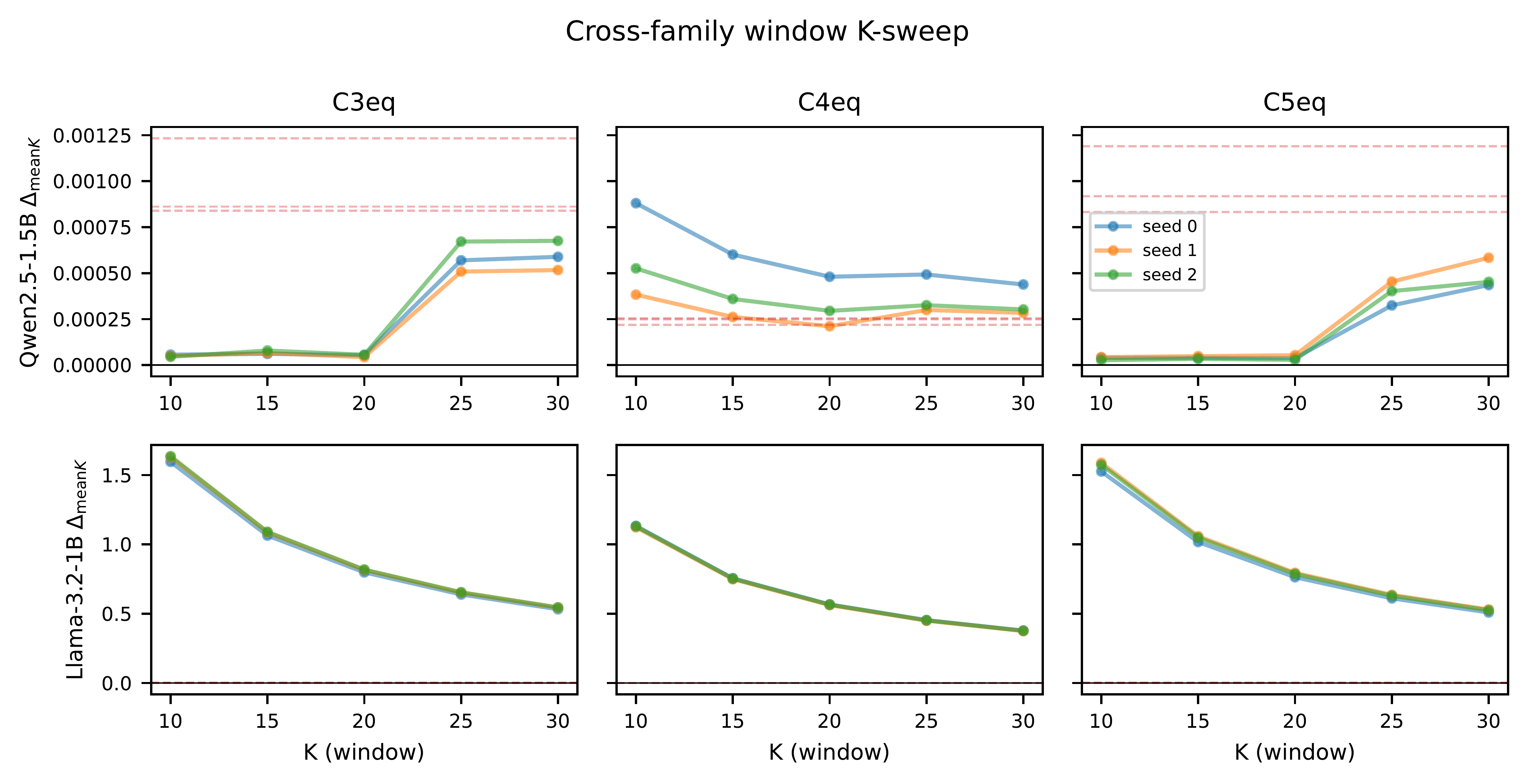
Figure 3: Descriptive smaller-family stress test. \(\Delta\mathrm{NLL}_{\mathrm{mean}K}\) for \(K\!\in\!\{10,15,20,25,30\}\) on Qwen2.5-1.5B (top) and
Llama-3.2-1B (bottom) at the C3/C4/C5-equivalent cells, per seed. Dashed red lines mark full canary_hex span \(\Delta\) where present. Y-axis scales differ by family by \(\sim\!1000\times\); read this as a smaller-family stress test, not as case-level replication..
3.5 Descriptive smaller-family non-replication check↩︎
We run a smaller-family stress test at the C3/C4/C5-equivalent cells on Qwen2.5-1.5B-Instruct [13] and Llama-3.2-1B-Instruct [14] (text-only LMs, same canary template, same bSFT data minus image fields, same probe family, \(n\!=\!3\) outer seeds at each cell). We do not print or claim a full \(4\!\times\!3\) smaller-family bSFT grid; App. 10 is the 7B all-cells matrix only. Headline-cell point estimates appear in Tab. 3; we read these as descriptive stress tests on smaller text-only backbones, not as case-level replication of the 7B mechanisms (Tab. 3 caption).
| Family | Cell | \(\Delta_{\mathrm{mean20}}\) | \(\Delta_{\mathrm{hex}}\) | hit\(@1\) |
|---|---|---|---|---|
| Qwen2.5-VL-7B | C3-eq | \(+0.0001\) | \(+0.0133\) | \(0.88\) |
| Qwen2.5-1.5B | C3-eq | \(+0.0001\) | \(+0.0010\) | \(1.00\) |
| Llama-3.2-1B | C3-eq | \(+0.8104\) | \(+0.0006\) | \(0.37\) |
| Qwen2.5-VL-7B | C4-eq | \(+0.0150\) | \(+0.0004\) | \(1.00\) |
| Qwen2.5-1.5B | C4-eq | \(+0.0003\) | \(+0.0002\) | \(1.00\) |
| Llama-3.2-1B | C4-eq | \(+0.5643\) | \(+0.0001\) | \(0.00\) |
| Qwen2.5-VL-7B | C5-eq | \(-0.0070\) | \(+0.0076\) | \(0.00\) |
| Qwen2.5-1.5B | C5-eq | \(+0.0000\) | \(+0.0010\) | \(1.00\) |
| Llama-3.2-1B | C5-eq | \(+0.7814\) | \(+0.0006\) | \(0.00\) |
3pt
3.5.0.1 Cross-family verdict.
The smaller-family stress test surfaces additional probe disagreements but does not replicate all three 7B case mechanisms at the C3/C4/C5-equivalent cells. Case 3’s undertrained-baseline mechanism has no direct analog in our text-only cross-family setup (text LMs in this protocol have no separate undertrained-canary regime; the image-canary gray-placeholder construction that triggers C5 on the VLM testbed is unavailable on text-only LMs), and the C5 cell at the 7B-fixed location does not reproduce as a misleading negative on either family (Tab. 3: Qwen-1.5B C5-eq \(\Delta_{\mathrm{mean20}}\!=\!{+}0\); Llama-1B C5-eq \(+0.78\) matches the same catastrophic-mean / preserved-hex / broken-greedy pattern as Llama C3-eq and C4-eq, not Case 3). Two additional smaller-family phenomena — a migrated Qwen-1.5B C4-equivalent cell with \(98\%\) preamble-driven \(\Delta_{\mathrm{mean20}}\!=\!{+}0.22\), and a Llama-3.2-1B T-bSFT-GUI step-trajectory where \(\mathrm{mean}_{K=20}\) grows monotonically while greedy hit\(@16\) recovers across step — and the smaller-family decoy audit at the candidate C5-equivalent cells (showing additive NLL gaps of \(+1.67\) to \(+10.86\) loss units between shuffled-hex / wrong-secret / format-only decoys and the true target) are reported in App. 16; this is a calibration of the decoy construction at different cells and does not adjudicate the original 7B C5 ambiguity, which lacks a paired decoy audit. Magnitudes are 3-seed point estimates, not inferential, and we read these rows as descriptive smaller-family stress tests rather than as case-level replication.
4 Related Work↩︎
4.0.0.1 Memorization probes for autoregressive models.
The canary-and-probe paradigm we use originates with Secret Sharer [2], which introduced exposure as a calibrated rank-based metric for unintended memorization, and was generalized in [4] to discoverable-extraction rates across model scales, data duplication, and prompt length. Truncated mean-NLL over the first \(K\) target tokens — the probe we audit — is a natural prefix-window operationalization in this lineage; the present paper’s three case studies show that, on a single-backbone testbed, the choice of probe (truncated mean NLL, full-span loss, behavioural exact-recall) can materially change false-positive and false-negative rates. We do not propose a new probe; we document, in one autoregressive generative-model testbed, three concrete cases where truncated mean-NLL silently disagrees with full-span NLL or with behavioral exact-recall, and attribute each disagreement to a specific token-position or baseline-regime mechanism.
4.0.0.2 Extraction and large-scale memorization.
[3] demonstrated that training data can be recovered from large language models via query-based extraction with ranking-based filtering, shifting the field toward extraction-based memorization metrics that do not depend on a fixed-window NLL probe at all; subsequent work [15] scales these attacks to production language models. Memory-trace studies that frame memorization as a finetuning-time and forgetting-time quantity [16] sit between extraction-based and NLL-based metrics and motivate the need to know what fixed-window NLL does and does not measure on a controlled canary set. Deduplication-driven studies [4], [5] show that duplicate training text affects memorized emissions and that memorization increases with duplication count, linking training distribution to probe response. Our setting is adjacent: the canary distribution is deliberately controlled, and we audit the probe rather than the underlying memorization rate, but the same evaluation-metric concerns apply.
4.0.0.3 Broader evaluation-reliability audits.
Our probe-disagreement view is part of a broader reliability concern: diagnostics, explanations, domain-validity audits, and benchmark verdicts can shift when the measured object changes [17]–[20]. Adjacent generative-model and RAG evaluations make a similar point through multidimensional bias benchmarks, context-conflict probes, and evidence-warrant audits [21]–[24]. We cite them as measurement-reliability neighbors rather than memorization-probe baselines.
4.0.0.4 Benign or safety-driven side effects on memorization.
The closest motivating works are [6], on Whack-a-Mole-style recall activation after benign or task-style fine-tuning, and [7], on privacy-ripple effects from adding or removing personal information. These claims are exactly the kind of memorization-versus-generalization question that probe choice can flip — the same probe-window decision that buries Case 1 (a tail-token greedy miss outside \(K\!=\!20\)) can also bury any reactivation that occurs predominantly outside the chosen window. We do not claim our three case studies refute or replicate those reactivation findings; we use a related probe setting on a different testbed and document where it is and is not self-consistent.
4.0.0.5 Unlearning and lifecycle.
A separate line studies training-data unlearning, from general SISA-style removal [10] to targeted forgetting of memorized generative-model content [11]. Recent LLM unlearning audits and unlearning-adjacent recommender work sharpen the same measurement question: forgetting should be tied to the measured object [25], while recommender unlearning mechanisms provide an adjacent measured-object-specific design [26]. The probe-disagreement phenomena we document are a precondition for unlearning evaluation: if truncated mean-NLL drops on an undertrained baseline without secret-specific evidence (Case 3), audits using the same probe family may register apparent “forgetting” without a behavioural change. We adapt the decoy/canary control of Secret Sharer [2] to expose this ambiguity.
4.0.0.6 Memorization in non-autoregressive generative models.
Memorization in diffusion models is an active area of the foundations literature [27]–[29], and the metric-dependence concern we document is not specific to autoregressive backbones: visual generative models can be probed via near-duplicate retrieval, likelihood-based membership inference, or direct extraction, each of which has its own false-positive and false-negative profile relative to true training-image replication. We do not run experiments on diffusion models in this paper; we limit our claims to an autoregressive setting and discuss in §5 which parts of the failure-mode taxonomy plausibly carry over and which require dedicated experiments.
4.0.0.7 What this paper adds.
Relative to the works above, our contribution is narrow and audit-shaped: in one testbed, we treat truncated mean-NLL as the unit of analysis, decompose it onto explicit token spans (preamble, canary_lit,
canary_hex, canary_end, trailing; Tab. 1), and report three cases where span or behavioural-recall verdicts diverge from the truncated probe. Three cases in one backbone are not a
population claim; they make the failure modes nameable so future probe-window choices can be reported with the relevant audits attached.
5 Discussion: evaluation protocols for memorization in generative models↩︎
5.0.0.1 Take-home.
In this testbed, truncated \(\mathrm{mean}_{K=20}\) NLL yields a false negative (Case 1), a false positive (Case 2), and an ambiguity (Case 3: an undertrained in-window NLL drop without full-secret recovery, not a secret-specific recovery claim). Memorization audits on canary sets should therefore report, beyond \(\Delta\mathrm{NLL}_{\mathrm{mean20}}\) alone:
Full-span secret NLL. A window that omits part of the secret span is blind to omitted-position damage. Case 1: the last hex BPE piece is at position \(23\), outside \(K\!=\!20\), so a \(0\!-\!19\) window drops it.
Behavioural hit\(@k\) with \(k\!\geq\!4\). Greedy hit\(@1\) catches Case 1’s tail-token brittleness; sampled hit\(@k\) checks whether the secret persists. In our matrix, hit\(@16\!=\!58/60\) on C3, so broken canaries remain in the secret distribution.
Per-span decomposition (e.g.
preamblevs.secret). Isolates whether a probe move is on the secret or on template-shared positions. Case 2’s \(+0.0150\) probe move sits \(\sim\!99\%\) on the non-secretpreamblespan while the secret-span \(\Delta\) is \(+0.0004\) and hit\(@1\!=\!1.00\).A saturated and an undertrained control to bound how far reactivation could move the probe in principle. Across the \(4\!\times\!2\) undertrained-image bSFT grid plus matched-norm LoRA-Noise, no variant produces verbatim hit\(@1\!>\!0\) (App. 6), so probe drops in this regime cannot be attributed to secret recovery without further evidence.
Decoy probes (shuffled / wrong-secret / format-only) before asserting secret-specificity. Case 3: an in-window hex-token NLL drop is consistent with both secret-token learning and format-prior smoothing. A 7B C5 decoy remains future work (cf.App. 16).
6 Scope of claims and reproducibility↩︎
6.0.0.1 Scope of claims.
The three case studies hold in our testbed only: Qwen2.5-VL-7B-Instruct, language-tower LoRA with frozen vision tower, four bSFT variants (GUI, SYNTH, Safety, Random), \(20\) canaries per modality (image, text, undertrained-image), exact substring probes, \(K\!=\!20\) for mean-NLL. Across the \(4\!\times\!2\) undertrained-image bSFT grid plus matched-norm LoRA-Noise (\(2\) steps), no variant produces verbatim hit\(@1\!>\!0\) on the undertrained canaries. The strongest evidence (Case 1, C3) is essentially text-only; we do not extrapolate to other backbones, PEFT configurations, canary templates, or non-autoregressive families (diffusion, flow). \(n\!=\!3\) seeds; hierarchical-bootstrap and Student-\(t_2\) intervals are descriptive only, and after post-hoc selection no inferential claim survives selection adjustment (Tab. 4).
6.0.0.2 Reproducibility.
We do not release supplementary material. All canonical numbers are reproduced in the printed tables: per-cell deltas in Table 7, per-seed sign-consistency and headline intervals in App. 8, span decomposition in Table 5, and merge/stacked comparisons in Tables 9–10. Selection-audit thresholds in Table 4 (\(|\Delta_{\mathrm{mean20}}|\!>\!10^{-3}\), \(|\Delta_{\mathrm{hex}}|\!<\!0.5|\Delta_{\mathrm{mean20}}|\), baseline \(+\) post hit\(@1\!=\!1\), screened negative under hb interval) were chosen before per-cell CIs were aggregated but were not preregistered or externally certified; read them as
authors’ internal selection thresholds, not a registered analysis plan. The full pipeline is recoverable from the body and tables; exact bit-for-bit reproduction requires the unreleased canary manifests and bSFT splits. Canary secrets are SHA-256
of whack-canary-{i:03d} truncated to \(16\) hex; bSFT samples \(5000\) examples without replacement under seed \(s\!\in\!\{0,1,2\}\) with
image-filename exclusion (§15); training is stacked LoRA (\(r\!=\!16\), \(\alpha\!=\!32\)) on top of the canary-merged base with AdamW, peak lr \(2\!\times\!10^{-5}\), cosine schedule, batch \(2\!\times\!\mathrm{accum}\,4\), max sequence length \(1024\).
7 Selection audit (full)↩︎
| Family | Pool | #qual. | Shown |
|---|---|---|---|
| hit\(@1\!<\!1\) at saturated baseline | \(26\) saturated cells (img\(+\)txt) | \(1\) | C3 (unique) |
| preamble drift: \(|\Delta_{\mathrm{mean20}}|\!>\!10^{-3}\), \(|\Delta_{\mathrm{hex}}|\!<\!0.5|\Delta_{\mathrm{mean20}}|\), baseline \(+\) post hit\(@1\!=\!1\) | \(26\) saturated cells | \(3\) (T-Safety \(1\!/\!3\!/\!5\)k) | C4 (largest magnitude) |
| undertrained-regime negative mean\(_{20}\): \(\Delta_{\mathrm{mean20}}\!<\!-10^{-3}\) | \(8\) undertrained-image bSFT cells | \(2\) (U-GUI 1k\(/\)3k) | C5 (largest magnitude \(\!=\!\)U-GUI 3k) |
| screened negative under hb interval on \(\Delta_{\mathrm{hex}}\) | \(48\)-row CI dump | \(0\) | — |
| descriptively negative hb interval on \(\Delta_{\mathrm{mean20}}\) | \(48\) | \(1\) (U-GUI 3k\(\!=\!\)C5) | C5 (sole negative) |
2.5pt
8 Per-seed sign-consistency and headline intervals↩︎
Across the five canonical cells, every per-seed \(\Delta\mathrm{NLL}_{\mathrm{mean20}}\), \(\Delta\mathrm{NLL}_{\mathrm{hex}}\), and hit\(@1\) value is
sign-consistent across the \(3\) outer seeds (max spread \(0.0049\) on C3 hex, \(0.0255\) on C5 canary_lit); the 3-seed mean of each cell equals
Table 2 by construction. Headline-row Student-\(t_2\) vs.hier-bootstrap intervals: C3 hex \([+0.0066,+0.0200]\) / \([+0.0061,+0.0226]\); C4 mean\(_{20}\) \([+0.0106,+0.0195]\) / \([+0.0129,+0.0169]\); C5 mean\(_{20}\) \([-0.0096,-0.0045]\) / \([-0.0118,-0.0021]\); C5 full hex \([+0.0027,+0.0124]\) / \([-0.0045,+0.0198]\). Both interval families are descriptive at \(n\!=\!3\); we read claims as joint requirements (same direction in both) and mark hb-only any claim that relies on
hier-bootstrap alone.
9 Algebra closure: span decomposition of \(\Delta\mathrm{NLL}_{\mathrm{mean20}}\)↩︎
For each canonical cell we decompose \(\Delta\mathrm{NLL}_{\mathrm{mean20}}\) into per-span contributions inside the \(K\!=\!20\) window. For each (canary, seed) instance let \(n_{s,c}\) be the number of tokens of span \(s\) that fall inside the canary’s \(K\!=\!20\) window and \(\overline{\Delta_{s,c}}\) the per-token \(\Delta\mathrm{NLL}\) over those tokens; the per-instance contribution of span \(s\) is \(n_{s,c}\,\overline{\Delta_{s,c}}/20\) (\(0\) if the canary has no tokens of \(s\) inside \(K\!=\!20\)). Averaging across all \(60\) (canary, seed) instances and summing across spans yields the per-canary mean \(\Delta\mathrm{NLL}_{\mathrm{mean20}}\) from the token-level forward pass.
The canonical mean\(_{20}\) uses the \(K\!=\!20\) probe pass; the token-level pass uses \(K\!=\!30\) to cover the hex span. Both compute teacher-forced cross-entropy in bf16 from the same weights, but bf16’s \(7\)-bit mantissa produces a per-cell residual of order \(10^{-4}\) (max \(-0.00030\) on C5). The residual is computed independently as canonical minus enumerated and shown as a disclosure row, not a free parameter. For text canaries (C3, C4) the Qwen2.5 tokenizer yields exactly \(n_{\mathrm{preamble}}\!=\!10\), \(n_{\mathrm{lit}}\!=\!1\), \(n_{\mathrm{hex}}\!=\!9\) inside \(K\!=\!20\); for image canaries (C1, C2, C5) BPE boundaries vary across strings, with cell-level averages \(\overline{n}_{\mathrm{lit}}\!\approx\!0.70\), \(\overline{n}_{\mathrm{hex}}\!\approx\!9.30\).
| Cell | Span | \(\overline{\Delta_s}\) /tok | \(\overline{n_s}\) | Contrib. |
|---|---|---|---|---|
| C1 (img) | canary_hex | \(+0.00317\) | \(9.30\) | \(+0.00148\) |
| canary_lit | \(-0.00004\) | \(0.70\) | \(-0.00000\) | |
| preamble | \(+0.00012\) | \(10.00\) | \(+0.00006\) | |
| enumerated sum (token-level \(K\!=\!30\)) | \(20.00\) | \(+0.00154\) | ||
| bf16 precision residual | — | \(<\!10^{-5}\) | ||
| canonical (Tab. [tbl:tab:dissociation]) | \(20.00\) | \(\mathbf{+0.00154}\) | ||
| C2 (img) | canary_hex | \(+0.00041\) | \(9.30\) | \(+0.00019\) |
| canary_lit | \(+0.00004\) | \(0.70\) | \(+0.00000\) | |
| preamble | \(+0.00044\) | \(10.00\) | \(+0.00022\) | |
| enumerated sum (token-level \(K\!=\!30\)) | \(20.00\) | \(+0.00041\) | ||
| bf16 precision residual | — | \(<\!10^{-5}\) | ||
| canonical (Tab. [tbl:tab:dissociation]) | \(20.00\) | \(\mathbf{+0.00041}\) | ||
| C3 (text) | canary_hex | \(+0.00013\) | \(9.00\) | \(+0.00006\) |
| canary_lit | \(+0.00000\) | \(1.00\) | \(+0.00000\) | |
| preamble | \(+0.00006\) | \(10.00\) | \(+0.00003\) | |
| enumerated sum (token-level \(K\!=\!30\)) | \(20.00\) | \(+0.00009\) | ||
| bf16 precision residual | — | \(<\!10^{-5}\) | ||
| canonical (Tab. [tbl:tab:dissociation]) | \(20.00\) | \(\mathbf{+0.00009}\) | ||
| C4 (text) | canary_hex | \(+0.00037\) | \(9.00\) | \(+0.00017\) |
| canary_lit | \(+0.00000\) | \(1.00\) | \(+0.00000\) | |
| preamble | \(+0.02973\) | \(10.00\) | \(+0.01486\) | |
| enumerated sum (token-level \(K\!=\!30\)) | \(20.00\) | \(+0.01503\) | ||
| bf16 precision residual | — | \(+0.00001\) | ||
| canonical (Tab. [tbl:tab:dissociation]) | \(20.00\) | \(\mathbf{+0.01504}\) | ||
| C5 (U-img) | canary_hex | \(-0.01253\) | \(9.30\) | \(-0.00583\) |
| canary_lit | \(-0.02601\) | \(0.70\) | \(-0.00091\) | |
| preamble | \(+0.00002\) | \(10.00\) | \(+0.00001\) | |
| enumerated sum (token-level \(K\!=\!30\)) | \(20.00\) | \(-0.00673\) | ||
| bf16 precision residual | — | \(-0.00030\) | ||
| canonical (Tab. [tbl:tab:dissociation]) | \(20.00\) | \(\mathbf{-0.00703}\) |
3pt
9.0.0.1 7B window K-sweep — derivable extremes.
The K-monotone claims for the 7B headline cells are recoverable from the algebra closure plus the headline full-span values: \(K\!=\!10\) is the preamble-only mean, \(K\!=\!20\) is the algebra-closure mean, and the full hex column reproduces Tab. 2. Intermediate \(K\!\in\!\{15,25,30\}\) values require re-running the per-token aggregator and are not printed.
| Cell | \(\mathrm{mean}_{K=10}\) (preamble-only) | \(\mathrm{mean}_{K=20}\) | \(\mathrm{hex}\) (full \(13\)-tok) |
|---|---|---|---|
| C3 (txt-GUI 5k) | \(+0.0001\) | \(+0.0001\) | \(+0.0133\) |
| C4 (txt-Safety 5k) | \(+0.0297\) | \(+0.0150\) | \(+0.0004\) |
| C5 (U-GUI 3k) | \(+0.0000\) | \(-0.0070\) | \(+0.0076\) |
4pt
10 All-cells systematic table↩︎
| Mod. | Variant | Step | \(\Delta_{\mathrm{mean20}}\) | \(\Delta_{\mathrm{hex}}\) | hit\(@1\) | \(n_{\mathrm{seeds}}\) |
|---|---|---|---|---|---|---|
| img | LoRA-Noise | 1000 | \(+6e-06\) | \(+1e-05\) | \(1.00\) | 3 |
| img | LoRA-Noise | 3000 | \(+1e-05\) | \(+2e-05\) | \(1.00\) | 3 |
| img | LoRA-Noise | 5000 | \(+1e-05\) | \(+2e-05\) | \(1.00\) | 3 |
| img | LoRA-Noise-SYNTH | 1000 | \(+8e-06\) | \(+1e-05\) | \(1.00\) | 3 |
| img | LoRA-Noise-SYNTH | 3000 | \(+1e-05\) | \(+2e-05\) | \(1.00\) | 3 |
| img | LoRA-Noise-SYNTH | 5000 | \(+9e-06\) | \(+2e-05\) | \(1.00\) | 3 |
| img | bSFT-GUI | 1000 | \(+4e-05\) | \(+6e-05\) | \(1.00\) | 3 |
| img | bSFT-GUI | 3000 | \(+0.0002\) | \(+0.0003\) | \(1.00\) | 3 |
| img | bSFT-GUI | 5000 | \(+0.0004\) | \(+0.0007\) | \(1.00\) | 3 |
| img | bSFT-GUI | 7000 | \(+0.0005\) | \(+0.0008\) | \(1.00\) | 3 |
| img | bSFT-GUI | 10000 | \(+0.0015\) | \(+0.0029\) | \(1.00\) | 3 |
| img | bSFT-Random | 1000 | \(+3e-05\) | \(+5e-05\) | \(1.00\) | 3 |
| img | bSFT-Random | 3000 | \(+9e-06\) | \(+2e-05\) | \(1.00\) | 3 |
| img | bSFT-Random | 5000 | \(+1e-05\) | \(+2e-05\) | \(1.00\) | 3 |
| img | bSFT-SYNTH | 1000 | \(+0.0002\) | \(+0.0001\) | \(1.00\) | 3 |
| img | bSFT-SYNTH | 3000 | \(+0.0003\) | \(+0.0003\) | \(1.00\) | 3 |
| img | bSFT-SYNTH | 5000 | \(+0.0004\) | \(+0.0003\) | \(1.00\) | 3 |
| img | bSFT-Safety | 1000 | \(+2e-05\) | \(+4e-05\) | \(1.00\) | 3 |
| img | bSFT-Safety | 3000 | \(+2e-06\) | \(+1e-05\) | \(1.00\) | 3 |
| img | bSFT-Safety | 5000 | \(+2e-06\) | \(+1e-05\) | \(1.00\) | 3 |
| img | baseline | 0 | \(+0e+00\) | \(+0e+00\) | \(1.00\) | 3 |
| txt | T-LoRA-Noise-GUI | 1000 | \(+2e-06\) | \(+4e-05\) | \(1.00\) | 3 |
| txt | T-LoRA-Noise-GUI | 3000 | \(+7e-06\) | \(+3e-05\) | \(1.00\) | 3 |
| txt | T-LoRA-Noise-GUI | 5000 | \(+1e-05\) | \(+8e-05\) | \(1.00\) | 3 |
| txt | T-LoRA-Noise-Safety | 1000 | \(+3e-06\) | \(+2e-05\) | \(1.00\) | 3 |
| txt | T-LoRA-Noise-Safety | 3000 | \(+7e-06\) | \(+4e-05\) | \(1.00\) | 3 |
| txt | T-LoRA-Noise-Safety | 5000 | \(+7e-06\) | \(+3e-05\) | \(1.00\) | 3 |
| txt | T-bSFT-GUI | 1000 | \(+3e-05\) | \(+0.0002\) | \(1.00\) | 3 |
| txt | T-bSFT-GUI | 3000 | \(+7e-05\) | \(+0.0027\) | \(1.00\) | 3 |
| txt | T-bSFT-GUI | 5000 | \(+9e-05\) | \(+0.0133\) | \(0.88\) | 3 |
| txt | T-bSFT-Random | 1000 | \(+2e-05\) | \(+0.0002\) | \(1.00\) | 3 |
| txt | T-bSFT-Random | 3000 | \(+2e-05\) | \(+0.0002\) | \(1.00\) | 3 |
| txt | T-bSFT-Random | 5000 | \(+3e-05\) | \(+0.0002\) | \(1.00\) | 3 |
| txt | T-bSFT-SYNTH | 1000 | \(+0.0003\) | \(+0.0007\) | \(1.00\) | 3 |
| txt | T-bSFT-SYNTH | 3000 | \(+0.0011\) | \(+0.0012\) | \(1.00\) | 3 |
| txt | T-bSFT-SYNTH | 5000 | \(+0.0015\) | \(+0.0013\) | \(1.00\) | 3 |
| txt | T-bSFT-Safety | 1000 | \(+0.0076\) | \(+0.0003\) | \(1.00\) | 3 |
| txt | T-bSFT-Safety | 3000 | \(+0.0097\) | \(+0.0004\) | \(1.00\) | 3 |
| txt | T-bSFT-Safety | 5000 | \(+0.0150\) | \(+0.0004\) | \(1.00\) | 3 |
| txt | T-baseline | 0 | \(+0e+00\) | \(+0e+00\) | \(1.00\) | 3 |
| U-img | U-LoRA-Noise | 1000 | \(-0.0003\) | \(-0.0011\) | \(0.00\) | 3 |
| U-img | U-LoRA-Noise | 3000 | \(-0.0001\) | \(+0.0011\) | \(0.00\) | 3 |
| U-img | U-bSFT-GUI | 1000 | \(-0.0033\) | \(-7e-05\) | \(0.00\) | 3 |
| U-img | U-bSFT-GUI | 3000 | \(-0.0070\) | \(+0.0076\) | \(0.00\) | 3 |
| U-img | U-bSFT-Random | 1000 | \(+0.0038\) | \(+0.0102\) | \(0.00\) | 3 |
| U-img | U-bSFT-Random | 3000 | \(+0.0034\) | \(+0.0093\) | \(0.00\) | 3 |
| U-img | U-bSFT-SYNTH | 1000 | \(+0.0471\) | \(+0.0260\) | \(0.00\) | 3 |
| U-img | U-bSFT-SYNTH | 3000 | \(+0.0544\) | \(+0.0243\) | \(0.00\) | 3 |
| U-img | U-bSFT-Safety | 1000 | \(-0.0005\) | \(-0.0006\) | \(0.00\) | 3 |
| U-img | U-bSFT-Safety | 3000 | \(-0.0001\) | \(+0.0012\) | \(0.00\) | 3 |
| U-img | baseline | 0 | \(+0e+00\) | \(+0e+00\) | \(0.00\) | 3 |
3pt
Table 7 reports \(\Delta\mathrm{NLL}_{\mathrm{mean20}}\), \(\Delta\mathrm{NLL}_{\mathrm{hex}}\), and hit\(@1\) for every (canary modality, variant, step) cell in our matrix, averaged across \(3\) seeds. Per-cell hierarchical-bootstrap (\(B\!=\!10000\)) and between-seed Student-\(t_2\) \(95\%\) CIs on \(\Delta\mathrm{NLL}_{\mathrm{mean20}}\) and \(\Delta\mathrm{NLL}_{\mathrm{hex}}\) are computed for the \(48\) CI-bearing rows (\(34\) bSFT \(+\) \(14\) LoRA-Noise; baselines have \(\Delta\!=\!0\) by construction); summary counts for the headline cells are reported in App. 8.
10.0.0.1 No descriptively clear-of-zero negative hex anywhere.
Across all \(48\) CI-bearing cells, zero cells have a hierarchical-bootstrap \(95\%\) CI for \(\Delta\mathrm{NLL}_{\mathrm{hex}}\) strictly below zero. Three cells have a slightly negative point estimate (U-LoRA-Noise \(-0.00113\), U-bSFT-GUI \(-7\!\times\!10^{-5}\), U-bSFT-Safety \(-0.00062\); all undertrained-regime step \(1000\), where baselines have hex NLL \(2.6\) and hit\(@1\!=\!0\)); each brackets zero under both hier-bootstrap and \(t_2\) between-seed intervals.
11 Cell accounting and matrix counts↩︎
The matrix decomposes as \(4\) bSFT variants (\(\mathrm{\small GUI}\), \(\mathrm{\small SYNTH}\), \(\mathrm{\small Safety}\), \(\mathrm{\small Random}\)) \(\times\,3\) canary regimes (saturated image, text, undertrained image) \(\times\,3\) seeds \(\times\,3\)–\(5\) step counts.
| Bucket | Aggr.rows | Seed-level runs | In “\(34\)” denom.? | CIs computed? |
|---|---|---|---|---|
| bSFT (GUI/SYNTH/Safety/Random) | \(34\) | \(102\) | yes | yes |
| LoRA-Noise norm-matched controls | \(14\) | \(42\) | no | yes |
| Baselines (\(0\)-step rows) | \(3\) | \(9\) | no | no |
| CI-bearing rows | \(\mathit{48}\,(=\!34\!+\!14)\) | — | — | — |
| Printed all-cells table rows | \(\mathit{51}\,(=\!48\!+\!3)\) | — | — | — |
| Total seed-level runs | — | \(144\,(=\!102\!+\!42)\) | — | — |
3pt
12 Merge-and-unload composition ablation↩︎
Stacked probe = base (with merged canary) \(+\) bSFT-LoRA loaded; Merged probe = base (with merged canary) \(+\) bSFT-LoRA merged into the base, then unloaded. Canary memory is intact in both cases; only the bSFT contribution changes from a LoRA delta to a full-rank weight update. Both deltas use the same \(M_{\mathrm{canary}}\)-only baseline. The ratio merged/stacked indicates how much of the stacked-LoRA drift survives the LoRA-to-full-rank conversion.
The “Stacked” column in Table 10 (C3 \(+0.0126\), C5 \(+0.0055\)) comes from the merge-comparison aggregation pipeline; the canonical \(\Delta_{\mathrm{hex}}\) in Table 2 (C3 \(+0.0133\), C5 \(+0.0076\)) comes from the \(K\!=\!30\) token-level probe pass. The two paths agree in sign at every cell; the magnitude gap (\(\!\approx\!0.002\), max \(0.0021\) on C5) reflects merge-pipeline aggregation drift, not the bf16 path residual. Table 2 remains the canonical headline estimator; Table 10 uses only stacked-vs-merged ratios.
Sanity check: merge does not erase all measured canary-span deltas. Secret-span deltas on C1, C3, C5 survive merging at ratios \(+0.98, +0.98, +0.77\); even on C4 itself the secret-span hex delta
survives at \(+0.51\), so the bSFT delta is not wholesale erased. Per-token NLL agreement (Table 9) shows mean \(|\Delta\mathrm{NLL}_{\mathrm{stacked\_vs\_merged}}|\!\leq\!0.005\) on canary_hex for C1–C4, while C4’s preamble \(|\Delta|\!=\!0.02837\) is \(\sim\!118\times\) its own secret-span \(|\Delta|\!=\!0.00024\). The stacked-vs-merged disagreement isolates to C4’s preamble tokens, consistent with the Case 2 claim that C4’s mean\(_{20}\) does not reflect secret-span damage.
| Cell | preamble | canary_lit | canary_hex | n tokens |
|---|---|---|---|---|
| C1 | \(0.00002\) | \(0.00000\) | \(0.00100\) | \(1800\) |
| C2 | \(0.00041\) | \(0.00002\) | \(0.00011\) | \(1800\) |
| C3 | \(0.00003\) | \(0.00000\) | \(0.00388\) | \(1800\) |
| C4 | \(\mathbf{0.02837}\) | \(0.00000\) | \(0.00024\) | \(1800\) |
| C5 | \(0.00001\) | \(0.00771\) | \(0.04181\) | \(1800\) |
4pt
The C4 preamble collapse to \(+0.05\) ratio is consistent with several non-exclusive mechanisms (template-token-activation precision sensitivity, BF16 merge rounding for low-magnitude weight updates,
LoRA-composition-specific effects) and we make no causal claim. The weak conclusion — a probe whose mass sits on preamble under loaded-LoRA evaluation is not robust under merged-LoRA evaluation, even though canary_hex deltas on
the same and other cells are robust — is sufficient to demote C4’s mean\(_{20}\) from a memorization claim.
| Cell | Span | Stacked | Merged | Merged/Stacked | ||
|---|---|---|---|---|---|---|
| C1 | preamble | \(+0.0001\) | \(+0.0001\) | +0.96 | ||
| canary_hex | \(+0.0029\) | \(+0.0029\) | +0.98 | |||
| C2 | preamble | \(+0.0004\) | \(+3e-05\) | +0.07 | ||
| canary_hex | \(+0.0003\) | \(+0.0002\) | +0.75 | |||
| C3 | preamble | \(+6e-05\) | \(+4e-05\) | +0.61 | ||
| canary_hex | \(+0.0126\) | \(+0.0124\) | +0.98 | |||
| C4 | preamble | \(+0.0297\) | \(+0.0014\) | +0.05 | ||
| canary_hex | \(+0.0004\) | \(+0.0002\) | +0.51 | |||
| C5 | preamble | \(+2e-05\) | \(+1e-05\) | +0.81 | ||
| canary_hex | \(+0.0055\) | \(+0.0043\) | +0.77 |
3pt
13 Direct re-exposure sanity check↩︎
To check that the secret-span and behavioural probes can move in this testbed (mean20 was the only probe that moved on saturated cells), we trained an additional T-bSFT-GUI variant where the GUI bSFT data was augmented with the \(20\) full-template text-canary captions themselves (full TEXTCAN-{16hex}-END, not a \(20\)-token truncation) — explicit re-exposure of the secret content, not a benign-SFT
condition. Across \(3\) seeds: \(\Delta\mathrm{NLL}_{\mathrm{mean20}}\!=\!{+}4\!\times\!10^{-5}\) (vs. \({+}9\!\times\!10^{-5}\) on plain T-bSFT-GUI; flat
both ways), \(\Delta\mathrm{NLL}_{\mathrm{hex}}\!=\!{+}0.0006\) (vs.\({+}0.0133\); \(\sim\!95\%\) collapse), hit\(@1\!=\!1.00\) (vs.\(0.88\); recovers to ceiling). The secret-span and behavioural probes move in the recovery direction when secret content is explicitly re-trained on, while mean20 stays flat.
This is a probe-sensitivity sanity check, not a Whack-a-Mole-style reactivation control: direct re-exposure is the easiest possible positive contrast, and we use it only to address “can the probes move?”.
14 C3 failure inventory and hit\(@k\)↩︎
For C3 (T-bSFT-GUI step \(5000\) on text canaries) we report all greedy generations across \(20\) canaries \(\times\,3\) seeds \(=\,60\) generations (hit\(@1\)) plus \(k\!-\!1\) stochastic samples at \(T\!=\!0.7,p\!=\!0.95\) for hit\(@4\) and hit\(@16\) (i.e.\(3\) and \(15\) samples beyond greedy, in the convention defined in §2).
| Seed | hit\(@1\) | hit\(@4\) | hit\(@16\) |
|---|---|---|---|
| seed 0 | \(17/20\) | \(18/20\) | \(19/20\) |
| seed 1 | \(18/20\) | \(19/20\) | \(19/20\) |
| seed 2 | \(18/20\) | \(19/20\) | \(20/20\) |
| total (\(N\!=\!60\)) | \(53/60\) | \(56/60\) | \(58/60\) |
6pt
All \(7/60\) greedy failures are wrong hex tail (last \(1\)–\(2\) characters), e.g.target TEXTCAN-139bed18a2190bba-END \(\to\) greedy TEXTCAN-139bed18a2190b68-END; this confirms the Case-1 token-level analysis that damage concentrates on trailing hex tokens outside \(K\!=\!20\).
14.0.0.1 BPE token disclosure.
Qwen2.5’s BPE boundaries vary per canary, so the final canary_hex piece (token \(23\)) holds the last \(1\)–\(2\) hex characters: \(1\) for canaries \(0\)/\(14\) (which fail \(3/3\) seeds), \(2\) for canary \(12\) (\(1/3\) seeds). Per-canary string, predicted-token, and rank-of-correct-token manifests are authors’ internal artifacts and not released.
14.0.0.2 Leave-one-canary-out robustness.
Headline \(\Delta_{\mathrm{hex}}\!=\!{+}0.0133\). Removing canary \(0\) (its largest single-canary contributor, \({+}0.123\) on its own span) gives \({+}0.0075\) (\(\sim\!57\%\)); the other \(19\) leave-one-out point estimates lie in \([{+}0.01332,{+}0.01400]\) (\(<\!5\%\) of headline). The behavioural break is concentrated in \(3/20\) canaries with the same Mode 1 token-\(23\) pattern, not a single canary’s idiosyncratic tokenisation.
15 Image–bSFT dataset overlap audit↩︎
Image canaries draw from ScreenSpot v2 [12], a revised release of the original ScreenSpot benchmark of [30], and the same source as the GUI bSFT data; a near-duplicate would trivially explain the C1 erosion as in-distribution
relearning. We verify no overlap two ways: (i) filename-set exclusion of the \(20\) canary images from bSFT sampling; (ii) perceptual-hash check (phash, \(8\!\times\!8\) DCT, distance \(\le\!4\)) across all canary–bSFT image pairs — no flagged pairs found in \(20\times5000\) comparisons. The text-canary placeholder
is a single \(224\!\times\!224\) mid-gray bitmap shared by Safety and Random by construction; a varied-image text-canary control is future work.
16 Smaller-family decoy audit and Llama-1B trajectory details↩︎
This appendix collects the smaller-family-only descriptive evidence that the body summarises but does not print: the decoy table at the candidate C5-equivalent cells (Tab. 12), the migrated Qwen-1.5B C4-equivalent cell, and the Llama-3.2-1B step-trajectory disagreements. None of this evidence pertains to the original 7B C5 cell, and we read all of it as descriptive smaller-family stress tests (per the caption of Tab. 3).
| Family | Decoy | \(\Delta_{\mathrm{mean20}}^{\mathrm{vs.\,true}}\) | \(\Delta_{\mathrm{hex}}^{\mathrm{vs.\,true}}\) | hit\(@1\) |
|---|---|---|---|---|
| Llama-3.2-1B | true | \(+0.0000\) | \(+0.0000\) | \(0.000\) |
| Llama-3.2-1B | shuffled_hex | \(+4.1514\) | \(+9.2485\) | \(0.000\) |
| Llama-3.2-1B | wrong_secret | \(+2.5014\) | \(+4.8954\) | \(0.000\) |
| Llama-3.2-1B | format_only | \(+3.4520\) | \(+10.8553\) | \(0.000\) |
| Qwen2.5-1.5B | true | \(+0.0000\) | \(+0.0000\) | \(1.000\) |
| Qwen2.5-1.5B | shuffled_hex | \(+3.2050\) | \(+6.4259\) | \(0.000\) |
| Qwen2.5-1.5B | wrong_secret | \(+3.2336\) | \(+4.3457\) | \(0.000\) |
| Qwen2.5-1.5B | format_only | \(+1.6702\) | \(+2.2722\) | \(0.000\) |
4pt
16.0.0.1 Migrated Qwen-1.5B C4 cell.
On Qwen2.5-1.5B the C4-equivalent cell migrates to T-bSFT-Random (\(5000\)): \(\Delta_{\mathrm{mean20}}\!=\!{+}0.222\), \(\Delta_{\mathrm{hex}}\!=\!{+}9\!\times\!10^{-4}\), hit\(@1\!=\!1.00\); \(98\%\) of the mean drift sits on preamble with canary_hex
essentially unchanged — a sharper version of the 7B C4 mechanism.
16.0.0.2 Llama-3.2-1B step-trajectory disagreements.
Two phenomena absent from the 7B testbed appear at the Llama-1B C3/C4-equivalent cells across step \(\in\!\{1k,3k,5k\}\): (i) on T-bSFT-GUI and T-bSFT-Safety the disagreement grows with bSFT
magnitude rather than collapsing (\(\Delta_{\mathrm{mean20}}\!=\!{+}0.56\) to \({+}0.81\) at step \(5000\) co-occurs with greedy hit\(@1\) break \(0.37\)/\(0.00\) while teacher-forced canary_hex stays within \(1.6\!\times\) baseline);
(ii) T-bSFT-GUI shows emergent recovery in greedy hit\(@16\) (seed-mean \(0\!\to\!0.20\!\to\!0.78\)) that is undetectable via \(\mathrm{mean}_{K=20}\) NLL, which grows monotonically over the same range. Inter-seed variance at step \(3000\) is high; we report a descriptive trajectory, not a dose-response claim.