Multiparameter Quantum Estimation and Degeneracy Structure in Three-Flavor Neutrino Oscillations
January 01, 1970
Abstract
Achieving precision measurements of neutrino oscillation parameters and resolving parameter degeneracies remain central challenges in neutrino physics. This work presents a systematic investigation of three-flavor neutrino oscillations within the framework of quantum estimation theory using the quantum Fisher information matrix (QFIM). The behavior of all six independent elements of the QFIM associated with the parameters \(\theta_{23}\), \(\delta_{\rm CP}\), and \(\Delta m_{31}^{2}\) is analyzed, and the impact of parameter correlations on the quantum Cramér–Rao bound is studied. Furthermore, we demonstrate that parameter degeneracies in neutrino oscillation probabilities do not necessarily imply indistinguishability of the underlying quantum states. By employing quantum fidelity and the QFIM, we show that degenerate parameter sets can exhibit distinct quantum-information characteristics that remain hidden at the probability level, revealing quantum-state differences between probability-degenerate \((\theta_{23},\delta_{\mathrm{CP}})\) solutions.
1 Introduction↩︎
One of the most profound and enduring puzzles within the Standard Model (SM) [1] of particle physics concerns the origin of neutrino mass. The SM, in its minimal formulation, predicts exactly massless neutrinos which is a consequence of the absence of right-handed neutrino fields and, correspondingly, the lack of any gauge-invariant Yukawa coupling that could otherwise generate a mass term upon electroweak symmetry breaking. This theoretical prediction, however, stands in sharp tension with experimental observations.
The observed deficit in the detected flux of electron neutrinos originating from the solar core [2], known as solar neutrino problem, provided the first compelling experimental evidence incompatible with the SM prediction of massless neutrinos. This deficit finds a natural resolution within the framework of neutrino oscillations, wherein the flavor eigenstates \(\ket{\nu_\alpha}\) (\(\alpha = e, \mu, \tau\)) are expressed as coherent superpositions of mass eigenstates \(\ket{\nu_i}\) (\(i = 1, 2, 3\)) through the unitary Pontecorvo–Maki–Nakagawa–Sakata (PMNS) [3]–[5] mixing matrix \(U_{\alpha i}\), i.e., \(\ket{\nu_\alpha} = \sum_i U_{\alpha i}^* \ket{\nu_i}\). As a consequence, a neutrino produced in a definite flavor state undergoes coherent flavor evolution during propagation, a dynamical effect that is contingent upon non-vanishing mass-squared splittings, \(\Delta m^2_{ij} \equiv m^2_i - m^2_j \neq 0\). Experimental evidence from atmospheric, solar, and reactor neutrino sources [6]–[9] has since firmly established the existence of neutrino oscillations, unambiguously implying that neutrinos have non-zero mass.
The oscillation framework is characterized by three mixing angles, two independent mass-squared differences, and the leptonic CP-violating phase [3], [10]. Precision measurements from solar, atmospheric, reactor, and accelerator experiments have now constrained the three-flavor oscillation parameters with remarkable accuracy [11], [12]. Despite remarkable experimental progress, several important challenges remain, particularly the precise determination of the leptonic CP phase, the resolution of the \(\theta_{23}\) octant ambiguity, and the identification of the neutrino mass ordering [12]–[16]. In particular, different combinations of oscillation parameters can lead to identical transition probabilities, giving rise to well-known degeneracies involving the atmospheric mixing angle, the CP phase, and the neutrino mass ordering [13], [17]–[26]. Such degeneracies represent a major obstacle in the interpretation of oscillation data and in the optimization of future neutrino experiments.
The resolution of parameter degeneracies has therefore become one of the central objectives of current and future neutrino oscillation experiments. Considerable effort has been devoted to mitigating these degeneracies through the use of multiple baselines, complementary oscillation channels, combined analyses of neutrino and antineutrino data, and synergistic studies involving different experiments [13]–[15]. While these approaches can significantly improve parameter determination, degeneracies continue to limit the precision with which the oscillation parameters can be extracted and remain a major challenge for future precision measurements. Consequently, it is important to investigate whether additional information beyond oscillation probabilities can provide further insight into the nature of these degeneracies and their impact on parameter estimation. Within this framework, the statistical sensitivity to oscillation parameters is commonly quantified by using the classical Fisher information (CFI), which characterizes the amount of information that can be extracted from measurement outcomes. However, the classical Fisher information depends explicitly on the chosen measurement strategy and therefore does not capture the ultimate precision limits imposed by quantum mechanics.
Quantum Fisher information (QFI) provides a natural extension of the classical Fisher information by quantifying the intrinsic sensitivity of a quantum state to variations of physical parameters. Unlike its classical counterpart, the QFI is independent of a specific measurement scheme and determines the ultimate precision achievable through the quantum Cramér-Rao bound [27]–[35]. In the context of neutrino oscillations, QFI has previously been employed to study the precision with which the CP phase and other oscillation parameters can be estimated [36]–[42]. Nevertheless, existing studies have predominantly focused on single-parameter estimation, while a systematic multiparameter analysis based on the QFIM remains largely unexplored within the three-flavor oscillation framework. In particular, the role of parameter correlations encoded in the QFIM and their implications for parameter degeneracies and simultaneous estimation have not yet been fully investigated.
In view of these loopholes, in this work we develop a multiparameter quantum-estimation framework for three-flavor neutrino oscillations based on the full quantum Fisher information matrix. Focusing on the parameter set \((\theta_{23},\delta_{\mathrm{CP}},\Delta m^2_{31})\), we investigate the simultaneous estimation of oscillation parameters and the role of parameter correlations in determining the attainable precision.
We further revisit the problem of parameter degeneracies from a quantum-information perspective. While degeneracies are conventionally defined through identical oscillation probabilities, the corresponding quantum states need not possess identical information-theoretic properties. Using QFIM, we investigate the relationship between probability degeneracies and state distinguishability. We find that the elements of QFIM can lift the degeneracy in every parameter direction simultaneously.
The paper is organized as follows. In Sec. 2, we briefly review the formalism of three-flavor neutrino oscillations and the quantum Fisher information matrix. In Sec. 3, we discuss the QFI for diagonal entries of QFIM along with the corresponding quantum Cramér-Rao bound (QCRB). Simultaneous estimation of the QFI of all six elements of QFIM and the interplay of parameter correlations along with their role on QCRB are discussed in Sec. 4. In Sec. 5, we discuss the parameter degeneracy in neutrino oscillation and the role of elements of QFIM on breaking these degeneracies. Finally, in Sec. 6, we summarize our findings and possible directions for future work.
2 Formalism: Neutrino Evolution and Quantum Fisher Information Matrix↩︎
A neutrino produced in a flavor state \(|\nu_\alpha\rangle\) can be written as a superposition of mass eigenstates \[\begin{align} |\nu_\alpha\rangle = \sum_i U_{\alpha i} |\nu_i\rangle, \end{align}\] where \(U\) is the PMNS mixing matrix, the flavor and mass eigenstates are related through this mixing matrix, which can represented as [43] \[\begin{align} \begin{pmatrix} 1 & 0 & 0\\ 0 & c_{23} & s_{23}\\ 0 & -s_{23} & c_{23} \end{pmatrix} \begin{pmatrix} c_{13} & 0 & s_{13}e^{-i\delta_{\rm CP}}\\ 0 & 1 & 0\\ -s_{13}e^{i\delta_{\rm CP}} & 0 & c_{13} \end{pmatrix} \begin{pmatrix} c_{12} & s_{12} & 0\\ -s_{12} & c_{12} & 0\\ 0 & 0 & 1 \end{pmatrix}, \end{align}\] where \(c_{ij}\equiv \cos\theta_{ij}\) and \(s_{ij}\equiv \sin\theta_{ij}\). The matrix is characterized by three mixing angles \((\theta_{12},\theta_{13},\theta_{23})\) and the Dirac CP-violating phase \(\delta_{\rm CP}\). During propagation, each mass eigenstate acquires a phase determined by its energy. After traveling a distance \(L\), the neutrino state evolves to [44], [45] \[\begin{align} |\nu_\alpha(L)\rangle = \sum_i U_{\alpha i} e^{-iE_i L} |\nu_i\rangle . \end{align}\] The probability of detecting the neutrino in a flavor state \(|\nu_\beta\rangle\) is given by \[\begin{align} P_{\alpha\beta}(L) = |\langle \nu_\beta | \nu_\alpha(L) \rangle|^2 . \end{align}\] In conventional analyses, oscillation parameters are inferred from measurements of these transition probabilities. However, different parameter combinations can yield identical probabilities, leading to the well-known degeneracy problem.
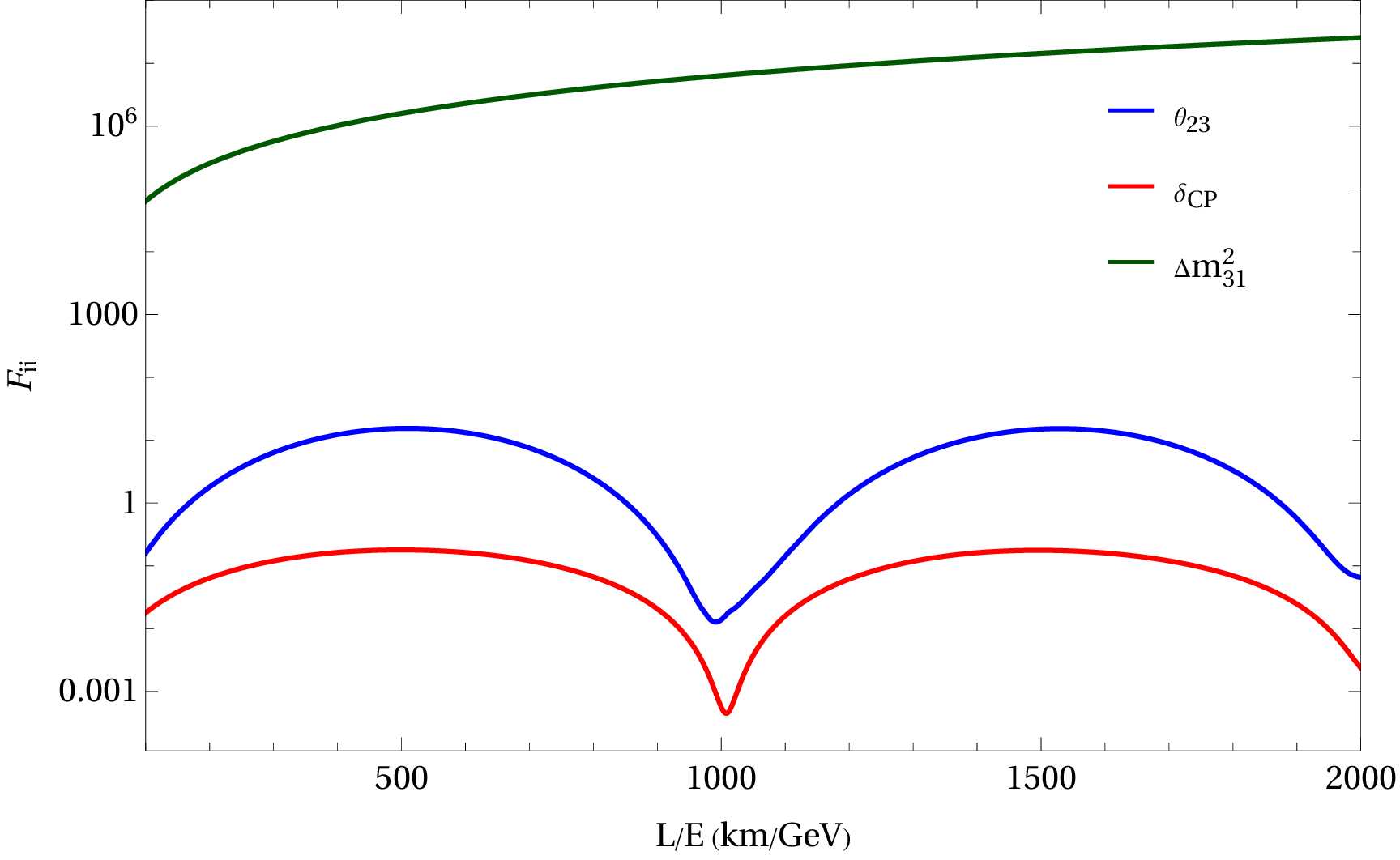
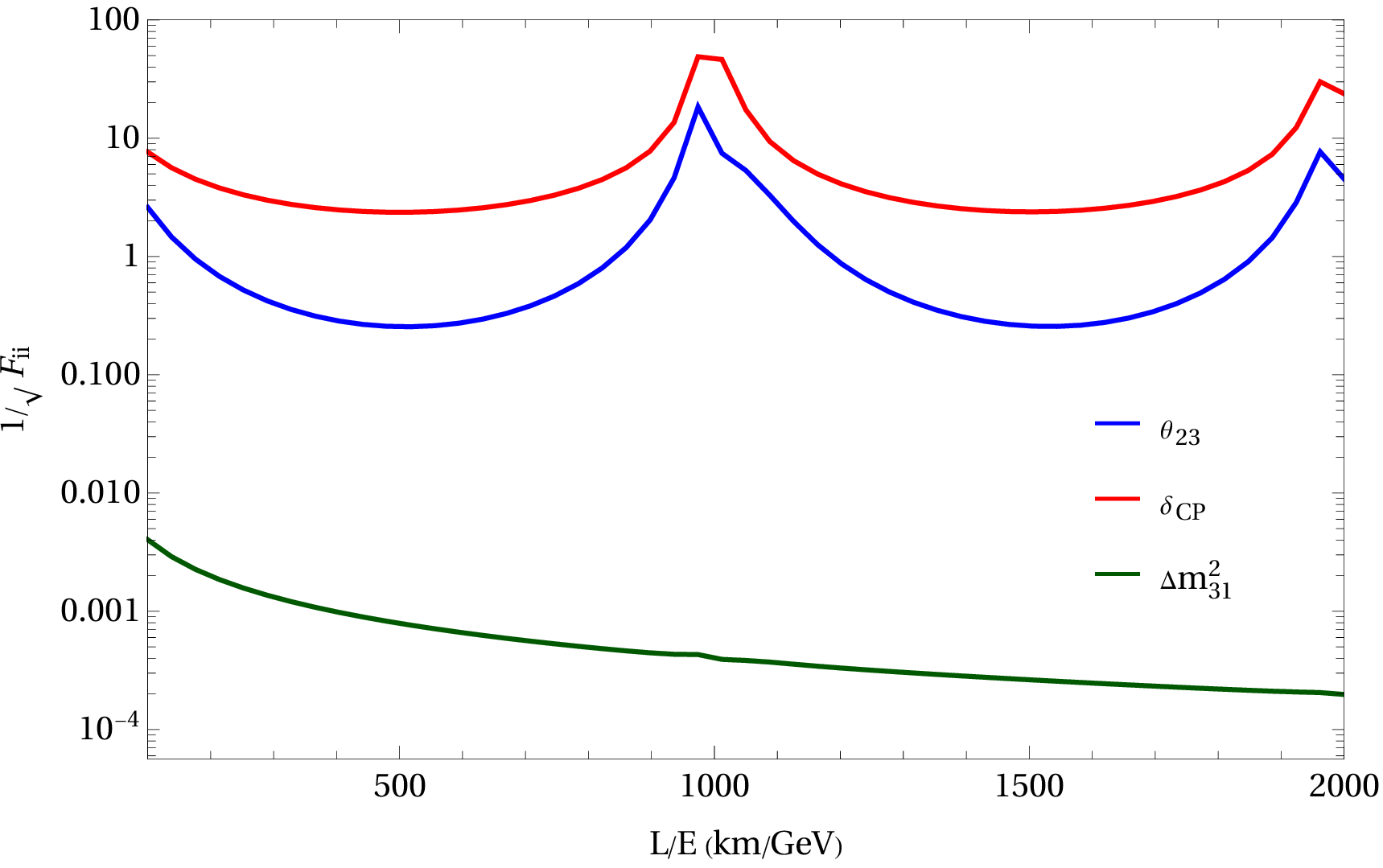
Figure 1: Quantum Fisher information of the diagonal elements of the QFIM (left panel) and the corresponding quantum Cramér-Rao bounds (right panel) for the oscillation parameters \(\theta_{23}\), \(\delta_{\mathrm{CP}}\), and \(\Delta m_{31}^{2}\) as function of baseline length-to-energy ratio..
To investigate parameter sensitivity at the level of the underlying quantum state, we employ the QFIM. For a pure quantum state \(|\psi(\boldsymbol{\theta})\rangle\) that depends on a set of parameters \(\boldsymbol{\theta}=(\theta_1,\theta_2,\cdots)\), the QFIM is defined as \[\begin{align} \mathcal{F}_{ij} = 4\,\mathrm{Re}\!\left(\langle \partial_i \psi | \partial_j \psi \rangle -\langle \partial_i \psi | \psi \rangle\langle \psi | \partial_j \psi \rangle \right), \end{align}\] where \(\partial_i \equiv \frac{\partial}{\partial \theta_i}\). In this work, the parameter vector is \[\boldsymbol{\Theta} = (\theta_{23},\,\delta_{\mathrm{CP}},\,\Delta m_{31}^2),\] which leads to a \(3\times3\) QFIM describing the sensitivities and correlations among these parameters. The QFIM matrix is explicitly given as \[\mathcal{F}(\Theta)= \begin{pmatrix} \mathcal{F}_{\theta_{23}\theta_{23}} & \mathcal{F}_{\theta_{23}\delta_{\rm CP}} & \mathcal{F}_{\theta_{23}\Delta m^2_{31}} \\[2mm] \mathcal{F}_{\delta_{\rm CP}\theta_{23}} & \mathcal{F}_{\delta_{\rm CP}\delta_{\rm CP}} & \mathcal{F}_{\delta_{\rm CP}\Delta m^2_{31}} \\[2mm] \mathcal{F}_{\Delta m^2_{31}\theta_{23}} & \mathcal{F}_{\Delta m^2_{31}\delta_{\rm CP}} & \mathcal{F}_{\Delta m^2_{31}\Delta m^2_{31}} \end{pmatrix}.\]
The diagonal elements \(\mathcal{F}_{ii}\) quantify the sensitivity of the quantum state with respect to individual parameters, while the off-diagonal elements \(\mathcal{F}_{ij}\) capture quantum sensitivity due to correlations between parameters. These correlations encode how variations in one parameter affect the estimation of another. The ultimate precision bound for parameter estimation can then be obtained via QFIM through the quantum Cramér–Rao inequality \[\begin{align} \Delta \theta_i \ge \sqrt{(\mathcal{F}^{-1})_{ii}}, \end{align}\] which establishes the minimum achievable variance in estimating the parameter \(\theta_i\).
| Parameter | Normal Ordering | Inverted Ordering |
| Best fit \(\pm 1\sigma\) | Best fit \(\pm 1\sigma\) ) | |
| \(\theta_{12}\,[^\circ]\) | \(33.68^{+0.73}_{-0.70}\) | \(33.68^{+0.73}_{-0.70}\) |
| \(\theta_{23}\,[^\circ]\) | \(43.3^{+1.0}_{-0.8}\) | \(47.9^{+0.7}_{-0.9}\) |
| \(\theta_{13}\,[^\circ]\) | \(8.56^{+0.11}_{-0.11}\) | \(8.59^{+0.11}_{-0.11}\) |
| \(\delta_{\rm CP}\,[^\circ]\) | \(212^{+26}_{-41}\) | \(274^{+25}_{-23}\) |
| \(\Delta m^2_{21}\,[10^{-5}\,\mathrm{eV}^2]\) | \(7.49^{+0.19}_{-0.19}\) | \(7.49^{+0.19}_{-0.19}\) |
| \(\Delta m^2_{31}\,[10^{-3}\,\mathrm{eV}^2]\) | \(+2.513^{+0.021}_{-0.019}\) | \(-2.484^{+0.020}_{-0.020}\) |
3 Individual parameter sensitivity and quantum-limited precision↩︎
Fig. 1 shows the QFI of the diagonal elements of the QFIM (left panel) and the corresponding quantum Cramér–Rao bound (QCRB) (right panel) as functions of the baseline-to-energy ratio \((L/E)\). Throughout the analysis, we adopt benchmark values of the oscillation parameters consistent with current global-fit results [12], ensuring compatibility with existing studies. Specifically, the best fit values corresponding to the Normal Ordering (NO) scenario are taken from Table 1. The diagonal elements \(\mathcal{F}_{\theta_{23}}\), \(\mathcal{F}_{\delta_{\mathrm{CP}}}\), and \(\mathcal{F}_{\Delta m^2_{31}}\) exhibit two prominent maxima around \(L/E \approx 500\) and \(1500\) km/GeV. Among them, \(\mathcal{F}_{\Delta m^2_{31}}\) dominates by several orders of magnitude (\(\sim 10^{6}\)–\(10^{7}\)), indicating a very strong sensitivity of the neutrino quantum state to variations in \(\Delta m^2_{31}\). The enhanced sensitivity near these regions originates from the oscillatory phase structure of neutrino flavor evolution, where small variations in the oscillation parameters produce significant changes in the quantum state. The comparatively large sensitivity to \(\Delta m^2_{31}\) reflects its direct contribution to the oscillation phase governing neutrino propagation. In contrast, \(\mathcal{F}_{\delta_{\mathrm{CP}}} \sim \mathcal{O}(0.1)\) remains comparatively small over the considered range, reflecting the relatively weaker sensitivity to the CP phase.
The corresponding QCRBs exhibit the expected inverse behavior with respect to the QFI. The uncertainty associated with \(\Delta m^2_{31}\) lies in the range \(10^{-7}\)–\(10^{-5}\), demonstrating very high estimation precision. The uncertainty in \(\theta_{23}\) is comparatively larger, varying approximately between \(10^{-1}\) and \(10^{2}\), while \(\delta_{\mathrm{CP}}\) exhibits the largest uncertainty, reaching values above \(\mathcal{O}(10^{3})\) in certain regions. This hierarchy directly reflects the relative sensitivity of the quantum state to the oscillation parameters. The observed baseline dependence further indicates the nontrivial multiparameter structure governing neutrino oscillation dynamics.
While the diagonal elements characterize the individual parameter sensitivities, neutrino oscillations inherently constitute a multiparameter system, where the interplay between different oscillation parameters is encoded in the off-diagonal structure of the QFIM and will be discussed in the next section.
4 Multiparameter structure and intrinsic parameter correlations↩︎
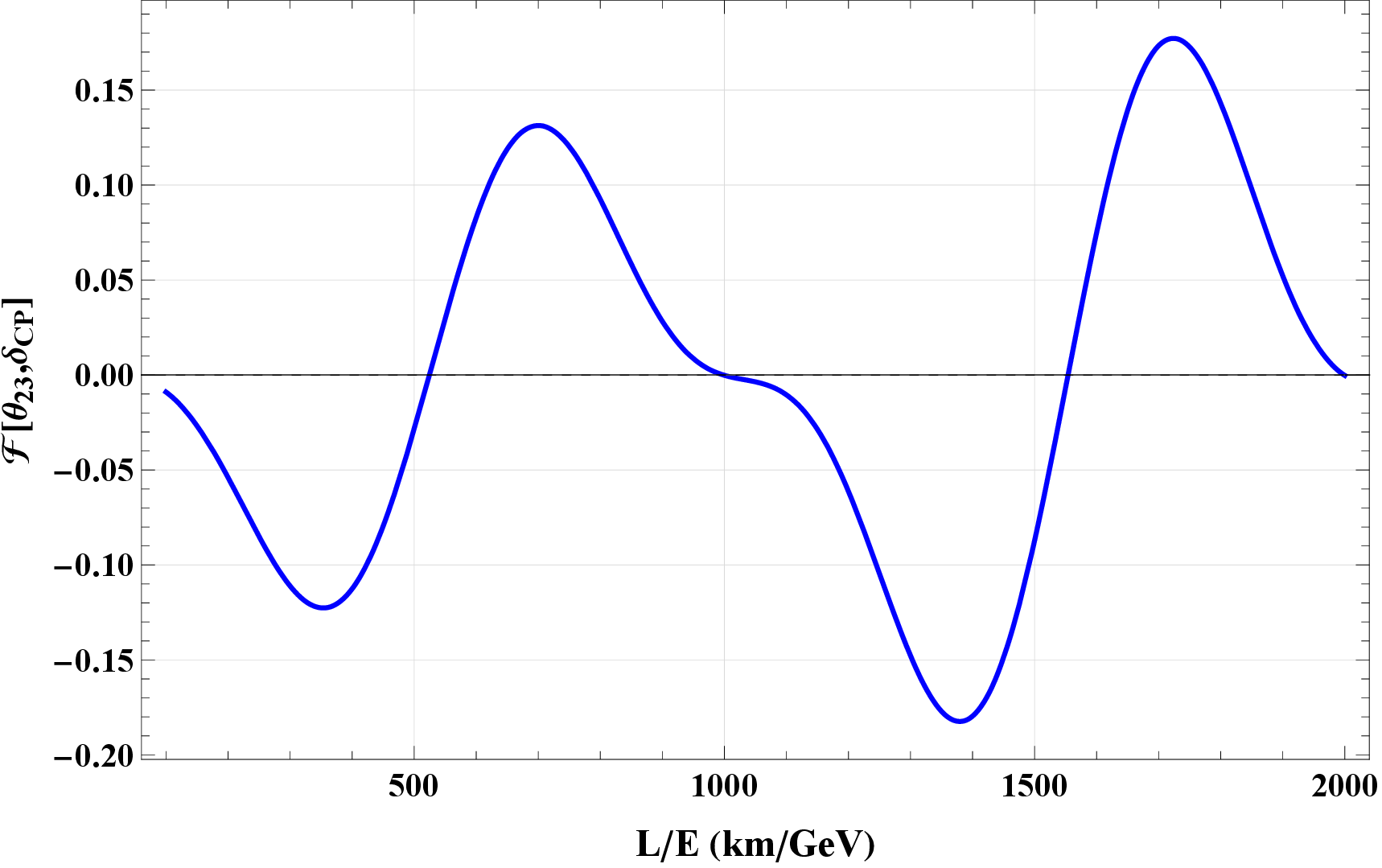
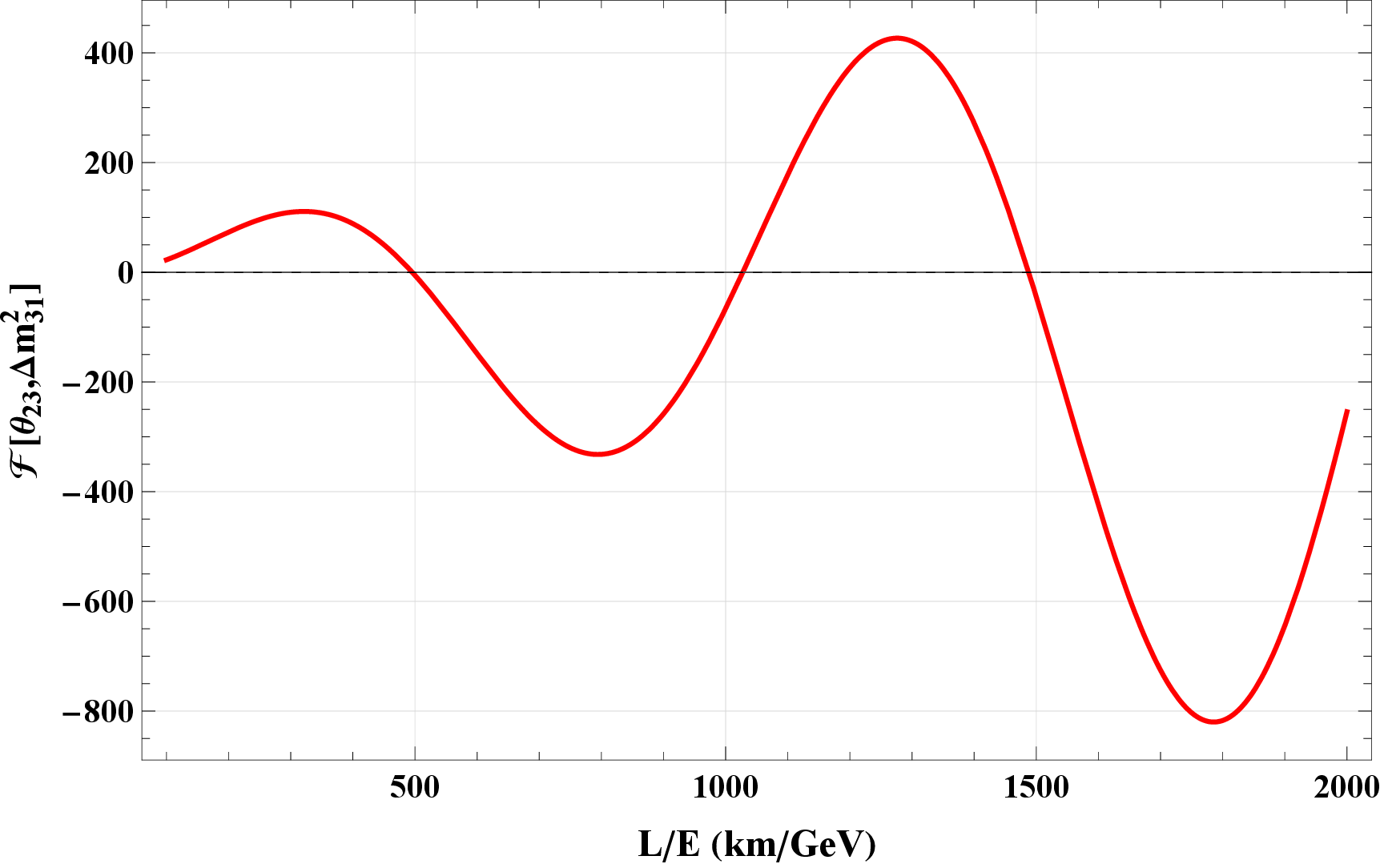
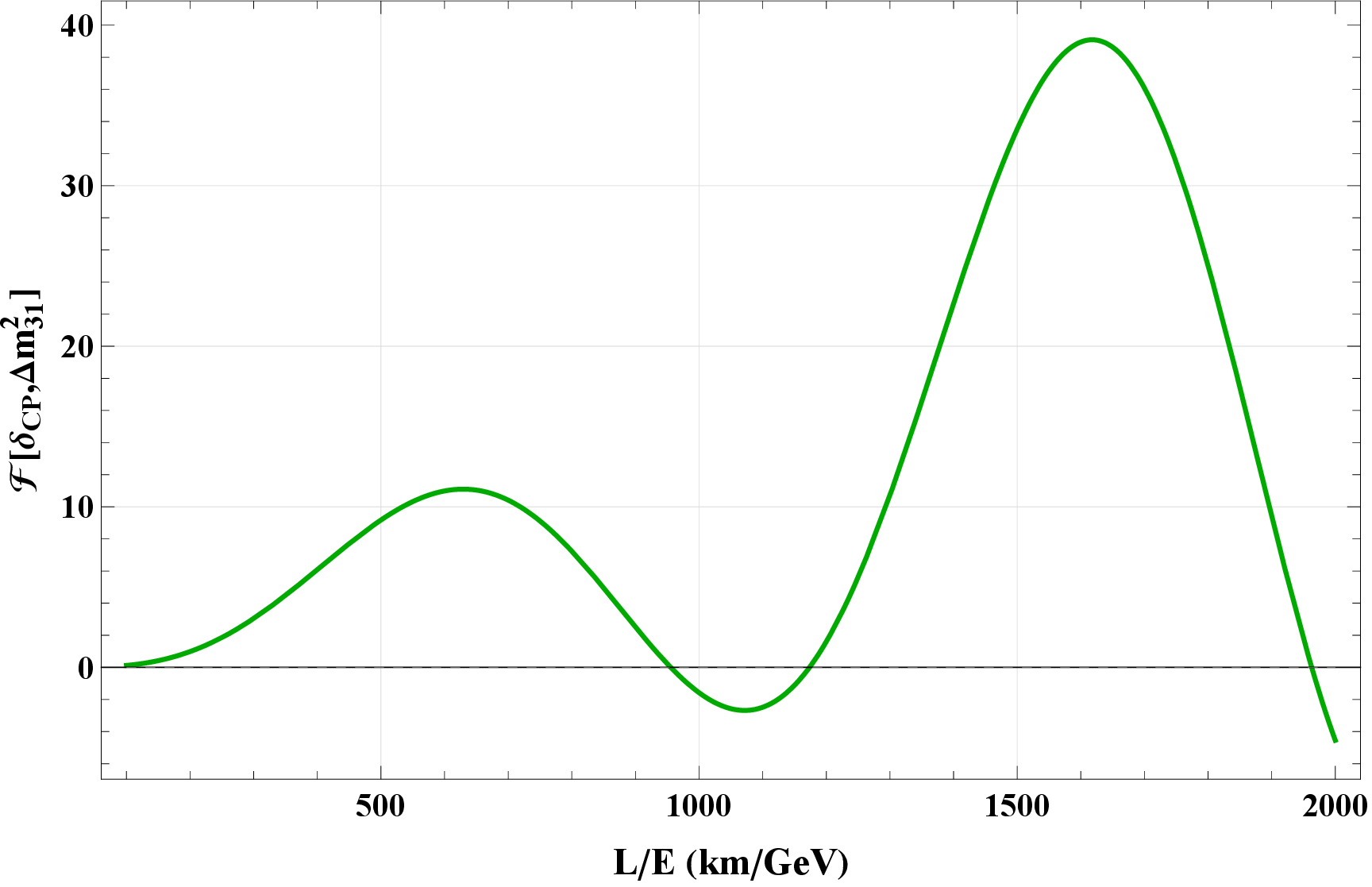

Figure 2: Quantum Fisher information of the Off-diagonal elements of the QFIM and the corresponding normalized parameter correlations (bottom-right panel) for different oscillation parameter pairs as functions of \(L/E\)..
Fig. 2 presents the off-diagonal QFIM elements and the corresponding normalized parameter correlations, as functions of the baseline-to-energy ratio \((L/E)\). The off-diagonal QFIM elements \(\mathcal{F}_{\theta_{23}\delta_{\mathrm{CP}}}\), \(\mathcal{F}_{\theta_{23}\Delta m^2_{31}}\), and \(\mathcal{F}_{\delta_{\mathrm{CP}}\Delta m^2_{31}}\) characterize the mixed response of the neutrino quantum state under simultaneous variations of different oscillation parameters. Unlike the diagonal elements, the off-diagonal terms can assume both positive and negative values, reflecting changes in the relative alignment of the parameter-induced quantum-state variations across different \(L/E\) regions.
The quantity \(\mathcal{F}_{\theta_{23}\delta_{\mathrm{CP}}}\) exhibits an oscillatory structure within the range \([-0.20,+0.16]\), with multiple sign reversals over the considered \(L/E\) interval. The element \(\mathcal{F}_{\theta_{23}\Delta m^2_{31}}\) possesses the largest magnitude among the off-diagonal entries, spanning approximately \([-800,+400]\), while \(\mathcal{F}_{\delta_{\mathrm{CP}}\Delta m^2_{31}}\) shows an intermediate behavior with a maximum around \(+39\) near \(L/E \approx 1600\) km/GeV. The strong baseline dependence and sign changes observed in these quantities indicate the nontrivial multiparameter structure governing neutrino oscillation dynamics.
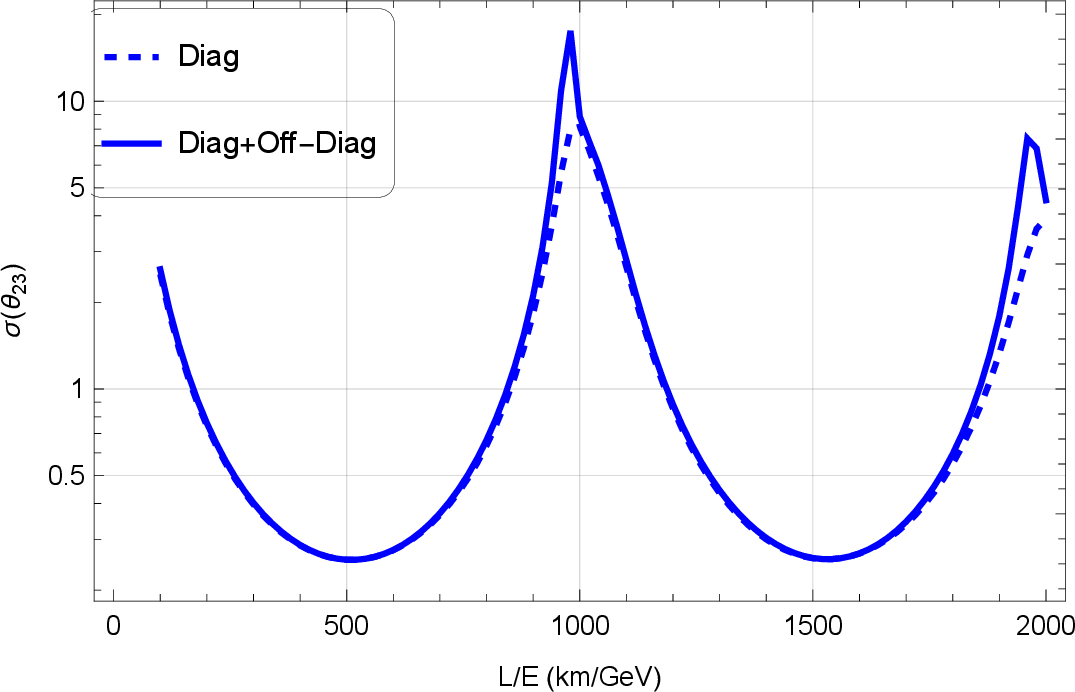
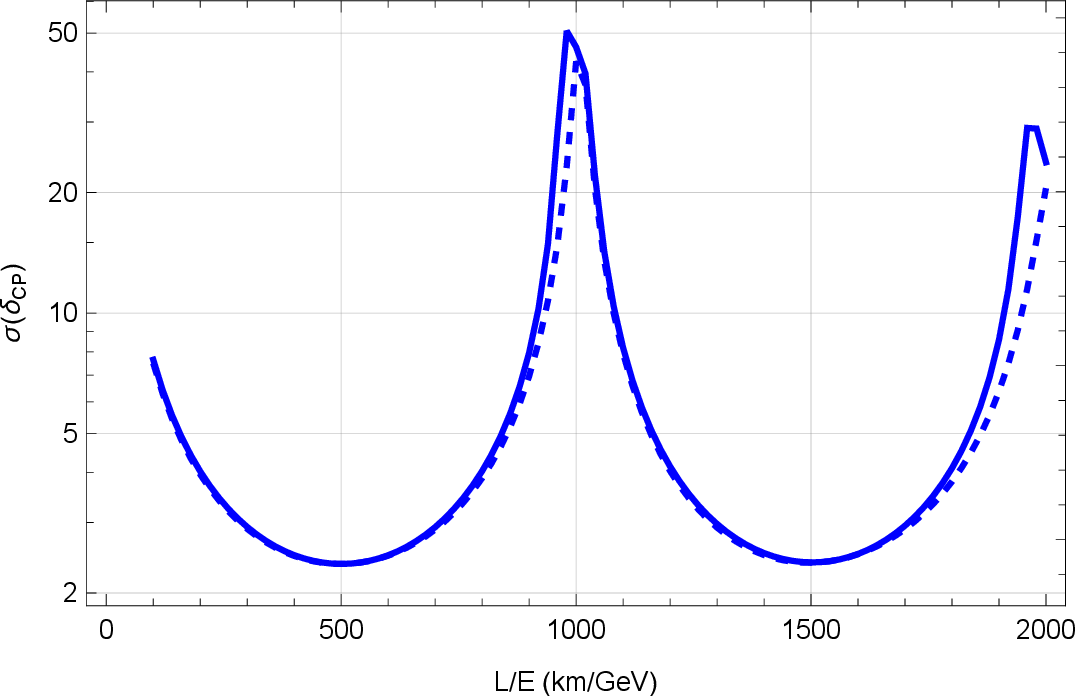
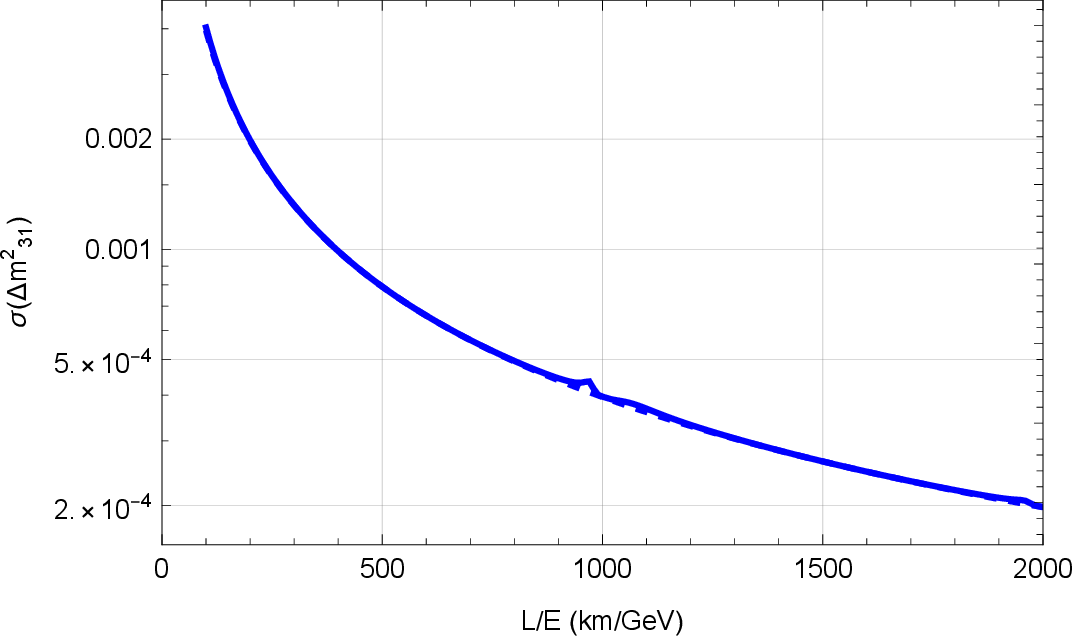
Figure 3: Comparison of the standard deviations obtained using only the diagonal QFI elements (dashed curves) and the full QFIM including off-diagonal contributions (solid curves) for the oscillation parameters \(\theta_{23}\), \(\delta_{\mathrm{CP}}\), and \(\Delta m^2_{31}\) as functions of \(L/E\)..
However, the magnitude of the raw QFI of the off-diagonal QFIM elements alone does not directly quantify the intrinsic correlations between oscillation parameters. To isolate the intrinsic correlation structure, we therefore consider the normalized coefficients \[C_{ij}=\frac{\mathcal{F}_{ij}}{\sqrt{\mathcal{F}_{ii}\mathcal{F}_{jj}}},\] shown in the bottom-right panel of Fig. 2. The sign of the correlation coefficient \(C_{ij}\) reflects the nature of the relationship between the corresponding oscillation parameters. Positive values correspond to correlated variations of the parameters, while negative values indicate an anti-correlation. The magnitude \(|C_{ij}|\) quantifies the strength of the correlation, with larger values indicating stronger parameter interdependence. The \((\theta_{23},\delta_{\mathrm{CP}})\) exhibits the strongest intrinsic correlation, reaching values close to unity near specific \(L/E\) regions, indicating that variations in these parameters produce highly aligned modifications of the neutrino quantum state. In contrast, the correlation between \((\delta_{\mathrm{CP}},\Delta m^2_{31})\) remains comparatively weak over most of the considered range, implying a relatively independent influence of these parameters on the quantum evolution. The pair \((\theta_{23},\Delta m^2_{31})\) exhibits moderate correlations with noticeable sign changes, reflecting transitions between aligned and opposing parameter-induced state variations. The present analysis may also have implications for future long-baseline accelerator experiments, which rely primarily on the \(\nu_\mu \rightarrow \nu_e\) appearance channel. Since these experiments probe specific regions of the \(L/E\) parameter space determined by their baselines and neutrino energy spectra, the correlation analysis presented in this work can provide useful information regarding the simultaneous determination of oscillation parameters. In particular, regions where the correlation coefficients are small correspond to weaker parameter interdependence and may therefore be more favorable for independent measurements of \(\theta_{23}\), \(\delta_{\rm CP}\), and \(\Delta m_{31}^{2}\). Consequently, the QFIM framework may serve as a complementary tool for identifying regions of enhanced sensitivity and reduced parameter correlations in future oscillation studies. To connect our results with a realistic experimental setup, we consider the DUNE experiment, which operates at a baseline of 1300 km and a neutrino flux peak around \(E\simeq2.5\) GeV, corresponding to \(L/E\simeq520\) km/GeV. From Fig. 2 (bottom-right panel), the correlation coefficients are relatively small in this region, indicating weak parameter interdependence among \(\theta_{23}\), \(\delta_{\rm CP}\), and \(\Delta m_{31}^{2}\). Such regions are expected to be favorable for simultaneous parameter estimation, highlighting the potential utility of the QFIM framework in identifying operating regimes with enhanced sensitivity and reduced parameter correlations for future long-baseline accelerator experiments.
Since the complete parameter uncertainties are governed by the inverse of the full QFIM, \[\mathrm{Cov}(\theta_\alpha, \theta_\beta) \geq \left(\mathcal{F}^{-1}\right)_{\alpha\beta},\] the off-diagonal structure of \(\mathcal{F}\) can modify the marginal variances beyond the diagonal-only estimate \(1/\mathcal{F}_{\alpha\alpha}\). To quantify the impact of parameter interplay on the achievable precision, we compare the minimum standard deviation obtained from the full QFIM, \[\sigma(\theta_\alpha)=\sqrt{\left(\mathcal{F}^{-1}\right)_{\alpha\alpha}},\] with the diagonal-only approximation as functions of \(L/E\) (see Fig. 3).
For both \(\sigma(\theta_{23})\) and \(\sigma(\delta_{\mathrm{CP}})\), the diagonal-only and full-QFIM estimates exhibit two minima around \(L/E \approx 500\) and \(1500\) km/GeV, coinciding with the regions where the diagonal QFI elements attain their maxima. The two estimates remain nearly identical over most of the considered range, with noticeable deviations appearing primarily near \(L/E \approx 1000\) km/GeV and for \(L/E \gtrsim 1700\) km/GeV. This behavior indicates that the off-diagonal correlations produce only moderate corrections to the marginal uncertainties of \(\theta_{23}\) and \(\delta_{\mathrm{CP}}\) in these regions.
In contrast, \(\sigma(\Delta m^2_{31})\) decreases monotonically throughout the considered \(L/E\) interval, and the diagonal-only and full-QFIM estimates remain nearly indistinguishable across the entire range. This behavior reflects the dominant contribution of \(\Delta m^2_{31}\) to the oscillation phase, which leads to a continuous growth of \(\mathcal{F}_{\Delta m^2_{31}}\) with increasing \(L/E\).
5 Resolving Parameter Degeneracies via QFI↩︎
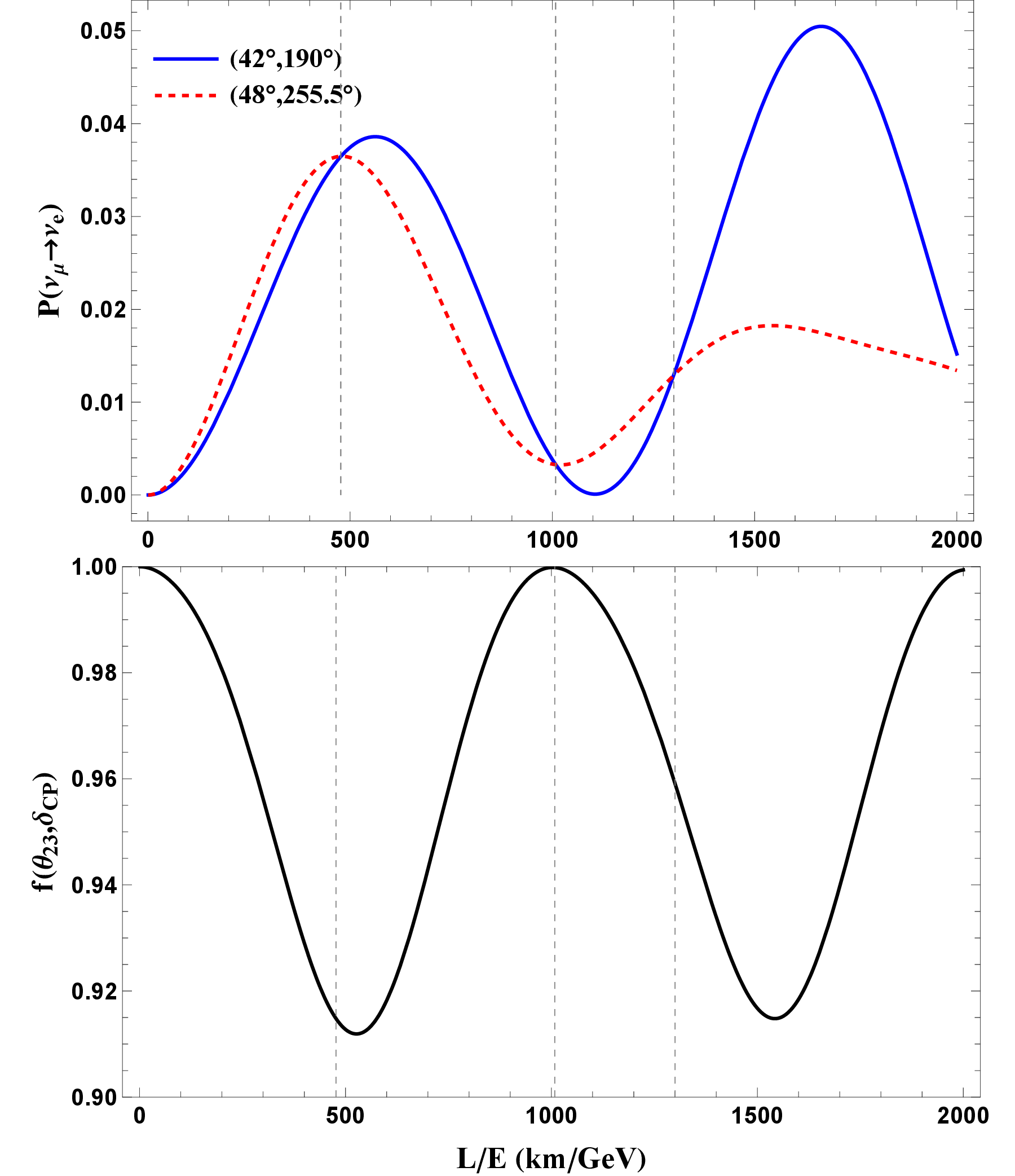
In neutrino oscillation experiments, parameter degeneracies arise when different sets of oscillation parameters produce nearly identical transition probabilities. A well-known example is the eightfold degeneracy associated with the atmospheric mixing angle, the CP-violating phase, and the neutrino mass ordering [17], [19], [21]. Since oscillation probabilities are classical observables constructed from quantum amplitudes, different parameter sets can lead to nearly indistinguishable experimental signatures despite corresponding to different underlying quantum states.
To highlight that the observed degeneracy may not necessitate the identical behavior at the quantum level, we consider two parameter sets \(\boldsymbol{\theta}_{1}\) and \(\boldsymbol{\theta}_{2}\) satisfying \[P_{\alpha\beta}(\boldsymbol{\theta}_{1}) \approx P_{\alpha\beta}(\boldsymbol{\theta}_{2}).\] As an illustrative example, we consider \[\begin{align} (\theta_{23},\delta_{\mathrm{CP}}) = (42^\circ,190^\circ), \quad (48^\circ,255.5^\circ), \end{align}\] with \(\Delta m^2_{31}\) fixed. At \(E=1~\mathrm{GeV}\), there exist three points in baseline length viz. \(L \in \{477,\,1008\,1300\}~\mathrm{km}\) (see Fig. 4) where the oscillation probabilities are identical. The probability-degenerate points correspond to the values of \(L/E\) at which the two benchmark parameter sets satisfy \(P_{\mu e}^{(1)}=P_{\mu e}^{(2)}\) up to numerical precision (\(\sim10^{-17}\)). The quantum mechanical distance between these two states are computed with fidelity given by [46] \[f(1,2) = \left| \langle \psi(\theta_{23}^{(1)},\delta_{\mathrm{CP}}^{(1)}) | \psi(\theta_{23}^{(2)},\delta_{\mathrm{CP}}^{(2)}) \rangle \right|^{2},\] At these three probability-degenerate point, we obtain the fidelity \(f\approx0.959\), which clearly highlights that the two quantum states possess a very large overlap but are not identical. This demonstrates that probability degeneracy does not necessarily imply complete indistinguishability at the quantum-state level.
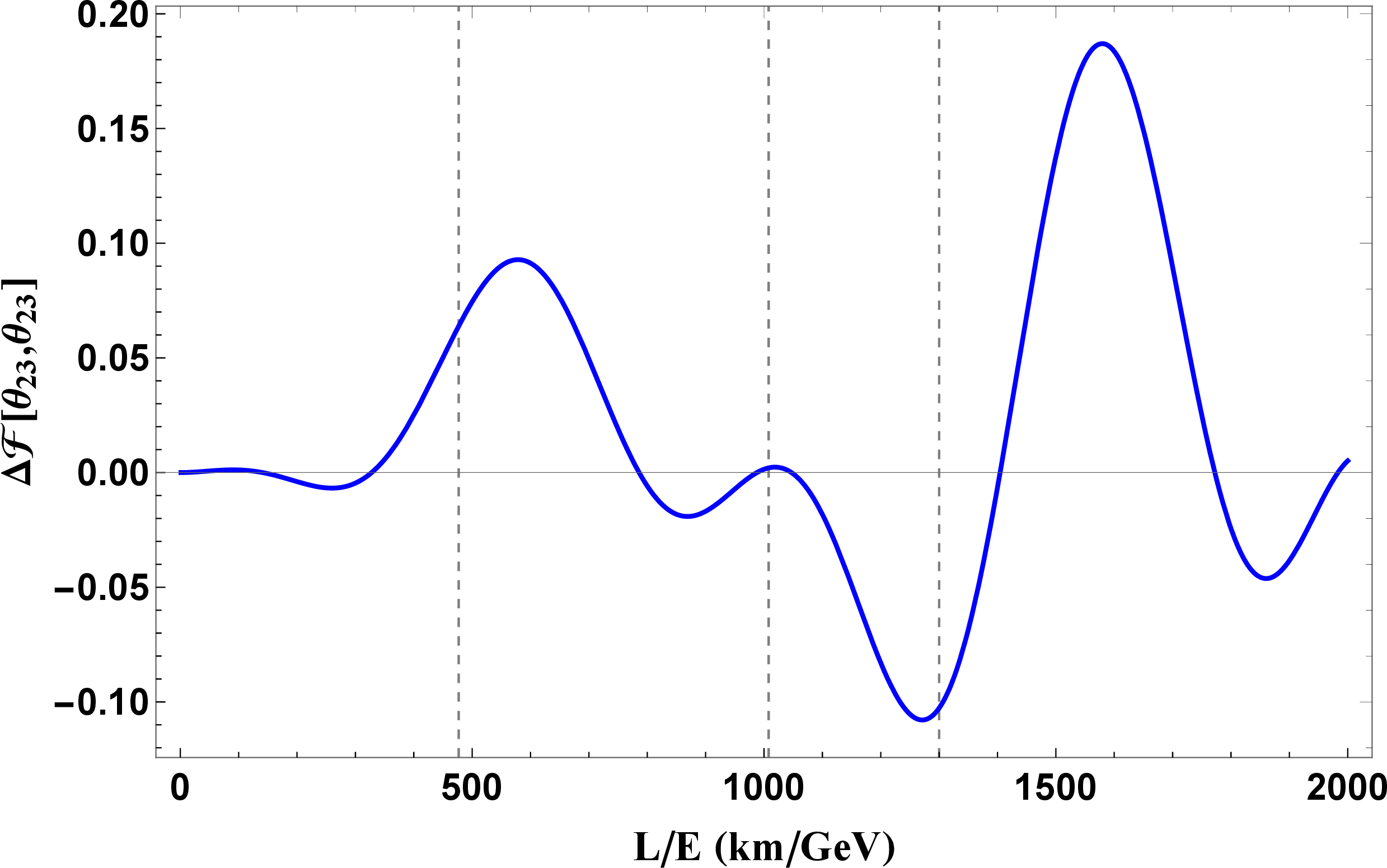
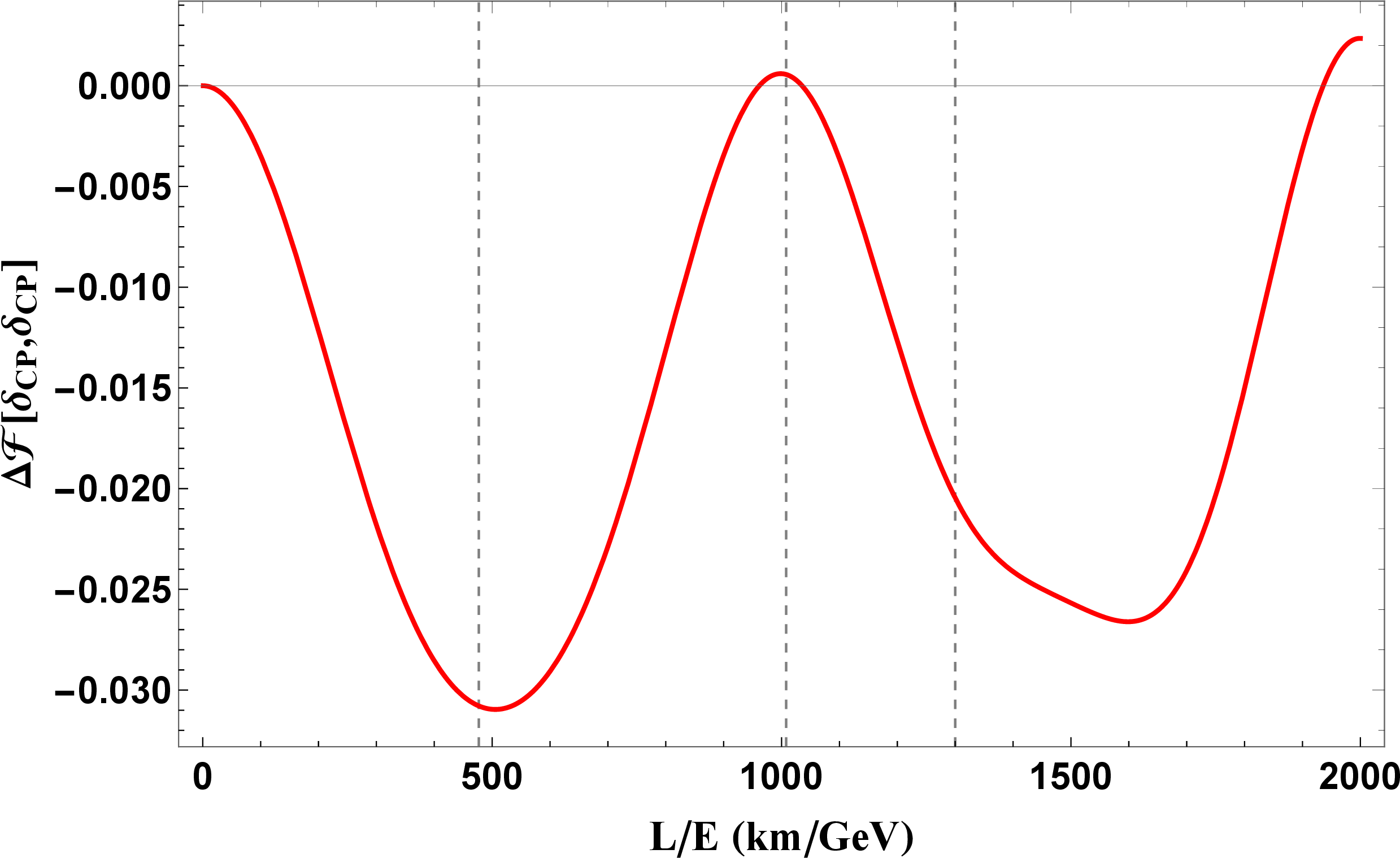
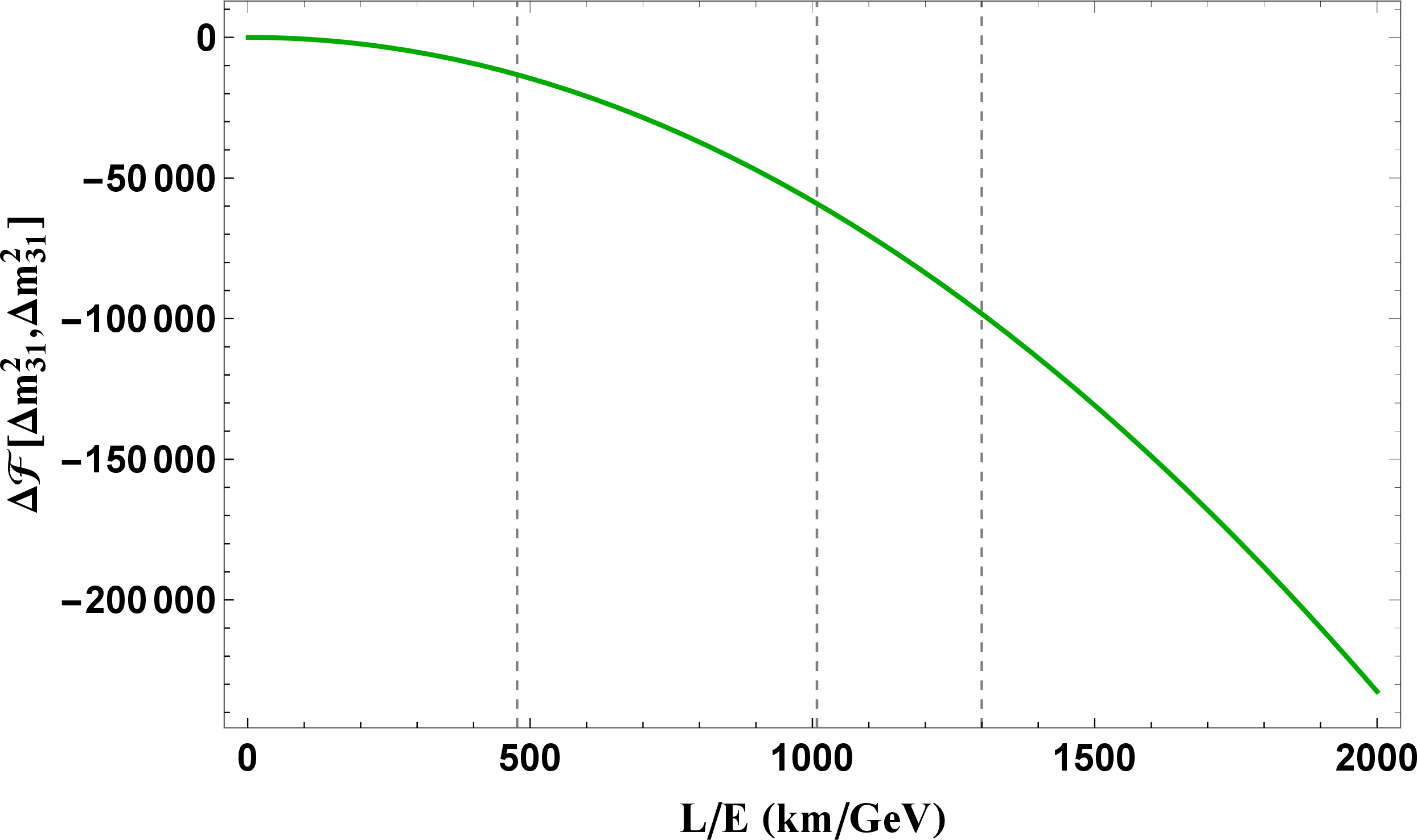
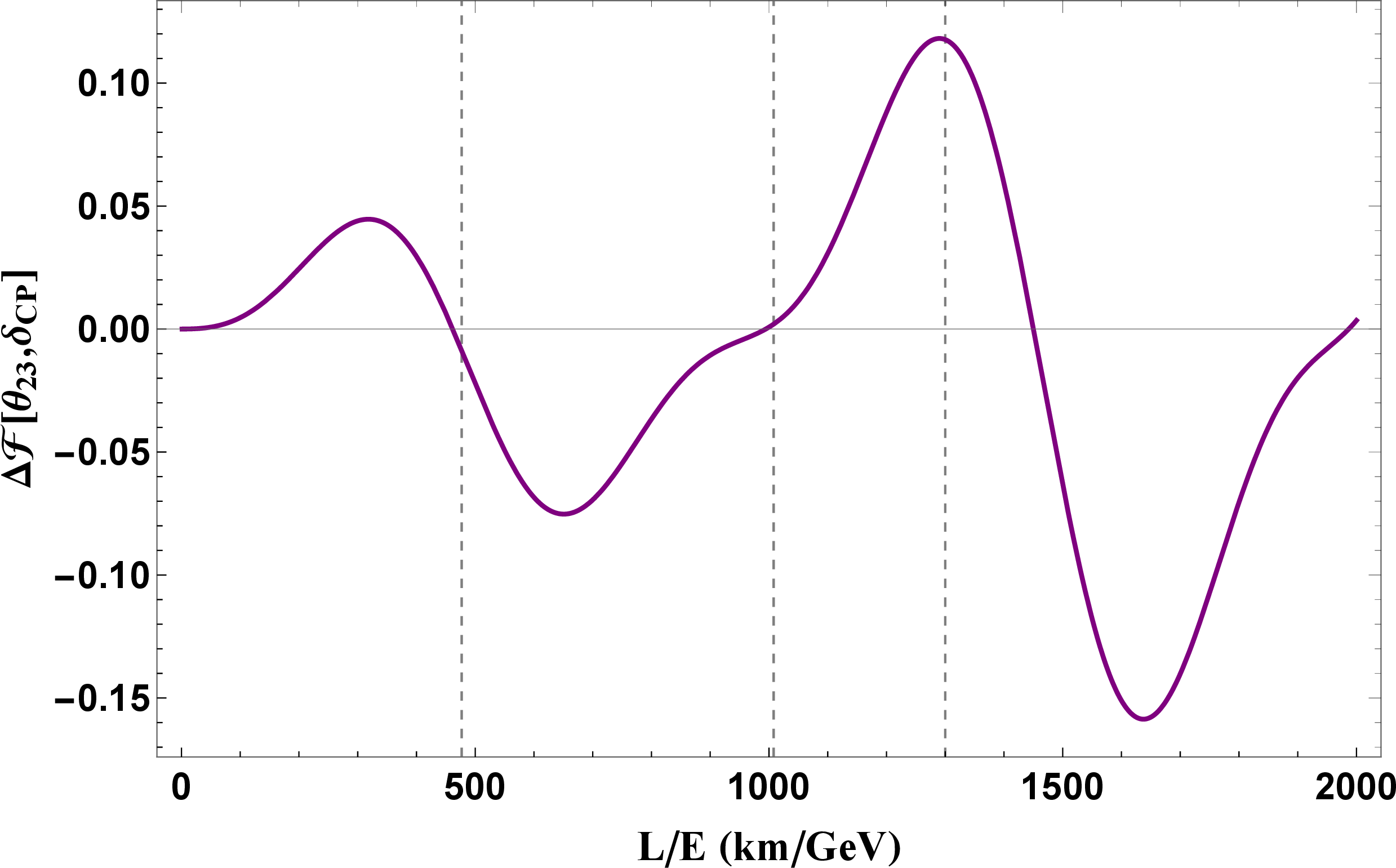
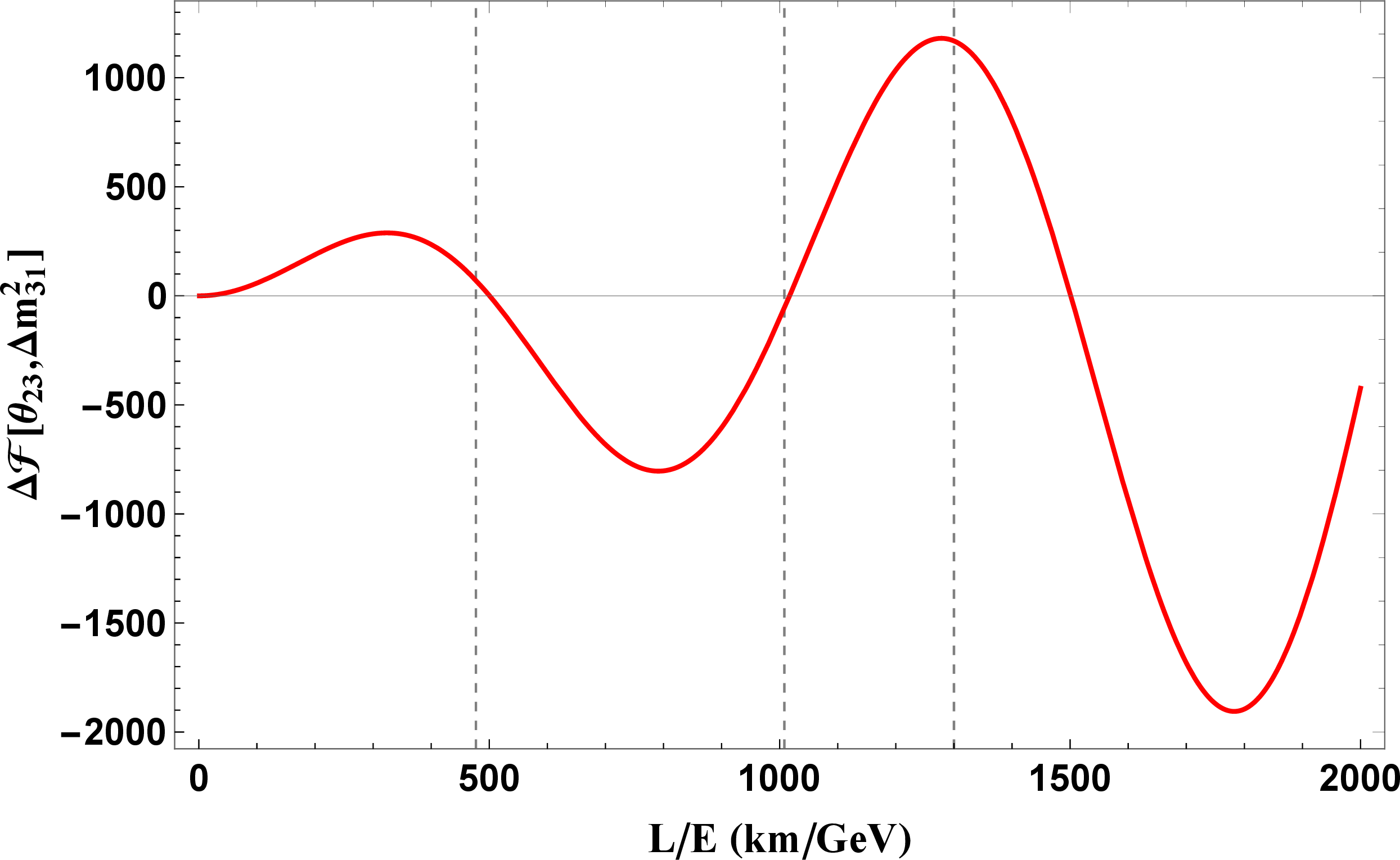
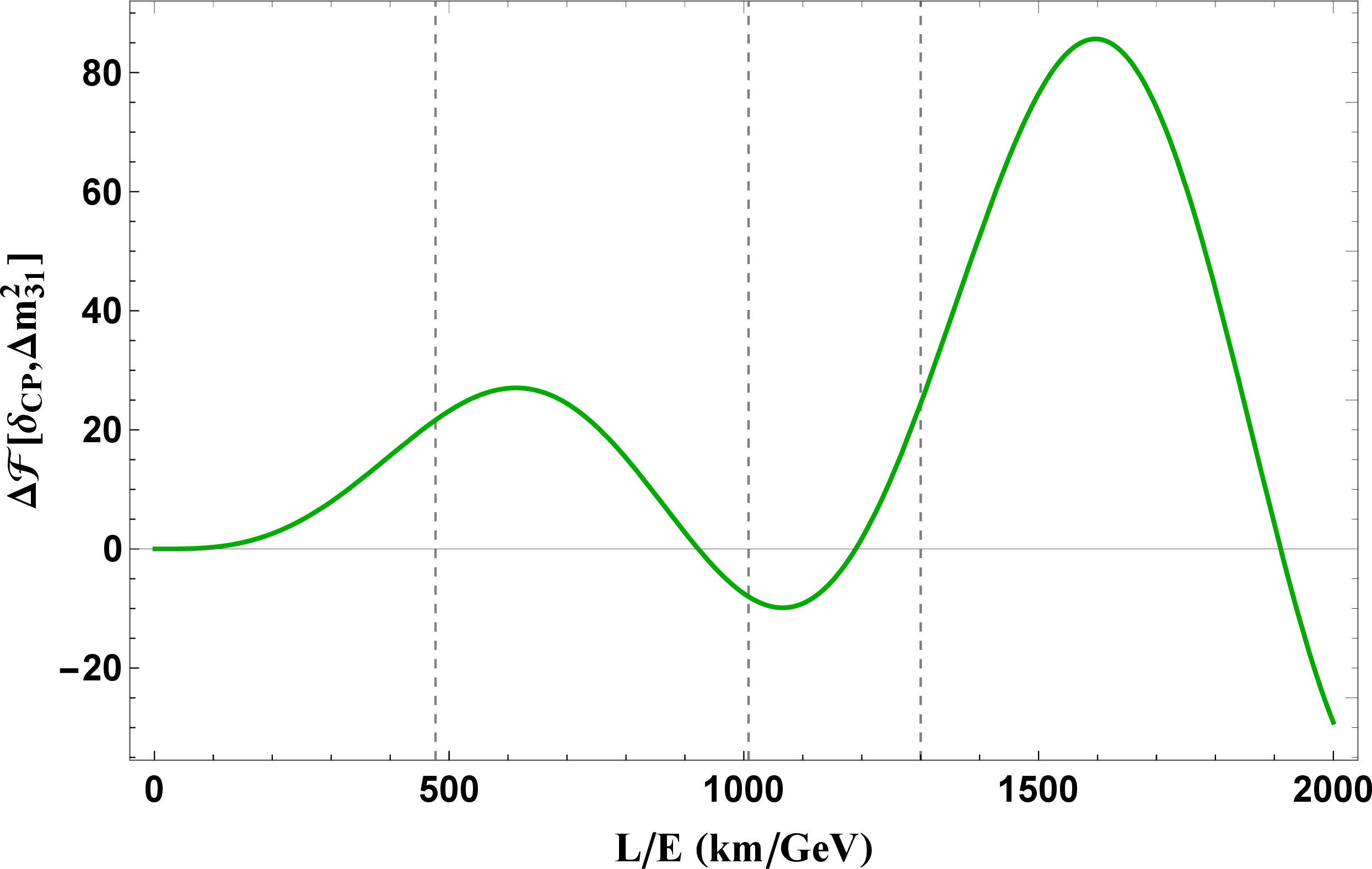
Figure 5: Differences in the diagonal (top row) and off-diagonal (bottom row) elements of the quantum Fisher information matrix between the two degenerate parameter sets \((\theta_{23},\delta_{\rm CP})=(42^\circ,190^\circ)\) and \((48^\circ,255.5^\circ)\) as a function of \(L/E\). The vertical dashed lines indicate the probability-degenerate points at \(L/E \simeq 477\), 1008, and 1300 km/GeV..
Although the fidelity establishes the existence of quantum distinguishability, it is a global overlap measure and does not directly reveal which parameter directions carry discriminating power. The QFIM provides precisely this information: \(\mathcal{F}_{ij}\) quantifies the sensitivity of the quantum state to simultaneous variations of parameters \(\theta_i\) and \(\theta_j\), and two states that differ in their local parameter-sensitivity geometry are distinguishable even when their classical probabilities coincide. To this end, we define the element-wise QFIM difference \[\Delta\mathcal{F}_{ij}(L/E) \;\equiv\; \mathcal{F}_{ij}^{(1)}(L/E) - \mathcal{F}_{ij}^{(2)}(L/E), \label{eq:deltaF}\tag{1}\] where \(\mathcal{F}_{ij}^{(k)}\) is the QFIM evaluated at \(\boldsymbol{\theta}_k\). A nonzero value of any element at a probability-degenerate \(L/E\) directly demonstrates that the QFIM lifts the degeneracy. Figure 5 displays all six independent elements of \(\Delta\mathcal{F}_{ij}\) as a function of \(L/E\) computed at the above discussed parameter space.
Examining the diagonal elements (top row of Fig. 5), we find that all three are nonzero at each of the three degenerate baselines. The \(\theta_{23}\) element (blue) exhibits oscillatory behaviour with amplitude \(\sim 0.1\)–\(0.18\), indicating that the two parameter sets differ substantially in their sensitivity to the atmospheric mixing angle. The \(\delta_{\mathrm{CP}}\) element is smaller in magnitude (\(\lesssim 0.03\)) but equally oscillatory and nonzero at the degenerate points. The \(\Delta m^2_{31}\) element is qualitatively different: it is large, monotonically growing in magnitude with baseline, and reaches \(|\Delta\mathcal{F}(\Delta m^2_{31})| \sim 2 \times 10^5\) at \(L/E = 2000~\mathrm{km/GeV}\). This reflects the fact that the mass-squared splitting governs the overall oscillation phase, whose sensitivity accumulates coherently with propagation length, and that the two degenerate parameter sets produce genuinely distinct phase evolutions despite identical instantaneous probabilities at specific \(L/E\) values.
The off-diagonal elements (bottom row of Fig. 5) encode cross-parameter correlations. The \(\theta_{23}\)–\(\delta_{\mathrm{CP}}\) element is oscillatory with amplitude \(\sim 0.15\), while the \(\delta_{\mathrm{CP}}\)–\(\Delta m^2_{31}\) element reaches amplitudes of \(\sim 80~\mathrm{GeV}^2/\mathrm{km}^2\). The \(\theta_{23}\)–\(\Delta m^2_{31}\) element is the largest off-diagonal contribution, with oscillatory amplitude, reflecting the strong interplay between the atmospheric angle and the mass ordering in driving the oscillation dynamics. Critically, all six elements are nonzero at the three probability-degenerate points, confirming that the QFIM can resolve the degeneracy in every parameter direction simultaneously.
Although the quantity \(\Delta\mathcal{F}_{ij}\) is not directly measurable, it provides information about differences in the underlying quantum-state geometry associated with probability-degenerate solutions. In practice, such differences may be inferred by comparing the quantum Fisher information with the corresponding classical Fisher information obtained from experimentally measured oscillation probabilities. Such a comparison could provide a bridge between the intrinsic quantum distinguishability predicted by the QFIM and the information that is accessible in realistic neutrino oscillation experiments. A detailed investigation of this connection is beyond the scope of the present work and will be explored in future studies.
6 Conclusion↩︎
In this work, we have performed a theoretical investigation of quantum Fisher information matrix (QFIM) with three parameters of interest viz., \(\theta_{23}\), \(\delta_{\mathrm{CP}}\), and \(\Delta m_{31}^2\) of the neutrino oscillation in three flavor scheme. We have computed the QFI for all six elements as a function of baseline length to energy ratio. Further, we show that the QFIM can distinguish between probability degenerate solutions in the \((\theta_{23},\delta_{\mathrm{CP}})\) parameter space.
Fig. 1 indicates that the diagonal elements of the QFIM reveal a clear hierarchy in parameter sensitivity, with \(\Delta m^2_{31}\) being the most precisely measurable parameter, followed by \(\theta_{23}\), while \(\delta_{CP}\) remains the least sensitive reflected in the smaller QFI values.
In Fig. 2, we show the QFI of the three off-diagonal elements of QFIM viz. \(\theta_{23}-\delta_{\mathrm{CP}}\), \(\theta_{23}-\Delta m_{31}^2\) and \(\delta_{\mathrm{CP}}-\Delta m_{31}^2\). The quantity \(\mathcal{F}_{\theta_{23}\delta_{\mathrm{CP}}}\) exhibits an oscillatory structure within the range \([-0.20,+0.16]\), with multiple sign reversals over the considered \(L/E\) interval. The element \(\mathcal{F}_{\theta_{23}\Delta m^2_{31}}\) possesses the largest magnitude among the off-diagonal entries, spanning approximately \([-800,+400]\), while \(\mathcal{F}_{\delta_{\mathrm{CP}}\Delta m^2_{31}}\) shows an intermediate behavior with a maximum around \(+39\) near \(L/E \approx 1600\) km/GeV.
However, from the correlation strength point of view, we note that (see bottom right panel of Fig. 2) \(\theta_{23}-\delta_{\mathrm{CP}}\) possess the largest correlation followed by \(\theta_{23}-\Delta m_{31}^2\) and \(\delta_{\mathrm{CP}}-\Delta m_{31}^2\). It implies that having a large raw QFI doesn’t necessarily mean a strong correlations among parameters.
Finally, we exploit the QFI of all six elements in order to break the degeneracy of neutrino oscillations. We choose two set of parameter space on \(\theta_{23}-\delta_{\mathrm{CP}}\) space and shown that the probability indeed have multiple degeneracy point in the \(L/E\) region (see Fig. 4). We showed that these points are quantum mechanically different by computing fidelity. We construct a simple observable (\(\Delta\mathcal{F}_{ij}\)) by taking the difference of QFI in two parameter space in order to highlight if QFI can indeed point to the distinguishability of degeneracy state at the quantum level. In Fig. 5, we show the corresponding \(\Delta\mathcal{F}_{ij}\). All the results point to the fact that the QFI could indeed capture the distinguishability of two quantum state even though they appear same at the probability level.
The advantage of the quantum-information framework becomes particularly evident in the presence of parameter degeneracies. While degenerate parameter sets may yield identical oscillation probabilities and therefore appear indistinguishable within a probability-based analysis, quantum-information measures such as the fidelity and the QFIM retain additional information about the underlying quantum states. The observed differences in these quantities demonstrate that probability degeneracies do not necessarily correspond to identical quantum states, highlighting the potential of quantum-information approaches to provide complementary insights beyond conventional oscillation analyses.
Acknowledgements↩︎
The authors gratefully acknowledge the support of the National Natural Science Foundation of China under Grant No. and 12075059, as well as the start-up fund of USTC.