Quark–hadron duality in inclusive electron–proton scattering at high \(Q^{2}\): structure functions and truncated moments from CLAS12
June 29, 2026
Abstract
We present a high-precision study of quark–hadron duality in inclusive electron–proton scattering in the nucleon resonance region, extending to \(Q^{2}\approx10~\mathrm{GeV}^{2}\), based on recent CLAS12 cross-section measurements at Jefferson Lab. The data, taken with a \(10.6\) GeV electron beam, span nine bins in four-momentum transfer over \(2.55 \le Q^{2} \le 10.4~\mathrm{GeV}^{2}\) and cover the full resonance region from the pion-production threshold up to \(W\approx2.5~\mathrm{GeV}\). To extend the hadronic description into the CLAS12 kinematic regime, we develop a phenomenological high-\(Q^{2}\) extension of the Argonne National Laboratory–Osaka University (ANL-Osaka) dynamical coupled-channels framework, constrained by the measured cross sections and anchored to the original ANL-Osaka calculation at \(Q_{0}^{2}=2.774~\mathrm{GeV}^{2}\). The extended framework enables a phenomenologically constrained longitudinal–transverse decomposition and extraction of the proton structure function \(F_{2}(W,Q^{2})\), from which we evaluate \(W\)-truncated Cornwall–Norton moments \(M_{2}(Q^{2})\) for the first, second, and third resonance regions as well as the high-\(W\) region. Comparison with the CJ15 global QCD analysis, including target-mass and higher-twist corrections, demonstrates overall consistency at the cross-section, structure-function, and truncated-moment levels across the kinematic range probed, providing quantitative evidence for both local and global quark–hadron duality and extending previous duality tests to substantially higher \(Q^{2}\). A further result of this analysis is the identification of a threshold effect in the partonic calculation: the finite-\(Q^{2}\) corrections do not enforce the physical pion-production threshold, and the residual discrepancy in the first resonance region is consistent with this effect rather than a breakdown of duality, indicating that threshold-constrained global analyses could sharpen future duality tests. Within the coupled-channel description, the single-pion channel alone underestimates the inclusive resonance-region strength above the \(\Delta(1232)\), which is carried predominantly by the multi-meson channels, as required for duality.
1 Introduction↩︎
Inclusive electron–proton scattering has long provided a primary avenue for investigating the internal structure of the nucleon across a wide range of distance scales. In the deep-inelastic scattering (DIS) regime, the cross sections are successfully described in terms of parton distribution functions (PDFs) governed by perturbative quantum chromodynamics (QCD). At lower invariant masses, \(W \lesssim 2~\mathrm{GeV}\), the cross sections exhibit pronounced resonance structures associated with the excitation of nucleon resonances, reflecting the strongly coupled, nonperturbative dynamics of QCD. A remarkable empirical connection between these two regimes is provided by quark–hadron duality, first observed by Bloom and Gilman [1], [2]. In inclusive scattering, this phenomenon manifests itself through the observation that structure functions measured in the resonance region, when appropriately averaged over the invariant mass \(W\), reproduce the same scaling behavior as those measured in the DIS region. Subsequent experimental measurements and theoretical investigations have shown that duality holds not only in a global sense—when averaged over broad resonance regions—but also, under suitable conditions, locally within individual resonance regions [3], [4]. From a theoretical perspective, quark–hadron duality can be understood within the framework of the operator product expansion (OPE), where higher-twist contributions become progressively suppressed with increasing four-momentum transfer \(Q^{2}\), allowing the resonance dynamics to reproduce leading-twist behavior upon averaging [3].
Quantitative tests of quark–hadron duality require precise measurements of inclusive observables in the resonance region over a broad range of \(Q^{2}\), together with theoretical descriptions capable of connecting the hadronic and partonic pictures. On the partonic side, modern global QCD analyses of PDFs have demonstrated that leading-twist calculations, supplemented by target-mass corrections (TMC) and phenomenological higher-twist (HT) terms, can describe inclusive DIS data down to relatively low values of \(Q^{2}\) and invariant mass [5]–[8]. This, in turn, makes it possible to evaluate structure functions and their truncated moments within a partonic framework and to compare them directly with resonance-region measurements.
Recent measurements of inclusive electron–proton scattering performed with the CLAS12 detector [9] at Jefferson Lab have substantially extended the available data in the nucleon resonance region. These measurements, carried out by V. Klimenko et al. [10] using CLAS12 Run Group A (RGA) data taken at a beam energy \(E = 10.6~\mathrm{GeV}\), provide absolute cross sections over the invariant-mass range from the pion-production threshold up to \(W \approx 2.5~\mathrm{GeV}\) for nine bins in four-momentum transfer spanning \(2.55 \le Q^{2} \le 10.4~\mathrm{GeV}^{2}\). Owing to the large acceptance of CLAS12, the data cover the full resonance region at each value of \(Q^{2}\), offering a unique opportunity to investigate the evolution of nucleon structure in the transition region between the hadronic and partonic descriptions and to test duality at momentum transfers well beyond those of earlier dedicated measurements in Hall C [4], [11] and with CLAS [12]. These measurements allow a direct test of whether the consistency between hadronic and partonic descriptions observed in earlier duality studies persists at substantially higher momentum transfers.
The primary goal of quark–hadron duality studies is to assess whether descriptions of nucleon structure based on hadronic degrees of freedom and those based on partonic degrees of freedom yield consistent results for inclusive observables. Addressing this question requires a framework in which the same physical quantities can be evaluated within both pictures and compared on an equal footing. On the hadronic side, this necessitates a theoretical description that explicitly incorporates nucleon resonances and is capable of reproducing the measured inclusive cross sections in the resonance region. Such a description can then be used to compute structure functions and their truncated moments, which represent averaged resonance contributions over specified invariant-mass regions. On the partonic side, the same observables can be evaluated using global QCD analyses of PDFs, including finite-\(Q^{2}\) corrections.
The hadronic description adopted in this work is provided by the Argonne National Laboratory–Osaka University (ANL-Osaka) dynamical coupled-channels (DCC) model [13]–[20]; the abbreviation AO is used for this model in equations throughout this paper. The ANL-Osaka model builds on a five-channel EBAC framework for \(\pi N\) and \(\gamma N\) reactions developed by an international collaboration within the Excited Baryon Analysis Center (EBAC) program at Jefferson Laboratory, and was later extended to an eight-channel model that also describes \(\nu N\) and \(K N\) reactions. In this framework the inclusive cross section is constructed from the \(\pi N\), \(\eta N\), \(K\Lambda\), \(K\Sigma\), and \(\pi\pi N\) channels, the last of which includes resonant \(\pi\Delta(1232)\), \(\rho N\), and \(\sigma N\) components, with parameters constrained by global fits to \(\pi N\) and \(\gamma N\) data. The original ANL-Osaka description of inclusive electron–proton scattering is, however, limited to \(Q^{2} \lesssim 3~\mathrm{GeV}^{2}\), because the ANL-Osaka parametrization of the resonance electromagnetic form factors \(F_{N^{*},\gamma N}(Q^{2})\) was established only up to this range in the original analysis of exclusive \(p(e,e'\pi)N\) data [19].
A central element of the present analysis is therefore a phenomenological extension of the ANL-Osaka model to high \(Q^{2}\), anchored to the ANL-Osaka calculation at \(Q_{0}^{2} = 2.774~\mathrm{GeV}^{2}\) and constrained directly by the CLAS12 cross sections at higher \(Q^{2}\). This extension is empirical: it provides a controlled high-\(Q^{2}\) interpolation anchored to the ANL-Osaka calculation, rather than a new dynamical coupled-channels solution. Using this extended description, we perform a phenomenologically constrained longitudinal–transverse (L/T) decomposition, extract the proton structure function \(F_{2}(W,Q^{2})\), and compute \(W\)-truncated Cornwall–Norton moments \(M_{2}(Q^{2})\) for four \(W\) ranges corresponding to the first, second, and third resonance regions and the high-\(W\) region beyond. The results are compared with two variants of the CJ15 next-to-leading-order (NLO) global QCD analysis [6], evaluated using LHAPDF 6.5.4 [21]: the NLO leading-twist baseline (denoted CJ15NLO+LT) and the same calculation supplemented by target-mass and higher-twist corrections (CJ15NLO+TMC+HT).
This is the first quantitative study of quark–hadron duality that combines recent CLAS12 measurements covering the full resonance region and extending to \(Q^{2}\approx10~\mathrm{GeV}^{2}\) with a coupled-channels hadronic description that incorporates both single-meson and multi-meson final states. The analysis establishes consistency between hadronic and partonic descriptions simultaneously at the level of inclusive cross sections, extracted structure functions, and truncated moments. In addition, the single-pion channel of the coupled-channel solution alone underestimates the inclusive resonance-region strength above the \(\Delta(1232)\), demonstrating that the multi-meson channels are essential for reproducing the strength required for local quark–hadron duality. These advances extend previous duality studies to substantially higher momentum transfers and provide new quantitative evidence for both local and global quark–hadron duality.
This paper is organized as follows. In Sec. 2 we summarize the ANL-Osaka dynamical coupled-channels model and its performance in describing the CLAS12 inclusive cross section at \(Q^{2} = 2.774~\mathrm{GeV}^{2}\). Section 3 describes the phenomenological extension of the ANL-Osaka model to high \(Q^{2}\) and the fitting procedure used to extract the structure function \(F_{2}\). The extended description is confronted with the measured inclusive cross sections at multiple \(Q^{2}\) bins in Sec. 4. The extracted \(F_{2}(W,Q^{2})\) and the resulting picture of local quark–hadron duality are presented in Sec. 5, and the \(W\)-truncated moments \(M_{2}(Q^{2})\) are discussed in Sec. 6. A summary and outlook are given in Sec. 7.
2 The ANL-Osaka model and its performance at \(Q^{2} \le 2.774~\mathrm{GeV}^{2}\)↩︎
The ANL-Osaka dynamical coupled-channels (DCC) framework provides a unified description of meson–baryon reactions and electromagnetic processes in the nucleon resonance region. Its electroproduction amplitudes have a factorized form, \[T_{MB,\gamma^{*}N}(W,Q^{2}) \;=\; t^{R}_{MB,\gamma^{*}N}(W,Q^{2}) \;+\; t^{NR}_{MB,\gamma^{*}N}(W,Q^{2}), \label{eq:T95AO}\tag{1}\] where the resonant amplitude is \[t^{R}_{MB,\gamma^{*}N}(W,Q^{2}) \;=\; \left[ \sum_{N^{*}} \frac{\bar{\Gamma}^{\dagger}_{N^{*},MB}(W)\, \bar{\Gamma}_{N^{*},\gamma N}(W)}{W - M^{0}_{N^{*}} - \Sigma_{N^{*}}(W)} \right] F_{N^{*},\gamma N}(Q^{2}), \label{eq:t95R}\tag{2}\] and the nonresonant amplitude has an analogous structure with form factors \(F^{n}_{MB,\gamma N}(Q^{2})\) associated with each Born-type contribution. In Eq. (2 ), \(\bar{\Gamma}_{N^{*},ab}(W)\) is the dressed vertex for the \(N^{*} \to ab\) decay, \(M^{0}_{N^{*}}\) is the bare resonance mass, \(\Sigma_{N^{*}}(W)\) is the mass shift generated by the nonresonant interactions, and \(F_{N^{*},\gamma N}(Q^{2})\) is the \(\gamma N \to N^{*}\) electromagnetic transition form factor. Within the original ANL-Osaka analysis, the \(\gamma N \to N^{*}\) form factors are parametrized as a polynomial in \(Q^{2}\), \[F_{N^{*},\gamma N}(Q^{2}) \;=\; \sum_{n=0}^{n_{\max}} c^{N}_{n}\,(Q^{2})^{n}, \label{eq:FN95poly}\tag{3}\] with the normalization at the photon point, \(F_{N^{*},\gamma N}(Q^{2}=0) = c^{N}_{0}\), fixed by global fits to the photo- and pion-electroproduction world data [18]–[20]. Similar coupled-channel descriptions have been developed by the Bonn–Gatchina group [22] and the Jülich–Bonn–Washington group [23], [24]; in the present work the ANL-Osaka model is adopted as the hadronic-basis input.
Figure 1 shows the CLAS12 inclusive cross section \(d^{2}\sigma/dW\,dQ^{2}\) at \(Q^{2} = 2.774~\mathrm{GeV}^{2}\) and \(E = 10.6~\mathrm{GeV}\), compared with the full ANL-Osaka calculation (red solid). The model reproduces the position and magnitude of the \(\Delta(1232)\), second-resonance, and third-resonance peaks observed in the data within the experimental uncertainties. The channel decomposition reveals an important physical feature: the single-pion (\(1\pi\)) subchannel (black dashed) dominates the cross section at low \(W\) but is rapidly overtaken by the multi-meson channels (blue dashed), which together carry the bulk of the strength above \(W \approx 1.5~\mathrm{GeV}\). The exclusive \(1\pi\) channel alone underestimates the inclusive cross section by roughly a factor of two near \(W \approx 1.7~\mathrm{GeV}\), indicating that high-mass \(N^{*}\) states with sizable \(\pi\Delta\), \(\rho N\), and \(\sigma N\) branching fractions must be retained for a quantitative description of the inclusive strength above the \(\Delta(1232)\). This comparison demonstrates explicitly that multi-meson channels are essential for reproducing the inclusive resonance-region strength and for realizing quark–hadron duality above the \(\Delta(1232)\) region. The full ANL-Osaka calculation therefore provides the natural hadronic-basis input for the high-\(Q^{2}\) extension developed in the following section.
![Figure 1: Inclusive cross section d^{2}\sigma/dW\,dQ^{2} at Q^{2} = 2.774~\mathrm{GeV}^{2} and E = 10.6~\mathrm{GeV}. Black points: CLAS12 RGA data [10]. Red solid: full ANL-Osaka model. Black dashed: 1\pi contribution. Blue dashed: sum of the multi-meson channels (two-pion, kaon, and heavier final states). The full ANL-Osaka calculation reproduces the resonance-region data within uncertainties; the channel decomposition shows that multi-meson channels provide the dominant contribution to the inclusive strength above W\approx1.5~\mathrm{GeV}.](/article/2606.29690/figures/xsec_2p774_decomp.png "fig:")
3 Phenomenological extension of the ANL-Osaka model to high \(Q^{2}\)↩︎
The ANL-Osaka model is extended to the CLAS12 kinematics in two stages, both anchored at \(Q_{0}^{2} = 2.774~\mathrm{GeV}^{2}\) and evolved to higher \(Q^{2}\) through the same exponential-scaling Breidenbach–Kuti Ansatz in \(\omega'\). In Fit 1 (Sec. 3.1) the inclusive cross section is decomposed into single-pion and multi-pion contributions, with their ratio \(R_{1\pi/2\pi}\) fixed to the ANL-Osaka value at \(Q_{0}^{2}\), over the resonance region \(W \lesssim 2.0~\mathrm{GeV}\) where the ANL-Osaka model is defined. In Fit 2 (Sec. 3.2) the inclusive cross section is decomposed instead into longitudinal and transverse virtual-photon components, with the ratio \(R_{LT}\) softly constrained to a reference value at \(Q_{0}^{2}\), and the description is extended to \(W \le 2.5~\mathrm{GeV}\). The two fits decompose the same inclusive cross section along different axes: Fit 1 resolves its single-pion/multi-pion content, whereas Fit 2 resolves the longitudinal and transverse components of the total cross section but not its single-pion/multi-pion content. The longitudinal–transverse separation of Fit 2 yields the proton structure function \(F_{2}(W,Q^{2})\), from which the \(W\)-truncated moments that enter the duality analysis are computed.
Since the resonance electromagnetic form factors of Eq. (3 ) have been determined only for \(Q^{2} \le 3~\mathrm{GeV}^{2}\), a direct application of the ANL-Osaka model at the higher \(Q^{2}\) values covered by CLAS12 is not currently possible. Following the strategy of earlier SLAC analyses of inclusive \(p(e,e')\) scattering [25], we exploit the factorized form of Eqs. (1 )–(2 ), in which each electroproduction amplitude separates into a \(W\)-dependent hadronic part and a \(Q^{2}\)-dependent form factor. This motivates the approximate representation of the inclusive structure functions, \[W_{i}(Q^{2},W) \;\simeq\; \bigl|F^{\rm AO}(W,Q^{2})\bigr|^{2} \sum_{MB} \bigl| t^{R}_{MB,\gamma N}(W,Q^{2}=0) + t^{NR}_{MB,\gamma N}(W,Q^{2}=0) \bigr|^{2}, \label{eq:W95factorized}\tag{4}\] in which the \(W\) dependence is fixed by the photoproduction amplitudes generated from the ANL-Osaka model, and the averaged \(Q^{2}\) evolution is encoded in the effective form factor \(|F^{\rm AO}(W,Q^{2})|^{2}\).
3.1 Fit 1: single-pion versus multi-pion decomposition (\(R_{1\pi/2\pi}\) fixed at \(Q_{0}^{2}\))↩︎
In the first stage we parametrize the inclusive cross section as a sum of evolved single-pion and multi-pion contributions, each anchored at \(Q_{0}^{2}\), \[\sigma(W,Q^{2}) \;=\; \tilde{\sigma}^{1\pi}(W,Q^{2}) + \tilde{\sigma}^{2\pi}(W,Q^{2}), \label{eq:fit1}\tag{5}\] with the evolved single-pion and multi-pion contributions \[\begin{align} \tilde{\sigma}^{1\pi}(W,Q^{2}) &= e^{-\alpha(Q^{2}-Q_{0}^{2})}\, \frac{F_{2}\bigl(\omega'(Q^{2},W);c_{1},c_{2},c_{3}\bigr)}{F_{2}\bigl(\omega'(Q_{0}^{2},W);c_{1},c_{2},c_{3}\bigr)} \,\sigma^{1\pi}(W,Q_{0}^{2}), \tag{6}\\[4pt] \tilde{\sigma}^{2\pi}(W,Q^{2}) &= e^{-\beta(Q^{2}-Q_{0}^{2})}\, \frac{F_{2}\bigl(\omega'(Q^{2},W);c'_{1},c'_{2},c'_{3}\bigr)}{F_{2}\bigl(\omega'(Q_{0}^{2},W);c'_{1},c'_{2},c'_{3}\bigr)} \,\sigma^{2\pi}(W,Q_{0}^{2}), \tag{7} \end{align}\] where \(\sigma^{1\pi}(W,Q_{0}^{2})\) and \(\sigma^{2\pi}(W,Q_{0}^{2})\) are the ANL-Osaka single-pion and multi-pion cross sections at the anchor point, \(\omega'(Q^{2},W) = 1 + W^{2}/Q^{2}\), and the modified Breidenbach–Kuti function is [25] \[F_{2}\bigl(\omega';c_{1},c_{2},c_{3}\bigr) \;=\; \sum_{i=1}^{3} c_{i} \left(1 - \frac{1}{\omega'}\right)^{2+i}. \label{eq:F295BK953}\tag{8}\] By construction, this parametrization reproduces the ANL-Osaka model at \(Q^{2} = Q_{0}^{2}\), while the exponential factors \(e^{-\alpha(Q^{2}-Q_{0}^{2})}\) and \(e^{-\beta(Q^{2}-Q_{0}^{2})}\) stabilize the extrapolation by suppressing the otherwise divergent behavior of the \(\omega'\) parametrization at large \(Q^{2}\). This parametrization yields good fits to the CLAS12 inclusive cross sections across the full \(Q^{2}\) range, with a data-only \(\chi^{2}/\mathrm{ndf} \approx 2\).
Figure 2 shows the result of this fit at four representative \(Q^{2}\) bins. The total (orange solid) is the sum, Eq. (5 ), of the evolved single-pion contribution \(\tilde{\sigma}^{1\pi}\) (green dashed) and the evolved multi-pion contribution \(\tilde{\sigma}^{2\pi}\) (red dot-dashed). The \(1\pi\) contribution governs the low-\(W\) behavior, in particular the \(\Delta(1232)\) peak, whereas the \(2\pi\) contribution grows in relative importance with \(W\) and carries the bulk of the high-\(W\) strength at every \(Q^{2}\). Any \(Q^{2}\) evolution of the relative \(1\pi\)/\(2\pi\) balance is mild and parametrization-dependent within the present inclusive data, and remains to be tested directly against forthcoming CLAS12 exclusive \(p(e,e'\pi)N\) and \(p(e,e'\pi\pi)N\) measurements. This stage fixes the anchored \(Q^{2}\)-evolution of the inclusive cross section and its single-pion/multi-pion content over the resonance region, \(W \lesssim 2.0~\mathrm{GeV}\). The longitudinal–transverse separation and the extension to \(W \le 2.5~\mathrm{GeV}\) are carried out in Fit 2 (Sec. 3.2).
![Figure 2: Fit 1 decomposition of the CLAS12 inclusive cross section d^{2}\sigma/dW\,dQ^{2} into single-pion and multi-pion contributions, shown in W slices for four representative Q^{2} bins, Q^{2} = 2.774, 3.793, 6.065, and 9.699~\mathrm{GeV}^{2}. Blue points: CLAS12 RGA data [10]. Orange solid: total Fit 1 result (data-only \chi^{2}/\mathrm{ndf} \approx 2), the sum \tilde{\sigma}^{1\pi}+\tilde{\sigma}^{2\pi} of Eq. (5 ). Green dashed: evolved single-pion contribution \tilde{\sigma}^{1\pi}. Red dot-dashed: evolved multi-pion contribution \tilde{\sigma}^{2\pi}. The 1\pi contribution dominates the low-W region, including the \Delta(1232) peak, while the 2\pi contribution carries the bulk of the high-W strength.](/article/2606.29690/figures/global_LT_1pi2pi_4panel.png "fig:")
3.2 Fit 2: longitudinal–transverse decomposition (\(R_{LT}\) constrained at \(Q_{0}^{2}\))↩︎
The second stage decomposes the inclusive cross section into longitudinal and transverse virtual-photon components, over the full measured range \(W \le 2.5~\mathrm{GeV}\), \[\begin{align} \sigma^{\rm tot}_{\rm AO}(Q^{2},W,E_{e}) \;=\;& \bigl[ \tilde{\sigma}^{\rm AO}_{T}(Q^{2},W) + \epsilon(Q^{2},W,E_{e})\, \tilde{\sigma}^{\rm AO}_{L}(Q^{2},W) \bigr] \notag\\ &\times \Gamma_{\rm Hand}(Q^{2},W,E_{e})\, \mathcal{J}(Q^{2},W,E_{e}), \label{eq:sigma95LT} \end{align}\tag{9}\] where \(\Gamma_{\rm Hand}\) is the Hand-convention virtual-photon flux, \(\epsilon\) is the transverse photon polarization, \(\mathcal{J}\) is the Jacobian to the \((W,Q^{2})\) phase space, and \(E_{e}\) is the electron beam energy. The kinematic quantities are defined by \[\begin{align} \epsilon(Q^{2},W,E_{e}) &= \left[ 1 + 2\left(1 + \frac{\nu^{2}}{Q^{2}}\right) \tan^{2}\frac{\theta_{e}}{2} \right]^{-1}, \tag{10}\\[4pt] \Gamma_{\rm Hand}(Q^{2},W,E_{e}) &= \frac{\alpha_{\rm em}}{2\pi^{2}}\, \frac{E_{e}-\nu}{E_{e}}\, \frac{K(W)}{Q^{2}\,[1-\epsilon]}, \tag{11}\\[4pt] K(W) &= \frac{W^{2}-m_{N}^{2}}{2 m_{N}}, \qquad \nu(Q^{2},W) = \frac{W^{2}+Q^{2}-m_{N}^{2}}{2 m_{N}}, \tag{12}\\[4pt] \mathcal{J}(Q^{2},W,E_{e}) &= \frac{\pi W}{m_{N} E_{e}\,(E_{e}-\nu)}, \tag{13}\\[4pt] \theta_{e}(Q^{2},W,E_{e}) &= \arccos\!\left[ 1 - \frac{Q^{2}}{2 E_{e}\,(E_{e}-\nu)} \right], \tag{14} \end{align}\] where \(\alpha_{\rm em}\) is the fine-structure constant and \(m_{N}\) is the nucleon mass. The extended ANL-Osaka components are written in the same anchored form as in Fit 1, \[\begin{align} \tilde{\sigma}^{\rm AO}_{T}(Q^{2},W) &= f(Q^{2};\alpha)\, \frac{F_{2}(\omega'[Q^{2},W];c_{1},c_{2},c_{3},c_{4})}{F_{2}(\omega'[Q_{0}^{2},W];c_{1},c_{2},c_{3},c_{4})} \,\sigma^{\rm AO}_{T,{\rm input}}(Q_{0}^{2},W), \tag{15}\\[4pt] \tilde{\sigma}^{\rm AO}_{L}(Q^{2},W) &= f(Q^{2};\beta)\, \frac{F_{2}(\omega'[Q^{2},W];c'_{1},c'_{2},c'_{3},c'_{4})}{F_{2}(\omega'[Q_{0}^{2},W];c'_{1},c'_{2},c'_{3},c'_{4})} \,\sigma^{\rm AO}_{L,{\rm input}}(Q_{0}^{2},W), \tag{16} \end{align}\] with the ANL-Osaka input cross sections \(\sigma^{\rm AO}_{T,{\rm input}}\) and \(\sigma^{\rm AO}_{L,{\rm input}}\) extended in \(W\) up to \(2.5~\mathrm{GeV}\) and the exponential scaling functions \[f(Q^{2};\alpha) = \exp[\alpha(Q^{2}-Q_{0}^{2})], \qquad f(Q^{2};\beta) = \exp[\beta(Q^{2}-Q_{0}^{2})]. \label{eq:expscaling}\tag{17}\] In this construction, the \(W\) dependence of \(\sigma^{\rm AO}_{T,{\rm input}}(Q_{0}^{2},W)\) and \(\sigma^{\rm AO}_{L,{\rm input}}(Q_{0}^{2},W)\) is taken from the original ANL-Osaka calculation and held fixed, while the parameters \(\alpha\), \(\beta\), and \(\{c_{i},c'_{i}\}\) control the phenomenological \(Q^{2}\) evolution constrained by the inclusive CLAS12 cross sections and the soft \(R_{LT}\) penalty. The inputs \(\sigma^{\rm AO}_{T,{\rm input}}\) and \(\sigma^{\rm AO}_{L,{\rm input}}\) are the channel-summed transverse and longitudinal cross sections, so Fit 2 resolves the longitudinal and transverse components of the total inclusive cross section but does not separate the single-pion and multi-pion contributions; that decomposition is provided only by Fit 1.
The modified Breidenbach–Kuti functions used here are extended, relative to the three-term form of Eq. (8 ) used in Fit 1, by an additional \((1-1/\omega')^{6}\) term, \[\begin{align} F_{2}(\omega';c_{1},c_{2},c_{3},c_{4}) &= \sum_{i=1}^{4} c_{i} \left(1 - \frac{1}{\omega'}\right)^{2+i}, \tag{18}\\ F_{2}(\omega';c'_{1},c'_{2},c'_{3},c'_{4}) &= \sum_{i=1}^{4} c'_{i} \left(1 - \frac{1}{\omega'}\right)^{2+i}, \tag{19} \end{align}\] in order to capture the change in curvature observed in the high-\(W\) data (\(W \gtrsim 2.0~\mathrm{GeV}\)) as \(Q^{2}\) increases.
The parameters \(\{\alpha,\beta,c_{i},c'_{i}\}\) are determined by minimizing the total \(\chi^{2}\), \[\chi^{2}_{\rm total} \;=\; \chi^{2}_{\rm data} \;+\; \Phi_{\rm penalty}, \label{eq:chi295total}\tag{20}\] where the data term is \[\chi^{2}_{\rm data} \;=\; \sum_{\{Q_{i}^{2},W_{j}\}} \frac{\bigl[ \sigma^{\rm tot}_{\rm data}(Q_{i}^{2},W_{j}) - \sigma^{\rm tot}_{\rm AO}(Q_{i}^{2},W_{j}) \bigr]^{2}}{\Delta\sigma^{\rm tot}_{\rm data}(Q_{i}^{2},W_{j})^{2}}, \label{eq:chi295data}\tag{21}\] and the penalty term implements a soft constraint on the longitudinal-to-transverse ratio, \[R_{LT}^{\rm AO,par.}(Q^{2},W) \;\equiv\; \frac{\tilde{\sigma}^{\rm AO}_{L}(Q^{2},W)}{\tilde{\sigma}^{\rm AO}_{T}(Q^{2},W)}, \label{eq:RLT}\tag{22}\] relative to the \(R_{LT}\) values predicted by a reference model: \[\Phi_{\rm penalty} \;=\; \sum_{\{Q_{{\rm m},i}^{2},W_{{\rm m},j}\}} \frac{\bigl[ R_{LT}^{\rm model}(Q_{{\rm m},i}^{2},W_{{\rm m},j}) - R_{LT}^{\rm AO,par.}(Q_{{\rm m},i}^{2},W_{{\rm m},j}) \bigr]^{2}}{\bigl[0.3\, R_{LT}^{\rm model}(Q_{{\rm m},i}^{2},W_{{\rm m},j}) \bigr]^{2}}. \label{eq:penalty}\tag{23}\]
A soft (quadratic) penalty, rather than a hard constraint, is adopted so that the data drive the fit where they are sufficiently sensitive, while the result remains stabilized in regions of weaker experimental constraint. The reference \(R_{LT}\) values are obtained from the ANL-Osaka model at \(Q_{0}^{2}\) and extended as a \(Q^{2}\)-independent function across the fitted range. A \(30\%\) tolerance is assigned to the reference \(R_{LT}\) values in the penalty term, allowing substantial deviations from the reference model while still providing sufficient stabilization in regions where the inclusive cross sections alone have limited sensitivity to \(R_{LT}\).
The total \(\chi^{2}\) surface is nonlinear in the fit parameters and admits multiple local minima. To reliably identify the global minimum, we employ a two-stage Monte Carlo search: \(N_{\rm sampling} = 5000\) randomized initial parameter configurations are generated within physically reasonable ranges (\(\alpha,\beta \in [-4.5,0.0]\), \(c_{i},c'_{i} \in [-600,600]\)), the \(N_{\rm simplex} = 2000\) configurations with the smallest \(\chi^{2}_{\rm total}\) are refined by simplex minimization [26], and the best \(N_{\rm MIGRAD} = 10\) of these are subjected to gradient-based Migrad minimization. The global best-fit solution is selected as the configuration yielding the smallest \(\chi^{2}_{\rm total}\). This procedure was found essential to avoid convergence to shallow local minima, particularly when alternative \(R_{LT}\) priors are employed.
Because the Breidenbach–Kuti functions are linear in their parameters, the overall normalizations \(c_{1}\) and \(c'_{1}\) cancel in the ratios of Eqs. (15 )–(16 ), so the model is fully specified by the irreducible parameter set \[\left\{ \alpha,\beta,\, r_{1} = c_{2}/c_{1},\, r_{2} = c_{3}/c_{1},\, r_{3} = c_{4}/c_{1},\, r'_{1} = c'_{2}/c'_{1},\, r'_{2} = c'_{3}/c'_{1},\, r'_{3} = c'_{4}/c'_{1} \right\}. \label{eq:irreducible}\tag{24}\] In practice the global minimum search is carried out in the \(\{c_{i},c'_{i}\}\) representation, which yields a smoother \(\chi^{2}\) landscape and improved numerical convergence in the Monte Carlo procedure; the result is transformed to the irreducible \(\{r_{i},r'_{i}\}\) representation after the fact for the presentation of final results and for the uncertainty estimation.
Statistical uncertainties on the fitted parameters were determined using a parametric bootstrap procedure [27], [28]. A total of \(2000\) bootstrap replicas were generated by fluctuating the measured cross sections according to their total experimental uncertainties, obtained by combining statistical and systematic contributions in quadrature and assuming Gaussian probability distributions. Each bootstrap replica was analyzed using the full constrained fitting procedure, including the \(R_{LT}\) penalty term, starting from the nominal best-fit solution. Because the entire nonlinear fitting procedure is repeated for every replica, correlations among all fit parameters are naturally incorporated into the resulting uncertainty estimates. The quoted parameter uncertainties correspond to the standard deviations of the bootstrap distributions and therefore represent the propagation of experimental uncertainties through the complete fitting procedure. This approach avoids reliance on the local quadratic approximation of the \(\chi^{2}\) surface, which does not provide reliable uncertainty estimates for the highly nonlinear constrained model considered here.
The uncertainties quoted in Table ¿tbl:tab:fit95params? represent the experimental uncertainties propagated through the bootstrap procedure, including the statistical and systematic uncertainties of the measured cross sections added in quadrature. Additional model-dependent systematic effects associated with the phenomenological extension of the ANL-Osaka model have not yet been quantified separately. These include possible sensitivity to the functional form of the high-\(Q^{2}\) extrapolation, the order of the modified Breidenbach–Kuti parametrization, the choice of fit range, and the imposed \(R_{LT}\) constraint. Nevertheless, the extracted inclusive observables were found to remain comparatively stable under the alternative \(R_{LT}\) priors considered in Table ¿tbl:tab:fit95params?. Using the CJ15-constrained fit in place of the ANL-Osaka-constrained default leads to only modest shifts of the extracted \(F_{2}\) and \(M_{2}\) values in the resonance region, well within the total uncertainties quoted in this work; the variation between the two constraints is smaller than the experimental uncertainty over most of the kinematic range. A more complete assessment of model-dependent systematic uncertainties, including propagation into the extracted \(F_{2}\) structure functions and truncated moments, will be pursued in future work.
| Parameter | AO-constrained (adopted) | CJ15-constrained |
|---|---|---|
| \(\alpha\) | \(-0.069 \pm 0.011\) | \(-0.119 \pm 0.009\) |
| \(\beta\) | \(-0.063 \pm 0.011\) | \(-0.379 \pm 0.030\) |
| \(r_{1}\) | \(-1.758 \pm 0.499\) | \(-2.508 \pm 0.252\) |
| \(r_{2}\) | \(\phantom{-}4.495 \pm 0.852\) | \(\phantom{-}3.858 \pm 0.537\) |
| \(r_{3}\) | \(-3.207 \pm 0.650\) | \(-2.347 \pm 0.380\) |
| \(r'_{1}\) | \(\phantom{-}4.861 \pm 0.600\) | \(-13.726 \pm 0.127\) |
| \(r'_{2}\) | \(-16.958 \pm 1.670\) | \(\phantom{-}46.761 \pm 1.150\) |
| \(r'_{3}\) | \(\phantom{-}18.998 \pm 1.800\) | \(-52.834 \pm 2.480\) |
| \(\chi^{2}_{\rm total}/\mathrm{ndf}\) | 2.02 | 2.58 |
| \(\chi^{2}_{\rm data}/\mathrm{ndf}\) | 2.00 | 1.95 |
| \(\Phi_{\rm penalty}/\mathrm{ndf}\) | 0.02 | 0.63 |
The best-fit parameters obtained with two alternative \(R_{LT}\) constraints (ANL-Osaka and CJ15) are reported in Table ¿tbl:tab:fit95params?. The data-only \(\chi^{2}_{\rm data}/\mathrm{ndf}\) is close to \(2\) in both cases, indicating that the experimental cross sections are well described regardless of which \(R_{LT}\) prior is used; the small difference in \(\chi^{2}_{\rm total}/\mathrm{ndf}\) reflects the different penalty contributions. The nearly identical values of \(\chi^{2}_{\rm data}/\mathrm{ndf}\) obtained with the ANL-Osaka and CJ15 constraints further indicate that the inclusive cross sections themselves do not strongly favor either \(R_{LT}\) prior. The ANL-Osaka-constrained fit is adopted as the default in what follows. The stability of the extracted observables under these substantially different \(R_{LT}\) constraints indicates that the principal physics conclusions are determined primarily by the CLAS12 data rather than by the specific choice of phenomenological prior.
The extended ANL-Osaka model introduced here is not a substitute for a full coupled-channels re-determination of the resonance form factors at high \(Q^{2}\); it provides a phenomenologically constrained interpolation, anchored to the data and to the ANL-Osaka description at \(Q_{0}^{2}\), sufficient for the L/T decomposition and the duality analysis presented below. No new resonance states are introduced, and no assumptions are made regarding modifications of the underlying hadronic interaction dynamics.
4 Inclusive cross sections at multiple \(Q^{2}\) bins↩︎
Figure 3 shows the measured CLAS12 inclusive cross sections \(d^{2}\sigma/dW\,dQ^{2}\) at four representative \(Q^{2}\) values (\(Q^{2} = 2.774\), \(3.793\), \(6.065\), and \(9.699~\mathrm{GeV}^{2}\)), over the full measured range up to \(W \approx 2.5~\mathrm{GeV}\), compared with the extended ANL-Osaka calculation (red solid; the Fit 2 result of Sec. 3.2), the CJ15NLO+LT prediction (blue dashed), and the CJ15NLO+TMC+HT calculation (orange dot-dashed).
![Figure 3: Inclusive cross sections d^{2}\sigma/dW\,dQ^{2} at Q^{2} = 2.774, 3.793, 6.065, and 9.699~\mathrm{GeV}^{2}, shown over the full measured range up to W \approx 2.5~\mathrm{GeV}. Black points: CLAS12 RGA data [10]. Red solid: extended ANL-Osaka calculation (the Fit 2 result of Sec. 3.2), anchored to the original ANL-Osaka model at Q_{0}^{2} = 2.774~\mathrm{GeV}^{2}. Blue dashed: CJ15NLO+LT. Orange dot-dashed: CJ15NLO+TMC+HT. The extended ANL-Osaka calculation reproduces the observed resonance structure across the full Q^{2} range, while the inclusion of target-mass and higher-twist corrections substantially improves agreement between the CJ15 calculation and the data at larger W.](/article/2606.29690/figures/xsec_4panel.png "fig:")
Several features are evident. First, the clear three-resonance structure, dominant at \(Q^{2} = 2.774~\mathrm{GeV}^{2}\), persists across the full \(Q^{2}\) range probed and is reproduced by the extended ANL-Osaka calculation at every \(Q^{2}\) point. Second, the CJ15NLO+LT curve systematically undershoots the data at low \(W\) and merges with the data only at the largest \(W\) and \(Q^{2}\). Third, the inclusion of target-mass and higher-twist corrections restores agreement with the data above \(W \approx 1.7~\mathrm{GeV}\) at all \(Q^{2}\). Finally, the extended ANL-Osaka calculation describes both the resonance structure and the average cross-section strength across the resonance region, providing a continuous hadronic description that merges smoothly with the CJ15NLO+TMC+HT prediction at higher \(W\).
A qualitative difference between the hadronic and partonic descriptions is visible near the pion-production threshold, \(W_{\rm thr} = m_{N} + m_{\pi} \approx 1.08~\mathrm{GeV}\). The inclusive inelastic cross section must vanish at \(W_{\rm thr}\), since no hadronic final state is kinematically accessible below it. The extended ANL-Osaka calculation satisfies this boundary condition by construction, because it is built from explicit meson–baryon channels, each carrying the correct threshold behavior. The CJ15NLO+LT calculation also vanishes at \(W_{\rm thr}\), as is evident from the blue dashed curve in Fig. 3: the leading-twist cross section is driven by the parton distributions evaluated at the corresponding Bjorken \(x\), and the relevant phase-space factor drives it smoothly to zero at the threshold. When target-mass and higher-twist corrections are added, however, this property is lost. The target-mass corrections shift the argument of the structure functions from \(x\) to the Nachtmann variable \(\xi\), and the phenomenological higher-twist term is a smooth analytic function fitted to the inclusive data at larger \(W\); neither contains information about the physical \(\pi N\) threshold. As a result, the CJ15NLO+TMC+HT curve (orange dot-dashed) does not vanish at \(W_{\rm thr}\). Because the structure function is a smooth function of \(W\), this incorrect boundary value is not confined to the immediate vicinity of \(W_{\rm thr}\): starting from a nonzero value at threshold, the CJ15NLO+TMC+HT curve also follows a different slope through the low-\(W\) region, so that the distortion of its shape extends across the first-resonance region and into the adjacent range of higher \(W\). This behavior is not a deficiency of the global QCD analysis; it simply reflects the fact that the finite-\(Q^{2}\) corrections, designed to extend a leading-twist description to lower \(W\) in an averaged sense, are not expected to hold pointwise at the lowest invariant masses, where the cross section is governed by exclusive hadronic dynamics. As discussed in Secs. 5 and 6, this low-\(W\) shape distortion propagates into the extracted \(F_{2}\) and, in an integrated form, into the first-resonance-region truncated moment.
5 Extraction of \(F_{2}\) and local quark–hadron duality↩︎
Using the L/T decomposition enabled by the extended ANL-Osaka description, we determine the proton structure function \(F_{2}(W,Q^{2})\) from the measured inclusive cross sections. The separation into longitudinal and transverse components is phenomenological, constrained by the \(R_{LT}\) penalty of Sec. 3.2; the \(F_{2}\) values reported here are therefore obtained within this AO-constrained framework rather than from a model-independent L/T separation of the data.
Figure 4 compares, at \(Q^{2} = 2.774~\mathrm{GeV}^{2}\), the full extended ANL-Osaka prediction for \(F_{2}\) (red solid) with its \(1\pi\) subchannel (black dashed) and with the CJ15NLO+TMC+HT calculation (orange dot-dashed). The comparison illustrates the duality picture directly: the full hadronic ANL-Osaka description produces the resonance peaks and dips displayed by the data. The crossings between the ANL-Osaka and CJ15NLO+TMC+HT curves occur near the dips between resonances, providing a visual manifestation of local duality: the resonance-region structure function oscillates around the smooth perturbative curve and, when averaged, follows it. By contrast, the \(1\pi\) subchannel alone falls systematically below the CJ15NLO+TMC+HT curve above the \(\Delta(1232)\) region; at the structure-function level, the smooth partonic strength is recovered only once the multi-meson channels are included.
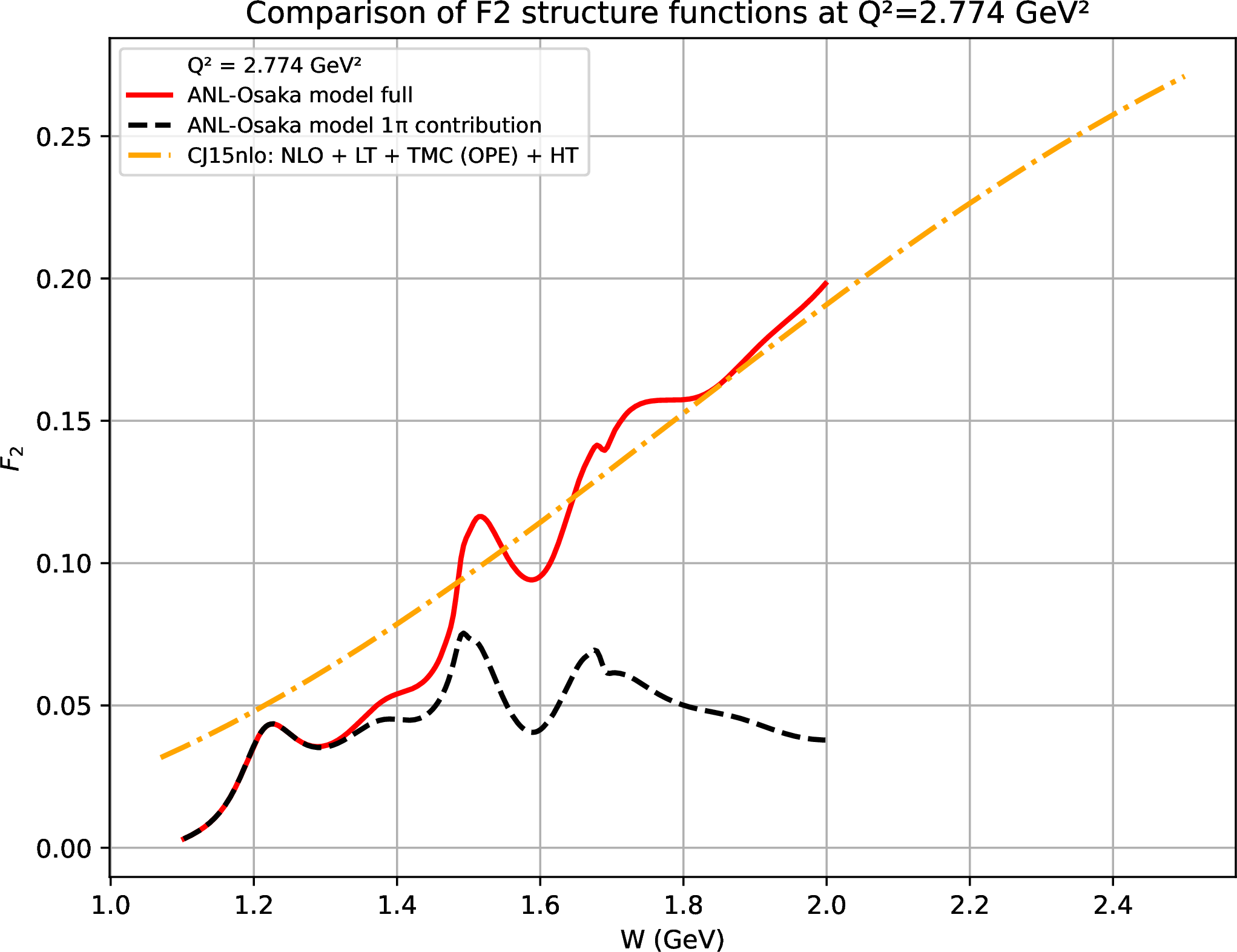
Figure 5 shows the extracted \(F_{2}(W,Q^{2})\) at the same four representative \(Q^{2}\) values, compared with the CJ15NLO+LT calculation (blue dashed), CJ15NLO+TMC+HT (orange dot-dashed), and the extended ANL-Osaka model (red solid). The local-duality picture established at the lowest \(Q^{2}\) extends across the full range: at every \(Q^{2}\), the extracted \(F_{2}\) retains the resonance structure seen in the data and oscillates around the smooth CJ15NLO+TMC+HT curve, consistent with local quark–hadron duality within the present uncertainties. The CJ15NLO+LT curve alone systematically undershoots the extracted \(F_{2}\) at low \(W\), with the gap closing as \(Q^{2}\) increases, consistent with the expected suppression of higher-twist contributions at large \(Q^{2}\) in the operator product expansion.
Although the overall duality picture is robust, a residual difference between the hadronic and partonic descriptions remains near the pion-production threshold. Consistent with the cross-section comparison of Sec. 4, the extracted \(F_2\) and the CJ15NLO+LT curve vanish at \(W_{\rm thr}\), whereas the CJ15NLO+TMC+HT curve does not, leading to a distortion of the low-\(W\) behavior.

6 Truncated moments and the onset of global duality↩︎
A quantitative test of quark–hadron duality is provided by the \(W\)-truncated Cornwall–Norton moments [29] of the \(F_{2}\) structure function, \[M_{2}^{\rm trunc}(Q^{2};W_{\min},W_{\max}) \;=\; \int_{x(W_{\max})}^{x(W_{\min})} F_{2}(x,Q^{2})\,dx, \label{eq:M295trunc}\tag{25}\] where \(x = Q^{2}/(W^{2} - m_{N}^{2} + Q^{2})\) is the Bjorken scaling variable. By restricting the integration to a finite \(W\) range and varying that range, one isolates the contribution of individual resonance regions and tests how well the smooth perturbative description reproduces the integrated resonance strength.
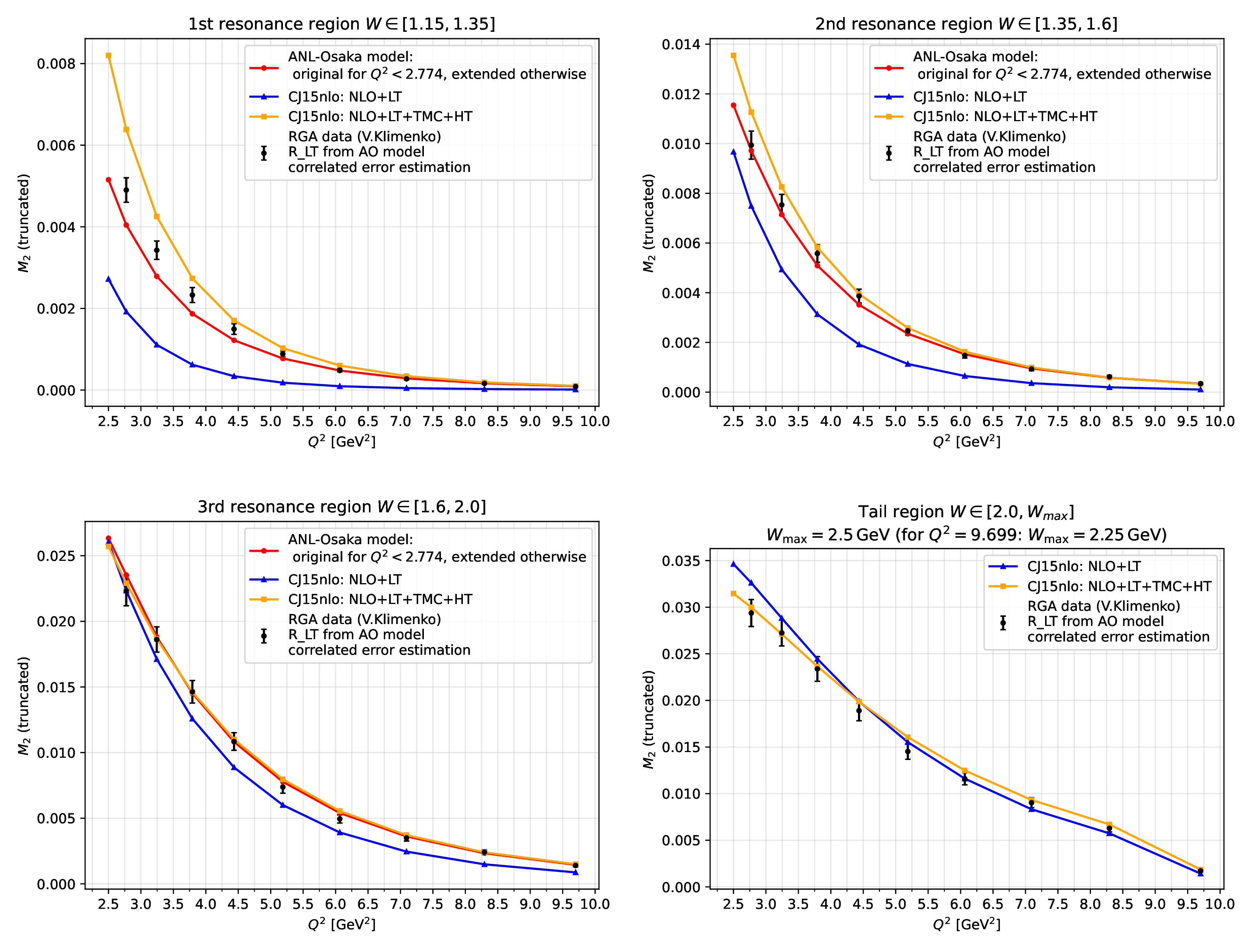
Figure 6 shows the extracted \(M_{2}^{\rm trunc}(Q^{2})\) for four \(W\) ranges: the first resonance region \(W \in [1.15,1.35]~\mathrm{GeV}\), the second resonance region \(W \in [1.35,1.60]~\mathrm{GeV}\), the third resonance region \(W \in [1.60,2.00]~\mathrm{GeV}\), and the high-\(W\) region \(W \in [2.00,W_{\max}]\) with \(W_{\max}=2.5~\mathrm{GeV}\) (reduced to \(2.25~\mathrm{GeV}\) at \(Q^{2}=9.699~\mathrm{GeV}^{2}\) owing to kinematic limits). The data are compared with the extended ANL-Osaka calculation (red), CJ15NLO+LT (blue triangles), and CJ15NLO+TMC+HT (orange squares). The principal observations are as follows.
In the first resonance region, \(W \in [1.15,1.35]~\mathrm{GeV}\), the CJ15NLO+LT curve lies well below the data over the entire \(Q^{2}\) range, reflecting the resonance strength carried by the \(\Delta(1232)\) that a smooth leading-twist description cannot reproduce. The CJ15NLO+TMC+HT curve, by contrast, lies systematically above the data, with the largest overshoot at the lowest \(Q^{2}\), while the extended ANL-Osaka calculation tracks the data closely. Moving to the second resonance region, \(W \in [1.35,1.60]~\mathrm{GeV}\), the CJ15NLO+TMC+HT curve still exceeds the data at lower \(Q^{2}\) values, but the overshoot is visibly smaller than in the first region. In the third resonance region, \(W \in [1.60,2.00]~\mathrm{GeV}\), the CJ15NLO+TMC+HT and ANL-Osaka curves agree closely with each other and with the data across the full \(Q^{2}\) range, while in the high-\(W\) region \(W \in [2.00,W_{\max}]\) the CJ15NLO+TMC+HT moment and the data are likewise in good agreement. In all four \(W\) ranges the CJ15NLO+LT curve lies below the CJ15NLO+TMC+HT curve, and the gap between the two narrows as \(Q^{2}\) increases.
Two systematic trends are therefore visible in Fig. 6. First, in each individual resonance region the agreement between the resonance-region data and the CJ15NLO+TMC+HT moment improves as \(Q^{2}\) increases, which is the expected onset of quark–hadron duality as higher-twist contributions are suppressed. Second, and independently of \(Q^{2}\), the CJ15NLO+TMC+HT moment shifts from a clear overshoot in the first resonance region, to a reduced overshoot in the second, to close agreement in the third region and the high-\(W\) region. This ordering, with the largest deviation nearest the pion-production threshold and progressively smaller deviations at higher invariant mass, follows the same pattern as the threshold boundary-condition mismatch discussed in Sec. 4.
The low-\(W\) shape distortion of the CJ15NLO+TMC+HT curve introduces an additional contribution to the truncated moments that is largest in the first resonance region and decreases progressively with increasing invariant mass. The observed ordering of the deviations in Fig. 6 is consistent with the threshold effect introduced in Sec. 4. Within the quoted uncertainties, the second and third resonance regions and the high-\(W\) region are in good agreement with CJ15NLO+TMC+HT for \(Q^{2}\gtrsim2.5~\mathrm{GeV}^{2}\), while the first resonance region retains a modest excess that is consistent with this threshold effect. A more quantitative assessment of threshold-constrained finite-\(Q^{2}\) corrections lies beyond the scope of the present work.
The four \(W\) ranges from \(W=1.15~\mathrm{GeV}\) to \(W_{\max}\) are contiguous and together span the entire resonance region and the high-\(W\) region beyond. This allows the relationship between local and global duality to be examined directly. A moment integrated over the full resonance region is, by the additivity of the integral in Eq. (25 ), simply the sum of the individual contributions. Because the four resonance intervals are contiguous, agreement in each individual region implies agreement for their sum, namely the moment integrated over the full resonance region. In this sense, local duality in the truncated-moment analysis naturally leads to global duality, whereas the converse does not necessarily hold, since a global match could in principle arise from compensating deviations among different resonance regions.
The present results establish agreement between the extracted moments and the CJ15NLO+TMC+HT expectation across the second and third resonance regions and the high-\(W\) region, while only a modest excess remains in the first resonance region near threshold. Since this excess is consistent with the threshold boundary-condition effect discussed above rather than with a breakdown of duality, the data provide strong evidence that global quark–hadron duality is realized across the full \(Q^{2}\) range probed by CLAS12.
7 Summary and outlook↩︎
We have presented a high-precision study of quark–hadron duality in inclusive electron–proton scattering extending to \(Q^{2}\approx10~\mathrm{GeV}^{2}\) across the full resonance region using recent CLAS12 measurements and an extended ANL-Osaka dynamical coupled-channels framework.
The analysis establishes consistency simultaneously at the level of inclusive cross sections, extracted structure functions, and truncated Cornwall–Norton moments, providing new quantitative evidence for both local and global quark–hadron duality at substantially higher momentum transfers than previously explored. The extracted resonance-region structure functions oscillate about the smooth perturbative expectation, while the truncated moments demonstrate agreement region by region across the resonance spectrum. Taken together, these observations show that local duality is realized throughout the resonance region and, through the additivity of the truncated moments, imply global duality over the full resonance region. Comparison with the CJ15 global QCD analysis, including target-mass corrections and phenomenological higher-twist contributions, indicates that the residual discrepancy observed in the first resonance region is consistent with the threshold boundary-condition artifact discussed above. This threshold effect—that the finite-\(Q^{2}\) corrections in global PDF analyses do not enforce the physical pion-production threshold—points to a concrete refinement of such analyses for future duality tests.
Several directions for future work follow naturally from the present analysis. The extended ANL-Osaka model can be used to compute higher truncated moments (\(M_{4}\), \(M_{6}\)) and thereby constrain the higher-twist matrix elements through the operator product expansion. A related direction concerns the threshold boundary condition: as discussed in Sec. 6, the finite-\(Q^{2}\) corrections applied to the CJ15NLO+LT baseline do not preserve the vanishing of the structure function at \(W_{\rm thr}\), and a global-analysis prescription that enforces this constraint would reduce the first-resonance-region moments and further sharpen the duality comparison. The determined factors \(e^{\alpha(Q^{2}-Q_{0}^{2})}F_{2}(\omega';\{c_{i}\})\) and \(e^{\beta(Q^{2}-Q_{0}^{2})}F_{2}(\omega';\{c'_{i}\})\) can be used to inform a high-\(Q^{2}\) extension of the ANL-Osaka \(\gamma N \to N^{*}\) form-factor parametrization, Eq. (3 ), in preparation for fits to forthcoming CLAS12 exclusive \(p(e,e'\pi)N\) and \(p(e,e'\pi\pi)N\) data in the range \(Q^{2} = 3\)–\(10~\mathrm{GeV}^{2}\). The duality study can also be extended to projected JLab 22 GeV kinematics [30] (\(E = 22~\mathrm{GeV}\), \(Q^{2} = 12\)–\(18~\mathrm{GeV}^{2}\)) using the extended ANL-Osaka framework, in support of the scientific case for the energy upgrade. Finally, the extracted \(F_{2}\) values can be compared with, and incorporated into, new global PDF analyses, to assess the impact of these resonance-region measurements on the large-\(x\) proton PDFs and to further illuminate the transition between the hadronic and partonic descriptions of nucleon structure.
This work was supported by the U.S. Department of Energy, Office of Science, under Contract Nos. DE-AC05-06OR23177, DE-AC02-05CH1123, and Contract No. DE-FG02-04ER41309.