Emergence of beating in a magnetic flagellum consisting of active bots
June 28, 2026
Abstract
We investigate the emergence of flagellar beating in chains of magnetic self-propelled particles (MSPPs) built from centimeter-scale vibrating robots (Hexbugs) with embedded neodymium dipoles. When one end of the chain is anchored and self-propulsion is activated, longitudinal stress accumulates along the chain until it overcomes the magnetic bending stiffness, triggering a buckling instability that drives sustained flagellar beating. Using a combination of experiments and numerical simulations, we identify three distinct dynamical regimes — straight chain, stable flagellar beating, and fission — governed by the competition between active force, chain length, and magnetic bending stiffness. The onset of beating requires a seed misalignment set by the balance between magnetic torques and rotational noise, and we show that the transition corresponds to a supercritical Hopf bifurcation. A kinematic model reproduces the observed orientation dynamics with excellent agreement. The magnetic bending stiffness, which arises directly from dipole-dipole interactions, is fully tunable via dipole strength and chain length, offering independent experimental control over both activity and rigidity. Our results establish a macroscopic platform for studying force-induced buckling and self-oscillations in active filaments, with direct connections to flagellar motion in biological and synthetic microswimmers.
Among the various interactions governing collective behavior in physical systems, magnetic dipole–dipole interactions appear across a broad range of scientific and technological contexts, from condensed matter and colloidal physics to biophysics and materials science [1]–[6]. In active matter systems, these interactions enable programmable self-assembly and long-range orientational alignment [7]–[10], with magnetotactic bacteria serving as natural models for directional guidance and collective behavior [11]–[13], while magnetically driven colloids offer synthetic analogs that can be precisely controlled via external fields [1], [14], [15]. These systems have proven effective in applications such as soft robotics, microfluidics, and biomedical devices. However, they often exhibit dynamic, transient metastable states, making long-term control a persistent challenge.
Active magnetic particles have thus emerged as a compelling class of systems, both in biological and synthetic contexts, where their complex behavior arises from the interplay between self-propulsion, magnetic dipolar interactions, and intrinsic polarization [8], [16]–[19]. A particularly intriguing case emerges when, in the presence of external fields or elastic bonding between particles, the head-to-tail symmetry of a linear configuration of active particles is broken, leading to flagellar-like beating driven by activity [20]–[22]. This phenomenon, known as beating by propulsion, mirrors the locomotion of spermatozoa and eukaryotic flagella [23]–[29], and has also been observed in synthetic systems such as active filaments and elastohydrodynamic simulations [9], [30]–[36], as well as in magnetic Janus particles and non-reciprocal active colloids [15], [17], [37]. Recently, this effect has been reproduced at the macroscopic scale using centimeter-scale Hexbugs: battery-powered robots propelled by internal vibrations [35], [38]. When connected via an elastic membrane, a Hexbug chain spontaneously exhibits oscillatory motion and synchronization, demonstrating the universality of this phenomenon across scales [39], [40]. Synchronization between flagella and cilia is a fundamental feature of biological locomotion and fluid transport [41], and has recently been reproduced in minimal synthetic designs [42].
In this work, we investigate the emergence of beating by propulsion in a chain of inertial, active disk-shaped particles with permanent magnetic dipole–dipole interactions [43]–[45]. Particles are arranged in a linear configuration with one end anchored to a rigid wall [33], remaining bound via dipole–dipole interactions. Upon activation, self-propulsion induces longitudinal stress along the chain that, depending on the interplay between activity, magnetic interaction, and orientational fluctuations, drives the system toward one of three regimes: a static straight chain, stable flagellar-like beating, or fission [16], [46]. We develop an analytical model for the tangential misalignment that triggers buckling [20], [34], and show that beating onset arises from the competition between active force \(F_0\), dipolar attraction \(F_{\rm mag}\), and orientational fluctuations \(D_R\). We further characterize beating amplitude and frequency as functions of magnetic strength and chain length through bending rigidity, bond angles, and three-body bending energy [9], providing a controllable platform for exploring active solids and self-oscillating filament dynamics [39], [47].
![Figure 1: Magnetic self-propelled particle (MSPP). Left: components of an MSPP — a neodymium cylindrical magnet (S–N poles indicated), a 3D-printed disk-shaped armor of diameter \sigma = 5 cm, and a Hexbug Nano robot providing self-propulsion via internal vibratory motion. Right: schematic of the assembled MSPP, modeled as a disk of diameter \sigma with orientation angle \varphi measured from the chain axis (green dashed line, corresponding to the \hat{\mathbf{x}} axis). The self-propulsion direction \hat{\mathbf{p}} = (\cos\varphi,
\sin\varphi, 0) is parallel to the permanent magnetic dipole moment \mathbf{m} = m\hat{\mathbf{p}}, with magnitude m = 0.6 \pm 0.1 Am^2 determined via gaussmeter measurements [44].](/article/2606.29499/Figure1.png "fig:")
1 Results and discussion↩︎
1.1 Experimental details↩︎
We experimentally study the dynamics of a chain composed of \(N\) magnetic self-propelled particles (MSPPs), constructed from Hexbug Nano robots [48] enclosed within 3D-printed disk-shaped armors of diameter \(\sigma = 5.0 \pm 0.1\) cm and mass \(M = 0.018\) kg. Each disk includes a cylindrical compartment along its diameter that houses a neodymium rod magnet of diameter \(d = 0.6 \pm 0.001\) cm and length \(L = 3.5 \pm 0.1\) cm, whose permanent magnetic dipole moment \(m = 0.6 \pm 0.1\) Am\(^2\) was determined via gaussmeter measurements [44]. Each MSPP self-propels along its body axis, oriented at angle \(\varphi_i\) with respect to the horizontal, with a magnetic dipole moment \(\mathbf{m}_i = m\hat{\mathbf{p}}_i\) parallel to the propulsion direction (see Fig. 1).
To ensure uniform propulsion, all experiments were carried out using new batteries, which allowed each MSPP to self-propel at a consistent average speed \(u_0^{\text{hexbugs}} = 2\) cm/s [44], leading to an active force \(F_0 = \gamma_T u_0^{\text{hexbugs}} = 2\times10^{-4}\) N. The translational friction coefficient \(\gamma_T = 10^{-2}\) kg/s, rotational friction coefficient \(\gamma_R=10^{-3}\) kg m\(^2\)/s, and rotational diffusion coefficient \(D_R = 10^{-5}\) rad\(^2\)/s were not measured directly but were selected to be consistent with the known dynamical behavior of Hexbug-based MSPPs in previous experiments [39], [43], [44], and validated by matching simulation trajectories to experimental observations (see Supplemental Material [49]). Due to the limited self-propulsion speed of the Hexbugs, we focus on chain lengths of \(N=4\) and \(N=5\) MSPPs. Throughout the main text we present results for the \(N=4\) case; details for the \(N=5\) configuration are provided in the Supplemental Material [49].
We break the symmetry of the magnetic chain by anchoring the head particle to a 3D-printed wall that fixes its position (\(\mathbf{r}_1=(0,0,0)\)) and orientation (\(\hat{\mathbf{p}} = -\hat{\mathbf{x}}\)), forming a magnetically bound chain via dipole–dipole interactions (see Figure 2). Due to the Hexbug’s internal propulsion mechanism, the head exhibits minimal residual vibrations. All particles are activated simultaneously at the start of each experiment.
The motion of the chain is recorded using a standard cellphone camera. Post-processing was conducted using a custom Python code to extract the trajectories and orientations of individual particles (see Supplemental Material [49]).
1.2 The onset of buckling↩︎
When particles are self-propelled along \(\hat{\mathbf{p}} = -\hat{\mathbf{x}}\), head-to-tail magnetic dipoles generate attractive forces and torques that bind the particles together, while active forces introduce a longitudinal pressure \(\Sigma_{\rm long} = F_0 N/\sigma^2\) that increases with chain length \(\ell_{\rm chain} = N\sigma\), where \(\sigma\) is the particle diameter and \(F_0\) is the active force (see Fig. 1).
This stress accumulation generates a symmetry breaking between the head and the tail of the chain. Whether buckling occurs depends on the competition between this accumulated stress and the magnetic bending stiffness \(k_{\rm mag} = \mu_0 m^2/2\pi\sigma^2\). Following Euler buckling theory [17], [21], [33], we define a critical force \(F_c = k_{\rm mag}/\ell_{\rm chain}^2\) and a total active force \(F_{\rm act} = F_0 N\). Their ratio defines the dimensionless buckling parameter \[\Pi_{\rm buck} = \frac{F_{\rm act}}{F_c} = \frac{F_0\,N^3\sigma^2}{k_{\rm mag}}, \label{eq:pibuck}\tag{1}\] which sets the balance between the active force \(F_0\), the magnetic interaction strength \(k_{\rm mag}\), and the chain length \(N\). When \(\Pi_{\rm buck}\ll 1\) the chain remains straight; when \(\Pi_{\rm buck}\sim 1\) flagellar-like beating develops; and when \(\Pi_{\rm buck}\gg 1\) fission is possible [16], [46] (see phase diagram in Supplemental Material [49]).
Substituting the experimental parameters (\(\sigma = 0.05\) m, \(m = 0.6\) Am\(^2\), \(F_0 =2\times 10^{-4}\) N) gives \(k_{\rm mag} = \mu_0 m^2/2\pi\sigma^2 = 2.88\times10^{-5}\) N m\(^2\) and \[\Pi_{\rm buck} = \frac{F_0\sigma^2}{k_{\rm mag}}\,N^3 = 1.736\times10^{-2}\,N^3.\] The resulting values for each chain length are summarized in Table 1:
| \(N\) | \(\Pi_{\rm buck}\) | Observed behavior |
|---|---|---|
| 3 | 0.47 | chain remains straight |
| 4 | 1.11 | stable flagellar beating |
| 5 | 2.17 | stable flagellar beating |
| 6 | 3.75 | chain breaks (fission) |
The table confirms that the criterion \(\Pi_{\rm buck}\sim 1\) cleanly separates the three regimes. When the magnetic interaction is kept constant, a chain of \(N=3\) cannot reach the buckling threshold and remains straight (see Supplemental Movie SM1). For \(N=6\), the active force overcomes magnetic cohesion and the chain breaks shortly after buckling (see Supplemental Movie SM4). Stable flagellar beating is therefore observed only for \(N=4\) and \(N=5\), which bracket the critical value \(\Pi_{\rm buck}\approx 1\) (see Supplemental Movie SM2, SM3).
The dimensionless criterion \(\Pi_{\rm buck}\sim 1\) is the discrete-chain analog of buckling parameters previously introduced for continuous active filaments [17], [20], [33], where the magnetic dipole-dipole interaction provides the effective bending rigidity \(k_{\rm mag}\) directly from particle properties, enabling independent experimental control of both activity and stiffness.
![Figure 2: Flagellar beating of a N=4 MSPP chain. (a) Experimental photograph showing the trajectories of individual MSPPs during flagellar beating. Colors indicate particle index: green for i=2, orange for i=3, and blue for i=4 (tail); the head particle (i=1) is anchored and not shown. (b) Schematic of the N=4 anchored chain defining the oscillation angle \theta_2 between the position vector of the second particle and the chain axis \hat{\mathbf{x}} (green dashed line). Red circles indicate the excluded-volume diameter \sigma of each MSPP. (c) Arc displacement \Delta s_i = (i-1)\sigma\theta_i(t) as a function of time from experiments. (d) Transverse displacement \Delta y_i(t) as a function of time measured during numerical simulations. In both (c) and (d), amplitude increases with distance from the anchored head, consistent with flagellar beating [27], [33]. (e) Oscillation amplitude \Delta S_i = (i-1)\sigma A_i across multiple realizations. Filled circles represent simulations and triangles represent experiments. Amplitudes are consistent across realizations, indicating they are set by intrinsic system parameters. (f) Normalized oscillation period T_i/T_2 across multiple realizations. Periods vary between realizations, reflecting sensitivity to initial orientations and rotational noise at the moment of buckling.](/article/2606.29499/Figure2.png "fig:")
1.3 Flagellar beating↩︎
We performed numerical simulations modeling MSPPs as disk-shaped particles with point dipoles located at their centers. The position of the \(i\)-th particle is \(\mathbf{r}_i(t) = (x_i(t), y_i(t), 0)\) and its orientation is \(\hat{\mathbf{p}}_i(t) = (\cos\varphi_i(t), \sin\varphi_i(t), 0)\). The magnetic dipole moment is \(\mathbf{m}_i = m\hat{\mathbf{p}}_i(t)\), where \(m\) is its magnitude. Once buckling is triggered, the chain develops stable flagellar beating. The equations of motion are \[\begin{align} M\ddot{\mathbf{r}}_i &=& F_{0}\hat{\mathbf{p}}_i(t) - \gamma_{T}\dot{\mathbf{r}}_i - \nabla_{\mathbf{r}_i}\sum_{j\neq i}\left(U^{\text{WCA}}_{ij}+U^{\text{D}}_{ij}\right), \tag{2}\\ \dot{\hat{\mathbf{p}}}_i &=& \frac{1}{\gamma_R}\left(\boldsymbol{\xi}_{i,R}(t) -\mathbf{T}_i\right)\times\hat{\mathbf{p}}_i, \tag{3} \end{align}\] where \(\gamma_T\) and \(\gamma_R\) are the translational and rotational friction coefficients, respectively, and \(F_0\) is the active force. The term \(\boldsymbol{\xi}_{i,R}(t)\) is a rotational Gaussian white noise of zero mean satisfying \(\langle\xi_{j,R}(t_1)\rangle = 0\) and \(\langle\xi_{j,R}(t_1)\xi_{j,R}(t_2)\rangle = 2\gamma_R^2 D_R\,\delta(t_1-t_2)\), where \(D_R\) is the rotational diffusion coefficient. The magnetic torque acting on particle \(i\) is \(\mathbf{T}_i = \hat{\mathbf{p}}_i\times \nabla_{\hat{\mathbf{p}}_i}U^{\text{D}}\).
We note that a self-alignment torque \(\beta(\hat{\mathbf{p}}_i\times \hat{\mathbf{v}}_i)\), which couples orientation to velocity, has been included in previous models of active magnetic particles [16], [44], [46] and shown to influence rotational dynamics in the absence of magnetic interactions. In the present system, however, magnetic torques dominate the orientational dynamics, and we verified that self-alignment plays no significant role in the flagellar beating observed here. Furthermore, since we study anchored chain configurations with fixed initial conditions, and since our analytical model (Eq. 7 ) reproduces the observed dynamics without this term, we omit it throughout.
Unlike colloidal systems typically modeled in the overdamped limit, Hexbug-based MSPPs operate at the macroscopic scale where inertial effects are non-negligible. The mass \(M\) therefore appears explicitly in Eq. 2 , placing this system in the regime of inertial magnetic active matter [43], [44], [50], where translational dynamics retains inertia while orientational dynamics remains overdamped.
Each MSPP is subject to two interactions: an excluded-volume potential \(U^{\text{WCA}}\) modeled by the Weeks–Chandler–Anderson (WCA) potential, and a magnetic dipole–dipole interaction \(U^{\text{D}}\), given by \[U^{\text{WCA}}_{ij} = \begin{cases} 4\varepsilon\!\left[\left(\dfrac{\sigma}{r_{ij}}\right)^{12} -\left(\dfrac{\sigma}{r_{ij}}\right)^{6}\right] & r_{ij} \leq r_m,\\[6pt] 0 & \text{otherwise,} \end{cases} \label{eq:wca}\tag{4}\] \[U^{\text{D}}_{ij} = \frac{\mu_0 m^2}{4\pi r_{ij}^3} \left[\hat{\mathbf{p}}_i\cdot\hat{\mathbf{p}}_j -\frac{3(\hat{\mathbf{p}}_i\cdot\mathbf{r}_{ij}) (\hat{\mathbf{p}}_j\cdot\mathbf{r}_{ij})}{r_{ij}^2}\right], \label{eq:dipole}\tag{5}\] where \(\mathbf{r}_{ij} = \mathbf{r}_j - \mathbf{r}_i\), \(r_{ij} = |\mathbf{r}_{ij}|\), \(r_m = 2^{1/6}\sigma\) is the WCA cutoff, and \(\varepsilon = 100\,k_BT\) is the excluded-volume energy scale.
For \(N=4\) MSPPs (and \(N=5\) in the Supplemental Material [49]), with parameters \(m=0.6\) Am\(^2\) and \(F_0=2\times10^{-4}\) N, we observe in both experiments and simulations that each particle in the chain undergoes flagellar beating (see Supplementary Movies S2, S3, S5). The beating is characterized by the angle \(\theta_i\), defined between the position vector of the \(i\)-th particle’s center and the horizontal axis (see Fig. 2 (b)). Each particle follows a closed orbit whose amplitude increases with distance from the clamped head, as observed in sperm flagella and elastoactive simulations [26], [27], [39]. This motion can be quantified by the arc length \(\Delta s_i = (i-1)\sigma\theta_i\) (valid when \(\theta_i\) is small) or equivalently by the transverse displacement \(\Delta y_i\), where \(i = 1, 2, \ldots, N\) and \(i=1\) corresponds to the head particle.
We plot both \(\Delta y\) and \(\Delta s\) as a function of time in Fig. 2 (c),(d) for experiments and simulations, respectively. Stable periodic oscillations are observed, with amplitude increasing with distance from the clamped head. This behavior has been reported in previous experimental realizations in colloidal and inertial systems [17], [39] and is consistently reproduced in our simulations. To quantify the oscillations, we fit a sinusoidal function \(\Delta y_i(t) \approx \Delta s_i(t) = A_i\sin(2\pi t/T_i)\) to each particle’s trajectory, extracting the oscillation amplitude \(A_i\) and period \(T_i\) across multiple experimental and numerical realizations.
To analyze and compare these results, we plot the arc swept \(\Delta s_i = (i-1)\sigma A_i\) and the normalized period ratio \(T_i/T_2\) for particles \(i=3\) (orange) and \(i=4\) (blue) in Fig. 2 (e),(f). Experimental data are shown as triangles and simulation results as circles, with all periods normalized by \(T_2\), the period of the second particle in the chain.
Interestingly, the oscillation amplitudes remain consistent across realizations, indicating that they are set by intrinsic physical parameters such as the dipolar interaction strength \(m\) and the active force \(F_0\) [16], [33]. In contrast, the oscillation periods vary across realizations. On average, we measure \(\langle T_3/T_2\rangle = 1.6\) and \(\langle T_4/T_2\rangle = 1.9\), with the last particle generally exhibiting a longer period than its neighbors, a trend observed consistently in both simulations and experiments. This variability suggests that the oscillation frequency is not deterministic but is sensitive to rotational noise and the relative initial orientation of each particle at the moment of buckling.
We further investigate the role of magnetic interactions in shaping the flagellar beating.
1.4 A simple theory for tangential misalignment↩︎
During the experiments, we tracked the orientation angle \(\varphi_i\) of each particle. Initially, all particles are aligned along the \(-\hat{\mathbf{x}}\) direction, forming a straight magnetic chain. Upon activation, a small misalignment between neighboring particles, induced by the accumulation of longitudinal stress and rotational diffusion [33], triggers buckling and the onset of flagellar beating. In the absence of rotational diffusion—as modeled in simulations—the system fails to break the initial symmetry, and even strongly active particles remain confined to a straight chain configuration [16].
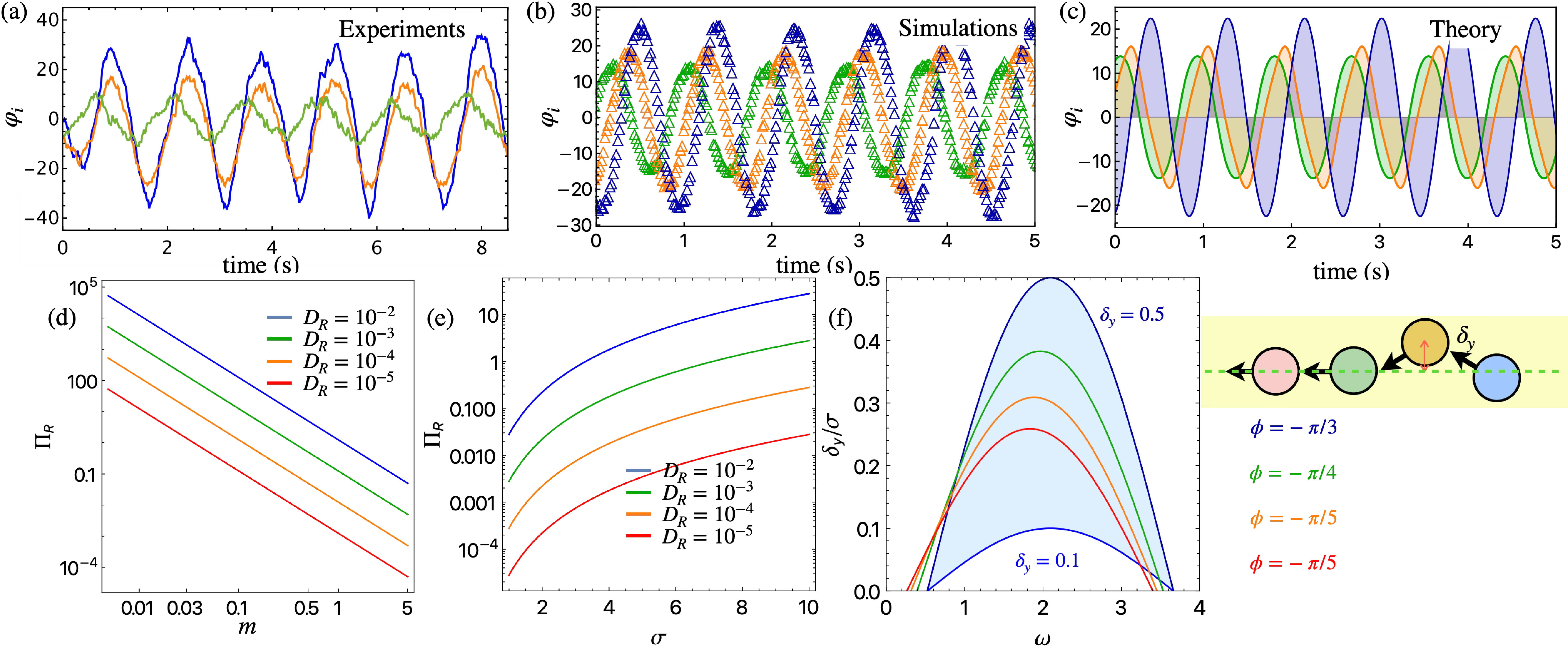
The orientation time evolution is shown in Fig. 3 (a),(b), where the amplitude of angular oscillation increases with the particle’s distance from the anchored head. The angular displacements are limited by dipole–dipole magnetic torques, which tend to restore tangential alignment between neighboring dipoles. In Eq. 3 , this torque counteracts rotational noise, acting as a restoring torque. The balance between the dipolar restoring torque and rotational noise defines a characteristic dimensionless misalignment parameter \[\Pi_R = \frac{4\pi\gamma_R D_R\sigma^3}{\mu_0 m^2}, \label{eq:delta}\tag{6}\] where \(\Pi_R = 4\pi\gamma_R D_R\sigma^3/\mu_0 m^2\) measures the typical noise-induced angular misalignment between neighboring MSPPs. When \(\Pi_R \ll 1\), magnetic torques dominate and the chain remains well-aligned; when \(\Pi_R \gtrsim 1\), rotational noise overcomes magnetic cohesion and stable flagellar beating is disrupted.
In Fig. 3 (d), we plot \(\Pi_R\) as a function of \(m\) for different \(D_R\) values; red curves correspond to low \(D_R \sim 10^{-5}\), while blue curves correspond to high \(D_R \sim 10^{-2}\). For large \(D_R\), \(\Pi_R > 1\) for most values of \(m\), meaning rotational noise dominates and stable flagellar beating cannot be maintained. For small \(D_R\), as in our setup (\(D_R = 10^{-5}\)), the noise-induced misalignment is small (\(\Pi_R \approx 0.006\) at \(m = 0.6\) Am\(^2\)), allowing magnetic torques to sustain a stable chain configuration from which flagellar beating can develop once \(\Pi_{\rm buck} \sim 1\).
In Fig. 3 (e), we show \(\Pi_R\) as a function of \(\sigma\) for fixed \(m\). As \(\sigma\) increases, the dipole–dipole interaction weakens (\(U^D \propto \sigma^{-3}\)) while the noise-induced misalignment grows (\(\Pi_R \propto \sigma^{3}\)), eventually exceeding the stability threshold. This confirms that larger particles require stronger dipole moments to sustain flagellar beating, consistent with our experimental observations.
To better understand the onset of buckling, we developed a theoretical model describing the time evolution of the orientation angle \(\varphi_i\) due to magnetic torques, \[\dot{\varphi}_i = \frac{\mu_0 m^2}{4\pi\gamma_R} \sum_{j \neq i} \hat{\mathbf{p}}_i \times \left( \frac{3 \vec{\mathbf{r}}_{ij} (\hat{\mathbf{p}}_j \cdot \vec{\mathbf{r}}_{ij})}{r_{ij}^5} - \frac{\hat{\mathbf{p}}_j}{r_{ij}^3} \right). \label{eq5}\tag{7}\] We assume particle orientations \(\hat{\mathbf{p}}_1 = (1, 0, 0)\) and, for \(i=2,3,4\), \(\hat{\mathbf{p}}_i = (\cos\varphi_i(t), \sin\varphi_i(t), 0)\), with positions \(\vec{\mathbf{r}}_1 = (0, 0, 0)\), \(\vec{\mathbf{r}}_2 = (\sigma, 0, 0)\), \(\vec{\mathbf{r}}_3 = (2\sigma, \delta_y \cos(\omega t), 0)\), and \(\vec{\mathbf{r}}_4 = (3\sigma, \delta_y \cos(\omega t + \phi), 0)\), where \(\delta_y\) is the amplitude of the transverse oscillation imposed on particles 3 and 4, \(\omega\) is an angular frequency, and \(\phi\) a phase. Note that \(\delta_y\) is the steady-state beating amplitude used as input to the kinematic model. When \(\delta_y = 0\) the chain remains stable; for \(\delta_y \neq 0\), flagellar beating emerges depending on \(\phi\) and \(\omega\). In Fig. 3 (c), filled curves show solutions to Eq. 7 for \(m=1\), \(\sigma=1\), \(\delta_y=0.45\), \(\omega=0.72\), and \(\phi=-\pi/4\), showing excellent agreement with simulations.
We find that a range of \((\delta_y, \phi)\) values leads to sustained flagellar beating for fixed \(\sigma\) and \(m\), as shown in Fig. 3 (f). The colored lines show \(\delta_y/\sigma\) as a function of \(\omega\) for different phase angles \(\phi\), bounded below by the minimum amplitude required to sustain beating, \(\delta_{y,\rm min}=0.1\sigma\), and above by the maximum, \(\delta_{y,\rm max}=0.5\sigma\).
![Figure 4: Chain flexibility and limit cycle dynamics. (a),(b) Kymographs showing the temporal evolution of the bond angles \Theta_1 and \Theta_2 (defined in the schematic inset) for simulations (a) and experiments (b), respectively. Colors represent the bond angle normalized by the maximum deflection detected, from blue (minimum) to red (maximum). The periodic banding confirms sustained flagellar beating, with simulations showing more regular oscillations than experiments due to the absence of environmental noise. (c) Phase space portrait of the mean curvature \Phi(t) versus mean polarization \Omega(t), showing the limit cycle structure characteristic of a supercritical Hopf bifurcation [34], [39]. Experimental trajectories (cyan) exhibit larger variability than simulations (red), reflecting sensitivity to rotational noise and initial conditions. (d) Time evolution of the three-body bending energy U_b for flagella composed of N=4 (top) and N=5 (bottom) particles, from simulations (red) and experiments (cyan). The N=5 chain exhibits larger oscillation amplitudes and more negative mean U_b, consistent with its greater flexibility as predicted by the k_{\rm mag}/(N\sigma)^2 scaling [33], [51].](/article/2606.29499/Figure4.png "fig:")
1.5 How soft is the magnetic flagellum?↩︎
The onset of these oscillations corresponds to a supercritical Hopf bifurcation [32], [34], [39], leading to a limit cycle in terms of the system’s mean polarization \(\Omega(t) = \frac{1}{N}\sum_{i=1}^N \varphi_i(t)\) and mean bond angle \(\Phi(t) = \frac{1}{N-1}\sum_{i=1}^{N-1}\Theta_i(t)\), where \(\Theta_i = \angle(\mathbf{b}_i, \mathbf{b}_{i+1})\) is the angle between consecutive bond vectors \(\mathbf{b}_i = \mathbf{r}_{i+1} - \mathbf{r}_i\), as shown in Fig. 4 (a) (red for experiments, gray for simulations). This limit cycle structure is analogous to that observed in elastoactive structures [39] and beating biological flagella [26], [27], where mean curvature and polarization serve as natural order parameters for the oscillatory state.
Next, we investigate the flexibility of the magnetic flagellum. The magnetic bending stiffness per particle pair, \(\kappa_{\rm mag} = \mu_0m^2/2\pi\sigma^2\), sets the resistance to relative angular deflection between neighboring MSPPs [9], [51]. The effective rigidity of the chain as a whole, however, is governed by the Euler critical force \(F_c = \kappa_{\rm mag}/(N\sigma)^2\), which decreases as \(N^{-2}\) with chain length [21], [33]. Consequently, shorter chains are stiffer and harder to buckle, while longer chains are more flexible and buckle under weaker active forcing, consistent with our experimental observations (see Supplementary Movies SM1–SM4).
To quantify this flexibility, we analyze the bond angles \(\Theta_i\), defined in the schematic of Fig. 4, and compute kymographs showing their time evolution for simulations and experiments in Fig. 4 (b),(c), respectively. Colors represent the bond angle normalized by the maximum deflection detected in each realization.
We model the chain bending using a three-body potential based on the unit bond vectors \(\mathbf{b}_i = (\mathbf{r}_i - \mathbf{r}_{i-1})/|\mathbf{r}_i - \mathbf{r}_{i-1}|\), yielding the total bending energy [31], [33], [51] \[U_b = \frac{k_{\rm mag}}{2} \sum_{i=2}^{N-1} \left( \mathbf{b}_{i+1} - \mathbf{b}_i \right)^2, \label{bendingpot}\tag{8}\] where \(k_{\rm mag} = \mu_0m^2/2\pi\sigma^2\) is the magnetic bending stiffness, which here plays the role of the bending rigidity \(\kappa\) in the discrete worm-like chain model [51]. Unlike passive polymer chains where \(\kappa\) is fixed by molecular architecture, here \(k_{\rm mag}\) is tunable via the dipole moment \(m\), offering direct experimental control over chain flexibility [9]. The bending energy over time is shown in Fig. 4 (d),(e), where oscillation amplitudes grow with \(N\) in agreement with the predicted \(k_{\rm mag}/(N\sigma)^2\) scaling [47].
Our work provides a physical realization of beating by propulsion [20], [21] in a model system where both bending rigidity and activity arise from controllable, experimentally tunable parameters. By combining magnetic dipolar interactions with self-propelled motion in centimeter-scale robots (Hexbugs) [43], [44], we construct magnetic self-propelled particles (MSPPs) that self-assemble into flexible chains and undergo spontaneous flagellar beating when one end is clamped.
Unlike microscale systems where flagellar motion typically results from internal motor activity or elastic deformations in slender filaments [31]–[33], here the oscillations are driven purely by the interplay between active forces, magnetic cohesion, and orientational fluctuations. Elasticity emerges effectively from the magnetic dipole-dipole interactions, giving rise to a bending rigidity \(k_{\rm mag}=\mu_0m^2/2\pi\sigma^2\) that can be modulated via dipole strength [9], [51], while the effective chain flexibility grows with particle number as \(F_c = k_{\rm mag}/(N\sigma)^2\), consistent with Euler buckling theory [17], [21], [33]. The onset of beating is initiated by a critical tangential misalignment \(\delta\) that triggers buckling, and rotational diffusion plays an essential role in symmetry breaking — without it, as shown in simulations, the chain remains in a metastable straight configuration regardless of propulsion strength [16], [33].
By systematically analyzing both experiments and simulations, we demonstrate that flagellar beating is robust and reproducible, with amplitude and frequency depending nonlinearly on dipolar strength and chain length [17], [39]. The macroscopic nature of our model offers unique advantages: trajectories and orientations can be tracked with high spatiotemporal resolution using simple imaging tools [44]; propulsion strength, dipolar coupling, and chain architecture can be modified in a controlled manner; and long timescales allow direct observation of transient and steady-state dynamics, including transitions between linear and nonlinear regimes [39], [47].
The observed flagellar beating is reminiscent of locomotion in spermatozoa and cilia [23], [26], [28], suggesting that the underlying principles — force-induced buckling coupled to orientational dynamics — may be generic across scales [27], [34]. While our current system focuses on a single flagellum, future studies could explore collective effects in systems of multiple interacting chains, where flagellar synchronization via magnetic or elastic coupling may give rise to behaviors analogous to those observed in biological arrays of cilia and flagella [40]–[42]. Our system further provides a platform for testing reduced models of active filaments, including symmetry-breaking bifurcations, limit cycles, and mode selection in nonlinear oscillators [32], [34], [39] — offering insights directly transferable to synthetic microswimmers [15], [37] and biological systems governed by active forces and mechanical constraints.
Acknowledgements↩︎
We thank Professor Eric Clement for helpful discussions. N. Q, D.H and F.G.-L. have received support from Fondecyt Regular No..
Author contributions↩︎
All authors contributed equally to the analysis and writing of the manuscript; F.G.-L, E.L. and E.B. designed the research, F.G.-L. performed the simulations. N.Q, D.H and E.B performed the experiments. N.Q. and D.H wrote the scripts to analyze the experimental data.
Additional information↩︎
There are no conflicts to declare.