The pairing mechanism of the bilayer nickelates La\(_3\)Ni\(_2\)O\(_7\) remains a hotly-debated open question. Existing strong-coupling theories are
divided into class favoring intralayer d-wave pairing and that favoring interlayer s-wave pairing, with the latter further divided into \(d_{z^2}\) orbital dominated mechanism driven by orbital hybridization and \(d_{x^2-y^2}\) orbital dominated mechanism driven by Hund’s rule. Recent angle-resolved-photoemission-spectrum (ARPES) and scanning-tunneling-microscope (STM) combinedly reveal a nodeless full pairing gap with low anisotropy,
supporting the s-wave pairing. Here we propose that the pairing gap along the Brillouin zone (BZ) diagonal can serve as a useful probe of pairing mechanism. Symmetry analysis suggests that orbital hybridization vanishes along the BZ diagonal, rendering
that the pairing gaps on the \(\gamma\)- and \(\alpha/\beta\)- pockets reflect the \(d_{z^2}\)- and \(d_{x^2-y^2}\)- orbital
pairing strength respectively. Under the \(d_{z^2}\) orbital dominated pairing mechanism driven by orbital hybridization, gap nodes are inevitable on the \(\alpha\)- and \(\beta\)- pockets along the BZ diagonal, which conflicts with the full gap revealed by ARPES and the U-shaped dI/dV curve observed by STM. The Hund’s rule driven pairing mechanism instead leads to a full pairing gap, which well
fits the ARPES and STM results. Furthermore, through a random-phase-approximation based calculation, we show that the weak-coupling theory, which tends to yield a \(d_{z^2}\)-orbital dominated pairing, also leads to nodes
or near-nodes on the \(\alpha\)- and \(\beta\)- pockets along the BZ diagonal, conflicting with experiments. This analysis clarifies the dominant role of \(d_{x^2-y^2}\) orbital in the pairing and establishes the Hund’s rule driven pairing mechanism as the most relevant one in La\(_3\)Ni\(_2\)O\(_7\).
The discovery of high-temperature superconductivity (SC) in the bilayer nickelates La\(_3\)Ni\(_2\)O\(_7\)[1]–[6] has aroused a surge in the
exploration of superconductors in the Ruddlesden-Popper (RP) phase nickelates [7]–[22], as well as investigation into their physical properties with respect to the crystal structure[23]–[29], electronic structure [26], [27], [29]–[55], [55]–[64], the competing orders [34]–[36], [48], [65]–[68], and the pairing nature
[52], [53], [55], [56], [58], [60], [67]–[128], attracting a lot of interests. Currently, the nickel-based SC has become a new platform for exploration and study of HTSC other than the cuprates and the iron-based superconductors. Meanwhile, the pairing mechanism
remains elusive.
It is now generally taken that the SC in the bilayer nickelates is driven by electron-electron interaction [2], [30]–[37], which is suggested by various experimental evidences including proximity of the SC to the spin-density-wave[37], the strong orbital-selective band renormalization[30]–[32], and the strange-metal transport behavior[2]. Very recently, the single-particle spectrum, including the angle-resolved-photoemission spectrum (ARPES) and the scanning-tunneling-microscope (STM) has been obtained. While the ARPES reveals a nearly isotropic nodeless
gap function[69], the STM spectrum takes a prominent U-shape[71], [72], which unambiguously reveals an s-wave pairing symmetry. These
clear features of the single-particle spectrum set strong constraint on theories of the pairing mechanism.
Existing theories on the pairing mechanism of La\(_3\)Ni\(_2\)O\(_7\) include strong-coupling theories and weak-coupling ones. Typical strong-coupling
theories are roughly divided into two classes. The first class adopts molecular orbital constructed via combining the atom orbitals from different layers into bonding or antibonding state as basis [119]–[123], and proposes that intralayer
superexchange interaction between these molecular orbitals drive intralayer d-wave pairing, which can hardly understand the APRES/STM observations. The second class holds that the ultimate driving force of the pairing mechanism originates from the
interlayer antiferromagnetic (AFM) superexchange interaction between the nearly half-filled \(d_{z^2}\) orbitals [67], [68], [92]–[118]. To settle
the difficulty that the low hole density and low mobility of the \(d_{z^2}\) orbital strongly suppress the phase coherence, this class is further divided into two types. In the first type, the \(d_{z^2}\)-orbital electrons can gain coherence through hybridization with the \(d_{x^2-y^2}\) orbital and dominates the SC [92]–[96], [98], [99]; in the second type, the \(d_{x^2-y^2}\)-orbital electrons gain an effective interlayer
superexchange interaction which is transferred from the \(d_{z^2}\) orbital via the Hund’s rule and dominate the SC [60], [67], [68], [100]–[118]. Both types yield interlayer s-wave pairings. Weak-coupling type of theories, e.g. the random-phase-approximation (RPA)[52], [53], [60], [78]–[80], [82]–[84], the fluctuation-exchange (FLEX) [55], [85], [87], [88] and the functional renormalization group (FRG)[56], [89], [90], yield that spin fluctuations mediate s\(^\pm\)-wave pairing. It is eager now to find useful ways to single out among the three
types of theories which yield s-wave pairing the one most relevant to La\(_3\)Ni\(_2\)O\(_7\).
In this paper, we study the single-particle spectrum of La\(_3\)Ni\(_2\)O\(_7\) revealed by ARPES and STM, and relate it to the pairing nature and pairing
mechanism. We propose that the pairing gap along the BZ diagonal can serve as a useful probe to detect the orbital-selective pairing nature which provides insight for the pairing mechanism. Due to different symmetries between \(d_{z^2}\)- and \(d_{x^2-y^2}\)- orbitals, their hybridization vanishes along the Brillouin zone (BZ) diagonal, so that the pairings on the \(\gamma\)- and \(\alpha/\beta\)- pockets reflect the intrinsic pairing strengths of the \(d_{z^2}\) and \(d_{x^2-y^2}\) orbitals respectively. Under the \(d_{z^2}\)-orbital dominated orbital-hybridization driven pairing mechanism, the pairing gaps along the BZ diagonal on the \(\alpha\)- and \(\beta\)- pockets
vanish, leading to a V-shaped STM curve, inconsistent with experiments. Under the \(d_{x^2-y^2}\)-orbital dominated Hund’s rule driven pairing mechanism, instead, the pairing gap is almost isotropic on each pocket, leading
to a fully-gaped s\(^\pm\)-wave pairing consistent with ARPES and STM. For the weak-coupling theory, our RPA calculations also yield gap nodes near the BZ diagonal which conflicts with experiments because, due to large
density of states (DOS) on the \(\gamma\)-pocket, the \(d_{z^2}\)-orbital dominates the pairing. Our analysis establishes the \(d_{x^2-y^2}\)-orbital
dominated Hund’s rule driven pairing mechanism as the most relevant one in La\(_3\)Ni\(_2\)O\(_7\).
0.0.0.2Orbital-Selective Pairing Nature. —
As the low-energy degree of freedom in La\(_3\)Ni\(_2\)O\(_7\) is dominated by the \(d_{z^2}\)- and \(d_{x^2-y^2}\)- orbitals, we adopt the two-orbital tight-binding (TB) model from Ref. [54] for the thin film,
\[\begin{align}
\label{H0}
H_{0} &=& H_0^x + H_0^z + H_0^{xz}=\sum_{\mathbf{k}} H_0(\mathbf{k})\nonumber\\&=&\sum_{\mathbf{k}} \left[ H_0^x(\mathbf{k}) + H_0^z(\mathbf{k}) + H_0^{xz}(\mathbf{k})\right],
\end{align}\tag{1}\] where \(H_0^x\) (\(H_0^z\)) denotes the intra-\(d_{x^2-y^2}\)- (\(d_{z^2}\)-) orbital
component and \(H_0^{xz}\) indicates the orbital-hybridization, \[\require{upgreek}
\begin{align}
H_{0}^{xz} &= \sum_{i,\updelta,\mu,\nu}t_{\mu\nu}^{xz}(\updelta)c_{i\mu x}^\dagger c_{i+\updelta,\nu z} + \text{h.c.} \\
&= \sum_{\mathbf{k}\mu\nu} h_{\mu\nu}^{xz}(\mathbf{k})c_{\mathbf{k}\mu x}^\dagger c_{\mathbf{k}\nu z},
\end{align}\] where \(\mu,\nu=\{\text{top},\text{bottom}\}\) labels layer and \(h_{\mu\nu}^{xz}(\mathbf{k})\) is the Fourier transformation of the hopping integral \(\require{upgreek}
t_{\mu\nu}^{xz}(\updelta)\).
Figure 1: The band structure (a) and Fermi surfaces (b) of TB models from Ref. [54]. The color indicates the
orbital weight.
Consider the mirror reflection about the in-plane diagonal \(\hat{M}\). Under this operation, while the \(d_{z^2}\)-orbital wave function remains unchanged, the \(d_{x^2-y^2}\)-orbital one changes sign. Then the invariance of the system under this symmetry operation requires \(\require{upgreek}
t^{xz}_{\mu\nu}(\hat{M}\updelta) = -t^{xz}_{\mu\nu}(\updelta)\), and hence \(h_{\mu\nu}^{xz}(\hat{M}\mathbf{k})= -h_{\mu\nu}^{xz}(\mathbf{k})\). For the momenta along the BZ diagonal \(\mathbf{k}_{\text{diag}}\), since \(\mathbf{k}_{\text{diag}}=\hat{M}\mathbf{k}_{\text{diag}}\), we have \(h_{\mu\nu}^{xz}(\mathbf{k}_{\text{diag}}) = 0\), and
hence \[\begin{align}
\label{H095diag}
H_{0}(\mathbf{k}_{\text{diag}}) =H_0^x(\mathbf{k}_{\text{diag}}) + H_0^z(\mathbf{k}_{\text{diag}}).
\end{align}\tag{2}\] Eq. (2 ) indicates that the TB Hamiltonian decouples into the \(d_{x^2-y^2}\)- component and the \(d_{z^2}\)- one along the BZ
diagonal. Specifically, along the BZ diagonal, the \(\alpha/\beta\) pocket corresponds to purely \(d_{x^2-y^2}\)- component, and the \(\gamma\) pocket
correspond to purely \(d_{z^2}\) component, as clearly displayed in the band structure shown in Fig. 1 (a) and the Fermi surface (FS) shown in Fig. 1 (b).
The orbital decoupling along the BZ diagonal brings convenience for investigating the orbital-selective pairing nature. In most proposed pairing mechanism for La\(_3\)Ni\(_2\)O\(_7\), the intraorbital pairing is dominant [52], [53], [55], [56], [78], [87], [89], [107], [127]. Therefore we only consider intraorbital pairing here, under which the pairing state can be described by the mean-field (MF) Hamiltonian \[\begin{align}
\label{eq:H95MF}
H_{\rm MF} &=& H_0+H^x_{\text{pair}}+H^z_{\text{pair}}=\sum_{\mathbf{k}} H_{\rm MF}(\mathbf{k})\nonumber\\
&=&\sum_{\mathbf{k}} \left[ H_0(\mathbf{k}) + H^x_{\text{pair}}(\mathbf{k})+H^z_{\text{pair}}(\mathbf{k})\right].
\end{align}\tag{3}\] As along the BZ diagonal, \(H_0^{xz}(\mathbf{k}_{\rm diag})=0\), we have \[\begin{align}
\label{eq:H95MF95diag}
H_{\rm MF}(\mathbf{k_{\rm diag}}) &=& \left[ H_0^x(\mathbf{k_{\rm diag}}) + H^x_{\text{pair}}(\mathbf{k_{\rm diag}})\right]\nonumber\\&+&\left[H_0^z(\mathbf{k_{\rm diag}}) + H^z_{\text{pair}}(\mathbf{k_{\rm diag}})\right].
\end{align}\tag{4}\] As the \(\alpha/\beta\) (\(\gamma\)) pocket is purely contributed by \(d_{x^2-y^2}\) (\(d_{z^2}\)) orbital along the BZ diagonal, the gap there is solely determined by \(H^x_{\text{pair}}\) (\(H^z_{\text{pair}}\)), as suggested by Eq. (4 ).
This orbital-selective pairing nature along the BZ diagonal provides insight for the pairing mechanism. In the following, we compare the pairing states obtained from the above introduced three types of pairing mechanism with ARPES and STM data. In the
comparison, we adopt the intraband pairing approximation and project the gap onto the FS, see SM for details.
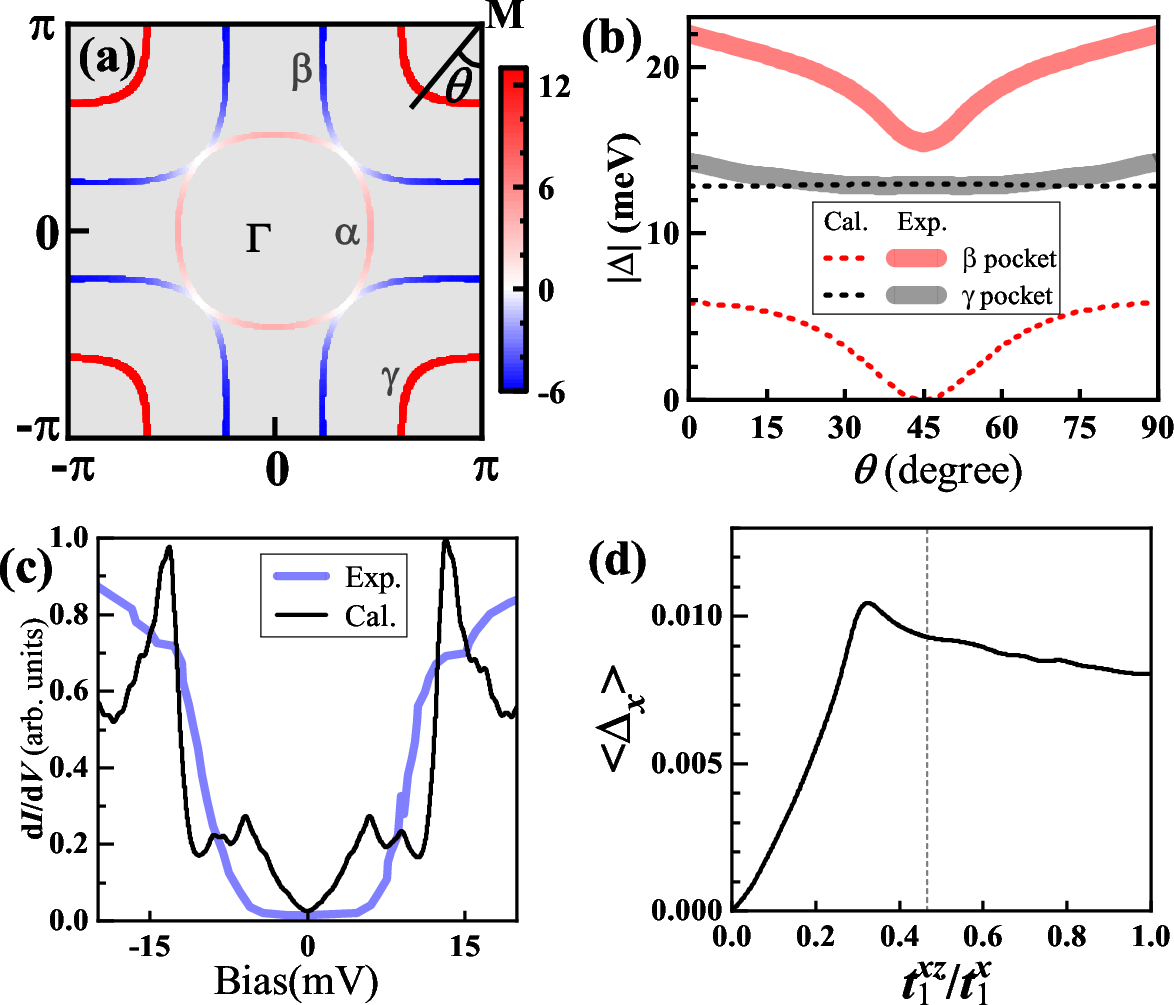
Figure 2: The calculated SC pairing gap and STM spectrum using Eq. 5 with \(\Delta_{\perp}^z = 13\) meV, compared with experimental results. (a) The distribution
of the SC gap \(\Delta(k)\) on the FS. (b) \(\theta\)-dependent SC gap on the \(\beta\) FS (red dashed line) and the \(\gamma\) FS (black dashed line), and the shaded area represents the experimental results. (c) The calculated STM spectrum (black line), compared with the experimental data (blue line). (d) The expectation value \(\langle \Delta_x \rangle\) as a function of the inter-orbital hopping \(t_1^{xz}\) (in units of \(t_1^{x}\)).
This strong-coupling type of theories take that the interlayer AFM superexchange drives interlayer s-wave pairing between \(d_{z^2}\)- electrons, which further gain coherence through hybridization with \(d_{x^2-y^2}\) orbital and dominate the SC [92]–[96], [98], [99]. In these theories, although the
\(d_{x^2-y^2}\)-orbital electrons also become SC through proximity (i.e. hybridization) with the \(d_{z^2}\)-orbital electrons, their intrinsic pairing is extremely weak due to
quarter-filling (i.e. heavily overdoping in an analogy to the cuprates) of this orbital and can be ignored. The obtained pairing state can be described by the MF Hamiltonian, \[\begin{align}
H_{\rm MF} &=& H_0^x + H_0^z + H_0^{xz} + H^z_{\text{pair}}\nonumber\\
H^z_{\text{pair}} &=& \Delta^z_{\perp} \sum_{i}\left( c_{izt\uparrow}^\dagger c_{izb\downarrow}^\dagger - c_{izt\downarrow}^\dagger c_{izb\uparrow}^\dagger + \mathrm{H.c.} \right).
\label{eq:H95MF95z}
\end{align}\tag{5}\] Note that the strong correlation in La\(_3\)Ni\(_2\)O\(_7\) causes orbital-selective band renormalization [30]–[32], which can be effectively treated as bringing about
different renormalization factors to the \(H_0^x\), \(H_0^z\) and \(H_0^{xz}\) terms. However, the basis formula of Eq. (5 )
and particularly the above symmetry argument maintain.
As along the BZ diagonal, \(H_0^{xz}(\mathbf{k}_{\rm diag})=0\), we have \[\begin{align}
\label{eq:H95MF95diag951}
H_{\rm MF}(\mathbf{k_{\rm diag}})=H_0^x(\mathbf{k_{\rm diag}})+H_0^z(\mathbf{k_{\rm diag}}) + H^z_{\text{pair}}(\mathbf{k_{\rm diag}}).
\end{align}\tag{6}\] As the \(\alpha/\beta\) pocket there is purely contributed by \(d_{x^2-y^2}\) orbital, the Hamiltonian there only contains the pure TB term \(H_0^x(\mathbf{k_{\rm diag}})\), and thus the pairing gap vanishes there, which is inconsistent with ARPES/STM.
Using Eq. (5 ), projection of the gap onto the FS leads to the distribution shown in Fig. 2 (a), which is compared with ARPES in Fig. 2 (b). We adopt \(\Delta^z_{\perp} = 13\) meV to well fit the ARPES gap on the \(\gamma\)- pocket, to find that the calculated gap distribution on the \(\beta\) pocket distinct
from that of ARPES: Besides the distinct gap amplitude, the pronounced difference lies in that the calculated gaps are strongly anisotropic and form nodes at the BZ diagonal while the ARPES reveals a full gap with low anisotropy. Due to presence of the gap
nodes, the calculated STM curve shown in Fig. 2 (c) exhibits a V- shape, distinct from the U-shaped experimental curve.
Despite absence of intrinsic pairing between the \(d_{x^2-y^2}\)- electrons, hybridization with \(d_{z^2}\) orbital induces nonzero expectation value of their interlayer pairing operator
\(\langle \Delta_x \rangle = 1/\sqrt{2}\langle c_{ixt\uparrow}^\dagger c_{ixb\downarrow}^\dagger - c_{ixt\downarrow}^\dagger c_{ixb\uparrow}^\dagger \rangle\), as shown in Fig. 2 (d). Such a
“hierarchical structure” of pairing in La\(_3\)Ni\(_2\)O\(_7\) has been reported in recent studies [96], [99]. However, this nonzero value only originates from the average over the whole
BZ. Focusing on the BZ diagonal, since the orbital hybridization vanishes there, gap nodes are inevitable on the \(\alpha/\beta\)-pockets. Therefore, an intrinsic pairing gap in the \(d_{x^2-y^2}\) orbital is required to understand the full pairing gap observed experimentally.
0.0.0.4Hund’s Rule Driven Pairing Mechanism. —
This strong-coupling type of theories hold that, although the interlayer AFM superexchange between the \(d_{z^2}\)- orbitals can induce intrinsic interlayer pairing between the \(d_{z^2}\)- electrons, the low hole density and low mobility of the \(d_{z^2}\)- orbital prevent it from dominating the SC. In contrast, the \(d_{x^2-y^2}\)-
electrons can form a dominant interlayer pairing induced by the effective interlayer superexchange transferred from the \(d_{z^2}\)- orbital through the Hund’s rule [60], [67], [68], [100]–[118]. The resultant pairing state can be described by the MF Hamitonian, \[\begin{align}
\label{eq:H95MF95x}
H_{\rm MF} &= H_0 + \Delta^x_{\perp} \sum_{i,\sigma}\left( c_{ixt\uparrow}^\dagger c_{ixb\downarrow}^\dagger - c_{ixt\downarrow}^\dagger c_{ixb\uparrow}^\dagger + \mathrm{H.c.} \right) \nonumber\\
&\quad + \Delta^z_{\perp} \sum_{i,\sigma}\left( c_{izt\uparrow}^\dagger c_{izb\downarrow}^\dagger - c_{izt\downarrow}^\dagger c_{izb\uparrow}^\dagger + \mathrm{H.c.} \right),
\end{align}\tag{7}\] where \(\Delta^x_{\perp}\) and \(\Delta^z_{\perp}\) denote the intrinsic interlayer pairing gaps in the \(d_{x^2-y^2}\)
and \(d_{z^2}\) orbitals, respectively. Here the finite value of \(\Delta^z_{\perp}\) relies on the presence of the \(\gamma\)- pocket which provides finite
hole density of the \(d_{z^2}\) orbital. Generally we have \(\Delta^x_{\perp}>\Delta^z_{\perp}\).
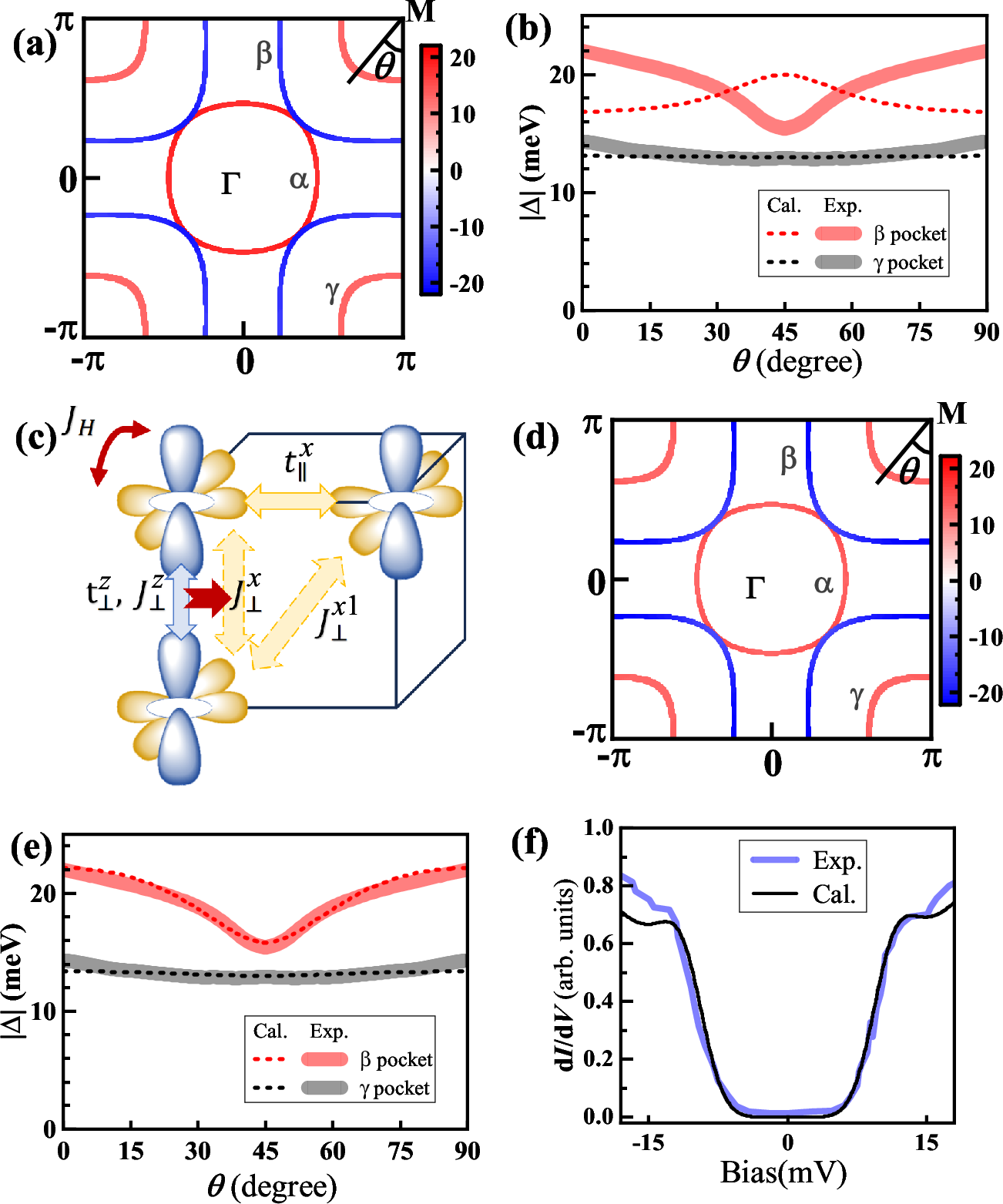
Figure 3: The calculated pairing gap and STM spectrum using Eq. (7 ). (a-b) Results with \(\Delta_{\perp}^x = 20\) meV and \(\Delta_{\perp}^z = 13\) meV: (a) The distribution of the SC gap \(\Delta(k)\) on the FS. (b) \(\theta\)-dependent SC gap on the \(\beta\) FS (red dashed line) and the \(\gamma\) FS (black dashed line), and the shaded area represents the experimental results. (c) Schematic diagram of the effective inter-layer couplings
\(J_{\perp}^{x}\) and \(J_{\perp}^{x1}\). (d-e) Same as (a-b) but including the additional interlayer NN pairing \(\Delta_{\perp}^{x1}\), with \(\Delta_{\perp}^x = 27\) meV, \(\Delta_{\perp}^z = 13\) meV, and \(\Delta_{\perp}^{x1} = -6\) meV. (f) STM spectrum (black line) calculated with the same
parameters as in (d)-(e) except for \(\Delta_{\perp}^z = 10\) meV due to sample difference, compared with the experimental data (blue line).
As claimed above, the \(\Delta^x_{\perp}\) directly opens the gap on the \(\alpha\)- and \(\beta\)- pockets along the BZ diagonal. Setting \(\Delta^x_{\perp} = 20\) meV and \(\Delta^z_{\perp} = 13\) meV as an example, we display the pairing gap on the FS in Figs. 3 (a, b). Clearly, we obtain full gaps on all
pockets, which qualitatively fit the ARPES/STM data. The fitting can be further improved through introducing a small interlayer nearest-neighbor (NN) pairing \(\Delta^{x1}_{\perp}\) between the \(d_{x^2-y^2}\) electrons, whose physical origin is schematically illustrated in Fig. 3 (c): The Hund’s rule transfers the interlayer AFM superexchange between the \(d_{z^2}\)- electrons \(J^z_\perp\) to the \(d_{x^2-y^2}\)- electrons as \(J^x_\perp\), and the intralayer hopping of the \(d_{x^2-y^2}\)- electrons \(t^x_{\parallel}\) further transfers \(J^x_\perp\) to between the interlayer NN sites as \(J^{x1}_\perp\), which induces \(\Delta^{x1}_{\perp}\). Setting \(\Delta^{x}_{\perp} = 27\) meV, \(\Delta^z_{\perp} = 13\) meV,
and \(\Delta^{x1}_{\perp} = -6\) meV, the gap distribution shown in Figs. 3 (d, e) perfectly fits the ARPES data. Furthermore, using the same set of \(\Delta^{x}_{\perp}\) and \(\Delta^{x1}_{\perp}\) but slightly different \(\Delta^z_{\perp} = 10\) meV, the calculated STM spectrum also well fits the U-shaped
experiment data, as shown in Fig. 3 (f). The slight variation of \(\Delta^z_{\perp}\) may be caused by sample difference which influences the oxygen content and hence the size of the \(\gamma\)-pocket, while the \(\Delta^{x}_{\perp}\) and \(\Delta^{x1}_{\perp}\) are not sensitive to the \(\gamma\)-pocket.
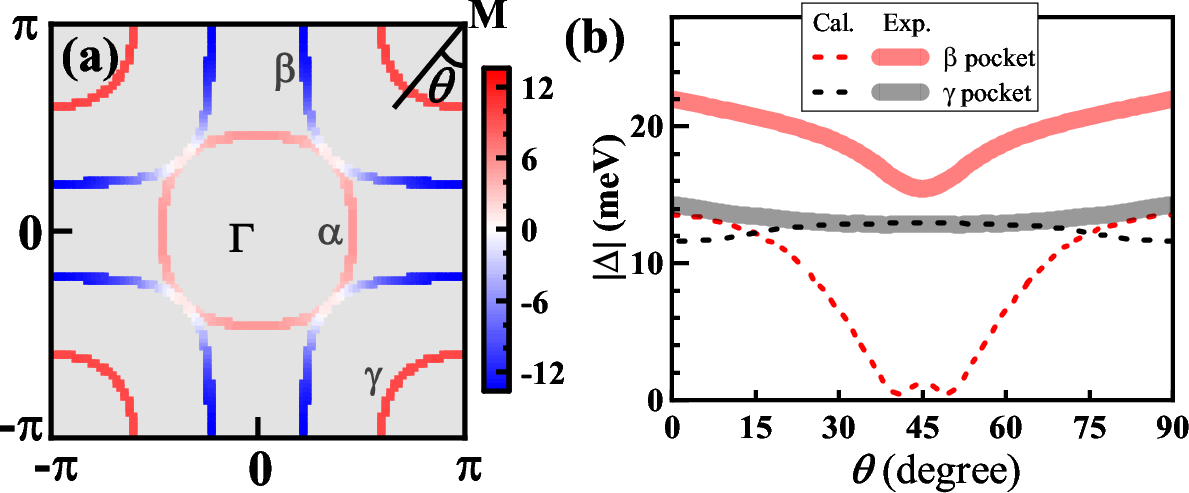
Figure 4: Pairing gap calculated by RPA, compared with experimental results (the shade area in b). (a) Distribution of the SC gap \(\Delta(k)\) on the FS. (b) \(\theta\)-dependent SC gap on the \(\beta\)- FS (red dashed line) and the \(\gamma\)- FS (black dashed line).
0.0.0.5Weak-coupling Pairing Mechanism. —.
The pairing mechanism of bilayer nickelate has been extensively studied within various weak-coupling approaches. These weak-coupling studies consistently yield gap nodes or near-nodes on the \(\beta\) pocket near the BZ
diagonal regime [52], [53], [55], [56], [60], [78]–[80], [82], [84], [85], [87]–[90], whose
physical origin however has not been clarified. For illustration, we perform an RPA calculation adopting the Hubbard-Kanamori model with choosing typical interaction parameters provided in Appendix B, and the results are shown in Figs. 4 (a-b). Clearly on the \(\beta\) pocket, the gap near the BZ diagonal regime is much weaker than that in other regimes, which conflicts with the nearly isotropic gap function observed
experimentally.
To clarify the physical origin of the gap nodes or near-nodes along the BZ diagonal, we calculated the real-space pairing pattern through a Fourier transformation of the obtained \(\mathbf{k}\)- space pairing gap, with
the results displayed in Appendix B. Two features are prominent for these data: First, the interorbital pairing is very weak and can be ignored. Second, the \(d_{z^2}\)- orbital pairing dominants the \(d_{x^2-y^2}\)- orbital pairing. The first feature justifies the validity of Eq. (3 ) and Eq. (4 ) and subsequent analysis, based on which the second feature further
causes the near-nodes around the BZ diagonal regime on the \(\beta\)-pocket through orbital-hybridization. The dominance of the \(d_{z^2}\)- orbital in the pairing is common in weak-coupling
theories [52], [56], [78], [87], [89], [90], which originates
from the \(\gamma\)- pocket formed by the flat top of the bonding \(d_{z^2}\)- band that hosts a large DOS and hence contributes significantly to the pairing.
Therefore, the weak-coupling theories and the orbital-hybridization driven strong-coupling theories share the same feature that the \(d_{z^2}\) orbital dominates the pairing, which inevitably leads to near-nodes along
the BZ diagonal on the \(\alpha/\beta\)- pocket, which however conflicts with experiments. The limitation of these theories lies in overestimation of \(d_{z^2}\) orbital in the pairing.
Physically, due to near half-filling of the \(d_{z^2}\) orbital, the Hubbard repulsion will strongly suppress the phase coherence and hence strongly suppress the SC order by a Gutzwiller renormalization factor [129]. However, the weak-coupling approach treats the \(d_{z^2}\) electrons as purely itinerant and ignore such
renormalization factor, which inevitably overestimates the significance of the \(d_{z^2}\)-electrons. The orbital-hybridization driven strong-coupling theories ignore the intrinsic pairing between the \(d_{x^2-y^2}\) orbital, which also overestimates the role of the \(d_{z^2}\)- orbital. In contrast, in the Hund’s-rule driven pairing mechanism, the \(d_{x^2-y^2}\) orbital dominantly carries the SC, which properly accounts for the strong-correlation effect and consistently explains the fully gapped spectrum.
0.0.0.6Conclusions. —.
In conclusion, based on symmetry analysis, we propose that vanish of orbital hybridization along the BZ diagonal causes orbital-selective pairing nature on different Fermi pockets, which provides a probe of pairing mechanism in La\(_3\)Ni\(_2\)O\(_7\). Analysis based on this proposal suggests that, in \(d_{z^2}\)- orbital dominated pairing mechanism such as
the orbital-hybridization driven strong-coupling theories and the weak-coupling theories, gap nodes or near-nodes are inevitable along the BZ diagonal on the \(\alpha/\beta\) pockets, which conflicts with the ARPES/STM
spectrum. In contrast, in \(d_{x^2-y^2}\)-orbital dominated mechanism such as the Hund’s rule driven strong-coupling theories, the calculated gap function can well fit the ARPES and STM data. This analysis clarifies the
dominant role of \(d_{x^2-y^2}\) orbital in the pairing and establishes the Hund’s rule driven pairing mechanism as the one most relevant to La\(_3\)Ni\(_2\)O\(_7\).
Based on the interlayer \(d_{x^2-y^2}\)-orbital pairing nature, we made further prediction on the ARPES. Along the BZ diagonal, the bonding and antibonding states of the \(d_{x^2-y^2}\)
orbital reside on the \(\alpha\)- and \(\beta\)- pockets, respectively. As derived in Appendix C, we predict that the gaps on the two pockets have equal amplitude and opposite signs. This
explains why the presence of two pockets does not lead to fluctuation of the observed pairing amplitude near the BZ diagonal. We have further studied the gap distribution in the case when the \(\gamma\) pocket is absent, as
some ARPES experiments suggest. Without the \(\gamma\) pocket, \(\Delta^z_{\perp}\) is suppressed due to poor coherence of the \(d_{z^2}\) orbital. In this
case, we predict that the gap on the \(\alpha\) and \(\beta\)- pockets reaches its maximum along the BZ diagonal because the weight of the \(d_{x^2-y^2}\)
orbital is maximized there. See Appendix C for details.
Here we provide the derivation details relevant to the calculation results shown in the main text, including the gap distribution on FS and the STM spectrum.
The distribution of gap on FS. We start from the mean-field Hamiltonian \[\begin{align}
H_{\rm MF} &= H_0 + \sum_{m,i}\Delta_{\perp}^{m} \left( c_{imt\uparrow}^\dagger c_{imb\downarrow}^\dagger - c_{imt\downarrow}^\dagger c_{imb\uparrow}^\dagger + \mathrm{H.c.} \right) \\
&=\sum_{\mathbf{k},\sigma}\sum_{mm'\mu\nu}h_{\mu\nu}^{mm'}(\mathbf{k})c_{\mathbf{k}m\mu\sigma}^\dagger c_{\mathbf{k}m'\nu\sigma}+\mathrm{H.c.} \\
&+ \sum_{m\mathbf{k}}\Delta_{\perp}^{m} \left( c_{\mathbf{k}mt\uparrow}^\dagger c_{-\mathbf{k}mb\downarrow}^\dagger - c_{\mathbf{k}mt\downarrow}^\dagger c_{-\mathbf{k}mb\uparrow}^\dagger + \mathrm{H.c.} \right)\notag,
\end{align}\] where \(m,m'\in\{x,z\}\) labeling the orbitals and \(\mu,\nu\in\{t,b\}\) labeling the layers. Diagonalizing the matrix \(h(\mathbf{k})\) yields the band eigenstates \(|\mathbf{k},l\rangle\) with eigenvector components \(\xi_{l,m\mu}(\mathbf{k})\) and eigenvalues \(\epsilon_l(\mathbf{k})\).
We reasonably adopt the intraband pairing approximation, in which only the intraband Cooper pairing of the form \(c_{\mathbf{k}l\sigma}^\dagger c_{-\mathbf{k}l\sigma'}^\dagger\) is retained. The band-basis mean-field
Hamiltonian then reads \[H_{\rm MF} = \sum_{\mathbf{k},l,\sigma} \epsilon_l(\mathbf{k}) c_{\mathbf{k}l\sigma}^\dagger c_{\mathbf{k}l\sigma}
+ \sum_{\mathbf{k},l} \left[ \Delta_{l}(\mathbf{k}) c_{\mathbf{k}l\uparrow}^\dagger c_{-\mathbf{k}l\downarrow}^\dagger + \mathrm{H.c.} \right]\notag,\] with \[\Delta_{l}(\mathbf{k}) = 2\Delta_{\perp}^{x}\,
\xi_{l,xt}^*(\mathbf{k}) \, \xi_{l,xb}^*(-\mathbf{k}) + 2\Delta_{\perp}^{z} \, \xi_{l,zt}^*(\mathbf{k}) \, \xi_{l,zb}^*(-\mathbf{k})\notag\]
When the NN interlayer pairing \(\Delta_{\perp}^{x1}\) is included, we need to add a term \(4\Delta_{\perp}^{x1}(\cos k_x + \cos
k_y) \xi_{l,xt}^*(\mathbf{k}) \xi_{l,xb}^*(-\mathbf{k})\) into \(\Delta_l(\mathbf{k})\).
STM spectrum. At finite temperature, the differential conductance is obtained by convolving the BCS density of states with the thermal kernel \(K_T(E)=-\partial f/\partial E\), \[\frac{dI}{dV}(V) \propto \sum_{l,\mathbf{k}} \left[ u_{l\mathbf{k}}^2 K_T\bigl(E_{l\mathbf{k}}-eV\bigr) + v_{l\mathbf{k}}^2 K_T\bigl(E_{l\mathbf{k}}+eV\bigr) \right]\notag,\] where \(u_{l\mathbf{k}}\) and \(v_{l\mathbf{k}}\) are the standard BCS coherence factors, \(E_{l\mathbf{k}}\) is the quasiparticle dispersion, and \[K(E) = \frac{1}{4k_{\rm B}T}\,\mathrm{sech}^2\!\left(\frac{E}{2k_{\rm B}T}\right)\notag.\]
We take \(k_{\rm B}T = 0.362\) meV in calculation, corresponding to the experimental measurement temperature.
In RPA framework, SC is driven by the spin or charge fluctuation with the propagator given by the spin or charge susceptibility \(\chi^{(s/c)}\) renormalized up to the RPA level. When the interaction strength \(U\) is smaller than the critical value \(U_c\), both \(\chi^{(s)}\) and \(\chi^{(c)}\) do not diverge and the spin and charge
fluctuation mediates SC.
We consider the multi-orbital Hubbard-Kanamori Hamiltonian and set the onsite intraorbital Coulomb repulsion strength \(U=1\text{ eV}\) and the strength of Hund’s coupling \(J_H=U/6\),
and the onsite interorbital Coulomb repulsion strength \(V\) is obtained from the relationship \(U=V+2J_H\)[130]. Then we apply the standard RPA approach [131]–[137] to obtain the \(\mathbf{k}\)-space gap function in the full BZ. After getting the \(\mathbf{k}\)-space gap function \(\Delta_{l}(\mathbf{k})\) in the full BZ, we obtain the real-space pairing components by Fourier transformation.
The ratios between some dominant pairing components and the interlayer pairing of the \(d_{z^2}\) orbital \(\Delta^{z,\perp}_{(0,0)}\) are shown in Table 1. For each case in \(d_{z^2}\) intralayer pairing, \(d_{z^2}\) interlayer pairing, \(d_{x^2-y^2}\) intralayer
pairing, \(d_{x^2-y^2}\) interlayer pairing and interorbital pairing, only the relative large values are shown.
Table 1: The ratios between some dominant pairing components and the interlayer pairing of the \(d_{z^2}\) orbital obtained from the RPA study. In the superscripts, \(z/x\)
represents the pairing of the \(d_{z^2}\) orbital or the \(d_{x^2-y^2}\) orbital, \(zx\) represents the interorbital pairing, and \(\parallel\) and \(\perp\) represent intralayer pairing and interlayer pairing, respectively. \((r_x,r_y)\) in the subscript represents the pairing between site
\(\mathbf{R}\) and site \(\mathbf{R}+r_x\mathbf{e}_x+r_y\mathbf{e}_y\).
Pairing Component
Value
\(\Delta^{z,\parallel}_{(0,0)}\)
\(-0.381\)
\(\Delta^{x,\parallel}_{(0,0)}\)
\(-0.021\)
\(\Delta^{z,\perp}_{(0,0)}\)
\(1.0\)
\(\Delta^{x,\perp}_{(0,0)}\)
\(0.457\)
\(\Delta^{z,\parallel}_{(1,0)}\)
\(-0.062\)
\(\Delta^{x,\parallel}_{(1,0)}\)
\(-0.024\)
\(\Delta^{z,\parallel}_{(1,1)}\)
\(-0.045\)
\(\Delta^{x,\parallel}_{(1,1)}\)
\(0.095\)
\(\Delta^{zx,\parallel}_{(1,0)}\)
\(0.009\)
3 Appendix C: The prediction of the gap distribution↩︎
Here, we perform two experimentally testable predictions, namely, the gap on the \(\alpha\) pocket and the gap evolution when the \(\gamma\) pocket is absent.
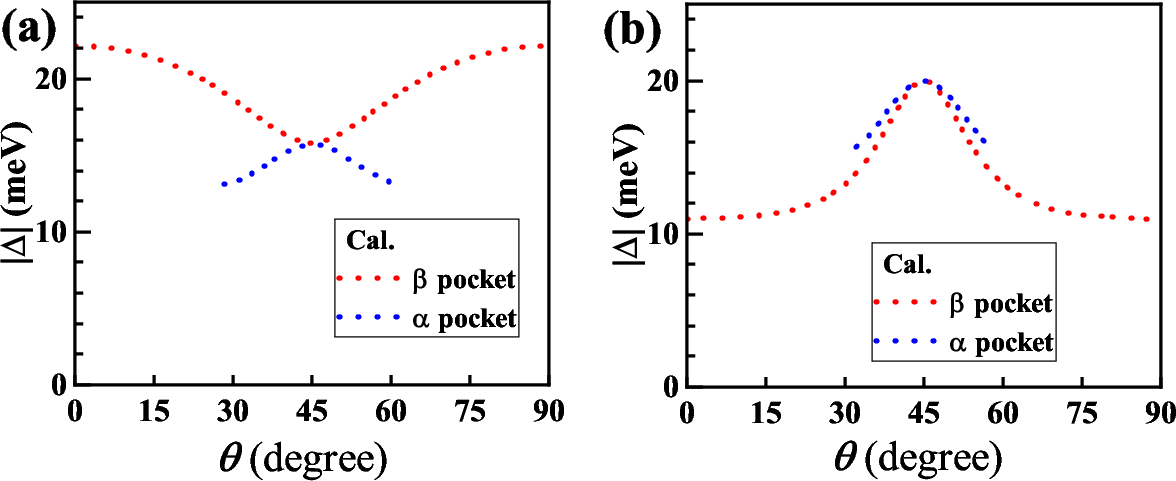
First, as shown in Fig. 5 (a), we predict that the gap on the \(\alpha\) pocket should be essentially isotropic, with a magnitude comparable to the gap on the \(\beta\) pocket along the diagonal direction (\(\sim 16\) meV).
This prediction follows directly from the orbital structure along the diagonal direction. There the \(\alpha\) and \(\beta\) states are the bonding and antibonding combinations of the two
layer \(d_{x^2-y^2}\) orbitals, \[\begin{align}
|\mathbf{k}_{\rm diag},\alpha/\beta\rangle &= \frac{1}{\sqrt{2}}\left(|\mathbf{k}_{\rm diag},tx\rangle \pm |\mathbf{k}_{\rm diag},bx\rangle\right),\\
|\mathbf{k}_{\rm diag},t/b,x\rangle &= \frac{1}{\sqrt{2}}\left(|\mathbf{k}_{\rm diag},\alpha\rangle \pm |\mathbf{k}_{\rm diag},\beta\rangle\right).
\end{align}\]
On the \(\beta\) and \(\alpha\) FSs, only the interlayer pairing \(\Delta^x_{\perp}\) can project onto the momentum \(\mathbf{k}_{\rm diag}\). The pairing term reads \[\begin{align}
H_{\rm pair}(\mathbf{k}_{\rm diag}) &= \Delta_{\perp}^{x} \left( c_{\mathbf{k}tx\uparrow}^\dagger c_{-\mathbf{k}bx\downarrow}^\dagger - c_{\mathbf{k}tx\downarrow}^\dagger c_{-\mathbf{k}bx\uparrow}^\dagger + \mathrm{H.c.}\right)\\
&=\Delta_{\perp}^{x} \left[(c_{\mathbf{k}\alpha\uparrow}^\dagger+ c_{\mathbf{k}\beta\uparrow}^\dagger)(c_{-\mathbf{k}\alpha\downarrow}^\dagger -c_{-\mathbf{k}\beta\downarrow}^\dagger)+\mathrm{H.c.}\right]\\
&=\Delta_{\perp}^{x} \left(c_{\mathbf{k}\alpha\uparrow}^\dagger c_{-\mathbf{k}\alpha\downarrow}^\dagger-c_{\mathbf{k}\beta\uparrow}^\dagger c_{-\mathbf{k}\beta\downarrow}^\dagger\right)+\mathrm{H.c.}\notag,
\end{align}\] It follows that \(\Delta_{\alpha}(\mathbf{k}_{\rm diag})=-\Delta_{\beta}(\mathbf{k}_{\rm diag})=\Delta_{\perp}^{x}\). The gaps on the two pockets have equal magnitude and opposite sign along the
diagonal. Meanwhile, the smaller size of the \(\alpha\) pocket limits angular variation of the gap, leading to the nearly isotropic gap seen in Fig. 5 (a).
Figure 5: \(\theta\)-dependent SC gap on FS. (a) the gap on the \(\alpha\) and \(\beta\) pockets. (b) the gap on the \(\alpha\) and \(\beta\) pockets when the \(\gamma\) pocket is absent.
Second, we consider the case without the \(\gamma\) pocket, as suggested by some ARPES experiments. In this case, the \(d_{z^2}\) orbital is much closer to half-filling, so the \(d_{z^2}\) pairing gap \(\Delta^z\) is strongly suppressed. With \(\Delta^z\) negligible, the \(\beta\)-pocket gap is dominated
by the \(d_{x^2-y^2}\) interlayer pairing. We predict that the gap remains fully opened, but its angular dependence changes, with the gap now reaching a maximum along the diagonal direction, as shown in Fig. 5 (b).
H. Sun et al., “Signatures of superconductivity near 80K in a nickelate under high pressure,”Nature, vol. 621, no. 7979, pp. 493–498, Sep.
2023, doi: 10.1038/s41586-023-06408-7.
[2]
Y. Zhang et al., “High-temperature superconductivity with zero resistance and strange-metal behaviour in La\(_3\)Ni\(_2\)O\(_{7-\delta}\),”Nat. Phys., vol. 20, no. 8, pp. 1269–1273, Aug. 2024, doi: 10.1038/s41567-024-02515-y.
[3]
J. Hou et al., “Emergence of high-temperature superconducting phase in pressurized La\(_{3}\)Ni\(_{2}\)O\(_7\) crystals,”Chin. Phys. Lett., vol. 40, no. 11, p. 117302, 2023, doi: 10.1088/0256-307X/40/11/117302.
[4]
G. Wang et al., “Pressure-induced superconductivity in polycrystalline La\(_3\)Ni\(_2\)O\(_7\),”Phys. Rev. X, vol. 14, p. 011040, Mar. 2024, doi: 10.1103/PhysRevX.14.011040.
[5]
Y. Zhou et al., “Investigations of key issues on the reproducibility of high-\(T_c\) superconductivity emerging from
compressed La\(_3\)Ni\(_2\)O\(_7\),”Matter and Radiation at Extremes, vol. 10, no. 2, 2025, [Online].
Available: https://pubs.aip.org/aip/mre/article/10/2/027801/3331819.
[6]
J. Li et al., “Identification of the superconductivity in bilayer nickelate La\(_3\)Ni\(_2\)O\(_7\) upon 100 GPa,”arXiv:2404.11369, 2024, [Online]. Available: https://arxiv.org/abs/2404.11369.
[7]
G. Wang et al., “Observation of high-temperature superconductivity in the high-pressure tetragonal phase of La\(_2\)PrNi\(_2\)O\(_{7-\delta}\),”arXiv:2311.08212, 2023, [Online]. Available: https://arxiv.org/abs/2311.08212.
[8]
N. Wang et al., “Bulk high-temperature superconductivity in the high-pressure tetragonal phase of bilayer La\(_2\)PrNi\(_2\)O\(_7\),”Nature, vol. 634, no. 8034, pp. 579–584, Oct. 2024, doi: 10.1038/s41586-024-07996-8.
[9]
Z. Dong et al., “Interstitial oxygen order and its competition with superconductivity in La\(_2\)PrNi\(_2\)O\(_{7+\delta}\),”Nature Materials, vol. 24, no. 12, pp. 1927–1934, 2025, [Online].
Available: https://www.nature.com/articles/s41563-025-02351-2.
[10]
L. Liu et al., “Evidence for the meissner effect in the nickelate superconductor La\(_3\)Ni\(_2\)O\(_{7-\delta}\) single crystal using diamond quantum sensors,”Phys. Rev. Lett., vol. 135, p. 096001, Aug. 2025, doi: 10.1103/yvj7-htb4.
[11]
Z. Qiu et al., “Interlayer coupling enhanced superconductivity near 100 K in La\(_{3-x}\)Nd\(_x\)Ni\(_2\)O\(_7\),”arXiv:2510.12359, 2025, [Online]. Available: https://arxiv.org/abs/2510.12359.
[12]
F. Li et al., “Bulk superconductivity up to 96 K in pressurized nickelate single crystals,”Nature, vol. 649, no. 8098, pp. 871–878, 2026,
[Online]. Available: https://www.nature.com/articles/s41586-025-09954-4.
[13]
Q. Zhong et al., “Evolution of the superconductivity in pressurized La\(_{3-x}\)Sm\(_x\)Ni\(_2\)O\(_7\),”arXiv:2510.13342, 2025, [Online]. Available: https://arxiv.org/abs/2510.13342.
[14]
P. Puphal et al., “Unconventional crystal structure of the high-pressure superconductor La\(_{3}\)Ni\(_{2}\)O\(_{7}\),”Phys. Rev. Lett., vol. 133, p. 146002, Oct. 2024, doi: 10.1103/PhysRevLett.133.146002.
[15]
X. Chen et al., “Polymorphism in the Ruddlesden–Popper nickelate La\(_3\)Ni\(_2\)O\(_7\): Discovery of a hidden phase with distinctive layer stacking,”J. Am. Chem. Soc., vol. 146, no. 6, pp. 3640–3645, Feb. 2024, doi: 10.1021/jacs.3c14052.
[16]
C. Huang et al., “Superconductivity in monolayer-trilayer phase of La\(_3\)Ni\(_2\)O\(_7\) under high pressure,”arXiv:2510.12250, 2025, [Online]. Available: https://arxiv.org/abs/2510.12250.
[17]
N. Yuan, A. Elghandour, J. Arneth, K. Dey, and R. Klingeler, “High-pressure crystal growth and investigation of the metal-to-metal transition of
Ruddlesden–Popper trilayer nickelates La\(_4\)Ni\(_3\)O\(_{10}\),”J. Cryst.
Growth, vol. 627, p. 127511, 2024, doi: https://doi.org/10.1016/j.jcrysgro.2023.127511.
[18]
J. Li et al., “Structural transition, electric transport, and electronic structures in the compressed trilayer nickelate La\(_{4}\)Ni\(_{3}\)O\(_{10}\),”Sci. China Phys. Mech. Astron., vol. 67, no. 11, p. 117403, 2024, [Online]. Available: https://www.sciengine.com/SCPMA/doi/10.1007/s11433-023-2329-x.
[19]
F. Li et al., “Design and synthesis of three-dimensional hybrid Ruddlesden-Popper nickelate single crystals,”Phys. Rev. Mater.,
vol. 8, p. 053401, May 2024, doi: 10.1103/PhysRevMaterials.8.053401.
[20]
E. K. Ko et al., “Signatures of ambient pressure superconductivity in thin film La\(_3\)Ni\(_2\)O\(_7\),”Nature, vol. 638, pp. 935–940, 2025, doi: 10.1038/s41586-024-08525-3.
[21]
G. Zhou et al., “Ambient-pressure superconductivity onset above 40 K in (La, Pr)\(_3\)Ni\(_2\)O\(_7\) films,”Nature, vol. 640, pp. 641–646, 2025, [Online]. Available: https://www.nature.com/articles/s41586-025-08755-z.
[22]
Y. Liu et al., “Superconductivity and normal-state transport in compressively strained La\(_2\)PrNi\(_2\)O\(_7\) thin films,”Nature Materials, pp. 1–7, 2025, [Online]. Available: https://www.nature.com/articles/s41563-025-02258-y.
[23]
G. Wang et al., “Chemical versus physical pressure effects on the structure transition of bilayer nickelates,”npj Quantum Materials, vol. 10, no. 1, p. 1,
2025, [Online]. Available: https://www.nature.com/articles/s41535-024-00721-8.
[24]
X. Zhou et al., “Revealing nanoscale structural phase separation in La\(_{3}\)Ni\(_{2}\)O\(_{7-\delta}\) single crystal via scanning near-field optical microscopy,”arXiv:2410.06602, 2024, [Online]. Available: https://arxiv.org/abs/2410.06602.
[25]
L. Wang et al., “Structure responsible for the superconducting state in La\(_3\)Ni\(_2\)O\(_7\) at low temperature and high pressure conditions,”Journal of the American Chemical Society, vol. 146, no. 11, pp. 7506–7514, Mar. 2024, doi: 10.1021/jacs.3c13094.
[26]
Z. Huo et al., “Modulation of the octahedral structure and potential superconductivity of La\(_3\)Ni\(_2\)O\(_7\) through strain engineering,”Science China Physics, Mechanics & Astronomy, vol. 68, no. 3, p. 237411, 2025, [Online]. Available: https://link.springer.com/article/10.1007/s11433-024-2583-y.
[27]
B. Geisler, J. J. Hamlin, G. R. Stewart, R. G. Hennig, and P. Hirschfeld, “Structural transitions, octahedral rotations, and electronic properties of \({A}_3\)Ni\(_2\)O\(_7\) rare-earth nickelates under high pressure,”npj Quantum Materials, vol. 9, no. 1, p. 38, 2024,
[Online]. Available: https://www.nature.com/articles/s41535-024-00648-0.
[28]
L. Bhatt et al., “Resolving structural origins for superconductivity in strain-engineered La\(_3\)Ni\(_2\)O\(_7\) thin films,”arXiv:2501.08204, 2025, [Online]. Available: https://arxiv.org/abs/2501.08204.
[29]
X.-W. Yi, W. Li, J.-Y. You, B. Gu, and G. Su, “Unifying strain- and pressure-driven superconductivity in La\(_3\)Ni\(_2\)O\(_7\): Suppressed charge and spin density waves and enhanced interlayer coupling,”Phys. Rev. B, vol. 112, p. L140504, Oct. 2025, doi: 10.1103/85qv-ncxb.
[30]
Y. Li et al., “Electronic correlation and pseudogap-like behavior of high-temperature superconductor La\(_3\)Ni\(_2\)O\(_7\),”Chin. Phys. Lett., vol. 41, no. 8, p. 087402, Jul. 2024, doi: 10.1088/0256-307X/41/8/087402.
[31]
J. Yang et al., “Orbital-dependent electron correlation in double-layer nickelate La\(_3\)Ni\(_2\)O\(_7\),”Nat. Commun., vol. 15, no. 1, p. 4373, 2024, [Online]. Available: https://www.nature.com/articles/s41467-024-48701-7.
[32]
M. Li et al., “Distinguishing electronic band structure of single-layer and bilayer Ruddlesden-Popper nickelates probed by in-situ high pressure
X-ray absorption near-edge spectroscopy,”arXiv:2410.04230, 2024, [Online]. Available: https://arxiv.org/abs/2410.04230.
[33]
S. Fan et al., “Tunneling spectra with gaplike features observed in nickelate La\(_{3}\)Ni\(_{2}\)O\(_{7}\) at ambient pressure,”Phys. Rev. B, vol. 110, p. 134520, Oct. 2024, doi: 10.1103/PhysRevB.110.134520.
[34]
X. Chen et al., “Electronic and magnetic excitations in La\(_3\)Ni\(_2\)O\(_7\),”Nature Communications, vol. 15, no. 1, p. 9597, Nov. 2024, doi: 10.1038/s41467-024-53863-5.
[35]
M. Kakoi et al., “Multiband metallic ground state in multilayered nickelates La\(_3\)Ni\(_2\)O\(_7\) and La\(_4\)Ni\(_3\)O\(_{10}\)
probed by \(^{139}\)La-NMR at ambient pressure,”J. Phys. Soc. Jpn., vol. 93, no. 5, p. 053702, 2024, doi: 10.7566/JPSJ.93.053702.
[36]
Y. Li et al., “Distinct ultrafast dynamics of bilayer and trilayer nickelate superconductors regarding the density-wave-like transitions,”Sci. Bull., vol.
70, no. 2, pp. 180–186, 2025, doi: https://doi.org/10.1016/j.scib.2024.10.011.
[37]
Z. Liu et al., “Electronic correlations and partial gap in the bilayer nickelate La\(_3\)Ni\(_2\)O\(_7\),”Nat. Commun., vol. 15, no. 1, p. 7570, Aug. 2024, doi: 10.1038/s41467-024-52001-5.
[38]
Z. Luo, X. Hu, M. Wang, W. Wú, and D.-X. Yao, “Bilayer two-orbital model of La\(_3\)Ni\(_2\)O\(_7\) under pressure,”Phys. Rev. Lett., vol. 131, p. 126001, Sep. 2023, doi: 10.1103/PhysRevLett.131.126001.
[39]
Z. Ouyang, J.-M. Wang, J.-X. Wang, R.-Q. He, L. Huang, and Z.-Y. Lu, “Hund electronic correlation in La\(_3\)Ni\(_2\)O\(_7\) under high pressure,”Phys. Rev. B, vol. 109, p. 115114, Mar. 2024, doi: 10.1103/PhysRevB.109.115114.
[40]
Y. Zhang, L.-F. Lin, A. Moreo, and E. Dagotto, “Electronic structure, dimer physics, orbital-selective behavior, and magnetic tendencies in the bilayer nickelate superconductor
La\(_3\)Ni\(_2\)O\(_7\) under pressure,”Phys. Rev. B, vol. 108, p. L180510, Nov. 2023, doi: 10.1103/PhysRevB.108.L180510.
[41]
X. Sui et al., “Electronic properties of the bilayer nickelates \({R}_{3}\)Ni\(_2\)O\(_7\) with oxygen vacancies (\(R=\)La or Ce),”Phys. Rev. B, vol. 109, p. 205156, May 2024, doi: 10.1103/PhysRevB.109.205156.
[42]
B. Geisler, L. Fanfarillo, J. J. Hamlin, G. R. Stewart, R. G. Hennig, and P. J. Hirschfeld, “Optical properties and electronic correlations in La\(_3\)Ni\(_2\)O\(_{7-\delta}\) bilayer nickelates under high pressure,”npj Quantum Materials, vol. 9, no. 1, p. 89, Nov.
2024, doi: 10.1038/s41535-024-00690-y.
[43]
Z. Ouyang, M. Gao, and Z.-Y. Lu, “Absence of electron-phonon coupling superconductivity in the bilayer phase of La\(_3\)Ni\(_2\)O\(_7\) under pressure,”npj Quantum Materials, vol. 9, no. 1, p. 80, Oct. 2024, doi: 10.1038/s41535-024-00689-5.
[44]
X. Chen, P. Jiang, J. Li, Z. Zhong, and Y. Lu, “Charge and spin instabilities in superconducting La\(_3\)Ni\(_2\)O\(_7\),”Phys. Rev. B, vol. 111, p. 014515, Jan. 2025, doi: 10.1103/PhysRevB.111.014515.
[45]
M. E. Haque, R. Ali, M. Masum, J. Hassan, and S. Naqib, “DFT exploration of pressure dependent physical properties of the recently discovered
La3Ni2O7 superconductor,”arXiv:2504.15853, 2025, [Online]. Available: https://arxiv.org/abs/2504.15853.
[46]
L. C. Rhodes and P. Wahl, “Structural routes to stabilize superconducting La\(_3\)Ni\(_2\)O\(_7\) at ambient pressure,”Phys. Rev. Mater., vol. 8, p. 044801, Apr. 2024, doi: 10.1103/PhysRevMaterials.8.044801.
[47]
L. Shi, Y. Luo, W. Wu, and Y. Zhang, “Theoretical investigation of high-\({T}_c\) superconductivity in Sr-doped La\(_3\)Ni\(_2\)O\(_7\) at ambient pressure,”arXiv:2503.13197, 2025, [Online]. Available: https://arxiv.org/abs/2503.13197.
[48]
Y.-B. Liu, H. Sun, M. Zhang, Q. Liu, W.-Q. Chen, and F. Yang, “Origin of the diagonal double-stripe spin-density-wave and potential superconductivity in bulk La\(_3\)Ni\(_2\)O\(_7\) at ambient pressure,”arXiv:2501.14752, 2025, [Online]. Available: https://arxiv.org/abs/2501.14752.
[49]
P. Li et al., “Angle-resolved photoemission spectroscopy of superconducting (la,pr)3Ni2O7/SrLaAlO4 heterostructures,”National Science Review, vol. 12, no.
10, p. nwaf205, Oct. 2025, doi: 10.1093/nsr/nwaf205.
[50]
B. Y. Wang et al., “Electronic structure of compressively strained thin film La\(_2\)PrNi\(_2\)O\(_7\),”arxiv:2504.16372, 2025, [Online]. Available: https://arxiv.org/abs/2504.16372.
[51]
W. Sun et al., “Observation of superconductivity-induced leading-edge gap in Sr-doped La\(_3\)Ni\(_2\)O\(_7\) thin films,”arXiv:2507.07409, 2025, [Online]. Available: https://arxiv.org/abs/2507.07409.
[52]
C. Yue et al., “Correlated electronic structures and unconventional superconductivity in bilayer nickelate heterostructures,”National Science Review, vol.
12, no. 10, p. nwaf253, Oct. 2025, doi: 10.1093/nsr/nwaf253.
[53]
Z.-Y. Shao, Y.-B. Liu, M. Liu, and F. Yang, “Band structure and pairing nature of La\(_3\)Ni\(_2\)O\(_7\) thin film at ambient pressure,”Phys. Rev. B, vol. 112, p. 024506, Jul. 2025, doi: 10.1103/9t6n-jqr5.
[54]
X. Hu, W. Qiu, C.-Q. Chen, Z. Luo, and D.-X. Yao, “Electronic structures and multi-orbital models of La\(_3\)Ni\(_2\)O\(_7\) thin films at ambient pressure,”Communications Physics, vol. 8, p. 506, 2025, [Online]. Available: https://www.nature.com/articles/s42005-025-02411-8.
[55]
K. Ushio et al., “Theoretical study on ambient pressure superconductivity in La\(_3\)Ni\(_2\)O\(_7\) thin films: Structural analysis, model construction, and robustness of \(s\pm\)-wave pairing,”arXiv:2506.20497, 2025,
[Online]. Available: https://arxiv.org/abs/2506.20497.
[56]
Y.-H. Cao, K.-Y. Jiang, H.-Y. Lu, D. Wang, and Q.-H. Wang, “Strain-engineered electronic structure and superconductivity in La\(_3\)Ni\(_2\)O\(_7\) thin films,”arxiv:2507.13694, 2025, [Online]. Available: https://arxiv.org/abs/2507.13694.
[57]
G. Li et al., “Theoretical study on the electronic properties and multiorbital models of La\(_3\)Ni\(_2\)O\(_7\) thin films on SrLaAlO\(_4\)(001),”arXiv:2512.17625, 2025, [Online].
Available: https://arxiv.org/abs/2512.17625.
[58]
Y. Zhang, L.-F. Lin, A. Moreo, S. Okamoto, T. A. Maier, and E. Dagotto, “Compressive strain turns \(s^{\pm}\)- into \(d\)-wave pairing in a one-unit-cell La\(_3\)Ni\(_2\)O\(_7\) thin film via
substrate-induced hole doping,”Phys. Rev. B, vol. 113, p. L140505, Apr. 2026, doi: 10.1103/7nxw-5zr5.
[59]
B. Geisler, J. J. Hamlin, G. R. Stewart, R. G. Hennig, and P. Hirschfeld, “Electronic reconstruction and interface engineering of emergent spin fluctuations in compressively
strained La\(_3\)Ni\(_2\)O\(_7\) on SrLaAlO\(_4\)(001),”arXiv:2503.10902, 2025, [Online]. Available: https://arxiv.org/abs/2503.10902.
[60]
Z.-Y. Shao et al., “Pairing without \(\gamma\)-pocket in the La\(_3\)Ni\(_2\)O\(_7\) thin film,”arXiv:2507.20287, 2025, [Online]. Available: https://arxiv.org/abs/2507.20287.
[61]
H. Shi et al., “The effect of carrier doping and thickness on the electronic structures of La\(_3\)Ni\(_2\)O\(_7\) thin films,”arXiv:2502.04255, 2025, [Online]. Available: https://arxiv.org/abs/2502.04255.
[62]
C. Le, J. Zhan, X. Wu, and J. Hu, “Landscape of correlated orders in strained bilayer nickelate thin films,”arXiv:2501.14665, 2025, [Online]. Available: https://arxiv.org/abs/2501.14665.
[63]
S. Bheemavarapu, “Strain-tuned structural, electronic, and superconducting properties of thin-film La\(_3\)Ni\(_2\)O\(_7\),”arXiv:2512.23630, 2025, [Online]. Available: https://arxiv.org/abs/2512.23630.
[64]
Y. Wang, Y. Zhang, and K. Jiang, “Electronic structure and disorder effect of La\(_3\)Ni\(_2\)O\(_7\) superconductor,”Chinese Physics B, vol. 34, no. 4, p. 047105, Apr. 2025, doi: 10.1088/1674-1056/adbacc.
[65]
K. Chen et al., “Effect of Pr-doping and oxygen vacancies on spin density wave in La\(_3\)Ni\(_2\)O\(_{7-\delta}\): A \(\mu\)SR investigation,”Phys. Rev. Res., vol. 7, p. L032014, Jul. 2025, doi: 10.1103/blkt-x2ps.
[66]
Q.-Y. Wu et al., “Ultrafast optical evidence of coexisting density waves in bilayer nickelate La\(_3\)Ni\(_2\)O\(_7\),”arXiv:2508.09436, 2025, [Online]. Available: https://arxiv.org/abs/2508.09436.
[67]
H.-X. Wang et al., “Origin of spin stripes in bilayer nickelate La\(_3\)Ni\(_2\)O\(_7\),”arXiv:2509.25344, 2025, [Online]. Available: https://arxiv.org/abs/2509.25344.
[68]
H. Yang and Y.-H. Zhang, “Magnetism and superconductivity in bilayer nickelate,”arXiv:2512.13793, 2025, [Online]. Available: https://arxiv.org/abs/2512.13793.
[69]
J. Shen et al., “Nodeless superconducting gap and electron-boson coupling in (La,Pr,Sm)\(_3\)Ni\(_2\)O\(_7\) films,”Science, p. 10.1126/science.adw8329, 2026, doi: 10.1126/science.adw8329.
[70]
S. Fan et al., “Superconducting gap structure and bosonic mode in La\(_2\)PrNi\(_2\)O\(_7\) thin films at ambient pressure,”arXiv:2506.01788, 2025, [Online]. Available: https://arxiv.org/abs/2506.01788.
[71]
X. Wang et al., “Atomically resolved intrinsic superconducting gap in (La,Pr)\(_3\)Ni\(_2\)O\(_7\) films,”arXiv:2605.14806, 2026, [Online]. Available: https://arxiv.org/abs/2605.14806.
[72]
Z. Liang et al., “Observation of flat-bottom U-shaped energy gap in high-\(T_c\) nickelate
(La,Pr)\(_3\)Ni\(_2\)O\(_7\) thin films,”arXiv:2605.15703, 2026, [Online]. Available: https://arxiv.org/abs/2605.15703.
[73]
Q. Li et al., “Enhanced superconductivity in the compressively strained bilayer nickelate thin films by pressure,”arxiv:2507.10399, 2025, [Online].
Available: https://arxiv.org/abs/2507.10399.
[74]
B. Hao et al., “Superconductivity and phase diagram in Sr-doped La\(_{3-x}\)Sr\(_x\)Ni\(_2\)O\(_7\) thin films,”arXiv:2505.12603, 2025, [Online]. Available: https://arxiv.org/abs/2505.12603.
[75]
G. Zhou et al., “Superconductivity onset above 60K in ambient-pressure nickelate films,”National Science Review, vol. 13, no. 9, p. nwag151,
May 2026, doi: 10.1093/nsr/nwag151.
[76]
H. Ji et al., “Signatures of spin-glass superconductivity in nickelate (La, Pr, Sm)\(_3\)Ni\(_2\)O\(_7\) films,”arXiv:2508.16412, 2025, [Online]. Available: https://arxiv.org/abs2508.16412.
[77]
Y. Liu et al., “A superconducting half-dome in bilayer nickelates,”arXiv:2603.12196, 2026, [Online]. Available: https://arxiv.org/abs/2603.12196.
[78]
Y.-B. Liu, J.-W. Mei, F. Ye, W.-Q. Chen, and F. Yang, “S\(^{\pm}\)-wave pairing and the destructive role of apical-oxygen deficiencies in
La\(_3\)Ni\(_2\)O\(_7\) under pressure,”Phys. Rev. Lett., vol. 131, p. 236002, Dec. 2023, doi: 10.1103/PhysRevLett.131.236002.
[79]
Y. Zhang, L.-F. Lin, A. Moreo, T. A. Maier, and E. Dagotto, “Structural phase transition, \(s_{\pm}\)-wave pairing, and magnetic stripe order in
bilayered superconductor La\(_3\)Ni\(_2\)O\(_7\) under pressure,”Nat. Commun., vol. 15, no. 1, p.
2470, 2024, [Online]. Available: https://www.nature.com/articles/s41467-024-46622-z.
[80]
Y. Zhang, L.-F. Lin, A. Moreo, T. A. Maier, and E. Dagotto, “Trends in electronic structures and \(s_{\pm}\)-wave pairing for the rare-earth series
in bilayer nickelate superconductor \({R}_3\)Ni\(_2\)O\(_7\),”Phys. Rev. B, vol. 108, p. 165141, Oct. 2023, doi:
10.1103/PhysRevB.108.165141.
[81]
S. Bötzel, F. Lechermann, J. Gondolf, and I. M. Eremin, “Theory of magnetic excitations in multilayer nickelate superconductor La\(_3\)Ni\(_2\)O\(_7\),”Phys. Rev. B, vol. 109, p. L180502, May 2024, doi: 10.1103/PhysRevB.109.L180502.
[82]
Y. Gao, “Robust \(s_{\pm}\)-wave pairing in a bilayer two-orbital model of pressurized La\(_3\)Ni\(_2\)O\(_7\) without the \(\gamma\)Fermi surface,”arXiv:2502.19840, 2025, [Online]. Available: https://arxiv.org/abs/2502.19840.
[83]
Y.-M. Wu et al., “Superconductivity and magnetism in bilayer nickelates: Itinerant perspective,”arXiv:2602.20288, 2026, [Online]. Available: https://arxiv.org/abs/2602.20288.
[84]
S. Ryee, N. Witt, G. Sangiovanni, and T. O. Wehling, “Optimal superconductivity near a Lifshitz transition in strained (La,Pr)\(_3\)Ni\(_2\)O\(_7\),”arxiv:2506.21480, 2025, [Online]. Available: https://arxiv.org/abs/2506.21480.
[85]
G. Heier, K. Park, and S. Y. Savrasov, “Competing \({d}_{xy}\) and \({s}_{\pm}\) pairing symmetries in
superconducting La\(_3\)Ni\(_2\)O\(_7\): \(\mathrm{LDA}+\mathrm{FLEX}\)
calculations,”Phys. Rev. B, vol. 109, p. 104508, Mar. 2024, doi: 10.1103/PhysRevB.109.104508.
[86]
H. Sakakibara, N. Kitamine, M. Ochi, and K. Kuroki, “Possible high \({T}_{c}\) superconductivity in La\(_3\)Ni\(_2\)O\(_7\) under high pressure through manifestation of a nearly half-filled bilayer Hubbard model,”Phys. Rev. Lett., vol. 132, p. 106002, Mar. 2024, doi: 10.1103/PhysRevLett.132.106002.
[87]
W. Xi, S.-L. Yu, and J.-X. Li, “Transition from \(s_{\pm}\)-wave to \(d_{x^2-y^2}\)-wave superconductivity driven
by interlayer interaction in the bilayer two-orbital model of La\(_3\)Ni\(_2\)O\(_7\),”Phys. Rev. B,
vol. 111, p. 104505, Mar. 2025, doi: 10.1103/PhysRevB.111.104505.
[88]
Y. Hua, W. He, W.-Q. Chen, J. Miao, and C. Yue, “Possible enhancement of superconductivity in ambient-pressure La\(_3\)Ni\(_2\)O\(_7\) thin film,”arXiv:2603.02685, 2026, [Online]. Available: https://arxiv.org/abs/2603.02685.
[89]
Q.-G. Yang, D. Wang, and Q.-H. Wang, “Possible \({S}_{\pm}\)-wave superconductivity in La\(_3\)Ni\(_2\)O\(_7\),”Phys. Rev. B, vol. 108, p. L140505, Oct. 2023, doi: 10.1103/PhysRevB.108.L140505.
[90]
Y. Gu, C. Le, Z. Yang, X. Wu, and J. Hu, “Effective model and pairing tendency in the bilayer Ni-based superconductor La\(_{3}\)Ni\(_{2}\)O\(_{7}\),”Phys. Rev. B, vol. 111, p. 174506, May 2025, doi: 10.1103/PhysRevB.111.174506.
[91]
P. Jiang et al., “Dual instability of superconductivity from oxygen defects in La\(_3\)Ni\(_2\)O\(_{7+\delta}\),”arXiv:2512.00301, 2025, [Online]. Available: https://arxiv.org/abs/2512.00301.
[92]
Y.-F. Yang, G.-M. Zhang, and F.-C. Zhang, “Interlayer valence bonds and two-component theory for high-\({T}_{c}\) superconductivity of
La\(_3\)Ni\(_2\)O\(_7\) under pressure,”Phys. Rev. B, vol. 108, p. L201108, Nov. 2023, doi: 10.1103/PhysRevB.108.L201108.
[93]
Q. Qin and Y.-F. Yang, “High-\({T}_{c}\) superconductivity by mobilizing local spin singlets and possible route to higher \({T}_{c}\) in pressurized La\(_3\)Ni\(_2\)O\(_7\),”Phys. Rev. B, vol.
108, p. L140504, Oct. 2023, doi: 10.1103/PhysRevB.108.L140504.
[94]
Y.-F. Yang, “Decomposition of multilayer superconductivity with interlayer pairing,”Phys. Rev. B, vol. 110, p. 104507, Sep. 2024, doi: 10.1103/PhysRevB.110.104507.
[95]
Y. Shen, M. Qin, and G.-M. Zhang, “Effective bi-layer model hamiltonian and density-matrix renormalization group study for the high-\({T}_c\)
superconductivity La\(_3\)Ni\(_2\)O\(_7\) under high pressure,”Chin. Phys. Lett., vol. 40, no. 12, p.
127401, 2023, [Online]. Available: https://iopscience.iop.org/article/10.1088/0256-307X/40/12/127401.
[96]
T. Kaneko, H. Sakakibara, M. Ochi, and K. Kuroki, “Pair correlations in the two-orbital Hubbard ladder: Implications for superconductivity in the bilayer nickelate
La\(_3\)Ni\(_2\)O\(_7\),”Phys. Rev. B, vol. 109, p. 045154, Jan. 2024, doi: 10.1103/PhysRevB.109.045154.
[97]
W. Wú, Z. Luo, D.-X. Yao, and M. Wang, “Superexchange and charge transfer in the nickelate superconductor La\(_3\)Ni\(_2\)O\(_7\) under pressure,”Sci. China-Phys. Mech. Astron., vol. 67, no. 11, p. 117402, 2024, [Online]. Available: https://link.springer.com/article/10.1007/s11433-023-2300-4.
[98]
J. Wang and Y. Yang, “A unified theory of thin film and bulk bilayer nickelates,”arXiv:2606.04821, 2026, [Online]. Available: https://arxiv.org/abs/2606.04821.
[99]
Y. Chen, Y. Shen, X. Qian, G.-M. Zhang, and M. Qin, “The evolution of pairing correlation with \(3d_{z^2}\) electron filling in a bilayer
two-orbital model for La\(_3\)Ni\(_2\)O\(_7\),”arXiv:2605.25654, 2026, [Online]. Available: https://arxiv.org/abs/2605.25654.
[100]
C. Lu, Z. Pan, F. Yang, and C. Wu, “Interlayer-coupling-driven high-temperature superconductivity in La\(_3\)Ni\(_2\)O\(_7\) under pressure,”Phys. Rev. Lett., vol. 132, p. 146002, Apr. 2024, doi: 10.1103/PhysRevLett.132.146002.
[101]
H. Oh and Y.-H. Zhang, “Type-II\(t\)-\({J}\) model and shared superexchange coupling from
Hund’s rule in superconducting La\(_3\)Ni\(_2\)O\(_7\),”Phys. Rev. B, vol. 108, p.
174511, Nov. 2023, doi: 10.1103/PhysRevB.108.174511.
[102]
X.-Z. Qu et al., “Bilayer \(t\)-\({J}\)-\({J}_{\perp}\) model and
magnetically mediated pairing in the pressurized nickelate La\(_3\)Ni\(_2\)O\(_7\),”Phys. Rev. Lett.,
vol. 132, p. 036502, Jan. 2024, doi: 10.1103/PhysRevLett.132.036502.
[103]
J.-X. Zhang, H.-K. Zhang, Y.-Z. You, and Z.-Y. Weng, “Strong pairing originated from an emergent \(\mathbb{Z}_2\) berry phase in
La\(_3\)Ni\(_2\)O\(_7\),”Phys. Rev. Lett., vol. 133, p. 126501, Sep. 2024, doi: 10.1103/PhysRevLett.133.126501.
[104]
Z. Pan, C. Lu, F. Yang, and C. Wu, “Effect of rare-earth element substitution in superconducting R\(_3\)Ni\(_2\)O\(_7\) under pressure,”Chinese Physics Letters, vol. 41, no. 8, p. 087401, 2024, doi: 10.1088/0256-307X/41/8/087401.
[105]
H. Yang, H. Oh, and Y.-H. Zhang, “Strong pairing from a small Fermi surface beyond weak coupling: Application to La\(_3\)Ni\(_2\)O\(_7\),”Phys. Rev. B, vol. 110, p. 104517, Sep. 2024, doi: 10.1103/PhysRevB.110.104517.
[106]
X. Wu, H. Yang, and Y.-H. Zhang, “Deconfined Fermi liquid to Fermi liquid transition and superconducting instability,”Phys. Rev. B, vol.
110, p. 125122, Sep. 2024, doi: 10.1103/PhysRevB.110.125122.
[107]
C. Lu, Z. Pan, F. Yang, and C. Wu, “Interplay of two \({E}_{g}\) orbitals in superconducting La\(_{3}\)Ni\(_{2}\)O\(_{7}\) under pressure,”Phys. Rev. B, vol. 110, p. 094509, Sep. 2024, doi: 10.1103/PhysRevB.110.094509.
[108]
D.-C. Lu et al., “Superconductivity from doping symmetric mass generation insulators: Application to La\(_3\)Ni\(_2\)O\(_7\) under pressure,”arXiv:2308.11195, 2023, [Online]. Available: https://arxiv.org/abs/2308.11195.
[109]
H. Lange, L. Homeier, E. Demler, U. Schollwöck, A. Bohrdt, and F. Grusdt, “Pairing dome from an emergent Feshbach resonance in a strongly repulsive bilayer
model,”Phys. Rev. B, vol. 110, p. L081113, Aug. 2024, doi: 10.1103/PhysRevB.110.L081113.
[110]
H. Lange, L. Homeier, E. Demler, U. Schollwöck, F. Grusdt, and A. Bohrdt, “Feshbach resonance in a strongly repulsive ladder of mixed dimensionality: A possible
scenario for bilayer nickelate superconductors,”Phys. Rev. B, vol. 109, p. 045127, Jan. 2024, doi: 10.1103/PhysRevB.109.045127.
[111]
Y. Tian and Y. Chen, “Spin density wave and superconductivity in the bilayer \(t\)-\(J\) model of
La\(_3\)Ni\(_2\)O\(_7\) under renormalized mean-field theory,”arXiv:2412.17453, 2024, [Online].
Available: https://arxiv.org/abs/2412.17453.
[112]
Z. Chen, Y.-B. Liu, and F. Yang, “Variational monte carlo study on the bilayer \(t\)-\(J_{\parallel}\)-\(J_{\perp}\) model for La\(_3\)Ni\(_2\)O\(_7\),”Phys. Rev. B, vol. 113, p. 174521, May 2026, doi: 10.1103/x95b-9hnm.
[113]
T. Kaneko, M. Kakoi, and K. Kuroki, “\(t\)-\({J}\) model for strongly correlated two-orbital systems: Application
to bilayer nickelate superconductors,”Phys. Rev. B, vol. 112, p. 075143, Aug. 2025, doi: 10.1103/bsgt-sg2s.
[114]
J.-H. Ji, C. Lu, Z.-Y. Shao, Z. Pan, F. Yang, and C. Wu, “A strong-coupling-limit study on the pairing mechanism in the pressurized La\(_3\)Ni\(_2\)O\(_7\),”Phys. Rev. B, vol. 112, p. 214515, 2025, [Online]. Available: https://journals.aps.org/prb/abstract/10.1103/f6sr-t6js.
[115]
J. Wang and Y. Yang, “Fermi liquid and isotropic superconductivity of Hund scenario for bilayer nickelates,”arXiv:2507.19301, 2025, [Online].
Available: https://arxiv.org/abs/2507.19301.
[116]
Z.-Y. Shao, J.-H. Ji, C. Wu, D.-X. Yao, and F. Yang, “Possible liquid-nitrogen-temperature superconductivity driven by perpendicular electric field in the single-bilayer film of
La\(_3\)Ni\(_2\)O\(_7\) at ambient pressure,”Nat. Commun., vol. 17, p. 1120, 2026, [Online].
Available: https://www.nature.com/articles/s41467-025-67880-5.
[117]
Z.-D. Fan and A. Vishwanath, “Minimal two band model and experimental proposals to distinguish pairing mechanisms of the high-T\(_c\)
superconductor La\(_3\)Ni\(_2\)O\(_7\),”arXiv:2512.05956, 2025, [Online]. Available: https://arxiv.org/abs/2512.05956.
[118]
H. Oh and Y.-H. Zhang, “Pair-density-wave superconductivity and Anderson’s theorem in bilayer nickelates,”arXiv:2512.15023, 2025, [Online].
Available: https://arxiv.org/abs/2512.15023.
Z. Fan et al., “Superconductivity in nickelate and cuprate superconductors with strong bilayer coupling,”Phys. Rev. B, vol. 110, p. 024514, Jul. 2024,
doi: 10.1103/PhysRevB.110.024514.
[121]
Z. Liao et al., “Electron correlations and superconductivity in La\(_{3}\)Ni\(_{2}\)O\(_{7}\) under pressure tuning,”Phys. Rev. B, vol. 108, p. 214522, Dec. 2023, doi: 10.1103/PhysRevB.108.214522.
[122]
R. Jiang, J. Hou, Z. Fan, Z.-J. Lang, and W. Ku, “Pressure driven fractionalization of ionic spins results in cupratelike high-\({T}_{c}\)
superconductivity in La\(_3\)Ni\(_2\)O\(_7\),”Phys. Rev. Lett., vol. 132, p. 126503, Mar. 2024, doi:
10.1103/PhysRevLett.132.126503.
[123]
Z. Wang, H.-J. Zhang, K. Jiang, and F.-C. Zhang, “Self-doped molecular Mott insulator for bilayer high-temperature superconducting La\(_3\)Ni\(_2\)O\(_7\),”National Science Review, vol. 12, no. 10, p. nwaf353, Oct. 2025, doi: 10.1093/nsr/nwaf353.
[124]
Z. Wang, Y. Wang, K. Jiang, J. Hu, and F.-C. Zhang, “Discriminating gap symmetries of superconducting La\(_3\)Ni\(_2\)O\(_7\),”arXiv:2512.12734, 2025, [Online]. Available: https://arxiv.org/abs/2512.12734.
[125]
Y. Yin, J. Zhan, B. Liu, and X. Han, “The \(s\pm\) pairing symmetry in the pressured La\(_3\)Ni\(_2\)O\(_7\) from electron-phonon coupling,”arXiv:2502.21016, 2025, [Online]. Available: https://arxiv.org/abs/2502.21016.
[126]
Z. Luo, B. Lv, M. Wang, W. Wú, and D.-X. Yao, “High-T\(_c\) superconductivity in La\(_3\)Ni\(_2\)O\(_7\) based on the bilayer two-orbital t-J model,”npj Quantum Materials, vol. 9, no. 1, p.
61, Aug. 2024, doi: 10.1038/s41535-024-00668-w.
[127]
W. Qiu, Z. Luo, X. Hu, and D.-X. Yao, “Pairing symmetry and superconductivity in La\(_3\)Ni\(_2\)O\(_7\) thin films,”arXiv:2506.20727, 2025, [Online]. Available: https://arxiv.org/abs/2506.20727.
[128]
Y.-H. Tian, Y. Chen, J.-M. Wang, R.-Q. He, and Z.-Y. Lu, “Correlation effects and concomitant two-orbital \({s}_{\pm}\)-wave superconductivity in
La\(_3\)Ni\(_2\)O\(_7\) under high pressure,”Phys. Rev. B, vol. 109, p. 165154, Apr. 2024, doi: 10.1103/PhysRevB.109.165154.
[129]
F. C. Zhang, C. Gros, T. M. Rice, and H. Shiba, “A renormalised hamiltonian approach to a resonant valence bond wavefunction,”Superconductor Science and
Technology, vol. 1, no. 1, p. 36, Jun. 1988, doi: 10.1088/0953-2048/1/1/009.
[130]
C. Castellani, C. R. Natoli, and J. Ranninger, “Magnetic structure of \({\mathrm{V}}_{2}\)\({\mathrm{O}}_{3}\) in
the insulating phase,”Phys. Rev. B, vol. 18, pp. 4945–4966, Nov. 1978, doi: 10.1103/PhysRevB.18.4945.
K. Yada and H. Kontani, “Origin of weak pseudogap behaviors in Na\(_{0.35}\)CoO\(_2\): Absence of small hole pockets,”J. Phys. Soc. Jpn., vol. 74, no. 8, pp. 2161–2164, 2005, [Online]. Available: https://journals.jps.jp/doi/abs/10.1143/JPSJ.74.2161.
S. Graser, T. Maier, P. Hirschfeld, and D. Scalapino, “Near-degeneracy of several pairing channels in multiorbital models for the Fe pnictides,”New J.
Phys., vol. 11, no. 2, p. 025016, 2009, [Online]. Available: https://iopscience.iop.org/article/10.1088/1367-2630/11/2/025016.
![Figure 1: The band structure (a) and Fermi surfaces (b) of TB models from Ref. [54]. The color indicates the orbital weight.](/article/2606.29470/Fig1TB.png "fig:")