Powers of matrices with all principal minors equal to \(1\)
June 27, 2026
Abstract
Consider a square matrix \(A\) whose all principal minors are equal to \(1\). Over a field, this property is inherited by any power of \(A\), but this is not the case over an arbitrary commutative ring. We show that it is the case over any regular ring, and also over the ring \(\mathbb{Z} / d\) for any integer \(d\), and in some other settings (quotients of Prüfer domains and principal quotients of normal domains). This generalizes Problem B5 of the 2021 Putnam contest.
Over arbitrary commutative rings, we identify a stronger property that is always inherited by powers: We say that a matrix \(A = \left(a_{i,j}\right)_{i,j\in\left[n\right]}\) is strongly \(1\)-principled if all its diagonal entries are \(1\) and if all the cyclic products \(a_{i_1, i_2} a_{i_2, i_3} \cdots a_{i_k, i_1}\) with \(k>1\) vanish. We show that the latter products are always integral over the ideal generated by the principal minors of \(A\) minus \(1\).
1 Definitions and the main result↩︎
Throughout this note, rings are commutative, associative and unital. For \(n\in\mathbb{N}\), we set \(\left[ n \right]:=\left\{ 1,2,\ldots,n\right\}\).
If \(A=\left( a_{i,j} \right)_{i,j\in\left[ n \right]}\) is an \(n\times n\)-matrix over a ring \(R\) and if \(S\subseteq\left[ n \right]\), then \(A_{S}\) denotes the principal submatrix of \(A\) with row and column set \(S\). That is, \(A_{S}=\operatorname{sub}_{S}^{S}A\) in the notation of [1]. For instance, \(\begin{pmatrix} a & b & c\\ a^{\prime} & b^{\prime} & c^{\prime}\\ a^{\prime\prime} & b^{\prime\prime} & c^{\prime\prime}\end{pmatrix}_{\left\{ 1,3\right\} } = \begin{pmatrix} a & c\\ a^{\prime\prime} & c^{\prime\prime} \end{pmatrix}\). The principal minors of an \(n\times n\)-matrix \(A\) are its minors \(\det\left( A_{S}\right)\) for all \(S\subseteq\left[ n \right]\). We use the convention that the empty determinant is \(1\).
Problem B5 of the 2021 Putnam contest [2] asserts that if \(A\in\mathbb{Z}^{n\times n}\) is an integer matrix whose all principal minors are odd, then all powers \(A^{m}\) of \(A\) have the same property. By reducing the matrix modulo \(2\), this can be restated as follows: If \(A\in\left( \mathbb{Z}/2\right) ^{n\times n}\) is a matrix over the two-element field \(\mathbb{Z}/2\) whose all principal minors equal \(1\), then all its powers \(A^{m}\) have the same property. This suggests a generalization to arbitrary commutative rings instead of \(\mathbb{Z}/2\); however, this generalization was disproved in [1] for \(4\times 4\)-matrices over a certain finite ring.2
In this note, we shall show that this generalization is nevertheless true if we replace \(\mathbb{Z}/2\) by any ring of the form \(\mathbb{Z}/d\) with \(d\) a positive integer. More generally, it is true over every quotient \(D/I\) whose kernel ideal \(I\) is integrally closed in \(D\). This includes quotients of Prüfer domains by arbitrary ideals and quotients of normal domains by principal ideals.
We introduce some terminology for the type of matrices we will study.
Definition 1. Let \(R\) be a commutative ring, and let \(A=\left( a_{i,j} \right) _{i,j\in\left[ n \right]}\) be an \(n\times n\)-matrix over \(R\). We say that \(A\) is \(1\)-principled if \[\det A_{S}=1 \qquad \text{for every }S\subseteq\left[ n \right].\]
Note that the diagonal entries of an \(n\times n\)-matrix are its \(1\times1\) principal minors. Hence, the diagonal entries of a \(1\)-principled matrix are \(1\).
Definition 2. Let \(S\) be a set. A cycle on \(S\) will mean a \(k\)-tuple\[C=\left( i_{1},i_{2},\ldots,i_{k}\right)\] where \(k>0\) and where \(i_{1},i_{2},\ldots,i_{k}\) are distinct elements of \(S\). To be more precise, the cycle will be not this \(k\)-tuple itself, but rather its equivalence class under cyclic rotation (i.e., we will count \(\left( i_{1},i_{2},\ldots,i_{k}\right)\) and \(\left( i_{2},i_{3},\ldots,i_{k},i_{1}\right)\) as being the same cycle). This cycle is said to have length \(k\), vertices \(i_1, i_2, \ldots, i_k\) and arcs \(\left( i_1, i_2 \right),\;\left( i_2, i_3 \right),\;\ldots,\;\left( i_k, i_1 \right)\); furthermore, we call it nontrivial if \(k>1\) (that is, if the cycle has more than one arc).
Definition 3. Let \(A = \left( a_{i,j} \right)_{i,j\in\left[ n \right]}\) be an \(n\times n\)-matrix over a commutative ring \(R\).
The \(A\)-weight of a cycle \(C=\left( i_{1},i_{2},\ldots,i_{k}\right)\) on \(\left[ n \right]\) is defined to be \[w_{A}(C):=a_{i_{1},i_{2}}a_{i_{2},i_{3}}\cdots a_{i_{k-1},i_{k}}a_{i_{k},i_{1}}.\]
We say that \(A\) is strongly \(1\)-principled if \[a_{i,i}=1\qquad\text{for all }i\in\left[ n \right]\] (that is, all diagonal entries of \(A\) are \(1\)) and \[w_{A}(C)=0\qquad\text{for each nontrivial cycle }C\text{ on }\left[ n \right]\] (that is, each nontrivial cycle on \(\left[ n \right]\) has \(A\)-weight \(0\)).
Example 1. If a matrix \(A = \left( a_{i,j} \right)_{i,j\in\left[ n \right]}\) is unitriangular (i.e., triangular and satisfies \(a_{i,i} = 1\) for all \(i \in \left[ n \right]\)), then \(A\) is strongly \(1\)-principled. Indeed, any nontrivial cycle on \(\left[ n \right]\) has an arc \(\left( i,j \right)\) with \(i<j\) and an arc \(\left( i,j \right)\) with \(i>j\), and at least one of these arcs will satisfy \(a_{i,j} = 0\); thus, the \(A\)-weight of the cycle is \(0\).
However, there are strongly \(1\)-principled matrices that are not unitriangular, such as \[A = \begin{pmatrix} 1 & 2 \\ 2 & 1 \end{pmatrix} \qquad \text{ over } R = \mathbb{Z}/ 4.\]
Our main result is the following.
Theorem 1. Let \(D\) be a commutative ring, let \(I\) be an integrally closed ideal of \(D\), and set \(R:=D/I\). Let \(A\) be a \(1\)-principled matrix over \(R\). Then \(A^{m}\) is \(1\)-principled for every \(m\in\mathbb{N}\).
The notion of an integrally closed ideal will be recalled in Section 3. The proof relies on three independent results, all of which hold over any (commutative) ring: First, every strongly \(1\)-principled matrix is \(1\)-principled (Proposition 2), although the converse does not always hold. Second, strongly \(1\)-principled matrices are stable under powers (Proposition 3). Third, every nontrivial cycle’s \(A\)-weight is integral over the ideal generated by the principal-minor defects (i.e., the principal minors minus \(1\)) (Theorem 5). In the setting of Theorem 1, this forces these weights to belong to \(I\), since \(I\) is integrally closed. After we prove all the results we have described, we shall discuss some examples of integrally closed ideals. Our proof yields a new solution to Problem B5 of the 2021 Putnam contest (which is the claim of Theorem 1 for \(D = \mathbb{Z}\) and \(I = 2\mathbb{Z}\)).
2 Strongly \(1\)-principled matrices↩︎
We begin with the theory of strongly \(1\)-principled matrices.
Proposition 2. Every strongly \(1\)-principled matrix over a commutative ring is \(1\)-principled.
Proof. Let \(A=\left( a_{i,j} \right)_{i,j\in\left[ n \right]}\) be a strongly \(1\)-principled \(n\times n\)-matrix. Let \(S\subseteq\left[ n \right]\). We expand \[\det A_{S} = \sum_{\pi\in\mathfrak{S}_S}\operatorname{sgn}\left( \pi \right) \prod_{i\in S}a_{i,\pi(i)} \label{eq46lem46strong-implies-principled461}\tag{1}\] (where \(\mathfrak{S}_S\) is the group of all permutations of \(S\)). The identity permutation \(\operatorname{id}\in \mathfrak{S}_S\) contributes \[\operatorname{sgn}\left( \operatorname{id} \right) \prod_{i\in S}a_{i,\operatorname{id}(i)} = \prod_{i\in S}a_{i,i} = 1 \qquad \left( \text{since a_{i,i} = 1 for all i} \right)\] to the right-hand side of (1 ). Every non-identity permutation \(\pi \in \mathfrak{S}_S\) has at least one nontrivial cycle \(\left( i_1, i_2, \ldots, i_k\right)\) in its cycle decomposition. The corresponding addend on the right-hand side of (1 ) therefore contains, as a factor, the \(A\)-weight of this nontrivial cycle. This factor is \(0\), since \(A\) is strongly \(1\)-principled. Hence all non-identity addends on the right-hand side of (1 ) vanish, and we conclude that \(\det A_{S}=1\). That is, \(A\) is \(1\)-principled. ◻
We shall use some basic graph theory (see, e.g., [3]). Let \(K_{n}^{\rightarrow}\) be the simple digraph (i.e., directed graph) with \(n\) vertices \(1,2,\ldots,n\) and \(n^{2}\) arcs \(\left( i,j\right)\) for all \(i,j\in\left[ n \right]\). What we called “cycles on \(\left[ n \right]\)”above are exactly the cycles of \(K_{n}^{\rightarrow}\) (considered up to cyclic rotation). We make the following elementary observation about walks.
Lemma 1. Let \[i_{0}\rightarrow i_{1}\rightarrow\cdots\rightarrow i_{m}=i_{0}\] be a closed walk of a simple digraph. If this closed walk is not the stationary walk \(i_{0}\rightarrow i_{0}\rightarrow\cdots\rightarrow i_{0}\), then it contains a nontrivial cycle. (” Contains”means that each arc of the cycle is an arc of the walk.)
Proof. Delete all loops3 from the closed walk. Since the original walk is not stationary, some arcs remain upon this deletion. Starting at any remaining arc and following the walk cyclically, eventually a vertex is repeated. The part of the walk between the first occurrence of this vertex and its next occurrence is a closed walk with no repeated internal vertices. This closed walk is therefore a cycle, and moreover a nontrivial cycle (since all loops have been deleted). ◻
Proposition 3. Let \(A\) be a strongly \(1\)-principled matrix over a commutative ring \(R\). Then \(A^{m}\) is strongly \(1\)-principled for every \(m\in\mathbb{N}\).
Proof. Let \(m\in\mathbb{N}\). The case \(m=0\) is clear, since \(A^{0}=I_{n}\). Assume \(m>0\).
Write the \(n\times n\)-matrix \(A\) as \(A=\left( a_{i,j} \right)_{i,j\in\left[ n \right]}\). We also use \(B_{i,j}\) to refer to the \(\left( i,j\right)\)-th entry of any matrix \(B\); thus, \(A_{i,j}=a_{i,j}\) for all \(i,j\in\left[ n \right]\). Since \(A\) is strongly \(1\)-principled, all diagonal entries of \(A\) are \(1\): For each \(i\in\left[ n \right]\), we have \[a_{i,i} =1.\label{pf46lem46strong-powers46aii}\tag{2}\]
First, we show that every diagonal entry of \(A^{m}\) is \(1\). Fix \(i\in \left[ n \right]\). It is well-known (see, e.g., [4]; also, the weighted version of [3]) that for any two vertices \(i\) and \(j\) of \(K_{n}^{\rightarrow}\), we have 4 \[\left( A^{m}\right)_{i,j} = \sum_{\substack{i=i_{0}\rightarrow i_{1}\rightarrow\cdots \rightarrow i_{m}=j\\\text{is a walk of }K_{n}^{\rightarrow}}} a_{i_{0},i_{1}}a_{i_{1},i_{2}}\cdots a_{i_{m-1},i_{m}} .\label{pf46lem46strong-powers461}\tag{3}\] Let us refer to the product \(a_{i_{0},i_{1}}a_{i_{1},i_{2}}\cdots a_{i_{m-1},i_{m}}\) in this sum as the \(A\)-weight of the walk \(i=i_{0}\rightarrow i_{1}\rightarrow\cdots\rightarrow i_{m}=j\). Thus, (3 ) says that \[\left( A^{m}\right)_{i,j} = \left( \text{sum of the A-weights of all length-m walks from i to j} \right). \qquad\qquad \label{pf46lem46strong-powers462}\tag{4}\]
In particular, \(\left( A^{m}\right)_{i,i}\) is the sum of the \(A\)-weights of all length-\(m\) walks from \(i\) to \(i\). The stationary walk \(i=i\rightarrow i\rightarrow\cdots\rightarrow i=i\) contributes \(1\) to this sum, since its \(A\)-weight is \(a_{i,i}a_{i,i}\cdots a_{i,i}=a_{i,i}^{m}=1\) (by (2 )). Each of the other length-\(m\) walks from \(i\) to \(i\) contains a nontrivial cycle by Lemma 1 (since it is a closed walk but not stationary). Since the latter cycle has \(A\)-weight \(0\) (because \(A\) is strongly \(1\)-principled), we conclude that the walk that contains it must have \(A\)-weight \(0\) as well (indeed, since \(R\) is commutative, the \(A\)-weight of the cycle is a factor of the \(A\)-weight of the walk). Thus, \(\left( A^{m}\right)_{i,i}\) is the sum of a single \(1\) (corresponding to the stationary walk \(i=i\rightarrow i\rightarrow\cdots\rightarrow i=i\)) and a lot of \(0\)’s (coming from all the other walks). Therefore, \[\left( A^{m}\right)_{i,i}=1. \label{pf46lem46strong-powers463}\tag{5}\]
Forget that we fixed \(i\). So we have proved 5 for each \(i \in \left[ n \right]\).
It remains to prove that every nontrivial cycle on \(\left[ n \right]\) has \(A^{m}\)-weight \(0\). Let\[C=\left( i_{1},i_{2},\ldots,i_{k}\right)\] be a nontrivial cycle on \(\left[ n \right]\), with length \(k>1\). We must show that \(w_{A^m} \left( C \right) = 0\).
Note that \(i_1 \neq i_2\) (by the definition of a cycle, since \(k>1\)).
Set \(i_{k+1}=i_{1}\) (that is, read the indices cyclically modulo \(k\)). Then, \[\begin{align} w_{A^m} \left( C \right) &= \left( A^{m}\right)_{i_{1},i_{2}}\left( A^{m}\right)_{i_{2},i_{3}}\cdots\left( A^{m}\right)_{i_{k},i_{1}} = \prod_{j=1}^{k}\left( A^{m}\right)_{i_{j},i_{j+1}} \\ &= \prod_{j=1}^{k} \left( \text{sum of the A-weights of all length-m walks from i_j to i_{j+1}} \right) \end{align}\] (by 4 ). Expanding this product, we obtain a sum over all \(k\)-tuples of length-\(m\) walks from \(i_{j}\) to \(i_{j+1}\) for each \(j\in\left[ k \right]\). The addend corresponding to such a \(k\)-tuple is the product of the \(A\)-weights of all these walks; but this is, of course, the \(A\)-weight of the closed walk (of length \(km\)) obtained by concatenating these \(k\) walks. This closed walk is not stationary (since \(i_1 \neq i_2\) are two distinct vertices on it). Hence it contains a nontrivial cycle, again by Lemma 1. The \(A\)-weight of this cycle is \(0\) since \(A\) is strongly \(1\)-principled; but it is a factor of the \(A\)-weight of the walk. Thus, the whole closed walk has \(A\)-weight \(0\) as well.
Thus, we have shown that \(w_{A^m} \left( C \right)\) is a sum of \(A\)-weights of certain closed walks, but each of these closed walks has \(A\)-weight \(0\). Hence, \[w_{A^m} \left( C \right) = 0.\] Combined with 5 , this completes the proof of the fact that \(A^{m}\) is strongly \(1\)-principled. The proposition is proved. ◻
Corollary 1. Let \(A\) be a strongly \(1\)-principled matrix over a commutative ring \(R\). Then \(A^{m}\) is \(1\)-principled for every \(m\in\mathbb{N}\).
Proof. The matrix \(A^m\) is strongly \(1\)-principled by Proposition 3, and therefore is \(1\)-principled by Proposition 2. ◻
Remark 4. Proposition 3 is genuinely a statement about powers, not about products. Even commuting products of strongly \(1\)-principled matrices need not be strongly \(1\)-principled.
For an explicit counterexample, let \(R = \mathbb{Z}/ 2 \mathbb{Z}= \mathbb{F}_2\). Let \[J=\begin{pmatrix} 1&1\\ 1&1 \end{pmatrix},\] so that \(J^2=0\). Now define the block matrices \[A=\begin{pmatrix} I_2&0\\ J&I_2 \end{pmatrix} =\begin{pmatrix} 1&0&0&0\\ 0&1&0&0\\ 1&1&1&0\\ 1&1&0&1 \end{pmatrix}, \qquad B=\begin{pmatrix} I_2&J\\ 0&I_2 \end{pmatrix} =\begin{pmatrix} 1&0&1&1\\ 0&1&1&1\\ 0&0&1&0\\ 0&0&0&1 \end{pmatrix}.\] Both \(A\) and \(B\) are unitriangular and thus strongly \(1\)-principled (by Example 1).
However, \[AB=\begin{pmatrix} I_2&J\\ J&I_2+J^2 \end{pmatrix} =\begin{pmatrix} I_2&J\\ J&I_2 \end{pmatrix} =\begin{pmatrix} I_2+J^2&J\\ J&I_2 \end{pmatrix}=BA =\begin{pmatrix} 1&0&1&1\\ 0&1&1&1\\ 1&1&1&0\\ 1&1&0&1 \end{pmatrix}.\] This common product is not strongly \(1\)-principled, since the nontrivial cycle \(\left( 1,3 \right)\) has \(AB\)-weight \(1\).
3 Integral closure and cycle weights↩︎
We now turn towards the harder, “upstream” direction, from \(1\)-principled to strongly \(1\)-principled. As we already mentioned, in general, a \(1\)-principled matrix is not always strongly \(1\)-principled; a counterexample is constructed in the footnote in [1]. However, \(1\)-principledness implies a weaker version of strong \(1\)-principledness, which we will later leverage to obtain the full property under certain conditions.
We will need the classical notion of integrality over an ideal, which we will now briefly recall; see [5] for a much more extensive treatment.
Definition 4. Let \(R\) be a commutative ring, let \(I\) be an ideal of \(R\), and let \(x\in R\). We say that \(x\) is integral over \(I\) if there exist a positive integer \(d\) and elements \(c_j\in I^j\) for all \(j\in\left[ d \right]\) such that \[x^d+c_1x^{d-1}+c_2x^{d-2}+\cdots+c_dx^0=0.\] The set of all elements of \(R\) that are integral over \(I\) is called the integral closure of \(I\) and is denoted by \(\overline{I}\). The ideal \(I\) is said to be integrally closed if \(\overline{I}=I\).
Thus, an element is integral over the zero ideal if and only if it is nilpotent. We shall use the following standard properties of integral closure of ideals.
Lemma 2. Let \(R\) be a commutative ring, and let \(I\) and \(J\) be ideals of \(R\). Then:
The set \(\overline{I}\) is an ideal of \(R\) containing \(I\) as a subset.
If \(I\subseteq J\), then \(\overline{I}\subseteq\overline{J}\).
The ideal \(\overline{I}\) is integrally closed; that is, \[\overline{\overline{I}}=\overline{I}.\]
If \(I\subseteq J\subseteq\overline{I}\), then \(\overline{J}=\overline{I}\).
Proof. Parts (a) and (c) are [5]. Part (b) is trivial. Part (d) follows from (b) and (c): the inclusions \(I\subseteq J\subseteq\overline{I}\) yield \[\overline{I}\subseteq\overline{J}\subseteq \overline{\overline{I}}=\overline{I}. \qedhere\] ◻
We next isolate the combinatorial ingredient. A Hamilton cycle on a finite set \(S\) means a cycle on \(S\) whose vertices are all the elements of \(S\). In other words, it means a Hamilton cycle of \(K_S^\to\), where \(K_S^\to\) is the digraph whose vertices are the elements of \(S\) and whose arcs are all the pairs \(\left( s,t \right)\) for \(s,t\in S\). We observe two obvious facts:
Each Hamilton cycle on a subset \(S\) of \(\left[ n \right]\) is a cycle on \(\left[ n \right]\). Conversely, each cycle on \(\left[ n \right]\) is a Hamilton cycle on \(S\), where \(S\) is the set of vertices of this cycle.
A cycle on a finite set \(S\) is Hamilton if and only if it has length \(\left| S \right|\).
We identify each cycle with its set of arcs (since the latter set uniquely determines the former cycle). The multiset union \(H \uplus H'\) of two cycles \(H\) and \(H'\) is defined to be a multidigraph (i.e., a directed multigraph) whose multiset of arcs is obtained by combining the sets of arcs of \(H\) and of \(H'\). (If an arc appears in both \(H\) and \(H'\), then it will appear twice in this multiset union.)
Lemma 3. Let \(S\) be a finite set, and let \(H\) and \(H'\) be two distinct Hamilton cycles on \(S\). Then the multiset union of (the sets of arcs of) \(H\) and \(H'\) can be partitioned into at least three cycles, each having length strictly smaller than \(\left|S\right|\).
Example 2. Let \(S=\left\{1,2,3,4,5\right\}\), and let \[H=\left( 1,2,3,4,5 \right) \qquad\text{and}\qquad H'=\left( 1,3,5,2,4 \right)\] be two Hamilton cycles on \(S\). Their multiset union has arcs \[\begin{align} \underbrace{(1,2),(2,3),(3,4),(4,5),(5,1)}_{\text{arcs of }H}, \underbrace{(1,3),(3,5),(5,2),(2,4),(4,1)}_{\text{arcs of }H'}. \end{align}\] These ten arcs can be partitioned into the following three cycles: \[\left( 1,2,4 \right),\qquad \left( 1,3,4,5 \right),\qquad \left( 2,3,5 \right).\] The following two pictures show the same multidigraph \(H\uplus H'\) twice. In the left picture, the arcs of \(H\) are red and the arcs of \(H'\) are blue. In the right picture, the three colors show the three cycles just listed.
Figure 1: 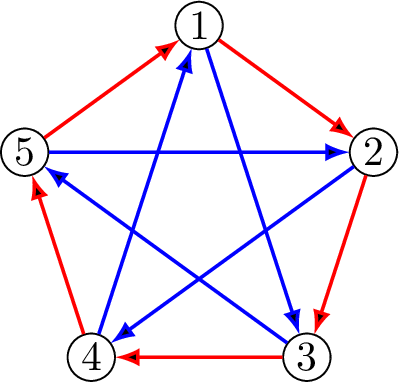 .
.
Figure 2: 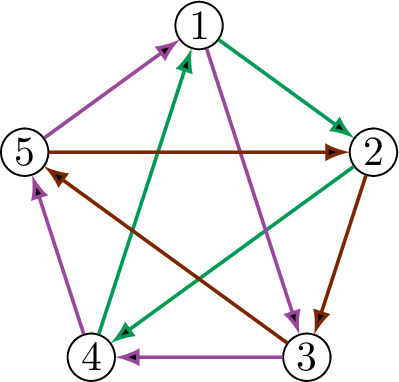 .
.
Indeed, these three cycles use the following arcs: \[\begin{align} \left( 1,2,4 \right) &: (1,2),(2,4),(4,1),\\ \left( 1,3,4,5 \right) &: (1,3),(3,4),(4,5),(5,1),\\ \left( 2,3,5 \right) &: (2,3),(3,5),(5,2). \end{align}\] Thus each arc of \(H\uplus H'\) is used exactly once. None of the three cycles is Hamilton on \(S\), since their lengths are \(3,4,3\), respectively.
Proof of Lemma 3.. Choose a vertex \(v\in S\) whose outgoing arcs in \(H\) and \(H'\) are distinct.5 Write these arcs as \[e=(v,a)\in H\qquad\text{and}\qquad e'=(v,b)\in H',\] where \(a\neq b\). Let \(P'\) be the directed path in \(H'\) from \(a\) back to \(v\), and let \(P\) be the directed path in \(H\) from \(b\) back to \(v\). Then the walks \[\begin{align} C &:= P'e \qquad \text{(that is, the path P' followed by the arc e)} \qquad \text{ and } \\ C' &:= Pe' \qquad \text{(that is, the path P followed by the arc e')} \end{align}\] are cycles. Both have length at most \(\left|S\right| - 1\). Indeed, if the cycle \(C\) had length \(\geq \left|S\right|\), then it would be Hamilton, and thus the path \(P'\) would contain every vertex. Hence the complementary path in \(H'\) from \(v\) to \(a\) would consist of a single arc. This arc would be the outgoing arc \((v,b)\) of \(v\) in \(H'\), forcing \(a=b\). The same argument applies to \(C'\).
The cycles \(C\) and \(C'\) are arc-disjoint in the multidigraph \(H\uplus H'\). Indeed:
The only \(H\)-arc used by \(C\) is \(e\), while the \(H\)-arcs used by \(C'\) lie in \(P\), which does not use \(e\) because \(P\) ends at \(v\). Thus, \(C\) and \(C'\) have no \(H\)-arcs in common.
Similarly, \(C\) and \(C'\) have no \(H'\)-arcs in common.
Remove the arcs of the two cycles \(C\) and \(C'\) from this multidigraph \(H\uplus H'\). The remaining multidigraph is balanced6, because both the original multidigraph \(H\uplus H'\) and the removed union \(C\cup C'\) are balanced. Hence its arcs can be partitioned into cycles7. None of these new cycles contains \(v\), since both outgoing arcs from \(v\) in \(H\uplus H'\) have been removed when we removed the arcs of \(C\) and \(C'\). Thus every new cycle has length at most \(\left|S\right| - 1\).
We have therefore partitioned the \(2\left|S\right|\) arcs of \(H\uplus H'\) into cycles of length at most \(\left|S\right|-1\). Consequently, the number of these cycles is at least \[\frac{2\left|S\right|}{\left|S\right|-1} > 2,\] that is, at least \(3\) (since it is an integer). This proves the lemma. ◻
Let \(A=\left( a_{i,j} \right)_{i,j\in\left[ n \right]}\) be a matrix over a commutative ring \(R\). For every integer \(r\geq2\), let \(K_{<r}(A)\) denote the ideal of \(R\) generated by the \(A\)-weights of all nontrivial cycles on \(\left[ n \right]\) whose length is strictly smaller than \(r\). Thus, \(K_{<2}(A)=0\) (since a nontrivial cycle cannot have length smaller than \(2\)).
Lemma 4. Let \(S\subseteq\left[ n \right]\) have size \(r\geq2\), and let \(H_1,H_2,\ldots,H_t\) be \(t\) distinct Hamilton cycles on \(S\), where \(t\geq2\). Then \[w_A(H_1)w_A(H_2)\cdots w_A(H_t)\in K_{<r}(A)^t.\]
Proof. Pick any \(i \neq j\) in \(\left[ t \right]\). By Lemma 3, the multiset union of the two distinct Hamilton cycles \(H_i\) and \(H_j\) on \(S\) can be partitioned into at least three cycles of length strictly smaller than \(r\). These latter cycles are all nontrivial, since they cannot contain any loops (indeed, all their arcs must be arcs of the original two Hamilton cycles, but those did not contain any loops). Hence, their \(A\)-weights belong to \(K_{<r}(A)\). Since the product of the \(A\)-weights is unchanged by repartitioning the same multiset of arcs, this shows that \[\begin{align} w_A(H_i)w_A(H_j)\in K_{<r}(A)^3. \label{pf46lem46products-Hamilton-cycles464} \end{align}\tag{6}\] Thus, we have proved 6 for any \(i \neq j\) in \(\left[ t \right]\).
Now, pair off \(2\left\lfloor t/2\right\rfloor\) of the \(t\) Hamilton cycles \(H_1,H_2,\ldots,H_t\). Multiplying the inclusions 6 for these pairs, and multiplying by the \(A\)-weight of the remaining cycle if \(t\) is odd, gives \[w_A(H_1)w_A(H_2)\cdots w_A(H_t) \in K_{<r}(A)^{3\left\lfloor t/2\right\rfloor}.\] Since \(3\left\lfloor t/2\right\rfloor\geq t\) for every \(t\geq2\), the right hand side is contained in \(K_{<r}(A)^t\). ◻
We can now state the universal algebraic result. Define the principal-minor-defect ideal of \(A\) to be the ideal \[J(A):=\left(\det A_S-1\;\middle|\;S\subseteq\left[ n \right]\right)\subseteq R\] (that is, the ideal of \(R\) generated by all \(2^n\) differences \(\det A_S - 1\), where \(S\) ranges over the subsets of \(\left[ n \right]\)).
Theorem 5. Let \(A\) be an \(n\times n\)-matrix over a commutative ring \(R\). Then the \(A\)-weight of every nontrivial cycle on \(\left[ n \right]\) is integral over \(J(A)\). Equivalently, every nontrivial cycle \(C\) on \(\left[ n \right]\) satisfies \[w_A(C)\in\overline{J(A)}.\]
Proof. We must show that each nontrivial cycle \(H\) on \(\left[ n \right]\) satisfies \(w_A\left( H \right) \in \overline{J(A)}\). In other words, we must show that for each \(r\geq 2\) and each \(r\)-element subset \(S\) of \(\left[ n \right]\), each Hamilton cycle \(H\) on \(S\) satisfies \(w_A\left( H \right) \in \overline{J(A)}\) (since any nontrivial cycle is a Hamilton cycle on a subset of size \(\geq 2\)).
We use strong induction on \(r\). Fix an \(r\)-element subset \(S\subseteq\left[ n \right]\), where \(r\geq2\), and let \(\mathcal{H}_S\) be the set of all Hamilton cycles on \(S\). For every \(H\in\mathcal{H}_S\), set \[z_H:=(-1)^{r-1}w_A(H).\] The sign \((-1)^{r-1}\) is the sign of the cyclic permutation corresponding to \(H\) (that is, of the permutation of \(S\) that sends each vertex of \(H\) to the next vertex that follows it on \(H\)).
Set \[K:=K_{<r}(A) \qquad\text{and}\qquad L:=J(A)+K.\] We first show that each \(z_H\) is integral over \(L\). Let \(e_t\) be the \(t\)-th elementary symmetric polynomial in the elements \(z_H\) for \(H\in\mathcal{H}_S\). In particular, \(e_0 = 1\) and \(e_1 = \sum_{H\in\mathcal{H}_S}z_H\).
We shall now use the determinant expansion 1 to show that \[e_1 \in L. \label{eq46Hamilton-e1-in-L}\tag{7}\]
Proof of 7 .. For each \(i \in S\), we have \(a_{i,i} - 1 \in J(A)\) (since \(a_{i,i}\) is the principal minor \(\det A_{\left\{ i \right\}}\) of \(A\)) and thus \(a_{i,i} - 1 \in J(A) \subseteq L\), so that \(a_{i,i} \equiv 1 \mod J(A)\). Hence, \(\prod_{i\in S}a_{i,i} \equiv \prod_{i\in S} 1 = 1 \mod L\). Thus, the addend corresponding to \(\pi = \operatorname{id}\in \mathfrak{S}_S\) on the right-hand side of 1 is \(\equiv 1 \mod L\). Each of the remaining addends in that sum
either corresponds to a permutation \(\pi\) that is an \(r\)-cycle, and thus is equal to \(\operatorname{sgn}\left( \pi \right) \prod_{i\in S} a_{i, \pi(i)} = \left( -1 \right)^{r-1} w_A\left( H \right) = z_H\) for a Hamilton cycle \(H \in \mathcal{H}_S\);
or corresponds to a permutation \(\pi\) that has at least two cycles (all of which must therefore have length smaller than \(r\), and at least one of which must be nontrivial because \(\pi \neq \operatorname{id}\)), and therefore contains the \(A\)-weight of a nontrivial cycle of length strictly smaller than \(r\) as a factor; therefore this addend belongs to \(K_{<r}(A) = K \subseteq L\).
Hence, reduced modulo \(L\), the equality 1 becomes \[\det A_{S} \equiv 1 + \sum_{H \in \mathcal{H}_S} z_H \mod L.\] Therefore, \[\sum_{H \in \mathcal{H}_S} z_H \equiv \det A_S - 1 \equiv 0 \mod L\] (since the definition of \(J(A)\) yields \(\det A_{S} - 1 \in J(A) \subseteq L\)). That is, \(\sum_{H \in \mathcal{H}_S} z_H \in L\). In other words, \(e_1 \in L\) (since \(e_1 = \sum_{H \in \mathcal{H}_S} z_H\)). This proves 7 . ◻
Now we shall generalize 7 by showing that \[\begin{align} e_t \in L^t \qquad \text{ for each } t \geq 0. \label{eq46Hamilton-et-in-Lt} \end{align}\tag{8}\]
Proof of 8 .. If \(t = 0\), then this is obvious (since \(L^0 = R\)). If \(t = 1\), then it follows from 7 . Thus, assume that \(t \geq 2\) henceforth. Now, \(e_t\) is defined as the sum of the \(t\)-wise products of the \(z_H\)’s with \(H \in \mathcal{H}_S\). Each addend in this sum is, up to sign, a product of the \(A\)-weights of \(t\) distinct Hamilton cycles on \(S\) (since the \(z_H\)’s are, up to sign, the \(A\)-weights of these cycles). But Lemma 4 shows that each such product belongs to \(K_{<r}(A)^t\). Therefore, their sum \(e_t\) belongs to \(K_{<r}(A)^t\) as well, and thus also to \(L^t\) (since \(K_{<r}(A) = K \subseteq L\)). This proves 8 . ◻
But Viète’s formulas show that every \(z_H\) is a root of the monic polynomial \[\prod_{G\in\mathcal{H}_S}(X-z_G) =X^{\left|\mathcal{H}_S\right|}-e_1X^{\left|\mathcal{H}_S\right|-1} +e_2X^{\left|\mathcal{H}_S\right|-2}-\cdots \in R\left[X\right],\] whose \(X^{\left|\mathcal{H}_S\right|-t}\)-coefficient belongs to \(L^t\) (by 8 ). Thus every \(z_H\) is integral over \(L\). Therefore, every \(w_A(H)\) is integral over \(L\) as well (since \(z_H\) is \(w_A(H)\) up to sign). In other words, \[\begin{align} w_A(H) \in \overline{L} \qquad \text{ for each } H \in \mathcal{H}_S. \label{eq46wAH-in-L1} \end{align}\tag{9}\]
By the induction hypothesis, the \(A\)-weights of all nontrivial cycles of length strictly smaller than \(r\) belong to \(\overline{J(A)}\). Since \(\overline{J(A)}\) is an ideal, this yields \[K\subseteq\overline{J(A)}\] (since \(K = K_{<r}(A)\) is the ideal generated by these \(A\)-weights). Hence \(L = J(A)+K \subseteq \overline{J(A)}\) (since \(J(A) \subseteq \overline{J(A)}\) and \(K\subseteq\overline{J(A)}\)). Thus, \[J(A) \subseteq L \subseteq \overline{J(A)}.\] Hence, Lemma 2 (d) now gives \(\overline{L} = \overline{J(A)}\). Thus, 9 rewrites as \[\begin{align} w_A(H) \in \overline{J(A)} \qquad \text{ for each } H \in \mathcal{H}_S. \end{align}\] In other words, each Hamilton cycle \(H\) on \(S\) satisfies \(w_A(H) \in \overline{J(A)}\). This completes the induction. ◻
Corollary 2. Let \(A\) be a \(1\)-principled \(n\times n\)-matrix over a commutative ring \(R\). Then the \(A\)-weight of every nontrivial cycle on \(\left[ n \right]\) is nilpotent.
Proof. In this case \(J(A)=0\) (since \(A\) is \(1\)-principled, so that all generators of \(J(A)\) are \(0\)). Thus, Theorem 5 shows that every nontrivial cycle’s \(A\)-weight is integral over the zero ideal, and therefore nilpotent. ◻
Corollary 3. Over a reduced commutative ring, every \(1\)-principled matrix is strongly \(1\)-principled. Consequently, every power of a \(1\)-principled matrix over a reduced ring is \(1\)-principled.
Proof. A reduced ring has no nonzero nilpotent elements, so the first claim follows from Corollary 2. The second then follows from Corollary 1. ◻
4 Quotients by integrally closed ideals↩︎
4.1 The general case↩︎
The universal theorem from the preceding section has the following immediate consequence.
Theorem 6. Let \(D\) be a commutative ring, let \(I\) be an integrally closed ideal of \(D\), and set \(R:=D/I\). Let \(A\) be a \(1\)-principled matrix over \(R\). Then \(A\) is strongly \(1\)-principled.
Proof. Choose a matrix \(\widetilde{A}\) over \(D\) whose image modulo \(I\) is \(A\). Since \(A\) is \(1\)-principled, we have \[\det \widetilde{A}_S-1\in I \qquad\text{for every }S\subseteq\left[ n \right].\] Thus \(J(\widetilde{A})\subseteq I\). By Theorem 5, every nontrivial cycle \(C\) on \(\left[ n \right]\) satisfies \(w_{\widetilde{A}}(C) \in \overline{J(\widetilde{A})} \subseteq \overline{I}\) (by Lemma 2 (b), since \(J(\widetilde{A})\subseteq I\)) and therefore \(w_{\widetilde{A}}(C) \in \overline{I} = I\) (since \(I\) is integrally closed). Reducing modulo \(I\), we obtain \(w_A\left( C \right) = 0\) for every nontrivial cycle \(C\). Also, the diagonal entries of \(A\) are \(1\), since they are its \(1\times1\) principal minors. Hence \(A\) is strongly \(1\)-principled. ◻
Proof of Theorem 1. By Theorem 6, the matrix \(A\) is strongly \(1\)-principled. Hence Corollary 1 shows that \(A^m\) is \(1\)-principled for every \(m\in\mathbb{N}\). ◻
4.2 The rings \(\mathbb{Z}/d\)↩︎
The case of the ring \(\mathbb{Z}/d = \mathbb{Z}/ d \mathbb{Z}\) admits a particularly elementary application of Theorem 5.
Lemma 5. Every ideal of \(\mathbb{Z}\) is integrally closed.
Proof. Every ideal of \(\mathbb{Z}\) has the form \(d\mathbb{Z}\) for some \(d\in\mathbb{N}\). The claim is clear for \(d=0\), since the only nilpotent integer is \(0\). Assume that \(d>0\), and let \(x\in\mathbb{Z}\) be integral over \(d\mathbb{Z}\). Thus, for some positive integer \(r\), we have \[\begin{align} x^r+c_1x^{r-1}+\cdots+c_rx^0=0 \qquad \text{with }c_j\in \left( d\mathbb{Z} \right)^j = d^j\mathbb{Z}. \label{pf46lem46Z-ideals-integrally-closed461} \end{align}\tag{10}\] Write \(c_j=d^jb_j\) with \(b_j\in\mathbb{Z}\), and put \(y=x/d\in\mathbb{Q}\). Dividing the equation 10 by \(d^r\) gives \[\begin{align} y^r+b_1y^{r-1}+\cdots+b_ry^0=0. \label{pf46lem46Z-ideals-integrally-closed462} \end{align}\tag{11}\] Thus \(y\) is a rational root of a monic polynomial in \(\mathbb{Z}[X]\). To see directly that \(y\in\mathbb{Z}\), write \(y=a/b\) in lowest terms with \(b>0\). After multiplication by \(b^r\), the equation 11 shows that \(b\mid a^r\). Since \(\gcd(a,b)=1\), this forces \(b=1\). Hence \(y\in\mathbb{Z}\), so \(x=dy\in d\mathbb{Z}\). ◻
Corollary 4. Let \(d\) be a positive integer, and let \(A\) be a \(1\)-principled matrix over \(\mathbb{Z}/d\mathbb{Z}\). Then \(A^m\) is \(1\)-principled for every \(m\in\mathbb{N}\).
Proof. The ideal \(d \mathbb{Z}\) of \(\mathbb{Z}\) is integrally closed by Lemma 5. Hence, Theorem 1 (applied to \(D = \mathbb{Z}\) and \(I = d\mathbb{Z}\)) shows that \(A^m\) is \(1\)-principled for every \(m\in\mathbb{N}\). ◻
Remark 7. Our above proof of Corollary 4 is self-contained. Indeed, the only result we have used without proof is Lemma 2, which in this case is being applied to \(R = \mathbb{Z}\); but this lemma is trivial when all ideals of \(R\) are integrally closed.
4.3 Prüfer domains↩︎
We next give a broad class of domains for which every ideal is integrally closed.
Definition 5. Let \(D\) be an integral domain with fraction field \(K\). A nonzero fractional ideal \(L\) of \(D\) is called invertible if there exists a fractional ideal \(M\) such that \(LM=D\). The domain \(D\) is called a Prüfer domain if every nonzero finitely generated ideal of \(D\) is invertible.
For background on Prüfer domains and their equivalent characterizations, see [6] and [7].
Lemma 6. Every ideal of a Prüfer domain is integrally closed.
Proof. This is part of [6], but we give a proof for the sake of completeness.
Let \(I\) be an ideal of a Prüfer domain \(D\), and let \(x\in D\) be integral over \(I\). We must show that \(x \in I\).
Choose an equation \[\begin{align} x^r+c_1x^{r-1}+\cdots+c_rx^0=0 \qquad \text{with } c_j\in I^j \label{pf46Pruefer46eq1} \end{align}\tag{12}\] (since \(x\) is integral over \(I\)). Only finitely many elements of \(I\) are needed to express all the \(c_j\) as sums of products of \(j\) elements of \(I\). Let \(J\subseteq I\) be the finitely generated ideal generated by these elements. Then \(c_j\in J^j\) for every \(j\), so \(x\) is integral over \(J\).
Set \(L:=J+xD\). If \(J=0\), then 12 gives \(x^r=0\), whence \(x=0\) since \(D\) is a domain; thus the claim is clear. Hence we may assume that \(J\neq0\). Then both \(J\) and \(L\) are nonzero finitely generated ideals, and therefore invertible. Moreover, 12 yields \[x^r\in JL^{r-1}.\] Any other product of \(r\) generators of \(L=J+xD\) already contains a factor from \(J\) and thus belongs to \(JL^{r-1}\) as well. Hence, \(L^r \subseteq JL^{r-1}\). Since the opposite inclusion is obvious, we thus have shown that \[L^r=JL^{r-1}.\] Since \(L^{r-1}\) is invertible, we may cancel it and obtain \(L=J\). In particular, \(x\in L=J\subseteq I\). Thus \(I\) is integrally closed. ◻
Corollary 5. Let \(D\) be a Prüfer domain, let \(I\) be an ideal of \(D\), and let \(A\) be a \(1\)-principled matrix over \(D/I\). Then \(A^m\) is \(1\)-principled for every \(m\in\mathbb{N}\).
Remark 8. Valuation domains are precisely the local Prüfer domains (see [6]). Thus quotients of valuation domains are included in Corollary 5.
4.4 Normal domains↩︎
Recall that a normal domain is a domain that is integrally closed in its fraction field. Every principal ideal of a normal domain is integrally closed; see [5]. Therefore Theorem 1 yields the following.
Corollary 6. Let \(D\) be a normal domain, let \(f\in D\) be a nonzero nonunit, and let \(A\) be a \(1\)-principled matrix over \(D/fD\). Then \(A^m\) is \(1\)-principled for every \(m\in\mathbb{N}\).
Remark 9. The hypothesis that the kernel ideal be integrally closed is the exact input needed by Theorem 6. One does not need every ideal of the ambient ring to be integrally closed. Thus the normal domain corollary applies to principal quotients even though arbitrary ideals of a normal domain need not be integrally closed.
References↩︎
This paper was written by GPT-5.5 in June 2026 with some amount of strategic prompting. It was then edited by the (first) author to improve writing.
This work is in the public domain.↩︎That said, a part of the generalization is true over any \(R\) (see [1]): If \(A\in R^{n\times n}\) is a matrix whose all principal minors equal \(1\), then all diagonal entries of its powers \(A^{m}\) equal \(1\) as well (even though some principal minors of \(A^{m}\) may differ from \(1\)).↩︎
Recall that a loop means an arc of the form \(\left( v,v \right)\) for some vertex \(v\).↩︎
A reader unfamiliar with this formula 3 can easily prove it by induction on \(m\) using \(A^m = A A^{m-1}\).↩︎
Such a vertex must exist, since \(H\) and \(H'\) are distinct.↩︎
A multidigraph is said to be balanced if for each vertex \(v\), the indegree of \(v\) equals the outdegree of \(v\).↩︎
We are using a well-known result saying that the set of arcs of a balanced multidigraph can be partitioned into cycles. This can be proved in many ways, e.g.: Start walking at any non-isolated vertex; each time you enter a vertex, the balancedness will ensure that you will be able to exit again; sooner or later you will run into a cycle. Whenever this happens, remove the cycle from the digraph, and repeat the same procedure. Removing a cycle leaves the digraph balanced, so this algorithm will continue until the digraph has no arcs left; at that point, the cycles obtained will form a partition of the set of all arcs.↩︎