LLM-Based Examination of Eligibility Criteria from Securities Prospectuses at the German Central Bank
June 25, 2026
1 Introduction↩︎
As the central bank of the Federal Republic of Germany and a core member of the Eurosystem, the Deutsche Bundesbank is responsible for implementing monetary policy and providing liquidity to the financial system. These operations are conducted as credit transactions: they must be backed by collateral to protect the central bank from financial risk. The acceptance of a security as collateral depends on its eligibility, which is based on specific legal and financial criteria to ensure that only high-quality assets are pledged [1].
The eligibility of securities is assessed on the basis of their prospectuses, which can be hundreds of pages long. Thousands of securities are issued annually, and verifying their eligibility is a time-consuming and tedious process, making eligibility estimation a prime target for automation.
The difficulty lies in the semi-structured nature of the source material, with evidence being scattered across the entire document and expressed through dozens of different conventions. Prospectuses can be bilingual, with English or German interleaved or presented in parallel columns, requiring models that are robust to language switching, ideally — able to use the information from both.
Previous work by [2] addressed this challenge by developing a Decision Support System that models the task as a Named Entity Recognition (NER) problem, solved using Transformer-based models [3], achieving good results on most criteria. Nevertheless, that approach introduced several constraints, primarily: it required extensive manual annotation to provide necessary supervision for all relevant annotation types, and the resulting models were sensitive to the rigid boundaries of text spans (which made them fragile when encountering OCR artifacts or financial language different from its training set).
In this paper, we present the first case study applying Large Language Models (LLMs) to the eligibility examination process at the German Central Bank, shifting the paradigm from traditional token classification to a generative Information Extraction approach.
The main contributions are as follows.
Presenting a multi-stage generative Information Extraction pipeline that allows the handling of linguistic structures that token-classification models may struggle to process
Introducing a value-based evaluation methodology using LLM-as-a-judge, resistant to OCR noise and linguistic variance
Although specialized domain models have shown good results in financial tasks, our study focuses on the zero-shot and instruction-following capabilities of high-performance general-purpose models: Llama-3.3-70B-Instruct [4] and Cohere Command-R 08-20241 for inference, and Mistral Small 3.1 Instruct2 for evaluation.
2 Examination of Eligibility Criteria↩︎
In the context of this case study, eligibility is determined by 6 criteria3, all of which must be fulfilled for the prospectus to be eligible. The descriptions that follow are simplifications and do not fully reflect the Eurosystem eligibility criteria4.
One of: EUR, USD, GBP, JPY
Only certain types of financial instruments are allowed (e.g. stocks are not)
Only fixed and unconditional amounts
The principal amount must be repaid in full at bond maturity
Only certain coupon structures allowed
Not subordinated to other debt.
The first 4 criteria will be referred to as “simple” criteria, as they depend only a single extracted entity from the document text. The last two complex criteria — coupon and status — are determined using a decision tree using multiple types extracted from the prospectus, and master data (asset type, issuer group, issuer date).
Each security is described by three data points. Prospectuses are PDF files describing the terms and conditions governing the issuance of the security. A base prospectus, if present, is considered part of the prospectus. (An issuer might have a base prospectus with overall standard terms, and issue prospectuses for each individual security containing information applicable to it specifically.) Crucially, the annotations in base prospectuses are available during inference and, in most cases, take precedence over data predicted from the prospectus. Each prospectus is always accompanied by master data (Stammdaten) — additional metadata about each prospectus, including its eligibility and the name of its base prospectus if present. These (except eligibility) are also available during inference.
3 Related Work↩︎
Information Extraction (IE) from financial documents is a rapidly evolving field, recently transitioning from traditional discriminative models to generative Large Language Models (LLMs).
3.0.0.1 Information extraction
[5] systematically evaluates different building blocks for LLM-based IE in layout-rich documents, including input formats, prompt structures, and cleanup/postprocessing steps applied to LLM output. [6] discusses the importance and evaluation of prompt engineering as applied to IE, with a focus on OCR-derived data.
[7] is a recent “systematic evaluation of state-of-the-art LLM and prompting methods” applied specifically to financial NER, comparing them to Transformer-based models, and finding that the latter consistently outperform generic LLMs, with prompt design and in-context learning narrowing the gap.
3.0.0.2 Pre-trained Models for Financial Domain
Though we focus on zero-shot general-purpose models, domain-specific finetuning has often been used for similar tasks and shown to be able to outperform significantly larger models.
This includes early efforts like FinBert [8], German-language financial models [9], and more recent multilingual suites like LLM Pro Finance [10]. See [11] for a deeper review of finance-specific, including multimodal, LLMs.
3.0.0.3 Benchmarking and Evaluation
FinBen [12] is a holistic financial benchmark for LLMs, spanning 24 tasks including information extraction. As tasks move beyond simple classification, “LLM-as-a-judge” has emerged as a vital tool for semantic evaluation. Current research focuses on improving the reliability and consistency of these automated judges to replace or augment rigid, offset-based metrics [13].
4 Data↩︎
4.1 ↩︎
4.1.0.1 Dataset Summary
The dataset we use was originally created in the context of [2], who modeled the task as NER and annotated it as such.
The dataset is composed of 413 prospectuses, split into a train set (268 prospectuses) and a test set (145). The test set prospectuses were annotated twice (each5 by two different annotators), resulting in 285 annotated documents, of which 82 (~29%) were ineligible.
The PDF files are sourced from the FinCorpus-DE10k [14] corpus and share its characteristics, particularly regarding PDF layouts, OCR artifacts, and the parallel presentation of English-German text.
4.1.0.2 Bilinguality and PDF Layouts
All documents are in German, and about a third are bilingual (English and German). Only the German text is annotated and considered primary. In the bilingual documents, different layouts are possible, including languages in separate columns or interleaved line by line. Tables, footnotes and checkboxes are present.
4.2 ↩︎
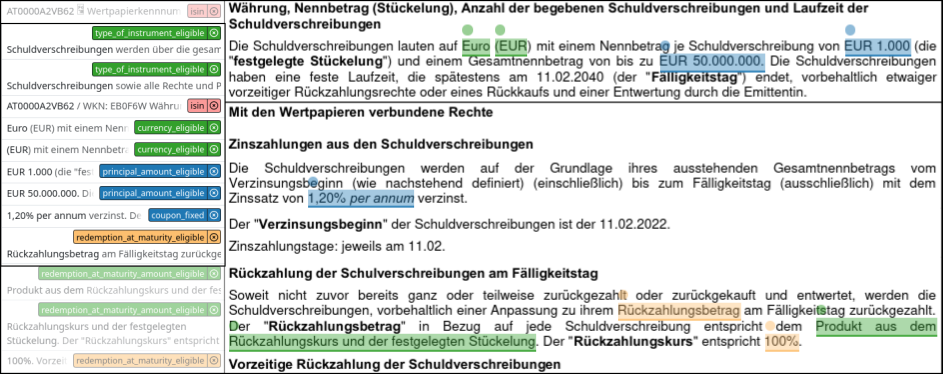
There are 18 annotation types. A partial annotated document is shown on Figure 1.
In the case of “simple” criteria, the presence or absence of an annotation of a certain type is enough to determine whether the criterion is fulfilled. For example, if the document text states that the currency for the security is EUR (one of the
eligible currencies), the span was marked with the annotation type currency_eligible; the criterion currency is considered fulfilled. Crucially, the intent was to annotate the place with the evidence rather than mere entity
mentions. A document may mention several currencies, but only one defining the security’s denomination constitutes evidence for eligibility. The absence of that annotation in a document implies that either that information is absent, or that the currency
is not an eligible one.
Currency here is useful as an example, but most of the other annotation types are more complex, longer (more than 30 words in some cases) and exhibit larger variance. A span containing the currency name is easily normalizable into a standard format for further processing (€, Euro, ... EUR) using a rule-based system, but not all extracted types are.
Not the entire prospectus was annotated — only enough to make an eligibility estimation. The rest was marked with a special Block annotation, to signal that NER models shouldn’t be trained on that text because it might contain unannotated
entities. An important side effect of this was that different annotators could find evidence for the same criterion in different places of the document. This had implications for both extraction and evaluation, see 7.2.0.3.
5 Methodology↩︎
5.1 ↩︎
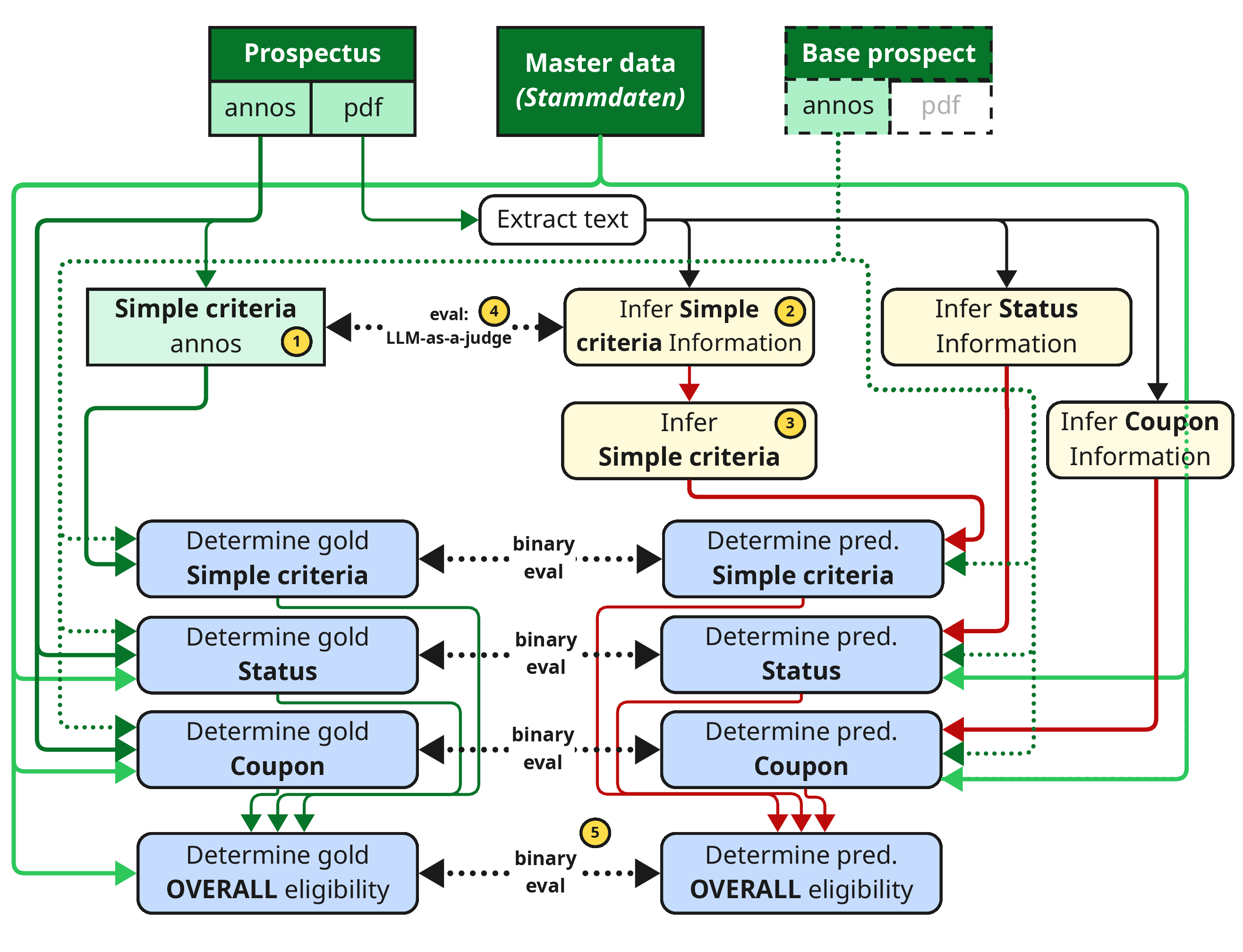
The main building blocks are shown in the diagram on Figure 2. LLMs are used for extraction, normalization, and interpretation. Their results are then processed algorithmically into the final criteria determination using Python.
5.1.0.1 Ground truth
First, the annotations from both the prospectus and base prospectus (if present) are parsed. The prospectus annotations are processed into ground truth criteria decisions and are used for evaluation; the base prospectus annotations are available during inference, and are provided to the blocks that determine the final predicted criteria.
5.1.0.2 PDF preprocessing
Before inference, the prospectus PDF is converted into Markdown using Docling [15]. The dataset already had extracted text created during the annotation process. That text contained many atypical or private-use-area Unicode code points (often in connection with checkboxes) and large amounts of inconsistent spacing. This led to unpredictable behavior during inference, including repetitions and unreliable JSON generation, especially by the Command-R 08-2024 model on longer prospectuses. Normalizing the text fixed these issues, and we quickly found that Docling offers good quality extracted text that requires no additional processing from our side. The markdown conversion preserves formatting, providing additional information about the structure of the document.
The offsets of the annotations referred to the previous (original) extracted text, and were thus rendered invalid. This had implications for evaluation but not for inference, since text extraction would have been performed anyway when classifying new prospectuses.
5.1.0.3 Inference
Data is first extracted and normalized using an LLM.
For example, for the “simple” criteria, a structure similar to Listing [lst:simplecriteriainfo] is first extracted ( on the diagram). For each criterion, it contains the value (required information in a normalized form), the raw value (exactly as stated in the text), and a quote from the source document with the surrounding context.
"principal_amount": {
  "raw_value": "up to 10.000,00€",
  "value": "up to EUR 10.000",
  "evidence": {
    "source": "Prospectus",
    "exact_quote": "in an aggregate principal
    amount of up to 10.000,00€ divided
    into up to 1,500 Pfandbriefe"
  },
},
"currency": {...},
"redemption_at_maturity": {...},
"type_of_instrument": {...}
For the “simple” criteria, a second inference step () interprets the extracted data into criteria predictions, for example checking whether the principal amount inferred in the previous step is fixed (and therefore valid), with results similar to Listing [lst:simplecriteria].
"principal_amount": {
  "eligible": true,
  "reason": "The principal amount is
      stated as 'up to EUR 10.000',
      which only caps the issuance
      volume and does not indicate
      variability.",
  "details": {"source": {...}}
},
"currency": {...},
"redemption_at_maturity": {...},
"type_of_instrument": {...}
For the “complex” criteria, the information required is extracted and interpreted in a single step.
5.1.0.4 Processing of the results
Finally, a final decision on each criterion is made based on the inferred result, base prospectus annotations if present, and master data (for the “complex” criteria). All these steps are done in Python. Lastly, the overall prospectus eligibility is determined: eligible if all criteria are fulfilled, ineligible otherwise.
5.2 ↩︎
After initial tests, we focused on two models: Llama-3.3-70B-Instruct6 and Cohere Command-R 08-20247 (32B). While Llama-3.3-70B-Instruct served as a high-reasoning baseline, Command-R 08-2024 was selected for its multilinguality as well as its specialized training in grounded generation and RAG-specific tasks, which we hypothesized would minimize hallucinations when quoting long financial prospectuses. Both have a large 128k context length, which allowed us to quote entire prospectuses directly in the prompt, without needing any of the methods used for processing documents longer than the model context.
We used LangChain with structured output to force the models into the required JSON schema.
For longer documents, Command-R 08-2024 often ended up stuck outputting tab characters or incorrectly escaping nested quotes of the documents it cited, returning incorrect JSON as a result. Applying a frequency penalty of \(0.05\) (in addition to text preprocessing discussed in Section 5.1.0.2) mitigated this issue. For both models we used a temperature of \(0.1\).
6 Evaluation↩︎
Evaluation is performed on three levels: (i) overall (per-document) prospectus eligibility ( on Figure 2), (ii) criteria results, and (iii) comparison of the extracted values to the annotations ().
6.1 ↩︎
6.1.0.1 Document-level
A prospectus is eligible if and only if all the criteria are fulfilled. The scores are shown on Table ¿tbl:tab:overall?.
6.1.0.2 Criteria evaluation
Same as document-level eligibility, this was evaluated as a binary classification task. The “complex” criteria required different extracted information depending on the master data values (in some cases none at all if the process was fully deterministic). As a result, their scores have a less direct dependence on LLM predictions. The results are shown on Table ¿tbl:tab:critprf?.
6.2 ↩︎
Evaluating the individual criteria measures the bottom line, but it is not the complete picture — a criterion can be correct for the wrong reasons. For instance, only a fixed/invariable principal amount is eligible. Extracting some different amount would set the criterion to the correct value as long as that amount is fixed. Thus, the extracted data itself also needs to be evaluated.
The NER classifier in [2] used the standard offset-based evaluation, comparing the locations of the predicted entities to the annotated ones.
Position-based evaluation is inherently flawed for long, semi-structured documents where the same evidence may appear redundantly (and as noted in 4.2, annotating all occurrences was not a goal during annotation). A value-based approach, which prioritizes semantic truth over positioning, was used.
6.2.0.1 Evaluation setting
For each field we needed to extract, we compared our (single) extracted value to (potentially multiple) annotations of the corresponding type. Either could be missing if the information was not found in the document.
For both we used the threshold-based approach from [6], which we expanded to handle zero or multiple ground truth annotations and missing predictions.
If at least one annotation of the relevant annotation type (\({y_{true}}\)) had a similarity of \(>80\%\) to our extraction (\(y_{pred}\)), we considered it a match; see Table ¿tbl:tab:binary? for the other cases. Each case, then, became either a True Positive, False Positive, True Negative, or False Negative (TP, FP, TN, FN on the table). From these Accuracy, Precision, Recall and F1-Score were calculated.
| \(\mathbf{y_{true}}\) | \(y_{pred}\) | \(\max(sim(\mathbf{y_{true}}, y_{pred}))\) | res |
|---|---|---|---|
| + | + | \(\geq 80\%\) | TP |
| + | + | \(<80\%\) | FN |
| + | - | N/A | FN |
| - | + | N/A | FP |
| - | - | N/A | TN |
For calculating the similarity, we used two approaches: fuzzy string matching and LLM-as-a-judge. The results are shown on Figure 3.
6.2.0.2 Fuzzy string matching
Following [6] we used fuzzy.token_set_ratio of the fuzzywuzzy8 package as simple similarity metric. It can match strings partially and is robust to changes in token order.
6.2.0.3 LLM-as-a-judge
We drafted custom instructions for every field we extracted, containing both specific rules about what is considered equivalent (e.g., different subtypes of the same financial instrument type) and generic ones (“equivalence is not affected by OCR noise, formatting, language, singular/plural”).
The judge-LLM returned scores and the reasons for them, which was crucial for explainability and helpful for improving the evaluation instructions. See [lst:judge] for an example.
"y_true": "Inhaber -schuldverschreibung",
"y_pred": "Schuldverschreibungen",
"llm_match": 1.0,
"llm_match_reason": "An
    'Inhaberschuldverschreibung' is a
    type of 'Schuldverschreibung';
    formatting differences are
    irrelevant."
The model used was Mistral-Small-3.1-24B-Instruct-25039 with its standard settings. The evaluation itself was executed using the pydantic-evals10 framework.
7 Results↩︎
max width=
7.1 ↩︎
Although [2] was already strong on many criteria, the transition from traditional methods to LLMs shows a clear performance uplift.
7.1.0.1 Per-document and criteria eligibility
The results for per-document eligibility are presented on Table ¿tbl:tab:overall?, for the criteria on Table ¿tbl:tab:critprf?.
Both Llama-3.3-70B-Instruct and Command-R 08-2024 generally perform within 1–3 percentage points of each other on most metrics, with Command-R 08-2024 emerging as the top performer by a very slight margin. Notably, it is a 32B model, roughly half the size of Llama-3.3-70B-Instruct. [2] performs best on the relatively simple or predominantly numeric types: currency, principal amount, and type of instrument. However, it falls behind the LLMs on the more linguistically complex redemption at maturity criterion and on the two “complex” criteria, status and coupon. These are harder to interpret because their values also depend on master data, making them less directly tied to inference results.
7.1.0.2 Extracted values
![Figure 3: F1-scores of extracted values. [2] reported offset-based metrics, while our models are evaluated using value-based ones (fuzzy matching and LLM-as-a-judge).](/article/2606.27316/pics/eval_extractions.png "fig:")
Figure 3 shows results on the extracted values calculated in three different ways: standard offset-based PRF as reported in [2]11 and two value-based ones: fuzzy match and LLM-as-a-judge. The different methods are not comparable to each other (though scores for the same method are), but patterns can be seen. The values clearly correlate — on balance, redemption at maturity and type of instrument were the hardest, while currency was the easiest.
Comparing to the criteria scores, it is clear that redemption at maturity was among the hardest for all models in all types of evaluation. This may be explained by the complexity of the underlying type.
7.2 ↩︎
7.2.0.1 Safety bias
The system achieves high precision at the cost of lower recall. A single False Negative in any of the six criteria results in an "Ineligible" document prediction, and most (\(\approx71\%\)) prospectuses of the test set are eligible. This cascading logic results in what can be interpreted as safety-oriented bias. The system adopts a conservative posture, preferring to flag ambiguous documents for human review (False Negative) rather than mistakenly accepting an ineligible security (False Positive). Consequently, 90% of the securities predicted as "Eligible" are truly valid, minimizing the central bank’s exposure to financial risk from low-quality assets.
7.2.0.2 Evaluation
We found fuzzy string matching surprisingly effective, given its simplicity. Drawbacks include fragility to stronger OCR artifacts, its tokenization (which treats compound words as single tokens12) and (crucially) inflated similarity for large numbers (USD 10.000,00 and USD 100.000,00 are different amounts but very similar strings). Interestingly, LLM-as-a-judge has equal or higher
scores than the fuzzy approach everywhere except principal amount, the only predominantly numeric type, which confirms this systematic bias.
LLM-as-a-judge had clear advantages for our setting, most importantly the ability to handle bilinguality (“subordinated” vs “nachrangig”) and semantics (“in full” vs “100% of the amount”).
Overall, we found that equivalent evidence within the same document differed by its location much more than by the exact language used (there may be linguistic variance between prospectuses, but rarely within the same one).
[5] calls fuzzy matching “well-suited for scenarios with minor variations caused by OCR errors or formatting discrepancies”, and this matches our experience; fuzzy matching would have been our first choice in scenarios with a single correct match not involving large numbers and in English (and the method can be extended to compensate for the latter two). Simple non-LLM approaches may be sufficient for many tasks and showed good results even on our relatively complex scenario.
7.2.0.3 PDF extraction artifacts and bilinguality
Interestingly, bilinguality was helpful for cases where the text extraction returned broken text flow — when two columns were merged into the same span, the presence of different languages helped separate them, for both the extraction and LLM-as-a-judge evaluation.
7.2.0.4 LLM bias minimization
LLMs suffer from lack of explainability [16]. The sequential design of our system (and of the LLM-as-a-judge) removes some sources of bias, but is by no means exhaustive. A model directly inferring e.g. seniority in the context of Status might, instead of seniority/subordination verbiage, decide based on generic pre-existing knowledge about the issuer.
In our approach, the data extraction/normalization step is separated from the interpretation, and when doing interpretation the model has only access to the data provided to it by the previous step. (This also prevents scenarios where a model would ignore a restriction because it didn’t extract it correctly in the first place.)
Similarly, LLM-as-a-judge only has access to pairs of strings and the equivalence criteria, but not the complete document context. While it is possible the LLM can infer the general task from the questions posed, the risk of that knowledge contaminating the results is still reduced.
7.2.0.5 Efficiency
For each document, 2 LLM requests are made for the “simple” criteria and 1 for each complex criterion; this can take tens of seconds, depending on document length. This is much longer than predicting NER tags on comparable infrastructure (ways of improving that are discussed in Section 8). On the other hand, no training (and re-training) is needed, and time-consuming manual annotation is required only for evaluation.
7.2.0.6 Adaptability
The paradigm shift of migrating implicit knowledge in the annotations to explicit knowledge in the prompts has wide-ranging implications.
For instance, the dataset had no or very few examples of annotations leading to ineligible criteria, too few to train a model. Annotating more data targeting specific gaps might have required finding and at least partially annotating prospectuses with these scenarios. For an LLM, adding examples (or even descriptions) to the prompt is enough.
Human language evolves over time due to linguistic and legal changes. Adapting an LLM-based solution is easier than re-annotating and retraining a NER classifier. Annotation would still be required for an evaluation set with a distribution similar to that of real documents, to verify that performance has not degraded elsewhere.
8 Limitations and Future Work↩︎
While the current generative pipeline provides a robust baseline for collateral eligibility examination, several areas for refinement and expansion remain to be addressed in subsequent research.
8.0.0.1 Advanced PDF Parsing and Vision Models
The current system relies on text-based Markdown conversion, which can struggle with e.g. columns, tables, and checkboxes. Vision-language models and OCR-free document understanding architectures are a promising avenue to process prospectuses directly.
8.0.0.2 Semantic Grounding and RAG Integration
To mitigate hallucination risks, provide human reviewers direct links to the relevant document spans, and decrease the amount of compute used, we plan to integrate a Retrieval-Augmented Generation (RAG) approach. Even in our experiments we found that models performed better on smaller prospectuses, despite larger ones fitting well into the stated context sizes; this is in line with existing research consensus [17]. Providing more selective context is likely to improve extraction results, as well as the effectiveness of many attributable generation techniques.
Options for attributable generation include injecting line/paragraph/page information in the text, contextual anchoring (requesting the LLM to provide words surrounding the relevant spans), semantic chunking with metadata, and leveraging models with native citation capabilities (as well as using those present in Command-R 08-2024).
8.0.0.3 Meta-evaluation of LLM-as-a-judge
Both approaches used in our value-based evaluation return predictable results and roughly agree with each other (and with the offset-based evaluation results of [2]), spot checks of the results pointed to no systemic issues, but hard data is missing. Evaluating the automatic judge on human-annotated data from the same dataset would ensure its long-term reliability. Investigating some failure modes (e.g. positional bias, length bias; measuring self-consistency, see [13]) can be done without a human-annotated dataset.
9 Conclusion↩︎
This study demonstrates the transition from traditional token-classification models to a generative LLM-based architecture for the automated examination of securities prospectuses at the German Central Bank. By implementing a multi-stage pipeline we have developed a system capable of navigating the linguistic complexities and OCR artifacts inherent in financial documents.
Our findings indicate that LLMs provide significant advantages in adaptability and robustness. Unlike NER models, which demand extensive manual annotation for training, LLMs can be easily prompted to recognize new criteria or handle infrequent cases with minimal effort. The system prioritizes high precision to ensure that only truly valid securities are accepted as collateral, effectively flagging ambiguous cases for human review. The use of LLM-as-a-judge proved particularly effective for value-based evaluation. Future work will focus on improving PDF text extraction through vision-based models and integrating Retrieval-Augmented Generation (RAG) to further ground the system’s interpretations in specific document spans. Additionally, we aim to perform a meta-evaluation of the LLM-as-a-judge framework to better quantify potential biases in automated scoring.
Acknowledgments↩︎
This work was carried out as part of the CORAL project (Constrained Retrieval-Augmented Language Model), funded by the German Federal Ministry of Research, Technology, and Space (BMFTR) under Grant 16IS24077C.
Appendix A. Sample Prompt↩︎
width=, height=0.95, keepaspectratio
Figure 4:  .
.
References↩︎
https://hf.co/mistralai/Mistral-Small-3.1-24B-Instruct-2503↩︎
In [2] two more are listed, and were excluded due to having few examples in the training data.↩︎
https://eur-lex.europa.eu/legal-content/EN/TXT/PDF/?uri=CELEX:32014O0060↩︎
A small number were unusable for technical reasons.↩︎
https://hf.co/mistralai/Mistral-Small-3.1-24B-Instruct-2503↩︎
Scores of “gbert-base”, the best-performing model↩︎
especially suboptimal for German: Inhaberschuldverschreibung ‘bearer bond’↩︎