Beyond Surface Forms: A Comprehensive, Mechanism-Oriented Taxonomy of Indirect Linguistic Encoding for LLM-Based Coded Language Detection
June 25, 2026
Abstract
To avoid moderation and surveillance on social media, some users routinely invent indirect linguistic expressions (ILE) that camouflage sensitive meanings. Such expressions surface as algospeak, euphemisms, and adversarial obfuscation, depending on intent and context, and they involve recurring encoding mechanisms. We propose a comprehensive, mechanism-oriented taxonomy of ILE that abstracts away from communicative goals and instead categorizes the underlying operations through which meaning is encoded and recovered. We evaluate the taxonomy by incorporating it into LLM prompts and comparing it with four existing taxonomies and a no-taxonomy baseline, using 2,000 manually annotated TikTok and Bluesky posts. The proposed taxonomy attains the strongest document- and span-level performance across the three LLMs, achieving an improvement of 4.7% in accuracy and 5.4% in F1 over the best-performing benchmark. The empirical results reveal the importance of a comprehensive, mechanism-oriented taxonomy as a stable scaffold for detecting emerging coded language and a useful input to content moderation. Code and the publicly releasable portion of the data are available at: https://github.com/hmdfiroozfar/mechanism-oriented-ile-taxonomy. TikTok-derived text is not redistributed because of data-sharing restrictions.
Disclaimer: This paper contains content that may be profane, vulgar, or offensive.
1 Introduction↩︎
Social media users routinely camouflage sensitive meanings to evade algorithmic moderation, shadow banning, and demonetization [1]–[3]. Existing forms span a wide spectrum of strategies that we collectively refer to as indirect linguistic encoding (ILE). ILE is a moving target for content moderation, as reflected by lexicons becoming stale within weeks [4], [5], and supervised detectors trained on older ILEs failing on newer ones.
Large language models (LLMs) offer a promising abstraction for ILE detection because they can model context and indirect meaning without explicit lexicons [6]. However, their performance is highly prompt-sensitive [7]. Recent studies report that structured, taxonomy-grounded prompts substantially improve classification under label sparsity and concept drift [8]–[11]. Hence, the quality of taxonomy-guided detection significantly depends on the taxonomy itself.
Previous research has established useful taxonomies for ILE, but typically with narrow coverage, mixed levels of abstraction, or weak separation of encoding and decoding pathways [6], [12]–[14]. In practice, users draw on a wide range of strategies and sometimes combine several within a single expression, as illustrated in Figure 1. Approaches that center on surface-form perturbation alone (coc@!ne for cocaine) only capture part of the phenomenon, underscoring the need for a more comprehensive taxonomy with broader strategy coverage to support reliable LLM-based detection.

This study seeks to answer two important questions: how to build a taxonomy of ILE with broader strategy coverage and whether its use indeed improves LLM-based detection. Our contributions are threefold. First, we propose a mechanism-oriented taxonomy that abstracts away from communicative intent and organizes encodings by the pathway through which meaning is concealed and recovered, introducing new top-level classes and sub-classes that prior schemes do not cover. Second, we construct a manually annotated dataset of 2,000 recent social media posts (600 Bluesky, 1,400 TikTok), labeled by two trained annotators for (i) binary presence of ILE at the document level, (ii) the spans of all ILE expressions within each post, and (iii) the mechanism class and sub-mechanism of each span in accordance with the proposed taxonomy. We release the publicly shareable portion of the dataset and accompanying code; TikTok-derived post text is withheld from the public release because of our TikTok data-sharing agreement. Third, we compare the proposed taxonomy with four existing taxonomies and a no-taxonomy baseline across three LLMs at both document and span levels, thereby producing empirical evidence suggesting that the comprehensiveness of a taxonomy determines whether it enhances LLM-based ILE detection rather than its mere use. The overall findings show that taxonomy-guided prompting can underperform a no-taxonomy prompt when coverage is partial, while a sufficiently comprehensive taxonomy yields the strongest performance across different LLMs.
2 Related Work↩︎
ILE detection. Supervised methods dominate ILE detection [15]–[20], but they generalize poorly across topics and over time, because lexical substitutions evolve quickly under the euphemism treadmill [4], [5], [21]. Semi-supervised approaches lower annotation requirements [22], [23], yet remain sensitive to seed selection and error propagation. Unsupervised and self-supervised methods instead discover coded terms directly from text [5], [24]–[28], but typically rely on domain constraints or seed keywords. Recent work turns to LLM-based detection in zero- or few-shot mode, which sidesteps these restrictions [6], [29]. Its accuracy, however, greatly relies on prompt design and conceptual scaffolding that the prompt encodes [7], [10].
Existing ILE taxonomies differ in organizing principles, methodological grounding, and scope. Early work is built upon context-specific empirical analysis of censorship avoidance. For example, [14] analyze morph encoding in Chinese social media and identify distinct categories that include phonetic substitution, character decomposition, translation, semantic reinterpretation, and historical reference. Despite its empirical grounding, this taxonomy is tightly coupled with the characteristics of Chinese writing and entity-level encoding, which constrains generalization across writing systems and recovery mechanisms. Subsequent taxonomies are constructed to support normalization and detection, with a common interest in observable surface perturbations. For example, [30] catalog character- and string-level manipulations (such as leetspeak, punctuation insertion, glyph substitution, and phonetic variants), without modeling semantic, referential, or convention-based strategies. More recent work draws on qualitative analysis of self-censorship. [12] organize strategies across orthography, morphology, phonology, prosody, and reanalysis, focusing on innovative linguistic forms without considering indirect strategies that require shared cultural reference or conventionalized shorthand beyond the scheme. A parallel line of algospeak-centric work [6], [13] groups surface strategies (e.g., abbreviations, phonetic spellings, symbol substitution, paraphrasing, repurposing) and operates at heterogeneous levels of abstraction and also omits referential and conventional-symbolic strategies. Across these efforts, the key limitation is that taxonomy construction has been largely study-specific and ad hoc, with categories drawn from small, non-representative samples or a fixed, predefined set of surface transformations, and with no shared, replicable procedure for iteratively refining categories and validating their coverage [6], [12], [13], [30], [31]. As a consequence, the resulting schemes capture only partial subsets of ILE, and which mechanisms a taxonomy covers is determined more by its source data than by a principled account of the encoding and decoding pathways themselves. We address this gap with a systematic taxonomy-development procedure, described next.
3 Proposed Taxonomy↩︎
3.1 Development Method↩︎
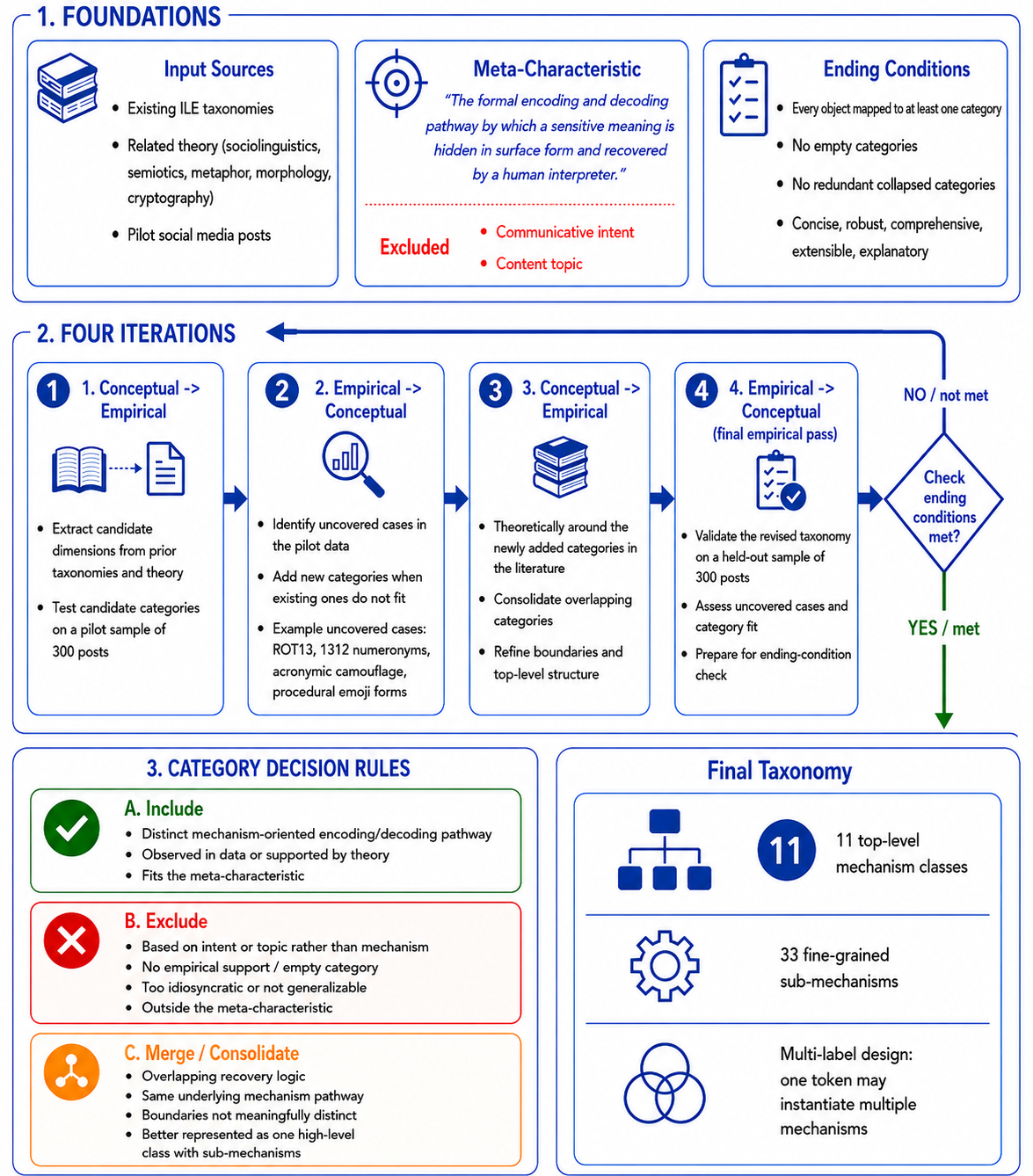
We follow the iterative taxonomy development advocated by [32], a well-established procedure for taxonomy construction. Figure [fig:taxonomy95dev] summarizes the full development process. The method alternates between two complementary paths until a set of ending conditions is met: an empirical-to-conceptual path that abstracts categories from observed objects, and a conceptual-to-empirical path that derives categories from theory and then tests them on data.
3.1.0.1 Meta-characteristic.
In line with [32], we begin by defining a meta-characteristic that serves as a logical constraint on every category in the taxonomy:
the formal encoding and decoding pathway by which a sensitive meaning is hidden in surface form and recovered by a human interpreter.
This meta-characteristic deliberately excludes communicative intent (e.g., moderation evasion, politeness, in-group signaling) and content topic (e.g., drugs, self-harm, sexuality), thereby keeping the taxonomy focused on how meaning is concealed rather than why or about what.
3.1.0.2 Ending conditions.
We adopt the objective conditions of [32], where every object in the dataset corresponds to at least one category, there is no empty category, and no two categories are collapsed into one, together with their subjective conditions (the taxonomy is concise, robust, comprehensive, extendible, and explanatory). Iterations terminate only when all conditions hold simultaneously.
3.1.0.3 Iterations.
The taxonomy is developed over four iterations:
Conceptual-to-empirical. We extract candidate dimensions from existing ILE taxonomies [6], [12]–[14], [30], [31] and from relevant linguistic theories pertaining to sociolinguistics, semiotics, conceptual metaphor, morphology, and cryptography. We then use a pilot sample of 300 posts to validate these dimensions.
Empirical-to-conceptual. Items not covered by any candidate category, such as ROT13 strings, numeronyms, acronymic camouflage, and procedural emoji forms, suggest new categories, with the meta-characteristic serving as the splitting criterion.
Conceptual-to-empirical. We carefully review extant literature to ground the newly added categories theoretically and consolidate those that overlap.
Empirical-to-conceptual. A final pass on a held-out 300-post sample confirms that all ending conditions are satisfied; that is, no additional new top-level category is required.
The resulting taxonomy has 11 top-level mechanism classes and 33 fine-grained sub-mechanisms (Appendix 7). More importantly, the taxonomy does not assume mutual exclusivity, meaning that a single encoded token can instantiate multiple mechanisms (see §5).
3.2 Top-Level Classes↩︎
Herein, we present top-level classes of the proposed taxonomy of ILE mechanisms and provide finer-grained sub-mechanisms in Appendix 7, together with definitions and examples.
3.2.0.1 Orthographic transformation
modifies the linguistic form while preserving human legibility through visual similarity. Recovery is enabled by perceptual normalization. Nonstandard orthography constitutes a systematic resource for indexing stance and identity instead of random error [33]–[35]. Such perturbations can disproportionately influence automated language processing while remaining readable to humans [36], [37].
3.2.0.2 Phonetic substitution
exploits phonological similarity to encode meaning, thereby enabling recovery through sound-based reconstruction rather than visual or rule-based decoding. Phonetic perturbations are generally effective for evading lexical classifiers, especially in multilingual or code-mixed contexts where misspellings and phonetic variants preserve intended meaning while altering surface form [38].
3.2.0.3 Formal compression
shortens expressions to compact forms whose meaning is recoverable through shared community conventions instead of linguistic resemblance or explicit decoding rules. Semantic content is not retrievable from the linguistic form itself; rather, it is inferred from communal knowledge of conventional expansions. It aligns with efficiency-based accounts of language, where form minimizes production effort while preserving communicative success under shared expectations [39], [40].
3.2.0.4 Formal encoding systems
conceal meaning through explicit, reversible rules that operate independently of linguistic structure or sound. Interpretation requires procedural decoding through rule inversion, in alignment with information-theoretic and cryptographic accounts of secrecy as a rule-governed transformation [41], [42].
3.2.0.5 Conventional sign reassignment
repurposes existing signs (lexical, numeric, or symbolic) whose surface form remains intact but acquires a new community-recognized meaning through repeated contextual use. Recovery proceeds by retrieval of a stored sign–meaning association rather than use of computational means. Accounts of semantic change attribute such shifts to pragmatic inference and reanalysis that tends to conventionalize over time [43], even though sociolinguistic research shows that these meanings function as socially indexical resources stabilized within communities of practice [34].
3.2.0.6 Morpho-lexical encoding
exploits productive word-formation processes to construct new forms that embed meaning while preserving recognizability; recovery proceeds by morphological decomposition. Morphological theory treats these processes as systematic mechanisms of lexical innovation, not ad hoc manipulations [44], [45].
3.2.0.7 Referential alias encoding
conveys meaning by substituting the name of a specific identifiable entity (e.g., person, organization, platform, product) with a stabilized alternate label grounded in shared cultural or reputational knowledge. In both interactional sociolinguistics and linguistic anthropology, such meanings can be analyzed as indexical, with interpretation relying on socially recognized identities, roles, or narratives rather than direct denotation [46], [47].
3.2.0.8 Semantic circumlocution
encodes meaning indirectly through descriptive phrasing or inferential context rather than lexical substitution or a stable code; recovery relies on shared pragmatic interpretation. Pragmatic theory suggests that speakers exploit implicature and indirectness to distinguish what is said from what is meant [48].
3.2.0.9 Metaphorical and metonymic encoding
expresses meanings through structured conceptual mappings, either cross-domain (metaphor) or within-domain associative links such as part–whole or attribute–entity (metonymy). In cognitive linguistics, conceptual metaphor represents a foundational mechanism for reasoning and communication in which one domain structures understanding of another domain [49].
3.2.0.10 Pictorial and symbolic encoding
employs non-alphabetic signs (primarily emoji) as meaning-bearing resources. Semiotic theory distinguishes iconic and symbolic relations. It explains how pictorial forms convey meaning through resemblance or convention [50], [51]. In computer-mediated communications, emoji function pragmatically to produce conventionalized interpretations in context rather than serving as decoration [52]–[54].
3.2.0.11 Cross-linguistic transformation
encodes meaning through language or script choice, such as translation and transliteration. Recovery proceeds by translating or transliterating back into the dominant linguistic code. Most code-switching and translanguaging research views multilingual repertoires as flexible semiotic resources that are deployed for pragmatic and social purposes [46], [55].
4 Dataset and Evaluations↩︎
4.1 Data Collection↩︎
We collected 2,000 English-language posts from two major platforms with contrasting moderation regimes: 1,400 TikTok video captions collected between March and May 2026, and 600 Bluesky posts collected from October 2025 to January 2026. On each platform, we used stratified sampling across two strata: posts containing at least one candidate ILE seed term or a phrase closely related to ILE usage and a topic-neutral random sample. The seed list was constructed on the basis of previous ILE studies and a pilot scan; it is intentionally broad and is utilized only to bias sampling toward plausibly coded content, instead of determining labels. We retained English-language posts, verified by langid and manual review, from public-facing accounts that contained at least three tokens. We removed duplicate posts, posts consisting only of URLs, hashtags, or @-mentions, and content from verified bot or automated aggregator accounts.
4.2 Annotation Protocol↩︎
Two trained annotators independently labeled every post across three nested layers: document-level ILE presence (binary), span-level markup of the minimal contiguous span, and mechanism-level assignment from the 11 classes in §3 and 33 sub-classes in Appendix 7, with co-occurrence marked explicitly when applicable. Each annotator first completed a calibration round on 150 development items not in the final evaluation set. We examined inter-annotator agreement on the full dataset using Cohen’s \(\kappa\) [56]–[58]. The agreement is high across all annotation layers: \(\kappa=0.852\) for document-level ILE presence, \(\kappa=0.789\) for taxonomy class assignment, and \(\kappa=0.886\) for token-level span-boundary labels. Disagreements were resolved through face-to-face discussion between the annotators until a consensus was reached. After resolution, 44.8% of items contain at least one ILE instance.
4.3 Models, Taxonomies, and Setup↩︎
We evaluate six prompt variants across three LLMs. The variants comprise four prevalent taxonomies [6], [12]–[14], the proposed taxonomy, and a no-taxonomy baseline. The models are GPT-5.4, Claude Sonnet 4.6, and DeepSeek V4 Flash. All models are prompted in a few-shot setting with the same four-example shot set; only the embedded taxonomy section varies across prompt variants (Appendix 8).
To contextualize LLM performance, we add four non-LLM baselines, including two supervised methods (TF-IDF + Logistic Regression and character n-gram + Linear SVM) and two unsupervised methods (Word2Vec cosine-to-seed and embedding-graph centrality). For supervised baselines, we use keyword-grouped 5-fold cross-validation (StratifiedGroupKFold), so examples sharing the same source keyword do not appear in both training and testing folds.
4.4 Evaluation Metrics↩︎
We evaluate ILE detection at two levels. At the document level, we consider the task as binary (ILE present versus absent) and rely on accuracy, macro-precision, macro-recall, and macro-F1. At the span level, we report span precision, recall, and F1 using one-to-one soft matching between gold-standard and predicted evidence spans. After span normalization (Unicode, whitespace, and lowercasing), a pair is viewed as a match if its similarity is \(\geq 0.5\), where similarity is the maximum of token-overlap F1 and character-overlap F1. Matching is greedy by similarity, with each span matched at most once.
To test statistical significance, we use paired bootstrap resampling with 10,000 iterations to compute 95% confidence intervals and two-sided \(p\)-values for pairwise comparisons between the model guided by the proposed taxonomy and each alternative. For document-level accuracy, we apply McNemar’s test on paired predictions, which tests the null hypothesis that two classifiers do not differ systematically on the same instances [59]. We further analyze compositional ILEs, defined as evidence spans annotated with two or more mechanism classes, to assess whether the proposed taxonomy better captures these harder, multi-mechanism encodings. Complementary results are reported in Appendix 9, including the per-class breakdown, significance tests, and the compositional ILE analysis.
4.5 Results↩︎
Table 1 presents document- and span-level performance across all models. For GPT-5.4, the proposed taxonomy achieves the best document-level performance (Acc = 0.843, F1 = 0.839), exceeding the best-performing benchmark taxonomy (Leal-Arenas & Corizzo) by 4.7% in accuracy and 5.4% in F1. At the span level, it attains the highest F1 (0.662), exhibiting a 3.4% improvement over the best-performing benchmark. The same performance ordering is observed for the other LLMs too: the proposed taxonomy consistently achieves the highest document- and span-level F1, and its improvement is robust across model families. All LLM variants outperform the supervised (Acc \(\leq\) 0.684) and unsupervised (Acc \(\leq\) 0.586) NLP baselines by a wide margin.
| Model | Variant | Document Level | Span Level | |||||
| Acc | P | R | F1 | P | R | F1 | ||
| GPT-5.4 | No Taxonomy | 0.785 | 0.811 | 0.768 | 0.771 | 0.791 | 0.483 | 0.599 |
| Zhang et al. | 0.766 | 0.790 | 0.749 | 0.752 | 0.764 | 0.453 | 0.569 | |
| Calhoun & Fawcett | 0.769 | 0.797 | 0.751 | 0.753 | 0.787 | 0.470 | 0.589 | |
| Fillies & Paschke | 0.794 | 0.817 | 0.778 | 0.782 | 0.740 | 0.535 | 0.621 | |
| Leal-Arenas & Corizzo | 0.805 | 0.823 | 0.792 | 0.796 | 0.764 | 0.551 | 0.640 | |
| Proposed Taxonomy | 0.843 | 0.846 | 0.836 | 0.839 | 0.707 | 0.623 | 0.662 | |
| Sonnet 4.6 | No Taxonomy | 0.822 | 0.830 | 0.812 | 0.816 | 0.746 | 0.618 | 0.676 |
| Zhang et al. | 0.788 | 0.808 | 0.773 | 0.776 | 0.771 | 0.533 | 0.630 | |
| Calhoun & Fawcett | 0.806 | 0.817 | 0.794 | 0.798 | 0.778 | 0.564 | 0.654 | |
| Fillies & Paschke | 0.817 | 0.821 | 0.809 | 0.812 | 0.728 | 0.624 | 0.672 | |
| Leal-Arenas & Corizzo | 0.823 | 0.828 | 0.814 | 0.817 | 0.771 | 0.619 | 0.686 | |
| Proposed Taxonomy | 0.832 | 0.831 | 0.829 | 0.830 | 0.720 | 0.660 | 0.688 | |
| DeepSeek V4 | No Taxonomy | 0.798 | 0.809 | 0.786 | 0.790 | 0.683 | 0.534 | 0.599 |
| Zhang et al. | 0.777 | 0.799 | 0.760 | 0.764 | 0.723 | 0.448 | 0.553 | |
| Calhoun & Fawcett | 0.791 | 0.806 | 0.778 | 0.782 | 0.742 | 0.506 | 0.602 | |
| Fillies & Paschke | 0.807 | 0.816 | 0.796 | 0.800 | 0.693 | 0.536 | 0.605 | |
| Leal-Arenas & Corizzo | 0.803 | 0.813 | 0.792 | 0.796 | 0.720 | 0.563 | 0.632 | |
| Proposed Taxonomy | 0.828 | 0.834 | 0.819 | 0.822 | 0.713 | 0.589 | 0.645 | |
| Supervised NLP | TF–IDF+Logistic Regression (Grouped) | 0.681 | 0.678 | 0.677 | 0.677 | – | – | – |
| Character N-Grams+SVM (Grouped) | 0.684 | 0.688 | 0.668 | 0.667 | – | – | – | |
| Unsupervised NLP | Word2Vec cosine-to-seed | 0.515 | 0.535 | 0.531 | 0.509 | – | – | – |
| embedding-graph centrality | 0.586 | 0.577 | 0.569 | 0.564 | – | – | – | |
4pt
4.6 Class-Level Breakdown↩︎
While the proposed taxonomy achieves the strongest overall performance across aggregate metrics (shown in Table 1), these results do not indicate which encoding classes drive the improvement. To scrutinize the source of improvement, we computed per-class recall for each prompt variant using GPT-5.4, the best-performing LLM, and reported the document-level recall in Table 2, and the span-level recall in Appendix 9.
| Class | Support | Zhang | Calhoun | Fillies | Leal | NoTax | Proposed | \(\boldsymbol{\Delta}\) |
|---|---|---|---|---|---|---|---|---|
| C1- Orthographic Transformation | 151 | 0.795 | 0.894 | 0.881 | 0.921 | 0.795 | 0.940 | +2.1% |
| C2- Phonetic Substitution | 331 | 0.637 | 0.640 | 0.689 | 0.707 | 0.647 | 0.764 | +8.1% |
| C3- Formal Compression | 240 | 0.533 | 0.529 | 0.629 | 0.654 | 0.592 | 0.721 | +10.2% |
| C4- Formal Encoding Systems | 63 | 0.556 | 0.317 | 0.429 | 0.508 | 0.587 | 0.952 | +62.2% |
| C5- Conventional Sign Reassignment | 128 | 0.539 | 0.531 | 0.609 | 0.602 | 0.562 | 0.711 | +16.7% |
| C6- Morpho-Lexical Encoding | 56 | 0.661 | 0.500 | 0.554 | 0.589 | 0.518 | 0.821 | +24.2% |
| C7- Referential Alias Encoding | 29 | 0.828 | 0.586 | 0.655 | 0.690 | 0.621 | 1.000 | +20.8% |
| C8- Semantic Circumlocution | 135 | 0.570 | 0.607 | 0.644 | 0.681 | 0.652 | 0.763 | +12.0% |
| C9- Metaphorical Metonymic Encoding | 45 | 0.800 | 0.733 | 0.733 | 0.822 | 0.733 | 0.933 | +13.5% |
| C10- Pictorial and Symbolic Encoding | 72 | 0.736 | 0.847 | 0.833 | 0.875 | 0.833 | 0.931 | +6.4% |
| C11- Cross-Linguistic Transformation | 10 | 0.400 | 0.400 | 0.600 | 0.500 | 0.400 | 0.800 | +33.3% |
4pt
The proposed taxonomy attains the highest recall in all classes. The improvement is the largest on classes that prior taxonomies cover poorly or not at all: formal encoding systems (C4), achieving a 62.2% improvement over the best-performing benchmark, followed by morpho-lexical encoding (C6, +24.3%) and referential alias encoding (C7, +20.8%). Even on classes where benchmarks already perform well, such as orthographic transformation (C1), the proposed taxonomy still yields the highest recall, indicating that its advantage is not confined to the categories that prior schemes omit.
4.7 Ablation Study↩︎
To assess the contribution of each class, we performed a class-drop ablation in which we removed one category at a time from the proposed taxonomy and re-evaluated GPT-5.4 using the resulting reduced prompt. Table ¿tbl:tab:abl? reports the corresponding reductions in accuracy and Macro-F1 relative to the full taxonomy.
3pt
max width=,center
Removing any single class decreases performance, with accuracy declining by 1.70% to 3.58% and Macro-F1 by 1.88% to 3.90% relative to the complete taxonomy. The largest degradation follows from removing Formal Encoding Systems (C4), which reduces accuracy by 3.58% and Macro-F1 by 3.90%. No ablated variant matches or exceeds the performance of the full taxonomy, indicating that each category contributes non-redundant information for ILE detection.
5 Discussion↩︎
5.0.0.1 Comprehensiveness is what makes a taxonomy useful for detection.
The collective results in Table 1 reveal an informative pattern. The strongest baseline prompt is a taxonomy-guided one [13], attaining document-level F1 = 0.796, yet two of the four benchmark taxonomies [12], [14] fall below the no-taxonomy prompt, suggesting that taxonomy guidance helps only when the taxonomy provides sufficient coverage of the encoding space. The class-level breakdown, shown in Table 2, clarifies the reason. Benchmark taxonomies remain competitive on categories they explicitly enumerate, such as Orthographic Transformation (where the proposed taxonomy leads by only 2.2%), but lag substantially on categories they omit or treat coarsely, most visibly on Formal Encoding Systems (+62.2% over the best-performing benchmark) and Conventional Sign Reassignment (+16.7%). Jointly, these results show that detection enhancement stems from how fully the taxonomy covers the underlying mechanism dimensions of ILE, rather than the presence versus absence of a taxonomy per se. This coverage is itself a product of the development method rather than chance, since deriving categories under a single meta-characteristic and iterating until explicit ending conditions hold is what systematically closes gaps in the mechanism space that ad hoc construction leaves open.
5.0.0.2 Sub-mechanism granularity matters.
Beyond the inclusion of new top-level categories, the proposed taxonomy refines existing ones by adding sub-mechanisms and separating patterns that prior research views as homogeneous. Table 2 shows that the
proposed taxonomy improves recall across all eleven classes, including several already represented at the top level in existing taxonomies. We argue that these enhancements arise not only from broader coverage, but also from finer-grained distinctions
within classes that prior schemes omit or collapse. Take Pictorial and Symbolic Encoding for illustration. Existing taxonomies typically treat emoji-based encoding as a limited set of patterns, such as iconic resemblance (e.g.,  \(\rightarrow\) marijuana), name-based emoji reference (e.g.,
 \(\rightarrow\) porn star), or action-event iconicity (e.g.,
  \(\rightarrow\) oral sex). Our data reveal two additional sub-mechanisms that
are overlooked by prior work. The first is pictorial letter substitution, in which an emoji visually replaces a letter within a word, as in auti
\(\rightarrow\) oral sex). Our data reveal two additional sub-mechanisms that
are overlooked by prior work. The first is pictorial letter substitution, in which an emoji visually replaces a letter within a word, as in auti m (“autism,” with the lightning emoji
substituting for the letter “s”). The second is procedural pictographic encoding, in which an emoji functions as an operator to transform a neighboring token. For example, the post mlm trade group 21
m (“autism,” with the lightning emoji
substituting for the letter “s”). The second is procedural pictographic encoding, in which an emoji functions as an operator to transform a neighboring token. For example, the post mlm trade group 21  -51 uses the cycle emoji as a reversal operator that transforms 21 and 51 into 12 and 15, referring to the intended ages of trading partners in a grooming-adjacent context.
A similar pattern also appears in Conventional Sign Reassignment, for which we introduce acronymic camouflage as a distinct sub-mechanism. In this strategy, a benign phrase such as “Keep Yourself Safe” indirectly refers to a moderated expression such as “Kill Yourself” through shared initials. Prevalent taxonomies may recognize the broader class, but they do not capture this specific encoding pathway. Hence, our contribution is not simply adding more categories in the proposed taxonomy; more importantly, it clarifies the underlying mechanisms to improve detection efficacy.
5.0.0.3 Comprehensive coverage makes compositional encoding tractable.
Approximately 15% of ILE instances in our dataset (257 of 1,739) have multiple mechanisms within a single expression. For example, 161 encodes AFA (“Anti-Fascist Action”) by containing both Formal Encoding Systems (where digits map to letters through alphabet position) and Formal Compression through initialism. This implies a promising strategy through which users generate new ILEs by layering existing mechanisms in combination. A taxonomy with broad coverage can cope with this effectively because each operation included in the composition is already represented. As a result, hybrid forms can be interpreted as combinations of known mechanisms instead of being treated as new categories.
5.0.0.4 Implications for content moderation.
The results show that mechanism-guided prompting can improve ILE detection substantially, but detection alone only constitutes part of a broader moderation pipeline. The same encoding mechanisms are used by various communities for different purposes. Marginalized creators often make use of indirect language to discuss sensitive topics (e.g., sex education, LGBTQ+ identity, or mental health) in environments where direct terminology may be demoted, suppressed, or even censored. At the same time, similar mechanisms can be exploited by harmful communities, such as extremist networks and actors involved in grooming or CSAM signaling. Hence, an encoding mechanism by itself does not determine whether a post is harmful; rather, harm depends on factors such as intent, target, and surrounding context. A mechanism-oriented taxonomy is useful because it separates how meaning is encoded from why it is being communicated, allowing moderation systems to pair mechanism labels with additional signals for intent, context, and harm. Treating detection in isolation, without this separation, would risk over-moderating legitimate uses alongside harmful ones.
5.0.0.5 An open methodological question.
ILE evolves in two important ways. It involves recombining existing mechanisms so that a comprehensive mechanism-oriented taxonomy can accommodate them, as demonstrated by the described compositional cases. Moreover, ILE involves the emergence of genuinely new mechanisms that existing taxonomy cannot anticipate and accommodate fully. As exemplified by [32], prior taxonomy studies provide defined procedures for developing a taxonomy, but fail to address the question about how to extend or revise it once new objects appear outside its current scope and applicability. This is not a serious limitation for stable domains but represents a critical challenge in fast-moving sociolinguistic phenomena that involve ILE. Addressing this challenge is an important direction for future research on taxonomies of fast-moving language phenomena.
6 Conclusion↩︎
We propose a comprehensive, mechanism-oriented taxonomy of ILE and use 2,000 manually annotated TikTok and Bluesky posts to evaluate it relative to four existing taxonomies and a no-taxonomy baseline across three LLMs. Rather than assembling categories from a single corpus or task, we derived the taxonomy through a systematic development procedure that constrains every category to a shared meta-characteristic and validates coverage against explicit ending conditions. It strengthens the taxonomy’s transferability beyond the immediate study setting and provides a transparent basis for principled updates as coded language evolves. The proposed taxonomy achieves the best document- and span-level performance, exhibiting the largest improvement on mechanism families that prior schemes omit or treat coarsely. This reveals the use of mechanism-level taxonomies as a stable scaffold for ILE detection as well as a useful input to downstream content moderation pipelines.
Limitations↩︎
The current research develops a mechanism-oriented taxonomy of ILE and demonstrates that taxonomy-guided prompting can improve LLM-based ILE detection. Several limitations must be acknowledged. For example, the proposed taxonomy and dataset are limited to English-language posts from Bluesky and TikTok. We focus on English, due to its dominance in major social media platforms and available ILE datasets, while enabling more controlled and comparable evaluations. We expect the top-level mechanism families to generalize across languages because they capture broad operations on linguistic form. But some classes, particularly Orthographic and Phonetic mechanisms, depend on alphabetic and phonological conventions that may not transfer directly or fully to logographic or morphologically rich languages where processes such as character decomposition, radical substitution, and productive affixation are (more) central. Extending the taxonomy to other linguistic systems is an important direction for future work. In addition, our analyses are limited to the textual content of posts and do not incorporate non-textual modalities. ILEs frequently appear in images, video, and audio, such as text rendered within memes, spoken euphemisms, or visually embedded symbols, and these forms may not be fully recoverable from text alone. Although the proposed taxonomy includes Pictorial and Symbolic Encoding, it captures only emoji and typographic symbols present in the text stream rather than encodings through the visual or auditory channel. Extending detection to multimodal inputs thus represents an important direction for future research.
Ethical Considerations↩︎
We use publicly available posts from TikTok and Bluesky. We release only the portion of the dataset that can be redistributed under applicable platform and data-use agreements; TikTok-derived text is excluded from the public release because of our TikTok data-sharing agreement. The released records are de-identified and contain only the textual content needed to reproduce the annotation task without account identifiers or other identifying metadata. This study qualifies as IRB-exempt, as it relies solely on publicly available, de-identified data and does not involve intervention or interaction with human subjects. We make no attempt to deanonymize users or infer private attributes, and the mechanism-oriented taxonomy classifies meaning according to how it is encoded rather than who produced it. The intended use of this work is to support content moderation and research by surfacing coded content that may evade lexicon-based filters. However, an encoding mechanism does not by itself indicate harmful intent. Mechanism-based detection should therefore support, rather than replace, contextual judgment, policy-relevant evidence, and, where appropriate, human review. This is especially important because coded language may be used both for harmful evasion and for legitimate self-protection by vulnerable users. Finally, our taxonomy is designed to characterize existing encoding patterns for research and moderation-support purposes, not to encourage the creation of new codes. The examples included in the paper are therefore primarily well-known cases from prior work or ILEs already circulating in public social media discourse.
7 Extended Taxonomy Table↩︎
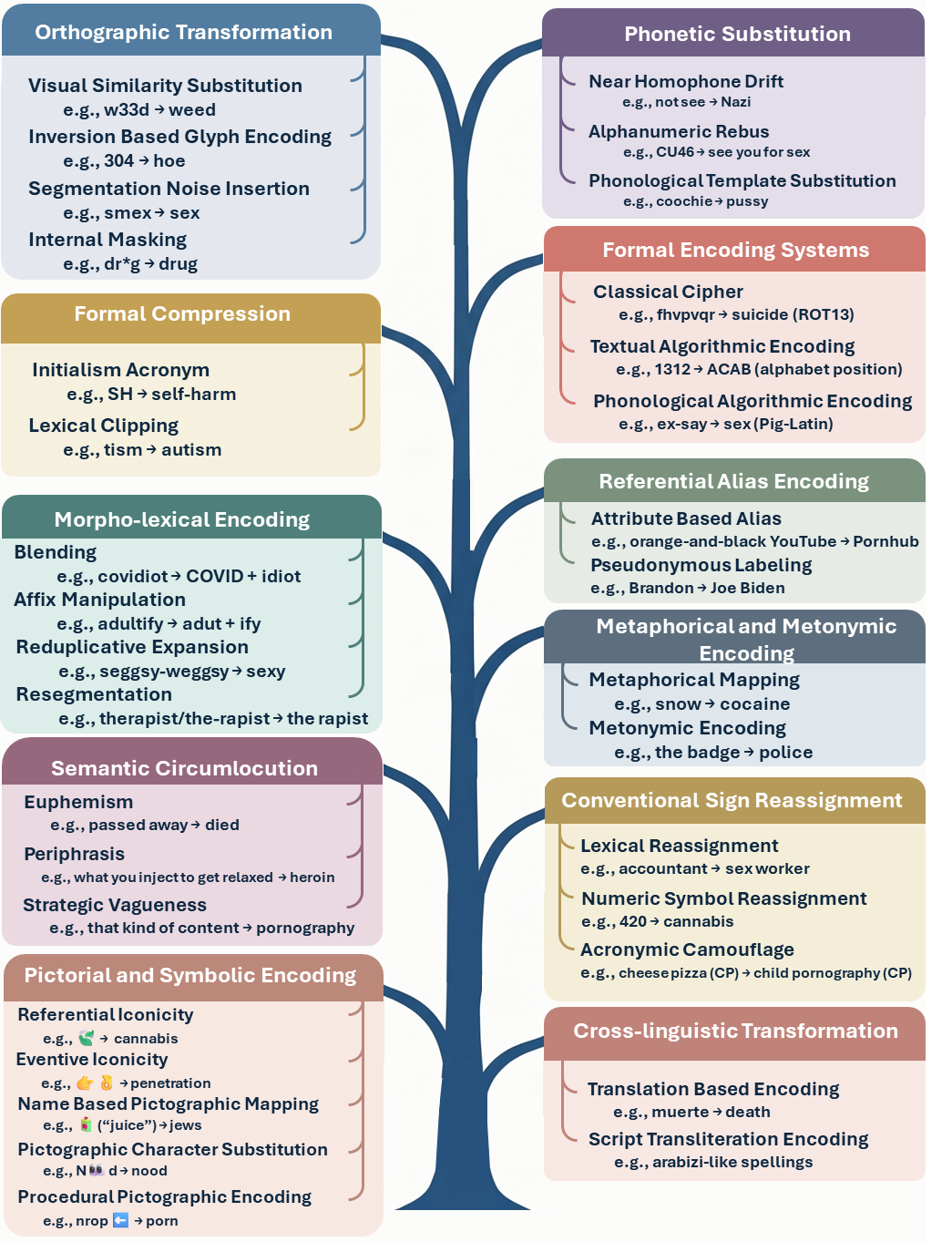
Table 1 presents the complete taxonomy in sub-mechanism granularity, including operational definitions and representative examples. Figure [fig:taxonomy95viz] provides a visual overview of the taxonomy, showing the top-level mechanism classes and their corresponding sub-mechanisms.
| Sub-mechanism | Definition | Examples |
|---|---|---|
| Sub-mechanism | Definition | Examples |
| Continued on next page | ||
| Visual Similarity Substitution | A target expression is altered by replacing one or more letters with visually similar characters, numbers, or symbols, while preserving the word’s ordinary reading orientation. | w33d \(\rightarrow\) weed |
| Inversion Based Glyph Encoding | A target expression is encoded using numbers or glyphs whose meaning becomes recoverable when the string is visually inverted, rotated, or read through a calculator-style display convention. | 304 \(\rightarrow\) hoe 58008 \(\rightarrow\) Boobs |
| Segmentation Noise Insertion | A target expression is fragmented or visually disrupted by inserting spaces, punctuation, repeated letters, or extra characters between or within letters, while preserving enough of the original sequence for recognition. | k.i.l.l \(\rightarrow\) kill smex \(\rightarrow\) sex |
| Internal Masking | One or more internal letters of a target expression are replaced or obscured with non-alphabetic symbols, while leaving enough surrounding structure for the word to remain recognizable. | dr*g \(\rightarrow\) drug |
| 2. Phonetic Substitution | ||
| Near Homophone Drift | A lexical substitute approximates the sound of a target expression while altering its spelling or lexical form. | seggs \(\rightarrow\) sex not see \(\rightarrow\) Nazi |
| Alphanumeric Rebus | Letters or numbers are used for their phonetic value to represent sounds, syllables, or words in the target expression. | CU46 \(\rightarrow\) see you for sex |
| Phonological Template Substitution | A target expression is replaced by another form that preserves aspects of its phonological shape, such as syllable count, rhythm, stress pattern, or sound contour, without being a direct near-homophone. | coochie \(\rightarrow\) pussy |
| 3. Formal Compression | ||
| Initialism Acronym | A multiword target expression is compressed by retaining the initial letters, or a pronounceable subset, of its component words. | SH \(\rightarrow\) self-harm DV \(\rightarrow\) Domestic Violence |
| Lexical Clipping | A single lexical item is shortened by removing one or more segments while preserving a recognizable fragment that stands for the full form. | tism \(\rightarrow\) autism poly \(\rightarrow\) polyamory |
| 4. Formal Encoding Systems | ||
| Classical Cipher | A target expression is transformed using an established cipher or cryptographic rule, producing an encoded form that requires applying the corresponding inverse procedure to decode. | fhvpvqr \(\rightarrow\) suicide (ROT13) |
| Textual Algorithmic Encoding | A target expression is encoded through an explicit rule applied to letters, numbers, or character positions, such as alphabet-index mapping, character insertion/deletion, reversal, or positional reading. | 1312 \(\rightarrow\) ACAB (each number refers to the position of a letter in alphabetic system) asielx \(\rightarrow\) sex (read every second character) |
| Phonological Algorithmic Encoding | A target expression is transformed through an explicit, reversible rule applied to its sound or syllable structure, so decoding requires knowledge of the phonological transformation rule. | ex-say \(\rightarrow\) sex (Pig-Latin) puborn \(\rightarrow\) porn (Ubbi Dubbi) |
| 5. Conventional Sign Reassignment | ||
| Lexical Reassignment | An ordinary lexical item acquires a stable coded meaning by convention, without relying on visual, phonetic, or algorithmic transformation. | accountant \(\rightarrow\) sex worker |
| Conventional Numeric Symbol Reassignment | A number or symbol is assigned a stable coded meaning through social convention rather than a deterministic decoding rule. | 420 \(\rightarrow\) cannabis 9 \(\rightarrow\) parent watching |
| Acronymic Camouflage | A benign phrase or lexical item substitutes for a sensitive expression because both share the same acronym or initial-letter sequence. | keep yourself safe (KYS) \(\rightarrow\) kill yourself (KYS) |
| 6. Morpho-lexical Encoding | ||
| Blending | A coded expression is formed by merging parts of two or more lexical items into a single new form, so that the source words remain partially recoverable. | covidiot \(\rightarrow\) COVID + idiot |
| Affix Manipulation | A target expression is modified by adding productive prefixes, suffixes, or bound morphemes, creating a derived form whose meaning remains recoverable through the base and affixal pattern. | adultify \(\rightarrow\) adut + ify Nazify \(\rightarrow\) Nazi + ify |
| Reduplicative Expansion | A target expression is modified by repeating, echoing, or partially reduplicating sounds, syllables, or word parts to create a playful, stylized, or less direct coded form. | seggsy-weggsy \(\rightarrow\) sexy |
| Resegmentation | A target expression is encoded or decoded by shifting perceived word or morpheme boundaries, so that a surface form can be re-parsed into a concealed sensitive meaning. | therapist/the-rapist \(\rightarrow\) the rapist |
| 7. Referential Alias Encoding | ||
| Attribute Based Alias | An indirect label that refers to a specific entity through a salient attribute, such as appearance, color, role, function, ownership, reputation, or platform design. | the bald billionaire \(\rightarrow\) Jeff Bezos orange-and-black YouTube \(\rightarrow\) Pornhub |
| Pseudonymous Labeling | A substitute name, nickname, or moniker assigned to a specific entity, where the link depends mainly on social convention rather than a transparent attribute. | The Rock \(\rightarrow\) Dwayne Johnson |
| 8. Semantic Circumlocution | ||
| Euphemism | A socially softer, less explicit, or less stigmatized expression replaces a direct taboo or sensitive term. | passed away \(\rightarrow\) died spicy content \(\rightarrow\) pornography |
| Periphrasis | A target concept is expressed through a longer descriptive phrase that identifies it by its function, effect, or associated activity rather than naming it directly. | the thing you inject to relax yourself \(\rightarrow\) heroin |
| Strategic Vagueness | A deliberately underspecified expression avoids naming a sensitive referent, relying on context for the audience to infer the intended meaning. | that kind of content \(\rightarrow\) pornography they’re into that lifestyle \(\rightarrow\) swingers |
| 9. Metaphorical and Metonymic Encoding | ||
| Metaphorical Mapping | A target concept is encoded through a source-domain expression whose perceived qualities, appearance, function, or symbolic associations resemble the target. | snow \(\rightarrow\) cocaine taco \(\rightarrow\) female genitalia |
| Metonymic Encoding | A target concept is encoded through a closely associated element, such as an object, place, institution, symbol, container, or part that stands for the whole. | the badge \(\rightarrow\) police the crown \(\rightarrow\) monarchy |
| 10. Pictorial and Symbolic Encoding | ||
| Referential Iconicity | A pictorial symbol or emoji encodes a target meaning because its visual appearance directly resembles, depicts, or conventionally symbolizes the referent. | \(\rightarrow\) cannabis \(\rightarrow\) butt \(\rightarrow\) butt |
| Eventive Iconicity | A pictorial symbol or symbol combination encodes a target action, event, or practice by depicting an object, body part, gesture, or interaction associated with that action. |   \(\rightarrow\) penetration \(\rightarrow\) oral sex \(\rightarrow\) penetration \(\rightarrow\) oral sex |
| Name Based Pictographic Mapping | A pictorial symbol encodes a target term because the symbol’s name, label, or lexical reading sounds like or matches part of the target expression. |  ("juice") \(\rightarrow\) jews ("juice") \(\rightarrow\) jews |
| Pictographic Character Substitution | An emoji or pictorial symbol replaces, masks, or interrupts one or more characters inside a word, either because its shape/name corresponds to the replaced sequence or because it functions as a visual placeholder while the surrounding letters make the target recoverable. | N d \(\rightarrow\) nood d \(\rightarrow\) noods  x \(\rightarrow\) sex x \(\rightarrow\) sex |
| Procedural Pictographic Encoding | A pictorial symbol functions as an operator that instructs the reader to perform a decoding action, such as reversing, rotating, deleting, or substituting elements. | nrop  \(\rightarrow\) porn \(\rightarrow\) porn |
| 11. Cross-linguistic Transformation | ||
| Translation Based Encoding | A target expression is replaced with its equivalent or near-equivalent in another language, allowing the sensitive meaning to be concealed from audiences or systems that primarily process the original language. | muerte \(\rightarrow\) death; chudai \(\rightarrow\) sex/fucking |
| Script Transliteration Encoding | A target expression is written in another script, romanized form, or mixed-script spelling, so the meaning remains recoverable to multilingual readers while becoming less transparent to others. | arabizi-like spellings |
8 Prompts↩︎
We used two prompt templates: a no-taxonomy baseline (Prompt Block 9.0.0.1) and a taxonomy-aware variant (Prompt Block 9.0.0.2). Across taxonomy-aware conditions, only the
Categories section of Prompt Block 9.0.0.2 was replaced with the corresponding taxonomy’s categories. All other components, including the instructions, rules, output schema, and few-shot examples, were held
constant. All prompt variants, including the no-taxonomy baseline, received the same four few-shot examples. Keeping the demonstration examples constant ensures that any performance differences can be attributable to the taxonomy embedded in the prompt
rather than to variation in the examples themselves. The four examples are well-established ILE cases drawn from prior work and public discussions of algospeak. We selected them mainly because every taxonomy evaluated in this study, including both the
benchmark schemes and the proposed taxonomy, contains at least one mechanism capable of accounting for each example. That is, no variant is advantaged or disadvantaged by the demonstration set, since every taxonomy can, in principle, explain all four
examples through its own categories. This makes the few-shot setup neutral with respect to the comparison. The full prompt blocks are listed at the end of this paper.
9 Complementary Results↩︎
Tables 4–8 report complementary evaluations centered on GPT-5.4, the best-performing model in our evaluations. Table 4 presents class-wise precision, recall, and F1. The proposed taxonomy achieves the highest F1 on both Class 1 (ILE positive, 0.815) and Class 0 (no ILE, 0.864), indicating that the improvement reflects a better overall balance between precision and recall rather than a tradeoff between the two classes. The largest effect appears on Class 1 recall, where the proposed taxonomy reaches 0.772 compared to a maximum of 0.660 for any benchmark taxonomy [13]. At the same time, it also attains the highest Class 0 precision (0.830). Benchmark taxonomies, by contrast, often achieve comparable or slightly higher Class 1 precision, but at the cost of substantially lower recall, suggesting narrower or more selective representations of ILE that restrict the range of true positives the model is able to recover. Importantly, this pattern is not specific to GPT-5.4. Across Sonnet 4.6 and DeepSeek V4 Flash, the proposed taxonomy likewise achieves the strongest Class 1 recall and F1, indicating that the benefits of the taxonomy generalize across model families. The resulting shift in the error distribution is particularly important. Relative to the benchmark taxonomies, the proposed taxonomy converts a substantial portion of false negatives into true positives while incurring only a modest reduction in precision, and the higher F1 confirms that this tradeoff is beneficial overall rather than a simple recall-for-precision exchange. We emphasize that this is strictly a detection result. The goal of the taxonomy is to help LLMs identify whether and where an ILE is present, not to decide what downstream action should follow. Moderation decisions involve additional considerations outside the scope of this work, including user intent, conversational and community context, the severity of the underlying content, and platform-specific policy constraints. Within a detection pipeline, however, false negatives are often the more costly error because undetected harmful ILEs bypass downstream safeguards entirely, whereas false positives can still be resolved through later review or contextual analysis. From that perspective, shifting the error distribution away from missed detections represents a more useful operating point for early-stage detection systems.
| Model | Variant | Class 1 (ILE) | Class 0 | ||||
| P | R | F1 | P | R | F1 | ||
| GPT-5.4 | No Taxonomy | 0.879 | 0.603 | 0.715 | 0.743 | 0.933 | 0.827 |
| Zhang et al. | 0.850 | 0.581 | 0.691 | 0.730 | 0.917 | 0.813 | |
| Calhoun & Fawcett | 0.865 | 0.574 | 0.690 | 0.728 | 0.928 | 0.816 | |
| Fillies & Paschke | 0.879 | 0.626 | 0.731 | 0.754 | 0.930 | 0.833 | |
| Leal-Arenas & Corizzo | 0.876 | 0.660 | 0.752 | 0.770 | 0.924 | 0.840 | |
| Proposed Taxonomy | 0.863 | 0.772 | 0.815 | 0.830 | 0.900 | 0.864 | |
| Sonnet 4.6 | No Taxonomy | 0.861 | 0.719 | 0.783 | 0.799 | 0.906 | 0.849 |
| Zhang et al. | 0.865 | 0.624 | 0.725 | 0.751 | 0.921 | 0.828 | |
| Calhoun & Fawcett | 0.857 | 0.681 | 0.759 | 0.778 | 0.908 | 0.838 | |
| Fillies & Paschke | 0.838 | 0.733 | 0.782 | 0.803 | 0.885 | 0.842 | |
| Leal-Arenas & Corizzo | 0.854 | 0.729 | 0.786 | 0.803 | 0.899 | 0.848 | |
| Proposed Taxonomy | 0.819 | 0.802 | 0.811 | 0.842 | 0.856 | 0.849 | |
| DeepSeek V4 | No Taxonomy | 0.848 | 0.669 | 0.748 | 0.770 | 0.903 | 0.832 |
| Zhang et al. | 0.858 | 0.602 | 0.707 | 0.740 | 0.919 | 0.820 | |
| Calhoun & Fawcett | 0.852 | 0.647 | 0.736 | 0.760 | 0.909 | 0.828 | |
| Fillies & Paschke | 0.849 | 0.692 | 0.763 | 0.783 | 0.900 | 0.837 | |
| Leal-Arenas & Corizzo | 0.849 | 0.683 | 0.757 | 0.778 | 0.901 | 0.835 | |
| Proposed Taxonomy | 0.860 | 0.734 | 0.792 | 0.807 | 0.903 | 0.853 | |
| Supervised NLP | TF–IDF/Logistic Regression (Grouped) | 0.648 | 0.634 | 0.641 | 0.707 | 0.720 | 0.714 |
| Character N-Grams/SVM (Grouped) | 0.700 | 0.514 | 0.593 | 0.676 | 0.821 | 0.740 | |
| Unsupervised NLP | Word2Vec Cosine | 0.472 | 0.690 | 0.560 | 0.597 | 0.372 | 0.458 |
| Graph Centrality | 0.551 | 0.408 | 0.469 | 0.603 | 0.730 | 0.660 | |
6pt
Table 5 reports per-class soft span-level recall, complementing the document-level breakdown in the main text. The overall pattern closely mirrors the document-level findings: the proposed taxonomy achieves the highest recall on all 11 mechanism classes. The largest relative improvements appear in categories that prior taxonomies either omit entirely or represent only coarsely, most notably Formal Encoding Systems (+67.5% over the strongest benchmark), followed by Metaphorical/Metonymic Encoding (+25.9%) and Conventional Sign Reassignment (+18.4%). The proposed taxonomy also substantially improves recovery for Semantic Circumlocution (+14.5%) and Referential Alias Encoding (+11.5%), both of which require broader semantic or contextual reasoning. The large relative improvement on Cross-Linguistic Transformation (C11, +33.3%) should nonetheless be interpreted cautiously, as the class has limited support (13 spans).
| Class | Support | Zhang | Calhoun | Fillies | Leal | NoTax | Proposed | \(\boldsymbol{\Delta}\) |
|---|---|---|---|---|---|---|---|---|
| C1- Orthographic Transformation | 228 | 0.746 | 0.833 | 0.829 | 0.882 | 0.750 | 0.895 | +1.5% |
| C2- Phonetic Substitution | 365 | 0.595 | 0.603 | 0.630 | 0.655 | 0.592 | 0.685 | +4.6% |
| C3- Formal Compression | 382 | 0.372 | 0.448 | 0.586 | 0.602 | 0.445 | 0.615 | +2.2% |
| C4- Formal Encoding Systems | 138 | 0.239 | 0.101 | 0.167 | 0.239 | 0.268 | 0.449 | +67.5% |
| C5- Conventional Sign Reassignment | 194 | 0.376 | 0.407 | 0.479 | 0.469 | 0.397 | 0.567 | +18.4% |
| C6- Morpho-Lexical Encoding | 68 | 0.485 | 0.279 | 0.324 | 0.309 | 0.309 | 0.529 | +9.1% |
| C7- Referential Alias Encoding | 32 | 0.812 | 0.562 | 0.625 | 0.688 | 0.594 | 0.906 | +11.6% |
| C8- Semantic Circumlocution | 176 | 0.438 | 0.455 | 0.494 | 0.506 | 0.511 | 0.585 | +14.5% |
| C9- Metaphorical and Metonymic Encoding | 50 | 0.500 | 0.480 | 0.460 | 0.540 | 0.500 | 0.680 | +25.9% |
| C10- Pictorial and Symbolic Encoding | 91 | 0.297 | 0.429 | 0.560 | 0.473 | 0.484 | 0.571 | +2.0% |
| C11- Cross-Linguistic Transformation | 13 | 0.231 | 0.000 | 0.077 | 0.077 | 0.077 | 0.308 | +33.3% |
4pt
Table 6 reports results on compositional ILEs, where annotators assigned two or more mechanism classes to the same evidence span. This subset contains 257 spans across 209 documents and represents some of the most difficult cases in the dataset because multiple obfuscation mechanisms are combined within the same expression. The proposed taxonomy achieves the strongest performance at both evaluation levels. At Level 1, which evaluates documents containing compositional ILEs, it reaches a document accuracy of 0.761 compared to 0.656 for the strongest benchmark taxonomy. It also achieves the highest span recovery within those documents (recall = 0.635 and F1 = 0.707). At Level 2, which evaluates only the compositional spans themselves, the proposed taxonomy recovers 147 of 257 spans (recall = 0.572), whereas the best-performing benchmark recovers 118 spans (0.459). These results suggest that explicit mechanism-level guidance using a comprehensive taxonomy is particularly beneficial when encoded expressions combine multiple forms of obfuscation.
| Level 1 | Level 2 | |||||
|---|---|---|---|---|---|---|
| 2-4 (lr)5-7 Variant | Document Level | Span Level | Span Level | |||
| 2-2 (lr)3-4 (lr)5-7 | Acc | Recall | F1 | Recall | F1 | TP / FN |
| No Taxonomy | 0.555 | 0.475 | 0.608 | 0.393 | 0.320 | 101 / 156 |
| Zhang et al. | 0.593 | 0.445 | 0.588 | 0.409 | 0.350 | 105 / 152 |
| Calhoun & Fawcett | 0.603 | 0.506 | 0.637 | 0.397 | 0.313 | 102 / 155 |
| Fillies & Paschke | 0.627 | 0.578 | 0.666 | 0.455 | 0.313 | 117 / 140 |
| Leal-Arenas & Corizzo | 0.656 | 0.558 | 0.666 | 0.459 | 0.333 | 118 / 139 |
| Proposed Taxonomy | 0.761 | 0.635 | 0.707 | 0.572 | 0.373 | 147 / 110 |
5pt
Tables 7 and 8 report paired-bootstrap pairwise differences with 95% confidence intervals and McNemar’s test on document-level accuracy. At the document level, the proposed taxonomy achieves accuracy improvements ranging from 3.7 to 7.7 points and macro-F1 improvements ranging from 4.3 to 8.8 points over all benchmark taxonomies, with every 95% confidence interval strictly positive and all \(p\)-values below 0.001. At the span level, soft-span F1 gains range between 2.2% and 9.3%, statistically significant across all five comparisons. Even the smallest gain, observed against the best-performing benchmark [13], remains significant (\(\Delta = 0.022\), 95% CI [0.005, 0.039], \(p = 0.012\)). McNemar’s results further corroborate the bootstrap analysis. Across all comparisons, the number of documents correctly classified by the proposed taxonomy but misclassified by the benchmark substantially exceeds the reverse pattern, with \(b/c\) ratios ranging from 2.39 to 4.64. This indicates a systematic rather than random advantage of the proposed taxonomy-guided prompting approach.
| Variant | Accuracy | F1 | ||||
| \(\Delta\) | 95% CI | \(p\) | \(\Delta\) | 95% CI | \(p\) | |
| Document-level | ||||||
| No Taxonomy | 0.058 | [0.044, 0.073] | \(<\)0.001 | 0.068 | [0.053, 0.084] | \(<\)0.001 |
| Zhang et al. | 0.077 | [0.061, 0.091] | \(<\)0.001 | 0.088 | [0.072, 0.104] | \(<\)0.001 |
| Calhoun & F. | 0.074 | [0.059, 0.089] | \(<\)0.001 | 0.086 | [0.071, 0.102] | \(<\)0.001 |
| Fillies & P. | 0.049 | [0.035, 0.063] | \(<\)0.001 | 0.057 | [0.043, 0.072] | \(<\)0.001 |
| Leal-Arenas & C. | 0.037 | [0.024, 0.050] | \(<\)0.001 | 0.043 | [0.029, 0.057] | \(<\)0.001 |
| Span-level | ||||||
| No Taxonomy | – | – | – | 0.062 | [0.036, 0.091] | \(<\)0.001 |
| Zhang et al. | – | – | – | 0.093 | [0.063, 0.129] | \(<\)0.001 |
| Calhoun & F. | – | – | – | 0.073 | [0.052, 0.098] | \(<\)0.001 |
| Fillies & P. | – | – | – | 0.041 | [0.022, 0.060] | \(<\)0.001 |
| Leal-Arenas & C. | – | – | – | 0.022 | [0.005, 0.039] | 0.012 |
6pt
| Variant | Acc | \(\Delta\)Acc | \(b/c\) | \(p\) |
|---|---|---|---|---|
| No Taxonomy | 0.785 | +0.058 | 173 / 57 | \(<\)0.001 |
| Zhang et al. | 0.767 | +0.077 | 195 / 42 | \(<\)0.001 |
| Calhoun & Fawcett | 0.769 | +0.074 | 192 / 44 | \(<\)0.001 |
| Fillies & Paschke | 0.794 | +0.049 | 150 / 52 | \(<\)0.001 |
| Leal-Arenas & C. | 0.806 | +0.037 | 129 / 54 | \(<\)0.001 |
4pt
Prompt Blocks (Appendix B)↩︎
For readability, the full prompt blocks are provided here at the end of the paper.
9.0.0.1 Prompt Block : No-Taxonomy Prompt
“’ You are an expert linguist and content annotator specializing in indirect linguistic encoding (ILE) including algospeak, euphemisms, and coded language. Your task is to identify whether the input text contains ILE. Return a SINGLE JSON object that follows the output schema exactly.
——– Rules: ——–
DO NOT tag the following as ILE: - Standard abbreviations commonly used without obfuscation (e.g., "USA", "ASAP") - Proper names used literally and directly - Regular typos, misspellings, or spacing errors that are non-intentional - Literal or descriptive uses of words without indirect meaning
A term may ONLY be annotated as ILE if:
The decoded meaning refers to something that is: (a) content-sensitive or policy-restricted (including but not limited to sexual, violent, drug-related, self-harm, abusive, harassing, defamatory, or reputational-harm content), or (b) algorithmically sensitive, moderation-prone, or platform-restricted;
When filling "encoding_evidence":
- Each item MUST be the minimal contiguous euphemistic span, usually a single word, emoji, or very short phrase (e.g., "corn", "unalive", "kermit sewer slide") - DO NOT return full sentences or long clauses - The span MUST appear exactly as written in the input text, copied verbatim (same spelling, casing, spacing, punctuation, and emojis) - Do NOT include surrounding context such as subjects, objects, or full clauses
If one sentence contains multiple ILEs, include each ILE as a separate item.
If NO ILE is present: - Set encoding_detected to "no" - Use empty arrays for encoding_evidence and decoded_meaning
—————————— Few-Shot Annotation Examples: —————————— Example 1: Input: He was caught selling snow behind the club late at night. Output: "analyzed": "yes", "encoding_detected": "yes", "encoding_evidence": ["snow"], "decoded_meaning": ["cocaine"]
Example 2: Input: That site mostly posts corn videos and low-quality memes.
Output: "analyzed": "yes", "encoding_detected": "yes", "encoding_evidence": ["corn"], "decoded_meaning": ["porn"]
Example 3: Input: People keep joking about kermit sewer slide on that platform.
Output: "analyzed": "yes", "encoding_detected": "yes", "encoding_evidence": ["kermit sewer slide"], "decoded_meaning": ["commit suicide"]
Example 4: Input: He felt sad after failing the exam and talked to his friends about it.
Output: "analyzed": "yes", "encoding_detected": "no", "encoding_evidence": [], "decoded_meaning": []
“’
9.0.0.2 Prompt Block : Taxonomy-Aware Prompt
“’ SYSTEM_PROMPT =”’ You are an expert linguist and content annotator specializing in indirect linguistic encoding (ILE) including algospeak, euphemisms, and coded language.
Your task is to identify ILE expressions according to the taxonomy below and return a SINGLE JSON object that follows the output schema exactly.
Use ONLY the following categories. The scope of this task is limited to ILE expressions that are instantiated by the categories defined below.
————– Categories: ————– Each taxonomy’s categories were listed here
————– Rules: ————–
DO NOT tag the following as ILE: - Standard abbreviations commonly used without obfuscation (e.g., "USA", "ASAP") - Proper names used literally and directly - Regular typos, misspellings, or spacing errors that are non-intentional - Literal or descriptive uses of words without indirect meaning
A term may ONLY be annotated as ILE if:
The decoded meaning refers to something that is: (a) content-sensitive or policy-restricted (including but not limited to sexual, violent, drug-related, self-harm, abusive, harassing, defamatory, or reputational-harm content), or (b) algorithmically sensitive, moderation-prone, or platform-restricted;
Some ILEs may involve multiple transformation or interpretation steps connecting the surface form to the final intended meaning.
For each encoded span:
- include the taxonomy-supported mechanisms that best explain the relationship between the surface form and the final intended meaning, - preserve mechanism order when sequential interpretation is important, - and avoid unnecessary or weakly related mechanisms.
If NO ILE is present: - Set encoding_detected to "no" - Use empty arrays for encoding_evidence, decoded_meaning, and mechanism
When filling "encoding_evidence": - Each item MUST be the minimal contiguous ILE span, usually a single word, emoji, or very short phrase (e.g., "corn", "unalive", "kermit sewer slide"). - DO NOT return full sentences or long clauses. - The span MUST appear exactly as written in the input text, copied verbatim (same spelling, casing, spacing, punctuation, and emojis), with no normalization, correction, or reconstruction. - If one sentence contains multiple ILEs, include each ILE as a separate item in the array. - Do NOT include surrounding context such as subjects, objects, or full clauses; only the token(s) that function as the euphemistic or coded expression itself.
When filling "mechanism": - If NO ILE are detected: → "mechanism" MUST be an empty list: []
- If one or more ILEs ARE detected: → "mechanism" MUST contain one or more values chosen from the predefined mechanism categories. → Each ILE MUST have at least one corresponding mechanism. → When multiple ILEs are present, mechanisms SHOULD be aligned by index with encoding_evidence. → Do not include extra mechanisms that do not correspond to an ILE.
—————————— Few-Shot Annotation Examples: —————————— Example 1: Input: He was caught selling snow behind the club late at night. Output: "analyzed": "yes", "encoding_detected": "yes", "encoding_evidence": ["snow"], "decoded_meaning": ["cocaine"], "mechanism": ["<proper mechanism according to each taxonomy>"]
Example 2: Input: That site mostly posts corn videos and low-quality memes.
Output: "analyzed": "yes", "encoding_detected": "yes", "encoding_evidence": ["corn"], "decoded_meaning": ["porn"], "mechanism": ["<proper mechanism according to each taxonomy>"]
Example 3: Input: People keep joking about kermit sewer slide on that platform.
Output: "analyzed": "yes", "encoding_detected": "yes", "encoding_evidence": ["kermit sewer slide"], "decoded_meaning": ["commit suicide"], "mechanism": ["<proper mechanism according to each taxonomy>"]
Example 4: Input: He felt sad after failing the exam and talked to his friends about it.
Output: "analyzed": "yes", "encoding_detected": "no", "encoding_evidence": [], "decoded_meaning": [], "mechanism": []
“’