Exploring the world of edge-chromatic 3-critical graphs
June 25, 2026
Abstract
A graph \(G\) with maximum degree \(\Delta\) is \(\Delta\)-critical if it is connected, satisfies \(\chi'(G)=\Delta+1\), and the deletion of any edge reduces its chromatic index to \(\Delta\). A \(\Delta\)-critical graph \(G\) is called nontrivial if it contains no \(\Delta\)-overfull subgraph; that is, no \(H \subseteq G\) such that \(|E(H)| > \Delta \lfloor |V(H)| /2 \rfloor\). There are no \(1\)-critical graphs, and the \(2\)-critical graphs are exactly the odd cycles. By work of Chetwynd and Yap from 1983, there is a unique nontrivial \(3\)-critical graph of order \(9\), and exactly two nontrivial \(3\)-critical graphs of order \(11\). In 2005, Bokal, Brinkmann, and Grünewald showed that there are exactly fourteen nontrivial \(3\)-critical graphs of order \(13\). For even orders, Brinkmann and Steffen proved in 1997 that no \(3\)-critical graphs of even order exist below order \(22\), there is exactly one 3-critical graph of order \(22\), and that there are exactly nine \(3\)-critical graphs of order \(24\).
To the best of our knowledge, there has been no further progress on the existence of nontrivial \(3\)-critical graphs of odd orders beyond the cases established two decades ago. In this paper, using computer-assisted search techniques, we determine the exact numbers of nontrivial \(3\)-critical graphs of odd orders from \(15\) to \(21\). The same data pipeline also reproduces the known order-\(22\) count of Brinkmann and Steffen, with one nontrivial \(3\)-critical graph. Beyond enumeration, we prove a characterization theorem for all nontrivial 3-critical graphs, with one case based on snarks. We also provide an analysis of our search algorithm.
1 Introduction↩︎
For integers \(p\) and \(q\), let \([p,q]=\{i\in\mathbb{Z}:p\le i\le q\}\), and write \([q]\) for \([1,q]\). Throughout the paper, all graphs are finite and simple unless explicitly stated otherwise.
For an integer \(k \ge 0\), an edge \(k\)-coloring of a graph \(G\) is a map \(\varphi:E(G)\to [k]\) such that adjacent edges receive distinct colors. Each set of edges colored by the same color under \(\varphi\) is a color class of \(G\). The chromatic index \(\chi'(G)\) is the least \(k\) for which \(G\) has an edge \(k\)-coloring. In the 1960s, Gupta [1] and, independently, Vizing [2] showed that for all graphs \(G\), \(\Delta(G) \le \chi'(G) \le \Delta(G)+1\). This result leads to a natural classification of all simple graphs. Following Fiorini and Wilson [3], a graph \(G\) is of class 1 if \(\chi'(G) = \Delta(G)\) and of class 2 if \(\chi'(G) = \Delta(G)+1\). Holyer [4] showed that it is NP-complete to determine whether an arbitrary graph is of class 1. However, a class of graphs fall into class 2 trivially because they have too many edges with respect to their maximum degree. They are overfull graphs. A graph \(G\) with \(|E(G)|>\Delta(G) \lfloor|V(G)|/2 \rfloor\) is overfull and an overfull subgraph \(H\) of \(G\) with \(\Delta(H)=\Delta(G)\) is called a \(\Delta(G)\)-overfull subgraph. Since in any edge \(k\)-coloring, each color class restricted to \(H\) is a matching of size at most \(\lfloor |V(H)|/2\rfloor\), it follows that if \(G\) contains a \(\Delta(G)\)-overfull subgraph \(H\), then \(\chi'(G) \ge \chi'(H) \ge |E(H)|/ \lfloor |V(H)|/2\rfloor>\Delta(H)=\Delta(G)\). Thus \(G\) is class 2 by the result of Gupta [1] and Vizing [2].
A graph \(G\) with \(\Delta(G)=k\) is called edge-chromatic \(k\)-critical if it is connected, \(\chi'(G)=k+1\), and \(\chi'(G-e)=k\) for every edge \(e\in E(G)\). An edge \(e\in E(G)\) is critical if \(\chi'(G-e)<\chi'(G)\). Since we are mainly concerned with edge colorings, we write “\(k\)-critical” for edge-chromatic \(k\)-critical. By the definition and the theorem of Gupta [1] and Vizing [2], a \(k\)-critical graph is a connected edge-minimal class \(2\) graph of maximum degree \(k\). There are no \(1\)-critical graphs, and the \(2\)-critical graphs are exactly the odd cycles. However, much less is known about \(3\)-critical graphs.
We call a \(k\)-critical graph \(G\) trivial if \(G\) contains a \(k\)-overfull subgraph. Otherwise, \(G\) is nontrivial. For a graph with maximum degree \(3\), the inequality \(|E(G)|>3\lfloor |V(G)|/2\rfloor\) forces \(G\) to have exactly one vertex of degree \(2\). Hence every \(2\)-connected trivial \(3\)-critical graph is overfull, and is obtained from a cubic graph by subdividing one edge.
We first observe that no cubic graph is \(3\)-critical. Suppose to the contrary that a cubic graph \(H\) is \(3\)-critical, and let \(e=uv\in E(H)\). Since \(H\) is \(3\)-critical, \(H-e\) has a proper edge \(3\)-coloring, and \(u,v\) are its only vertices of degree \(2\). The two missing colors at \(u\) and \(v\) must differ: otherwise, assigning that common color to \(e\) would extend the coloring to all of \(H\), contradicting \(\chi'(H)=4\). Form \(H^*\) from \(H-e\) by adding a new vertex \(x\) adjacent to both \(u\) and \(v\), and color \(xu\) and \(xv\) with the colors missing at \(u\) and \(v\), respectively. Since these colors are distinct, this is a proper edge \(3\)-coloring of \(H^*\). But \(H^*\) has odd order \(|V(H)|+1\) and \(\tfrac{3}{2}|V(H)|+1\) edges, so it is \(3\)-overfull and hence class \(2\); this contradicts the existence of a proper edge \(3\)-coloring. Therefore no cubic graph is \(3\)-critical.
Consequently every \(3\)-critical graph has a vertex of degree \(2\), and by a result of Jakobsen [5] no \(3\)-critical graph has exactly two vertices of degree \(2\). Thus a \(3\)-critical graph has exactly one degree-\(2\) vertex or at least three.
These two possibilities correspond exactly to the trivial and nontrivial cases. A \(3\)-critical graph \(G\) is nontrivial if and only if it has at least three vertices of degree \(2\). Indeed, since \(G\) is edge-critical, it has no proper \(3\)-overfull subgraph, so the only possible \(3\)-overfull subgraph of \(G\) is \(G\) itself; and a subcubic graph is \(3\)-overfull precisely when it has odd order and exactly one vertex of degree \(2\). Thus \(G\) is trivial exactly when it has a single degree-\(2\) vertex, and nontrivial exactly when it has at least three.
The structure of nontrivial \(3\)-critical graphs is nonetheless more involved. In this paper we enumerate the nontrivial \(3\)-critical graphs of order at most \(22\), and we establish a characterization of all nontrivial \(3\)-critical graphs.
Much of the interest in finding \(k\)-critical graphs was inspired by the Edge-chromatic Critical Graph Conjecture, proposed by Beineke and Wilson [6] in 1973 and independently by Jakobsen [5] in 1974, stating that every edge-chromatic critical graph has odd order. In the same paper, Jakobsen gave a complete list of all 3-critical graphs on at most 9 vertices. He showed that 3-critical graphs exist on 5, 7, and 9 vertices, with the graph obtained from the Petersen graph by deleting one vertex being the only nontrivial 3-critical graph of odd order at most 9. He also showed that no 3-critical graph of even order has at most 9 vertices. Beineke and Fiorini in 1976 [7] determined \(k\)-critical graphs for all possible \(k\) up to \(7\) vertices, and proved that there is no \(3\)-critical graph of even order less than \(12\) and no \(3\)-critical graph of order \(12\). Based on results of Beineke and Fiorini [7], Fiorini and Wilson [3] gave the first complete lists of edge-chromatic critical graphs of order \(n\le 8\) and of even order \(n\le 10\). Chetwynd and Yap [8] closed the order \(9\) gap. It turned out that the Petersen graph minus a vertex is the only nontrivial critical graph on up to 10 vertices. More than ten years later in 1998, with computer-aided proof, Brinkmann and Steffen [9] showed that there is no edge-chromatic critical graph of order 12, and there are precisely two nontrivial edge-chromatic critical graphs on 11 vertices. In 2005, Bokal, Brinkmann, and Grünewald [10] showed that there are no critical graphs of order 14 and that there are exactly 14 nontrivial critical graphs of order 13, which are all 3-critical. The results were proved partly by theoretical techniques and partly by actual computation. Goldberg [11] constructed an infinite family of \(3\)-critical graphs of even order, whose smallest member has \(22\) vertices. Chetwynd and Fiol independently found two \(4\)-critical graphs on \(18\) vertices; see the survey account in [12]. Aided by computer search, Brinkmann and Steffen [13] showed that the smallest 3-critical graph of even order has 22 vertices and that there are exactly nine of order 24. The graph of order 22 is shown to be the smallest 3-critical graph of even order. They also showed that there are exactly two 4-critical graphs of order 18, and that these graphs are the smallest 4-critical graphs of even order.
Our focus in this paper is the finite census of nontrivial \(3\)-critical graphs through order \(22\). We summarize the known cases in Table 1.
| Order \(n\) | # Nontrivial 3-critical graphs | Reference |
|---|---|---|
| 4,5,6,7,8 | 0 | [5] |
| 9 | 1 | [5], [8] |
| 10 | 0 | [7] |
| 11 | 2 | [9] |
| 12 | 0 | [7] |
| 13 | 14 | [10]; reproduced here |
| 14 | 0 | [10]; reproduced here |
| 15 | 94 | this paper |
| 17 | 774 | this paper |
| 19 | \(6{,}984\) | this paper |
| 21 | \(70{,}530\) | this paper |
| 16,18,20 | 0 | [13]; reproduced here |
| 22 | 1 | [13]; reproduced here |
| 24 | 9 | [13] |
Apart from the enumeration result shown in Table 1, our other main contribution in this paper concerns the generation of nontrivial \(3\)-critical graphs. We discover a new construction and, building on it, give a characterization of all nontrivial \(3\)-critical graphs. To state these results, we first define the following three types of operations. The first two types of operations are known, for example, see [10]. The third type, with \(H\) taken to be \(K_{\Delta,\Delta-1}\), was introduced by Grünewald and Steffen in 1999 [14], and is known as a Meredith-extension [15].
Vertex-blowup. Let \(H\) be a subcubic graph and let \(x\in V(H)\). The graph \(G\) obtained from \(H-x\) and a disjoint triangle by joining each neighbor of \(x\) to a distinct vertex of the triangle is called a vertex-blowup of \(H\) at \(x\).
Hajós-join. Let \(G_1\) and \(G_2\) be graphs, and let \(u_1v_1\in E(G_1)\) and \(u_2v_2\in E(G_2)\). The graph \(G\) obtained from \(G_1-u_1v_1\) and \(G_2-u_2v_2\) by identifying \(u_1\) and \(u_2\), and then adding the edge \(v_1v_2\), is called a Hajós-join of \(G_1\) and \(G_2\).
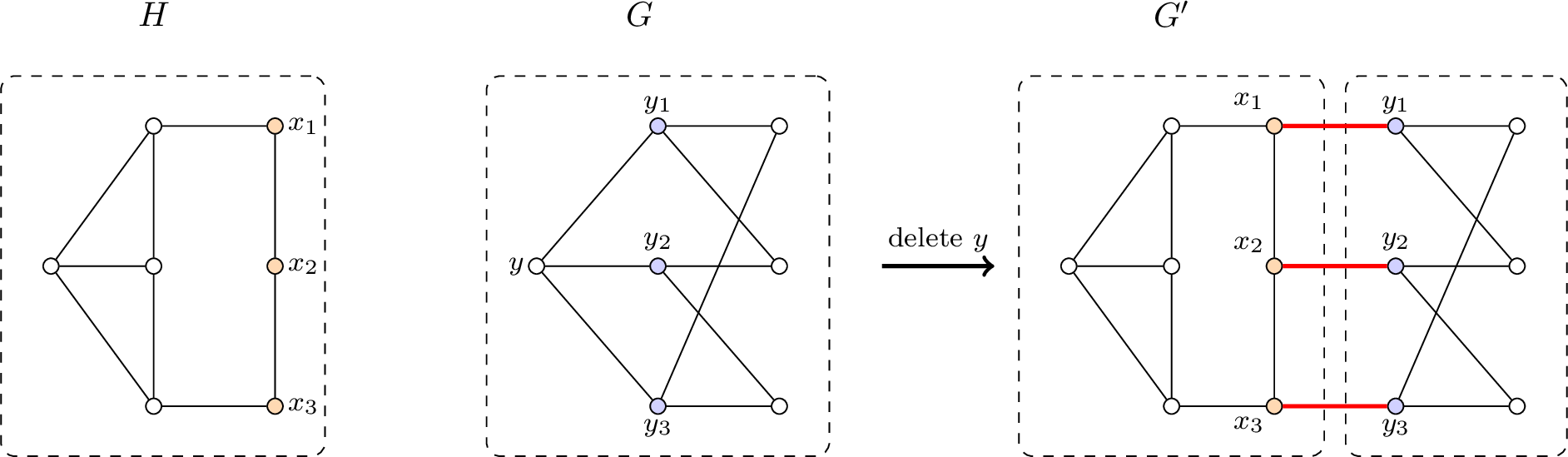
Meredith-type extension. Let \(G\) and \(H\) be two disjoint graphs, each with maximum degree \(\Delta\). Suppose that \(H\) has exactly \(\Delta\) vertices of degree \(\Delta-1\), with every other vertex of degree \(\Delta\); we call the degree-\((\Delta-1)\) vertices the connector vertices of \(H\). Let \(y\in V(G)\) be a vertex of degree \(\Delta\), with neighborhood \(N_{G}(y)=\{y_1,\ldots,y_\Delta\}\). The Meredith-type extension of \(G\) through \(H\) at \(y\) is the graph \(G'\) obtained from the disjoint union of \(H\) and \(G-y\) by adding a perfect matching of \(\Delta\) edges between the connector vertices of \(H\) and the vertices \(y_1,\ldots,y_\Delta\).
For \(\Delta=3\), the gadget \(H\) has exactly three connector vertices of degree \(2\) and all other vertices of degree \(3\); the vertex \(y\) has three neighbors \(y_1,y_2,y_3\); and the three matching edges join the connectors to \(y_1,y_2,y_3\), as illustrated in Figure 1.
A snark is a cubic class \(2\) graph that has no triangle and is cyclically \(4\)-edge-connected, where, for an integer \(k\ge 0\), a graph \(G\) is cyclically \(k\)-edge-connected if for every edge set \(F\) of size less than \(k\), at most one component of \(G-F\) contains a cycle. Our main result is the following.
Theorem 1. Let \(G\) be a nontrivial \(3\)-critical graph of order \(n\). Then one of the following holds.
(a) \(G\) is obtained from a nontrivial \(3\)-critical graph of order \(n-2\) through a vertex-blowup.
(b) \(G\) is obtained from two smaller \(3\)-critical graphs, at least one of which is nontrivial, through a Hajós-join.
(c) \(G\) is obtained from a nontrivial \(3\)-critical graph by a Meredith-type extension through a class 1 graph.
(d) \(n\) is odd and \(G\) is obtained from a snark of order \(n+1\) by deleting exactly one vertex and some edges.
(e) \(n\) is even and \(G\) is obtained from a snark of order \(n\) by deleting some edges.
As an application of Theorem 1 and the fact that no snark has order less than 18, we give a theoretical proof of the following result, which was verified computationally in [13].
Corollary 2. There is no 3-critical graph of even order less than 18.
The remainder of this paper is organized as follows. In Section 2, we introduce some preliminaries and study the properties of the three types of operations, in particular those of the Meredith-type extension. In Section 3, we prove Theorem 1 and Corollary 2. In the final section, we discuss some algorithmic aspects of our enumeration.
2 Preliminaries and Properties of the Three Operations↩︎
2.1 Preliminaries↩︎
Let \(G\) be a graph. We use \(V(G)\) and \(E(G)\) to denote the vertex set and edge set of \(G\), respectively, and write \(e(G)=|E(G)|\). For \(v\in V(G)\), let \(N_G(v)\) be the set of neighbors of \(v\) in \(G\). The degree of \(v\) in \(G\), denoted by \(d_G(v)\), is the number of edges of \(G\) incident with \(v\).
Let \(V_1,V_2\subseteq V(G)\) be disjoint vertex sets. We write \(E_G(V_1,V_2)\) for the set of edges of \(G\) with one endpoint in \(V_1\) and the other in \(V_2\), and let \(e_G(V_1,V_2)=|E_G(V_1,V_2)|\). If \(V_1=\{v\}\), we write \(E_G(v,V_2)\) and \(e_G(v,V_2)\) instead of \(E_G(\{v\},V_2)\) and \(e_G(\{v\},V_2)\). We also write \(G[V_1,V_2]\) for the bipartite subgraph of \(G\) with vertex set \(V_1\cup V_2\) and edge set \(E_G(V_1,V_2)\).
Let \(S\subseteq V(G)\) and \(v\in V(G)\). We write \(N_G(v,S)=N_G(v)\cap S\), and \(d_G(v,S)=e_G(v,S\setminus\{v\})\). The subgraph of \(G\) induced by \(S\) is denoted by \(G[S]\). We write \(G-S=G[V(G)\setminus S]\), and use the abbreviation \(G-x\) for \(G-\{x\}\). We also write \(e_G(S)=e(G[S])\).
If \(F\subseteq E(G)\), then \(G-F\) denotes the graph obtained from \(G\) by deleting all edges in \(F\), and \(G[F]\) denotes the subgraph of \(G\) induced by the edge set \(F\). We write \(V(F)\) for the set of vertices covered by the edges in \(F\). For a set \(F \subseteq E(\overline{G})\) of edges, let \(G+F\) denote the graph obtained from \(G\) by adding all edges in \(F\). We also use the abbreviation \(G+e\) for \(G+\{e\}\).
Let \(k\in\mathbb{N}\), and let \(\mathcal{C}^k(G)\) denote the set of all edge \(k\)-colorings of a multigraph \(G\). For \(\varphi\in \mathcal{C}^k(G)\) and \(v\in V(G)\), the set of colors present at \(v\) is \[\varphi(v)=\{\varphi(e): \text{e\in E(G) is incident with v}\},\] and the set of colors missing at \(v\) is \(\overline{\varphi}(v)=[k]\setminus \varphi(v)\). For \(X\subseteq V(G)\) and \(i\in [k]\), define \(\overline{\varphi}_X^{-1}(i)=\{v\in X:i\in \overline{\varphi}(v)\}\). We write simply \(\overline{\varphi}^{-1}(i)\) for \(\overline{\varphi}_{V(G)}^{-1}(i)\).
Lemma 3 (Vizing’s Adjacency Lemma (VAL), [2]). Let \(G\) be a class 2 graph with maximum degree \(\Delta\). If \(e=xy\) is a critical edge of \(G\), then \(x\) has at least \(\Delta-d_G(y)+1\) neighbors of degree \(\Delta\) in \(V(G)\setminus\{y\}\). As a consequence, \(d_G(x)+d_G(y)\ge \Delta+2\).
Given an edge-coloring of \(G\) and a color \(i\), the edges colored \(i\) form a matching, and hence the number of vertices not incident with an edge of color \(i\) has the same parity as \(|V(G)|\). We will use the following Parity Lemma of Grünewald and Steffen [16].
Lemma 4 (Parity Lemma). Let \(G\) be a multigraph, and let \(\varphi \in \mathcal{C}^k(G)\) for some integer \(k\ge \Delta(G)\). Then \(|\overline{\varphi}^{-1}(i)|\equiv |V(G)| \pmod 2\) for every color \(i\in [k]\).
Let \(G\) be a graph and let \(F\subseteq E(G)\). We call \(F\) a disconnecting set if \(G-F\) has more components than \(G\). Furthermore, if there exists a set \(S\subseteq V(G)\) such that \(F=E_G(S,V(G)\setminus S)\), then \(F\) is called an edge-cut. In this case, we also write \(F=\delta_G(S)\), and we omit the subscript \(G\) when the graph is clear from the context. It is easy to verify that every inclusion-minimal disconnecting set is an edge-cut. A disconnecting set \(F\) is essential if at least two components of \(G-F\) each contain an edge, and is cyclic if at least two components of \(G-F\) each contain a cycle.
Lemma 5. The following hold.
(1) Let \(G\) be a connected essentially \(2\)-edge-connected graph, and let \(F\subseteq E(G)\) be an essential disconnecting set of size \(2\). Then \(G-F\) has exactly two components. In particular, \(F\) is an edge-cut. Moreover, if \(G\) is subcubic and \(2\)-edge-connected, then \(F\) is a matching.
(2) Let \(G\) be a connected cyclically \(3\)-edge-connected graph, and let \(F\subseteq E(G)\) be a cyclic disconnecting set of size \(3\). Then \(G-F\) has exactly two components. In particular, \(F\) is an edge-cut. Moreover, if \(G\) is subcubic, then \(F\) is a matching.
Proof. We first prove (1). Since \(F\) is an essential disconnecting set, at least two components of \(G-F\) contain edges. Let \(C\) be one such component. Since another component of \(G-F\) contains an edge, the cut \(\delta_G(V(C))\) is essential. Moreover, \(\delta_G(V(C))\subseteq F\), because every edge from \(C\) to \(V(G)\setminus V(C)\) must have been deleted by \(F\). Since \(G\) is essentially \(2\)-edge-connected, \[2\le |\delta_G(V(C))|\le |F|=2.\] Thus \(\delta_G(V(C))=F\). In particular, every edge of \(F\) has one end in \(C\) and one end outside \(C\).
Let \(C'\) be another component of \(G-F\) containing an edge. The same argument gives \(\delta_G(V(C'))=F\). Hence every edge of \(F\) joins \(C\) to \(C'\). Since \(G\) is connected, there can be no third component of \(G-F\). Therefore \(G-F\) has exactly two components, and \(F\) is an edge-cut.
Now assume further that \(G\) is subcubic and \(2\)-edge-connected. Let the two components of \(G-F\) have vertex sets \(S\) and \(V(G)\setminus S\), so that \(F=\delta_G(S)\). Suppose, for a contradiction, that the two edges of \(F\) have a common end \(u\in S\). Since \(G\) is subcubic, \(u\) has at most one neighbor in \(S\). As \(G\) is connected and \(S\setminus\{u\}\) is nonempty, \(u\) has exactly one neighbor in \(S\), say \(u'\). Then the only edge from \(S\setminus\{u\}\) to \(V(G)\setminus (S\setminus\{u\})\) is \(uu'\). Hence \(uu'\) is a bridge of \(G\), contradicting that \(G\) is \(2\)-edge-connected. The same argument applies if the common end lies in \(V(G)\setminus S\). Therefore \(F\) is a matching. This proves (1).
We now prove (2). Since \(F\) is a cyclic disconnecting set, at least two components of \(G-F\) contain cycles. Let \(C\) be one such component. Since another component of \(G-F\) contains a cycle, the cut \(\delta_G(V(C))\) is cyclic. Moreover, \(\delta_G(V(C))\subseteq F\). Since \(G\) is cyclically \(3\)-edge-connected, \[3\le |\delta_G(V(C))|\le |F|=3.\] Thus \(\delta_G(V(C))=F\). In particular, every edge of \(F\) has one end in \(C\) and one end outside \(C\).
Let \(C'\) be another component of \(G-F\) containing a cycle. The same argument gives \(\delta_G(V(C'))=F\). Hence every edge of \(F\) joins \(C\) to \(C'\). Since \(G\) is connected, there can be no third component of \(G-F\). Therefore \(G-F\) has exactly two components, and \(F\) is an edge-cut.
It remains to prove the matching statement under the additional assumption that \(G\) is subcubic. Let the two components of \(G-F\) have vertex sets \(S\) and \(V(G)\setminus S\), so that \(F=\delta_G(S)\). Suppose, for a contradiction, that two edges of \(F\) have a common end \(u\in S\). Let \(r=d_G(u,V(G)\setminus S)\). Then \(r\ge 2\). Since \(G\) is subcubic, \(d_G(u,S)\le 1\). Hence no cycle of \(G[S]\) uses \(u\).
Put \(S'=S\setminus\{u\}\). Then \[|\delta_G(S')| = |\delta_G(S)|-r+d_G(u,S) \le 3-2+1 =2.\] Both sides of this new cut still contain cycles: the side \(S'\) contains a cycle because \(G[S]\) contains a cycle and no cycle of \(G[S]\) uses \(u\), while the other side already contained a cycle before \(u\) was moved. Thus \(\delta_G(S')\) is a cyclic edge-cut of size less than \(3\), contradicting that \(G\) is cyclically \(3\)-edge-connected.
The same argument applies if two edges of \(F\) have a common end in \(V(G)\setminus S\). Therefore no two edges of \(F\) share an end, and so \(F\) is a matching. This proves (2). ◻
By Lemma 5, we adopt the following terminology for the remainder of the paper. If \(G\) is subcubic and \(2\)-edge-connected, we call every essential disconnecting set of size \(2\) an essential \(2\)-edge-cut. If \(G\) is subcubic, \(2\)-edge-connected, and cyclically \(3\)-edge-connected, we call every cyclic disconnecting set of size \(3\) a cyclic \(3\)-edge-cut. Note also that every \(3\)-critical graph is \(2\)-edge-connected, a fact we use frequently.
2.2 Properties of the Three Operations↩︎
Let \(G\) be a graph. We call \[\mathop{\mathrm{def}}(G)=\sum_{v\in V(G)}(\Delta(G)-d_G(v))\] the deficiency of \(G\). The following result was due to Grünewald and Steffen from 1999 [14].
Lemma 6 ([14]). Let \(G\) be a \(k\)-critical multigraph, where \(k\ge 2\), and let \(H\) be an induced proper submultigraph of odd order. If \(\mathop{\mathrm{def}}(H)=k\), then the multigraph obtained from \(G\) by contracting \(H\) to a single vertex \(v\) is \(k\)-critical.
The next result shows that a vertex-blowup preserves 3-criticality. The forward implication was listed as Lemma 3 in [10], and the converse implication follows from Lemma 6 by taking \(H\) as a triangle.
Lemma 7. Let \(H\) be a subcubic graph and \(G\) a graph obtained from \(H\) by a vertex-blowup. Then \(G\) is 3-critical if and only if \(H\) is 3-critical.
The following Hajós-join preservation result is classical; see Jakobsen [17].
Lemma 8. Let \(G\) and \(G'\) be two \(3\)-critical graphs and \(v\in V(G)\), \(v'\in V(G')\) two vertices such that \[d_G(v)+d_{G'}(v')\le 5.\] Let \(uv\in E(G)\) and \(u'v'\in E(G')\). Then the Hajós-join obtained from \(G-uv\) and \(G'-u'v'\) by identifying \(v\) and \(v'\) and adding the edge \(uu'\) is \(3\)-critical.
We prove the converse of the preceding lemma under an additional condition. A triangle \(T\) in \(G\) is independent if no vertex in \(V(G)\setminus V(T)\) is adjacent to more than one vertex of \(T\).
Theorem 9. Let \(G\) be a nontrivial \(3\)-critical graph with no independent triangle. If \(G\) has an essential \(2\)-edge-cut, then \(G\) is the Hajós join of two \(3\)-critical graphs, at least one of which is nontrivial.
Proof. We first choose the cut carefully. Let \(F=\{u_1u_2,v_1v_2\}\) be an essential \(2\)-edge-cut of \(G\). By Lemma 5(1), \(G-F\) has exactly two components and \(F\) is a matching in \(G\). Let \(H_1\) and \(H_2\) be these two components, where \(u_i,v_i\in V(H_i)\) for each \(i\in [2]\). Then \(u_1\ne v_1\) and \(u_2\ne v_2\) since \(F\) is a matching.
For each \(i\in [2]\), let \(H_i^*\) be obtained from \(H_i\) by adding two pendant edges at \(u_i\) and \(v_i\). A coloring of \(H_i^*\) is called a same-state coloring if the two pendant edges receive the same color, and a different-state coloring if they receive distinct colors.
Since \(F\) is essential, each component \(H_i\) contains an edge. Hence, for each \(i\in [2]\), the graph \(H_i^*\) has at least one state: delete an edge from the other component and restrict a proper edge \(3\)-coloring of the resulting graph to the \(H_i\)-side.
The two sides cannot have a common state. Indeed, if both \(H_1^*\) and \(H_2^*\) had same-state colorings, or both had different-state colorings, then after permuting colors on one side, the two colorings could be glued along the two edges of \(F\), giving a proper edge \(3\)-coloring of \(G\), a contradiction.
Thus the two state sets are nonempty and disjoint subsets of \(\{\text{same},\text{different}\}\). Therefore one side has only same-state colorings and the other has only different-state colorings. Among all essential \(2\)-edge-cuts of \(G\), choose \(F\) so that the same-state side is as large as possible. We keep the notation so that \(H_1^*\) has only same-state colorings and \(H_2^*\) has only different-state colorings.
We claim that \(u_2v_2\notin E(H_2)\). Suppose, to the contrary, that \(u_2v_2\in E(H_2)\). Since \(H_2^*\) has only different-state colorings, each of \(u_2\) and \(v_2\) has a neighbor in \(H_2-\{u_2,v_2\}\). Indeed, if, say, \(u_2\) were incident in \(H_2\) only with \(u_2v_2\), then from a different-state coloring of \(H_2^*\) we could recolor the pendant edge at \(u_2\) with the color of the pendant edge at \(v_2\), obtaining a same-state coloring of \(H_2^*\), a contradiction.
Let \(u_2u_2'\) and \(v_2v_2'\) be edges from \(\{u_2,v_2\}\) to \(H_2-\{u_2,v_2\}\). We first show that \(u_2'\ne v_2'\). Suppose not, and write \(u_2'=v_2'=z\). Then \(u_2v_2zu_2\) is an independent triangle, contradicting the assumption that \(G\) has no independent triangle. Hence \(u_2'\ne v_2'\).
Since \(\Delta(G)\le 3\), the edges \(u_2u_2'\) and \(v_2v_2'\) are the only edges from \(\{u_2,v_2\}\) to \(H_2-\{u_2,v_2\}\). Thus \[F'=\{u_2u_2',v_2v_2'\}\] is an edge-cut. Moreover, \(F'\) is essential. After deleting \(F'\), one component contains \(H_1\) together with \(u_2,v_2\) and the edges \(u_1u_2,v_1v_2,u_2v_2\), so this component contains an edge. The other side contains \(u_2'\) and \(v_2'\). Since \(u_2'\ne v_2'\) and \(\delta(G)\ge 2\), the vertex \(u_2'\) has an incident edge different from \(u_2u_2'\). This edge lies in \(H_2-\{u_2,v_2\}\), since \(v_2\) is adjacent to \(v_2'\) rather than \(u_2'\). Hence the other side also contains an edge. Therefore \(F'\) is an essential \(2\)-edge-cut.
Let \(H_1'\) be the component of \(G-F'\) containing \(H_1\). Thus \(H_1'\) is obtained from \(H_1\) by adding \(u_2,v_2\) and the edges \(u_1u_2,v_1v_2,u_2v_2\).
We show that \((H_1')^*\) has only same-state colorings. Consider any proper edge \(3\)-coloring of \((H_1')^*\). Restrict it to the old \(H_1\)-side, viewing \(u_1u_2\) and \(v_1v_2\) as the two pendant edges of \(H_1^*\). Since \(H_1^*\) has only same-state colorings, the edges \(u_1u_2\) and \(v_1v_2\) receive the same color, say \(\alpha\). At the vertices \(u_2\) and \(v_2\), the edge \(u_2v_2\) must receive a color different from \(\alpha\). Therefore the two new pendant edges of \((H_1')^*\) must both receive the third color. Thus every coloring of \((H_1')^*\) has same state. This contradicts the maximal choice of the same-state side, since \(H_1'\) properly contains \(H_1\). Hence \(u_2v_2\notin E(H_2)\).
Now let \(x\) be a new vertex, and define \[G_1=H_1+xu_1+xv_1 \qquad\text{and}\qquad G_2=H_2+u_2v_2,\] where \(u_2v_2\) is a new edge. This is well-defined and both graphs are simple because \(u_1 \ne v_1\), \(u_2\ne v_2\), and \(u_2v_2\notin E(H_2)\).
We claim that \(G_1\) and \(G_2\) are \(3\)-critical. First, neither graph is edge \(3\)-colorable. If \(G_1\) had a proper edge \(3\)-coloring, then the two edges incident with \(x\) would receive distinct colors. Deleting \(x\) would give a different-state coloring of \(H_1^*\), a contradiction. Similarly, if \(G_2\) had a proper edge \(3\)-coloring, then replacing the edge \(u_2v_2\) by two pendant edges with the same color would give a same-state coloring of \(H_2^*\), a contradiction.
It remains to show that deleting any edge from either graph gives an edge \(3\)-colorable graph. For \(G_1\), if \(e\) is one of the two edges incident with \(x\), then a same-state coloring of \(H_1^*\) gives a proper edge \(3\)-coloring of \(G_1-e\). If \(e\in E(H_1)\), then \(G-e\) has a proper edge \(3\)-coloring. Restricting this coloring to the \(H_2\)-side gives a state coloring of \(H_2^*\), hence a different-state coloring. Therefore the restriction to \(H_1-e\) gives a different-state coloring of \(H_1^*-e\), which extends to a proper edge \(3\)-coloring of \(G_1-e\) by using the two distinct boundary colors on \(xu_1\) and \(xv_1\).
For \(G_2\), if \(e=u_2v_2\), then \(G_2-e=H_2\) is \(3\)-colorable by deleting the pendant edges from any coloring of \(H_2^*\). If \(e\in E(H_2)\), then \(G-e\) has a proper edge \(3\)-coloring. Restricting this coloring to the \(H_1\)-side gives a state coloring of \(H_1^*\), hence a same-state coloring. Therefore the restriction to \(H_2-e\) gives a same-state coloring of \(H_2^*-e\), and replacing the two pendant edges by the single edge \(u_2v_2\) with their common color gives a proper edge \(3\)-coloring of \(G_2-e\).
Thus \(G_1\) and \(G_2\) are \(3\)-critical.
Finally, \(G\) is obtained as the Hajós join of \(G_1\) and \(G_2\): delete the edge \(xv_1\) from \(G_1\), delete the edge \(u_2v_2\) from \(G_2\), identify \(x\) with \(u_2\), and add the edge \(v_1v_2\). The remaining edge \(xu_1\) becomes \(u_1u_2\), so the resulting graph is exactly \(G\).
Since \(G\) is nontrivial, it has at least three vertices of degree \(2\). Suppose, for a contradiction, that both \(G_1\) and \(G_2\) are trivial. Then each has exactly one vertex of degree \(2\). In \(G_1\), the new vertex \(x\) has degree \(2\), so \(x\) is the unique degree-\(2\) vertex of \(G_1\). In the Hajós-join described above, the vertex \(x\) is identified with \(u_2\) and does not remain as a separate vertex. All vertices of \(G_1-x\) keep their degrees, and the vertices of \(G_2\) keep their degrees after deleting \(u_2v_2\) and adding \(v_1v_2\). Hence the resulting graph has at most two vertices of degree \(2\). This contradicts that \(G\) has at least three vertices of degree \(2\). Therefore at least one of \(G_1\) and \(G_2\) is nontrivial. ◻
In the remainder of this subsection, we study properties of the Meredith-type extension.
Let \(G\) be a subcubic graph with three distinct specified vertices \(x_1,x_2,x_3\), each of degree less than \(3\). We denote by \(G^p\) the graph obtained from \(G\) by adding three pendant edges \(e_1,e_2,e_3\), where \(e_i\) is incident with \(x_i\) for each \(i\in[3]\). We say that a set \(F\subseteq \{e_1,e_2,e_3\}\) with \(|F|=2\) is realized in \(G^p\) if \(G^p\) has a proper edge \(3\)-coloring in which the two edges in \(F\) receive the same color and the remaining distinguished pendant edge receives a different color. We say that \(G^p\) has a monochromatic state if \(G^p\) has a proper edge \(3\)-coloring in which \(e_1,e_2,e_3\) all receive the same color.
Let \(D\) and \(H\) be two subcubic graphs, and suppose that \(D^p\) and \(H^p\) have distinguished pendant edges \(f_1,f_2,f_3\) and \(e_1,e_2,e_3\), respectively. Let \[\mathcal{S}_D=\{F\subseteq \{f_1,f_2,f_3\}: |F|=2 \text{ and } F \text{ is realized in } D^p\}.\] For each edge \(e\in E(H)\), let \[\mathcal{S}_H(e)=\{F\subseteq \{e_1,e_2,e_3\}: |F|=2 \text{ and } F \text{ is realized in } H^p-e\}.\] We also say that \(H^p-e\) has a monochromatic state if it has a proper edge \(3\)-coloring in which \(e_1,e_2,e_3\) all receive the same color.
We say that \(D\) and \(H\) have a compatible \(3\)-coloring if one of the following holds.
\(\mathcal{S}_D\) consists of all three pairs from \(\{f_1,f_2,f_3\}\), and \(\mathcal{S}_H(e)\neq \emptyset\) for every \(e\in E(H)\).
\(|\mathcal{S}_D|=2\), and \(|\mathcal{S}_H(e)|\ge 2\) for every \(e\in E(H)\).
\(D^p\) has a monochromatic state, and \(H^p-e\) has a monochromatic state for every \(e\in E(H)\).
The result below says that we can construct a \(3\)-critical graph from \(D^p\) and \(H^p\) whenever \(D\) and \(H\) have a compatible \(3\)-coloring.
Theorem 10. Let \(G\) be a nontrivial \(3\)-critical graph and let \(y\in V(G)\) with \(N_G(y)=\{y_1,y_2,y_3\}\). Let \(H\) be a connected class \(1\) graph of maximum degree \(3\) with exactly three vertices \(x_1,x_2,x_3\) of degree \(2\), and all other vertices of degree \(3\).
Let \(D=G-y\), and let \(D^p\) be obtained from \(D\) by adding pendant edges \(f_i\) incident with \(y_i\) for each \(i\in[3]\). Let \(H^p\) be obtained from \(H\) by adding pendant edges \(e_i\) incident with \(x_i\) for each \(i\in[3]\). Suppose that \(D\) and \(H\) have a compatible \(3\)-coloring. Then, for every bijection \(\sigma:[3]\to[3]\), the graph \[J=(G-y)\cup H+\{y_i x_{\sigma(i)}: i\in[3]\}\] is a nontrivial \(3\)-critical graph.
Proof. First note a simple consequence of the assumptions on \(H\). Since \(H\) is class \(1\), \(H\) has a proper edge \(3\)-coloring. Since \(H\) has exactly three vertices of degree \(2\) and all other vertices have degree \(3\), we have \(|V(H)|\) odd. In any proper edge \(3\)-coloring of \(H^p\), the colors on \(e_1,e_2,e_3\) are precisely the colors missing at \(x_1,x_2,x_3\) in the restriction to \(H\). Hence, by the Parity Lemma (Lemma 4), in every proper edge \(3\)-coloring of \(H^p\), the pendant edges \(e_1,e_2,e_3\) receive three distinct colors.
We first show that \(J\) is not edge \(3\)-colorable. Suppose, to the contrary, that \(J\) has a proper edge \(3\)-coloring. Restrict this coloring to \(H\) and view the three edges \(y_i x_{\sigma(i)}\) as the pendant edges \(e_{\sigma(i)}\) of \(H^p\). By the preceding paragraph, these three edges receive three distinct colors. Now restrict the same coloring to \(D=G-y\) and view the three edges \(y_i x_{\sigma(i)}\) as the pendant edges \(f_i\) of \(D^p\). Then \(f_1,f_2,f_3\) receive three distinct colors, so we can replace them by the three edges \(yy_1,yy_2,yy_3\) and obtain a proper edge \(3\)-coloring of \(G\), a contradiction. Hence \(J\) is class \(2\).
It remains to show that deleting any edge of \(J\) gives an edge \(3\)-colorable graph. We consider three cases.
First let \(e\in E(G-y)\). Since \(G\) is \(3\)-critical, \(G-e\) has a proper edge \(3\)-coloring. At the vertex \(y\), the three edges \(yy_1,yy_2,yy_3\) receive three distinct colors. Deleting \(y\) and replacing these three edges by the pendant edges \(f_1,f_2,f_3\) gives a proper edge \(3\)-coloring of \(D^p-e\) in which \(f_1,f_2,f_3\) receive three distinct colors. Also, as shown above, \(H^p\) has a proper edge \(3\)-coloring in which \(e_1,e_2,e_3\) receive three distinct colors. After a permutation of colors, these two colorings agree on the identified pendant edges. Hence they combine to give a proper edge \(3\)-coloring of \(J-e\).
Next let \(e=y_i x_{\sigma(i)}\) be one of the three new edges. Since \(G\) is \(3\)-critical, \(G-yy_i\) has a proper edge \(3\)-coloring. The two edges \(yy_j,yy_k\), where \(\{i,j,k\}=[3]\), receive distinct colors. Deleting \(y\) gives a coloring of \(G-y\) in which the two remaining new edges should receive two distinct prescribed colors. On the \(H\)-side, take a proper edge \(3\)-coloring of \(H^p\) in which \(e_1,e_2,e_3\) receive three distinct colors, delete the pendant edge \(e_{\sigma(i)}\), and permute the colors so that \(e_{\sigma(j)}\) and \(e_{\sigma(k)}\) receive the prescribed colors. These two colorings combine to give a proper edge \(3\)-coloring of \(J-e\).
Finally let \(e\in E(H)\). We use compatibility.
If Type I holds, then \(\mathcal{S}_H(e)\neq\emptyset\); choose a pair \(Q_0\in \mathcal{S}_H(e)\). Since \(\mathcal{S}_D\) contains all three pairs, the corresponding pair \(P=\{f_i:e_{\sigma(i)}\in Q_0\}\) is realized in \(D^p\).
If Type II holds, then \(|\mathcal{S}_D|=2\) and \(|\mathcal{S}_H(e)|\ge 2\). Under the bijection \(\sigma\), the two pairs in \(\mathcal{S}_D\) correspond to two pairs of \(\{e_1,e_2,e_3\}\). Since two families of two \(2\)-subsets of a \(3\)-element set must intersect, there is a pair \(Q_0\in \mathcal{S}_H(e)\) whose corresponding pair \(P=\{f_i:e_{\sigma(i)}\in Q_0\}\) lies in \(\mathcal{S}_D\).
In either Type I or Type II, choose a coloring of \(D^p\) realizing \(P\) and a coloring of \(H^p-e\) realizing \(Q_0\). After a permutation of colors on one side, the colors on the identified pendant edges agree. Hence the two colorings combine to give a proper edge \(3\)-coloring of \(J-e\).
It remains to consider Type III. In this case, both \(D^p\) and \(H^p-e\) have monochromatic states. Choose such colorings. After a permutation of colors on one side, all three pendant edges on both sides receive the same color. Hence the two colorings agree on the identified pendant edges, and they combine to give a proper edge \(3\)-coloring of \(J-e\).
Finally, \(J\) is nontrivial. Indeed, the vertex \(y\) has degree \(3\) in \(G\), and the operation replaces \(y\) by the graph \(H\) while preserving the degrees of all vertices of \(G-y\). Hence all degree-\(2\) vertices of \(G\) remain degree-\(2\) vertices of \(J\). Since \(G\) is nontrivial, \(J\) has at least three degree-\(2\) vertices. ◻
We demonstrate Theorem 10 below by constructing a nontrivial 3-critical graph for each of the compatible coloring types.
2.2.0.1 Type I example.
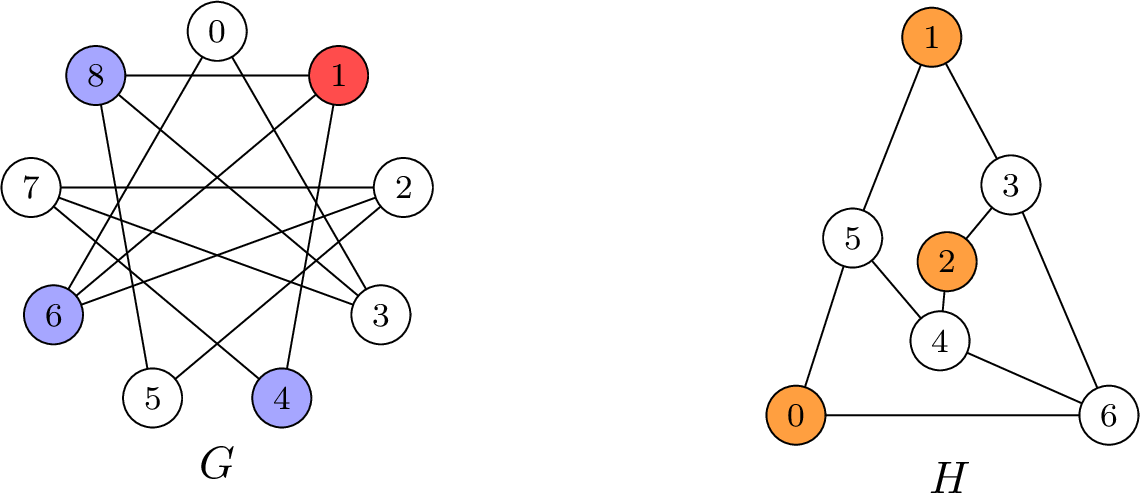
Let \(G\) be the unique order-\(9\) nontrivial \(3\)-critical graph with graph6 code HCOf@pS, let \(y=1\),
and write \(N_G(y)=\{4,6,8\}\), where the pendant edges \(f_1,f_2,f_3\) of \(D^p\) are incident with \(4,6,8\),
respectively. The verified \(D^p\)-side audit gives \[\mathcal{S}_D=\big\{\{f_1,f_2\},\{f_1,f_3\},\{f_2,f_3\}\big\}.\] Let \(H\) be the class 1 graph of
order \(7\) with graph6 code FBJKo (canonical form F@Um_), whose three degree-\(2\) vertices are \(x_1=0\), \(x_2=1\), and \(x_3=2\). For every \(e\in E(H)\), the verified \(H^p-e\) audit gives \(\mathcal{S}_H(e)\neq\emptyset\), so the \(H\)-side condition holds. Here the minimum is attained at the edge \(46\), where \[\mathcal{S}_H(46)=\big\{\{e_1,e_3\}\big\},\qquad |\mathcal{S}_H(46)|=1,\] giving a genuinely minimal Type I instance, in contrast to \(H=K_{2,3}\), for which \(|\mathcal{S}_H(e)|=3\) for every \(e\). Hence the pair in Theorem 10 is compatible of
Type I, and the resulting extension \(J\) is a nontrivial \(3\)-critical graph of order \(15\) (verified graph6 N??GgoWHICOGO@G?o@G); see
Figure 2.
2.2.0.2 Type II example.
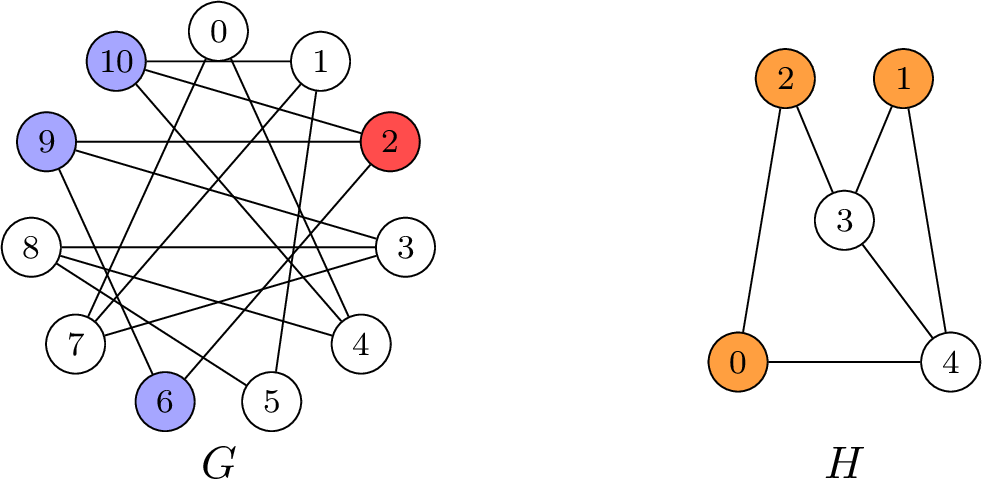
Let \(G\) be the first order-\(11\) nontrivial \(3\)-critical graph with graph6 code J?@E_[KbO?, let \(y=2\), and write \(N_G(y)=\{6,9,10\}\), where the pendant edges \(f_1,f_2,f_3\) of \(D^p\) are incident with \(6,9,10\), respectively. The verified \(D^p\)-side audit gives \[\mathcal{S}_D=\big\{\{f_1,f_2\},\{f_1,f_3\}\big\},\] so the pair \(\{f_2,f_3\}\) is not realized and \(D^p\) has no monochromatic state. Let \(H\) be the class 1 graph of order \(5\) with graph6
code DRs (canonical form DLs), whose three degree-\(2\) vertices are \(x_1=0\), \(x_2=1\), and \(x_3=2\). For every \(e\in E(H)\), the verified \(H^p-e\) audit gives \(|\mathcal{S}_H(e)|\ge 2\), with the minimum value \(2\) attained, for instance, at the edge \(02\), where \[\mathcal{S}_H(02)=\big\{\{e_1,e_2\},\{e_2,e_3\}\big\}.\] Hence the pair in Theorem 10 is compatible of Type II, and the resulting extension \(J\) is a nontrivial \(3\)-critical graph of order \(15\) (verified graph6 N?COoG?_kWGCGGOOcG_); see Figure 3.
In this Type II case, one may take \(H\) to be the graph obtained from any Kotzig graph by deleting a single vertex. Here a class 1 cubic graph is called a Kotzig graph if it has a unique proper edge \(3\)-coloring, up to a permutation of the colors.
2.2.0.3 Type III example.
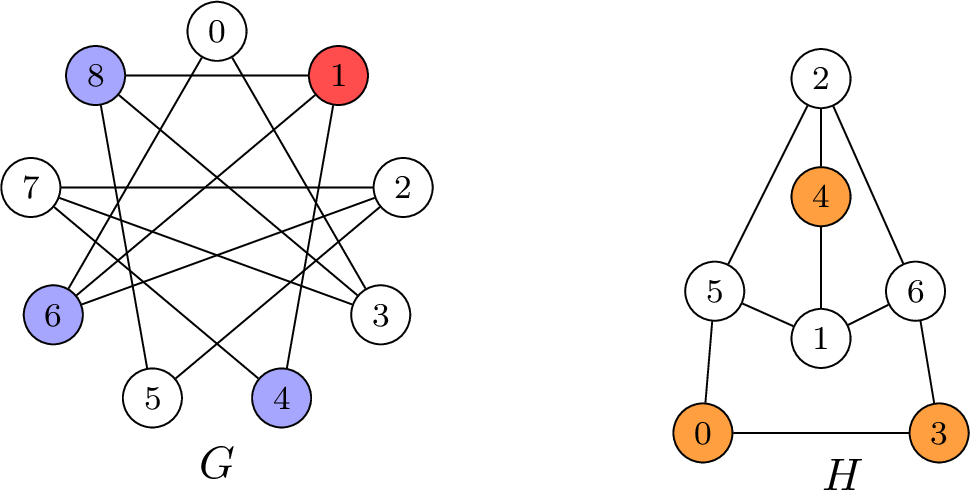
Let \(G\) be the order-\(9\) nontrivial \(3\)-critical graph with graph6 code HCOf@pS, let \(y=1\), and
write \(N_G(y)=\{4,6,8\}\), where the pendant edges \(f_1,f_2,f_3\) of \(D^p\) are incident with \(4,6,8\), respectively.
The verified \(D^p\)-side audit gives a monochromatic state. Let \(H\) be the class \(1\) graph with graph6 code FCZb_, where the three
degree-\(2\) vertices are \(x_1=0\), \(x_2=3\), and \(x_3=4\). For every \(e\in E(H)\), the
verified \(H^p-e\) audit gives a monochromatic state. Hence the pair in Theorem 10 is compatible of Type III, and
the resulting extension \(J\) is a nontrivial \(3\)-critical graph of order \(15\) (verified graph6 NpDQOG@GG@?@??D?@W); see Figure 4.
The following is a weaker converse of Theorem 10.
Theorem 11. Let \(G'\) be a cyclically \(3\)-edge-connected nontrivial \(3\)-critical graph, and let \(F=\{y_i x_i:i\in[3]\}\) be a cyclic \(3\)-edge-cut of \(G'\). Let \(H\) be one component of \(G'-F\) with \(x_1,x_2,x_3\in V(H)\), and suppose that \(H\) contains no vertex that has degree \(2\) in \(G'\). Let \(G\) be obtained from \(G'\) by contracting \(H\) to a single vertex \(y\). Let \(D=G-y\), with distinguished vertices \(y_1,y_2,y_3\), and let \(D^p\) be obtained from \(D\) by adding pendant edges \(f_i\) incident with \(y_i\) for each \(i\in[3]\). Let \(H^p\) be obtained from \(H\) by adding pendant edges \(e_i\) incident with \(x_i\) for each \(i\in[3]\).
Then the following hold.
(1) \(H\) is a connected class \(1\) graph with exactly three vertices of degree \(2\), namely \(x_1,x_2,x_3\), and all other vertices of \(H\) have degree \(3\).
(2) \(G\) is a nontrivial \(3\)-critical graph.
(3) \(G'\) is the Meredith-type extension of \(G\) through \(H\) at \(y\).
(4) \(D^p\) realizes at least two pair states. That is, for at least two pairs \(\{i,j\}\subseteq[3]\), the graph \(D^p\) has a proper edge \(3\)-coloring in which \(f_i\) and \(f_j\) receive the same color and the remaining pendant edge receives a different color.
(5) For every edge \(e\in E(H)\), either \(D^p\) and \(H^p-e\) have a common pair state, or both \(D^p\) and \(H^p-e\) have a common monochromatic state on their three pendant edges.
Proof. By Lemma 5(2), \(G'-F\) has exactly two components and \(F\) is a matching in \(G'\).
We prove the degree assertion for \(H\). Since \(H\) contains no vertex that has degree \(2\) in \(G'\), and since \(G'\) is subcubic and \(3\)-critical, every vertex of \(H\) has degree \(3\) in \(G'\). Since \(F\) is a matching in \(G'\), each vertex \(x_i\) is incident with exactly one edge of \(F\). Thus \(d_H(x_i)=2\) for each \(i\in[3]\). Every other vertex of \(H\) is incident with no edge of \(F\), and therefore has degree \(3\) in \(H\). Thus \(H\) has exactly three vertices of degree \(2\), namely \(x_1,x_2,x_3\), and all other vertices of \(H\) have degree \(3\). Also, \(H\) is connected because it is a component of \(G'-F\).
We show that \(H\) is class \(1\). Choose an edge \(g\in F\). Since \(G'\) is \(3\)-critical, \(G'-g\) has a proper edge \(3\)-coloring. Restricting this coloring to \(H\) gives a proper edge \(3\)-coloring of \(H\). Hence \(H\) is class \(1\). This proves (1).
We now prove that \(G\) is a nontrivial \(3\)-critical graph. The subgraph \(H\) is an induced proper subgraph of \(G'\), since it is a component of \(G'-F\). Moreover, \(H\) has odd order (the number of vertices of odd degree in \(H\) is even and it has exactly three vertices of even degree) with \(\mathop{\mathrm{def}}(H)=\sum_{v\in V(H)}(3-d_H(v))=3\). Thus Lemma 6 applies with \(k=3\), and the graph \(G\) obtained by contracting \(H\) is \(3\)-critical.
It remains to check that \(G\) is nontrivial. Since \(G'\) is nontrivial, \(G'\) has at least three vertices of degree \(2\). By assumption, no vertex of \(H\) has degree \(2\) in \(G'\). Hence all degree-\(2\) vertices of \(G'\) lie outside \(H\), and their degrees are unchanged when \(H\) is contracted. Thus \(G\) has at least three vertices of degree \(2\), and so \(G\) is nontrivial. This proves (2).
By the definition of \(G\), the vertex \(y\) has neighbors \(y_1,y_2,y_3\) in \(G\). Moreover, \(G'\) is obtained from \(G-y\) and \(H\) by adding the three edges \(y_i x_i\) for \(i\in[3]\). Thus \(G'\) is the Meredith-type extension of \(G\) through \(H\) at \(y\). This proves (3).
We first note that \(D^p\) has no rainbow boundary state. Indeed, if \(D^p\) had a proper edge \(3\)-coloring in which \(f_1,f_2,f_3\) received three distinct colors, then identifying the three pendant ends into a single vertex would give a proper edge \(3\)-coloring of \(G\), contradicting that \(G\) is class \(2\).
For (4), fix \(i\in[3]\), and let \(\{i,j,k\}=[3]\). Since \(G\) is \(3\)-critical, \(G-yy_i\) has a proper edge \(3\)-coloring. The two edges \(yy_j\) and \(yy_k\) receive distinct colors. Deleting \(y\) and replacing \(yy_j,yy_k\) by the pendant edges \(f_j,f_k\), and then coloring \(f_i\) with a color missing at \(y_i\), gives a proper edge \(3\)-coloring of \(D^p\). Since \(f_j\) and \(f_k\) receive distinct colors, and since \(D^p\) has no rainbow boundary state, the color on \(f_i\) must agree with exactly one of the colors on \(f_j\) and \(f_k\). Hence \(D^p\) realizes a pair state involving \(f_i\). Since this holds for every \(i\in[3]\), the graph \(D^p\) realizes at least two pair states. This proves (4).
For (5), let \(e\in E(H)\). Since \(G'\) is \(3\)-critical, \(G'-e\) has a proper edge \(3\)-coloring. Restricting this coloring to the two sides of the cut gives a proper edge \(3\)-coloring of \(D^p\) and a proper edge \(3\)-coloring of \(H^p-e\). These two colorings have the same boundary state on the three cut edges, with \(f_i\) corresponding to \(e_i\) for each \(i\in[3]\). This common state cannot be a rainbow state, since \(D^p\) has no rainbow boundary state. Therefore the common state is either a pair state or a monochromatic state. In the first case, \(D^p\) and \(H^p-e\) have a common pair state. In the second case, both \(D^p\) and \(H^p-e\) have a common monochromatic state. This proves (5). ◻
3 Proofs of Theorem 1 and Corollary 2↩︎
The proof requires the result below, which will be proved later in this section.
Lemma 12. Let \(G\) be a cyclically \(3\)-edge-connected nontrivial \(3\)-critical graph of girth at least \(4\). Assume that for every cyclic \(3\)-edge-cut \(F\) of \(G\), each component of \(G-F\) contains a vertex of degree \(2\) in \(G\). Then \(G\) has a completion \(\widehat G\) to a cyclically \(4\)-edge-connected cubic class \(2\) graph of girth at least \(4\), obtained as follows:
(1) if \(|V(G)|\) is even, then there is a pairing of all degree-\(2\) vertices of \(G\) such that adding an edge between the two vertices in each pair gives such a completion;
(2) if \(|V(G)|\) is odd, then there are three degree-\(2\) vertices \(z_1,z_2,z_3\) of \(G\) and a pairing of all remaining degree-\(2\) vertices such that adding a new vertex adjacent to \(z_1,z_2,z_3\) and adding an edge between the two vertices in each pair gives such a completion.
Proof of Theorem 1. Let \(G\) be an \(n\)-vertex nontrivial \(3\)-critical graph.
If \(G\) contains an independent triangle \(T\), then by Lemma 7 the graph \(G'\) obtained from \(G\) by contracting \(T\) to a single vertex \(x\) is \(3\)-critical. Moreover, \(G'\) is nontrivial, since the independent triangle can have at most one vertex that has degree 2 in \(G\) by Vizing’s Adjacency Lemma and in that case, the new contracted vertex also has degree 2. Thus \(G\) is obtained from \(G'\) by a vertex-blowup at \(x\), and Statement (a) holds.
Suppose next that \(G\) contains a triangle \(xyzx\) that is not independent in \(G\). Since \(\Delta(G)=3\) and \(G\ne K_4\), there is a vertex \(w\in V(G)\setminus\{x,y,z\}\) adjacent to exactly two vertices of the triangle; say \(wx,wy\in E(G)\). Let \[F=\delta_G(\{x,y,z,w\}).\] The vertices \(x\) and \(y\) already have degree \(3\), and only \(z\) and \(w\) can send edges to \(V(G)\setminus\{x,y,z,w\}\). Hence \(|F|\le 2\). Since \(G\) is connected and has no bridge, and since \(G\) is nontrivial, the set \(V(G)\setminus\{x,y,z,w\}\) is nonempty and \(|F|\ne 0,1\). Thus \(|F|=2\). Consequently both \(z\) and \(w\) have degree \(3\). Since \(G\) is 2-edge-connected and \(|F|=2\), it follows that \(G-F\) has exactly two components. Since \(G\) is nontrivial, all degree-\(2\) vertices of \(G\) lie in the other component of \(G-F\); in particular, that component has at least three vertices and contains an edge. The set \(\{x,y,z,w\}\) also induces a subgraph containing a cycle. Hence \(F\) is an essential \(2\)-edge-cut. By Lemma 9, the graph \(G\) is obtained from two smaller \(3\)-critical graphs by a Hajós-join, at least one of which is nontrivial. The same conclusion holds if \(G\) has any cyclic \(2\)-edge-cut. In either case Statement (b) holds.
We may therefore assume that \(G\) has girth at least \(4\) and is cyclically \(3\)-edge-connected.
Suppose that \(G\) has a cyclic \(3\)-edge-cut \(F\) such that one component \(H\) of \(G-F\) contains no vertex of degree \(2\) in \(G\). By Lemma 11(2), contracting \(H\) to a single vertex yields a \(3\)-critical graph \(G'\), and \(G\) is recovered from \(G'\) by a Meredith-type extension at that vertex by Lemma 11(3). The graph \(G'\) has at least three vertices of degree 2. Indeed, all degree-\(2\) vertices of \(G\) lie outside \(H\), and so they remain in \(G'\), and so \(G'\) is nontrivial. Thus Statement (c) holds.
Finally, assume that \(G\) has girth at least \(4\), is cyclically \(3\)-edge-connected, and that for every cyclic \(3\)-edge-cut \(F\) each component of \(G-F\) contains a vertex of degree \(2\) in \(G\). By Lemma 12, \(G\) can be completed to a snark \(\widehat G\). The completion described in Lemma 12 gives Statement (d) when \(n\) is odd and Statement (e) when \(n\) is even. ◻
Proof of Corollary 2. Suppose, for a contradiction, that the theorem is false, and choose a \(3\)-critical graph \(G\) of even order \(n<18\) with \(n\) minimum.
First suppose that \(G\) is trivial. Then \(G\) contains a \(3\)-overfull subgraph \(H\). Since \(G\) is edge-critical, \(H=G\); otherwise, deleting an edge of \(G\) outside \(H\) would leave the same overfull subgraph and hence would still be class \(2\), contradicting criticality. Thus \(G\) itself is overfull. But a subcubic overfull graph has odd order and exactly one vertex of degree \(2\), a contradiction. Hence \(G\) is nontrivial.
Apply Theorem 1 to \(G\).
If Theorem 1(a) holds, then \(G\) is obtained from a nontrivial \(3\)-critical graph of order \(n-2\) by a vertex-blowup. Since \(n\) is even, \(n-2\) is even, contradicting the minimality of \(n\).
If Theorem 1(b) holds, then \(G\) is obtained from two smaller \(3\)-critical graphs \(G_1\) and \(G_2\) by a Hajós-join. A Hajós-join has order \(|V(G_1)|+|V(G_2)|-1\). Since this number is even, exactly one of \(|V(G_1)|\) and \(|V(G_2)|\) is even. That even-order factor is a smaller even-order \(3\)-critical graph, again contradicting the minimality of \(n\).
If Theorem 1(c) holds, then \(G\) is obtained from a nontrivial \(3\)-critical graph \(G_0\) by a Meredith-type extension using a class 1 graph \(H\) with exactly three degree-\(2\) connector vertices and all other vertices of degree \(3\). Since \(\sum_{v\in V(H)} d_H(v)=3|V(H)|-3\) is even, \(|V(H)|\) is odd. Therefore the extension changes the order by \(|V(H)|-1\), which is even. Thus \(G_0\) has even order smaller than \(n\), contradicting the minimality of \(n\).
Theorem 1(d) cannot occur because \(n\) is even.
It remains to consider the case in Theorem 1(e). Then \(G\) is obtained from a snark \(S\) of order \(n\) by deleting some edges. Since the Petersen graph is the only snark of order less than 18 [18], \(S\) must be the Petersen graph. However, the only 3-critical subgraph of the Petersen graph is the graph obtained by deleting one vertex, a contradiction.
All cases lead to contradictions. Therefore no even-order \(3\)-critical graph of order less than \(18\) exists. ◻
3.1 Proof of Lemma 12↩︎
In the remainder of this section, we prove Lemma 12. A set \(S\subseteq V(G)\) is called a minimal cyclic \(3\)-shore if \(\delta_G(S)\) is a cyclic \(3\)-edge-cut, \(G[S]\) contains a cycle, and no proper subset of \(S\) has both properties.
The next result shows that, although the cyclic \(3\)-edge-cuts of a cyclically \(3\)-edge-connected \(3\)-critical graph need not be laminar in \(G\) itself, they become laminar after smoothing certain degree-\(2\) vertices.
Lemma 13 (Smoothing Lemma). Let \(G\) be a cyclically \(3\)-edge-connected \(3\)-critical graph. Form \(H\) by repeatedly smoothing a degree-\(2\) vertex whenever it is an endvertex of an edge belonging to a cyclic \(3\)-edge-cut. Then the cyclic \(3\)-edge-cuts of \(H\) are laminar.
Proof. Since \(G\) is \(3\)-critical, we have \(\Delta(G)=3\), \(\delta(G)\ge 2\), and \(G\) has no bridge. By Vizing’s Adjacency Lemma, no two degree-\(2\) vertices of \(G\) are adjacent, and every degree-\(3\) vertex of \(G\) has at most one neighbor of degree \(2\).
We first record that the needed properties are preserved by the smoothing process. Let \(Q\) be a current graph in the process, and suppose that a degree-\(2\) vertex \(v\) is smoothed. Let the neighbors of \(v\) be \(x\) and \(y\). Since no two degree-\(2\) vertices of \(Q\) are adjacent, both \(x\) and \(y\) have degree \(3\).
Also, by Lemma 5(2), for any cyclic 3-edge-cut \(F\) in \(Q\), \(Q-F\) has exactly two components and \(F\) is a matching in \(Q\).
The smoothing does not create parallel edges. Indeed, suppose that \(xy\in E(Q)\). Since \(v\) is smoothed, one of the edges incident with \(v\), say \(xv\), belongs to a cyclic \(3\)-edge-cut. In the corresponding shore, the vertices \(x\) and \(v\) lie on different sides. If \(y\) lies on the same side as \(v\), then \(xy\) also lies in the cut, and the two cut-edges \(xv\) and \(xy\) have the common end \(x\). If \(y\) lies on the same side as \(x\), then \(vy\) also lies in the cut, and the two cut-edges \(xv\) and \(vy\) have the common end \(v\). Both cases contradict the matching property above. Therefore \(x\) and \(y\) are nonadjacent before the smoothing.
The degree-\(2\) adjacency property is also preserved. Smoothing \(v\) deletes the degree-\(2\) neighbor \(v\) of \(x\) and \(y\) and replaces it by a degree-\(3\) neighbor. Thus no two degree-\(2\) vertices become adjacent, and no degree-\(3\) vertex gains a second degree-\(2\) neighbor.
Bridgelessness is preserved as well. Indeed, if an old edge became a bridge after the smoothing, then it was already a bridge before the smoothing. If the new edge \(xy\) were a bridge after the smoothing, then in the previous graph one of the two edges \(xv\) and \(vy\) would be a bridge, again a contradiction.
Finally, cyclically \(3\)-edge-connectedness is preserved. If smoothing \(v\) created a cyclic edge-cut of size at most \(2\), then replacing the new edge \(xy\) by the path \(xvy\), and placing \(v\) on one of the two sides, would give a cyclic edge-cut of the same size in the previous graph. This contradicts cyclically \(3\)-edge-connectedness of the previous graph.
The process terminates because each smoothing reduces the number of vertices. Thus \(H\) is subcubic, simple, bridgeless, cyclically \(3\)-edge-connected, no two degree-\(2\) vertices of \(H\) are adjacent, every degree-\(3\) vertex of \(H\) has at most one neighbor of degree \(2\), and no degree-\(2\) vertex of \(H\) is an endvertex of an edge belonging to a cyclic \(3\)-edge-cut of \(H\).
Suppose, for a contradiction, that \(H\) has two crossing cyclic \(3\)-edge-cuts. Let these cuts be \(\delta_H(A)\) and \(\delta_H(B)\). Put \[X=A\cap B,\qquad Y=A\setminus B,\qquad Z=B\setminus A,\qquad W=V(H)\setminus(A\cup B).\] See Figure 5 for an illustration of these four sets.
Since \(A\) and \(B\) cross, all four sets \(X,Y,Z,W\) are nonempty. Write \[e_{XY}=e_H(X,Y),\quad e_{XZ}=e_H(X,Z),\quad e_{XW}=e_H(X,W),\] and \[e_{YZ}=e_H(Y,Z),\quad e_{YW}=e_H(Y,W),\quad e_{ZW}=e_H(Z,W).\]

Since \(\delta_H(A)\) and \(\delta_H(B)\) both have size \(3\), we have \[\label{eq:Gstar-cutAB} e_{XZ}+e_{XW}+e_{YZ}+e_{YW}=3 \qquad\text{and}\qquad e_{XY}+e_{XW}+e_{YZ}+e_{ZW}=3.\tag{1}\] The boundary sizes of the four corners are \[|\delta_H(X)|=e_{XY}+e_{XZ}+e_{XW},\] \[|\delta_H(Y)|=e_{XY}+e_{YZ}+e_{YW},\] \[|\delta_H(Z)|=e_{XZ}+e_{YZ}+e_{ZW},\] and \[|\delta_H(W)|=e_{XW}+e_{YW}+e_{ZW}.\] Adding these four equalities gives \[|\delta_H(X)|+|\delta_H(Y)|+|\delta_H(Z)|+|\delta_H(W)| = 2(e_{XY}+e_{XZ}+e_{XW}+e_{YZ}+e_{YW}+e_{ZW}).\] On the other hand, from 1 , \[e_{XY}+e_{XZ}+e_{YW}+e_{ZW}+2e_{XW}+2e_{YZ}=6.\] Thus \[\label{eq:Gstar-corner-sum} |\delta_H(X)|+|\delta_H(Y)|+|\delta_H(Z)|+|\delta_H(W)| = 12-2e_{XW}-2e_{YZ}\le 12.\tag{2}\]
We claim that some corner has boundary size at most \(2\). Indeed, if all four corners had boundary size at least \(3\), then by 2 all four boundary sizes would be exactly \(3\), and also \[e_{XW}=e_{YZ}=0.\] Then 1 gives \[e_{XZ}+e_{YW}=3 \qquad\text{and}\qquad e_{XY}+e_{ZW}=3.\] The four corner-boundary equalities become \[e_{XY}+e_{XZ}=3,\qquad e_{XY}+e_{YW}=3,\] and \[e_{XZ}+e_{ZW}=3,\qquad e_{YW}+e_{ZW}=3.\] From the first two equations, we get \(e_{XZ}=e_{YW}\), which contradicts \(e_{XZ}+e_{YW}=3\). Hence some corner has boundary size at most \(2\).
By replacing \(A\) or \(B\) by its complement, and by interchanging \(A\) and \(B\) if necessary, we may assume that this corner is \(Z\). Indeed, if the small corner is \(X\), replace \(A\) by \(V(H)\setminus A\); if it is \(Y\), interchange \(A\) and \(B\); and if it is \(W\), replace \(B\) by \(V(H)\setminus B\). Since \(\delta_H(A)\) and \(\delta_H(B)\) are cyclic cuts, their complementary shores are also cyclic shores, and crossing is preserved. Therefore we may assume that \(|\delta_H(Z)|\le 2\).
Since \(H\) is connected and bridgeless, and since \(Z\) is nonempty and proper, we have \(|\delta_H(Z)|=2\). If \(H[Z]\) contained a cycle, then \(\delta_H(Z)\) would be a cyclic \(2\)-edge-cut, contradicting cyclically \(3\)-edge-connectedness. Hence \(H[Z]\) is acyclic.
Also \(H[Z]\) is connected. Otherwise one component of \(H[Z]\) would have boundary size at most \(1\), contradicting that \(H\) is connected and bridgeless. Hence \(H[Z]\) is a tree. Since \(|\delta_H(Z)|=2\), we have \[\sum_{v\in Z}d_H(v) = 2e_H(Z)+|\delta_H(Z)| = 2(|Z|-1)+2 = 2|Z|.\] As \(H\) is bridgeless, every vertex of \(H\) has degree at least \(2\). Hence every vertex of \(Z\) has degree exactly \(2\) in \(H\).
If \(|Z|\ge 2\), then the tree \(H[Z]\) contains an edge whose two ends both have degree \(2\) in \(H\), contradicting that no two degree-\(2\) vertices of \(H\) are adjacent. Therefore \(Z\) consists of a single vertex, say \(Z=\{z\}\), and \(d_H(z)=2\).
Now the two edges incident with \(z\) lie in the boundaries of the crossing cyclic \(3\)-cuts \(\delta_H(A)\) and \(\delta_H(B)\). Indeed, an edge from \(z\) to \(X\) lies in \(\delta_H(A)\), an edge from \(z\) to \(W\) lies in \(\delta_H(B)\), and an edge from \(z\) to \(Y\) lies in both \(\delta_H(A)\) and \(\delta_H(B)\). Thus \(z\) is a degree-\(2\) endvertex of an edge belonging to a cyclic \(3\)-edge-cut of \(H\). This contradicts the choice of the final graph \(H\), in which no such degree-\(2\) vertex remains.
Therefore no two cyclic \(3\)-edge-cuts of \(H\) cross. Hence the cyclic \(3\)-edge-cuts of \(H\) are laminar. ◻
Proof of Lemma 12. Since \(G\) is \(3\)-critical, we have \(\Delta(G)=3\), \(\delta(G)\ge 2\), and \(G\) is class \(2\). By Vizing’s Adjacency Lemma, no two degree-\(2\) vertices of \(G\) are adjacent. Moreover, if a degree-\(3\) vertex \(u\) is adjacent to a degree-\(2\) vertex, then the other two neighbors of \(u\) have degree \(3\). Therefore no two degree-\(2\) vertices of \(G\) have a common neighbor.
Let \(G^s\) be the graph obtained from \(G\) by the smoothing process in Lemma 13. Thus \(G^s\) is simple, its cyclic \(3\)-edge-cuts are laminar, and no degree-\(2\) vertex of \(G^s\) is an endvertex of an edge belonging to a cyclic \(3\)-edge-cut. Let \(Z\) be the set of degree-\(2\) vertices of \(G^s\), and let \(R\) be the set of degree-\(2\) vertices of \(G\) which are smoothed out in the process. Hence the degree-\(2\) vertices of \(G\) are exactly the vertices in \(Z\cup R\).
We shall use the following consequence of Lemma 13: if \(G^s\) has a cyclic \(3\)-edge-cut, then both sides of every cyclic \(3\)-edge-cut of \(G^s\) contain a vertex of \(Z\). Indeed, if one side of such a cut contained no vertex of \(Z\), then lifting the cut back to \(G\) and putting all smoothed boundary vertices on the other side would give a cyclic \(3\)-edge-cut of \(G\) whose one side contains no degree-\(2\) vertex, contradicting the hypothesis.
We first dispose of the case where \(G\) has no cyclic \(3\)-edge-cut. In this case no crossing condition is needed. If the number of degree-\(2\) vertices of \(G\) is even, pair them arbitrarily and add one edge for each pair. If the number of degree-\(2\) vertices of \(G\) is odd, choose any three degree-\(2\) vertices, add a new vertex adjacent to them, and pair the remaining degree-\(2\) vertices arbitrarily. Let \(\widehat G\) be the resulting graph. Then \(\widehat G\) is cubic. The arguments below show that \(\widehat G\) is simple, has girth at least \(4\), and is class \(2\). Moreover, the final cyclic-connectivity argument below would imply that any cyclic edge-cut of \(\widehat G\) of size at most \(3\) gives a cyclic \(3\)-edge-cut of \(G\), a contradiction. Hence in this case \(\widehat G\) is cyclically \(4\)-edge-connected.
Thus we may assume from now on that \(G\) has a cyclic \(3\)-edge-cut. Then \(G^s\) also has a cyclic \(3\)-edge-cut, and so \(Z\ne\emptyset\).
The cut tree. We now choose the marks to which the tree pairing will be applied. If \(|R|\) is even, put \[X=Z \qquad\text{and}\qquad R_0=R.\] If \(|R|\) is odd, choose one vertex \(w\in R\), and put \[X=Z\cup\{w\} \qquad\text{and}\qquad R_0=R\setminus\{w\}.\] In both cases, \(R_0\) has even size. The vertices in \(R_0\) will not be used in the cut tree; they will be paired arbitrarily at the end.
We construct a marked tree \(T\) for the active mark set \(X\). First suppose \(|R|\) is even. Since the cyclic \(3\)-edge-cuts of \(G^s\) are laminar, fix one vertex \(z_0\in Z\), and for each cyclic \(3\)-edge-cut of \(G^s\) choose the shore not containing \(z_0\). These chosen shores form a laminar family \(\mathcal{L}\). Adjoin \(V(G^s)\) as a root and order \(\mathcal{L}\cup\{V(G^s)\}\) by inclusion. For \(A,B\in\mathcal{L}\cup\{V(G^s)\}\), call \(B\) a child of \(A\) if \(B\subsetneq A\) and no member of \(\mathcal{L}\cup\{V(G^s)\}\) lies strictly between \(B\) and \(A\). This gives a rooted tree \(T\) whose edges correspond to the cyclic \(3\)-edge-cuts of \(G^s\). Place each vertex of \(Z\) at the smallest member of \(\mathcal{L}\cup\{V(G^s)\}\) containing it. Since both sides of every cyclic \(3\)-edge-cut of \(G^s\) contain a vertex of \(Z\), every edge of \(T\) separates marks from \(X=Z\).
Now suppose \(|R|\) is odd. Let \(w\in R\) be the chosen smoothed-out degree-\(2\) vertex, and let \(a\) and \(b\) be the two neighbors of \(w\) in the original graph \(G\). Thus, in \(G^s\), the path \(awb\) has been smoothed to a single edge \(ab\).
We use the same laminar cut tree for the cyclic \(3\)-edge-cuts of \(G^s\), but we place the additional mark \(w\) at the edge-position corresponding to the smoothed edge \(ab\). Equivalently, in the tree representation, we subdivide this position once and put the mark \(w\) at the new subdivision vertex. This is a single refinement, not a separate subdivision for each cut containing \(ab\).
Let \(Q=\delta_{G^s}(A)\) be a cyclic \(3\)-edge-cut of \(G^s\). If \(ab\notin Q\), then \(a\) and \(b\) lie on the same side of \(Q\), and the mark \(w\) is placed on that same side. If \(ab\in Q\), then exactly one of \(a,b\) lies in \(A\). Say, after relabeling, that \(a\in A\) and \(b\notin A\). After opening \(ab\) back to the path \(awb\), the cut \(Q\) has two possible lifted shores: one uses the edge \(aw\), and the other uses the edge \(wb\). These two lifted shores are nested, corresponding to placing \(w\) on one side of the cut or on the other. Thus every cyclic \(3\)-edge-cut of \(G^s\) using the smoothed edge \(ab\) is recorded by the same edge-position \(ab\), with \(w\) inserted at that position.
It remains to check that every edge of the refined tree separates the active mark set \(X=Z\cup\{w\}\). For tree edges not affected by the insertion of \(w\), this was already true because both sides of the corresponding cyclic \(3\)-edge-cut of \(G^s\) contain vertices of \(Z\). For the two new tree edges created at the position of \(ab\), the two open sides of the corresponding topological cut in \(G^s\) already contain vertices of \(Z\). Hence one new tree edge separates a side containing a vertex of \(Z\) from a side containing \(w\) and another vertex of \(Z\), while the other new tree edge separates a side containing \(w\) and a vertex of \(Z\) from a side containing another vertex of \(Z\). Therefore both new tree edges also separate marks of \(X\).
Thus, also in the case where \(|R|\) is odd, we obtain a finite marked tree \(T\) such that every edge of \(T\) separates marks from \(X=Z\cup\{w\}\).
A pairing fact for marked trees. We use the following elementary fact. Let \(T\) be a finite tree whose marks are vertices, possibly with several marks at the same vertex. Suppose that every edge of \(T\) separates marks. If the number of marks is even, then the marks can be paired so that every edge of \(T\) separates at least one pair. If the number of marks is odd, then three marks can be chosen and the remaining marks can be paired so that every edge of \(T\) either separates one of the pairs or separates the three chosen marks nontrivially, that is, each component of \(T-e\) contains at least one of the three chosen marks.
We prove the fact by induction on the number of vertices of \(T\). First we reduce to the case where every mark lies at a leaf and every leaf contains exactly one mark. Indeed, attach a new leaf for each mark and move the mark to that new leaf. If the desired pairing, or the desired choice of three marks together with a pairing of the remaining marks, works in the enlarged tree, then it also works for the original tree after deleting the added leaf edges. Thus we may assume that every mark is a leaf-mark. In particular, every leaf of \(T\) contains a mark, since an unmarked leaf would give an incident edge whose leaf side contains no mark.
If \(T\) has at most three marks, the result is immediate. If there are two marks, pair them. If there are three marks, choose all three as the special marks. Thus assume that \(T\) has at least four marks in the even case and at least five marks in the odd case.
Let \(z\) be a leaf of \(T\), and let \(m_z\) be the mark at \(z\). Delete \(z\), and then repeatedly delete any unmarked leaf that is created. Let \(T'\) be the resulting tree. Then \(T'\) contains all marks except \(m_z\), and every leaf of \(T'\) contains a mark. Hence every edge of \(T'\) separates the remaining marks: each component of \(T'-e\) contains a leaf of \(T'\), and each leaf of \(T'\) contains a mark. Therefore the induction hypothesis applies to \(T'\). Let \(r\) be the unique vertex of \(T'\) at which the deleted path from \(z\) meets \(T'\).
First suppose that the number of marks of \(T\) is odd. Then the number of marks of \(T'\) is even. By induction, the marks of \(T'\) can be paired so that every edge of \(T'\) separates at least one pair. Choose one pair \(\{a,b\}\) from this pairing. In \(T\), choose the three special marks \(m_z,a,b\), and keep all pairs of the inductive pairing except \(\{a,b\}\).
Every edge on the deleted path from \(z\) to \(r\) separates \(m_z\) from \(a,b\), and hence separates the three special marks nontrivially. Now let \(e\in E(T')\). If \(e\) is separated by one of the kept pairs, then it is covered. Otherwise, in the inductive pairing, the edge \(e\) was separated by the removed pair \(\{a,b\}\). Hence \(a\) and \(b\) lie in different components of \(T'-e\), and so the three special marks \(m_z,a,b\) are separated nontrivially by \(e\). This proves the odd case.
Now suppose that the number of marks of \(T\) is even. Then the number of marks of \(T'\) is odd. By induction, there are three special marks \(a,b,c\) in \(T'\), and the remaining marks of \(T'\) can be paired so that every edge of \(T'\) is either separated by one of the pairs or separates \(a,b,c\) nontrivially.
Let \(R'\) be the minimal subtree of \(T'\) containing \(a,b,c\). Choose a vertex \(u\in V(R')\) as follows. If one of \(a,b,c\) lies on the path between the other two, then let \(u\) be that mark. Otherwise, let \(u\) be the unique vertex of degree \(3\) in \(R'\). Thus \(R'\) is the union of the three paths from \(u\) to \(a,b,c\), where one of these paths may be trivial.
Relabel \(a,b,c\) so that \(a\ne u\) and the component of \(T'-u\) containing \(a\) does not contain \(r\). This is possible as follows. If \(u\) is not one of the three marks \(a,b,c\), then the three paths from \(u\) to \(a,b,c\) start in three distinct components of \(T'-u\), and at most one of these components contains \(r\). Hence one may choose \(a\) from a component not containing \(r\). If \(u\) is one of the three marks, then the other two marks lie in two distinct components of \(T'-u\); again at most one of these components contains \(r\), so one of the other two marks can be chosen as \(a\).
Pair \(m_z\) with \(a\), pair \(b\) with \(c\), and keep all pairs given by the induction on \(T'\). Every edge on the deleted path from \(z\) to \(r\) is separated by the pair \(\{m_z,a\}\). Now let \(e\in E(T')\). If \(e\) is separated by one of the inductive pairs, then it is covered. Otherwise, by the induction hypothesis, \(e\) separates the three marks \(a,b,c\) nontrivially. Hence \(e\) lies in \(R'\), and more precisely \(e\) lies on exactly one of the paths from \(u\) to \(a\), from \(u\) to \(b\), or from \(u\) to \(c\).
If \(e\) lies on the path from \(u\) to \(b\), or on the path from \(u\) to \(c\), then the pair \(\{b,c\}\) separates \(e\). It remains to consider the case where \(e\) lies on the path from \(u\) to \(a\). Let \(A_e\) and \(B_e\) be the two components of \(T'-e\), with \(a\in A_e\) and \(u,b,c\in B_e\). Since \(e\) lies on the path from \(u\) to \(a\), the component \(A_e\) is contained in the component of \(T'-u\) containing \(a\). By the choice of \(a\), this component does not contain \(r\). Hence \(r\in B_e\).
In the original tree \(T\), the deleted path from \(z\) to \(r\) meets \(T'\) only at \(r\). Therefore, after deleting \(e\) from \(T\), the mark \(m_z\) lies in the component containing \(r\), and hence in the component containing \(u,b,c\). Thus \(m_z\) and \(a\) lie in different components of \(T-e\), so the pair \(\{m_z,a\}\) separates \(e\). This proves the even case, and hence the pairing fact.
Choosing the completion. Apply the pairing fact to the marked tree \(T\) with mark set \(X\). Since \(|R_0|\) is even, pair the vertices of \(R_0\) arbitrarily.
If \(|X|\) is even, pair the marks of \(X\) as given by the even case of the pairing fact, and add one new edge for each pair, including the arbitrary pairs in \(R_0\).
If \(|X|\) is odd, choose three special marks in \(X\) and pair the remaining marks of \(X\) as given by the odd case of the pairing fact. Add a new vertex \(x\) adjacent to the three special marks, and add one new edge for each pair, including the arbitrary pairs in \(R_0\).
Let \(\widehat G\) be the resulting graph. Every degree-\(2\) vertex of \(G\) receives exactly one new incident edge, and in the odd case the new vertex \(x\) has degree \(3\). Hence \(\widehat G\) is cubic. We call the added edges, and in the odd case the three edges incident with \(x\), the completion edges.
The crossing property. We claim that every cyclic \(3\)-edge-cut of \(G\) is crossed by at least one completion edge.
Let \(C\) be a cyclic \(3\)-edge-cut of \(G\). If \(|R|\) is even, project \(C\) onto the corresponding cyclic \(3\)-edge-cut of \(G^s\) by replacing each edge of \(C\) with its corresponding smoothed edge in \(G^s\). More precisely, if \(uv\in C\) and \(d_G(u)=d_G(v)=3\), then \(uv\in E(G^s)\). If one of \(u\) and \(v\) has degree 2 in \(G\), say \(d_G(v)=2\), then \(uv\) is replaced by \(uw\in E(G^s)\), where \(w\) is the other neighbor of \(v\) in \(G\). If \(|R|\) is odd, do the same projection for all vertices of \(R_0\), but keep the chosen vertex \(w\) open. Thus in both cases \(C\) determines an edge \(e_T\) of the marked tree \(T\).
If \(|X|\) is even, then by the pairing fact some paired pair of marks in \(X\) is separated by \(e_T\). The corresponding completion edge crosses \(C\).
If \(|X|\) is odd, then either \(e_T\) separates one of the paired pairs, or \(e_T\) separates the three special marks nontrivially. In the first case, the completion edge joining that pair crosses \(C\). In the second case, no matter which side of the cut contains the new vertex \(x\), at least one of the three edges from \(x\) to the special marks crosses \(C\).
This proves the crossing property.
\(\widehat G\) is simple and has girth at least \(4\). By Vizing’s Adjacency Lemma applied to the \(3\)-critical graph \(G\), no two degree-\(2\) vertices of \(G\) are adjacent or share a common neighbor. Each degree-\(2\) vertex is used exactly once in the completion. Therefore no completion edge duplicates an edge of \(G\), and no completion edge creates a triangle. In the case where the new vertex \(x\) is added, its three neighbors are degree-\(2\) vertices of \(G\), and these are pairwise nonadjacent. Thus no triangle passes through \(x\). Since \(G\) has girth at least \(4\), it follows that \(\widehat G\) has girth at least \(4\).
\(\widehat G\) is class \(2\). This follows since \(G\subseteq \widehat G\) and \(G\) is class \(2\).
\(\widehat G\) is cyclically \(4\)-edge-connected. We first record an auxiliary fact. Let \(D\) be one side of an edge-cut of \(G\) of size at most \(3\), and suppose that \(G[D]\) is acyclic. If \(G[D]\) has \(q\) components, then \[\sum_{v\in D}(d_G(v)-2)=|\delta_G(D)|-2q.\] Since \(\delta(G)\ge 2\) and \(|\delta_G(D)|\le 3\), this forces \(q=1\). Thus \(G[D]\) is a tree and the left-hand side is at most \(1\). Hence \(D\) contains at most one vertex of degree \(3\) in \(G\), and all other vertices of \(D\) have degree \(2\) in \(G\). If \(D\) contained two degree-\(2\) vertices of \(G\), then, in this tree, there would either be two adjacent degree-\(2\) vertices or two degree-\(2\) vertices with a common neighbor, contradicting Vizing’s Adjacency Lemma. Hence \[\label{eq:acyclic-side} \text{an acyclic side of an edge-cut of G of size at most 3 contains at most one degree-2 vertex of G.}\tag{3}\]
Suppose, for a contradiction, that \(\widehat G\) has a cyclic edge-cut \(F=\delta_{\widehat G}(A)\) with \(|F|\le 3\). Put \[A_0=A\cap V(G) \qquad\text{and}\qquad C_0=\delta_G(A_0).\] Then \(C_0\subseteq F\), because every edge of \(G\) crossing between \(A_0\) and \(V(G)\setminus A_0\) also crosses between \(A\) and \(V(\widehat G)\setminus A\). Hence \(|C_0|\le 3\).
We claim that both \(G[A_0]\) and \(G[V(G)\setminus A_0]\) contain a cycle. Suppose first that \(G[A_0]\) is acyclic. By 3 , \(A_0\) contains at most one degree-\(2\) vertex of \(G\). Since \(F\) is cyclic, the \(A\)-side of \(\widehat G-F\) contains a cycle. This cycle cannot lie entirely in \(G[A_0]\), so it uses a completion edge. A paired completion edge with exactly one end in \(A_0\) lies in \(F\) and is absent from the \(A\)-side of \(\widehat G-F\). Hence any paired completion edge used by the cycle has both ends in \(A_0\), giving at least two degree-\(2\) vertices of \(G\) in \(A_0\). In the case where the cycle uses the new vertex \(x\), it uses two edges incident with \(x\), and again their old ends give at least two degree-\(2\) vertices of \(G\) in \(A_0\). Both possibilities contradict 3 . Therefore \(G[A_0]\) contains a cycle. The same argument applied to the other side shows that \(G[V(G)\setminus A_0]\) contains a cycle.
Thus \(C_0\) is a cyclic edge-cut of \(G\) with \(|C_0|\le 3\). Since \(G\) is cyclically \(3\)-edge-connected, we have \(|C_0|=3\). If \(G\) has no cyclic \(3\)-edge-cut, this is already a contradiction. Otherwise, \(C_0\) is a cyclic \(3\)-edge-cut of \(G\), and by the crossing property some completion edge crosses \(C_0\). Therefore this completion edge lies in \(F\).
But \(C_0\subseteq F\) and the three edges of \(C_0\) are edges of \(G\), while the completion edge is not an edge of \(G\). Hence \(|F|\ge |C_0|+1=4\), contradicting \(|F|\le 3\). Therefore \(\widehat G\) has no cyclic edge-cut of size at most \(3\), and so \(\widehat G\) is cyclically \(4\)-edge-connected.
Combining the preceding parts, \(\widehat G\) is a cyclically \(4\)-edge-connected cubic class \(2\) graph of girth at least \(4\). ◻
4 Algorithmic Aspects↩︎
In this section we describe the search pipeline used to enumerate the nontrivial \(3\)-critical graphs of orders \(13\) through \(22\). We first give the pipeline overview in Subsection 4.1, then record the per-order statistics in Subsection 4.2, and finally give the census categorization in Subsection 4.3.
Data and code availability. All census output files, machine-readable audit reports, and search/audit code referenced in this paper are archived in the public repository
(release v1.1.1). A permanently archived snapshot of this release is deposited on Zenodo with concept DOI 10.5281/zenodo.20821990 [19], which always resolves to the latest version. Throughout the paper, file paths of the forms results/…, reports/…, and code/… are relative to this repository, which we call the
data repository. The README records SHA-256 hashes of the census files and gives a file-to-claim mapping. The implementation is under code/. Its input and output are graph6 strings, and the manuscript-facing records are the per-order
JSON files under results/.
4.1 Pipeline overview↩︎
The pipeline processes each target order \(n\) in five stages.
Generate. The program calls
gengfrom thenautypackage with the flags \[\texttt{-Cq -d2 -D3 } n .\] Thus only \(2\)-connected graphs with minimum degree at least \(2\) and maximum degree at most \(3\) are generated. The exact command used by the current code is built incode/main.py. For example, at order \(13\) this generation step produces \(11{,}679\) candidates.Prune. A generated graph is discarded if it satisfies either of the following two filters from \[\texttt{code/critical\_graph\_search/pruning.py}.\]
It is bipartite. By Kőnig’s Theorem, every bipartite graph is class \(1\) [20].
It is regular. In the present subcubic search, regular candidates cannot contribute to the \(3\)-critical census: \(2\)-regular candidates have maximum degree \(2\), while cubic candidates are not \(3\)-critical.
Class \(2\) test. For each remaining candidate, the program checks whether \(G\) is \(\Delta(G)\)-edge-colorable by backtracking. If such a coloring exists, then \(\chi'(G)=\Delta(G)\) and the graph is discarded.
Edge-criticality test. For each class \(2\) candidate, the program verifies that \(G-e\) is \(\Delta(G)\)-edge-colorable for every edge \(e\in E(G)\). This is the implemented \(\Delta\)-criticality test in \[\texttt{code/critical\_graph\_search/criticality.py}.\] The primary census uses the bitmask backtracking implementation. The companion reference backtracking implementation in
code/critical_graph_search/edge_coloring.pyis used in later audit scripts to cross-check the manuscript-facing survivors.Overfull-subgraph test. Finally, the program searches all odd induced subgraphs \(H\) and discards \(G\) if \[|E(H)|>\Delta(G)\left\lfloor\frac{|V(H)|}{2}\right\rfloor.\] Such a graph contains a \(\Delta(G)\)-overfull subgraph and is treated as trivial for the purposes of this census. The remaining graphs are the nontrivial \(3\)-critical survivors.
The per-order statistics produced by these stages are recorded in Subsection 4.2.
4.2 Per-order statistics↩︎
Table 2 records the quantitative throughput of the pipeline for the five odd orders used in the census. The column “After pruning” is the generated count minus the graphs removed by the two pruning filters (F1) and (F2). The column “Class 1 / non-critical” records the remaining graphs that are either \(3\)-edge-colorable or fail the edge-criticality test.
| Order \(n\) | Generated | After pruning | Class 1 / non-critical | Total critical | Overfull critical | Nontrivial survivors |
|---|---|---|---|---|---|---|
| \(13\) | \(11{,}679\) | \(11{,}380\) | \(10{,}624\) | \(755\) | \(741\) | \(14\) |
| \(15\) | \(165{,}993\) | \(163{,}531\) | \(156{,}559\) | \(6{,}971\) | \(6{,}877\) | \(94\) |
| \(17\) | \(2{,}756{,}486\) | \(2{,}732{,}845\) | \(2{,}655{,}174\) | \(77{,}670\) | \(76{,}896\) | \(774\) |
| \(19\) | \(51{,}643{,}246\) | \(51{,}387{,}795\) | \(50{,}380{,}366\) | \(1{,}007{,}427\) | \(1{,}000{,}443\) | \(6{,}984\) |
| \(21\) | \(1{,}068{,}435{,}908\) | \(1{,}065{,}397{,}521\) | \(1{,}050{,}610{,}728\) | \(14{,}786{,}792\) | \(14{,}716{,}262\) | \(70{,}530\) |
3pt
The computation scales from \(11{,}679\) generated candidates at order \(13\) to \(1{,}068{,}435{,}908\) generated candidates at order \(21\). Among the critical graphs, the overfull fraction is very high: in every row of Table 2, it is above \(98\%\). Thus most graphs passing the class \(2\) and edge-criticality tests are removed by the overfull-subgraph obstruction. The nontrivial survivor counts are \[14,\;94,\;774,\;6{,}984,\;70{,}530,\] which grow rapidly along the odd orders and suggest a conjectural growth pattern. Empirically, each step of \(+2\) in the order multiplies the number of generated candidates by roughly a factor of \(18\) and the number of nontrivial survivors by roughly a factor of \(10\) (for example, \(6{,}984\) at order \(19\) versus \(70{,}530\) at order \(21\)); the corresponding CPU cost grows by a factor of about \(22\) per step. These ratios are what make the exhaustive census beyond order \(22\) computationally demanding and motivate the finite scope adopted here.
For reproducibility, the SHA-256 hashes of the source JSON files order_n_delta_3.json or compressed order_n_delta_3.json.gz, for \(n=13,15,17,19,21\), are respectively \[\begin{gather}
\texttt{799aae0712bfb53b10279cdb178abd9ae2b55924f134d2fd3f9154ad4527ef10},\\
\texttt{c5c391d32a4019a6765e236ac9bfbd292572722073fbb72312d4ecbf91293162},\\
\texttt{c7447e9626f53cdb8a381376ec76eb95a58368bab85dd16dd02ba6d4f7b9a269},\\
\texttt{9f4eff7e13636fce3bcd3fc69cd2a3dfb36f1ad80e01656509fc6b9927f92b1e},\\
\texttt{2f9c3e46d744dc0b62a95631e050af657806ec76ae03a286f7e845c69cff24db}.
\end{gather}\] The critical split is exact in each file: \[\text{Total critical} = \text{Overfull critical} + \text{Nontrivial survivors}.\] The broader post-pruning ledger is also consistent in the required
direction: “After pruning” is at least “Class 1 / non-critical” plus “Total critical” in every row. The JSON records have residual slacks of \(1\), \(1\), \(1\), \(2\), and \(1\) graphs for \(n=13,15,17,19,21\), respectively.
For completeness, we also ran the same pipeline at the even orders. By the result of Brinkmann and Steffen [13], there is no nontrivial \(3\)-critical graph of even order below \(22\), and exactly one of order \(22\); our pipeline reproduces this. Table 3 records the even-order throughput.
| Order \(n\) | Generated | After pruning | Class 1 / non-critical | Total critical | Overfull critical | Nontrivial survivors |
|---|---|---|---|---|---|---|
| \(14\) | \(43{,}418\) | \(41{,}751\) | \(41{,}750\) | \(0\) | \(0\) | \(0\) |
| \(16\) | \(666{,}854\) | \(653{,}513\) | \(653{,}512\) | \(0\) | \(0\) | \(0\) |
| \(18\) | \(11{,}780{,}245\) | \(11{,}650{,}297\) | \(11{,}650{,}296\) | \(0\) | \(0\) | \(0\) |
| \(20\) | \(232{,}275{,}898\) | \(230{,}799{,}117\) | \(230{,}799{,}116\) | \(0\) | \(0\) | \(0\) |
| \(22\) | \(5{,}022{,}269{,}988\) | \(5{,}003{,}271{,}897\) | \(5{,}003{,}271{,}895\) | \(1\) | \(0\) | \(1\) |
3pt
At the even orders \(14,16,18\), and \(20\), the pipeline finds no \(3\)-critical graphs. At order \(22\), it leaves exactly one nontrivial survivor, agreeing with the known Brinkmann–Steffen count. In every recorded row, the identity \[\text{Total critical} = \text{Overfull critical} + \text{Nontrivial survivors}\] holds, and the post-pruning ledger carries the same residual slack of \(1\) graph seen at the odd orders.
For order \(22\), the final run generated \(5{,}022{,}269{,}988\) \(2\)-connected subcubic graphs and left exactly one nontrivial \(3\)-critical survivor. The source file is results/order_22_delta_3.json.gz, with compressed SHA-256 hash \[\texttt{57dbfccd9cb352564f5422530c9a0b7e269148c9789bf040f0dfd7ab96ed553e}.\] A separate audit of the single survivor checks both edge-criticality and non-overfullness with the primary and reference implementations.
4.3 Categorization according to Theorem 1↩︎
For each order \(n\in\{13,15,17,19,21,22\}\), we categorize each survivor by the first applicable case in the proof of Theorem 1. First, if \(G\) has an independent triangle, then it falls under clause (a), the vertex-blowup case. Second, if \(G\) has a triangle but no independent triangle, then it falls under clause (b), the Hajós-join case, by Theorem 9. Third, if \(G\) has no triangle but has a cyclic \(2\)-edge-cut, then it again falls under clause (b).
Now suppose that \(G\) has girth at least \(4\) and is cyclically \(3\)-edge-connected. There are two cases. In the first case, some cyclic \(3\)-edge-cut side \(H\) contains no vertex that has degree \(2\) in \(G\). Then, by Theorem 11, we may contract \(H\) to a degree-\(3\) vertex of a smaller nontrivial \(3\)-critical graph. Hence \(G\) is a Meredith-type extension and falls under clause (c). In the second case, every cyclic \(3\)-edge-cut side contains a degree-\(2\) vertex of \(G\). Then, by Lemma 12, \(G\) has a snark completion. If \(n\) is odd, then \(G\) is obtained from a snark of order \(n+1\) by deleting one vertex and some edges, so it falls under clause (d). If \(n\) is even, then \(G\) is obtained from a snark of order \(n\) by deleting some edges, so it falls under clause (e).
Applying this decision procedure to the full survivor censuses gives the partition recorded in Table 4. In every row, the four category counts sum exactly to the number of nontrivial survivors of that order. For the odd orders, the snark-completion column is clause (d), while for the even order \(n=22\) it is clause (e). The vertex-blowup clause (a) dominates at every order: it accounts for \(5{,}928\) of the \(6{,}984\) order-\(19\) survivors and \(60{,}479\) of the \(70{,}530\) order-\(21\) survivors.
| Order \(n\) | Survivors | (a) Vertex-blowup | (b) Hajós-join | (c) Meredith-type | (d)/(e) Snark-completion |
|---|---|---|---|---|---|
| \(13\) | \(14\) | \(10\) | \(3\) | \(1\) | \(0\) |
| \(15\) | \(94\) | \(76\) | \(13\) | \(5\) | \(0\) |
| \(17\) | \(774\) | \(639\) | \(91\) | \(18\) | \(26\) |
| \(19\) | \(6{,}984\) | \(5{,}928\) | \(712\) | \(140\) | \(204\) |
| \(21\) | \(70{,}530\) | \(60{,}479\) | \(6{,}693\) | \(1{,}001\) | \(2{,}357\) |
| \(22\) | \(1\) | \(0\) | \(0\) | \(0\) | \(1\) |
4pt
Declaration of Use of AI Tools↩︎
In the course of this work, the authors used AI-based tools—large language models (including ChatGPT 5.5 and Claude Opus) and AI coding assistants—in the following ways. The candidate graphs were generated by geng from the
nauty suite; AI coding assistants helped develop, debug, and document the search, classification, and audit code used to produce and categorize the census, which is archived in the data repository (see the data-and-code availability statement
in Section 4). The authors established and proved Theorem 1 through their own mathematical analysis, informed by
examining the generated graphs. The authors also used a large language model to assist with language editing, grammar, clarity, and formatting of the manuscript. The authors reviewed, tested, and verified all AI-assisted code, and independently checked all
definitions, statements, proofs, and computational results. The authors assume responsibility for all content.
Acknowledgments↩︎
This work was completed in part with resources provided by the Auburn University Easley Cluster.
References↩︎
Department of Mathematics and Statistics, Auburn University, Auburn, AL 36849. Email:
le.chen@auburn.edu. Supported in part by NSF grants DMS-2246850 and DMS-2443823 and by a Collaboration Grant for Mathematicians (#959981) from the Simons Foundation.↩︎Department of Mathematics and Statistics, Auburn University, Auburn, AL 36849, USA. Email:
szs0398@auburn.edu. Supported in part by NSF grant DMS-2451895.↩︎