Computating decomposition groups and inertia groups using Newton polygons
June 25, 2026
Abstract
Newton polygons are powerful tools for computing the decomposition of prime ideals in extension rings. Methods based on Newton polygons have been developed through the work of Ore, Montes, and Nart. Kölle and Schmid obtained a method for determining decomposition groups from Newton polygons and associated data under assumptions introduced by Ore. In this paper, we extend their approach and show how to determine decomposition groups under the weaker assumptions introduced by Montes and Nart, formulated in terms of indices.
1 Keywords: Galois group, Newton polygon, index of equation order.
1 Introduction↩︎
In general, describing the prime ideal decomposition of a given extension of number fields is a highly difficult and fundamental problem in number theory. In 1878, Dedekind, in his paper [1], proved that under certain conditions, the prime ideal decomposition corresponds to the factorization of the defining polynomial into irreducible factors over the residue field. Dedekind’s theorem is well known to be remarkable both theoretically and computationally, although its applicability is limited.
In 1928, Ore extended Dedekind’s approach by introducing the Newton polygon method, which enables the determination of the prime ideal decomposition under a weaker condition, called regularity. Ore’s theorem applies in far more cases than Dedekind’s theorem and describes the decomposition in terms of Newton polygons.
Furthermore, in 1992, Montes and Nart refined Ore’s method and succeeded in computing prime ideal decompositions under an even weaker condition. The condition is necessary and sufficient for the applicability of their method.
On the other hand, Dedekind’s theorem has also inspired further developments in the study of Galois groups. Beckmann (in [2]) observed that, under the assumptions of Dedekind’s theorem, the cycle type of a generator of the inertia group of a tamely ramified prime can be determined. As she was unable to locate a proof of this statement, she provided one in her paper.
Furthermore, in 2004-2009, Kölle and Schmid extended these ideas by establishing an analogue of the above theorem under the assumption of Ore. Their method, which makes substantial use of local field theory, not only enabled the computation of decomposition and inertia groups but also led to further developments in this area.
In this paper, we aim to establish an analogue of the theorem of Kölle and Schmid under the assumption of Montes and Nart (11 16). In particular, we refine the polynomial construction of Kölle and Schmid, which is based on Ore’s method, within the framework of Montes and Nart.
2 Preliminaries↩︎
Let \(p\) be a prime number. Fix an algebraic closure \(\overline{\mathbb{Q}}_p\) (resp. \(\overline{\mathbb{F}}_p\)) of \(\mathbb{Q}_p\) (resp. \(\mathbb{F}_p\)). Throughout, every algebraic extension of \(\mathbb{Q}_p\) (resp. \(\mathbb{F}_p\)) is regarded as a subfield of \(\overline{\mathbb{Q}}_p\) (resp. \(\overline{\mathbb{F}}_p\)). Let \(K\) be a finite extension of \(\mathbb{Q}_p\). We denote by \(\mathcal{O}_K\) the ring of integers of \(K\), by \(\mathfrak{p}_K\) the prime ideal of \(\mathcal{O}_K\), by \(\mathbb{F}_K\) the residue field, and by \(v_K\) the valuation of \(\overline{\mathbb{Q}}_p\) normalized by \(v_K(K^{\times}) = \mathbb{Z}\). We fix a uniformizer \(\pi \in \mathcal{O}_K\). For \(a \in \mathcal{O}_K\), the image of \(a\) in \(\mathbb{F}_K\) is denoted by \(\overline{a}\). We shall denote the image of \(\varphi(X) \in \mathcal{O}_K [X]\) in \(\mathbb{F}_K [X]\) also by \(\overline{\varphi}(X)\). In this paper, we assume that a polynomial \(f\) is separable.
2.1 Newton polygons↩︎
We define \(\varphi\)-polygons, which generalize the classical Newton polygon, and the polynomials associated to them. To this end, we extend the valuation \(v_K\) to \(\mathcal{O}_K[X]\), which we denote by the same symbol, by \[\begin{align} v_K:\mathcal{O}_K[X] & \rightarrow \mathbb{Z}_{\ge 0} \cup \{ \infty \}, \\ a_0 + a_1 X + \cdots + a_n X^n & \mapsto \min\{v_K(a_i):0 \le i \le n \}. \end{align}\] Let \(\varphi(X) \in \mathcal{O}_K[X]\) be a monic irreducible polynomial of degree \(l \ge 1\) such that its reduction \(\overline{\varphi}(X)\) is also irreducible over \(\mathbb{F}_K\). Fix a root \(\zeta\) of \(\overline{\varphi}\). Given a polynomial \(f(X) \in \mathcal{O}_K[X]\) of degree \(n\), we obtain a unique \(\varphi\)-expansion as \[f(X) = \sum_{i = 0}^{[n/l]} a_i(X) \varphi(X)^i,\] where each \(a_i(X) \in \mathcal{O}_K[X]\) is a polynomial of degree \(< l\) or \(a_i(X)=0\). Throughout, we assume \(a_0(X) \ne 0\).
When \(f(X) \in \mathcal{O}_K[X]\) is expanded as above, we define the \(\varphi\)-polygon of \(f(X)\) as the lower convex envelope in the Euclidean plane of points \(\{(i,v_K(a_i))|0 \le i \le [n/l]\}\). When \(\varphi(X) = X\), the \(\varphi\)-polygon is the classical Newton polygon. If \(f(X)\) is a monic polynomial, we call the set of sides with negative slope the principal part of \(\varphi\)-polygon. When \(\overline{\varphi}\) does not divide \(\overline{f}\), the \(\varphi\)-polygon of \(f\) has no principal part. We say that the \(\varphi\)-polygon is one-sided when it has exactly one side; otherwise, we say that it is many-sided.
In general, let \(S\) be a line segment in \(\mathbb{R}^2\) with negative slope and its endpoints having integer coordinates. Let its initial point be \((r,s)\) and its terminal point be \((r + E,s - H)\). We call \(E\) the length of \(S\) and \(H\) the height of \(S\), denoted \(E(S)\) and \(H(S)\), respectively. We define \[d = \gcd(E(S),H(S)),\] and call \(d\) the degree of \(S\). If \(H = E = 0\), we set \(d = 0\).
Let \(f(X) \in \mathcal{O}_K[X]\) be a monic polynomial, and \(S\) be a line segment in \(\{ (x,y) \in \mathbb{R}^2 \mid x \ge 0, y \ge 0 \}\) with negative slope and its endpoints having integer coordinates. Suppose that no vertex of the \(\varphi\)-polygon of \(f\) lies below \(S\). We denote the endpoints of \(S\) by \(P = (e_0,h_0)\) and \(Q = (e_1,h_1)\), where \(e_0 \le e_1\). Write \(d\) for the degree of \(S\). Put \[b_j(X) = \pi^{-h_0 + jh} a_{e_0 + je},\] where \(h = \frac{h_0 - h_1}{d}, e = \frac{e_1 - e_0}{d}\). We define the polynomial associated to \(f\) and \(S\), or the associated polynomial of \(f\) and \(S\) as \[f_S(Y) = \sum_{j=0}^d \overline{b_j}(\zeta) Y^j.\] If no vertex lies on \(S\), we set \(f_S(Y) = 0\). We also define the normalized associated polynomial by \[f_S^{\mathrm{norm}}(Y) = \overline{b_d}(\zeta)^{-1} \sum_{j=0}^d \overline{b_j}(\zeta) Y^j.\]
We now define the associated polynomial for a general line or line segment \(S\). Let \(V\) be the set of integer lattice points lying on \(S \cap \{ (x,y) \in \mathbb{R}^2 \mid x \ge 0, y \ge 0 \}\). We denote by \(P, Q\) the points of \(V\) with minimal and maximal abscissa, respectively, and set \(S'\) to be the line segment between \(P\) and \(Q\). We define the associated polynomials of \(f\) and \(S\) by \(f_S = f_{S'}\) and \(f^{\mathrm{norm}}_S = f^{\mathrm{norm}}_{S'}\).
Remark 1. If \(f = \varphi^m\) and the \(\varphi\)-polygon of \(f\) is one-sided, then \(f_S = f_S^{\mathrm{norm}}\).
2.2 Works of Ore, Montes and Nart on Newton polygons↩︎
In this section, we review the works of Ore and of Montes–Nart on Newton polygons.
The following two theorems are well-known facts about Newton polygons.
Theorem 2 (Theorem of the product). Let \(f_1, \dots ,f_g \in \mathcal{O}_K[X]\) be monic polynomials, and write \(f(X) = f_1(X) \cdots f_g(X)\). Let \(S_{i,1}, \dots S_{i,k_i}\) be the sides of the principal part of the \(\varphi\)-polygon of \(f_i\). We define \(M=\{-H(S_{i,j})/E(S_{i,j}) \in \mathbb{Q}_{< 0} \mid 1 \le i \le g,1 \le j \le k_i\}\), and let \(M'\) be the set of slopes of the sides in the principal part of the \(\varphi\)-polygon of \(f\). Then, \(M=M'\), and for any side \(S\) of the \(\varphi\)-polygon of \(f\) with slope \(-m\), we have \[E(S)=\sum_{\substack{i,j\\H(S_{i,j})/E(S_{i,j})=m}} E(S_{i,j}), H(S)=\sum_{\substack{i,j\\H(S_{i,j})/E(S_{i,j})=m}} H(S_{i,j}).\] Moreover, for any \(m \in \mathbb{Q}_{>0}\), let \(S_m\) be a side of the \(\varphi\)-polygon of \(f\) of slope \(-m\), and let \(S_{i,m}\) be a side of the \(\varphi\)-polygon of \(f_i\) of slope \(-m\). Then, \[f_S^{\mathrm{norm}}(Y) = \sideset{}{'}\prod_{i}f_{S_{i,m}}^{\mathrm{norm}}(Y),\] where the product runs over all \(i\) such that the \(\varphi\)-polygon of \(f_i\) has a side of slope \(-m\).
Theorem 3 (Theorem of the polygon). Let \(f \in \mathcal{O}_K[X]\) be a monic polynomial whose reduction is a power of \(\varphi\) and whose \(\varphi\)-polygon consists of the sides \(S_1, \dots ,S_g\). Let the slope of \(S_{i}\) be \(-m_i\). Then, there exist monic polynomials \(f_1, \dots ,f_g \in \mathcal{O}_K[X]\) satisfying the following conditions:
\(f(X) = \displaystyle \prod_{i = 1}^g f_i(X)\).
The \(\varphi\)-polygon of \(f_i\) is one-sided, and it has the same length and height as \(S_{i}\).
Let \(S_{i}\) also denote the \(\varphi\)-polygon of \(f_i\), then \(f_{S_{i}}^{\mathrm{norm}}(Y) = (f_i)_{S_{i}}^{\mathrm{norm}}(Y)\).
If \(\theta \in \overline{\mathbb{Q}}_p\) is a root of \(f_i(X)\), then \(v_K(\varphi(\theta)) = m_i\).
Let \(f \in \mathcal{O}_K[X]\) be a monic polynomial whose \(\varphi\)-polygon is one-sided, and denote this polygon by \(S\). We say \(f\) is regular if the associated polynomial \(f_S(Y)\) is separable. For a regular polynomial, Ore showed that the ramification index and inertia degree of the field defined by the polynomial can be computed from the \(\varphi\)-polygon.
Theorem 4 (Theorem of Ore). Let \(f(X) \in \mathcal{O}_K[X]\) be a monic polynomial whose \(\varphi\)-polygon is one-sided, and denote this polygon by \(S\). Suppose that \(\overline{f}(Y) = \overline{\varphi}(Y)^n (n \in \mathbb{Z}_{\ge 0})\). We write \(e=E(S)/d\) and \(h=H(S)/d\). Let \[f_S(Y) = \psi_1(Y)^{e_1} \cdots \psi_t(Y)^{e_t}\] be the factorization of \(f_S^{\mathrm{norm}}\) into a product of powers of distinct irreducible polynomials of \(\mathbb{F}_K[Y]\). Then \(f\) admits a factorization \[f(X) = f_1(X) \cdots f_t(X),\] where each \(f_i(X)\) is a monic polynomial with a one-sided \(\varphi\)-polygon \(S_{i}\) of the same slope as \(S\), and whose associated polynomial \((f_i)_{S_{i}}(Y)\) equals \(\psi_i(Y)^{e_i}\). Moreover, we suppose that \(f(X)\) is regular (i.e., \(e_1 = \cdots = e_t = 1\)), and let \(\theta\) be a root of \(f_i(X)\) and \(L = K(\theta)\). Then, all \(f_i\) are irreducible, the prime ideal of \(L\) equals \((\varphi(\theta)^b/\pi^c)\mathcal{O}_L\) where \(b\) and \(c\) are positive integers such that \(bh - ce = 1\), and \(\mathcal{O}_L\) is the ring of integers of \(L\), and \[e(L/K) = e, f(L/K) = l \cdot \deg \psi_i(Y).\]
Now, we define the two indices \(i_K(f)\) and \(i_\varphi(f)\) of a polynomial.
Definition 1. For a monic polynomial \(f(X) \in \mathcal{O}_K[X]\), we define \(i_K(f)\) as follows:
If \(f(X)\) is irreducible, choose a root \(\theta\), and put \(L=K(\theta)\). We then define \[i_K(f) = v_K([\mathcal{O}_L:\mathcal{O}_K[\theta]])/[K:\mathbb{Q}_p].\]
For monic irreducible polynomials \(g(X),h(X) \in \mathcal{O}_K[X]\), we set \[r(g,h) = v_K(\mathrm{Res}(g,h)),\] where \(\mathrm{Res}(g,h)\) is the resultant of \(g(X)\) and \(h(X)\).
Let \(f(X)\) be a product of monic irreducible polynomials \(f_1(X), \dots ,f_t(X) \in \mathcal{O}_K[X]\). We define \[i_K(f) = \sum_{i = 1}^t i_K(f_i) + \sum_{i<j} r(f_i,f_j).\]
Definition 2. Let \(f(X) \in \mathcal{O}_K[X]\) be a monic polynomial, and suppose that the principal part of the \(\varphi\)-polygon of \(f(X)\) consists of the sides \(S_1, \dots ,S_r\). For each \(i\), denote the length, height, and degree of \(S_{i}\) by \(E_i\), \(H_i\), and \(d_i\), respectively. Then, we define \[i_{\varphi}(f) = \deg\varphi\cdot\left(\sum_{i = 1}^{r - 1} E_i \cdot \left(\sum_{j = i + 1}^r H_j\right) + \frac{1}{2} \sum_{i = 1}^r (H_i E_i - H_i - E_i + d_i)\right).\]
The quantity \(i_{\varphi}(f)/\deg\varphi(X)\) represents the number of points of integer coordinates below or on the \(\varphi\)-polygon of \(f\), excluding those lying on both axes. See 1.
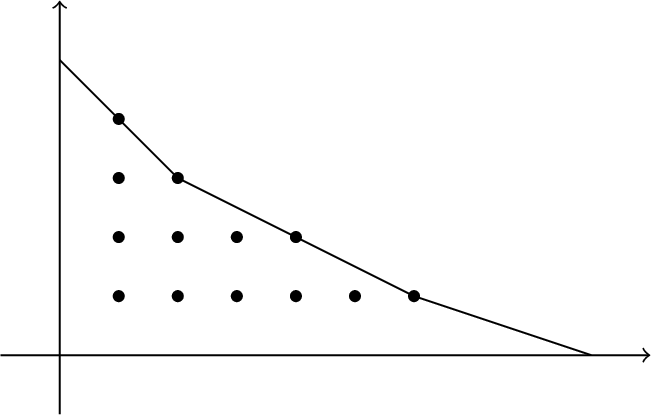
Let \(f(X) \in \mathcal{O}_K[X]\) be a monic irreducible polynomial. By Hensel’s lemma, there exists a monic irreducible polynomial \(\overline{\varphi}(Y) \in \mathbb{F}_K[Y]\) such that \(\overline{f}(Y) = \overline{\varphi}(Y)^n (n \in \mathbb{Z}_{> 0})\). Assume that \(f(X)\) has a one-sided \(\varphi\)-polygon \(S\), and set \(e=E(S)/d\), \(h=H(S)/d\). By Theorem 4, there exists a monic irreducible polynomial \(\psi(Y) \in \mathbb{F}_K[Y]\) such that \(f_S(Y) = \psi(Y)^a (a \in \mathbb{Z}_{> 0})\). Let \(\theta\) be a root of \(f(X)\) and put \(L=K(\theta)\). We define \(\gamma_i=\varphi(\theta)^i/\pi^{[iH/E]} \in \mathcal{O}_L \quad (i = 0, \dots ,n - 1)\).
Proposition 5. [3] Under the above assumptions, the following conditions are equivalent:
\(i_K(f) = i_{\varphi}(f).\)
\(e(L/K) = ea\), \(f(L/K) = l \cdot \deg\psi(Y)\) and [\(a = 1\) or \(\mathfrak{p}_L = \varphi(\gamma_e)\mathcal{O}_L\)].
To prove the above proposition, Montes and Nart proved the following lemma on the valuation of the resultant.
Lemma 1. [3] Let \(f,g \in \mathcal{O}_K[X]\) be monic polynomials of degrees \(n\), \(n'\), respectively. Assume that the \(\varphi\)-polygons \(S\) and \(S'\) of \(f\) and \(g\) are one-sided, and denote their heights by \(H\) and \(H'\), respectively. Then, \[v_K(\mathrm{Res}(f,g)) \ge \min\{nH',n'H\}.\] Moreover, equality holds if and only if either slope of \(S\), \(S'\) are different or \(\mathrm{Res}(f_S,g_{S'}) \ne 0\).
Using 5, Montes and Nart proved the following theorem, which is a generalization of theorem of Ore.
Theorem 6. [3] Under the assumptions and notation of Theorem 4, suppose that \(i_K(f) = i_{\varphi}(f)\). Then, \(f_1(X), \dots ,f_t(X)\) are irreducible, and \[e(L/K) = ee_i, f(L/K) = l\cdot\deg\psi_i(Y).\]
We can check the condition \(i_K(f) = i_{\varphi}(f)\) as follows.
We continue to use the above notation. Let \(T\) be the unique unramified extension of \(K\) of degree \(l\). Let \(\mathcal{O}_K[X,Y] \to \mathbb{F}_K[X,Y]/(\bar{\varphi}(X)) \cong \mathbb{F}_T[Y]\) be the natural homomorphism, and choose a lift \(\Psi_i(X,Y)\) of \(\psi_i(Y)\) such that \[\Psi_i(X,Y) = \sum_j a_j(X)Y^j,\quad \deg a_j(X) < \deg\varphi(X) \quad \text{or} \quad a_j(X) = 0.\] We define \[f^0(X) = \pi^H \prod_{i = 1}^t \Psi_i(X,\varphi(X)^e/\pi^h)^{e_i} \in \mathcal{O}_K[X],\] and \[f^1(X) = f(X) - f^0(X).\] Let \(\tilde{S}\) be the side \(S\) shifted upwards by \(1/e\). Then, the \(\varphi\)-polygon of \(f^1(X)\) has no points below \(\tilde{S}\).
Theorem 7. [3] The equality \(i_K(f) = i_{\varphi}(f)\) holds if and only if we have either \(a_i = 1\) or \(\psi_i(Y) \nmid f^1_{\tilde{S}}(Y)\) in \(\mathbb{F}_T[Y]\) for all \(i\).
Let \(f(X) \in \mathcal{O}_K[X]\) be a monic polynomial, not necessarily one-sided. Let \(S_1, \dots ,S_r\) be the sides of the principal part of the \(\varphi\)-polygon of \(f\). By 3, \(f(X)\) admits a factorization \(f(X)=f_1(X) \cdots f_r(X)\) where the \(\varphi\)-polygon of \(f_i\) is \(S_{i}\). Since each \(f_i\) is one-sided, we can define \(f_i^0\) and \(f_i^1\) as above. We then define \[f^1(X)=f(X)-LC_{\varphi}(f) \cdot \prod_{i=1}^r f_i^0(X),\] where \(LC_{\varphi}(f)\) is the leading coefficient of the \(\varphi\)-expansion of \(f\). Now, we define \(\widetilde{S_{i}}\) again. Let \(\overline{S}_{i}\) be a line containing \(S_{i}\). Put \(\widetilde{S_{i}}\) be the minimal line segment containing \(\overline{S}_{i} \cap (\mathbb{Z}_{\ge 0} \times \mathbb{Z}_{\ge 0})\).
Theorem 8. [3] We use the above notation. Let \(\psi(Y)\) be an irreducible factor of \((f_i)_{S_{i}}\). Then, \(\psi(Y)\) divides \((f_i^1)_{\widetilde{S_{i}}}(Y)\) if and only if it divides \((f^1)_{\widetilde{S_{i}}}(Y)\).
To apply 6 to the many-sided case, we have to check the condition on indices.
Definition 3. Let \(f(X) \in \mathcal{O}_{K}[X]\). We call a set \(\{\varphi_{i}(X)\}_{i \in I}\) of monic irreducible polynomials in \(\mathcal{O}_{K}[X]\) a set of irreducible pullbacks of \(f\) if \(\{\overline{\varphi_{i}}(X)\}_{i \in I}\) coincides with the set of the distinct irreducible factors of \(\overline{f}(X) \in \mathbb{F}_{K}[X]\).
The following theorem is an analogue of 7.
Theorem 9 ([3] [4]). Let \(\Phi\) be a set of irreducible pullbacks of \(f\). Then, \[\mathrm{i}_{K}(f) \ge \sum_{\varphi \in \Phi} \mathrm{i}_{\varphi}(f). \label{1:ineq:thm}\tag{1}\] Moreover, the equality holds if and only if for any \(\varphi(X) \in \Phi\) we have either \(\Psi(Y)^2 \nmid f_{S}(Y)\) or \(\Psi(Y) \nmid f^{1}_{\tilde{S}}(Y)\) for any side \(S\) of the principal parts of the \(\varphi\)-polygons and for any irreducible factor \(\Psi(Y)\) of \(f_{S}(Y)\).
2.3 Works of Kölle and Schmid↩︎
Now, we review the theorem of Kölle and Schmid. Throughout this section, we suppose that \(\overline{f}(X) = X^n\) and \(\varphi(X) = X\).
In this section, we assume that \(K\) is a (global) number field. Let \(f(X)=\sum_{i = 0}^n a_i X^{n - i} \in \mathcal{O}_K[X]\) be a polynomial, \(L\) be the splitting field of \(f(X)\), and \(G = \mathrm{Gal}_K(f) = \mathrm{Gal}(L/K)\). Let \(\mathfrak{p}\) be a prime ideal of \(K\). We denote the set of all roots of \(f\) by \(Z_f\). Then \(G\) acts on \(Z_f\). Let \(\mathfrak{P}\) be a prime ideal of \(L\) lying above \(\mathfrak{p}\), and \(G_\mathfrak{P}\) and \(I_\mathfrak{P}\) be the decomposition group and the inertia group of \(L/K\) at \(\mathfrak{P}\), respectively. Then, \(G_{\mathfrak{P}} = \mathrm{Gal}(L_{\mathfrak{P}}/K_{\mathfrak{p}})\). Denote the set of roots of \(f\) whose \(\mathfrak{p}\)-adic valuation is equal to \(-m\) by \(Z_{f,m}\). Then \(G_{\mathfrak{P}}\) acts on \(Z_{f,m}\). We set \(G_{\mathfrak{P}}^{Z_{f,m}} = G_{\mathfrak{P}}/\mathrm{Stab}_{G_{\mathfrak{P}}}(Z_{f,m})\). \(G_{\mathfrak{P}}^{Z_{f,m}}\) also acts on \(Z_{f,m}\). Let \(S_m\) be the side of \(\varphi\)-polygon \(S\) of \(f(X)\) with slope \(m\). Put \(e=E(S_m)/d\) and \(h=H(S_m)/d\), and let \((s,v_{\mathfrak{p}}(a_s))\) be its initial point. We define \(f_m = \displaystyle{\sum_{(i,v_{\mathfrak{p}}(a_i)) \in S_m}} (-1)^i a_s^{-1} a_{i}X^{de-i}\). Let the distinct irreducible factors of \(f_S^{\mathrm{norm}}\) over \(\mathbb{F}_{K_{\mathfrak{p}}}\) have degrees \(d_1, \dots ,d_r\) (so that \(\sum_{i = 1}^r d_i = d = \deg (f_S^{\mathrm{norm}})\)).
The following is the theorem of Kölle and Schmid.
Theorem 10 ([5],[6]). We use the above notation, and suppose that \(f\) is regular. Then, \(f_m\) is separable and \(|Z_{f,m}| = de\). If in addition \(\mathfrak{p} \nmid e\), then the following hold:
For every root \(\beta\) of \(f_m\), there exists \(\theta \in Z_{f,m}\) such that \(K_{\mathfrak{p}}(\beta) = K_{\mathfrak{p}}(\theta)\), and vice versa.
\(G_{\mathfrak{P}}^{Z_{f,m}}\) is permutation isomorphic to \(\mathrm{Gal}_{K_\mathfrak{p}}(f_m)\).
\(I_{\mathfrak{P}}^{Z_{f,m}}\) is cyclic and generated by an element which is the product of \(d\) disjoint \(e\)-cycles on \(Z_{f,m}\).
\(G_{\mathfrak{P}}^{Z_{f,m}} = \langle \sigma,\tau \rangle\) has just \(r\) orbits of sizes \(d_1 e, \dots ,d_r e\) and is a metacyclic group, with \(\sigma^{-1}\tau\sigma = \tau^{N\mathfrak{p}}\). Let \(\mu = \mathrm{lcm}(\omega,d_1, \dots ,d_r) \quad (\omega = \mathrm{ord}_e N\mathfrak{p})\), the order of the (cyclic) group \(G_{\mathfrak{P}}^{Z_{f,m}}/I_{\mathfrak{P}}^{Z_{f,m}}\) is divisible by \(\mu\), and it is a divisor of \(\mu e\). This order is equal to \(\mu\) if \(e = 1\) and \(d = 1\), and if \(r = 1\) and \(\gcd (\omega,d) = 1\).
3 Main theorem↩︎
3.1 One-sided case↩︎
In this section, we prove a generalization of the theorem of Kölle and Schmid for polynomials having a one-sided \(\varphi\)-polygon. Throughout this section, we assume that \(\overline{f}(X) = X^n\) and \(\varphi(X) = X\).
To state the theorem, we define the following polynomial. We use the notation of 2. Let \(f(X) \in \mathcal{O}_K[X]\) be a monic polynomial having a one-sided polygon \(S\). We define \(\tilde{f}^1(X) \in \mathcal{O}_K[X]\) by \(\tilde{f}^1(X) = (f^1)^0(X)\), using the definition of 2.2 applied to \(f^1\) and its \(\varphi\)-polygon \(\tilde{S}\). We put \(\tilde{f}=f^0 + \tilde{f}^1\).
In the following theorem, we use the notation of 2.3.
Theorem 11. Suppose that \(f\) has a one-sided \(\varphi\)-polygon and \(i_{K_{\mathfrak{p}}}(f) = i_{\varphi}(f)\). Then, \(\tilde{f}\) is separable, \(f\) has \(de\) roots, and the \(\mathfrak{p}\)-adic valuations of all roots of \(f\) are equal to \(m\). Moreover, let \(f_S = \psi_1^{a_1} \cdots \psi_r^{a_r}\) be the irreducible factorization over \(\mathbb{F}_{K_{\mathfrak{p}}}\), and put \(a = \mathrm{lcm}\{a_1, \dots ,a_r\}\). If in addition \(\mathfrak{p} \nmid ea\), then the following hold:
For every root \(\beta\) of \(\tilde{f}\), there exists \(\theta \in Z_f\) such that \(K_{\mathfrak{p}}(\beta) = K_{\mathfrak{p}}(\theta)\), and vice versa.
\(G_{\mathfrak{P}}\) is permutation isomorphic to \(\mathrm{Gal}_{K_\mathfrak{p}}(\tilde{f})\).
\(I_{\mathfrak{P}}\) is cyclic and generated by an element which is the product of \(d\) disjoint \(ea\)-cycles on \(Z_f\).
\(G_{\mathfrak{P}} = \langle \sigma,\tau \rangle\) has just \(r\) orbits of sizes \(d_1 ea_1, \dots ,d_r ea_r\) and is a metacyclic group, with \(\sigma^{-1}\tau\sigma = \tau^{N\mathfrak{p}}\). Let \(\mu = \mathrm{lcm}(\omega,d_1, \dots ,d_r) \quad (\omega = \mathrm{ord}_{ea} N\mathfrak{p})\), the order of the (cyclic) group \(G_{\mathfrak{P}}/I_{\mathfrak{P}}\) is divisible by \(\mu\), and it is a divisor of \(\mu ea\).
To prove this theorem, we prove several propositions on polynomials having a one-sided \(\varphi\)-polygon. Throughout this section, we assume that \(i_K(f) = i_{\varphi}(f)\). Since all points of \(\varphi\)-polygons of \(f(X)\) and \(\tilde{f}(X)\) lying on \(S\) coincide, we have \(f_S(Y) = \tilde{f}_S(Y)\).
Proposition 12. \(\tilde{f}(X)\) is separable.
Proof. Note that \(f_S(Y) = \tilde{f}_S(Y)\) and \({f^1}_{\tilde{S}}(Y) = {\tilde{f}^1}_{\tilde{S}}(Y)\). By 9, \[i_K(f) = i_{\varphi}(f) \Leftrightarrow i_K(\tilde{f}) = i_{\varphi}(\tilde{f}).\] Therefore, by 6, \(\tilde{f}(X)\) factors into distinct irreducible polynomials. ◻
Let \(F_f\) and \(F_{\tilde{f}}\) be the sets of irreducible factors of \(f\) and \(\tilde{f}\), respectively. The following proposition follows from 6.
Proposition 13. There exists a one-to-one correspondence \(\phi \leftrightarrow \psi\) between \(F_f\) and \(F_{\tilde{f}}\) satisfying the following conditions:
There exists an irreducible polynomial \(g(Y) \in \mathbb{F}_K[Y]\) such that \(\phi_{S_1}(Y) = \psi_{S_2}(Y) = g(Y)^a\), where \(S_1\) and \(S_2\) are the \(\varphi\)-polygons of \(\phi\) and \(\psi\), respectively.
Let \(\theta\) and \(\beta\) be roots of \(\phi\) and \(\psi\), respectively. Then, \[\begin{align} e(K(\theta)/K) &= e(K(\beta)/K) = ea, \\ f(K(\theta)/K) &= f(K(\beta)/K) = \deg(g). \end{align}\]
Proposition 14. Suppose that \(f_S = \psi^a\) for some irreducible polynomial \(\psi \in \mathbb{F}_K[Y]\), and that \(\mathfrak{p} \nmid ea\). Then there exists a one-to-one correspondence \(\theta \leftrightarrow \beta\) between the roots of \(f\) and those of \(\tilde{f}\) such that \(K(\theta) = K(\beta)\).
To prove this proposition, we prove the following lemma.
Lemma 2. Let \(\{\alpha_1, \dots ,\alpha_t\}\) be the set of roots of \(f_S(Y)\) in \(\overline{\mathbb{F}}_K\) with multiplicities \(a_1, \dots ,a_t\), respectively. Assume that \(\mathfrak{p} \nmid e\). Let \(Z_f\) be the set of roots of \(f\) in \(\overline{K}\). We define an equivalence relation on \(Z_f\) by \(v_K(\beta - \beta') > \frac{h}{e} \quad (\beta, \beta' \in Z_f)\) and denote the decomposition of \(Z_f\) into equivalence classes by \(Z_f = \coprod_{i = 1}^l Z_f^i\). Then \(l = et\), and \(\#Z_f^i = a_i\). In particular, if \(f_S = \psi^a\) for some irreducible polynomial \(\psi \in \mathbb{F}_K[Y]\), we have \(\#Z_f^i = a\) for all \(i\).
Proof. We first show that it is sufficient to consider the case that \(f_S\) is a power of a polynomial of degree one. Let \(\hat{T}\) be the unique unramified extension of \(K\) of degree \(\deg f_S\), then \(f_S = \prod_{k = 1}^t {\psi_k}^{a_k}\) for some distinct linear polynomials \(\psi_k \in \mathbb{F}_{\hat{T}}[Y] (k = 1, \dots ,t)\). By 4, \(f\) admits a factorization \(f = \prod_{k = 1}^t f_k\) over \(\hat{T}\) such that \((f_k)_{S_{k}} = {\psi_k}^{a_k}\), where \(S_{k}\) is the \(\varphi\)-polygon of \(f_k\). Denote the decomposition of \(Z_{f_k}\) into equivalence classes by \(Z_{f_k} = \coprod_{i = 1}^{l_k} Z_{f_k}^i\). We will show that \(Z_{f_k}^i\) forms an equivalence class in \(Z_f\) for all \(k\) and \(i\). It suffices to show that the elements of \(Z_{f_k}\) and \(Z_{f_{k'}}\) are not equivalent for \(k \ne k'\). Let \(\beta \in Z_{f_k}\) and \(\beta' \in Z_{f_{k'}}\), and let \(g_k\) and \(g_{k'}\) be the minimal polynomials of \(\beta\) and \(\beta'\), respectively. By 2, the \(\varphi\)-polygons of \(g_k\) and \(g_{k'}\) have the same slope as \(S\), and \((g_k)_{S_{k}'} = \psi_k^{b_k}\) and \((g_{k'})_{S_{k'}'} = \psi_{k'}^{b_{k'}}\) for some \(b_k\) and \(b_{k'}\), where \(S_{k}'\) and \(S_{k'}'\) are the \(\varphi\)-polygons of \(g_k\) and \(g_{k'}\), respectively. Let \(\alpha_k\) and \(\alpha_{k'}\) be roots of \(g_k^0\) and \(g_{k'}^0\), respectively. Then, \(\overline{\pi^{-h}{\alpha_k}^e}, \overline{\pi^{-h}{\alpha_{k'}}^e} \in \mathbb{F}_{\hat{T}}\) are roots of \(\psi_k\) and \(\psi_{k'}\), respectively. Since \(\psi_k\) and \(\psi_{k'}\) are coprime, we have \(\overline{\pi^{-h}{\alpha_k}^e} \ne \overline{\pi^{-h}{\alpha_{k'}}^e}\) in \(\mathbb{F}_{\hat{T}}\), and \[v_K(\pi^{-h}{\alpha_k}^e - \pi^{-h}{\alpha_{k'}}^e) = 0.\] This implies that \[v_K(\pi^{-\frac{h}{e}}\alpha_k - \pi^{-\frac{h}{e}}\alpha_{k'}) = 0,\] and we have \[v_K(\alpha_k - \alpha_{k'}) = \frac{h}{e}.\] By 1, \[v_K(\mathrm{Res}(g_k,g_k^0)) > b_k e \cdot b_k h.\] Let \(L_0\) be the compositum of the splitting fields of \(g_k\) and \(g_k^0\) over \(\hat{T}\). Since the Galois group \(\mathrm{Gal}(L_0/\hat{T})\) acts transitively on \(Z_{g_k}\), for any two roots \(\beta_0, \beta_1 \in Z_{g_k}\), there exists \(\sigma_0 \in \mathrm{Gal}(L_0/\hat{T})\) such that \(\sigma_0(\beta_0) = \beta_1\), and we have \(v_K(\prod_{\alpha \in Z_{g_k^0}} (\beta_0 - \alpha)) = v_K(\sigma_0(\prod_{\alpha \in Z_{g_k^0}} (\beta_0 - \alpha))) = v_K(\prod_{\alpha \in Z_{g_k^0}} (\beta_1 - \alpha))\). Hence, \[v_K(\prod_{\alpha \in Z_{g_k^0}} (\beta - \alpha)) > b_k h.\] Moreover, by 3, for any \(\alpha \in Z_{g_k^0}\), we have \[\begin{align} v_K(\beta - \alpha) &\ge \min\{v_K(\beta),v_K(\alpha)\} \\ &=\frac{h}{e}. \end{align}\] These inequalities show that there exists a root \(\alpha_k\) of \(g_k^0\) such that \[v_K(\beta - \alpha_k) > \frac{h}{e}.\] On the other hand, since \[\frac{h}{e} = v_K(\alpha_k - \alpha_{k'}) = v_K(\alpha_k - \beta + \beta - \alpha_{k'}),\] we have \[v_K(\beta - \alpha_{k'}) = \frac{h}{e}.\] Similarly, the same holds for \(\beta'\). Therefore, we have \[v_K(\beta - \beta') = v_K(\beta - \alpha_k + \alpha_k - \beta') = \frac{h}{e}.\]
Therefore, we may assume that \(f_S = \psi^a\) for some linear polynomial \(\psi\). In this case, \(f^0(X) = (X^e - b)^a \quad (b \in \mathcal{O}_K)\). Let \(\alpha\) be a root of \(f^0\), and \(\zeta\) a primitive \(e\)-th root of unity. Then, the set of roots of \(f^0\) is \(Z_{f^0} = \{\alpha,\alpha\zeta, \dots ,\alpha\zeta^{e-1}\}\). By 1, for \(\beta \in Z_f\), there exists an \(i \in \{0, \dots ,e-1\}\) such that \[v_K(\beta - \alpha\zeta^i) > \frac{h}{e}.\] Moreover, since \(\mathfrak{p} \nmid e\), we have \[v_K(\prod_{i \ne 0} (\alpha - \alpha\zeta^i)) = v_K(\alpha^{e - 1}\prod_{i \ne 0} (1 - \zeta^i)) = (e - 1) \cdot \frac{h}{e}.\] For \(i \ne 0\), we have \[v_K(\alpha - \alpha\zeta^i) \ge \min\{v_K(\alpha),v_K(\alpha\zeta^i)\} = \frac{h}{e}.\] Hence, \[v_K(\alpha - \alpha\zeta^i) = \frac{h}{e} \label{formula:lem-1}.\tag{2}\]
Put \(Z_f^i = \{\beta \in Z_f \mid v_K(\beta - \alpha\zeta^i) > \frac{h}{e}\} \quad (i = 0, \dots ,e - 1)\). We will show that each \(Z_f^i\) forms an equivalence class in \(Z_f\). For \(\beta, \beta' \in Z_f^i\), we have \[\begin{align} v_K(\beta - \beta') &= v_K(\beta - \alpha\zeta^i + \alpha\zeta^i - \beta') \\ &= \min\{v_K(\beta - \alpha\zeta^i),v_K(\beta' - \alpha\zeta^i)\} \\ &> \frac{h}{e}. \end{align}\] Hence, \(\beta\) and \(\beta'\) are equivalent. Let \(i \ne j\), and let \(\beta \in Z_f^i\) and \(\beta' \in Z_f^j\). Then, we have \[\begin{align} v_K(\beta - \beta') &= v_K(\beta - \alpha\zeta^j + \alpha\zeta^j - \beta') \\ &\ge \min\{v_K(\beta - \alpha\zeta^j),v_K(\beta' - \alpha\zeta^j)\}. \end{align}\] By (2 ), \[\begin{align} v_K(\beta - \alpha\zeta^j) &= v_K(\beta - \alpha\zeta^i + \alpha\zeta^i - \alpha\zeta^j) \\ &= \frac{h}{e}. \end{align}\] This implies that \[v_K(\beta - \beta') = \frac{h}{e}.\] Therefore, \(Z_f^i\) forms an equivalence class.
It remains to show that \(\#Z^i_f = a\) for all \(i\). Let \(T = \hat{T}(\zeta)\). Since \(\mathfrak{p} \nmid e\), \(T/K\) is unramified. If \(e = 1\), there is only one equivalence class, and the claim is clear. Assume that \(e \ne 1\). Let \(\beta_i \in Z_f^i\), and let \(L\) and \(L_0\) be the splitting fields of \(f\) and \(f^0\) over \(T\), respectively. Since \(v_K(\alpha) = \frac{h}{e}\) and \(e\) and \(h\) are coprime, we have \(v_K(\alpha^m) \notin \mathbb{Z}\) for each \(m = 1, \dots ,e-1\), hence \(\alpha^m \notin T\). By Kummer theory, \(f^0\) is irreducible over \(T\), and for any \(i\) and \(j\), there exists \(\sigma_{ij} \in \mathrm{Gal}(LL_0/T)\) such that \(\sigma_{ij}(\alpha \zeta^i) = \alpha \zeta^j\). Then, we have \[v_K(\beta_i - \alpha\zeta^i) = v_K(\sigma_{ij}(\beta_i) - \alpha\zeta^j),\] hence \(\sigma_{ij}(\beta_i) \in Z^j_f\). This implies that \(\#Z^j_f \ge \#Z^i_f\) for any \(i\) and \(j\), and so \(\#Z^j_f = \#Z^i_f\). Therefore, we have shown that \(\#Z^i_f = a\). ◻
Remark 15. In the proof of this lemma, the assumption \(i_K(f) = i_{\varphi}(f)\) is not required.
Proof of 14. Put \(n = \deg \psi\). Then, the length, height, and degree of \(S\) are given by \(E = \deg f = \deg \tilde{f} = nea, H = nah, d = na\).
First, we show that it is sufficient to consider the case that \(n = 1\). Let \(\hat{T}\) be the unramified extension of \(K\) of degree \(n\). Then, \(\psi = \prod_{i = 1}^n \psi_i\) for some distinct linear polynomials \(\psi_i \quad (i = 1, \dots ,n)\). Let \(\theta\) and \(\beta\) be roots of \(f\) and \(\tilde{f}\), respectively. By 6, \(\hat{T} \subseteq K(\theta), \hat{T} \subseteq K(\beta)\). Hence, we have \(K(\theta) = \hat{T}(\theta), K(\beta) = \hat{T}(\beta)\). By 5, \(\tilde{\psi}(\pi^{-h}\theta^e)\) is a uniformizer of \(K(\theta)\), where \(\tilde{\psi}\) is a lift of \(\psi\). Let \(g \in \mathcal{O}_{\hat{T}}[X]\) be the minimal polynomial of \(\theta\) over \(\hat{T}\). By 4, \(g_S = \psi_i^l\) for some \(i\) and \(l\). Assume that \(i = 1\). Since \(g^0(\theta) + g^1(\theta) = g(\theta) = 0\), we have \[v_K(g^0(\theta)) = v_K(g^1(\theta)) \ge H + \frac{1}{e}.\] Moreover, let \(\tilde{\psi}_1\) be a lift of \(\psi_1\), since \(g^0(\theta) = \pi^H\tilde{\psi}_1(\pi^{-h}\theta^e)^l\), we have \[v_K(\tilde{\psi}_1(\pi^{-h}\theta^e)) \ge \frac{1}{le} \ge \frac{1}{ea}.\] On the other hand, we have \[v_K(\tilde{\psi}_1(\pi^{-h}\theta^e)) \le v_K(\tilde{\psi}(\pi^{-h}\theta^e)) \le \frac{1}{ea}.\] It follows that all the inequalities become equalities, \(l = a\), and \(\tilde{\psi}_1(\pi^{-h}\theta^e)\) is a uniformizer of \(\hat{T}(\theta)\). By 5, the equality \(i_{\hat{T}}(g) = i_{\varphi}(g)\) holds. Therefore, it is sufficient to prove the proposition for \(\hat{T}\) and \(g\).
Hence, we can suppose that \(\deg \psi = 1\). Let \(\theta\) be a root of \(f\). Let \(f(X) - \tilde{f}(X) = \sum_{i = 0}^E c_{E - i}X^i\). Since \(f_S = \tilde{f}_S, f_{\tilde{S}}^1 = \tilde{f}_{\tilde{S}}^1\), for each \(i\), we have \[v_K(c_{E - i}) \ge H - \frac{h}{e} \cdot i + \frac{2}{e}.\] Thus, we have \[v_K(\tilde{f}(\theta)) = v_K(f(\theta) - \tilde{f}(\theta)) \ge H + \frac{2}{e} > H + \frac{1}{e}.\] By 6, the ramification index of \(K(\theta)/K\) is equal to \(ea\). Denote the set of roots of \(\tilde{f}\) by \(\{\beta_j \mid j = 1, \dots ,ea\}\). For all \(j\), we have \[v_K(\theta - \beta_j) \ge \min\{v_K(\theta),v_K(\beta_j)\} = \frac{h}{e}.\] If \(v_K(\theta - \beta_{j_1}) > \frac{h}{e}\) and \(v_K(\beta_{j_1} - \beta_{j_2}) = \frac{h}{e}\), we have \[v_K(\theta - \beta_{j_2}) = v_K(\theta - \beta_{j_1} + \beta_{j_1} - \beta_{j_2}) = \frac{h}{e}.\] By 2, there are at most \(a\) roots such that \(v_K(\theta - \beta_j) \ge \frac{h}{e} + \frac{1}{ea}\). Noting that \(\tilde{f}\) has \(ea\) roots, we obtain from above inequalities that there exists \(j_0 \in \{1, \dots E\}\) such that \[v_K(\theta - \beta_{j_0}) > \frac{h}{e} + \frac{1}{ea} \label{formula:prop4-2}.\tag{3}\] Assume that \(j_0 = 1\), and denote \(\beta = \beta_1\).
We consider the derivative \(\tilde{f}'\) of \(\tilde{f}\). Since \(\tilde{f}^0(X) = \pi^H\tilde{\psi}(\pi^{-h}X^e)^a\), we have \[(\tilde{f}^0)'(X) = ea\pi^{(a-1)h}X^{e - 1}\tilde{\psi}(\pi^{-h}X^e)^{a - 1}.\] Noting that \(\mathfrak{p} \nmid ea\) and \(\tilde{\psi}(\pi^{-h}\beta^e)\) is a uniformizer of \(K(\beta)\), it follows that \[v_K((\tilde{f}^0)'(\beta)) = ah - \frac{h}{e} +\frac{a - 1}{ea}.\] Since the points of the \(\varphi\)-polygon of \(\tilde{f}^1\) lie on \(\tilde{S}\), we have \[v_K((\tilde{f}^1)'(\beta)) \ge ah - \frac{h}{e} + \frac{1}{e} > v_K((\tilde{f}^0)'(\beta)).\] Hence, \[\begin{align} \sum_{i \ne 1} v_K(\beta - \beta_i) &= v_K(\tilde{f}'(\beta)) \\ &=v_K((\tilde{f}^0)'(\beta)) \\ &= ah - \frac{h}{e} + \frac{a - 1}{ea} \end{align}\] Since \(v_K(\beta - \beta_i) \ge \frac{h}{e}\) for \(i \ne 1\), we have \[v_K(\beta - \beta_i) \le \frac{h}{e} + \frac{a - 1}{ea}.\] By 2, there are just \(a - 1\) roots \(\beta_i\) satisfying \(v_K(\beta - \beta_i) > \frac{h}{e}\). Consequently, for all \(i = 2, \dots ,ea\), \[v_K(\beta - \beta_i) \le \frac{h}{e} + \frac{1}{ea}. \label{formula:prop4-3}\tag{4}\]
From (3 ) and (4 ), for all \(i \ne 1\), we have \[v_K(\theta - \beta) > v_K(\beta - \beta_i).\] By Krasner’s lemma, this gives \(K(\beta) \subset K(\theta)\). We have equality since \(f\) and \(\tilde{f}\) are irreducible over \(K\) of the same degree.
It remains to show the uniqueness of \(\beta\). If there exists another root \(\beta'\) of \(\tilde{f}\) satisfying (3 ), then we have \[v_K(\beta - \beta') > \frac{h}{e} + \frac{1}{ea}.\] This contradicts (4 ). ◻
Proof of 11. We now prove 11. We use the notation of 2.3.
By 12, \(\tilde{f}\) is separable. By 3, the \(\mathfrak{p}\)-adic valuations of all \(de\) roots of \(f\) are equal to \(m\).
Assume that \(\mathfrak{p} \nmid ea\). (i) follows from 13 and 14. By (i), the splitting fields of \(f\) and \(\tilde{f}\) coincide, say \(L\). Hence, \(G_{\mathfrak{P}}\) is isomorphic to \(\mathrm{Gal}_{K_{\mathfrak{p}}}(\tilde{f})\) as a finite group. Let \(\theta\) be a root of \(f\), and \(g(X) \in K_{\mathfrak{p}}[X]\) the minimal polynomial of \(\theta\) over \(K_{\mathfrak{p}}\). Let \(\tilde{g}\) be the irreducible factor of \(\tilde{f}\) corresponding to \(g\) under the bijection of 13, and \(\beta\) be the root of \(\tilde{g}\) corresponding to \(\theta\) under the bijection of 14. Since \(\deg g = \deg \tilde{g}\), the \(G_{\mathfrak{P}}\)-orbit of \(\theta\) has the same length as the \(\mathrm{Gal}_{K_{\mathfrak{p}}}(\tilde{f})\)-orbit of \(\beta\). Moreover, the stabilizers of \(\theta\) and \(\beta\) can be written as \(\mathrm{Gal}(L/K_{\mathfrak{p}}(\theta))\) and \(\mathrm{Gal}(L/K_{\mathfrak{p}}(\beta))\), respectively. Since \(K_{\mathfrak{p}}(\theta) = K_{\mathfrak{p}}(\beta)\), it follows that the stabilizers of \(\theta\) and \(\beta\) coincide. These imply (ii).
Put \(G' = \mathrm{Gal}(L/K_{\mathfrak{p}})\). By (ii), we may identify \(G_{\mathfrak{P}}\) with \(G'\), together with their action on \(Z_f\) (or \(Z_{\tilde{f}}\)). Let \(\hat{T}\) be the maximal unramified subextension of \(L/K_{\mathfrak{p}}\), then \(I_{\mathfrak{P}} = \mathrm{Gal}(L/\hat{T})\).
By 6, the factorization of 4 \[\tilde{f}(X) = \tilde{f}_1(X) \cdots \tilde{f}_r(X)\] is an irreducible factorization. Hence, \(Z_f\) has \(r\) orbits of lengths \(d_1 ea_1, \dots ,d_r ea_r\) under the action of \(G\). Moreover, since \(L/\hat{T}\) is tamely ramified, \(G_{\mathfrak{P}}\) is a metacyclic group. Let \(\tau\) be a generator of \(I_{\mathfrak{P}}\), and \(\sigma\) be a lift of a generator of \(G_{\mathfrak{P}}/I_{\mathfrak{P}}\). Then we have \(\sigma^{-1}\tau\sigma = \tau^{N\mathfrak{p}}\).
Let \(\varepsilon \in \bar{K}_{\mathfrak{p}}\) be a primitive \(ea\)-th root of unity. Then \([K_{\mathfrak{p}}(\varepsilon):K_{\mathfrak{p}}] = \omega\). Let \(\beta\) be a root of \(\tilde{f}\), and \(T'\) be the maximal unramified subextension of \(K_{\mathfrak{p}}(\beta)/K_{\mathfrak{p}}\). Since \(K_{\mathfrak{p}}(\beta)/K_{\mathfrak{p}}\) is tamely ramified and by the theorem of Pauli and Roblot ([7]), there exists an element \(u \in T'\) such that \(K_{\mathfrak{p}}(\beta)\) coincides with the extension over \(T'\) defined by the polynomial \(X^{ea_i} - u\). Let \(\alpha\) be a root of \(X^{ea_i} - u\). Then the set of roots of \(X^{ea_i} - u\) can be written as \(\{\alpha,\alpha\varepsilon_i,\dots,\alpha\varepsilon_i^{ea_i-1}\}\), where \(\varepsilon_i\) is a primitive \(ea_i\)-th root of unity. Since the normal closure of \(K_{\mathfrak{p}}(\beta)\) is contained in \(L\), \(\varepsilon_i \in L\) for all \(i=1, \dots ,r\). Hence, \(\varepsilon \in L\). Since \(\mathfrak{p} \nmid ea\), \(K_{\mathfrak{p}}(\varepsilon)/K_{\mathfrak{p}}\) is unramified. Hence, \(K_{\mathfrak{p}}(\varepsilon) \subset \hat{T}\). It follows that \(\omega\) divides \(|G_{\mathfrak{P}}/I_{\mathfrak{P}}|\). Moreover, let \(\beta_i\) be a root of \(\tilde{f}_i\). By 6, the degree over \(K_{\mathfrak{p}}\) of the maximal unramified subextension of \(K_{\mathfrak{p}}(\beta_i)/K_{\mathfrak{p}}\) is equal to \(d_i\). It follows that \(d_i\) divides \(|G_{\mathfrak{P}}/I_{\mathfrak{P}}|\) for each \(i\). Therefore \(\mu\) divides \(|G_{\mathfrak{P}}/I_{\mathfrak{P}}|\).
Since \(d_i\) divides \(|G_{\mathfrak{P}}/I_{\mathfrak{P}}|\) for each \(i\), \(\tilde{f}_S\) factors as a product of linear polynomials over \(\mathbb{F}_{\hat{T}}\). Since \(\hat{T}/K_{\mathfrak{p}}\) is unramified, the \(\varphi\)-polygon of \(\tilde{f}\) over \(\hat{T}\) coincides with that over \(K_{\mathfrak{p}}\). This implies that the equality \(i_{\hat{T}}(\tilde{f}) = i_{\varphi}(\tilde{f})\) also holds. Indeed, the polynomial \(\tilde{f}^1\) defined over \(\hat{T}\) coincides with that defined over \(K_{\mathfrak{p}}\). Noting that \(\tilde{f}^1_{\tilde{S}}\) is a polynomial over \(\mathbb{F}_{K_{\mathfrak{p}}}\), it follows from 7 that \(i_{\hat{T}}(\tilde{f}) = i_{\varphi}(\tilde{f})\). By 6, \(\tilde{f}\) factors as a product of irreducible polynomials of degree \(ea_i\). Thus, \(I_{\mathfrak{P}}\)-orbits of \(Z_{\tilde{f}}\) have lengths \(ea_i\). Since \(L/K_{\mathfrak{p}}\) is tamely ramified, \(I_{\mathfrak{P}}\) is a cyclic group. These imply (iii).
There exists a unique subfield \(T\) of \(\hat{T}\) such that \([T:K_{\mathfrak{p}}] = \mu\). Let \(\beta\) be a root of \(\tilde{f}\), and suppose that \(\tilde{f}_j\) is the minimal polynomial of \(\beta\). Since \(d_j \mid \mu\), \((\tilde{f}_j)_S\) factors as a product of linear polynomials over \(\mathbb{F}_T\). By 6, \(T(\beta)/T\) is a totally ramified extension of degree \(ea_j\). Since \(\varepsilon \in T\), \(T(\beta)/T\) is a Galois extension by the theorem of Pauli and Roblot and Kummer theory. On the other hand, \(\hat{T}/T\) is unramified, and hence \(T(\beta)\) and \(\hat{T}\) are linearly disjoint over \(T\). It follows that \(T(\beta)\hat{T}/T(\beta)\) is a cyclic extension of degree \([\hat{T}:T]\). Noting that \(L\) is the compositum of all these \(T(\beta)\) and \(T(\beta)/T\) is a Galois extension of degree \(ea_i\), the exponent of its Galois group \(\mathrm{Gal}(L/T)\) is \(ea\). Hence, the exponent of \(\mathrm{Gal}(T(\beta)\hat{T}/T)\) divides \(ea\). Since \(\mathrm{Gal}(T(\beta)\hat{T}/T(\beta))\) is a cyclic subgroup of \(\mathrm{Gal}(T(\beta)\hat{T}/T)\), its degree \([\hat{T}:T]\) divides \(ea\). Therefore \(|G_{\mathfrak{P}}/I_{\mathfrak{P}}|\) divides \(\mu ea\). Thus, (iv) has been proved. ◻
3.2 Many-sided case↩︎
In this section, we study polynomials whose Newton polygons are not necessarily one-sided. Montes and Nart showed that, if the decomposition of \(f(X)\) corresponding to its Newton polygon is \(f_{1}(X)\cdots f_{r}(X)\), then one can obtain from \(f(X)\) the associated polynomial of each \(f_{i}\), as well as a polynomial containing information on \((f_{i}^{1})_{\widetilde{S_{i}}}\) (8). For their purposes, the polynomial obtained from \(f(X)\) is sufficient, although it may contain extraneous terms. For our purposes, however, we need to recover the exact polynomial \((f_i^1)_{\widetilde{S_{i}}}\). In this section, we give a method to recover it from \(f(X)\).
Let the sides of the Newton polygon of \(f(X)\) be denoted from left to right by \(S_{1},\dots,S_{r}\), and let the decomposition according to 3 be denoted by \[f(X)=f_{1}(X)\cdots f_{r}(X).\] Since each Newton polygon of \(f_{i}(X)\) has only one side as mentioned above in 8, we can define \(f_{i}^{1}(X)\) for \(i=1,\dots,r\). Thus we have \[\begin{align} f(X) &= \prod_{i=1}^{r}(f_{i}^{0}(X)+f_{i}^{1}(X)) \\ &= \prod_{i=1}^{r}f_{i}^{0}(X) + \sum_{i=1}^{r}\left(f_{i}^{1}(X)\prod_{j\ne i}f_{j}^{0}(X)\right) + \sum_{i<j}\left(f_{i}^{1}(X)f_{j}^{1}(X)\prod_{k\ne i,j}f_{k}^{0}(X)\right) \end{align}\] By definition, we obtain \[f^{1}(X) = \sum_{i=1}^{r}\left(f_{i}^{1}(X)\prod_{j\ne i}f_{j}^{0}(X)\right) + \sum_{i<j}\left(f_{i}^{1}(X)f_{j}^{1}(X)\prod_{k\ne i,j}f_{k}^{0}(X)\right).\]
Let \(\ell\in\{1,2,\dots,r\}\).
If \(\ell = i\) or \(\ell = j\), then the Newton polygon of \(f_{i}^{1}(X)f_{j}^{1}(X)\prod_{k\ne i,j}f_{k}^{0}(X)\) does not intersect with \(\widetilde{S_{\ell}}\).
If \(\ell \ne i,j\), then \(f_{i}^{1}(X)f_{j}^{1}(X)\prod_{k\ne i,j}f_{k}^{0}(X)\) is divisible by \(f_{\ell}^{0}(X)\).
If \(\ell \ne i\), then \(f_{i}^{1}(X)\prod_{j\ne i}f_{j}^{0}(X)\) is divisible by \(f_{\ell}^{0}(X)\).
Therefore we have \[(f^{1})_{\widetilde{S_{\ell}}}(Y) \equiv \left(f_{\ell}^{1}\prod_{i\ne\ell}f_{i}^0\right)_{\widetilde{S_{\ell}}}(Y) \mod (f_{\ell}^{0})_{\widetilde{S_{\ell}}}(Y).\] Since the Newton polygon of \(\prod_{i\ne\ell}f_{i}^{0}(X)\) has no side with the same slope as \(S_{\ell}\), \(\left(\prod_{i\ne\ell}f_{i}^{0}\right)_{\widetilde{S_{\ell}}}(Y)\) is a monomial. Here, \(\widetilde{S_{\ell}}\) is obtained by translating \(S_{\ell}\) so that it is tangent to the Newton polygon of \(\prod_{i\ne\ell}f_{i}^{0}(X)\). Put \[A_{\ell} = \sum_{i<\ell}\lfloor \deg f_{i}^{0}(X)/e_{\ell}\rfloor.\] We define \(R_{\ell}(Y)\) to be a representative of the residue class of \((f^{1})_{\widetilde{S_{\ell}}}(Y)\) modulo \((f_{\ell}^{0})_{\widetilde{S_{\ell}}}(Y)\) of the form \[R_{\ell}(Y) = Y^{A_{\ell}}Q_{\ell}(Y).\] We choose such a representative so that \[\deg Q_{\ell}(Y) < \deg (f_{\ell}^0)_{\widetilde{S_{\ell}}}(Y).\] Under this condition, \(R_{\ell}(Y)\) is uniquely determined.
Now we obtain the following theorem.
Theorem 16. With the above notation, we have \[R_{\ell}(Y) = \left(\prod_{i\ne\ell}f_{i}^{0}\right)_{\widetilde{S_{\ell}}}(Y) \cdot (f_{\ell}^{1})_{\widetilde{S_{\ell}}}(Y).\]
Proof. By the preceding discussion, the two sides agree up to the coefficient coming from the monomial \[\left(\prod_{i\ne\ell}f_{i}^{0}\right)_{\widetilde{S_{\ell}}}(Y).\] To complete the proof, it remains to compare this coefficient.
The coefficient is given by the product of the constant terms of the polynomials corresponding to the sides lying to the right of \(S_{\ell}\). Equivalently, it is the term corresponding to the point at which the Newton polygon of \(\prod_{i\ne\ell}f_{i}(X)\) is tangent to \(\widetilde{S_{\ell}}\). In \(\mathbb{F}_K[Y]\), this coefficient is equal to \[\prod_{i > \ell} f_i^0(0).\] This proves the theorem. ◻
4 An Example↩︎
Consider a polynomial \[f(X) = X^5 - 43X^3 - 7X^2 + 354X + 1072.\] We will obtain the Galois group \(G\) of \(f\) over \(\mathbb{Q}\).
This polynomial has the discriminant \[\mathrm{Disc}(f) = 1677927225500100 = 2^{2} 3^{14} 5^{2} 1873^{2}.\] For \(p=7\), we have \[f(X) \equiv X^5 + 6X^3 + 4X +1 \mod 7.\] Since the polynomial is irreducible in \(\mathbb{F}_{7}[X]\), we can apply Dedekind’s theorem to \(f\) and \(7\), and the decomposition group of \(7\) is isomorphic to the cyclic group \(C_5\) of order \(5\).
For \(p=5\), since \[\begin{align} f(X-3) &= X^5 - 15X^4 + 47X^3 + 110X^2 -360X + 865\\ &= X^5 - 3\cdot 5X^4 + 47X^3 + 22\cdot 5X^2 - 72\cdot 5X + 173\cdot 5, \end{align}\] the \(5\)-adic Newton polygon of \(f(X-3)\) has two sides, one of which is the non-principal part. The principal side has the length \(3\) and the height \(1\), hence the associated polynomial of \(f\) and the side has degree one and we can apply the theorem of Kölle and Schmid. As a result, the decomposition group corresponding to the principal part is isomorphic to \(C_{3}\).
Finally, we consider \(p=3\). Since \[\begin{align} f(X+1) &= X^5 + 5X^4 - 33X^3 - 126X^2 + 216X + 1377 \\ &= X^5 + 5X^4 - 11\cdot 3X^3 - 14\cdot 3^2X^2 + 8\cdot 3^3X + 17\cdot3^4, \end{align}\] the \(3\)-adic Newton polygon of \(f(X+1)\) has two sides, one of which is the non-principal part. Let \(S\) be the principal side of the polygon, \(g\) the polynomial corresponding to \(S\), and \(h\) the polynomial corresponding to the non-principal part. Then, we have \[\begin{align} &f_{S}(Y) = 2(Y^2 + Y + 2)^2,\\ &f^{1}_{\tilde{S}}(Y) = 2Y(Y+2)(Y^2+2Y+2). \end{align}\] \(Y^2 + Y + 2\) does not divide \(f^{1}_{\tilde{S}}(Y)\) in \(\mathbb{F}_{3}[Y]\). Thus, we can apply our main theorem to this polynomial.
To apply our theorem, we calculate \(g^{1}_{\tilde{S}}\) as in 3.2. \[\begin{align} g^{1}_{\tilde{S}}(Y) &= \left(f^{1}_{\tilde{S}}(Y) - f_{S}(Y)\right)/h_{0}(0)\\ &= (Y^3 + 2Y^2 + 1)/2\\ &= 2Y^3 + Y^2 + 2. \end{align}\] Thus, we obtain \[\tilde{g}(X) = X^4+(2\cdot 3+2\cdot3^2)X^3+(2\cdot 3^2+1\cdot 3^3)X^2+(1\cdot3^3)X+(1\cdot 3^4+2\cdot 3^5).\] This polynomial is irreducible over \(\mathbb{Q}_{3}\), and its discriminant is a square. Since \(f_{S}(Y) = 2(Y^2 + Y + 2)^2\), our theorem implies that the Galois group of \(\tilde{g}\) over \(\mathbb{Q}_{3}\) has order \(4\). Hence, the Galois group is \(C_{2}\times C_{2}\).
Thus, \(G\) contains subgroups isomorphic to \(C_3\), \(C_5\), and \(C_2 \times C_2\). Hence \(|G|\) is divisible by \(3\), \(5\), and \(4\), and therefore by \(60\). Since the discriminant of \(f\) is a square, we have \(G \le A_5\). Thus \(|G| = 60\), and hence \(G\) is isomorphic to \(A_5\).
Acknowledgements↩︎
The authors are grateful to Professor Masanari Kida for his support and encouragement.
References↩︎
2020 Mathematics Subject Classification. 11S20 ; 11R32, 11S05.↩︎