Skill-DisCo: Distilling and Compiling Agent Traces into Reusable Procedural Skills
June 25, 2026
Abstract
Agents often repeatedly solve similar task instances from scratch, leading to unnecessary reasoning cost and long execution traces. Prior work has explored workflow reuse and executable skill induction, but it remains unclear which task scenarios admit procedural skills and how the shared procedural structure should be represented across successful traces. We study this problem in FSM-defined scenarios, where successful traces can be viewed as paths in an unknown transition graph, and formulate procedural skills as reusable parameterized control-flow subgraphs. Based on this view, we introduce Skill-DisCo, a distillation-and-compilation framework that distills reusable PFSM subgraphs from successful traces and compiles them into callable, executable, and verifiable procedural skills. Experiments on ALFWorld and WebArena show that Skill-DisCo improves success rates and reduces agent turns across benchmarks and model scales, demonstrating the benefits of representing shared experience as reusable execution structures.
1 Introduction↩︎
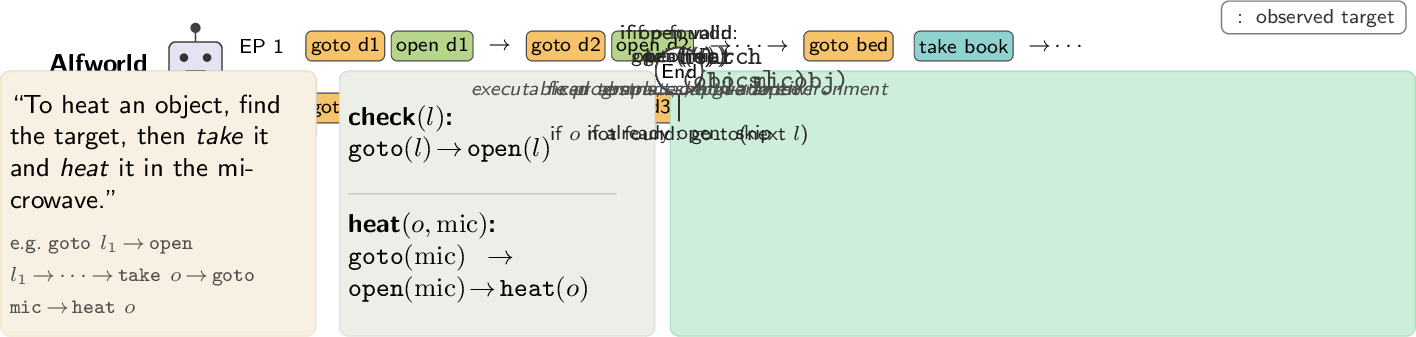
LLM agents are increasingly used for interactive tasks that require many reasoning and acting steps [1]–[4]. Yet even with stronger action representations such as CodeAct [3], agents often solve each task independently, repeatedly rediscovering low-level action patterns shared across related tasks (Figure 1). This increases reasoning cost, execution length, and generalization brittleness [5], [6]. Recent work on experience reuse addresses this issue by extracting reusable workflows from trajectories [5] or inducing executable skills that improve verifiability and composability [6]. These results suggest that agents should accumulate reusable procedures rather than solve each task from scratch.
However, the foundations of procedural skill discovery remain under-specified. Reusable skills are meaningful when tasks share stable execution patterns, but become ill-defined for open-ended, instance-specific generation. Existing methods often synthesize skills directly from successful traces using LLMs. Without an explicit notion of shared structure, the resulting libraries can become fragmented and redundant toward trace-specific surface patterns rather than reusable procedural logic.
We make the scope of procedural skill discovery explicit by focusing on FSM-defined scenarios, where execution dynamics are described by finite states, admissible actions, and deterministic transitions. In such scenarios, successful traces are paths in an unknown transition graph, and procedural skills correspond to repeated transition structures that help reach goal states. If this graph were known, task completion would reduce to graph search. In realistic agent settings, however, the graph is unavailable, and the agent only observes successful traces.
To capture shared structure across traces, we formalize procedural skills through a Parameterized Finite-State Machine (PFSM) view. A PFSM abstracts concrete states and actions into parameterized states and operators, so traces with different objects, states, or lengths can instantiate the same execution pattern. Under this view, each successful trace can be lifted into a parameterized trace graph, and a procedural skill is a reusable PFSM subgraph matched across traces under parameter binding. Thus, a skill is not merely a textual routine or an LLM-generated script, but a structurally grounded abstraction of shared execution logic.
This formulation does not assume that the latent PFSM is directly observable. In realistic agent environments, neither the full transition graph nor the lifting function from raw traces to PFSM subgraphs is given. Skill-DisCo therefore approximates PFSM-based skill discovery by recovering reusable parameterized control-flow patterns from successful traces and validating them through skill compilation. This yields a distillation-and-compilation framework. Distillation discovers compact, high-coverage PFSM subgraphs that favor reusable structures over trace-specific routines. Compilation turns each discovered structure into a callable, executable, and verifiable skill through explicit specification and execution-grounded verification.
Our contributions are as follows:
(C1) We make explicit the scope of procedural skill discovery by focusing on FSM-defined scenarios, where successful traces are paths in an unknown transition graph and reusable skills have well-defined transition semantics.
(C2) We formulate procedural skills as reusable parameterized control-flow subgraphs that can match multiple successful traces under parameter binding. This provides structural targets for skill discovery, rather than treating each successful trace as an independent routine.
(C3) We introduce Skill-DisCo, a distillation-and-compilation framework that approximates these structural targets and compiles them into verified and executable procedural skills.
(C4) Extensive experiments show that Skill-DisCo improves both success rate and efficiency across different benchmarks and model scales. Further analysis shows that compact compiled skills reduce library redundancy, improve execution reliability, and transfer procedural knowledge from stronger induction models to smaller execution models.
2 Preliminaries↩︎
2.1 FSM-Defined Scenarios↩︎
In this paper, we focus on scenarios whose execution dynamics can be formulated as finite-state machines. Such scenarios have a finite state space, a finite action space, and deterministic transitions: given a state \(s \in \mathcal{S}\) and an action \(a \in \mathcal{A}\), the next state is uniquely determined by \(\delta(s,a)\). We refer to such scenarios as FSM-defined scenarios.
Definition 1 (FSM-Defined Scenario). A scenario is called an FSM-defined scenario* if its execution dynamics can be represented as a finite-state machine \[\mathcal{M} = (\mathcal{S}, \mathcal{A}, \delta, \mathcal{S}_0, \mathcal{S}_{\mathrm{goal}}),\] where \(\mathcal{S}\) is a finite set of states, \(\mathcal{A}\) is a finite set of actions, \(\delta: \mathcal{S} \times \mathcal{A} \rightarrow \mathcal{S}\) is a deterministic transition function, \(\mathcal{S}_0 \subseteq \mathcal{S}\) is the set of possible initial states, and \(\mathcal{S}_{\mathrm{goal}} \subseteq \mathcal{S}\) is the set of goal states. The corresponding transition graph is defined as \(G^{*} = (V^{*}, E^{*})\), where \(V^{*} = \mathcal{S}\) and \(E^{*} = \{(s,a,s') \mid s,s' \in \mathcal{S}, a \in \mathcal{A}, \delta(s,a)=s'\}.\)*
For an FSM-defined scenario, if the complete transition graph \(G^{*}\) and the goal states are known, task completion can be reduced to finding a path from an initial state to a goal state on \(G^{*}\). However, the complete transition graph is unavailable in many agent settings. Thus, we aim to infer reusable transition structures from past successful traces.
Definition 2 (Primitive Operator). A primitive operator is a tuple \[op=(\mathcal{X}, \mathcal{Y}, \mathrm{Pre}, \mathrm{Post}),\], where \(\mathcal{X}\) is the input space, \(\mathcal{Y}\) is the output space, \(\mathrm{Pre}: \mathcal{X}\rightarrow\{0,1\}\) is a pre-condition predicate, and \(\mathrm{Post}: \mathcal{X}\times\mathcal{Y}\rightarrow\{0,1\}\) is a post-evaluation predicate. For any input \(x\in\mathcal{X}\) satisfying \(\mathrm{Pre}(x)=1\), executing \(op\) produces a unique output \(y=op(x)\in\mathcal{Y}\) such that \(\mathrm{Post}(x,y)=1.\)
Definition 3 (Successful Trace). Given an FSM-defined scenario \(\mathcal{M} = (\mathcal{S}, \mathcal{A}, \delta, \mathcal{S}_0, \mathcal{S}_{\mathrm{goal}})\), an agent trace is a finite execution record \(\tau = (o_0, a_0, o_1, a_1, \ldots, a_{T-1}, o_T)\), where \(o_t\) denotes the observation received by the agent at step \(t\) and \(a_t \in \mathcal{A}\) is the action executed by the agent.
The trace is induced by an underlying state trajectory \((s_0, a_0, s_1, a_1, \ldots, a_{T-1}, s_T),\) such that \(s_{t+1} = \delta(s_t, a_t),\) and each observation \(o_t\) is generated from the underlying state \(s_t\). We call \(\tau\) a successful agent trace if the underlying execution starts from a valid initial state and reaches a goal state, i.e. \(s_0 \in \mathcal{S}_0\) and \(s_T \in \mathcal{S}_{\mathrm{goal}}.\)
Note that every action \(a \in \mathcal{A}\) in an FSM-defined scenario is treated as a Primitive Operator, i.e. actions in a Successful Trace are all primitive operators. For clarity, we will simply refer to such primitive operators as actions throughout the paper.
2.2 PFSM-Based Procedural Skill Discovery↩︎
A standard FSM represents task completion as a concrete path from an initial state to a goal state. Such a path precisely records one execution, but is often too instance-specific because each transition is grounded in concrete states and actions. As a result, executions with the same control logic may appear as different paths when they involve different objects, locations, or intermediate states.
To capture reusable execution patterns, we introduce the notion of a Parameterized Finite State Machine (PFSM). A PFSM abstracts concrete states and actions with parameters, allowing multiple concrete FSM paths to be represented by the same parameterized control-flow structure.
Definition 4 (Parameterized FSM (PFSM)). A Parameterized Finite State Machine* is defined as \[\widetilde{\mathcal{M}} = (\widetilde{\mathcal{S}}, \widetilde{\mathcal{A}}, \Theta, \widetilde{\delta}, \widetilde{\mathcal{S}}_0, \widetilde{\mathcal{S}}_{\mathrm{goal}}),\] where \(\widetilde{\mathcal{S}}\) is a finite set of parameterized states, \(\widetilde{\mathcal{A}}\) is a finite set of parameterized actions, \(\Theta\) is the parameter space, and \(\widetilde{\delta}: \widetilde{\mathcal{S}} \times \widetilde{\mathcal{A}} \times \Theta \rightarrow \widetilde{\mathcal{S}}\) is a deterministic parameterized transition function. Each parameter assignment \(\theta \in \Theta\) instantiates a parameterized transition into a concrete FSM transition. Here, a parameterized state \(\tilde{s}\in\widetilde{\mathcal{S}}\) represents an abstract execution state rather than a fully grounded environment state. A parameterized action \(\tilde{a}\in\widetilde{\mathcal{A}}\) represents an action schema whose arguments are instantiated by parameters.*
2.2.0.1 Example 1.
Consider two successful traces for finding and taking a target object:
go_to(drawer1) \(\rightarrow\) open(drawer1) \(\rightarrow\) go_to(drawer2) \(\rightarrow\)
open(drawer2) \(\rightarrow\) go_to(desk1) \(\rightarrow\) go_to(bed) \(\rightarrow\) take(book) \(\rightarrow\) end.
go_to(shelf1) \(\rightarrow\) go_to(shelf2) \(\rightarrow\) go_to(drawer1) \(\rightarrow\)
open(drawer1) \(\rightarrow\) go_to(drawer2) \(\rightarrow\) open(drawer2) \(\rightarrow\)
take(mug) \(\rightarrow\) end.
In a standard FSM, these two traces correspond to different concrete paths, because they visit different numbers of locations. However, they share the same parameterized control-flow pattern:
| repeat | go_to(\(l\)) |
if can_open(\(l\)) then open(\(l\)) |
|
check_target(\(l, o\)) |
|
| until | found(\(o\)) |
| then | take(\(o\)). |
This pattern can be represented as a PFSM with parameterized actions such as \(\texttt{go\_to}(l)\) and \(\texttt{take}(o)\), where \(l\) is a location parameter and \(o\) is an object parameter. The loop over candidate locations abstracts away the number and identity of concrete locations, while preserving the reusable control logic needed to complete the task.
Given a set of successful traces, each trace can be lifted from a concrete FSM path to a subgraph of the PFSM transition graph. Such a subgraph captures the parameterized execution structure of a successful trace, including its abstract states, parameterized actions, and control-flow relations. We refer to this lifted subgraph as a parameterized trace graph. Since the underlying PFSM is unavailable, the lifting function \(\phi: \tau_i \mapsto \widetilde{G}_i\) does not admit a closed-form definition. We approximate it via a multi-stage pipeline described in Section 3.
Our goal is to discover procedural skills from successful traces. Intuitively, a procedural skill corresponds to a PFSM subgraph that is shared by many successful traces. Such a subgraph captures a recurring control-flow structure that helps the agent reach a goal across different concrete instantiations.
Problem 1 (Procedural Skill Discovery). Given a set of successful traces \(\mathcal{T}^{+}=\{\tau_1,\tau_2,\ldots,\tau_N\}\) and a lifting function \(\phi:\tau_i \mapsto \widetilde{G}_i\) that maps each trace to a parameterized trace graph, the goal is to discover a set of procedural skills \(\mathcal{K}=\{K_1,K_2,\ldots,K_m\}\), where each skill \(K_j\) is a parameterized control-flow subgraph that matches a subset of \(\{\widetilde{G}_i\}_{i=1}^N\) under parameter binding, i.e. \(K_j \preceq \widetilde{G}_i\) for \(i\) in some index set.
Intuitively, a desirable skill set \(\mathcal{K}\) should satisfy three properties: (i) Coverage, where each skill is supported by multiple successful traces rather than a single execution, (ii) Utility, where skills capture control-flow structures that help reach goal states, and (iii) Compactness, where skills are neither overly specific nor trivially generic. In realistic agent settings, neither the full PFSM \(\widetilde{\mathcal{M}}\) nor the lifting function \(\phi\) is analytically available. Skill-DisCo approximates both from successful traces through the pipeline in Section 3.
3 The Skill-DisCo Framework↩︎
Section 2 formulates procedural skill discovery as identifying reusable PFSM subgraphs from successful agent traces. Solving this problem directly is challenging because the complete PFSM \(\widetilde{\mathcal{M}}\) is unavailable, the lifting function \(\phi\) from raw traces to parameterized trace graphs must be inferred, and exact subgraph matching under parameter binding is costly and noise-sensitive. To address these challenges, Skill-DisCo discovers procedural skills through distillation and compilation.
3.1 Framework Overview↩︎
Figure 2 shows an overview of the Skill-DisCo framework. The input to Skill-DisCo is a set of successful traces \(\mathcal{T}^{+}=\{\tau_1,\tau_2,\ldots,\tau_N\}\), where \(N\) denotes the number of successful traces. The output is a skill library \(\mathcal{K}=\{K_1,K_2,\ldots,K_m\}\), which contains the \(m\) procedural skills.
Skill-DisCo contains two phases. The distillation phase approximates the latent lifting function from traces to reusable PFSM subgraphs. It first normalizes each raw trace into an executable intermediate program, then segments the program into subgoal-level operations, and finally clusters fragments that share parameterized control-flow structure. Each cluster is treated as an approximate PFSM subgraph and becomes a skill candidate.
The compilation phase turns each candidate structure into an executable artifact. It first constructs a skill specification with a signature, description, behavioral requirements, and metadata. It then synthesizes Python code and verifies it on held-out tasks; only skills that pass verification are included in the final callable library.
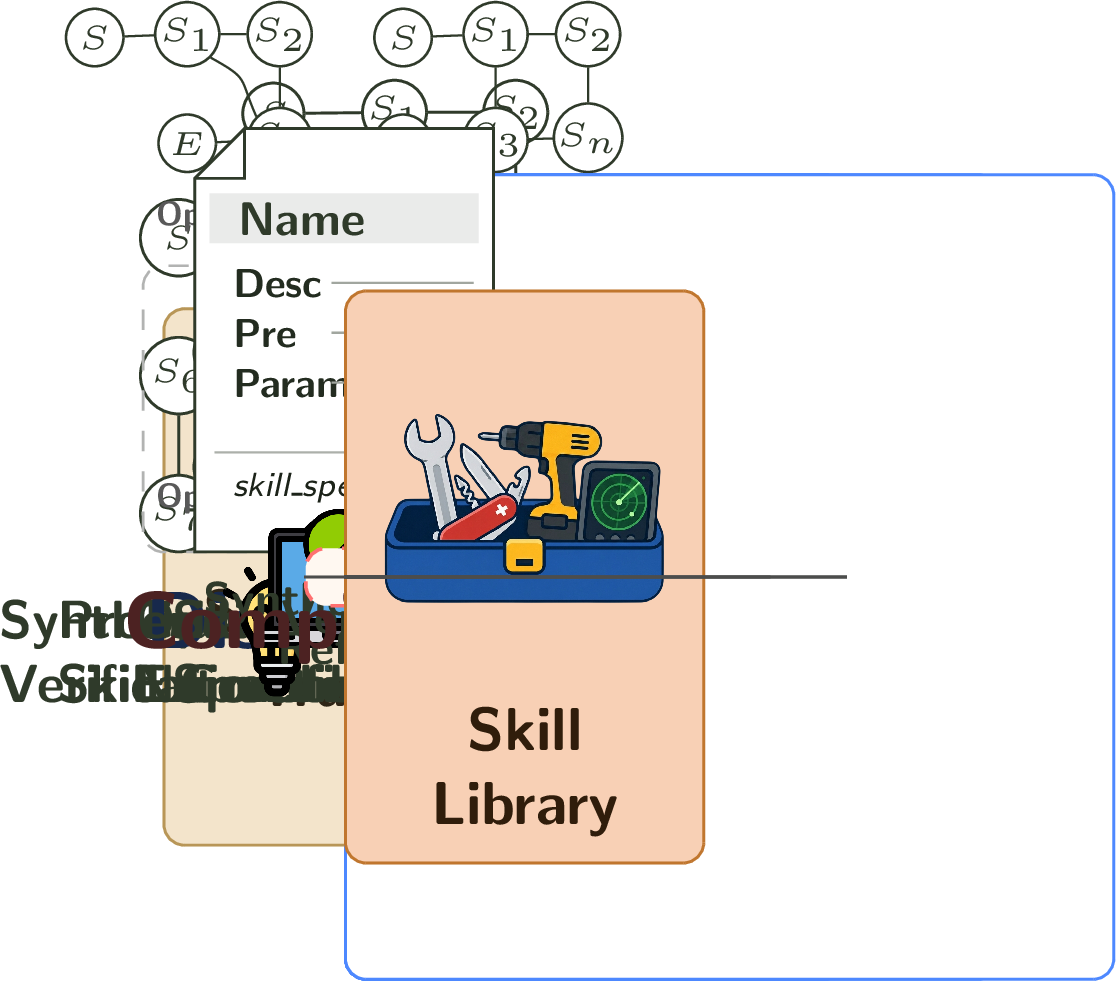
3.2 The Distillation Phase↩︎
The distillation phase consists of three stages that jointly approximate the latent lifting function \(\phi: \tau_i \mapsto \widetilde{G}_i\) and discover reusable PFSM subgraphs from successful traces. As described in Section 2, each raw execution trace is first abstracted into a concrete trace graph over the FSM. This concrete trace graph is then lifted into a PFSM graph, where repeated action patterns are represented as parameterized, code-like control-flow structures with branches. Finally, reusable subgraphs are identified from the resulting PFSM graphs and extracted as procedural skills. Therefore, the lifting function \(\phi\) is not implemented as a single monolithic step. Instead, it is decomposed into three successive transformations, each corresponding to one stage of the distillation phase.
Stage 1: Trace Normalization. Trace normalization converts each successful raw trace into a structured, executable intermediate representation. Raw agent logs interleave reasoning text, tool calls, observations, and action histories, but do not expose the control-flow structure needed for PFSM-based skill discovery. Skill-DisCo therefore normalizes each trace into a program \(p_i\) that preserves primitive operators and observations while making loops, branches, and parameterized entities explicit.
Each normalized program has three components: primitive environment calls paired with observations, symbolic variables for task-specific entities such as objects or web elements, and code-level control flow for repeated action patterns and observation-conditioned decisions. For example, a trace that visits candidate locations until an object is found can become a loop whose guard depends on the current observation.
In our implementation, an LLM extracts all executed actions and observations, preserves their order, replaces concrete entities with typed variables when possible, and emits a Python-like program. This program is not the final skill; it is an intermediate representation from which reusable subgoal-level operations are extracted.
Stage 2: Subgoal-level Operation Extraction. The goal of Stage 2 is to decompose each normalized program into subgoal-level operations that can serve as candidate procedural skills. A complete trace often contains multiple reusable parts. For example, a single household task may include searching for an object, retrieving it, navigating to an appliance, and applying the appliance. Treating the whole trace as one skill would make the induced routine too specific, while treating each primitive operator as a skill would lose the benefit of procedural reuse. Skill-DisCo therefore extracts intermediate-granularity operators that correspond to coherent subgoals.
Given a normalized program \(p_i\), the operator extractor emits \(\mathcal{O}_i=\{o^{(i)}_1,\ldots,o^{(i)}_{m_i}\},\) where each operator is represented as \(o=(\nu,\sigma,\mathbf{u},c).\) Here, \(\nu\) is an action-oriented identifier, \(\sigma\) is a natural-language summary, \(\mathbf{u}=(u_1,\ldots,u_{|o|})\) is the primitive operator sequence, and \(c\) is the corresponding code fragment. We discard unit-length fragments with \(|o|=1\), since they correspond to primitive operators rather than reusable procedural structure. The remaining multi-step operators are collected as \(\mathcal{O}_{\mathrm{multi}} = \bigcup_i \{o\in\mathcal{O}_i: |o|\geq 2\}.\)
Stage 3: Procedural Skill Consolidation. Stage 3 consolidates procedural skills by clustering subgoal-level operations that approximate the same reusable PFSM subgraph. Intuitively, a useful procedural skill should be supported by multiple successful traces, rather than being an incidental pattern that appears in only one execution.
In Skill-DisCo, subgoal-level operations are grouped together when they share the same underlying parameterized execution structure, even if their concrete objects, locations, or action lengths differ. For example, the two traces in Example 1 differ in their concrete locations, objects, and path lengths, but share the same parameterized search-and-take control flow.
Each cluster approximates a reusable PFSM subgraph and receives a reusability score: \[r_k \approx \frac{1}{N} \sum_{i=1}^{N} \mathbb{I}[K_k \preceq \widetilde{G}_i],\] where \(K_k \preceq \widetilde{G}_i\) indicates that the PFSM subgraph approximated by cluster \(c_k\) can be matched to the lifted trace graph \(\widetilde{G}_i\) under some parameter binding. The score is estimated from trace coverage and operation statistics. For each high-coverage cluster, Skill-DisCo abstracts the shared subgoal-level operation as a procedural skill.
3.3 The Compilation Phase↩︎
The distillation phase abstracts high-coverage clusters into procedural skills representing reusable PFSM subgraphs. However, a PFSM subgraph is only a structural artifact, i.e. it does not define a callable interface, runtime grounding rules, return protocol, or failure handling. The compilation phase turns each procedural skill into a callable, executable, and verifiable version. In Skill-DisCo, the compilation phase consists of two stages: skill specification and skill synthesis and verification.
Stage 4: Skill Specification. Stage 4 augments discovered procedural skills with explicit specifications. For each skill abstracted from a high-coverage cluster, Skill-DisCo creates a skill definition that captures how the skill should be invoked and what behavior it should satisfy before any concrete implementation is generated. Each skill definition contains: (i) a signature, including an action-oriented skill name, typed parameters with default values, and a structured return type (ii) a description, serving as both a machine-readable docstring and LLM-facing guidance (iii) behavioral requirements, including preconditions, postconditions, and declared side effects and (iv) metadata, including the skill abstraction level, expected primitive actions amortized per invocation, and a confidence score inherited from \(r_k\).
The explicit specification guides implementation synthesis and provides concrete criteria for verification, while giving the deployed agent a domain-agnostic vocabulary for selecting skills during task execution.
Stage 5: Synthesis and Verification. Stage 5 turns each skill specification into a verified executable skill through a synthesis and verification loop. Given a skill definition, Skill-DisCo first synthesizes a Python program that realizes the specified behavior using the primitive actions. During execution, \(f_k\) interacts with the workload environment and returns a structured output that provides execution information to the caller.
On a held-out set, verification checks runtime correctness, postcondition satisfaction, and action savings. Skills that fail are re-synthesized with feedback for up to \(R\) retries; any remaining failures are discarded.
The result is a verified executable skill library: each skill exposes a documented signature that agents can inspect, select, and call during task execution.
4 Experiments↩︎
We evaluate whether Skill-DisCo can distill reusable procedural skills from successful traces and deploy them as reliable skills for interactive agents. Our experiments are organized around four questions: RQ1. Does Skill-DisCo improve end-to-end task success rate and turn efficiency compared with base agents and prior skill-induction methods? (§4.2) RQ2. Do the procedural skills transfer across model families, scales, and reasoning modes? (§4.3) RQ3. How are the learned skills invoked and executed at inference time? (§4.4) RQ4. Do all components of Skill-DisCo contribute to the observed gains? (§4.5)
4.1 Experimental Setup↩︎
Datasets. We evaluate on two interactive agent datasets with different execution structures: (1) ALFWorld [7] consists of text-based household tasks that require navigation, search, and object manipulation. (2) WebArena [8] consists of realistic web-navigation tasks over self-hosted websites.
Splits. For each dataset, we use a strict induction/evaluation split: skills are derived only from the induction split and evaluated only on held-out tasks. For ALFWorld, the induction split consists of 200 tasks
sampled from the official train set, and the evaluation split is the official unseen split with 134 tasks. For WebArena, which has no canonical induction split, we split the 812 tasks in half: the first 406 tasks for induction and the
remaining 406 for evaluation. All baselines use the same splits as Skill-DisCo.
Baselines. We compare against two categories of baselines. The first category contains base agents without skill augmentation: ReAct [1] using the AgentBench implementation [9], and CodeAct [3]. The second group consists of offline workflow- and skill-induction methods: AWMoffline [5] and the offline variant of ASI, ASIoffline [6]. For all skill-augmented variants, each skill’s signature and description are appended in agents’ prompts to instruct LLMs to decide whether and how to invoke a skill or emit a primitive action.
Metrics. We report success rate (SR) and average agent turns (Avg. Turns) per episode. Full per-episode token usage and inference cost are reported in Appendix 7.3.
4.2 End-to-End Performance↩︎
We first evaluate whether Skill-DisCo improves complete task execution when added to existing interactive agents. Table ¿tbl:tab:baseline-comparison? compares Skill-DisCo with base agents and prior offline skill-induction methods using GPT-4o. Skill-DisCo also uses GPT-4o to induce the skill library.
3pt
@l c c@ Method & SR (%) \(\uparrow\) & Avg.Turns \(\downarrow\)
ReAct & 82.0 & 19.3
CodeAct & 96.3 & 3.6
(l)2-3 AWMoffline & 54.5 & 11.3
ASIoffline & 47.0 & 11.4
(l)2-3 \(+\) ReAct & 92.4 (\(+12.7\%\)) & 8.8 (\(-54.5\%\))
\(+\) CodeAct & 99.3 (\(+3.1\%\)) & 3.2 (\(-11.3\%\))
ReAct & 23.9 & 5.9
CodeAct & 20.0 & 10.9
(l)2-3 AWMoffline & 21.2 & 5.9
ASIoffline & 24.6 & 5.7
(l)2-3 \(+\) ReAct & 29.1 (\(+21.6\%\)) & 5.1 (\(-13.1\%\))
\(+\) CodeAct & 22.9 (\(+14.8\%\)) & 8.5 (\(-22.0\%\))
Higher task success rate. Skill-DisCo achieves the highest SR on all benchmarks under our evaluation setting. On ALFWorld, Skill-DisCo \(+\) CodeAct improves over the strong CodeAct from 96.3% to 99.3%. On WebArena, Skill-DisCo \(+\) ReAct improves ReAct from 23.9% to 29.1%, outperforming ASIoffline by 4.5 absolute points. Since all offline skill-induction methods use the same induction and evaluation splits, these gains reflect the quality of the induced skills by Skill-DisCo.
Consistent reduction in agent turns. Skill-DisCo also reduces average turns across all settings: \(-54.5\%\)/\(-11.3\%\) (ReAct/CodeAct) on ALFWorld and \(-13.1\%\)/\(-22.0\%\) on WebArena. By delegating repeated low-level action sequences to the reliable procedural skills, agents solve each task with fewer decisions.
Complementary to different agents. Table ¿tbl:tab:baseline-comparison? shows that the same library improves both ReAct (natural-language reasoning) and CodeAct (code-emitting) across all benchmarks, indicating that Skill-DisCo acts as an agent-agnostic augmentation layer by providing reusable procedural skills, rather than being tied to a specific agent.
3pt
@l c c c c@ & &
(lr)2-3(lr)4-5 Model & Van. & +Sk. (\(\Delta\)) & Van. & +Sk. (\(\Delta\))
Qwen3.5-4B & 61.2 & 91.0 (\(+48.8\%\)) & 9.0 & 5.0 (\(-44.4\%\))
Qwen3.5-9B & 54.5 & 98.5 (\(+80.8\%\)) & 10.8 & 3.4 (\(-68.2\%\))
GPT-4o & 96.3 & 99.3 (\(+3.1\%\)) & 3.6 & 3.2 (\(-11.3\%\))
GPT-4o-mini & 71.6 & 94.8 (\(+32.3\%\)) & 7.1 & 4.4 (\(-38.0\%\))
GPT-5-chat & 91.0 & 98.5 (\(+8.2\%\)) & 4.7 & 3.0 (\(-34.6\%\))
GPT-5-mini & 91.8 & 98.5 (\(+7.3\%\)) & 4.9 & 3.3 (\(-33.3\%\))
Qwen3.5-4B & 10.1 & 18.7 (\(+85.3\%\)) & 8.6 & 6.8 (\(-20.4\%\))
Qwen3.5-9B & 21.2 & 23.9 (\(+12.8\%\)) & 6.8 & 6.0 (\(-12.0\%\))
GPT-4o & 23.9 & 29.1 (\(+21.6\%\)) & 5.9 & 5.1 (\(-13.1\%\))
GPT-4o-mini & 18.0 & 18.0 (\(\pm0.0\%\)) & 7.7 & 7.1 (\(-7.7\%\))
GPT-5-chat & 32.5 & 37.0 (\(+13.7\%\)) & 5.3 & 4.8 (\(-8.6\%\))
GPT-5-mini & 32.5 & 33.7 (\(+3.8\%\)) & 5.4 & 4.8 (\(-10.1\%\))
| Bench | Method | #Sk | Turns \(\downarrow\) | Sk.turns | Avg.prim.steps | Max prim.steps | Err. (%) \(\downarrow\) |
|---|---|---|---|---|---|---|---|
| ALFWorld | ASIoffline | 110 | 11.4 | 1.4 | 0.2 | 10 | 75.3 |
| 5 | 3.2 | 2.6 | 5.6 | 33 | 0.0 | ||
| WebArena | ASIoffline | 146 | 5.5 | 1.3 | 2.5 | 8 | 33.9 |
| 20 | 5.1 | 1.0 | 2.8 | 36 | 21.5 |
6pt
4.3 Cross-Model Skill Transferability↩︎
We next test whether the skill library induced by Skill-DisCo with GPT-4o can transfer to other models. We deploy the same skill library without modification across multiple target models: Qwen3.5-4B, Qwen3.5-9B, GPT-4o, GPT-4o-mini, GPT-5-chat, and GPT-5-mini. Based on Table ¿tbl:tab:baseline-comparison?, we use the skill library induced from the stronger Skill-DisCo configuration on each benchmark: CodeAct for ALFWorld and ReAct for WebArena.
Skills transfer across target models. With the same skill library, every target model benefits: average turns drop in every cell (\(-7.7\%\) to \(-68.2\%\)), while SR improves by \(+3.1\%\) to \(+80.8\%\) on ALFWorld and by up to \(+85.3\%\) on WebArena with no decreases. These results show that the induced skills are robust across model families and scales.
Weaker models can benefit substantially from skill transfer. Although gains are not strictly monotone in capacity, the largest jumps occur on the smaller open-source backbones: Qwen3.5-9B gains \(+80.8\%\) on ALFWorld and Qwen3.5-4B gains \(+85.3\%\) on WebArena, versus only \(+3.1\%\)–\(+7.3\%\) for GPT-4o/GPT-5-mini. Strikingly, Qwen3.5-9B with the GPT-4o-induced library reaches 98.5% on ALFWorld, surpassing its inducer (96.3%) at a fraction of the cost. This shows that Skill-DisCo serves as a form of procedural-knowledge distillation and transfer, allowing smaller models to benefit from skills compiled by a stronger inducer.
4.4 Skill Usage and Execution Reliability↩︎
We analyze how much of an episode the agent delegates to its skill library and how reliably those skill calls execute. Following the settings in Table ¿tbl:tab:baseline-comparison? (CodeAct on ALFWorld and ReAct on WebArena), we report aggregate skill-usage statistics in Table 1 and compare Skill-DisCo with ASIoffline.
Skill-DisCo learns compact, high-coverage skills. Skill-DisCo uses far fewer skills than ASI (5 vs. on ALFWorld; 20 vs. on WebArena) while each call covers more prim. steps (5.6 vs. on ALFWorld; 2.8 vs. on WebArena) and larger maximum step compression (33/36 vs./8). Thus, Skill-DisCo distills compact skills that encode reusable procedures rather than shallow fragments.
Verified skills execute more reliably. Skill-DisCo makes skill calls less error-prone, reducing execution errors from 75.3% to 0.0% on ALFWorld and from 33.9% to 21.5% on WebArena. Thus, its gains come not only from invoking skills, but from invoking skills that execute reliably; together with higher step compression, this explains the SR and turn improvements in Table ¿tbl:tab:baseline-comparison?.
4.5 Ablation Study↩︎
We evaluate the contribution of the two main phases of Skill-DisCo, distillation and compilation, through ablations on ALFWorld using CodeAct with GPT-4o (Table 2).
| Configuration | #Sk | SR (%) | Turns |
|---|---|---|---|
| A1: no distill | 43 | 53.0 (\(-46.6\%\)) | 11.5 |
| A2: no compile | NA | 97.0 (\(-2.3\%\)) | 3.6 |
| Full | 5 | 99.3 | 3.2 |
4pt
Distillation is the main driver of success. Removing distillation and inducing skills per successful trace yields a larger 43-skill library but reduces SR from 99.3% to 53.0% and increases turns from 3.2 to 11.5. Without cross-trace consolidation the library is dominated by overlapping, trace-specific variants, making skill selection harder and causing wrong-variant invocations or fallback to long open-loop executions.
Compilation mainly improves execution compactness. Removing compilation and shipping the output of Stage 3 as natural-language procedure descriptions only modestly reduces SR (\(99.3\!\to\!97.0\%\)), but each episode must keep the full procedure text in context, inflating tokens (Appendix 7.3). Compiling skills into callable code externalizes procedural execution from the prompt, yielding both efficiency and a small additional reliability gain.
5 Related Work↩︎
LLM-Based Agents. ReAct [1] interleaves reasoning with actions; CodeAct [3], PAL [10], and Code as Policies [11] show executable code improves compositional reasoning [12]. Yet procedural knowledge in successful traces remains ephemeral and rarely reused.
Reusing Agent Experience as Behavioral Imitation. A common line keeps the model fixed and reuses experience as token-level context: Reflexion [2] prompts self-reflection; AWM [5] induces textual workflows; Trace2Skill [13] writes structured skill documents. All store knowledge in natural language—unverifiable before deployment and re-interpreted at inference. Skill-DisCo instead compiles procedural knowledge into external executable code, verifiable offline and reusable across models.
Synthesizing Executable Tools, Workflows, and Skills. (1) Tool and workflow generation. LATM [14], CREATOR [15], and ToolGen [16] synthesize or unify tools per task; AgentDistill [17] produces MCP modules for training-free transfer. At the system level, ADAS [18], AgentSquare [19], AFlow [20], and MaAS [21] automate agentic-system or workflow design. All start from explicit task specifications; Skill-DisCo mines a corpus of execution traces, grounding skills in recurring behavior. (2) Skill induction from agent experience. Voyager [22] commits one JavaScript function per successful task, leaving near-duplicate variants unconsolidated. SkillWeaver [23] derives APIs from website affordances, not workload traces. ASI [6] shows programs beat free-form text as skill representations but still operates per-trajectory. Skill-DisCo is an offline corpus-level compiler: semantic clustering merges equivalent operations into verified executable skills, so library size scales with distinct behaviors, not episode count.
6 Conclusion↩︎
This paper studies procedural skill discovery by making shared execution structure across successful traces explicit. We formulate skills as reusable PFSM subgraphs under parameter binding, and introduce Skill-DisCo which distills compact, high-coverage structures from traces and compiles them into executable, and verifiable skills. Experiments on ALFWorld and WebArena show that these structurally grounded skills improve success rate and turn efficiency, supporting more reliable and transferable agent experience reuse.
Limitations↩︎
Procedural tasks only. SkillDisCo compiles programmatic skills from interaction traces and is effective for tasks with reusable procedural structure (navigation, web automation, tool use). It offers no benefit for pure NLP tasks such as text generation or reading comprehension, where success depends on linguistic understanding rather than executable procedures.
Pipeline quality depends on model capability. SkillDisCo’s pipeline relies on the compiler LLM’s reasoning and code-generation ability. Insufficient model capability yields incorrect or overly specific skills, and output quality degrades as model capability decreases..
Requires successful traces. Only successful episodes contribute distillation signal. In domains where even frontier models succeed rarely, the corpus may be too sparse for reliable corpus-level skill extraction.
7 Full Results: Token Usage and Inference Cost↩︎
7.1 API Pricing Assumptions↩︎
All per-episode inference costs reported in the paper are computed from provider-published token prices, retrieved from Artificial Analysis1 on 23 May 2026 (on-demand rates). Cached input tokens (returned inside a context-caching session) are billed at \(\frac{1}{10}\) of the regular input rate; output tokens are billed at the full output rate. No batch-API discounts are applied.
7.2 Full Baseline Comparison with Token and Cost Statistics↩︎
Table ¿tbl:tab:full-baseline-comparison? reproduces Table ¿tbl:tab:baseline-comparison? from the main paper with the three token/cost columns restored.
4pt
@l c c r r r@ Method & SR (%) \(\uparrow\) & Avg.Turns \(\downarrow\) & In-Tok.(Cached) &
Out-Tok. & Cost ($)
ReAct & 82.00 & 19.29 & 35,600 (22,200) & 626 & 0.0450
CodeAct & 96.27 & 3.63 & 7,721 (6,232) & 562 & 0.0109
(l)2-6 AWMoffline & 54.48 & 11.34 & 38,908 (22,923) & 275 & 0.0484
ASIoffline & 47.01 & 11.43 & 68,945 (54,175) & 286 & 0.0533
(l)2-6 \(+\) ReAct & 92.40 (\(+12.7\%\)) & 8.78 (\(-54.5\%\)) & 22,100
(11,300) (\(-37.9\%\)) & 607 (\(-3.0\%\)) & 0.0360 (\(-20.0\%\))
\(+\) CodeAct & 99.25 (\(+3.1\%\)) & 3.22 (\(-11.3\%\)) &
8,468 (6,303) (\(+9.7\%\)) & 368 (\(-34.5\%\)) & 0.0107 (\(-1.8\%\))
ReAct & 23.89 & 5.88 & 50,914 (8,605) & 728 & 0.1152
CodeAct & 19.95 & 10.86 & 75,962 (24,202) & 806 & 0.1435
(l)2-6 AWMoffline & 21.18 & 5.92 & 49,025 (11,748) & 564 & 0.1018
ASIoffline & 24.63 & 5.71 & 56,662 (9,247) & 603 & 0.1269
(l)2-6 \(+\) ReAct & 29.06 (\(+21.6\%\)) & 5.11 (\(-13.1\%\)) & 51,068 (8,582) (\(+0.3\%\)) & 561 (\(-22.9\%\)) &
0.1215 (\(+5.5\%\))
\(+\) CodeAct & 22.91 (\(+14.8\%\)) & 8.47 (\(-22.0\%\)) & 85,649
(27,078) (\(+12.8\%\)) & 736 (\(-8.7\%\)) & 0.1606 (\(+11.9\%\))
Parenthesized values give relative \(\Delta\) vs.the matching base agent (ReAct or CodeAct). Best and second-best per column highlighted; our rows in bold
.
7.3 Per-Episode Token and Cost Breakdown↩︎
Tables 3 expand the aggregate “Avg.In-Tok.(Cached) / Avg.Out-Tok./ Avg.Cost” figures from Table ¿tbl:tab:multi-models? with the full numerical detail for every model-setting pair.
| In-Tok.(Cached) | Out-Tok. | Cost ($) | |||||||
|---|---|---|---|---|---|---|---|---|---|
| 2-4(lr)5-7(lr)8-10 Model | Vanilla | +Skill | \(\Delta\) | Vanilla | +Skill | \(\Delta\) | Vanilla | +Skill | \(\Delta\) |
| Qwen3.5-4B | 28,010 (24,566) | 19,608 (14,505) | \(-30.0\%\) | 2,095 | 1,391 | \(-33.6\%\) | 0.00049 | 0.00041 | \(-16.3\%\) |
| Qwen3.5-9B | 27,754 (24,939) | 10,152 (7,292) | \(-63.4\%\) | 1,382 | 610 | \(-55.9\%\) | 0.00061 | 0.00036 | \(-41.0\%\) |
| GPT-4o | 7,721 (6,232) | 8,468 (6,303) | \(+9.7\%\) | 562 | 368 | \(-34.5\%\) | 0.01090 | 0.01067 | \(-2.1\%\) |
| GPT-4o-mini | 17,620 (16,020) | 13,686 (11,271) | \(-22.3\%\) | 891 | 485 | \(-45.6\%\) | 0.00102 | 0.00082 | \(-19.6\%\) |
| GPT-5-chat | 10,606 (8,517) | 7,728 (5,496) | \(-27.1\%\) | 677 | 391 | \(-42.2\%\) | 0.01040 | 0.00739 | \(-28.9\%\) |
| GPT-5-mini | 11,046 (6,979) | 8,561 (6,189) | \(-22.5\%\) | 871 | 492 | \(-43.5\%\) | 0.00293 | 0.00173 | \(-41.0\%\) |
3pt
7.4 Full Ablation Breakdown↩︎
Table 4 expands the two-row ablation summary in Table 2 (§4.5) with the no-skill baseline and per-episode token and cost statistics.
| Configuration | #Sk | SR (%) | Turns | In-Tok.(Cached) | Out-Tok. | Cost ($) |
|---|---|---|---|---|---|---|
| Vanilla (no skills) | 0 | 96.27 | 3.63 | 7,720 (6,231) | 561 | 0.01090 |
| A1: no distill | 43 | 52.99 | 11.51 | 107,528 (97,901) | 994 | 0.05849 |
| A2: no compile | 0 | 97.01 | 3.59 | 19,083 (17,393) | 559 | 0.01417 |
| Full | 5 | 99.25 | 3.22 | 8,468 (6,302) | 368 | 0.01067 |
4pt
8 Pipeline Stage Prompts↩︎
We summarize the LLM prompts that drive each pipeline stage (latest_pipeline/skill_mining/). For brevity each listing keeps the system message’s role, key directives, and the JSON output schema; long motivating examples, repeated rationale,
and formatting boilerplate from the source files are elided with “…”. Placeholders in {braces} are Python f-string slots filled at runtime. A few slots in Stages 4 and 5 are specialized per benchmark (benchmark_prompts.py) – we
leave them as placeholders here and omit the benchmark-specific fills for brevity.
8.1 Stage 1 — Trace \(\to\) Program Transpilation↩︎
Listing lst:prompt-stage1: Stage 1 prompt (trace normalization, from \texttt{prompt/trace\_converter.md}).
[System]
You are a Senior AI Systems Architect. Convert a raw ReAct trace
(alternating THOUGHT / ACTION messages and environment observations)
into a structured Python program that preserves the reasoning while
making control flow explicit and logically stable.

Each reasoning block must follow the Unified Reasoning Template:
  # A. Deterministic (logic-controlled)
  if "<condition>" in observation:
      action = "<derived action>"
      context.append((observation, None, action))
      observation, available_actions = env.step(action)
  # B. Cognitive (LLM-driven, for adaptive / uncertain steps)
  thinking, action = llm(task, context, observation, available_actions)
  context.append((observation, thinking, action))
  observation, available_actions = env.step(action)

Rules: (i) use deterministic control flow (if/for/while) for repetitive
or stabilized reasoning; (ii) reserve llm() for adaptive decisions;
(iii) update `context` and call `env.step()` after every action;
(iv) preserve every ACTION from the trace -- never drop mistakes or
recovery steps; (v) copy real observation/thinking/action strings as
inline `# ...` comments.

[User]
Please convert the following agent trace history to Python code:
{raw_history}
8.2 Stage 2 — Semantic Operation Extraction↩︎
Listing lst:prompt-stage2: Stage 2 prompt.
[System]
You are an expert at analyzing agent traces represented as Python code.
Extract semantic operations: groups of consecutive steps that together
accomplish one coherent sub-goal and whose internal relationship can
be expressed as control flow (if/for/while or fixed sequence).
A good operation has clear boundaries, locality, and reusability.

For each operation emit:
  name         : snake_case verb_noun
  description  : the sub-goal
  env_steps    : every (action, observation) pair -- prefer the
                 authoritative env-step log over the code, which may
                 have dropped actions during conversion
  code_snippet : the complete code block (no truncation)
  succeeded    : true iff the final observation confirms the sub-goal
                 (e.g., "Nothing happens." => false)

Output JSON: {"task_summary": "...", "operations": [ ... ]}

[User]
## Code to Analyze
```python
{trace.code}
```
{env_log_section}
Please extract all semantic operations. The env-step log is
authoritative -- group its entries by the code's structure but
include ALL actions from the log.
8.3 Stage 3 — Operation Clustering (Two Passes)↩︎
Stage 3 first runs a grouping pass over mini-batches that proposes candidate reusable patterns, then a consolidation pass that merges overlapping proposals into a minimal cluster set.
Listing lst:prompt-stage3a: Stage 3a prompt -- grouping.
[System]
You are identifying reusable operation patterns. Partition the input
operations into non-overlapping groups whose members share the largest
reusable action/observation pattern and semantic goal -- transferring
across different objects, locations, pages, or task instances.

Rules: use `env_steps` to decide membership (not names); ignore
incidental differences; split only when the action pattern or goal
differs; ignore operations that did not change state; prefer fewer,
larger, uniform groups -- when in doubt, MERGE.

Output JSON: {"groups": [{"group_name", "description",
"representative_operations": [{"operation_id","name"}]}]}

[User]
## Operations to Analyze ({len(batch)} operations)
```json
{json.dumps(batch, indent=2)}
```
Listing lst:prompt-stage3b: Stage 3b prompt -- consolidation.
[System]
Merge the candidate operation groups into a minimal, non-redundant
skill set. Assign every input group `index` to exactly one final
cluster (no overlap, no missing index).

Merge groups whose reusable skill, goal, or induced state change is
similar, even if the wording, objects, locations, or appliances
differ. Proceed in three steps: (1) draft candidate clusters,
(2) merge duplicates/overlaps, (3) emit the final JSON as the LAST
fenced `json` block in your response.

Output JSON: {"clusters": [{"name", "description",
"indices": [0,3,7]}, ...]}

[User]
## Groups to Consolidate ({len(groups)} groups)
```json
{json.dumps(group_summaries, indent=2)}
```
8.4 Stage 4 — Skill Contract Definition↩︎
Stage 4 turns each cluster into a typed skill contract. The base prompt is built by build_stage4_prompt(bench_cfg) and contains two benchmark slots, {action_construction_note} and {action_seq_example}, that are
filled per benchmark.
Listing lst:prompt-stage4: Stage 4 prompt (benchmark slots left as placeholders).
[System]
You design reusable skill APIs for LLM agents. Skills are Python
functions of the form
    def skill_name(param1, param2, ...):
`env` is a global -- never a parameter -- and is used as
    observation, available_actions = env.step(action: str)
After a skill returns, the caller LLM sees ONLY the returned Dict;
it must always include at least `success`, the latest `observation`
and `available_actions`, and a process trace of (action, observation).

Design principles: (1) generalize -- parameterize object names,
location lists, and action templates; (2) single responsibility --
one goal per skill; (3) action SELECTION not construction --
    {action_construction_note}
(4) declare every state change in `side_effects` and reflect it in
`canonical_action_sequence`; (5) compose freely -- assume no
prerequisite from the caller.

Output JSON contract:
  {"skill_name", "description", "docstring",
   "parameters": [{"name","type","description","required","default"}],
   "return_type": "Dict",
   "preconditions", "postconditions", "side_effects",
   "canonical_action_sequence": [
       "Ordered action templates with {param} placeholders.",
       {action_seq_example}
       "Derive ONLY from SUCCEEDED traces; prefer the shortest
        successful sequence; copy the exact action syntax."
   ],
   "abstraction_level": "primitive|composite|workflow",
   "estimated_actions_saved": <int>, "confidence_score": <float>}

[User]
## Operation Group
- Name / Description / #operations / #traces / avg_actions /
  reusability_score: {cluster fields}

## Representative Operations (real env.step() patterns)
```json
{json.dumps(examples, indent=2)}
```
Define a general, reusable skill that abstracts this pattern.
8.5 Stage 5 — Skill Synthesis↩︎
Stage 5 synthesises a self-contained Python implementation from the Stage 4 contract. The base prompt is built by build_stage5_prompt(bench_cfg) and contains two benchmark slots, {first_action_rule} (how to obtain the first
vs. later actions) and {identifier_note} (an env-specific gotcha).
Listing lst:prompt-stage5: Stage 5 prompt (benchmark slots left as placeholders).
[System]
You synthesise the Python body of a skill defined by the Stage 4
contract. `env` is global; signature contains only domain parameters.

Critical rules:
1. Use ONLY `env.step()` and the Python stdlib -- no helper
   functions, no simulation, no fabricated observations.
2. {first_action_rule}
3. Match the trace's action syntax exactly; when constructing,
   reproduce the verb / preposition / argument pattern from the
   reference traces.
4. Branch on the LATEST `observation`, not on a self-computed flag.
5. Honour every parameter; implement every step in
   `canonical_action_sequence` and only those plus declared
   side effects.
6. Append every (action, observation) pair to `process_trace`.
7. Return a Dict including at least `success`, latest `observation`,
   latest `available_actions`, and `process_trace` (plus any extra
   keys the caller needs).

Environment note: {identifier_note}

Output JSON: {"implementation": "def skill_name(...): \\n  ...",
              "example_usage":  "result = skill_name(...) ..."}

[User]
## Skill Definition
{skill.skill_name / description / parameters / pre & postconditions}

## Representative Code Examples (ground truth env.step() patterns)
```json
{json.dumps(examples, indent=2)}
```
Synthesise the implementation. Select actions from
`available_actions`, follow the code_snippet patterns exactly, and
return the Dict so the caller can continue without blind spots.
9 Skill Library Examples↩︎
We show one representative skill for each benchmark, reproduced verbatim from the final compiled skill catalogs. Listing [lst:skill-alfworld-search] is the highest-coverage skill in the ALFWorld library: it iterates over a list of candidate locations, opens any closed containers, and returns as soon as the target item is
observed. Listing [lst:skill-webarena-submit] is a representative WebArena skill that drives the multi-step submission workflow on a Reddit clone
(open form \(\to\) fill URL / title / body \(\to\) select forum \(\to\) submit), with every action selected by content-based matching against the live
admissible-action set via find_bid(...).
Listing lst:skill-alfworld-search: ALFWorld skill: \texttt{systematic\_search\_locations}.
def systematic_search_locations(locations, target):
    """Systematically search through a list of locations to find a
    specific target item. The skill navigates to each location, opens
    it if necessary, and examines its contents to locate the target.

    Args:
        locations: A list of location names to search through.
        target: The name of the item to search for.
    """
    process_trace = []
    found_in = None

    for location in locations:
        # Step 1: Go to the location
        action = f"go to {location}"
        observation, available_actions = env.step(action)
        process_trace.append((action, observation))

        # Step 2: Check if the location is closed and open it if necessary
        if "closed" in observation:
            action = next(
                (a for a in available_actions
                 if "open" in a.lower() and location in a.lower()),
                f"open {location}",
            )
            observation, available_actions = env.step(action)
            process_trace.append((action, observation))

        # Step 3: Inspect the contents of the location
        if target in observation:
            found_in = location
            return {
                "success": True,
                "found_in": found_in,
                "observation": observation,
                "available_actions": available_actions,
                "process_trace": process_trace,
            }

    # If the target is not found in any location
    return {
        "success": False,
        "found_in": None,
        "observation": observation,
        "available_actions": available_actions,
        "process_trace": process_trace,
    }
Listing lst:skill-webarena-submit: WebArena skill: \texttt{create\_submission\_workflow} (Reddit site).
def create_submission_workflow(
    title: str,
    body: str,
    forum_name: str,
    url: Optional[str] = None):

    """Complete workflow for creating a new submission/post. Navigates
    to the submission form, fills in required fields (URL if present,
    title, body), selects the target forum, and submits the form.
    Flow: click Submit -> fill fields -> select forum -> click Create.

    Args:
        title: Title of the submission to post.
        body: Main content/body of the submission.
        forum_name: Target forum/subreddit label to select.
        url: Optional URL to include if the form has a URL field.
    """
    process_trace = []
    matched_elements = []
    failure_reason = None

    observation = env.step('noop(0)')

    # Step 1: Click "Submit" to open the submission form
    submit_bid = find_bid('Submit', observation)
    if not submit_bid:
        return {'success': False, 'observation': observation,
                'process_trace': process_trace,
                'matched_elements': matched_elements,
                'failure_reason': "Submit button not found."}
    observation = env.step(f"click('{submit_bid}')")
    process_trace.append((f"click('{submit_bid}')", observation))
    matched_elements.append('Submit')

    # Step 2: Optionally fill URL field
    if url:
        url_bid = find_bid('URL', observation)
        if url_bid:
            act = f"fill({url_bid!r}, {str(url)!r})"
            observation = env.step(act)
            process_trace.append((act, observation))
            matched_elements.append('URL')

    # Step 3: Fill Title field
    title_bid = find_bid('Title', observation)
    if not title_bid:
        return {'success': False, 'observation': observation,
                'process_trace': process_trace,
                'matched_elements': matched_elements,
                'failure_reason': "Title field not found."}
    act = f"fill({title_bid!r}, {str(title)!r})"
    observation = env.step(act)
    process_trace.append((act, observation))
    matched_elements.append('Title')

    # Step 4: Open forum-selection dropdown and pick the target forum
    combobox_bid = find_bid('Choose one', observation) \;
                   or find_bid('Forum', observation)
    if not combobox_bid:
        return {'success': False, 'observation': observation,
                'process_trace': process_trace,
                'matched_elements': matched_elements,
                'failure_reason': "Forum selection combobox not found."}
    observation = env.step(f"click('{combobox_bid}')")
    process_trace.append((f"click('{combobox_bid}')", observation))
    forum_bid = find_bid(forum_name, observation)
    if not forum_bid:
        return {'success': False, 'observation': observation,
                'process_trace': process_trace,
                'matched_elements': matched_elements,
                'failure_reason': f"Forum '{forum_name}' not found."}
    observation = env.step(f"click('{forum_bid}')")
    process_trace.append((f"click('{forum_bid}')", observation))
    matched_elements.append(forum_name)

    # Step 5: Fill Body field
    body_bid = find_bid('Body', observation)
    if not body_bid:
        return {'success': False, 'observation': observation,
                'process_trace': process_trace,
                'matched_elements': matched_elements,
                'failure_reason': "Body field not found."}
    act = f"fill({body_bid!r}, {str(body)!r})"
    observation = env.step(act)
    process_trace.append((act, observation))
    matched_elements.append('Body')

    # Step 6: Click "Create submission" to finalize
    create_bid = find_bid('Create submission', observation) \;
                 or find_bid('Submit', observation)
    if not create_bid:
        return {'success': False, 'observation': observation,
                'process_trace': process_trace,
                'matched_elements': matched_elements,
                'failure_reason': "Create-submission button not found."}
    observation = env.step(f"click('{create_bid}')")
    process_trace.append((f"click('{create_bid}')", observation))
    matched_elements.append('Create submission')

    success = 'submitted' in observation.lower() \;
              or 'created' in observation.lower()
    return {
        'success': success,
        'observation': observation,
        'process_trace': process_trace,
        'matched_elements': matched_elements,
        'failure_reason': None
            if success
            else 'No success confirmation detected.',
    }