ProvenAI:
Provenance-Native Traces of Evidence in Generated Answers
January 01, 1970
Abstract
Retrieval-augmented systems routinely present citations alongside generated answers, yet a citation does not confirm that the corresponding source meaningfully shaped the output. This paper introduces ProvenAI, a framework that decomposes transparency in multi-hop question answering into three independently measurable layers: answer correctness, citation fidelity against benchmark supporting evidence, and per-document influence under leave-one-resource-out intervention. Targeting the HotpotQA distractor benchmark through a seven-stage pipeline covering data normalisation, retrieval indexing, citation-aware answer generation, attribution auditing, ablation-based influence estimation, batch evaluation, and interactive inspection, ProvenAI evaluates 7,405 validation examples drawn from a canonical corpus of 509,300 passages. The system achieves 53.53% answer accuracy alongside a mean citation-fidelity score of 71.55%, and a worked example surfaces what we call the citation-influence gap: a clean citation audit co-occurring with a profile in which one cited source registers only weak influence while seven uncited sources demonstrably shift the output. We formalise the relationship between the implemented surface proxy and a token-level KL-divergence target through a stated faithfulness condition, ground the framework in causal-mediation analysis and database-provenance theory, and discuss how the three measurement layers compose with cryptographic provenance architectures emerging in autonomous scientific discovery. ProvenAI establishes that meaningful transparency in retrieval-grounded QA requires traceable links across retrieved, cited, and behaviourally influential evidence as three distinct, independently measured layers.
Preprint.
1 Introduction↩︎
Retrieval-augmented generation has become a mainstream mechanism for improving the factual grounding of language model outputs by supplying external documents at inference time [1], [2]. Multi-hop question answering amplifies the challenge: a correct answer typically requires chaining evidence across several documents, making it essential to understand not only what was retrieved but how each piece of evidence influenced the final response [3], [4]. The HotpotQA distractor benchmark provides sentence-level supporting-fact annotations and has therefore become a principled testbed for studying how retrieved evidence propagates through a pipeline.
Despite the promise of citation-bearing outputs, a model that receives ten retrieved passages and cites only two of them may still be shaped by the remaining eight. The citation list answers a single narrow question, namely what the model claims to have used, and says nothing about whether those sources matched the gold supporting facts, nor whether removing any particular document would have changed the response. State-of-the-art systems leave citations unsupported a substantial fraction of the time and frequently cite sources in ways that do not reflect their actual context usage [5]–[7]. Recent work further shows that language models can be distracted by irrelevant retrieved context [8] and may rely on parametric memory rather than the cited passages [9], making the gap between cited and influential evidence operationally important. The need for output-level auditing is especially acute in security and forensic applications, where LLM-driven pipelines increasingly analyse logs and evidence yet must remain accountable to a verifiable record of what shaped each conclusion [10], [11].
ProvenAI is built around this gap. It is not a stronger QA model but an infrastructure for measuring how evidence propagates through a retrieval-grounded pipeline. The core premise is that answer quality, citation faithfulness, and resource influence each capture a different dimension of transparency, and collapsing them into a single score discards the diagnostic information practitioners need. The implemented system follows a seven-stage workflow in which HotpotQA data are converted into stable local artefacts, a dense retrieval index is built, a generation step produces citation-aware answers, an auditing step checks citations against gold supporting facts, leave-one-resource-out ablations estimate per-document influence, metrics are aggregated over the full validation split, and a Streamlit dashboard exposes results alongside Model Context Protocol [12] trace artefacts.
The contributions of this work are fourfold. We present a practical decomposition of retrieval-grounded QA transparency into three independently measurable layers and supply formal operationalisations for each. We report an end-to-end pipeline evaluated over the complete HotpotQA distractor validation split, with reproducible structured report artefacts at every stage. We exhibit and characterise the citation-influence gap, formalise the relationship between the implemented surface proxy and a token-level KL-divergence target, and connect the framework to causal-mediation analysis and database-provenance theory. Finally, we discuss how the three measurement layers compose with cryptographic provenance architectures relevant to autonomous scientific discovery, settings in which the audit trail must be an invariant of execution rather than retrospective annotation.
2 Related Work↩︎
2.0.0.1 Multi-hop retrieval and RAG foundations.
Retrieval-augmented generation pairs a parametric language model with a non-parametric retrieval index over a corpus [1], with dense passage retrieval [13] and approximate nearest-neighbour indexing [14] as the standard implementation. Multi-hop benchmarks demand chained evidence: HotpotQA [3] provides sentence-level supporting-fact annotations across two-hop questions, and MuSiQue extends control over reasoning structure through single-hop compositions [15]. Surveys show that while RAG substantially reduces hallucinations on knowledge-intensive tasks, retrieval errors propagate through generation in ways aggregate accuracy scores cannot readily surface [2], [16]. Self-RAG trains a single model to decide adaptively when to retrieve and to critique its own evidence through self-reflection tokens [17], and dedicated multi-hop RAG evaluations show that existing dense and sparse retrieval methods perform poorly when several evidence hops are required [4]. Beyond single-model pipelines, structural analyses of multi-agent LLM communication show that reasoning reliability depends on the topology through which evidence propagates [18], reinforcing that what flows between components, not only what each component emits, governs trust. ProvenAI does not train a new retriever or generator; it measures what can be inferred around an inference-only pipeline built from fixed pre-trained components [19], [20].
2.0.0.2 Citation quality and verifiability.
Generative search systems that produce fluent citation-bearing answers can still fail to ground those citations in the corresponding source passages [5]. FActScore decomposes long-form generations into atomic claims and checks each against a knowledge source [21], RAGAS supplies reference-free metrics for faithfulness and context relevance [22], and the AIS framework defines verifiable NLG as output attributable to identified sources with a two-stage annotation pipeline [23]. ALCE formalised end-to-end evaluation of citation-bearing answers, demonstrating that even strong models leave citations unsupported a significant fraction of the time [6], and MIRAGE uses model internals, specifically KL-divergence shifts, to attribute answers to retrieved passages more faithfully than self-citation prompting [7]. ProvenAI is aligned with this evaluation-focused direction but adds an orthogonal question: after a document has been cited, does removing it from context actually change what the model generates?
2.0.0.3 Context attribution, causal mediation, and provenance theory.
Ablation-based attribution has a long lineage in machine-learning interpretability, from local surrogate models such as LIME [24] to causal-mediation analyses that intervene on internal model components [25], formalised through the do-calculus [26]. ContextCite formalises context attribution by fitting a sparse linear surrogate over random context ablations, with the key finding that removing high-scoring context segments causes larger output probability drops than removing low-scoring ones [27], and SelfCite demonstrates that context ablation can serve directly as a self-supervised reward for citation-generating models [28]. ProvenAI applies the same ablation intuition at the document level and uses it to assign categorical influence labels rather than to fine-tune a model. Provenance has also been advanced as a structural security primitive in AI-driven systems, spanning secure cloud architecture and migration [29] and ontology-grounded forensic reasoning [11]; ProvenAI inherits this orientation and applies it to the citation layer of retrieval-grounded QA. The broader notion of evidence provenance has deep roots in the database literature, where formal frameworks distinguish why, where, and how provenance [30], [31]; we adopt this layered perspective when discussing how ProvenAI’s measurement infrastructure composes with cryptographic enforcement (Section 7). The Model Context Protocol standardises how AI applications access external data and tools [12], [32]; ProvenAI incorporates a local MCP layer as a traceable interface for retrieval-time resource access without claiming that MCP itself resolves attribution.
3 Problem Formulation↩︎
Let \(q\) denote a question and \(R = \{r_1, \dots, r_k\}\) the set of retrieved resources provided to the model as context. The generator produces a textual answer \(a\) and a citation set \(C \subseteq R\). The dataset supplies a gold answer \(a^{*}\) and a set of expected supporting document titles \(G\). ProvenAI evaluates three layers independently. Answer correctness asks whether \(a\) matches \(a^{*}\) after lightweight string normalisation. Citation fidelity asks whether the titles in \(C\) align with the supporting titles in \(G\). Resource influence asks whether removing \(r_i\) from context changes the answer or citation pattern.
3.1 Citation fidelity↩︎
Citation fidelity is operationalised at the document-title level using token-set Jaccard similarity. Let \(T_C\) denote cited titles and \(T_G\) denote gold supporting titles. A cited title is counted as a match if its Jaccard similarity to the nearest supporting title meets threshold \(\tau\): \[\begin{align} P_\tau &= \frac{1}{|T_C|}\sum_{t \in T_C} \mathbf{1}\!\left(\max_{g \in T_G}\mathrm{sim}(t,g)\ge \tau\right), \\ R_\tau &= \frac{1}{|T_G|}\sum_{g \in T_G} \mathbf{1}\!\left(\max_{t \in T_C}\mathrm{sim}(t,g)\ge \tau\right), \\ F_\tau &= \frac{2 P_\tau R_\tau}{P_\tau + R_\tau}. \end{align}\] The threshold \(\tau\) is held fixed across the validation split (Table ¿tbl:tab:config?); we report results under both exact (\(\tau=1\)) and semantic (\(\tau=0.34\)) matching.
3.2 Resource influence: KL target and surface proxy↩︎
The conceptual target for per-document influence is the KL divergence between the full-context output distribution and the distribution obtained after removing \(r_i\): \[\mathrm{Influence}_{\mathrm{KL}}(r_i) = \mathop{\mathrm{D_{\mathrm{KL}}}}\!\big(p(\cdot \mid q, R)\,\big\|\,p(\cdot \mid q, R \setminus \{r_i\})\big). \label{eq:klinf}\tag{1}\] Equation 1 is a do-calculus quantity in the sense of [26]: leave-one-resource-out ablation is the intervention \(\mathrm{do}(R \leftarrow R \setminus \{r_i\})\), and \(\mathrm{Influence}_{\mathrm{KL}}\) measures the natural direct effect of \(r_i\) on the output distribution [25]. Because the local MLX inference path used in this work does not expose per-token probabilities, the system computes a surface-level proxy from regenerated samples: \[\begin{align} \Delta a(r_i) &= 1 - \mathop{\mathrm{Jaccard}}\!\big(\mathrm{tok}(a),\mathrm{tok}(a_{-i})\big),\\ \Delta c(r_i) &= 1 - \frac{|C \cap C_{-i}|}{|C \cup C_{-i}|},\\ \phi(r_i) &= 0.8\,\Delta a(r_i) + 0.2\,\Delta c(r_i), \end{align}\] where \(a_{-i}\) and \(C_{-i}\) are the answer and citation set regenerated after removing \(r_i\). The proxy aggregates two surface signals: token-level shift in the realised answer and Jaccard distance between citation sets. The \(0.8/0.2\) weighting reflects the relative reliability of the two signals; principled probability-aware estimators [27], [28] are deferred to a backend that exposes per-token logits.
Proposition 1 (Faithfulness of the surface proxy under near-deterministic decoding). Let \(p_t\) and \(p'_t\) denote the next-token distributions under the full and ablated contexts at step \(t\), conditioned on the same generated prefix, and let \(a, a_{-i}\) be the corresponding greedy decodings. Suppose at every step \(t\) before the first divergence the model is \(\epsilon\)-confident, \(\max_w p_t(w) \ge 1-\epsilon\) for some \(\epsilon \in (0,\tfrac12)\). If \(\Delta a(r_i) > 0\), then at the first step \(t^{*}\) where \(a_{t^{*}} \neq a_{-i,t^{*}}\), \[\mathop{\mathrm{D_{\mathrm{KL}}}}\!\big(p_{t^{*}}\,\big\|\,p'_{t^{*}}\big)\;\ge\; 2\left(\tfrac12 - \epsilon\right)^{2}. \label{eq:bound}\qquad{(1)}\] In particular, in the deterministic-decoding limit \(\epsilon \to 0\), every observable answer change is witnessed by a strictly positive KL gap of at least \(\tfrac12\) nat, so \(\Delta a\) is a sound (one-sided) indicator of the KL target.
The reverse direction does not hold: KL shifts that preserve the argmax leave \(\Delta a\) at zero, the regime in which the proxy systematically underestimates influence. A short proof appears in Appendix 10. Proposition 1 clarifies the empirical scope of the proxy: when decoding is near-deterministic, \(\Delta a > 0\) certifies a non-trivial KL shift, but the converse fails because probability mass can redistribute over near-tied candidates without altering the realised answer string. The citation component \(\Delta c\) partially compensates by detecting distributional shifts that surface in the citation set even when the answer string is stable, but it does not close the gap; closing it requires probability-aware backends.
Three practical consequences of the bound are worth stating explicitly. First, every used or hallucinated citation verdict supported by \(\phi(r_i) > 0\) corresponds to a token-level KL shift of at least \(2(\tfrac12 - \epsilon)^2\) nats at some decoding step, so positive proxy readings should be read as evidence of distributional displacement rather than as artefacts of stochastic decoding. Second, the bound is one-sided, so a low influence verdict cannot be read as a certificate that \(r_i\) had no effect on the output distribution; it merely says the realised answer and citation set were stable under removal. Third, because the bound depends only on argmax confidence rather than on absolute log-probabilities, the proxy degrades gracefully as the generator becomes less confident: the empirical \(\Delta a\) will increase under higher-temperature decoding even when \(\mathrm{Influence}_{\mathrm{KL}}\) is constant, which we control by holding decoding deterministic across the validation split.
3.3 Verdict assignment↩︎
Each retrieved resource receives one of four labels via a measurable function \(V\) defined on the product of the citation indicator and the influence proxy. With threshold \(\theta\), \(V\) assigns used when \(r_i \in C\) and \(\phi(r_i) \ge \theta\); hallucinated citation when \(r_i \in C\) and \(\phi(r_i) < \theta\); uncited influential when \(r_i \notin C\) and \(\phi(r_i) \ge \theta\); and low influence otherwise. The threshold is set adaptively per example as \(\theta = \max\!\big(\mathrm{median}(\{\phi(r_i)\}), \theta_{\mathrm{floor}}\big)\), ensuring that approximately half of the documents are flagged as influential while the floor protects against degenerate cases in which all proxy values collapse to zero. The diagonal labels used and low influence are the cases in which citation and influence agree; the off-diagonal labels are the cases the rest of the pipeline is designed to surface, and they are the operational instantiation of the citation-influence gap.
4 System Design↩︎
4.1 Seven-stage pipeline↩︎
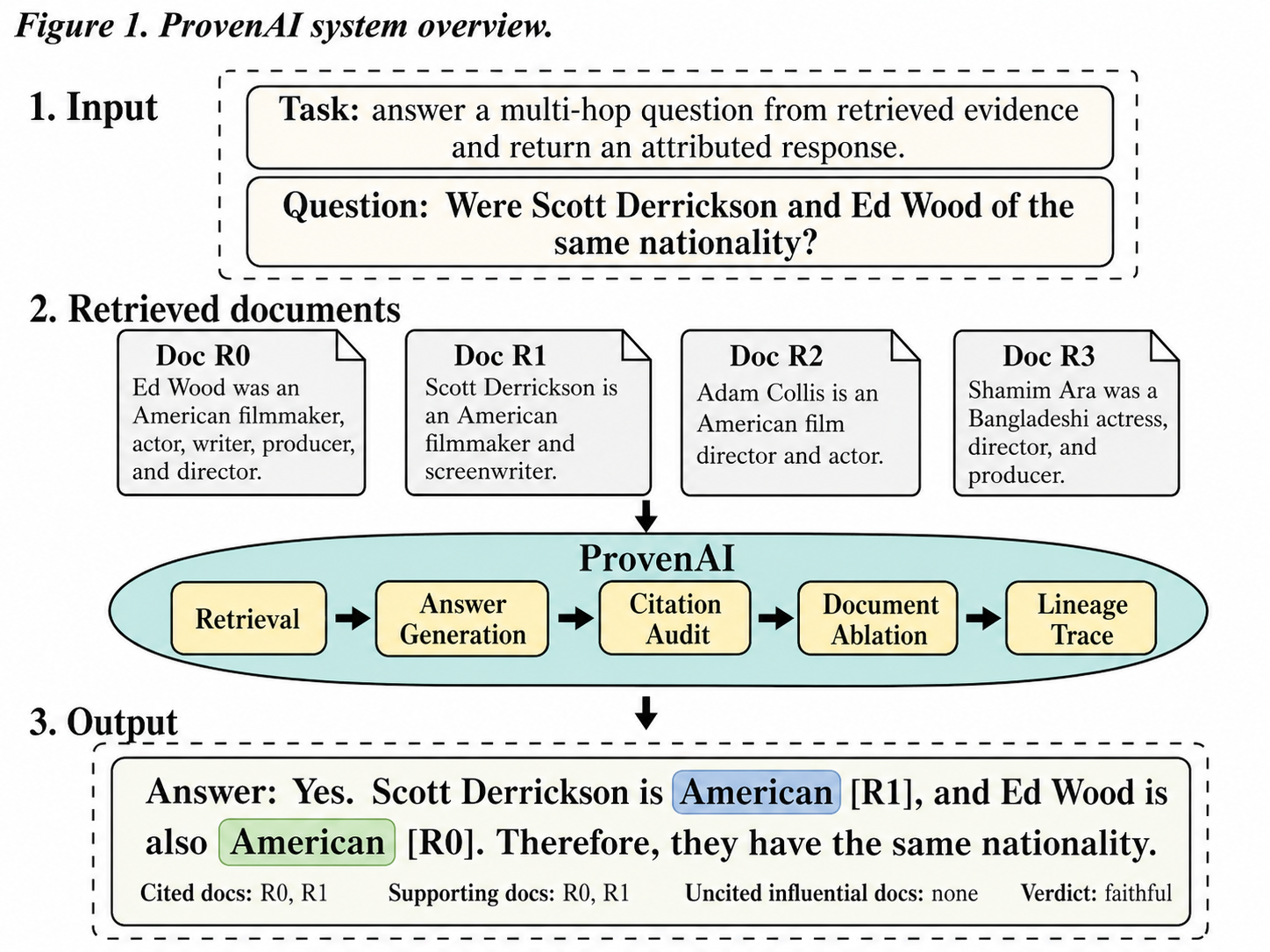
ProvenAI is organised into seven sequential stages summarised in Table 1, with the end-to-end flow visualised in Figure 1. The modular layout loosely couples data preparation, retrieval, generation, attribution, ablation, evaluation, and inspection so that individual stages can be tested, rerun, or swapped independently, and each stage writes artefacts to disk that downstream stages can read or reuse without recomputation.
| Stage | Primary role | Saved output |
|---|---|---|
| 1 | Normalise HotpotQA distractor records | JSONL examples, evidence files, manifest |
| 2 | Build retrieval corpus and FAISS index | Canonical corpus, embeddings, FAISS index, SQLite lookup |
| 3 | Generate citation-aware answers | Answer reports with retrieved resources |
| 4 | Audit citation fidelity | Per-example citation metrics and verdicts |
| 5 | Estimate document influence | Ablation reports and influence labels |
| 6 | Run aggregate evaluation | Validation metrics and summary JSON |
| 7 | Inspect results interactively | Streamlit views and exportable reports |
4.2 Data, retrieval, and generation layers↩︎
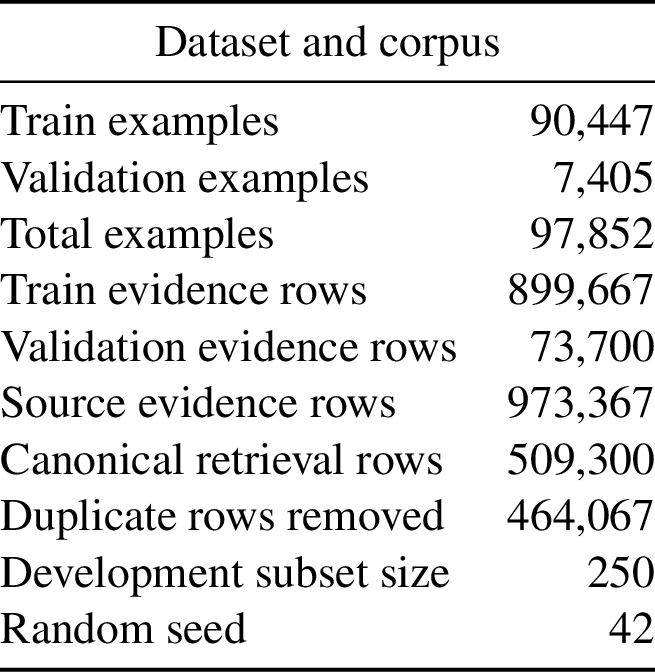
HotpotQA distractor records are converted into local JSONL files with stable fields for example identifier, question text, gold answer, supporting facts, supporting titles, and evidence documents. A deterministic development subset (250 examples, seed
42) supports faster iteration without rerunning the full validation split. The retrieval corpus deduplicates evidence rows on title-text identity, removing 464,067 redundant copies while preserving provenance links and yielding a canonical corpus of
509,300 passages. Document embeddings are computed with the SBERT-style all-MiniLM-L6-v2 model [19] and indexed by FAISS with
inner-product scoring [14]; a SQLite mirror lets the inspection dashboard serve records without loading the full JSONL file.
Each generation prompt elicits three sections (final answer, evidence summary, chain of reasoning) with inline citation tags [R0], [R1], …linking claims to retrieved resources. The default local inference path uses
Qwen/Qwen2.5-3B-Instruct [20]; a Hugging Face Transformers path is reserved for future experiments requiring per-token
probabilities. The output parser repairs common formatting failures, extracts inline citation references, retains raw model output alongside the parsed result, and saves a structured JSON report per example. A local MCP server [12] exposes HotpotQA-backed tools through a standard interface, recording JSON-RPC requests, returned resources, deterministic resource identifiers, and trace
graphs that can be replayed later. The MCP layer is additive: it supplements attribution and ablation metrics with an inspectable record of which resources entered the pipeline.
5 Experimental Setup↩︎
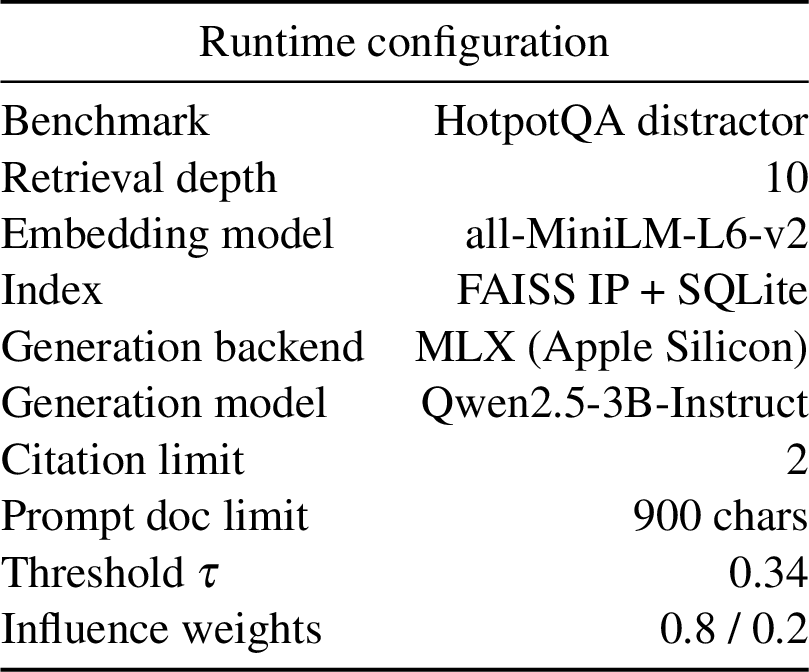
The evaluation covers the full HotpotQA distractor validation split. Table ¿tbl:tab:config? reports dataset statistics and the primary runtime configuration drawn directly from the saved artefacts. These values are reported in full because modest changes to retrieval depth, model scale, or citation threshold can shift both answer accuracy and audit behaviour in non-trivial ways. Answer correctness is evaluated via lightweight normalisation in which citation tags are stripped, strings are lowercased and trimmed, and yes/no questions are handled with prefix matching; this is adequate for internal diagnostics but should not be compared directly against official HotpotQA leaderboard scores.
6 Results↩︎
6.1 Aggregate validation metrics↩︎
Table 2 reports aggregate metrics over the full validation split. Leave-one-resource-out ablation is disabled during the full-batch run because, at retrieval depth 10, ablation per example requires approximately \(k+1 = 11\) forward passes per item, increasing total inference cost by roughly an order of magnitude. The headline observation is that citation fidelity exceeds answer accuracy by a substantial margin (71.55% versus 53.53%): the model frequently identifies and cites the correct supporting titles even on examples where the final answer string is scored as incorrect. This divergence supports the core argument of the paper. Answer correctness and evidence alignment are not interchangeable, and collapsing them into a single score would obscure cases where evidence handling is sound but answer generation falls short, or vice versa. The zero aggregate influence score reflects the decision to disable ablation during the full-validation run, not a substantive empirical finding; influence estimates are examined instead in targeted example-level reports.
| Metric | Value |
|---|---|
| Validation examples | 7,405 |
| Answer accuracy | 0.5353 |
| Mean citation-fidelity score | 0.7155 |
| Mean exact citation F1 | 0.7155 |
| Mean semantic citation F1 | 0.7155 |
| Aggregate influence score (ablation disabled) | 0.0000 |
The 18-point spread between citation fidelity and answer accuracy is the population-level signature of the same decoupling that the case study isolates at the example level. Roughly speaking, if citation fidelity and answer accuracy were tightly coupled we would expect the ratio of correct-and-faithful answers to total faithful answers to track the marginal accuracy, and the two metrics would move together under any change of generation backend or retrieval depth. Empirically they do not. The model retrieves and cites the correct supporting titles substantially more often than it produces a normalisation-matched answer string, which means a non-trivial fraction of the validation set sits in the regime where the evidence layer is sound but the answer-generation layer fails downstream, plausibly through arithmetic errors on numeric questions, format mismatches on yes/no items, or surface-level paraphrase divergence. Conversely, a smaller but non-zero fraction sits in the opposite regime, with a correct answer paired with a degraded citation set, which is the population-level analogue of a hallucinated citation verdict. The three-layer decomposition is what makes either failure mode visible.
6.2 Case study: the citation-influence gap↩︎
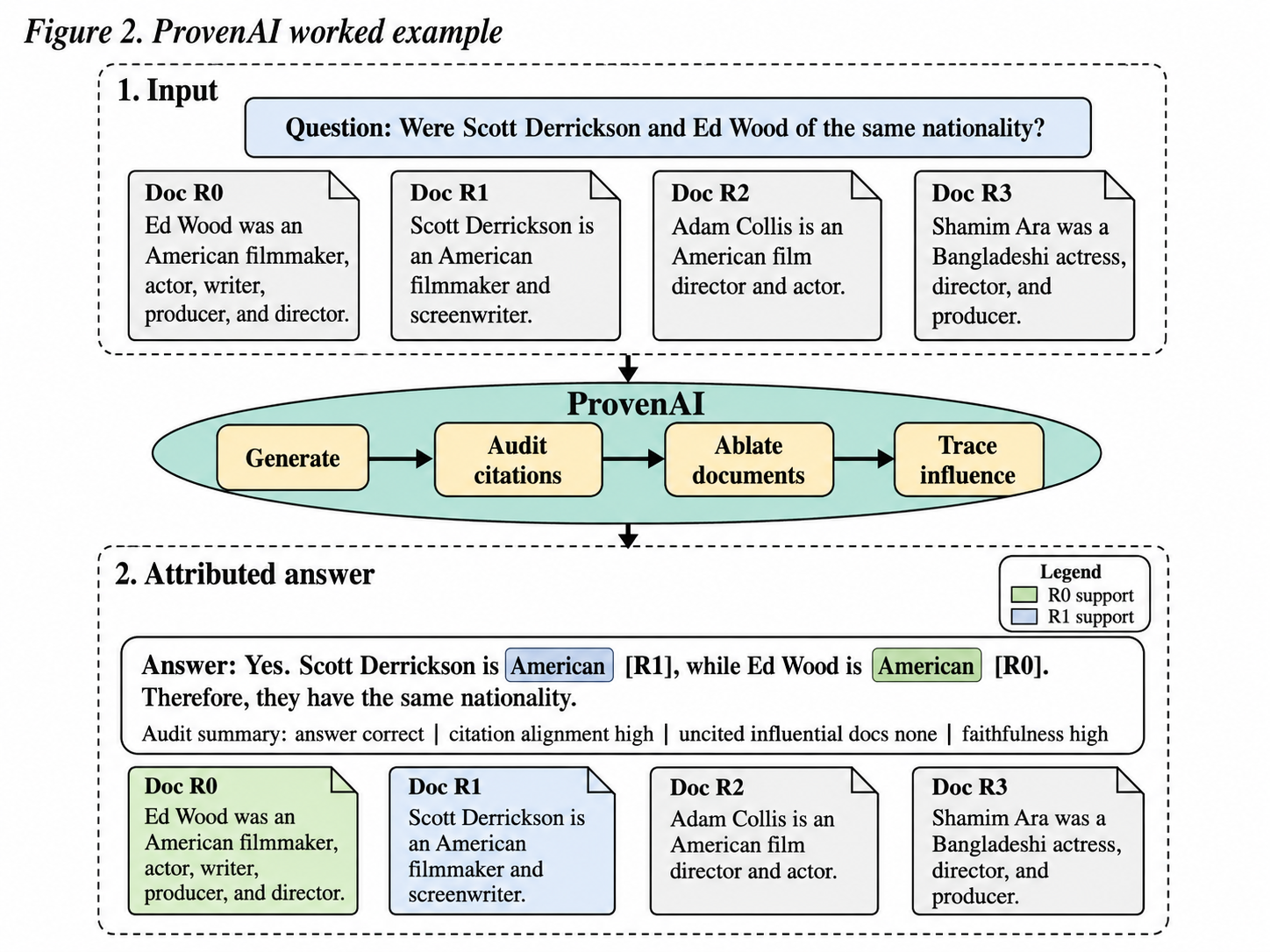
A saved ablation report addresses the question Were Scott Derrickson and Ed Wood of the same nationality? The gold answer is yes; the model correctly identifies both as American and cites the corresponding retrieved documents. The citation audit is perfect: cited titles match HotpotQA supporting titles exactly, yielding \(F_\tau = 1.0\) under both exact and semantic matching. If the analysis stopped there, the example would appear fully transparent. The influence report reveals a more complicated picture. Ten retrieved documents are tested via leave-one-out ablation. Figure 2 presents the example in human-readable form, and Table 3 expresses the verdict distribution numerically. One cited source falls below the influence threshold while seven uncited sources each shift the answer or citation set when removed. A plausible reading is that co-retrieved passages about other American filmmakers stabilise the nationality pattern in the model’s output, even though none of those passages appear in the response. This interpretation is consistent with prior observations that language models can be perturbed by irrelevant context [8] and that retrieved evidence often acts at a coarser granularity than self-citation suggests [7], [27]. The example does not establish token-level causal dependence, but it demonstrates that the observable citation set and the empirical sensitivity profile can diverge substantially, which is the defining feature of the citation-influence gap.
| Verdict | Count |
|---|---|
| Used | 1 |
| Hallucinated citation | 1 |
| Uncited-influential | 7 |
| Low-influence | 1 |
7 From Measurement to Provenance-Native Reasoning↩︎
ProvenAI is a measurement infrastructure: it observes a retrieval-grounded pipeline from the outside and assigns each retrieved document one of four diagnostic verdicts. A complementary line of work, exemplified by emerging cryptographic-provenance architectures for autonomous scientific workflows, treats provenance as an enforcement property in which each module commits to its inputs and outputs at execution time so that downstream consumers can verify, after the fact, that the data flowing into a conclusion was authentic and unmanipulated. The three layers ProvenAI distinguishes have natural counterparts in such architectures. Answer correctness corresponds to checking a final claim against a ground truth where one exists. Citation fidelity corresponds to verifying that the resources nominally referenced by a claim were retrieved through the trusted interface and, in cryptographic settings, were signed by the upstream module that produced them. Resource influence corresponds to confirming that the data which actually shaped the output is the same data the system claims to have used.
The citation-influence gap suggests that the third layer is non-trivial even when the first two are clean. A retrieval-grounded pipeline can be cryptographically sound at every boundary, with every retrieved document authentic and every citation referring to a genuinely retrieved passage, and still produce answers shaped by passages outside the cited set. For autonomous discovery settings in which AI systems orchestrate experimental decisions, generate analysis code, or extract claims from prior literature, this gap is an attack surface in its own right: an adversary who cannot poison the data or forge a signature may still shape conclusions by influencing what is retrieved, since uncited co-retrieved passages can stabilise particular output patterns. Defences that validate inputs before they reach the model, such as ontology-driven prompt-injection mitigation [33], [34], and zero-trust policies that treat every request as untrusted until verified [35], address the upstream half of this problem; ProvenAI’s influence layer addresses the downstream half by exposing which retrieved evidence actually moved the output. Provenance-native reasoning therefore requires an audit trail that exposes not only which documents were nominally used but which documents the realised output was actually sensitive to, a distinction that maps cleanly onto the database literature’s separation of why and how provenance [30], [31]. ProvenAI’s contribution to this broader programme is to show that the latter quantity is measurable and non-redundant with the former, and to provide an end-to-end pipeline in which ablation-based influence sits alongside cryptographically inspectable retrieval traces (via MCP) within a single reproducible report. We view this composability as the practical content of verifiable reasoning in retrieval-grounded systems: a property that combines structural commitment at module boundaries with behavioural sensitivity analysis at the resource level.
Concretely, an auditable record for a retrieval-grounded inference in an autonomous discovery setting would expose at least four classes of artefact for each generated claim. The first is the retrieval manifest, identifying every \(r_i \in R\) together with the resource identifier under which it was obtained from the trusted interface; in our implementation this is precisely the role of the MCP trace graph (Appendix 14). The second is the citation manifest, identifying the subset \(C \subseteq R\) that the generator nominally invoked. The third is the verdict assignment \(V\), mapping each \(r_i\) into one of the four categorical labels by combining its citation indicator with its influence signal. The fourth is the proxy-to-target relationship under which the influence signal was computed, including the decoding-confidence regime captured by Proposition 1; without this fourth element the influence layer is uninterpretable across pipelines. ProvenAI emits the first three artefacts directly and characterises the fourth analytically, so a downstream consumer reviewing a synthetic scientific claim can audit not only which sources were retrieved and cited but the conditions under which the recorded influence numbers should be trusted. The same auditability requirement has motivated ontology-grounded and reinforcement-learning-based pipelines for cloud forensics and incident response [10], [11], [36], where the value of an automated conclusion depends on a defensible record of the evidence behind it.
8 Discussion and Limitations↩︎
8.0.0.1 Citations indicate claimed use, not confirmed influence.
A citation tells the reader which source the answer nominally refers to but does not confirm that this source was the primary driver of the generated content. Self-citing systems frequently struggle to match required citation formats, refer to non-existent sources, or fail to reflect how context was actually used during generation [6], [7]. ProvenAI treats citation as one measurable layer and tests it against a second, independent layer: output sensitivity under resource removal. The three-layer decomposition exposes failure modes such as correct answer with poor citation fidelity, or clean citation audit with diffuse influence, that aggregate accuracy cannot distinguish.
8.0.0.2 Toward distributional influence measurement.
The most significant limitation of the current implementation is that the local MLX backend does not provide per-token probability outputs, preventing direct computation of \(\mathrm{Influence}_{\mathrm{KL}}\) from Equation 1 . Proposition 1 bounds the regime in which the surface proxy is faithful but also identifies its blind spot: when probability mass redistributes among ties, \(\Delta a\) remains zero. ContextCite’s sparse linear surrogate over random ablations [27] and SelfCite’s necessity-and-sufficiency ablation rewards [28] both rely on log-probability access; replacing the local backend with an inference path that exposes per-token probabilities would let ProvenAI adopt these probability-aware estimators, moving from the current surface proxy toward distributional measurement.
8.0.0.3 Scale, attribution granularity, and scope.
The current local path uses a 3B Qwen2.5 model for stability, with planned experiments targeted at 7B to 8B models on a higher-resource environment. The smaller model likely yields lower answer accuracy and may affect both citation behaviour and influence estimates in ways that would not generalise to larger systems. The attribution audit also operates at the document-title level: it does not verify sentence-level entailment or confirm that the specific passage within a cited document actually supports the corresponding claim, so a title match is necessary but not sufficient for faithful citation [21], [23]. All reported results derive from the HotpotQA distractor split; before drawing broad conclusions about the citation-influence gap, the phenomenon should be examined on further benchmarks and open-domain settings where the document pool is not curated per question.
8.0.0.4 Broader impact.
ProvenAI is designed to improve calibration of trust in retrieval-grounded systems. A plausible risk is that detailed audit artefacts may paradoxically increase over-reliance: users who see rich trace outputs may treat them as proof of correctness, a calibration risk familiar from work on security awareness and human-facing trust mechanisms [37]. The interface should therefore present influence scores explicitly as diagnostic indicators, not guarantees. The work uses a publicly available benchmark and involves no collection of human-subject data.
9 Conclusion↩︎
ProvenAI demonstrates that transparency in retrieval-grounded QA is better understood as a layered property than as a single indicator. The generated answer, the citation list, and the resource influence profile each reveal complementary information, and they can disagree in ways a single correctness score would hide. On the HotpotQA distractor validation split, the system achieves moderate answer accuracy alongside substantially higher citation fidelity, and the ablation case study shows that a clean citation audit can coexist with a complex, partially uncited influence profile, the pattern we call the citation-influence gap. We have formalised the relationship between the implemented surface proxy and a token-level KL-divergence target, situated the framework within causal-mediation analysis and database-provenance theory, and argued that measurement-based audit composes naturally with the cryptographic-provenance architectures that autonomous discovery settings increasingly require. Limitations include a proxy-based influence estimate, a model smaller than the original design target, and title-level attribution as only a first step toward full evidence verification. ProvenAI nonetheless provides a reproducible foundation for auditable multi-hop QA research and a clear path toward more rigorous, probability-aware provenance analysis.
10 Proof of Proposition 1↩︎
We restate the setting briefly. Let \(p_t, p'_t\) be the next-token distributions under the full and ablated contexts at step \(t\), conditioned on the same generated prefix, and let \(a, a_{-i}\) be the corresponding greedy decodings. Assume \(\max_w p_t(w) \ge 1-\epsilon\) for all \(t\) before the first divergence, with \(\epsilon \in (0,\tfrac12)\). Suppose \(\Delta a(r_i) > 0\), so \(a \neq a_{-i}\), and let \(t^{*}\) be the first step where \(a_{t^{*}} \neq a_{-i,t^{*}}\). Write \(w := a_{t^{*}} = \mathop{\mathrm{arg\,max}}_u p_{t^{*}}(u)\) and \(w' := a_{-i,t^{*}} = \mathop{\mathrm{arg\,max}}_u p'_{t^{*}}(u)\) with \(w \neq w'\). By the confidence assumption, \(p_{t^{*}}(w) \ge 1-\epsilon\). Because \(w'\) is the argmax under \(p'_{t^{*}}\) and \(w \neq w'\), it must hold that \(p'_{t^{*}}(w) \le p'_{t^{*}}(w')\), and since these are two disjoint masses summing to at most one, \(p'_{t^{*}}(w) \le \tfrac12\).
The total variation distance is bounded below by the gap at coordinate \(w\): \[\|p_{t^{*}} - p'_{t^{*}}\|_{\mathrm{TV}} \;\ge\; p_{t^{*}}(w) - p'_{t^{*}}(w) \;\ge\;(1-\epsilon) - \tfrac12 = \tfrac12 - \epsilon.\] Pinsker’s inequality, \(\mathop{\mathrm{D_{\mathrm{KL}}}}(p \,\|\, q) \ge 2\|p - q\|_{\mathrm{TV}}^{2}\), then yields \[\mathop{\mathrm{D_{\mathrm{KL}}}}\!\big(p_{t^{*}}\,\big\|\,p'_{t^{*}}\big)\;\ge\; 2\left(\tfrac12 - \epsilon\right)^{2}.\] As \(\epsilon \to 0\) the bound approaches \(\tfrac12\) nat, establishing the claimed one-sided witnessing.
For the converse, consider \(p_{t^{*}}(w) = 0.9\), \(p_{t^{*}}(u) = 0.1\) and \(p'_{t^{*}}(w) = 0.6\), \(p'_{t^{*}}(u) = 0.4\) for some \(u \neq w\). Both distributions have argmax \(w\), hence \(a_{t^{*}} = a_{-i,t^{*}}\) and \(\Delta a\) contributes zero at this step, yet \(\mathop{\mathrm{D_{\mathrm{KL}}}}(p_{t^{*}} \,\|\, p'_{t^{*}}) \approx 0.092\) nat is strictly positive. The proxy is therefore one-sided: positive answer-change implies positive KL, but not conversely.
11 Reproducibility Details↩︎
The repository organises ProvenAI into scriptable phases. The representative commands below reproduce the main artefact pipeline once the HotpotQA cache and required dependencies are available:
PYTHONPATH=src python3 scripts/prepare_hotpotqa.py
PYTHONPATH=src python3 scripts/build_faiss_index.py
PYTHONPATH=src python3 scripts/run_experiment.py
PYTHONPATH=src python3 scripts/run_attribution_audit.py
PYTHONPATH=src python3 scripts/run_ablation.py
PYTHONPATH=src python3 scripts/run_evaluation.py
PYTHONPATH=src python3 scripts/run_mcp_server.py
The current configuration records the dataset variant, retrieval depth, generation backend, attribution threshold, evaluation split, and report locations. The latest saved artefacts referenced in this draft are the manifest under , the retrieval metadata under , the attribution audit under , the ablation report under , and the aggregate evaluation under .
12 Portal and Dashboard Screenshots↩︎
The interactive ProvenAI portal supports inspection of generated answers, retrieved evidence, citation fidelity, ablation behaviour, and MCP trace lineage. The screenshots below render once the corresponding image files are uploaded.
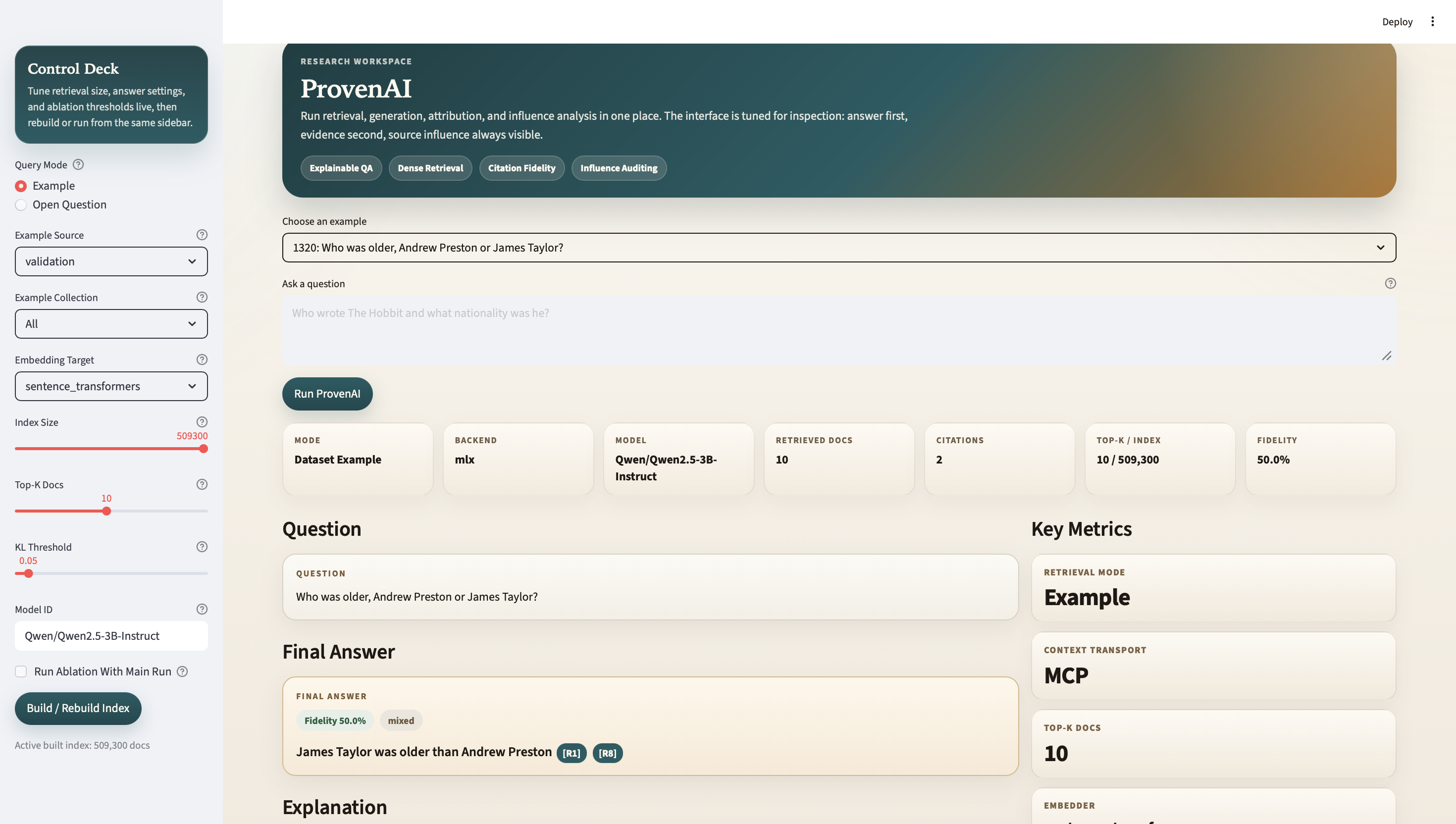
Figure 3: ProvenAI console overview showing the question, generated answer, citation count, and evaluation summary..

Figure 4: Evidence inspection view showing retrieved documents, cited sources, and supporting context..
13 Additional Experimental Details↩︎
ProvenAI is configured for the HotpotQA distractor setting. The current draft reports the saved full-validation evaluation with 7,405 examples, top-\(k = 10\) retrieval, semantic attribution threshold 0.34, and the local Apple Silicon MLX generation path. The repository also supports smaller deterministic development runs for faster iteration. The Phase 5 influence analysis should be interpreted as a proxy measurement in the current implementation. The local MLX path records answer and citation changes under leave-one-resource-out ablation but does not expose token-level probabilities for KL-divergence influence scoring; claims about resource influence in this draft should therefore be framed as answer-and-citation sensitivity rather than probability-level causal influence, as quantified by Proposition 1.
14 MCP Traceability↩︎
The MCP integration exposes retrieval and evidence resources through structured tool calls and stable resource identifiers. Representative MCP operations include get_example, get_supporting_facts, search_hotpotqa,
get_evidence_document, get_trace_session_status, and get_trace_graph. These traces link retrieval calls, returned resources, cited evidence, and downstream reports, making provenance inspectable after generation.