Context Recycling for Long-Horizon
LLM Inference
A Hierarchical Memory Architecture for Managing
Fixed Context Budgets Across Unbounded Sessions
May 01, 2026
Abstract
Large language models are stateless: every request begins with no memory of prior interactions, and the fixed context window is the sole channel through which external knowledge reaches the model. We reframe the context window as a recyclable execution workspace—a fixed-budget resource that is explicitly loaded, used, and released on every turn, analogous to a working set in operating systems. We present a five-layer memory hierarchy that supports this model, spanning from an optional training-free LoRA layer (amortized zero-token domain expertise) through disk-backed storage (effectively unbounded capacity), with deterministic proactive retrieval that assembles relevant knowledge before each inference call. The hierarchy is implemented in ContextForge, an open-source Python system, and evaluated on a 276-million-row enterprise dataset against an Azure AI Foundry agent using the Fabric Data Agent tool under the same LLM. Under controlled conditions, the context-recycling system achieves approximately equivalent accuracy (\(85\) vs.\(84\) out of \(120\)) while using \(4.2\times\) fewer tokens and responding \(4.7\times\) faster on a 12-turn benchmark. A longer 15-turn evaluation shows consistent results (\(225\) vs. \(194\) out of \(300\)) with efficiency gains compounding to \(13.4\times\) fewer tokens and \(8.0\times\) faster responses as conversation depth increases. Active context usage remains bounded with respect to the fixed token budget regardless of conversation length or backing-store size, enabling long-running sessions under a fixed active context budget over large knowledge stores on commodity hardware. Code and evaluation artifacts are available at https://github.com/Betanu701/ContextForge.
Keywords: context recycling, hierarchical memory, large language models, context window management, cache-augmented generation
1 Introduction↩︎
Large language models are stateless systems deployed into settings that demand memory. Each API call arrives with no recollection of prior interactions, and the context window—typically 8K to 128K tokens—is the only channel through which external knowledge can reach the model. For deployments where knowledge bases span billions of tokens and conversations extend over hundreds of turns, this statelessness creates a fundamental mismatch between the model’s interface and the application’s requirements.
This paper reframes the LLM context window as a recyclable execution workspace, analogous to a working set in operating systems. Rather than attempting to fit all relevant knowledge into a single, ever-growing prompt, the system explicitly loads, uses, and releases context on every turn within a fixed token budget. This framing is orthogonal to advances in long-context model architectures and complementary to existing retrieval and memory-augmentation approaches. The central contribution is bounded active context that does not grow with conversation length, while retaining access to a larger backing store.
The dominant approaches to extending LLM knowledge each address a subset of the problem:
1.0.0.1 Retrieval-Augmented Generation (RAG).
RAG systems [1] retrieve document chunks from a vector store and inject them into the context window. This introduces per-query retrieval latency, produces approximate matches subject to semantic drift, and imposes a flat organizational structure. RAG also lacks session memory: every turn is an independent retrieval operation. The approach presented here is complementary to RAG—it provides the context-management layer that RAG systems lack.
1.0.0.2 Fine-tuning.
Parameter-efficient fine-tuning (LoRA, QLoRA) embeds domain knowledge into model weights, but requires labeled training data, GPU compute, and full adapter reconstruction whenever the knowledge changes.
1.0.0.3 Extended context windows.
Models with extended context windows can ingest larger documents, but prefill latency and serving cost grow substantially with context length, and models remain stateless between sessions. Our approach is orthogonal: it manages what enters the context window, regardless of window size.
We present a five-layer memory hierarchy that distributes knowledge across multiple levels of proximity to the model—from an optional in-weight LoRA layer (amortized zero-token cost) through disk-backed storage (effectively unbounded capacity, sub-5 ms retrieval). A context-recycling mechanism treats the context window as a reusable, fixed-budget workspace, enabling long-running conversations over large knowledge bases under a fixed active context budget.
The hierarchy is implemented in ContextForge, an open-source Python system available at https://github.com/Betanu701/ContextForge, used to validate the architecture across multiple model providers. All experiments use the same underlying LLM and dataset to isolate the effect of context management.
The remainder of this paper is organized as follows. Section 2 presents the five-layer architecture. Section 3 details the optional training-free LoRA construction. Section 4 describes the context-recycling mechanism. Section 5 covers the proactive loading pipeline. Section 7 discusses the database module. Section 8 presents the nightly precomputation system. Section 9 provides empirical evaluation, and Section 11 concludes.
2 Five-Layer Memory Architecture↩︎
The system organizes knowledge into five layers, ordered by proximity to the model’s computation (Figure 1). The primary contribution is the explicit lifecycle management of the context window (Layers 0–1), which leverages existing KV cache mechanisms as part of a broader context-recycling strategy to anchor stable hierarchical context across turns. Layer \(-\)1 (LoRA) is optional and applies only to self-hosted models; Layers 2–3 provide indexing and persistence.

2.1 Layer \(-\)1: LoRA Weights (Optional)↩︎
For self-hosted models with accessible weights, domain expertise can be embedded directly into the model’s MLP weight matrices via training-free Low-Rank Adaptation (LoRA). This layer consumes zero context tokens: the model recognizes domain-specific patterns, terminology, and reasoning strategies without any prompt overhead. This layer is entirely optional; the system functions fully without it. Section 3 describes the construction process.
When both LoRA weights and knowledge tree content are present for the same domain, the two layers are complementary: the adapter provides pattern-level familiarity while the tree supplies specific facts.
2.2 Layer 0: Residual States↩︎
The system prompt, top-level tree summaries, and pre-computed metrics are assembled once at session start and their KV-cache entries are retained as a stable prefix. Subsequent requests reuse these cached key-value states without recomputation, yielding a 48% memory saving compared to re-encoding the system prompt on every request. This leverages existing KV cache mechanisms as part of the broader context-recycling strategy—the contribution is not KV reuse itself, but its integration into explicit context-window lifecycle management.
2.3 Layer 1: Branch Cache↩︎
The active knowledge branch—the set of tree nodes relevant to the current query—is loaded into the context window dynamically. Branch swaps take \(<\)50 ms. With TQ3 quantization (3-bit KV cache), a 16 GB VRAM budget holds approximately 768K tokens of cached knowledge (\({\sim}\)600K words). This is the only layer whose token count varies between queries.
2.4 Layer 2: Memory Index↩︎
An in-memory SQLite FTS5 inverted index maps keywords to tree nodes using BM25 scoring. Lookup is \(O(1)\) per term and completes in under 1 ms regardless of index size. This is the routing layer: it determines which branch to load without itself consuming context tokens.
2.5 Layer 3: Knowledge Store↩︎
The permanent store is a SQLite database in WAL (Write-Ahead Logging) mode, providing effectively unbounded capacity at \(<\)5 ms read latency on SSD. All tree nodes, documents, session histories, and cached results reside here. The database supports up to 281 TB, with FTS5 index overhead of approximately 30% of indexed text size.
2.5.0.1 Key insight.
Knowledge resides at three levels simultaneously: in the model weights (Layer \(-\)1, zero tokens, optional), in the active context (Layers 0–1, \({\sim}\)3–12K tokens under a fixed budget), and on disk (Layers 2–3, effectively unbounded). Only Layer 1 changes between queries; all other layers are either stable or serve as routing indices. The context window is treated as a fixed, recyclable execution resource—not a buffer that grows with conversation length.
3 Training-Free LoRA Construction (Optional)↩︎
This optional layer explores a training-free construction of LoRA adapters using forward-pass activation statistics and linear algebra, applicable only to self-hosted open-weight models. It is not the primary contribution of this work; the context-recycling system functions fully without it. We include the description because the technique improved domain-specific accuracy in our local testing and may be of independent interest.
The construction rests on three empirical observations:
The \(A\) matrix is effectively random. During standard LoRA training, the down-projection matrix \(A\) moves only 7.6% from its random initialization. We treat \(A\) as a fixed random projection basis.
The \(B\) matrix contains the knowledge signal. The activation difference between domain-specific text and general text captures the “direction” of domain expertise in activation space. SVD extracts its rank-\(r\) approximation directly.
Magnitude scales predictably. We use an empirical default prior for adapter magnitude \[\label{eq:bnorm} \|B\| = \frac{\sqrt{d_{\text{hidden}}}}{30}\tag{1}\] and refine it, when needed, via a forward-pass-only perplexity sweep on held-out domain data.
3.1 Construction Algorithm↩︎
Given a domain text corpus \(\mathcal{D}\) and a general-purpose reference corpus \(\mathcal{G}\), the LoRA adapter is constructed as follows:
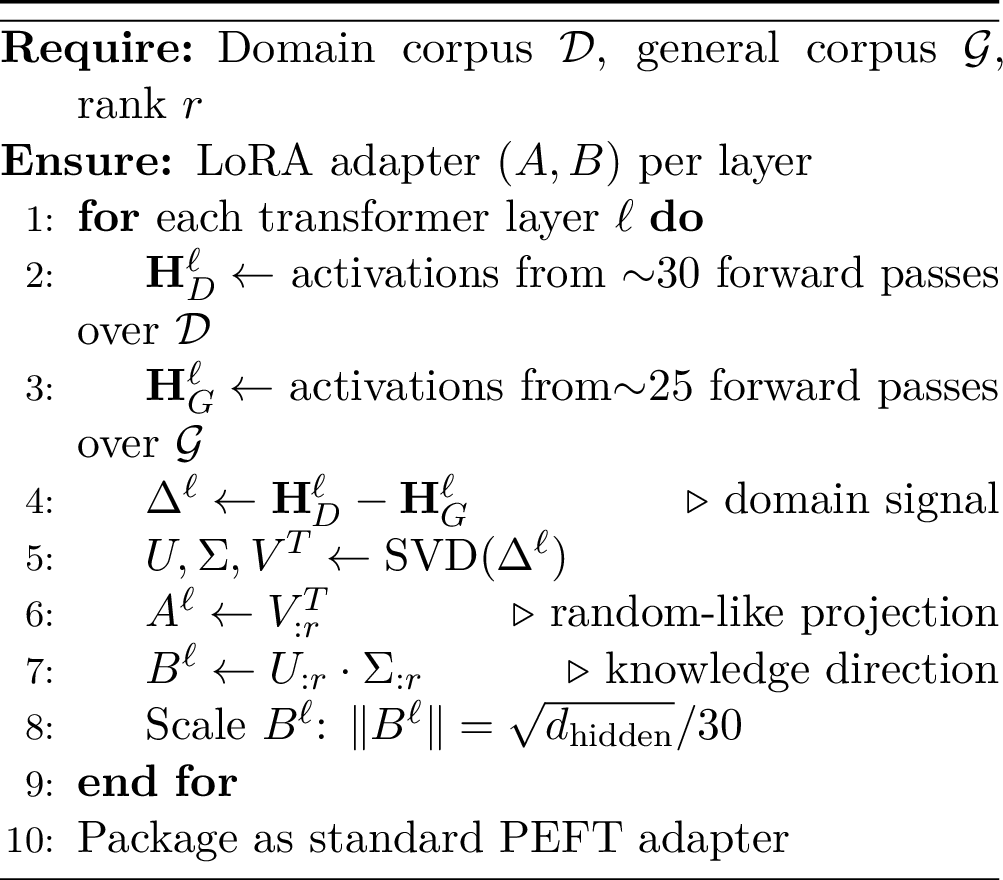
The entire process requires only forward (inference) passes—no backpropagation, no gradient computation, no GPU. Construction completes in approximately 200 seconds on CPU.
3.2 Validation↩︎
Table 1 compares the training-free method against traditional GPU-trained LoRA on a medical question-answering benchmark.
| Method | \(\Delta\) Acc. | GPU | Time |
|---|---|---|---|
| GPU-trained LoRA | +10.0% | Yes | 30–120 min |
| Text-constructed | +12.5% | No | 200 s |
| Perplexity-calibrated | +8.3% | No | \({\sim}\)300 s |
| Cross-family transfer | +6.7–10% | No | seconds |
On our internal evaluation setting, the training-free construction matched or slightly exceeded GPU-trained LoRA on the medical QA task (Table 1); we make no general claim that this holds across all domains or benchmarks.
3.2.0.1 Scope and limitations.
This layer applies exclusively to self-hosted models where direct weight access is available. Cloud API providers (OpenAI, Anthropic) do not expose model weights and therefore cannot support adapter injection. Validation was conducted across 8 open-weight model families (Qwen, Llama, Mistral, Phi, Gemma, DeepSeek, Yi, InternLM) in local deployment configurations. The medical QA benchmark used a curated evaluation set; further independent validation on standardized benchmarks (e.g., MedQA, USMLE) and at enterprise scale would strengthen these findings.
3.3 Domain Coverage↩︎
The system maintains 20+ domain adapters (coding, medical, mathematics, engineering, AI/ML, physics, biology, creative arts, game development, robotics, electronics, and others) across multiple model size tiers. Adapters are loaded dynamically at inference time via PEFT—no model restart required. A lightweight domain router classifies each incoming message and transparently activates the appropriate adapter.
3.4 Query Processing Flow↩︎
Figure 3 illustrates the end-to-end path of a single user query through the five-layer hierarchy. The diagram should be read from top to bottom: each query is routed, assembled, used for generation, and then released before the next turn.

4 Context Recycling↩︎
The central contribution of this work is treating the context window as a fixed-budget, recyclable workspace rather than a one-time buffer. Traditional LLM deployments fill the context with history and knowledge, generate a response, and either discard or re-pack everything on the next call. The system described here treats the context window as a reusable execution resource—analogous to a working set in virtual memory, where pages are loaded on demand, used, and evicted under a fixed physical memory budget.
4.1 Mechanism↩︎
On each turn:
The proactive loader identifies the most relevant knowledge branch via the BM25 index (Layer 2).
The branch content is loaded into the context window (Layer 1).
The LLM generates a response using the assembled context.
The branch is freed—its tokens are released from the active context.
The next query can load an entirely different branch using the same token budget.
4.2 Bounded Active Context↩︎
Table 2 shows that active token usage remains bounded with respect to the fixed context budget, independent of conversation length or backing-store size.
| Component | Turn 1 | Turn 50 | Turn 1K |
|---|---|---|---|
| Permanent ctx (L0) | 500 | 500 | 500 |
| Loaded branch (L1) | 2–10K | 2–10K | 2–10K |
| Compacted history | 0 | \({\sim}\)1K | \({\sim}\)1K |
| Total active | 3–11K | 4–12K | 4–12K |
| Knowledge on disk | 100K | 100K | 100K |
History does not grow without bound. A context compaction engine monitors the conversation buffer and triggers LLM-based summarization when it exceeds a configurable threshold (default: 3,000 tokens). The summary preserves key facts, decisions, and action items while discarding conversational filler, achieving 4–8\(\times\) compaction ratios.
4.3 Application: Project-Scale Generation↩︎
Context recycling enables generating entire software projects within a fixed context budget. Each generated file is compacted to its signatures (class definitions, function headers, import statements—approximately 500 tokens versus 5,000 for full content) and carried forward as context. Active context at file 1 equals active context at file 100.
5 Proactive Context Loading↩︎
The system eliminates the need for users to explicitly manage context. Every message triggers a deterministic knowledge assembly pipeline. Retrieval is deterministic because branch selection is driven by explicit keyword extraction and BM25 ranking over the FTS5 index, not by stochastic generation. The pipeline proceeds as follows:
Keyword extraction. Significant terms are extracted from the user message via stop-word removal and pattern matching (\({\sim}\)0 ms).
Index lookup. Keywords query the FTS5 BM25 index (Layer 2), returning ranked tree nodes (\(<\)1 ms).
Cache check. If the top-ranked branch is already in the Layer 1 cache, it is reused at amortized zero marginal cost.
Branch load. On a cache miss, the branch is loaded from Layer 3 (2–4 s for cold load, then cached for subsequent queries).
Context assembly. The system constructs the final message sequence: permanent context (Layer 0) \(+\) loaded knowledge (Layer 1) \(+\) compacted session history \(+\) user message.
LLM generation. The assembled context is sent to the configured provider.
Context recycling. The loaded branch is released; next query reuses the budget.
5.1 Predictive Pre-Loading↩︎
Beyond reactive retrieval, the system anticipates future information needs:
Temporal patterns. If a user accesses “morning standup notes” daily at 9 AM, the branch is pre-loaded at 8:55 AM.
Topical proximity. When a “database” branch is active, commonly co-accessed branches (“schema”, “migration”) are pre-loaded.
Session continuity. On session resume, all branches that were active at pause time are pre-loaded.
Pre-loaded branches reside in the KV cache—leveraging existing cache mechanisms as part of the recycling strategy—at amortized zero marginal query cost. Incorrect predictions incur no penalty beyond cache occupancy.
6 The Knowledge Tree↩︎
Knowledge is organized as a hierarchical tree, mirroring how organizations naturally categorize information. Each node contains:
A summary—a concise description used for index matching and parent-level traversal. Summaries propagate upward: a parent’s summary includes keywords from all children.
Content—the full knowledge payload, loaded only when the branch is activated. Content can be arbitrarily large.
This dual structure enables a critical optimization: index lookups match against summaries (fast, small), but context injection uses content (complete, large).
6.0.0.1 Navigation complexity.
Tree lookup is \(O(\text{depth})\)—constant with respect to active context regardless of tree width or total node count. A tree with 50 million nodes responds in the same time as one with 5,000, because: (1) the FTS5 index finds the target in \(O(1)\); (2) only the matched branch’s content loads; (3) tree depth is bounded by organizational granularity (typically 4–8 levels).
6.0.0.2 Comparison with flat vector stores.
| Property | Vector Store | Hier.Tree |
|---|---|---|
| Organization | Flat chunks | Natural hierarchy |
| Search | Approx.(cosine) | Exact (BM25) |
| Access control | Per-chunk | Per-branch |
| Scaling | Index rebuild | \(O(1)\) add |
| Lookup | \(O(\log n)\) ANN | \(O(1)\) inverted idx |
7 Database Module↩︎
The same five-layer architecture applies to SQL databases. Instead of documents, the tree holds schemas, cached query results, and pre-computed metrics.
7.1 The Five-Layer Database Stack↩︎
| Layer | DB Equivalent | Module |
|---|---|---|
| \(-1\): LoRA | SQL patterns | Training data |
| 0: Residual | Daily metrics | MetricAggr. |
| 1: Branch | Table schemas | SchemaIdx. |
| 2: Index | Pattern cache | QueryCache |
| 3: Store | Live DB (SQL) | DBConnector |
7.1.0.1 SchemaIndexer.
Every table, column, relationship, and index is indexed into the knowledge tree so the LLM generates SQL with real schema context rather than guesswork.
7.1.0.2 QueryCache.
Questions are normalized to canonical patterns (“What was Q1 revenue?” and “Show me Q1 revenue” map to the same cache key), with results cached under a configurable TTL.
7.1.0.3 MetricAggregator.
Registered metrics (revenue, customer count, etc.)are pre-computed and injected into the permanent context (Layer 0), enabling sub-100 ms answers for common aggregate questions.
7.1.0.4 QueryDecomposer.
Complex questions are decomposed into parallel sub-queries. “Compare Q1 to last year by region and product” becomes three independent queries whose results are merged by the LLM.
8 Nightly Precomputation↩︎
A scheduled nightly job shifts the system from reactive to proactive, pre-computing answers to anticipated questions during off-peak hours.
8.1 Six-Phase Pipeline↩︎
Schema Refresh (\({\sim}\)2 min). Detect schema changes, update tree nodes.
Core Metrics (\({\sim}\)5 min). Execute registered metric queries, update permanent context.
Dimensional Pre-computation (\({\sim}\)15 min). Cross-tabulate metrics against dimensions (region, product, time period).
Pattern Replay (\({\sim}\)10 min). Re-execute the previous day’s top 50 queries to warm the cache with fresh data.
Anomaly Detection (\({\sim}\)5 min). Compare current metrics against 30-day history; flag and explain outliers.
Executive Briefing (\({\sim}\)2 min). Synthesize all outputs into a personalized narrative summary.
8.2 Pattern Learning↩︎
The system monitors query patterns and progressively pre-answers recurring questions. Table 5 shows the cache hit rate trajectory.
| Week | Cache Hit | Avg Resp.Time |
|---|---|---|
| 1 (cold start) | \({\sim}\)20% | \({\sim}\)8 s |
| 4 | \({\sim}\)70% | \({\sim}\)1.5 s |
| 8 | \({\sim}\)85% | \({\sim}\)0.5 s |
| 12+ (steady) | \({\sim}\)90%+ | \({\sim}\)0.3 s |
9 Empirical Evaluation↩︎
We evaluate the context-recycling system against an Azure AI Foundry agent configured with the Fabric Data Agent tool on an enterprise dataset. The goal of this evaluation is to isolate context-management effects under controlled conditions, not to claim superiority across all tasks or domains.
9.1 Setup↩︎
9.1.0.1 Dataset.
CMS Medicare Provider Utilization and Payment Data: 276 million fact rows across 5 tables, deployed to Microsoft Fabric with a lakehouse SQL endpoint. The tables contain provider, drug, utilization, payment, and geographic fields used for aggregate analytical queries.
9.1.0.2 Evaluation model.
All experiments in this paper—including the 12-turn and 15-turn benchmarks—were conducted using GPT-5.4 [2]. Differences between benchmark results therefore reflect differences in task length and interaction horizon, not differences in the underlying language model. Both systems use the same model and endpoint via the Azure OpenAI Chat Completions API.
9.1.0.3 Baseline.
We compare against an Azure AI Foundry agent configured with the Fabric Data Agent tool [3] to query the Microsoft Fabric lakehouse/semantic model. This baseline represents a production agent pattern where the LLM maintains a single conversation thread and invokes the Fabric Data Agent for data access and execution.
9.1.0.4 Benchmark.
A 12-turn conversational benchmark designed to test progressive complexity: simple lookups (T01–T03), aggregations (T04–T06), domain-specific reasoning (T07–T09), and multi-step analytical queries (T10–T12). Each turn is scored 0–10 by a structured rubric. The score reflects answer correctness, completeness, and consistency with the verified data for that turn; higher scores indicate closer agreement with the expected analytical result.
9.2 Results↩︎
| Metric | Fabric Agt. | |
|---|---|---|
| Score (of 120) | 85 | 84 |
| Avg response | 9.7 s | 45.7 s |
| Total tokens | 31K | 132K |
| Speed | \(4.7\times\) faster | |
| Token eff. | \(4.2\times\) fewer | |
The context-recycling system matches the baseline agent in accuracy while achieving a \(4.7\times\) speed advantage and consuming \(4.2\times\) fewer tokens. Accuracy is approximately equivalent; the primary divergence is in efficiency. The token savings translate to proportional cost reduction under standard API pricing.
9.3 Robustness Across Repeated Long-Horizon Runs↩︎
To assess stability over longer conversations, a second evaluation used 15-turn benchmarks with the same CMS Medicare dataset (deployed to Fabric) and the same baseline agent framework. Two independent cycles were run under identical conditions; a third cycle was excluded due to cascading Fabric infrastructure failures on the baseline and a concurrent provider-level API change that altered token behavior, making it incomparable.
| Metric | Fabric Agt. | |
|---|---|---|
| Score (of 300) | 225 (75.0%) | 194 (64.7%) |
| Avg latency | 7.6 s | 60.5 s |
| Total tokens | 25,666 | 345,112 |
| Turn success | 28/30 | 27/30 |
| Speed | \(8.0\times\) faster | |
| Token eff. | \(13.4\times\) fewer | |
Table 7 summarizes results across both cycles. The context-recycling system scores consistently higher (\(+10.3\) percentage points), with the efficiency gap widening relative to the 12-turn evaluation: \(8.0\times\) faster and \(13.4\times\) fewer tokens versus \(4.7\times\) and \(4.2\times\) respectively. This divergence is expected: as conversation length grows, the baseline re-transmits the full conversation history on each turn (reaching \({\sim}\)22K tokens per request by T15), while the context-recycling system assembles fresh context independently per turn, keeping per-turn token counts stable (\({\sim}\)850 tokens/turn). The efficiency advantage thus compounds with conversation depth.
Cycle-level scores were consistent: 113/150 and 112/150 for the context-recycling system versus 96/150 and 98/150 for the baseline across the two runs, suggesting stable behavior rather than favorable variance.
9.3.0.1 Content filtering and infrastructure failures.
Both systems triggered Azure’s content safety filter at identical rates (2/30 turns each, 6.7%), producing false positives on turns involving accumulated drug-prescription context. In the baseline, the filter activated consistently at T10 (a
revisitation of earlier prescription data), where accumulated conversation history exceeded the content-filter’s sensitivity threshold. The context-recycling system triggered the filter at T12 (a synthesis/recall turn). These are false positives from
Azure’s content safety layer—not errors attributable to either system’s architecture—and affected both systems equally. The baseline additionally experienced one infrastructure error (Fabric tool_user_error) across 30 turns; the
context-recycling system experienced zero.
9.4 Response Time Scaling↩︎
Response time remains approximately constant with respect to active context across knowledge base sizes because: (1) LoRA domain knowledge, when present, adds amortized zero marginal latency; (2) the FTS5 inverted index is \(O(1)\) regardless of document count; (3) only the relevant branch loads, not the entire knowledge base; (4) branch loading is a one-time cost amortized across subsequent queries.
| KB Size | Lookup | Branch | Gen. | Total |
|---|---|---|---|---|
| 10M | \(<\)1 ms | cached | 0.7 s | \(\scriptstyle\sim\)1 s |
| 100M | \(<\)1 ms | cached | 1.4 s | \(\scriptstyle\sim\)1.5 s |
| 1B | \(<\)1 ms | 2–4 s | 1.4 s | \(\scriptstyle\sim\)3.5 s |
| 100B | \(<\)1 ms | 2–4 s | 2 s | \(\scriptstyle\sim\)4 s |
9.5 Memory Efficiency↩︎
Table 9 summarizes the memory optimizations applied across the five layers and their cumulative effect on token and VRAM consumption.
| Optimization | Savings | Mechanism |
|---|---|---|
| LoRA injection | 0 tokens | Knowledge in weights |
| Residual states | 48% | System prompt KV reuse |
| TQ3 quant. | 6\(\times\) | 3-bit KV cache |
| Compaction | 4–8\(\times\) | LLM summarization |
| Prefix cache | \({\sim}\)100% | Prompts cached once |
9.6 Knowledge Recall↩︎
Cache-Augmented Generation (CAG) achieves exact recall of injected context because knowledge is placed directly into the model’s context window—not approximated via embedding similarity. The model sees the exact text. This property has been validated across 8 model families: Qwen, Llama, Mistral, Phi, Gemma, DeepSeek, Yi, and InternLM.
10 Limitations and Future Work↩︎
Several limitations of this work should be noted, and we identify directions for future research.
10.0.0.1 Benchmark scope.
The empirical evaluation uses two benchmarks—a 12-turn and a 15-turn evaluation, both using GPT-5.4—on one enterprise dataset (CMS Medicare, 276M rows). While the benchmarks cover progressive complexity from simple lookups through multi-step analytical queries and show consistent results across multiple independent runs, they represent one domain and one data source. Broader evaluation across diverse domains (e.g., legal, scientific literature, software engineering) and standardized benchmarks would strengthen generalizability claims. We do not claim statistical significance from two runs; the results demonstrate consistent, stable behavior.
10.0.0.2 Training-free LoRA validation.
The LoRA construction method was validated across 8 open-weight model families in local deployment. However, testing was conducted using internally designed evaluation sets rather than established public benchmarks. The +12.5% medical QA improvement, while consistent across model families, requires independent replication on standardized benchmarks such as MedQA or MMLU to confirm robustness. Additionally, the method is inherently limited to self-hosted models; cloud API providers do not expose the weight access required for adapter injection.
10.0.0.3 Scaling characteristics.
The bounded active-context claims are supported by architectural analysis and local benchmarking, but have not been validated at the largest projected scales (100B+ tokens). Distributed knowledge trees across multiple nodes remain a design-stage capability.
10.0.0.4 Cache hit rate projections.
The nightly job’s cache hit rate progression (20% to 90%+) is based on observed patterns during development and limited deployment. Production validation across diverse user populations and query distributions would provide more reliable projections.
10.0.0.5 Future directions.
Future work includes: (1) validation of training-free LoRA on standardized public benchmarks; (2) large-scale deployment studies measuring context recycling effectiveness over thousands of concurrent users; (3) investigation of hybrid retrieval combining BM25 with learned sparse representations; and (4) extending the architecture to multi-modal knowledge (images, code, structured data) within the same hierarchical tree.
11 Conclusion↩︎
This paper presents context recycling as a systems-level approach to managing LLM context windows for long-horizon inference. By treating the context window as a fixed-budget, recyclable execution resource and distributing knowledge across five hierarchical layers, the system enables effectively unbounded long-running memory under a fixed active context budget. The optional training-free LoRA construction adds domain expertise at amortized zero token cost for self-hosted models, while proactive context loading provides deterministic knowledge assembly.
Empirical results on a 276-million-row enterprise dataset show that the context-recycling system achieves approximately equivalent or higher accuracy compared to an Azure AI Foundry agent using the Fabric Data Agent tool while using \(4.2\)–\(13.4\times\) fewer tokens and responding \(4.7\)–\(8.0\times\) faster under controlled conditions, with the efficiency advantage compounding as conversation length increases. The primary divergence is in efficiency, not accuracy. While further validation is needed across additional domains and at larger scales, the architectural principles—hierarchical memory layering, context recycling, and proactive loading—are orthogonal to advances in model architecture or context window size and can be composed with existing retrieval and memory-augmentation approaches.
The system is available as an open-source Python implementation supporting OpenAI, Anthropic, and any OpenAI-compatible local inference server.
12 Related Work↩︎
12.0.0.1 RAG systems.
Lewis et al. [1] introduced retrieval-augmented generation, combining a dense retriever with a seq2seq generator. Subsequent work has improved retrieval quality [4] but retains the flat-index architecture and per-query retrieval latency. The hierarchical caching approach presented here is complementary to RAG: it provides the context-lifecycle management that RAG systems currently lack.
12.0.0.2 Long-context models.
Extending context windows via position interpolation [5], ALiBi [6], or architecture modifications allows models to ingest more tokens per request but does not address persistence across sessions or the quadratic cost of attention. Munkhdalai and Faruqui [7] propose Infini-Attention, which modifies the attention mechanism itself to handle long input sequences, but requires model architecture changes. InfiniPot [8] addresses memory-constrained context via progressive summarization, operating at the model level rather than as a systems-level middleware. The context recycling approach is orthogonal to these advances: it manages what enters the context window regardless of window size.
12.0.0.3 LoRA and parameter-efficient fine-tuning.
Hu et al. [9] introduced low-rank adaptation for efficient fine-tuning. Our training-free construction method differs fundamentally: it uses SVD on activation differences rather than gradient descent, requires no labeled data, and completes on CPU. Recent work on training-free LoRA fusion [10], [11] addresses combining existing trained adapters without additional training, but does not construct adapters from scratch.
12.0.0.4 Cache-augmented generation.
Chan et al. [12] demonstrate that preloading documents into the KV cache (“CAG”) can outperform RAG for knowledge-intensive tasks. The Layer 1 branch cache implements a similar principle but extends it with hierarchical organization, context recycling across turns, and proactive loading—capabilities not addressed in single-layer CAG systems. The two approaches are complementary: CAG validates the preloading strategy while context recycling adds lifecycle management.
12.0.0.5 Serving systems and KV-cache paging.
PagedAttention [13] applies OS-inspired paging to KV-cache memory management for LLM serving. This is complementary to our focus on context-window lifecycle management at the application and middleware level.
12.0.0.6 Hierarchical memory for LLM agents.
HiAgent [14] introduces hierarchical working memory management for long-horizon agent tasks, achieving 20% higher success rates through structured memory. HiMem [15] proposes hierarchical long-term memory for agent persistence. Both focus on agent task execution rather than general-purpose knowledge retrieval, and neither implements explicit context recycling or proactive loading. Shan et al. [16] present cognitive memory with hierarchical updates for streaming scenarios, while a recent technical survey [17] offers a broad taxonomy of AI memory systems. Our work operates at a different systems-level concern: context-window lifecycle management rather than agent planning.
12.0.0.7 Memory-augmented architectures.
MemoryBank [18] and MemGPT [19] add persistent memory to LLMs but rely on the LLM itself for memory management decisions. The approach here uses deterministic, index-driven retrieval for reliability and speed, reserving LLM inference for content generation only. MemGPT manages memory externally through a virtual-context, OS-inspired approach; our contribution is deterministic, index-driven context assembly and explicit context-window lifecycle management.
12.0.0.8 Tree-structured retrieval.
TreeRAG [20] uses hierarchical document storage with bidirectional traversal for long-document retrieval. The knowledge tree described here serves a broader role: it is the organizational backbone for all five memory layers, not solely a retrieval structure.
12.0.0.9 Budget-aware context management.
ContextBudget [21] formulates context management for long-horizon agents as a budget-constrained sequential decision problem. Our work is complementary: context recycling reduces the cost of assembling the active workspace each turn, while ContextBudget focuses on learning what to compress or retain as histories grow under a fixed window.
Acknowledgements↩︎
Portions of this manuscript were drafted and revised with the assistance of generative AI language tools (GitHub Copilot, Claude). The author takes full responsibility for the correctness and integrity of all content, in accordance with arXiv policy on the use of generative AI [22].
12.0.0.10 Reproducibility.
The 15-turn benchmark script is available at in the project repository. Benchmark reports and raw outputs referenced in this paper are included as artifacts (; ) to enable traceability of the reported scores, latency, and token totals. All code and evaluation artifacts referenced in this work are available at https://github.com/Betanu701/ContextForge.