A Free Sphere Reverses the Rebound Direction of a Near-Wall Cavitation Bubble
June 24, 2026
Abstract
A near-wall cavitation bubble is generally expected to acquire a wallward Kelvin-impulse bias and to rebound or jet toward the wall. Here we show that this canonical direction can be reversed by a wall-supported free sphere. High-speed imaging reveals a transition from away-from-wall to wallward rebound as the initial bubble–sphere separation is increased. By reconstructing the Kelvin impulse on a closed bubble boundary that includes both the visible free interface and the bubble-side contact closure, we find that the reversal is not governed primarily by the instantaneous velocity of the sphere. Instead, sphere displacement creates a contact closure on which the bubble-source contribution supplies an away-from-wall impulse. This contact-source impulse competes with a wallward background formed by the wall-image source and the quadrupolar component of the sphere-induced field. The resulting balance yields a calibrated geometric criterion, \(\mathcal{M}_K\), and, in the comparable-size bubble–sphere regime, reduces to a contact number \(a_z z_b/R_K^2\). These results identify a contact-geometric mechanism by which a movable particle can redirect the first-cycle jet and rebound bias of a near-wall cavitation bubble.
Near a rigid wall, a collapsing cavitation bubble usually develops a wallward Kelvin-impulse bias and a wall-directed jet [1]–[3]. This directionality concentrates liquid inertia and impulsive loading on the solid surface and is a central route to cavitation erosion [4]–[7]. A major way of reducing this loading is therefore to alter the collapse asymmetry or redirect the post-collapse motion. Such redirection has been observed near gas-entrapping surfaces [8], [9], in externally imposed flow fields [10], and near curved or compound boundaries [11]–[14]. These studies show that the rebound or jet direction is not merely a passive consequence of bubble collapse, but can be selected by the surrounding boundaries.
This direction-selection problem becomes more subtle when the boundary is a particle that can move. Cavitation bubbles can accelerate free particles and modify particle-scale flows [15]–[17], while recent particle-laden configurations show that particles can also reshape cavitation jetting and lift-off dynamics [18], [19]. For a particle initially resting on a rigid substrate, a laser-induced bubble can lift the particle from the wall [20]. However, lift-off alone does not determine whether the particle subsequently remains separated from the wall or is driven back toward it. That later outcome is controlled by the rebound or jet direction selected by the bubble near the end of the first cycle. A criterion for this direction in a movable-boundary geometry is still lacking.
Here we show that a wall-supported free sphere can reverse the canonical wallward rebound direction of a near-wall cavitation bubble within the first bubble cycle. High-speed imaging reveals a transition from away-from-wall to wallward rebound as the initial bubble–sphere separation is increased. To identify the mechanism, we reconstruct the Kelvin impulse on a closed bubble boundary composed of the visible free interface and the bubble-side contact closure. The reversal is not governed primarily by the instantaneous velocity of the sphere. Instead, the lifted sphere changes the closed boundary on which the bubble Kelvin impulse is defined: the bubble-source contribution over the contact closure supplies an away-from-wall impulse, competing with a wallward background from the wall-image source and the quadrupolar sphere-induced field. Their balance yields a geometric impulse criterion, \(\mathcal{M}_K\), which separates away-from-wall from wallward rebound and reduces, in the comparable-size bubble–sphere regime, to the contact number \(a_z z_b/R_K^2\).
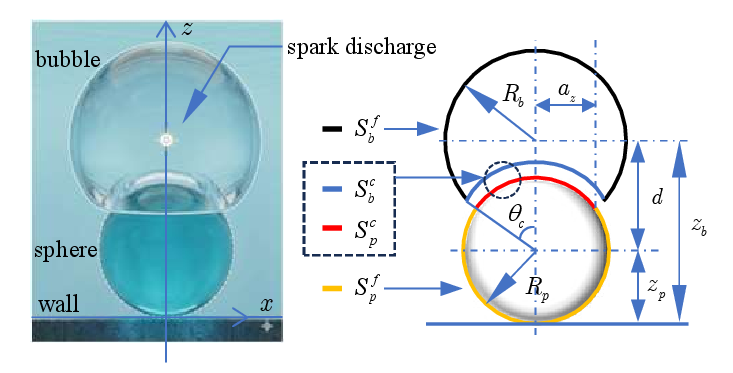
The experimental configuration and notation are shown in Fig. 1. A hydrophilic glass sphere of radius \(R_p=\SI{5}{mm}\) and density \(\rho_p=\SI{2500}{kg.m^{-3}}\) initially rests on a rigid marble wall. A single cavitation bubble is generated by controlled spark discharge on the symmetry axis of the sphere at height \(z_b\) [15], [17], [20]–[24]. The sphere-center position is denoted by \(z_p(t)\), with \(z_{p,0}=R_p\), so that the initial bubble–sphere center distance is \(d_0=z_b-z_{p,0}\). Experiments are performed for different maximum bubble radii \(R_{b,\max}\) and initial distances \(d_0\). The bubble-radius history \(R_b(t)\), the sphere trajectory \(z_p(t)\), and the rebound direction are extracted from side-view high-speed images recorded by a Phantom camera at \(24000\) frames per second with an exposure time of \(\SI{1.5}{\micro\second}\). The measured \(R_b(t)\) corresponds to the envelope of the visible free-interface portion \(S_b^f\) of the bubble. For the Kelvin-impulse evaluation, the closed bubble boundary is completed by adding the bubble-side contact surface \(S_b^c\) when contact occurs.
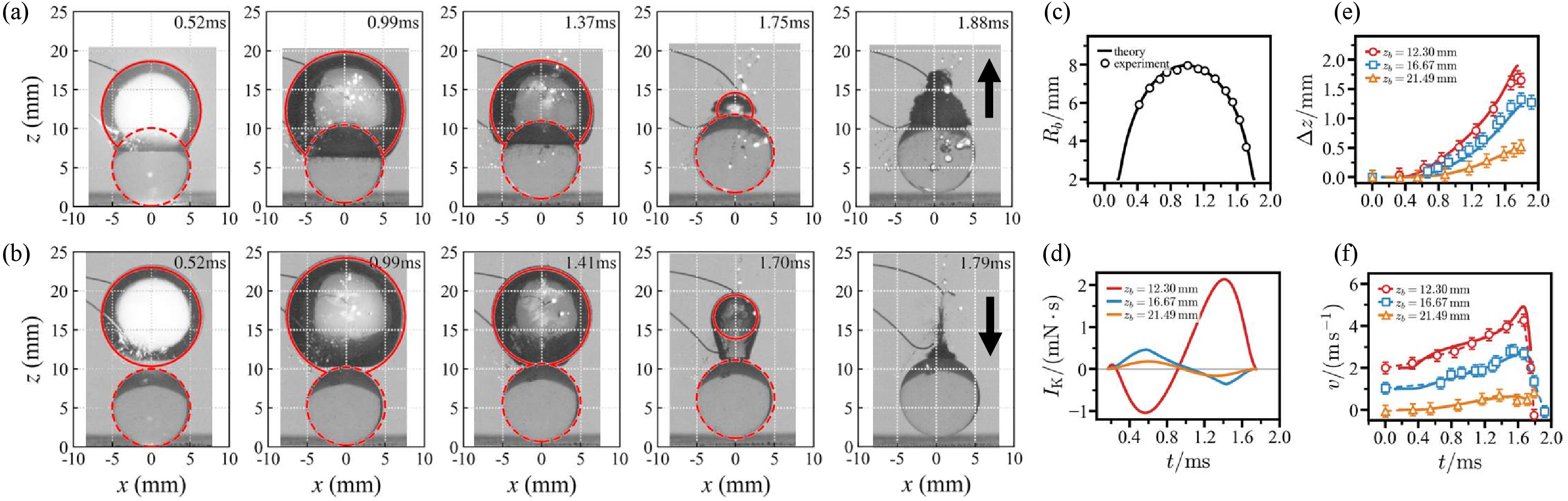
Figures 2 (a) and 2 (b) show two representative bubble–sphere interactions with opposite post-first-cycle jet or rebound biases. At the smaller separation, \(z_b=12.30,\mathrm{mm}\), strong near-field contact lifts the sphere from the wall and the bubble rebounds away from the wall. At the larger separation, \(z_b=16.67,\mathrm{mm}\), the bubble remains wallward biased despite the presence of the sphere.
To quantify this transition, we compute the coupled flow and sphere motion during the first bubble cycle. The liquid is treated as inviscid, incompressible, and irrotational, with instantaneous velocity potential \(\phi(\mathbf{x},t;Q,z_b,z_p,v_p)\) [25]–[27]. The measured radius history \(R_b(t)\) prescribes the bubble-source strength \(Q(t)=4\pi R_b^2\dot{R}_b\) [1], [28], [29]; the rigid wall is imposed by the method of images [2], [3], [30]; and the sphere-induced correction is represented by a multipole expansion satisfying no penetration on the moving sphere [3], [25], [31]–[33]. The sphere motion is obtained from a partitioned pressure calculation: the liquid-wetted surface uses the unsteady Bernoulli pressure \(p_f=\rho(\partial_t\phi-|\nabla\phi|^2/2)\), while the forced bubble–sphere contact cap is assigned a power-consistent mean pressure.
The measured \(R_b(t)\) used as the source input is shown in Fig. 2 (c). With this input, the computed sphere displacement and velocity reproduce the observed lift-off, acceleration, and deceleration trends, as shown in Figs. 2 (e) and 2 (f). We then reconstruct the bubble Kelvin impulse on the closed bubble boundary, composed of the visible free-interface part \(S_b^f\) and the bubble-side contact closure \(S_b^c\):
\[\mathbf{I}_K = -\rho \left[ \int_{S_b^f}\phi_b^f\,\mathbf{n}\,\,\mathrm{d}S + \int_{S_b^c}\phi_b^c\,\mathbf{n}\,\,\mathrm{d}S \right]. \label{eq:IK95closed}\tag{1}\]
Here \(\phi_b^{f}\) is obtained from the analytical potential-flow model on \(S_b^f\). On the forced contact cap \(S_b^c\), the contact potential \(\phi_b^{c}\) is reconstructed from the imposed contact geometry and boundary conditions using a boundary-integral procedure [2], [3], [34]. The resulting vertical impulse \(I_K(t)\), shown in Fig. 2 (d), changes sign consistently with the observed jet or rebound bias: the away-from-wall case develops an upward-biased impulse, whereas the wallward case retains a downward-biased impulse. We therefore decompose the reconstructed Kelvin impulse to identify the boundary contribution responsible for the direction reversal.
We then ask which part of the closed boundary and which potential component dominate this impulse bias. To this end, the vertical Kelvin impulse is decomposed into the bubble-source contribution, wall-image-source contribution, sphere-induced contribution, image-sphere contribution, and moving-contact velocity contributions, denoted by \(I_{\rm bub}\), \(I_{\rm ibub}\), \(I_{\rm sph}\), \(I_{\rm isph}\), and \(I_{\rm vel}\), respectively: \[I_{K} \simeq I_{\mathrm{bub}} + I_{\mathrm{ibub}} + I_{\mathrm{sph}} + I_{\mathrm{isph}} + I_{\mathrm{vel}} . \label{eq:impulse95decomp}\tag{2}\] This decomposition is used below to identify the dominant term responsible for the reversal of the bubble impulse.

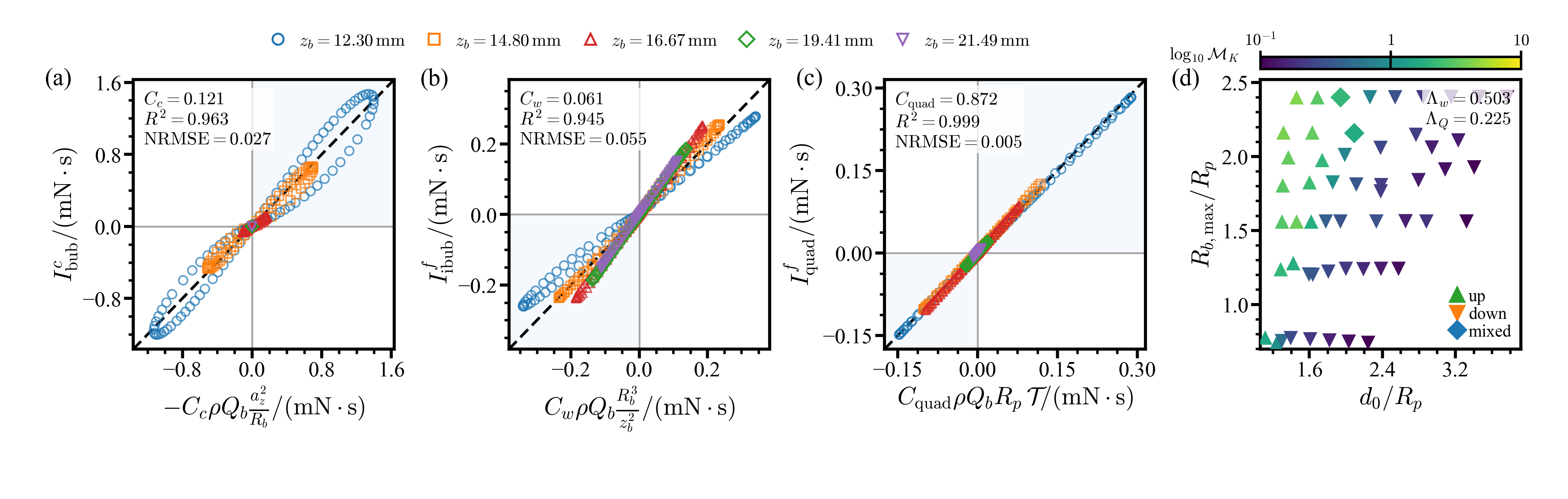
Figure 3 identifies the dominant contributions to the impulse bias. On the closed bubble boundary, \(I_{\rm bub}\) supplies the positive, away-from-wall impulse, whereas \(I_{\rm ibub}\) and \(I_{\rm sph}\) provide the negative wallward contribution; \(I_{\rm isph}\) and \(I_{\rm vel}\) remain secondary, as shown in Figs. 3 (a,b). This is consistent with the conclusion that the sphere velocity gives only a finite correction, whereas the dominant variation comes from the bubble-source contribution over the contact part, controlled by the first-cycle contact area. Restricting the integral to the contact closure surface confirms that the contact impulse is almost entirely \(I_{\rm bub}^{c}\) Figs. 3 (c,d), and the total bubble-source impulse closely follows it, \(I_{\rm bub}\simeq I_{\rm bub}^{c}\) [Fig. 3 (g)]. On the free interface, the near-end-cycle downward signature of the sphere-induced contribution is mainly captured by the quadrupolar component, \(I_{\rm quad}^{f}\), while the wall-image source contributes \(I_{\rm ibub}^{f}\), as shown in Figs. 3 (e,f). The \(z_b\)-sweep further serves as a sensitivity check: \(I_{\rm ibub}\) and \(I_{\rm sph}\) vary much more weakly with \(z_b\) than \(I_{\rm bub}\) Fig. 3 (h). Thus, for the leading-order scaling, the negative wallward impulse can be treated as a relatively stable background threshold, and the reversal problem reduces to a competition between the contact-source impulse \(I_{\rm bub}^{c}\) and the free-interface contributions from the wall-image source \(I_{\rm ibub}^{f}\) and the quadrupolar sphere-induced field \(I_{\rm quad}^{f}\).
Motivated by the decomposition above, we next validate the three dominant impulse scalings. Using the contact-pressure treatment for the forced contact cap [20], [35], [36], the standard wall-image construction [2], [3], [30], and the quadrupole formulation for a spherical boundary [3], [31]–[33], the corresponding scaling bases are \(-\rho Q_b a_z^2/R_b\), \(\rho Q_bR_b^3/z_b^2\), and \(\rho Q_bR_p\mathcal{T}(R_b/R_p,d/R_p,\alpha)\), respectively. Here \(d=|z_b-z_p|\), \(\alpha\) is the opening angle of the bubble free interface, and \(\mathcal{T}\) is the dimensionless kernel obtained from the analytic free-interface quadrupole integral, whose explicit form is given in the Supplemental Material. The collapses in Figs. 4 (a–c) validate these scalings and determine the component-level coefficients \(C_c\), \(C_w\), and \(C_{\rm quad}\).
The quadrupolar contribution is then evaluated at \(t_K\), chosen as the instant at which \(Q_b\) is most negative. In the present data set, \(0.495\le R_K/R_p\le 1.632\) and \(0.880\le d_K/R_p\le 3.464\). Over this range, the finite-size correction proportional to \((1-R_K/R_p)^2\) is secondary to the dominant \((d_K/R_p)^2\) dependence, so that the late-cycle kernel reduces to \(\mathcal{T}_K\simeq -(1/32)(R_p/d_K)^3[2R_K/R_p-(d_K/R_p)^2]\). For non-contact cases, \(a_z=0\) and the free interface is complete, so that \(\alpha=\pi\) and the quadrupolar kernel reduces to \(R_b^3R_p^4/d^7\). These cases therefore contain no away-from-wall contact-source contribution, and the quadrupolar term only enters as a correction to the wallward background.
Combining the validated component scalings gives the late-cycle vertical impulse balance \[\begin{align} I_K &\simeq -\frac{\rho Q_K C_c}{R_K} \left[ a_z^2 +2\Lambda_Q\frac{R_K^2R_p^3}{d_K^3} -\Lambda_Q\frac{R_KR_p^2}{d_K} -\Lambda_w\frac{R_K^4}{z_b^2} \right], \end{align} \label{eq:IK95balance95compact}\tag{3}\] where \(R_K=R_b(t_K)\), \(d_K=d(t_K)\), and \(Q_K=Q_b(t_K)<0\). The two weights are not fitted to the observed rebound directions. They are fixed by the component-level coefficients in Figs. 4 (a–c): \[\Lambda_w=\left|\frac{C_w}{C_c}\right|, \qquad \Lambda_Q=\left|\frac{C_{\rm quad}}{32C_c}\right|. \label{eq:Lambda95def}\tag{4}\] The factor \(1/32\) in \(\Lambda_Q\) comes from the analytical quadrupolar reduction. Since the prefactor \(-\rho Q_KC_c/R_K\) is positive, the rebound direction is determined by the bracketed geometric balance. Using \(R_p\) to nondimensionalize lengths, we define \[\begin{align} \mathcal{M}_K &= \frac{ \hat{a}_z^2+2\Lambda_Q\hat{R}_K^2\hat{d}_K^{-3} }{ \Lambda_Q\hat{R}_K\hat{d}_K^{-1} +\Lambda_w\hat{R}_K^4\hat{z}_b^{-2} }. \end{align} \label{eq:MK}\tag{5}\]
Here \(\hat{a}_z=a_z/R_p\), \(\hat{R}_K=R_K/R_p\), \(\hat{d}_K=d_K/R_p\), and \(\hat{z}_b=z_b/R_p\). The criterion \(\mathcal{M}_K>1\) predicts an away-from-wall impulse, whereas \(\mathcal{M}_K<1\) predicts a wallward impulse. Thus the classification in Fig. 4 (d) is obtained without any direct fitting to the rebound-direction labels.
In the present parameter range, the quadrupolar term is comparable to the wall-image term but is far less sensitive to geometry than the contact-source term. The full balance is quantified by \(\mathcal{M}_K\) and tested in Fig. 4 (d). Absorbing the quadrupolar correction into an effective wallward background gives the reduced contact criterion \[\frac{a_z z_b}{R_K^2}=C_* . \label{eq:simple95criterion}\tag{6}\] For the present data set, \(C_*\simeq 2.7\); larger values predict away-from-wall rebound and smaller values predict wallward rebound. This reduction shows that the reversal is controlled primarily by whether the projected contact-source impulse exceeds the effective wallward background.
In conclusion, we have shown that a wall-supported free sphere can reverse the first-cycle Kelvin-impulse bias of a near-wall cavitation bubble. The mechanism is not governed primarily by the instantaneous velocity of the sphere. Instead, in the comparable-size bubble–sphere regime studied here, the upward impulse is supplied by the bubble-source contribution over the contact part of the closed bubble boundary, with its strength set by the projected contact scale \(a_z\). The opposing wallward impulse is supplied by two background contributions: the wall-image source and the quadrupolar component of the sphere-induced field.
This balance is first captured by the full impulse criterion \(\mathcal{M}_K\), which retains the contact-source, wall-image, and quadrupolar sphere-induced terms. Because the wall-image and quadrupolar contributions vary much less sensitively than the contact-source term over the present data set, they can be absorbed into an effective wallward background, yielding the reduced contact number \(a_z z_b/R_K^2\). The two-level criterion therefore identifies the same physical transition: rebound away from the wall occurs when the contact-source impulse exceeds the wallward background, whereas wallward rebound persists when the background dominates.
These results show that a surface sphere is not merely accelerated by a cavitation bubble. Once displaced, it modifies the closed boundary on which the bubble Kelvin impulse is defined and thereby redirects the bubble’s jet and rebound bias within the first cycle. This contact-geometric mechanism provides a route for predicting whether a lifted sphere remains separated from the wall as an energy-absorbing movable boundary or returns toward the wall as a potential secondary impact source for cavitation damage.
The authors acknowledge financial support from the National Natural Science Foundation of China (No. 52471345) and the Innovation Capability Support Program of Shaanxi (No. 2024RS-CXTD-15).