Obstructions to Minimal Regular Black Hole Cosmologies
June 23, 2026
Abstract
We derive an obstruction to FRW daughter cosmologies from static, asymptotically flat regular black holes. The trapped region of such a parent is Kantowski–Sachs rather than FRW, so the daughter must be introduced as a separate matched region. For closed daughters, the angular Darmois condition is controlled by the Misner–Sharp mass: asymptotic flatness and finite ADM mass force the induced density to decay as \(A^{-3}\), while the \(k=+1\) curvature term scales as \(A^{-2}\). The minimal closed branch is therefore bounded rather than indefinitely expanding. Flat and open daughters avoid this boundedness mechanism, but the general flat/open FRW completeness theorem prevents non-static curvature-regular, ANEC-consistent flat/open daughters from being geodesically complete. For Bardeen, the parent source does not naturally supply the late-time support needed for an unbounded closed daughter. A viable FRW daughter therefore requires additional structure, such as modified asymptotics, nonminimal matching, non-FRW evolution, or an additional stress-energy component.
1 Introduction↩︎
A recurring idea in gravitational physics is that black-hole interiors may admit a cosmological interpretation. In singular examples such as Schwarzschild, the trapped region can be rewritten as a Kantowski–Sachs spacetime, while in regular black holes the singularity is replaced by a nonsingular core, often locally de Sitter-like near the center. This raises a simple question: can a regular black-hole interior furnish a genuine daughter cosmology, or does such an interpretation require additional global structure or a new stress-energy component?
To address this question, we consider static, spherically symmetric, asymptotically flat regular black holes with trapped interiors, using the Bardeen black hole as a representative example. By a minimal daughter construction we mean a no-shell FRW matching whose evolution is fixed by the parent metric, with no added late-time bulk sector, modified asymptotics, or independent shell stress tensor. The FRW daughter is therefore a separate homogeneous and isotropic matched continuation rather than a coordinate rewriting of the Kantowski–Sachs trapped region. We impose the averaged null energy condition (ANEC) as a minimal non-exoticity criterion: it allows controlled local violations of the pointwise null energy condition while constraining the averaged null energy along complete null geodesics [1], [2]. The completeness theorem used below is formulated under the same assumption [3], [4].
Throughout, an indefinitely expanding daughter means an unbounded branch with scale factor \(A(\tau)\to\infty\), rather than a long-lived finite expansion between turning points. The main flat/open/closed dichotomy is formulated for the one-function static spherical class \(g_{tt}g_{rr}=-1\); the closed-branch boundedness is extended to redshifted static parents in Sec. 4.2.1
Historically, the broad idea that black-hole interiors may be related to cosmological regions appears in black-hole-universe proposals [5], [6], limiting-curvature and baby-universe constructions [7]–[13], and regular de Sitter-core scenarios [14]–[18]. A complementary line of work concerns the geodesic completeness of nonsingular cosmologies [19]–[24]. More recently, Oppenheimer–Snyder-type and generalized constructions have been developed for regular black holes and nonsingular cosmologies with Hayward, Bardeen, and Minkowski-type cores [25]–[29].
We show that a regular core is not by itself enough to produce an FRW daughter having the full list of desired properties: indefinite expansion, curvature regularity, geodesic completeness, and ANEC consistency. The result separates into two logically distinct obstructions. For closed daughters, boundedness is controlled by asymptotic flatness and finite ADM mass through the no-shell matching equation. For flat and open daughters, the obstruction is more general: it follows from the flat/open FRW completeness theorem, independently of the black-hole matching construction.
The rest of the paper is organized as follows. In Sec. 2 we review the trapped-region geometry of the parent spacetime. In Sec. 3 we show that the trapped interior is not itself an FRW cosmology. In Sec. 4 we derive the no-shell FRW daughter equations and discuss a redshift-function extension. In Sec. 5 we prove the closed-branch boundedness theorem, explain how the flat/open branches fall under the general FRW completeness obstruction, and analyze the lifetime and tuning of the closed Bardeen branch. In Sec. 6 we discuss core type and source limitations.
2 Trapped interiors of regular black holes↩︎
We begin by considering static, spherically symmetric metrics of the form \[ds^2=-f(r)\,dt^2+f(r)^{-1}dr^2+r^2d\Omega_2^2, \label{eq:parent95static95metric}\tag{1}\] with an asymptotically flat exterior and a regular core [14], [15], [17], [30]–[32]. On any trapped interval \(f(r)<0\), defining \[T\equiv r,\qquad \chi\equiv t,\qquad d\tau=\frac{dT}{\sqrt{|f(T)|}}, \label{eq:trapped95coords95compact}\tag{2}\] recasts the metric as \[\begin{align} ds^2&=-d\tau^2+a(\tau)^2d\chi^2+b(\tau)^2d\Omega_2^2, \nonumber\\ a(\tau)&=\sqrt{|f(T(\tau))|}, \qquad b(\tau)=T(\tau). \label{eq:ks95metric95compact} \end{align}\tag{3}\] For this one-function class, one has \(\dot{b}=a\) with the orientation chosen so that \(T\) increases with \(\tau\); equivalently, \(|\dot{b}|=a\) independent of orientation.
We choose to work with the Bardeen geometry [14], [17], \[f(r)=1-\frac{2Mr^2}{(r^2+g^2)^{3/2}}. \label{eq:bardeen95f95compact}\tag{4}\] For \(M/g>3\sqrt{3}/4\), this solution has two horizons. Its causal structure then consists of a static exterior, a finite trapped nonstatic band \(r_-<r<r_+\), and a regular static core \(0\le r<r_-\). Near the center, \[f(r)=1-\frac{2M}{g^3}r^2+O(r^4), \qquad \Lambda_{\rm eff}=\frac{6M}{g^3}, \label{eq:bardeen95core95compact}\tag{5}\] so the core is locally de Sitter-like. The effective source may be written as \[T^\mu{}_{\nu}=\mathrm{diag}\bigl(-\rho(r),p_r(r),p_T(r),p_T(r)\bigr), \label{eq:bardeen95source95tensor95compact}\tag{6}\] with \[\begin{align} \rho(r)&=\frac{3Mg^2}{4\pi(r^2+g^2)^{5/2}}, \nonumber\\ p_r(r)&=-\rho(r), \nonumber\\ p_T(r)&=\frac{3Mg^2(3r^2-2g^2)}{8\pi(r^2+g^2)^{7/2}}. \label{eq:bardeen95source95compact} \end{align}\tag{7}\] Thus the source is anisotropic away from the center and isotropizes only in the \(r\to0\) limit. 2
3 The trapped interior is not FRW↩︎
The following familiar observation sets our stage: the trapped region of a static spherical black hole is Kantowski–Sachs rather than FRW. Thus the FRW daughter considered below is a separate matched region, and not simply a coordinate reinterpretation of the trapped band.
Proposition 1 (Static trapped-region obstruction). Consider a one-function static, spherically symmetric parent spacetime of the form 1 with a trapped interval \(f(r)<0\). In the induced Kantowski–Sachs description 3 , the trapped interior is not an exact FRW cosmology in its natural slicing.
Moreover, defining \[H_\parallel:=\frac{\dot{a}}{a}, \qquad H_\perp:=\frac{\dot{b}}{b},\] isotropic expansion on a connected open interval, \(H_\parallel=H_\perp\), is equivalent to \[a(\tau)=C\,b(\tau),\] for some constant \(C>0\), and hence to \[|f(T)|=C^2T^2.\] Thus isotropic expansion can occur only in this highly special case and is nongeneric within the one-function static class. This is a necessary condition for isotropic expansion, not a sufficient condition for an exact FRW geometry.
Proof. At fixed \(\tau\), the induced spatial metric is \[h_{ij}dx^i dx^j = a(\tau)^2 d\chi^2+b(\tau)^2 d\Omega_2^2 .\] Thus each spatial slice has the direct-product geometry \(\mathbb{R}_\chi\times S^2_{\,b(\tau)}\), lacking constant sectional curvature: two-planes containing the \(\chi\)-direction have zero sectional curvature, while two-planes tangent to the sphere have sectional curvature \(1/b(\tau)^2\). Therefore the trapped interior is not an exact FRW cosmology in its natural slicing.
In the one-function case, one has \(\dot{b}=a\). A necessary condition for exact FRW behavior on an open interval is isotropic expansion, \(H_\parallel=H_\perp\), or equivalently \[\frac{\dot{a}}{a}=\frac{\dot{b}}{b}.\] On a connected open interval this integrates to \(a(\tau)=C\,b(\tau)\) for some constant \(C>0\), and the converse is immediate. Since \(b=T\) and \(a=\sqrt{|f(T)|}\), the condition becomes \[|f(T)|=C^2T^2.\]
This is a highly special condition, and it still does not make the geometry FRW. Even when it holds, it only equalizes the directional Hubble rates; it does not alter the intrinsic product geometry of the \(\tau=\mathrm{const}\) slices. The natural spatial slices remain \(\mathbb{R}\times S^2\) rather than constant-curvature three-spaces. ◻
For the Bardeen metric 4 , one has on the trapped interval \[|f(T)|=\frac{2MT^2}{(T^2+g^2)^{3/2}}-1, \label{eq:bardeen95absf95obstruction}\tag{8}\] which is not of the form \(C^2T^2\) on any open interval. Hence the Bardeen trapped region does not admit isotropic expansion over any finite portion of its interior evolution. More importantly, the trapped region is only the finite band \(r_-<r<r_+\): it terminates at the inner horizon and is followed by a regular static core. Thus even though the core becomes locally de Sitter-like as \(r\to0\), the trapped Kantowski–Sachs phase itself does not evolve into a daughter FRW branch.
Hence, Proposition 1 rules out the simplest possibility: the trapped region of the static parent is not already the daughter universe. For the Bardeen trapped band this conclusion is corroborated by the invariants. FRW spacetimes are conformally flat, whereas for a one-function spherical metric written as \(F(r)=1-2m(r)/r\), \[C_{abcd}C^{abcd} = \frac{48}{r^6}\left(m-\frac{r m'}{3}\right)^2 . \label{eq:weyl95mass95function}\tag{9}\] For Bardeen, \(m(r)=Mr^3/(r^2+g^2)^{3/2}\), so \[C_{abcd}C^{abcd} = \frac{48M^2r^4}{(r^2+g^2)^5}. \label{eq:bardeen95weyl95invariant}\tag{10}\] This invariant vanishes at \(r=0\), as expected for the limiting de Sitter-like core, but it is nonzero for every \(r>0\), in particular on the finite trapped band \(r_-<r<r_+\). So the Bardeen trapped band is not an FRW spacetime.
4 No-shell FRW daughters from static parents↩︎
Having shown the Kantowski–Sachs trapped interior of the parent is not itself the daughter cosmology, we now turn to the simplest global continuation one might try: a no-shell matching to an FRW daughter region. In this matching, the FRW daughter is a separate spacetime region attached across a spherical hypersurface and constrained by the Darmois–Israel no-shell conditions [35], [36]. This is the standard spherical FRW/static matching structure we use as a minimal control problem rather than as a full collapse model.
The use of an FRW daughter is not arbitrary, since for regular black-holes such as Bardeen, the source isotropizes and the geometry approaches a de Sitter-like core near \(r=0\). Since de Sitter space admits homogeneous and isotropic slicings, an FRW daughter is the natural optimistic continuation to test. The question now is whether the most symmetric no-shell daughter ansatz suggested by the regular core can support an indefinitely expanding cosmology without additional global structure or some new matter content.
4.1 General junction equation↩︎
We consider a static parent geometry, written in curvature coordinates as \[ds_+^2=-F(R)\,dT^2+\frac{dR^2}{F(R)}+R^2 d\Omega_2^2, \label{eq:generic95exterior95metric}\tag{11}\] and an FRW daughter region \[ds_-^2=-d\tau^2+A(\tau)^2\left[\frac{d\chi^2}{1-k\chi^2}+\chi^2 d\Omega_2^2\right], \qquad k=0,\pm1. \label{eq:generic95frw95metric}\tag{12}\] We define \[H:=\frac{\dot{A}}{A}. \label{eq:frw95hubble}\tag{13}\]
For the flat or open cases, the matching hypersurface is at fixed comoving radius \[\chi=\chi_b=\text{const}, \qquad R_b(\tau)=A(\tau)\chi_b. \label{eq:boundary95flat95open}\tag{14}\] On the FRW side, the induced metric on the hypersurface is \[ds^2_\Sigma=-d\tau^2+R_b(\tau)^2d\Omega_2^2. \label{eq:induced95metric95interior}\tag{15}\] On the exterior side, parameterizing the hypersurface by \(x_+^\mu(\tau,\theta,\varphi)=(T(\tau),R_b(\tau),\theta,\varphi)\), one finds \[ds^2_\Sigma=-\left(F(R_b)\dot{T}^{\,2}-\frac{\dot{R}_b^{\,2}}{F(R_b)}\right)d\tau^2 +R_b^2d\Omega_2^2, \label{eq:induced95metric95exterior}\tag{16}\] so matching the first fundamental form gives \[F(R_b)\dot{T}^{\,2}-\frac{\dot{R}_b^{\,2}}{F(R_b)}=1. \label{eq:tt95matching95condition}\tag{17}\] With the standard orientation choice for the outward normal, the angular extrinsic-curvature condition gives \[\dot{R}_b^{\,2}+F(R_b)=1-k\chi_b^2. \label{eq:rr95matching95condition}\tag{18}\] The remaining \(\tau\tau\) component is consistent with the same comoving no-shell construction; for completeness we derive both components in Appendix 8. Using \(R_b=A\chi_b\) and dividing by \(A^2\chi_b^2\), one obtains \[H^2+\frac{k}{A^2} = \frac{1-F(A\chi_b)}{A^2\chi_b^2}. \label{eq:general95matching95equation}\tag{19}\] Equation 19 is the key point of the minimal construction: with no shell stress tensor, the daughter Friedmann equation is inherited directly from the parent metric function \(F(R)\). Equivalently, defining the Misner–Sharp mass function of the static parent geometry [37] by \[m(R):=\frac{R}{2}\bigl[1-F(R)\bigr], \label{eq:misner95sharp95mass}\tag{20}\] Eq. 19 becomes the invariant relation \[H^2+\frac{k}{A^2} = \frac{2m(A\chi_b)}{A^3\chi_b^3} \qquad (k=0,-1), \label{eq:general95matching95mass95function}\tag{21}\] and, for the closed parametrization introduced below, \[H^2+\frac{1}{A^2} = \frac{2m(A\sin\psi_b)}{A^3\sin^3\psi_b}. \label{eq:closed95matching95mass95function}\tag{22}\] This form makes clear that the matching equation is controlled by the parent mass profile rather than by a coordinate artifact. It also shows that the final no-shell evolution equation extends across simple zeros of \(F\) by continuity, even though the preceding derivation was written in static coordinates away from coordinate horizons.
4.2 Redshift functions do not rescue the closed branch↩︎
A natural question is whether the closed-branch obstruction is an artifact of the special choice \(g_{TT}g_{RR}=-1\). To test this, we allow a nontrivial static redshift function. Under the same comoving no-shell assumptions, the angular Darmois condition remains controlled by the Misner–Sharp mass profile, while the redshift function enters only through the \(K_{\tau\tau}\) condition. The large-\(A\) argument leading to closed-branch boundedness therefore survives unchanged.
To see this, consider the more general static spherical metric \[ds_+^2=-e^{2\Phi(R)}F(R)dT^2+\frac{dR^2}{F(R)}+R^2d\Omega_2^2 \,, \label{eq:general95redshift95metric}\tag{23}\] where \(\Phi(R)\) is the redshift function. For a comoving FRW boundary, the angular Darmois condition is unchanged: \[\dot{R}_b^{\,2}+F(R_b)=\beta^2, \label{eq:redshift95angular95condition}\tag{24}\] where \[\beta^2= \begin{cases} 1-k\chi_b^2, & k=0,-1,\\ \cos^2\psi_b, & k=+1. \end{cases} \label{eq:beta95definition}\tag{25}\] Thus, for closed daughters, the Friedmann equation and its large-\(A\) asymptotics are controlled by \(F(R)\), equivalently by the Misner–Sharp mass, and not by the redshift function \(\Phi\). If \(F(R)=1-2M/R+o(R^{-1})\), the same asymptotic obstruction to unbounded closed expansion follows.
The \(\tau\tau\) condition is more restrictive: because the FRW boundary is comoving, \(K^-_{\tau\tau}=0\), and hence the parent-side trajectory must be geodesic. For Eq. 23 , the radial geodesic equation is \[\ddot R_b=-\frac{1}{2} F'(R_b) -\Phi'(R_b)\bigl(\dot{R}_b^{\,2}+F(R_b)\bigr). \label{eq:redshift95geodesic95equation}\tag{26}\] On the other hand, differentiating Eq. 24 gives \[\ddot R_b=-\frac{1}{2}F'(R_b), \label{eq:redshift95differentiated95angular}\tag{27}\] with the equality understood by continuity at turning points. Combining Eqs. 26 and 27 gives \[\Phi'(R_b)\bigl(\dot{R}_b^{\,2}+F(R_b)\bigr)=0.\] Using Eq. 24 , this becomes \[\Phi'(R_b)\,\beta^2=0. \label{eq:redshift95no95shell95constraint}\tag{28}\] Therefore a static redshift function is not capable of saving the closed branch. Under the same comoving no-shell assumptions, full Darmois matching requires either \(\Phi'(R_b)=0\) along the swept portion of the trajectory, or a degenerate static limit in which the condition is imposed only at the matched point.
For flat/open boundaries and for non-equatorial closed boundaries, \(\beta^2>0\), so full Darmois matching requires \(\Phi'(R_b)=0\) throughout the swept trajectory. In the equatorial closed case \(\beta^2=0\), but the angular condition itself gives \(\dot{R}_b^{\,2}+F(R_b)=0\), which forbids unbounded expansion when \(F\to1\). Thus the closed-branch boundedness is controlled by the invariant mass profile rather than by the redshift function.
4.3 Closed daughter universes↩︎
For the closed case \(k=+1\), it is convenient to write the daughter metric as \[ds_-^2=-d\tau^2+A(\tau)^2\left(d\psi^2+\sin^2\psi\,d\Omega_2^2\right), \label{eq:closed95frw95metric}\tag{29}\] with the boundary at fixed \[\psi=\psi_b=\text{const}, \qquad R_b(\tau)=A(\tau)\sin\psi_b. \label{eq:boundary95closed}\tag{30}\] Since the areal radius depends on \(\sin\psi_b\), we take \(0<\psi_b\le\pi/2\) without loss of generality for the nondegenerate branch considered below. The matching equation becomes \[H^2+\frac{1}{A^2} = \frac{1-F(A\sin\psi_b)}{A^2\sin^2\psi_b}. \label{eq:closed95matching95equation}\tag{31}\]
For the Bardeen exterior, this gives \[H^2 = \frac{2M}{\bigl(A^2\sin^2\psi_b+g^2\bigr)^{3/2}} -\frac{1}{A^2}, \label{eq:bardeen95closed95matching}\tag{32}\] which clearly displays the competition between the finite-mass contribution and the \(k=+1\) positive-curvature term. At large \(A\), the positive contribution falls as \(A^{-3}\), whereas the curvature term falls as \(A^{-2}\) and therefore dominates. In the next section we show that this obstruction is not special to Bardeen, but follows from asymptotic flatness and finite ADM mass. As shown in Sec. 4.2, adding a static redshift function does not change the large-radius conclusion.
We may express the same result as an effective closed-FRW source. Below, the density \(\rho_{\rm eff}\) is the homogeneous density inferred from the daughter Friedmann equation and not the unchanged anisotropic Bardeen nonlinear-electrodynamics stress tensor. Writing \[H^2+\frac{1}{A^2} = \frac{8\pi G}{3}\rho_{\rm eff}(A), \label{eq:effective95friedmann95closed95matching}\tag{33}\] one obtains \[\rho_{\rm eff}(A) = \frac{3M}{4\pi G\,\bigl(A^2\sin^2\psi_b+g^2\bigr)^{3/2}}. \label{eq:rhoeff95bardeen95matching}\tag{34}\] This effective source is vacuum-like near the emergence region and falls as \(A^{-3}\) at large \(A\).
The corresponding effective pressure is fixed by the conservation equation, \[\frac{d\rho_{\rm eff}}{d\tau} +3H(\rho_{\rm eff}+p_{\rm eff})=0,\] or, equivalently, \[p_{\rm eff}(A) = -\rho_{\rm eff}(A)-\frac{A}{3}\frac{d\rho_{\rm eff}}{dA}.\] For Bardeen this gives (with \(s=\sin\psi_b\) for the closed branch), \[p_{\rm eff}(A) = -\frac{3Mg^2}{4\pi G\bigl(A^2s^2+g^2\bigr)^{5/2}},\] and hence \[w_{\rm eff}(A) = \frac{p_{\rm eff}}{\rho_{\rm eff}} = -\frac{g^2}{A^2s^2+g^2}.\] Thus the matched daughter source interpolates from vacuum-like behavior \(w_{\rm eff}\to-1\) near the regular core to dust-like behavior \(w_{\rm eff}\to0\) at large \(A\). It supplies acceleration only for \(A^2s^2<2g^2\), and therefore cannot provide the persistent \(w\le -1/3\) support needed for an unbounded closed daughter.
4.4 Flat daughter universes↩︎
For the flat case \(k=0\), Eq. 19 reduces to \[H^2 = \frac{1-F(A\chi_b)}{A^2\chi_b^2}. \label{eq:flat95matching95equation}\tag{35}\] For Bardeen, \[H^2 = \frac{2M}{\bigl(A^2\chi_b^2+g^2\bigr)^{3/2}}. \label{eq:bardeen95flat95matching}\tag{36}\] Unlike the closed case, there is no positive-curvature term forcing a turning point, so the flat daughter branch is monotonic. Near \(A\to0\), \[H^2\to \frac{2M}{g^3}, \label{eq:bardeen95flat95early95matching}\tag{37}\] and the early-time behavior is asymptotically de Sitter-like, \[A(\tau)\sim e^{H_0\tau}, \qquad H_0^2=\frac{2M}{g^3}. \label{eq:bardeen95flat95desitter95matching}\tag{38}\] At large \(A\), \[H^2\sim \frac{2M}{\chi_b^3A^3}, \label{eq:bardeen95flat95late95matching}\tag{39}\] so \[A(\tau)\propto \tau^{2/3}. \label{eq:bardeen95flat95late95solution95matching}\tag{40}\] Thus the flat daughter branch is nonsingular in cosmic time and evolves from an asymptotically de Sitter-like past into a dust-like late phase. As we will emphasize below, however, this does not furnish a geodesically complete nonsingular cosmology.
4.5 Open daughter universes↩︎
For the open case \(k=-1\), Eq. 19 gives \[H^2-\frac{1}{A^2} = \frac{1-F(A\chi_b)}{A^2\chi_b^2}. \label{eq:open95matching95equation}\tag{41}\] For an asymptotically flat finite-mass parent, \[H^2= \frac{1}{A^2} + \frac{2M}{A^3\chi_b^3} +o(A^{-3}). \label{eq:open95late95H2}\tag{42}\] Thus the open branch, like the flat branch, avoids the closed-universe recollapse argument. Its obstruction is instead the shared flat/open completeness theorem used in Sec. 5.
If the parent has a de Sitter-like core, \(F(R)=1-H_0^2R^2+O(R^4)\), then the open matching equation gives \[H^2-\frac{1}{A^2}\to H_0^2, \qquad \dot{A}^2=1+H_0^2A^2+O(A^4).\] Locally, the leading-order solution is the open de Sitter slicing, \[A(\tau)=H_0^{-1}\sinh\!\bigl[H_0(\tau-\tau_0)\bigr]+O(A^3).\] The endpoint \(A=0\) is not a curvature singularity, but the open slicing covers only a geodesically incomplete patch of de Sitter space. This provides the local model for the flat/open incompleteness obstruction discussed in Sec. 5.
5 Obstruction mechanisms↩︎
The preceding matching equations give the closed-branch obstruction, while the flat/open branches are controlled by the general FRW completeness theorem.
Theorem 1 (Minimal asymptotically flat FRW daughters). Consider a static, spherically symmetric, asymptotically flat parent spacetime in the one-function class \(g_{tt}g_{rr}=-1\), with finite ADM mass \(M>0\). Attach an FRW daughter across a nondegenerate comoving spherical Darmois boundary. Assume that the matching is no-shell and that the daughter evolution is fixed by the parent metric profile, with no additional late-time bulk component, modified asymptotics, or independent shell stress tensor. Then the closed daughter branch is bounded at finite scale factor and therefore does not yield an indefinitely expanding FRW cosmology.
For flat and open daughters, the obstruction is more general. Independently of the black-hole matching construction, a non-static curvature-regular FRW spacetime with \(k=0\) or \(k=-1\) and regular affine ends cannot be both null geodesically complete and ANEC-consistent. Therefore the minimal asymptotically flat no-shell construction does not produce any FRW daughter satisfying all desired properties: indefinite expansion, curvature regularity, geodesic completeness, and ANEC consistency.
The proof separates into two logically distinct ingredients. The closed branch is bounded by the finite-ADM matching equation. The flat/open theorem obstructs null completeness; since geodesic completeness requires null completeness, this already excludes full geodesic completeness. 3 As shown in Sec. 4.2, the closed-branch boundedness also extends to redshifted static parents in the same comoving no-shell setup.
5.1 Closed daughters from asymptotically flat parents are bounded↩︎
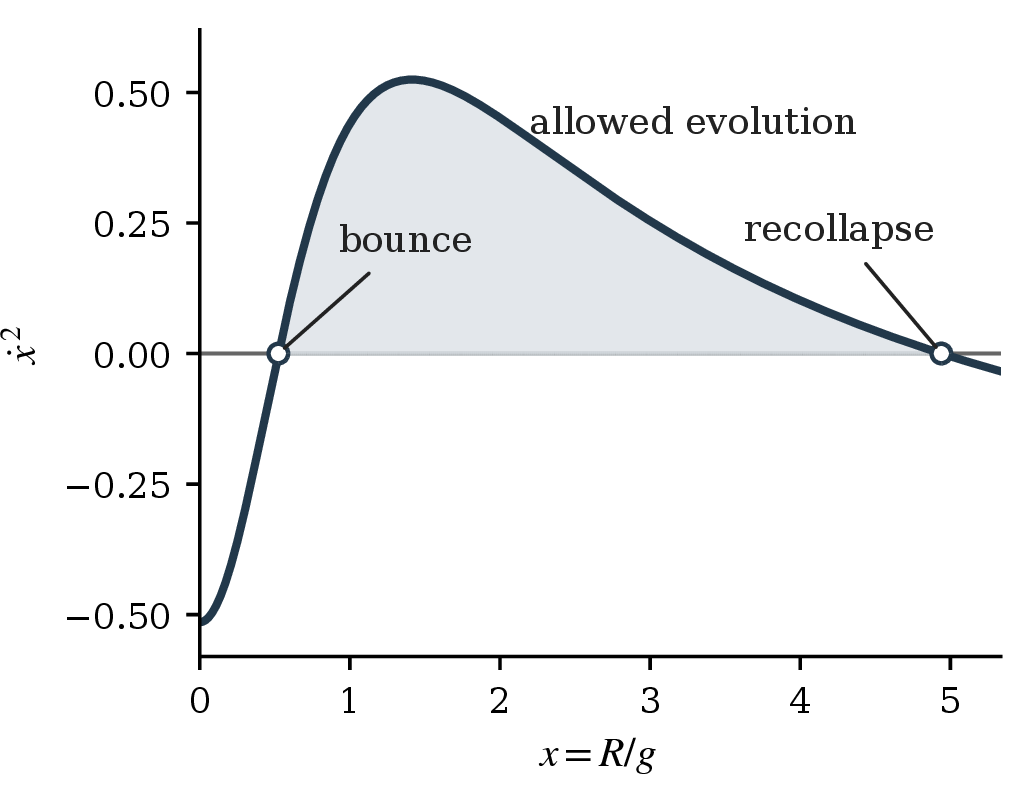
We now assume only that the parent geometry is asymptotically flat with finite ADM mass, \[F(R)=1-\frac{2M}{R}+o(R^{-1}), \qquad M>0. \label{eq:asymptotic95flatness}\tag{43}\] The closed matching equation admits two especially transparent forms. First, in terms of the parent mass function, Eq. 22 shows directly that finite ADM mass induces a dust-like late-time density. The same obstruction also appears in mechanical form: \[\dot{R}_b^{\,2}=E-F(R_b), \qquad E=\cos^2\psi_b . \label{eq:closed95mechanical95form}\tag{44}\] For a nondegenerate closed matching surface, \(0<\psi_b\le \pi/2\), one has \(E<1\). Since asymptotic flatness implies \(F(R)\to1\) as \(R\to\infty\), \[E-F(R)\longrightarrow -\sin^2\psi_b<0 . \label{eq:mechanical95asymptotic95forbidden}\tag{45}\] Thus the daughter trajectory cannot reach arbitrarily large areal radius. The same conclusion can be expressed in Friedmann language. Since finite ADM mass means \[m(R)\to M\qquad (R\to\infty), \label{eq:mass95function95adm95limit}\tag{46}\] Eq. 22 gives \[\frac{2m(A\sin\psi_b)}{A^3\sin^3\psi_b} = \frac{2M}{A^3\sin^3\psi_b}+o(A^{-3}). \label{eq:mass95function95asymptotic95density}\tag{47}\] Therefore \[H^2= -\frac{1}{A^2} +\frac{2M}{A^3\sin^3\psi_b} +o(A^{-3}). \label{eq:closed95asymptotic95H2}\tag{48}\] The \(A^{-2}\) curvature term dominates over the \(A^{-3}\) matter term for sufficiently large \(A\), so \(H^2<0\) at large scale factor. Hence a closed no-shell daughter is unable to expand to arbitrarily large radius. If an allowed nondegenerate branch emerges from a finite bounce, it encounters a finite outer turning point and generically recollapses; degenerate endpoints are tuned limiting cases rather than indefinitely expanding solutions.
This mechanism is illustrated in Fig. 1 for a representative asymptotically flat Bardeen daughter. The important point is that the obstruction is not the absence of a bounce or the formation of a singular big crunch. The branch is bounded between finite turning points. The obstruction is instead that the minimal closed branch does not yield an indefinitely expanding daughter universe.
Proposition 2 (Closed daughter boundedness). For any no-shell closed FRW daughter universe with nondegenerate matching surface \(0<\psi_b\le \pi/2\), matched to a static asymptotically flat parent geometry with finite ADM mass and curvature-coordinate function \(F(R)=1-2M/R+o(R^{-1})\), the daughter branch cannot extend to arbitrarily large \(A\). If the allowed interval has a simple finite outer zero, the expanding branch reaches a finite turning point and recollapses. Degenerate endpoints are tuned limiting cases corresponding to static or asymptotically static behavior.
Proof. Eq. 44 gives \[\dot{R}_b^{\,2}=E-F(R_b), \qquad E=\cos^2\psi_b .\] For \(0<\psi_b\le \pi/2\), one has \(E<1\), while asymptotic flatness gives \(F(R)\to1\). Hence \[E-F(R)\longrightarrow -\sin^2\psi_b<0 ,\] so the physical region \(\dot{R}_b^{\,2}\ge0\) cannot extend to arbitrarily large \(R_b\). Since \(R_b=A\sin\psi_b\) and \(\sin\psi_b>0\), the daughter branch cannot extend to arbitrarily large \(A\).
Equivalently, Eq. 48 gives \[H^2= -\frac{1}{A^2} +\frac{2M}{A^3\sin^3\psi_b} +o(A^{-3}) \qquad (A\to\infty).\] Thus the \(A^{-2}\) curvature term eventually dominates the induced \(A^{-3}\) matter term, and \(H^2<0\) at sufficiently large scale factor. Along a physical daughter solution one must have \(H^2\ge0\). Therefore an expanding branch cannot be unbounded.
If the upper endpoint of an allowed connected component is a simple zero of \(E-F(R_b)\), the expanding solution reaches a finite outer turning point \(A_{\max}\) with \(H(A_{\max})=0\) and then recollapses. Degenerate zeros are tuned limiting cases and give static or asymptotically static behavior rather than an indefinitely expanding daughter universe. ◻
This is a class statement depending only on the angular junction equation and the asymptotic Schwarzschild falloff of the parent geometry, not on whether the regular core is of de Sitter type, Minkowski type, or some other nonsingular form. In mass-function language, the obstruction is simply the finite-ADM limit \(m(R)\to M\).
5.2 Lifetime and tuning of the closed branch↩︎
The closed Bardeen branch illustrates that boundedness means finite lifetime, not necessarily singular collapse. Define \[x:=\frac{R_b}{g}=\frac{A\sin\psi_b}{g}, \qquad \eta:=\frac{\tau}{g}, \qquad \mu:=\frac{M}{g}. \label{eq:dimensionless95closed95vars}\tag{49}\] Equation 32 becomes \[\left(\frac{dx}{d\eta}\right)^2 = \frac{2\mu x^2}{(1+x^2)^{3/2}}-\sin^2\psi_b. \label{eq:bardeen95dimensionless95xdot}\tag{50}\] The first term on the right-hand side has maximum at \(x=\sqrt2\), with value \(4\mu/(3\sqrt3)\). Thus an allowed nondegenerate closed Bardeen branch exists when \[\sin^2\psi_b<\frac{4\mu}{3\sqrt3}, \label{eq:bardeen95allowed95condition}\tag{51}\] while equality gives a tuned static limiting case. For a nonextremal Bardeen black hole, \(\mu>3\sqrt3/4\), this condition is automatically satisfied for \(0<\psi_b\le\pi/2\). The allowed region is therefore the finite interval between the two positive roots \(x_-\) and \(x_+\) of the right-hand side.
The expansion time from the inner to the outer turning point is \[\Delta\tau_{\rm exp} = g\int_{x_-}^{x_+} \frac{dx}{\sqrt{\dfrac{2\mu x^2}{(1+x^2)^{3/2}}-\sin^2\psi_b}}. \label{eq:closed95expansion95time95integral}\tag{52}\] For order-one matching data this time is of order the black-hole scale. It can be made parametrically large by taking \(\psi_b\ll1\). In that limit \(x_+\sim2\mu/\sin^2\psi_b\), and the large-\(x\) part of the integral gives \[\Delta\tau_{\rm exp} \sim \frac{\pi M}{\sin^3\psi_b} \qquad (\psi_b\ll1). \label{eq:closed95expansion95time95scaling}\tag{53}\] This long-lived limit is a tuning of the matched branch rather than a way to circumvent the result. The parameter \(\psi_b\) is global junction data fixing the comoving angular location of the FRW boundary. Thus a long-lived closed branch can be engineered by tuning the matching construction, but it is not a prediction of the asymptotically flat parent geometry itself.
There is also a second long-lived limit near the tuned static endpoint. As \(\sin^2\psi_b\) approaches the maximum value \(4\mu/(3\sqrt3)\), the two turning points coalesce near \(x=\sqrt2\), and the effective potential develops a double root. The expansion time becomes parametrically large because the trajectory spends a long interval near the quasi-static point. Once again, this is a tuning of the junction data rather than a prediction of the parent geometry, and fails to produce an indefinitely expanding branch.
5.3 Flat and open daughters avoid boundedness but fail completeness↩︎
For the flat daughter branch, the large-\(A\) asymptotic from Eqs. 35 and 43 is \[H^2\sim \frac{2M}{A^3\chi_b^3}, \qquad A(\tau)\propto \tau^{2/3}. \label{eq:flat95late95H2}\tag{54}\] Thus the specific boundedness mechanism of the closed branch is absent. In applying the flat/open completeness condition, the object being tested is the maximal FRW daughter spacetime determined by the matched scale-factor law \(A(\tau)\), not merely the finite comoving ball bounded by the junction surface.
If the parent also has a de Sitter-like regular core, \[F(R)=1-H_0^2R^2+O(R^4) \qquad (R\to0), \label{eq:desitter95core95parent}\tag{55}\] then Eq. 35 implies \[H^2\to H_0^2 \qquad (A\to0), \label{eq:flat95early95desitter}\tag{56}\] so the early-time branch is asymptotically de Sitter-like, \[A(\tau)\sim e^{H_0\tau} \qquad (\tau\to-\infty). \label{eq:flat95early95scale95factor}\tag{57}\] This makes the incompleteness mechanism explicit. For a radial null geodesic in the flat FRW metric, the conserved comoving momentum gives \(d\lambda\propto A(\tau)d\tau\), where \(\lambda\) is an affine parameter. Thus the past affine length of the asymptotic de Sitter branch is finite: \[\Delta\lambda \propto \int_{-\infty}^{\tau_0} A(\tau)\,d\tau \sim \int_{-\infty}^{\tau_0} e^{H_0\tau}\,d\tau <\infty . \label{eq:flat95affine95incompleteness}\tag{58}\]
Thus the flat daughter model is nonsingular in cosmic time and monotonic, but it is past null incomplete via the general flat/open FRW completeness obstruction. More generally, non-static curvature-regular flat/open FRW spacetimes with regular affine ends cannot be both null geodesically complete and ANEC-consistent [3], [4]. Hence the flat daughter branch avoids the closed-universe boundedness mechanism, but it does not satisfy our full desired set of properties.
The open branch is in the same completeness class. As discussed in Sec. 4.5, it avoids the closed-branch boundedness mechanism, but the local open de Sitter behavior is only a curvature-regular FRW patch and is not geodesically complete as an FRW spacetime. Combining this flat/open completeness obstruction with Proposition 2 proves Theorem 1: the closed branch is bounded by finite ADM mass, while flat and open branches fail the regular-complete-ANEC conditions by the general FRW completeness theorem.
5.4 Escape routes↩︎
The assumptions enter the closed and flat/open models differently. In the closed model, the large-\(A\) failure follows from the finite-ADM limit \(m(R)\to M\), which makes the induced no-shell density scale as \(A^{-3}\). An unbounded closed daughter therefore requires an ingredient that changes this late-time balance: modified asymptotics for which the effective mass function does not approach a constant, an independent shell stress tensor, a non-FRW or non-comoving daughter geometry, or an additional smooth bulk component whose density redshifts no faster than \(A^{-2}\). A positive vacuum-energy component is the simplest example, but adding it lies outside the asymptotically flat minimal construction considered here.
A flat/open evasion must give up at least one of the desired conditions: curvature regularity, null completeness, ANEC consistency, the FRW ansatz, or the flat/open curvature class.
6 Core type and source limitations↩︎
The preceding theorem is a structural statement about asymptotically flat constructions, but does not apply to all black-hole-universe models. Two possible escape attempts are especially natural: changing the core type and using the parent matter source as the daughter source.
6.1 De Sitter cores versus Minkowski cores↩︎
The Bardeen geometry has a locally de Sitter-like core, which is often one of the motivations for viewing regular black-hole interiors as cosmological seeds. This local behavior is compatible with recent convergence-condition analyses: de Sitter-core regular black holes can preserve the null condition while evading singularity theorems through strong-energy-condition violation [38]. In our case, however, the core type does not control the large-\(A\) fate of the daughter.
Minkowski-core parents provide a useful comparison. Their early-time daughter patch can approach a Minkowski-like nonsingular regime rather than an asymptotically de Sitter-like one, as illustrated in Ref. [28]. This changes the early-time patch but not the closed-branch obstruction: for \(k=+1\), boundedness follows from asymptotic flatness and finite ADM mass. For \(k=0\) and \(k=-1\), changing the core type likewise does not by itself evade the general flat/open completeness theorem.
6.2 Can the parent matter source rescue the daughter universe?↩︎
One might also ask whether the matter source associated with the parent regular black hole can stabilize the daughter cosmology. We do not prove a general no-go theorem, but the minimal Bardeen/nonlinear-electrodynamics route is disfavored for two simple reasons.
First, the unchanged static source remains anisotropic away from the center and decays too rapidly at large areal radius. For Bardeen, the static density falls as \(r^{-5}\), while the no-shell Friedmann density induced by the exterior mass profile falls as \(A^{-3}\). Neither behavior supplies the persistent \(A^{-2}\)-or-slower support required to evade the closed-branch obstruction.
Second, promoting the same broad matter class to a homogeneous or coarse-grained cosmological source is not automatic. A homogeneous magnetic sector must be isotropized or averaged, and in an ordinary Maxwellian weak-field completion the late-time behavior is radiation-like rather than dark-energy-like. The original Ayón-Beato–García realization of Bardeen is not itself a standard Maxwell weak-field model, so this should not be read as a no-go theorem for all nonlinear-electrodynamics cosmologies. Our point is that neither the unchanged anisotropic parent source nor ordinary weak-field homogeneous continuations naturally provide the persistent \(w\le -1/3\) support needed for an unbounded closed daughter.
7 Conclusions↩︎
We have examined whether asymptotically flat regular black holes can admit minimal FRW daughter cosmologies. We identify a structural obstruction. The trapped interior of the parent spacetime is not itself an FRW cosmology, so an FRW daughter must be introduced as a separate matched region. In the minimal no-shell construction, closed daughters are bounded rather than indefinitely expanding. Flat and open daughters can avoid this boundedness mechanism, but the general flat/open FRW completeness theorem prevents non-static, curvature-regular, ANEC-consistent flat/open daughters from being null geodesically complete.
These conclusions are not tied to one special metric. The closed-branch result follows from asymptotic flatness and finite ADM mass, while the flat/open obstruction follows from general completeness constraints on non-static FRW cosmologies. Changing the detailed core structure from de Sitter-like to Minkowski-like modifies the early-time daughter patch but does not evade this dichotomy. Likewise, the parent matter source does not naturally provide the late-time support required to evade the closed-branch obstruction.
Our result does not exclude more elaborate black-hole-universe constructions with shells, modified asymptotics, non-FRW daughters, or additional smooth bulk components. Rather, it identifies which ingredients must be changed. Closed FRW daughters require additional late-time support absent from finite-ADM no-shell matching, while flat/open FRW daughters must somehow leave the hypotheses of the flat/open completeness theorem. The main lesson is that a regular core, even a de Sitter-like one, is not by itself sufficient to produce a viable FRW daughter cosmology in the sense considered here.
DAE was supported in part by the U.S. Department of Energy, Office of High Energy Physics, under Award Number DE-SC0019470.
8 Darmois conditions for the comoving no-shell boundary↩︎
Here we present the full no-shell matching conditions used in Sec. 4.1. For the FRW daughter metric 12 , a boundary at fixed \(\chi=\chi_b\) has areal radius \(R_b=A\chi_b\). The outward unit normal on the FRW side is \[n_-^\mu\partial_\mu=\frac{\sqrt{1-k\chi_b^2}}{A}\,\partial_\chi,\] and therefore \[K_{\theta\theta}^- = R_b\,n_-^\mu\partial_\mu R =R_b\sqrt{1-k\chi_b^2}. \label{eq:appendix95Ktheta95minus}\tag{59}\] On the parent side, with trajectory \(x_+^\mu=(T(\tau),R_b(\tau),\theta,\varphi)\), the induced-metric condition is \[F(R_b)\dot{T}^{\,2}-\frac{\dot{R}_b^{\,2}}{F(R_b)}=1.\] Choosing the outward normal consistently with the orientation in the main text gives \[K_{\theta\theta}^+=R_b F(R_b)\dot{T} =R_b\sqrt{F(R_b)+\dot{R}_b^{\,2}}. \label{eq:appendix95Ktheta95plus}\tag{60}\] Equating Eqs. 59 and 60 yields \[\dot{R}_b^{\,2}+F(R_b)=1-k\chi_b^2,\] which is Eq. 18 . For the closed parametrization \(R_b=A\sin\psi_b\), the same calculation gives \[K_{\theta\theta}^- = R_b\cos\psi_b, \qquad \dot{R}_b^{\,2}+F(R_b)=\cos^2\psi_b .\]
The remaining \(\tau\tau\) condition is also satisfied. On the FRW side the boundary is comoving and geodesic, hence \(K_{\tau\tau}^-=0\). On the parent side, differentiating the first integral away from a turning point gives \[\ddot R_b=-\frac{1}{2} F'(R_b), \label{eq:appendix95boundary95geodesic95equation}\tag{61}\] which is precisely the radial geodesic equation for the trajectory in the one-function parent metric. Thus \(K_{\tau\tau}^+=0\). At a turning point this relation is understood by continuity, or equivalently by using the local second-order geodesic equation rather than dividing by \(\dot{R}_b\). Hence the angular condition together with induced-metric matching gives the full Darmois no-shell matching for the comoving construction. For the redshifted metric 23 , the angular condition is unchanged, while the \(\tau\tau\) condition gives the additional constraint discussed in Sec. 4.2.
References↩︎
We take \(c=G=1\), except when \(G\) is restored for clarity in the effective FRW density and pressure.↩︎
The same trapped-region geometry can also be used in time-dependent classical double-copy constructions [33], [34]. Here we use only the geometric and source-side ingredients needed for the cosmological obstruction.↩︎
The regular-affine-end assumption excludes irregular null-end behavior for which the affine ANEC identity is not controlled. The matched finite-ADM daughters considered here have ordinary asymptotic ends, so they either lie in this regular endpoint class or are explicitly null incomplete.↩︎