Data Recipes for Agentic Models
June 23, 2026
Abstract
Agentic language models dramatically expand the applications of AI yet little is publicly known about how to curate training data for broadly capable agents. Existing open efforts such as SWE-Smith, SERA, and Nemotron-Terminal typically target a single benchmark, leaving open the question of how to train models that generalize across diverse agentic tasks. The OpenThoughts-Agent (OT-Agent) project addresses this gap with a fully open data curation pipeline for training agentic models. We conduct more than 100 controlled ablation experiments to systematically investigate each stage of the pipeline, yielding insights on the importance of task sources and diversity. We then assemble a training set of 100K examples from our pipeline and fine-tune Qwen3-32B on this dataset, which yields an average accuracy of 44.8% across seven agentic benchmarks and a 3.9 percentage point improvement over the strongest existing open data agentic model (Nemotron-Terminal-32B, 40.9%). Moreover, our training data exhibits strong scaling properties, outperforming alternative open datasets at every training set size in compute-controlled comparisons. We publicly release our training sets, data pipeline, experimental data, and models at openthoughts.ai to support future open research on agentic model training.
![Figure 1: The OpenThoughts-Agent-SFT dataset leads to SotA performance on Terminal-Bench 2.0 and an 100-subset of SWE-Bench Verified at large dataset scales. The all-benchmark average is over the seven benchmarks reported in Table [tab:ot_agent_main_table1]. Additional notes on SERA below.](/article/2606.24855/figures/figure1_option8_8b.png "fig:")
1 Introduction↩︎
Agentic language models have dramatically expanded the applications of AI. Instead of only answering questions, this new generation of models can perform a wide range of complex tasks that involve using a computer in intricate ways. As a result, AI agents such as Claude Code, Codex, and OpenClaw have rapidly grown in popularity. To enable these agentic applications, the underlying models have improved in their ability to use tools and reason coherently over a long horizon. Further developing these models towards better agents is one of the most important research directions in AI.
At the same time, the public literature contains little information on how to train state-of-the-art agentic models, especially when it comes to training data. The recent DeepSeekV4 release is an illustrative example [1]: the model weights are open and the accompanying paper contains more than 50 pages with details on the architecture and training process, but the paper describes the training data only at a high level with two paragraphs. While there are initial efforts to curate training data for agents in the open such as SWE-Smith [2], SERA [3], Nemotron-Terminal [4], and OpenSWE [5], these efforts usually focus only on one benchmark at a time, e.g., SWE-Bench [6] or Terminal-Bench [7]. Hence, it is currently difficult for open AI research to understand how broadly capable agentic models are trained, and to contribute to their improvement.
We take a step towards open training data for agentic models with the OpenThoughts-Agent (OT-Agent) project. Building on the insights from the prior OpenThoughts work [8], we focus on post-training data for supervised fine-tuning (SFT), now with the goal of improving a model’s performance on multiple agentic benchmarks. Our first contribution is a comprehensive data curation pipeline for agentic SFT data on which we conduct more than 100 ablation experiments. Our experiments lead to the following key findings:
As with reasoning data, the choice of instructions is among the most important factors in our data pipeline.
The strongest model by benchmark performance does not necessarily make the best teacher.
Filtering training data to retain the execution traces with more model turns improves the resulting training sets.
Repeating the top few sources leads to diminishing returns in our largest training runs, and we therefore expand the set of data sources to increase diversity.
Building on our experiments, we assemble a state-of-the-art training set for fine-tuning agentic models. In particular, we fine-tune the Qwen3-32B model on 100k data points from our pipeline and achieve the best performance on a broad suite of agentic tasks compared to other open data models with a Qwen3 or earlier base model at <=32B scale (see Table [tab:ot_agent_main_table1]). Our model achieves 54.0% on SWE-Bench Verified and 26.2% on Terminal-Bench 2.0, compared to 41.9% and 25.1% for Nemotron-Terminal-32B. In addition, our model also outperforms prior work on further agentic benchmarks including Aider Polyglot [9], BFCL-Parity [10], GAIA-127 [11], and FinanceAgent-Terminal [12]. Figure 1 shows that our training set is not only good because of its size but also exhibits strong scaling trends, outperforming other open datasets in a compute-controlled way for every training set size.
In addition to our SFT investigation, we also study data curation for reinforcement learning (RL). We briefly document the challenges of existing open-data RL curation efforts (such as reproducibility, usability, and scaling) and introduce a newly curated RL dataset. We then validate the efficacy of this data by post-training an 8B model in two stages (SFT + RL) which outperforms our best single-stage 8B model, as well as the strongest existing <=8B baselines, on average across 7 agentic benchmarks (see Table [tab:ot_agent_8B_table3] for details).
We publicly release our training sets, data pipeline, experimental data, and models at https://www.openthoughts.ai/, so that future open research can build on our artifacts.
2 Related Work↩︎
Data curation. Data curation includes data sourcing, data labeling / verification, and sometimes filtration [13], [14]. The advent of large language models and scaling laws progressively made clear the large role data curation plays in AI capabilities, and led to considerable industrial research and rapid advances in the state-of-the-art, as well as a series of public data curation efforts for vision-language models, language models and reasoning models [8], [13]–[15]. Rigorous public research on data curation for agents, however, remains scarce, providing a core motivation for this work.
Agents and their benchmarks. The evaluation of large language models has progressed rapidly in the space of the last five years; where pioneering models such as GPT-3 reported primarily on multiple-choice benchmarks such as MMLU, evaluated by probing logprobs for continuation tokens, the community quickly advanced to evaluating the open-ended completions of generative models directly. With the debut of OpenAI’s O series of models, specialized thinking formats grew popular and specialized benchmarks such as AIME (static) and LiveBench and LiveCodeBench (dynamic) were developed to challenge thinking models.
Agentic Models. Most recently, the frontier has extended again, with benchmarks such as SWE-Bench and Terminal-Bench assigning scores to discrete tasks such as GitHub issue resolution [6], [7]. Throughout this process, standardized evaluation platforms such as Evalchemy and Harbor have made benchmarks more affordable and reproducible [16], [17]. Over the past year and a half, as agentic AI has entered the research mainstream, various data curation strategies have been proposed for the effective post-training of AI agents, spanning both SFT and RL data curation [2]–[4], [18]–[21]. However, these works have two key limitations; firstly, they almost exclusively focus either on SFT or on RL, with little attention paid to how these steps intersect; secondly, they tend to focus on a single benchmark or a small cluster of closely related agentic benchmarks. By contrast, our work focuses on generalization across agentic benchmarks, the interaction between SFT and RL, across several popular model scales, and utilizes a range of agentic benchmarks, including OpenThoughts-TB-Lite, new in this work. Recent works use Qwen-3.5 as base model for their experiments [22]. We have decided to keep Qwen-3 as base model to enable consistent comparisons throughout our project. Porting our data improvements to Qwen-3.5 and studying interactions between base model and SFT / RL data are important directions for future work.
Public frameworks for building agents. Although a detailed discussion is beyond the scope of this paper, we wish to emphasize that sound engineering practices constituted a central focus (and a central challenge) of this work, and acknowledge those we used. Many public frameworks for SFT are reasonably mature; we selected a fork of Llama-Factory, extending it to support ALST long-sequence training [23], [24]. Our reinforcement learning framework was an extended version of the popular SkyRL framework; most of the improvements are described in [25]. We used [16] for environment, benchmark and harness management.
3 SFT Data Pipeline↩︎
3.0.0.1 Pipeline
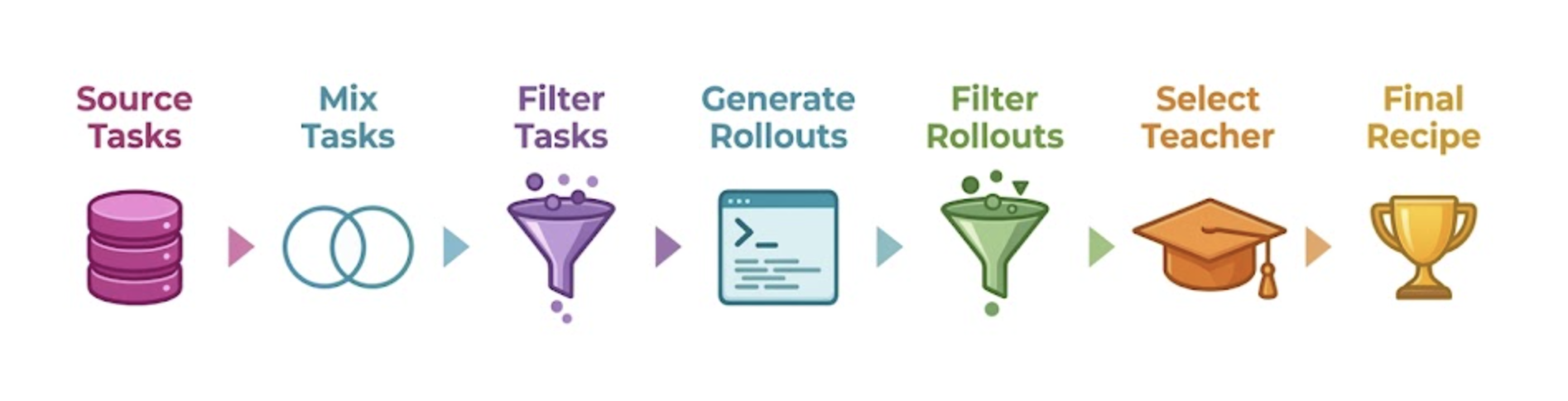
This section introduces our experimental pipeline for building the OpenThoughts-Agent dataset. Our goal is to create the best dataset of (task, trajectory) pairs for supervised finetuning coding and terminal agents. The best dataset is the one that
produces the highest-performing agent on downstream benchmarks. To do so, we ablate each pipeline step independently, and select the best-performing strategy based on the average z-score across three benchmarks. We compute the \(z\)-score of every candidate strategy’s accuracy across the stage’s full candidate set (subtracting the stage’s per-benchmark mean and dividing by its standard deviation), then average the three resulting per-benchmark \(z\)-scores. This standardization gives each benchmark equal weight in the ranking despite differing accuracy ranges across the candidate set. Sections 3.1 to 3.6 describe each stage of the pipeline in detail. Unless otherwise specified, trajectories are generated by GLM-4.7-AWQ [26] acting as the teacher in the terminus-2 harness inside Daytona sandboxes. We conduct our experiments on datasets of size \(10{,}000\) since that is small enough to be cost-effective yet large enough to provide a meaningful signal.
3.0.0.2 Training
For each ablation experiment, we utilize the full pipeline to generate \(10{,}000\) trajectories for each data strategy, and we finetune Qwen3-8B [27] on each dataset using full-parameter SFT, learning rate \(4\mathrm{e}{-5}\) with cosine schedule, global batch size \(96\), \(7\) epochs, and \(32{,}768\) context length. Each \(10{,}000\) finetune takes 160 GPU-hours on GH200s, allowing us to run dozens of pipeline ablations in parallel. These experiments inform the design choices for the final OpenThoughts-Agent pipeline. We include additional details on hyperparameters, training infrastructure, and per-stage SFT settings in the Appendix Section 9.
3.0.0.3 Evaluation Setup
We evaluate our models on a set of agent benchmarks that probe long-horizon software-engineering and terminal-use behavior. Our core suite consists of three benchmarks: (1) OpenThoughts-TBLite (100 tasks) [28]: a curated collection of 100 Terminal-Bench style tasks that balanced across four difficulty buckets and engineered as a fast proxy for the full Terminal-Bench 2.0 performance, (2) SWE-Bench Verified-100 (100 tasks) [6]: a stratified subsample (by repository) of the 500-task human-validated SWE-Bench Verified split; an agent produces a patch against a Python repo at a fixed commit, binary-scored by the upstream test harness, and (3) Terminal Bench 2 (89 tasks) [7]: hand-crafted, human-verified tasks that spans SWE, biology, security, system administration, and machine learning.
All evaluations run inside isolated Daytona sandboxes [29] using the terminus-2 [7] agent harness, with \(n=3\) stochastic re-runs
per task and standard error reported across trials. To measure generalization, our pipeline experiments exclude a held-out set of out-of-distribution benchmarks, which are only measured once pipeline experimentation is complete. This held-out set consists
of Aider Polyglot [9], BFCL [10], MedAgentBench [30], GAIA [11], and FinanceAgent-Terminal [12]. 13 contains further details on evaluation infrastructure and per-benchmark configuration.
3.1 Sourcing Tasks↩︎
Since an SFT agentic dataset comprises task descriptions and agent trajectory pairs, the strategy for generating task descriptions can change downstream accuracy by up to 30 pp on SWE-Bench Verified-100 and 10 pp on Terminal-Bench 2.0(3, ranks 1 vs 95). The design space for task generation strategies is large, encompassing synthetic task generation, human task generation, and more. Moreover, the domain knowledge and skills covered by a task generation strategy can also lead to large differences in downstream performance.
To efficiently find the best task data generation strategies, we ablate a set of 95 task generation strategies covering different initial sources, modes of generation (synthetic vs.not synthetic), and knowledge domains for those tasks. We report the findings in [tab:task_gen_table]. The top-performing task generation strategies include synthetic issue-resolution tasks such as SWE-Smith and our own IssueTasks datasets, human-written computer-use questions such as StackExchange SuperUser and Tezos, and other strategies. The effect of choosing different task generation strategies leads to a large difference in downstream evals; for example, TerminalBench 2.0 scores range from 10.9% to 0.4%. We also observe that performance improvements at the top end of data generation strategies are spiky: the top coding-related datasets, such as SWE-Smith, greatly improve SWE-Bench, whereas the human-written infrastructure questions, such as StackExchange SuperUser, improve TerminalBench 2.0.
3.2 Mixing Tasks↩︎
Our set of task descriptions will come from a mix of the task generation strategies from 3.1. While there is a rich literature on data mixing strategies, we simply ablate the use of the top 1, top 2, and so on datasets in the mix, given the relative ranking of each task generation strategy from 3.1. For the Top-\(N\) mixing strategy, we take the top \(N\) data generation strategies and sample \(\frac{10{,}000}{N}\) task descriptions from each.
The results of mixing strategy are in 1. Mixing around the Top 4 or Top 8 task generation strategies works best and outperforms the non-mixed Top 1 baseline, since it performs well on all our benchmarks rather than solely on SWE-Bench.
| Benchmarks | Average | ||||||
|---|---|---|---|---|---|---|---|
| 3-5 (lr)6-7 Rank | Mixing Strategy | SWE-Bench Verified (100) | OT-TBLite | Terminal-Bench 2.0 | Raw | Normalized | |
| 1 | Top 4 | 29.33 | 17.00 | 8.24 | 18.19 | +0.49 | |
| 2 | Top 2 | 29.00 | 18.12 | 7.12 | 18.08 | +0.48 | |
| 3 | Top 8 | 28.00 | 15.86 | 8.61 | 17.49 | +0.19 | |
| \(\cdots\) | |||||||
| 6 | Top 1 | 30.67 | 14.80 | 4.49 | 16.65 | -0.57 | |
3.3 Task Augmentation Strategies↩︎
After initially generating the task descriptions, a natural hypothesis is that refining them by clarifying their requirements or increasing their difficulty can improve dataset quality. We explore different methods for augmenting task descriptions, such as using an LLM to combine tasks from different sources, add new constraints to each task, harden the task descriptions, and more. The results of these interventions are in [tab:task_augmentation]. We find that all interventions fail to improve the baseline of leaving the task description untouched after generation.
3.4 Filtering Tasks↩︎
After determining the final mix of task generation strategies, filtering out poor tasks from a set of task descriptions can improve downstream performance. We repeat the ablation of the set of task description filters from OpenThoughts. [tab:task_filtering] holds the results. We find similar results: LLM task description filters yield the largest improvement among the filters we tested (+3 pp avg, [tab:task_filtering]). Filtering tasks to those that GPT-5 requires more tokens to solve finds tasks that lead to roughly 3 percentage points improvement across all benchmarks.
3.5 Teacher Model↩︎
After selecting the set of methods for generating task descriptions, we ablate the design choices for generating the agentic rollouts. Prior work has shown that the choice of teacher can make a significant difference in downstream evals [8]. Building on this awareness, we take the best mix of task descriptions from 3.2 and generate a dataset with different teachers that perform well on TerminalBench 2.0, including GPT-5.3-Codex, Kimi K2.5, GLM-4.6-AWQ, GLM 5, and our baseline GLM-4.7-AWQ. Our results are in [tab:teacher_ablation]. Despite GPT-5.3-Codex being the best-performing model, it is a worse teacher than GLM-4.7-AWQ, representing a roughly 5% decrease in performance on TerminalBench 2.0. The best teacher is GLM 4.7, despite being older and less performant (e.g., on Terminal Bench) than Kimi K2.5.
3.6 Filtering Agent Rollouts↩︎
Filtering out lower-quality agentic rollouts is one way to improve dataset quality. We apply simple heuristic filters, including removing traces that hit a timeout during generation, removing subagent traces, and removing traces with fewer than 5 turns. Our results are in [tab:answer_filtering]. We again find that methods that yield longer agentic traces yield better performance, with filtering traces with fewer than 5 turns yielding the largest improvement in downstream evaluation scores. Because longer traces also carry more tokens, we verify in 7.3 that this gain persists at a matched token budget, confirming it stems from higher-quality multi-turn supervision rather than additional training compute.
4 Scaling Up SFT Data↩︎
Scaling dataset size is a powerful method for improving downstream performance. After the pipeline ablations, our final pipeline yields a dataset of 10K datapoints. To increase the dataset size, several simple strategies are possible: (1) using the same task descriptions and generating more agentic rollouts per task; (2) using more task descriptions from the original sources; (3) using synthetic augmentation to create new task descriptions; and (4) using more initial sources.
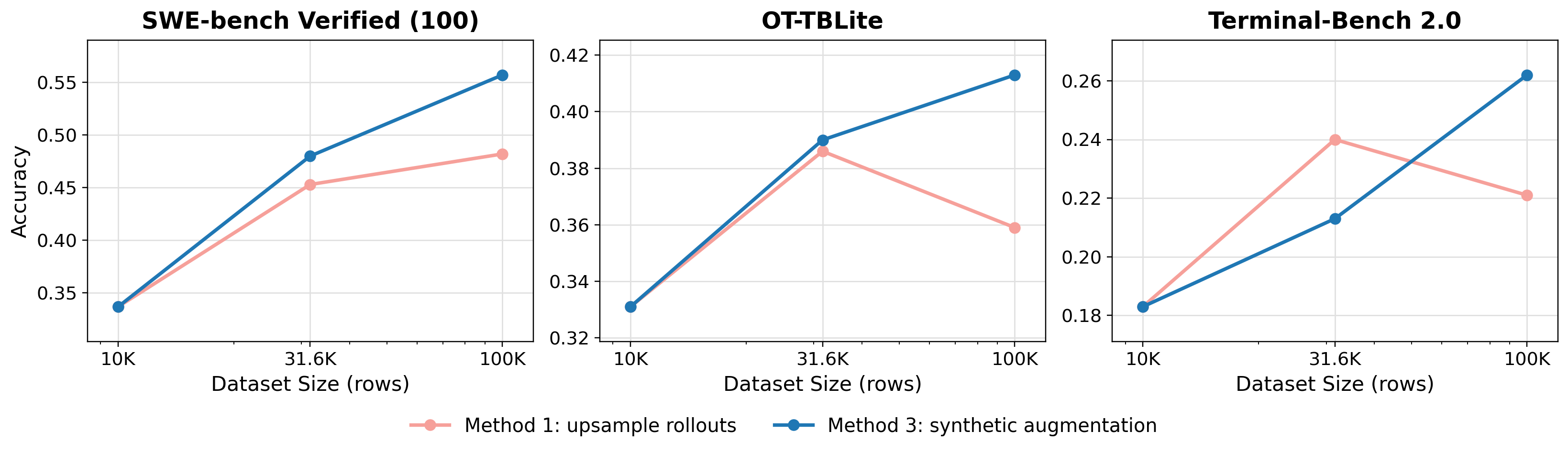
We start with Method 1 since it is the simplest. The results are in 3. We find that performance plateaus from 31.6K to 100K (+3pp on SWE-Bench Verified-100, \(-2\)pp on Terminal-Bench 2.0; both within standard error), suggesting that task-description diversity is the bottleneck. While Method 2 would be a simple fix, we are limited by our initial sources; for example, Tezos contains only 997 unique task descriptions.
We attempt sourcing from more tasks from Top-4, Top-8, and Top-16 datasets at the 100K scale (Method 4 results in 2). Adding more sources beyond Top-4 does not reliably help: Top-8 does not significantly outperform Top-4 on every benchmark, while broadening to Top-16 hurts on every benchmark. We therefore retain the original Top-4 source mix for the remainder of our experiments and do not pursue Method 4 further.
| Source Mix | SWE-Bench Verified-100 | OT-TBLite | Terminal-Bench 2.0 |
|---|---|---|---|
| Top-4 | 45.33 | 36.90 | 21.72 |
| Top-8 | 49.00 | 38.87 | 22.85 |
| Top-16 | 40.33 | 33.14 | 20.60 |
We turn to synthetic task augmentation (Method 3) and report the results in 3. Concretely, we take the four highest-scoring sources from 3.2 (swe-smith,
stackexchange-superuser, stackexchange-tezos, and issue-tasks) and replace the Tezos subset with a synthetically augmented version of itself. Tezos contributes the fewest unique task descriptions (only 997 unique tasks). We replace it with a synthetically
augmented version of itself: we apply the instruction-rewriting strategies from 3.3 to those same 997 base problems, expanding their distinct surface forms from \(\sim\)902 to
over 21K without introducing any new underlying problems. We then use the gpt-5-nano response-length signal from 3.4 as upsampling weights rather than as a hard top-\(k\) filter — every unique task receives at least one rollout, with the remaining capacity allocated proportionally to score. Our goal is to preserve full task coverage at every dataset scale. We then apply the \(\geq 5\)-turn trace filter uniformly across all four sources. We see continued performance gains at larger dataset scales, demonstrating that augmentation overcomes the limited task-description-diversity bottleneck observed in
Method 1.
4.0.0.1 OpenThoughts-Agent-v2
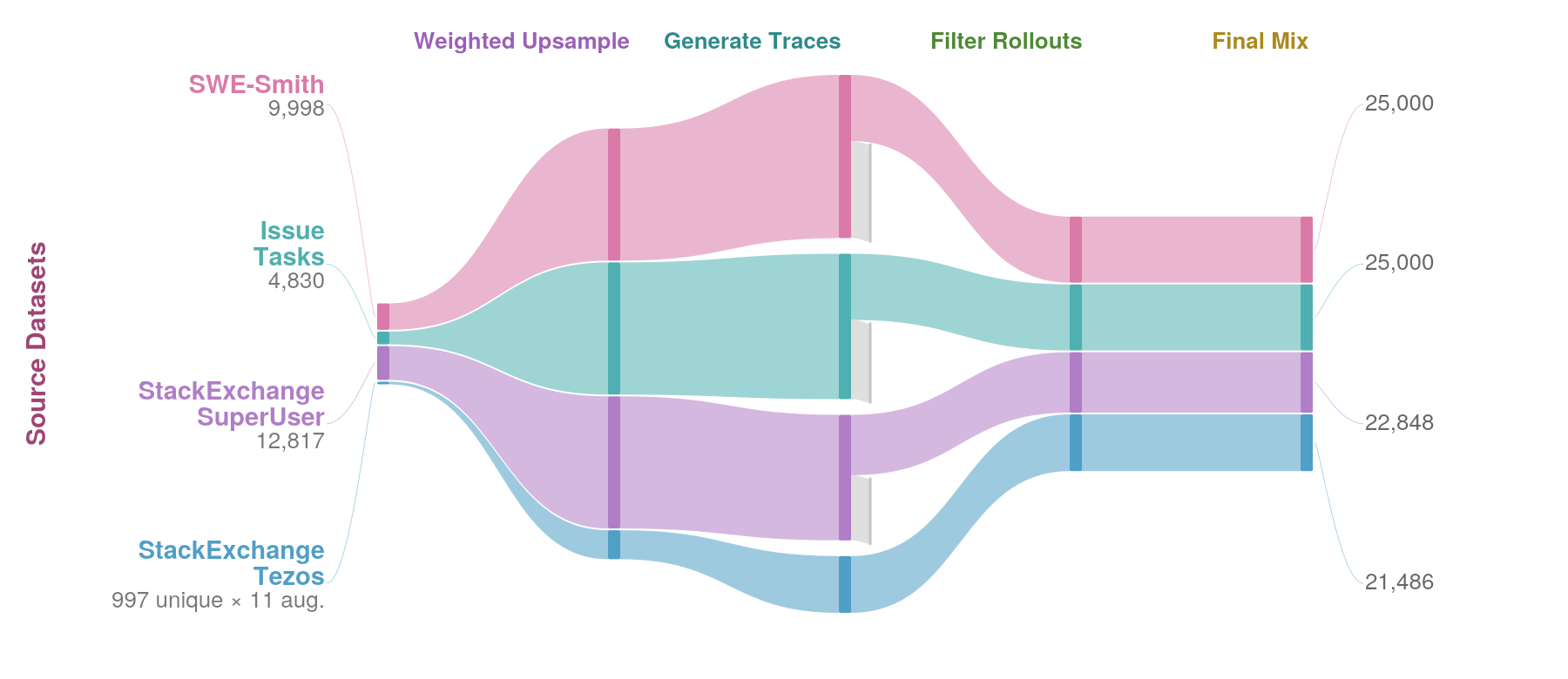
At the 100K scale, we observe the best performance for the 32B SFT model, reaching 26.2% on Terminal-Bench 2.0, 41.3% on OT-TBLite, and 55.7% on SWE-Bench Verified-100, showing a monotonic improvement from 31.6K of \(+7.7\)pp on SWE-Bench Verified-100 and \(+5.0\)pp on Terminal-Bench 2.0. We report the full data generation pipeline for our final 100k-sized dataset, OpenThoughts-Agent-v2 in 4. We begin from our initial 4 task sources, including synthetic GitHub Issues, human-written Linux tasks, and human-written cryptocurrency questions. We repeat task descriptions and synthetically augment the Tezos questions. We generate agentic rollouts using GLM-4.7-AWQ and filter out traces with fewer than 5 turns.
5 Reinforcement Learning↩︎
Many high-profile RL datasets, including SWE-Smith and R2EGym [2], [31], followed a similar approach: select a representative GitHub repository whose state and dependencies can be captured in a Docker container, select or synthesize a flawed commit with failing tests, and generate a natural-language problem statement describing the issue and requesting the agent turn the failing tests green. We incorporate these efforts into a larger-scale and more systematic series of ablation studies – similar to our work in the SFT domain, we investigate to what extent model performance depends on the source of the RL training data. To isolate this, we run a controlled data-source ablation, which we describe below.
5.1 Experimental Details↩︎
To control compute consumption, we focus our RL investigations in the 8B regime. We run async RL using the RLOO algorithm [32] with standard binary rewards on verifier success (expect PASS : PASS, expect FAIL : FAIL for all tests). We conduct RL starting from a distilled 8B checkpoint (OT-Agent-ColdSFT) trained on SWE-Smith traces generated by a GLM 4.7 AWQ teacher with thinking, which we also train. Our hero run trained on 24xA100 80GB GPUs with a batch size of 64 and a total wallclock time of \(\approx\)46 hours. For additional technical details and complete hyperparameters, please refer to 10.
5.2 Sourcing Tasks in RL↩︎
In our ablation, every run uses identical hyperparameters and evaluation criteria, the only thing we vary is the dataset the agent trains on. We compare six sources spanning competitive programming recast as Python contracts
(pymethods2test), real-repository bug-fixing (inferredbugs), competitive-programming environments (code-contests), an LLM-filtered Nemotron code-oracle mix (nemotron-code-oracle), an LLM-verified
freelancer-task set (llm-verifier-freelancer), and natural-language-to-Bash tasks (nl2bash), as well as SWE-Smith and R2EGym, with the same evaluation conditions described in 3. The training
logs indicate all sources are learnable to some degree – inferredbugs and nemotron-code-oracle runs show healthy, monotonically rising mean reward over training (roughly \(0.21\!\to\!0.46\) and
\(0.06\!\to\!0.36\) across their exported steps, respectively), whereas code-contests plateaus at a much lower reward ceiling (\(0.06\!\to\!0.14\))
The data source matters. [tab:rl_data_ablation] shows that source ablation spans a \(7.6\)-point range in raw average accuracy, larger than the \(2.0\)-point run-to-run reproducibility variance (see [tab:rl_reproducibility]), but smaller than the variance derived from SFT source ablation as described in 3.
Our strongest source, pymethods2test, is a mix of Codeforces / CodeChef / TopCoder style competitive-programming problems that have been re-cast as single-function Python contracts with synthesized docstring-style task descriptions and
auto-generated unittest suites. There is no multi-file editing, no repository navigation, no shell-state accumulation across turns. Skills exercised include 1D/2D dynamic programming, string and pattern matching (KMP), combinatorics, matrix/grid
construction, ad-hoc puzzles, and formatted table/string generation. Reference solutions average around 20 LOC and task description around 200 words. This dataset is highly reproducible (no potentially stale github references), highly usable (all tasks use
the same build environment) and has a clear, and in this case appropriately moderate, difficulty ceiling. The concise but challenging source tasks induce the cold-start model to adopt a consistent problem-solving pattern; during RL, it replaces loops of
thinking and exploratory (sed and grep) tool calls with a compact explore, patch, and submit policy. We further analyze the emergent behavioral changes behind the pymethods2test result – and why its RL signal pushes the policy to explore more
aggressively than the alternatives – in 12.
Among the alternatives, the synthetic-and-competitive-programming sources (inferredbugs, code-contests) lead on ID, while the more heterogeneous tool-use sources (llm-verifier-freelancer, nl2bash) are
competitive on OOD despite weaker ID scores. The moderate ID / OOD decoupling suggests that data sources emphasizing single-function code correctness transfer most cleanly to the SWE/terminal Core benchmarks, while broader tool-use data buys OOD
generalization at some ID cost; only pymethods2test sits at the top of both.
5.3 Results↩︎
In [tab:ot_agent_8B_table3], we show that the complete post-training pipeline (SFT + RL) outperforms the baslines on both core benchmarks, as well as on average across the entire benchmark suite, improving by 18 points, on average, above the Qwen3-8B base model.
“Undertrained” SFT models benefit more from RL, and ultimately outperform pure-distilled models and RL-only models. Consistent with prior work, we find in [tab:8b_pipeline_ablation] that RL provides the most gains when the SFT model is selected with RL in mind [33]. The Qwen3-8B model, which performs poorly in the terminus-2 harness on agentic benchmarks, is unable to benefit from agentic RL. The model SFT’d on a
smaller amount of data provides the better starting point.
6 Conclusion↩︎
Agents are increasingly central to science and technology, yet little is publicly known about the data curation techniques used to train them. We address this gap by conducting controlled ablations on a six-stage SFT data curation pipeline, alongside a
focused study of agentic RL data. Using the resulting dataset, OpenThoughts-Agent-v2, we finetune Qwen3-32B into OpenThinker-Agent-32B, the strongest open-data <=32B model (Qwen3 family or earlier) on the average of seven agentic benchmarks spanning
software engineering, terminal use, tool calling, healthcare, finance, and general assistant tasks. At the 8B scale, combining our SFT data with our pymethods2test RL dataset further outperforms the strongest existing <=8B baselines,
providing initial evidence that the SFT and RL stages of agentic post-training can be designed to compose. We release the data, pipeline, and models at https://openthoughts.ai to enable broader open
research on agentic models.
Limitations include our RL investigation which was conducted only at the 8B scale due to compute constraints; whether the same RL recipe transfers to the 32B regime remains an open question. We also do not ablate the choice of base model: all SFT runs begin from the Qwen3 family, so the contribution of base-model pretraining to the final performance is not isolated. Finally, our largest training set contains 100K trajectories; whether the trends we observe extrapolate to multi-million-trajectory regimes remains untested.
6.0.0.1 Broader Impacts
This work aims to advance open research on agentic models by releasing the dataset, pipeline, and trained models. Open release accelerates scientific progress and lowers the barrier to entry for academic and independent research. However, agentic models are inherently dual-use technologies: the same capabilities that enable beneficial automation can also enable misuse, including unauthorized actions on shared systems. We encourage downstream users to deploy these models with appropriate sandboxing and human oversight.
MN and JJ acknowledge funding by EU Horizon under grant no. 101214398 (ELLIOT) and co-funding by EU from Digital Europe Programme under grant no. 101195233 (openEuroLLM), co-funding from EU under Digital Europe Programme under grant no. 101198470 (LLMs4EU) and from EuroHPC Joint Undertaking programme under grant no. 101182737 (MINERVA), funding by the German Federal Ministry of Research, Technology and Space (BMFTR) under grant no. 01IS24085C (OPENHAFM), under the grant 01IS22094B (WestAI – AI Service Center West), and under the grant 16HPC117K (MINERVA).
BF gratefully acknolwedges resources of the Oak Ridge Leadership Computing Facility (OLCF) and Argonne Leadership Computing Facility (ALCF)] which are a DOE Office of Science User Facility. This work was supported by an award from the ASCR Leadership Computing Challenge (ALCC) under project ERCAP0034861, and the ongoing support of Oumi.AI.
LS gratefully acknowledges the Open Philanthropy Institute for Foundations of Machine Learning (IFML), Apple, and the Microsoft Grant in Customer Experience Innovation for their support on this project.
The entire team wishes to acknowledge the Gauss Centre for Supercomputing e.V. (GCS) for funding this work by providing computing time through the John von Neumann Institute for Computing (NIC) on the supercomputer JUWELS Booster and JUPITER at Jülich Supercomputing Centre (JSC), EuroHPC Joint Undertaking for computing time and storage on the EuroHPC supercomputer LEONARDO, hosted by CINECA (Bologna, Italy) and the LEONARDO consortium through an EuroHPC AI Factory Science and Innovation grant EHPC-AIF-2025SC04-290 and on EuroHPC supercomputer MareNostrum5 hosted by BSC (Barcelona, Spain) through EuroHPC development access grant EHPC-DEV-2026D01-097, storage resources on JUST granted and operated by JSC and supported by Helmholtz Data Federation (HDF), computing time granted by the JARA and JSC on the supercomputer JURECA at JSC, computing time granted on prototype JEDI via JUREAP (JUPITER Early Access Program) grant at JSC and computing time granted via Gauss AI Competition (reformo) on JUPITER through GCS and German Federal Ministry of Research, Technology and Space (BMFTR). LAION further acknowledges public storage grant by HuggingFace that allows us to provide convenient access to the output of the open-source research to broad community via HF repository. Further thanks go for support provided by supercomputing facilities and their teams, especially to Bjoern Hagemeier and Mathis Bode from Juelich Supercomputer Center (JSC, Germany). This project also benefited from the support of the TACC, NYU Torch, and ZIH Capella supercompute clusters, as well as Modal and Google, and Anyscale for hosting our group meetings.
Finally, we owe a deep debt of gratitude to Daytona.io for providing a robust and scalable container solution for our agentic post-training experiments, and to the Laude Institute for supporting our project with a Slingshots // TWO grant, and the Harbor Framework for allowing us to provide input in the development of the their sandboxing evaluation and optimization environment.
7 Full SFT Pipeline Ablation Tables↩︎
This appendix contains the full ablation tables for the SFT pipeline experiments summarized in 3. All experiments follow the setup described in 3: \(10{,}000\) trajectories per dataset, Qwen3-8B fine-tuned with full-parameter SFT, and three stochastic re-runs per benchmark with standard error reported as a subscript.
7.1 Task Generation Strategies (Full Ranking)↩︎
3 and 4 report the full ranking of all 95 task generation strategies summarized in [tab:task_gen_table]. Strategies are sorted by normalized average \(z\)-score across the three benchmarks.
| Benchmarks (%) | Average | |||||
|---|---|---|---|---|---|---|
| 3-5 (lr)6-7 Rank | Strategy | SWE-Bench Verified (100) | OT-TBLite | Terminal-Bench 2.0 | Raw | Normalized |
| 1 | swe-smith | 32.33 | 17.63 | 6.37 | 18.78 | +1.92 |
| 2 | stackexchange-superuser | 13.33 | 16.68 | 10.86 | 13.62 | +1.51 |
| 3 | stackexchange-tezos | 16.33 | 16.94 | 9.36 | 14.21 | +1.45 |
| 4 | issue-tasks | 24.00 | 16.44 | 6.74 | 15.73 | +1.37 |
| 5 | repo-scaffold | 11.00 | 20.68 | 8.24 | 13.31 | +1.31 |
| 6 | r2egym | 28.33 | 16.57 | 4.12 | 16.34 | +1.17 |
| 7 | stackexchange-tor | 15.33 | 16.11 | 8.61 | 13.35 | +1.16 |
| 8 | swegym | 27.00 | 17.09 | 4.12 | 16.07 | +1.14 |
| 9 | code-feedback | 11.00 | 17.39 | 8.61 | 12.33 | +1.04 |
| 10 | stackexchange-unix | 16.00 | 18.90 | 5.99 | 13.63 | +1.02 |
| 11 | taskmaster2 | 10.00 | 16.44 | 8.99 | 11.81 | +0.95 |
| 12 | staqc | 11.00 | 19.41 | 6.74 | 12.38 | +0.91 |
| 13 | multifile-composition | 9.67 | 20.61 | 5.99 | 12.09 | +0.82 |
| 14 | stack-pytest-withtests | 18.33 | 18.43 | 3.75 | 13.50 | +0.70 |
| 15 | ghactions | 8.00 | 17.58 | 7.12 | 10.90 | +0.61 |
| 16 | stack-selfdoc-gpt5mini | 11.00 | 17.79 | 5.99 | 11.59 | +0.61 |
| 17 | self-instruct-naive | 10.00 | 14.70 | 7.87 | 10.86 | +0.57 |
| 18 | stack-ruby | 9.67 | 16.04 | 7.12 | 10.94 | +0.55 |
| 19 | nemotron-junit | 7.33 | 15.90 | 7.87 | 10.37 | +0.54 |
| 20 | synatra | 7.00 | 14.11 | 8.99 | 10.03 | +0.54 |
| 21 | stack-selfdoc | 14.33 | 15.38 | 5.62 | 11.78 | +0.49 |
| 22 | manybugs | 18.33 | 12.37 | 5.99 | 12.23 | +0.48 |
| 23 | pr-mining | 11.00 | 16.58 | 5.99 | 11.19 | +0.48 |
| 24 | nebius-swe-agent | 19.33 | 12.85 | 5.24 | 12.47 | +0.45 |
| 25 | stack-pytest | 11.00 | 16.70 | 5.62 | 11.11 | +0.43 |
| 26 | stack-bash-withtests | 10.67 | 16.78 | 5.62 | 11.02 | +0.42 |
| 27 | go-browse-wa | 12.00 | 15.97 | 5.62 | 11.20 | +0.41 |
| 28 | exercism-python | 7.33 | 12.52 | 8.99 | 9.61 | +0.39 |
| 29 | softwareheritage | 9.00 | 16.82 | 5.99 | 10.60 | +0.39 |
| 30 | stack-cpp | 11.00 | 17.04 | 5.24 | 11.09 | +0.39 |
| 31 | stack-junit | 8.67 | 14.91 | 7.12 | 10.23 | +0.38 |
| 32 | github-dockerfiles | 9.33 | 12.41 | 8.24 | 9.99 | +0.36 |
| 33 | stack-rust | 9.33 | 19.68 | 4.12 | 11.04 | +0.36 |
| 34 | freelancer | 8.67 | 17.07 | 5.62 | 10.45 | +0.33 |
| 35 | swegym-openhands | 20.00 | 13.16 | 4.12 | 12.43 | +0.32 |
| 36 | nl2bash | 2.00 | 12.88 | 7.12 | 10.00 | +0.31 |
| 37 | stack-pytest-gpt5mini | 8.00 | 16.37 | 5.99 | 10.12 | +0.28 |
| 38 | stack-dockerfile | 8.00 | 17.56 | 5.24 | 10.27 | +0.27 |
| 39 | stackexchange-overflow | 9.67 | 15.89 | 5.62 | 10.39 | +0.27 |
| 40 | bugsinpy | 12.33 | 15.44 | 4.87 | 10.88 | +0.24 |
| 41 | stack-rspec | 8.00 | 17.72 | 4.87 | 10.20 | +0.22 |
| 42 | stackexchange-codereview | 11.00 | 14.50 | 5.62 | 10.37 | +0.20 |
| 43 | glaive-code-assistant | 10.33 | 16.81 | 4.49 | 10.54 | +0.19 |
| 44 | stack-pytest-synthetic-gpt5nano | 10.67 | 16.53 | 4.49 | 10.56 | +0.19 |
| 45 | mind2web | 8.67 | 15.32 | 5.62 | 9.87 | +0.15 |
| 46 | stack-jest | 9.33 | 14.99 | 5.62 | 9.98 | +0.15 |
| 47 | stack-bash | 11.33 | 12.39 | 6.37 | 10.03 | +0.14 |
| 48 | bash-textbook | 6.67 | 16.72 | 5.24 | 9.54 | +0.11 |
| 49 | stack-phpunit | 7.67 | 16.76 | 4.87 | 9.77 | +0.10 |
| 50 | stack-csharp | 8.67 | 16.12 | 4.87 | 9.89 | +0.09 |
| 51 | nemotron-bash-withtests-gpt5mini | 9.33 | 14.52 | 5.24 | 9.70 | +0.04 |
| 52 | nemotron-rspec | 9.00 | 15.35 | 4.87 | 9.74 | +0.03 |
| 53 | nnetnav-live | 11.33 | 13.35 | 5.24 | 9.97 | +0.03 |
| 54 | bugswarm | 13.67 | 11.24 | 5.62 | 10.18 | +0.02 |
| 55 | crosscodeeval-csharp | 5.67 | 13.75 | 6.74 | 8.72 | +0.01 |
| 56 | crosscodeeval-python | 8.00 | 14.30 | 5.62 | 9.31 | 0.00 |
| 57 | curriculum-hard | 10.33 | 15.83 | 3.75 | 9.97 | -0.04 |
| 58 | nemotron-bash-withtests | 5.67 | 15.22 | 5.62 | 8.84 | -0.04 |
| 59 | wizardlm-orca | 7.00 | 15.73 | 4.87 | 9.20 | -0.04 |
| 60 | curriculum-easy | 10.33 | 14.22 | 4.49 | 9.68 | -0.07 |
4pt
| Benchmarks (%) | Average | |||||
|---|---|---|---|---|---|---|
| 3-5 (lr)6-7 Rank | Strategy | SWE-Bench Verified (100) | OT-TBLite | Terminal-Bench 2.0 | Raw | Normalized |
| 61 | nemotron-csharp | 9.30 | 12.70 | 5.62 | 9.21 | -0.08 |
| 62 | curriculum-medium | 8.67 | 13.50 | 5.24 | 9.14 | -0.11 |
| 63 | nemotron-bash | 7.33 | 11.43 | 6.74 | 8.50 | -0.13 |
| 64 | stack-bash-withtests-gpt5mini | 7.00 | 14.97 | 4.49 | 8.82 | -0.19 |
| 65 | crosscodeeval-typescript | 6.67 | 14.90 | 4.49 | 8.69 | -0.22 |
| 66 | defects4j | 9.67 | 11.85 | 4.87 | 8.80 | -0.29 |
| 67 | nemotron-cpp | 5.67 | 14.73 | 4.49 | 8.30 | -0.30 |
| 68 | agenttuning-alfworld | 4.00 | 12.45 | 5.62 | 7.36 | -0.42 |
| 69 | qasper | 8.00 | 11.51 | 4.87 | 8.13 | -0.42 |
| 70 | codeactinstruct | 4.67 | 11.21 | 5.62 | 7.17 | -0.51 |
| 71 | inferredbugs | 14.00 | 9.83 | 3.37 | 9.07 | -0.51 |
| 72 | crosscodeeval-java | 6.33 | 12.81 | 4.12 | 7.75 | -0.52 |
| 73 | nemotron-rust | 4.70 | 11.86 | 5.00 | 7.19 | -0.56 |
| 74 | taco | 6.00 | 11.06 | 4.87 | 7.31 | -0.58 |
| 75 | magicoder | 6.00 | 13.11 | 3.37 | 7.49 | -0.65 |
| 76 | toolscale | 4.40 | 15.26 | 2.62 | 7.43 | -0.65 |
| 77 | orca-agentinstruct | 5.00 | 13.18 | 3.37 | 7.18 | -0.70 |
| 78 | stack-go | 7.33 | 12.42 | 3.00 | 7.58 | -0.71 |
| 79 | codenet-python | 4.67 | 10.22 | 4.87 | 6.59 | -0.75 |
| 80 | nemotron-pytest | 5.33 | 8.39 | 4.87 | 6.20 | -0.90 |
| 81 | codeforces | 3.67 | 8.61 | 5.24 | 5.84 | -0.91 |
| 82 | e2egit | 2.00 | 10.75 | 4.49 | 5.75 | -0.92 |
| 83 | nemo-prism-math | 2.67 | 11.73 | 3.75 | 6.05 | -0.92 |
| 84 | codeelo | 3.33 | 10.86 | 3.75 | 5.98 | -0.97 |
| 85 | pymethods2test | 6.33 | 9.68 | 3.00 | 6.34 | -1.05 |
| 86 | quixbugs | 5.67 | 12.94 | 1.30 | 6.64 | -1.06 |
| 87 | unitsyn-python | 3.30 | 10.68 | 3.37 | 5.78 | -1.06 |
| 88 | agenttuning-kg | 4.00 | 7.08 | 4.49 | 5.19 | -1.18 |
| 89 | all-puzzles | 2.33 | 8.45 | 3.75 | 4.84 | -1.27 |
| 90 | code-contests | 2.33 | 11.09 | 2.25 | 5.22 | -1.27 |
| 91 | agenttuning-webshop | 1.67 | 9.14 | 3.37 | 4.73 | -1.31 |
| 92 | tulu3-sft-personas-math | 3.00 | 9.30 | 2.62 | 4.97 | -1.35 |
| 93 | agenttuning-db | 3.67 | 7.53 | 1.50 | 4.23 | -1.70 |
| 94 | agenttuning-mind2web | 0.33 | 4.65 | 1.12 | 2.03 | -2.26 |
| 95 | agenttuning-os | 0.00 | 5.64 | 0.37 | 2.00 | -2.31 |
4pt
7.2 Mixing Strategies (Full Results)↩︎
5 reports both presentation methods (random shuffle within task and sequential round-robin) for all values of \(N\). The random-shuffle Top-4 result is reproduced in 1 of the main text.
| Benchmarks | Average | ||||||
|---|---|---|---|---|---|---|---|
| 3-5 (lr)6-7 Rank | Mixing Strategy | SWE-Bench Verified (100) | OT-TBLite | Terminal-Bench 2.0 | Raw | Normalized | |
| Random shuffle within task | |||||||
| 1 | Top 4 | 29.33 | 17.00 | 8.24 | 18.19 | +0.49 | |
| 2 | Top 2 | 29.00 | 18.12 | 7.12 | 18.08 | +0.48 | |
| 3 | Top 8 | 28.00 | 15.86 | 8.61 | 17.49 | +0.19 | |
| 4 | Top 16 | 26.67 | 19.19 | 4.12 | 16.66 | -0.10 | |
| 5 | Top 32 | 20.33 | 18.67 | 5.99 | 15.00 | -0.48 | |
| 6 | Top 1 | 30.67 | 14.80 | 4.49 | 16.65 | -0.57 | |
| Sequential round-robin | |||||||
| 1 | Top 8 | 32.67 | 16.28 | 8.99 | 19.31 | +0.46 | |
| 2 | Top 4 | 28.00 | 17.86 | 8.61 | 18.16 | +0.28 | |
| 3 | Top 2 | 28.67 | 18.05 | 7.49 | 18.07 | +0.11 | |
| 4 | Top 32 | 23.00 | 20.21 | 6.37 | 16.53 | -0.23 | |
| 5 | Top 16 | 27.33 | 17.68 | 5.62 | 16.88 | -0.62 | |
7.3 Filtering for Longer Episodes: A Compute-Controlled Ablation↩︎
3 shows that keeping execution traces with more model turns improves the resulting training set. Since longer (\(\geq 5\)-turn) traces also pack more tokens into each example, the gain could in principle come from one of two sources: the higher-quality multi-turn supervision we intend to select for, or simply a larger training-compute budget. At a fixed row count, the min-turns filter sees roughly 45% more tokens than an unfiltered subset, so the two explanations are confounded unless we equalize the token budget. We do so directly. We build two training sets that consume the same \(\sim\)145M tokens: the first keeps the longest (\(\geq 5\)-turn) episodes (\(9{,}859\) rows), and the second draws a random subsample of the pool (\(14{,}470\) rows). Everything else about the two runs is identical. [tab:compute_controlled_filtering] reports the result.
With the token budget held fixed, the min-turns filter still beats the random control by \(+3.5\)pp on average, with \(+5.4\)pp on SWE-Bench Verified-100 and \(+3.8\)pp on Terminal-Bench 2.0 while OT-TBLite moves within the per-benchmark noise. The effect therefore cannot be attributed to extra training compute and longer episodes lead to higher accuracy in multi-turn agentic tasks.
8 Scaling at 8B↩︎
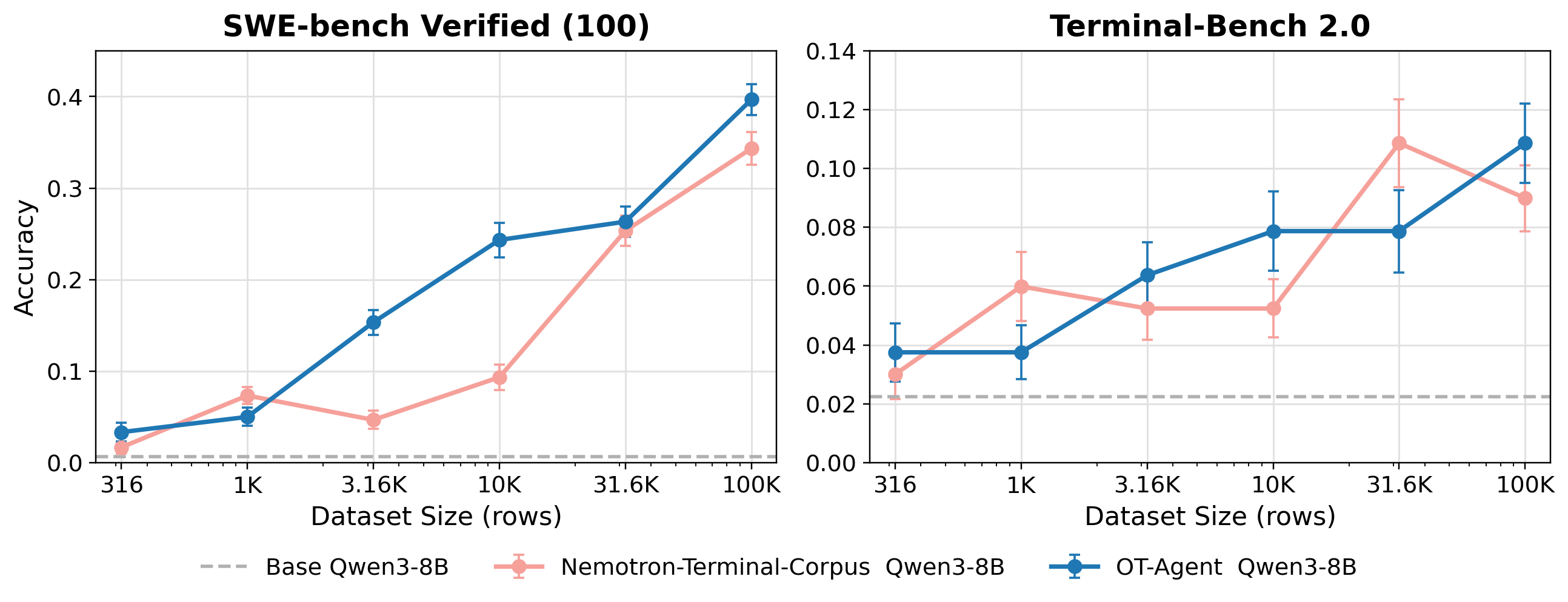
Our pipeline ablations (3) use Qwen3-8B as the base model. Here we verify that the final OpenThoughts-Agent data recipe also scales at the 8B model size, mirroring the 32B trends in 1. 5 reports SWE-bench Verified-100 and Terminal-Bench 2.0 accuracy as we scale the OpenThoughts-Agent-v2 dataset from 316 to 100K rows, alongside the Nemotron-Terminal-Corpus baseline and the base Qwen3-8B model.
OpenThoughts-Agent leads the Nemotron-Terminal-Corpus baseline at most matched dataset sizes on both benchmarks. For example, at 10K rows it reaches 24.3% versus 9.3% on SWE-bench Verified-100. As with the 32B model, performance continues to improve at the largest scale rather than plateauing: at 100K rows the 8B reaches 39.7% on SWE-bench Verified-100 and 10.9% on Terminal-Bench 2.0 (up from 26.3% and 7.9% at 31.6K), surpassing the Nemotron-Terminal-Corpus baseline on both benchmarks (34.3% and 9.0%, respectively). This mirrors the effect of synthetic task augmentation at 32B (4), where expanding task-description diversity overcomes the upsampling bottleneck.
9 SFT Hyperparameters↩︎
10 RL Hyperparameters and Infrastructure↩︎
10.1 Hardware↩︎
| Site / scheduler | NERSC Perlmutter |
| Nodes | 6 (2 shared policy / reference, 4 inference) |
| Accelerators | 4 \(\times\) NVIDIA A100-SXM4-80GB per node (24 GPUs total) |
| Interconnect / runtime | Cray Shasta, Ray cluster, CUDA 12.8, PyTorch bf16 |
10.2 Algorithm and optimizer↩︎
| RL algorithm | RLOO with per-prompt std normalization (grpo_norm_by_std=true) |
| Loss reduction | token-mean |
| PPO clip range | \([\epsilon_{\text{lo}}, \epsilon_{\text{hi}}] = [0.2, 0.2]\), \(c=3\) |
| KL control | No |
| Entropy regularization | No |
| Advantage normalization | per-batch |
| Optimizer (policy) | AdamW, \(\beta=(0.9,\,0.999)\), weight decay \(0\) |
| Optimizer (critic) | AdamW, \(\beta=(0.9,\,0.999)\), weight decay \(0.01\) |
| Learning rate | \(5 \times 10^{-6}\) |
| Schedule | constant (no warmup) |
| Gradient clipping | global norm \(\le 1.0\) |
| Precision | bf16 autocast, fp32 grad accumulation |
10.3 Training schedule↩︎
| Global steps | 48 |
| Epochs | 2 |
| Train batch (prompts) | 64 |
| Samples per prompt | 8 (so 512 trajectories per gradient update) |
| Policy mini-batch | 64 prompts |
| Update epochs per batch | 1 |
| Micro-batch (per GPU) | 1 (train), 4 (forward) |
| Sample packing | enabled |
| Gradient checkpointing | enabled (non-reentrant) |
| HF Hub save interval | every 5 steps |
10.4 Distributed strategy↩︎
| Strategy | FSDP2, fsdp_size=4 (intra-node), CPU param offload |
| Reference / policy colocation | yes (shared 2-node pool, swapped on/off device) |
| Async generation | enabled, max staleness 16 steps, 768 parallel workers |
| Sequence parallel | 1 (Ulysses backend available, unused) |
10.5 Generation (vLLM)↩︎
| Engine | vLLM async, 16 inference engines, eager mode |
| Sampling | temperature 0.7, top-\(p\) 0.95, top-\(k\) 20 |
| Max generation length | 4,096 tokens |
| Max model context | 32,768 tokens |
| Prefix caching / chunked prefill | enabled |
| KV cache target utilization | 0.9 of GPU memory |
| Eval sampling | greedy (\(T=0\), top-\(k=-1\)), \(n=8\) trajectories per prompt |
10.6 Rollout environment (Harbor / terminus-2)↩︎
| Harbor agent | terminus-2 with interleaved thinking enabled |
| Per-trial sandbox | 1 vCPU, 2,048 MB RAM, 2,048 MB storage |
| Per-trial timeout | 1,800 s agent / 120 s verifier |
| Concurrent trials | 280 |
| Number of turns cap per task | unbounded (effectively gated by timeout) |
| Retry policy | 3 retries, exponential backoff (60–600 s) |
| Failure-mode handling | masked transient infra errors |
| (Sandbox infra, network) | |
zero reward on TimeoutError, parse errors, OOM |
10.7 Headline metrics at step 48↩︎
reward/avg_pass_at_8 |
0.281 |
reward/avg_raw_reward |
0.107 |
policy/policy_entropy |
0.072 |
policy/raw_grad_norm |
0.018 |
| Runtime | \(1.66\times 10^{5}\) s (\(\approx\)46 h) |
10.8 Reproducibility Artifacts↩︎
Pinned source commits (as of run start, 2026-02-27):
| Repo | Branch | Commit |
|---|---|---|
| open-thoughts/OpenThoughts-Agent | main | 4e2b8422 |
| penfever/SkyRL (fork) | penfever/working |
ada3bd4f |
| laude-institute/harbor | penfever/temp-override |
94f358bc |
Full wandb run at dogml, available on request. Public HF checkpoint available as laion/rl_swesmith-fixthink-pymethods2test-45. We selected a fork of Llama-Factory from
[23], extending it to support ALST long-sequence training [24]. Our reinforcement learning framework was an extended version of the popular SkyRL framework from [34]; most of the improvements are described in [35]. We used [16] for environment, benchmark and harness management.
11 RL Run-to-Run Reproducibility↩︎
A natural concern for any RL result is how much of the reported improvement is signal versus run-to-run noise in the training pipeline. To probe this, we evaluate three near-replicate RL runs of the pymethods2test experiment. All three
start from the same GLM-4.7-distilled SWE-Smith 8B checkpoint and use the same RLOO recipe, environment, and 24\(\times\)A100 setup described in 5 and 10; they differ only in minor training choices (the exported step and, for one run, the learning rate). Because the three runs share a configuration up to these small perturbations, the spread of their downstream eval
scores is a direct, if conservative, estimate of the reproducibility of the RL pipeline. The headline checkpoint (pymethods2test-45) was additionally evaluated twice on every benchmark, which lets us separate eval noise (re-running
the same checkpoint) from training-run noise (re-running the pipeline). [tab:rl_reproducibility] summarizes the comparison; per-cell
variance combines within-eval binomial sampling with between-eval variance using the mixed estimator defined in the caption.
Replicate RL runs differ by only \(\approx\)1.6 points on ID and \(\approx\)2.0 points on OOD. The in-distribution (Core) set means lie within \(20.2\)–\(21.8\%\) (range \(1.6\) pp, cross-run standard deviation \(0.8\) pp) and the out-of-distribution means within \(26.5\)–\(28.5\%\) (range \(2.0\) pp, cross-run standard deviation \(1.0\) pp), including the learning-rate variant. This
run-level spread is comparable to, and slightly larger than, the per-cell eval noise: the two repeated evaluations of pymethods2test-45 differ by \(0.3\)–\(3.7\) points on most
benchmarks, with the small-\(N\) FinanceAgent-Terminal (50 tasks) the main outlier at \(\approx\)11 points, consistent with its large binomial sampling error. At the benchmark level, larger
denominators are correspondingly more stable: SWE-Bench-Verified (500 tasks) varies by only \(1.5\) points across runs while the 50–127-task OOD benchmarks vary by \(2.7\)–\(5.3\) points, indicating that most of the per-benchmark variability is eval sampling noise rather than genuine training-run differences. The two single-eval runs (10-step and lr5e-6) are reported with binomial-only error bars,
since a single eval cannot estimate run-level variance; their means nonetheless fall inside the band set by the twice-evaluated headline run.
Takeaway. The pipeline is reproducible at the \(\sim\)2-point level: the gains reported in [tab:ot_agent_8B_table3] – the \(\approx\)5-point RL-specific gain on the Core benchmarks over the SFT-only checkpoint (e.g.\(+5.4\) on SWE-Bench-Verified), as well as the \(\approx\)18-point gain of the full SFT+RL pipeline over the Qwen3-8B base – are substantially larger than the \(\approx\)1.6/2.0-point ID/OOD run-to-run spread measured here, so they are unlikely to be artifacts of training-run noise. Reporting set-level means with the mixed-variance error above, rather than single best-of-many eval numbers, is the appropriate way to compare RL checkpoints at this scale.
12 What RL Learns: Emergent Behavior Behind the pymethods2test Result↩︎
[tab:rl_data_ablation] establishes that pymethods2test is the strongest RL data source, but not why. Here, we offer
a detailed mechanistic account of the behavioral changes that emerge after RL. We compare the headline pymethods2test run to the llm-verifier-freelancer run, the strongest OOD alternative in [tab:rl_data_ablation]). Our analysis combines three views: (i) time-binned behavioral statistics over the RL traces themselves (\(\sim\)11k hero
rollouts, \(\sim\)53k baseline rollouts); (ii) per-trace behavioral deltas between the pre-RL base checkpoint and the post-RL checkpoint, measured on held-out eval traces; and (iii) a pairwise LLM judge
(gpt-5-2025-08-07) that reads \(30\) same-task pre/post trace pairs per run and reports a winner, confidence, and behavioral tags.
12.1 Legitimate exploration, not reward hacking↩︎
The largest and most consistent shifts are all increases in exploratory activity. Reasoning expands sharply – think tokens per trace more than double (\(30.3\!\to\!65.4\), \(+116\%\)) and think blocks roughly double (\(0.21\!\to\!0.44\)) – alongside more self-correction (\(0.63\!\to\!1.14\) phrases per trace, \(+81\%\)), more tool calls (\(31.3\!\to\!40.9\), \(+31\%\)), more assistant messages (\(20.0\!\to\!26.3\)), and longer
conversations (\(+12.9\) turns, \(+29\%\) tokens). The post-RL policy is thus more exploratory than even the already-verbose distilled base. Over \(30\) same-task pre/post trace pairs, the judge prefers the post-RL hero policy on \(25/30\) (\(83.3\%\), \(0\) ties, \(24/30\) high-confidence). The most frequent behavioral tags are more-tool-calls (\(73\%\) of pairs), longer-trace (\(53\%\)),
more-tool-errors (\(50\%\)), and different-solution-strategy (\(47\%\)) – the judge independently sees the same expansion the metrics show. The change is
not uniformly “more verbose,” however: \(8/30\) pairs (\(27\%\)) are tagged fewer-tool-calls/shorter-trace, i.e.on a sizable minority of tasks RL taught
the policy to condense.
Three observations argue that this is genuine capability change rather than a reward-hacking or formatting artifact. First, the post-RL policy emits more tool calls and more broken tool calls in absolute terms (\(5.9\!\to\!8.8\) tool errors per trace, \(+48\%\)), which is the opposite of what a policy gaming a brittle parser would do. Second, the per-call tool error rate rises only \(+4.1\) pp (\(31.6\%\!\to\!35.8\%\)): the extra absolute errors are mostly explained by issuing more calls, not by tool-use competence degrading. Third, the share of
mark_task_complete calls actually rises (\(1.9\%\!\to\!3.0\%\)), inconsistent with a policy that learned to end early to harvest a formatting reward. The behavioral expansion converts to held-out
gains: on the \(100\) shared SWE-Bench-Verified tasks, RL flips \(18\) tasks from fail to pass against a single regression (sympy__sympy-15017).
12.1.0.1 Why this data source pushed the policy to explore.
The RL-time reward trajectory (6, blue) is the key context: pymethods2test presents a medium, non-saturated reward (it hovers around \(0.47\)–\(0.51\), far from the ceiling) that is hard to improve. Under RLOO this is exactly the regime that rewards trying harder – thinking more, calling more tools, attempting more fixes – because incremental returns come from
working a problem more thoroughly rather than from a quick exploit. Across the run, mean conversation length and think budget grow while the reward plateaus, until the policy over-extends. We read the collapse as the downside of the same exploration
pressure that produced the gains, not as a separate failure: the reproducibility study in 11 (which exports at step \(45\), and a \(10\)-step and an
lr5e-6 variant) is the corresponding evidence that the pre-collapse regime is stable to re-run.
12.2 The contrast: the LLM-verifier run compacts instead of explores↩︎
Running the identical pipeline on llm-verifier-freelancer produces the mirror image ([tab:rl_behavior_hero_vs_baseline]). Its RL-time reward rises near-monotonically from \(\approx 0.54\) to \(\approx 0.73\) with
no collapse (7), and along the way the policy compacts: mean turns fall (\(-7.8\)), tool calls fall (\(-8\%\)), think tokens fall (\(-42\%\)), and self-correction phrases fall sharply (\(19.7\!\to\!8.0\) per trace, \(-59\%\)), while tokens per conversation stay essentially flat (\(+1\%\)). Every behavioral axis on which the hero run moved up, the baseline run moved down. The LLM judge sees the same thing from the other direction: it prefers the post-RL baseline policy on \(22/30\) pairs (\(73.3\%\)), but now the dominant tags are fewer-tool-calls (\(53\%\)), shorter-trace (\(40\%\)), and different-tool-strategy (\(40\%\)). Its top judgments describe a pre-RL policy trapped in loops of malformed tool arguments that RL taught to stop dithering and ship;
on financeagent-14 (post-RL wins, high confidence) “the baseline meandered with many turns (113) and tool calls (55) \(\dots\) The post-RL trace kept things short (12 turns, 6 tool calls) \(\dots\) avoided EDGAR API usage and did not self-correct, proceeding more directly toward the target metric.”
12.3 Connecting behavior to downstream evals↩︎
The behavioral changes persist into held-out evaluation and track the downstream ranking in [tab:rl_data_ablation]. On the \(300\)-row SWE-Bench-Verified eval, the pre-collapse hero checkpoint roughly doubles the base policy’s all-trial reward – the Harbor Mean accuracy that counts errored/timed-out trials as \(0\), the same metric reported in [tab:ot_agent_8B_table3,tab:rl_data_ablation] (post-RL \(0.33\) vs.pre-RL \(0.19\); 6, markers) – and flips \(18\) tasks fail\(\to\)pass. This all-trial accuracy rises even though the mean reward over completed trials
dips (\(0.652\!\to\!0.541\), [tab:rl_behavior_hero_vs_baseline]): RL converts many trials the
base used to abandon to timeouts into completed attempts, and because those rescued trials are the harder ones, the conditional average falls while the all-trial accuracy climbs The baseline’s compaction also helps its own evals (post-RL \(0.224\) vs.pre-RL \(0.173\) on the \(156\)-row FinanceAgent eval), which is why llm-verifier-freelancer is competitive on OOD in [tab:rl_data_ablation]; but compaction transfers less well to ID Core benchmarks that reward thoroughness.

![Figure 7: Baseline (llm-verifier-freelancer) RL-time reward rises near-monotonically. Mean reward per rollout in 4-hour bins (blue line, clustered at right of the wall-clock axis because the pre-RL base eval – gray square – predates training by months) rises smoothly from \approx 0.54 to \approx 0.73 with no collapse, the mirror image of 6. The corresponding policy compacts (fewer turns, tool calls, and think tokens; see [tab:rl_behavior_hero_vs_baseline]) rather than expands.](/article/2606.24855/figures/rl_baseline_reward_monotone.png "fig:")

13 Eval Setup↩︎
13.0.0.1 Evaluation Stack Overview
For evaluation, we serve models using vLLM [36], orchestrate agent trials through Harbor [16], and isolate each trial in a Daytona [29] sandbox. We evaluate on the following benchmarks:
Terminal Bench 2.0 (89 tasks) [7]: Hand-crafted, human-verified tasks that spans SWE, biology, security, system administration, and machine learning.
SWE-Bench-Verified-100 (100 tasks) [6]: a stratified subsample (by repository) of the 500-task human-validated SWE-Bench Verified split where agent produces a patch against a Python repo at a fixed commit.
SWE-Bench-Verified (500 tasks) [6]: full SWE-Bench Verified split, same format as above.
OpenThoughts-TBLite (100 tasks) [28]: a curated collection of 100 Terminal-Bench style tasks that balanced across four difficulty buckets and engineered as a fast proxy for the full Terminal-Bench 2.0 performance;
Aider Polyglot (225 tasks) [9]: A multi-language code-editing benchmark (C++, Go, Java, JavaScript, Python, Rust) sourced from Exercism and filtered to the harder problems.
BFCL-Parity (123 tasks) [10]: Berkeley Function Calling Leaderboard (BFCL) is a comprehensive benchmark for evaluating large language models’ ability to call functions/tools correctly based on natural language instructions. This is a stratified random subsample of BFCL v4.
MedAgentBench (300 tasks) [30]: A clinical-agent benchmark over a vendored FHIR server populated with \(\sim\)700k records.
GAIA-127 (127 tasks) [11]: A text-only subset of the GAIA validation split for general-AI-assistant multi-step factoid QA with web browsing, file handling, and tool use. For this benchmark, we evaluated in a default setting without setting a search API.
FinanceAgent-Terminal (50 tasks) [12]: A terminal-agent variant of Vals AI’s Finance Agent Benchmark over SEC 10-K/10-Q filings, with shell access to EDGAR/web/RAG tools. For this benchmark, we evaluated while providing SERP and EDGAR APIs available to the models.
All datasets are prepared in Harbor format, and for OOD benchmarks we generated the dataset using Harbor adapter [16].
13.0.0.2 Evaluation Setup
For every (model, benchmark, harness) combination, we performed 3 repeated runs and report average pass@1 accuracy and standard error across runs. All evaluations with our trained model run with a 32K context window, a 16K output cap, and a proactive
summarization threshold of 2048 tokens. Each fire defaults to 32 concurrent trials, with Daytona snapshot registered and reused whenever available to avoid environment rebuilding during repeated evaluations. This mitigate the occurrence of transient
environment build errors and speed up evaluations overall. For every baseline model we report, we run the above procedure twice: once under terminus-2 (parity with the setup of our trained model) and once under the preferred scaffold and
serving configuration indicated from the original report.
13.0.0.3 Timeout-aware Evaluation
Agentic trials are token-bound: a trial that takes ten minutes for an 8B model decoding at \(\sim\)150 tokens/s may take an hour for a 32B model decoding at \(\sim\)30 tokens/s, with the
same number of agent turns. Holding per-trial timeouts constant across model sizes therefore confounds accuracy — slower models time out on tasks faster ones complete. To compensate this, we applied a timeout multiplier \(m\) (through the --timeout-multiplier flag in harbor configuration). We use \(m = 2\) for 8B fires and \(m = 16\) for 32B fires. To avoid overly
time-consuming evaluations, after applying the multipliers we employed a 2-hour cap on agent execution regardless of \(m\): \[\text{effective\_timeout} \;=\; \min\!\big(\text{cap},\; \text{base}
\times m\big).\] For larger models where we cannot get comparable throughput, we used third-party API to ensure fair comparison.
13.0.0.4 Coderforge-Preview
We do not include in the main results table open-data releases that did not release a model; the most prominent example of this is CoderForge-Preview [37].
13.0.0.5 Reproducing OpenSWE
OpenSWE [5] reports \(62.4\%\) on SWE-Bench-Verified (full \(500\)-task split) training from a Qwen-2.5-32B base. We attempted to reproduce this score using the publicly released GAIR/OpenSWE-32B checkpoint. To match their setup, we ran with the same temperature=0.7, \(128\text{K}\)-token context window, 300 step budget, and together with a SWE-Agent harness configuration the authors shared with us in correspondence. The OpenSWE repository mainly provides detail for data pipelines, but
scaffold or evaluation-harness components were not publicly released at the time of writing, so we cannot guarantee an exact match in every internal detail. On our SWE-Bench-Verified-100 subset we measure \(44.0\%\); we do
not yet have a directly comparable number on the full \(500\)-task split, so the gap to the reported \(62.4\%\) is partly across different denominators in addition to whatever methodological
differences remain. We have not been able to fully attribute the residual gap and continue to investigate. In the meantime, we flag OpenSWE in Table [tab:appendix_eval_table] and exclude it from main Table [tab:ot_agent_main_table1], while still citing
the reported number with an underline marker.
13.0.0.6 Evaluation on Terminal-Bench 2.1.
Concurrent with our experiments, Terminal-Bench 2.1 was released, which revises 31% of Terminal-Bench 2.0 tasks (28/89 tasks) to correct for three defect classes: specification–verification mismatches, resource mismatches, and benchmark drift [38]. Because Terminal-Bench 2.0 is one of our two core benchmarks, we re-evaluated a representative baseline (Qwen 3.5-27B) on Terminal-Bench 2.1 to verify that our conclusions hold after a new release. The table 6 reports the accuracy in TB2.0 and TB2.1. The observed change ( 3.0 pp) is far smaller than the up-to-12.0 pp shifts the audit reports for frontier agents [38]. We therefore continue to report TB2.0 results throughout, as re-evaluating every model on TB2.1 would be cost-prohibitive.
| Benchmark | Accuracy \(\pm\) se (%) |
|---|---|
| Terminal-Bench 2.0 | \(40.1 \pm 1.6\) |
| Terminal-Bench 2.1 | \(43.1 \pm 1.4\) |