: Structured Reasoning with Spatio-Temporal Anchors for Cinematographic Video Captioning
June 23, 2026
Abstract
Cinematographic captioning aims to describe how a video is filmed using professional film-language concepts such as camera movement, shot size, depth of field, composition, and shooting angle. This capability is important for fine-grained video understanding and controllable movie-quality video generation, yet remains underexplored in existing multimodal large language models. Unlike question-answering-based evaluation of cinematic understanding, cinematographic captioning requires a unified open-form description over multiple cinematographic dimensions. This task is challenging for two main reasons: the model must infer professional cinematographic concepts from subtle visual evidence, and it must generate captions that are both comprehensive and accurate. Accordingly, we propose , a framework that combines structured reasoning with spatio-temporal anchors and reinforcement learning with comprehensiveness, accuracy, and gated coverage rewards. The former grounds professional cinematographic descriptions in explicit visual evidence and organizes them into compact atomic reasoning for supervised fine-tuning, while the latter improves the balance between descriptive completeness and factual correctness. In addition, we construct CineCap Bench, a benchmark of 472 manually annotated video-caption pairs for systematic evaluation. Extensive experiments show that consistently outperforms strong proprietary and open-source baselines, establishing a new state of the art for cinematographic captioning. The code, model checkpoint, and benchmark are publicly available in our https://github.com/Hectormxy/CineCap.git.
<ccs2012> <concept> <concept_id>10010147.10010178.10010224.10010225.10010230</concept_id> <concept_desc>Computing methodologies Video summarization</concept_desc> <concept_significance>500</concept_significance> </concept> <concept> <concept_id>10010147.10010178.10010224.10010225.10010227</concept_id> <concept_desc>Computing methodologies Scene understanding</concept_desc> <concept_significance>300</concept_significance> </concept> <concept> <concept_id>10010147.10010178.10010187.10003797</concept_id> <concept_desc>Computing methodologies Description logics</concept_desc> <concept_significance>100</concept_significance> </concept> </ccs2012>
1 Introduction↩︎
The cinematography of video, also referred to as camera-related cinematics [1], denotes the visual language governing the manner in which visual content is filmed, organized, and presented across spatial and temporal dimensions [2]–[6]. Beyond the mere recording of scene content, cinematography shapes the structuring of visual information, directs viewer attention, and conveys motion, spatial relationships, and narrative emphasis. As multimodal large language models (MLLMs) [7]–[10] are increasingly expected to understand videos at a level surpassing coarse semantic interpretation, reliable cinematographic understanding emerges as a crucial capability. This not only necessitates perception of scene content but also requires inference of the observer’s state via changes in viewpoint, scale, and spatial relations, which is indispensable for three-dimensional spatial comprehension. Moreover, it provides a critical foundation for controllable generation of movie-quality videos [11]–[14], where precise modeling of camera-related attributes is essential to produce professional visual outputs.
Recently, cinematic understanding has garnered increasing attention within MLLM research [15]–[18]. One research direction formulates the problem as visual question answering, encompassing classification and multiple-choice formats [15], [19], where models predict predefined cinematic concepts from limited candidate options. While convenient for benchmarking, these approaches primarily evaluate constrained recognition capabilities and do not require the model to articulate a unified description of how a video is filmed. Another direction addresses caption generation [20] but typically restricts itself to limited factors, most commonly camera motion. For example, CamReasoner [18] emphasizes camera motion understanding in a VQA-style setting rather than producing joint descriptions of broader cinematographic attributes. In contrast, our work focuses on cinematographic captioning, aiming to generate open-form descriptions that jointly encompass six key dimensions: camera movement, shot size, shooting angle, depth of field, composition, and subject orientation. This task is essential because cinematographic understanding in practice is inherently multi-dimensional [1], and isolated prediction of individual factors fails to fully capture how visual presentation is constructed. Compared to constrained recognition tasks, cinematographic captioning offers a more comprehensive generative formulation of cinematic understanding and a practical setting for end-to-end video-cinematography alignment.
Despite its significance, cinematographic captioning remains a challenging task. First, it requires fine-grained understanding of professional cinematographic concepts that are often visually subtle and prone to confusion. For instance, the model must distinguish between camera motion and subject motion, as well as differentiate closely related categories such as close-up and medium close-up. Second, cinematographic patterns within a video typically exhibit temporal compositionality rather than static characteristics. A single video may present compound camera behaviors, where one segment displays a particular type of camera movement and a subsequent segment shifts to another, as illustrated in Fig. [fig:teaser]. This necessitates modeling of temporally evolving cinematographic structures instead of assigning a single label to the entire video. Third, as a dense captioning task [21]–[23], cinematographic captioning requires the model to be not only accurate but also comprehensive. The description must faithfully cover multiple cinematographic dimensions and integrate them into a coherent and fluent narrative.
To address these challenges, we propose , a framework that grounds caption generation in explicit visual evidence via Structured Reasoning with Spatio-Temporal Anchors. Specifically, spatial anchors are introduced to infer professional cinematographic concepts from observable visual cues, while temporal anchors associate dynamic aspects with specific timestamps. For example, in Fig. [fig:teaser], the model detects a tilt-up during 00:00–00:02 from the downward motion of background seaweed and identifies a shaking phase between 00:02–00:09 by observing its irregular entry and exit from the frame. To support unified descriptions across multiple cinematographic dimensions, we construct atomic structured chain-of-thought (CoT) data for supervised fine-tuning. Subsequently, reinforcement learning is employed with atomic caption evaluation using Group Relative Policy Optimization [24] (GRPO), where an LLM-as-a-Judge provides a comprehensiveness score \(s_{\mathrm{cmp}}\) and an accuracy score \(s_{\mathrm{acc}}\). However, sole optimization of \(s_{\mathrm{cmp}}\) and \(s_{\mathrm{acc}}\) within GRPO leads to insufficient coverage in practice. To address this trade-off, where joint optimization improves accuracy at the expense of comprehensiveness, we propose an atomic coverage reward that constrains the number of described atomic aspects rather than caption length, thus better balancing the two objectives.
To systematically evaluate cinematic captioning quality, we build CineCap Bench, a benchmark comprising 472 manually annotated video-caption pairs sourced from public film datasets and YouTube videos. We assess captions both at the aspect level and overall, measuring comprehensiveness and accuracy across multiple cinematographic dimensions. Experimental results demonstrate that CineCap surpasses both closed-source models and an array of open-source baselines, establishing new state-of-the-art performance. These findings validate the efficacy of our spatio-temporal anchor-based structured reasoning and reinforcement learning framework.
Our key contributions can be summarized as follows:
We introduce a novel perspective for addressing multi-dimensional cinematographic understanding by grounding caption generation in explicit spatio-temporal visual evidence, thereby tackling the inherent complexity of cinematic attribute interaction and temporal composition.
We propose , which introduces spatio-temporal anchor-based structured reasoning coupled with an atomic coverage reward mechanism to enhance fine-grained comprehension of professional cinematographic concepts and achieve a balanced trade-off between description comprehensiveness and accuracy.
We construct CineCap Bench, the first comprehensive benchmark dataset for cinematic captioning, featuring 472 carefully annotated video-caption pairs covering diverse cinematographic aspects.
We conduct extensive experiments showing that consistently outperforms both open-source and proprietary baselines, achieving up to 32.41% improvement in F1 evaluation.
2 Related Work↩︎
2.1 Camera Related Video Analysis.↩︎
To enable cinematic video generation, understanding cinematography in videos [15]–[17], [19] has drawn growing attention. VidComposition [19] introduces a benchmark for evaluating the composition understanding ability of multimodal large language models (MLLMs) and comprehensively assesses 33 models on this task. Focusing specifically on camera motion, CameraBench [17] defines a rigorous taxonomy of camera motion primitives and collects a large set of expert-annotated video clips, demonstrating via SFT that MLLMs can acquire limited understanding of motion types and directions. CineTechBench [16] and ShotBench [15] further extend the evaluation scope to include composition, shot size, and depth of field, providing a more holistic benchmark for assessing cinematographic understanding in video models. However, most existing studies rely on multiple-choice evaluation [25]–[27].
2.2 Reinforcement Learning for Vision Language Model.↩︎
Inspired by the success of reinforcement learning in large language models, recent studies have explored its application to multimodal large models [28]–[30]. Vision-R1 [31] introduces a Progressive Thinking Suppression Training strategy combined with GRPO, effectively enhancing complex reasoning ability after cold-start training. VLM-R1 [32] rigorously demonstrates the effectiveness and generalization of reinforcement learning on visual understanding tasks. R1-VL [33] proposes Step-wise GRPO, enabling multimodal models to self-improve reasoning through simple yet dense step-wise rewards. For video understanding, Video-R1 [34] creatively proposes T-GRPO, incorporating temporal modeling to promote explicit temporal reasoning; Video-RFT [35] introduces a semantic-consistency reward to strengthen alignment between textual reasoning and visual evidence; and VideoChat-R1 [34], [36] systematically explores Reinforcement Fine-Tuning (RFT) with GRPO for video MLLMs. Unlike these works, our CineJudge targets video caption evaluation, which demands both temporal sensitivity and accurate assessment of video–caption alignment.
2.3 Dense Captioning.↩︎
Dense captioning aims to generate multiple fine-grained descriptions for visual content and has been studied in both images and videos. DenseCap [37] first formulates dense captioning in images by jointly localizing salient regions and generating region-level descriptions. Dense-Captioning Events in Videos [38] extends this setting to videos by detecting and describing multiple temporal events. Later work further improves dense video captioning through streamlined proposal-caption pipelines [39]. Reinforcement learning has also been widely explored to improve caption quality. SCST [40] optimizes non-differentiable caption metrics with policy gradients, while hierarchical reinforcement learning [41] encourages more detailed video descriptions through multi-level decision making. More recently, CapRL [42], CCCaption [43], and RubiCap [44] investigate fine-grained reward design for dense caption generation, focusing on utility, completeness and correctness, or structured rubric-based evaluation. However, these methods target general dense captioning rather than cinematic description. Our work instead studies dense captioning in the cinematographic domain, where the model must jointly describe multiple professional camera-related attributes.
3 Task Formulation and Benchmark↩︎
3.1 Task Formulation↩︎
Given a video clip v, the goal of cinematographic captioning is to generate a free-form caption c that comprehensively describes its cinematographic characteristics across six specific dimensions: camera movement, shot size, shooting angle, depth of field, composition, and subject orientation. Unlike standard video captioning, which focuses primarily on the events occurring within the scene, this task centers on how the scene is visually filmed and presented. Moreover, it diverges from typical classification or multiple-choice approaches by requiring a unified caption that covers multiple dimensions simultaneously, rather than producing isolated predictions for predefined labels. Thus, this task directly addresses the problem of aligning video content with cinematographic description in an end-to-end manner.
3.2 Data Construction↩︎
Data Source. For cinematographic captioning, the quality of source videos is critical since fine-grained camera-related attributes demand sufficient visual clarity and rich cinematic expression to be reliably perceived. To this end, data are collected from two sources: YouTube videos and publicly available film content. To obtain clips with consistent cinematographic structure, PySceneDetect [45] is first applied to segment raw videos into single-shot clips. Focusing primarily on camera-related cinematography, each clip is initially annotated with a camera-motion category label. These labels are then used to balance the data distribution across motion types, after which dense cinematographic captions are annotated on the balanced subset. This pipeline enhances coverage of key camera-motion patterns and establishes a more appropriate data foundation for multi-dimensional cinematographic captioning.
Annotation Pipeline. To ensure annotation quality and consistency, annotators with backgrounds in aesthetics or film-related fields are recruited and required to complete training and qualification tests prior to formal annotation. For each video clip, a semi-automatic pipeline is adopted: an initial caption is generated using the closed-source model Gemini 3 Pro [46], after which annotators revise the caption by correcting errors, adding missing details, removing unsupported content, and refining professional terminology. The revised caption is subsequently normalized into a unified output format. To guarantee data quality, a two-stage review process is implemented post-annotation: a first-round review randomly inspects approximately 30% of the samples, followed by a second-round expert review on about 10% of the samples. This multi-stage procedure improves the accuracy, consistency, and professionalism of the resulting annotations.
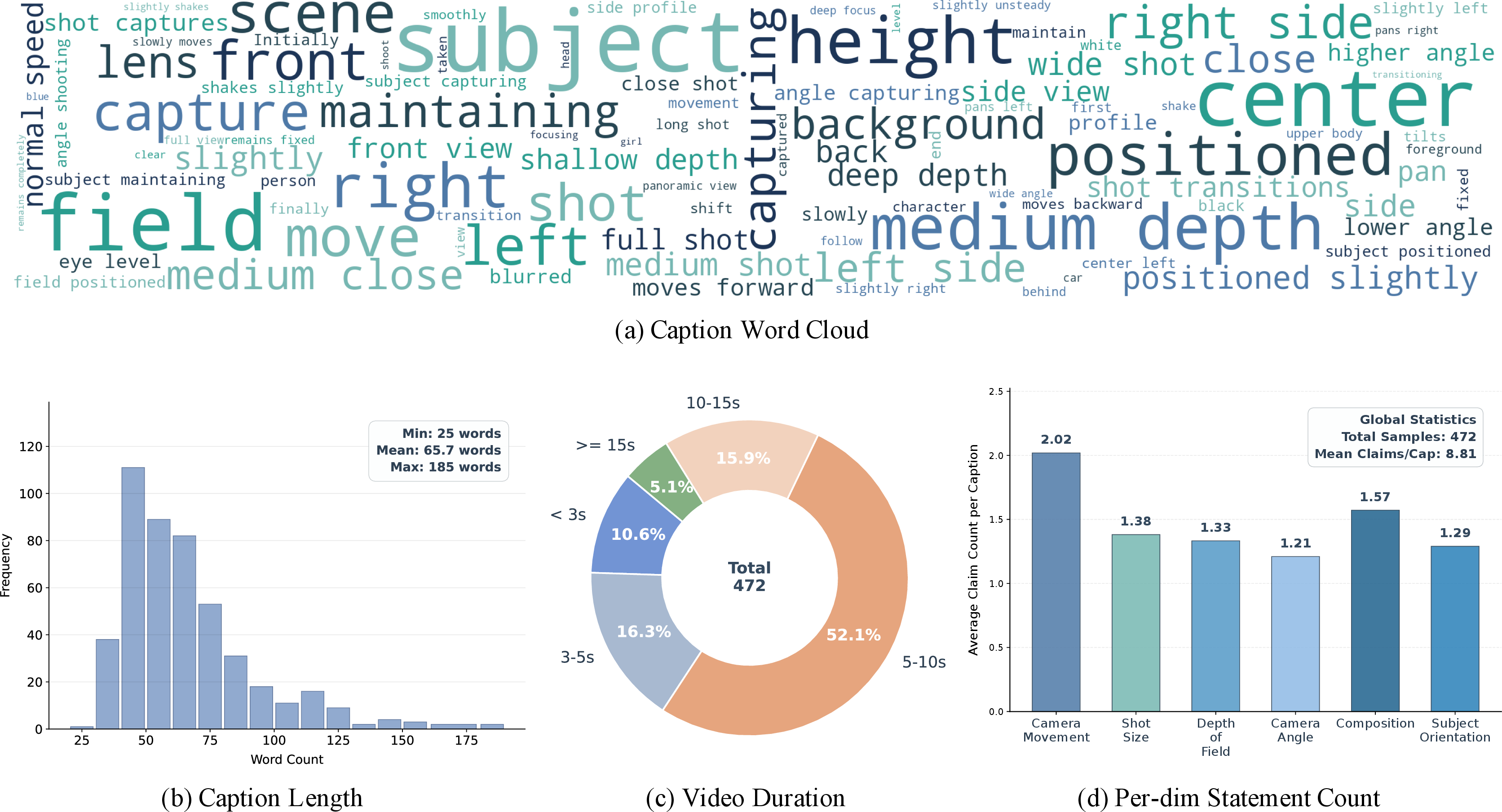
Benchmark Statistics. CineCap Bench comprises 472 manually annotated video-caption pairs. As shown in Fig. 1a, the caption word cloud predominantly features cinematography-oriented expressions related to framing, shot scale, viewpoint, and subject position, indicating that the benchmark captures professional visual presentation rather than generic scene semantics. Figures 1b–c illustrate that the benchmark covers a wide range of video durations and caption lengths. Most clips last between 5 and 10 seconds, while captions range from brief descriptions to relatively long paragraphs, with an average length of 65.7 words. This variability indicates that cinematographic captioning requires flexible description granularity rather than a fixed-length output.
Further examination of the distribution of statement counts across cinematographic dimensions is presented in Fig. 1d. Different dimensions exhibit distinct annotation patterns, demonstrating that cinematographic description is inherently multi-dimensional and compositional. In particular, certain dimensions, such as camera movement and composition, frequently involve multiple statements within a single caption, reflecting the temporally evolving and compound nature of cinematographic expression. These statistics confirm that CineCap Bench presents realistic variation in both temporal structure and descriptive granularity, making it suitable for evaluating whether a model can generate captions that are both comprehensive and accurate.
3.3 Evaluation Protocol↩︎
Cinematographic captioning is evaluated from two perspectives: comprehensiveness and accuracy. Comprehensiveness assesses whether a caption sufficiently covers the cinematographic attributes expressed in the video, whereas accuracy evaluates whether the described attributes are visually correct. Both criteria are essential. A caption may be accurate but incomplete if it describes only a subset of the relevant dimensions, and it may be comprehensive yet unreliable if it includes unsupported or incorrect descriptions.
To capture the multi-dimensional nature of the task, evaluation is performed at both the aspect level and the overall level. The aspect-level evaluation measures whether the generated caption provides sufficiently complete and factually accurate descriptions for each of the six cinematographic dimensions: camera movement, shot size, shooting angle, depth of field, composition, and subject orientation. The overall-level evaluation assesses whether the caption as a whole offers a globally comprehensive and accurate account of how the video is filmed. We report both comprehensiveness and accuracy at these two levels to assess not only fine-grained performance on individual factors but also the quality of the caption as a unified dense description.
4 Method↩︎
4.1 Overview↩︎
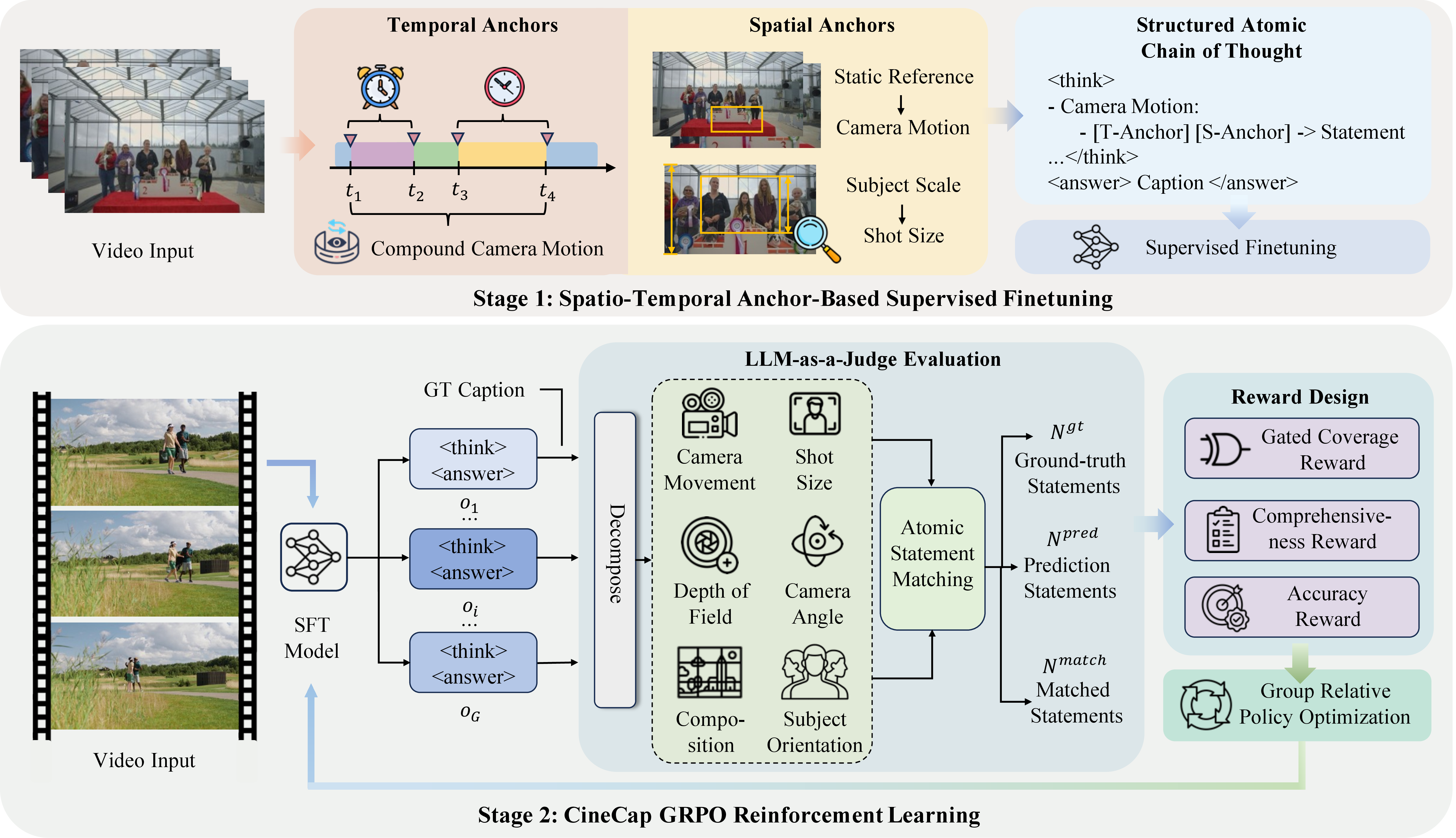
Given a video clip, the objective is to generate a dense cinematographic caption that jointly describes multiple camera-related attributes within a unified paragraph. This task requires the model not only to infer professional cinematographic concepts from explicit visual evidence but also to balance comprehensiveness and accuracy in an open-form generation setting. To address these challenges, we propose a two-stage framework. In the first stage, Spatio-Temporal Anchor-Based Structured Reasoning is introduced to organize visual evidence into structured reasoning for multi-dimensional cinematographic description, which is then used to construct atomic chain-of-thought (CoT) supervision for supervised fine-tuning. In the second stage, GRPO is applied with rewards targeting comprehensiveness, accuracy, and coverage to enhance the quality of the generated captions. The overall pipeline is illustrated in Fig. 2.
4.2 Spatio-Temporal Anchor-Based Reasoning↩︎
Cinematographic attributes are not directly observable as discrete labels from video alone. Camera motion is typically perceived relative to reference objects within the scene, and professional cinematographic concepts require explicit interpretation of visual evidence. A video clip may contain compound cinematographic patterns, with camera movement evolving over time and other dimensions, such as composition and subject orientation, changing accordingly. These characteristics render single-shot global descriptions insufficient for cinematographic captioning. Based on this observation, we propose Spatio-Temporal Anchor-Based Structured Reasoning, which introduces spatial anchors to ground professional concepts in scene evidence, and temporal anchors to localize dynamically changing attributes.
Spatial anchors. Spatial anchors ground fine-grained cinematographic concepts in directly observable visual evidence. Rather than predicting abstract film-language terms holistically, the model first identifies concrete cues and subsequently infers the corresponding attribute. For example, camera motion is inferred from positional changes of static background references, which distinguishes it from subject motion; subject scale indicates shot size; foreground-background sharpness informs depth of field. In this manner, spatial anchors explicitly link scene evidence with professional cinematographic terminology. All such cues are directly observable from the current frame or local visual content.
Temporal anchors. By combining spatial and temporal anchors, our structured reasoning framework provides an intermediate representation between raw video signals and final language output. It enables the model to describe cinematographic attributes based on explicit evidence, while preserving the compositional structure needed for dense multi-dimensional captioning. Temporal anchors bind dynamic cinematographic attributes to localized temporal intervals. Formally, for a video clip, each dynamic attribute is represented by one or more anchors \(\tau = [t_s, t_e]\) indicating the temporal segment during which the attribute is exhibited. This enables the model to describe compound cinematographic patterns within a single clip rather than generating a single global description. In practice, different intervals may correspond to different camera motions, while related dimensions such as composition and subject orientation may also vary with the camera trajectory. Temporal anchors thus provide the temporal structure necessary for multi-stage and compound cinematographic reasoning.
By combining spatial and temporal anchors, the structured reasoning framework provides an intermediate representation bridging raw video signals and final language output. This facilitates description of cinematographic attributes based on explicit evidence while preserving the compositional structure required for dense multi-dimensional captioning.
4.3 Supervised Fine-Tuning with Atomic CoT↩︎
We construct supervised fine-tuning data in the form of atomic chain-of-thought (CoT) instead of unconstrained long-form reasoning. This design is motivated by two observations. First, recent video-language studies indicate that explicit CoT is not uniformly beneficial across all multimodal tasks; for some perception-intensive settings, direct answering can match or outperform CoT despite its higher generation cost [47]. Second, overly long reasoning chains in cinematographic captioning often introduce redundant statements and accumulate errors across steps.
In light of these observations, explicit reasoning is applied only to cinematographic attributes that require inference, notably camera motion and other temporally evolving patterns. Conversely, attributes such as subject orientation or composition are often directly observable from the current frame or local visual content, and are therefore supervised with direct statements rather than extended reasoning chains.
Accordingly, the supervision is organized into an atomic structured format. For dynamic attributes requiring temporal reasoning, each unit follows the form [temporal anchor] [spatial anchor]\(\rightarrow\)statement, where [spatial anchor] is optional. For directly observable attributes, supervision consists of the statement alone. This design maintains concise supervision while preserving
explicit reasoning where necessary, enabling the model to learn multi-dimensional cinematographic descriptions without relying on unnecessarily long CoT trajectories.
To construct the supervision data, we begin with manually annotated video-caption pairs and generate atomic CoT annotations conditioned on ground-truth captions. This construction recovers the visual evidence underpinning each target description,
producing an evidence-to-answer CoT that aligns with the evidence-grounded nature of cinematographic captioning. The generated reasoning traces undergo review by human annotators and a closed-source model to enhance logical coherence and mitigate reasoning
or formatting errors. Finally, all samples are normalized into a unified <answer>...</answer> format, yielding 80K video–CoT–caption training samples for supervised fine-tuning. Additional details regarding the construction
pipeline and exact prompts are provided in the supplementary material.
4.4 Fine-grained Reward Design↩︎
The supervised fine-tuned model is further optimized via Group Relative Policy Optimization (GRPO) to improve caption quality according to two fundamental objectives of cinematographic captioning: comprehensiveness and accuracy. Given a sampled caption, an LLM is employed as a judge to perform atomic evaluation following the same six-aspect decomposition employed in our CoT supervision, including Camera Movement, Shot Size, Depth of Field, Camera Angle, Composition, and Subject Orientation. For each aspect \(d\), the judge decomposes both the ground-truth and generated captions into atomic statements, producing counts of ground-truth statements \(n_d^{\mathrm{gt}}\) , predicted statements \(n_d^{\mathrm{pred}}\), and semantically matched statements \(n_d^{\mathrm{match}}\). These counts are aggregated over all six aspects: \[N^{\mathrm{gt}}=\sum_{d=1}^{6} n_d^{\mathrm{gt}}, \qquad N^{\mathrm{pred}}=\sum_{d=1}^{6} n_d^{\mathrm{pred}}, \qquad N^{\mathrm{match}}=\sum_{d=1}^{6} n_d^{\mathrm{match}}.\] Based on these statistics, the comprehensiveness score and accuracy score are defined as \[s_{\mathrm{cmp}} = \frac{N^{\mathrm{match}}}{\max(N^{\mathrm{gt}},1)}, \qquad s_{\mathrm{acc}} = \frac{N^{\mathrm{match}}}{\max(N^{\mathrm{pred}},1)}.\] Here, \(s_{\mathrm{cmp}}\) measures the proportion of ground-truth cinematographic content covered by the generated caption, while \(s_{\mathrm{acc}}\) measures the factual correctness of generated content.
A natural approach is to combine \(s_{\mathrm{cmp}}\) and \(s_{\mathrm{acc}}\) directly as reinforcement signals. However, in practice, improvement in accuracy tends to dominate the overall reward. Consequently, the model favors producing shorter and more conservative captions to increase \(s_{\mathrm{acc}}\), which limits gains in comprehensiveness. To balance these objectives, an additional coverage reward is introduced to regularize the overall count of described atomic statements. Unlike length-based regularization, this coverage reward is defined using atomic statement counts rather than caption length, motivated by the observation that a longer caption does not necessarily yield higher comprehensiveness; what matters is coverage of critical atomic cinematographic information.
Concretely, the coverage reward is defined as \[r_{\mathrm{cov}} = -\min\left(1, \frac{|N^{\mathrm{gt}} - N^{\mathrm{pred}}|}{\max(N^{\mathrm{gt}}, 1)}\right).\] This reward encourages the generated caption to better match the target coverage at the atomic level. However, we observe that directly applying \(r_{\mathrm{cov}}\) can suppress accuracy improvement, since coverage control may encourage additional statements even when their correctness is not yet reliable. To mitigate this, a gated design is implemented, activating the coverage reward only when the caption attains sufficient accuracy. Specifically, the gated coverage reward is defined as \[r_{\mathrm{cov}}^{\mathrm{gate}} = \mathbb{I}(s_{\mathrm{acc}}>\tau)\, \left( -\min\!\left(1,\frac{|N^{\mathrm{gt}}-N^{\mathrm{pred}}|}{\max(N^{\mathrm{gt}},1)}\right) \right),\] where \(\mathbb{I}(\cdot)\) is the indicator function and \(\tau\) is an accuracy threshold.
For the \(i\)-th sampled response, we set \[r_{\mathrm{cmp},i} = s_{\mathrm{cmp},i}, \qquad r_{\mathrm{acc},i} = s_{\mathrm{acc},i},\] and define the final reward as \[R_i = \lambda_{\mathrm{cmp}} r_{\mathrm{cmp},i} + \lambda_{\mathrm{acc}} r_{\mathrm{acc},i} + \lambda_{\mathrm{cov}} r_{\mathrm{cov},i}^{\mathrm{gate}}.\]
| Model | CM | SS | DF | CA | CO | SO | Overall | ||||||||
|---|---|---|---|---|---|---|---|---|---|---|---|---|---|---|---|
| 2-3 (lr)4-5 (lr)6-7 (lr)8-9 (lr)10-11 (lr)12-13 (lr)14-16 | Cmp | Acc | Cmp | Acc | Cmp | Acc | Cmp | Acc | Cmp | Acc | Cmp | Acc | Cmp | Acc | F1 |
| Proprietary models | |||||||||||||||
| Gemini-2.5-Pro[48] | 40.23 | 43.09 | 51.07 | 47.92 | 48.11 | 47.37 | 80.92 | 78.61 | 40.24 | 43.55 | 48.90 | 45.44 | 52.03 | 52.53 | 52.28 |
| Gemini-3.1-Pro[49] | 29.22 | 40.50 | 54.34 | 60.52 | 43.01 | 43.59 | 79.00 | 80.60 | 19.98 | 22.76 | 54.78 | 58.01 | 46.31 | 60.48 | 52.45 |
| Open-source models (\(>\)10B) | |||||||||||||||
| Qwen3-VL-30B[8] | 29.22 | 30.31 | 54.26 | 49.47 | 36.12 | 36.39 | 44.67 | 43.53 | 30.19 | 33.16 | 34.52 | 34.32 | 39.33 | 43.42 | 41.27 |
| Qwen2.5-VL-72B[7] | 28.42 | 32.23 | 53.19 | 52.83 | 31.92 | 31.11 | 65.65 | 60.58 | 35.71 | 37.93 | 28.70 | 30.18 | 41.02 | 43.39 | 42.17 |
| Open-source models (\(<\)10B) | |||||||||||||||
| Tarsier-7B[50] | 8.06 | 13.11 | 37.57 | 35.51 | 27.38 | 28.28 | 15.81 | 14.92 | 17.83 | 21.47 | 22.95 | 25.23 | 22.64 | 31.05 | 26.19 |
| InternVL-3-8B[9] | 18.80 | 25.21 | 42.70 | 40.32 | 33.66 | 34.89 | 27.17 | 26.41 | 27.85 | 31.54 | 29.27 | 31.57 | 30.69 | 36.81 | 33.47 |
| LLaVa-OV-7B[51] | 8.94 | 13.51 | 28.21 | 25.98 | 19.50 | 20.04 | 11.66 | 10.86 | 16.14 | 17.98 | 19.79 | 21.10 | 19.30 | 31.40 | 23.91 |
| LLaVa-NV-7B[52] | 8.11 | 12.89 | 56.68 | 34.91 | 23.23 | 23.71 | 30.37 | 25.44 | 24.31 | 29.91 | 20.23 | 22.02 | 28.05 | 30.14 | 29.06 |
| Qwen3-VL-8B[8] | 34.48 | 31.66 | 45.49 | 38.52 | 36.76 | 33.40 | 61.12 | 51.14 | 33.31 | 36.73 | 44.19 | 41.21 | 44.09 | 38.60 | 41.16 |
| Ours (CineCap) | 54.38 | 60.50 | 76.51 | 77.44 | 79.68 | 82.91 | 90.06 | 88.35 | 66.17 | 66.09 | 72.51 | 69.54 | 72.38 (+28.29) | 74.80 (+36.2) | 73.57 (+32.41) |
Following the GRPO training paradigm, the group-wise advantage of each sampled response is computed by \[A_i = \frac{R_i - \mathrm{mean}(\{R_j\})}{\mathrm{std}(\{R_j\})},\] where \(\{R_j\}\) represents the rewards of all sampled responses within the same group. Let \[\rho_i = \frac{\pi_{\theta}(o_i \mid q)}{\pi_{\theta_{\mathrm{old}}}(o_i \mid q)}.\] The final GRPO objective is formulated as \[\begin{align} \mathcal{J}_{\mathrm{GRPO}}(\theta) &= \mathbb{E}_{q, \{o_i\}} \left[ \frac{1}{N}\sum_{i=1}^N \mathcal{L}_i - \beta \, \mathbb{D}_{\mathrm{KL}} \bigl(\pi_{\theta} \| \pi_{\mathrm{ref}}\bigr) \right], \\ \mathcal{L}_i &= \min \Bigl( \rho_i A_i,\, \mathrm{clip}(\rho_i, 1-\epsilon, 1+\epsilon) A_i \Bigr). \end{align}\] Here, \(q\) denotes the input query, \(o_i\) denotes the \(i\)-th sampled response, and \(\pi_{\mathrm{ref}}\) is the reference policy. This optimization encourages the model to generate captions that achieve a better balance between factual correctness and descriptive coverage.
5 Experiments↩︎
5.1 Implementation Details↩︎
During the SFT stage, we train the base model Qwen3-VL-8B [8] on 80K samples for 2 epochs, with a batch size of 128 and a learning rate of \(2\times10^{-5}\). During the GRPO stage, we further train on 2K samples for 1 epoch, using 8 rollouts, a learning rate of \(1\times10^{-5}\), and a prompt-wise batch size of 32. In the reward design, we set \(\lambda_{\mathrm{acc}}=0.5\), \(\lambda_{\mathrm{cmp}}=0.5\), and \(\lambda_{\mathrm{cov}}=0.1\), while the gate threshold (\(\tau\)) for activating the coverage reward is set to 0.75. Videos are sampled at 2 FPS, with a maximum of 256 tokens per frame. All experiments are conducted on \(32\times 80\) GB GPUs. More implementation details are provided in the appendix.
5.2 Comparison with State of the Art↩︎
To evaluate the effectiveness of CineCap, we compare it against a broad set of strong baselines, including both proprietary and open-source multimodal models. Specifically, the proprietary baselines include Gemini-2.5-Pro [48] and Gemini-3.1-Pro [49], while the open-source baselines include Qwen3-VL-30B [8], Qwen2.5-VL-72B [7], Qwen3-VL-8B [8], Tarsier-7B [50], InternVL3-8B [9], LLaVA-OneVision-7B [51], and LLaVA-NeXT-Video-7B [52]. These baselines cover representative recent models with strong visual understanding and generation capabilities, enabling a comprehensive comparison on cinematographic captioning.
For evaluation, we report both aspect-level and overall-level results under the two criteria defined in Sec.3.3: comprehensiveness (Cmp) and accuracy (Acc). The aspect-level evaluation covers six cinematographic dimensions, including Camera Movement (CM), Shot Size (SS), Depth of Field (DF), Camera Angle (CA), Composition (CO), and Subject Orientation (SO), while the overall level further reports holistic Cmp, Acc, and F1.
Tab. 1 shows that CineCap consistently outperforms all proprietary and open-source baselines across all metrics. In particular, CineCap achieves 72.38 overall Cmp, 74.80 overall Acc, and 73.57 F1, significantly surpassing the strongest baseline Gemini-3.1-Pro (46.31, 60.48, 52.45). This demonstrates that our method improves not only factual correctness but also descriptive coverage.
The gains are consistent across all six cinematographic dimensions. The improvements are especially large on Camera Movement, Shot Size, Depth of Field, and Composition, where multi-dimensional dense description requires both fine-grained visual understanding and explicit structured reasoning. For example, on Camera Movement, CineCap improves Cmp/Acc from 40.23/43.09 to 54.38/60.50, and on Depth of Field from 48.11/47.37 to 79.68/82.91. Meanwhile, the strong performance on Camera Angle (90.06/88.35) and Subject Orientation (72.51/69.54) further indicates that our framework can jointly support both dynamic and static cinematographic description within a unified caption. These results verify the effectiveness of our spatio-temporal structured reasoning and reward design for multi-dimensional cinematographic captioning.
| Model | Cmp | Acc | F1 | \(\Delta\) F1 |
|---|---|---|---|---|
| Base (Qwen3)[8] | 44.09 | 38.60 | 41.16 | - |
| + Direct Caption SFT | 68.00 | 70.58 | 69.27 | +28.11 |
| + CineCap SFT | 69.36 | 71.08 | 70.21 | +29.05 |
| + CineCap SFT w/ GRPO | 72.38 | 74.80 | 73.57 | +32.41 |
| Model | Cmp | Acc | F1 | \(\Delta\) F1 |
|---|---|---|---|---|
| CineCap SFT | 69.36 | 71.08 | 70.21 | - |
| + Cmp & Acc Reward | 71.40 | 74.52 | 72.93 | +2.72 |
| Parallel variations based on (+ Cmp & Acc Reward): | ||||
| w/ Len Penalty | 73.29 | 70.20 | 71.71 | +1.50 |
| w/ Cov (w/o gate) | 72.27 | 73.96 | 73.11 | +2.90 |
| w/ Cov (w/ gate) | 72.38 | 74.80 | 73.57 | +3.36 |
5.3 Ablation Analysis↩︎
5.3.1 Fine-tuning Strategy Ablation↩︎
Tab. 2 shows the ablation of progressive fine-tuning strategies. From the base model, direct caption SFT raises overall F1 from 41.16 to 69.27, confirming that curated cinematographic caption data provide strong supervision. However, this gain is not solely due to data. Replacing direct caption SFT with CineCap SFT, which uses the same training source but adds spatio-temporal anchor-based atomic CoT supervision, further improves F1 from 69.27 to 70.21. This indicates that structured supervision, not just more data, drives this improvement. Applying CineCap GRPO on top of CineCap SFT raises overall F1 from 70.21 to 73.57 with simultaneous gains in accuracy and comprehensiveness. This verifies the reward design effectively complements supervised learning by balancing descriptive coverage and factual correctness. The consistent improvements in both metrics suggest the gain arises from better alignment of captions with the cinematographic structure rather than longer or more aggressive generation.
Structured spatio-temporal atomic supervision improves performance beyond curated caption data alone. The proposed reward further enhances accuracy and comprehensiveness by balancing coverage and correctness, promoting better caption-structure alignment.
5.3.2 Reward Design Ablation↩︎
Table 3 presents an analysis of reward design commencing from CineCap SFT. The addition of the Cmp & Acc Reward increases the overall F1 score from 70.21 to 72.93, demonstrating the advantage of reinforcement learning on these objectives. Introducing a naive length penalty improves comprehensiveness but decreases accuracy, which causes the F1 score to decline to 71.71, indicating that longer captions tend to be more complete but less accurate. Substituting the length penalty with the proposed coverage reward yields improved balance between metrics, confirming that atomic statement coverage serves as a more effective control signal than caption length. The inclusion of the gating mechanism further enhances the final results to 74.80 in accuracy, 72.38 in comprehensiveness, and 73.57 in F1—the highest among all variants—validating that the gated coverage reward effectively balances descriptive completeness and factual accuracy.
Caption length is an inadequate proxy for cinematographic completeness. Controlling atomic aspect coverage through a gating mechanism attains a superior balance between accuracy and coverage.

Fig. 3 shows the training dynamics of different reward components. All curves increase steadily, indicating stable GRPO optimization. The accuracy reward grows faster and remains higher than the completeness reward. Overall, the trend supports the effectiveness of our reward design.
6 Conclusion↩︎
This work proposes , a unified framework for cinematographic captioning, and formulates the task as a multi-dimensional dense description problem across six essential cinematographic dimensions. The proposed method integrates spatio-temporal anchor-based structured reasoning, atomic chain-of-thought supervision, and GRPO-based reward optimization to enhance both descriptive completeness and factual accuracy. To enable systematic evaluation, CineCap Bench is introduced, offering fine-grained assessments at both the aspect and overall levels. We conduct extensive experiments showing that consistently outperforms both open-source and proprietary baselines, achieving up to 32.41% improvement in F1 evaluation. It is expected that this work will promote further research on cinematographic understanding and provide valuable support for downstream tasks involving controllable cinematic video generation.