Hadronisation of in-medium \(c\bar c\) pairs to the exotic \(X(3872)\)
January 01, 1970
Abstract
The separation of \(c\bar c\) quarks in the quark-gluon plasma and the characteristic size of the final state quarkonia should lead to the observed hadron ratios in nuclear collisions. Such dependence manifests itself through the Fermi Golden rule, where hadron ratios are sensitive to the inner product between in-vacuum and in-medium wave functions. A novel hard probe is the exotic \(X(3872)\), which is expected to have a molecular and a compact component. We bridge more than a decade of several LHC experimental results on hard probes, namely \(J/\Psi\), \(\Psi(2S)\) and \(X(3872)\) hadrons, to the degree of separation and dissociation of in-medium hidden-charm systems.
Introduction – Ultra-relativistic heavy-ion collisions create the uttermost conditions of temperature and density, such that ordinary matter transitions into a deconfined chirally symmetric state [1] known as Quark-Gluon Plasma (QGP). At the Large Hadron Collider (LHC), the QGP formed in Pb-Pb collisions exhibits a strong collective behavior over femptoscopic length and time scales, rendering it a unique environment for studying the underlying theory, quantum chromodynamics (QCD), in its perturbative and non-perturbative regimes [2]–[4]. Comparisons against p-p collisions, where the produced system is much smaller, provide a baseline to understand the QGP properties and effects [5], with hard probes being an excellent phenomenological tool to register them [6].
Hard scattered hidden-charm systems are created much before the QGP thermalization time. Therefore, heavy quarks are particularly clean probes of the QGP dynamics, with the associated spectra reflecting medium-induced effects [7]. In particular, the presence of roaming color charges screens the hidden-charm system potential, weakening it, while causing the diffusing \(c\bar{c}\) quarks to develop Brownian motion. These effects leverage each other, dissociating part of the \(c\bar c\) pairs into open-charm systems and so reducing the probability for charmonia production. The \(X(3872)\), an exotic hadron candidate [8], [9], is particularly sensitive to these medium-induced effects [10], [11]. Its quantum numbers, \(J=1^{++}\), allow an inner structure featuring an interplay between a loose \(D^0-\bar D^{0*}\) meson molecule state and a compact state incorporating \(c\bar cq\bar q\) tetra-quark and Charmonium-like \(c\bar c\) contributions, respectively mixed at around \(90\% \pm 3 \%\) and \(10\% \pm 3 \%\) probability [12]–[15]. Hence, dissociated in-medium \(c\bar c\) pairs can still evolve to this exotic hadron, giving its dominant molecular structure.
In this letter we take into account the QGP "melting" effects and connect the observed \(X(3872)\), \(\psi(2S)\) and \(J/\psi\) ratios in p-p and Pb-Pb collisions at the LHC to the characteristic lengths of in-medium hidden-charm systems and the final states they evolve to. This picture is well supported by the Fermi Golden Rule: the transition into hadrons should be proportional to the density of states, \(\rho_{a}\), with \(_a\) denoting the final hadronic state, and to the square of the inner product between the in-medium, \(i\), \(c\bar c\) pair wave function (WF), \(|\Psi_{c\bar c}^i\rangle\), and the vacuum hadronic WF, \(|\Psi_{a}\rangle\). In turn, hadron ratios follow cleanly from Golden-Rule ratios, \[\text{Had. ratios} \propto \frac{\rho_{a}}{\rho_{b}} \frac{|\langle \Psi_{a} | \widetilde{\Psi}_{c\bar c}^i\rangle|^2}{|\langle \Psi_{b} | \widetilde{\Psi}_{c\bar c}^j\rangle|^2}\,, \label{FERMIgr}\tag{1}\] where common normalizing factors cancel. Notice, we include the perturbation Hamiltonian in our modified WF of the in-medium \(c\bar c\) pair \(| \widetilde{\Psi}_{c\bar c}^i\rangle= H' | \Psi_{c\bar c}^i\rangle\).
Experimental measurements – The production of \(J/\psi\), \(\psi(2S)\) and \(X(3872)\) hadrons, as a function of the transverse momentum, \(p_T\), and collision centrality, \(Cent\), has been the subject of several experiments. In turn, these differential measurements form the baseline for building composite observables, namely the nuclear modification factor, the relative production ratio and its double ratio. Measurements of these observables against centrality are particularly relevant since this variable (only available in Pb-Pb systems) conveys information about the size of the QGP. Measurements against \(p_T\) are also informative because they can highlight where different production and hadronisation mechanisms become dominant.
The nuclear modification factor, \(R_{AA}\), quantifies the difference between a Pb-Pb and a binary-scaled p-p system in terms of particle production. Measurements of this observable differentiated against centrality for the \(J/\psi\) and \(\psi(2S)\) mesons reveal an overall production suppression in Pb-Pb collisions (\(R_{AA}<1\)), with values trending towards unity as collisions become more peripheral [16]–[22].
The relative production of charmonium states, \(R\), is sensitive to in-medium dynamics of hidden-charm systems. Studies of this observable differentiated against \(p_T\) reveal a moderate linear dependence in the p-p system [23]–[25]. In contrast, in the Pb-Pb system, no dependence was found [26], including none on centrality [27].
The double ratio of relative productions, \(\mathrm{DR}\), is computed to suppress experimental uncertainties while maintaining sensitivity to QGP effects. Against centrality, measurements at the LHC show a \(\mathrm{DR}<1\), without trends forming [28], [29].
In addition to Charmonium states, the \(X(3872)\) relative production to \(\psi(2S)\) has also been studied at the LHC in p-p [30]–[32] and Pb-Pb [33] collisions. While in the smaller p-p system a huge relative suppression of \(X(3872)\) production was found, in the Pb-Pb system a value compatible with unity was reported. From the measurements performed in both systems and from \(\psi(2S)\) nuclear modification factor a \(R_{AA}\approx1.45\pm1.27\) follows for the \(X(3872)\).
To ensure consistency among the plethora of results introduced above, maintaining proximity to the QGP thermodynamics and suppressing nuclear and quark recombination effects [34], preference is given to measurements taken at mid-rapidity, \(|y|<1.6\), and compatible with an effective transverse momentum of \(p^{eff}_T\approx10~\text{GeV}\). For measurements reported in intervals spawning a large low-to-high \(p_T\) region the effective value is still reasonable. Particle production is predominantly taking place at the lower end of extended \(p_T\) bins, rendering ratios more sensitive to those regions [35]. The selected results are summarized in Table 1 and paired with the \(R_{HBT}\) of the respective centrality class [36]. The relative production of both \(\psi(2S)\) to \(J/\psi\) mesons, measured at forward-rapidity in the Pb-Pb collision system, and \(X(3872)\) to \(\psi(2S)\), measured in a slightly higher \(p_T\) region, are nonetheless considered in this work, albeit not shown in the table. The former ratio is quoted inclusively since there is no dependence on centrality.
| Cent | \(\mathbf{R_{AA}^{J/\psi}}\) | \(\mathbf{R_{AA}^{\psi(2S)}}\) | DR | \(\mathbf{R_{\mathbf{HBT}}^{\mathrm{PbPb}}}\) |
|---|---|---|---|---|
| \(0\)–\(10\) | \(0.25\pm0.03\) | \(<0.15\) | \(0.14\pm0.20\) | \(6.0\) |
| \(10\)–\(20\) | \(0.33\pm0.03\) | \(0.12\pm0.06\) | \(0.35\pm0.17\) | \(5.4\) |
| \(20\)–\(30\) | \(0.40\pm0.04\) | \(0.21\pm0.08\) | \(0.54\pm0.20\) | \(4.7\) |
| \(30\)–\(40\) | \(0.46\pm0.05\) | \(0.25\pm0.09\) | \(0.53\pm0.18\) | \(4.1\) |
| \(40\)–\(50\) | \(0.62\pm0.07\) | \(0.19\pm0.11\) | \(0.31\pm0.17\) | \(3.7\) |
| \(0\)–\(100\) | \(0.37\pm0.035\) | \(0.13\pm0.06\) | \(0.39\pm0.08\) | \(5.0\) |
4pt
Density of States – In the designed kinematic region the density of states entering Eq 1 can be estimated through statistical hadronisation [37]–[39], where final-state hadrons are being sampled from a thermal source at temperature \(T\simeq158~\mathrm{MeV}\) [40]. Hence, the Lorentz invariant phase space measure of the final state hadron is weighted by a thermal factor which, in \((p_T,y,\phi)\) coordinates, reads \[\begin{align} \frac{d\rho_{a}}{dp_T}\Bigg|_{p^{eff}_T} = \frac{g_{a}}{8\pi^2} \, p^{eff}_T \int_{-1.6}^{1.6} dy\,\,e^{\left(-m_T^{a}\cosh y\right)/T}, \label{eq:DOS95pTy} \end{align}\tag{2}\] where \(\int d\phi = 2\pi\) is already integrated out, \(m_T^{a}=(\,p_T^2+m_{a}^2)^{1/2}\) and \(g_{a}\) is the hadron spin degeneracy. For the particles under consideration in this letter \(g_{a}\) cancels when taking the ratios of the respective density of states, which becomes an average with respect to the thermal weight of the reference hadron, \(\int_{1.6}^{1.6}dy\, \exp(-(m_T^{b}\cosh y )/T)\), \[\begin{align} \frac{\rho_{a}}{\rho_{b}}= \left\langle e^{\left(-\Delta m_T^{ab}\cosh y\right)/T} \right\rangle\,, \label{eq:DOS95ratio} \end{align}\tag{3}\] with \(\Delta m_T^{ab}=m_T^{a}-m_T^{b}\). When the same hadron appears in both sides of the ratio, as in \(R_{AA}\), \(\Delta m_T^{ab}\) vanishes and so \({\rho_{a}/\rho_{b}}\) reduces to unity. Similarly, in the \(\mathrm{DR}\) observable, the density of states ratio reduces to unity as well. Only in the \(\psi(2S)\) to \(J/\psi\) relative production a non-trivial density of states contribution, \(\rho_{\psi(2S)}/\rho_{J/\psi}= 0.293\), appears.
Vacuum Wave Functions – To obtain \(J/\psi\) and \(\psi(2S)\) WFs we solve the Schrödinger equation for the QCD potential [41], [42], \[\begin{align} V_{c\bar c} =& -\frac{4}{3}\frac{\alpha_s}{r} + br + \frac{32\pi}{9}\frac{\alpha_s}{m_c^2} \, \tilde{\delta}_\sigma(r) \,\vec{S}_c \cdot \vec{S}_c \nonumber\\ +&\frac{1}{m_c^2}\Bigg[\Bigg( \frac{2\alpha_s}{r^3} - \frac{b}{2r} \Bigg)\vec{L}\cdot\vec{S} + \frac{4\alpha_s}{r^3}T\Bigg], \label{HNR} \end{align}\tag{4}\] treating all terms simultaneously under a coupled-channel framework to account for possible spin-tensor induced mixing between states sharing identical quantum numbers. To do so the short-distance singularities arising from the spin-orbit and tensor interactions are regularized according to \(1/r^3\;\longrightarrow\;\left(r^2+1/m_c^2\right)^{-3/2}\). By solving for the whole potential simultaneously we see the contribution of D-waves to the WFs of \(J/\psi\) and \(\psi(2S)\) to be smaller than \(0.1\%\) and thus negligible. Therefore we consider these WFs to be correctly given by the \(1S\) component.
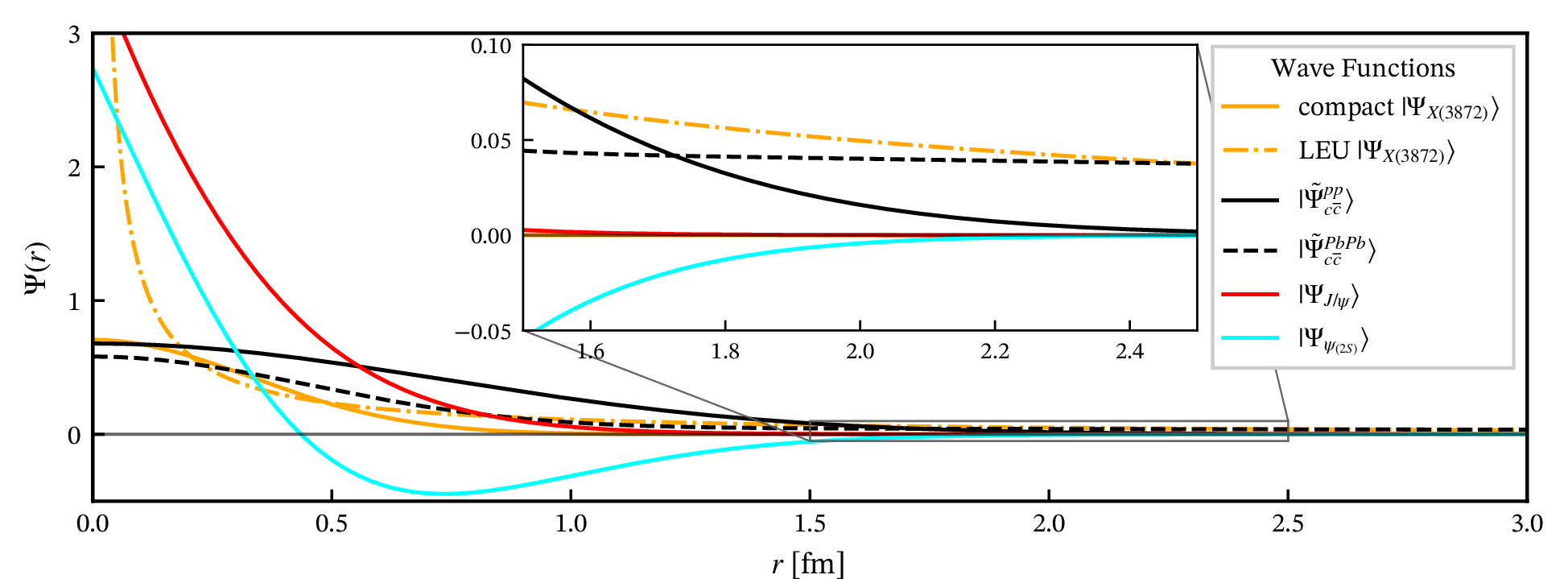
For the exotic \(X(3872)\) hadron there is a prediction for the molecular part of the WF steaming from Low Energy Universality (LEU) [43]. LEU is valid for shallow resonances with large scattering lengths, like the one of the \(X(3872)\), with \(a \approx9.6\pm1.7~\text{fm}\) [44]. However, to also incorporate its compact nature an ansatz Gaussian WF, \[G(\sigma; r) = (\sqrt{\pi \sigma})^{-3/2} \,\text{exp}({-r^2/(2\sigma^2)})\] is used such that the full WF reads \[\Psi_X(r) = N\Bigg(\underbrace{\sqrt{\beta}\,G(\sigma^X; r)}_\text{compact } + \underbrace{\frac{\sqrt{1-\beta}}{r \sqrt{2\pi a}} e^{-r/a}}_\text{LEU}\Bigg), \label{X95compact95leu}\tag{5}\] where \(N\) is a normalizing factor. We consider a mixing parameter \(\beta=10\%\) and \(\sigma^X\) such that the compact WF features a \(\sqrt{\langle r^2\rangle}\approx0.40~\text{fm}\), respecting the landscape of charmonia states, including hidden-charm tetraquarks [45]. Still, due to its dominant loose nature, the \(X(3872)\) WF remains very spatially extended, with \(\sqrt{\langle r^2\rangle}\approx6.44~\text{fm}\). In Fig. 1 the compact and loose components of \(X(3872)\) WF are individually sketched alongside \(J/\psi\) and \(\psi(2S)\) mesons WFs.
In-medium \(c\bar c\) Wave Function – Owing to the underlying randomness of the QGP dissociating effects, the modified WFs of in-medium \(c\bar c\) pairs can be profiled through Gaussian ansätze, constrained to respect the size of the p-p and Pb-Pb systems’ particle-emitting sources. These have been characterized at the LHC employing Hanbury Brown–Twiss (HBT) correlations [46]–[48]. We do not expect the perturbation hamiltonian \(H'\) to significantly modify the WF. The measured HBT radii in Pb-Pb collisions, \(R^{\mathrm{PbPb}}_{\mathrm{HBT}}\), is consistent with with the formation of a large system, with \(R^{\mathrm{PbPb}}_{\mathrm{HBT}}\) up to \(7~\text{fm}\) for head-on collisions, for other Pb-Pb centralities see Table 1, while in p-p collisions the system is much smaller, with \(R^{\mathrm{pp}}_{\mathrm{HBT}}\) of the order of \(1~\text{fm}\). Hence, these characteristic lengths define the limiting case for the separation that dissociated \(c\bar c\) pairs can develop in each system before hadronisation. Therefore, in the small p-p collision system, the in-medium \(c\bar c\) pair modified WF is described by a Gaussian function, \[\widetilde{\Psi}_{c\bar c}(\sigma;r)=G(\sigma; r),\] with \(\sigma\) the pair spatial width. Following the considerations above, this parameter is caped such that it yields a modified WF featuring \(\sqrt{\langle r^2\rangle}\leq R^{pp}_{\mathrm{HBT}}\). A constrain on the lower limit can also be imposed at \(\sqrt{\langle r^2\rangle}\geq0.3~\text{fm}\), since smaller WFs do not fit naturally in the hadronic scale.
For the Pb-Pb system, the large spatial extent of the medium should allow to independently resolve a compact component [49]–[56], associated with pairs that survive in a close configuration, and a more diffuse component, associated with dissociated pairs whose separation increased over larger distances. So, the modified WF of a \(c\bar c\) pair in the Pb-Pb system is written as a coherent superposition between a compact and a loose component, \[\begin{align} \label{inmedium95PbPb} \widetilde{\Psi}'_{c\bar c}(\sigma',\alpha;r)=N\Big(\underbrace{\sqrt{\alpha}\,G(\sigma'; r)}_\text{compact}+\underbrace{\sqrt{1-\alpha}\,G(\varsigma; r)}_\text{loose}\Big) \end{align}\tag{6}\] with \(\sigma'\) and \(\varsigma\) respectively describing the spatial width of the \(c\bar c\) pairs that remain bound and become dissociated, and \(\alpha\) the relative balance between these two components. Again, \(\sigma'\) is required to yield a contribution to the overall WF falling within hadronic scales, with \(0.3\leq\sqrt{\langle r^2\rangle}\leq1~\text{fm}\), while \(\varsigma\) is fixed such that the loose component features \(\sqrt{\langle r^2\rangle}= R^{\mathrm{PbPb}}_{\mathrm{HBT}}\), matching the characteristic size of the medium produced in Pb-Pb collisions. The fraction of in-medium \(c\bar c\) quarks retaining a close configuration is also not completely free – it must lie sufficiently away from unity and from zero, as these two limiting regions would be in huge disagreement with nuclear collisions data [57]. In this way, \(\sigma\), \(\alpha\) and \(\sigma'\) are allowed to float within a physically motivated range, to be tested against the experimental measurements concerning charmonia production in p-p and Pb-Pb collisions.
Representative in-medium modified WFs of \(c\bar c\) pairs are sketched in Fig. 1, where in the zoomed panel the WF of \(c\bar c\) pairs in a Pb-Pb system can be seen developing an evanescent tail, similar to the LEU part of \(X(3872)\) WF. The compatibility between both WFs highlights the important role of spatially extended \(c\bar c\) pairs in the formation of this exotic hadron in Pb-Pb collisions.
Results – Having gathered all underlying ingredients, Eq. 1 is evaluated over the phase space of interest. This defines two-dimensional (2-D) maps in the \((\sigma,\sigma')\) plane, allowing to identify regions where Golden Rule ratios describe the associated experimental observable at fixed \(\alpha\). Then, \(\alpha\) is scanned until a common overlapping region emerges. The results in each \(Cent\) bin are shown in Fig. 2, where the 2-D maps are displayed as function of in-medium \(c\bar c\) pair modified WF \(\sqrt{\langle r^2\rangle}\). The small panel at the bottom right corner indicates the values of \(\alpha\) used in each plot and the only interval of this variable where the common solutions appear.
A single common overlapping region is found. It remains stable across the centrality bins and evolves smoothly in parameter space. The permitted values of \(\alpha\) support the scenario in which a fraction of the initial hidden-charm systems remain sufficiently localized to project efficiently onto charmonia states. This surviving fraction increases towards more peripheral collisions (high centrality bins), capturing the size dependence of QGP effects. Their characteristic are around \(\sqrt{\langle r^2\rangle}\approx0.85\) fm for the single component we consider in the p-p system and \(\sqrt{\langle r^2\rangle}\approx0.55\) fm for the localised component in the Pb-Pb system. The isolated plot at the top of Fig. 2 shows the inclusive-centrality scan where the \(X(3872)\) experimental constraint is successfully accommodated. Our analysis implies the \(X(3872)\) indeed has a dominant LEU component. Moreover, considering only the LEU WF prediction spoils the common overlapping region, supporting a diminished yet important compact degree of freedom contributing to this exotic state.
Conclusion – Utilizing a plethora of experimental results on the production of \(J/\psi, \, \psi(2S)\) and \(X(3872)\) in Heavy Ion collisions, we constrained quantitatively both the \(c \bar c\) pair in the medium and the components of the WF of the exotic \(X(3872)\). The obtained results highlight how hadronisation becomes very sensitive to the spatial distribution of the involved states. Quantum numbers alone cannot distinguish between degrees of freedom when the same \(J^{PC}\) states are contributing. In this context, the Golden Rule becomes a bridge between hadron theory and heavy-ion phenomenology, with the QGP acting as a filter for resolving hadronic inner structures. This becomes particularly interesting for exotic hadron candidates, providing sufficient experimental data is available. For instance, the \(T_{cc}\) also has an important LEU component [58]. Other examples are, \(c\bar cq\bar q\) states [59], [60], including with strangeness [61]–[65], or even \(c\bar cqqq\) [66]–[69]. Our approach can rather straightforwardly be applied to the tower of \(\Upsilon(nS)\) states [70]–[72], where it should also be possible to quantify the amount of \(b\bar b\) dissociation, and test if \(\Upsilon(10753)\) has a LEU component [73]. Gluon degrees of freedom [74]–[77] can also be tested.

Acknowledgments – This work was partly supported by TSU, Tsinghua University of Beijing, under the Tsinghua University Initiative Scientific Research Program; and by LIP, Laboratório de Instrumentação e Física Experimental de Partículas, under the contract UID/50007/2025 with FCT, Fundação para a Ciência e Tecnología; and by CeFEMA, Centre of Physics and Engineering of Advanced Materials, under contracts UID/04540/2025, UID/PRR/04540/2025 and UID/PRR2/04540/2025 with the Portuguese Agência para a Investigação e Inovação AI2, doi https://doi.org/10.54499/UID/PRR/04540/2025, https://doi.org/10.54499/UID/PRR/04540/2025 and https://doi.org/10.54499/UID/PRR2/04540/2025 ; and by LaPMET, Laboratory of Physics for Materials and Emerging Technologies Portuguese under contract LA/P/0095/2020with the Portuguese Agência para a Investigação e Inovação AI2, doi https://doi.org/10.54499/LA/P/0095/2020