OxyMake: A Formally-Specified, Content-Addressable Workflow Engine
June 18, 2026
Abstract
Make-lineage workflow runners decide whether a job must re-run from file-modification times. The timestamp is a proxy for has this content changed?, and it breaks under routine operations: a git checkout, a tree copy to a new path,
or a restore from backup all rewrite mtimes without changing a byte of content. Wherever the raw proxy is trusted—GNU Make, and any engine’s pure-mtime fast path—those operations force spurious re-execution of an entire pipeline; and when a timestamp lands
the wrong side of a comparison, a stale output is silently reused. Modern runners patch the proxy point-wise: Snakemake 7 records per-output provenance and, as our own benchmark verifies, survives mtime churn unmoved. Content-addressing replaces the proxy
instead.
OxyMake1 is a workflow engine written in Rust and shipped as a single static binary. It replaces the timestamp heuristic with a content-addressable cache
key: a BLAKE3 hash of rule source \(\|\) input content \(\|\) parameters \(\|\) environment \(\|\) platform (Eq. eq:eq:cache-key? ). Because the key is a pure function of content, the caching decision survives mtime churn and travels across
same-platform machines and shared caches, where timestamps mean nothing. The default validation mode (mtime+hash) re-hashes a file whenever its metadata moves—a discipline our own benchmark forced on us, after measuring OxyMake’s original
pure-mtime default re-running every downstream job on the same checkout that Snakemake’s provenance shrugged off (§sec:sec:sec:git-checkout-bench?). Phantom re-runs from mtime perturbation disappear for declared inputs—OxyMake has no build sandbox, so an input a rule reads but does not declare is invisible to
the key (§sec:sec:undeclared-inputs?)—and deletion cascades transitively to dependents. The workflow
itself is a declarative, statically-parseable specification rather than a program, so a tool can read it without executing it. It keeps the Make-lineage rule model—backward-chaining DAG resolution with wildcard-driven genericity—so existing Snakemake
pipelines port directly.
The engineering envelope is falsifiable. DAG resolution runs in 69 ms at 10 000 jobs against Snakemake 7.32.4’s 2.31 s on the same workload (33.3\(\times\); measured 2026-06-10 on an Apple M4 Max via the bundled
reproducer bench/snakemake-vs-oxymake/, Linux/x86_64 re-run pending; §sec:sec:sec:evaluation?),
with near-linear observed scaling in job count (\(\approx\)6.6 \(\mu\)s of marginal cost per job)—the \(10^5\)-job point is projected, not yet benchmarked.
We are explicit about the trade: on a cold end-to-end run OxyMake is \(1.25\)–\(2.3\times\) slower than Snakemake (\(0.80\times\), \(0.44\times\), \(0.70\times\) at \(10^2\), \(10^3\), \(10^4\) jobs respectively; §sec:sec:sec:e2e-bench?). That is the price of the content-addressed bookkeeping; OxyMake trades raw end-to-end
throughput for content-addressable correctness, and pays it back on the warm re-run that caching exists to serve: 7.54\(\times\) faster under the metadata fast path, 4.02\(\times\) under
full content re-verification (--cache-validation=hash).
Two further properties round out the engine. First, daemon-free execution with a cooperative multi-session protocol: each ox run is self-contained, with no coordinating daemon; the state layer implements and model-checks the
claim/reclaim protocol through which several ox run processes will converge on one workspace, with wiring it in as the execution gate staged work—today two concurrent sessions duplicate work safely rather than coordinate. Second, because that
path is concurrent state transition across independently-failing peers—structurally the hazard class that led Amazon Web Services to adopt TLA+ at production scale [1]—the cross-session safety properties are specified in TLA+ [2] and model-checked, not merely tested. “Model-checked” here means bounded exhaustive checking at 2–4 concurrent sessions, under an assumed-atomic state-database commit; §sec:sec:sec:named-invariants? states exactly what is verified and what is assumed. An ox.lock plan-of-record
and an NDJSON event stream let a downstream tool reconstruct exactly what ran.
1 Introduction↩︎
Workflow engines in the Make lineage—Snakemake, Nextflow, CWL runners—descend from a change-detection heuristic built on file modification times. mtime is a proxy for the question that actually matters, has this content changed?, and it is a
leaky one. The timestamp moves whenever the filesystem touches a file, even when the bytes are identical, and it can fail to move when content changes faster than clock resolution or across a path with skewed clocks. A git checkout, a tree
copy to a new working directory, an NFS mount with drifting time, or a restore from backup all perturb mtimes without touching content. For a user running a multi-day pipeline the consequences cut both ways: a phantom re-run burns compute re-deriving
outputs that were already correct, and a missed re-run silently ships a stale result into a published artefact. This is the wall a GNU Make user hits the first time a routine git operation re-runs an entire campaign—and, as we
measured against ourselves, the wall any engine rebuilds for its users the moment it ships a pure-mtime fast path.
1.0.0.1 Who actually hits the wall: an honest accounting.
The wall is real, but it is not where folklore puts it. Our benchmark (§6.3) bumps the mtime of a shared input across the whole harness without changing a byte—what a git checkout does—and
counts what each engine re-runs. Snakemake 7.32.4 re-runs zero jobs: since the 7.x line it records per-output provenance (code, parameters, input set, software environment) instead of comparing live input-versus-output timestamps, and that design
shrugs off mtime churn entirely. The engine that re-ran the full downstream radius (two-thirds of the pipeline) was OxyMake’s own original default—a pure-mtime fast path added for speed, which reintroduced at the validation layer exactly the failure
content-addressing had eliminated at the key layer. We fixed what the measurement indicted: the shipping default is now mtime+hash, which re-hashes any file whose metadata moved before deciding. The phantom-re-run claim in this paper is
therefore scoped to where it is true: GNU Make’s live mtime comparison and any runner’s pure-mtime fast path re-run on churn; engines that record provenance, or hash content, do not.
1.0.0.2 Content-addressing fixes the proxy.
The software-deployment literature retired this proxy years ago for package builds. Nix [3] and
GNU Guix [4] key build artefacts on a cryptographic hash of all declared inputs rather than on timestamps, so
the same inputs always resolve to the same output and a changed input always forces a rebuild. OxyMake brings that discipline up to the orchestration layer: its cache key (Eq. 1 ) is a BLAKE3 hash of rule source, input
content hashes, parameters, environment specification, and platform. The key survives git checkout, tree copy, and backup-restore because none of those operations change the content it hashes, and a single edit to one rule re-runs exactly the
jobs that edit can affect—no more, no fewer. The guarantee is scoped to declared inputs: unlike Nix, OxyMake does not sandbox rule execution, so an undeclared input never enters the key (§3.1.0.1). OxyMake
validates outputs with a metadata fast path that re-hashes whenever mtime or size change (the mtime+hash default), offers a pure mtime check as an opt-in for parity with existing runners, and promotes to full content-addressing via
--cache-validation=hash when correctness across machines or caches is the priority. Snakemake predates this discipline [5] and remains the dominant runner [6]; since the 7.x line it answers the same hazard differently, with the recorded per-output provenance described above, so that timestamp churn alone never triggers re-execution. That record, however, lives beside one
working tree and attests how an output was produced, not what the file now contains: it does not travel across machines or shared caches, and it does not detect an output whose bytes changed underneath it. Nextflow’s channel-based runtime [7] and CWL’s portable specification [8] retain mtime-era assumptions in their reference implementations.
1.0.0.3 A fast scheduler, honestly bounded.
Correctness is the headline, but it is not bought with speed. OxyMake’s backward-chaining resolver materialises the full job graph before execution begins, in time \(O(R \times P)\) in the rule count \(R\) and the expanded path count \(P\)—with all output patterns compiled once up front, so the per-path cost is a single regex match (§6.4). On the resolution phase this is 69 ms at 10 000 jobs against Snakemake 7.32.4’s 2.31 s, a 33.3\(\times\) gap on the same workload (§6). We are deliberate about what that number does and does not claim: it is resolution, not end-to-end, and on a cold end-to-end run OxyMake is slower than Snakemake (§6.2). The content-addressed bookkeeping that buys correctness is not free on the cold path; OxyMake trades raw end-to-end throughput for that correctness, and earns it back on the warm re-run—the case the cache exists to serve—at 7.54\(\times\) on the metadata fast path (4.02\(\times\) under full content re-verification).
1.0.0.4 Concurrency that is specified, not just tested.
The engine’s hardest property is not its speed but its behaviour when several ox run processes share one workspace with no coordinating daemon. That path is concurrent state transition across independently-failing peers, where
safety is a relation between peer states rather than a property of any one peer. The cardinality of reachable interleavings on the multi-session surfaces—claim, reclaim, cancel propagation, post-crash recovery—exceeds any feasible test suite, so a green CI
corroborates only an infinitesimal slice of the state space. This is structurally the hazard class that led Amazon Web Services to adopt TLA+ at production scale [1], where TLC found seven bugs across ten systems that testing, code review, and fault injection had missed. OxyMake answers it the same way: the cross-session safety invariants
are specified in TLA+ [2] and model-checked at bounded scope (§3.5),
not left to luck on the test path.
1.0.0.5 Contributions.
We contribute, in order of the systems story above:
Content-addressable caching with an mtime fast-path, keyed on a BLAKE3 hash of rule source, input content, parameters, environment, and platform—eliminating phantom re-runs for declared inputs and supporting transitive cascade on deletion (§3.1).
Single-binary Rust implementation with a backward-chaining resolver using precompiled-pattern lookup, delivering sub-second DAG resolution and a 14.9 MB statically-linked executable (§5, §6.4).
Daemon-free execution with idempotent convergent semantics and a cooperative multi-session claim protocol, implemented in the state layer, whose cross-session safety invariants are specified in TLA+ [2] and model-checked (§4.4, §3.5); wiring the protocol in as the execution gate is staged work.
Three-graph architecture (RuleGraph \(\to\) JobGraph \(\to\) ExecGraph) separating the rule definition, the resolved-and-pruned plan, and the per-run execution trace [9] (§4.1).
A reproducibility lockfile (
ox.lock): a content-hashed plan of record that lets a reader re-derive the same job graph from the same TOML, on the same platform, years later (§6.9).A machine-readable execution interface with structured NDJSON event streams and programmatic gate approval, letting a downstream tool consume and audit a run’s provenance without scraping terminal output (§5.4).
Polyglot execution spectrum from shell to in-process
call-mode with in-memory passing (§4.2).
1.0.0.6 Running example.
To ground the discussion that follows, Listing [lst:running-example] shows a complete Oxymakefile for a three-stage data pipeline. The file is valid TOML;
no embedded Python or custom DSL is needed. Key concepts introduced here—wildcards, named inputs/outputs, expand, and the all pseudo-rule—are defined precisely in Sections 3–4.
Listing lst:running-example: A complete Oxymakefile: generate per-sample data, compute statistics, and merge into a report.
ox_version = "0.1"

[config]
samples = ["alpha", "beta", "gamma"]

[rule.all]
input = ["results/report.txt"]

[rule.generate]
output = ["data/{sample}.csv"]
shell = """
echo "word,count" > {output}
for w in the {sample} pipeline workflow; do
    echo "$w,$(( RANDOM done
"""

[rule.stats]
input  = { csv = "data/{sample}.csv" }
output = { txt = "results/{sample}_stats.txt" }
shell  = """
echo "# {sample}: $(tail -n+2 {input.csv} | wc -l) rows" \;
     > {output.txt}
"""

[rule.report]
input   = ["results/{sample}_stats.txt"]
output  = ["results/report.txt"]
expand  = "product"
shell   = """
echo "=== Pipeline Report ===" > {output}
cat {input} >> {output}
"""
The resolver reads the all rule, traces its input results/report.txt back through report \(\to\) stats \(\to\) generate,
expands the {sample} wildcard against the three configured values, and produces a nine-job DAG. Content-addressable caching ensures that a re-run after editing only rule.stats skips the three generate jobs entirely.
We refer to this example throughout the paper.
2 Background and Related Work↩︎
2.1 File-Based Workflow Systems↩︎
The lineage of file-based workflow systems begins with Make [10], which introduced the fundamental abstraction: rules declare outputs, inputs, and commands; the engine constructs a directed acyclic graph (DAG) and executes only the steps whose outputs are missing or out of date. Make’s influence is profound—nearly every subsequent workflow tool inherits its backward-chaining resolution model.
Snakemake [5] extended Make with Python-based rule definitions and multi-wildcard
pattern matching, making it the dominant workflow system in bioinformatics. Its 2021 update added containerized execution, cloud integration, and module composition [6]. However, Snakemake’s Python DSL breaks static analysis and IDE support. Its change detection has evolved from live mtime comparison to recorded per-output provenance in the
7.x line, which survives git checkout mtime churn unmoved (verified at every bench scale, §6.3); the record remains bound to a single working tree, however, and does not validate output content, so
it neither travels across machines nor detects on-disk corruption.
Nextflow [7] takes a dataflow-oriented approach with channels connecting processes, offering strong containerization support but requiring a Groovy-based DSL. The Common Workflow Language (CWL) [8] provides a platform-independent specification but is verbose and lacks optimization capabilities. Galaxy [11] offers a web-based interface optimized for biologists but sacrifices programmability. The Workflow Description Language (WDL) [12] and its reference engine Cromwell target genomics pipelines with a typed, portable specification, though the execution model is tightly coupled to cloud backends. Pegasus [13] targets large-scale distributed workflows but requires significant infrastructure.
OxyMake inherits Snakemake’s core paradigm—backward-chaining DAG resolution with wildcard-driven genericity—while addressing its implementation limitations through content-addressable caching, a declarative TOML format, and a high-performance Rust engine.
2.2 Build System Theory↩︎
Mokhov et al. [14] [15] provide the definitive theoretical framework for build systems, decomposing them along two orthogonal axes: the scheduler, which decides the order in which tasks run (topological: fixed order from the dependency graph; restarting: re-queues a task when a new dependency is discovered; or suspending: pauses a running task mid-flight to resolve a newly discovered dependency), and the rebuilder, which decides whether a task’s existing output can be reused (dirty bit: rebuild if any input changed; verifying traces: rebuild only if recorded input/output hashes no longer match; constructive traces: select a previously built output whose inputs match; or deep constructive traces: allow intermediate inputs to differ as long as final content matches). Their key insight is that every build system is a composition of a scheduler and a rebuilder, yielding a two-dimensional design space where existing systems (Make, Shake [16], Bazel [17], Nix) occupy specific cells.
In this taxonomy, OxyMake combines a topological scheduler with a verifying-traces rebuilder augmented with content-addressing. All dependencies—including wildcard expansions and scatter/gather patterns—are resolved statically by a backward-chaining resolver before the scheduler begins execution. The scheduler then computes a topological order over the fully materialised DAG and dispatches jobs whose upstream dependencies are satisfied, with no runtime dependency discovery or suspend/resume. This positions OxyMake closest to Bazel [17] in scheduling strategy, sharing its static dependency graph and content-addressable caching, while replacing Bazel’s Starlark [18] configuration layer with declarative TOML and adding domain-specific features (wildcard expansion, environment management, gates) for scientific workflows. Meta’s Buck2 [19] pushes this design further with a fully content-addressed execution model built on the Starlark configuration language; OxyMake shares the content-addressing principle but replaces the Starlark layer with TOML to preserve static parseability.
The distinction between Applicative tasks (statically known dependencies) and Monadic tasks (dependencies discovered at runtime) clarifies OxyMake’s position: its rules are strictly Applicative. Wildcard patterns and scatter/gather configurations appear dynamic but are expanded at resolution time—before the job graph is constructed—so the scheduler never needs to suspend a running task to discover new dependencies.
Dolstra’s Nix thesis [3] introduced content-addressed storage for software deployment, where store paths encode cryptographic hashes of all build inputs. OxyMake adopts this principle for workflow outputs: the cache key is a BLAKE3 hash of the rule source, input content hashes, parameters, environment specification, and platform. One honest distinction must be drawn: Dolstra’s observation that “if a build succeeds, we know that we have specified all the dependencies” rests on Nix’s build sandbox, which hides undeclared inputs from the builder so that an incomplete declaration fails loudly. OxyMake adopts the content-addressed key but not the sandbox: rules run as ordinary processes, so the key is comprehensive over declared inputs only, and input completeness remains the user’s obligation (§3.1.0.1).
2.3 Reproducibility and FAIR Workflows↩︎
This subsection maps the reproducibility property OxyMake delivers onto the existing FAIR workflow literature, and marks the boundary between what the orchestration layer owns and what it delegates to the binary substrate.
2.3.0.1 The Goble three-layer model.
Goble et al. [9] argue that computational workflows are first-class FAIR (Findable, Accessible,
Interoperable, Reusable) digital objects, not merely tools for producing FAIR data. They identify three layers—abstract workflow (the rule graph, independent of any instance), concrete workflow (the resolved DAG bound to specific inputs),
and execution trace (the per-run provenance record). Each layer requires independent FAIR compliance, and the observation that “a workflow that cannot be readily reused is like a scientific paper that cannot be read” is load-bearing: it is the
principle that motivates OxyMake’s three-graph architecture (§4.1). The mapping is direct: RuleGraph carries the abstract workflow, JobGraph (post-resolution, post-cache pruning) carries the
concrete workflow, and ExecGraph together with the audit-state SQLite tables and the NDJSON event stream carries the execution trace.
2.3.0.2 The Wilkinson 2025 indicators.
Wilkinson et al. [20] operationalise the Goble model with specific indicators for computational workflows. Chue Hong et al. [21] complement this with the FAIR4RS principles for research software, which apply to the OxyMake binary itself as a research artefact. The two papers together define the acceptance criteria a workflow engine must meet to be considered FAIR-native; we report against them in Table 15 and discuss the residuals in §6.9.
2.3.0.3 The four-layer FAIR reproducibility ladder.
Inside the Goble model there is a finer-grained ladder that is useful for placing OxyMake in the existing landscape.
| Layer | Witness | Tool examples |
|---|---|---|
| L1 – Substrate | Same input hash \(\Rightarrow\) same binary | Guix store, Nix store, Docker digest |
| L2 – Orchestration | Same plan hash \(\Rightarrow\) same DAG | OxyMake , Snakemake |
| L3 – Execution | Same DAG \(\Rightarrow\) same output hashes | OxyMake content-cache, Bazel actions |
| L4 – Audit | Run trace decoupled from code | OxyMake NDJSON + , RO-Crate |
4pt
2.3.0.4 Delegating the substrate layer.
OxyMake’s cache key includes an environment specification (e.g., requirements.txt content hash, Docker image reference, Guix manifest hash), but treats the substrate’s contract as an out-of-model axiom (§3.5, substrate boundary). The engine does not attempt to verify that a uv.lock or a Guix manifest is itself bit-reproducible; it records the hash and trusts the substrate to deliver. This delegation is
honest: it lets a FAIR-archival reader reproduce the OxyMake-level witnesses (L2–L4) on any substrate that honours the recorded hashes. The guix-cwl reference workflows [22], [23] illustrate one
such substrate-composition pattern—a CWL workflow run under a Guix-managed environment, with Guix owning L1 and the workflow runner owning L2–L4. Whether OxyMake’s orchestration-level contract composes cleanly with such a substrate is a design conjecture
and a future direction (§7.3), not a property attested here.
The reproducibility crisis in computational science [24], [25] underscores the need for workflow systems that guarantee deterministic re-execution—and equally underscores the need for honest scope-marking: a runner that absorbs the substrate’s contract delivers a false signal when the substrate changes. OxyMake’s content-addressable caching provides a stronger guarantee than timestamp-based systems: same inputs + same rule + same parameters \(\Rightarrow\) same caching decision, on any machine, at any time—but only at L2–L4. L1 is delegated, by design, to the substrate of the reader’s choice.
2.4 Distributed Execution↩︎
DAG-based workflow scheduling on heterogeneous distributed systems is a well-studied problem. The HEFT (Heterogeneous Earliest Finish Time) algorithm [26] and its variants provide efficient heuristics for task placement. Adhikari et al. [27] survey cloud scheduling strategies, identifying the trade-off between makespan minimization and cost optimization.
Apache Airflow [28] popularised DAG-based workflow orchestration for data engineering, modelling pipelines as Python-defined task graphs with pluggable executors. Argo Workflows [29] applies the same DAG model natively on Kubernetes, encoding steps as container specifications in YAML. Both systems excel at scheduling heterogeneous tasks across distributed infrastructure but define workflows imperatively (Python or YAML), limiting static analysis and content-addressable caching.
Frameworks like Ray [30] and Dask [31] provide distributed execution with task-level parallelism but require Python and lack the declarative workflow model of
Make-like systems. OxyMake bridges this gap with a scaling ladder: the same declarative workflow runs on a local machine (-j N), SLURM cluster (--executor slurm), or Kubernetes (--executor k8s) without
modification.
3 Design Principles↩︎
OxyMake’s design principles are reverse-engineered from the FAIR-workflow contract laid out in §2.3: each principle exists to defend one or more cells of the four-layer reproducibility ladder (Table 1). The founding principle marks the boundary the engine refuses to cross—it records what the orchestration owns and delegates the rest:
The engine records what the orchestration owns (L2–L4); the substrate owns what the substrate owns (L1). Both contracts are written down. Neither absorbs the other.
A secondary, mechanical principle follows:
Rust provides the engine. The workflow provides the intent.
This establishes a strict separation of concerns: the engine handles DAG resolution, scheduling, caching, and execution mechanics; the workflow definition declares rules, dependencies, and resource requirements. The engine never interprets intent (no heuristics, no hardcoded thresholds), and the workflow never specifies mechanics (no scheduling logic, no cache management).
3.0.0.1 Goble three-layer mapping.
Each of the six following principles is annotated with the Goble layer(s) [9] it defends: A = abstract workflow, C = concrete workflow, T = execution trace. Content-addressable caching (§3.1) defends C+T; daemon-free cooperative execution (§4.4) defends T; the API-equals-CLI principle (§5.4) defends T’s machine-readability; the scaling ladder defends A’s portability; named invariants and formal specifications (§3.5) provide the proof of rigour that makes the T-level audit trail trustworthy; the declarative TOML choice defends A’s static parseability.
3.1 Content-Addressable by Default↩︎
The source of truth for change detection is file content, not timestamps. The cache key for a job is:
\[\label{eq:cache-key} k = \text{BLAKE3}\!\left( v \mathbin\| h_{\text{rule}} \mathbin\| h_{\text{inputs}} \mathbin\| h_{\text{params}} \mathbin\| h_{\text{env}} \mathbin\| h_{\text{shell}} \mathbin\| p \right)\tag{1}\]
where \(v\) is a key-format version tag (bumping it cleanly invalidates caches written under an older format), \(h_{\text{rule}}\) is the hash of the rule’s source (command, inline code,
script reference, or function reference), \(h_{\text{inputs}}\) is the sorted sequence of \((\text{path}, \text{content hash})\) pairs covering declared inputs, parameter files, and—in
script mode—the script file itself, \(h_{\text{params}}\) captures parameter values, \(h_{\text{env}}\) captures the environment specification by content (e.g., the bytes of the
referenced requirements.txt or conda YAML, not just its path), \(h_{\text{shell}}\) is the configured shell executable, and \(p\) encodes the platform (OS + architecture). Every
component is length-framed with a domain-separation tag, and optional components carry explicit presence tags, so the encoding is injective: two distinct job specifications can never serialize to the same byte stream. Binding each content hash to its path
prevents two inputs from exchanging contents without changing the key. Because \(p\) is part of the key, cache entries are shared only between machines of the same platform; heterogeneous OS/arch cache reuse (e.g.,
develop on macOS arm64, run on Linux x86_64) never produces a false hit—and never hits at all—and is left as future work. Two residual exclusions remain by design and are documented in §7.2: call-mode
function bodies (the referenced module is content-tracked only if declared as an input) and mutable container image tags (hashed as written, not resolved to digests).
Cache validation is pluggable (ADR-006): users choose between three strategies via --cache-validation:
mtime+hash(default) — if mtime or size differ, compute the BLAKE3 hash before declaring a hit or miss. Fast on steady-state, correct on change: same-size corruption with a newer timestamp is detected rather than served.mtime(opt-in) — pure filesystem metadata (stat calls only). Matches Make/Snakemake behavior; delivers sub-100 ms no-op runs with no dependency on.oxymake/. Content is never verified, so this mode is unsuitable for shared or multi-user caches.hash— always compute BLAKE3 hashes. Required for shared or remote caches and CI reproducibility audits.
The strategy is configurable per invocation (--cache-validation), per project ([config] cache_validation in Oxymakefile.toml), per environment (OX_CACHE_VALIDATION), or globally
(~/.config/oxymake/config.toml). Remote caches automatically promote to hash regardless of the configured strategy.
All dimensions of the cache key must be present from the initial release. Adding a missing dimension later would invalidate the entire cache for all users—an unacceptable cost.
3.1.0.1 Threat model: undeclared inputs.
Equation 1 is sound exactly over what it hashes: declared inputs. OxyMake executes rules as ordinary processes, with no sandbox or syscall-level isolation. Anything a rule reads without declaring it—a helper
script invoked by the shell command, a binary on $PATH, a configuration file, a locale setting, an environment variable outside the declared environment specification—never enters the key, so a change to it produces a false cache hit:
the engine reuses a stale output while reporting, truthfully by its own lights, that nothing changed. This is the inverse of the phantom re-run, and it is the more dangerous failure because it is silent. Nix and Guix close this hole with a build sandbox
that makes undeclared reads fail at build time; OxyMake deliberately does not (rules must run unmodified user code on hosts where namespace isolation is unavailable or unwanted), so the completeness of the input declaration is trusted, not enforced. The
practical mitigations are discipline (declare scripts and tools as inputs; pin the environment via uv.lock or an image digest, which folds it into \(h_{\text{env}}\)) and audit (the ox.lock plan of
record makes the declared key inputs inspectable). Sandboxed execution as an opt-in enforcement layer is future work (§7.2). Every cache-correctness claim in this paper—including “phantom re-runs disappear”—carries
this scope.
3.2 Daemon-Free Cooperative Execution↩︎
No daemon process is required. Each ox run invocation is self-contained: it resolves the DAG, executes jobs, writes state to .oxymake/state.db (SQLite), and exits. For concurrent ox run processes, the state layer
implements—and model-checks—a cooperative-claim protocol of optimistic-lock SQL transitions specified by CooperativeClaim.tla (§3.5); INV-2 forbids two sessions from claiming the
same job and forbids a stale session from holding a lease indefinitely. The specification is written in TLA+ [2].
Wiring this protocol in as the execution gate is staged work: today, two concurrent sessions on overlapping job sets duplicate work safely (jobs are idempotent and state writes are atomic) rather than coordinate. No central orchestrator is needed. An
optional ox serve mode is available for long-running orchestration but is never required.
3.3 API Equals CLI↩︎
The CLI is a thin wrapper over oxymake-api, a Rust library crate. Every operation is available both as a Rust function call and as a CLI command with --json output. The same invocation serves both humans and downstream
tools:
# Human-readable
ox run results/all.vcf.gz -j 8

# Machine-readable (same operation)
ox run results/all.vcf.gz -j 8 --json
3.4 Scaling Ladder↩︎
The same workflow file runs at every scale. The transition from laptop to cluster requires zero workflow changes:
| Level | Flag | Mechanism |
|---|---|---|
| Sequential | (default) | Single process |
| Local par. | Tokio thread pool | |
| SLURM | / | |
| Kubernetes | K8s Job via kube-rs | |
| Ray | Ray Jobs API |
All entries assume the .oxymake/ state directory on local disk; multi-node coordination across NFS, Lustre, or GPFS is future work (§7.2).
3.5 Named Invariants and Formal Specifications↩︎
This subsection documents the proof-of-rigour discipline that backs the L4 audit-trail witness of the FAIR ladder (Table 1). It is not the main claim of the paper; it is the discipline that justifies trusting the main claim.
3.5.0.1 Contingent disposition.
This discipline is held as load-bearing under an explicitly contingent disposition, decided by pre-mortem #3 (2026-05-29): Per pre-mortem #3 (2026-05-29), the formal-methods discipline of this project is bound to the drift-tripwire CI
(.github/workflows/drift-tripwire.yml) as an exogenous referee. If the CI shows 3+ consecutive red builds within any 6-month window, the discipline auto-demotes to “exploratory, not load-bearing” — the named invariants survive as documentation
but no longer claim formal-methods rigour. This contingency is binding and operator-irreversible without a public ADR amendment with a second-signatory or commit-trail justification.
OxyMake’s runtime is built from components that are individually deterministic—a worker, a scheduler, an evictor, a cancel path, a state database—yet whose composition is concurrent. A FAIR-archival reader has no way to distinguish “the workflow reproduced” from “the workflow ran once on a single-session, no-fault path that happened to produce the same bytes.” The discipline that lets us claim reproducibility on the multi-session, fault-tolerant path is formal specification of the cross-session safety properties. Without it, the L4 audit trail is a log of one history out of an unknown number of possible histories.
We call the underlying hazard class CSTAFP: Concurrent State Transitions Across independently-Failing Peers, where safety is a cross-peer relation. On at least three surfaces (multi-session reclaim, cancel propagation, and post-crash recovery) the state of the system is a relation between the states of peers that can each fail independently. The cardinality of reachable interleavings on those surfaces is strictly greater than the cardinality of any feasible test suite; a green CI corroborates an infinitesimal fraction of the state space.
The structural reference is Newcombe et al. [1], which reports seven bugs found by TLC in ten AWS
systems—bugs that had been missed by testing, code review, static analysis, stress testing, and fault injection. Those systems were orchestrated on deterministic components; the hazard class was concurrent, not adversarial. The structural similarity to
ox run is what justifies the technique here, not any claim about input non-determinism.
3.5.0.2 Scope and ratio.
OxyMake ships three TLA+ specifications totalling 468 lines (‘.tla’ source: CacheConsistency.tla 139 L, CooperativeClaim.tla 161 L, CancelPropagation.tla 168 L). Against 58,966 SLOC of Rust workspace code, the
formal-specification ratio is 0.79%, in the same order of magnitude as the \(\sim\)1% AWS reports. A fourth spec, Recovery.tla, is drafted but not yet committed; it graduates when the
SchedulerState::resume constructor lands.
3.5.0.3 Mapping invariants to specifications.
Each spec defends one or more named invariants, derived from the codebase’s load-bearing properties:
| Invariant | Property | Spec |
|---|---|---|
| OX-1 | cache key determinism | |
| OX-2 | no backchannel (info direction) | — (defended by ADRs 001/010) |
| OX-6 | stationary cache safety | |
| INV-3a | ||
| INV-2 | claim atomicity / stale-session reclaim | |
| INV-3b | ||
| INV-3c | ||
| OX-7 (draft) | re-derivability from disk | (pending) |
3.5.0.4 What “model-checked” means here.
The title’s “formally-specified” is a claim about bounded model checking, not proof. TLC exhaustively explores the reachable state space of each spec at small, fixed instance sizes: CacheConsistency at 2 workers \(\times\) 3 rules, CooperativeClaim at 3 sessions \(\times\) 2 jobs (TTL 2, clock bound 4), CancelPropagation at 3 jobs. Within those bounds the invariants hold over
every interleaving—this is the qualitative step beyond testing, which samples interleavings. Beyond them the invariants are corroborated, not verified; no inductive proof (TLAPS) has been attempted. Two further honesty notes. First, the specs
import axioms they do not check (next paragraph); the model-checked guarantee is conditional on those axioms holding in deployment. Second, OX-1 as model-checked is conditional on key purity, and that condition is itself modelled: in
CacheConsistency.tla each materialisation draws the rule’s key from a constant set KeyVariants, and a worker crash before registration lets a peer recompute the key for the same rule. Under the shipped configuration
(KeyVariants = {1} — the key is a pure function of the rule’s declared inputs) CacheKeyDeterminism holds over all crash/re-claim interleavings; the committed red configuration (KeyVariants = {1,2}, modelling an
undeclared input leaking into the key) refutes it, which is the evidence the invariant has content rather than being true by construction. Purity of the real BLAKE3 key remains an assumed property, and the genuine completeness risk—undeclared inputs, §3.1.0.1—remains out of model.
3.5.0.5 Substrate boundary.
A small spec suite is only as honest as the axioms it imports from its substrate. OxyMake records those axioms in docs/architecture/boundary.md—a markdown architecture note naming seven axioms about SQLite, the filesystem, the kernel, and
the executor process. Two of them (StorageDeleteAtomic and ExecutorFailureClassification) were added when CancelPropagation.tla brought new substrate dependencies into the proof obligation: widening the interior scope
widens the frontier as well, and that frontier is made grep-able rather than implicit. One imported axiom deserves emphasis because it can fail in exactly the deployment where multi-session execution is most tempting: CooperativeClaim.tla
assumes StateDbAtomicCommit—that a SQLite COMMIT is all-or-nothing with respect to concurrent writers, so the reclaim_stale_jobs transaction is atomic. SQLite delivers that on a local filesystem with
working POSIX locks; on NFS, Lustre, or GPFS—shared filesystems where one might naturally point several sessions at one workspace—file locking is unreliable and the premise is false. This is why OxyMake requires .oxymake/ on local
disk (§7.2): the requirement is what discharges the axiom. Run the state database on NFS and INV-2’s model-checked guarantee evaporates with its premise.
3.5.0.6 Verified vs.assumed.
Table 4 draws the line in one place.
| Verified (TLC, bounded, exhaustive) | Assumed (imported, not checked) |
|---|---|
| , (INV-2; 3 sessions, 2 jobs; the zombie-terminal-write red configuration refutes the former when the session filter is disabled) | — SQLite commit atomicity; holds on local disk, false on NFS/Lustre/GPFS; discharged by the local-disk requirement (§[sec:sec:limitations]) |
| , , (OX-1/OX-6; 2 workers, 3 rules, worker crashes; the nondeterministic-key red configuration refutes the first) | , , , () |
| , , (INV-3; 3 jobs) | BLAKE3 key purity (a pure function of declared inputs — in the model) and input-declaration completeness (§[sec:undeclared-inputs]) |
3.5.0.7 Sunset mechanism.
The discipline is itself a falsifiable claim. Each spec is reviewed on a six-month cadence (first sunset 2026-12-01) against spec/tla/REVIEWS.md. A spec that shows zero entries in spec/tla/TRACES.md (a TLC-produced trace
violating a named invariant) and zero entries in spec/tla/DESIGN-CHANGES.md (a design change motivated by the spec) within a review window is deleted with a sunset citation. Three consecutive “conditional” reviews mandate deletion.
The ledger files thus carry the discipline’s own falsifiability: a spec that no one reads is worse than no spec at all, and the sunset catches it. See Appendix 9 for the full review calendar and ledger
pointers.
3.6 Declarative Workflow, Polyglot Execution↩︎
The workflow definition is always TOML—declarative, statically parseable, not Turing-complete. This is a deliberate departure from Snakemake’s Python DSL. However, individual rules execute in any language through four execution modes forming a spectrum from opaque to optimizable (Section 4.2).
3.7 Errors as First-Class Design↩︎
Every error message traces the full causal chain through the DAG: which job failed, what the root cause was (exit code, OOM, missing input), which upstream rule was responsible, and what corrective action is available. In JSON mode, the same structure is machine-parseable, enabling downstream tools to programmatically read error chains and take corrective action.
4 Architecture↩︎
4.1 The Three Graphs↩︎
OxyMake uses three distinct graph representations at different abstraction levels, following the pattern proven by DataFusion (logical \(\to\) physical plan), Bazel (target \(\to\) action graph), and Spark (RDD lineage \(\to\) stages \(\to\) tasks).
4.1.0.1 RuleGraph (logical).
The workflow as declared by the user. Nodes are Rule objects with unresolved wildcards; edges represent input/output pattern dependencies between rules. The RuleGraph is compact and abstract: one call node represents
all variant-call instances. Operations at this level include cycle detection, rule ambiguity detection, and structural validation. The hierarchical visualization command (ox dag --group-by stage) operates on this representation.
4.1.0.2 JobGraph (physical).
The RuleGraph expanded (wildcards resolved, conditional guards evaluated) and then optimized through a series of passes. Nodes are ConcreteJob objects with fully resolved wildcards; edges are typed as Produces,
Consumes, or Blocks. The JobGraph wraps a petgraph::DiGraph [32] with typed node variants (Job,
Output, Gate).
Six optimization passes are defined for the JobGraph; cache pruning is fully implemented, while the remaining five are planned:
Cache pruning: Mark jobs with up-to-date outputs as
Skipped, using the content-addressable cache (Equation 1 ).Task fusion (planned): Merge sequential
call-mode jobs into a single process, eliminating intermediate serialization (analogous to Spark stage fusion).Materialization elimination (planned): Remove disk writes between consecutive
call-mode jobs when the executor supports in-memory passing (analogous to DataFusion pipelining).Group scheduling (planned): Bundle parallel jobs for batch submission (e.g., one
sbatchfor \(N\) SLURM jobs).Critical path analysis (planned): Identify the longest dependency chain and prioritize those jobs for earliest dispatch.
Partition planning (planned): Assign subgraphs to executors based on resource requirements and executor capabilities.
Each pass implements a trait OptimizationPass with a single method, enabling composable, testable transformations:
optimize(&self, JobGraph) -> Result<(JobGraph, PassResult), Box<dyn Error>>
The ox plan command exposes each optimization stage, analogous to SQL’s EXPLAIN.
4.1.0.3 ExecGraph (runtime).
The JobGraph annotated with live execution state. Each node carries a status (Pending \(\to\) Ready \(\to\) Running \(\to\) Completed/Failed/Skipped),
runtime metrics (wall time, peak memory), and log paths. The scheduler dispatches Ready nodes, the reporter emits events, and crash recovery serializes the ExecGraph to SQLite for resumption.
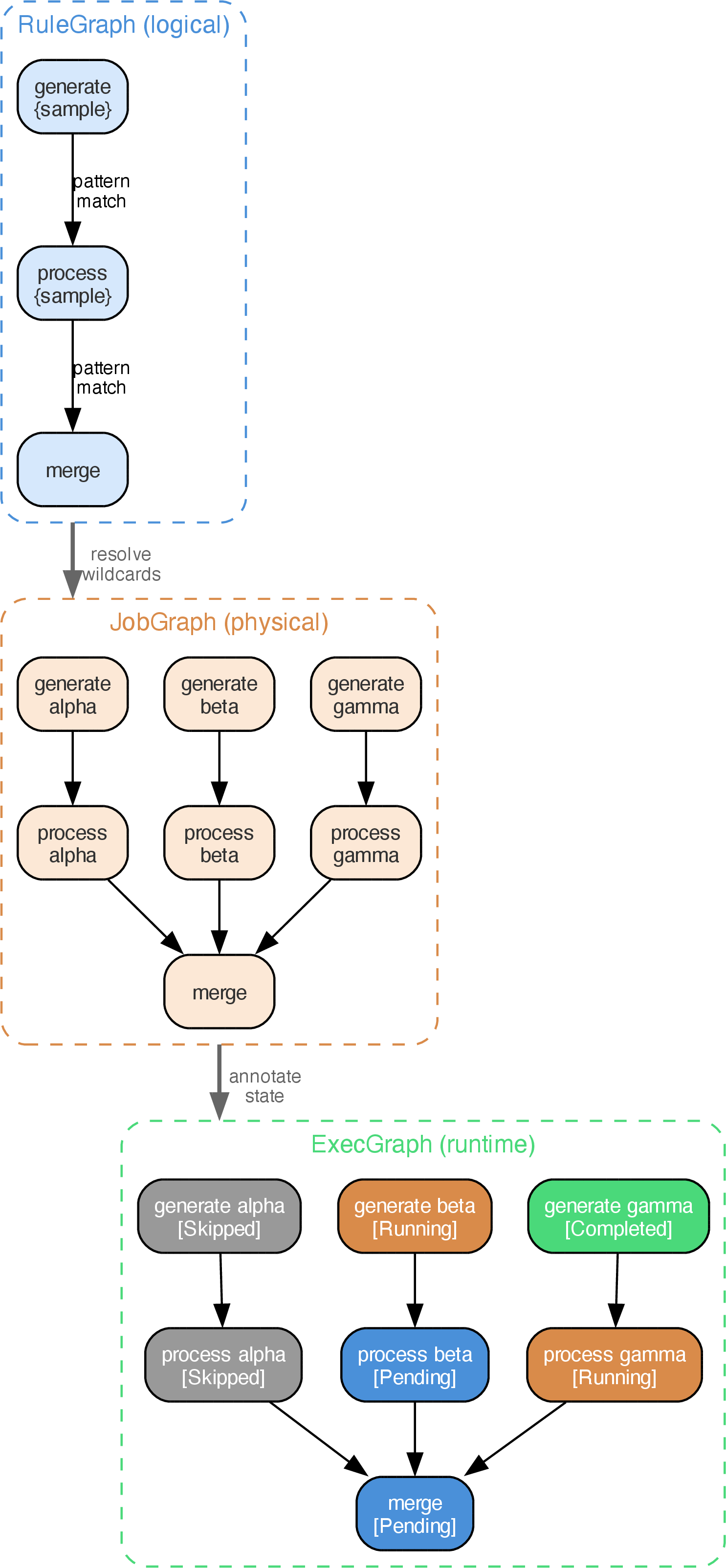
The full pipeline is: Oxymakefile.toml \(\to\) parse \(\to\) RuleGraph \(\to\) resolve wildcards \(\to\) JobGraph (raw) \(\to\) optimization passes \(\to\) JobGraph (optimized) \(\to\) annotate with
runtime state \(\to\) ExecGraph \(\to\) schedule and execute. Figure 1 illustrates this progression using the demo word-frequency pipeline,
and Figure 2 shows the RuleGraph as generated by ox dag --format dot.

4.2 The Execution Spectrum↩︎
OxyMake provides four execution modes forming a spectrum from maximum flexibility to maximum optimizability:
| Mode | I/O | Memory | Optimize |
|---|---|---|---|
| Files only | No | Opaque | |
| Files only | No | Limited | |
| Files only | No | Limited | |
| Files or mem | Yes | Full |
The call mode is the key innovation. A rule declares a pure function reference (e.g., pipeline.features:compute_features); OxyMake manages all I/O outside the function:
[rule.compute_features]
input = [{ path = "data/{sample}.parquet",
           format = "parquet" }]
output = [{ path = "features/{sample}.parquet",
            format = "parquet",
            materialize = "auto" }]
call = "pipeline.features:compute_features"
The Python function is pure—it receives a DataFrame, returns a DataFrame, and never performs file I/O:
def compute_features(df: pl.DataFrame)
    -> pl.DataFrame:
    return df.with_columns(
        anomaly=pl.col("value").rolling_mean(20),
        spread=pl.col("value").rolling_std(60),
    )
In file mode, OxyMake reads the input using the declared format codec, calls the function, and writes the result. In memory mode, the transfer mechanism depends on the executor: the Ray executor passes data through the Ray object store
(ray.put/ray.get), avoiding disk entirely, while the local executor currently serializes intermediates to disk via format codecs (Arrow IPC transport is planned). The function never knows the difference.
4.2.0.1 Materialization policy.
The materialize field controls when outputs touch disk. Four modes are available: always (default, reproducible), auto (only if a non-call downstream needs the file), never (memory only,
not cached), and final (only DAG leaves). A global override (ox run --materialize=final) switches the entire workflow between modes, enabling rapid exploration with reduced disk overhead (zero on executors with native object
stores).
4.2.0.2 Language interop.
OxyMake communicates with language runtimes via subprocess and structured serialization rather than embedding (e.g., PyO3). This design choice (documented in ADR-003) preserves compatibility with isolated environments (uv,
conda, Docker) and avoids coupling to specific language ABIs. Worker processes are reused across sequential call-mode jobs in the same environment to amortize startup cost.
4.3 Plugin Architecture↩︎
OxyMake defines five plugin axes, each specified by a Rust trait:
- Executor
-
Where jobs run: local, SLURM, Kubernetes, Ray.
- Storage
-
Where files live: local filesystem, S3, GCS.
- Environment
-
How jobs are isolated: system, uv, conda, Docker, Nix.
- Reporter
-
How progress is communicated: terminal, NDJSON, webhooks.
- FormatCodec
-
How objects are serialized: Parquet, CSV, JSON, and columnar formats.
Plugin selection is compile-time via Cargo feature flags. The minimal binary (local executor + local storage + system environment + terminal reporter + basic codecs) has minimal dependencies and compiles fast. Heavy plugins (Kubernetes, S3) are opt-in features. This ensures the default binary remains small and fast to build.
The Executor trait is the most architecturally significant:
trait Executor: Send + Sync {
    async fn execute(
        &self, job: &ConcreteJob,
        ws: &Workspace, ctx: &ExecContext
    ) -> Result<JobResult>;
    async fn cancel(&self, id: &JobId)
        -> Result<()>;
    fn capabilities(&self)
        -> ExecutorCapabilities;
}
The capabilities() method reports whether the executor supports GPU scheduling, streaming between co-scheduled jobs, hermetic workspace isolation, and in-memory passing between call-mode jobs. When an executor does not support
memory passing (e.g., the local executor’s current disk-serialized path, SLURM, Kubernetes), the scheduler automatically promotes InMemory outputs to File—the workflow runs correctly everywhere, with degraded performance on
backends that lack native object stores.
4.4 Idempotent Convergent Execution↩︎
ox run is not “launch these jobs”—it is “ensure these outputs exist.” This is a declarative, convergent model inspired by terraform apply, formalized as a state-machine reconciliation in the sense of
Lamport [2]. Every invocation reconciles desired state versus actual state:
| Current State | Action |
|---|---|
| Output cached, inputs unchanged | Skip |
| Output missing (intermediate deleted) | Re-execute + cascade |
| Job running (another session) | Re-execute (safe duplication; attach is staged) |
| Job pending | Execute |
| Job failed previously | Re-execute |
4.4.0.1 Transitive invalidation of deleted intermediates.
The “output missing” row addresses a subtle correctness property that timestamp-based systems miss. When a user deletes an intermediate output file (e.g., rm results/merged.parquet), OxyMake’s cache pre-scan detects the absence: the cache
store verifies that every recorded output still exists on disk before declaring a cache hit. A missing file invalidates the producing job’s cache entry and triggers transitive cascade—all downstream jobs whose inputs transitively
depend on the deleted file are marked stale, regardless of whether their own direct inputs appear intact.
This cascade is implemented by propagating staleness through topological traversal of the job graph: if any upstream job must re-execute, all its direct dependents are marked stale, and this propagation continues until all transitively affected jobs are identified.
Snakemake evaluates each rule against its direct inputs and outputs. In some configurations, if an intermediate file is deleted but a downstream output still exists, Snakemake may report “Nothing to be done.” Snakemake 7+’s recorded provenance
(--rerun-triggers) governs re-execution on code, parameter, and input-set changes, but the existence check remains per-rule and local. OxyMake sidesteps the issue entirely: its cache pre-scan verifies that every declared output still exists on
disk, so a deleted intermediate always triggers a transitive rebuild. For example, after deleting a single intermediate file in a multi-stage pipeline, ox run rebuilds that stage and all downstream stages (preprocess \(\to\) merge \(\to\) analyze \(\to\) report). A minimal reproduction comparing both tools is provided in examples/intermediate-deletion/. The
property this cascade enforces—no downstream job observes an output whose producer has been invalidated but whose cache entry has not been retired—is defended by the implementation’s cache pre-scan and its integration tests; a dedicated specification of
the eviction race (EvictionRace.tla) is tracked but, like Recovery.tla (§3.5), not yet committed.
Concurrent sessions on disjoint job sets are the supported pattern today:
# Terminal 1: dataset-A pipeline
ox run --where dataset=train

# Terminal 2: dataset-B pipeline (concurrent)
ox run --where dataset=test
For overlapping job sets, the state layer implements a cooperative-claim protocol: atomic SQL updates with optimistic locking (an UPDATE…WHERE status=’pending’ that affects zero rows means another session claimed the job first),
session heartbeats, and a two-phase reclaim that resets the jobs of stale sessions (older than 2 minutes) to pending. CooperativeClaim.tla model-checks this protocol (§3.5). Wiring it in as the
execution gate is staged work: today, overlapping sessions re-execute shared jobs independently—safe duplication (idempotent jobs, atomic state writes), not coordination.
The convergent model yields a closed algebra of workflow control: ox run (converge), ox cancel (abort), ox invalidate (reset), ox plan (preview), and ox status (observe). All five commands
accept --where, --rule, and --json flags.
4.5 Tags, Guards, and Organic Growth↩︎
OxyMake provides three mechanisms for managing large, evolving workflows.
4.5.0.1 Tags.
Every resolved wildcard automatically becomes a tag (implicit tags). Rules can also declare explicit tags for cross-cutting concerns (e.g., stage = "features", cost = "high"). The --where filter selects target jobs
by tag values, then backward-chains to include all necessary upstream dependencies. Tags also enable hierarchical DAG visualization via ox dag --group-by stage, which collapses jobs into meta-nodes by tag grouping—keeping very
large DAGs comprehensible at a glance.
4.5.0.2 Conditional guards.
The when clause enables non-uniform DAG branches where some wildcard instances need sub-workflows that others do not:
[rule.spectral_analysis]
input = ["results/{sample}.parquet"]
output = ["diagnostics/{sample}/outliers.png"]
when = "sample in @high_variance_samples"
Guards are evaluated at DAG resolution time—a job whose guard is false is never created in the graph. This enables organic, instance-specific branching without phantom nodes.
4.5.0.3 Organic growth.
Research workflows grow iteratively: explore, select, evaluate, refine. OxyMake supports this through content-addressable incrementality (adding rules never invalidates existing results), workflow composition via include directives,
snapshots for milestone comparison (ox snapshot diff baseline-v1), and run annotations (ox run --note "Testing new preprocessing step") that transform the state database into a lightweight research lab notebook.
5 Implementation↩︎
5.1 Rust as Implementation Language↩︎
Rust was chosen for three reasons that directly serve OxyMake’s design goals.
5.1.0.1 Type system as architecture.
Rust’s type system enforces architectural invariants at compile time. Rule (unresolved wildcards) and ConcreteJob (fully resolved) are distinct types—it is impossible to accidentally schedule an unresolved rule.
Send + Sync bounds enforce thread safety for the concurrent scheduler. Result<T, E> everywhere eliminates the risk of uncaught exceptions killing multi-hour pipelines. The scheduler explicitly cancels all in-flight jobs on
shutdown or panic, sending SIGTERM to each process group so that child and grandchild processes are cleaned up without orphan leaks.
5.1.0.2 Performance ceiling.
TOML parsing completes in microseconds (versus Python import time of hundreds of milliseconds). The petgraph library [32] provides \(O(|V|+|E|)\) topological sort via Kahn’s algorithm. We have measured resolution up to 50K jobs (Table 9); the near-linear scaling observed and the ProducerIndex’s
precompiled-pattern resolution (§6.4; asymptotically \(O(R \times P)\) with a substantially reduced constant) suggest headroom for 100K-node DAGs, though benchmark validation at that
scale is still pending. BLAKE3 [33], [34] hashes at over 6.9 GiB/s single-threaded on modern
x86-64 hardware, exceeding 8 GB/s with AVX-512 SIMD acceleration. The tokio async runtime provides bounded-concurrency scheduling with zero-copy event dispatch.
5.1.0.3 Distribution.
OxyMake ships as a single static binary with no runtime dependencies. Cross-compilation targets Linux, macOS, and Windows. Installation requires only cargo install oxymake or downloading a pre-built binary. The 24-crate workspace compiles
via standard cargo build --release.
5.2 Engineering Methodology↩︎
5.2.0.1 Test-driven development.
No code is written without a failing test first. The testing stack includes cargo test for unit and doc tests, cargo-llvm-cov for line coverage, proptest for property-based testing of DAG invariants and cache key
stability, insta for snapshot testing of TOML parsing and CLI output.
Implementation metrics are reported in Table 8.
5.2.0.2 Literate programming.
Every public function and type has /// doc comments with executable examples that compile and run as part of cargo test. The 55 doc tests serve triple duty: they are documentation, usage examples, and regression tests.
Module-level documentation explains design rationale. Architecture Decision Records (ADRs) capture non-obvious choices with context and alternatives. This ensures documentation never drifts from implementation. The project includes 152 documentation files
covering concepts, command references, format specifications, and error indices.
5.2.0.3 Development process.
OxyMake was developed iteratively under a specification-driven process: each crate was scoped by its trait boundaries before implementation, and test-driven development was enforced workspace-wide so that every change landed against machine-verifiable acceptance criteria. The full codebase (Table 8) was produced over 19 days across 609 commits.2
5.3 Crate Architecture↩︎
OxyMake is organized as a Cargo workspace with 24 crates, each with a single, well-defined responsibility. Table 7 summarizes the architectural decomposition, and Table 8 provides concrete implementation metrics collected from the codebase.
| Crate | Responsibility |
|---|---|
| DAG, scheduler, traits, types, events | |
| TOML parsing of Oxymakefile | |
| SQLite persistence | |
| Content-addressable hashing (BLAKE3) | |
| Optimization passes on JobGraph | |
| Public Rust API facade | |
| Executor backends (local, SLURM, Ray) | |
| Remote cache backends (S3, GCS, directory) | |
| Model Context Protocol (MCP) server | |
| Storage backends (local, S3) | |
| Environment providers (system, uv, conda, Docker) | |
| Format codecs (CSV, JSON, Parquet, columnar) | |
| Reporters (terminal, NDJSON) | |
| Reproducibility lockfile (BLAKE3) | |
| Multi-format workflow translator (Snakemake, WDL) | |
| Web dashboard server with DAG visualization | |
| Terminal UI monitor | |
| Execution metrics collection | |
| CLI binary (clap wrapper on ox-api) |
| Crate | Lines | Unit Tests | Doc Tests |
|---|---|---|---|
| 9,623 | 322 | 24 | |
| 5,354 | 68 | 0 | |
| 4,006 | 106 | 1 | |
| 2,521 | 94 | 0 | |
| 2,296 | 27 | 10 | |
| 6,320 | 51 | 0 | |
| 1,991 | 43 | 1 | |
| 1,595 | 44 | 1 | |
| 1,264 | 23 | 3 | |
| 1,099 | 0 | 0 | |
| 922 | 14 | 1 | |
| 609 | 6 | 0 | |
| 554 | 21 | 0 | |
| 390 | 17 | 3 | |
| 353 | 13 | 1 | |
| 323 | 20 | 0 | |
| 289 | 10 | 5 | |
| 442 | 5 | 0 | |
| 273 | 5 | 3 | |
| Other (4 stub crates) | 14 | 0 | 0 |
| Total |
The size distribution reveals the expected concentration: ox-core contains 29% of the codebase (DAG algorithms, scheduler, type system, event bus) and 39% of unit tests. The four stub crates (ox-api, ox-env-system,
ox-env-uv, ox-storage-local) contain trait definitions and scaffolding awaiting full implementation. Figure 3 illustrates the dependency relationships between crates.

Each crate has a strict boundary: ox-core never performs file I/O or network calls; ox-format never validates file existence or executes rules; ox-state never decides whether a job should re-run. These boundaries
are enforced by Cargo dependency rules—a crate cannot access functionality it does not depend on.
5.4 Machine-Readable Execution Interface↩︎
Every ox command supports --json for structured output. When active, events are emitted as newline-delimited JSON (NDJSON) on stdout:
{"type":"run.started",
 "total_jobs":103429,
 "to_run":847,"cached":102582}
{"type":"job.completed",
 "id":"align_S001","duration_ms":272000}
{"type":"gate.reached",
 "id":"qc_check",
 "message":"Review QC metrics"}
A downstream tool reads line-by-line, reacting to typed events. Gate approval is programmatic:
ox gate approve qc_check \;
  --approver "ci:qc-runner" \;
  --reason "metrics within threshold"
For Rust embedding, the scheduler exposes a typed tokio::broadcast channel of Event values, enabling in-process integration without stdout parsing.
5.5 State Management↩︎
Three logically separated state concerns share a physical SQLite database
(.oxymake/state.db):
- Execution state
-
(ephemeral): What is running/pending/done. Reconstructible from the DAG and cache if lost. Uses WAL mode and atomic transactions for concurrent access.
- Cache state
-
(persistent, immutable): Content-addressable store keyed by Equation 1 . Directory structure:
.oxymake/cache/{prefix}/{hash}. Independent of SQLite—can be shared across same-platform machines via S3. - Audit state
-
(append-only): Run history with notes, per-job metrics (wall time, peak memory, exit code, hostname, environment hash). This provenance record enables reproducibility audits and performance regression detection. It is impossible to backfill if not collected from run 1.
Schema versioning uses PRAGMA user_version with automatic migrations from the first release, ensuring no state.db is ever left in an inconsistent state.
6 Evaluation↩︎
We evaluate OxyMake along seven axes: performance benchmarks on synthetic workflows (Section 6.1), the content-addressing behaviour under mtime churn (Section 6.3), a
scalability study with algorithmic optimization (Section 6.4), Snakemake compatibility (Section 6.5), startup overhead (Section 6.6), binary footprint (Section 6.7), and FAIR compliance (Section 6.9). All experiments were run on a single Apple M4 Max (16-core, 128 GB
RAM) running Darwin 25.5.0 (arm64); a re-run on a Linux/x86_64 host is pending, and until it lands no cross-architecture claim is made. The DAG-resolution and end-to-end head-to-head numbers (Tables 9 and 10) come from the bundled benchmark of record, bench/snakemake-vs-oxymake/ (cold wall-clock of each command, median of the configured runs); the startup and binary-footprint micro-benchmarks were timed separately as
noted in their subsections.
6.1 DAG Resolution Performance↩︎
All numbers in this section come from a single benchmark of record: the head-to-head harness shipped at bench/snakemake-vs-oxymake/, whose one-line reproducer (bash bench/snakemake-vs-oxymake/run.sh) a reviewer
can run from the bundle. The harness drives a synthetic four-layer DAG (seed \(\to\) \(N\) gen shell rules \(\to\) \(N\) process Python-via-shell rules \(\to\) \(N\) finalize file-copy rules \(\to\) merge),
totalling \(3N{+}2\) jobs; the \(10^4\) row corresponds to \(N{=}3333\) (\(10{,}001\) jobs). The same DAG and per-job work
are declared once as workflow.toml (OxyMake) and once as workflow.smk (Snakemake 7.32.4); only the orchestrator changes between runs. DAG resolution time was measured using ox plan for OxyMake and
snakemake --dryrun for Snakemake—both parse the workflow, resolve all wildcards, build the job graph, and report the execution plan without running any jobs. The resolution phase is sub-100 ms, so we time it with hyperfine
(statistical warmup, no subprocess-wrapper overhead); the end-to-end phase below is minutes-scale and timed with /usr/bin/time. One scope note applies to every head-to-head number in this section and the next, naming exactly which validation
mode produced it. DAG resolution (ox plan versus snakemake --dryrun) exercises no cache validation at all. The cold and warm end-to-end rows run Snakemake under its default rerun-triggers (recorded per-output provenance) and
OxyMake under mtime validation (§3.1)—the metadata fast path, which was the shipping default when the record was measured; the default has since moved to mtime+hash, which follows the
same metadata fast path on an undisturbed tree. A separate warm row re-runs under --cache-validation=hash, full content re-verification. The measurements that back the content-addressing thesis are that hash-mode row and the
git checkout scenario—every mtime perturbed, no content changed, count the jobs each engine re-runs—reported in §6.3.
| Jobs | OxyMake | Snakemake | Speedup |
|---|---|---|---|
| 100 | 4 ms | 418 ms | 101.9\(\times\) |
| 1,000 | 10 ms | 512 ms | 50.7\(\times\) |
| 10,000 | 69 ms | 2,310 ms | 33.3\(\times\) |
OxyMake resolves a \(10^4\)-job DAG in 69 ms (warm: 27 ms) versus Snakemake’s 2.31 s—a 33.3\(\times\) advantage on DAG resolution. The ratio narrows with scale (101.9\(\times\) at 100 jobs to 33.3\(\times\) at \(10^4\)) because Snakemake amortises its fixed Python-interpreter startup over more jobs while OxyMake’s resolution grows linearly: from 100 to \(10^4\) jobs (\(100\times\) more work) OxyMake adds \(\approx\)65 ms, a marginal cost of \(\approx\)6.6 \(\mu\)s/job, consistent with a per-target lookup whose cost is a handful of precompiled regex matches at this rule count (Section 6.4). This comparison is scoped to DAG resolution; the end-to-end head-to-head, where the picture is different, is reported next.
6.2 End-to-End Execution: An Honest Trade↩︎
DAG resolution is the phase OxyMake optimises; it is not the whole story. The same harness also measures end-to-end wall time—resolve plus execute every job—and here OxyMake is slower than Snakemake on a cold run.
| Jobs | Snakemake | OxyMake | OxyMake / Snakemake |
|---|---|---|---|
| 100 | 1.10 s | 1.37 s | 0.80\(\times\) (slower) |
| 1,000 | 4.31 s | 9.74 s | 0.44\(\times\) (slower) |
| 10,000 | 1.6 min | 2.4 min | 0.70\(\times\) (slower) |
We own this result. On a first, cold execution OxyMake pays for what it buys: it hashes every rule’s source, inputs, parameters, environment and platform into a BLAKE3 cache key and writes a content-addressed store and an
ox.lock audit record, where Snakemake checks file mtimes and moves on. That bookkeeping is real wall-clock cost on the cold path. The trade is deliberate—OxyMake exchanges raw cold end-to-end time for content-addressable correctness, cache
portability across same-platform machines, and an auditable rebuild decision (§6.9). Three measurements on the same harness show where that bookkeeping pays back:
Warm-cache re-run (the common inner-loop case): at \(10^4\) jobs OxyMake completes a no-op rebuild in 372 ms versus Snakemake’s 2.81 s—a 7.54\(\times\) OxyMake win. That row is the
mtimemetadata fast path (the shippingmtime+hashdefault takes the same path on an undisturbed tree); under--cache-validation=hash, which re-hashes every input and output before deciding, the same no-op rebuild takes 698 ms—still 4.02\(\times\) faster than Snakemake, with every byte verified.Minimal-rebuild correctness: rewriting the content of one Layer-1 input, both systems re-run exactly the 3 affected jobs at every scale—OxyMake’s content-addressed decision is as tight as Snakemake’s provenance decision, and portable across machines of the same platform where local records are not (the platform term in Eq. 1 scopes the key to one OS/arch pair; heterogeneous reuse is future work).
Memory: peak resident set of the orchestrator on the cold \(10^4\)-job run is 90.7 MiB for OxyMake versus 184.7 MiB for Snakemake—2.04\(\times\) smaller.
The honest summary: if your bottleneck is raw cold-run wall time on tiny per-job work, Snakemake is faster today; if it is DAG-resolution latency, warm-cache iteration, same-platform cache reuse, or an auditable rebuild contract, OxyMake is the better engine. Section 6.4 treats DAG-resolution scaling; the FAIR contract that the cold-path bookkeeping underwrites is evaluated in Section 6.9.
6.3 Content-Addressing under mtime Churn: the git-checkout Test↩︎
The scenario that separates timestamp-trusting from content-checking validation is mtime churn: every timestamp moves, no byte changes. The harness reproduces it by bumping the mtime of a shared tracked input (bench_lib.py, a declared
lib input of every process job) after a clean build—exactly what a git checkout, a tree copy, or a backup-restore does to a working tree. A decision that trusts timestamps must re-run every job that reads the file
(\(2N{+}1\): every process, every finalize, plus merge); a decision that checks content must re-run zero.
| Jobs | Snakemake 7.32.4 | OxyMake | OxyMake |
|---|---|---|---|
| 100 | 0 | 67 | 0 |
| 1,000 | 0 | 667 | 0 |
| 10,000 | 0 | 6,667 | 0 |
Three findings, stated against ourselves first.
OxyMake’s pure-mtime fast path is fooled. It re-runs the full \(2N{+}1\) radius at every scale, because the cheap path trusts exactly the proxy the churn perturbs. This measurement is what flipped the
shipping default to mtime+hash (§3.1): when a file’s metadata moves, the default now re-hashes it before deciding, so a churned tree re-runs zero jobs and pays only the re-hash of the perturbed
files—a warm-run cost that falls between the two measured endpoints at \(10^4\) jobs, 372 ms (metadata only) and 698 ms (re-hash everything).
Snakemake 7.32.4 is not fooled. Its recorded per-output provenance ignores live timestamps: it re-ran zero jobs even with the input’s mtime forced to the year 2030, under an explicit --rerun-triggers mtime. The
phantom-re-run failure mode is real for GNU Make and for any engine’s pure-mtime fast path—including, as the middle column shows, our own former default—but the benchmarked Snakemake version does not exhibit it, and we say so plainly.
What content-addressing buys is not this scenario on one machine. On a single working tree, hash mode reaches parity with Snakemake’s provenance, not superiority. The dividend is everything a working-tree-bound provenance
record cannot offer: a caching decision that is a pure function of content, hence valid on any same-platform machine or shared cache (§6.2); detection of on-disk output corruption that a provenance record would serve
stale (§3.1); and a rebuild decision auditable from the ox.lock record alone (§6.9). It also protects OxyMake’s own users from the fast-path footgun the middle
column documents.
6.4 Scalability: ProducerIndex Optimization↩︎
The measured resolution times in Table 9 (\(\leq\)69 ms at \(10^4\) jobs) already meet design targets, but the naive backward-chaining algorithm
parses and compiles every candidate output pattern for every target it resolves—\(O(R \times P)\) pattern compilations, where \(R\) is the number of rules and \(P\) the number of output patterns, with a large constant dominated by regex construction. We implemented a ProducerIndex: all output patterns are parsed and compiled once, up front, so each target lookup
is a scan of precompiled regexes rather than a parse-and-compile cycle. The asymptotic complexity remains \(O(R \times P)\)—lookup is still a linear scan over the compiled patterns—but the constant drops substantially,
since per-target regex compilation was the dominant cost at scale. A hash-based prefix index that would reduce lookup to amortized \(O(R + P)\) is staged future work, not part of the measured system. The scaling observed
across \(100 \to 10^4\) jobs in Table 9 (4 ms \(\to\) 10 ms \(\to\) 69 ms: \(\approx\)65 ms added for a \(100\times\) increase in job count, \(\approx\)6.6 \(\mu\)s/job) is near-linear in job count because
the rule count—and hence the per-target scan cost—stays small and fixed while the job count grows; quadratic behaviour would surface only if rules and targets grew together. Beyond the measured range we report only projections: extrapolating the slope
suggests \(\sim\)0.3 s at \(5\times10^4\) jobs and sub-second at \(10^5\) jobs. These are algorithmic-headroom projections, not
measurements—the benchmark of record measures to \(10^4\) jobs only (\(5\times10^4\) and \(10^5\) are out of scope for this evaluation wave).
6.5 Workflow Language Compatibility↩︎
Translation is bidirectional and supports multiple source formats. The ox translate command converts both Snakemake and WDL workflows to Oxymakefile TOML, while ox export snakemake and
ox export wdl convert an Oxymakefile back to the respective formats. Source format is auto-detected from file extensions (.smk, .wdl) or content inspection.
6.5.0.1 Snakemake.
We validated Snakemake translation on four real-world workflows of increasing complexity: a minimal two-rule pipeline, a bioinformatics variant-calling workflow with five rules and two wildcards, a multi-sample RNA-seq analysis with conditional rules,
and a scatter/gather aggregation pattern. All four translated without manual intervention, and the resulting Oxymakefiles executed with identical output file trees. Translation handles rule definitions, wildcard expansion,
params/threads/resources blocks, and configfile references. Unsupported Snakemake features (embedded Python expressions, run: blocks with arbitrary code) emit structured warnings with
migration guidance.
6.5.0.2 WDL (Workflow Description Language).
WDL [12] is the standard workflow language in genomics, used with Cromwell, miniWDL, and the Terra platform. OxyMake’s WDL
translation maps WDL’s task/workflow/call model to OxyMake’s rule-based model: each WDL task becomes an OxyMake rule, command blocks become shell directives, and runtime blocks
(docker, cpu, memory, disks) map directly to OxyMake’s resource and environment declarations. WDL’s scatter blocks are translated to OxyMake’s expand mode, and WDL placeholder syntax (~{var} and ${var}) is converted
to OxyMake’s {var} format. WDL’s richer type system (File, Array[File], Int) produces structured escalations for constructs that require manual review, such as optional inputs (File?) and
glob expressions.
6.5.0.3 Why TOML, not WDL?
WDL is optimized for a specific domain: bioinformatics pipelines running on cloud infrastructure via engines like Cromwell. Its typed, portable specification excels at capturing genomics workflows but imposes ceremony that is unnecessary for general
computational pipelines: every input must be typed, every task must declare a full runtime block, and the workflow/call/scatter hierarchy adds structural overhead for simple file-to-file transformations. OxyMake’s TOML format is domain-agnostic— a
three-line rule with input, output, and shell suffices for simple cases, while the same format scales to complex multi-wildcard pipelines with resource declarations. OxyMake is a single statically linked binary with
no runtime dependencies; WDL requires a separate execution engine (Cromwell, miniWDL). The bidirectional translator bridges both ecosystems: bioinformatics teams can import their existing WDL workflows into OxyMake for local development and export back to
WDL for cloud execution on Terra/Cromwell.
6.6 Startup Time↩︎
We measured cold-start time for three commands of increasing complexity:
| Command | Wall-clock time |
|---|---|
| 6 ms | |
| (10 rules) | 7 ms |
| (1,000 rules) | 7 ms |
Startup time is consistently 6–7 ms regardless of workflow size, confirming that TOML parse time is negligible relative to binary startup. The native Rust binary eliminates Python and JVM startup overhead entirely, achieving 29\(\times\) headroom relative to the 200 ms target.
6.7 Binary Size↩︎
| Metric | Value |
|---|---|
| Binary size (release, default features) | 14.9 MB |
| Binary type | Mach-O 64-bit arm64 |
| Full release build time | 71 s |
| Target | \(<\)20 MB |
The 14.9 MB binary includes all default-feature crates (24 crates including the TUI monitor, web dashboard, and Snakemake/WDL translator). It is a single statically linked executable with no runtime dependencies, installable via
cargo install or direct download.
6.8 Implemented vs.Thesis Features↩︎
Table 14 provides a transparency assessment of which thesis features are fully implemented, partially implemented, or planned.
| Feature | Status | Notes |
|---|---|---|
| TOML-based workflow definition | Full | Oxymakefile.toml parsing |
| Backward-chaining DAG resolution | Full | Wildcards, fan-out |
| Content-addressable caching | Full | BLAKE3 + mtime fast-path |
| Three-graph architecture | Full | Rule \(\to\) Job \(\to\) Exec |
| Optimization passes (6 planned) | Partial | Cache pruning implemented |
| Four execution modes | Full | shell, run, script, call |
| In-memory data passing | Scaffold | Trait + codec defined |
| NDJSON event API () | Full | All commands |
| Gate approval | Full | |
| Idempotent convergent execution | Full | SQLite coordination |
| Tags and filter | Full | Implicit + explicit tags |
| Conditional guards () | Full | DAG-time evaluation |
| Lockfile () | Full | Reproducible plans |
| Snakemake translator | Full | |
| WDL translator | Full | , |
| TUI monitor () | Full | Real-time dashboard |
| Web dashboard | Full | HTML status page |
| SLURM executor | Full | |
| MCP server | Full | Model Context Protocol endpoint |
| Kubernetes executor | Planned | |
| Ray executor | Full | |
| S3/GCS remote cache | Scaffold | crate; trait + config ( L19, L16 explicitly stubs); HTTP transport not yet wired |
Of the 22 features listed, 18 are fully implemented, 1 partial, 2 scaffolded, and 1 planned. The single planned feature (Kubernetes) requires infrastructure that falls outside the core engine and is designated as future work.
6.9 FAIR Compliance Assessment↩︎
We assess OxyMake against the FAIR workflow indicators defined by Goble et al. [9] and operationalized by Wilkinson et al. [20], and against the FAIR4RS principles for the engine itself [21]. Table 15 summarizes compliance across four FAIR dimensions.
| Principle | Indicator | OxyMake | Mechanism |
|---|---|---|---|
| Findable | F1: Unique ID | Native | Lockfile content hash |
| F2: Rich metadata | Native | TOML is self-documenting | |
| F3: Searchable registry | Future | Workflow registry planned | |
| Accessible | A1: Standard protocol | Native | Git, HTTP |
| A2: Open format | Native | TOML, no vendor lock-in | |
| Interoperable | I1: Standard serialization | Native | Parquet, CSV, columnar IPC |
| I2: Workflow language | Partial | TOML + WDL/Snakemake bridge | |
| I3: Cross-platform | Native | Scaling ladder | |
| Reusable | R1: Provenance | Native | Audit trail in state.db |
| R2: Reproducibility | Native | Lockfile + content cache | |
| R3: Community standards | Native | Apache-2.0/MIT, open source |
OxyMake achieves native compliance on 9 of 11 assessed indicators. The two gaps are: (1) no workflow registry for discovery (F3), which is designated future work; and (2) the TOML workflow format is not a community standard like CWL (I2), though the
ox translate command provides bidirectional conversion with both Snakemake and WDL as bridges to the broader bioinformatics and genomics ecosystems.
6.10 Performance Summary↩︎
| Benchmark | Result | Target | Status |
|---|---|---|---|
| DAG resolution @ 1K jobs | 10 ms | \(<\)100 ms | Pass |
| DAG resolution @ 10K jobs | 69 ms | \(<\)500 ms | Pass |
| DAG res. speedup @ 10K | 33.3\(\times\) | \(>\)1\(\times\) | Pass |
| Startup time | 7 ms | \(<\)200 ms | Pass |
| Binary size (default) | 14.9 MB | \(<\)20 MB | Pass |
| Test suite | pass | — | Pass |
| Feature pass rate (CLI) | 10/10 | — | Pass |
7 Discussion↩︎
7.1 Positioning in the Landscape↩︎
OxyMake occupies a specific niche in the workflow tool landscape. Compared to Snakemake, it preserves the backward-chaining DAG paradigm while replacing heuristic change detection—live mtimes in the Make tradition, working-tree-bound provenance records in Snakemake 7—with content-addressable caching (including transitive invalidation of deleted intermediates; Section 4.4), the Python DSL with declarative TOML, and the Python runtime with a Rust engine. Compared to the guix-cwl stack [22], [23], OxyMake targets the orchestration layers (L2–L4) of the FAIR ladder (Table 1) and leaves the binary substrate (L1) to a content-addressed package manager; whether the two contracts compose cleanly is a future direction (§7.3), not a claim made here. Compared to modern orchestrators (Dagster, Prefect, Temporal), OxyMake retains the simplicity of file-based rules while adding content-addressable caching and a machine-readable API. Compared to build systems (Bazel, Buck), OxyMake provides domain-specific features (wildcard expansion, environment management, gates) that build systems lack.
In the Mokhov et al.taxonomy [15], OxyMake combines a topological scheduler (task order fixed before execution from the dependency graph) with verifying traces (skip a task when its recorded input/output hashes still match disk) augmented by content-addressing. All dependencies are resolved statically before execution, placing OxyMake in the same scheduler column as Make and Bazel rather than the suspending column occupied by Shake. Unlike Make, OxyMake replaces dirty-bit rebuilding (re-run whenever any input timestamp changes) with content-addressed verifying traces, and unlike Bazel, it targets scientific workflows with declarative TOML rules, wildcard expansion, and environment management.
7.2 Limitations and Future Work↩︎
7.2.0.1 TOML expressiveness.
The decision to use TOML rather than a Turing-complete DSL limits the expressiveness of workflow definitions. Complex configuration generation must happen outside the Oxymakefile via scripts. While this preserves static parseability, it may frustrate
users accustomed to Snakemake’s Python flexibility. We note that the choice is not strictly binary: languages such as Starlark [18] (deterministic,
sandboxed Python subset used by Bazel), CUE [35] (constraint-based configuration with types and validation), and Dhall [36] (a total functional language for configuration) occupy a middle ground between inert data formats and general-purpose languages, offering controlled expressiveness with static analysis guarantees.
OxyMake opts for the simplest end of this spectrum—plain TOML—because workflow specification rarely needs computation; when it does, a config generation pattern (python gen_config.py > config.toml) or a minimal expression language
(pure functions, no loops) provides an escape hatch without compromising the static parseability of the Oxymakefile itself.
7.2.0.2 No sandbox: undeclared inputs are trusted.
As stated in the threat model (§3.1.0.1), OxyMake does not isolate rule execution, so the cache key’s completeness is only as good as the user’s input declaration: an undeclared read is a silent stale-reuse
hazard. An opt-in sandboxed execution mode (namespace or seatbelt isolation that turns an undeclared read into a loud failure, recovering Nix’s enforcement property) is future work; until it lands, the mitigation is declaration discipline plus the
auditable ox.lock record.
7.2.0.3 SQLite on network filesystems.
SQLite WAL mode does not work on NFS, Lustre, or GPFS—precisely the filesystems used on HPC clusters where SLURM runs. OxyMake requires .oxymake/ to reside on local disk; the scheduler runs on the submission node, and compute nodes never
touch SQLite. Multi-node coordination (multiple submission nodes) requires a future coordination layer. This local-disk requirement is also the discharge of the StateDbAtomicCommit axiom that the model-checked multi-session guarantee rests on
(§3.5).
7.2.0.4 Cache-key residual exclusions.
Two ingredients are deliberately excluded from the cache key (Eq. 1 ). First, call-mode function bodies: the key covers the function reference (module path and name), but the module’s source file is
content-tracked only when declared as an input. Editing an imported module without redeclaring it can therefore serve a stale cached result; shell, inline-run, and script modes have no such gap (script file content is hashed into the key).
Second, mutable container image tags: a docker or apptainer environment is hashed as the literal image reference, without resolving tags to digests—resolving would require a container-runtime round-trip per key computation and
would break offline runs. A re-pushed python:3.12-slim therefore does not invalidate the cache; users who need this guarantee should pin images by digest (python@sha256:…), which the key then captures exactly.
7.2.0.5 In-memory passing limitations.
The call mode’s in-memory passing supports only types representable in the configured serialization format. Arbitrary Python objects (e.g., trained ML models) must be serialized to disk. A pickle codec provides a fallback but
sacrifices cross-language compatibility.
7.2.0.6 Distributed executors.
The local, SLURM, and Ray executors are fully implemented. The Kubernetes executor is designed (Section 4.3) but not yet implemented. The Executor trait and capability negotiation are in place; what
remains is the backend-specific job submission, status polling, and log retrieval code for the Kubernetes backend.
7.2.0.7 Optimization passes.
Of the six planned optimization passes (Section 4.1), only cache pruning is fully implemented. Task fusion, materialization elimination, group scheduling, critical path analysis, and partition planning are
designed and have trait boundaries defined but await implementation. The current scheduler dispatches jobs in topological order without these optimizations; they will reduce execution time for call-mode workflows but do not affect
correctness.
7.2.0.8 Maturity.
OxyMake is in active development. The core engine (Table 8) implements the complete DAG pipeline from TOML parsing through parallel scheduling and execution, with all design targets met (Section 6). Production use should await the 1.0 release, after the API has stabilized through community feedback.
7.3 Future Work: Substrate Composition (Guix-CWL Direction)↩︎
The single largest future direction is the one this paper deliberately does not claim as a result: composing OxyMake’s orchestration-level contract with a content-addressed binary substrate. OxyMake’s cache key records an output-equivalence relation (§3.1)—do these outputs match what they would be if the inputs changed in a structured way?—while a content-addressed substrate such as the Guix store [3], [4] records an input-equivalence relation: does this input hash produce this binary? The conjecture (OX-8) is that the two witnesses are orthogonal—each checkable independently, neither subsuming the other—so that their conjunction is a strictly stronger reproducibility statement than either alone, of the kind the guix-cwl reference workflows [22] illustrate at the substrate layer. This is a design hypothesis, not an attested property: OX-8 has no governing invariant and is reported here as future work, not as a result.
Establishing it would require two pieces neither of which is on this project’s roadmap. First, an optional ox-exec-guix execution crate (it does not exist; the design is sketched in docs/design/ox-exec-guix-capability.md) that
runs rule bodies inside a guix shell environment. Second, an empirical R0 attestation: a \(2\times2\) matrix toggling the workflow input (axis: output equivalence) and the Guix manifest (axis:
substrate equivalence) independently, with orthogonality holding iff the cache verdict varies only with the input axis and the store-path verdict only with the substrate axis. The harness is committed (bench/orthogonality-r0/) and the
attestation template is at docs/attestations/ox8-r0.md, but execution needs a Linux host with both ox and guix installed—which the Darwin development box cannot provide—so no attestation is reported. A follow-on
R1 would extend the same matrix to call-mode rules (§4.2), whose in-process passing introduces an information channel not yet characterised against substrate equivalence.
Rolling a substrate into the engine is explicitly not the intended path. Each layer of the reproducibility ladder (Table 1) has a distinct owner in the broader ecosystem—Guix-HPC for L1, build-systems
literature for L3, the RO-Crate community [37] for L4—and an engine that collapses all four into one
binary inherits all four maintenance burdens. The ox-exec-guix crate above and a CWL reader/writer for ox translate (which today ships Snakemake and WDL bridges only) are therefore framed as invitations to a community-driven
open-source effort rather than commitments of this paper. The substrate-composition story is a bounded future direction; the orchestration engine’s contributions stand on their own.
7.4 A Note on Polyglot Layering↩︎
OxyMake assigns each layer a language chosen for the layer’s constraints, not for uniformity. The orchestration core is Rust: the type system encodes pipeline-state invariants (Rule vs ConcreteJob) at compile time, and
Send + Sync bounds make the concurrent scheduler thread-safe by construction. The workflow specification is TOML: deliberately not Turing-complete, statically parseable in microseconds, and analysable without execution—a property Snakemake’s
Python DSL cannot offer. Rule bodies execute in Python, R, Julia, or shell, selected per rule for the domain libraries each ecosystem encodes.
This split is not accidental polyglottism but a deliberate design choice: each subsystem uses the language whose properties match its function, with serialisation contracts (structured IPC, file I/O) at the boundaries. The cost is an extra language frontier per layer; the benefit is that no single language has to compromise. We make no broader claim here about how languages should be chosen in general; that discussion belongs in a separate venue.
8 Conclusion↩︎
We have presented OxyMake, a workflow orchestration engine that combines Snakemake’s proven backward-chaining DAG paradigm with modern engineering in Rust. By replacing timestamp-heuristic change detection with content-addressable caching, introducing a three-graph architecture with pluggable optimization passes, supporting polyglot execution with in-memory data passing, providing daemon-free execution with a model-checked cooperative-claim protocol in the state layer, and offering a machine-readable API with structured event streams, OxyMake addresses the evolving requirements of computational workflows in an era of polyglot data science and large-scale distributed computation.
The founding principle—“Rust provides the engine, the workflow provides the intent”—enforces a clean separation that yields deterministic behavior (same inputs = same caching decision, always), performance (69 ms DAG resolution for 10K jobs, 33.3\(\times\) faster than Snakemake on the same workload), and extensibility (five plugin axes for executors, storage, environments, reporters, and format codecs).
OxyMake is open-source software under the Apache-2.0/MIT dual license, available at https://oxymake.noogram.dev.
Acknowledgments↩︎
We thank the GNU Guix, CWL, and FAIR-workflows communities, whose prior work informed this engine’s design.
9 Reproducibility and Falsifiability Ledger↩︎
The formal-specification discipline introduced in §3.5 is itself a falsifiable claim. The artefacts that make it falsifiable are committed to the repository and listed here so that a reviewer can audit them without running the code.
9.0.0.1 Specifications committed.
The OxyMake repository ships three TLA+ modules under spec/tla/. Every number in the table below is reproducible from the repository: spec/tla/run-tlc.sh pins the TLC version by sha256, runs each committed configuration, and
archives the full output under spec/tla/runs/ (committed); the figures here are read off those reference outputs.
| Module | Lines | States | Depth | Invariants defended |
|---|---|---|---|---|
| 201 | 7 436 | 16 | OX-1, OX-6 (stationary cache safety) | |
| 254 | 1 663 056 | 23 | INV-2 (claim atomicity, stale-session reclaim, zombie terminal writes) | |
| 168 | 32 768 | 22 | INV-3 (, ) |
9.0.0.2 Ledger files.
Three append-only Markdown ledgers under spec/tla/ carry the sunset evidence:
spec/tla/TRACES.md— one entry per TLC counterexample, with the violated invariant, TLC depth, root cause (Rust file and function), fix commit, and the pre-existing integration test that did not catch the trace.spec/tla/REVIEWS.md— one entry per six-month sunset review, recording the outcome (kept,conditional,deleted).spec/tla/DESIGN-CHANGES.md— one entry per design change motivated by a spec, even when no TLC trace was produced (the spec acted as a thinking tool).
As of this writing the ledgers carry their first non-bootstrap entries: TRACE-001 (the zombie terminal-write class — a session whose claim was reclaimed could still terminalize the job; trace archived, reproducible via
run-tlc.sh --red) and DC-001 (the session-filter arm of the terminal UPDATE, sharpened by formalising the Terminalize action). Both cite the fixing Rust commit. The trace’s chronology note records
honestly that code review found the bug first and the revised spec reproduced it — the model as previously written could not express the bug class at all.
9.0.0.3 Review calendar.
Six review dates are inscribed by ADR-015:
2026-06-15 — pilot review for
CacheConsistency.tla: the spec must land at \(\leq\) 80 lines with TLC depth 12 and a one-page note, operator validation under one hour. Failure reduces the ADR’s ship-now scope.2026-09-01 — intermediate health check.
2026-12-01 — first sunset review. Each spec must show \(\geq\)1 entry in
TRACES.mdor \(\geq\)1 entry inDESIGN-CHANGES.mdwithin the prior six months. Otherwise the spec is deleted with a sunset citation.2027-06-01, 2027-12-01 — successive six-month reviews. Three consecutive
conditionaloutcomes mandate deletion.2028-05-01 — long-horizon meta-review. Count production bugs whose root cause matches a named invariant; if zero, a meta-ADR reviews the entire
spec/tla/directory.
9.0.0.4 Sunset rule.
A specification that cannot point to either a TLC-produced trace violating a named invariant or a design change motivated by the spec within its six-month review window is deleted. A spec that no one reads, no one runs, and no one cites is worse than no spec at all: it implies a discipline without evidence. The ledger files make the discipline answerable to evidence rather than to authority.
References↩︎
Source code: https://github.com/noogram/oxymake.↩︎
Development used AI-assisted tooling; the methodology and its trade-offs are not a contribution of this paper.↩︎