Optimal Diameters of High Multiplicity g-Golomb Rulers
May 14, 2026
Abstract
A set \({\cal G}\) of integers is called a \(g\)-Golomb ruler of length \(n\) if the difference between any two distinct elements of \({\cal G}\) is repeated at most \(g\) times. If \(g=1\), these are also called \(B_2\)-sets, Sidon sets, and Babcock sets. We define \(G(g,n)\) to represent the minimum diameter of a \(g\)-Golomb Ruler. In this paper, we prove that for all \(b\ge 1\), if \(g \ge \frac{7}{4}\left(b^{3/2} -b\right)+1,\) then \(G(g,g+b)=g+2b-2\). Sharper bounds are given for \(b\le 18\). The main technique is through an arithmetic property of the integers that are not in a \(g\)-Golomb ruler, leading us to introduce LM rulers, a new class of rulers where every distance \(d\) occurs as a difference at most \(d-1\) times. We show that the minimum diameter of an \(n\)-element LM ruler \(L(n)\) is \(\sqrt{8/9} \cdot (n-1)^{3/2} \le L(n) \le \frac{7}{4}\left((n+1)^{3/2}-(n+1)\right).\)
Optimal Diameters of High Multiplicity \(g\)-Golomb Rulers
cm Aditya Gupta
Department of Mathematics
University of Washington Seattle, WA 98195
USA
adi3011@uw.edu
Kevin O’Bryant
City University of New York
The Graduate Center and The College of Staten Island
2800 Victory Boulevard
Staten Island, NY 10314
USA
kevin.obryant@csi.cuny.edu
in
1 Introduction↩︎
A Golomb ruler is a set \({\cal G}\) of integers with the property that for each \(d\ge 1\), there is at most 1 pair \((a,b)\in{\cal G}\times{\cal G}\) with \(d=a-b\). That is, with these marks on a ruler, there is at most one way to measure a distance of \(d\). Golomb rulers are also called Sidon sets, Babcock sets, and \(B_2\) sets, and there are several generalizations that have received attention [@2004.Obryant].
Here, we consider \(g\)-Golomb rulers, where \(g\) is a positive integer. Some small examples were computed in [@1984.Atkinson&Hassenklover] and [@1986.Atkinson&Santoro&Urrutia], and families of examples in [@2015.Caicedo&Martos&Trujillo] and [@2021.Ojeda&Urbano&Solarte].
Definition 1. The set \({\cal G}\) is a \(g\)-Golomb ruler if there are at most \(g\) pairs \((a,b) \in {\cal G}\times{\cal G}\) with \(d=b-a\). We set \(G(g,n)\) to be the minimum diameter of an \(g\)-Golomb ruler with \(n\) elements.
Sequences A003022, A392461, A392462, A392463, A395265 are \(G(1,n)\), \(G(2,n)\), \(G(3,n)\), \(G(4,n)\), \(G(5,n)\), respectively. As part of this work, we have extended \(G(g,n)\) for \(2\le g \le 5\).
The set \(\{1,2,\dots,n\}\) is a \(g\)-Golomb ruler for \(g\ge n-1\), and so trivially \(G(g,n)=n-1\) for \(n\le g+1\). The table of non-trivial values—\(G(g,g+b)\), where \(g\) and \(b\) are positive integers—is in Table 1. Row \(g\) of Table 1 is asymptotically \(g^{-1}n^2\) [@2015.Caicedo&Martos&Trujillo]. Our main result, Theorem 4, identifies precisely the infinite ends of the columns of Table 1.
| \(g \backslash b\) | 1 | 2 | 3 | 4 | 5 | 6 | 7 | 8 | 9 | 10 | 11 | 12 | 13 | 14 | 15 | 16 | 17 | 18 | 19 | 20 | 21 | 22 | 23 | 24 | 25 | 26 | 27 | ||||||||||||||||||||||||||||||||||||||||||||||||||||||
|---|---|---|---|---|---|---|---|---|---|---|---|---|---|---|---|---|---|---|---|---|---|---|---|---|---|---|---|---|---|---|---|---|---|---|---|---|---|---|---|---|---|---|---|---|---|---|---|---|---|---|---|---|---|---|---|---|---|---|---|---|---|---|---|---|---|---|---|---|---|---|---|---|---|---|---|---|---|---|---|---|---|
| 1 | 3 | 6 | 11 | 17 | 25 | 34 | 44 | 55 | 72 | 85 | 106 | 127 | 151 | 177 | 199 | 216 | 246 | 283 | 333 | 356 | 372 | 425 | 480 | 492 | 553 | 585 | |||||||||||||||||||||||||||||||||||||||||||||||||||||||
| 2 | 4 | 6 | 9 | 13 | 18 | 23 | 29 | 36 | 44 | 53 | 63 | 74 | 84 | 97 | |||||||||||||||||||||||||||||||||||||||||||||||||||||||||||||||||||
| 3 | 7 | 10 | 13 | 16 | 20 | 25 | 30 | 35 | 42 | 49 | 56 | 64 | 73 | ||||||||||||||||||||||||||||||||||||||||||||||||||||||||||||||||||||
| 4 | 8 | 10 | 13 | 16 | 20 | 23 | 28 | 32 | 37 | 43 | 49 | 55 | |||||||||||||||||||||||||||||||||||||||||||||||||||||||||||||||||||||
| 5 | 11 | 14 | 16 | 20 | 23 | 27 | 31 | 35 | 40 | 45 | 50 | ||||||||||||||||||||||||||||||||||||||||||||||||||||||||||||||||||||||
| 6 | 12 | 14 | 17 | 20 | 23 | 26 | 30 | 34 | 38 | ||||||||||||||||||||||||||||||||||||||||||||||||||||||||||||||||||||||||
| 7 | 13 | 15 | 18 | 20 | 23 | 26 | 30 | 33 | 37 | ||||||||||||||||||||||||||||||||||||||||||||||||||||||||||||||||||||||||
| 8 | 16 | 18 | 21 | 24 | 27 | 30 | 33 | 37 | |||||||||||||||||||||||||||||||||||||||||||||||||||||||||||||||||||||||||
| 9 | 17 | 19 | 22 | 24 | 27 | 30 | 34 | 37 | |||||||||||||||||||||||||||||||||||||||||||||||||||||||||||||||||||||||||
| 10 | 18 | 20 | 23 | 25 | 28 | 31 | 34 | 37 | |||||||||||||||||||||||||||||||||||||||||||||||||||||||||||||||||||||||||
| 11 | 19 | 21 | 23 | 26 | 29 | 31 | 34 | 37 | |||||||||||||||||||||||||||||||||||||||||||||||||||||||||||||||||||||||||
| 12 | 22 | 24 | 27 | 29 | 32 | 35 | 38 | ||||||||||||||||||||||||||||||||||||||||||||||||||||||||||||||||||||||||||
| 13 | 23 | 25 | 28 | 30 | 33 | 35 | 38 | ||||||||||||||||||||||||||||||||||||||||||||||||||||||||||||||||||||||||||
| 14 | 24 | 26 | 28 | 31 | 33 | 36 | 39 | ||||||||||||||||||||||||||||||||||||||||||||||||||||||||||||||||||||||||||
| 15 | 25 | 27 | 29 | 32 | 34 | 37 | 40 | ||||||||||||||||||||||||||||||||||||||||||||||||||||||||||||||||||||||||||
| 16 | 26 | 28 | 30 | 33 | 35 | 38 | 40 | ||||||||||||||||||||||||||||||||||||||||||||||||||||||||||||||||||||||||||
| 17 | 29 | 31 | 33 | 36 | 38 | 41 | |||||||||||||||||||||||||||||||||||||||||||||||||||||||||||||||||||||||||||
| 18 | 30 | 32 | 34 | 37 | 39 | 42 | |||||||||||||||||||||||||||||||||||||||||||||||||||||||||||||||||||||||||||
| 19 | 31 | 33 | 35 | 38 | 40 | 43 | |||||||||||||||||||||||||||||||||||||||||||||||||||||||||||||||||||||||||||
| 20 | 32 | 34 | 36 | 38 | 41 | 43 | |||||||||||||||||||||||||||||||||||||||||||||||||||||||||||||||||||||||||||
| 21 | 33 | 35 | 37 | 39 | 42 | 44 | |||||||||||||||||||||||||||||||||||||||||||||||||||||||||||||||||||||||||||
| 22 | 36 | 38 | 40 | 43 | 45 | ||||||||||||||||||||||||||||||||||||||||||||||||||||||||||||||||||||||||||||
| 23 | 37 | 39 | 41 | 44 | 46 | ||||||||||||||||||||||||||||||||||||||||||||||||||||||||||||||||||||||||||||
| 24 | 38 | 40 | 42 | 44 | 47 | ||||||||||||||||||||||||||||||||||||||||||||||||||||||||||||||||||||||||||||
| 25 | 39 | 41 | 43 | 45 | 48 | ||||||||||||||||||||||||||||||||||||||||||||||||||||||||||||||||||||||||||||
| 26 | 40 | 42 | 44 | 46 | 49 | ||||||||||||||||||||||||||||||||||||||||||||||||||||||||||||||||||||||||||||
| 27 | 43 | 45 | 47 | 50 | |||||||||||||||||||||||||||||||||||||||||||||||||||||||||||||||||||||||||||||
| 28 | 44 | 46 | 48 | 50 | |||||||||||||||||||||||||||||||||||||||||||||||||||||||||||||||||||||||||||||
| 29 | 45 | 47 | 49 | 51 | |||||||||||||||||||||||||||||||||||||||||||||||||||||||||||||||||||||||||||||
| 30 | 46 | 48 | 50 | 52 | |||||||||||||||||||||||||||||||||||||||||||||||||||||||||||||||||||||||||||||
| 31 | 47 | 49 | 51 | 53 | |||||||||||||||||||||||||||||||||||||||||||||||||||||||||||||||||||||||||||||
| 32 | 48 | 50 | 52 | 54 | |||||||||||||||||||||||||||||||||||||||||||||||||||||||||||||||||||||||||||||
| 33 | 51 | 53 | 55 | ||||||||||||||||||||||||||||||||||||||||||||||||||||||||||||||||||||||||||||||
| 34 | 52 | 54 | 56 | ||||||||||||||||||||||||||||||||||||||||||||||||||||||||||||||||||||||||||||||
| 35 | 53 | 55 | 57 | ||||||||||||||||||||||||||||||||||||||||||||||||||||||||||||||||||||||||||||||
| 36 | 54 | 56 | 58 | ||||||||||||||||||||||||||||||||||||||||||||||||||||||||||||||||||||||||||||||
| 37 | 55 | 57 | 59 | ||||||||||||||||||||||||||||||||||||||||||||||||||||||||||||||||||||||||||||||
| 38 | 56 | 58 | 60 | ||||||||||||||||||||||||||||||||||||||||||||||||||||||||||||||||||||||||||||||
| 39 | 59 | 61 | |||||||||||||||||||||||||||||||||||||||||||||||||||||||||||||||||||||||||||||||
| 40 | 60 | 62 | |||||||||||||||||||||||||||||||||||||||||||||||||||||||||||||||||||||||||||||||
| 41 | 61 | 63 | |||||||||||||||||||||||||||||||||||||||||||||||||||||||||||||||||||||||||||||||
| 42 | 62 | 64 | |||||||||||||||||||||||||||||||||||||||||||||||||||||||||||||||||||||||||||||||
| 43 | 63 | 65 | |||||||||||||||||||||||||||||||||||||||||||||||||||||||||||||||||||||||||||||||
| 44 | 64 | 66 | |||||||||||||||||||||||||||||||||||||||||||||||||||||||||||||||||||||||||||||||
| 45 | 65 | 67 |
2pt
In proving our values of \(G(g,g+b)\), it is necessary to introduce LM rulers.
Definition 2. A set \({\cal L}\) of integers is an LM ruler if every positive integer \(d\) has at most \(d-1\) representations as a difference of elements of \({\cal L}\). Let \(L(n)\) be the minimum possible diameter of an LM ruler with \(n\) elements.
Table 2 shows the optimal LM ruler for \(1\le n \le 17\). Their lengths are sequence A392517. We prove
Theorem 3. Suppose that \(\{0=\ell_1<\ell_2<\dots<\ell_n\}\) is a LM ruler. Then \[\ell_n \ge \sqrt{8/9} \cdot (n-1)^{3/2}.\] Moreover, there is an infinite LM ruler \(\{0=h_1<h_2<\dots<h_n<\dots\}\) with \(h_n \le \frac{7}{4}\left((n+1)^{3/2}-(n+1)\right)\). In particular, \[\sqrt{8/9} \cdot (n-1)^{3/2} \le L(n) \le \frac{7}{4}\left((n+1)^{3/2}-(n+1)\right).\]
The connection between LM rulers and \(g\)-Golomb rulers is given in Theorem 4, which is the main result of this work.
Theorem 4. If \(g\ge L(b-1)+1\), then \(G(g,g+b)=g+2b-2\). In particular, if \(g \ge \frac{7}{4}\left(b^{3/2}-b\right)+1\), then \(G(g,g+b)=g+2b-2\).
In Section 3 we prove \(G(g,g+b) \ge g +2b-2\). In Section 4 we explore the specific cases of \(b=1,2,3,4\). In Section 5 we develop an upper and lower bound for a LM ruler (defined below). We then use the results of Section 5 in Section 6 to prove that \(G(g,g+b) \le g+2b-2\).
2 Notation and Definitions↩︎
For any \(m \in \mathbb{N}\), the discrete interval \([0,m]\) is defined as the set of non-negative integers, \[[0,m] := \{k \in \mathbb{Z} : 0 \le k \le m\}.\] The diameter of a set \({\cal A}\) is given by \[\mathop{\mathrm{diam}}({\cal A}) := \max {\cal A}- \min {\cal A}.\]
For a set \({\cal A}\subset {\mathbb{Z}}\), the representation function \(r_{{\cal A}-{\cal A}}(d)\) denotes the number of times a distance \(d \in \mathbb{Z}^+\) occurs as a difference between distinct elements of \(A\). Namely, \[r_{{\cal A}-{\cal A}}(d) := \#\{(a_1, a_2) \in A \times A : a_2 - a_1 = d\}.\] With this notation, we can restate Definition 1 as: a set \({\cal G}\) is a \(g\)-Golomb ruler if for all \(d\ge1\) we have \(r_{{\cal G}-{\cal G}}(d)\le g\). We can restate Definition 2 as: a set \({\cal L}\) is an LM ruler if for all \(d\ge 1\) we have \(r_{{\cal L}-{\cal L}}(d)\le d-1\).
We have found that to understand the elements of a \(g\)-Golomb ruler, it is essential to understand the elements that are missing from the ruler.
Definition 5 (Holes). The set \({\cal H}({\cal A})\) of holes of a finite set \({\cal A}\) of integers is the set of integers between the minimum and maximum of \({\cal A}\) that are not in \({\cal A}\). That is, \[{\cal H}({\cal A}) := \left[\min{\cal A},\max{\cal A}\right] \setminus {\cal A}.\]
Namely, we will find that the holes of a minimum-diameter \(g\)-Golomb ruler are an LM ruler.
3 A lower bound on the diameter of \(g\)-Golomb rulers↩︎
Lemma 6. Let \(g,b\) be positive integers, and let \({\cal G}\) be a \(g\)-Golomb ruler with \(g+b\) elements. Then \[\mathop{\mathrm{diam}}({\cal G}) \ge g + 2b - 2.\]
Proof. Suppose for contradiction that \(\alpha:=\mathop{\mathrm{diam}}({\cal G}) \le g + 2b - 3\). The discrete interval \([0,\alpha]\) contains exactly \(\alpha + 1\) integers. Therefore, the exact number of holes \({\cal H}={\cal H}({\cal G})\) is \[|{\cal H}| = (\alpha + 1) - |{\cal G}| = \alpha + 1 - g - b.\]
We analyze the representation function for \(d = 1\). In the complete interval \([0,\alpha]\), there are \(\alpha\) pairs of distance 1. Each hole \(h \in {\cal H}\) removes at most two such pairs: \((h-1, h)\) and \((h, h+1)\). Therefore, \[\begin{align} r_{{\cal G}-{\cal G}}(1) &\ge \alpha - 2|{\cal H}| \\ &= \alpha - 2(\alpha + 1 - g - b) \\ &= 2g + 2b - \alpha - 2 \\ &\ge 2g + 2b - (g + 2b - 3) - 2 \\ &= g+1. \end{align}\] Since \(g+1 > g\), this contradicts the definition of a \(g\)-Golomb ruler. Hence, \(\alpha \ge g+2b-2\). ◻
4 Exact constructions of \(g\)-Golomb rulers for small \(b\)↩︎
Lemma 7. If \(b\in\{1,2\}\) and \(g\ge 1\), or \(b=3\) and \(g \ge2\), or \(b=4\) and \(g \ge 4\), then the minimum diameter of a \(g\)-Golomb ruler with \(g+b\) marks is \(G(g, g+b) = g + 2b - 2\).
Proof. Applying the general lower bound from Lemma 6, we know that \(G(g, g+b) \ge g + 2b - 2\). To show equality, we give minimal sets \({\cal G}\) for each case (the shown sets are not always the unique sets with minimum diameter). It is straightforward to verify that these constructions satisfy \(r_{{\cal G}-{\cal G}}(d) \le g\) for all valid distances and are therefore minimal \(g\)-Golomb rulers.
\[\begin{array}{|r|cclc|}\hline \text{valid g} &b & n & \text{g-Golomb Ruler}& G(g,g+b) \\ \hline g \ge 1 & 1 & g+1 & [0, g] & g \\ g \ge 1 & 2 & g+2 & [0, g] \cup \{g+2\} & g+2 \\ g \ge 2 & 3 & g+3 & [0, g-1] \cup \{g+1, g+2\} \cup \{g+4\} & g+4\\ g \ge 4& 4 & g+4 & [0, g-2] \cup \{g, g+1\} \cup \{g+3\} \cup \{g+5, g+6\} & g+6 \\ \hline \end{array}\]
We show these rulers visually in Figure 1. ◻

5 Linear multiplicity (LM) rulers↩︎
In this section, we prove a lower bound and upper bound for the optimal diameter of a set \({\cal L}\) which satisfies the LM ruler criterion.
5.1 Examples of LM rulers↩︎
To motivate our investigation into the growth of LM rulers, we give examples of LM rulers of sets that achieve the minimum possible diameter for a given size \(n\) in Table 2. These sets were verified computationally to satisfy the LM ruler condition \(r_{{\cal L}-{\cal L}}(d) \leq d-1\) for all positive integers \(d\). Sequence A392517 gives the minimum diameter of an LM ruler with \(n\) marks.
| \(n\) | \(\mathrm{diam}(\cL )\) | Optimal LM ruler \(\cS\) |
|---|---|---|
| 1 | 0 | \([0]\) |
| 2 | 2 | \([0, 2]\) |
| 3 | 5 | \([0, 2, 5]\) |
| 4 | 8 | \([0, 2, 5, 8]\) |
| 5 | 12 | \([0, 2, 5, 8, 12]\) |
| 6 | 16 | \([0, 2, 5, 8, 12, 16]\) |
| 7 | 20 | \([0, 2, 5, 8, 12, 16, 20]\) |
| 8 | 25 | \([0, 2, 5, 8, 12, 16, 20, 25]\) |
| 9 | 30 | \([0, 2, 5, 8, 12, 16, 20, 25, 30]\) |
| 10 | 35 | \([0, 2, 5, 8, 12, 16, 20, 25, 30, 35]\) |
| 11 | 40 | \([0, 2, 6, 9, 12, 16, 20, 25, 30, 35, 40]\) |
| 12 | 46 | \([0, 2, 6, 9, 12, 16, 20, 25, 30, 35, 40, 46]\) |
| 13 | 52 | \([0, 2, 6, 9, 12, 16, 20, 25, 30, 35, 40, 46, 52]\) |
| 14 | 58 | \([0, 2, 6, 9, 12, 16, 20, 25, 30, 35, 40, 46, 52, 58]\) |
| 15 | 64 | \([0, 2, 6, 9, 13, 16, 20, 25, 30, 35, 40, 46, 52, 58, 64]\) |
| 16 | 70 | \([0, 2, 7, 10, 14, 17, 21, 25, 30, 35, 40, 46, 52, 58, 64, 70]\) |
| 17 | 77 | \([0, 2, 7, 10, 14, 17, 21, 25, 30, 35, 40, 46, 52, 58, 64, 70, 77]\) |
| 18 | 84 | \([0, 2, 7, 10, 14, 17, 21, 25, 30, 35, 40, 46, 52, 58, 64, 70, 77, 84]\) |
In the following two subsections, we formalize the asymptotic behavior suggested by this pattern. In Subsection 5.2, we establish an upper bound on the minimum diameter of an LM ruler using a specific construction. In Subsection 5.3, we derive a lower bound.
5.2 An upper bound on the minimum diameter of an LM ruler↩︎
We consider the following construction with positive parameter \(C\), which we will eventually set to \(\frac{7}{4}\). Define \[\begin{align} h_0 &:= 0, \\ h_m &:= \left\lfloor C\bigl((m+2)^{3/2} - (m+2)\bigr)\right\rfloor \quad\text{for } m \geq 1, \\ {\cal S}&:= \left\{ h_m : m \geq 0 \right\},\\ {\cal S}_n &:= \left\{ h_m : 0 \leq m \leq n-1 \right\}. \end{align}\] We will show that \({\cal S}\) is an LM ruler, from which it follows that \({\cal S}_n\) is an LM ruler of size \(n\) with diameter \(\mathop{\mathrm{diam}}({\cal S}_n) = h_{n-1} \leq C\bigl((n+1)^{3/2} - (n+1)\bigr)\).
For \(x \geq 1\) we write \(\varphi(x) := C\bigl((x+2)^{3/2}-(x+2)\bigr)\), so that \(h_m = \lfloor \varphi(m)\rfloor\) for \(m \geq 1\). We also write \(\widetilde{W}_k(x) := C\bigl((x+k+2)^{3/2} - (x+2)^{3/2}\bigr)\) for the difference of the leading terms, and define the continuous window function \[W_k(x) := \varphi(x+k) - \varphi(x) = \widetilde{W}_k(x) - Ck.\]
Lemma 8. Let \(m,k,d\) be positive integers. If \(h_{m+k} - h_m = d\), then \(W_k(m) \in (d-1, d+1)\).
Proof. Using \(\{ x \}\) for the fractional part of \(x\), i.e., \(x=\lfloor x \rfloor+\{ x \}\), we have \[\begin{align} W_k(m) &= \lfloor \varphi(m+k) \rfloor+\{ \varphi(m+k) \} - \lfloor \varphi(m) \rfloor - \{ \varphi(m) \} \\ &= h_{m+k}-h_m +\{ \varphi(m+k) \}-\{ \varphi(m) \}. \end{align}\] The difference of two fractional parts is in \((-1,1)\), and consequently \(W_k(m)\in (d-1,d+1)\). ◻
For the tail pairs \((h_m, h_{m+k})\) with \(m \geq 1\), we define \[N_k(d) := \# \left\{m \in \mathbb{Z}_{\geq 1} : W_k(m) \in (d-1, d+1)\right\}.\] Since \(\varphi\) is strictly increasing, the element \(h_0 = 0\) generates at most one pair \((h_0, h_k)\) with difference \(d\) for each \(d\). Therefore \[r_{{\cal S}-{\cal S}}(d) \leq 1 + \sum_{k \geq 1} N_k(d).\]
Lemma 9. For all \(k \geq 1\), the function \(W_k\) is strictly increasing and strictly concave for \(x\ge 1\). Furthermore, for all \(x \geq 1\), \[\widetilde{W}_k(x) > \dfrac{3Ck}{4}\bigl((x+2)^{1/2} + (x+k+2)^{1/2}\bigr).\]
Proof. We may write \(\widetilde{W}_k(x) = C\int_{x+2}^{x+k+2} \frac{3}{2}\,t^{1/2}\,dt\). Differentiating with respect to \(x\): \[\begin{align} W_k'(x) = \widetilde{W}_k'(x) &= \frac{3C}{2}\left[(x+k+2)^{1/2} - (x+2)^{1/2}\right] > 0 \\ W_k''(x) = \widetilde{W}_k''(x) &= \frac{3C}{4}\left[(x+k+2)^{-1/2} - (x+2)^{-1/2}\right] < 0 \end{align}\] The signs follow because \(x + k + 2 > x + 2 \ge 3\), so \(W_k\) is strictly increasing and strictly concave on \([1, \infty)\).
The lower bound follows from the concavity of \(f(t) = \frac{3}{2}t^{1/2}\): the chord from \((x+2,f(x+2))\) to \((x+k+2,f(x+k+2))\) lies below the graph, so the integral exceeds the trapezoidal approximation, giving \[\widetilde{W}_k(x) > C \cdot \frac{k}{2}\big(f(x+2) + f(x+k+2)\big) = \frac{3Ck}{4}\big((x+2)^{1/2} + (x+k+2)^{1/2}\big).\qedhere\] ◻
Lemma 10. Let \(K\) be the unique positive solution to \(C\bigl((K+3)^{3/2} - 3^{3/2} - K\bigr) = d+1\). For all \(k > K\), we have \(N_k(d) = 0\).
Proof. Since \(W_k(x)\) is strictly increasing for \(x \ge 1\), its minimum on \(\{m \ge 1\}\) occurs at \(m = 1\): \[W_k(1) = C\bigl((k+3)^{3/2} - 3^{3/2} - k\bigr).\] The function \(g(x) := C\bigl((x+3)^{3/2} - 3^{3/2} - x\bigr)\) is strictly increasing for \(x \ge 1\), since \(g'(x) = C\bigl(\frac{3}{2}(x+3)^{1/2} - 1\bigr) > 0\). Therefore, if \(k > K\), then \(W_k(1) = g(k) > g(K) = d+1\). By monotonicity, \(W_k(m) > d+1\) for all \(m \ge 1\), and so \(N_k(d) = 0\). ◻
Lemma 11. For all positive integers \(d,k\), we have \[N_k(d) \leq \frac{16(d+1)}{9C^2k^2} + \frac{16}{9Ck} + 1.\]
Proof. If \(W_k(1) \ge d+1\), then \(N_k(d)=0\) by monotonicity; the bound holds trivially. We now assume \(W_k(1) < d+1\).
Since \(W_k\) is continuous, strictly increasing, and unbounded, the condition \(W_k(x) \in (d-1, d+1)\) defines a unique maximal open interval \((x_L, x_R) \subseteq (1,\infty)\), where \(W_k(x_L) = \max\{W_k(1),d-1\}\) and \(W_k(x_R) = d+1\). We have \[\begin{align} N_k(d)&=\#\{ m \in {\mathbb{N}}: x_L < m < x_R\} \le x_R-x_L+1. \end{align}\]
Since \(W_k(x_L) \geq d-1\), we have \(W_k(x_R) - W_k(x_L) \leq 2\). By the Mean Value Theorem, there exists \(\xi \in (x_L, x_R)\) with \(W_k'(\xi)(x_R - x_L) \leq 2\). Since \(W_k\) is concave, \(W_k'(\xi) > W_k'(x_R)\), giving \[\label{eq:discrete95boundv2} N_k(d) \leq x_R - x_L + 1 \leq \frac{2}{W_k'(x_R)} + 1.\tag{1}\]
To bound \(W_k'(x_R)\) from below, we use the derivative in the form \[\label{eq:derivativev2} W_k'(x) = \frac{3Ck/2}{(x+k+2)^{1/2} + (x+2)^{1/2}}.\tag{2}\] At the right boundary, \(W_k(x_R) = d+1\) means \(\widetilde{W}_k(x_R) = d+1+Ck\). Lemma 9 applied at \(x_R\) gives \[\frac{3Ck}{4}\bigl((x_R+2)^{1/2} + (x_R+k+2)^{1/2}\bigr)< d+1+Ck,\] from which we conclude that \[(x_R+2)^{1/2} + (x_R+k+2)^{1/2} < \frac{4(d+1+Ck)}{3Ck}.\] The derivative \(W_k'(x_R)\) given in Equation 2 now yields \[W_k'(x_R) > \frac{3Ck/2}{{4(d+1+Ck)}/({3Ck})} = \frac{9C^2k^2}{8(d+1+Ck)}.\] Inserting into 1 : \[N_k(d) \leq \frac{16(d+1+Ck)}{9C^2k^2} + 1 = \frac{16(d+1)}{9C^2k^2} + \frac{16}{9Ck} + 1.\qedhere\] ◻
Theorem 12. For \(C = \frac{7}{4}\), the set \({\cal S}= \{h_m : m \ge 0\}\) is an LM ruler. Consequently, for each \(n \ge 1\), \({\cal S}_n\) is an LM ruler of size \(n\) with \[\mathop{\mathrm{diam}}({\cal S}_n) \le \frac{7}{4}\bigl((n+1)^{3/2} - (n+1)\bigr).\]
Proof. We show that \(r_{{\cal S}-{\cal S}}(d) \le d - 1\) for all \(d \ge 1\). The proof is divided into two cases, according to whether \(d \le 4475\).
First, if \(d\le 4475\), we proceed as follows. The minimum gap in \({\cal S}\) is \(h_1 - h_0 = 3\), so \(r_{{\cal S}-{\cal S}}(d) = 0 \leq d-1\) for \(d \leq 2\). For \(3 \le d \le 4475\), the inequality \(r_{{\cal S}-{\cal S}}(d) \le d-1\) is verified by direct computation. For each \(d\), the contribution from \(h_0\) is at most \(1\) (since \(\varphi\) is strictly increasing, at most one \(k\) satisfies \(h_k = d\)). For each \(k \leq \lfloor K \rfloor\), the values \(x_L\) and \(x_R\) satisfying \[W_k(x_L) = d-1 \quad \text{and} \quad W_k(x_R) = d+1\] are determined, and the exact representation count is computed by checking \(h_{m+k} - h_m = d\) for each integer \(m\) in \((x_L, x_R)\). The total count, including the \(h_0\) contribution, is verified to be at most \(d-1\) in every case.
Now, suppose that \(d \ge 4476\). By Lemma 10, only gap sizes \(k\) up to \(\lfloor K \rfloor\) contribute to the tail sum \(\sum_k N_k(d)\). Since \(\varphi\) is strictly increasing, the \(h_0\) term contributes at most \(1\) to \(r_{{\cal S}-{\cal S}}(d)\). Since \(r_{{\cal S}-{\cal S}}(d)\) is an integer, it suffices to show that the upper bound is strictly less than \(d\), as this implies \(r_{{\cal S}-{\cal S}}(d) \le d-1\). Applying Lemma 11 and using \(\sum_{k=1}^{\infty} \frac{1}{k^2} = \frac{\pi^2}{6}\) and \(\sum_{k=1}^{N} \frac{1}{k} \le 1 + \ln N\): \[\label{eq:rd95boundv2} r_{{\cal S}-{\cal S}}(d) \le 1 + \sum_{k=1}^{\lfloor K \rfloor}\biggl(\frac{16(d+1)}{9C^2 k^2} + \frac{16}{9Ck} + 1\biggr) < 1 + \frac{8\pi^2(d+1)}{27C^2} + \frac{16(1+\ln K)}{9C} + K =: 1 + B(d).\tag{3}\] We must show \(1 + B(d) < d\) for all \(d \ge 4476\).
Now, we examine the reason for the specific value of \(C\). The bound \(B(d)\) consists of three terms. The first, \(\frac{8\pi^2(d+1)}{27C^2}\), is linear in \(d\). The second and third terms, \(\frac{16(1+\ln K)}{9C}\) and \(K\), are sublinear. For \(B(d)\) to be less than \(d\) for all large \(d\), the coefficient of the leading term must satisfy \(\frac{8\pi^2}{27C^2} < 1\). Thus,the condition on \(C\) is \[\label{eq:alpha95conditionv2} \frac{8\pi^2}{27C^2} < 1 \qquad\iff\qquad C > \sqrt{\frac{8\pi^2}{27}} = \frac{2\pi\sqrt{2}}{3\sqrt{3}} \approx 1.71.\tag{4}\] If \(C\) is at or below this threshold, the linear term alone already exceeds \(d\) for large \(d\). If \(C\) is above the threshold, the linear term grows strictly slower than \(d\). So, we choose \(C = \frac{7}{4}\) as it allows for viable direct computation \((d\le4475)\).
Now we verify \(d \ge 4476\).
Define \(\epsilon(d) := (d-1) - B(d)\), so that \(\epsilon(d) > 0\) implies \(1 + B(d) < d\). Substituting \(C = \frac{7}{4}\) and writing \(\beta = \frac{128\pi^2}{1323}\) for the value of \(\frac{8\pi^2}{27C^2}\) at \(C = \frac{7}{4}\): \[\epsilon(d) = (1-\beta)(d+1) - 2 - \frac{64(1+\ln K)}{63} - K.\]
Differentiating implicitly (using \(K\) as a function of \(d\)): \[\epsilon'(d) = (1-\beta) - \left(\frac{64}{63 K} + 1\right)K'.\] The derivative \(K'\) is obtained by differentiating the defining relation \(C\bigl((K+3)^{3/2} - 3^{3/2} - K\bigr) = d+1\): \[K' = \frac{1}{C\bigl(\tfrac{3}{2}(K+3)^{1/2} - 1\bigr)}.\]
Since \(\pi^2 < 9.87\), we have \(\beta < 0.955\), so \(1 - \beta > 0.045\). For \(d \ge 4476\), we have \(K > 194\), so \((K+3)^{1/2} > 14\), giving \[K' < \frac{4}{7\bigl(\tfrac{3}{2}\cdot 14 - 1\bigr)} = \frac{4}{140} = \frac{1}{35} < 0.029.\] Furthermore, \(\frac{64}{63 K} + 1 < \frac{64}{63 \cdot 194} + 1 < 1.006\). Therefore \[\epsilon'(d) > 0.045 - 0.029 \cdot 1.006 > 0.045 - 0.030 = 0.015 > 0.\] Thus \(\epsilon'(d) > 0\) for all \(d \ge 4476\).
A direct computation gives \(\epsilon(4476) > 0\). Since \(\epsilon\) is increasing for all \(d \ge 4476\), it follows that \(\epsilon(d) > 0\) for all \(d \ge 4476\), and hence \(r_{{\cal S}-{\cal S}}(d) \le d-1\) in this range.
Both cases confirm \(r_{{\cal S}-{\cal S}}(d) \le d-1\) for all \(d \ge 1\), so \({\cal S}\) is an LM ruler. The diameter bound \(\mathop{\mathrm{diam}}({\cal S}_n) = h_{n-1} \le C\bigl((n+1)^{3/2} - (n+1)\bigr)\) follows directly from the definition of \(h_m\). ◻
5.3 A lower bound on the minimum diameter of an LM ruler↩︎
While this lower bound is not needed for the proof of Theorem 4, we provide it as it demonstrates that the correct growth rate for LM rulers is \(\Theta(n^{3/2})\).
Theorem 13. For any LM ruler \({\cal A}\) of size \(n \geq 2\), we have \[\mathop{\mathrm{diam}}({\cal A}) \geq \frac{2\sqrt{2}}{3}(n-1)^{3/2}.\]
Proof. Suppose that \({\cal A}=\{\lambda_1<\dots<\lambda_n\}\), and set \(s_i=\lambda_{i+1}-\lambda_i\) to be the first differences. Further, let \[s_{(1)} \leq s_{(2)} \leq \cdots \leq s_{(n-1)}\] be a reordering of the first differences \(s_1,\dots,s_{n-1}\).
By the definition of LM ruler, there are at most \(d-1\) differences of size \(d\), and so there are at most \[\sum_{d=1}^\ell (d-1) = \frac{\ell(\ell-1)}{2}\] first differences of size at most \(\ell\). Taking \(\ell=\sqrt{2i}\), we see that there are at most \(\sqrt{2i}(\sqrt{2i}-1)/2<i\) first differences of size \(\sqrt{2i}\) or smaller, whence \[\label{eq:greedy} s_{(i)}>\sqrt{2i}.\tag{5}\]
The diameter equals the sum of the first differences, \[\mathop{\mathrm{diam}}({\cal A}) = \sum_{i=1}^{n-1} s_i = \sum_{i=1}^{n-1} s_{(i)},\] and applying Inequality 5 to each term gives \[\mathop{\mathrm{diam}}({\cal A}) \geq \sum_{i=1}^{n-1} \sqrt{2i} = \sqrt{2}\sum_{i=1}^{n-1}\sqrt{i}.\] Since \(\sqrt{t}\) is increasing, \(\sqrt{i} \geq \int_{i-1}^{i}\sqrt{t}\,dt\) for each \(i \geq 1\). Summing over \(i\) gives \[\sum_{i=1}^{n-1}\sqrt{i} \;\geq\; \sum_{i=1}^{n-1}\int_{i-1}^{i}\sqrt{t}\,dt = \int_0^{n-1}\sqrt{t}\,dt = \frac{2}{3}(n-1)^{3/2}.\] Therefore, \[\mathop{\mathrm{diam}}({\cal A}) \geq \sqrt{2} \cdot \frac{2}{3}(n-1)^{3/2},\] as claimed. ◻
6 An upper bound on the diameter of \(g\)-Golomb rulers↩︎
Lemma 14. Let \(g\) and \(b\) be positive integers with \(g\ge b-1\). Let \({\cal I}= [0, g+2b-2]\), let \({\cal H}\subseteq [b,\, g+b-1]\) with \(|{\cal H}| = b-1\), and let \({\cal G}= {\cal I}\setminus {\cal H}\). Then for all \(d \ge b\) we have \(r_{{\cal G}-{\cal G}}(d) \le g\).
Proof. The setup can be visualized as follows.
Figure 2: 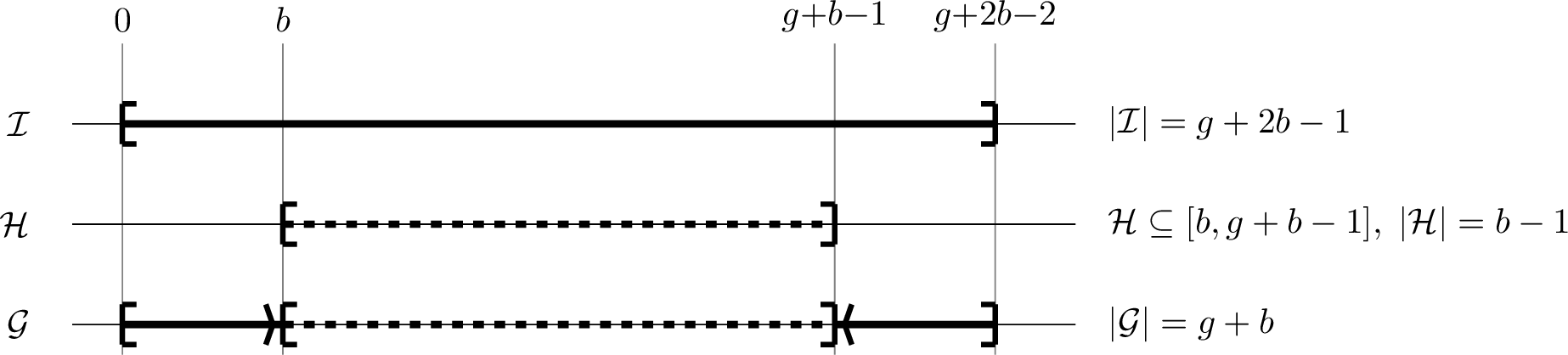 .
.
If \(d>g+2b-2=\mathop{\mathrm{diam}}({\cal I})\), then no pair in \({\cal I}\) has difference \(d\), so \(r_{{\cal G}-{\cal G}}(d)=0\).
Now suppose \(b\le d\le g+2b-2\). In the full interval \({\cal I}\), the number of pairs with difference \(d\) is \[r_{{\cal I}-{\cal I}}(d)=g+2b-2-d+1=g+2b-1-d.\]
We consider three ranges of \(d\), according to whether \(d\ge 2b-1\). If \(d\ge 2b-1\), then \[r_{{\cal G}-{\cal G}}(d)\le r_{{\cal I}-{\cal I}}(d)=g+2b-1-d\le g.\] On the other hand, suppose that \(b \le d \le 2b-2\). Every pair of elements of \({\cal G}\) with difference \(d\) is a pair of elements of \({\cal I}\) with difference \(d\) in which neither element of the pair is in \({\cal H}\); ergo, we have \[\begin{align} r_{{\cal G}-{\cal G}}(d) &=\#\left\{(x-d,x): x,x-d\in {\cal G}\right\} \notag\\ &=\#\left\{(i-d,i): i,i-d \in {\cal I}\right\} \notag\\ &\qquad\qquad -\#\left\{(h-d,h) : (h\in{\cal H}\text{ or } h-d \in {\cal H}) \text{ and } (h,h-d \in {\cal I}) \right\} \notag\\ &= g+2b-1-d -\#\left\{h \in [d,g+2b-2] : h\in{\cal H}\text{ or } h-d \in {\cal H}\right\} \label{eq:r40d4132as32holes}\\ &\le g+2b-1-d - | {\cal H}\cap [d,g+2b-2]|.\notag \end{align}\tag{6}\] If \(d=b\), then \({\cal H}\cap [d,g+2b-2]={\cal H}\), and we have shown that \(r_{{\cal G}-{\cal G}}(b) \le g\). If \(d>b\), then \({\cal H}\cap [d,g+2b-2] \subseteq {\cal H}\setminus[b,d-1]\), in which case \[| {\cal H}\cap [d,g+2b-2]| \ge |{\cal H}|-|[b,d-1]|=(b-1)-(d-b).\] It follows that \(r_{{\cal G}-{\cal G}}(d) \le g\). ◻
Proof of Theorem 4.. By Lemma 6, we know that \(G(g,g+b)\ge g+2b-2\). We need to show that, given \(g,b\) with \(g\ge L(b-1)+1\), there is a \(g\)-Golomb ruler \({\cal G}\) with \(g+b\) elements contained in \({\cal I}:= [0,g+2b-2]\).
In Lemma 7, we gave examples that achieve this for \(b=1,g\ge 1 = L(0)+1\), \(b=2,g\ge 1=L(1)+1\), \(b=3,g\ge 2, L(2)+1=3\), and \(b=4,g\ge 4, L(3)+1=6\). Recall that the value of \(L(n)\) for \(0\le n \le 18\) is given in Table 2. We henceforth assume \(b\ge 5\).
Our strategy is to take an LM ruler contained in \([b,g+b-1]\) with \(b-1\) elements as \({\cal H}\), and set \({\cal G}:={\cal I}\setminus {\cal H}\).
By Definition 2, there is an LM ruler with \(b-1\) elements and diameter \(L(b-1)\). If \(g\ge L(b-1)+1\), then we can take that ruler to be in the interval \([b,g+b-1]\), which has diameter \(g-1\). We set this as \({\cal H}\), our set of holes.
By Lemma 14, the placement of \({\cal H}\) in \([b,g+b-1]\) immediately gives \[r_{{\cal G}-{\cal G}}(d)\le g\] for all \(d\ge b\), with no further conditions on \({\cal H}\). We now focus on the distances \(d\le b-1\).
By Line 6 in the proof of Lemma 14, we have \[r_{{\cal G}-{\cal G}}(d) = g+2b-1-d -\#\left\{h \in [d,g+2b-2] : h\in{\cal H}\text{ or } h-d \in {\cal H}\right\} .\] Thus, to show that \(r_{{\cal G}-{\cal G}}(d) \le g\), it is sufficient to show that \[\label{eq:to32show} \#\left\{h \in [d,g+2b-2] : h\in{\cal H}\text{ or } h-d \in {\cal H}\right\} \ge 2b-1-d.\tag{7}\]
With \(d\le b-1\), every element of \[{\cal H}\subseteq[b,g+b-1]\subseteq [d,g+b-1+d]\subseteq[d,b+2b-2]\] is counted as both an \(h\) and an \(h-d\), and so \[\begin{align} \#\big\{h \in [d,g+2b-2]&\, : h\in{\cal H}\text{ or } h-d \in {\cal H}\big\} \\ &=|{\cal H}|+|{\cal H}|- \#\left\{h \in [b,g+b-1] : h\in{\cal H}\text{ and } h-d \in {\cal H}\right\} \\ &= 2(b-1)-r_{{\cal H}-{\cal H}}(d). \end{align}\] As \({\cal H}\) is an LM ruler, we know that \(r_{{\cal H}-{\cal H}}(d)\le d-1\), which establishes the inequality on Line 7 . Thus, the main claim of Theorem 4 is proved.
In Theorem 12, we establish that \(L(n+1) \le \frac{7}{4}(n^{3/2}-n)\), from which we know that if \(g\ge \frac{7}{4}(b^{3/2}-b)+1\), then \(G(g,g+b)=g+2b-2\). ◻
7 Open Problems↩︎
Sharpen the bounds on \(L(n)\) and compute more exact values.
Our use of \(N_k(d)\) to bound \(r_{{\cal G}-{\cal G}}(d)\) is wasteful. Find a better route.
Fix \(b\), find the minimum value of \(\{G(g,g+b):g\ge 1\}\).
Extend Table 1.
Compute explicit upper and lower bounds for the missing entries of Table 1.
What is \(\min \{ g: G(g,g+b)=g+2b-2\}\). If this minimum is \(g_0\), when is it true that \(G(g_0-1,g_0-1+b)=g_0+2b-2\)?
Acknowledgments↩︎
The first author is grateful to Professor Isabella Novik, whose initial homework problem sparked a lasting interest in the study of Golomb rulers.
The first author thanks their parents, Ashish and Sonika Gupta, and their grandparents, whose early influence inspired the author to pursue the study of mathematics. Further, the first author wishes to thank Dr.Anuj Kumar for his unwavering support and inspiring the author to pursue research.
The authors also thank Theodore Meek and Saurav Mukherjee for their help with proofreading early manuscripts of this paper. We also thank Sean A. Irvine and Vrinda Inani for sharing their computations.
Mathematics Subject Classification: Primary 05B10. Secondary 11B13.
Keywords: Sidon Set, Generalized Golomb Ruler, \(g\)-Golomb Ruler
(Concerned with sequences)
A392517, A003022, A392461, A392462, A392463, A395265.
Return to Journal of Integer Sequences home page.