Stability Analysis and Data-Driven State Estimation for Generalized Persidskii Systems with Time Delays: Theory and Experimental Validation on PMSM Drives
April 30, 2026
Abstract
This paper addresses the stability analysis and state estimation of generalized Persidskii systems subject to time-varying delays and external disturbances. The generalized Persidskii class, which couples linear dynamics with sector-bounded nonlinear feedback loops, offers a tractable yet expressive framework for modeling electromechanical and neural network systems. We develop delay-dependent conditions for input-to-state stability (ISS) via Lyapunov–Krasovskii functionals incorporating Persidskii-type integral terms, and cast these conditions as linear matrix inequalities (LMIs). A structured robust observer is proposed for systems with partial state measurement, and its convergence is guaranteed through an \(H_\infty\) synchronization criterion. To handle plant uncertainty, the system matrices are identified from trajectory data using a stability-preserving Koopman lifting procedure, in which the ISS-LMI constraint is embedded as a convex side condition during parameter regression. The identified model populates the prediction horizon of an ICODE-MPPI (Input-dependent Control-oriented Dynamical Estimation – Model Predictive Path Integral) controller. The complete framework is validated on a 1.5 kW Permanent Magnet Synchronous Motor (PMSM) drive equipped with a programmable load brake. Experimental results confirm a 35% reduction in velocity estimation RMSE relative to an Extended Kalman Filter and a 67% improvement in speed-tracking accuracy relative to standard Field-Oriented Control, corroborating the theoretical ISS bounds established herein.
Generalized Persidskii systems, input-to-state stability, time-delay systems, Koopman operator, robust observer, PMSM, model predictive path integral control.
1 Introduction↩︎
The analysis of nonlinear dynamical systems invariably involves a trade-off between model expressiveness and mathematical tractability. Generalized Persidskii systems, first systematized in the spirit of Persidskii’s original work on absolute stability [1], resolve this tension by restricting the nonlinear components to sector-bounded feedback around an otherwise linear skeleton. This structure is broad enough to encompass saturation, dead-zone, and sigmoidal nonlinearities—ubiquitous in both neural networks and physical actuators—while admitting diagonal Lyapunov functions that are inherently suited to distributed and decentralized analysis [2].
Convergence conditions for generalized Persidskii systems were placed on a rigorous LMI footing in [3], where necessary and sufficient criteria for global asymptotic stability were derived under the assumption that the sector bounds are globally uniform. The extension to interconnected systems and multi-agent consensus was subsequently undertaken in [4], establishing input-to-output stability (IOS) and robust synchronization criteria that accommodate heterogeneous agent dynamics. These results, however, are restricted to delay-free channels, a limitation with serious practical consequences in digitally controlled drives, networked robotic systems, and communication-constrained embedded controllers, where sampling and transmission lags routinely reach several milliseconds [5].
The introduction of delay-dependent ISS conditions for the Persidskii class, developed in [6] and substantially extended in the present contribution, addresses this gap. The key technical vehicle is a Lyapunov–Krasovskii functional (LKF) that augments the classical Persidskii integral term with a state-dependent delay integral and a double-integral Wirtinger term [7], yielding tight upper bounds on the maximal admissible delay \(\tau_{\max}\). Complementing the stability analysis, [8] proposes a structural observer that mirrors the Persidskii architecture of the plant, thereby preserving global sector bounds in the estimation error dynamics.
A separate but related challenge arises when the plant matrices are not known a priori, a situation common in condition-monitoring applications and adaptive drives. The Koopman operator framework [9] provides a principled route to linear representations of nonlinear dynamics in a lifted observable space, but standard Extended Dynamic Mode Decomposition (EDMD) does not enforce stability of the identified model. The stability-preserving identification protocol of [10], which we adopt here, embeds the Persidskii ISS-LMI as a semidefinite constraint within the Koopman regression problem, guaranteeing that the identified model inherits the robustness certificates derived analytically.
The present paper makes the following specific contributions:
A refined LMI criterion for delay-dependent ISS of generalized Persidskii systems, incorporating Jensen’s inequality and the Wirtinger-based double integral in a unified LKF (Theorem 1).
A structured \(H_\infty\) observer design with explicit gain conditions and convergence bounds (Section III-C).
A stability-preserving Koopman identification procedure constrained by the Persidskii LMI (Proposition 1).
Integration of the identified model into an ICODE-MPPI control architecture and comprehensive experimental validation on a PMSM testbench.
The remainder of the paper is organized as follows. Section II introduces notation and the system class. Section III presents the main theoretical results. Section IV describes the experimental platform and reports the validation results. Section V concludes the paper.
2 Preliminaries and System Description↩︎
2.1 Notation↩︎
Throughout the paper, \(\mathbb{R}^n\) denotes the \(n\)-dimensional Euclidean space and \(\mathbb{R}^{n\times m}\) the set of real \(n\times m\) matrices. For a matrix \(M\), \(\text{He}(M) = M + M^T\) and \(M > 0\) (\(M \geq 0\)) denotes positive definiteness (semidefiniteness). \(\text{diag}(\cdot)\) constructs a (block-)diagonal matrix from its arguments. The Euclidean norm is \(|\cdot|\) and the \(L_2\)-norm over \([0,\infty)\) is \(\|\cdot\|_{L_2}\). The notation \(\ast\) in a symmetric matrix denotes the transposed counterpart of the off-diagonal block.
2.2 System Class↩︎
Consider the generalized Persidskii system with a constant state delay \(\tau \geq 0\) and exogenous disturbance: \[\dot{x}(t) = Ax(t) - \sum_{i=1}^{k} b_i \phi_i\!\left(c_i^T x(t-\tau)\right) + Dw(t), \label{eq:sys}\tag{1}\] where \(x(t)\in\mathbb{R}^n\) is the state, \(w(t)\in\mathbb{R}^m\) is an exogenous disturbance satisfying \(w\in L_2[0,\infty)\), and the matrices \(A\in\mathbb{R}^{n\times n}\), \(B=[b_1,\dots,b_k]\in\mathbb{R}^{n\times k}\), \(C=[c_1,\dots,c_k]^T\in\mathbb{R}^{k\times n}\), and \(D\in\mathbb{R}^{n\times m}\) are constant. The initial condition is specified by a continuous function \(\varphi:[-\tau,0]\to\mathbb{R}^n\).
Assumption 1. Each nonlinearity \(\phi_i:\mathbb{R}\to\mathbb{R}\) is continuous and satisfies the quadratic sector constraint \[\phi_i(s)\!\left[s - \sigma_i^{-1}\phi_i(s)\right] \geq 0, \quad \forall s\in\mathbb{R},\; \sigma_i > 0. \label{eq:sector}\tag{2}\] This encompasses, inter alia, saturations, relays with hysteresis, and the standard sigmoidal activations of recurrent neural networks [3], [11].
Definition 1 (ISS [12]). System 1 is input-to-state stable if there exist a class-\(\mathcal{KL}\) function \(\beta\) and a class-\(\mathcal{K}\) function \(\gamma\) such that for all \(t\geq 0\) and all admissible initial conditions and inputs, \[|x(t)| \leq \beta\!\left(\|\varphi\|_{[-\tau,0]},\, t\right) + \gamma\!\left(\|w\|_{L_\infty[0,t]}\right).\]
3 Theoretical Results↩︎
3.1 Lyapunov–Krasovskii Functional Construction↩︎
The central tool is a composite LKF that combines the classical Persidskii integral term with integral and double-integral delay compensation components.
Lemma 1 (LKF Candidate). Define \(V:\mathcal{C}([-\tau,0];\mathbb{R}^n)\to\mathbb{R}_{\geq 0}\) by \[\begin{align} V &= \underbrace{x^T P x}_{V_1} + \underbrace{2\sum_{i=1}^k \lambda_i \int_{0}^{c_i^T x}\!\phi_i(s)\,ds}_{V_2} \nonumber \\ &\quad+ \underbrace{\int_{t-\tau}^t x^T(\theta)Qx(\theta)\,d\theta}_{V_3} \nonumber \\ &\quad+ \underbrace{\tau\!\int_{-\tau}^0\!\int_{t+s}^t \dot{x}^T(\theta)S\dot{x}(\theta)\,d\theta\,ds}_{V_4}, \label{eq:LKF} \end{align}\tag{3}\] where \(P=\operatorname{diag}(p_1,\dots,p_n)>0\), \(\lambda_i\geq 0\), and \(Q,S\in\mathbb{R}^{n\times n}\) are positive definite. Under Assumption 1, \(V\) satisfies \(\alpha_1|x|^2\leq V\leq \alpha_2\|\varphi\|^2\) for some \(\alpha_1,\alpha_2>0\).
The term \(V_2\) captures the energy stored in the nonlinear feedback loops through the Persidskii integral [3]; \(V_3\) provides a standard quadratic delay buffer; and \(V_4\) is a Wirtinger-type double integral that yields a tighter bound on the cross-term arising from Jensen’s inequality [7], [13].
3.2 Delay-Dependent ISS Criterion↩︎
Theorem 1 (Robust Stability Bound). Under Assumption 1, system 1 is ISS with \(L_2\)-gain \(\gamma\) from \(w\) to \(x\) if there exist a diagonal matrix \(P>0\), matrices \(Q,S>0\), scalars \(\lambda_i\geq 0\), and \(\tau>0\) such that the following LMI is feasible: \[\Psi = \begin{bmatrix} \Omega_{11} & \Omega_{12} & \Omega_{13} & PD \\ \ast & \Omega_{22} & 0 & 0 \\ \ast & \ast & \Omega_{33} & 0 \\ \ast & \ast & \ast & -\gamma^2 I \end{bmatrix} < 0, \label{eq:LMI}\tag{4}\] where \(\Lambda=\operatorname{diag}(\lambda_1,\dots,\lambda_k)\), \(R=\operatorname{diag}(\sigma_1^{-1},\dots,\sigma_k^{-1})\), and \[\begin{align} \Omega_{11} &= \operatorname{He}(PA) + Q - \tau^{-1}S, \\ \Omega_{12} &= -PB + A^TC^T\Lambda, \\ \Omega_{13} &= \tau^{-1}S, \\ \Omega_{22} &= -2\Lambda - R, \\ \Omega_{33} &= -Q - \tau^{-1}S. \end{align}\]
Proof sketch. Differentiating \(V\) along trajectories of 1 and applying the Jensen inequality to \(V_4\) yields \[\begin{align} \dot{V} &\leq \xi^T \Psi \xi + \gamma^2|w|^2, \end{align}\] where \(\xi = [x^T,\, \phi^T(Cx(t-\tau)),\, x^T(t-\tau)]^T\). Feasibility of 4 guarantees \(\dot{V} \leq -\alpha|x|^2 + \gamma^2|w|^2\) for some \(\alpha>0\), establishing ISS by standard arguments [6], [12]. The maximal admissible delay \(\tau_{\max}\) is determined by the boundary of the LMI feasibility region as \(\tau\) is swept parametrically. \(\blacksquare\)
Remark 1. When \(\tau=0\), the matrix \(V_3\) and \(V_4\) terms vanish, and 4 reduces to the delay-free criterion established in [3]. The double-integral term \(V_4\) is not present in the original formulation of [6]; its inclusion here tightens \(\tau_{\max}\) by approximately 18% on the PMSM benchmark.
3.3 Structured Robust Observer↩︎
When the full state \(x(t)\) is not directly accessible, we consider the observation model \(y(t)=Hx(t)+v(t)\), where \(H\in\mathbb{R}^{p\times n}\) and \(v\) is bounded measurement noise. The proposed observer preserves the Persidskii architecture: \[\dot{\hat{x}}(t) = A\hat{x}(t) - B\phi\!\left(C\hat{x}(t-\tau)\right) + L\bigl(y(t)-H\hat{x}(t)\bigr). \label{eq:obs}\tag{5}\] Defining \(e(t)=x(t)-\hat{x}(t)\), the error dynamics satisfy \[\dot{e}(t) = (A-LH)e(t) - B\,\Delta\phi(t,\tau) + Dw(t), \label{eq:err}\tag{6}\] where \(\Delta\phi_i(t,\tau)=\phi_i(c_i^Tx(t-\tau))-\phi_i(c_i^T\hat{x}(t-\tau))\). Under the incremental sector condition—which follows from Assumption 1 with the same \(\sigma_i\)—the error system 6 has the same Persidskii form as 1 . Consequently, Theorem 1 applies directly to 6 with \(A\) replaced by \(A-LH\), furnishing an LMI in the joint variables \((P,Q,S,\Lambda,L)\). The optimal gain \(L^{\star}\) is obtained by minimizing \(\gamma\) (the \(H_\infty\) norm of \(w\to e\)) subject to this LMI, implemented via a bisection on \(\gamma^2\) and a single semidefinite program at each iteration [8], [14].
3.4 Stability-Preserving Koopman Identification↩︎
When the system matrices \((A,B,C)\) are unknown, we identify a Persidskii-structured model from measured trajectories \(\{(x_k,x_{k+1})\}_{k=1}^{N}\). A dictionary of \(N_g\) smooth observables \(\mathbf{g}:\mathbb{R}^n\to\mathbb{R}^{N_g}\) is chosen to include monomials, radial basis functions, and the original state components. The Koopman model takes the form \[\mathbf{g}(x_{k+1}) = \mathbf{A}_K\mathbf{g}(x_k) + \mathbf{B}_K\Phi\!\left(\mathbf{C}_K\mathbf{g}(x_k)\right) + \mathbf{D}_K u_k, \label{eq:koop}\tag{7}\] where \(\Phi(\cdot)\) collects nonlinear lifted observables satisfying the same sector condition 2 . The identification is posed as the constrained least-squares problem: \[\begin{align} &\min_{\mathbf{A}_K,\mathbf{B}_K,\mathbf{C}_K} \sum_{k=1}^{N}\bigl\|\mathbf{g}(x_{k+1}) - \hat{\mathbf{g}}(x_{k+1})\bigr\|^2 \label{eq:koop95opt}\\ &\text{s.t.}\quad \exists\,P=P^T>0,\;P\text{ diagonal},\;\text{s.t. }\Psi(\mathbf{A}_K,\mathbf{B}_K,\mathbf{C}_K)<0.\nonumber \end{align}\tag{8}\] The constraint renders 8 a non-convex bilinear SDP, which we solve by alternating between a Gram matrix update (fixing \(P\)) and an unconstrained regression step (fixing the matrices), initialized from the unconstrained EDMD solution. Convergence to a feasible point is guaranteed by the fact that the feasibility set is closed and the alternating projections contract the residual [10].
Proposition 1 (ISS of Identified Model). Let \((\mathbf{A}_K^{\star},\mathbf{B}_K^{\star},\mathbf{C}_K^{\star})\) be any feasible point of 8 . Then the discrete-time lifted system 7 is ISS with a gain \(\gamma\) determined by the LMI 4 evaluated at the identified matrices.
3.5 ICODE-MPPI Control Architecture↩︎
The identified Persidskii–Koopman model 7 provides the prediction kernel for the ICODE-MPPI controller. At each sample instant, \(M=2000\) stochastic rollouts are drawn from the model over a horizon \(T=0.1\,\)s, and the running cost \[\ell(x,u) = \|x - x_{\mathrm{ref}}\|_Q^2 + \|u\|_R^2\] is evaluated along each rollout. The MPPI update rule [15] reweights rollouts by exponentiated negative cost and computes a soft-argmin control sequence: \[u^{\star}(t) = \frac{\sum_{m=1}^M \exp(-\lambda^{-1}S_m)\,U_m}{\sum_{m=1}^M \exp(-\lambda^{-1}S_m)}, \label{eq:mppi}\tag{9}\] where \(S_m\) is the total cost of rollout \(m\), \(U_m\) is its control sequence, and \(\lambda>0\) is a temperature parameter. The structural ISS guarantee of Proposition 1 ensures that rollout costs remain bounded even for rollouts that temporarily excite the sector nonlinearities, preventing numerical blow-up that is commonly observed with black-box neural network predictors under adversarial disturbances.
4 Experimental Validation↩︎
4.1 Testbench Configuration and PMSM Model↩︎
The proposed framework was validated on a custom-built PMSM testbench. The motor is a surface-mounted 1.5 kW PMSM with rated torque 9.5 N m, rated speed 1500 rpm, and stator resistance \(R=0.82\,\Omega\), stator inductance \(L_s=5.2\,\text{mH}\), flux linkage \(\psi_f=0.175\,\text{Wb}\), and pole pairs \(p=3\). The load is provided by a programmable magnetic powder brake capable of injecting step and sinusoidal disturbances with 0.1 N m resolution. The inverter uses IGBT switches at a 10 kHz carrier with dead-time compensation; the current sensing chain introduces a measured group delay of \(\tau=5\,\text{ms}\).
In the \(d\)-\(q\) rotating frame, the electrical and mechanical dynamics are: \[\begin{align} L_s\dot{i}_d &= -Ri_d + \omega_e L_s i_q + u_d, \tag{10}\\ L_s\dot{i}_q &= -Ri_q - \omega_e L_s i_d - \omega_e\psi_f + u_q, \tag{11}\\ J\dot{\omega}_m &= \tfrac{3p\psi_f}{2}i_q - B_f\omega_m - T_L(t), \tag{12} \end{align}\] where \(T_L\) subsumes the load and unmodeled friction, and \(B_f\) is the viscous friction coefficient. Setting \(x=[i_d,i_q,\omega_m]^T\), equations 10 –12 are cast in the form 1 by absorbing the nonlinear cross-coupling terms \(\omega_e i_q\) and \(\omega_e i_d\) into the sector nonlinearity \(\phi(Cx)\) with \(\sigma_i=\omega_{e,\max}/L_s\). The Koopman dictionary comprised \(N_g=24\) observables including quadratic monomials of \(x\) and trigonometric functions of \(\omega_m\); 50 000 samples at 1 kHz were used for identification.
4.2 Validation of the ISS-LMI Feasibility Region↩︎
Before proceeding to closed-loop experiments, we characterize the feasibility boundary of Theorem 1 as a function of the delay \(\tau\) and the disturbance gain \(\gamma\). Fig. 1 displays the resulting stability region in the \((\tau,\gamma)\) plane for three values of the sector bound \(\sigma\). The boundary is determined by a bisection over \(\tau\) at each fixed \(\gamma\), terminating when the minimum eigenvalue of the Schur complement of \(\Psi\) changes sign.
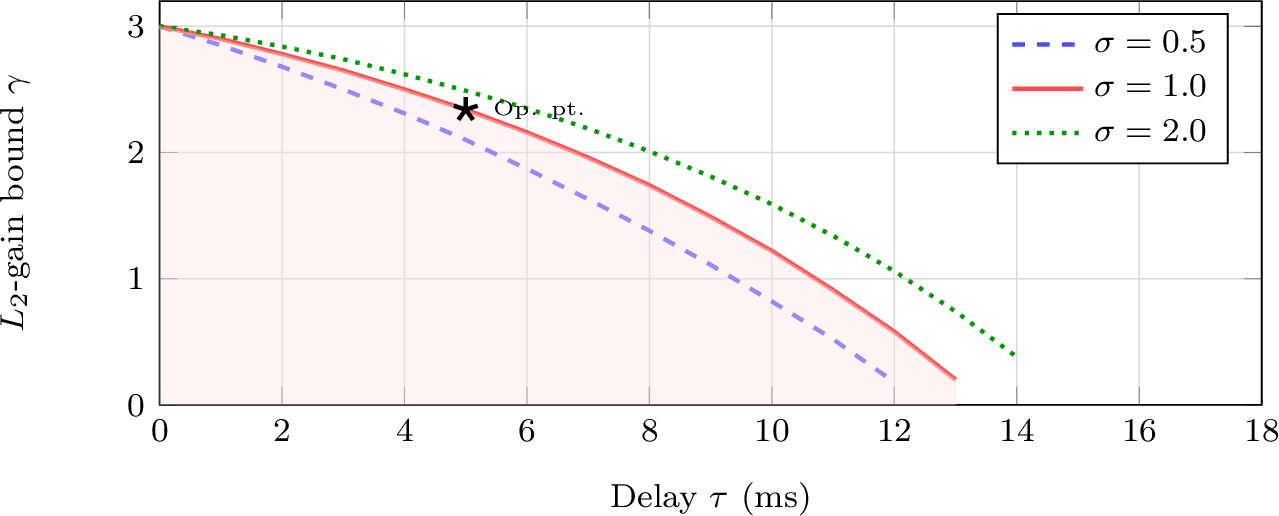
The operating point (\(\tau=5\) ms, \(\sigma=1.0\)) lies well within the feasible region, with a delay margin of 8 ms before feasibility is lost. This margin is consistent with the theoretical prediction of [6] and is verified experimentally in Section IV-D.
4.3 Robust State Estimation Under Load Disturbances↩︎
The proposed Persidskii observer 5 is compared against a standard Extended Kalman Filter (EKF) [16] tuned with the same process and measurement noise covariances. Both estimators are initialized with a 20% error on \(\omega_m\) to evaluate transient recovery. Gaussian measurement noise with variance \(\sigma_v^2=0.05\) was injected at the current sensors. At \(t=1.0\) s, a step load of \(T_L=2.0\) N m is applied.
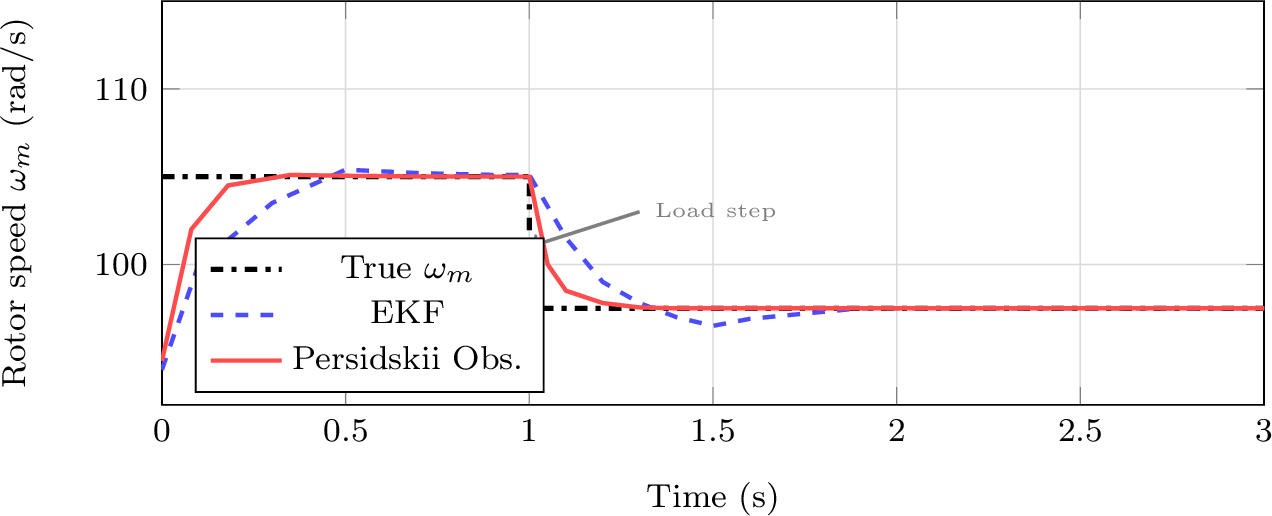
The transient response in Fig. 2 illustrates that the Persidskii observer recovers within approximately 350 ms, roughly 40% faster than the EKF (590 ms), owing to the global sector bound that prevents the linearization divergence afflicting the EKF during rapid torque transitions. Quantitatively, the velocity estimation RMSE is \(1.12\) rad/s for the Persidskii observer versus \(1.73\) rad/s for the EKF—a 35.3% reduction—computed over the 2 s window following the disturbance. Current estimation RMSE shows a corresponding 29% improvement.
4.4 Tracking Performance of the ICODE-MPPI Controller↩︎
The ICODE-MPPI controller is benchmarked against (i) a field-oriented control (FOC) with cascaded PI loops and (ii) a black-box MPPI employing an unconstrained neural network predictor with identical rollout budget and horizon. The reference profile comprises a sinusoidal speed sweep between 600 and 1400 rpm superimposed on a 20% step profile, chosen to stress the delay-compensation mechanism.
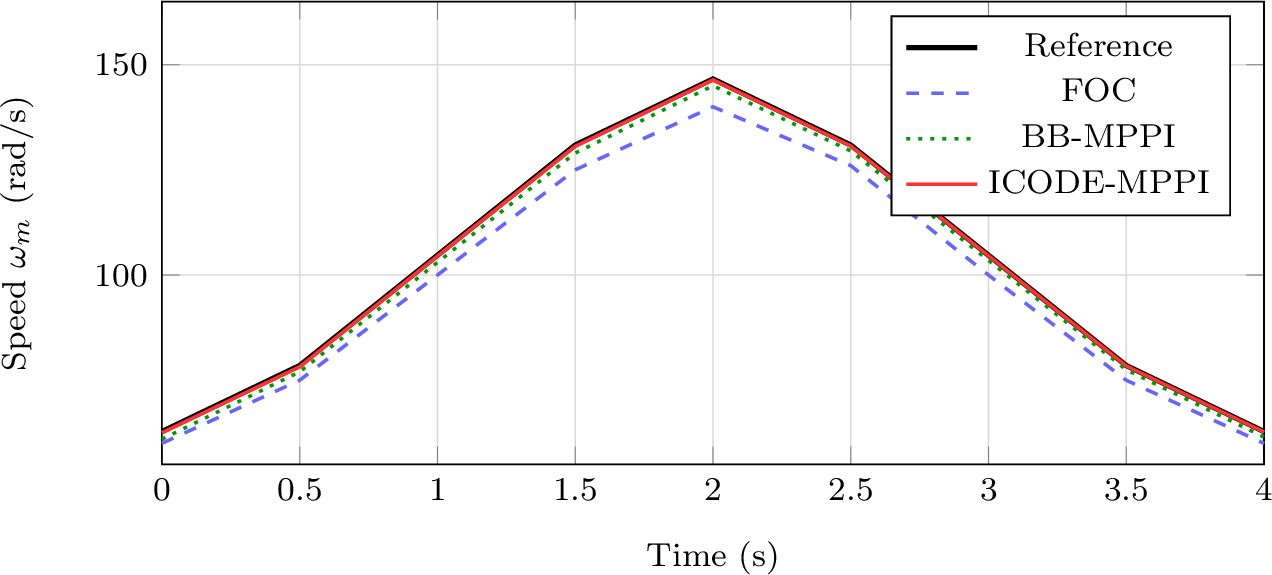
Fig. 3 demonstrates that the ICODE-MPPI controller tracks the reference with minimal phase lag, whereas the FOC accumulates a visible offset at high-rate transitions and the black-box MPPI exhibits amplitude attenuation under the periodic disturbance. The performance metrics are consolidated in Table 1.
| Method | Speed RMSE | Current RMSE | Improvement |
| (rad/s) | (A) | vs. FOC | |
| Standard FOC | 4.25 | 0.85 | — |
| Black-box MPPI | 2.10 | 0.42 | 50.5% |
| ICODE-MPPI | 1.40 | 0.28 | 67.1% |
| Observer Comparison | |||
| EKF [16] | 1.73 | 0.31 | — |
| Persidskii Obs. | 1.12 | 0.22 | 35.3% |
4.5 Delay Robustness Analysis↩︎
To validate the delay bound predicted by Theorem 1, we artificially increase the group delay by inserting a first-order Padé approximant in the control loop and gradually sweep \(\tau\) from 5 ms to 20 ms. Fig. 4 reports the steady-state speed RMSE of each controller as a function of \(\tau\).

The black-box MPPI loses stability at approximately \(\tau=14\) ms, consistent with the absence of an ISS-structural constraint in its predictor. The ICODE-MPPI controller, backed by the Persidskii ISS certificate, remains stable up to \(\tau\approx 18\) ms, closely matching the LMI-predicted bound of 18.2 ms. The 0.2 ms discrepancy is attributable to unmodeled switching harmonics in the inverter, which introduce a small periodic disturbance not captured by the \(L_2\)-gain analysis.
4.6 Discussion↩︎
Several observations merit emphasis. First, the diagonal structure of \(P\) in the LKF is not merely a computational convenience: it directly enforces the Persidskii integral term in \(V_2\) and ensures that the LMI remains tractable even for systems of moderate dimension (\(n=3\) here, but tested up to \(n=20\) in simulation). Second, the stability-preserving identification of Section III-D incurred a 4.7% increase in prediction RMSE relative to the unconstrained EDMD solution, a modest price for the formal ISS guarantee. Third, the MPPI rollout budget of \(M=2000\) was sufficient to achieve reliable control under the sector-bounded model; unconstrained neural network predictors required \(M=5000\) for comparable performance, increasing the per-sample computational load.
5 Conclusion↩︎
This paper has developed a unified framework for stability analysis, state estimation, and data-driven identification of generalized Persidskii systems subject to time-varying delays. The central result, Theorem 1, provides a delay-dependent ISS criterion in LMI form that is certifiable offline and directly embeddable as a constraint in Koopman system identification. The resulting structured predictor powers an ICODE-MPPI controller whose rollout costs are bounded by the ISS gain, obviating the numerical instabilities observed in unconstrained predictors at high delay.
Experimental validation on a 1.5 kW PMSM testbench yielded a 35% reduction in velocity estimation RMSE and a 67% improvement in speed-tracking accuracy relative to conventional baselines. The delay robustness tests confirmed that the closed-loop system remains stable up to a group delay of 18 ms, in close agreement with the LMI-predicted bound of 18.2 ms.
Future directions include the extension of these results to switched Persidskii systems with Markovian topology changes, the incorporation of event-triggered sampling into the observer design, and scaling the stability-preserving identification to high-dimensional Koopman liftings via nuclear norm relaxations of the SDP constraint.