Certain degenerations of surfaces in fake weighted projective \(3\)-space
April 28, 2026
Abstract
We study degenerations (along an edge) of surfaces in (fake) weighted projective \(3\)-space. We introduce the Hodge theoretic data and show that the Hodge loci of vanishing cycles both might be proper or not. This illustrates results of Green and Voisin.
1 Introduction↩︎
Let \(\Delta\) be a \(3\)-dimensional lattice simplex and \(f\) a nondegenerate Laurent polynomial with Newton polytope \(\Delta\). Write \(U_{reg}(\Delta)\) for all of these Laurent polynomials. Let \(\mathbb{P}_{\Delta}\) be the projective toric variety to the normal fan of \(\Delta\) and \(Z_{\Delta,f}\) the closure of \[\begin{align} Z_f := \{f=0\} \subset T \end{align}\] in \(\mathbb{P}_{\Delta}\). Then \(\mathbb{P}_{\Delta}\) is a fake weighted projective \(3\)-space. Given a polytope \(F\) let \(l^*(F)\) denote the number of lattice points in the relative interior of \(F\).
Assume that there is an edge \(e \leq \Delta\) with \(l^*(e) >0\). Then we may subdivide \(\Delta\) along the edge \(e\) into simplices as in the Figure below.
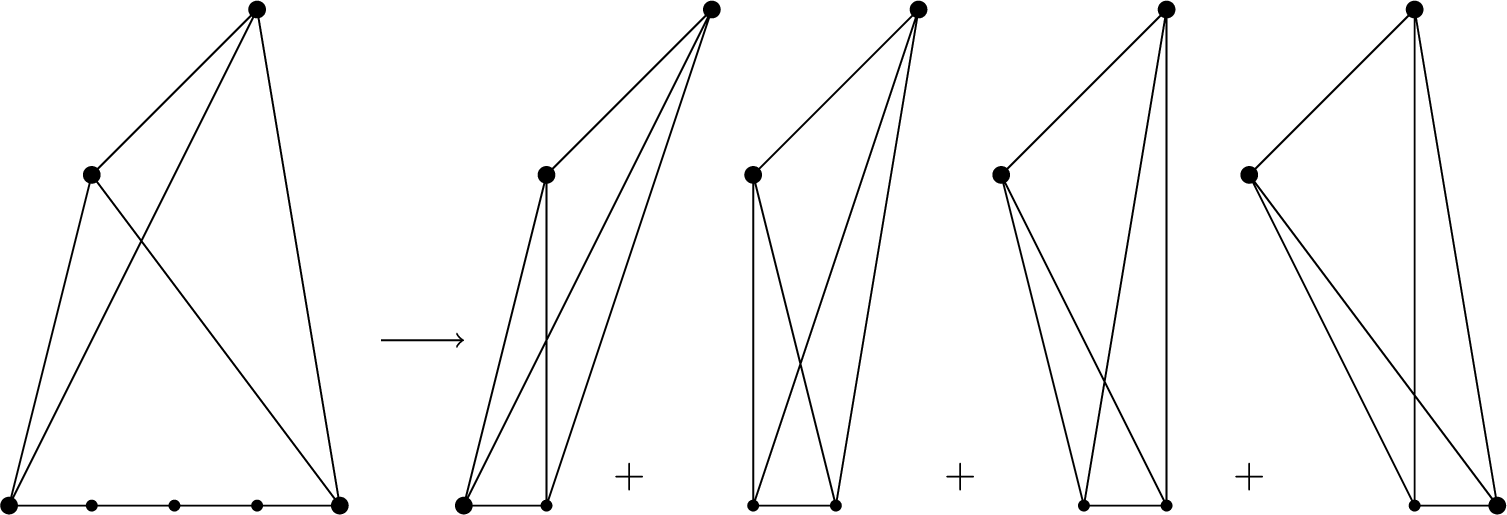
Such a subdivision corresponds to a degeneration both of the toric \(3\)-fold \(\mathbb{P}_{\Delta}\) and of the hypersurface \(Z_{\Delta,f}\). If \(f \in U_{reg}(\Delta)\) is enough nondegenerate then we get \[\dim \, H^{2,0}(Z_{\Delta,f}) = \underbrace{p_g(Z_{\Delta,f})}_{l^*(\Delta)} = \sum\limits_{i = 1}^r
\underbrace{p_g(Z_{\Delta_i,f_i})}_{l^*(\Delta_i)} + \sum\limits_{i = 1}^{r-1} \underbrace{g(Z_{\Delta_i,f_i} \cap Z_{\Delta_{i+1},f_{i+1}})}_{l^*(\Delta_i \cap \Delta_{i+1})}\] with \(Z_{\Delta_i,f_i}\) a closure in
\(\mathbb{P}_{\Delta_i}\). We restrict to a one-dimensional subfamily \(Z_{\Delta,t}\), \(t \in B\), where \(B\) denotes the
unit disc, and switch to a semistable degeneration \(\mathcal{X} \overset{p}{\rightarrow} B\) by base change and birational maps (see construction 3).
Write \(X_t := p^{-1}(t)\). Then given \(t \neq 0\) the fibre \(X_t\) is a resolution of singularities of \(Z_{\Delta,t}\)
and there is a toric morphism \(\mathbb{P}' \rightarrow \mathbb{P}_{\Delta}\) inducing this resolution. Considering the geometric genus \(p_g(X_t)\) we can keep track of the
original degeneration within this semistable degeneration. There are cohomology classes on \(X_t:= p^{-1}(t)\), \(t \neq 0\), that come from \(X_0\). But
there might be also additional vanishing cohomology classes. These vanishing cohomology classes are rational cohomology classes and orthogonal on those coming from \(X_0\) with respect to the intersection product
on \(H^2(X_t, \mathbb{Q})\).
The number of these vanishing cohomology classes in the semistable degeneration from above equals \[2 \cdot \sum\limits_{i=1}^{r-1} l^*(\Delta_{i} \cap \Delta_{i+1}).\] Since these classes are rational and \(H^{0,2}(X_t) = \overline{H^{2,0}(X_t)}\), assuming \[\begin{align} \sum\limits_{i=1}^{r-1} l^*(\Delta_{i} \cap \Delta_{i+1}) > \sum\limits_{i = 1}^r l^*(\Delta_i),
\end{align}\] there is a cohomology class \(\lambda_t \in H_{van}^2(X_t,\mathbb{C}) \cap H^{1,1}(X_t)\). This means that the Hodge locus \(U_{\lambda}^1 := \{ f \in U_{reg}(\Delta) \mid
\lambda_f \in F^1 H^2(Z_{\Delta,f},\mathbb{C}) \}\) is not proper:
Theorem 1. Let \(\Delta\) be a \(3\)-dimensional simplex having an edge \(e\) with \(l^*(e) >0\). Let \(f \in U_{reg}(\Delta)\) be sufficiently nondegenerate and consider the subdivision \[\Delta = \Delta_1 \cup ... \cup \Delta_r, \quad \Delta_{i,i+1}:= \Delta_i \cap \Delta_{i+1}\] from above. If \[\begin{align} \label{assumption95interior95points95intersection95subdivision} \sum\limits_{i=1}^{r-1} l^*(\Delta_{i,i+1}) > \sum\limits_{i = 1}^r l^*(\Delta_i), \end{align}\qquad{(1)}\] there is \(\lambda \in H_{van}^2(X_t,\mathbb{C})\) such that the Hodge locus \(U_{\lambda}^1\) is not a proper subvariety.
The criterion (?? ) appears already for surfaces in weighted projective \(3\)-space, as one can check with a computer program. In the following we check (Construction 9) that a Voisin type criterion \[\begin{align} H^{2,0}(X_t) \cap H_{van}^2(X_t,\mathbb{C}) \neq \{0\}
\end{align}\] remains valid (except if \(H_{van}^2(X_t,\mathbb{C}) = \{0\}\), which is not essential, see Remark 10) in our setting of surfaces in (fake) weighted projective \(3\)-space. This criterion might be helpful in proving the properness of the
Noether-Lefschetz locus.
This paper studies elementary degenerations (degenerations along an edge) and transports two approaches to the properness of the Noether-Lefschetz locus of surfaces in \(\mathbb{P}^3\) (compare [1]) to the setting of surfaces in (fake) weighted projective \(3\)-space. It serves as an elementary exemplification of a result of
Green ([2],[1]). In the first version of this preprint there was
an elementary mistake. We note that correcting this mistake gives our result a different intuition.
2 Degenerations and the geometric genus↩︎
Definition 1. A degeneration of algebraic surfaces is a proper flat morphism \(p: \mathcal{X} \rightarrow B\), where \(B \subset \mathbb{C}\) is the unit disc, such that \(X_t:= p^{-1}(t)\) is a smooth projective surface for \(t \neq 0\) and the total space \(\mathcal{X}\) is a Kähler manifold. The degeneration is called semistable if we may write \(X_0 = \sum\limits_{i = 1}^r V_i\), where \(V_i\) are smooth and the irreducible components of \(X_0\), the \(V_i\) intersect transversally and locally \(p\) is defined by \[t = x_1 \cdot ... \cdot x_k\]
Construction 2. (Subdivison of a simplex along an edge)
Assume that \(\Delta\) is a \(3\)-dimensional simplex with \(l^*(\Delta) > 0\) and having an edge \(e\) with \(r:= l^*(e) > 0\). Choose a subdivision \[\begin{align} & \Delta = \Delta_1 \cup ... \cup \Delta_r \\ & \Delta_{i,i+1} := \Delta_i \cap \Delta_{i+1}.
\end{align}\]
Let \(f_t \in U_{reg}(\Delta)\) be a one-parameter family of nondegenerate Laurent polynomials. Then we may choose a birational toric morphism \(\mathbb{P}' \rightarrow
\mathbb{P}_{\Delta}\) such that the closure \(X_t:= Z_t'\) of \(Z_{f_t}\) is smooth for \(t \neq 0\).
Assume that \(f_{0 \vert{\Delta_i}} \in U_{reg}(\Delta_i)\) for \(i=1,...,r\) and \(f_{0 \vert{\Delta_{i,i+1}}} \in U_{reg}(\Delta_{i,i+1})\) for \(i=1,..,r-1\). Denoting by \(Z_{\Delta_i}\) the closure of \(\{f_{0 \vert{\Delta_i}} = 0\}\) in \(\mathbb{P}_{\Delta_i}\) we may
assume that \(Z_{\Delta_i}\) and \(Z_{\Delta_{i+1}}\) intersect transversally. Since \(Z_{\Delta_i} \subset \mathbb{P}_{\Delta_i}\) is ample this is a
nonempty Zariski open conditions on the coeffficients of \(f_0\).
Construction 3. (Semistable degeneration)
Given a degeneration \(p: \mathcal{X} \rightarrow B\) there exists a base change \(\phi: B \rightarrow B\) given by \(t \mapsto t^N\), a semistable
degeneration \(p': \mathcal{Y} \rightarrow B\) and a diagram \[\begin{tikzcd} \mathcal{Y} \arrow[dashed]{r}{\psi} \arrow{dr}{p'} & \mathcal{X} \times_{\phi} B \arrow[d] \arrow[r] &
\mathcal{X} \arrow{d}{p} \\ & B \arrow{r}{\phi} & B \end{tikzcd}\] such that \(\psi\) is a birational map of the central fibre given by blowing up and blowing down subvarieties.
Lemma 1. Let \(\Delta\) be a \(3\)-dimensional lattice simplex with \(l^*(\Delta) >0\) and an edge \(e\) wit \(l^*(e) >0\). Choose the subdivision \[\Delta = \Delta_1 \cup ... \cup \Delta_r, \quad \Delta_{i,i+1} := \Delta_i \cap \Delta_{i+1}\] along \(e\) with hypersurfaces \(Z_{\Delta}\), \(V_i := Z_{\Delta_i}\) and double curves \(C_{i,i+1} := Z_{\Delta_i} \cap Z_{\Delta_{i+1}}\). Then \[p_g(X_t) = \sum\limits_{i = 1}^r p_g(Z_{\Delta_i}) + \sum\limits_{i = 1}^{r-1} g(C_{i,i+1}).\] As a consequence for all additional components \(V_{r+1},...,V_l\) in a semistable degeneration and all other double curves \(C_{ij}\) we have \[p_g(V_i) = 0, \quad g(C_{ij}) = 0.\]
Proof. We have \(p_g(X_t) = l^*(\Delta)\) and \(p_g(Z_{\Delta_i}) = l^*(\Delta_i)\) for \(i=1,...,r\) by [3]. Further \(g(C_{i,i+1}) = l^*(\Delta_{i,i+1})\) and \[\begin{align} \label{geom95genus95additive95sum} l^*(\Delta) = \sum\limits_{i = 1}^r l^*(\Delta_i) + \sum\limits_{i = 1}^{r-1} l^*(\Delta_{i,i+1}). \end{align}\tag{1}\] Let \(\mathcal{X} \rightarrow B\) be a semistable degeneration one obtains by the semistable reduction Theorem. Then by ([4]) we have \[\begin{align} \label{formula95geometric95genus95degeneration} p_g(X_t) = \sum\limits_{i = 1}^l p_g(V_i) + \sum\limits_{i \neq j} g(C_{ij}) + h^2(\Gamma). \end{align}\tag{2}\] where \(\Gamma\) denotes the dual graph of \(X_0\). But all nonzero terms are already contained in \(p_g(Z_{\Delta_i})\) and \(g(C_{i,i+1})\). Thus \(h^2(\Gamma) = 0\) and the result follows. ◻
In the following we summarize some known results on degenerations (of algebraic surfaces). See ([4]) and ([5]) for details.
Remark 4. The result stays true for different subdivisions of \(\Delta\) such that no interior point of \(\Delta\) belongs to an edge of the subdivision. Let \[T: H^2(X_t, \mathbb{Q}) \rightarrow H^2(X_t, \mathbb{Q}), \quad t \neq 0\] be the monodromy homomorphism and \(N := \log(T)\). Then in the above situation in fact \(N = T-I\) since \(h^2(\Gamma) =0\).
Construction 5. (Clemens-Schmid exact sequence)
By the invariant cycle theorem* ([1]) the \(T\)-invariant cohomology classes of \(H^2(X_t,
\mathbb{Q})\) come from \(H^2(X_0, \mathbb{Q})\), that is the following sequence is exact at the middle term \[\begin{align} \label{exact95sequence95part95Clemens95Schmid} H^2(X_0, \mathbb{Q}) \overset{\alpha}{\rightarrow} H^2(X_t, \mathbb{Q}) \overset{N}{\rightarrow} H^2(X_t, \mathbb{Q}).
\end{align}\tag{3}\] In fact this triple fits into an exact sequence, the Clemens-Schmid exact sequence (see [4] for details on the maps
\(\alpha, \, \beta\) and \(\gamma\)) \[\begin{align} \label{Clemens95Schmidt95exact95sequence} 0
&\rightarrow H^{0}(X_t, \mathbb{Q}) \rightarrow H_{4}(X_0, \mathbb{Q}) \overset{\alpha}{\rightarrow} H^{2}(X_0, \mathbb{Q}) \overset{\beta}{\rightarrow} H^2(X_t, \mathbb{Q}) \\ & \overset{N}{\rightarrow} H^{2}(X_t, \mathbb{Q})
\overset{\gamma}{\rightarrow} H_2(X_0, \mathbb{Q}) \nonumber
\end{align}\tag{4}\] *
Definition 6. We define \[H^2(X_t, \mathbb{Q})_{van} \cong H^2(X_t, \mathbb{Q})/\ker(N).\] and call its elements vanishing cohomology classes.
Construction 7. (Limiting mixed Hodge structure)
We could equip \(X_t\) and \(X_0\) with mixed Hodge structures and then the Clemens-Schmidt exact sequence gets an exact sequence of MHS: Let \[0 \subset W_0
\subset W_1 \subset W_2 \subset W_3 = W_4 = H^2(X_t, \mathbb{Q})\] be the weight filtration. Then \(W_0=0\) since \(h^2(\Gamma) = 0\) and since \(q(V_i)=0\) we get \[\begin{align} &W_2/W_1 = \ker \Big( \bigoplus\limits_i H^{2}(V_i,\mathbb{C}) \rightarrow \bigoplus\limits_i H^2(C_{i,i+1},\mathbb{C}) \Big), \\ &W_1 = W_1/W_0 \cong
\bigoplus\limits_{i = 1}^{r-1} H^1(C_{i,i+1}, \mathbb{Q})
\end{align}\] Further \(N\) is of type \((-1,-1)\) thus \(H^2(X_t, \mathbb{Q})_{van} = W_3/W_2 \cong W_1/W_0\). We write \(F_{lim}^p\) for the limiting Hodge structure* on \(H^2(X_t,\mathbb{C})\). The mixed Hodge structure on \(H^2(X_0,\mathbb{C})\) is computed via
Mayer-Vietoris sequences from equi-dimensional strata of \(X_0\).*
Remark 8. (Vanishing classes orthogonal on \(\ker(N)\))
The importance of vanishing cohomology classes arise from the fact that we have a orthogonal decomposition \[\begin{align} \label{orthogonal95sum95decomposition95van95coh}
H^2(X_t, \mathbb{Q}) \cong H^2(X_t, \mathbb{Q})_{van} \oplus \ker(N).
\end{align}\qquad{(2)}\] with respect to the intersection pairing. Following ([1]) we give a proof of the orthogonality of this direct sum: \(X_0\) is a deformation retract of \(\mathcal{X}\). By Poincaré duality we get \[H_2(X_0, \mathbb{Q}) \cong H_2(\mathcal{X}, \mathbb{Q}) \cong H^4(\mathcal{X},
\mathbb{Q})\] and the homomorphism \(\gamma\) may be identified with the Gysin homomorphism \(j_{*}: H^2(X_t, \mathbb{Q}) \rightarrow H^4(\mathcal{X}, \mathbb{Q})\), \(j: X_t \rightarrow \mathcal{X}\) the inclusion. Thus we get \(H^2(X_t, \mathbb{Q})_{van} \cong \ker(j_*)\). It follows \[x.j^{*}(y) = j_*(x).y = 0\] for \(x \in H^2(X_t, \mathbb{Q})_{van}\), \(y \in H^2(\mathcal{X}, \mathbb{Q})\) by the projection formula. Since \(\ker(N) \cong j^{*}H^2(\mathcal{X}, \mathbb{Q})\)
the direct sum is orthogonal.
3 Vanishing cohomology classes and the Hodge decomposition↩︎
Theorem 2. Let \(\Delta\) be a \(3\)-dimensional simplex having an edge \(e\) with \(l^*(e) >0\). Let \(f \in U_{reg}(\Delta)\) be sufficiently nondegenerate and consider the subdivision \[\Delta = \Delta_1 \cup ... \cup \Delta_r, \quad \Delta_{i,i+1}:= \Delta_i \cap \Delta_{i+1}\] from above. If \[\begin{align} \label{vtewxfcp} \sum\limits_{i=1}^{r-1} l^*(\Delta_{i,i+1}) > \sum\limits_{i = 1}^r l^*(\Delta_i), \end{align}\qquad{(3)}\] there is \(\lambda \in H_{van}^2(X_t,\mathbb{C})\) such that the Hodge locus \(U_{\lambda}^1 := \{ f \in U_{reg}(\Delta) \mid \lambda_f \in F^1 H^2(Z_{\Delta,f},\mathbb{C}) \}\) is not a proper subvariety.
Proof. The vanishing cohomology classes lie in \(H^2(X_t, \mathbb{Q})\) and the space \(H^{2,0}(X_t) \oplus H^{0,2}(X_t)\) intersects \(H^2(X_t, \mathbb{Q})\) in a \(\leq p_g\)-dimensional vector subspace. Thus by ?? and construction 7 there is a linear combination \[\begin{align} \lambda := \sum\limits_{i} a_i \cdot V_i, \quad a_i \in \mathbb{R}, \quad \textrm{with } \pi\big(\lambda \big) = 0, \end{align}\] where \(\pi: H^2(X_t,\mathbb{C}) \rightarrow H^{2,0}(X_t) \oplus H^{1,1}(X_t)\) denotes the natural projection. Thus \(\lambda \in H_{van}^2(X_t, \mathbb{R}) \cap H^{1,1}(X_t)\) and the Hodge locus \(U_{\lambda}^1\) is not proper. ◻
Construction 9. Unlike the criterion (for the properness* on the Noether-Lefschetz locus) via the Hodge loci we guess that another criterion of Voisin ([1]) might be helpful for generalizations to surfaces in (fake) weighted projective \(3\)-space:*
Either \(H_{van}^2(X_t,\mathbb{C}) = \{0\}\) or \(H_{lim}^{2,0}(X_t) \cap H_{van}^2(X_t,\mathbb{C}) \neq \{0\}\).
\(H_{lim}^{2,0}(X_t) = L^*(\Delta) = H^{2,0}(X_t)\)
This gives us a Voisin type criterion \[\begin{align} \label{Voisin39s95criterion95properness95NL} H^{2,0}(X_t) \cap H_{van}^2(X_t,\mathbb{C}) \neq \{0\}. \end{align}\qquad{(4)}\]
- Voisin’s proof of the properness* of the Noether-Lefschetz locus (compare also the conjecture in [6]) works with Lefschetz pencils (and the respective vanishing cohomology) and uses the irreducibility of the action of \(T\) on the vanishing cohomology classes. We therefore could not finish a proof.*
**Proof.* (of the first two points)
If \(\l^*(\Delta_{i,i+1}) = 0\) for all \(i=1,...,r-1\) then \(H_{van}^2(X_t,\mathbb{C}) = \{0\}\) and \(T=I\) is trivial.
Else we read off the limiting Hodge filtraton somehow involved from the Clemens-Schmid exact sequence and the Hodge filtration of \(H^2(X_0,\mathbb{C})\) computed via equidimensional strata. We claim that
\[\begin{align} \label{equation95lim95hodge95str952095intersection} H_{lim}^{2,0}(X_t) \cong \Big(H_{lim}^{2,0}(X_t) \cap H_{van}^2(X_t,\mathbb{C}) \Big)
\oplus \Big( H_{lim}^{2,0}(X_t) \cap \ker(N) \Big)
\end{align}\tag{5}\] The inclusion \(\supset\) is clear. With the notation of Construction 7 we have \[\begin{align} & \ker(N) = W_2 = W_1 \oplus W_2/W_1 , \\ & \Rightarrow H_{lim}^{2,0}(X_t) \cap \ker(N) = F_{lim}^2 W_2/W_1 \cong \bigoplus\limits_{i}
H^{2,0}(V_i).
\end{align}\] and \[\begin{align} & H_{van}^{2}(X_t,\mathbb{C}) \cong W_3/W_2 \cong W_1/W_0 \cong \bigoplus\limits_i H^1(C_{i,i+1},\mathbb{C}), \\ & H_{lim}^{2,0}(X_t) \cap H_{van}^{2}(X_t,\mathbb{C}) = F_{lim}^2
W_3/W_2 \cong \bigoplus\limits_i H^{1,0}(C_{i,i+1}).
\end{align}\] Thus the equation 5 follows and since \(\dim \, \ker(N) < h^{2,0}(X_t)\) the first point follows. Besides by the formula for the
geometric genus naturally \(H^{2,0}(V_i) \cong L^*(\Delta_i)\) and \(H^{1,0}(C_{i,i+1}) \cong L^*(\Delta_{i,i+1})\), and the second point follows \[\begin{align}
L^*(\Delta) = \bigoplus\limits_i L^*(\Delta_i) \oplus \bigoplus\limits_i L^*(\Delta_{i,i+1}).
\end{align}\] ◻*
Remark 10. If there is not necessarily an edge \(e \leq \Delta\) with \(l^*(e) > 0\) we can still subdivide \(\Delta\) and find a degeneration with possibly \(h^2(\Gamma) > 0\). In this case we get \(W_0 = H^2(\left| \Gamma \right|, \mathbb{C})\) and \(\ker(N) = W_2/W_0\), \(H_{van}^2(X_t,\mathbb{C}) \cong W_1/W_0 \oplus W_0\). Thus \(H_{van}^2(X_t,\mathbb{C})\) just can get bigger in this case. The proofs of the first is valid in this cases as well. Thus we definitely find a degeneration \(\mathcal{X} \rightarrow B\) of \(X_t\) with \(H_{van}^2(X_t,\mathbb{C}) \neq \{0\}\) and we obtain a criterion of Voisin type: \(H^{2,0}(X_t) \cap H_{van}(X_t,\mathbb{C}) \neq \{0\}\).
Remark 11. By rersults of Green ([2],[1]) Theorem (2) cannot happen if \(Z_{\Delta,f}\) is sufficiently ample, for example when replacing \(\Delta\) by \(k \cdot \Delta\) for some natural number \(k \gg 0\), not violating our condition ?? .