A contemporary science map
through the lens of IEEE and ACM periodicals
April 28, 2026
Abstract
ACM and IEEE are the two premier associations on computing and electrical/electronics engineering which publish and organize the great majority of periodicals and conferences, respectively, serving these disciplines. Science is a constantly evolving process, and these publication fora are expected to follow the trends. In this article, we focus on the periodicals published by the two associations and seek to detect and/or confirm any contemporary science trends as these are reflected to the periodical titles established recently. Our study is rather qualitative than quantitative, aiming at revealing patterns immediately comprehensible and validatable by the reader. Among the most notable patterns, we see a growing preference of both associations for the open access mode of publication; we also observe ACM’s orientation toward AI-focused periodicals, and most importantly, a significant theme overlap among periodicals of the same association and this is valid for both ACM and IEEE.
1 Introduction↩︎
Traditionally, scientific journals are considered as the primary means for disseminating scholarly research [1]. Even though the situation is slightly different in computer science, where in some of its subfields, the conferences are considered to some extend the primary channel for publishing scientific results [2]–[4], we can still perceive that journals comprise the long term “scientific memory" of the community, and thus the preferred forum to submit research.
Journals apart from being just the fora for publishing research results, they can also be perceived as a mirror of the science evolution and its contemporary focus. When new scientific fields are emerging, new journals are established to serve the community. New journals can also be established when a field is expanding too much so that the number of submitted articles can not be handled and published by current journals, or when a field is broken into very specialized subfields that need “specialized" new journals. At this point, we need to mention that current publication practices have evolved so that instead of only journals, publishers publish magazines; we will collectively call journals and magazines as periodicals.
In this article, we aim at investigating computer and communications science and engineering current focus through the lens of periodical establishment. Even though there exist several publishers such as ACM, IEEE, Elsevier, Springer-Nature, Wiley etc that publish periodicals on computer and communications, in our study we focus exclusively on the periodicals published by ACM and IEEE, since these two are the two major computer and communication engineering and science associations, and typically they lead the trends, and also because their periodicals have the highest impact and respect among scholars. Our work is completely different from those that investigate impact and/or volume of publications per publisher, e.g., the work in [5]–[7], and in general there is no strictly related work to ours.
The major aim of the present article is to shed light on the current scientific domains in computer science and engineering as served by periodicals of the two computing associations, namely ACM and IEEE and to record any apparent and latent patterns. In this context, the present article makes the following contributions:
it examines which are the most popular subject categories served by the periodicals,
it investiagates the birth and discontinuation disctribution of the periodicals, and finally
it examines the degree of overlap among the topics of the periodicals.
The rest of the article is structured as follows: section 2 describes the data that we have accumulated for study and section 3 records our observations related to the evolution of the number and topics of the two associations’ periodicals.Then, in section 4 we briefly introduce our online Web tool that helps navigate through the world of IEEE and ACM periodicals, and finally, in section 5 we summarize the contributions and conclude the article.
2 Data collection and measures↩︎
In general, our data concern the title of periodicals, the year of their establishment, impact measures, and similarities among the periodicals’ scope. The aforementioned information was mainly retrieved from the digital libraries of ACM (https://dl.acm.org) and IEEE (https://ieeexplore.ieee.org), and it is presented in the next subsections.
2.1 Statistics of periodicals↩︎
Firstly, we will describe some very basic information that was retrieved by these digital libraries. The first observation is that IEEE has almost five times more periodicals than ACM; this is expected to some extent, if we consider the broader scope of IEEE (covering computing, communications, power, etc) than the scope of ACM which focuses mainly on “computing", but at a greater specialization degree (e.g., IEEE TKDE versus the set of ACM TODS and ACM TOIT and ACM TOIS). Table 1 provides the detailed numbers.
| association | journals/transactions | magazines |
|---|---|---|
| IEEE | 282 | 59 |
| ACM | 70 | 0 |
We need to say at this point that ACM publishes practically no magazines, apart from the flagship magazine of Communications of the ACM and the newly established ACM AI Letters. It publishes only journals/transactions. So, we choose to examine only ACM’s journals/transactions, called collectively journals, and we see that there are \(70\) such journals. On the other hand, IEEEXplore accommodates \(282\) journals and \(59\) magazines. Some of these periodicals, have stopped their operation or stopped being published by IEEE (e.g., those by IMA), some others are newsletters. So we have excluded such cases from our study, and we are left with the number of periodicals mentioned in Table 1.
For all IEEE’s periodicals we have available their establishment year, whereas for ACM’s journals, there exist three journals for which we were not able to find their establishment year.
2.2 Impact measures↩︎
Since we aimed to somehow get a picture of how newly established periodicals are perceived by the scientific community, and also we wished to be able to contrast the popularity of new areas with that of the old ones via the periodicals serving them, we resorted to the use of journal impact measures, namely the Journal Impact Factor [8] or JIF for short, and the CiteScore [9].
Let \(c_{y}\) stand for the citations received within the year “y" by the citable items published during the years”y-1" and “y-2"; let also \(c_{y}^{i}\) stand for the citations received from within year”y-i" until the year “y" by the citable items published during the years”y-i" until “y", and finally let \(n_x\) stand for the number of citable items published by the periodical within year”x". Then, Equations 1 and 2 define the JIF and CiteScore for 2024, respectively. \[\begin{align} JIF_{2024} &= \frac{c_{2024}}{n_{2023} + n_{2022}}\tag{1}\\ CiteScore_{2024} &= \frac{c_{2024}^{3}}{n_{2024}+n_{2023}+n_{2022}+n_{2021}}\tag{2} \end{align}\]
The astute reader will deduce from the aforementioned equations and the value of CiteScore can be approximated quite satisfactory by twise the value of JIF (this can also be observed by contrasting Figure 1 to 2 and Figure 3 to 4). So, in this article we mainly focus on the JIF.
Apparently, periodicals published strictly after 2021 have not received a JIF yet, and similarly, periodicals established strictly after 2020 have not received a CiteScore yet. In Table 2 we show for how many IEEE and ACM periodicals we got their JIF and/or CiteScore.
| periodical | cardinality | w/o IF | w/o CiteScore |
|---|---|---|---|
| IEEE | 282+59=341 | 56 | 51 |
| ACM | 70 | 24 | 23 |
ACM has \(14\) journals established after 2021 and thus they can not have a JIF, but there are \(10\) journals whose JIF is unknown. Also, there exist \(10\) ACM journals that do not have CiteScore because they were established in or after 2022, and there exist \(3\) journals whose establishment year could not be found. Moreover, there exist \(7\) journals that started in or before 2021, but we lack their CiteScore.
For IEEE, there exist 56 for which their JIF is unknown, and 26 out of them were established after 2021, so they can not get a JIF yet. However, for the rest 30 we were not able to find their JIF. On the other hand, from out 51 IEEE periodicals without CiteScore, 27 of them were established after 2021 and thus they will get a CiteScore in the near future.
2.3 Periodicals’ topic similarity measures↩︎
In order to assess the similarity of topics of two periodicals, since these topics are described by keywords we deployed two widely used set similarity measures, namely the Jaccard and Dice index (or coefficient). The Jaccard coefficient with values ranging in \([0 \dots 1]\) is a statistic used for assessing the similarity (and thus diversity) of sets. It is defined in general by taking the ratio of two sizes, namely of the intersection size divided by the union size (see Equations 3 and 4 ). Similar in spirit is the Dice coefficient defined in Equations 5 and 6 .
\[\begin{align} J(A,B) &= \frac{|A \cap B|}{|A \cup B|}\tag{3}\\ d_J(A,B) &= 1 - J(A,B)\tag{4}\\ D(A,B) &= \frac{2|A \cap B|}{|A| + |B|}\tag{5}\\ d_D(A,B) &= 1 - D(A,B)\tag{6} \end{align}\]
To exemplify the first definition, let us take as example the following two IEEE periodicals: IEEE Transactions on Knowledge and Data Engineering (TKDE) with subject(s) “Computing and Processing" and IEEE Wireless Communications magazine (WComm) with subjects”a) Communication, Networking and Broadcast Technologies, b) Computing and Processing, c) Signal Processing and Analysis". Then, \(Jaccard(TKDE,WComm)=\frac{1}{3}=0.33\), and thus the Jaccard distance equals \(d_J(TKDE,WComm)=1-0.33=0.67\).
3 Periodicals’ impact, lifetime and themes↩︎
In the next sections, we present the main findings of our investigation concerning periodicals (and thus topics) with the largest impact, the topics that require new periodicals and finally the overlap of periodicals’ focus areas.
3.1 The top performing periodicals↩︎
The top performing journals according to Impact Factor for IEEE1 and ACM are illustrated in Figure 1 and Figure 3, respectively, whereas the top performing journals according to CiteSore for IEEE and ACM are illustrated in Figure 2 and Figure 4.

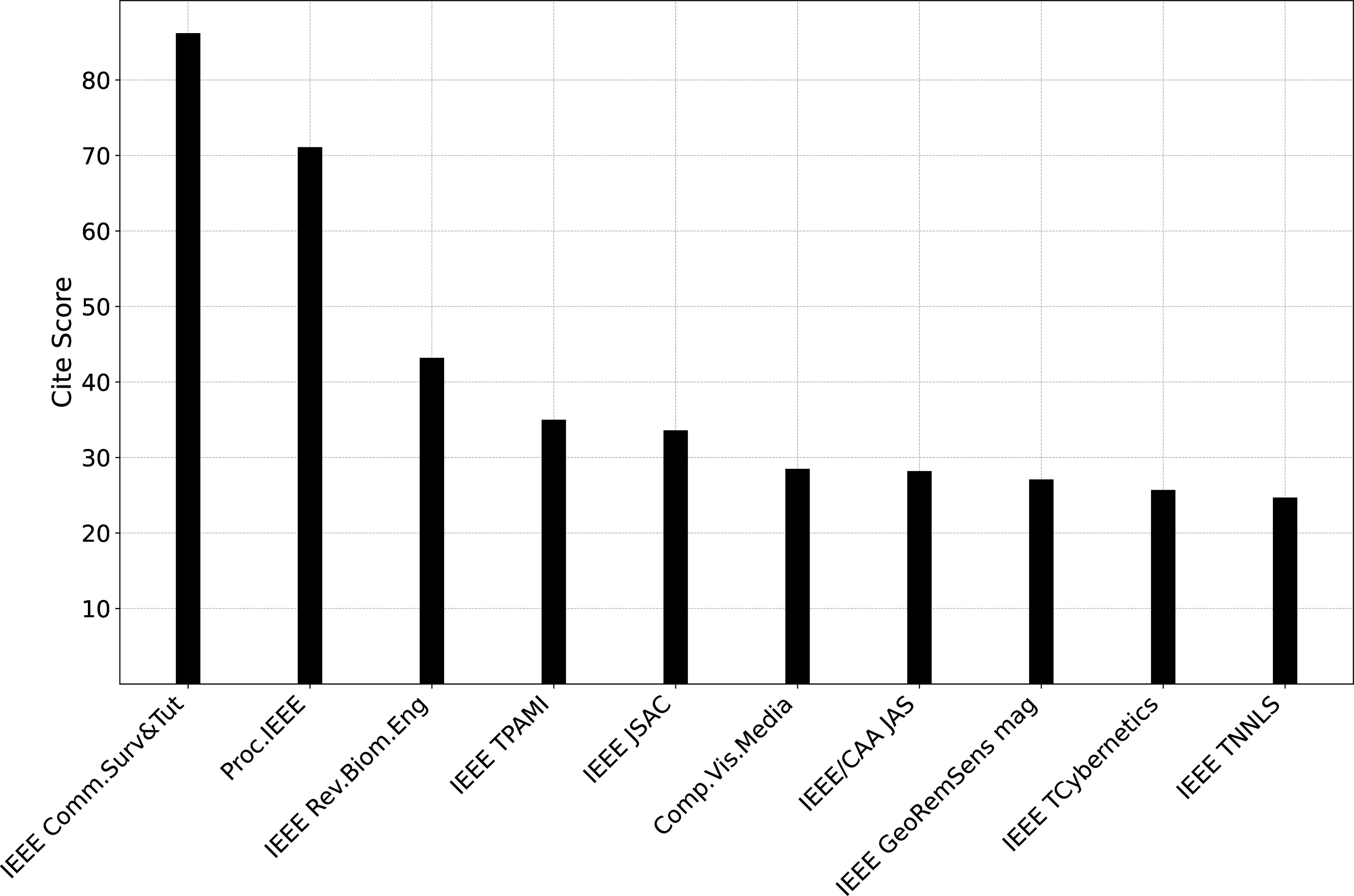
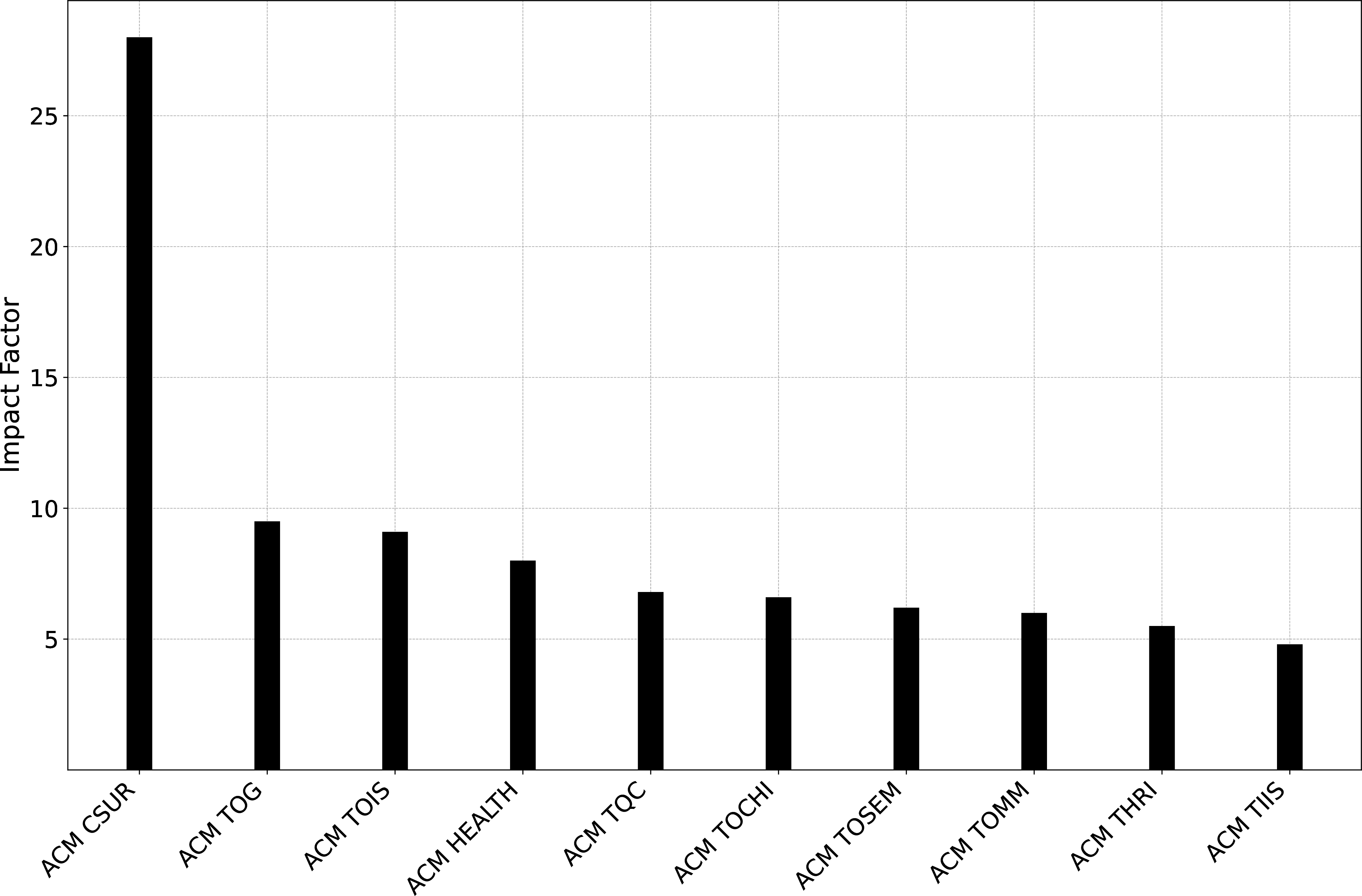
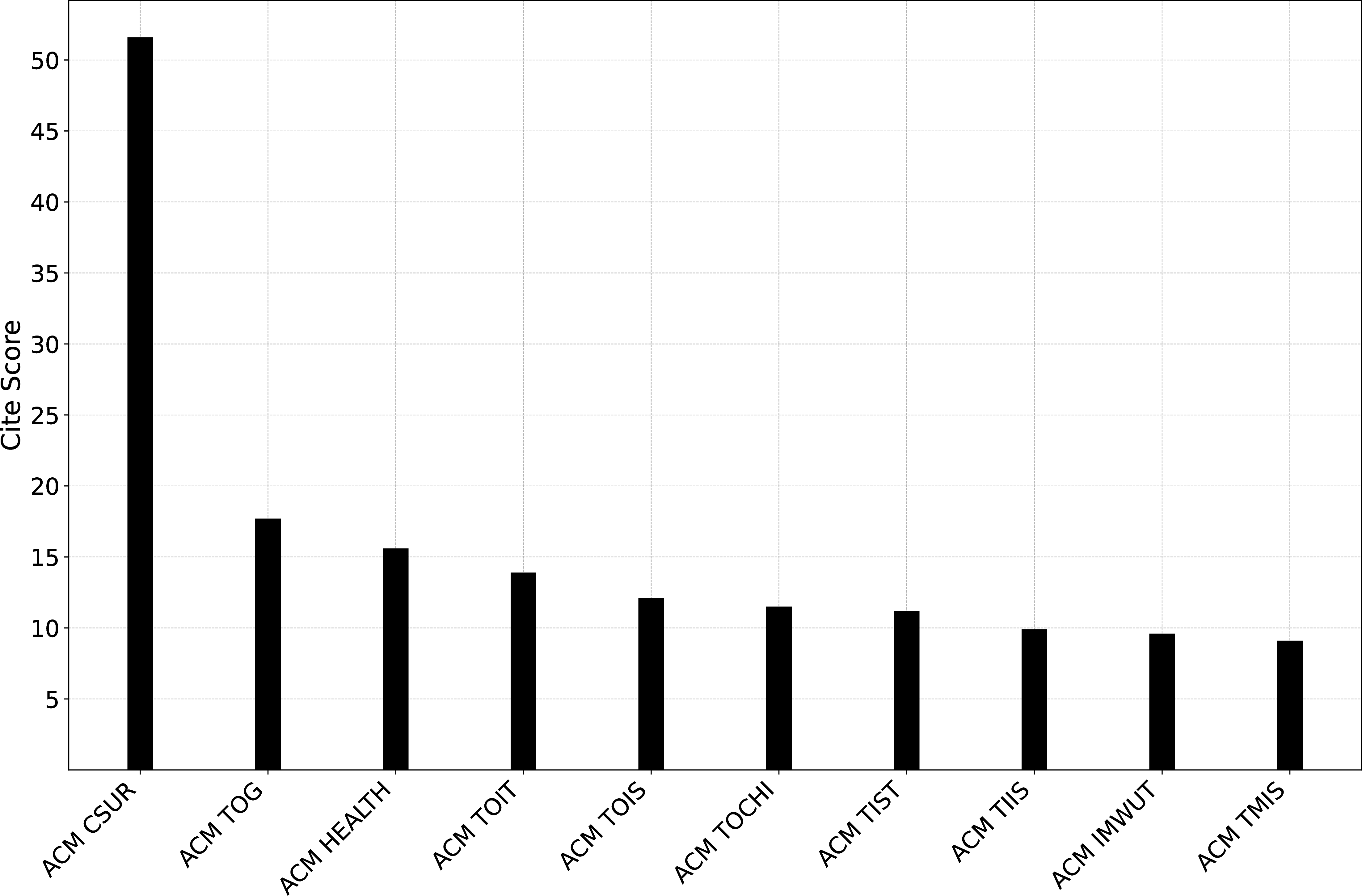
As expected, periodicals publishing survey articles, namely ACM CSUR and IEEE Communication Surveys & Tutorials are the top performers with respect to both JIF and CiteScore. After them, we see that the second best performing periodicals are those whose area focuses around learning, intelligence, robotics etc. These are the following:
IEEE Transactions on Pattern Analysis and Machine Intelligence (TPAMI),
IEEE/CAA Journal of Automatica Sinica (JAS),
Computational Visual Media (Comp.Vis.Media)2,
IEEE Transactions on Intelligent Vehicles (TIV),
IEEE Transactions on Image Processing (IEEE TIP),
ACM Transactions on Intelligent Systems and Technology (TIST),
ACM Transactions on Interactive Intelligent Systems (TIIS), etc.
On the other hand, ACM’s most impactful periodicals do not focus on any specific topic, but we can see them ranging from graphics, health, software engineering, multimedia, intelligent systems, etc.
The next question that we would like to investiagte is whether these IEEE and ACM periodicas have always been on the top-\(10\) and what was the evolution of their impact. In Figure 5 we illustrate the impact evolution of those IEEE periodicals with the highest JIF for \(2024\).
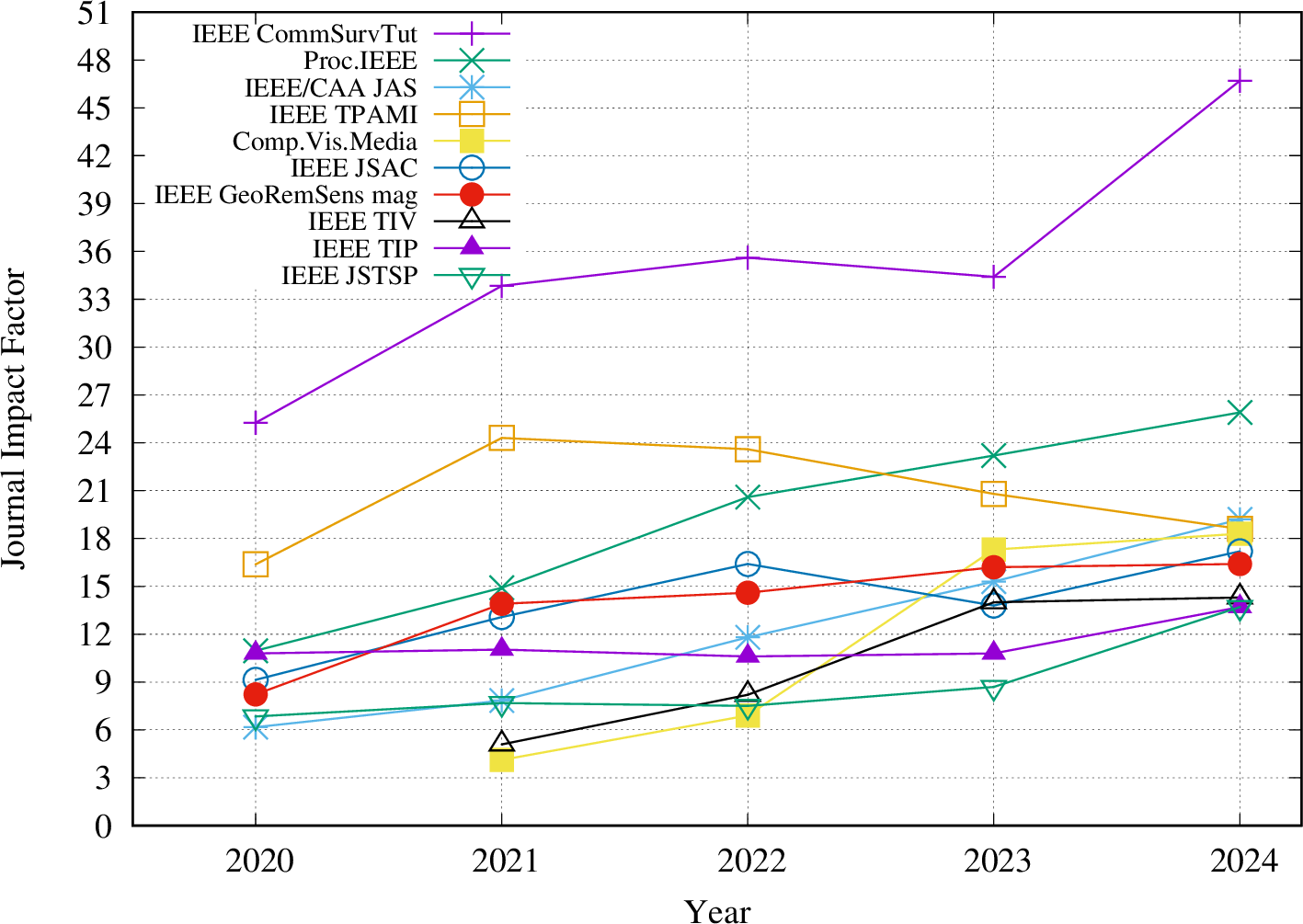
So, we see that these periodicals are building their impact/reputation linearly within the last five years, with the sole exception of IEEE TPAMI whose impact declines steadily since \(2021\).
As far as the ACM periodicals which are toppers in \(2024\), we see that their impact increases twofold since \(2020\), with the exception of ACM CSUR which presents a three-fold increase (see Figure 6).

Let us present now what was the IEEE periodicals with the largest JIF in a sample of recent years. In Tables 3–5, we present the toppers with respect to JIF for the years \(2023\), \(2022\) and \(2020\). Taking into account these tables and Figure 1 and focusing on the ranking rather than absolute values of JIF, we can deduce that the impact of periodicals serving communications and signals gradually reduces, whereas periodicals serving intelligence gain impact.
| IEEE Communications Surveys & Tutorials | 34.4 |
|---|---|
| Proceedings of the IEEE | 23.2 |
| IEEE Trans.on Pattern Analysis and Machine Intelligence | 20.8 |
| IEEE Reviews in Biomedical Engineering | 17.2 |
| IEEE-CAA Journal of Automatica Sinica | 15.3 |
| IEEE Geoscience and Remote Sensing Magazine | 16.2 |
| IEEE Transactions on Intelligent Vehicles | 14.0 |
| IEEE Journal on Selected Areas in Communications | 13.8 |
| IEEE Transactions on Industrial Informatics | 11.7 |
| IEEE Transactions on Evolutionary Computation | 11.7 |
| IEEE Communications Surveys & Tutorials | 35.6 |
|---|---|
| Proceedings of the IEEE | 20.6 |
| IEEE Trans.on Pattern Analysis and Machine Intelligence | 23.6 |
| IEEE Reviews in Biomedical Engineering | 17.6 |
| IEEE Journal on Selected Areas in Communications | 16.4 |
| IEEE Signal Processing magazine | 14.9 |
| IEEE Geoscience and Remote Sensing Magazine | 14.6 |
| IEEE Transactions on Evolutionary Computation | 14.3 |
| IEEE Wireless Communications magazine | 12.9 |
| IEEE Transactions on Industrial Informatics | 12.3 |
| IEEE Communications Surveys & Tutorials | 25.24 |
|---|---|
| IEEE Trans.on Pattern Analysis and Machine Intelligence | 16.38 |
| IEEE Trans. on Systems, Man and Cybernetics: Systems | 13.45 |
| IEEE Signal Processing magazine | 12.55 |
| IEEE Transactions on Fuzzy Systems | 12.02 |
| IEEE Wireless Communications magazine | 11.97 |
| IEEE Transactions on Cybernetics | 11.44 |
| IEEE Computational Intelligence magazine | 11.35 |
| Proceedings of the IEEE | 10.96 |
| IEEE Transactions on Image Processing | 10.85 |
3.2 The birth and discontinuation of periodicals↩︎
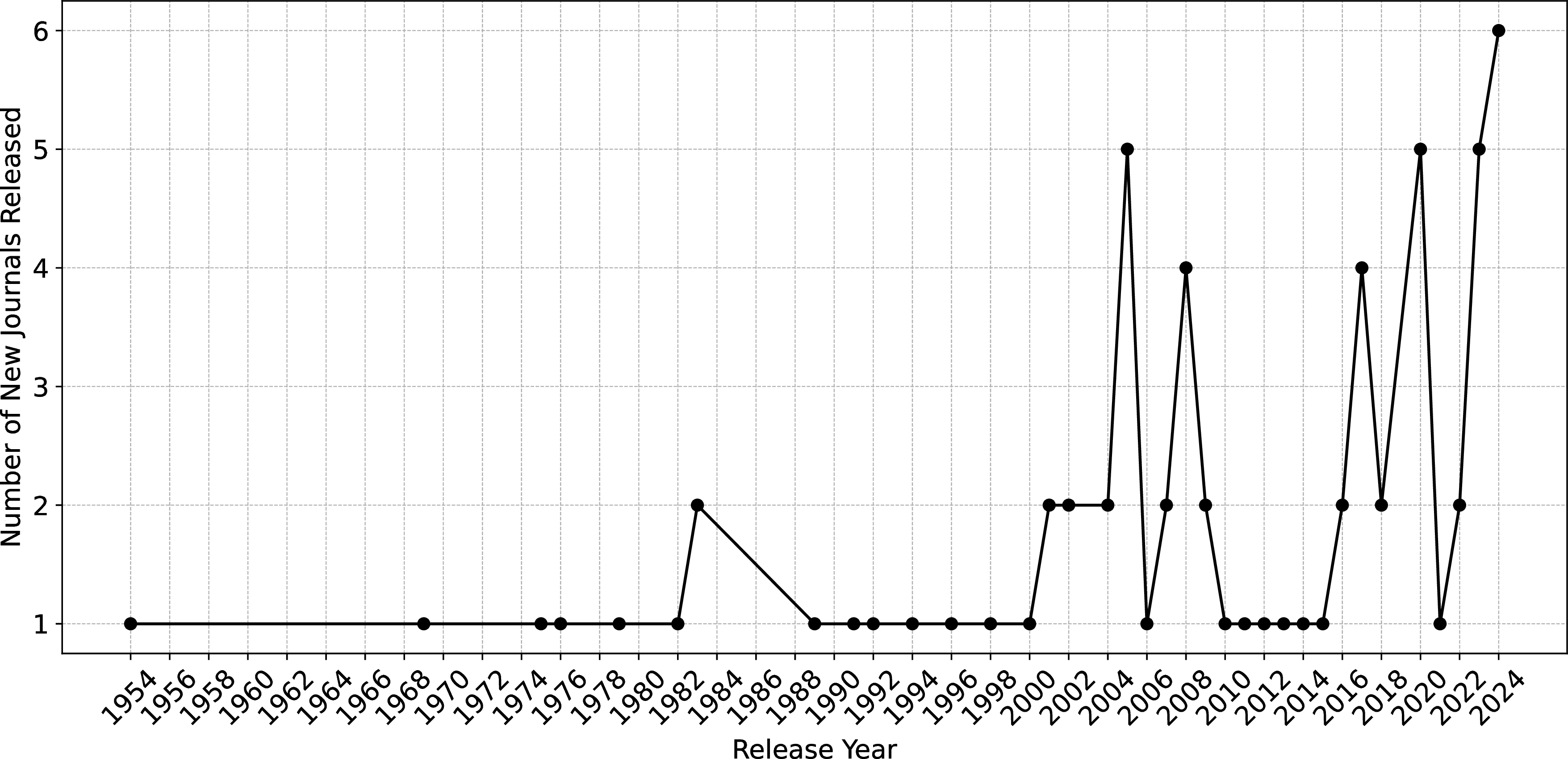
The birth rates for ACM journals are depicted in Figure 7. After 2020, we can note a couple of peaks in years \(2023\) and \(2024\), where ACM established the following journals:
2023
ACM Journal on Computing and Sustainable Societies,
ACM Transactions on Recommender Systems,
Games: Research and Practice,
Proceedings of the ACM on Management of Data,
Proceedings of the ACM on Networking,
2024
ACM Journal on Autonomous Transportation Systems,
ACM Journal of Data Science,
ACM Journal on Responsible Computing,
ACM/IMS Journal of Data Science,
ACM Transactions on Probabilistic Machine Learning.
Proceedings of the ACM on Software Engineering, and
So, we observe that the majority of these new periodicals focus on data management and “learning", i.e., data science, machine learning, recommendation, autonomous systems. This trends goes on for subsequent years, when ACM establishes some more new periodicals, namely ACM Transactions on AI for Science, ACM Transactions on AI Security and Privacy, and ACM AI Letters. Therefore, it seems that ACM has a clear orientation towards establishing new journals that focus on the generic area of artificially intelligence and intelligent systems.
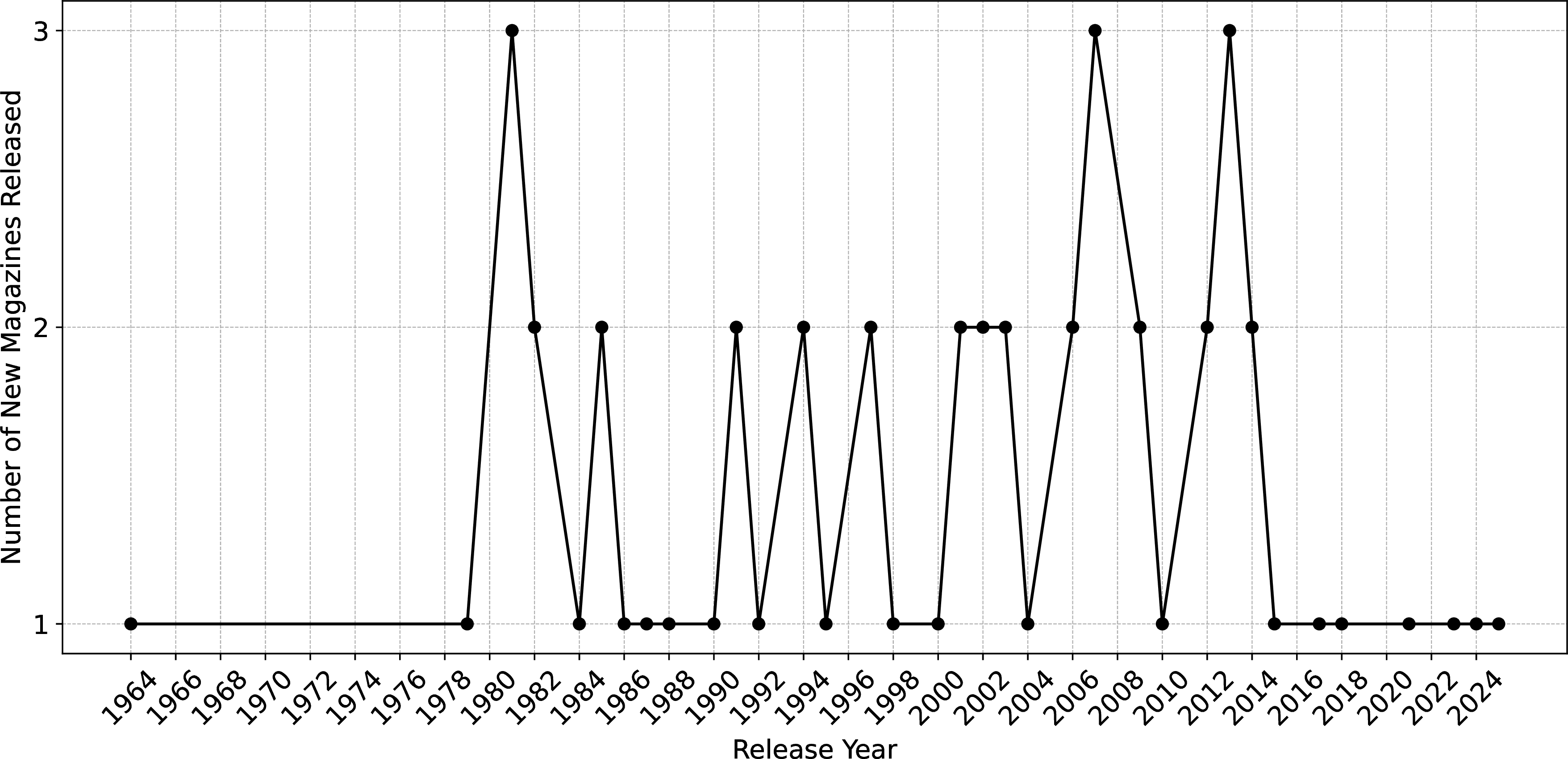
The birth rates for IEEE magazines and journals are illustrated in Figure 8 and Figure 9, respectively. As far as the magazines are concerned, we note that establishment of new ones is not very frequent. During the past five years, only four new magazines are published, namely
IEEE BITS Information Theory Magazine (2021),
IEEE Electron Devices Magazine (2023),
IEEE Reliability Magazine (2024), and
IEEE Energy Sustainability Magazine (2025),
without any particular focus on some field.
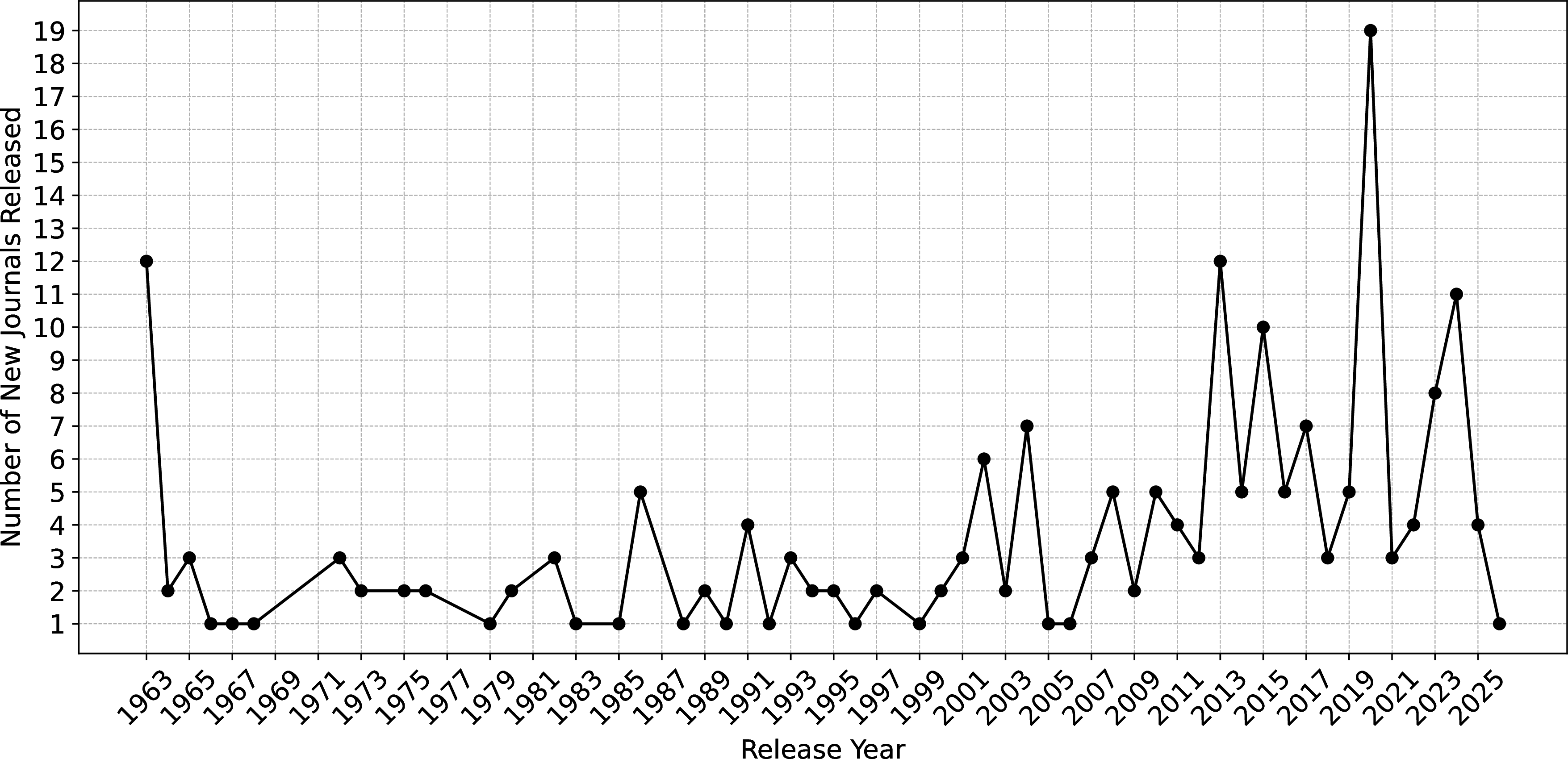
But, when observing the establishment of new IEEE journals, we see a couple of peaks in years \(2020\) and \(2024\), when \(19\) and \(11\) new journals appear in these years, respectively. In particular, \(14\) out of \(19\) new journals in year 2020, are “Open Journal of" designating a strong the transition to the open access model3. The Appendix contains a detailed presentation of the new titles for these years. Apart from this, we can not see any other strong pattern in the newly established IEEE titles, meaning that we see new IEEE periodicals related to electronics, to signals, to systems, to AI, and so on, in a quite balanced way.
Then, we looked at the discontinuation distribution, namely we asked whether periodicals ‘die’ as a consequence of reduced interest in an area. We present the results in Figure 10 for both journals and magazines.
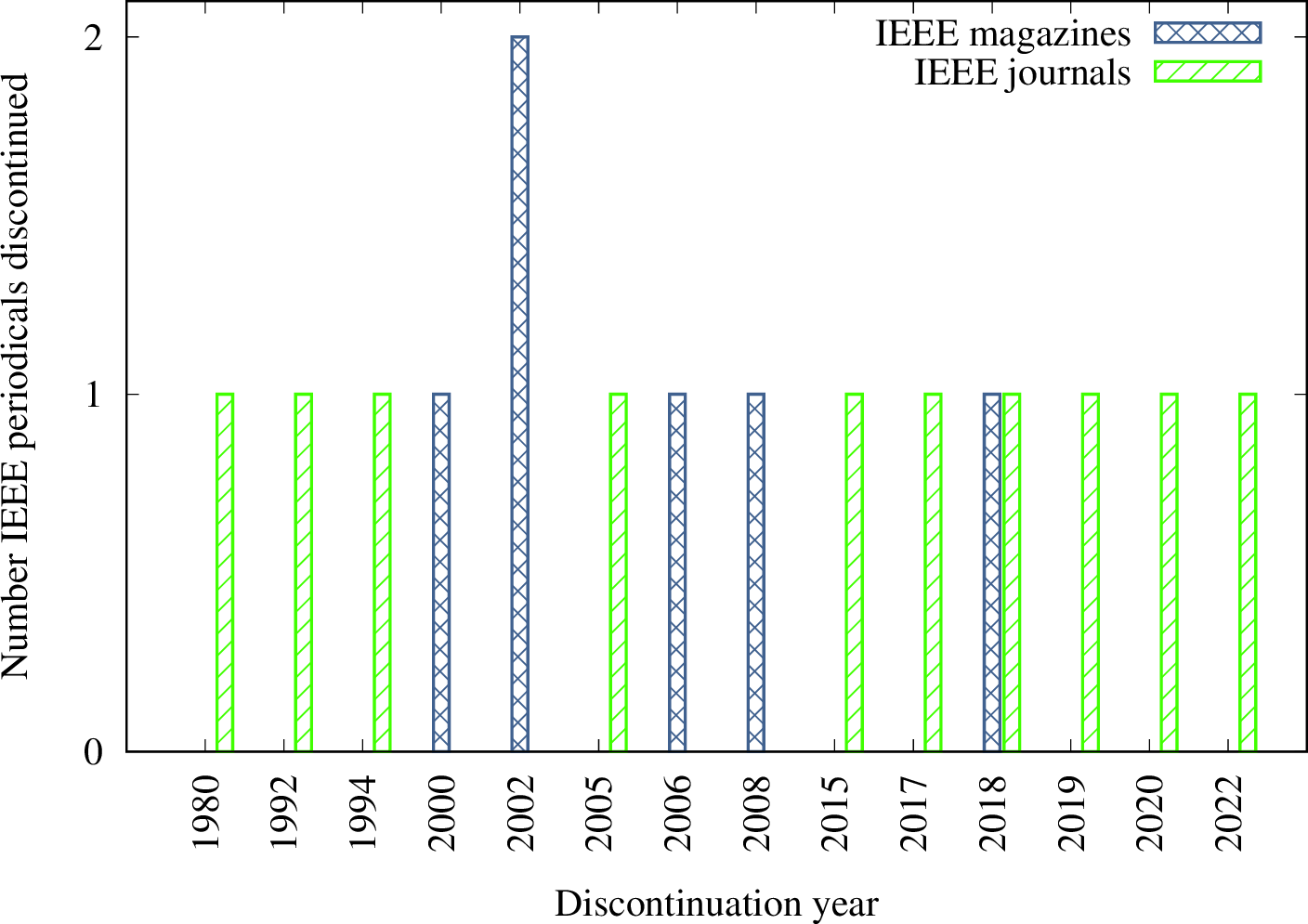
Looking at the recent past, only one magazine ceased its operation, namely the IEEE Cloud Computing magazine in \(2018\). This seems somewhat irrational, since cloud computing continues to be a very hot research and development area especially because of the progress in AI, and moreover because this area is supported by a very vibrant community of researchers.
On the other hand, examining the discontinuation of IEEE journals in the recent past, we will see that only five journals stopped being published (the year of discontinuation in parenthesis), namely
IEEE Transactions on Multi-Scale Computing Systems (2018),
IEEE RFID Virtual Journal (2018),
IEEE Biometrics Compendium (2019),
IEEE Letters of the Computer Society (2020), and
IEEE RFIC Virtual Journal (2022).
From among them, only the first is an “actual" journal, whereas the others are newsletters or do not publish original material. For instance, from 2010 until 2019, the IEEE Biometrics Council has published the IEEE Biometrics Compendium which was a selection of relevant biometrics related articles from IEEE Transactions on Image Processing, IEEE Transactions on Information Forensics and Security and IEEE Transactions on Systems, Man, and Cybernetics, Part B (Cybernetics). Therefore, only one IEEE journal stopped recently its operation.
3.3 Topic categories↩︎
To examine the most popular scientific disciplines covered by ACM’s and IEEE’s periodicals, we present in Table 6 and 7 the top-\(10\) categories served by the periodicals. The number next to each catergory records the percentage of periodicals that serve this specific category. Apparently, a category (subject) might appear in several periodicals, so the percentages add up to more than \(100\)%. This is also an indication of overlap among the topics of periodicals (cf.section 3.4).
So, the most popular discipline covered by ACM’s periodicals falls within the broader area of artificial intelligence (machine/deep learning); the second most signigifcant area is that of human-computer interaction. It is interesting to note that around \(22\)% of periodicals accept articles relevant to natural language processing, and we can speculate that the huge growth of a deep learning technology, namely Foundation Models comprises the main reason.
| Topic | percent |
|---|---|
| Machine learning | 57.75 |
| Neural networks | 53.52 |
| Artificial intelligence | 45.07 |
| Embedded systems | 30.99 |
| Surveys and overviews | 23.94 |
| Human computer interaction | 22.54 |
| Natural language processing | 22.54 |
| Design and analysis of algorithms | 21.13 |
| Empirical studies in HCI | 19.72 |
| User studies | 19.72 |
IEEE’s periodicals most popular category is ‘Computing and Processing’, which certainly includes topics such as AI and machine/deep learning4 but it is significantly broader covering also data science/management; even periodicals focusing on communications include this subject in their topics. As expected, the next most popular category is the networking and communications technologies, followed by circuits and systems and then signals.
| Topic | percent |
|---|---|
| Computing and Processing | 50.44 |
| Communication, Networking and Broadcast Technologies | 33.14 |
| Components, Circuits, Devices and Systems | 32.26 |
| Signal Processing and Analysis | 22.29 |
| General Topics for Engineers | 19.94 |
| Power, Energy and Industry Applications | 18.18 |
| Fields, Waves and Electromagnetics | 14.66 |
| Robotics and Control Systems | 12.02 |
| Bioengineering | 9.97 |
| Engineered Materials, Dielectrics and Plasmas | 9.97 |
As noted earlier, summing the top percentages add up to more than \(200\)% which implies that there significant overlap among the areas served by the periodicals; so in the next section we investigate this overlap.
3.4 Theme overlap among periodicals↩︎
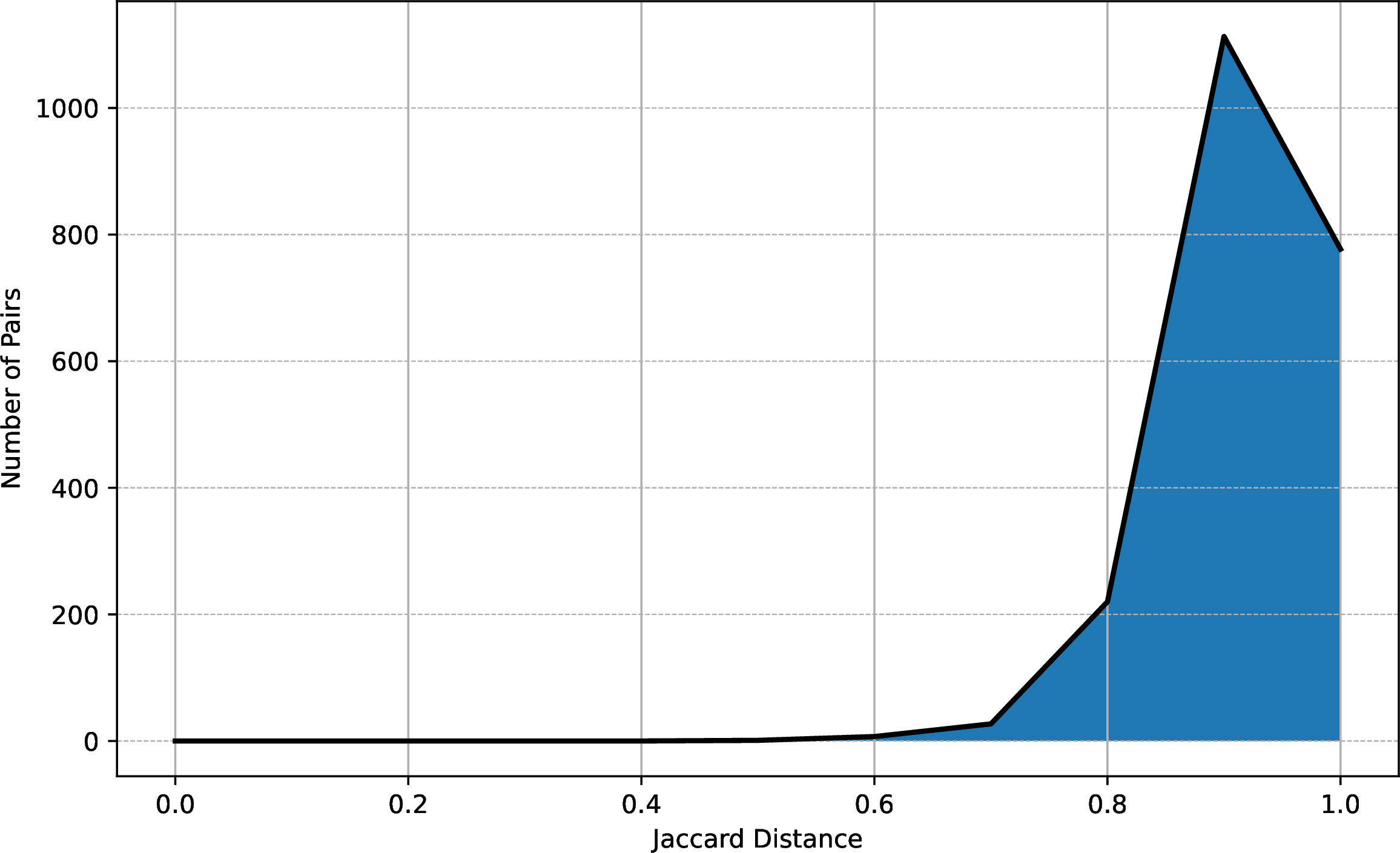
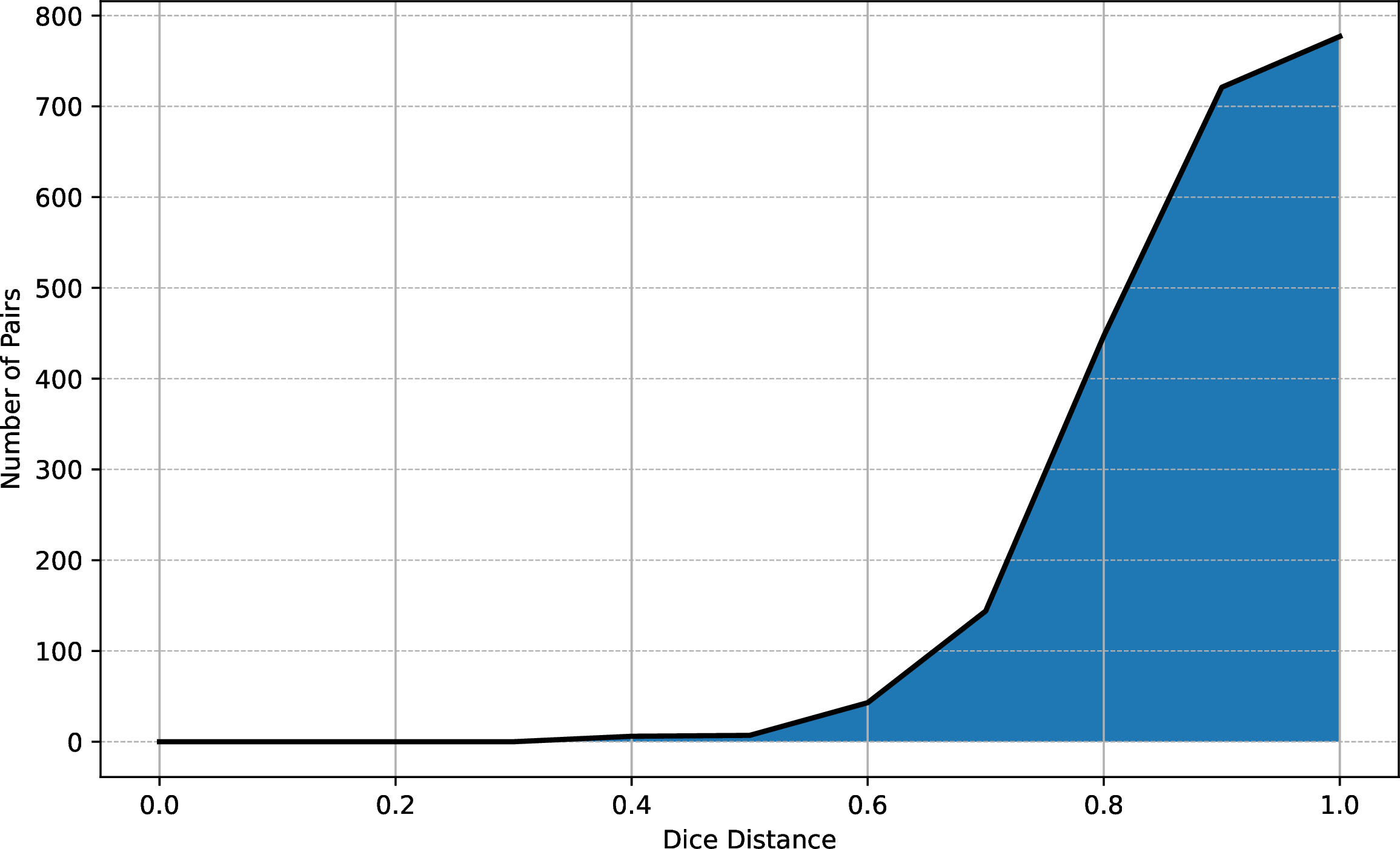
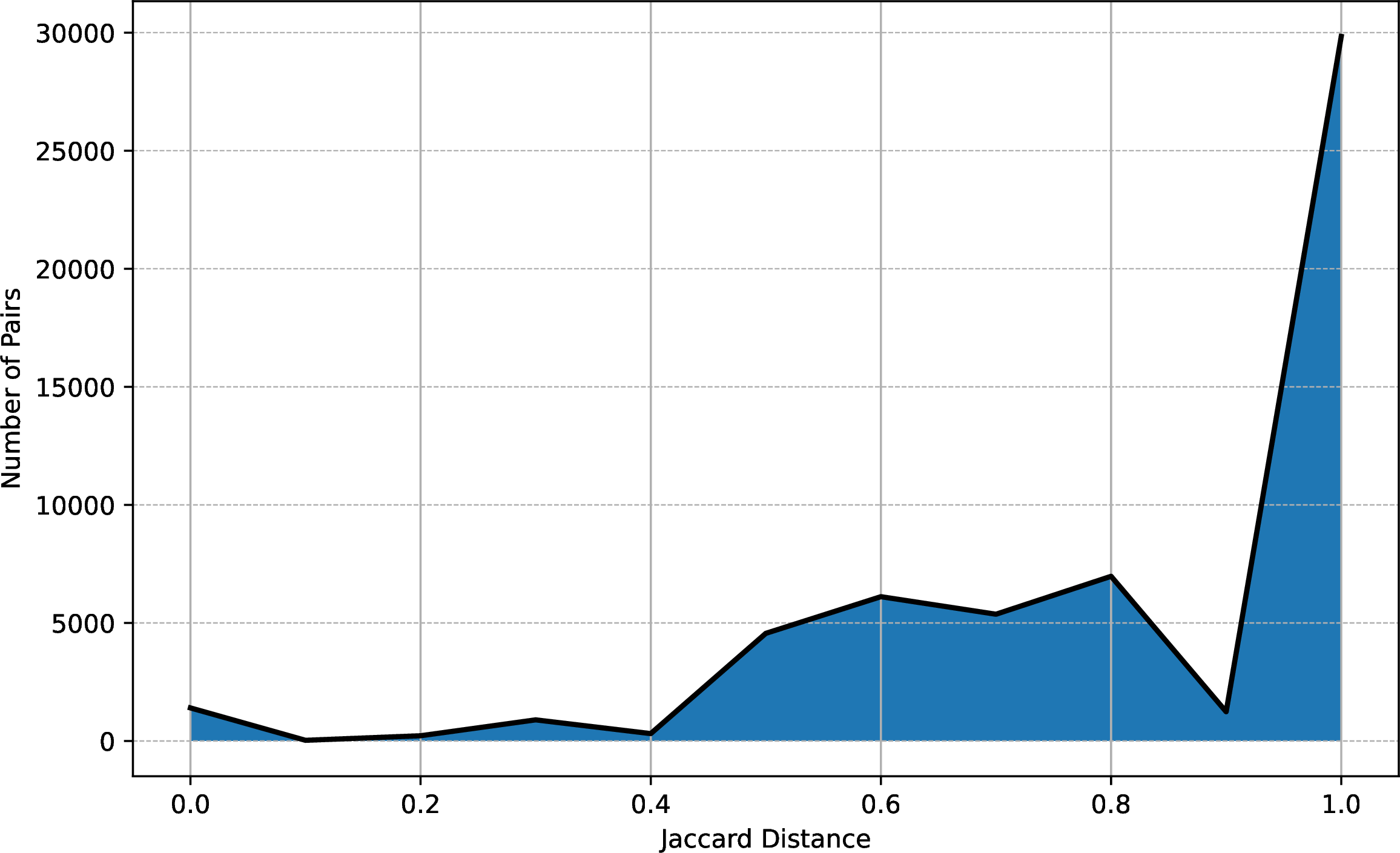
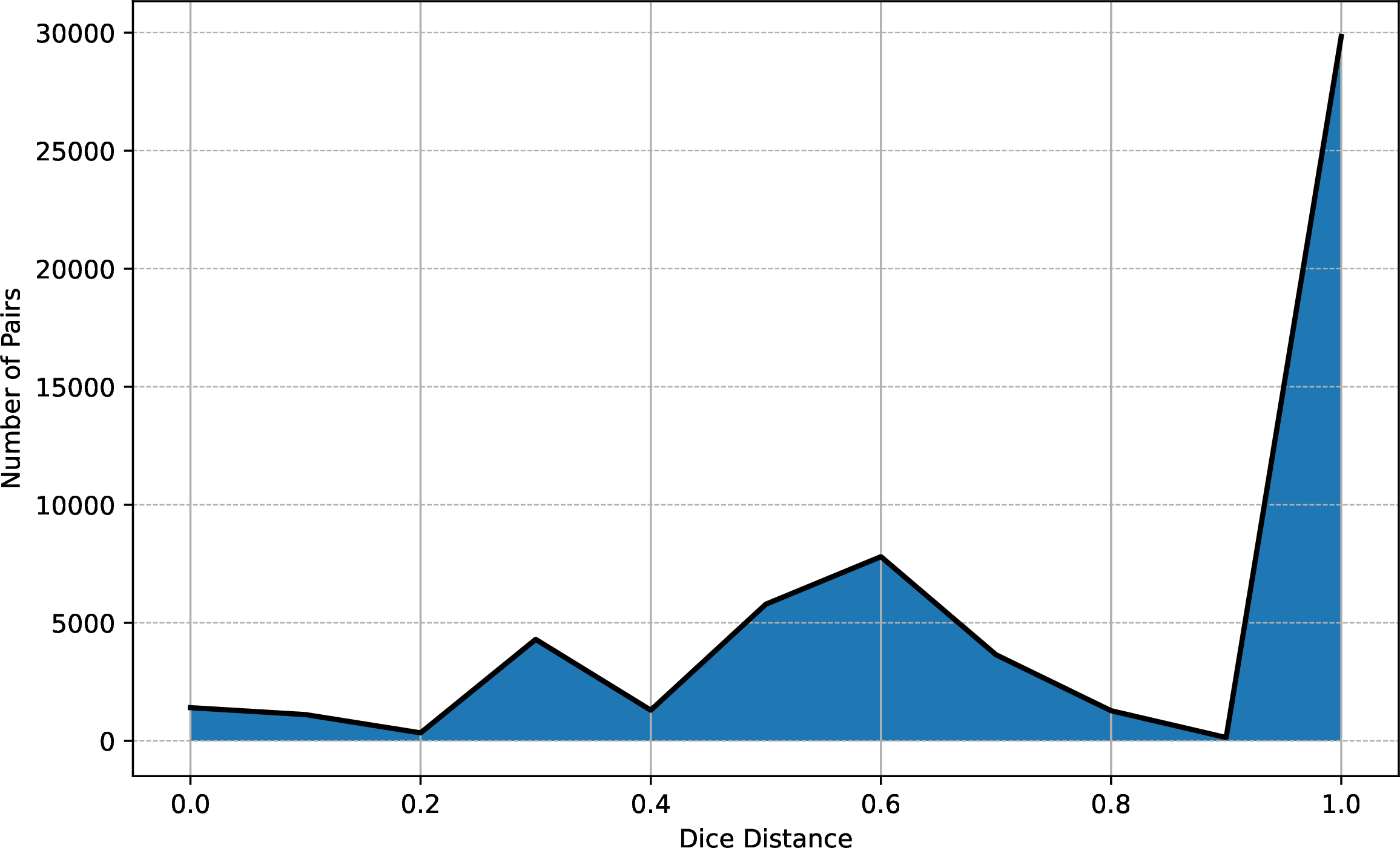
Our final effort aimed at investigating the degree of overlap among the themes of periodical of the two associations. Towards this goal we used the overlap measures defined in Subsection 2.3. These measures are quite similar, but not identical and for the sake of completeness we include both of them in our presentation. The relevant figures should be interpreted in the following way: a mass concentrated towards the far right end of the plot (i.e., close to \(1\)) implies a very low overlap among the topics of the periodicals; when a significant part of the mass is concentrated around the middle of the plot (at point \(0.5\) in \(x\)-axis) implies that there is a significant overlap among the topics of the periodicals.
Examining firstly the ACM’s periodicals (the results appear in Figures 11 and 12) we observe that the “center of mass" is located close to \(0.9\) (for both the Jaccard and the Dice measure). So, it seems that the ACM periodicals have a very low theme overlap among them. There is one straightforward explanation for that and one that is more subtle. As far as the ACM periodicals are concerned, their area of focus is determined with a quite extended set of keywords. So, the cardinality of the keyword sets used by Jaccard (and Dice) is quite large and consequently these large sets are not practically feasible to have significant overlap. The subtle explanation seems to be based on the ACM’s tradition to have only one journal for a quite broad discipline, e.g., one journal for databases, one for networking, one for information systems, and so on.
The overlap profile among IEEE periodicals is apparently different. The results are depicted in Figures 13 and 14. So, we observe that the “center of mass" is located around \(0.7\) for the Jaccard coefficient and even more to the left for the Dice coefficient. So, we can safely conclude that the IEEE periodicals exhibit is significant overlap in their themes.
There seem to exist three main reasons that explain this observation. The first straightforward reason has to do with the set of keywords that describe the area of interest of an IEEE periodical. IEEE use a very limited set of keywords. For instance, ‘IEEE Transactions on Knowledge and Data Engineering (TKDE)’ and ‘IEEE Wireless Communications magazine (WComm)’ – two periodicals with apparently quite diverse focus – are described by: for TKDE the subject(s) are the following a) Computing and Processing for TKDE, whereas for IEEE WComm the subjects are the following: a) Communication, Networking and Broadcast Technologies, b) Computing and Processing, c) Signal Processing and Analysis. A second straighforward reason is that some IEEE societies publish practically a “Transactions", a magazine, and a”Letters" periodical which all have identical subjects, e.g, IEEE Transactions on Wireless Communications, IEEE Wireless Communications magazine and IEEE Wireless Communication Letters. However, the contribution to the aggregrate overlap due to this, is far less that the previous reason, because there are not too many societies that follow this pattern.
There is also a subtle reason for observing the significant overlap. This has to do with the actual areas served by the periodicals, i.e., different periodicals serving the very same parts of a discipline. As a characteristic example consider the following periodicals “IEEE Transactions on Communications",”IEEE Transactions on Wireless Communications", “IEEE Journal on Selected Areas in Communications",”IEEE Open Journal of the Communications Society", which all publish articles on communications (and networking).
4 Web tool for navigating in the periodicals↩︎
The investigation covered in this article was supported by the development of a publicly available Web tool found in the location https://prism.e-ce.uth.gr/. This tool, namely PRISM (Periodical Research & Insights for Scholarly Metrics) records the impact measures of periodicals, the subject categories, the establishment year of each periodical, and the overlap of pairs of periodicals. It is a searchable service, including filters to detect specific periodicals or pairs of them.
5 Discussion and conclusions↩︎
Modern science evolves very rapidly with new disciplines arising and others declining in research activity. Publication fora, namely periodicals and conferences need to support this continuous progress, and also to serve a steadily growing number of researchers. This article examines the periodicals i.e., journals and magazines published by ACM and IEEE since these are the two computing associations that currently are shaping the field, and in particular our work focuses on the last five years. The aim is to seek for qualitative patterns that confirm or refute a close match to the contemporary computer science and engineering evolution.
In the context of this question, our first objective was to identify the (top-10) most impactful periodicals. As expected, the periodicals publishing survey articles were on the top of the impact scale for both ACM and IEEE. Their performance keeps growing during the last five years and the performance gap with respect to the second best performing periodical widens. The exponentially growing population of published articles and the lengthier references list in each article can obviously explain this observation. As far as the rest of the top-10, we observed that most of them increase their impact during the last five years, with the exception of IEEE TPAMI. Most of the IEEE’s periodicals in the top-10 are serving a “data analysis and learning" discipline, i.e. they lie in the generic area of artificial intelligence, and also with a couple lying in the area of networks and signals. On the other hand, looking at the ACM’s top-10 list, we can not observe any such clear pattern, but it is interesting to note in the top-10 a couple of periodicals serving human-machine interaction. As a final comment for the impact, we see that the top-10 list changes year by year, with the most notable pattern being the decline of IEEE periodicals serving”communications, networking and signals" in favor of those serving the “learning" area.
It is expected that a changing landscape in science would also trigger the establishment and perhaps discontinuation of periodicals. Indeed, both IEEE and ACM have established a significant number of new periodicals during the past five years. ACM has focused almost exclusively on the broad area of AI-related periodicals. On the other hand, IEEE’s new periodicals cover a quite diverse field of topics ranging from communications, signals, power, devices/displays, etc. It is interesting to note that both IEEE and ACM established periodicals to service “vertical areas", such a health, agriculture, showing a trend for overspecialization in publication. Another striking characteristic is the preference for the”open access" mode of publication. IEEE has initiated nineteen “Open Journals". ACM, starting from 2026, has turned into a complete open access mode, following a trend that other publishers such as MDPI started long before. Additionally, it has been established that periodicals”never die".
Finally, as far as the theme overlap among periodicals of the same association is concerned, we observed a quite high overlap. In particular, the theme overlap is more significant for IEEE’s periodicals than for ACM’s periodicals. This observation can not only be explained by the larger number of IEEE periodicals, but also by the overspecialization of their periodicals, and the existence of multiple periodicals serving the same area.
Interesting extensions of our work would be to study which periodicals become “archival", which are”trendy" and also to generalize the ideas of this article to other well-established publishers such as MDPI, Elsevier, Springer-Nature.
6 IEEE periodicals established in 2020–2026↩︎
A very small number of “new" journals are simply older ones but just renamed, e.g., the old”IEEE/ACM Transactions on Networking" has now become “IEEE Transactions on Networking", the old”IEEE/ACM Transactions on Audio, Speech and Language Processing" has now become “IEEE Transactions on Audio, Speech and Language Processing", the old”IEEE/ACM Transactions on Computational Biology and Bioinformatics" has now become “IEEE Transactions on Computational Biology and Bioinformatics".
2020
IEEE Journal of Emerging and Selected Topics in Industrial Electronics
IEEE Journal on Selected Areas in Information Theory
IEEE Open Journal of Antennas and Propagation
IEEE Open Journal of Circuits and Systems
IEEE Open Journal of Engineering in Medicine and Biology
IEEE Open Journal of Industry Applications
IEEE Open Journal of Intelligent Transportation Systems
IEEE Open Journal of Nanotechnology
IEEE Open Journal of Power and Energy
IEEE Open Journal of Power Electronics
IEEE Open Journal of Signal Processing
IEEE Open Journal of The Communications Society
IEEE Open Journal of The Computer Society
IEEE Open Journal of The Industrial Electronics Society
IEEE Open Journal of The Solid-State Circuits Society
IEEE Open Journal of Vehicular Technology
IEEE Transactions on Artificial Intelligence
IEEE Transactions on Quantum Engineering
IEEE Transactions on Technology and Society
2021
IEEE Canadian Journal of Electrical and Computer Engineering
IEEE Journal of Microwaves
IEEE Open Journal of Ultrasonics, Ferroelectrics, and Frequency Control
2022
IEEE Journal on Flexible Electronics
IEEE Open Journal of Control Systems
IEEE Open Journal of Instrumentation and Measurement
IEEE Transactions on Signal and Power Integrity
2023
IEEE Journal of Indoor and Seamless Positioning and Navigation
IEEE Microwave and Wireless Technology Letters
IEEE Open Journal of Systems Engineering
IEEE Transactions on AgriFood Electronics
IEEE Transactions on Energy Markets, Policy and Regulation
IEEE Transactions on Industrial Cyber-Physical Systems
IEEE Transactions on Machine Learning in Communications and Networking
IEEE Transactions on Radar Systems
2024
IEEE Data Descriptions
IEEE Electron Devices Reviews
IEEE Robotics and Automation Practice
IEEE Journal of Selected Areas in Sensors
IEEE Open Journal on Immersive Displays
IEEE Sensors Reviews
IEEE Systems, Man, and Cybernetics Letters
IEEE Transactions on Circuits and Systems for Artificial Intelligence
IEEE Transactions on Field Robotics
IEEE Transactions on Materials for Electron Devices
IEEE Transactions on Privacy
2025
IEEE Journal of Selected Topics in Electromagnetics, Antennas and Propagation
IEEE Transactions on Audio, Speech and Language Processing
IEEE Transactions on Computational Biology and Bioinformatics
IEEE Transactions on Networking
2026
- IEEE Journal on Wireless Power Technologies
7 ACM periodicals established in 2020–2026↩︎
2020
ACM Transactions on Computing for Healthcare
ACM Transactions on Internet of Things
ACM Transactions on Quantum Computing
Digital Government: Research and Practice
Digital Threats: Research and Practice
2021
- ACM Transactions on Evolutionary Learning and Optimization
2022
Collective Intelligence
Distributed Ledger Technologies: Research and Practice
2023
ACM Journal on Computing and Sustainable Societies
ACM Transactions on Recommender Systems
Games: Research and Practice
Proceedings of the ACM on Management of Data
Proceedings of the ACM on Networking
2024
ACM Journal of Data Science
ACM Journal on Autonomous Transportation Systems
ACM Journal on Responsible Computing
ACM Transactions on Probabilistic Machine Learning
ACM/IMS Journal of Data Science
Proceedings of the ACM on Software Engineering
2026
ACM AI Letters
ACM Transactions on AI for Science
ACM Transactions on AI Security and Privacy
References↩︎
In Figure 1, IEEE JSTSP stands for IEEE Journal of Selected Topics in Signal Processing.↩︎
Computational Visual Media is a fully open access journal, published bimonthly by Tsinghua University Press with all articles available on IEEE Xplore from volume 11/2025.↩︎
A model that is completely followed by ACM, starting from 2026.↩︎
IEEE does not have a specific subject category for AI, and periodicals serving this area declare as their subject the ‘Computing and Processing’ area.↩︎