Taxonomy of Integrable and Ground-State Solvable Models:
Jastrow Wavefunctions on Graphs and Parent Hamiltonians
February 25, 2026
Abstract
We introduce a family of many-body systems of distinguishable continuous-variable particles in which interparticle interactions are set by the adjacency matrix of a graph. The ground-state wavefunction of such systems is of a generalized Jastrow form involving the product of pair-correlation functions over the edge set of the graph. These systems describe quantum fluids when the graph is complete, and the pair function has a well-defined permutation symmetry. In general, they provide the continuous-variable generalization of spin systems on graphs, with broken permutation symmetry. The corresponding parent Hamiltonian is shown to include (a) two-body interactions determined by the graph adjacency matrix and (b) three-body interactions over all possible 2-paths on the graph. Employing elements of graph theory, we chart the landscape of models, recovering known instances in the literature and providing numerous new examples of ground-state solvable models for which the system Hamiltonian, ground-state wavefunction, and corresponding energy eigenvalue are specified.
1 Introduction↩︎
Distinguishable degrees of freedom, such as spins, play a central role in the theory of quantum many-body systems. Since Bethe’s solution of a one-dimensional interacting model [1], quantum spin Hamiltonians have served as paradigmatic settings for correlated matter and, more recently, for quantum computation and simulation. In quantum information science, distinguishable two-level systems (qubits) and their generalizations (qudits) provide a natural language for describing controllable many-body dynamics [2]. In parallel, networks of continuous-variable degrees of freedom, such as coupled oscillators, are widely used to model transport and entanglement properties in extended systems [3], [4].
Bosons, fermions, and anyons are endowed with permutation symmetry, but particles are treated as distinguishable when corresponding to different species [5]–[9], as in the study of atomic mixtures [10], [11]. Freezing the spatial degree of freedom in systems of continuous variables provides a fruitful approach for deriving many-body spin systems, such as the celebrated Haldane-Shastry model [12], [13]. The breaking of permutation symmetry is also used in quantum Monte Carlo methods, e.g., when using Nosanow-Jastrow wave functions in the quantum theory of solids to effectively pin down particles at given coordinates [14]. In such cases, permutation symmetry can then be restored by suitable symmetrization [15]–[17]. Experimentally, particle ordering and addressability are increasingly routine in platforms such as ion chains, optical tweezer arrays, and Rydberg-based quantum simulators, where the relevant degrees of freedom are intrinsically labeled.
In this work, we consider networks of distinguishable single quantum systems with continuous variables. We focus on a class of models in which the ground-state wavefunction contains product pair-correlation functions over a set of particle pairs. Such a structure in the ground-state wavefunction is known as the Jastrow form when it involves all possible particle pairs, i.e., those with permutation symmetry [18]. By contrast, in this work, we consider many-body quantum systems in which the ground-state wavefunction involves only pair-correlation terms at the edges of the graph. As it turns out, the parent Hamiltonian with such a ground-state involves pairwise interactions between the edges of the graph. In addition, it may involve three-body interactions spanning the set of 2-paths in the connectivity graph. The resulting Hamiltonians describe mixtures of distinguishable particles with continuous variables in a region of space, with interactions specified by the graph’s adjacency matrix. These models can be further generalized to include a spatial distribution of particles on a lattice or graph by extending the Nosanow-Jastrow ansatz used in the quantum theory of solids to a graph-based formulation.
In what follows, we first derive the parent Hamiltonian associated with a Graph–Jastrow wavefunction (GJW) in arbitrary spatial dimensions and subsequently specialize to one-dimensional systems, where the structure simplifies considerably, and a rich taxonomy emerges. We begin with the case of all-to-all pairwise interactions corresponding to a complete graph. In this limit, we recover a broad and important class of exactly solvable models [17], [19], including the Calogero–Sutherland family [20], [21], trigonometric variants [18], [22], and the Lieb–Liniger gas [23]–[27], among others. When the pair-correlation function possesses a definite parity, the resulting ground state is fully (anti)symmetric under particle exchange, thereby restoring permutation symmetry and describing bosonic or fermionic quantum fluids.
We then extend the construction to arbitrary connectivity graphs and use elementary tools from graph theory to organize the resulting models. When the graph is a path or cycle, the formalism yields a natural generalization of the Jain–Khare model [28]–[33] for arbitrary pair functions, featuring inverse-square nearest-neighbor interactions supplemented by an induced attractive three-body term. For regular graphs with finite coordination number, one recovers and generalizes truncated Calogero–Sutherland-type models [34]–[37].
Beyond unifying these known examples, our main objective is taxonomic. For each graph family and each admissible pair function \(f\), the framework explicitly specifies the parent Hamiltonian, the exact ground-state wavefunction, and the corresponding ground-state energy. Moreover, we show how standard graph operations such as joins and graph products systematically generate new composite models with transparent physical interpretations, including continuum analogs of “system + environment” constructions familiar from impurity and decoherence problems.
2 Quantum Many-body Wavefunctions on Graphs↩︎
We are interested in describing quantum many-body systems of \(N\) particles, each of which is associated with a vertex of the graph. The interaction between any two particles is associated with an edge, so the resulting graph describes the interactions between particles. This is a common approach, e.g., in the study of networks of oscillators. Our interest is in the identification of more general quasi-solvable many-body quantum models for which several exact properties can be derived, such as the ground-state wavefunction, its energy, and the parent Hamiltonian.
To this end, we introduce a finite set \(V=\{1,2,\dots,N\}\) and consider a classical graph \(\mathcal{G}(V, E)\) with \(N\) vertices and \(M\) edges, where \(V\) and \(E\) denote the sets of vertices and edges of \(\mathcal{G}\), respectively. The set of edges is composed of pairs \((i,j)\) labeling an edge that starts at vertex \(i\) and ends at vertex \(j\). Such graph can be described by the adjacency matrix \(A=A(\mathcal{G})\) with elements \(A_{ij}=1\) if \((i, j)\in E\) and \(A_{ij}=0\) otherwise.
In the description of quantum many-body networks, we endow each vertex with a quantum-mechanical particle in space dimension \(D\), i.e., with coordinate \(\vec{r}_i\in\mathbb{R}^D\). We shall focus on ground-state wavefunctions with a Jastrow form and associated pair correlation functions \(f_{ij}=f(\|\vec{r}_i-\vec{r}_j\|)\) of particles \(i\) and \(j\) with an edge \((i,j)= (j, i)\). The graph accounting for pair correlations in the ground-state wavefunction is thus undirected, and its adjacency matrix satisfies \(A_{ii}=0\), \(A_{ij}=A_{ji}\). As we shall see, there is a one-to-one correspondence between the graph of pair correlations in the generalized Jastrow ansatz and the graph accounting for two-body interactions in the corresponding parent Hamiltonian. The presence of pair correlation functions in the ground-state wavefunction and of two-body interactions in the system Hamiltonian is determined by the graph’s adjacency matrix.
To make use of the adjacency matrix, we shall thus avoid the double counting and define the set \(E\) as that of all edges \((i,j)\) of \(\mathcal{G}\) with the edge \(i<j\). We shall exclude self-interaction between particles, which is tantamount to considering an anti-reflexive graph with no \((i, i)\) edges. The cardinality of \(V\) and \(E\) is denoted by \(|V|\) and \(|E|\), respectively. Given that we consider one particle in each node of the graph, \(|V|\) equals the total particle number \(N\) and sets the order of the graph. The number of edges \(|E|=M\) is also known as the size of the graph.
The Hilbert space of a many-body system on a graph \(\mathcal{G}(V, E)\) is spanned by the set of square-integrable functions \[\begin{align} \mathcal{H}_{\mathcal{G}}=L^2(\mathbb{R}^{DN},d\mathbf{r})=\bigotimes_{i\in V}L^2(\mathbb{R}^D,d^Dr_i), \end{align}\] with \(\mathbf{r}=(\vec{r}_i)_{i\in V}\) and \(\vec{r}_i = (x_i^1, x_i^2, \cdots, x_i^D)\in\mathbb{R}^D\) denotes the coordinate of the \(i\)-th particle, i.e., that on the node \(i\). However, as in the study of conventional Jastrow wavefunctions, it is often convenient to focus on wavefunctions containing only the pairwise product of pair functions, which are not square-integrable. The inclusion of one-body functions in the Jastrow ansatz can be justified in the presence of an external potential, and exact identities relating quantum states with and without confinement are known [17], [19], [38]. Similar identities also apply to the corresponding Hamiltonians and their eigenvalues.
We focus exclusively on interacting systems associated with a connected graph such that a path (correlations) exists between any two vertices (particles). In doing so, we exclude mixtures of non-interacting species. However, the latter can be accounted for by a straightforward generalization of our construction to disconnected graphs.
3 Parent Hamiltonian of Graph Jastrow Wavefunctions↩︎
We are interested in finding the parent Hamiltonian \(\hat{H}_0\) with a ground-state wavefunction of the “Graph-Jastrow” form i.e., GJW in \(D\) spatial dimensions for \(N\) particles, \[\begin{align} \label{Psi0free} \Phi_0(\vec{r}_1,\dots,\vec{r}_N)=\prod_{(i,j)\in E}f(r_{ij})=\prod_{i<j}e^{A_{ij}\log f(r_{ij})}, \end{align}\tag{1}\] where \(r_i = ||\vec{r}_i|| = \sqrt{\sum_{\mu=1}^D (x_i^{\mu})^2}\) is the Euclidean norm, \(A_{ij}\) are the elements of the adjacency matrix \(A\), and the product runs over all edges in the graph (with \(i<j\)) and \(r_{ij}=\|\vec{r}_i-\vec{r}_j\|\). Thus, we consider the pair function \(f(r_{ij})\) to depend exclusively on the relative distance between particles.
In \(D\) spatial dimensions, we can write the single-particle Laplacian in hyperspherical coordinates as [39]
\[\label{p14661} \begin{align} \nabla^2 & = \frac{1}{r^{D-1}}\frac{\partial}{\partial r}\bigg(r^{D-1}\frac{\partial}{\partial r}\bigg) + \frac{\Delta^{S^{D-1}}(\theta_1, \theta_2, \cdot\cdot\cdot, \varphi)}{r^2} , \end{align}\tag{2}\] to determine the parent Hamiltonian \(\hat{H}_0\), satisfying \(\hat{H}_0\Phi_0=0\), we first note that the kinetic energy operator in \(D\)-spatial dimensions can be written in hyperspherical coordinates as \[\begin{align} \label{Tddim} \hat{T}&=&-\frac{\hbar^2}{2m}\sum_{i=1}^N\left[\frac{1}{r_i^{D-1}}\frac{\partial}{\partial r_i}\bigg(r_i^{D-1}\frac{\partial}{\partial r_i}\bigg)+\frac{\Delta^{S^{D-1}}}{r_i^{2}}\right], \;\; \end{align}\tag{3}\] where the Laplace-Beltrami operator on the sphere \(S^{D-1}\) is denoted by \(\Delta_i^{S^{D-1}}\).
Noting that \(\Delta_i^{S^{D-1}}\Phi_0=0\), we conclude that the parent Hamiltonian of the GJW involves exclusively two-body and three-body interactions and takes the form \[\begin{align} \label{Hgraph} \hat{H}_0=-\frac{\hbar^2}{2m}\sum_{i = 1}^N \Delta_i+ \hat{V}_2+\hat{V}_3, \end{align}\tag{4}\] where the two- and three-body potentials are given by \[\begin{align} \hat{V}_2&=&\frac{\hbar^2}{m}\sum_{i<j} A_{ij}\bigg[ \frac{f''_{ij}}{f_{ij}} + \frac{(D-1)}{r_{ij}} \frac{f'_{ij}}{f_{ij}}\bigg],\\ \hat{V}_3&=&\frac{\hbar^2}{2m}\sum_{i=1}^N \sum_{k\neq j \neq i}A_{ij}A_{ik} (\hat{r}_{ij}\cdot\hat{r}_{ik} ) \frac{f'_{ij}}{f_{ij}} \frac{f'_{ik}}{f_{ik}}, \end{align}\] where \(\hat{r}_{ij}:=(\vec{r}_i-\vec{r}_j)/r_{ij}\) and the sum subindex \(k\neq j \neq i\) indicates the sum over the three indices \(i,j,k\) excluding any repetition. Here, \(f'\) and \(f''\) denote the first and second spatial derivatives of \(f(r_{ij})=f_{ij}\), respectively.
| Pair Function | Two-body Potential: \(\hat{V}_2\) | Three-body Potential: \(\hat{V}_3\) | Model/Interactions |
|---|---|---|---|
| \(f(x_{ij})\) | \(\displaystyle \frac{\hbar^2}{2m} \sum_i \sum_{j\neq i} A_{ij}\frac{f''_{ij}}{f_{ij}}\) | \(\displaystyle \frac{\hbar^2}{2m} \sum_i \sum_{k\neq j\neq i} A_{ij}A_{ik}\frac{f'_{ij}}{f_{ij}}\frac{f'_{ik}}{f_{ik}}\) | Arbitrary interaction |
| \(|x_{ij}|^g\) | \(\displaystyle \frac{\hbar^2 g(g-1)}{m} \sum_{i<j} \frac{A_{ij}}{|x_{ij}|^2}\) | \(\displaystyle \frac{\hbar^2 g^2}{m} \sum_{i<j<k} \!\left(\frac{A_{ij}A_{ik}}{x_{ij}x_{ik}} -\frac{A_{ji}A_{jk}}{x_{ij}x_{jk}} +\frac{A_{ki}A_{kj}}{x_{ik}x_{jk}}\right)\) | Inverse-square |
| \(\exp(g|x_{ij}|)\) | \(\displaystyle \frac{\hbar^2 g}{m} \sum_{i<j} A_{ij}\,[g+2\delta(x_{ij})]\) | \(\displaystyle \frac{\hbar^2 g^2}{m} \sum_{i<j<k} (\tilde A_{ij}\tilde A_{ik}+\tilde A_{ji}\tilde A_{jk}+\tilde A_{ki}\tilde A_{kj})\) | Contact |
| \(\exp(g|x_{ij}|^2)\) | \(\displaystyle \frac{2\hbar^2 g}{m} \sum_{i<j} A_{ij}(1+2g|x_{ij}|^2)\) | \(\displaystyle \frac{2\hbar^2 g^2}{m} \sum_{i<j<k} (A_{x_{ij}}A_{x_{ik}}+A_{x_{ji}}A_{x_{jk}}+A_{x_{ki}}A_{x_{kj}})\) | Coupled oscillators |
| \(|\sinh(x_{ij}/\ell)|^g\) | \(\displaystyle \frac{\hbar^2 g}{m\ell^2} \sum_{i<j} A_{ij} \!\left[g+\frac{(g-1)}{\sinh^2(x_{ij}/\ell)}\right]\) | \(\displaystyle \frac{\hbar^2 g^2}{2m\ell^2} \sum_{i<j<k} (A_{ct_{ij}}A_{ct_{ik}}+A_{ct_{ji}}A_{ct_{jk}}+A_{ct_{ki}}A_{ct_{kj}})\) | Hyperbolic |
4pt
Note that by construction \(\hat{H}_0\Phi_0=0\). It can be shown that this Hamiltonian is positive semidefinite, \(\hat{H}_0\geq 0\), whence it follows that \(\Phi_0\) is the true ground state. To this end, let us define \[\begin{align} Q_i&:=&\frac{\hbar}{\sqrt{2m}}\Big(\nabla_i-\sum_{j\neq i} A_{ij}\frac{f'_{ij}}{f_{ij}}\hat{r}_{ij}\Big),\\ Q_i^\dagger&:=&\frac{\hbar}{\sqrt{2m}}\Big(-\nabla_i-\sum_{j\neq i} A_{ij}\frac{f'_{ij}}{f_{ij}}\hat{r}_{ij}\Big), \end{align}\] with \(Q_i\Phi_0=0\) for all \(i\). Then the parent Hamiltonian admits the exact factorization \[\hat{H}_0=\sum_{i=1}^N Q_i^\dagger Q_i.\]
In particular, for a generic many-body state \(\Phi\) \[\langle\Phi,\hat{H}_0\Phi\rangle=\sum_{i=1}^N \|Q_i\Phi\|^2\ge 0,\] so \(\hat{H}_0\) is positive semidefinite and \(\Phi_0\) is a zero-energy ground state. In many specific instances, however, \(\hat{V}_2\) and \(\hat{V}_3\) include constant terms that can be absorbed in a nonzero ground-state energy \(E_0\), that is, by setting \((\hat{H}_0-E_0)\Phi_0=0\).
4 Parent Hamiltonian of a Graph-Jastrow Wavefunction Under Confinement↩︎
One can generalize the above construction by considering the possibility that each particle experiences a one-body confinement potential \(g(\vec{r}_i)\). We can write the Ansatz for the ground-state of the many-body Hamiltonian \(\hat{H}\) as \[\begin{align} \label{Psi0pot} \Psi_0(\vec{r}_1, \cdot\cdot\cdot,\vec{r}_N) = \prod_{i \in V} g(\vec{r}_i) \prod_{i<j}e^{A_{ij}\log f(r_{ij})}. \end{align}\tag{5}\]
Following [17], [19], by explicit evaluation of the action of the Laplacian on \(\Psi_0\), one finds the parent Hamiltonian, satisfying \(\hat{H} \Psi_0 = 0\), to be given by \[\begin{align} \hat{H} &=& \hat{H}_0+ \hat{V}_{1} + \hat{V}_{\rm 2LL}, \\ \tag{6} \hat{V}_{ 1} &=& \frac{\hbar^2}{2m} \sum_{i=1}^N \left[\frac{(D-1)}{r_i}\frac{\tilde{g}'_i}{\tilde{g}_i}+\frac{\tilde{g}''_i}{\tilde{g}_i}\right],\\ \tag{7} \hat{V}_{\rm 2LL} &=& \frac{\hbar^2}{m} \sum_{i<j} A_{ij} \frac{f'_{ij}}{f_{ij}} \hat{r}_{ij} \cdot \bigg[ \frac{\tilde{g}'_i}{\tilde{g}_i} \hat{r}_i - \frac{\tilde{g}'_j}{\tilde{g}_j} \hat{r}_j \bigg]. \end{align}\]
Thus, the inclusion of the one-body function \(g(\vec{r}_i)=\tilde{g}_i\) in the GJW gives rise to an external one-body potential \(\hat{V}_{\rm 1}\) as well as pair-wise interactions \(\hat{V}_{\rm 2LL}\) that are generally long-range. As an example, choosing a Gaussian wavefunction \[\begin{align} g(\vec{r}_i)=\exp\left(-\frac{m\omega}{2\hbar}r_i^2\right), \end{align}\] gives rise to a harmonic trap as a confining potential \[\begin{align} \hat{V}_{1}=\sum_{i=1}\frac{1}{2}m\omega^2 r_i^2 - \frac{D}{2}N\hbar\omega, \end{align}\] and a long-range potential \[\begin{align} \hat{V}_{\rm 2LL} =-\hbar\omega\sum_{i<j} A_{ij} \frac{f'_{ij}}{f_{ij}} {r}_{ij}. \end{align}\]
These results have a direct correspondence in models involving all-to-all pairwise interactions [19].
5 Parent Hamiltonian of Graph Jastrow wavefunctions in 1D↩︎
We shall mostly focus on the one-dimensional case with \(D=1\), where an important simplification occurs. We are interested in finding the parent Hamiltonian \(\hat{H}_0\) with a ground-state of the GJW form \[\begin{align} \label{hydkgaln} \Phi_0(x_1,\cdot\cdot\cdot,x_N) = \prod_{(i,j)\in E} f_{ij} = \prod_{i<j} e^{A_{ij} \log f_{ij}}, \end{align}\tag{8}\] where \(x_{ij}=x_{i,j}=x_i-x_j\), \(A_{ij}=A_{ji}\), and \(f_{ij}=f_{ji}\). The parent Hamiltonian \(\hat{H}_0\) satisfying \(\hat{H}_0\Phi_0=0\) simplifies to \[\label{V3Eq} \begin{align} \hat{H}_0 & = -\frac{\hbar^2}{2m} \sum_{i=1}^N \frac{\partial^2}{\partial x_i^2} + \hat{V}_2 + \hat{V}_3, \\ \hat{V}_2 & = \frac{\hbar^2}{2m} \sum_{i=1}^N \sum_{j\neq i} A_{ij} \frac{f''_{ij}}{f_{ij}}, \\ \hat{V}_3 & = \frac{\hbar^2}{2m}\sum_{i=1}^N \sum_{k\neq j \neq i} A_{ij}A_{ik} \frac{f'_{ij}}{f_{ij}} \frac{f'_{ik}}{f_{ik}}. \end{align}\tag{9}\]
In the standard Bijl-Jastrow form, in which the product in equation (1 ) extends over all possible pairs of particles, the quantum exchange statistics is encoded in the pair correlation function. When the pair correlation function is symmetric (antisymmetric), \(\Phi_0\) describes bosons (fermions). One-dimensional anyons can be accommodated using anyon-fermion and anyon-boson dualities [40]–[44]. In the following, we shall be interested in graphs with restricted interactions and assume that particles are distinguishable. Exchange statistics may then be recovered by imposing symmetrization ‘by hand’, as in the use of quantum solids with Nosanow-Jastrow ansätze [14]–[17].
Equations (1 ) and (9 ) depend explicitly on the adjacency matrix of the graph that determines the ground-state pair correlations, as well as the pairwise interactions between particles. In what follows, we shall classify instances of this family of systems according to the adjacency matrix.
| Pair Function | Two-body Potential: \(\hat{V}_2\) | Three-body Potential: \(\hat{V}_3\) | Model/Interactions |
|---|---|---|---|
| \(f(x_{ij})\) | \(\displaystyle \frac{\hbar^2}{m} \sum_{ i < j} \frac{f''_{ij}}{f_{ij}}\) | \(\displaystyle \frac{\hbar^2}{m}\sum_{i<j<k}\left[\frac{f'_{ij}f'_{ik}}{f_{ij}f_{ik}} -\frac{f'_{ij}f'_{jk}}{f_{ij}f_{jk}}+\frac{f'_{ik}f'_{jk}}{f_{ik}f_{jk}}\right]\) | Arbitrary [17] |
| \(\displaystyle |x_{ij}|^g\) | \(\displaystyle \frac{\hbar^2}{m}\sum_{i<j}\frac{g(g-1)}{|x_{ij}|^2}\) | \(0\) | Calogero-Moser [5], [6], [20] |
| \(\displaystyle \exp(g|x_{ij}|)\) | \(\displaystyle \frac{\hbar^2g^2}{2m}{N(N-1)} + \frac{2\hbar^2g}{m}\sum_{i<j}\delta(x_{ij})\) | \(\displaystyle\frac{\hbar^2g^2}{6m} N(N-1)(N-2)\) | Lieb-Liniger [23]–[25], [45], [46] |
| \(\displaystyle \exp(g|x_{ij}|^2)\) | \(\displaystyle\frac{\hbar^2g}{m}N(N-1) +\frac{4\hbar^2g^2}{m} \sum_{i<j}|x_{ij}|^2\) | \(\displaystyle \frac{2\hbar^2g^2}{m}(N-2)\sum_{i<j}|x_{ij}|^2\) | Coupled oscillators |
| \(\displaystyle |\sinh(x_{ij}/\ell)|^g\) | \(\displaystyle \frac{\hbar^2 g^2 }{2m\ell^2}N(N-1)+\frac{\hbar^2}{m\ell^2}\sum_{i<j}\frac{g(g-1)}{{\rm sinh}^2(x_{ij}/\ell)}\) | \(\displaystyle \frac{\hbar^2g^2}{6m\ell^2}N(N-1)(N-2)\) | Hyperbolic |
4pt
6 \(K_N\) complete graph models: All-to-all pairwise interactions↩︎
Standard quantum fluids have interactions between all possible neighbors, and the ground-state GJW takes the Bijl-Jastrow form \[\begin{align} \label{BJGS} \Phi_0(x_1,\cdots,x_N)=\prod_{i<j}f_{ij}, \end{align}\tag{10}\] that can be associated with the adjacency matrix \[\begin{align} \label{Achain} A_{ij}=1-\delta_{ij}, \end{align}\tag{11}\] the latter corresponds to a complete graph \(K_N\) where the number of edges is \(|E|=\binom{N}{2}=N(N-1)/2\).
The complete family of models with a wavefunction of Bijl-Jastrow form has been discussed, e.g., in [17]. The parent Hamiltonian (4 ) with ground-state (10 ) involves a two-body potential with all-to-all pairwise interactions, \[\begin{align} \label{V2KN} \hat{V}_2=\frac{\hbar^2}{m} \sum_{ i < j} \frac{f''_{ij}}{f_{ij}}. \end{align}\tag{12}\]
The three-body interaction spans over all possible triplets, \[\begin{align} \label{V3KN} \hat{V}_3=\frac{\hbar^2}{m}\sum_{i<j<k}\left[\frac{f'_{ij}f'_{ik}}{f_{ij}f_{ik}} -\frac{f'_{ij}f'_{jk}}{f_{ij}f_{jk}}+\frac{f'_{ik}f'_{jk}}{f_{ik}f_{jk}}\right], \end{align}\tag{13}\] and the number of paths of path length two is \(p_2(K_N)=N(N-1)(N-2)/2\). Some relevant instances in this category are shown in Table 2. The ground-state energy becomes \(E_0=-\frac{\hbar^2g^2}{6m}N(N^2-1)\), which is exactly the McGuire soliton energy in free space [25], as a result of the constant contributions from \(\hat{V}_2\) and \(\hat{V}_3\).
7 Path \(P_N\) and Cycle \(C_N\) Graph Nodes with Nearest Neighbor Interactions↩︎
We next consider a ground-state with a GJW form restricted to nearest neighbors with an arbitrary pair function \(f_{i,i+1} = f(x_{i,i+1})\), \[\label{k-NN1} \Phi_0(x_1,\cdots, x_N) = \prod_{i=1}^N f_{i,i+1} .\tag{14}\]
Systems of \(N\) particles with nearest-neighbor interactions can be associated with path and cycle graphs, \(P_N\) and \(C_N\), respectively. They satisfy \[\left. \begin{align} |E| & = N-1,\quad p_2(G) = N-2, \quad {\rm for \;} P_N \\ |E| & = N,\quad p_2(G) = N, \quad {\rm for \;} C_N \end{align} \right\}.\]
By construction, the wavefunction (14 ) breaks the permutation symmetry and assumes the distinguishability of particles, so that they can be labeled (ordered) and that pair correlations are restricted to nearest neighbors. Symmetry can be restored by explicit symmetrization. Correlations in the wavefunction 14 can be associated with the adjacency matrix \[\left. \begin{align} A_{ij} & = \delta_{i, j+1} + \delta_{i,j-1}, \quad {\rm for \;} P_N \\ A_{ij} & = \delta_{i, (j+1){\rm \; mod \;}N} + \delta_{i,(j-1){\rm \; mod \;}N}, \quad {\rm for \;} C_N \end{align} \right\}.\]
| Pair Function | Two-body Potential: \(\hat{V}_2^{(P_N)}\) | Three-body Potential: \(\hat{V}_3^{(P_N)}\) | Model/Interactions |
|---|---|---|---|
| \(f(x_{i,i+1})\) | \(\displaystyle \frac{\hbar^2}{m} \sum_{i=1}^{N-1} \frac{f''_{i,i+1 }}{f_{i,i+1}}\) | \(\displaystyle -\frac{\hbar^2}{m} \sum_{i=2}^{N-1} \frac{f'_{i-1,i}}{f_{i-1,i}} \frac{f'_{i,i+1}}{f_{i,i+1}}\) | Arbitary |
| \(|x_{i,i+1}|^g\) | \(\displaystyle \frac{\hbar^2}{m} \sum_{i=1}^{N-1} \frac{g(g-1)}{|x_{i,i+1}|^2}\) | \(\displaystyle - \frac{\hbar^2}{m} \sum_{i=2}^{N-1} \frac{g^2}{x_{i-1,i} \;x_{i,i+1}}\) | Jain-Khare [28] |
| \(\exp(g|x_{i,i+1}|)\) | \(\displaystyle \frac{\hbar^2g}{m} \bigg[ g (N-1) + 2 \sum_{i=1}^{N} \delta(x_{i,i+1}) \bigg]\) | \(\displaystyle \frac{\hbar^2g^2}{m} (N-2)\) | Contact [45], [46] |
| \(\exp(g|x_{i,i+1}|^{2})\) | \(\displaystyle \frac{2\hbar^2 g}{m} \bigg[ (N-1) + 2g \sum_{i=1}^{N} |x_{i,i+1}|^{2} \bigg]\) | \(\displaystyle - \frac{4\hbar^2g^2}{m} \sum_{i=2}^{N-1} x_{i-1,i} \;x_{i,i+1}\) | Coupled oscillators |
| \(|\sinh{(x_{i,i+1}/\ell)}|^g\) | \(\displaystyle \frac{\hbar^2g}{m\ell^2} \bigg[ (N-1) + (g-1) \sum_{i=1}^{N-1} \coth^2{(x_{i,i+1}/\ell)} \bigg]\) | \(\displaystyle - \frac{\hbar^2g^2}{m\ell^2} \sum_{i=2}^{N-1} \coth{(x_{i-1,i}/\ell)} \coth{(x_{i,i+1}/\ell) }\) | Hyperbolic |
4pt
| Pair Function | Two-body Potential: \(\hat{V}_2^{(C_N)}\) | Three-body Potential: \(\hat{V}_3^{(C_N)}\) | Model/Interactions |
|---|---|---|---|
| \(f(x_{i,i+1})\) | \(\displaystyle \frac{\hbar^2}{m} \sum_{i=1}^{N} \frac{f''_{i,i+1 }}{f_{i,i+1}}\) | \(\displaystyle -\frac{\hbar^2}{m} \sum_{i=1}^{N} \frac{f'_{i-1,i}}{f_{i-1,i}} \frac{f'_{i,i+1}}{f_{i,i+1}}\) | Arbitary |
| \(|x_{i,i+1}|^g\) | \(\displaystyle \frac{\hbar^2}{m} \sum_{i=1}^{N} \frac{g(g-1)}{|x_{i,i+1}|^2}\) | \(\displaystyle -\frac{\hbar^2}{m} \sum_{i=1}^{N} \frac{g^2}{x_{i-1,i} \;x_{i,i+1}}\) | Jain-Khare [28] |
| \(\exp(g|x_{i,i+1}|)\) | \(\displaystyle \frac{\hbar^2g}{m} \bigg[ g N + 2 \sum_{i=1}^{N} \delta(x_{i,i+1}) \bigg]\) | \(\displaystyle \frac{\hbar^2g^2}{m} N\) | Contact [45], [46] |
| \(\exp(g|x_{i,i+1}|^{2})\) | \(\displaystyle \frac{2\hbar^2 g}{m} \bigg[ N + 2g \sum_{i=1}^{N} |x_{i,i+1}|^{2} \bigg]\) | \(\displaystyle -\frac{4\hbar^2g^2}{m} \sum_{i=1}^{N} x_{i-1,i} \;x_{i,i+1}\) | Coupled oscillators |
| \(|\sinh{(x_{i,i+1}/\ell)}|^g\) | \(\displaystyle \frac{\hbar^2g}{m\ell^2} \bigg[ N + (g-1) \sum_{i=1}^{N} \coth^2{(x_{i,i+1}/\ell)} \bigg]\) | \(\displaystyle -\frac{\hbar^2g^2}{m\ell^2} \sum_{i=1}^{N} \coth{(x_{i-1,i}/\ell)} \coth{(x_{i,i+1}/\ell) }\) | Hyperbolic |
4pt
Therefore, depending on the graph (whether it is \(P_N\) or \(C_N\)), the Graph-Jastrow ansatz will be, \[\begin{align} \Phi_0^{(P_N)}(x_1,\cdot\cdot\cdot, x_N) & = \prod_{i=1}^{N-1} f_{i,i+1}, \\ \Phi_0^{(C_N)}(x_1,\cdot\cdot\cdot, x_N) & = \prod_{i=1}^{N} f_{i,(i+1) {\rm \;mod \;}N}. \end{align}\]
Now, using equation 9 we find that, \[\begin{align} \label{nn-Ham} \hat{H}_0^{(P_N)} & = & -\frac{\hbar^2}{2m} \sum_{i=1}^{N} \frac{\partial^2}{\partial x_i^2} + \hat{V}_2^{(P_N)} + \hat{V}_3^{(P_N)}, \\ \hat{V}_2^{(P_N)} & = & +\frac{\hbar^2}{m} \sum_{i=1}^{N-1} \frac{f''_{i,i+1}}{f_{i,i+1}}, \\ \hat{V}_3^{(P_N)} &=& -\frac{\hbar^2}{m} \sum_{i=2}^{N-1} \frac{f'_{i-1,i}}{f_{i-1,i}} \frac{f'_{i,i+1}}{f_{i,i+1}}. \end{align}\tag{15}\]
A specific instance of this family has been discussed in the literature and is known as the Jain-Khare model, with inverse-square pairwise interactions between nearest neighbors and three-body interactions restricted to next-nearest neighbors [28]–[33]. This corresponds to the choice of the pair function \(|x_{i,i+1}|^g\), which can be considered the nearest-neighbor truncation of the CSM.
Equation 15 provides the complete family of one-dimensional models of the Jain-Khare type for an arbitrary choice of the pair function. Some relevant instances in this category are shown in Tables 3 and 4.
Let us elaborate on the physical relevance of these models by explicitly considering the case with the pair correlation function \(\exp(g|x_{ij}|)\), where the sum of \(\hat{V}_2\) and \(\hat{V}_3\) adds up to a constant and a two-body contact interaction between nearest neighbors. The latter is reminiscent of the Lieb-Liniger contact interactions that describe, e.g., ultracold gases in tight waveguides [23], [24], [47]. As the interaction strength is arbitrary and possibly finite, this system describes distinguishable particles of equal mass, each interacting exclusively with two other particles (the neighbors in the graph representation) and exhibiting no interaction with the remaining particles.
8 \(2r\) regular graph models: Interactions with truncated range↩︎
Many-body models with a truncated range inverse-square interaction have recently been considered, interpolating between the Jain-Khare model and the Calogero-Sutherland model [34], [35]. This suggests the existence of a complete family of models with truncated range interactions involving other pair functions \(f_{ij}\). That can be associated with the adjacency matrices \[\label{fvbrogxw} \begin{align} A^{(P_N)}_{ij} & = \sum_{k=1}^r \delta_{i,j+k} + \delta_{i,j-k} = \sum_{k=1}^r \delta_{|i-j|, k}, \\ A^{(C_N)}_{ij} & = \;\sum_{k=1}^r \delta_{i,(j+k) \mod{N}} + \delta_{i,(j-k) \mod{N}}, \end{align}\tag{16}\] where \(r\) is the range of the interaction. With periodic boundary conditions, the adjacency matrix describes a connected \((2r)\)-regular graph in which each vertex has degree \(2r\). Thus, the edge count is \(|E|=r N\) and \(p_2(\mathcal{G})=Nr(2r-1)\). Naturally, for \(r=1\), one finds the \(P_N\) and \(C_N\) models (with open and periodic boundary conditions, respectively), while for \(r=(N-1)/2\) one recovers the \(K_N\) models.

| Pair Function | Two-body Potential: \(\hat{V}_2\) | Three-body Potential: \(\hat{V}_3\) | Model/Interactions |
|---|---|---|---|
| \(f(x_{i,i+k})\) | \(\displaystyle \frac{\hbar^2}{m} \sum_{k=1}^r \sum_{i=1}^{N-k} \frac{f''_{i,i+k}}{f_{i,i+k}}\) | Eq. ([V3T]) | Arbitrary Interaction |
| \(|x_{i,i+k}|^g\) | \(\displaystyle \frac{\hbar^2}{m} \sum_{k=1}^r \sum_{i=1}^{N-k} \frac{g(g-1)}{|x_{i,i+k}|^2}\) | Eq. ([V3T]) | TCSM [34] |
| \(\exp(g|x_{i,i+k}|)\) | \(\displaystyle \frac{\hbar^2g}{2m} \bigg[gr[2N-r-1] + 4 \sum_{k=1}^r \sum_{i=1}^{N-k} \delta(x_{i,i+k}) \bigg]\) | Eq. ([V3T]) | - - - - - |
| \(\exp(g|x_{i,i+k}|^{2})\) | \(\displaystyle \frac{\hbar^2g}{m} \bigg[r[2N-r-1] + 4g \sum_{k=1}^r \sum_{i=1}^{N-k} |x_{i,i+k}|^{2} \bigg]\) | Eq. ([V3T]) | - - - - - |
| \(|\sinh{(x_{i,i+k}/\ell)}|^g\) | \(\displaystyle \frac{\hbar^2g}{2m\ell^2} \bigg[ r[2N-r-1] + 2(g-1) \sum_{k=1}^r \sum_{i=1}^{N-k} \coth^2{(x_{i,i+k}/\ell)} \bigg]\) | Eq. ([V3T]) | - - - - - |
4pt
We consider a ground-state with GJW form restricted to the \(r\) nearest neighbors
\[\begin{align} \label{BJT} \Phi_0(x_1,\dots,x_N) = \prod_{k=1}^r \prod_{i=1}^{N-k} f_{i,i+k}. \end{align}\tag{17}\]
The parent Hamiltonian with the ground-state wavefunction (17 ) takes the form of (4 ), where the two-body potential involves interactions with a truncated range \(r\) \[\label{V2T} \begin{align} \hat{V}_2 = \frac{\hbar^2}{m} \sum_{k=1}^r \sum_{i=1}^{N-k} \frac{f''_{i,i+k}}{f_{i,i+k}} = \frac{\hbar^2}{m} \sum_{\substack{i<j \\|i-j|\leq r}}^N \frac{f''_{ij}}{f_{ij}}, \end{align}\tag{18}\] while the three-body term simplifies to \[\begin{align} \label{V3T} \hat{V}_3 & =& \frac{\hbar^2}{m} \bigg[ \sum_{k,q=1}^r \sum_{i=q+1}^{N-k} \frac{f'_{i,i+k}}{f_{i,i+k}} \frac{f'_{i,i-q}}{f_{i,i-q}} \\ & & + \sum_{k < q}^r\sum_{i=1}^{N-q} \frac{f'_{i,i+k}}{f_{i,i+k}} \frac{f'_{i,i+q}}{f_{i,i+q}} + \sum_{k < q}^r \sum_{i=q+1}^{N} \frac{f'_{i,i-k}}{f_{i,i-k}} \frac{f'_{i,i-q}}{f_{i,i-q}} \bigg]. \nonumber \end{align}\tag{19}\]
Specific cases are listed in Table 5, where the form of the two-body potential \(\hat{V}_2\) is given. All cases involve a nontrivial three-body term \(\hat{V}_3\) which follows directly from Eq. 19 . For instance, for the truncated Calogero-Sutherland models [34], with \(f(x_{i,j}) = |x_{i, j}|^g\), \(f_{ij}'/f_{ij}=g/x_{ij}\). Similarly, choosing the pair function as a \(k\)-local exponential function, \(f(x_{ij}) = \exp(g|x_{ij}|)\), yields \(f_{ij}'/f_{ij}=g {\rm sgn}(x_{ij})\). As another choice, we consider the pair function given by a \(k\)-local Gaussian function, \(f(x_{i,j}) = \exp(g|x_{i,j}|^{2})\), for which \(f_{ij}'/f_{ij}=2gx_{ij}\). Finally, for the \(k\)-local hyperbolic function, \(f(x_{i,j}) = |\sinh{(x_{i,j}/\ell)}|^g\), one can write down the explicit \(\hat{V}_3\) term using \(f_{ij}'/f_{ij}=(g/\ell)\coth{(x_{ij}/\ell)}\).
9 Generating many-body quantum models by graph operations↩︎
Elementary graph operations allow the construction of new graphs from a given set of more elementary ones. Among them, the class of binary operations includes graph union, intersection, and join, as well as various graph products. As the adjacency matrix enters directly into the ground-state wavefunction and the corresponding parent Hamiltonian, the construction of new models is natural using the tools of algebraic graph theory [48].
9.1 Graph joins and mixtures↩︎
Graph joins are a standard graph operation that combines two simpler graphs into a more complex one, which is otherwise difficult to study. Let \(\mathcal{G}_1=(V_1, E_1)\) and \(\mathcal{G}_2=(V_2, E_2)\) be two different graphs with \(V_1 \cap V_2 = \varnothing\). The graph join \(\mathcal{G}_1 \vee \mathcal{G}_2\) is obtained by taking the disjoint union \(\mathcal{G}_1 \sqcup \mathcal{G}_2\) and adding all possible edges between \(V_1\) and \(V_2\). Formally, we can write it as: \[\begin{align} E(\mathcal{G}_1 \vee \mathcal{G}_2) &=& E_1 \cup E_2 \cup \{ (v_1,v_2) : v_{1(2)} \in V_{1(2)} \}, \;\;\;\\ V(\mathcal{G}_1 \vee \mathcal{G}_2) &=& V_1 \cup V_2 , \end{align}\] similarly, if \(|V_1|=m, |V_2|=n\), the adjacency matrix can be written as, \[A (\mathcal{G}_1 \vee \mathcal{G}_2) = \begin{pmatrix} A_1 & \mathbb{J}_{m\times n} \\ \mathbb{J}_{n\times m} & A_2 \end{pmatrix} .\]
Some prominent examples of such graph joins are the complete bipartite graph \(K_{m,n} = \overline{K_m} \vee \overline{K_n}\), which has \((m+n)\) vertices and an edge count of \(|E|=mn\), with every vertex in \(V_1\) connected to every vertex in \(V_2\). The graphs \(K_{8,8}\) and \(K_{8,5}\) are shown in Figure 2.
4pt
| Pair Function | Two-body Potential: \(\hat{V}_2\) | Three-body Potential: \(\hat{V}_3\) | Model/Interactions |
|---|---|---|---|
| \(f(x_{1,j})\) | \(\displaystyle \frac{\hbar^2}{m} \sum_{j=2}^N \frac{f''_{1,j}}{f_{1,j}}\) | \(\displaystyle \frac{\hbar^2}{m} \sum_{2\leq j < k} \frac{f'_{1,j}}{f_{1,j}} \frac{f'_{1,k}}{f_{1,k}}\) | Arbitrary |
| \(|x_{1,j}|^g\) | \(\displaystyle \frac{\hbar^2}{m} \sum_{j=2}^N \frac{g(g-1)}{|x_{1,j}|^2}\) | \(\displaystyle \frac{\hbar^2g^2}{m} \sum_{2\leq j < k} \frac{1}{x_{1,j} \;x_{1,k}}\) | |
| \(\exp(g|x_{1,j}|)\) | \(\displaystyle \frac{\hbar^2g}{m} \bigg[ g(N-1) + 2 \sum_{j=2}^N \delta(x_{1,j}) \bigg]\) | \(\displaystyle \frac{\hbar^2g^2}{m} \sum_{2\leq j < k} {\rm sgn}(x_{1,j}) \;{\rm sgn}(x_{1,k})\) | |
| \(\exp(g|x_{1,j}|^{2})\) | \(\displaystyle \frac{2\hbar^2g}{m} \bigg[ (N-1) + 2g \sum_{j=2}^N |x_{1,j}|^2 \bigg]\) | \(\displaystyle \frac{4\hbar^2g^2}{m} \sum_{2\leq j < k} x_{1,j} \;x_{1,k}\) | |
| \(|\sinh{(x_{1,j}/\ell)}|^g\) | \(\displaystyle \frac{\hbar^2g}{m\ell^2} \bigg[ (N-1) + (g-1) \sum_{j=2}^N \coth^2{(x_{1,j}/\ell)} \bigg]\) | \(\displaystyle \frac{\hbar^2g^2}{m\ell^2} \sum_{2\leq j < k} \coth{(x_{1,j}/\ell)} \;\coth{(x_{1,k}/\ell)}\) |
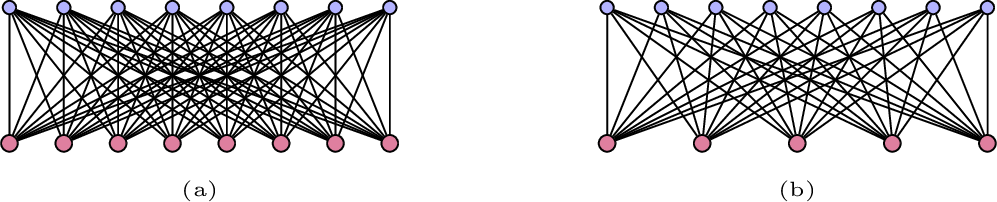
Bipartite graphs are natural for describing binary mixtures of particles. In particular, consider a system composed of two species \(A\) and \(B\). Assume there are \(N_A\) particles of type \(A\) and \(N_B\) particles of type \(B\). A bipartite graph \(K_{N_A, N_B}\) is natural to describe mixtures in which there are no AA or BB interactions, but there are AB interactions. Arguably, this setting is rather restricted, as one may generally want to consider AA and BB interactions, with or without local restrictions.
We will consider another instructive example: the star graph \(S_{n} = K_1 \vee \overline{K_n}\). Many-body systems with pair correlations described by a star graph often arise in models of decoherence with an explicit description of the environmental degrees of freedom, as in the central spin model. A star graph is a tree in which one vertex has degree \(N-1\), while the remaining \((N-1)\) vertices have degree one. A star graph is also a complete bipartite graph \(K_{1, N-1}\). The ground-state GJW in such a system is of the form \[\begin{align} \label{BJstar} \Phi_0(x_1,\dots,x_N)=\prod_{j=2}^Nf(x_{1,j})=\prod_{j=2}^N f_{1,j} , \end{align}\tag{20}\]
where the particle at position \(x_1\) occupies the central vertex of the connectivity graph, with adjacency matrix \(A_{ij}=\delta_{i,1}+\delta_{1,j}-2\delta_{i,1}\delta_{1,j}\). Physically, this corresponds to a single particle embedded in a surrounding environment of distinguishable particles, as in impurity and polaron models, with the important distinction that the latter case often involves indistinguishable particles. Many-body states with pair correlations described by a star-graph are the ground-state of the Hamiltonian with

\[\begin{align} \hat{H}_0 &=& -\frac{\hbar^2}{2m} \sum_{i=1}^N \frac{\partial^2}{\partial x_i^2} + \hat{V}_2 + \hat{V}_3 , \\ \tag{21} \hat{V}_2 &=& \frac{\hbar^2}{m} \sum_{j=2}^N\frac{f''_{1,j}}{f_{1,j}} , \\ \tag{22} \hat{V}_3 &=& -\frac{\hbar^2}{m} \sum_{2\leq j <k}^N \frac{f'_{j,1}}{f_{j,1}} \frac{f'_{1,k}}{f_{1,k}}. \end{align}\]
One can also write the graph joins as \(\mathcal{G}_1 \vee \mathcal{G}_2 = \overline{\overline{\mathcal{G}_1} \sqcup \overline{\mathcal{G}_2} }\). Quite similar to the star graphs, one can also write wheel graphs as the graph join, \(W_{N+1} =K_1 \vee C_N\), which we discuss in the next section.
9.2 Graph products↩︎
| Graph Product Type | Edge Condition Description | Adjacency Matrix |
|---|---|---|
| Cartesian : \(\mathcal{G}_1 \square \mathcal{G}_2\) | \(v_1\) & \(v_2\) are adjacent if \(g_1=g_2\) & \(\{h_1,h_2\}\in E(\mathcal{G}_2)\), or vice-versa | \(A_{\mathcal{G}_1} \otimes \mathbb{I}_{\mathcal{G}_2} + \mathbb{I}_{\mathcal{G}_1} \otimes A_{\mathcal{G}_2}\) |
| Lexicographic : \(\mathcal{G}_1 \circ \mathcal{G}_2\) | \(v_1\) & \(v_2\) are adjacent if \(\{g_1,g_2\}\in E(\mathcal{G}_1)\) or \(g_1=g_2\) & \(\{h_1,h_2\}\in E(\mathcal{G}_2)\) | \(A_{\mathcal{G}_1} \otimes \mathbb{J}_{\mathcal{G}_2} + \mathbb{I}_{\mathcal{G}_1} \otimes A_{\mathcal{G}_2}\) |
| Tensor/Direct : \(\mathcal{G}_1 \times \mathcal{G}_2\) | \(v_1\) & \(v_2\) are adjacent if \(\{g_1,g_2\}\in E(\mathcal{G}_1)\) & \(\{h_1,h_2\}\in E(\mathcal{G}_2)\) | \(A_{\mathcal{G}_1} \otimes A_{\mathcal{G}_2}\) |
| Strong : \(\mathcal{G}_1 \boxtimes \mathcal{G}_2\) | \(v_1\) & \(v_2\) are adjacent if Cartesian or Tensor condition is satisfied | \(A_{\mathcal{G}_1} \otimes \mathbb{I}_{\mathcal{G}_2} + \mathbb{I}_{\mathcal{G}_1} \otimes A_{\mathcal{G}_2} + A_{\mathcal{G}_1} \otimes A_{\mathcal{G}_2}\) |
| Corona : \(\mathcal{G}_1 \odot \mathcal{G}_2\) | Attach a copy of \(\mathcal{G}_2\) to each vertex of \(\mathcal{G}_1\) | Not simple Kronecker |
4pt
Our discussion of star and wheel graphs motivates the consideration of more complex graphs with \(N-1\) vertices as a model of an environment \(\mathcal{G}_\mathcal{E}\) in which all nodes interact with an additional central particle, in analogy with central spin models. As it turns out, the connectivity graph of such a composite many-body system is given by a graph operation, the corona product \(K_1\odot\mathcal{G}_\mathcal{E}\). More generally, the description of a composite system including an environment and a system of interest, the connectivity graph is described by the joining graph \(\mathcal{G}_\mathcal{E}\vee \mathcal{G}_\mathcal{S}\) obtained by the union graph \(\mathcal{G}_\mathcal{E}\cup\mathcal{G}_\mathcal{S}\) of the environment with that of the system, with all the edges that join vertices of the first graph to vertices of the second. The Hilbert space of the composite system is the tensor product \(\mathcal{H}_{\mathcal{G}_\mathcal{E}}\otimes\mathcal{H}_{\mathcal{G}_\mathcal{S}}\). An alternative construction of more complex many-body quantum systems from simple ones relies on graph products, of which one can distinguish different kinds; see Table 6. Let us consider two graphs \(\mathcal{G}_1\) and \(\mathcal{G}_2\), with adjacency matrix \(A_1\) and \(A_2\) and vertex count \(|V_1|\) and \(|V_2|\), respectively. The corresponding many-body quantum systems have Hilbert spaces \(\mathcal{H}_{\mathcal{G}_1}\) and \(\mathcal{H}_{\mathcal{G}_2}\). The Cartesian product of the two graphs is a new graph \(\mathcal{G}_1\Box\mathcal{G}_2\) with \(|V_1|\times|V_2|\) vertices, and adjacency matrix, \(A(\mathcal{G}_1\Box\mathcal{G}_2)=A(\mathcal{G}_2\Box\mathcal{G}_1)\) \[\begin{align} A(\mathcal{G}_1\Box\mathcal{G}_2)=A(\mathcal{G}_1)\otimes\mathbb{I}_{\mathcal{G}_2}+\mathbb{I}_{\mathcal{G}_1}\otimes A(\mathcal{G}_2) . \end{align}\]
The Hilbert space of the new many-body system on the graph \(\mathcal{G}_1\Box\mathcal{G}_2\) is thus \(\mathcal{H}_{\mathcal{G}_1\Box\mathcal{G}_2}=\mathcal{H}_{\mathcal{G}_1}\otimes\mathcal{H}_{\mathcal{G}_2}\). A relevant example in condensed matter is the ladder graph \(L_N=P_N\Box P_2\), with \(|V|=2N\) and \(|E|=3N-2\).

The adjacency matrix for the ladder graph, compressed to 1D as two composite particles bound to form a single entity, can be written as \[A_{(i,\alpha),(j,\beta)} = \delta_{|i-j|,1} \delta_{\alpha,\beta} + \delta_{i,j} \delta_{\alpha,\Bar{\beta}},\] where \(i\in\{1,\cdot\cdot\cdot,N\}\), \(\alpha \in \{A,B\}\), and \(\Bar{A}=B , \Bar{B}=A\). Using this, we can write the ground-state GJW, \[\begin{align} \Phi_0(\{x_k^A, x_k^B\}) & = \prod_{(i,\alpha) < (j,\beta) } \bigg[ f_{i,j}^{(\alpha,\beta)} \bigg]^{A_{(i,\alpha),(j,\beta)}} \\ & = \prod_{i=1}^N f(x_i^A - x_i^B) \prod_{\alpha=A,B} \prod_{i=1}^N f_{i,i+1}^{\alpha} , \end{align}\] where \(f_{i,j}^{(\alpha,\beta)} = f(x_i^{\alpha} - x_j^{\beta})\), \(f_{i,i}^{(\alpha,\beta)}=f_i^{(\alpha,\beta)}\),and \(f^{(\alpha,\alpha)}_{i,j}=f^{\alpha}_{i,j}\). Using this GJW ansatz, we find the parent Hamiltonian \[\begin{align} \hat{H}_0 & = & \sum_{\alpha=A,B}\hat{H}_0^{\alpha} = \hat{H}_0^A + \hat{H}_0^B , \\ \hat{H}_0^{\alpha} & = & -\frac{\hbar^2}{2m} \sum_{i} \frac{\partial^2}{\partial (x_i^{\alpha})^2} + \hat{V}_{\rm int}^{\alpha} + \hat{V}_{2}^{\alpha} + \hat{V}_{2 \rm L}^{\alpha} + \hat{V}_3^{\alpha} , \nonumber \end{align}\] where the extra two-body term \(V_{\rm int}\) accounts for the nearest-neighbor interaction between \(A\) and \(B\) particles. Explicitly, we can write all the multi-body terms as (\(\eta_{\alpha}=+(-)1\) for \(\alpha= A(B)\)), \[\begin{align} \hat{V}_{\rm int}^{\alpha} & = & \frac{\hbar^2}{2m} \sum_{i=1}^N \frac{f''(x_i^A - x_i^B)}{f(x_i^A - x_i^B)} , \\ \hat{V}_2^{\alpha} & = & \frac{\hbar^2}{m} \sum_{i} \frac{f''(x_i^{\alpha}-x_{i+1}^{\alpha})}{f(x_i^{\alpha}-x_{i+1}^{\alpha})} , \\ \hat{V}_{2\rm L}^{\alpha} & = & \frac{\hbar^2}{m} \sum_{i} \frac{f'^{(A,B)}_i}{f^{(A,B)}_i} \bigg[\frac{f'^{\alpha}_{i-1,i}}{f^{\alpha}_{i-1,i}} - \frac{f'^{\alpha}_{i,i+1}}{f^{\alpha}_{i,i+1}} \bigg] \eta_{\alpha} , \\ \hat{V}_3^{\alpha} & = & -\frac{\hbar^2}{m} \sum_{i} \frac{f'^{\alpha}_{i-1,i}}{f^{\alpha}_{i-1,i}} \frac{f'^{\alpha}_{i,i+1}}{f^{\alpha}_{i,i+1}} . \end{align}\]
| Standard Graph | Product Type | Product Structure |
|---|---|---|
| Grid/Lattice \(P_{m,n}\) | Cartesian | \(P_m \square P_n\) |
| Hypercube \(Q_n\) | Cartesian | \(K_2^{\square n} = K_2 \square K_2 \square \cdot\cdot\cdot \square K_2 \;\;\) (\(n\) times) |
| Complete Bipartite \(K_{m,n}\) | Lexicographic | \(E_m \circ K_n\) |
| Prism \(Y_n\) | Cartesian | \(C_n \square P_2\) |
| Wheel \(W_{n+1}\) | Corona/Join | \(K_1 \odot C_n\) or, \(K_1 \vee C_n\) |
4pt
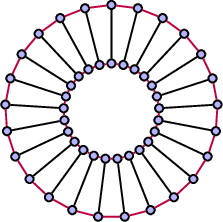
Similarly, prism graphs, also known as circular ladder graphs, are associated with the Cartesian product of a cycle graph and a \(2\)-path, \(Y_N = CL_N = C_N \Box P_2\), see Fig. 5. A finite \(N\times M\) lattice graph can be obtained as \(P_N\Box P_M\). In particular, for \(r=3\), one finds cubic graphs \(Q_N\), such as the Petersen graph (\(N=10\)). Adjacency matrix for prism graphs, \[\begin{align} A_{ij} = & \sum_{k=1}^N \bigg[ \delta_{i,k} \delta_{j, (k \; {\rm mod} \; N)+1} + \delta_{i,k} \delta_{j,k+N} \\ & \;\;\;\;\; + \delta_{i,N+k} \delta_{j, (k \; {\rm mod} \; N)+N+1} \bigg]. \end{align}\]
The many-body systems associated with a star graph involved an environment of noninteracting particles. The simplest generalization is to include nearest-neighbor interactions between the particles in the environment, while keeping their pairwise interactions with the central particle. This leads to considering pair correlations characterized by a wheel graph \(W_N\), obtained from a cycle graph \(C_{N-1}\) by adding a vertex which is a hub, and connected to all the vertices of \(C_{N-1}\). As a result, \(|E|=2(N-1)\). The adjacency matrix has elements \[\begin{align} \begin{aligned} A_{ij}= & \;\delta_{i,1}+\delta_{1,j}-2\delta_{i,1}\delta_{1,j}+\delta_{i,j+1}+\delta_{i,j-1} \\ & + \delta_{i,2}\delta_{N,j}+\delta_{i,N}\delta_{2,j} - \delta_{i,2} \delta_{1,j} - \delta_{i,1}\delta_{2} . \end{aligned} \end{align}\]
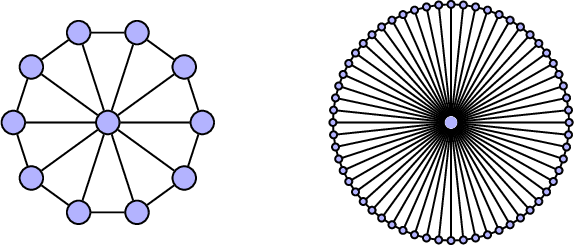
The ground-state GJW for the wheel graph reads \[\begin{align} \Phi_0 & = \prod_{k=1}^{n-1} f_{k, k+1} f_{k+n, k+n+1 } f_{k,k+n} f_{n,1} f_{2n, n+1} f_{n,2n }. \end{align}\]
A few other relevant graph operations are the strong product and the lexicographic product. The strong product graph \(\mathcal{G}_1\boxtimes\mathcal{G}_2\) and the lexicographic product \(\mathcal{G}_1\circ \mathcal{G}_2\) of \(\mathcal{G}_1\) and \(\mathcal{G}_2\) have a vertex count of \(|V_{\mathcal{G}_1}||V_{\mathcal{G}_2}|\), and its adjacency matrix reads as follows: \[\begin{align} A(\mathcal{G}_1\boxtimes \mathcal{G}_2) &=& A_{\mathcal{G}_1} \otimes \mathbb{I}_{\mathcal{G}_2} + \mathbb{I}_{\mathcal{G}_1} \otimes A_{\mathcal{G}_2} + A_{\mathcal{G}_1} \otimes A_{\mathcal{G}_2} , \;\;\; {} \\ A(\mathcal{G}_1\circ \mathcal{G}_2) &=& A_{\mathcal{G}_1} \otimes \mathbb{J}_{\mathcal{G}_2} + \mathbb{I}_{\mathcal{G}_1} \otimes A_{\mathcal{G}_2} , \end{align}\] where \(\mathbb{J}\) is the all ones matrix. Consequently, the many-body Hilbert space is \(\mathcal{H}_{\mathcal{G}_1\times\mathcal{G}_2}=\mathcal{H}_{\mathcal{G}_1}\otimes\mathcal{H}_{\mathcal{G}_2}\). A relevant example to demonstrate the following two graph operations is the celebrated Creutz ladder [49], shown in Fig. 7.
![Figure 7: Top: Creutz Ladder Graph P_7 \circ P_2 \cong P_7 \boxtimes P_2, comes from a theorem \mathcal{G}_1 \circ \mathcal{G}_2 \cong \mathcal{G}_1 \boxtimes \mathcal{G}_2 iff \mathcal{G}_2 is a complete graph [50]. Bottom: Flattened Creutz ladder to visualize a more realistic 1D model with two particles bound per unit cell. It differs from the model shown in Fig. 4, by including the cross-particle interactions in the nearest neighbor.](/article/2602.22315/_pdflatex/hltcbnaq.png "fig:")
The adjacency matrix for the Creutz ladder graph, compressed to 1D as two composite particles bound to form a single entity, can be written as: \[A_{(i,\alpha),(j,\beta)} = \delta_{|i-j|,1} \delta_{\alpha,\beta} + \delta_{|i-j|,1} \delta_{\alpha,\Bar{\beta}} + \delta_{i,j} \delta_{\alpha,\Bar{\beta}},\] where, \(i\in\{1,\cdot\cdot\cdot,N\}\), \(\alpha \in \{A,B\}\) and, \(\Bar{A}=B , \Bar{B}=A\).
Similarly, there are other known graph products available in the literature a non-exhaustive set of such products with descriptions is given in the table 6. We emphasize that the graph structure is not necessarily reflected by pinning the particles in coordinate space as one would do for particles sitting on a lattice. Rather, its adjacency matrix governs the ground-state correlations and particle interactions.
10 Discussion↩︎
Before closing, we consider several extensions of our study. The PHJ formulation presented focuses on the graph structure of pairwise interparticle interactions. The coordinate of each particle takes values in the Euclidean space \(\vec{r}_i\in\mathbb{R}^D\) and is unconstrained by the graph features, but for the possible occurrence of hard-core interparticle interactions. In condensed matter systems, it is often of interest to restrict the motion of particles to a given spatial distribution. One possible way of doing so is to use a structured external potential, in which particles can move as done, e.g., with ultracold atoms in optical lattices and optical tweezers. In other applications, it is preferable to pin down the particles at a given location in space, e.g., as in the description of quantum solids, lattices of oscillators, etc. In Monte Carlo studies, such pinning is described by replacing the Jastrow ansatz by a Nosanow-Jastrow wavefunction, in which the location of each particle is determined [15]–[17]. At this level of description, particles are distinguished by their location, e.g., on a lattice or, more generally, a topological graph. This may be pursued using topological graph theory, which studies the embedding of a graph in a given space.
Another research direction is that of disordered systems. Although on physical grounds, the study of random interactions may appear contrived, it has found manifold applications. Consider the ground-states of the generalized GJW form \[\begin{align} \Phi_0(x_1,\dots,x_N)=\prod_{i<j}e^{p_{ij}\log f_{ij}}, \end{align}\] with \(p_{ij}\in\mathbb{R}\), to accommodate weighted graphs or random graphs. In this case, the parent Hamiltonian takes the form \[\begin{align} \hat{H}_0=-\frac{\hbar^2}{2m}\sum_{i=1}^{N}\frac{\partial^2}{\partial x_i^2} +\hat{V}_2+ \hat{V} _3, \end{align}\] with the two-body and three-body potentials given by (assuming \(p_{ij} = p_{ji}\))
\[\begin{align} \hat{V}_2 &= \frac{\hbar^2}{m} \sum_{i<j} \left[ p_{ij} \frac{f''_{ij}}{f_{ij}} + p_{ij}(p_{ij}-1) \bigg(\frac{f'_{ij}}{f_{ij}}\bigg)^2 \right], \tag{23} \\ \hat{V}_3 &= \frac{\hbar^2}{m} \sum_{i<j<k} \Bigg[ p_{ij}p_{ik}\frac{f'_{ij}f'_{ik}}{f_{ij}f_{ik}} - p_{ij}p_{jk}\frac{f'_{ij}f'_{jk}}{f_{ij}f_{jk}} \notag\\ &\qquad + p_{ik}p_{jk}\frac{f'_{ik}f'_{jk}}{f_{ik}f_{jk}} \Bigg]. \tag{24} \end{align}\]
This resembles a multi-species many-body system in which the interaction strength varies for different pairs and trios of particles. Such a possibility has been studied in the literature, and we may find important generalizations. For instance, the generalization of the CSM to multi-species with varying interactions was presented in both one [51] and higher spatial dimensions [52]. In random graphs, one considers a distribution of graphs with a probability density function, e.g., for a given graph. In other words, one can consider the probability distribution for a given adjacency matrix \({\rm Pr}(A)\) and study, e.g., the average Hamiltonian. \[\begin{align} \int d\mu(A){\rm Pr}(A) \hat{H}_0(A). \end{align}\]
Ensemble averages over pure states lead to mixed states represented by density matrices, motivating the construction \[\begin{align} \int d\mu(A){\rm Pr}(A) \Phi_0(x_1,\dots,x_N;A)\Phi_0^*(x_1',\dots,x_N';A).\nonumber \\ \end{align}\]
Extensions to higher spatial dimensions and to random or regular graph ensembles may reveal universality classes controlled by connectivity rather than geometry.
More broadly, the graph formulation suggests that qualitative features of the many-body systems, such as the prevalence and structure of three-body terms or the emergence of effective locality, can be organized by standard graph invariants, such as the degree distribution, number of 2-paths, clustering, and the spectral properties of \(A\). Identifying graph families that preserve extended sets of conserved quantities and characterizing excitation spectra are particularly promising open problems. Specifically, beyond constructing a tower of excited states associated with the center of mass, one may wonder whether the parent Hamiltonians of GJW may be quasi-exactly solvable [9], [53].
11 Conclusions↩︎
We have introduced a graph-based generalization of the Jastrow ansatz for many-body systems of distinguishable continuous-variable particles. In this “Graph-Jastrow” construction, the ground-state wavefunction is a product of pair correlators over the edge set of a graph, and the adjacency matrix determines which correlations are present. The approach provides a continuum-variable counterpart of spin models on graphs, with explicit breaking of permutation symmetry for generic connectivity.
A central structural result is that the corresponding parent Hamiltonian contains (i) two-body interactions supported on graph edges and (ii) three-body interactions supported on length-two paths of the graph. These terms arise from the action of the kinetic-energy operator on an edge-factorized wavefunction and therefore encode the local combinatorics of the underlying connectivity. In the complete-graph limit, the construction recovers standard Bijl–Jastrow quantum fluids and known integrable models; for restricted connectivity, it reproduces and extends truncated and symmetry-broken families discussed in the literature.
More generally, by organizing models according to graph families and graph operations (joins and products), we have charted a landscape of integrable and ground-state solvable systems for which the Hamiltonian, ground state, and ground-state energy are obtained in closed form. In one dimension, the framework also provides an alternative notion of locality: interactions are truncated by adjacency rather than by spatial range.
Open directions include understanding excitation spectra and correlations beyond the ground state, establishing large-\(N\) limits for sparse and dense graph sequences, and identifying graph conditions under which additional conserved quantities survive. Extensions to weighted and random graph ensembles, as well as to spatially embedded or pinned-particle variants, offer further opportunities to connect the present construction with experimental platforms and with established paradigms in many-body physics.
Acknowledgments.— It is a pleasure to acknowledge discussions with Errol D. G. Drummond, Íñigo L. Egusquiza, András Grabarits, Maxim Olchanyi, and Jing Yang. This work is supported by the Luxembourg National Research Fund under Grant No. C-PRIDE/23/18691647/QUANCOM.