Differential graded algebras with divided powers and homotopy Lie algebras
January 01, 1970
Abstract
Given a commutative algebra \(A\) and a quotient \(A\)-algebra \(A/I\), we construct a resolution of \(A/I\) as an \(A\)-module such that it is also a differential graded (dg) algebra with divided powers (PD). This construction makes use of symmetric tensors in the symmetric tensor category of dg \(A\)-modules and does not require a Noetherian assumption on \(A\). Moreover, the resolution has many lifting properties which we leverage to study the homotopy Lie algebra associated to the pair \((A,A/I)\), which is defined as the image in the Yoneda algebra \(\operatorname{Ext}^*_{A}(A/I,A/I)\) of the cohomology of the PD derivations of this PD dg algebra. Finally we investigate the complete intersection case in more details as well as connect it to the finite generation of the Yoneda algebra.
1 Introduction↩︎
This paper is part of our effort to understand the geometries attached to a vertex algebra. Corresponding to each vertex algebra \(V\), there is a Poisson algebra \(R(V)\) which defines a Poisson scheme \(X_V=\operatorname{\sf spec}{R(V)}\). In the rational \(C_2\)-cofinite case, \(X_V\) has only one point. In [1], we defined a cohomological dual \(X_{V,x}^!=\operatorname{\sf spec}((\operatorname{Ext}_{R(V)}^*(\mathsf{k}_x, \mathsf{k}_x))^{ab})\) for each closed point \(x\in X_V\) and call it the cohomological variety of \(V\) at \(x\). While it defines an invariant of the vertex algebra \(V\), it is difficult to compute in most cases, in particular when \(x \in X_V\) is not a local complete intersection. In [1], we estimated a lower bound on the dimension of this variety for many rational \(C_2\)-cofinite vertex algebras. Our goal is to establish a cohomological support variety theory ([2] for restricted Lie algebras in positive characteristic, [3] for Lie superalgebras) for representations of vertex algebras in terms of quasicoherent sheaves. In the present paper, we explore a model different from \(X_{V,x}^!\). The Yoneda algebra \(\operatorname{Ext}_{R(V)}^*(\mathsf{k}_x, \mathsf{k}_x)\) is actually a Hopf algebra, which is the universal enveloping algebra of a graded Lie algebra, called the homotopy Lie algebra of \(R(V)\), in the symmetric monoidal category of graded vector spaces (with Koszul braiding) when \(R(V)\) is Noetherian. Hence the idea of associated varieties of representations of Lie algebras can be applied [4]–[7]. To prepare for this, we first need to explore this Lie algebra from the differential graded context. Since the algebra \(R(V)\) is in general not Noetherian and not complete intersection, we give a more functorial construction of the homotopy Lie algebra as well as its dg enhancement, depending on the construction of the Koszul-Tate resolution, preparing for applications to dg vertex algebras which have been established in [8]–[10]. One of our objectives is to construct a cohomological duality for vertex algebras, by establishing a Koszul-Tate type of resolutions of vertex algebras.
The Koszul-Tate resolution requires a divided power structure (PD structure) [11]–[15] on the resolution algebra, which is called semi-free in some literature. The free algebras with PD structures have been studied with concrete constructions by Roby in [11]–[13]. One of the approaches is to use the functorial construction of the subalgebra \(\operatorname{\sf TS}_A(V)\) of symmetric tensors in the shuffle algebra (\(T_A(V)\) with shuffle product) over a free \(A\)-module \(V\). This construction has an apparent functorial advantage, automatically making \(\operatorname{\sf TS}_A(V)\) a cocommutative commutative Hopf algebra with PD structure. In this paper, we extend this construction to the symmetric monoidal category of differential complexes over general commutative rings. This is done in Section 3 with elementary setup in Section 2. More precisely, in Section 3 we first extend the construction of free PD algebras by Roby in [13] using the shuffle algebra of symmetric tensors \(\operatorname{\sf TS}_{A}(M)\) of a free \(A\)-module \(M\) to the symmetric tensor category \(\operatorname{\sf Cplx}(A)^{free}\) of differential complexes of free \(A\)-modules. This defines a functor \(\operatorname{\sf TS}_{A}^*(-):\operatorname{\sf Cplx}(A)^{free} \to \operatorname{\sf grPDAlg}(A)\) to the category of graded PD algebras over \(A\) (see [14] for graded PD algebras), sending direct sums to tensor products. Thus there is a PBW type basis for each given basis \(\mathcal{B}\) of \(M\) with a given total order. This functor automatically defines a graded Hopf algebra with PD structure on \(\operatorname{\sf TS}_A(M)\). The freeness then makes it possible to extend differentials if \(A\) is a PD dg algebra. We use this functor \(\operatorname{\sf TS}_A(-)\) to construct a Koszul-Tate resolution for an arbitrary commutative ring \(A\) with an ideal \(I\) and quotient ring \(A/I\) as an \(A\)-algebra.
In most constructions in the literature, we find that either \(A\) is assumed to be Noetherian (most in the context of Noetherian local rings such as in [16]–[19]) or to be a \(\mathbb{Q}\)-algebra, from rational homotopy theory [20] (thus the PD structure becomes automatic and unique) such as in [21]–[23]. In Tate’s construction [19], the approach consists in killing one cocycle at a time, which is good enough to apply when \(A\) is Noetherian. Northcott [24] extended Tate’s construction by still working over generators and taking limits. This extension is then used in Gulliksen-Levin’s lecture notes [18] as well as Stacks-Project ([15]) and others.
We take a generator free approach and apply the functor \(\operatorname{\sf TS}_{A}(-)\) to kill the entire (co)homology at a degree at once. This is a Sullivan type construction from homotopy theory [20], [25] where we attach all cells of a given dimension at once. We will rely heavily on the use of the PD structure to extend PD dg algebra homomorphisms as well as derivations. The Koszul-Tate resolution \(P^*=\varinjlim_{n} P_{n}^*\) of \(A/I\) as an \(A\)-algebra depends on the choice of the free \(A\)-module cover \(\phi_{n+1}: F_{n+1}\to H^{-n}(P^*_n)\) that kills degree \(-n\) cohomology of earlier stage \(P_n^*\) and the next stage is obtained as \(P_{n+1}^*=P_{n}^*\otimes_A \operatorname{\sf TS}_{A}(F_{n+1}[n+1])\). The differential on \(P^*_{n+1}\) is the unique extension of \(d_{P_{n}^*}\) and \(\phi_{n+1}\), making \(P_{n+1}^*\) a PD dg algebra and the natural embedding \(P_{n}^*\to P_{n+1}^*\) a homomorphism of PD dg algebras. We remark that, by construction, each \(P_n^*\) is a graded PD Hopf algebra which is both graded commutative and graded cocommutative. Thus, forgetting the differential, \(P^*\) is a connected graded cocommutative PD Hopf algebra over \(A\). However it is not a PD dg Hopf algebra (see [14]) as the comultiplication will fail to be a chain map, as one might expect.
It is well-known that the Yoneda algebra \(\operatorname{\sf Ext}_A^*(A/I,A/I)\) is isomorphic to \(H^*(\mathcal{H}om_{A}^*(P^*,P^*))\), not only as graded \(A\)-modules, but also as graded algebras with the composition product on \(H^*(\mathcal{H}om_{A}^*(P^*,P^*))\) up to a Koszul sign. In Section 4, we consider the subcomplex \(\mathcal{D}er^{*,\operatorname{pd}}_A(P^*, P^*)\subseteq \mathcal{H}om_{A}^*(P^*,P^*)\) of the PD derivations. The complex \(\mathcal{D}er^{*,\operatorname{pd}}_A(P^*, P^*)\) is naturally a dg Lie algebra, which is a dg Lie subalgebra of \(\mathcal{D}er^{*}_A(P^*, P^*)\). The graded Lie algebra \(H^*(\mathcal{D}er^{*,\operatorname{pd}}_A(P^*, P^*))\) (in the symmetric tensor category of graded \(A\)-modules) naturally maps to a graded Lie subalgebra in \(H^*( \mathcal{H}om_{A}^*(P^*,P^*))\). Its image is defined to be the Homotopy Lie algebra. In the case where \(A\) is Noetherian, \(I\) is maximal, and the resolution \(P^*\) is \(I\)-minimal (i.e., \(d(P^{-n}) \subseteq IP^{-n+1}\)), the Yoneda algebra \(\operatorname{\sf Ext}_{A}^*(A/I,A/I)\) has a connected Hopf algebra structure whose homogeneous primitive elements form a graded Lie algebra, which is classically defined as the homotopy Lie algebra [16]. Moreover, the homotopy Lie algebra has a restricted structure, and the Yoneda algebra is the restricted enveloping algebra of the homotopy Lie algebra.
We could not prove that the graded Lie algebra \(H^*(\mathcal{D}er^{*,\operatorname{pd}}_A(P^*, P^*))\) does not depend on the resolution \(P^*\) for the \(A\)-algebra \(A/I\). We also will not discuss the model category structure on the category of PD dg algebras so that the Koszul-Tate resolution \(P^*\) constructed is a cofibrant object.
The concept of Homotopy Lie algebra was first defined by the homotopy groups of \(H\)-spaces in [26] and later interpreted for commutative local Noetherian rings (see [16]–[18]). We choose the definition using the dg Lie algebra \(\mathcal{D}er^{*, \operatorname{pd}}_A(P^*, P^*)\), which has a natural restricted structure given by \(D \mapsto D \circ D\). This Lie algebra plays the role of tangent complex in the context of rational homotopy theory and model category, or derived algebraic geometry. We will not interpret the cotangent complex in terms of the PD dg algebra \(P^*\). Cotangent complexes mostly appear in the simplicial context [27]. There is a dg approach to cotangent complexes in [28]. In the paper [29], Richter has proved that divided power structures on the chain complexes will naturally arise from the simplicial commutative algebra structure via normalized Moore complex. There is a different notion of homotopy Lie algebra operadic approach in [30] using Lie operad in the homotopy category of differential complexes. In case \(\mathbb{Q}\subseteq A\), the homotopy Lie algebra is closely related to the Homotopy Lie algebra described in this paper.
We have not yet considered the case where \(A\) is a Poisson \(\mathsf{k}\)-algebra and \(I\) is a Poisson ideal, but we expect that there is a Koszul-Tate resolution \(P^*\) which has a Poisson dg algebra with PD structure so that the augmentation \(P^*\to A/I\) [31] is a Poisson algebra homomorphism. Due to the size of the paper, we also do not mention the algebra of PD dg differential operators on the PD dg algebra \(P^*\).
In Section 5, we consider the special case when \(A\) is a complete intersection as well as several examples arising from simple singularities. In this case, \(P^*\) can constructed as \(I\)-minimal and the homotopy Lie algebra can be computed as a certain graded Lie algebra concentrated on degree 1 and 2. Conversely, any such graded Lie algebra (with a restricted structure) can be seen as the homotopy Lie algebra of some complete intersection algebra. In this section, we also consider the finite generation question of Yoneda algebras. This is a classical question regarding finite generation of cohomology rings of groups, restricted Lie algebras, and Hopf algebras (see [2], [32]–[36]). In contrast to finite groups or finite dimensional restricted Lie algebras, the Yoneda algebra is finitely generated if and only if there is a resolution \(P^*\) that is finitely generated as a PD dg algebra, which is equivalent to the homotopy Lie algebra having finite total dimension or to \(A\) being a complete intersection ring.
Although we are focusing on the case where \(A\) is a commutative ring and \(I\) is an ideal in this paper, the Yoneda algebra has the following geometric formulation. Let \(X\) be any \(\mathsf{k}\)-scheme and \(Z\subseteq X\) be a closed subscheme. Let \(\mathcal{I} \subseteq \mathcal{O}_X\) be the ideal sheaf (on \(X\)) defining \(Z\). The structure sheaf of \(Z\), \(\mathcal{O}_Z=\mathcal{O}_X/\mathcal{I}\), is an \(\mathcal{O}_X\)-module supported over \(Z\). We then want to compute the graded sheaf of \(\mathcal{O}_Z\)-modules \({\mathcal{E}xt}^*_{\mathcal{O}_X}(\mathcal{O}_Z, \mathcal{O}_Z)\) in the category of \(\mathcal{O}_X\)-modules on \(X\). More generally, when \(Z'\) is another closed subscheme of \(X\) with the defining ideal \(\mathcal{J}\), we want to compute the graded sheaf \({\mathcal{E}xt}^*_{\mathcal{O}_X}(\mathcal{O}_Z, \mathcal{O}_{Z'})\). The sheaves \({\mathcal{E}xt}^*_{\mathcal{O}_X}(\mathcal{F}, \mathcal{G})\) for certain vector bundles \(\mathcal{F}\) on \(Z\) and \(\mathcal{G}\) on \(Z'\) are expected to have physical interpretations [37]. We note that this sheaf is supported over the scheme intersection \(Z\times_X Z'\), which is a subscheme of \(X\) defined by the ideal \(\mathcal{I}+\mathcal{J}\) with structure sheaf \(\mathcal{O}_Z\otimes_{\mathcal{O}_X}\mathcal{O}_{Z'}\). The sheaves \(\mathcal{T}or^{\mathcal{O}_X}_*(\mathcal{O}_Z, \mathcal{O}_{Z'})\) measure the derived intersection of \(Z\) and \(Z'\) [38]. When \(x\in Z\cap Z'\), by considering the localisations of \(\mathcal{O}_X\), \(\mathcal{O}_Z\) and \(\mathcal{O}_{Z'}\) at \(x\), the modules \(\mathcal{T}or^{\mathcal{O}_{X, x}}_i(\mathcal{O}_{Z,x}, \mathcal{O}_{Z', x})\) provide the intersection multiplicity of \(Z\) and \(Z'\) at \(x\) as Serre’s homological characterisation of intersection theory.
If \(Z\subseteq X\) is a closed subvariety then \(\operatorname{Ext}^1_{\mathcal{O}_X}(\mathcal{O}_Z, \mathcal{O}_Z)\) is the tangent space of the moduli space of subvarieties at the point \([Z]\). The (skew)-commutativity of the Yoneda product can be used to construct symplectic structure on the moduli space (see [39]). If \([Z]\) is a smooth point of the moduli space, then the Yoneda product is skew commutative. When \(Z=\{z\}\) is a closed point, \(\operatorname{Ext}^{1}_{\mathcal{O}_X }(\mathsf{k}_z, \mathsf{k}_z)\) is the tangent space \(T_zX\).
Acknowledgements. The authors would like to thank the anonymous referee for a detailed report containing thoughtful comments that greatly helped in improving the present paper. This work started with substantial discussions with Cuipo Jiang on the cohomological varieties for vertex algebras and both authors appreciate her contributions. The second author also wants to thank Amnon Yekutieli for sending his preliminary version of [28].
2 The category of PD dg algebras over a PD dg ring↩︎
2.1 Complexes and graded modules↩︎
Fix a commutative ring \(A\) and consider the categories \(\operatorname{\sf Cplx}(A)\) of differential (cochain) complexes of \(A\)-modules, and \(A\operatorname{\sf -mod}^{\mathbb{Z}}\) the category of \(\mathbb{Z}\)-graded \(A\)-modules. Note that \(A\operatorname{\sf -mod}^{\mathbb{Z}}\) is a symmetric monoidal category with tensor product \(\otimes = \otimes_A\) where \[(M^* \otimes N^*)^n=\bigoplus_{i+j=n}M^i \otimes N^j\] and with braiding \[\begin{array}{cccc} b_{M^*,N^*}:&M^i \otimes N^j & \to & N^j \otimes M^i \\ & m \otimes n & \mapsto & (-1)^{ij}n \otimes m. \end{array}\] Then \(\operatorname{\sf Cplx}(A)\) is also a symmetric monoidal category with tensor product of differential complexes with a similar braiding. We label the cochain complexes \[\cdots \to M^{i}\stackrel{d^{i}}{\to} M^{i+1}\to \cdots\] if the differential map is of degree \(1\). By simply relabeling \(M_i=M^{-i}\), then each differential cochain complex becomes a differential chain complex with differential \(d^{i}=d_{-i}\) of degree \(-1\). We say that \((M^*,d^*)\) is \(A\)-free if \(M^i\) is a free \(A\)-module for all \(i\), and the category of these complexes is written \(\operatorname{\sf Cplx}(A)^{free}\).
Finally we have a forgetful functor \[\operatorname{\sf Cplx}(A) \to A\operatorname{\sf -mod}^{\mathbb{Z}}\] sending \((M^*,d^*)\) to \(M^*=\bigoplus_{n \in \mathbb{Z}}M^n\). For simplicity reasons, we will later on write \(M^*\) for either the complex or the resulting graded \(A\)-module, depending on the context.
We will also consider the full subcategory \(\operatorname{\sf Cplx}(A)^+\) of the cochain complexes \((M^* , d^*)\) with \(M^i=0\) for all \(i>0\).
2.2 PD dg rings↩︎
A strictly graded commutative dg ring refers to a graded commutative dg ring satisfying \(xx=0\) for all odd degree elements \(x\).
Let \((R^*, d^*)\) be a strictly graded commutative dg ring with \(I \subseteq R\) a dg ideal. We write \(I_{ev}=\bigoplus_{n \in \mathbb{Z}}I^{2n}\) and \(I_{odd}=\bigoplus_{n \in \mathbb{Z}}I^{2n+1}\) for the even and odd components of \(I\). We define \(R_{ev}\) and \(R_{odd}\) similarly. A divided power (PD) structure on \(I\) is a sequence of maps \(\gamma_n: I_{ev}\to I_{ev}\) (\(n \in \mathbb{Z}_{+}\)) and \(\gamma_0:I_{ev} \to R^*\) given by \(\gamma_0(x)=1\) satisfying the following conditions:
\(\gamma_1(x)=x\) for all \(x \in I\);
\(\gamma_n(x)\gamma_m(x)=\binom{n+m}{m} \gamma_{n+m}(x)\) for all \(x\in I_{ev}\);
\(\gamma_n(ax)=a^n\gamma_n(x)\) for all \(a\in R_{ev}\) and \(x\in I_{ev}\);
\(\gamma_n(x+y)=\sum_{i=0}^n\gamma_i(x)\gamma_{n-i}(y)\) for all \(x, y\in I_{ev}\);
\(\gamma_p( \gamma_q(x))=\frac{(pq)!}{p!(q!)^p}\gamma_{pq}(x)\) for all \(x \in I_{ev}\);
\(\gamma_n(I_{2r})\subseteq I_{2rn}\) for \(n>0\);
\(\gamma_n(xy)=0 \text{ for all } x \in R_{odd}, y\in I_{odd} \text{ homogeneous of odd degrees and } n\geq 2\);
\(d(\gamma_n(x))=\gamma_{n-1}(x)d(x)\).
A PD dg ring is a triple \((R^*,I,\gamma)\) where \(R^*\) is a dg ring, \(I\) is a dg ideal of \(R^*\), and \(\gamma\) is a PD structure on \(I\). We will call \(I\) the PD ideal of \((R^*,I,\gamma)\). When the ideal \(I\) and the PD structure \(\gamma\) are clear, we will simply write \(R^*\) for the PD dg ring.
The condition [axiom957] on the odd degree was imposed by André in [14]. We recall that the PD structure is heavily dependent on the ideal \(I\). The use of the term “PD” comes from the French “puissances divisées”, the term under which the notion was introduced (see [12]). It follows from the definition that:
Given any PD dg ring \(R^*\), for any \(x \in I_{ev}\), then \(n! \gamma_n(x)=x^n\) for all \(n \geq 0\).
If \(R\) is a graded commutative dg \(\mathbb{Q}\)-algebra, i.e., \(\mathbb{Q}\subset R_0\), then for any dg ideal \(I \subset R\) there exists a unique PD dg structure on \(R\) given by \(\gamma_n(x)=\frac{x^n}{n!}\) for \(x \in I_{ev}\).
Any strictly graded commutative dg ring \(R^*\) is a PD dg ring with \(I=\{0\}\). In particular, this is true when \(R^*\) is concentrated in degree \(0\), which is a commutative ring.
Let \((R^*, d^*)\) be a dg ring in \(\operatorname{\sf Cplx}(A)\). Set \(B^*(R^*)\subseteq Z^*(R^*)\subseteq R^*\) the coboundary and cocycle subcomplexes of \(R^*\). Then \(Z^*(R^*)Z^*(R^*)\subseteq Z^*(R^*)\) by the Leibniz rule, rule that also implies \(d(1)=0\). Thus \(Z^*(R^*)\) is a dg subring of \(R^*\) (with trivial differential) and \(B^*(R^*)\) is a two-sided ideal of \(Z^*(R^*)\). Therefore the cohomology \(H^*(R^*)\) is dg ring (with trivial differential).
Note that \(Z^*(I)=I\cap Z^*(R^*)\) is a dg ideal of \(Z^*(R^*)\). It follows from [axiom958] in the definition of the PD structure that \(\gamma_n(Z^*(I)_{ev})\subseteq Z^*(I)_{ev}\). Thus \((Z^*(R^*), Z^*(I), \gamma)\) is a PD dg ring. Set \(I(H^*(R^*))\) the image of \(Z^*(I)\) in \(H^*(R^*)\), which is clearly an ideal. We want to assume that the PD structure on \((Z^*(R^*), Z^*(I), \gamma)\) induces a PD structure \((H^*(R^*), I(H^*(R^*)), \bar \gamma)\). This requires \[\begin{align} \gamma_n(z+b)=\gamma_n(z)+\sum_{i=1}^n\gamma_{n-i}(z)\gamma_{i}(b)\in \gamma_n(z)+I_{ev}\cap B^*(R^*) \end{align}\] for \(z\in I_{ev}\cap Z^*(R^*)\) and \(b\in I_{ev}\cap B^*(R^*)\), i.e., \(B^*(R^*)\) should be a PD dg ideal of \(Z^*(R^*)\). Since \(n\gamma_{n}(d(r))=\gamma_{n-1}(d(r))d(r)\) by Axioms [axiom951] and [axiom952], then \(B^*(R^*)\) is a PD dg ideal of \(Z^*(R^*)\) if \(R^*\) is a \(\mathbb{Q}\)-algebra.
Given two PD dg rings \((R', I',\gamma')\) and \((R'', I'',\gamma'')\), with the ideal \(I=\operatorname{\sf Im}(R'\otimes_{\mathbb{Z}} I''+I'\otimes_{\mathbb{Z}} R'')\subseteq R=R'\otimes_{\mathbb{Z}} R''\), there exists (cf. [18]) a unique PD structure \((R,I,\gamma)\) such that the obvious dg ring homomorphisms \(\iota':(R',I',\gamma')\to(R,I, \gamma)\) and \(\iota'': (R'',I'',\gamma'')\to(R,I, \gamma)\) are PD dg ring homomorphisms. Using Axiom [axiom953], we can make \(\gamma_n\) explicit. If \(x'\in R'\) and \(x''\in R''\) are homogeneous, then \((x'\otimes x'')=(x'\otimes 1)(1\otimes x'')=(-1)^{|x'||x''|}(1\otimes x'')(x'\otimes 1)\). For \(x''\in I''_{ev}\) and \(x' \in R'_{ev}\), we have \[\begin{array}{rcl} \gamma_n(x'\otimes x'') & = & (x'\otimes 1)^{n}\gamma_n(1\otimes x'') \\[5pt] & = & (x'\otimes 1)^{n}\gamma_n \circ \iota''(x'') \\[5pt] & = & (x'\otimes 1)^{n} \iota'' \circ \gamma_n''(x'') \\[5pt] & = & (x'\otimes 1)^{n}(1\otimes \gamma''_n(x'')) \\[5pt] & = & x'^{n}\otimes \gamma''_n(x'') \end{array}\] because \(\iota''\) is a PD homomorphism. Likewise, for \(x'\in I'_{ev}\) and \(x'' \in R''_{ev}\) we have \[\begin{align} \gamma_n(x'\otimes x'')=&(-1)^{n|x'||x''|}(1\otimes x'')^{n}( \gamma'_n(x')\otimes 1) \notag \\[5pt] =&(-1)^{n|x'||x''|}(-1)^{n|x'|n|x''|}\gamma'_n(x')\otimes x''^{n}\notag \\[5pt] =&\gamma'_n(x')\otimes x''^{n}. \label{pd95tensor95first} \end{align}\tag{1}\] Moreover, \(\gamma_n(R'_{odd} \otimes I''_{odd}+I'_{odd} \otimes R''_{odd})=0\) for \(n >1\) because of Axiom [axiom957].
Therefore the category of PD dg rings is a tensor category. Let \(F\) be the forgetful functor from the category of PD dg rings to the category of dg rings. This makes \(F\) into a strictly monoidal functor. However, the tensor product is not the coproduct (cf. [15]). In fact, there is a homomorphism of PD dg rings \[(R_1^*,I_1^*, \gamma)\coprod_{(R_0^*,I_0^*, \gamma)}(R_2^*,I_2^*, \gamma) \to (R_1^*,I_1^*, \gamma)\otimes_{(R_0^*,I_0^*, \gamma)}(R_2^*,I_2^*, \gamma)\] and there is a natural homomorphism of dg rings \[F((R_1^*,I_1^*, \gamma))\otimes_{F((R_0^*,I_0^*, \gamma))}F((R_2^*,I_2^*, \gamma))\to F\left((R_1^*,I_1^*, \gamma)\coprod_{(R_0^*,I_0^*, \gamma)}(R_2^*,I_2^*, \gamma)\right)\] which is not an isomorphism ([15]).
The example in ([15]) suggests that this failure can be avoided if one requires a certain flatness condition, in particular, freeness condition. Thus working on resolutions becomes necessary in many applications.
We note that the braiding in the tensor category of complexes of abelian groups induces a symmetric tensor category structure on the category of commutative dg rings. The same braiding defines a symmetric tensor structure on the category of PD dg rings. We will need this symmetric tensor category structure later to work on Hopf algebras.
The following argument will become useful later on. Let \(A'\) be a commutative \(A\)-algebra. We can regard \(A'\) as a PD dg \(A\)-algebra \((A',\{0\}, 0)\). Let \(\operatorname{\sf PDdgAlg}(A)\) be the category of PD dg rings with PD dg ring homomorphisms \((A, \{0\},0) \to (R^*, I^*, \gamma)\). Morphisms of \(\operatorname{\sf PDdgAlg}(A)\) are morphisms of PD dg rings which are \(A\)-linear. In particular, \(\operatorname{\sf PDdgAlg}(A)\) contains the category of commutative \(A\)-algebras as a full subcategory.
If \(A\to A'\) is a ring homomorphism and \((A^*,I,\gamma)\) is a PD dg \(A\)-algebra, we define the base extension \(A^*_{A'}=A^* \otimes_{A} A'\). It has an ideal \(I_{A'}=\operatorname{\sf Im}(I\otimes A') \subset A^*_{A'}\). Moreover, \(\gamma:I_{ev} \to I_{ev}\) extends to \(\gamma_{A'}:(I_{A'})_{ev} \to (I_{A'})_{ev}\) by \((\gamma_{A'})_n(x \otimes \alpha)=\gamma_n(x) \otimes \alpha^n\) for all \(x \in I_{ev}, \alpha \in A'\).
Lemma 1. If \(A\to A'\) is a ring homomorphism, then for any PD dg \(A\)-algebra \((A^*,I,\gamma)\), the PD dg \(A'\)-algebra structure \((A^*_{A'},I_{A'}, \gamma_{A'})\) is isomorphic to the tensor product of PD dg \(A\)-algebras \((A^*,I,\gamma)\) and \((A',\{0\},0)\).
Lemma 2. Let \(A^*\) be a dg \(\mathbb{Z}\)-algebra, which is torsion free as \(\mathbb{Z}\)-module. Let \(I \subset A^*\) be a dg ideal. Assume that there exist maps \(\gamma_n:I_{ev} \to I_{ev}\) (\(n \geq 1\)) such that \(x^n=n!\gamma_n(x)\) for all \(x \in I_{ev}\). Then \(\gamma_n\) satisfies the relations (1)-(6). Moreover, for any commutative \(\mathbb{Z}\)-algebra \(A\), the maps \((\gamma_{A})_n\) also satisfy (1)-(6).
Proof. The ring homomorphism \(A^* \to \mathbb{Q} \otimes_{\mathbb{Z}}A^*\) is injective as \(A^*\) is torsion free. The ring homomorphism \(A^* \to A^*_{A}\) commutes with \(\gamma\) and \(\gamma_{A}\). ◻
3 Koszul-Tate Resolutions for arbitrary commutative rings↩︎
3.1 Symmetric tensors of differential complexes↩︎
Let \(A\) be a commutative ring. We briefly recall the symmetric strict monoidal category \(\operatorname{\sf Cplx}(A)\) of differential (cochain) complexes of \(A\)-modules with morphisms being chain maps. The tensor product over \(A\) of two complexes \((X^*, d^*)\otimes (Y^*, d^*)\) is defined by \[((X^*, d^*)\otimes(Y^*, d^*))^n=\bigoplus _{i+j=n}X^i\otimes Y^j\] with differential \(d^{X\otimes Y}(x\otimes y)=d(x)\otimes y+(-1)^{|x|}x\otimes d(y)\) for all homogeneous \(x\in X^*\) and \(y\in Y^*\). In this section we will use \(\otimes=\otimes_{A}\) unless there is a confusion with other tensor products.
The braiding \(b_{X, Y}: X^*\otimes Y^*\to Y^*\otimes X^*\) is defined by \[b_{X,Y}(x\otimes y)=(-1)^{|x||y|}y\otimes x\] for all homogeneous \(x\in X^*\) and \(y\in Y^*\). The map \(b_{X,Y}\) is clearly a chain map of chain complexes: \[\begin{align} b_{X,Y}d^{X\otimes Y}(x\otimes y)&=(-1)^{(|x|+1)|y|}y\otimes d(x) +(-1)^{|x|}(-1)^{|x|(|y|+1)} d(y)\otimes x\\ &=(-1)^{|x||y|}(d(y)\otimes x+(-1)^{|y|}y\otimes d(x))=d^{Y\otimes X}b_{X,Y}(x\otimes y). \end{align}\] An associative algebra object \((A^*, m, 1)\) (with multiplication \(m: A^*\otimes A^*\to\) being a chain map) in \(\operatorname{\sf Cplx}(A)\) is called a dg algebra over \(A\). We use \(\operatorname{\sf DGA}(A)\) to denote the category of all dg algebras over \(A\). A dg algebra \((A^*, m, 1)\) is called strictly graded commutative if \[\begin{align} \label{diag:commutativity} \xymatrix{A^*\otimes A^*\ar[dr]_m\ar[rr]^{b_{A, A}}&& A^*\otimes A^*\ar[dl]^{m}\\ &A^*& } \end{align}\tag{2}\] is a commutative diagram and if \(m(x, x)=0\) for all homogeneous \(x\in X^{odd}\). Let \(\operatorname{\sf scDGA}(A)\) denote the category of strictly graded commutative dg algebras in \(\operatorname{\sf Cplx}(A)\). If \((A^*, d^A)\) and \((B^*, d^B)\) are two strictly graded commutative dg algebras, then \(A^*\otimes B^*\) is also a strictly graded commutative dg algebra. We recall the multiplication \(m_{A\otimes B}\) is defined as the following: \[(A^*\otimes B^*)\otimes (A^*\otimes B^*)\xrightarrow{1\otimes b_{B, A}\otimes 1}(A^*\otimes A^*)\otimes (B^*\otimes B^*)\xrightarrow{m_A\otimes m_B}A^*\otimes B^*.\]
If \(\operatorname{\sf cAlg}(A)\) is the category of commutative \(A\)-algebras, then there are embeddings \(\operatorname{\sf cAlg}(A) \hookrightarrow \operatorname{\sf scDGA}(A) \hookrightarrow \operatorname{\sf PDdgA}(A)\) as full subcategories. This is clear from [note95ring95dg] in Section 2.2.
Let \((X^*, d^*)\) be an object in \(\operatorname{\sf Cplx}(A)\). Then \(T_A^n(X^*)=X^*\otimes\cdots\otimes X^*\) is a differential complex. The symmetric group \(\mathfrak{S}_n\) acts on \(T_A^n(X^*)\) as automorphisms of chain complexes as follows: \[\begin{align} \label{action95sigma} \sigma(x_1\otimes\cdots\otimes x_n)=(-1)^{\ell(\sigma; (x_1, \dots, x_n))}(x_{\sigma^{-1}(1)}\otimes \cdots \otimes x_{\sigma^{-1}(n)}). \end{align}\tag{3}\] Here \(\ell(\sigma;(x_1, \dots, x_n))=\sum_{(i, j)\in\operatorname{\sf Inv}(\sigma^{-1})}|x_i||x_j|\) and \(\operatorname{\sf Inv}(\sigma)=\{ (i< j) \;|\; \sigma(i)> \sigma (j)\}\) is the set of inversions of \(\sigma\). This group action is generated by the braiding \((i, i+1)\mapsto b_{i, i+1}=1^{\otimes (i-1)}\otimes b_{X,X}\otimes 1^{\otimes(n-i-1)}\). As \(b_{X,X}\) is a chain map, then so is \(\sigma: T_A^n(X^*)\to T_A^n(X^*)\).
Let \(\operatorname{\sf TS}_A^n(X^*)=T_A^n(X^*)^{\mathfrak{S}_n}\) be the \(A\)-submodule of \(\mathfrak{S}_n\)-fixed points. Thus \(\operatorname{\sf TS}_A^n(X^*)\) is closed under differentials since the \(\mathfrak{S}_n\)-action commutes with the differentials, making \(\operatorname{\sf TS}_A^n(X^*)\) a subcomplex of \(T_A^n(X^*)\). It is obvious that \(\operatorname{\sf TS}_A^1(X^*)=T_A^1(X^*)=X^*.\)
Using induction, one can check that, for any sequence of homogeneous elements \((x_1,\dots, x_n)\) in \(X^*\) and \(\sigma, \tau\in \mathfrak{S}_n\), we have \[\ell(\sigma\tau; (x_1, \cdots, x_n))\equiv \ell(\sigma; (x_1, \cdots, x_n))+\ell(\tau; (x_{\sigma^{-1}(1)}, \cdots, x_{\sigma^{-1}(n)})) \pmod 2.\]
For \(m, n \in \mathbb{Z}_{>0}\), we set \(\mathfrak{S}(m,n)=\mathfrak{S}_{m+n}/(\mathfrak{S}_m\times \mathfrak{S}_n)\). The relative trace map \(\operatorname{\sf Tr}_{\operatorname{}(m,n)}:\operatorname{\sf TS}_A^{m}(X^*) \otimes \operatorname{\sf TS}_A^{n}(X^*) \to \operatorname{\sf TS}_A^{m+n}(X^*)\) (see [40]) is defined by \[\operatorname{\sf Tr}_{(m,n)}(f \otimes g)=\sum_{\sigma \in \mathfrak{S}(m,n)}\sigma (f \otimes g).\] Note that, for any \((\sigma_m, \sigma_n) \in \mathfrak{S}_m\times \mathfrak{S}_n\subseteq \mathfrak{S}_{m+n}\), \[\sigma \circ(\sigma_m, \sigma_n) (f\otimes g)=\sigma(f\otimes g)\] as \(f\) and \(g\) are symmetric tensors themselves. Hence \(\operatorname{\sf Tr}_{\mathfrak{S}(m,n)}(f \otimes g) \in \operatorname{\sf TS}_A^{m+n}(X^*)\). With this we define a multiplication (shuffle product) \[\begin{align} \label{TS-star-product} \star: \operatorname{\sf TS}_A^m(X^*)\otimes\operatorname{\sf TS}_A^n(X^*)\to \operatorname{\sf TS}_A^{n+m}(X^*) \end{align}\tag{4}\] as follows: for \(f\in \operatorname{\sf TS}_A^m(X^*)\) and \(g\in \operatorname{\sf TS}_A^n(X^*)\), \[\begin{align} \label{shuffle-product} f\star g=\operatorname{\sf Tr}_{\mathfrak{S}(m,n)}(f \otimes g). \end{align}\tag{5}\]
We note that the definition of \(\star\)-product in 5 does not apply to elements in \(T_A(X^*)\) directly. However, this product can be extended to all elements in \(T_A(X^*)\) as follows. There is a canonical choice of minimal coset representatives \(\sigma\in \mathfrak{S}(m,n)\), called \((m,n)\)-shuffles (see [40]), such that \[\sigma(1)<\cdots<\sigma(m)\; \text{ and } \; \sigma(m+1)<\cdots<\sigma(m+n).\] Let \(\operatorname{Sh}(m,n)\subseteq \mathfrak{S}_{m+n}\) be the set of all \((m,n)\)-shuffles. Then \[\begin{align} f \star g=\sum_{\sigma \in \operatorname{Sh}(m,n)}\sigma (f \otimes g) \end{align}\] for all \(f\in T_A^m(X^*)\) and \(g\in T_A^n(X^*)\). We will also refer to this product on \(T_A(X^*)\) as shuffle product. It is a standard argument that \((T_A(X^*), \star)\) is an associative dg algebra. In fact, the argument applies to any strict symmetric monoidal category in place of \(\operatorname{\sf Cplx}\) by using the obvious bijective maps \(\operatorname{Sh}(l+m, n)\times \operatorname{Sh}(l,m)\to \operatorname{Sh}(l,m,n)\) and \(\operatorname{Sh}(l, m+n)\times \operatorname{Sh}(m,n)\to \operatorname{Sh}(l,m,n)\). To distinguish with standard tensor multiplication, we use \(T_A(X^*)_{Sh}=(T_A(X^*), \star)\) to denote the dg algebra with respect to the \(\star\)-product following the notation of Roby [13] (in fact a slightly modified notation to avoid confusion with the base ring \(A\)).
Proposition 1. Let \(X^*\) be an object in \(\operatorname{\sf Cplx}(A)\). Then \(\operatorname{\sf TS}_A(X^*)=\bigoplus _{n=0}^{\infty}\operatorname{\sf TS}_A^n(X^*)\) is an \(\mathbb{N}\)-graded associative dg \(A\)-subalgebra of \(T_A(X^*)_{Sh}=(T_A(X^*), \star)\) under the multiplication \(\star\). Moreover, we have functors \[T_A(-): \operatorname{\sf Cplx}(A) \to \operatorname{\sf DGA}(A)\; \text{ and }\; T_A(-)_{Sh}: \operatorname{\sf Cplx}(A) \to \operatorname{\sf DGA}(A)\] such that \(\operatorname{\sf TS}_A(-)\) is a subfunctor of \(T_A(-)_{Sh}\).
Proof. We know that the natural product \(m_{T}: T_A^m(X^*)\otimes T_A^n(X^*)\to T_A^{m+n}(X^*)\) of the tensor algebra is a chain map by: \[\begin{align} &dm_{T}((x_1\otimes\cdots \otimes x_m) \otimes (x_{m+1} \otimes \cdots \otimes x_{m+n})) \\ &=d(x_1\otimes\cdots \otimes x_m \otimes x_{m+1} \otimes \cdots \otimes x_{m+n}) \\ &=\sum_{i=1}^{m+n}(-1)^{\sum_{j=1}^{i-1}|x_j|} x_1 \otimes\cdots \otimes d(x_i)\otimes \cdots \otimes x_{m+n}\\ &=\left(\sum_{i=1}^{m}(-1)^{\sum_{j=1}^{i-1}|x_j|} x_1 \otimes\cdots \otimes d(x_i)\otimes \cdots \otimes x_{m}\right) \otimes x_{m+1} \otimes \cdots \otimes x_{m+n}\\ & \quad +(-1)^{\sum_{j=1}^m|x_j|}\sum_{i=1}^{n} (-1)^{\sum_{j=1}^{i-1}|x_{m+j}|} (x_1 \otimes\cdots \otimes x_m)\otimes (x_{m+1}\otimes \cdots \otimes d(x_{m+i})\otimes \cdots \otimes x_{m+n}) \\ &=d(x_1 \otimes \cdots \otimes x_m) \otimes (x_{m+1} \otimes \cdots \otimes x_{m+n})\\ & \quad +(-1)^{|x_1 \otimes \cdots \otimes x_m|}(x_1 \otimes \cdots \otimes x_m) \otimes d(x_{m+1} \otimes \cdots \otimes x_{m+n}), \\ &=m_{T}(d(x_1 \otimes \cdots \otimes x_m) \otimes (x_{m+1} \otimes \cdots \otimes x_{m+n}))\\ & \quad +m_{T}\left((-1)^{|x_1 \otimes \cdots \otimes x_m|}(x_1 \otimes \cdots \otimes x_m) \otimes d(x_{m+1} \otimes \cdots \otimes x_{m+n})\right)\\ &=m_{T}d((x_1\otimes\cdots \otimes x_m) \otimes (x_{m+1} \otimes \cdots \otimes x_{m+n})). \end{align}\] Thus the algebra \((T_A(X^*), m_{T})\) is a dg \(A\)-algebra.
Moreover, the action of \(\mathfrak{S}_{n}\) on \(T_A^n(X^*)\) is a chain map too, hence the multiplication \(\star: T_A^m(X^*)\otimes T_A^n(X^*)\to T_A^{m+n}(X^*)\) is also chain map. In particular \(\star: \operatorname{\sf TS}_A^m(X^*)\otimes \operatorname{\sf TS}_A^n(X^*)\to \operatorname{\sf TS}_A^{m+n}(X^*)\) is also a chain map. If \(\phi: X^*\to Y^*\) is a chain map, then \(T_A(\phi): T_A(X^*)\to T_A(Y^*)\) is also a chain map and a dg \(A\)-algebra homomorphism with respect to the standard multiplication \(m_T\). The map \(T^n(\phi): T_A^n(X^*)\to T_A^n(Y^*)\) commutes with the symmetric group \(\mathfrak{S}_n\) action. Therefore, \(T_A(\phi)_{Sh}:=T_A(\phi): T_A^n(X^*)_{Sh}\to T_A^n(Y^*)_{Sh}\) is a homomorphism of dg \(A\)-algebras. Clearly we have \(T_A(\phi)_{Sh} (\operatorname{\sf TS}_A(X^*)) \subseteq \operatorname{\sf TS}_A(Y^*)\). Let \(\operatorname{\sf TS}_A(\phi):\operatorname{\sf TS}_A(X^*)\to \operatorname{\sf TS}_A(Y^*)\) be the restriction of \(T_A(\phi)_{Sh}\). Then the functorialities of \(T_A(-)\), \(T_A(-)_{Sh}\), and \(\operatorname{\sf TS}_A(-)\) follow directly. ◻
We see that \(\operatorname{\sf TS}_A^+(X^*)=\bigoplus_{n>0}\operatorname{\sf TS}_A^n(X^*)\) is a dg ideal of the dg algebra \(\operatorname{\sf TS}_A(X^*)\) and is the kernel of the augmentation map \(\operatorname{\sf TS}_A(X^*)\twoheadrightarrow A\), which is also a chain map.
Remark 2. If instead of working in \(\operatorname{\sf Cplx}(A)\) we work in \(A\operatorname{\sf -mod}^{\mathbb{Z}}\), everything carries over. Forgetting the differentials, we consider \(\operatorname{\sf TS}_A^n(X^*)\) as an object in the category \(A\operatorname{\sf -mod}^{\mathbb{Z}}\). We will call this grading the internal dg grading in contrast to the tensor grading \(n\) of elements in \(\operatorname{\sf TS}_A^n(X^*)\). Thus \(\operatorname{\sf TS}_A(X^*)\) is an \((\mathbb{N} \times \mathbb{Z})\)-graded algebra object in \(A\operatorname{\sf -mod}\) while it is an \(\mathbb{N}\)-graded algebra in \(\operatorname{\sf Cplx}(A)\). For a homogeneous element \(x\in \operatorname{\sf TS}_A^n(X^*)\) having degree \((n, |x|)\), we will use \(\deg(x)=n\) for tensor degree or polynomial degree, in contrast to \(|x|\) for the differential degree. Thus the differential \(d: \operatorname{\sf TS}_A(X^*)\to \operatorname{\sf TS}_A(X^*)\) has degree \((0,1)\). Taking the total degree \(\operatorname{\sf to}(x)=\deg(x)+|x|\), \(\operatorname{\sf TS}_A(X^*)\) remains an algebra object in \(\operatorname{\sf Cplx}(A)\).
Theorem 3. Let \((X^*, d^*)\) be a differential complex in \(\operatorname{\sf Cplx}(A)\) such that \(X^i\) is a free \(A\)-module for all \(i\). The dg algebra \(T_A(X^*)_{Sh}\) is a connected (i.e., \((T_A(X^*)_{Sh})_0=A\)) strictly graded commutative \(A\)-algebra. In particular, \(\operatorname{\sf TS}_A(X^*)\) is a connected \(\mathbb{N}\)-graded strictly graded commutative dg \(A\)-algebra.
Proof. The fact that \(T_A(X^*)_{Sh}\) is an \(\mathbb{N}\)-graded associative dg \(A\)-algebra has already been shown in Proposition 1. For given \(m, n\geq 1\), define \(\sigma \in \operatorname{Sh}(m,n)\) by \[\begin{align} &\sigma(1)=n+1, \;\sigma(2)=n+2, \;\dots \, \;, \;\sigma(m)=n+m, \\ &\sigma(m+1)=1, \;\sigma(m+2)=2, \;\dots \, \;, \;\sigma(m+n)=n. \end{align}\] Then \(\operatorname{Sh}(n,m)\circ \sigma= \operatorname{Sh}(m,n)\) and \(\operatorname{Sh}(n,m)= \operatorname{Sh}(m,n)\circ \sigma^{-1}\).
Consider \(z_1 \in T_A^m(X)\) and \(z_2 \in T_A^n(X)\) of homogeneous of dg degrees \(|z_1|\) and \(|z_2|\) respectively. Then we have \(l(\sigma, (z_1\otimes z_2)) \equiv |z_1||z_2|\pmod 2\) and \[\begin{align} \sigma(z_1\otimes z_2)=(-1)^{|z_1||z_2|}(z_2\otimes z_1). \end{align}\] This can be shown by first assuming that both \(z_1\) and \(z_2\) are pure tensors and then one can extend linearly to both being finite sums of pure tensors. Thus \[\begin{array}{rcl} z_2 \star z_1 & = & \displaystyle\sum_{\tau\in\operatorname{Sh}(n,m)}\tau(z_2 \otimes z_1)=\sum_{\tau\in \operatorname{Sh}(m,n)}\tau\sigma^{-1}(z_2 \otimes z_1)\\ & = & \displaystyle\sum_{\tau\in \operatorname{Sh}(m,n)}(-1)^{|z_1|z_2|}\tau(z_1 \otimes z_2)=(-1)^{|z_1||z_2|} (z_1 \star z_2). \end{array}\] This shows that \(\star\)-product on \(T_A(X^*)\) is graded commutative. We still need to show that \(z_1\star z_1=0\) if \(|z_1|\) is odd. When \(2\) is not a zero divisor, it is a consequence of the above equality. In general, when \(n=m\), the map \(F: \operatorname{Sh}(m,m)\to \operatorname{Sh}(m,m)\) defined by \(\tau\mapsto \tau\circ \sigma\) has no fixed point and \(F^2=\operatorname{\sf Id}\). The order two group \(\langle F\rangle\) action on \(\operatorname{Sh}(m,m)\) decomposes \(\operatorname{Sh}(m,m)=\coprod_{\tau \in (K')_{m}^2}\{\tau, \tau\circ\sigma\}\) as disjoint union of orbits. Here \((K')_{m}^2 \subseteq \operatorname{Sh}(m,m)\) is a complete set of \(F\)-orbit representatives (see Lemma 3). Then, for any \(z\in T_A^m(X^*)\) homogeneous, \[\begin{align} \label{eq:x42x610} z\star z=\sum_{\tau\in (K')_{m}^2} (\tau(z\otimes z)+\tau(\sigma(z\otimes z)))=\sum_{\tau\in (K')_{m}^2}(1+(-1)^{|z||z|})\tau(z\otimes z). \end{align}\tag{6}\] Therefore \(z\star z=0\) if \(|z|\) is odd. ◻
3.2 PD algebra structure↩︎
Let \((K')_{n}^p\) be the set of elements \(\sigma \in \mathfrak{S}_{np}\) that preserve the relative order of the terms within each of the \(p\) blocks of size \(n\) and such that \(\sigma (n)<\sigma(2n)<\cdots <\sigma(pn)\). They form a set of complete coset representatives in \(\mathfrak{S}_{pn}\) modulo the subgroup \(\mathfrak{S}_p\ltimes (\mathfrak{S}_n\times\cdots\times \mathfrak{S}_n)\) as in [13]. Let us state the following well-known lemma which will be used later on.
Lemma 3. We have \[\operatorname{Sh}(n,n)=(K')_{n}^2 \cup (K')_{n}^2c\] where \(c \in \mathfrak{S}_{2n}\) is defined by \[c:i \mapsto \left\{\begin{array}{l} i+n \text{ if } i \leq n, \\ i-n \text{ if } i \geq n+1. \end{array} \right.\]
Theorem 4. If \(V=\bigoplus_i V^i\) is a graded \(A\)-module, then \(T_A(V)_{Sh}\) is a strictly graded commutative algebra with PD structure on the ideal \(T_A^+(V)=\bigoplus_{n>0}T_A^n(X^*)\). In particular, \(\operatorname{\sf TS}_A(V)\) is a PD subalgebra of \(T_A(V)_{Sh}\) with PD ideal \(\operatorname{\sf TS}_A^+(V)\).
Proof. Let \(\mathcal{V}\) be the free graded monoid constructed on \(V\). \(\mathcal{V}\) is the set of words constructed with symbols in bijection with the homogeneous elements \(V^{hom}\) of \(V\). Set \(\mathbb{Z}(\mathcal{V})\) the monoid algebra over the integers and set \(\mathcal{V}_p\) the set of words of length \(p\). The permutation group \(\mathfrak{S}_p\) acts on \(\mathbb{Z} \mathcal{V}_p\) by (cf. Eq. 3 ): \[\sigma.(v_1 \cdots v_p)=(-1)^{l(\sigma;(v_1,\dots, v_p))}v_{\sigma^{-1}(1)} \cdots v_{\sigma^{-1}(p)}\] and we extend to the whole of \(\mathbb{Z} \mathcal{V}_p\) by linearity. For two words \(m_p \in \mathcal{V}_p\) and \(m_q \in \mathcal{V}_q\), we also define \[m_p \star m_q = \sum_{\sigma \in \operatorname{Sh}(p,q)} \sigma(m_p \cdot m_q)\] where \(\cdot\) denotes the monoidal product in \(\mathbb{Z}(\mathcal{V})\), and extend to \(\mathbb{Z}(\mathcal{V})\) by linearity. Similarly to Eq.@eq:eq:x42x610 , we can show that if \(z=v_1 \cdots v_p \in \mathcal{V}_p\) with \(|z|=\sum_{i=1}^p|v_i|\) odd, then \(z \star z=0\). We can also show that \(\star\) is graded commutative like in the proof of Theorem 3. It follows that \((\mathbb{Z}(\mathcal{V}), \star)\) is a strictly graded commutative algebra. Following [13], we denote it by \(\mathbb{Z}_S(\mathcal{V})\) where the subscript indicates the use of the shuffle product. We will write \(\mathbb{Z}_S^+(\mathcal{V})\) for the submonoid of \(\mathbb{Z}_S(\mathcal{V})\) built on \(\bigoplus_{n>0}\mathcal{V}_{n}\), and \(Z_S^+(\mathcal{V})_{ev}\) will designate the \(\mathbb{Z}\)-submodule \(Z_S^+(\mathcal{V})\) built on words of even degrees.
For \(z \in \mathcal{V}_p\) with \(|z|\) even and \(n \geq 1\), we define \[\gamma_n(z)=\sum_{\sigma\in (K')_{p}^{n}}\sigma(z^n)\] and it satisfies \(z^{\star n}=n! \gamma_n(z)\) (see [13]). Moreover, once can check that for any \(z_i \in \mathcal{V}_{p_i}\), we have \((z_1+\cdots+z_k)^{\star n}=n!\sum_{h_1+\dots+h_k=n}\gamma_{h_1}(z_1) \star \cdots \star \gamma_{h_k}(z_k)\). Hence we write \(\gamma_n(z_1+\dots +z_k)=\sum_{h_1+\dots+h_k=n}\gamma_{h_1}(z_1) \star \cdots \star \gamma_{h_k}(z_k)\). This defines maps \(\gamma_n:Z_S^+(\mathcal{V})_{ev} \to \mathbb{Z}_S^+(\mathcal{V})_{ev}\) such that for any \(z \in Z_S^+(\mathcal{V})_{ev}\) we have \[\begin{align} \label{eq:free95power} z^{\star n}=n! \gamma_n(z). \end{align}\tag{7}\]
Consider \(z \in \mathcal{V}_{n_1}\) and \(w \in \mathcal{V}_{n_2}\) with \(|z|\), \(|w|\) odd. Then \[(z \star w) \star (z \star w)=\sum_{\sigma \in \operatorname{Sh}(n_1+n_2,n_1+n_2)}\sigma((z \star w) \cdot (z \star w)).\] Using Lemma 3, we see that \[\begin{array}{rcl} (z \star w) \star (z \star w) & = & \displaystyle \sum_{\sigma \in (K')_{n_1+n_2}^2}\sigma((z \star w) \cdot (z \star w))+\sum_{\sigma \in (K')_{n_1+n_2}^2}\sigma c ((z \star w) \cdot (z \star w)) \\[10pt] & = & \displaystyle \gamma_2(z \star w)+\sum_{\sigma \in (K')_{n_1+n_2}^2}(-1)^{|z \star w||z \star w|}\sigma ((z \star w) \cdot (z \star w)) \\[5pt] & = & \displaystyle (1+(-1)^{|z \star w||z \star w|})\gamma_2(z \star w) \\[5pt] & = & 2 \gamma_2(z \star w) \end{array}\] as \(|z \star w|\) is even. But we know that \(\star\) is associative and strictly graded commutative, so the left hand size of the above equation is \(0\). It follows that \(2 \gamma_2(z \star w)=0\) in \(\mathbb{Z}_S(\mathcal{V})\), which is a free \(\mathbb{Z}\)-module, and so \(\gamma_2(z \star w)=0\). Using Eq.@eq:eq:free95power , one can show that if \(n \geq 2\), then \(0=\gamma_2(z \star w)\gamma_{n-2}(z \star w)=\binom{n}{2}\gamma_n(z \star w)\) in \(\mathbb{Z}_S(\mathcal{V})\). Again, the freeness of \(\mathbb{Z}_S(\mathcal{V})\) over \(\mathbb{Z}\) implies \(\gamma_n(x \star y)=0\) for all \(n \geq 2\). Hence Axiom [axiom957] is satisfied for \(\mathbb{Z}_S(\mathcal{V})\). Axioms [axiom951]-[axiom956] are easy to verify using Eq.@eq:eq:free95power . It follows that \(\mathbb{Z}_S(\mathcal{V})\) is a PD algebra with PD ideal \(\mathbb{Z}_S^+(\mathcal{V})\).
Set \(A \mathcal{V}=A \otimes_{\mathbb{Z}} \mathbb{Z}(\mathcal{V})\) and \(A_S \mathcal{V}=A \otimes_{\mathbb{Z}} \mathbb{Z}_S(\mathcal{V})\). By Lemma 2, the PD structure of \(\mathbb{Z}_S(\mathcal{V})\) passes to \(A_S \mathcal{V}\). Following [13], we see that there is a surjective algebra homomorphism \(q:A \mathcal{V} \to T_A(V)\) such that \(q:A \mathcal{V}_n \to T_A^n(V)\) is compatible with the action of \(\mathfrak{S}_n\).
Let \(T_A(V)_{Sh}=(T_A(V), \star)\) with the \(\star\)-product given by: \[x \star y = \sum_{\sigma \in \operatorname{Sh}(p,q)} \sigma(x \otimes y)\] for \(x \in T_A^p(V), y \in T_A^q(V)\). Therefore \(q\) preserves the \(\star\)-product by definition. Therefore \(T_A(V)_{Sh}\) is a strictly graded commutative algebra with a PD structure given by: \[\gamma_n(x)=\sum_{\sigma\in (K')_{p}^{n}}\sigma(x \otimes \cdots \otimes x)\] for \(x \in T_A^p(V)\) and \(|x|\) even. Moreover the ideal of the PD structure is \(T_A^+(V)\).
We know from Eq.@eq:shuffle-product that if \(\overline{x}\in \operatorname{\sf TS}_A^{p}(V)\) and \(\overline{y}\in \operatorname{\sf TS}_A^q(V)\), then \(\overline{x} \star \overline{y}\in \operatorname{\sf TS}_A^{p+q}(V)\) is homogeneous of even degree. Moreover, note that if \(\overline{x} \in \operatorname{\sf TS}_A^p(V)\) is of even degree, then \(\overline{x}\otimes \cdots\otimes \overline{x}\) is clearly invariant under the group \(\mathfrak{S}_n\ltimes (\mathfrak{S}_p\times\cdots\times \mathfrak{S}_p)\). Thus \(\overline{\gamma_n}(\overline{x})\) is in \(\operatorname{\sf TS}_A^{np}(V)\). It follows that \(\operatorname{\sf TS}_A(V)\) is a PD subalgebra of \(T_A(V)_{Sh}\) with PD ideal \(\operatorname{\sf TS}_A^+(V)\). ◻
Theorem 5. Set \((X^*, d^*)\) a differential complex in \(\operatorname{\sf Cplx}(A)^{free}\). Then \(\operatorname{\sf TS}_A(X^*)\) equipped with the shuffle product is PD dg subalgebra of \(T_A(X^*)_{Sh}\).
Proof. Axioms [axiom951]-[axiom957] have been verified in Theorem 4. It remains to check Axiom [axiom958].
Let \(\mathcal{X}\) be the free graded monoid on the symbols \(\{u_x \;| \;x \in X^{hom} \}\). Then the monoid ring \(\mathbb{Z}(\mathcal{X})\) is a dg algebra with differential \(d(u_x)=u_{d(x)}\) for \(x \in X^*\). Based on the proof of Theorem 4, we can define the \(\star\)-product and see that \(\mathbb{Z}_S(\mathcal{X})\) (\(=\mathbb{Z}(\mathcal{X})\) with \(\star\)-product) has a PD structure and a dg structure compatible with the action of \(\mathfrak{S}_n\).
Consider \(x \in \mathbb{Z}_S^+(\mathcal{X})_{ev}\). Then \[n!\gamma_n(x)=x^{\star n}.\] But we know that \(\mathbb{Z}_S(\mathcal{X})\) is a dg algebra and so \[\begin{array}{rcl} n!d(\gamma_n(x)) & = &\displaystyle d(x^{\star n})\\ & = &\displaystyle \sum_{i=0}^{n-1} (-1)^{i|x|}x^{\star i} \star d(x) \star x^{\star (n-1-i) } \\ & = &\displaystyle \left(\sum_{i=0}^{n-1} x^{\star (n-1)}\right)\star d(x) \text{ as } |x| \text{ even} \\ & = &\displaystyle n x^{\star (n-1)} \star d(x) \\ & = & n! \gamma_{n-1}(x) \star d(x) \end{array}\] It follows that \(n! \big(d(\gamma_n(x))-\gamma_{n-1}(x) \star d(x)\big)=0\) in \(\mathbb{Z}_S(\mathcal{X})\), which is free over \(\mathbb{Z}\). Hence \(d(\gamma_n(x))=\gamma_{n-1}(x) \star d(x)\) and Axiom [axiom958] is satisfied.
The map \(q\) defined in the proof of Theorem 4 commutes with \(d\). It follows that \(T_A(X^*)_{Sh}\) has a dg structure and a PD structure coming from those of \(\mathbb{Z}_S(\mathcal{X})\). But Axiom [axiom958] is satisfied in \(\mathbb{Z}_S(\mathcal{X})\), and so it is also satisfied in \(T_A(X^*)_{Sh}\).
We have already seen in Proposition 1 and Theorem 4 that \(\operatorname{\sf TS}_A(X^*)\) is a dg subalgebra (\(d\) commutes with the action of \(\mathfrak{S}_n\)) and a PD subalgebra of \(T_A(X^*)_{Sh}\). As Axiom [axiom958] is satisfied in \(T_A(X^*)_{Sh}\), it will also be satisfied in \(\operatorname{\sf TS}_A(X^*)\). Hence \(\operatorname{\sf TS}_A(X^*)\) is a PD dg subalgebra of \(T_A(X^*)_{Sh}\). ◻
By using Theorem 5, we see that, as graded algebras, \[\operatorname{\sf TS}_A(X^*)=\bigotimes_{i\in \mathbb{Z}}\operatorname{\sf TS}_A(X^i[-i])\] where the \(A\)-modules \(X^i\) are regarded as complexes concentrated in degree \(0\). This also gives a PBW type basis for the algebra \(\operatorname{\sf TS}_A(X^*)\) if each \(X^i\) is a free \(A\)-module with basis \(B_n\) (with an argument similar to that of [40]). Set \(\mathbb{N}_s=\mathbb{N} \coprod \mathbb{Z}/2\mathbb{Z}\) and let \(f: B=\coprod_{n}B_n\to \mathbb{N}_s\) be a function with finite support where \(f(B_n) \subset \mathbb{N}\) if \(n\) is even and \(f(B_n) \subset \mathbb{Z}/2\mathbb{Z}\) if \(n\) is odd. We use \(\mathbb{N}_s^{(B)}\) to denote the set of all such maps \(f\). For each \(f \in \mathbb{N}_s^{(B)}\), set \[\begin{align} \label{PBW95TS} x^{(f)}=\prod^\star_{b\in B} b^{(f(b))} \end{align}\tag{8}\] where \(b^{(f(b))}=\gamma_{f(b)}(b)\). Here \(\prod^\star\) means a finite \(\star\)-product with a fixed ordering of the set \(B\). Note that \(x^{(f)}\in \operatorname{\sf TS}_A^{\sum_{b\in B}f(b)}(X^*)\) and its dg degree is \[|x^{(f)}|=\sum_{b\in B}f(b)|b|.\] In the following, we consider the differential \(d\). As \(T_A(X^*)_{Sh}\) is a dg algebra (cf. Proposition 1), it follows that for each element \(f\) we have: \[\begin{align} \label{eq:differential} d(x^{(f)})=\sum_{b\in B}\left ( \prod^\star_{b'<b}(-1)^{f(b')|b'|} {b'}^{(f(b'))}\right ) \star d(b^{(f(b))}) \star \left (\prod^\star_{b'>b} {b'}^{(f(b'))}\right ). \end{align}\tag{9}\]
Given two complexes \(X^*\) and \(Y^*\), we have PD dg algebra homomorphisms \(\iota_{\operatorname{\sf TS}_A(X)}:\operatorname{\sf TS}_A(X) \to \operatorname{\sf TS}_A(X) \otimes \operatorname{\sf TS}_A(Y)\) and \(\iota_{\operatorname{\sf TS}_A(Y)}:\operatorname{\sf TS}_A(Y) \to \operatorname{\sf TS}_A(X) \otimes \operatorname{\sf TS}_A(Y)\) (see Section 2).
Theorem 6. The assignment \(\operatorname{\sf TS}_A(-): \operatorname{\sf Cplx}(A)^{free} \to \operatorname{\sf PDdgAlg}(A)\) defines a functor. Moreover, for a direct sum \(X^* \oplus Y^*\) with injections \(\iota_X:X^* \to X^* \oplus Y^*\) and \(\iota_Y:Y^* \to X^* \oplus Y^*\), we have an isomorphism of PD dg algebras \[h: \operatorname{\sf TS}_A(X^*) \otimes_A \operatorname{\sf TS}_A(Y^*) \stackrel{\cong}{\to} \operatorname{\sf TS}_A(X^* \oplus Y^*)\] such that \(h \circ \iota_{\operatorname{\sf TS}_A(X)}=\operatorname{\sf TS}_A(\iota_X)\) and \(h \circ \iota_{\operatorname{\sf TS}_A(Y)}=\operatorname{\sf TS}_A(\iota_Y)\).
Proof. Let \(u:X^* \to Y^*\) be a chain map of complexes and \(T_A(u):T_A(X^*) \to T_A(Y^*)\) the graded dg algebra homomorphism. In fact, \(T_A(u)\) is also a PD dg algebra homomorphism \(T_A(X^*)_{Sh} \to T_A(Y^*)_{Sh}\). Since \(|u|=0\), we have \(\ell(\sigma;(u(x_1), \cdots, u(x_n))) = \ell(\sigma;(x_1, \cdots, x_n))\). Thus, the chain map \(T^n(u):T_A^n(X^*)\to T_A^n(Y^*)\) commutes with the action of \(\mathfrak{S}_n\). Therefore \(T_A(u)(\operatorname{\sf TS}_A(X^*)) \subset \operatorname{\sf TS}_A(Y^*)\). Moreover the restriction \(\operatorname{\sf TS}_A(u):\operatorname{\sf TS}_A(X^*) \to \operatorname{\sf TS}_A(Y^*)\) of \(T_A(u)\) is a homomorphism of PD dg algebras.
The statement about direct sums and tensor products and the fact that \(h\) is an isomorphism of dg algebras is done similarly to [40]. To see that \(h\) preserves the PD structure for even factors, consider \(m_X \in \operatorname{\sf TS}_A(X^*)\), \(m_Y \in \operatorname{\sf TS}_A(Y^*)\) with \(|m_X|,|m_Y|\) even. Then \[\begin{array}{rcl} h (\gamma_n(m_X \otimes m_Y)) & = & h(\gamma_n(m_X) \otimes m_Y^{\star n}) \quad \text{by Eq.}\eqref{pd95tensor95first} \\[5pt] & = & \operatorname{\sf TS}_A(\iota_X)(\gamma_n(m_X)) \star \operatorname{\sf TS}_A(\iota_Y)(m_Y^{\star n}) \\[5pt] & = & \operatorname{\sf TS}_A(\iota_X)(\gamma_n(m_X)) \star \operatorname{\sf TS}_A(\iota_Y)(m_Y)^{\star n} \text{ as } \operatorname{\sf TS}_A(\iota_Y) \text{ is a homomorphism} \\ &&\text{ of PD dg algebras} \end{array}\] and \[\begin{array}{rcl} \gamma_n (h(m_X \otimes m_Y)) & = & \gamma_n(\operatorname{\sf TS}_A(\iota_X)(m_X) \star \operatorname{\sf TS}_A(\iota_Y)(m_Y)) \\[5pt] & = & \gamma_n(\operatorname{\sf TS}_A(\iota_Y)(m_Y) \star \operatorname{\sf TS}_A(\iota_X)(m_X)) \text{ as }\star \text{ is graded commutative}\\[5pt] & = & \operatorname{\sf TS}_A(\iota_Y)(m_Y)^{\star n} \star \gamma_n( \operatorname{\sf TS}_A(\iota_X)(m_X)) \text{ because of Axiom \eqref{axiom953}}\\[5pt] & = & \operatorname{\sf TS}_A(\iota_X)(\gamma_n(m_X)) \star \operatorname{\sf TS}_A(\iota_Y)(m_Y)^{\star n} \text{ as } \operatorname{\sf TS}_A(\iota_X) \text{ is a homomorphism} \\ &&\text{ of PD dg algebras}. \end{array}\] Thus \(h (\gamma_n(m_X \otimes m_Y))=\gamma_n (h(m_X \otimes m_Y))\) so \(h\) preserves the divided power structure. ◻
3.3 Hopf algebra structures↩︎
Consider \(X^* \in \operatorname{\sf Cplx}(A)^{free}\). By using the isomorphism \(h\) in Theorem 6, the maps \(+: X^*\oplus X^*\to X^*\), and \(\delta: X^*\to X^*\oplus X^*\) with \(\delta(x)=(x, x)\) induce homomorphisms \(\mu=\operatorname{\sf TS}_A(+) \circ h: \operatorname{\sf TS}_A(X^*)\otimes \operatorname{\sf TS}_A(X^*)\to \operatorname{\sf TS}_A(X^*)\) and \(\Delta=h^{-1} \circ \operatorname{\sf TS}_A(\delta) \;:\operatorname{\sf TS}_A(X^*)\to \operatorname{\sf TS}_A(X^*)\otimes \operatorname{\sf TS}_A(X^*)\) in \(\operatorname{\sf PDdgAlg}(A)\). In fact, \(\mu\) is exactly the \(\star\)-product in \(\operatorname{\sf TS}_A(X^*)\). Indeed, for \(x,x' \in \operatorname{\sf TS}_A(X^*)\), we have \[\begin{array}{rcl} \mu(x \otimes x') & = & \operatorname{\sf TS}_A(+) \circ h(x \otimes x') \\ & = & \operatorname{\sf TS}_A(+)\big(\operatorname{\sf TS}_A(\iota_1)(x) \star \operatorname{\sf TS}_A(\iota_2)(x') \big) \\ & = & \operatorname{\sf TS}_A(+)(\operatorname{\sf TS}_A(\iota_1)(x)) \star \operatorname{\sf TS}_A(+)(\operatorname{\sf TS}_A(\iota_2)(x')) \text{ as } \operatorname{\sf TS}_A(+) \text{ is a morphism} \\ & & \text{of algebras} \\ & = & x \star x' \text{ as } +\! \circ \iota_i=\operatorname{id}_X \text{ for } i=1,2. \end{array}\] As \(\operatorname{\sf TS}_A(\{0\})=A\), the maps \(\{0\}\to X^*\) and \(X^*\to \{0\}\) define morphisms \(u:A \to \operatorname{\sf TS}_A(X^*)\) and \(\varepsilon: \operatorname{\sf TS}_A(X^*)\to A\), making \(\operatorname{\sf TS}_A(X^*)\) into a commutative and cocommutative bialgebra with \(u\) and \(\epsilon\) the unit and counit respectively (see [40]). In fact, the map \(\operatorname{\sf neg}: X^*\to X^*\) sending \(\operatorname{\sf neg}(x)=-x\) defines the antipode \(S: \operatorname{\sf TS}_A(X^*)\to \operatorname{\sf TS}_A(X^*)\) making \(\operatorname{\sf TS}_A(X^*)\) into a connected commutative and cocommutative Hopf algebra. The antipode property follows easily from the functoriality of \(\operatorname{\sf TS}_A(-)\) and the following commutative diagrams \[\xymatrix{ X^*\oplus X^*\oplus X^* \ar[rr]^{(+, \operatorname{\sf Id})}\ar[d]_{( \operatorname{\sf Id}, +)}&&X^*\oplus X^*\ar[d]^{+} \\ X^*\oplus X^* \ar[rr]_{+}&& X^*} \quad \quad \xymatrix{ X^*\oplus X^*\oplus X^* &&X^*\oplus X^*\ar[ll]_{(\operatorname{\sf Id},\delta)} \\ X^*\oplus X^* \ar[u]^{(\delta, \operatorname{\sf Id})}&& \ar[ll]^{\delta}X^*\ar[u]_{\delta}}\] \[\xymatrix{ X^*\ar[dr]^{\varepsilon}\ar[rr]^{\delta}\ar[d]_{\delta}&& X^*\oplus X^* \ar[d]^{(\operatorname{\sf Id}, \operatorname{\sf neg})}\\ X^*\oplus X^*\ar[d]_{( \operatorname{\sf neg},\operatorname{\sf Id})}&\{0\}\ar[dr]^{u} &X^*\oplus X^*\ar[d]^{+}\\ X^*\oplus X^* \ar[rr]_{+}&& X^* }.\]
Theorem 7. For any \(X^* \in \operatorname{\sf Cplx}(A)^{free}\), then \(\operatorname{\sf TS}_A(X^*)\) is a cocommutative dg Hopf algebra with a PD structure.
3.4 Freeness of PD dg algebra \(\operatorname{\sf TS}_A(X^*)\)↩︎
We now show that the functor \(\operatorname{\sf TS}_A(-): \operatorname{\sf Cplx}(A) \to \operatorname{\sf PDdgAlg}(A)\) is the left adjoint of the forgetful functor \(\operatorname{\sf PDdgAlg}(A)\to \operatorname{\sf Cplx}(A)\) in the sense of the following theorem:
Theorem 8. Set \(X^* \in \operatorname{\sf Cplx}(A)^{free}\) and \((A^*,I,\gamma) \in \operatorname{\sf PDdgAlg}(A)\). Let \(\rho: X^*\to I\) be a morphism in \(\operatorname{\sf Cplx}(A)\), i.e., \(\rho\) is a chain map. Then there is a unique PD dg algebra homomorphism \(\tilde{\rho}: \operatorname{\sf TS}_A(X^*)\to A^*\) extending \(\rho\).
Proof. We note that \(\operatorname{\sf TS}_A^1(X^*)=X^*\) is a subcomplex of \(\operatorname{\sf TS}_A(X^*)\). We fix a basis \(B\) of \(X^*\) and consider the PBW basis of \(\operatorname{\sf TS}_A(X^*)\) as done in Eq.@eq:PBW95TS . We now define \(\tilde{\rho}\) as follows: for \(f \in \mathbb{N}_s^{(B)}\) \[\begin{align} \tilde{\rho} (x^{(f)})=\prod_{b\in B}\gamma_{f(b)}(\rho(b)). \end{align}\] The application \(\tilde{\rho}\) is clearly a graded PD algebra homomorphism. We only need to show that \(\tilde{\rho}\) is a chain map. This is clear using the fact that \(d^A\) satisfies the Leibniz rule and Eq.@eq:eq:differential . The uniqueness is obvious. ◻
We remark that \(\operatorname{\sf TS}_A(X^*)\) is not free as strictly commutative dg algebra in general unless \(\mathbb{Q}\subseteq A\). In there are definitions of semi-free resolutions in the literature, in which each step is assumed to be free commutative algebra. In that sense, the resolution we are going to construct will not be semi-free. However, one could understand that in the PD dg sense, the construction we will get is indeed semi-free.
3.5 Lifting properties↩︎
Proposition 9. Let \(A'^*, A^*\) be two PD dg algebras with PD dg ideals \(I', I\), and let \(\pi: A'^* \to A^*\) be a morphism of PD dg algebras with the restriction \(\pi: I' \to I\) being surjective. Then for any \(X^* \in \operatorname{\sf Cplx}(A)^{free}\) and any homomorphism \(\rho: X^*\to I\) of complexes, there is a homomorphism of PD dg algebras \(\tilde{\rho}': \operatorname{\sf TS}_A(X^*)\to A'^*\) such that \(\tilde{\rho}=\pi\circ \tilde{\rho}'\).
Proof. We have a chain map \(\rho:X^*\to I\subseteq A^*\) and a surjection \(\pi: I' \to I\). As \(X^*\) is assumed to be free, there exists a lift \(\rho':X^* \to I'\) such that \(\rho=\pi \circ \rho'\). We then apply Theorem 8 to \(\rho'\) and \(\rho\) to construct their respective lifts \(\tilde{\rho}'\) and \(\tilde{\rho}\). We obtain the following diagram: \[\begin{figure}\includegraphics[width=0.8\textwidth]{_pdflatex/eqsbjdux.png}\label{fvaewzmr}\end{figure}\tag{10}\] It follows that \((\pi \circ \tilde{\rho}'-\tilde{\rho})\circ \iota=0\). As \(\iota\) is an injection, it implies that \(\pi \circ \tilde{\rho}'=\tilde{\rho}\) on the image of \(\iota\), with is \(\operatorname{\sf TS}_A^1(X^*)\). But as all morphisms involved are PD dg algebras homomorphisms, the equality remains valid on the PD dg subalgebra of \(\operatorname{\sf TS}_A(X^*)\) generated by \(\operatorname{\sf TS}_A^1(X^*)\), which is equal to \(\operatorname{\sf TS}_A(X^*)\) by the PBW basis of Eq.@eq:PBW95TS . ◻
3.6 PD dg algebra extensions↩︎
Let \(F=V[-p]\) be a complex concentrated in degree \(p\) (\(p \leq 0\)) for a free \(A\)-module \(V\). Then we have \(\operatorname{Hom}_{\operatorname{\sf Cplx}}(F, X^*)=\operatorname{Hom}_{A\operatorname{\!-Mod}}(V, Z^p(X^*))\). Let \((A^*,d^A)\) be an object in \(\operatorname{\sf scDGA}(A)\) and \(\phi: F\to A^*\) be a chain map. We define a map \(d^\phi: \operatorname{\sf TS}_A(F[1])\otimes A^*\to \operatorname{\sf TS}_A(F[1])\otimes A^*\) as follows:
\(d^\phi(x \otimes 1)=1 \otimes \phi(x)\) for all \(x \in \operatorname{\sf TS}_A^1(F[1])\);
\(d^\phi(1 \otimes a)=1 \otimes d^A(a)\) for all \(a \in A^*\);
\(d^\phi(x^{(f)} \otimes a)=d(x^{(f)})\otimes a + (-1)^{|x^{(f)}|}x^{(f)} \otimes d^A(a)\) for all \(x^{(f)} \in \operatorname{\sf TS}_A(F[1])\) and \(a \in A^*\);
where \[\begin{align} d(x^{(f)}) \otimes a=\sum_{b\in B}\left ( \prod^\star_{b'<b}(-1)^{f(b')|b'|} {b'}^{(f(b'))}\right ) \star b^{(f(b)-1)} \star \left (\prod^\star_{b'>b} {b'}^{(f(b'))}\right) \otimes \phi(b)a . \end{align}\] Then \(d^\phi\) is derivation extending \(d^A\) such that \(\operatorname{\sf TS}_A(F[1])\otimes A^*\) is a dg algebra with derivation \(d^\phi\) and \(A^*\to \operatorname{\sf TS}_A(F[1])\otimes A^*\) is a homomorphism of dg algebras.
Theorem 10. Assume that \(A^*\) is a PD dg cocommutative Hopf \(A\)-algebra with \(A^{>0}=\{0\}\) and \(A^0=A\). Then the pair \((\operatorname{\sf TS}_A(F[1])\otimes A^*, d^\phi)\) is PD dg cocommutative Hopf \(A\)-algebra, and it satisfies \(Z^{p}(\operatorname{\sf TS}_A(F[1])\otimes A^*)=Z^{p}(A^*)\) and \(B^{p}(\operatorname{\sf TS}_A(F[1])\otimes A^*)=B^{p}(A^*)+\phi(V)\). In particular, \(H^n(\operatorname{\sf TS}_A(F[1])\otimes A^*)=H^n(A^*)\) for all \(n>p\) and \(H^p(\operatorname{\sf TS}_A(F[1])\otimes A^*)=H^p(A^*)/\overline{\phi(V)}\). Finally, the embedding \(A^* \to \operatorname{\sf TS}_A(F[1])\otimes A^*\) is a PD dg Hopf algebra homomorphism.
Remark 11. The embedding \(\operatorname{\sf TS}_A(F[1]) \to \operatorname{\sf TS}_A(F[1])\otimes A^*\) is PD Hopf algebra homomorphism but not a dg homomorphism due to the way \(d^\phi\) is defined.
Proof. We have seen that \(\operatorname{\sf TS}_A(F[1])\otimes A^*\) is a PD algebra (cf. Theorem 4 and Section 2.2). We also know from Theorem 7 that \(\operatorname{\sf TS}_A(F[1])\) has a cocommutative Hopf algebra structure. It follows that \(\operatorname{\sf TS}_A(F[1])\otimes A^*\) has a natural cocommutative Hopf algebra structure. Then we also see that \((\operatorname{\sf TS}_A(F[1])\otimes A^*, d^\phi)\) is a dg algebra because of the dg structure on the tensor product and the definition of \(d^\phi\). It remains to check Axiom [axiom958].
Let \(x \in \operatorname{\sf TS}_A^+(F[1])_{ev}\) and \(a \in A_{ev}\). Then \[\begin{array}{rcl} d^\phi(\gamma_n(x \otimes a)) &=&\displaystyle d^\phi(\gamma_n(x) \otimes a^n) \\ &=&\displaystyle d(\gamma_n(x)) \otimes a^n+\gamma_n(x) \otimes d^A(a^n) \\ &=&\displaystyle d(x) \gamma_{n-1}(x) \otimes a^n+n\gamma_n(x) \otimes d^A(a)a^{n-1}. \end{array}\] On the other hand, \[\begin{array}{rcl} d^\phi(x \otimes a)\gamma_{n-1}(x \otimes a) &=&\left(d(x) \otimes a+x \otimes d^A(a)\right) \left(\gamma_{n-1}(x) \otimes a^{n-1}\right) \\ &=&d(x)\gamma_{n-1}(x) \otimes a^n+x\gamma_{n-1}(x) \otimes d^A(a)a^{n-1}. \end{array}\]
We know that \(\operatorname{\sf TS}_A(F[1])\) is a PD algebra, and so it satisfies Axioms [axiom951] and [axiom952]. But then for any element in \(x \in \operatorname{\sf TS}_A^+(F[1])_{ev}\), we have \[\begin{align} \label{eq:new95equation} x \gamma_{n-1}(x)=\gamma_1(x)\gamma_{n-1}(x)=\binom{n}{1}\gamma_n(x)=n\gamma_n(x). \end{align}\tag{11}\] It follows that \(d^\phi(\gamma_n(x \otimes a)) =d^\phi(x \otimes a)\gamma_{n-1}(x \otimes a)\).
Now let \(x \in \operatorname{\sf TS}_A(F[1])_{ev}\) and \(a \in I_{ev}\). Then \[\begin{array}{rcl} d^\phi(\gamma_n(x \otimes a)) &=&\displaystyle d^\phi(x^{\star n} \otimes \gamma_n(a)) \\ &=&\displaystyle d(x^{\star n}) \otimes \gamma_n(a)+x^{\star n} \otimes d^A(\gamma_n(a)) \\ &=&\displaystyle d(x)x^{\star n-1} \otimes n \gamma_n(a)+x^{\star n} \otimes d^A(a)\gamma_{n-1}(a). \end{array}\] On the other hand, \[\begin{array}{rcl} d^\phi(x \otimes a)\gamma_{n-1}(x \otimes a) &=&\left(d(x) \otimes a+x \otimes d^A(a)\right) \left(x^{\star n-1} \otimes \gamma_{n-1}(a)\right) \\ &=&d(x)x^{\star n-1} \otimes a \gamma_{n-1}(a)+x^{\star n} \otimes d^A(a)\gamma_{n-1}(a). \end{array}\] As \(A^*\) is a PD dg algebra, Eq.@eq:eq:new95equation is also valid in \(I_{ev}\). It follows that \(d^\phi(\gamma_n(x \otimes a)) =d^\phi(x \otimes a)\gamma_{n-1}(x \otimes a)\).
If \(x\) and \(a\) are odd and \(n \geq 3\), then Axiom [axiom958] is obvious. If \(n=2\), we have \(d^\phi(\gamma_2(x \otimes a))=0\) and \[d^\phi(x \otimes a)\gamma_{1}(x \otimes a)=d(x)x \otimes a^2+x^{\star 2} \otimes d^A(a)a=0\] because of the strict graded commutativity of both \(A^*\) and \(\operatorname{\sf TS}_A(F[1])\).
Finally, using Axiom [axiom954] and the above computations, we show that Axiom [axiom958] is satisfied for any element in \(\operatorname{\sf TS}_A^+(F[1])_{ev} \otimes A_{ev} +\operatorname{\sf TS}_A(F[1])_{ev} \otimes I_{ev}\). Therefore \((\operatorname{\sf TS}_A(F[1])\otimes A^*, d^\phi)\) is PD dg algebra.
We know that \(F[1]\) is concentrated in degree \(p-1 < 0\) and \(A^*\) only has non-positive degrees. Hence \(\operatorname{\sf TS}_A(F[1])\otimes A^*\) only has non-positive degrees. It follows that for any \(n \leq 0\), \[\begin{array}{rcl} (\operatorname{\sf TS}_A(F[1])\otimes A^*)^n & = &\displaystyle \sum_{n_1+n_2=n}\operatorname{\sf TS}_A(F[1])^{n_1}\otimes A^{n_2} \\ & = &\displaystyle \sum_{n_2=n}^0\operatorname{\sf TS}_A(F[1])^{n-n_2}\otimes A^{n_2} \end{array}\] But we also know that the homogeneous components of \(\operatorname{\sf TS}_A(F[1])\) are in degree \(k(p-1)\) with \(k \in \mathbb{N}\). Hence if \(n \geq p\), then \(0 \geq n-n_2 \geq n \geq p> k(p-1)\) for all \(k \geq 1\) as \(p-1<0\). It follows that if \(n \geq p\), then \[(\operatorname{\sf TS}_A(F[1])\otimes A^*)^n = A^{n},\] implying that for all \(n>p\), we have \[H^n(\operatorname{\sf TS}_A(F[1])\otimes A^*)=H^n(A^*).\]
As \((\operatorname{\sf TS}_A(F[1])\otimes A^*)^p = A^{p}\), it is natural that \(Z^{p}(\operatorname{\sf TS}_A(F[1])\otimes A^*)=Z^{p}(A^*)\). We have \((\operatorname{\sf TS}_A(F[1])\otimes A^*)^{p-1}=F[1] \otimes A + A \otimes A^{p-1}\). If \(x \in F[1]\) and \(a \in A^{p-1}\), then \(d^\phi(x \otimes 1)=1 \otimes \phi(x)\) and \(d^\phi(1 \otimes a)=1 \otimes d^A(a)\). Hence \(B^{p}(\operatorname{\sf TS}_A(F[1])\otimes A^*)=B^{p}(A^*)+\phi(V)\). It then follows that \(H^p(\operatorname{\sf TS}_A(F[1])\otimes A^*)=H^p(A^*)/\overline{\phi(V)}\) where \(\overline{\phi(V)}\) is the image of \(\phi(V)\) modulo \(B^p(A^*)\).
The last statement is a direct consequence of the definition of \(d^\phi\) and the definition of the PD structure on the tensor product (see Section 2.2). ◻
Theorem 12. Let \(A\) be any commutative ring and \(I \subset A\) an ideal. There exists a PD dg algebra with a cocommutative Hopf structure \(P^*=\bigoplus_{i=0}^\infty P^{-i}\) satisfying the following conditions:
\(\mathcal{I}=\bigoplus_{i>0}P^{-i}\) is the PD dg ideal;
\(P^*\) is K-projective, i.e., \(\mathcal{H}om_A^* (P^*,-)\) sends acyclic complexes to acyclic complexes (see [41]);
There is a quasi-isomorphism \(P^* \to A/I\) of PD dg \(A\)-algebras, where \(A/I\) is seen as a PD dg \(A\)-algebra with PD dg ideal \(\{0\}\).
Proof. We set \(P_0=A\) concentrated in degree \(0\), \(F_1\) free \(A\)-module with surjective \(A\)-module homomorphism \(F_1 \to I\). Thus we have \(\phi_1:F_1 \to P_0\) is a chain map. Then define \(P_1=\operatorname{\sf TS}_A(F_1[1])\otimes_A P_0\) using Theorem 10. It is a PD dg cocommutative Hopf algebra with PD dg ideal \(\mathcal{I}_1=\operatorname{\sf TS}_A^+(F_1[1])\otimes_A P_0=P_1^-\) with the properties: \(H^n(P_1)=H^n(P_0)\) for all \(n>0\) and \(H^0(P_1)=H^0(P_0)/\overline{\phi_1(F_1)}=A/I\).
Assume that \(P_n\) and \(\mathcal{I}_n\) have been constructed, with the property: \(P_n \to A/I\) such that \[H^{-i}(P_n)=\begin{cases} A/I & \text{ if }i=0, \\ 0 & \text{ if } 0<i<n. \end{cases}\] and \[\mathcal{I}_n=P_n^-.\] Then let \(F_{n+1}\) be a free \(A\)-module with surjective \(A\)-module homomorphism \(F_{n+1} \to Z^{-n}(P_n)\). Thus \(\phi_{n+1}:F_{n+1}[n+1] \to P_n\) is a chain map. Then define \[P_{n+1}=\operatorname{\sf TS}_A(F_{n+1}[n+1])\otimes_A P_n\] using Theorem 10. We have \[H^{-i}(P_{n+1})=\begin{cases} A/I & \text{ if }i=0, \\ 0 & \text{ if } 0<i<n+1. \end{cases}\] and \[\mathcal{I}_{n+1}=\operatorname{\sf TS}_A^+(F_{n+1}[n+1])\otimes_R P_n+\operatorname{\sf TS}_A(F_{n+1}[n+1]) \otimes_R P_n^-=P_{n+1}^-.\] There is a PD dg algebra homomorphism \(P_n \to P_{n+1}\) and it commutes with the maps \(P_n \to A/I\) and \(P_{n+1} \to A/I\).
Finally, take \(P^*=\varinjlim_{n}P_n\) and \(\mathcal{I}=\varinjlim_{n}\mathcal{I}_n=P^-\). We get a quasi-isomorphism \(P^* \to A/I\). Every cohomological degree of \(P^*\) is projective and \(P^*\) has no positive cohomological degree, so it is K-projective. ◻
Remark 13. Note that in Theorem 12, the dg structure and the Hopf structure both exist, but they are not compatible with one another. More particularly, the comultiplication \(\Delta:P^* \to P^* \otimes P^*\) is not a chain map. Indeed, based on the construction, we know that elements in \(F_1\) are primitive. Consider \(T \in F_1\) with \(dT=\phi(T)=a \in A\). It follows that \[d\Delta(T)=d(T \otimes 1 +1 \otimes T)=a \otimes 1+1 \otimes a=2a(1 \otimes 1)=2\Delta(a)=2\Delta(d(T))\] So \(\Delta\) will never be a chain map.
Theorem 14. Let \(A\) be any \(\mathsf{k}\)-algebra, \(I \subset A\) an ideal, \(Q^*\) a PD dg algebra with PD ideal \(J_{Q}^*=\oplus_{n>0}Q^{-n}\subseteq Q^*\) and satisfying
\(Q^n=0\) for all \(n>0\);
\(p^*: Q^*\to A/I\) is homomorphism of PD dg \(A\)-algebras and a quasi-isomorphism as complex of \(A\)-modules (in particular, \(p^*\) is componentwise surjective).
Let \(P^*\) be the PD dg algebra constructed in Theorem 12. Then there exists a PD dg algebra homomorphism \(\theta:P^* \to Q^*\) making the following triangle commute: \[\begin{figure}\includegraphics[width=0.8\textwidth]{_pdflatex/hbuymixg.png}\label{devbpzco}\end{figure}\tag{12}\]
Proof. We will proceed by induction using the PD dg algebras \(P^*_n\) constructed in the proof of Theorem 12 by constructing PD dg algebra homomorphisms \(\theta_{n}: P_n^*\to Q^*\) making the following diagram of PD dg \(A\)-algebras \[\begin{figure}\includegraphics[width=0.8\textwidth]{_pdflatex/igqynwpa.png}\label{yuaxdtms}\end{figure}\tag{13}\] commute and \(\theta_{n+1}|_{P_n^*}=\theta_n\).
For \(n=0\), we have \(P_0^*=A\) and define \(\theta_0: P^*_0 \to Q^*\) as the homomorphism of the \(A\)-algebra structure. Since \(Q^{1}=0\), then \(\theta_0\) is a chain map, and it also preserves the algebra structure as it comes from the structure of \(Q^*\). Hence \(\theta_0\) is a dg algebra homomorphism.
We know that \(\epsilon_Q:Q^0 \to A/I\) is an \(A\)-module homomorphism and we can thus check that \(\epsilon_Q \circ \theta_0=\epsilon_Q\).
Let \(\phi_1: F_1\to I\) be the surjective \(A\)-module homomorphism introduced in Theorem 12. We thus have \[F_1 \overset{\phi_1}{\longrightarrow} I \overset{\theta_0}{\longrightarrow} h^*_0(I) \subset \operatorname{Ker}(\epsilon_Q)=\operatorname{Im}(d_Q^{-1})\] as \(Q^*\) is an exact complex. We can thus lift \(\theta_0(I)\) to an \(A\)-module \(\widetilde{F_1} \subset Q^{-1}\). We naturally get an \(A\)-module homomorphism \(\widetilde{ \phi_1}:F_1 \to \widetilde{F_1}\) through the lift of the image of a basis of the free \(A\)-module \(F_1\). By shifting, it can be seen as an \(A\)-module homomorphism \(F_1[1] \to Q^{-1}\). Then using Eq.@eq:PBW95TS , we obtain a PD dg algebra homomorphism \(\psi_1:\operatorname{\sf TS}(F_1[1]) \to Q^*\), and finally we set \[\begin{array}{rccc} P_1^*=& \operatorname{\sf TS}(F_1[1]) \otimes_A P_0^* & \overset{\theta_1}{\longrightarrow} & Q^* \\ &x \otimes p & \longmapsto & \psi_1(x)\theta_0(p). \end{array}\] One can verify through explicit computations that \(\theta_1\) is indeed a PD dg algebra homomorphism. Moreover, we have \(\theta_{1}|_{P_0^*}=\theta_0\) so the triangle commutes.
Assume we have a PD dg algebra homomorphism \(\theta_{n}:P^*_{n} \to Q^*\) making the triangle commute. We want to extend \(\theta_{n}\) to \(P_{n+1}=\operatorname{\sf TS}(F_{n+1}[n+1]) \otimes_A P_{n}\). As done for the first step, consider \(\phi_{n+1}: F_{n+1}[n]\to Z^{-n}(P_n^*)\) as in Theorem 12. We thus have \[F_{n+1}[n] \overset{\phi_{n+1}}{\longrightarrow} Z^{-n}(P_n^*) \overset{\theta_n}{\longrightarrow} \theta_n(Z^{-n}(P_n^*)) \subset \operatorname{Ker}(d^{-n}_Q)=\operatorname{Im}(d_Q^{-(n+1)}).\] As before, we then define an \(A\)-module homomorphism \(F_{n+1}[n+1] \to Q^{-(n+1)}\), which then leads to a PD dg algebra homomorphism \(\psi_{n+1}:\operatorname{\sf TS}(F_{n+1}[n+1]) \to Q^*\). We finally set \[\begin{array}{rccc} P_{n+1}^*=& \operatorname{\sf TS}(F_{n+1}[n+1]) \otimes_A P_n^* & \overset{\theta_{n+1}}{\longrightarrow} & Q^* \\ &x \otimes p & \longmapsto & \psi_{n+1}(x)\theta_n(p). \end{array}\] We verify explicitly that \(\theta_{n+1}\) is a PD dg algebra homomorphism. As \(P^*_{n+1}\) and \(P^*_0\) differ only in degree strictly positive, the triangle \[\begin{figure}\includegraphics[width=0.8\textwidth]{_pdflatex/aflcbsjd.png}\label{ctnbyuje}\end{figure}\tag{14}\] commutes. We conclude the proof by taking \(P^*=\varinjlim_{n}P^*_n\). ◻
Corollary 1. Let \(P^*\) and \(Q^*\) be two resolutions of \(A/I\) obtained using the construction of Theorem 12. Let \(\theta: P^* \to Q^*\) and \(\tau:Q^* \to P^*\) be the two PD dg algebra homomorphisms constructed from Theorem 14. Then as homomorphisms of \(A\)-modules, \(\theta \circ \tau\) and \(\tau \circ \theta\) are homotopic to the identity, i.e., \[\tau \circ \theta \simeq \operatorname{id}_{P^*} \quad \text{and} \quad \theta \circ \tau \simeq \operatorname{id}_{Q^*}.\]
Proof. To fix notation, we write \(\epsilon_P:P^0 \to A/I\) and \(\epsilon_Q:Q^0 \to A/I\) for the augmentation maps. Using the commutation of the diagram in Theorem 14, we see that \(\epsilon_P \circ \tau^0 \circ \theta^0=\epsilon_Q \circ \theta^0=\epsilon_P\), and so we obtain the following commutative diagram \[\begin{figure}\includegraphics[width=0.8\textwidth]{_pdflatex/bjzynokf.png}\label{igpvfhen}\end{figure}\tag{15}\] We thus have a chain map \(\tau \circ \theta :P^* \to P^*\) such that \(\epsilon_P \circ (\tau \circ \theta)=\epsilon_P\). We can then set the chain map \(h^*=\tau \circ \theta -\operatorname{id}_{P^*}\) and we have \(\epsilon_P \circ h^0=0\). Through a standard induction, one can verify that \(h^*\) is null homotopic, and so \(\tau \circ \theta \simeq \operatorname{id}_{P^*}\). We prove similarly that \(\theta \circ \tau \simeq \operatorname{id}_{Q^*}\). ◻
Let \(\theta: P^* \to Q^*\) and \(\tau: Q^* \to P^*\) be PD dg \(A\)-algebra homomorphisms such that \(\theta \circ \tau \simeq \operatorname{id}_{Q^*}\) and \(\tau \circ \theta \simeq \operatorname{id}_{P^*}\). Define \(\alpha: \mathcal{H}om_A^*(P^*, P^*) \to \mathcal{H}om_A^*(Q^*, Q^*)\) by \(\alpha(D)=\theta \circ D \circ \tau\). We note that \(\alpha\) is chain map. But \(\alpha\) does not preserve the composition multiplication unless \(\theta\) and \(\tau\) are inverse to each other on the chain level. However, we have the following:
Corollary 2. \(\alpha\) induces an \(A\)-algebra isomorphism \[H^*(\alpha):H^*(\mathcal{H}om_A^*(P^*, P^*)) \to H^*(\mathcal{H}om_A^*(Q^*, Q^*)).\] with inverse \(H^*(\alpha')\) with \(\alpha'(D')=\tau \circ D' \circ \theta\).
Proof. Set \(P^*\), \(Q^*\), \(\alpha\) and \(\alpha'\) as in the statement of the corollary. We know that \(\psi \circ \varphi\) is a chain map so it is a cocycle of \(\mathcal{H}om_A^*(P^*, P^*)\). Then, we know that there exists \(h:P^* \to P^*\) of degree \(1\) such that \(\tau \circ \theta =\operatorname{id}_{P^*}+h \circ d_{P^*}+d_{P^*} \circ h=\operatorname{id}_{P^*}+d_{\operatorname{End}_{P^*}}(h)\). Hence \([\tau \circ \theta ]=[\operatorname{id}_{P^*}]\), where \([\cdot]\) denote the class in \(H^*(\mathcal{H}om_A^*(P^*, P^*))\). Likewise, \([\theta \circ \tau ]=[\operatorname{id}_{Q^*}]\).
We can see that \(\alpha\) and \(\alpha'\) are chain maps. Moreover, \(H^*(\alpha)\) is an isomorphism of \(A\)-modules with inverse \(H^*(\alpha')\). Indeed, for any \(D \in Z^*(\mathcal{H}om_A^*(P^*, P^*))\), we have \(H^*(\alpha' \circ \alpha)([D])=[\tau \circ \theta \circ D \circ \tau \circ \theta ]=[\tau \circ \theta ] [D] [\tau \circ \theta ]=[D]\) as \([\tau \circ \theta ]=[\operatorname{id}_{P^*}]\). Similarly, we obtain \(H^*(\alpha \circ \alpha')([D'])=[D']\) for any \(D' \in Z^*(\mathcal{H}om_A^*(Q^*, Q^*))\).
It remains to verify that \(H^*(\alpha)\) is an algebra morphism. Consider \(D_1, D_2 \in Z^*(\mathcal{H}om_A^*(P^*, P^*))\). Then we can verify that \[\alpha(D_1) \circ \alpha(D_2)-\alpha(D_1 \circ D_2)=(-1)^{|D_1]}d_{\mathcal{H}om_A^*(P^*, P^*)}(\varphi \circ D_1 \circ h \circ D_2 \circ \psi).\] Hence \(\alpha\) induces an algebra isomorphism \(H^*(\alpha) : H^*(\mathcal{H}om_A^*(P^*, P^*)) \to H^*(\mathcal{H}om_A^*(Q^*, Q^*))\) with inverse \(H^*(\alpha')\). ◻
4 Derivations of PD dg algebras↩︎
Let \(A\) be a commutative ring. A quick consequence of \(P^*\) in Theorem 12 being K-projective is that the functor \(\mathcal{H}om_A^*(P^*, -)\) sends quasi-isomorphisms to quasi-isomorphisms. To see this, consider a quasi-isomorphism \(f: M^*\to N^*\). We know that \(f\) is a quasi-isomorphism if and only if \(\operatorname{\sf Cone}(f)\) is acyclic [42]. It follows that \(\mathcal{H}om_A^*(P^*,\operatorname{\sf Cone}(f))\) is also acyclic. But one can show that \(\mathcal{H}om_A^*(P^*,\operatorname{\sf Cone}(f)) \cong \operatorname{\sf Cone}(\mathcal{H}om_A^*(P^*,f))\) ([43]), implying that \(\mathcal{H}om_A^*(P^*,f)\) is a quasi-isomorphism (using [42] once more). Finally, it can be shown that any complex of projective \(A\)-modules bounded above is K-projective (cf. [15]).
Set \(I \subset A\) an ideal and consider the \(A\)-algebra \(A/I\). In this section, we will rely on the \(A\)-algebra structure of \(A/I\) in order to make use of Theorem 12. Moreover, this structure naturally makes \(A/I\) into an \(A\)-module, and we will be able to consider the Yoneda algebra \(\operatorname{Ext}_A^*(A/I,A/I)\). Let \(\epsilon: P^*\to A/I\) be an \(A\)-projective resolution. Given an element \(\widetilde{\varphi} \in \mathcal{H}om_A^{n}(P^*,P^*)\), we write \(\widetilde{\varphi}_{-k} :P^{-k} \to P^{-k+n}\) for each homogeneous component. We say that \(\widetilde{\varphi}\) is a cocycle if \(d(\widetilde{\varphi})=0\), i.e, if \(d \circ \widetilde{\varphi}_{-k-1} -(-1)^{n}\widetilde{\varphi}_{-k} \circ d=0\) for all \(k\). Notice that \(|d(\widetilde{\varphi})|=|\widetilde{\varphi}|+1\), hence \(\mathcal{H}om_A^{*}(P^*,P^*)\) is a cochain complex.
Set \(\varphi:P^{-n} \to A/I\) a morphism of \(A\)-modules. We say that a morphism of complexes \(\widetilde{\varphi}:P^* \to P^*\) is a lift of \(\varphi\) if the following conditions are satisfied:
\(|\widetilde{\varphi}|=n\);
\(\widetilde{\varphi}\) is a cocycle;
\(\epsilon \circ \widetilde{\varphi}_{-n}=\varphi\).
This can be summarized in the following commutative diagram:
Figure 1:  .
.
The Yoneda algebra \(\operatorname{Ext}_A^*(A/I,A/I)\) is equipped with two distinct products, which we differentiate here to avoid sign problems. To define them, take \(\varphi:P^{-n} \to A/I\) and \(\psi:P^{-m} \to A/I\) be representatives of elements in \(\operatorname{Ext}_A^*(A/I,A/I)\). Using the lifts defined above, the composition product is given as \(\psi \circ \varphi=\epsilon \circ \widetilde{\psi} \circ \widetilde{\varphi}\). To compute the other product, called Yoneda product (see [44]), one needs a different lift from the one defined above. For a map \(\varphi:P^{-n} \to A/I\), we define \(\varphi_{-n-i} :P_{-n-i} \to P_{-i}\) (\(i \geq 0\)) as we did \(\widetilde{\varphi}_{-n-i}\) but the bottom row of the diagram is given by \(d\) and not \((-1)^nd\). The Yoneda product is then \(\psi \cdot \varphi=\psi \circ \varphi_{-m-n}\).
Lemma 4. The Yoneda product and the composition products differ by a sign change. More precisely, for any \(\varphi, \psi \in \operatorname{Ext}_A^*(A/I,A/I)\), we have \[\psi \cdot \varphi=(-1)^{|\varphi||\psi|}\psi \circ \varphi.\]
Proof. Set \(\varphi:P^{-n} \to A/I\). Using the notations introduced above, we have \(\widetilde{\varphi}_{-n-i}=(-1)^{ni}\varphi_{-n-i}\) up to boundaries.
Consider \(\varphi:P^{-n} \to A/I\) and \(\psi:P^{-m} \to A/I\). Then, by definition, \(\psi \cdot \varphi=\psi \circ \varphi_{-m-n}:P^{-m-n} \to A/I\). But \(\psi \circ \varphi_{-m-n}=\epsilon \circ \widetilde{\psi}_{-m} \circ \varphi_{-m-n}=(-1)^{mn}\epsilon \circ \widetilde{\psi}_{-m} \circ \widetilde{\varphi}_{-m-n}\) as \(\operatorname{Ker}d=\operatorname{Im}\epsilon\). We see that \(\epsilon \circ \widetilde{\psi}_{-m} \circ \widetilde{\varphi}_{-m-n}\) is the component \(P^{-m-n} \to A/I\) of the map of complexes \(\epsilon \circ \widetilde{\psi} \circ \widetilde{\varphi}\). But as \(A/I\) is concentrated in degree \(0\), all the other components of this map are zero. It follows that \(\psi \cdot \varphi\) is the only (possibly) non-zero component of the map of complexes \((-1)^{mn}\epsilon \circ \widetilde{\psi} \circ \widetilde{\varphi}\). ◻
Remark 15. In the remainder of the paper, when speaking about the product in \(\operatorname{Ext}_A^*(A/I,A/I)\), if not explicitly stated, we will always consider the Yoneda product.
The \(A\)-projective resolution \(\epsilon: P^*\to A/I\) is a quasi-isomorphism of complexes of \(A\)-modules with \(A/I\) regarded as a complex concentrated in degree \(0\). Moreover, \(\mathcal{H}om_A^*(P^*, P^*)\) is a dg algebra over \(A\). Post-composition with \(\epsilon\) defines a chain map \(\mathcal{H}om_A^*(P^*,\epsilon): \mathcal{H}om_A^*(P^*, P^*)\to \mathcal{H}om_A^*(P^*, A/I)\), which is surjective because of the projectivity of \(P^*\). As each summand of \(P^*\) is projective and they are bounded above, it follows that \(P^*\) is \(K\)-projective. Then, following the discussion at the beginning of the section, \(\mathcal{H}om_A^*(P^*,\epsilon)\) is a quasi-isomorphism. The natural dg algebra structure on \(\mathcal{H}om_A^*(P^*,P^*)\) defines the algebra structure on \(\operatorname{\sf Ext}^*_A(A/I,A/I)\):
Proposition 16. The map \(\mathcal{H}om_A^*(P^*,\epsilon)\) induces an isomorphism of graded algebras \[H^*(\mathcal{H}om_A^*(P^*, P^*))\stackrel{\cong}{\to} H^*(\mathcal{H}om_A^*(P^*, A/I))=\operatorname{\sf Ext}^*_A(A/I,A/I)\] for the composition product structure \(\operatorname{\sf Ext}^*_A(A/I,A/I)\) (see Lemma 4). Moreover, since \(P^*\) is a Hopf algebra and \(A/I\) is an algebra, there is a convolution algebra structure on \(\mathcal{H}om_A^*(P^*, A/I)\).
Remark 17. The convolution algebra structure in the above proposition is different from the Yoneda product and composition product on \(\operatorname{\sf Ext}^*_A(A/I,A/I)\). Indeed, as the comultiplication on \(P^*\) is cocommutative (Theorem 12), it follows that the convolution product, being the dual of the comultiplication, is graded commutative. However, the Yoneda product (and the composition product) is not necessarily graded commutative. For example, consider \(A=\mathbb{C}[x,y]/(xy)\) and \(I=(x,y)\). Then \(\operatorname{\sf Ext}^*_A(A/I,A/I)\) is generated by two generators of degree \(1\), written \(\alpha_x\) and \(\alpha_y\), and by one generator of degree \(2\), written \(\beta\). The graded commutator of the Yoneda product is then given by \([\alpha_x,\alpha_y]=\beta\), \([\alpha_x,\alpha_x]=[\alpha_y,\alpha_y]=0\), and \(\beta\) is central. It follows that the Yoneda product is not graded commutative while the convolution product is. We will not consider the convolution product in the remainder of this paper.
We now consider \(P^*\) the resolution of \(A/I\) obtained in Theorem 12. It is a PD dg algebra. We define the set of PD dg derivations on \(P^*\): \[\begin{array}{rl} \mathcal{D}er_A^{*,\operatorname{pd}}(P^*,P^*)=\displaystyle\bigoplus_{n \in \mathbb{Z}} & \{ \varphi \in \mathcal{H}om_A^n(P^*,P^*) \;| \;\varphi(ab)=\varphi(a)b+(-1)^{|a|n}a\varphi(b) \\ & \quad \text{and } \varphi(a^{(k)})=\varphi(a)a^{(k-1)} \text{ if } |a| \text{ even} \} \end{array}\] where we write \(a^{(k)}=\gamma_k(a)\) to lighten notation. It is a routine to verify that \(\mathcal{D}er_A^{*,\operatorname{pd}}(P^*,P^*)\) is a subcomplex of \(\mathcal{H}om_A^*(P^*,P^*)\).
Proposition 18. The cochain complex \(\mathcal{D}er_A^{*,\operatorname{pd}}(P^*,P^*)\) is a dg Lie algebra with the bracket given by the graded commutator in \(\mathcal{H}om_A^{*}(P^*,P^*)\), i.e., \([\phi, \psi]=\phi\circ \psi-(-1)^{|\phi||\psi|}\psi\circ \phi\) for homogeneous \(\phi, \psi \in \mathcal{H}om_A^{*}(P^*,P^*)\).
Proof. The Jacobi identity and the skew-symmetry of the bracket are direct consequences of the use of the graded commutator. We first show that \(\mathcal{D}er_A^{*,\operatorname{pd}}(P^*,P^*)\) is closed under the bracket. For any \(a,b \in P^*\) with \(a\) homogeneous, we have \[[\varphi, \psi](ab)=[\varphi, \psi](a)b+(-1)^{(|\varphi|+|\psi|)|a|}a[\varphi, \psi](b).\] However, we know that for any homogeneous \(x \in P^*\), \(|[\varphi, \psi](x)|=|\varphi|+|\psi|+|x|\), and so \(|[\varphi, \psi]|=|\varphi|+|\psi|\). It follows that \([\varphi, \psi](ab)=[\varphi, \psi](a)b+(-1)^{|[\varphi, \psi]||a|}a[\varphi, \psi](b)\) and \([\varphi, \psi]\) is a derivation.
Using the fact that \(\varphi\) and \(\psi\) are PD dg derivations and that \(P^*\) is graded commutative, we can show that \([\varphi, \psi](a^{(k)})=a^{(k-1)}[\varphi, \psi](a)\) if \(|a|\) is even. Hence \([\varphi, \psi]\) preserves the PD structure.
It remains to check that there exists a differential \(d:\mathcal{D}er_A^{*,\operatorname{pd}}(P^*,P^*) \to \mathcal{D}er_A^{*,\operatorname{pd}}(P^*,P^*)\) compatible with the bracket. This differential is induced from the one on \(\mathcal{H}om_A^*(P^*,P^*)\) and reads \(d(\varphi)(a)=d(\varphi(a))-(-1)^{|\varphi|}\varphi(d(a))\). We then check explicitly that:
\(d(\varphi)(ab)=d(\varphi)(a)b+(-1)^{|d(\varphi)||a|}ad(\varphi)(b)\) for any \(a, b \in P^*\) with \(a\) homogeneous;
\(d(\varphi)(a^{(k)})=a^{(k-1)}d(\varphi)(a)\) if \(|a|\) is even;
\(d([\varphi, \psi])=[d(\varphi), \psi]+(-1)^{|\varphi|}[\varphi, d(\psi)]\).
◻
An immediate consequence of the previous proposition is the following corollary:
Corollary 3. The complex \(H^*(\mathcal{D}er_A^{*,\operatorname{pd}}(P^*,P^*))\) is a graded Lie algebra.
Consider two PD dg \(A\)-algebras \(P^*\) and \(Q^*\) equipped with a PD dg algebra morphism \(\theta:P^* \to Q^*\). Then \(\mathcal{H}om_A^{*}(P^*,Q^*)\) is a cochain complex with differential \(d(f)=d_Q\circ f-(-1)^{|f|}f\circ d_P\). In fact \(\mathcal{H}om_A^{*}(P^*,Q^*)\) is a right dg \(\mathcal{H}om_A^{*}(P^*,P^*)\)-module and left dg \(\mathcal{H}om_A^{*}(Q^*,Q^*)\)-module with the actions defined by \[\begin{align} \label{eq:action95dg} f\cdot \varphi=f \circ \varphi \quad \text{ and } \quad \psi\cdot f=\psi\circ f \end{align}\tag{16}\] for any \(\varphi \in \mathcal{H}om_A^{|\varphi|}(P^*,P^*)\), \(\psi \in \mathcal{H}om_A^{|\psi|}(Q^*,Q^*)\) and \(f \in \mathcal{H}om_A^{|f|}(P^*,Q^*)\).
Let \(\theta_*:\mathcal{H}om_A^{*}(P^*,P^*)\to \mathcal{H}om_A^{*}(P^*,Q^*)\) and \(\theta^*:\mathcal{H}om_A^{*}(Q^*,Q^*)\to \mathcal{H}om_A^{*}(P^*,Q^*)\) be the maps defined by \[\theta_*(\varphi)=\theta\circ \varphi \quad \text{and } \quad \theta^*(\psi)=\psi\circ \theta\] for all \(\varphi \in \mathcal{H}om_A^{*}(P^*,P^*)\) and \(\psi\in \mathcal{H}om_A^{*}(Q^*,Q^*)\). Then both \(\theta^*\) and \(\theta_*\) are chain maps.
We can then define \[\begin{array}{rl} \mathcal{D}er_{A, \theta}^{*,\operatorname{pd}}(P^*,Q^*)=\displaystyle\bigoplus_{n \in \mathbb{Z}} & \{ f \in \mathcal{H}om_A^n(P^*,Q^*) \;| \;f(ab)=f(a)\theta(b)+(-1)^{|a|n}\theta(a)f(b) \\ & \quad \text{and } f(a^{(k)})=f(a)\theta(a^{(k-1)}) \text{ if } |a| \text{ even} \}. \end{array}\] It can be similarly verified that \(\mathcal{D}er_{A,\theta}^{*,\operatorname{pd}}(P^*,Q^*)\) is a subcomplex of \(\mathcal{H}om_A^*(P^*,Q^*)\) and that \[\begin{align} \label{eq:derivation-transfer} \theta_*(\mathcal{D}er_A^{*,\operatorname{pd}}(P^*,P^*))\subseteq \mathcal{D}er_{A,\theta}^{*,\operatorname{pd}}(P^*,Q^*) \;\text{ and } \; \theta^*(\mathcal{D}er_A^{*,\operatorname{pd}}(Q^*,Q^*))\subseteq \mathcal{D}er_{A,\theta}^{*,\operatorname{pd}}(P^*,Q^*) \end{align}\tag{17}\]
Proposition 19. Let \(P^*\), \(Q^*\) and \(\theta\) be as above. Then \[\mathcal{D}er_{A,\theta}^{*,\operatorname{pd}}(P^*,Q^*)=\mathcal{H}om_A^*(\bigoplus_{n \geq 0} F_{n+1}[n+1],Q^*)\] as graded \(A\)-modules.
Proof. By Theorem 12, each element \(\widetilde{\varphi} \in \mathcal{D}er_{A,\theta}^{*,\operatorname{pd}}(P^*,Q^*)\) is uniquely determined by its values on \(F_{n+1}[n+1]\) for all \(n \geq 0\), and they define an element in \(\mathcal{H}om_A^*(\bigoplus_{n \geq 0} F_{n+1}[n+1],Q^*)\). Clearly, each element in \(\mathcal{H}om_A^*(\bigoplus_{n \geq 0} F_{n+1}[n+1],Q^*)\) uniquely extends to a derivation in \(\mathcal{D}er_{A,\theta}^{*,\operatorname{pd}}(P^*,Q^*)\). ◻
Conjecture 20. Let \(Q^*\) be a PD dg algebra constructed as in Theorem 12 and let \(\sigma:Q^* \to Q^*\) be a PD dg algebra homomorphism that is homotopic to the identity. Then the following commutative diagram
Figure 2: 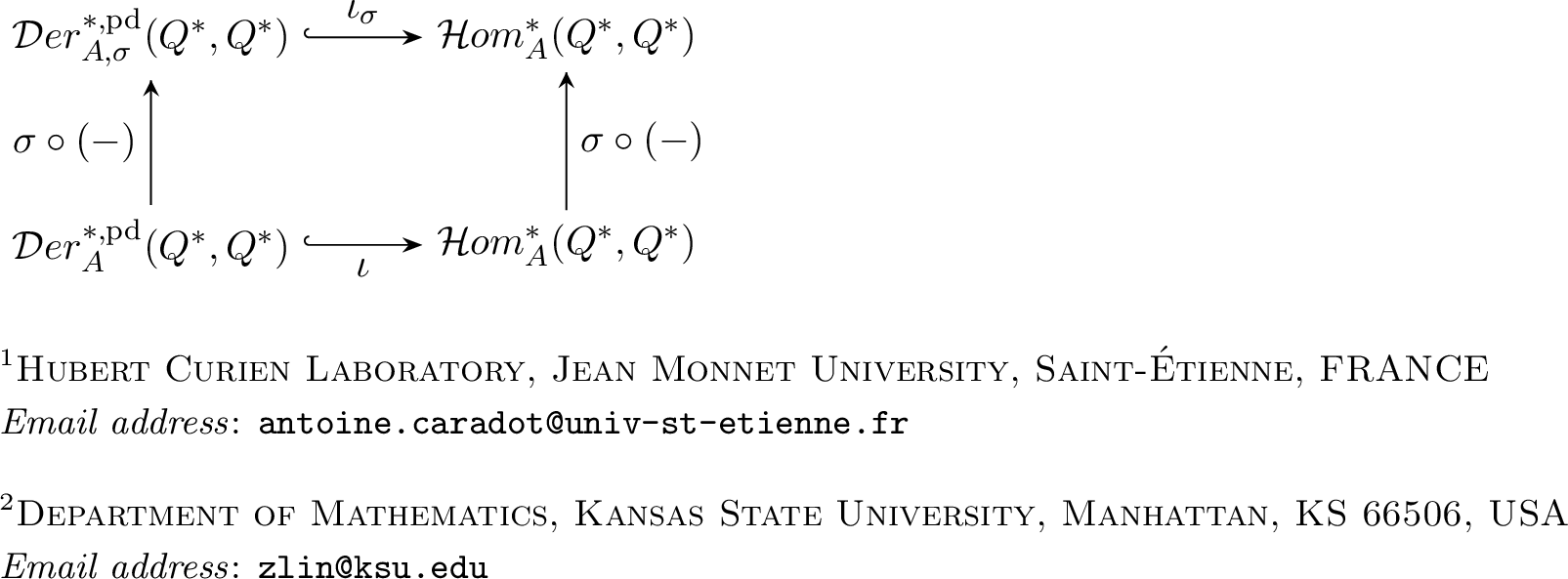 .
.
induces an equality of \(A\)-modules \[H^*(\iota_\sigma)(H^*(\mathcal{D}er_{A,\sigma}^{*,\operatorname{pd}}(Q^*,Q^*))) = H^*(\iota)(H^*(\mathcal{D}er_{A}^{*,\operatorname{pd}}(Q^*,Q^*)))\] inside of \(H^*(\mathcal{H}om_A^*(Q^*,Q^*))\).
The homomorphism \(\sigma \circ (-):\mathcal{H}om_A^{*}(Q^*,Q^*) \to \mathcal{H}om_A^{*}(Q^*,Q^*)\) induces the identity on \(H^*(\mathcal{H}om_A^{*}(Q^*,Q^*))\) since \(\sigma - \operatorname{id}_{Q^*}=d_{\mathcal{H}om}(h)\) for some \(h \in \mathcal{H}om_A^{-1}(Q^*,Q^*)\).
The composition of chain maps: \[\mathcal{D}er_A^{*,\operatorname{pd}}(P^*,P^*) \hookrightarrow \mathcal{H}om_A^{*}(P^*,P^*) \to \mathcal{H}om^{*}(P^*,A/I)\] induces an \(A\)-linear map of graded Lie algebras \[\begin{align} \label{eq:morphism} \Psi_P: H^*(\mathcal{D}er_A^{*,\operatorname{pd}}(P^*,P^*)) \to \operatorname{Ext}_A^*(A/I,A/I) \end{align}\tag{18}\] where the Lie bracket is the graded commutator.
Set \(\varphi \in Z^0(\mathcal{D}er_A^{*,\operatorname{pd}}(P^*,P^*))\), then \(\varphi_0:P^0 \to P^0\) is an \(A\)-module morphism defined by \(\varphi_0(1)\) as \(P^0=A\). But \(\varphi_0(1)=0\) due to the Leibniz rule, and so \(\varphi_0=0\). As \(P^*\) is exact and \(\varphi\) is a chain map, one can construct by induction on \(n\) an \(A\)-module homomorphism \(h_n:P^{n} \to P^{n-1}\) such that \(\varphi_n=d_{P^*} \circ h_n+h_{n-1} \circ d_{P^*}=d_{\mathcal{H}om}(h)_n\). Hence the cohomology class of \(\varphi\) is zero in \(H^0(\mathcal{H}om_A^{*,\operatorname{pd}}(P^*,P^*))\). Combining that with the result of Lemma 7 with \(X^*=P^*\), we get that
\[\begin{align} \label{eq:neg95hom} \Psi_P(H^{\leq 0}(\mathcal{D}er_A^{*,\operatorname{pd}}(P^*,P^*)))=0. \end{align}\tag{19}\]
Definition 1. Let \(A\) be a commutative ring. A restricted graded Lie algebra \(\mathfrak{g}\) over \(A\) is a strictly positively graded \(A\)-module \(\bigoplus_{n \geq 1}\mathfrak{g}_n\) equipped with a bilinear pairing \[[\cdot, \cdot]: \mathfrak{g}_m \times \mathfrak{g}_n \longrightarrow \mathfrak{g}_{m+n}\] and a quadratic operator \[q:\mathfrak{g}_{2n+1} \longrightarrow \mathfrak{g}_{4n+2}\] satisfying the following properties: for any \(a \in \mathfrak{g}_{|a|}\), \(b \in \mathfrak{g}_{|b|}\) and \(c \in \mathfrak{g}_{|c|}\), then
\([a, b]=-(-1)^{|a||b|}[b, a]\);
\([a,a]=0\) for \(|a|\) even;
\((-1)^{|a||c|}[a,[b,c]]+(-1)^{|b||a|}[b,[c,a]]+(-1)^{|c||b|}[c,[a,b]]=0\);
\([a,[a,a]]=0\) for \(|a|\) odd;
\(q(\lambda a)=\lambda^2 q(a)\) for \(\lambda \in A\) and \(|a|\) odd;
\([a, b]=q(a+b)-q(a)-q(b)\) for \(|a|=|b|\) odd;
\([a,[a,b]]=[q(a),b]\) for \(|a|\) odd.
Remark 21.
Notice that when \(2\) is invertible in \(A\), then condition [def:Lie:cond11/2] is a direct consequence of [def:Lie:cond1]. Likewise, when \(3\) is invertible in \(A\), then condition [def:Lie:cond21/3] is a direct consequence of [def:Lie:cond2]. This explain the choice of notation.
If \(2\) is invertible in \(A\), then [def:Lie:cond3] and [def:Lie:cond4] imply that \(q(a)=\frac{1}{2}[a,a]\) for any \(|a|\) odd, and all relations except [def:Lie:cond21/3] are consequences of [def:Lie:cond1] and [def:Lie:cond2]. Hence if \(2\) and \(3\) are invertible in \(A\), then Definition 1 is the usual definition of a graded Lie algebra.
The above definition of a restricted graded Lie algebra was introduced in [16] as a graded Lie algebra over a field. It also appears in [45] as an adjusted Lie algebra and in [26] as a restricted Lie algebra following Jacobson ([46]). We choose the terminology “restricted graded algebra" to put the emphasis both the graded structure and the additional map \(q\).
Proposition 22. With \(P^*\), \(A\) and \(M\) as above, the cohomology space \(H^{*}(\mathcal{D}er_A^{*,\operatorname{pd}}(P^*,P^*))\) is a restricted graded Lie algebra.
Proof. Use Corollary 3 for the graded Lie bracket, Eq.@eq:eq:neg95hom for the grading, and Appendix 8 for the quadratic map. ◻
We now introduce the following definition:
Definition 2. Let \(A\) and \(I\) be as above and \(P^*\) be the PD dg algebra obtained in Theorem 12. The homotopy Lie algebra of the pair \((A,I)\), written \(\pi^*(A,I)\), is the graded Lie algebra given by \[\pi^*(A,I)=\Psi_P(H^{*}(\mathcal{D}er_A^{*,\operatorname{pd}}(P^*,P^*))) \subset \operatorname{Ext}_A^*(A/I,A/I).\]
Theorem 23. Let \(P^*\) and \(Q^*\) be two PD dg algebras obtained through the construction of Theorem 12. Then if Conjecture 20 is true, then \[\operatorname{Im}\Psi_P=\operatorname{Im}\Psi_Q.\]
Proof. Consider \(\theta: P^* \to Q^*\) and \(\tau :Q^* \to P^*\) the PD dg algebras homomorphisms obtained in Theorem 14 and Corollary 1. Then we have following commutative diagram of complexes
Figure 3:  .
.
The top right square obviously commutes, and the bottom right triangle commutes because of Theorem 14. The left two squares commute following 17 . Using Conjecture 20, we have that the image of \(H^*(\mathcal{D}er_{A}^{*,\operatorname{pd}}(Q^*,Q^*))\) in \(H^*(\mathcal{H}om_A^*(Q^*,Q^*))\) is equal to that of \(H^*(\mathcal{D}er_{A, \theta\circ \tau}^{*,\operatorname{pd}}(Q^*,Q^*))\). We note that composition of the top row is \(\Psi_P\) when they are all mapped into \(\operatorname{Ext}_A^*(A/I,A/I)\) after taking the cohomology. Thus we have \(\operatorname{Im}(\Psi_{P})\subseteq \operatorname{Im}(\Psi_{Q})\). One can use the other direction of the commutative diagram to get \(\operatorname{Im}(\Psi_{Q})\subseteq \operatorname{Im}(\Psi_{P})\) using the fact that \(\tau\circ \theta\) is homotopy equivalent to identity of \(P^*\). ◻
We will thus omit the subscript and write \(\Psi\) in the rest of this paper.
Remark 24. We expect that the graded Lie algebra \(H^*(\mathcal{D}er^{*,\operatorname{pd}}_{A} (P^*, P^*))\) is independent of the construction of \(P^*\). This would be a homotopy theory question with respect to a model category structure on the category of PD dg \(A\)-algebras. Even though \(P^*\) is a cofibrant replacement of \(A/I\), the literature still could not automatically let us conclude. Hopefully with the work of [29], one can pass to the simplicial world to draw this conclusion.
A complex \(X^*\) of \(A\)-modules is called \(I\)-minimal if \(d(X^*) \subseteq I X^*\). In this case, we have \(H^*(\mathcal{H}om_A(X^*,A/I))=\mathcal{H}om_A(X^*,A/I)\) and \(H^*(X^* \otimes A/I)=X^* \otimes A/I\).
We now assume that \(P^*\). We also assume that \(F_n\) is a free \(A\)-module of finite rank for each \(n \geq 0\). It follows that as a PD dg algebra, \(P^*\) might have infinitely many generators, but for each degree, there will be only finitely many of them.
Following the proof of Theorem 12, let \(\mathcal{B}(-(n+1))\) be an \(A\)-basis of \(F_{n+1}[n+1]\) and set \(\mathcal{B}(0)=0\). We also set an order on each \(\mathcal{B}(-n)\). It follows that \(\mathcal{B}=\bigcup_{n \geq 0} \mathcal{B}(-n)\) is a set of generators of the PD dg algebra \(P^*\). Finally we set an order on \(\mathcal{B}\) such that \(b'<b\) for any \(b \in \mathcal{B}(-n)\) and \(b' \in \mathcal{B}(-(n+1))\).
A basis of \(P^*\) as an \(A\)-module is given through \[\begin{align} \label{eq:basis95P} \mathcal{X}=\{f : \mathcal{B} \to \mathbb{N} \;| \;f \text{ has finite support and }f(b)=0, 1 \text{ if } |b| \text{ odd for }b \in \mathcal{B} \}. \end{align}\tag{20}\] For \(f \in \mathcal{X}\), we write \(\operatorname{deg}f=\sum_{b \in \mathcal{B}}f(b)|b|\) for the degree of \(f\). We also write \(\operatorname{poldeg}b^{(f)}=\sum_{b \in \mathcal{B}} f(b)\) for its polynomial degree. There is a decomposition \(\mathcal{X}=\bigcup_{n \in \mathbb{N}}\mathcal{X}(-n)\) where \(\mathcal{X}(-n)=\{f \in \mathcal{X} \;| \;\operatorname{deg}f=-n\}\). The basis element of \(P^*\) corresponding to \(f \in \mathcal{X}\) will be written \(b^{(f)}=\prod_{b \in \mathcal{B}} b^{(f(b))}\) where the \(b\)’s are in descending order and \(b^{(f(b))}=\gamma_{f(b)}(b)\). Set \(b^{(f)} \in \mathcal{X}\) and define the \(A\)-linear map \((b^{(f)})^\vee:P^{\operatorname{deg} f} \to A/I\) that sends all elements of \(\mathcal{X}(\operatorname{deg}f)\) to zero except for \(b^{(f)}\) which is sent to \(1\) (\(A/I\) is an algebra so it has a unit).
Similarly, we write \((b^\vee)^{f}=\prod_{b \in \mathcal{B}} (b^\vee)^{f(b)}\) for the ordered product in \(\operatorname{Ext}_A^*(A/I,A/I)\) (notice that \((b^\vee)^{f}\) uses the product without divided powers).
Theorem 25. With \(P^*\) and \(A\) as above, let \(b \in \mathcal{B}\) be a generator of \(P^*\) as a PD dg algebra. Then there exists a cocycle \(\widetilde{\varphi} \in Z^{-|b|}(\mathcal{D}er_A^{*,\operatorname{pd}}(P^*,P^*))\) such that \(\epsilon \circ \widetilde{\varphi}_{| P^{|b|}} =b^\vee\).
Proof. Set \(s=|b|<0\) and define \(\widetilde{\varphi}_n=0\) for \(n >s\) and \(\widetilde{\varphi}_s:P^s \to P^0\) sending \(b\) to \(1\) and any other element of \(\mathcal{X}(s)\) to zero. So \(\epsilon \circ \widetilde{\varphi}_s=b^\vee\).
We know that \(P^*\) is an \(I\)-minimal resolution so \[\epsilon \circ \widetilde{\varphi}_s \circ d(P^{s-1})=b^\vee(d(P^{s-1})) \subset b^\vee(I P^s)=0.\] Hence \(\operatorname{Im}(\widetilde{\varphi}_s \circ d) \subset \operatorname{Ker}\epsilon = \operatorname{Im}((-1)^sd)\), and so we can construct an \(A\)-linear map \(\widetilde{\varphi}_{s-1}:P^{s-1} \to P^{-1}\) making the diagram commute as follows.
The PD generators of \(P^*\) of degree \(-1\) will be written as \(T_i\). Any \(b^{(f)} \in \mathcal{X}(s-1)\) such that \(b\) does not appear in \(d(b^{(f)})\) is sent to zero by \(\widetilde{\varphi}_{s-1}\). But \(b\) appears in \(d(b^{(f)})\) only if \(b^{(f)}=T_ib\) or \(b^{(f)}=b' \in \mathcal{B}(s-1)\). In the first case, \(\widetilde{\varphi}_{s}d(T_ib)=d(T_i)=(-1)^sd((-1)^sT_i)\) so we set \(\widetilde{\varphi}_{s-1}(T_ib)=(-1)^sT_i\). In the second case, there exists \(x \in I\) such that \(xb\) appears in \(d(b')\). Thus \(\widetilde{\varphi}_{s}d(b')=\widetilde{\varphi}_{s}(xb)=x \in I=\operatorname{Ker}\epsilon=\operatorname{Im}(-1)^sd\). Hence there exists \(y \in P^{-1}\) such that \((-1)^s dy=x\), and we set \(\widetilde{\varphi}_{s-1}(b')=y\).
We know check that \(\widetilde{\varphi}_{s-1}\) satisfies the PD relations. The elements in \(\mathcal{X}(s-1)\) are of the following forms:
elements of \(\mathcal{B}(s-1)\);
monomials \(b^{(f)}\) with \(\operatorname{poldeg}f \geq 2\) and with \(f(b)=1\), i.e., \(b^{(f)}=T_ib\);
monomials \(b^{(f)}\) with \(\operatorname{poldeg}f \geq 2\) and with \(f(b)=0\).
In case (1), there is nothing to verify. In case (2), we have \(\widetilde{\varphi}_{s-1}(T_ib)=(-1)^sT_i=\widetilde{\varphi}_{-1}(T_i)b+(-1)^{s|T_i|}T_i\widetilde{\varphi}_{s}(b)\). Lastly, in case (3), all variables in \(b^{(f)}\) have degree \(\geq s\) and \(f(b)=0\), so \(b\) does not appear in \(d(f^{(b)})\). As explained in the previous paragraph, we set \(\widetilde{\varphi}_{s-1}(b^{(f)})=0\), and it follows that \(\widetilde{\varphi}_{s-1}\) satisfies the PD relation on this monomial.
We now assume that we have lifted \(\widetilde{\varphi}_{s}\) up to \(\widetilde{\varphi}_{N}\) and each \(\widetilde{\varphi}_{k}\) (\(N \leq k \leq s\)) satisfies the PD relations. Consider an element in \(\mathcal{X}(N-1)\). There are three cases:
\(\bullet\) Case 1. The element is of the form \(b^{(f_1)}b^{(f_2)}\) such that there exist \(b_1\) and \(b_2\) satisfying \(f_1(b_1) \neq 0\) and \(f_2(b_1)=0\), and satisfying \(f_1(b_2) = 0\) and \(f_2(b_2) \neq 0\). We write \(Y=b^{(f_1)}\) and \(Z=b^{(f_2)}\). Then \[\begin{align} \widetilde{\varphi}_{N}d(YZ) & = \widetilde{\varphi}_{N}\left(d(Y)Z+(-1)^{|Y|}Yd(Z)\right) \\[5pt] & = \widetilde{\varphi}_{|Y|+1}(d(Y))Z+(-1)^{s(|Y|+1)}d(Y)\widetilde{\varphi}_{|Z|}(Z) \\[5pt] & \quad +(-1)^{|Y|}\left(\widetilde{\varphi}_{|Y|}(Y)d(Z)+(-1)^{s|Y|}Y\widetilde{\varphi}_{|Z|+1}(d(Z))\right) \\[5pt] & = (-1)^sd(\widetilde{\varphi}_{|Y|}(Y))Z+(-1)^{|Y|}\widetilde{\varphi}_{|Y|}(Y)d(Z) \\[5pt] & \quad +(-1)^{s(|Y|+1)}d(Y)\widetilde{\varphi}_{|Z|}(Z)+(-1)^{|Y|(s+1)}(-1)^sY d( \widetilde{\varphi}_{|Z|}(Z)) \\[5pt] &=(-1)^sd\left(\widetilde{\varphi}_{|Y|}(Y)Z+(-1)^{s|Y|}Y\widetilde{\varphi}_{|Z|}(Z)\right). \end{align}\] Hence we set \(\widetilde{\varphi}_{N-1}(b^{(f_1)}b^{(f_2)})=\widetilde{\varphi}_{|b^{(f_1)}|}(b^{(f_1)})b^{(f_2)}+(-1)^{s|b^{(f_1)}|}b^{(f_1)}\widetilde{\varphi}_{|b^{(f_2)}|}(b^{(f_2)})\). As \(\widetilde{\varphi}_{|b^{(f_1)}|}\) and \(\widetilde{\varphi}_{|b^{(f_2)}|}\) satisfy the PD relations, then so does \(\widetilde{\varphi}_{N-1}\) on \(b^{(f_1)}b^{(f_2)}\).
\(\bullet\) Case 2. The element is of the form \(b'^{(k)}\) where \(b' \in \mathcal{B}(-2n)\) for some \(n>0\). Using the fact that \(\widetilde{\varphi}_{N}\) satisfies the PD relations and that \(|b'|\) is even, we can show that \[\begin{array}{rcl} \widetilde{\varphi}_{N}d(b'^{(k)}) & = & (-1)^sd\left(\widetilde{\varphi}_{|b'|}(b')b'^{(k-1)}\right) \end{array}\] so we can set \(\widetilde{\varphi}_{N-1}(b'^{(k)})=\widetilde{\varphi}_{|b'|}(b')b'^{(k-1)}\) and it satisfies the PD relations on this element.
\(\bullet\) Case 3. The element is a variable \(b' \in \mathcal{B}(N-1)\). Then \((-1)^sd \circ \widetilde{\varphi}_{N} \circ d(b')=\widetilde{\varphi}_{N+1} \circ d \circ d(b')=0\). So \(\widetilde{\varphi}_{N} d(b') \in \operatorname{Ker}(-1)^sd=\operatorname{Im}(-1)^sd\). Hence there exists an element \(Z \in P^{N-1-s}\) such that \((-1)^sd(Z)=\widetilde{\varphi}_{N}d(b')\). We can set \(\widetilde{\varphi}_{N-1}(b')=Z\).
We have thus defined an \(A\)-linear map \(\widetilde{\varphi}_{N-1}:P^{N-1}\to P^{N-1-s}\) that satisfies the PD relations on every element of \(\mathcal{X}(N-1)\). By induction, it follows that the map \(\widetilde{\varphi}:P^* \to P^*\) is an element of \(Z^{-|b|}(\mathcal{D}er_A^{*,\operatorname{pd}}(P^*,P^*))\). ◻
Example 1. The fact that the resolution \(P^*\) is \(I\)-minimal is not automatic. For example, take \(A=\mathbb{C}[x,y]/(c_1,c_2)\) where \(c_1=x^3,c_2=x^2(1+y)\). Set \(\mathfrak{m}=(x,y) \subset \mathbb{C}[x,y]\) and \(\mathfrak{m}_x\) its image in \(A\). Notice that \(A\) is not a complete intersection as \(xc_2=(1+y)c_1\) (see Section 5.1 for the definition of complete intersection). The free variables in degrees \(-1\) and \(-2\) of the partial resolution \(P_2^*\) are given by \(dT_x=x,dT_y=y,dS_1=x^2T_x,dS_2=(1+y)xT_x\). But we see that \(d\big((1+y)S_1\big)=(1+y)x^2T_x=0\) in \(P_2^{-1}\), so \((1+y)S_1 \in \operatorname{Ker}d\) and obviously \((1+y)S_1 \notin \mathfrak{m}_xP_2^{-2}=\mathfrak{m}_xP^{-2}\). But then it means that \((1+y)S_1 \in d(P^{-3})\) as \(P^*\) is exact, so we cannot have \(d(P^{-3}) \subset \mathfrak{m}_x P^{-2}\). Hence the resolution \(P^*\) is not \(I\)-minimal.
We cannot lift morphisms corresponding to elements of the form \((b^{(f)})^\vee\) if there exist \(b_1 \neq b_2\) in \(\mathcal{B}\) with \(f(b_1) \neq 0 \neq f(b_2)\), as they would not satisfy the PD relations. For example, consider \(b^{(k)}\) for an even variable \(b\) and \(k \geq 2\). We want to lift \((b^{(k)})^\vee\). As in Theorem 25, we define \(\widetilde{\varphi}_n=0\) for \(n >|b^{(k)}|\) and \(\widetilde{\varphi}_{|b^{(k)}|}:P^{|b^{(k)}|} \to P^0\) where \(\widetilde{\varphi}_{|b^{(k)}|}(b^{(k)})=1\). But we want \(\widetilde{\varphi}_{|b^{(k)}|}\) to satisfy the PD relations, so \(1=\widetilde{\varphi}_{|b^{(k)}|}(b^{(k)})=\widetilde{\varphi}_{|b|}(b)b^{(k-1)}=0\) as \(\widetilde{\varphi}_{|b|}=0\), which is a contradiction. Likewise, if \(Z=b^{(f_1)}b^{(f_2)}\) as in the previous proof. Then \(\widetilde{\varphi}_{|b^{(f_1)}b^{(f_2)}|}(b^{(f_1)}b^{(f_2)})=1\), \(\widetilde{\varphi}_{|b^{(f_1)}|}(b^{(f_1)})=0\), and \(\widetilde{\varphi}_{|b^{(f_2)}|}(b^{(f_2)})=0\). Hence \(1=\widetilde{\varphi}_{|b^{(f_1)}b^{(f_2)}|}(b^{(f_1)}b^{(f_2)})=\widetilde{\varphi}_{|b^{(f_1)}|}(b^{(f_1)})b^{(f_2)}+(-1)^{|b^{(f_1)}b^{(f_2)}||b^{(f_1)}|}b^{(f_1)}\widetilde{\varphi}_{|b^{(f_2)}|}(b^{(f_2)})=0\), which is also a contradiction.
Theorem 26. Let \(A\) and \(P^*\) be as above. Then any element in \(H^{n}(\mathcal{D}er_A^{*,\operatorname{pd}}(P^*,P^*))\) with \(n >0\) is the image of an \(A\)-linear combination of lifts of \(b^\vee\) with \(b \in \mathcal{B}(-n)\).
Proof. Consider \(\varphi \in Z^{n}(\mathcal{D}er_A^{*,\operatorname{pd}}(P^*,P^*))\) with \(n>0\). Then we have \(\varphi_{-n}:P^{-n} \to P^0\) and as \(\varphi\) is a PD derivation, we see that \(\varphi_{-n}(b^{(f)})=0\) if \(\operatorname{poldeg}b^{(f)} \geq 2\), and so \(\varphi_{-n}=\sum_{b \in \mathcal{B}(-n)}\varphi(b)\widetilde{\varphi^b}_{|b|}\), where \(\varphi(b) \in P^0=A\) and \(\widetilde{\varphi^b}_{|b|}:P^{|b|} \to P^0\) is the map sending \(b\) to \(1\) and any other element of \(\mathcal{X}(-n)\) to zero. So \(\epsilon \circ \widetilde{\varphi^b}_{|b|}=b^\vee\). We have seen in Theorem 25 that \(b^\vee\) can be lifted to \(\widetilde{\varphi^b} \in Z^{n}(\mathcal{D}er_A^{*,\operatorname{pd}}(P^*,P^*))\). It follows that \(\sum_{b \in \mathcal{B}(-n)}\varphi(b)\widetilde{\varphi^b}\) is a lift of \(\varphi_{-n}\). But we also know that \(\varphi\) is a cocycle so it is also a lift of \(\varphi_{-n}\). It follows that in \(H^{n}(\mathcal{D}er_A^{*,\operatorname{pd}}(P^*,P^*))\), we have \[\overline{\varphi}=\sum_{b \in \mathcal{B}(-n)}\varphi(b)\overline{\widetilde{\varphi^b}}\] where \(\overline{\varphi}\) indicate the cohomology class of \(\varphi\). ◻
Based on Theorem 26 and Eq.@eq:eq:neg95hom , we have the following situation: \[\begin{array}{cccc} \Psi: & H^*(\mathcal{D}er_A^{*,\operatorname{pd}}(P^*,P^*)) & \to& H^*(\mathcal{H}om_A^{*}(P^*,P^*)) \\ &\{\text{degree }\leq 0\} & \mapsto & 0 \\ &\text{degree }n \geq 1 & \mapsto & A/I\text{-linear span of }\{b^\vee \;| \;b \in \mathcal{B}(-n)\} \subset H^n(\mathcal{H}om_A^{*}(P^*,P^*)). \end{array}\] where \(H^{<0}(\mathcal{H}om_A^{*}(P^*,P^*))=0\) by Lemma 7.
We have seen in Theorem 26 that \(\Psi\) is not surjective as products of \(b^\vee\) cannot be reached. Moreover, \(\Psi\) might not be injective. Indeed, using Theorem 26, if we write \(\widetilde{\varphi^{b}}\) for the lift of \(b^\vee\) and set \(a \in A\), then we see that \(\Psi(a \widetilde{\varphi^{b}})=\overline{a}b^\vee\). Hence if \(\overline{a}=\overline{a'}\) with \(a \neq a'\), then \(\Psi(a \widetilde{\varphi^{b}})=\Psi(a' \widetilde{\varphi^{b}})\) but \(a \widetilde{\varphi^{b}} \neq a' \widetilde{\varphi^{b}}\).
It was stated in Theorem 22 that \(H^*(\mathcal{D}er_A^{*,\operatorname{pd}}(P^*,P^*))\) is a restricted graded Lie algebra with \(q(D)=D \circ D\). However, we see from Lemma 4 that \(\Psi(q(D))=\Psi(D) \circ \Psi(D)=-\Psi(D) \cdot \Psi(D)\) as \(|D|\) odd. On \(\operatorname{Im}(\Psi)\) we define two quadratic maps \(q_{yon}:\Psi(D) \mapsto \Psi(D) \cdot \Psi(D)\) and \(q_{comp}:\Psi(D) \mapsto \Psi(D) \circ \Psi(D)\). We also write \([\cdot,\cdot]_{yon}\) and \([\cdot,\cdot]_{comp}\) for the super commutator with respect to the Yoneda and composition products, respectively. Then we can verify that \(([\cdot,\cdot]_{yon}, q_{yon})\) and \(([\cdot,\cdot]_{comp}, q_{comp})\) provide \(\pi^*(A,I)\) with two different restricted graded Lie algebra structures. In what follows, we will only consider the structure coming from the Yoneda product and write only \(([\cdot,\cdot], q)\) for the Lie bracket and the quadratic map.
Proposition 27. Set \(A\), \(P^*\) as above, and set \(b^{(f)} \in \mathcal{X}\). Then \((b^{(f)})^\vee \in \operatorname{Ext}_A^*(A/I,A/I)\) can be expressed as a finite \(A/I\)-linear combination of elements of the form \((b^\vee)^{h}\) with \(h \in \mathcal{X}(\operatorname{deg}f)\). In particular, \(\{b^\vee \;| \; b \in \mathcal{B}\}\) is a set of generators of \(\operatorname{Ext}_A^*(A/I,A/I)\) as an \(A/I\)-algebra.
Proof. Set \(\mathcal{B}(b^{(f)})=\{b \in \mathcal{B} \;| \;f(b) \neq 0\}\). We know that \(\mathcal{B}(b^{(f)})\) is a ordered set coming from the order on \(\mathcal{B}\) and it is finite as \(f\) has finite support. Set \(b'=\operatorname{min} \mathcal{B}(b^{(f)})\). Hence \(b'\) is the right-most variable of the ordered monomial \(b^{(f)}\). We lift \(b'^\vee\) and call \(\widetilde{\varphi}'\) the resulting PD dg derivation.
For any \(b'' \in \mathcal{B}\), define \(\delta_{b''} : \mathcal{B} \to \mathbb{N}\) such that \(\delta_{b''}(b)=\delta_{b'', b}\) (Kronecker coefficient). Consider \(\widetilde{\varphi}'_{|b^{(f)}|} :P^{|b^{(f)}|} \to P^{|b^{(f-\delta_{b'})}|}\) and set \(b^{(g)}\) an element in \(\mathcal{X}(b^{(f)})\), i.e., \(|b^{(g)}|=|b^{(f)}|\). Then for \(b^{(f-\delta_{b'})}\) to appear in \(\widetilde{\varphi}'_{|b^{(f)}|}(b^{(g)})\), there are two possibilities:
\(b^{(g)}=b^{(f)}\);
\(g(b) \leq f(b)\) for all \(|b| \leq |b'|\) and there exists a unique \(b''\) such that \(|b''|>|b'|\) and \(g(b'')=1\). As \(|b^{(g)}|=|b^{(f)}|\), this is only possible if \(\operatorname{poldeg}b^{(g)}<\operatorname{poldeg}b^{(f)}\).
It follows that \[(b^{(f-\delta_{b'})})^\vee \circ \widetilde{\varphi}'_{|b^{(f)}|}=(b^{(f)})^\vee+\sum_{\substack{|b^{(g)}|=|b^{(f)}| \\ \operatorname{poldeg}b^{(g)}<\operatorname{poldeg}b^{(f)}}} \overline{a_g}(b^{(g)})^\vee\] where \(\overline{a_g} \in A/I\). Then, using Lemma 4, we can rewrite the above equation into \[\begin{align} \label{eq:decomp} (b^{(f)})^\vee=(-1)^{|b'||b^{(f-\delta_{b'})}|}(b^{(f-\delta_{b'})})^\vee \cdot b'^\vee-\sum_{\substack{|b^{(g)}|=|b^{(f)}| \\ \operatorname{poldeg}b^{(g)}<\operatorname{poldeg}b^{(f)}}} \overline{a_g} (b^{(g)})^\vee. \end{align}\tag{21}\] But we know that \(\operatorname{poldeg}b^{(f-\delta_{b'})}<\operatorname{poldeg}b^{(f)}\), and so Eq.@eq:eq:decomp states that \((b^{(f)})^\vee\) is an \(A/I\)-linear combination of Yoneda products of \((b^{(h)})^\vee\) with \(\operatorname{poldeg}b^{(h)}<\operatorname{poldeg}b^{(f)}\). By doing an induction on this polynomial degree, we see that \((b^{(f)})^\vee\) is an \(A/I\)-linear combination of unordered products of elements in \(\{b^\vee \;| \;b \in \mathcal{B}\}\). However, we know that \(\operatorname{Im}\Psi\) is a graded Lie algebra whose Lie bracket is the graded commutator in \(\operatorname{Ext}_A^*(A/I,A/I)\). Hence we can reorder the monomials so that \((b^{(f)})^\vee\) is an \(A/I\)-linear combination of elements in \(\{(b^\vee)^h \;| \;h \in \mathcal{X}(\operatorname{deg}f)\}\). ◻
We give below the last theorem of this section, providing a connection between the homotopy Lie algebra of \(A\) and the PD dg derivations of the resolution \(P^*\).
Theorem 28. Let \(A\) be a Noetherian ring, \(I \subset A\) an ideal, and \(P^*\) is the \(I\)-minimal PD dg resolution of the \(A\)-module \(A/I\) with \(P^n\) a free \(A\)-module for all \(n\). Then the Yoneda algebra is equipped with a comultiplication satisfying \[\begin{align} \label{eq:inclusion} \pi^*(A,I) \subseteq \operatorname{Prim}(\operatorname{Ext}_A^*(A/I,A/I)), \end{align}\tag{22}\] where \(\pi^*(A,I)\) is a restricted graded Lie algebra with an ordered basis \(\{b^\vee \;| \;b \in \mathcal{B}\}\). In particular \(\operatorname{Ext}_A^*(A/I,A/I)\) is generated as an \(A/I\)-algebra by \(\pi^*(A,I)\). Moreover, we have
If \(\mathbb{Q} \subset A\), then Eq.@eq:eq:inclusion in an equality.
If \(\mathbb{Q} \not\subset A\), then Eq.@eq:eq:inclusion is a strict inclusion.
Proof. We know ([47]) that \(\operatorname{Tor}^A_*(A/I,A/I)=H^*(P^* \otimes_A A/I)\) is equipped with a product \[\begin{array}{cccc} \varpi: & H^*(P^* \otimes_A A/I) \otimes_{A/I} H^*(P^* \otimes_A A/I) & \to & H^*(P^* \otimes_A A/I) \\ & \overline{u} \otimes \overline{v} & \mapsto & \overline{uv}. \end{array}\] But as \(P^*\) is assumed to be \(I\)-minimal, we have \(H^*(P^* \otimes_A A/I)=P^* \otimes_A A/I\) and the above product is then the regular product of the algebra \(P^* \otimes_A A/I\). The above product is a morphism of \(A/I\)-modules and for all \(n \geq 0\), its dual gives a map \[\Delta_n: \mathcal{H}om_{A/I}(P^{-n} \otimes_A A/I,A/I) \to \mathcal{H}om_{A/I}\left(\bigoplus_{i+j=n}(P^{-i} \otimes_A A/I) \otimes_{A/I} (P^{-j} \otimes_A A/I),A/I\right).\] However, we have \(\mathcal{H}om_{A/I}(P^{-n} \otimes_A A/I,A/I)=\mathcal{H}om_A(P^{-n},A/I)\) by base change. Moreover, we can rewrite \((P^{-i} \otimes_A A/I) \otimes_{A/I} (P^{-j} \otimes_A A/I)=P^{-i} \otimes_A P^{-j} \otimes_A A/I\). The right hand side becomes \(\bigoplus_{i+j=n}\mathcal{H}om_A(P^{-i} \otimes_A P^{-j},A/I)\) using the commutation of \(\mathcal{H}om\) with finite direct sums and the base change. Then, we know that \(P^{-i}\) and \(P^{-j}\) are free \(A\)-modules of finite rank due to \(A\) being Noetherian, so we can split the tensor product. Finally, using the fact that \(\operatorname{Ext}_A^n(A/I,A/I)=\mathcal{H}om_A(P^{-n},A/I)\) for all \(n \geq 0\) due to \(P^*\) being \(I\)-minimal, we can rewrite \(\Delta_n\) as \[\Delta_n: \operatorname{Ext}_A^n(A/I,A/I) \to \bigoplus_{i+j=n}\operatorname{Ext}_A^i(A/I,A/I) \otimes_A \operatorname{Ext}_A^j(A/I,A/I).\] We thus have a comultiplication \(\Delta:\operatorname{Ext}_A^*(A/I,A/I) \to \operatorname{Ext}_A^*(A/I,A/I) \otimes_A \operatorname{Ext}_A^*(A/I,A/I)\).
Let \(b \in \mathcal{B}\) and consider \(b^\vee \in \operatorname{Ext}_A^{-|b|}(A/I,A/I)\). Then by definition \(\Delta(b^\vee)=b^\vee \circ \varpi\). As \(b\) is a generator of \(P^*\) as a PD algebra and \(\varpi\) is the product in \(P^* \otimes_AA/I\), the only possibility for \(b\) to appear as an element in \(\operatorname{Im}\varpi\) is as \(b=\varpi(b \otimes 1)=\varpi(1 \otimes b)\). Hence \(\Delta(b^\vee)=b^\vee \otimes_A 1 +1 \otimes_A b^\vee\) and \(b^\vee \in \operatorname{Prim}(\operatorname{Ext}_A^{*}(A/I,A/I))\). As \(\Delta\) is linear, it follows that \(\pi^*(A,I) \subseteq \operatorname{Prim}(\operatorname{Ext}_A^*(A/I,A/I))\).
We have assumed \(P^*\) \(I\)-minimal, and so \(\operatorname{Ext}^*_A(A/I,A/I)\) is spanned by elements \((b^{(f)})^\vee\) with \(f \in \mathcal{X}\) (cf. Eq.@eq:eq:basis95P ). We have seen above that if \(\operatorname{poldeg}b^{(f)}=1\), then \((b^{(f)})^\vee\) is primitive. Now assume that \(\operatorname{poldeg}b^{(f)} \geq 2\). We have two cases:
Case 1: there exist \(b \neq b' \in \mathcal{B}\) such that \(f(b) \neq 0 \neq f(b')\). Hence we can decompose \(b^{(f)}=b^{(g)}b^{(h)}\) with
\(g,h \in \mathcal{X}\) having disjoint supports. But then we have \(\Delta((b^{(f)})^\vee)(b^{(g)} \otimes_A b^{(h)})=(b^{(f)})^\vee \circ \varpi(b^{(g)} \otimes_A
b^{(h)})=(b^{(f)})^\vee(b^{(f)})=1\), hence \(\Delta((b^{(f)})^\vee)\) contains \((b^{(g)})^\vee \otimes_A (b^{(h)})^\vee\) so \((b^{(f)})^\vee\)
cannot be primitive.
Case 2: we have \(b^{(f)}=b^{(k)}\) for some \(b \in \mathcal{B}\) with \(|b|\) even and \(k \geq 2\). We need to consider two subcases:
Assume \(\mathbb{Q} \subset A\). Then we have \(kb^{(k)}=bb^{(k-1)}\), and so \(\Delta((b^{(k)})^\vee)(b \otimes_A b^{(k-1)})=(b^{(k)})^\vee(kb^{(k)})=k\). Hence we see that \(\Delta((b^{(k)})^\vee)\) contains \(k (b^\vee \otimes_A (b^{(k-1)})^\vee)\), implying that \((b^{(k)})^\vee\) is not primitive.
Assume \(\mathbb{Q} \not\subset A\). Then there exists a prime \(p \in \mathbb{N}\) such that for any \(1 \leq m \leq p-1\), we have \(b^{(m)}b^{(p-m)}=\binom{p}{m}b^{(p)}=0\) as \(p\) divides \(\binom{p}{m}\). Hence \(b^{(p)}\) cannot be obtained using elements of lower degrees. It follows that \((b^{(p)})^\vee\) is primitive.
In the case where \(\mathbb{Q} \subset A\), we have seen that \((b^{(f)})^\vee\) is primitive if and only if \(b^{(f)} \in \mathcal{B}\). As the comultiplication is linear, it follows that \(\operatorname{Prim}(\operatorname{Ext}_A^*(A/I,A/I))=\pi^*(A,I)\). Moreover, in the case where \(\mathbb{Q} \not\subset A\), there exists a prime \(p \in \mathbb{N}\) such that \((b^{(p)})^\vee \in \operatorname{Prim}(\operatorname{Ext}_A^*(A/I,A/I))\) but we know that \((b^{(p)})^\vee \notin \pi^*(A,I)\). As a consequence, we have \(\pi^*(A,I) \subsetneq \operatorname{Prim}(\operatorname{Ext}_A^*(A/I,A/I))\). The remaining statements follow from Proposition 27. ◻
5 Homotopy Lie algebras and complete intersections↩︎
5.1 The Yoneda algebra of a complete intersection algebra↩︎
Let \(\mathsf{k}\) be a commutative Noetherian ring and set \(A=\mathsf{k}[x_1,\dots, x_n]/(c_1,\dots, c_k)\) a complete intersection \(\mathsf{k}\)-algebra, i.e., \(c_1, \dots, c_k \in \mathsf{k}[x_1, \dots, x_n]\) is a regular sequence. This means that \(c_{i+1}\) is not a zero divisor in \(\mathsf{k}[x_1,\dots, x_n]/( c_1,\dots, c_i)\) for all \(i\). Set \(\mathfrak{m}=(x_1, \dots , x_n) \subset k[x_1, \dots, x_n]\). The polynomial ring \(\mathsf{k}[x_1, \dots, x_n]\) is graded with \(|x_i|=1\), and so is \(\mathfrak{m}\). We will take about polynomial degree (not to be confused with the polynomial degree of Section 4, but the difference will be clear by the context). We assume that for all \(1 \leq p \leq k\), we have \(c_p \in \mathfrak{m}^2\) and write \(c_p=\sum_{i=1}^n c_{p, i}x_i\) with \(c_{p, i} \in \mathfrak{m}\). Let \(\mathfrak{m}_x=(\overline{x_1}, \dots, \overline{x_{n}})\) be the ideal of \(A\) which is the image of \(\mathfrak{m}\). We are interested in the \(A\)-module \(\mathsf{k}=A/\mathfrak{m}_x\). Using a reasoning similar to that of [19], a corollary of Theorem 12 in the complete intersection case states that the free resolution \(P^*\) of the \(A\)-module \(\mathsf{k}\) is given by \(P_2\), i.e., the complex \(P_2\) is already exact. Hence \(P^*\) is generated as a PD dg algebra by the set \[\{T_i, S_p \;| \;1 \leq i \leq n, \, 1 \leq p \leq k, \, \operatorname{deg}T_i=-1, \, \operatorname{deg}S_p=-2\}\] and the differential \(d\) is given by:
\(d(T_i) = \overline{x_i}\) for all \(1 \leq i \leq n\),
\(d(S_p) = \displaystyle \sum_{i=1}^n \overline{c_{p, i}} \, T_i\) for all \(1 \leq p \leq k\).
To lighten notations, we will remove the \(\overline{\color{white}x}\) so it is assumed that we are in the quotient ring. Moreover, we will write \(S_i^{(k)}=\gamma_k(S_i)\) for the divided power structure. We see that \(d(P^*) \subseteq \mathfrak{m}_xP^{*}\), and so the resolution is \(\mathfrak{m}_x\)-minimal, implying that \(\operatorname{Ext}_A^*(\mathsf{k},\mathsf{k})=\mathcal{H}om_{A}^*(P^*, \mathsf{k})\).
For all \(1 \leq i \leq n\) and \(1 \leq p \leq k\), we define \(\alpha_i=T_i^\vee\) and \(\beta_p=S_p^\vee\) (see before Theorem 25 for the notation).
Theorem 29. Let \(A=\mathsf{k}[x_1,\dots, x_n]/(c_1,\dots, c_k)\) be a complete intersection \(\mathsf{k}\)-algebra with \(\mathsf{k}\) is a commutative Noetherian ring. Consider the \(A\)-module \(\mathsf{k}=A/\mathfrak{m}_x\). We assume that for all \(1 \leq p \leq k\), we have \(c_p \in \mathfrak{m}^2\). By writing \(c_p \equiv \sum_{i < j}(n^p_{i, j}+n^p_{j, i})x_ix_j+\sum_{i}n^p_{i, i}x_i^2 \mod \mathfrak{m}^3\), we have that \[\begin{align} \pi^*(A, \mathsf{k})=\bigoplus_{i=1}^n\mathsf{k} \alpha_i \oplus \bigoplus_{p=1}^k \mathsf{k} \beta_p \end{align}\] is a restricted graded Lie algebra with \(\operatorname{deg}\alpha_i=1\), \(\operatorname{deg}\beta_p=2\), and the restricted Lie structure is given by:
align [_i, _j] & = _p=1^k (n^p_i, j+n^p_j, i)_p 1 i j n ;
[_i, _i] & = _p=1^k 2n^p_i, i_p 1 i n ;
[_p, ^*(A, )] & = 0 1 p k;
q(_i) & =_p=1^k n^p_i, i_p 1 i n.
Proof. We know from the discussion before Proposition 27 and from Theorem 28 that \(\pi^*(A,\mathsf{k})\) is a restricted graded Lie algebra spanned by the \(\alpha_i\) and \(\beta_p\), and the restricted map is given by the square. The Lie brackets \([\alpha_i,\alpha_j]\) and the quadratic map \(q(\alpha_i)\) are obtained by Lemma 6. The Lie brackets \([\beta_p,\alpha_i]\) and \([\beta_p,\beta_q]\) are zero as they would be elements of degree \(3\) and \(4\) respectively, and the highest degree in \(\pi^*(A,\mathsf{k})\) is \(2\). ◻
Remark 30. Here we can make a connection with the cohomological variety introduced in [1]. Consider the case where \(A\) is not a complete intersection, and set \(\varpi: \widetilde{A} \to A\) the complete intersection approximation of \(A\) (see [1] for details on the notations). Set \(\widetilde{I}=\varpi^{-1}(I)\). Then \(A/I\) is an \(A\)-module and an \(\widetilde{A}\)-module through the \(\widetilde{A}\)-module isomorphism \(A/I \cong \widetilde{A}/\widetilde{I}\). We then have the following commutative diagram
Figure 4: 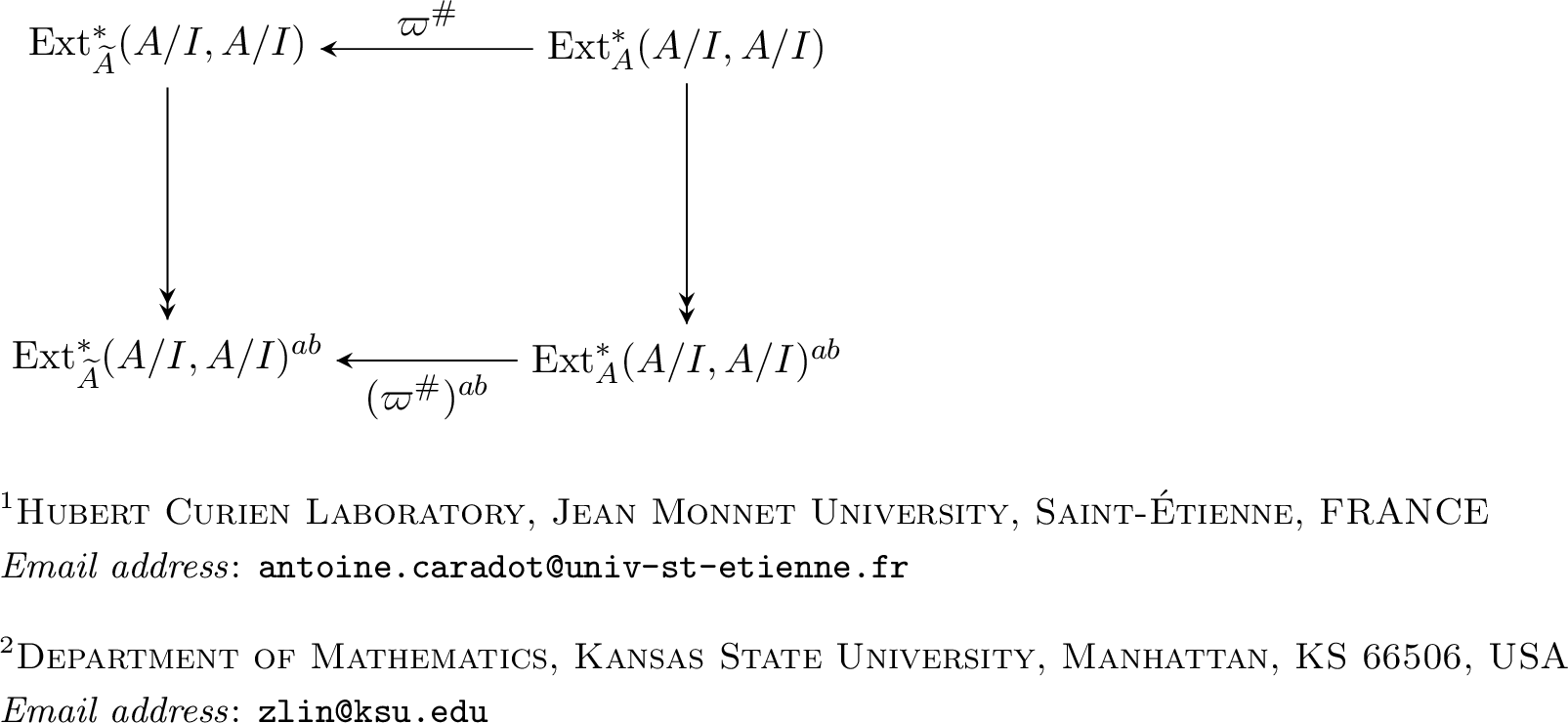 .
.
We know from Theorem 28 that \(\widetilde{\pi}^*=\pi^*(\widetilde{A},\widetilde{I})\) and \(\pi^*=\pi^*(A,I)\) generate their respective Yoneda algebras. Then using Theorem 29, we obtain \[\begin{align} & \operatorname{Ext}_{\widetilde{A}}^*(A/I,A/I)^{ab}=\operatorname{Sym}_{A/I}\left(\widetilde{\pi}^2/[\widetilde{\pi}^1,\widetilde{\pi}^1]\bigoplus \widetilde{\pi}^1\right), \\ & \operatorname{Ext}_{A}^*(A/I,A/I)^{ab}=\operatorname{Sym}_{A/I}(\pi^*/[\pi^*,\pi^*]). \end{align}\] Set \(A=R(L_{\mathfrak{\hat{g}}}(k,0))\) where \(\mathfrak{g}\) is a finite dimensional simple Lie algebra with non-degenerate symmetric invariant bilinear form with level \(k \in \mathbb{Z}_{\geq 2}\), as in [1]. Set also \(I\) the ideal generated by a basis of \(\mathfrak{g}\), so that \(A/I=\mathsf{k}\). Then \([\widetilde{\pi}^1,\widetilde{\pi}^1]=0\) as the relations of \(\widetilde{A}\) all satisfy \(\widetilde{c_p} \in \mathfrak{m}^3 \backslash \mathfrak{m}^2\). Then the morphism of [1] becomes \[\operatorname{Ext}_{A}^*(\mathsf{k},\mathsf{k}) \twoheadrightarrow \operatorname{Sym}_{\mathsf{k}}(\widetilde{\pi}^2).\] It follows that the results on the cohomological variety found in [1] focus on the degree \(2\) part of the homotopy Lie algebra of \(\widetilde{A}\) when \(A=R(L_{\hat{\mathfrak{g}}}(k,0))\). Moreover, we also know from [1] that \(\dim_{\mathsf{k}} \pi^2=\dim_{\mathsf{k}} \widetilde{\pi}^2=\dim_{\mathsf{k}} L((k+1)\theta)\), where \(L((k+1)\theta)\) is the highest \(\mathfrak{g}\)-module of highest weight \((k+1)\theta\) with \(\theta\) the highest root of \(\mathfrak{g}\).
Example 2. A simple singularity is an isolated hypersurface singularity in \(\mathbb{C}^3\) obtained as the quotient of the complex plane by the natural action of a finite subgroup of \(\operatorname{SU}_2\). Such singularities are linked to the finite dimensional simple Lie algebras through the resolution of the singular point, and they are given by the following equations: \[\begin{align} \renewcommand\arraystretch{1.1} \begin{array}{|l|l|} \hline \text{Type} & \text{Equation} \\ \hline A_n \;(n \geq 1) & x^{n+1}+yz \\ \hline D_{n+2} \;(n \geq 2)& x^{n+1}+xy^2+z^2 \\ \hline E_6 & x^4+y^3+z^2 \\ \hline E_7 & x^3+xy^3+z^2 \\ \hline E_8 & x^5+y^3+z^2 \\ \hline \end{array} \end{align}\]
We consider the singularities above over any commutative Noetherian ring, i.e., the ring of functions of the singularity \(X\) is given by \(A_X=\mathsf{k}[x,y,z]/(c)\) with \(\mathsf{k}\) a commutative Noetherian ring and \(c \in \mathfrak{m}^2\). This is a complete intersection \(\mathsf{k}\)-algebra, and so we can apply Theorem 29. In the table below, we give the degree \(1\) and degree \(2\) basis of \(\pi^*(A_X, \mathsf{k})\), as well as the non-zero values for the bracket and for \(q\).
\[\begin{array}{|c|c|c|c|c|} \hline X & \pi^1(A_X, \mathsf{k}) & \pi^2(A_X, \mathsf{k}) & [\cdot, \cdot] & q \\ \hline A_1 & \mathsf{k} \alpha_x \oplus \mathsf{k} \alpha_y \oplus \mathsf{k} \alpha_z & \mathsf{k} \beta &\begin{array}{l} [\alpha_x, \alpha_x]=2\beta \\[5pt] [\alpha_y, \alpha_z]=\beta \end{array} & \begin{array}{l} q(\alpha_x)=\beta \end{array} \\ \hline A_n (n \geq 2) & \mathsf{k} \alpha_x \oplus \mathsf{k} \alpha_y \oplus \mathsf{k} \alpha_z & \mathsf{k} \beta & \begin{array}{l} [\alpha_y, \alpha_z]=\beta \end{array} & q=0 \\ \hline \begin{array}{c} D_{n+2} \;(n \geq 2),\\ E_6, E_7, E_8 \end{array}& \mathsf{k} \alpha_x \oplus \mathsf{k} \alpha_y \oplus \mathsf{k} \alpha_z & \mathsf{k} \beta & \begin{array}{l} [\alpha_z, \alpha_z]=2\beta \end{array} & \begin{array}{l} q(\alpha_z)=\beta \end{array} \\ \hline \end{array}\]
The above example illustrates a particular property of \(\pi^*(A,\mathsf{k})\), in that it is not impacted by terms of degree higher than \(2\) in the relations of \(A\). We indeed see that for the simple singularities of types \(D_{n+2}\), \(E_6\), \(E_7\) and \(E_8\), we obtain the same \(\pi^*(A,\mathsf{k})\), even if the rings of functions are different. However, those ring differences appear in terms of polynomial degree \(3\) and above in the relations. This particularity of \(\pi^*(A,\mathsf{k})\) is due to the fact that we are looking at the trivial \(A\)-module \(\mathsf{k}\). Indeed, if we were to add to the relation \(c\) of \(A_X\) a term \(x^{a_x}y^{a_y}z^{a_z}\) with \(a_x+a_y+a_z \geq 3\) and \(a_x \geq 1\), then we could choose the differential of the corresponding element \(S\) of degree \(-2\) in the resolution so that it contains \(x^{a_x-1}y^{a_y}z^{a_z}T_x\). It follows that if we lift the morphism \(\alpha_x\), then \((\widetilde{\alpha_x})_{-2}(S)\) contains \(x^{a_x-2}y^{a_y}z^{a_z}T_x\) if \(a_x \geq 2\), or \(y^{a_y-1}z^{a_z}T_y\), or \(y^{a_y}z^{a_z-1}T_z\) otherwise, depending on the values of \(a_y\) and \(a_z\). In all cases, we see that \((\widetilde{\alpha_x})_{-2}(S)\) contains a term of the form \(p_iT_i\) where \(p_i\) is a monomial of degree \(\geq 1\). Hence \(\alpha_i \circ (\widetilde{\alpha_x})_{-2}(S)\) will contain \(p_i\alpha_i(T_i)=p_i1=0\) because \(\mathsf{k}\) is the trivial \(A\)-module. Therefore if we were to modify the exponents in \(x^{a_x}y^{a_y}z^{a_z}\), as long as their sum remains above \(3\), the Yoneda product will remain the same. This can be seen more generally in Theorem 29, because in the presentation of \(\pi^*(A,\mathsf{k})\), the relations are constructed from the terms of polynomial degree \(2\) in the relations, and higher degree terms do not interfere.
Let \(A=\mathsf{k}[x_1,\dots, x_n]/(c_1,\dots, c_k)\) be a \(\mathsf{k}\)-algebra such that for all \(1 \leq p \leq k\), we have \(c_p \in \mathfrak{m}^2\). Let \(\lfloor c_p \rfloor \in \mathfrak{m}^2\) be the homogeneous polynomial degree \(2\) part of \(c_p\). We define \(\lfloor A \rfloor= \mathsf{k}[x_1,\dots, x_n]/(\lfloor c_1 \rfloor,\dots, \lfloor c_k \rfloor)\), which is a quadratic algebra. Even if \(A\) is a complete intersection, the algebra \(\lfloor A \rfloor\) might not be a complete intersection. Due to the above discussion, we obtain a corollary to the previous theorem.
Corollary 4. Assume that both \(A\) and \(\lfloor A \rfloor\) are complete intersections. Then we have an isomorphism of restricted graded Lie algebras \[\pi^*(A, \mathsf{k}) \cong \pi^*(\lfloor A \rfloor, \mathsf{k}).\]
We conclude this section by drawing a parallel between Theorem 29 and the following result of G. Sjödin:
Theorem 31. ([48]).Let \(R\) be a local ring with maximal ideal \(\mathfrak{m}_x\) and residue field \(\mathsf{k}\). The algebra \(\operatorname{Ext}_R^*(\mathsf{k}, \mathsf{k})\) is finitely generated and strictly graded commutative if and only if \(R\) is a local complete intersection with \[\operatorname{dim}_{\mathsf{k}} \mathfrak{m}_x^2/\mathfrak{m}_x^3=\binom{n+1}{2}\] where \(n=\operatorname{dim}_{\mathsf{k}} \mathfrak{m}_x/\mathfrak{m}_x^2\).
When the algebra \(A\) in Theorem 29 is a complete intersection with the relations in \(\mathfrak{m}^2\), we know from Theorem 28 that the Yoneda algebra is finitely generated. So we want to focus on the numerical condition in Sjödin’s result. The number \(\binom{n+1}{2}\) is the dimension of the space of homogeneous polynomials of degree \(2\) in \(n\) variables. On the other hand, \(\operatorname{dim}_{\mathsf{k}} \mathfrak{m}_x^2/\mathfrak{m}_x^3\) is the dimension of the space of homogeneous polynomials of degree \(2\) in \(A\). Hence Sjödin’s criteria means that the degree \(2\) homogeneous subspace of \(A\) is as big as possible. A consequence of Theorem 29 is that the Yoneda algebra is strictly graded commutative if and only if \(c_p \in \mathfrak{m}^3\) for all \(p\). However, if this condition is verified, then all monomials of degree \(2\) in \(A\) are linearly independent, and so Sjödin’s criteria is verified. If a relation \(c_p\) contains terms of degree \(2\), it can be written as \(c_p=\lfloor c_p \rfloor+(c_p)_{\geq3}\) with \((c_p)_{\geq3} \in \mathfrak{m}^3\). But as \(\overline{c_p}=0\) in \(A\), we see that \(\overline{\lfloor c_p \rfloor}= -\overline{(c_p)_{\geq3}}\) and so \(\overline{\lfloor c_p \rfloor} \in \mathfrak{m}_x^3\), creating a linear dependency between elements in \(\mathfrak{m}_x^2/\mathfrak{m}_x^3\). Thus \(\mathfrak{m}_x^2/\mathfrak{m}_x^3\) cannot have the highest possible dimension. It follows that we have an equivalence: \[\operatorname{dim}_{\mathsf{k}} \mathfrak{m}_x^2/\mathfrak{m}_x^3=\binom{n+1}{2} \Longleftrightarrow c_p \in \mathfrak{m}^3 \;\forall \;p.\] Moreover, we know from Theorem 29 that for a complete intersection ring, having \(c_p \in \mathfrak{m}^3\) for all \(p\) is equivalent to \(\pi^*(R, \mathsf{k})\) having trivial Lie bracket. We thus obtain the following corollary to Theorem 31:
Corollary 5. Let \(R\) be a local ring with maximal ideal \(\mathfrak{m}_x\) and residue field \(\mathsf{k}\). The algebra \(\operatorname{Ext}_R^*(\mathsf{k}, \mathsf{k})\) is finitely generated and strictly graded commutative if and only if \(\pi^*(R, \mathsf{k})\) has trivial Lie bracket and is in degree \(1\) and \(2\).
The advantage of Sjödin’s theorem is that \(R\) being a complete intersection is not a hypothesis but a part of the result. However, his result does not give any information about the structure of \(\pi^*(R, \mathsf{k})\) when the above equality is not verified. On the other hand, Theorem 29 gives a presentation of the restricted graded Lie algebra even if the equality is not verified.
Remark 32. As mentioned before, the Yoneda product is not impacted by the terms of degree at least \(3\) in the relations of \(A\), which illustrates the importance of the quotient \(\mathfrak{m}_x^2/\mathfrak{m}_x^3\) in Sjödin’s result. However, one may wonder how to differentiate between two Yoneda algebras when the Yoneda product is the same. This can be done using \(A_\infty\)-structures. Simply put, an \(A_\infty\)-structure on a graded vector space \(A\) is a collection of products \(b_n: A^{\otimes n} \longrightarrow A\) for all \(n \geq 1\), verifying compatibility conditions. For example, for each \(n \geq 3\), the ring \(R_n=\mathbb{C}[x]/(x^n)\) gives \(\operatorname{Ext}_{R_n}^*(\mathbb{C}, \mathbb{C})=\mathbb{C}[\alpha, \beta]/(\alpha^2)\). But by adding an \(A_\infty\)-structure, we obtain that \(b_2\) is the Yoneda product, \(b_n\) is non-zero and \(b_m=0\) for \(m \neq 2, n\). Equipped with this extra structure, \(\operatorname{Ext}_{R_n}^*(\mathbb{C}, \mathbb{C}) \not\cong \operatorname{Ext}_{R_{n'}}^*(\mathbb{C}, \mathbb{C})\) for \(n \neq n'\) as \(A_\infty\)-algebras. We will not be dealing with \(A_\infty\)-structures in the rest of this article, the reader is referred to [49] and [50] for more details on the subject.
5.2 Reconstruction of complete intersections↩︎
In this section, we show how to reconstruct an algebra from its homotopy Lie algebra. We will first need results related to Gröbner bases.
Let \(\operatorname{Pol}=\mathsf{k}[x_1, \dots, x_n]\) be a polynomial ring with \(\mathsf{k}\) a field. For \(\mathbf{a}=(a_1,\dots,a_n) \in \mathbb{N}^n\), we write \(x^\mathbf{a}=x_1^{a_1} \cdots x_n^{a_n} \in \operatorname{Pol}\). We will refer to notations of [51].
Proposition 33. Set \(f_1, \dots, f_s \in \operatorname{Pol}\) with \(s \leq n\). For any \(1 \leq i \leq s\), set \(l_i> \deg (f_i)\) (here \(\deg\) refers to the total degree of the polynomial) and define \(g_i=f_i+x_i^{l_i}\). Then \(\{g_1, \dots, g_s\}\) is a Gröbner basis of \(I_s=(g_1, \dots, g_s)\).
Proof. We will take the lexicographic order (see [51]) on the set of monomials. With this order, \(x^\mathbf{a}<x^\mathbf{b}\) for \(\mathbf{a}, \mathbf{b}\in \mathbb{N}^n\) if either \(|\mathbf{a}|=\sum_i a_i<|\mathbf{b}|=\sum_i b_i\), or \(|\mathbf{a}|=|\mathbf{b}|\) and \(a_i<b_i\) for the smallest \(i\) with \(a_i\neq b_i\). In particular, we have \(x_1 > x_2 > \dots > x_n\).
In our setting, the initial monomial of \(g_i\) is \(\operatorname{in}_<(g_i)=x_i^{l_i}\) and the pair \((\operatorname{in}_<(g_i), \operatorname{in}_<(g_j))\) is relatively prime if \(i\neq j\). By [51] Cor. 2.3.4, \(\{g_1, \dots, g_s\}\) is a Gröbner basis for the ideal \(I_s\). In fact, it is a reduced Gröbner basis. ◻
The following result seems to be well-known to the commutative algebra community, but we failed to find a reference. We provide a proof in Appendix 6 for the sake of completeness.
Lemma 5. Let \(\{g_1, \dots, g_s\}\) be a Gröbner basis such that \((\operatorname{in}_<(g_i), \operatorname{in}_<(g_j))\) is a relative prime pair if \(i\neq j\). Then \(\{g_1, \dots, g_s\}\) is a regular sequence in \(\operatorname{Pol}\).
Let \(\mathfrak{g}=\mathfrak{g}_1 \oplus \mathfrak{g}_2\) be a finite dimensional restricted graded Lie algebra over a field \(\mathsf{k}\) such that \(\dim_{\mathsf{k}} \mathfrak{g}_1 \geq \dim_{\mathsf{k}} \mathfrak{g}_2\). We write \(\{\alpha_1, \dots, \alpha_n \}\) and \(\{\beta_1, \dots, \beta_k\}\) for bases of \(\mathfrak{g}_1\) and \(\mathfrak{g}_2\) respectively. For each \(1 \leq p \leq k\), we construct the matrix \(N^p=(n^{p}_{i,j})\in M_n(\mathsf{k})\) given by the structure constants of \(\mathfrak{g}\), i.e., \([\alpha_i,\alpha_j]=\sum_{p=1}^k (n^p_{i,j}+n^p_{j,i})\beta_p\) for \(i \neq j\) and \(q(\alpha_i)=\sum_{p=1}^k n^p_{i,i}\beta\). We can now prove the following result:
Theorem 34. Given a finite dimensional restricted graded Lie algebra \(\mathfrak{g}=\mathfrak{g}_1 \oplus \mathfrak{g}_2\) over a field \(\mathsf{k}\) with \(\dim_{\mathsf{k}} \mathfrak{g}_1 \geq \dim_{\mathsf{k}} \mathfrak{g}_2\), there exists a finitely generated complete intersection \(\mathsf{k}\)-algebra \(A\) such that \(\pi^*(A, \mathsf{k}) \cong \mathfrak{g}\) as restricted graded Lie algebras.
Proof. We first define \(\operatorname{Pol}=\mathsf{k}[x_1, \dots, x_n]\) and, using the matrices \(N^p\) introduced previously, we set \(c'_p=\sum_{i, j}n^{p}_{i,j}x_ix_j \in \operatorname{Pol}\) and \(c_p=c_p'+x_p^3 \in \operatorname{Pol}\) for all \(1 \leq p \leq k\). Let \(A=\operatorname{Pol}/(c_1, \dots, c_k)\) and let \(\mathfrak{m}_x\) be the kernel of the morphism \(A\to \mathsf{k}\) defined by \(\overline{x_i}\mapsto 0\). Then by Proposition 33 the family \(\{c_1, \dots, c_k\}\) is a Gröbner basis of the ideal \((c_1, \dots, c_k)\), and by Lemma 5 it is also regular sequence in \(\operatorname{Pol}\). Using Theorem 29, we can then conclude the proof. ◻
5.3 Finite generation of the Yoneda algebra↩︎
Let \(\mathsf{k}\) be a commutative ring and let \(A=\mathsf{k}[x_1,\dots, x_n]/(c_1,\dots, c_k)\) be a finitely generated commutative \(\mathsf{k}\)-algebra such that the resolution \(P^*\) of Theorem 12 of the trivial \(A\)-module \(\mathsf{k}=A/\mathfrak{m}_x\) is obtained after finitely many steps and each \(F_n\) is of finite rank over \(A\) (see the proof of Theorem 12 for the notation). It follows that \(\mathcal{B}\) is a finite set and we write \(N\) for its cardinal. We also assume that \(P^*\) is an \(\mathfrak{m}_x\)-minimal resolution of \(\mathsf{k}\), i.e., \(d(P^*) \subset \mathfrak{m}_x P^*\), and so \(\operatorname{Ext}_{A}^*(\mathsf{k}, \mathsf{k})=\mathcal{H}om^*_A(P^*, \mathsf{k})\). We know from Proposition 27 that for any \(n >0\), the space \(\operatorname{Ext}_A^n(\mathsf{k}, \mathsf{k})\) is spanned by elements of the form \((b^\vee)^f\) with \(f \in \mathcal{B}(-n)\). In particular, we have seen that \(\operatorname{Ext}_{A}^*(\mathsf{k}, \mathsf{k})\) is generated over \(\mathsf{k}\) (with the Yoneda product) by the subspace \(V=\bigoplus_{b \in \mathcal{B}} \mathsf{k} b^\vee\), and any element of \(\operatorname{Ext}_{A}^*(\mathsf{k}, \mathsf{k})\) is an ordered polynomial in the \(b^\vee\). Assuming \(\mathsf{k}\) is a field, it follows that \[\bigoplus_{s=0}^k\dim_{\mathsf{k}} V^s \leq \displaystyle \bigoplus_{s=0}^k \binom{N-1+s}{N-1} \leq \displaystyle (k+1)(N+k)^{N-1},\] where \(V^s\) is the subspace of \(\operatorname{Ext}_{A}^*(\mathsf{k}, \mathsf{k})\) spanned by the \((b^\vee)^f\) with \(\operatorname{poldeg}f=s\). It follows that \(\operatorname{GKdim}_{\mathsf{k}}\operatorname{Ext}_{A}^*(\mathsf{k}, \mathsf{k}) \leq N\) (cf. [52]) and the Yoneda algebra has finite Gelfand-Kirillov dimension. Based on [17], it follows that the local ring \(A_{\mathfrak{m}_x}\) is a complete intersection. Furthermore, as stated in Section 5.1, if \(A\) is a complete intersection, then there exists a resolution \(P^*\) obtained after adjoining variables of degree \(-2\). This resolution is \(\mathfrak{m}_x\)-minimal if the relations of \(A\) are at least of polynomial degree \(2\). By combining these results, we obtain:
Theorem 35. Let \(A\) be a finitely generated commutative \(\mathsf{k}\)-algebra with \(\mathsf{k}\) a field and with relations of polynomial degree at least \(2\). There exists a PD dg resolution \(P^*\) of the trivial \(A\)-module \(\mathsf{k}\) that is \(\mathfrak{m}_x\)-minimal and such that \(\mathcal{B}\) is finite if and only if (the localisation of) \(A\) is a complete intersection. In this case, there exists a PD dg resolution such that \(\operatorname{min}\{|b| \;| \;b \in \mathcal{B}\}=-2\), and a presentation of \(\pi^*(A,\mathsf{k})\) is given in Theorem 29.
We now assume that \(A\) is local and not a complete intersection. Hence its \(\mathfrak{m}_x\)-minimal PD dg resolution (if it exists) will need an infinite set \(\mathcal{B}\). It follows that its Yoneda algebra will be generated by infinitely many variables. If we assume that there are relations so that \(\operatorname{Ext}_A^*(\mathsf{k},\mathsf{k})\) only needs a finite subset \(\mathcal{B}'\) of \(\mathcal{B}\), then the previous reasoning still applies and so any element will be a linear combination of elements of the form \((b'^\vee)^f\) with \(b' \in \mathcal{B}'\). But then we can use the same reasoning as the proof of Theorem 35 to see that \(A\) is a complete intersection, which is a contradiction. Hence \(\operatorname{Ext}_A^*(\mathsf{k},\mathsf{k})\) is generated by an infinite set \(\mathcal{B}^\vee=\{b^\vee \;| \;b \in \mathcal{B}\}\), and for each \(b^\vee \in \mathcal{B}^\vee\), we have \(b^\vee \notin (b'^\vee \;| \;b' \in \mathcal{B}\backslash \{b\})\). It follows that \(\pi^*(A, \mathsf{k})\) will have infinitely many homogeneous components. In particular, we get the following corollary:
Corollary 6. Let \(A\) be a finitely generated local \(\mathsf{k}\)-algebra with \(\mathsf{k}\) a field. Assume that there exists an \(\mathfrak{m}_x\)-minimal PD dg resolution of the trivial module \(\mathsf{k}\). Then \(\pi^*(A, \mathsf{k})\) is either in degree \(1\) and \(2\), or has infinitely many homogeneous components.
6 Computations on PD dg algebras↩︎
Consider the settings and notation of Section 5.1.
Lemma 6. In the Yoneda algebra \(\operatorname{Ext}_A^*(\mathsf{k}, \mathsf{k})\), we have:
\(\alpha_i \alpha_j +\alpha_j \alpha_i= \displaystyle \sum_{p=1}^k(n^p_{i, j}+n^p_{j, i})\beta_p\) for all \(1 \leq i \neq j \leq n\),
\(\alpha_i^2= \displaystyle \sum_{p=1}^k n^p_{i, i}\beta_p\) for all \(1 \leq i \leq n\).
Proof. Fix \(1 \leq i \leq n\) and consider the following diagram:
Figure 5: 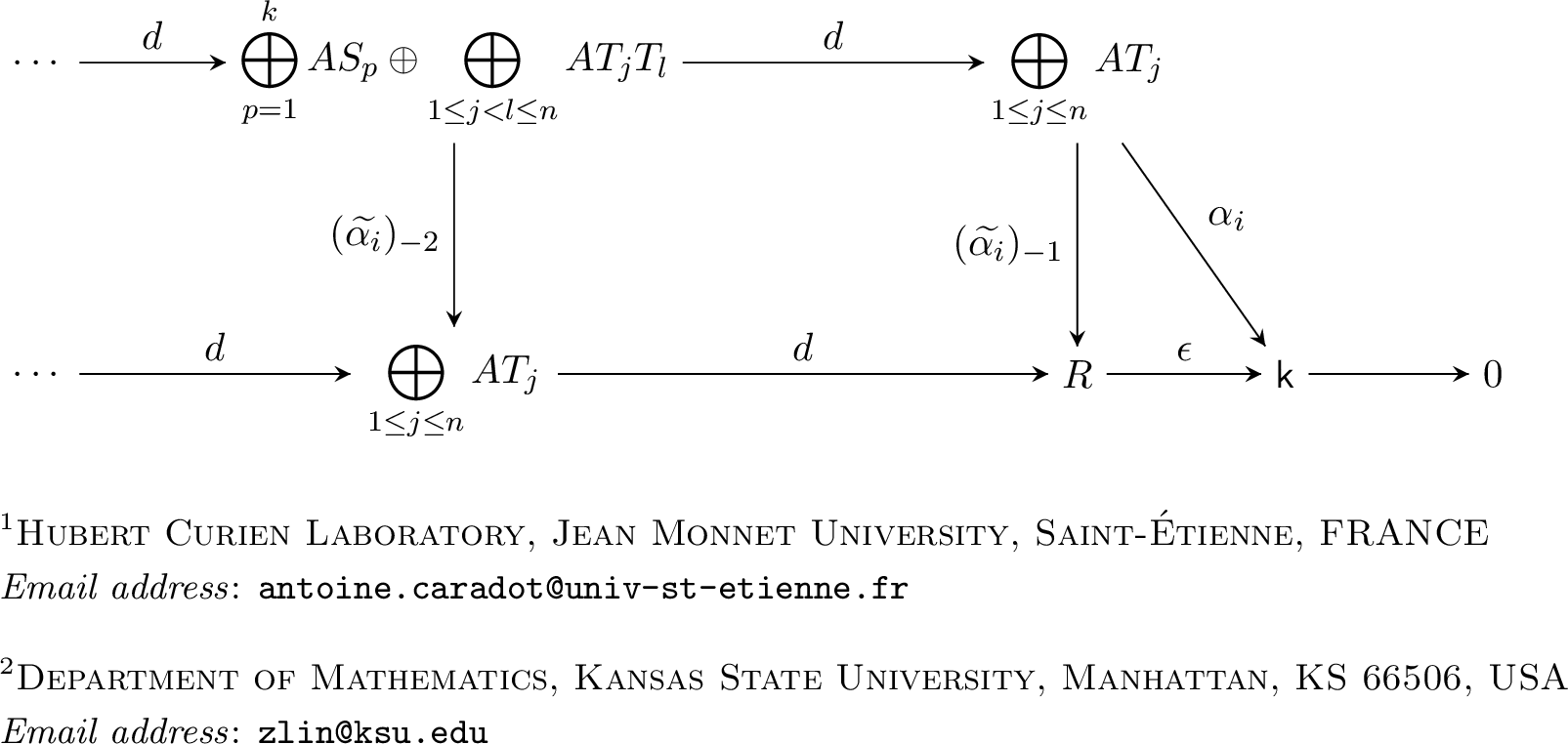 .
.
where \(\epsilon\) is the augmentation map corresponding to the ideal \(\mathfrak{m}_x\), and \((\widetilde{\alpha_i})_{-1}\), \((\widetilde{\alpha_i})_{-2}\) make the diagram commute (they exist because the \(P^i\)’s are projective \(A\)-modules).
We know that for all \(1 \leq l \leq n\), \(1 \leq p \leq k\), we have \(c_{p,l}=\sum_{j=1}^n n^p_{l,j}x_j \in \mathfrak{m}\). So we can define \(C_{p,l}=\sum_{j=1}^n n^p_{l,j}T_j \in P^{-1}\) satisfying \(d(C_{p,l})=c_{p,l}\). The first two maps in the above commutative diagram are then given by: \[\begin{align} \begin{array}[t]{cccc} (\widetilde{\alpha_i})_{-1}: & P^{-1} & \longrightarrow & P^0 \\ & T_j & \longmapsto & \delta_{i, j} \end{array} \quad \text{ and } \quad \begin{array}[t]{cccc} (\widetilde{\alpha_i})_{-2}: & P^{-2} & \longrightarrow & P^{-1} \\ & T_j T_l& \longmapsto & \left\{\begin{array}{cl} -T_l & \text{ if } j=i,\\ T_j & \text{ if } l=i,\\ 0 & \text{ otherwise}, \end{array}\right. \\ & S_p & \longmapsto & C_{p, i}. \end{array} \end{align}\] The Yoneda product \(\alpha_j \alpha_i\) is then: \[\begin{array}[t]{cccl} \alpha_j \alpha_i: & P^{-2} & \longrightarrow & \mathsf{k} \\ & T_j T_i & \longmapsto & 1, \\ & S_p & \longmapsto & n^p_{i, j} \;\forall p, \\ & \text{other} & \longmapsto & 0. \end{array}\] The formulas of the lemma follow. ◻
We give below the proof of a lemma in Section 5.2.
Proof of Lemma 5. We prove that for all \(s\), the image \(\overline{g_s}\) is not a zero divisor in \(\operatorname{Pol}/I_{s-1}\), with \(I_{s-1}=(g_1, \dots, g_{s-1})\).
By the division algorithm [51], any \(f\in \operatorname{Pol}\) can be written as \(f\equiv f' \operatorname{ mod } I_{s-1}\) such that none of \(\operatorname{in}_<(g_i)\) divides any \(u\in \operatorname{supp}(f')\) if \(f'\neq 0\).
Assume that \(\overline{g_s}\) is a zero divisor in \(\operatorname{Pol}/I_{s-1}\), i.e., there exists \(\overline{f} \neq 0\) such that \(\overline{f} \overline{g_s}=0\). As \(\overline{f} \neq 0\), we have \(f' \neq 0\) and \(f'g_s \in I_{s-1}\). Once again, the division algorithm applied to \(f'g_s\) with respect to \(g_1, \dots, g_{s-1}\) gives \[f'g_s=h_1g_1+\cdots+h_{s-1}g_{s-1}.\] If \(h_i\neq 0\), then \(\operatorname{in}_<(f'g_s)\geq \operatorname{in}_<(h_i g_i)\) by the division algorithm. In particular, \[\operatorname{in}_<(f'g_s)\geq \max\{ \operatorname{in}_<(h_i g_i) \;|\; h_i\neq 0,\; i<s\}.\] On the other hand, by [51] we have \[\operatorname{in}_<(f'g_s)\leq \max\{ \operatorname{in}_<(h_i g_i) \;|\; h_i\neq 0,\; i<s\}.\] It follows that \(\operatorname{in}_<(f'g_s) = \max\{ \operatorname{in}_<(h_i g_i) \;|\; h_i\neq 0,\; i<s\}\), and so there exists an \(i<s\) such that \(\operatorname{in}_<(f'g_s)=\operatorname{in}_<(h_i g_i)\). Using [51], we have \[\operatorname{in}_<(f')\operatorname{in}_<(g_s)=\operatorname{in}_<(h_i)\operatorname{in}_<(g_i).\] Since \((\operatorname{in}_<(g_s),\operatorname{in}_<(g_i))\) is a relatively prime pair in \(\operatorname{Pol}\) by assumption, it follows that \(\operatorname{in}_<(g_i)\) must divide \(\operatorname{in}_<(f')\). This contradict the assumption that, since \(f'\neq 0\), \(\operatorname{in}_<(g_i)\) does not divide any \(u\in \operatorname{supp}(f')\). ◻
7 Some homological exercises↩︎
Let \(\mathcal{C}\) be an abelian category. We denote by \(\mathcal{C}h(\mathcal{C})\) the category of cochain complexes in \(\mathcal{C}\) with morphisms being chain maps, and \(\mathcal{H}(\mathcal{C})\) the homotopy category. The proof of the following lemma is a straightforward exercise by doing a downward induction on the cohomological degree.
Lemma 7. Let \(\mathcal{C}\) be an abelian category. Let \(P^\ast\) and \(X^\ast\) be cochain complexes in \(\mathcal{C}\) with the following properties:
There is an \(l\in \mathbb{Z}\) such that \(P^n=0\) for all \(n>l\), and each \(P^n\) is projective in \(\mathcal{C}\).
\(X^\ast\) is exact in all negative degrees: \(H^n(X^\ast)=0\) for every \(n<0\).
Then for every integer \(r<-l\) every cocycle \[f\in Z^{r}\bigl(\mathcal{H}om^*_{\mathcal{C}}(P^\ast,X^\ast)\bigr)=\operatorname{Hom}_{\mathcal{C}h(\mathcal{C})}(P^*,X^*[r])\] is null-homotopic, equivalently \(\operatorname{Hom}_{\mathcal{H}(\mathcal{C})}(P^*, X^*[r])=0\) for all \(r<-l\). Consequently \[H^{r}\bigl(\mathcal{H}om^*_{\mathcal{C}}(P^\ast,X^\ast)\bigr)=0\qquad(\forall r<-l).\]
Proof. Write the differential of a complex \(Y^\ast\) by \(d_Y\). A homogeneous cochain \(f\) of degree \(r<-l\) is a collection of morphisms \(f^n:P^n\to X^{n+r}\) satisfying the cocycle condition \[\begin{align} \label{eq:C} d_X\circ f^n - (-1)^r f^{n+1}\circ d_P = 0\qquad\text{for all }n. \end{align}\tag{23}\] Equivalently \(f\in \operatorname{Hom}_{\mathcal{C}h(\mathcal{C})}(P^*, X^*[r])\) We will construct a homotopy \(h\) of degree \(r-1\) with components \(h^n:P^n\to X^{n+r-1}\) such that \[\begin{align} \label{eq:H} (-1)^{r}d_X\circ h^n + h^{n+1}\circ d_P \;=\;(-1)^{r} f^n \qquad\text{for all }n, \end{align}\tag{24}\] which is exactly the equation \(d_{\operatorname{Hom}}(h)=f\). The construction is by downward induction on \(n\) (recall \(P^n=0\) for \(n>l\)).
Base step. Start at \(n=l\). Since \(P^{l+1}=0\) the cocycle identity 23 for \(n=l\) reduces to \(d_X\circ f^n = 0\). Because \(r<-l\) we have \(n+r< 0\), so \(d_X\circ f^n\) lands in a negative degree of \(X^\ast\). By exactness of \(X^\ast\) at degree \(n+r\) we have \(\operatorname{Ker}(d_X|_{X^{n+r}})=\operatorname{Im}(d_X|_{X^{n+r-1}})\). Hence the map \(f^n:P^n\to X^{r+n}\) factors through \(d_X:X^{n+r-1}\to X^{n+r}\); i.e. there exists a morphism \(h^n:P^n\to X^{n+r-1}\) such that \[d_X\circ h^n \;=\; f^n.\] since \(P^n\) is projective in \(\mathcal{C}\). Thus 24 holds for \(n=l\) (the term involving \(h^{n+1}\) vanishes since \(P^{n+1}=0\)).
Inductive step. Let \(m\le l\). Suppose \(h^{m+1},h^{m+2},\dots\) have been constructed so that 24 holds on all degrees \(>m\). Define the map \[u^m \;:=\; f^m + (-1)^{\,r-1} h^{m+1}\circ d_P \;:\; P^m \longrightarrow X^{m+r}.\] We check that \(u^m\) takes values in \(\operatorname{Ker}(d_X)\). Indeed \[\begin{align} d_X\circ u^m &= d_X\circ f^m + (-1)^{\,r-1} d_X\circ h^{m+1}\circ d_P \\ &= (-1)^r f^{m+1}\circ d_P + (-1)^{\,r-1}\bigl( f^{m+1} + (-1)^{\,r-1} h^{m+2}\circ d_P \bigr)\circ d_P \end{align}\] where we used the cocycle identity 23 for \(f\) and the inductive hypothesis 24 for \(h^{m+1}\). The two terms cancel and one obtains \(d_X\circ u^m=0\). By exactness of \(X^\ast\) at degree \(m+r\) we have \(\operatorname{Ker}(d_X|_{X^{m+r}})=\operatorname{Im}(d_X|_{X^{m+r-1}})\), so \(u^m\) factors through \(d_X:X^{m+r-1}\to X^{m+r}\). Equivalently there exists a morphism \(h^m:P^m\to X^{m+r-1}\) with \[d_X\circ h^m \;=\; u^m\] since \(P^m\) is projective in \(\mathcal{C}\). By construction the equality 24 then holds on degree \(m\), completing the induction.
Since \(P^n=0\) for \(n > l\) the downward induction defines \(h^n\) for all \(n\). The family \(h=\{h^n\}\) satisfies 24 on every degree, hence \(f=d_{\operatorname{Hom}}(h)\) and so \(f\) is null-homotopic. ◻
8 Square of PD derivations of odd degrees↩︎
Lemma 8. Let \(P^*\) be a strictly graded commutative PD dg algebra over a commutative ring \(R\) and let \[D\colon P^* \longrightarrow P^{*+r}\] be a PD derivation of odd degree \(r\). Then \(D^2:=D\circ D\) is a PD derivation of degree \(2r\).
Proof. We check the two required properties.
(Derivation property). Let \(a,b\in P^*\) be homogeneous. By the graded Leibniz rule for \(D\), \[D(ab)=D(a)\,b + (-1)^{r|a|}a\,D(b).\] By applying \(D\) again and expanding each term we get: \[\begin{align} D^2(ab) &= D\big(D(a)\,b\big) + (-1)^{r|a|} D\big(a\,D(b)\big) \\ &= D^2(a)\,b + (-1)^{r|D(a)|} D(a)D(b) + (-1)^{r|a|}\big( D(a)D(b) + (-1)^{r|a|} a D^2(b)\big). \end{align}\] But we know that \(|D(a)| = |a|+r\), so \[(-1)^{r|D(a)|} = (-1)^{r|a|}(-1)^{r^2}=-(-1)^{r|a|}\] as \(r\) is odd. Substituting this into the previous equation, the two middle terms cancel each other and we obtain \[D^2(ab)=D^2(a)\,b + a\,D^2(b),\] which is the graded Leibniz rule for \(D^2\) (degree \(2r\)). In particular, \(D^2\) is a derivation.
(PD rule). Let \(x\in P^*\) be homogeneous with \(x \in I_{ev}\), and fix \(m\ge1\). Using the PD rule for \(D\) and the Leibniz rule, \[\begin{align} D^2(\gamma_m(x)) &= D\big(\gamma_{m-1}(x)D(x)\big) \\ &= D(\gamma_{m-1}(x))\,D(x) + (-1)^{r\cdot|\gamma_{m-1}(x)|}\,\gamma_{m-1}(x)\,D^2(x) \\ &= \gamma_{m-2}(x)\,D(x)^2 + (-1)^{r\cdot|\gamma_{m-1}(x)|}\,\gamma_{m-1}(x)\,D^2(x) \\ &= \gamma_{m-2}(x)\,D(x)^2+\gamma_{m-1}(x)\,D^2(x). \end{align}\] as \(|\gamma_{m-1}(x)|=(m-1)|x|\) is even. Because \(r\) is odd and \(|x|\) is even, \(|D(x)|=|x|+r\) is odd, hence \(D(x)^2=0\) due to the strict graded commutativity. Thus the previous equation becomes \[D^2(\gamma_m(x))=\gamma_{m-1}(x)\,D^2(x),\] and \(D^2\) satisfies the PD rule on divided powers. ◻
Lemma 9. Let \(P^*\) be a PD dg algebra over a commutative ring \(R\), and let \[\mathcal{D}er^{*,\operatorname{pd}}_{R}(P^*,P^*)\] be the cochain complex of PD derivations with differential \[\partial(D)= [d, D] \;=\; d\circ D - (-1)^{|D|} D\circ d,\] where \(d\) is the internal differential of \(P^*\) and \(|D|\) is the degree of \(D\). Assume \(q\colon \mathcal{D}er^{odd,pd}_R(P^*,P^*) \to \mathcal{D}er^{even,pd}_R(P^*,P^*)\) is given by \(q(D)=D\circ D\). If \(D\) satisfies \(\partial(D)=0\) (i.e., \(D\) is a cocycle), then \(\partial(q(D))=0\). Hence \(q\) sends cocycles to cocycles and induces a map (for odd \(r\)) \[q\colon H^{r}\big(\mathcal{D}er^{*,\operatorname{pd}}_R(P^*,P^*)\big)\to H^{2r}\big(\mathcal{D}er^{*,\operatorname{pd}}_R(P^*,P^*)\big).\]
Proof. Consider the graded commutator \([X,Y]=X\circ Y - (-1)^{|X||Y|} Y\circ X\). We have the identity \[[X, Y \circ Z] \;=\; [X,Y] \circ \,Z + (-1)^{|X||Y|} Y \circ \,[X,Z],\] valid for any homogeneous \(X,Y,Z \in \mathcal{D}er^{*,\operatorname{pd}}_R(P^*,P^*)\). Setting \(X=d\), \(Y=Z=D\), and using \(|d|=1\) and \(|D|=r\), \[[d, q(D)] = [d,D] \circ \,D + (-1)^r D \circ \,[d,D].\] If \(D\) is a cocycle then \([d,D]=0\), so both terms on the right vanish and hence \([d,q(D)]=0\). Equivalently \(\partial(q(D))=0\), as required. ◻
Lemma 10. Let \(\mathcal{D}er^{*,\operatorname{pd}}_R(P^*,P^*)\) be the dg Lie algebra of PD derivations equipped with the graded commutator \[[X,Y]=X\circ Y - (-1)^{|X||Y|}Y\circ X.\] Let \(D\in\mathcal{D}er^{r,pd}_R(P^*,P^*)\) be homogeneous of odd degree \(r\), and let \(D'\in\mathcal{D}er^{*,\operatorname{pd}}_R(P^*,P^*)\) be arbitrary homogeneous. Then \[[D^2, D'] \;=\; [D,[D,D']].\]
Proof. For homogeneous \(X,Y,Z\) one has \[[X \circ Y,Z]=X \circ [Y,Z]+(-1)^{|Y||Z|}[X,Z] \circ Y.\] Taking \(X=Y=D\) and \(Z=D'\) yields \[[D^2,D']=D \circ \,[D,D']+(-1)^{|D||D'|}[D,D'] \circ D.\] On the other hand \[[D,[D,D']]=D \circ \,[D,D']-(-1)^{|D|(|D|+|D'|)}[D,D'] \circ D.\] Since \(|D|\) is odd, \((-1)^{|D|(|D|+|D'|)}=-(-1)^{|D||D'|}\), and so \[[D,[D,D']]=D \circ \,[D,D']+(-1)^{|D||D'|}[D,D'] \circ D=[D^2,D'].\] ◻