Ge as an orbitronic platform: giant orbital Hall effect
September 24, 2025
Abstract
State-of-the-art developments in magnetic devices rely on manufacturing faster, more efficient memory elements. A significant development in this direction has been the discovery of orbital torques, which employ the orbital angular momentum of Bloch electrons to switch the magnetisation of an adjacent ferromagnet, and has motivated the search for orbitronic materials displaying strong orbital dynamics exemplified, by the orbital Hall effect (OHE). In this work we propose Ge, as an optimal orbitronic platform. We demonstrate that holes in bulk Ge exhibit a giant OHE, exceeding that of the bulk states of topological insulators, and exceeding the spin-Hall effect by four orders of magnitude. The calculation is performed within the framework of the Luttinger model and the modern theory of orbital magnetisation, while incorporating recently-discovered quantum corrections to the OHE. Our study constitutes a fundamental milestone in applying the modern theory to a system with inversion symmetry. Moreover, we argue that bulk Ge serves as an ideal testbed for the orbital torque resulting from a charge current, since the spin- and orbital-Edelstein effects in Ge are forbidden by symmetry. Our results provide a blueprint for producing strong orbital torques in magnetic devices with Ge, guiding future experimental work in this direction.
1 Introduction↩︎
Orbital dynamics in condensed matter systems have come under renewed scrutiny in recent years with an intense focus on out-of-equilibrium phenomena broadly encompassed by the field of orbitronics [1]–[4]. The study of orbitronic phenomena involving the electrical generation and transport of Bloch electrons’ orbital angular momentum (OAM) has witnessed significant experimental progress [5]–[19]. This is chiefly motivated by the notion of an orbital torque, that is, a torque exerted on an adjacent magnetisation by a non-equilibrium OAM density, and is regarded as an orbital analogue of the various spin torque mechanisms that have received considerable attention in magnetic systems [20]–[32]. One of the principal mechanisms responsible for the orbital torque is the orbital Hall effect (OHE), which represents a flow of OAM in response to an electric field [33]–[35]. The OHE has been actively studied recently spurred by its potential application in magnetic memory devices [13], [36]–[63]
In light of the intense activity on orbital dynamics the overarching technological question concerns which mechanisms and which materials help us maximise orbital torques on ferromagnetic memory elements. In this connection we recently showed that the bulk states of topological insulators give rise to a giant OHE in an electric field, building on earlier work demonstrating that orbital and spin effects in topological insulator surface states are of a similar order of magnitude [64]. In general, orbital and spin effects cannot be distinguished experimentally, and at the moment the only indication of their relative magnitudes comes from theoretical calculation. Moreover, whereas the equilibrium OAM in a clean system is well understood [65]–[70], most interest in the OAM at present is motivated by its out-of-equilibrium properties [71]–[75], where fundamental issues need to be resolved. As an example, it was shown recently that quantum corrections to the OHE can overwhelm the conventional terms, while disorder can dominate the effect in certain systems[37], [59]. An important fundamental question concerns inversion symmetric systems, on which there has been a significant body of work [76], motivated in part by recent experiments [36], [43].
The modern theory of orbital magnetisation shows that orbital magnetisation of charge carriers in solids can be constructed via the Berry connection of Bloch wavefunctions. This theory was derived using both semiclassical and Wannier approaches [65]–[70], and has been used to describe the orbital magnetisation both in and out of equilibrium [70], [74], [77]. Theoretical research on OAM dynamics in inversion symmetric systems has employed approaches that rely either on symmetry or on the atomic OAM operator, with virtually no work, to our knowledge, within the framework of the modern theory of orbital magnetisation. This is perhaps because the modern theory makes an explicit connection between the equilibrium OAM and the Berry curvature, which has been studied overwhelmingly in systems that break inversion symmetry. To summarise, an active search is underway for efficient orbitronic materials, while inversion symmetric systems have received little attention in the context of the modern theory of orbital magnetisation.
| Ge | Bi\(_2\)Se\(_3\) | |
|---|---|---|
| \(\sigma^y_{zx,OHE}\) (e nm\(^{-1}\)) | \(-3.1\) | \(-1.2\) [[53]] |
| \(\sigma^y_{zx,SHE}\) (e nm\(^{-1}\)) | \(-0.5\times10^{-3}\) | \(1.5\times10^{-3}\) [[53]] |
In light of these outstanding questions, in this work we propose Ge holes, a system well described by the spherical Luttinger Hamiltonian, as an ideal platform for orbitronic applications. We demonstrate that holes in 3D Ge exhibit a giant OHE, which is larger than that of the bulk states of topological insulators, and exceeds the spin-Hall effect (SHE) by four orders of magnitude, as is shown in Tab. 1. As compared to topological insulators, Ge has the additional advantages of ultrahigh mobilities [78], [79] and proximity to Si microfabrication, ensuring high sample quality and making it a material of choice for semiconductor quantum computing.[80], [81] Additionally, a recent experiment has demonstrated a large inverse orbital Hall effect in Ge using YIG/W/Ge and YIG/Pt/Ge heterostructures [63], the results indicate that the magnitude of the OHE effect in Ge is of a similar order of magnitude to the SHE in Pt.
Aside from identifying Ge as an excellent orbitronic material, our result is important for several reasons. Firstly, from a technical perspective, it highlights the necessity of incorporating quantum corrections in the evaluation of the OHE, showing that once more the correction is larger than the conventional contribution. Moreover, the OHE in Ge is entirely driven by spin-orbit coupling, in agreement with generic observations on the OHE in a recent study.[82] Secondly, Ge is an optimal system to test the size of the orbital torque arising from the OHE experimentally, because the spin- and orbital-Edelstein effects are prohibited by symmetry in bulk Ge. This implies that only the OHE and SHE are present, and our calculation, treating OHE and SHE in Ge on the same footing, shows that OHE \(\gg\) SHE. Finally, our work shows that the OHE is present in an inversion-symmetric system even within the framework of the modern theory of orbital magnetisation. The modern theory is of course general, but has overwhelmingly been applied to systems breaking inversion symmetry, which often ensure a sizable Berry curvature. Nevertheless, in the Luttinger model, even in the spherical approximation, the Berry curvature and OAM are both finite at a given wave vector, even though their integrals over occupied states naturally vanish in the absence of time-reversal breaking mechanisms. The finite Berry curvature and OAM are responsible for the giant OHE that we identify in Ge. Our results are an order of magnitude larger than recent computational studies for Ge, [76] although a direct comparison is somewhat difficult given the rather different methodology used in earlier approaches. Unifying these different perspectives on a technical level will be an important undertaking for future studies.
The outline of this paper is as follows. In Sec. II we outline our methodology, including the Kohn-Luttinger Hamiltonian, transport formalism based on the Liouville equation, and approach to determining the non-equilibrium density matrix together with the orbital and spin currents. In Sec. III we present our results for the OHE and SHE in Ge and compare them with bulk topological insulators and with previous studies. In Sec. IV we discuss the implications of our findings for orbitronics as well as for the modern theory of orbital magnetisation. We end with a summary and outlook.
2 Methodology↩︎
2.1 Hamiltonian↩︎
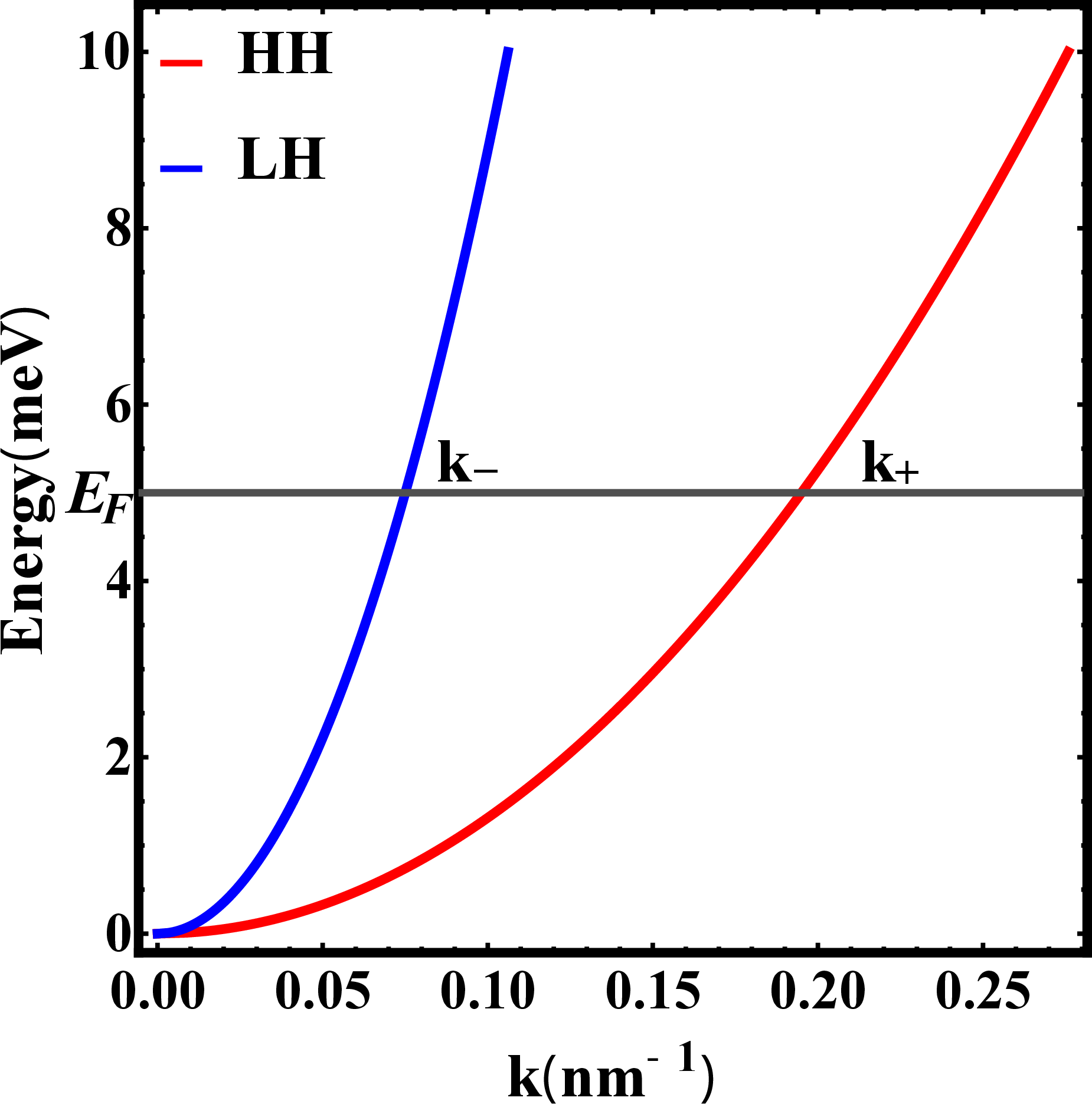
Holes in 3D Ge are described by the Luttinger-Kohn Hamiltonian: \[H_0 = -{\textstyle{\hbar^2 \over 2m}}\left((\gamma_1+{\textstyle{5 \over 2}}\bar{\gamma})k^2-2\bar{\gamma}(\boldsymbol{k}\cdot\boldsymbol{J})^2\right)\,,\] where \(m\) is the bare electron mass, \(J_i\) are the spin 3/2 matrices and \(\gamma_{1,2,3}\) are the Luttinger parameters with \(\bar{\gamma}=(\gamma_2 + \gamma_3)/2\). We use the spherical approximation, which works well for Ge, this allows for a clean analytical expression for the intrinsic orbital current. Holes have an effective spin \(3/2\) due to the combination of their atomic orbital angular momentum and spin, as the good quantum number for holes in the bulk is the total angular momentum \(J\) projected onto the wavevector \(\boldsymbol{k}\). [83] Holes with this projection equal to \(\pm3/2\) are known as heavy holes while those with \(\pm1/2\) are known as light holes due to their different effective masses shown in Fig. 1. We note that the effective spin-3/2 of hole systems leads to dynamics that either has no equivalent in electron systems [84] or is very difficult to observe in electron systems. [85]
2.2 Equilibrium OAM and Berry curvature↩︎
The Berry curvature for band \(m\) and wavevector \(\boldsymbol{k}\) is defined as \(\Omega^m_i = \epsilon_{ijl}{\rm Im} \langle \partial_j u_{m\boldsymbol{k}}| \partial_l u_{m\boldsymbol{k}}\rangle\) and for 3D holes it takes the form \[\Omega^m_i = -{\textstyle{k_i \over k^3}}J_z^{mm}\,.\] The Berry curvature is closely related to the equilibrium OAM. The OAM operator is defined as the symmetrised combination \(\hat{\boldsymbol{L}}={\textstyle{m \over 2}}(\hat{\boldsymbol{r}}\times\hat{\boldsymbol{v}} - \hat{\boldsymbol{v}}\times\hat{\boldsymbol{r}})\), where \(\hat{\boldsymbol{v}}\) is the velocity operator and \(\hat{\boldsymbol{r}}\) the position operator. Note that the mass appearing in the OAM operator is the bare electron mass, for holes we use the negative of the electron mass. The local circulation part of the equilibrium OAM for band \(m\) and wavevector \(\boldsymbol{k}\) is calculated as \(L^{i}_{m\boldsymbol{k}} =-{\textstyle{m \over \hbar}}\epsilon_{ijl} {\rm Im} \langle \partial_j u_{m\boldsymbol{k} }|\epsilon^{m}_{\boldsymbol{k}}-H_0| \partial_l u_{m\boldsymbol{k} } \rangle\)[65]–[70]. The orbital angular momentum of 3D holes in band \(m\) and wavevector \(\boldsymbol{k}\) is \[L^m_i = {\textstyle{3 \hbar \bar{\gamma} k_i \over k}}(\sigma_z\otimes\mathbb{I})^{mm}\,,\] where \(\sigma_z\) is the \(z\) Pauli matrix and \(\mathbb{I}\) is the \(2\times2\) identity matrix.
Hence, the Berry curvature of each band does not vanish, and the OAM is finite for a hole in band \(m\) with wavevector \(\boldsymbol{k}\). However, the integral of both the OAM and Berry curvature over occupied states will vanish as expected, since the system has time reversal symmetry.
2.3 Non-equilibrium formalism↩︎
To evaluate the orbital and spin Hall effects we require the non-equilibrium correction to the density matrix in an electric field, for which we use the linear response theory following the approach of Refs. [86], [87]. The single-particle density operator obeys the quantum Liouville equation, \({\partial}{\hat{\rho}}/{\partial}t + (i/\hbar)[{\hat{H}},{\hat{\rho}}]=0\), where \({\hat{H}}={\hat{H}}_0+{\hat{H}}_E\). Here \({\hat{H}}_0\) is the band Hamiltonian and \({\hat{H}}_E=e{\boldsymbol{E}}\cdot\hat{\boldsymbol{r}}\) is the potential due to the external electrical field. We work in the Hilbert space spanned by Bloch wave-functions \({\big| \hskip 0.1em\Psi_{m{\boldsymbol{k}}} \hskip 0.1em\big\rangle} = e^{i{\boldsymbol{k}}\cdot{\boldsymbol{r}}} {\big| \hskip 0.1emu_{m{\boldsymbol{k}}}\hskip 0.1em\big\rangle}\). In the crystal momentum representation the equilibrium density matrix has the diagonal form \(\rho_{0{\boldsymbol{k}}}^{mn} = f_m\, \delta_{mn}\), where \(f_m \equiv f({\varepsilon}_{m{\boldsymbol{k}}})\) is the Fermi-Dirac distribution for band \(m\). In an electric field the density matrix can be written as \(\hat{\rho} = \rho_0+\rho_E\), and, in linear response, it has been shown that in the absence of disorder[86] \[\label{rhoE} \rho^{mn}_{E{\boldsymbol{k}}} = {f({\varepsilon}_{m{\boldsymbol{k}}})-f({\varepsilon}_{n{\boldsymbol{k}}})\over {\varepsilon}_{m{\boldsymbol{k}}} -{\varepsilon}_{n{\boldsymbol{k}}} }\> e{\boldsymbol{E}}\cdot {\boldsymbol{\mathcal{R}}}^{mn}_{\boldsymbol{k}}\quad,\tag{1}\] where \(\boldsymbol{\mathcal{R}}_{\boldsymbol{k}}^{mn}=\langle u_{n\boldsymbol{k}}|i\partial u_{m\boldsymbol{k}}/\partial \boldsymbol{k}\rangle\) is the Berry connection. In this work we ignore extrinsic terms due to disorder and instead focus on intrinsic terms.
Now, our evaluation of the orbital current follows the calculation in Ref. [88]. The orbital current operator is defined as \({\hat{\jmath}}^\alpha_\delta = {\textstyle{1 \over 2}}\big\{{\hat{L}}_\alpha,{\hat{v}}_\delta\big\}\), where the OAM polarization is taken to be along the \(\alpha\)-direction while the transport direction is denoted by \(\delta\). The expectation values of \({\hat{\jmath}}\) is then evaluated by taking the trace with the density matrix. Once \(\rho^{mn}_{E{\boldsymbol{k}}}\) is found the expectation value of the orbital current can be written as \[\label{OC} \begin{align} &\langle{\hat{\jmath}}^\alpha_\delta\rangle ={\textstyle{m\epsilon^{\vphantom{*}}_{\alpha\beta\gamma} \over 4}} \sum_{m,{\boldsymbol{k}}} \big\{{\mathcal{R}}^{\vphantom{\dagger}}_\beta, \rho^{\vphantom{\dagger}}_{E{\boldsymbol{k}}}\big\}^{mm}\, \big\{v_\delta, v_\gamma\big\}^{mm} +\\ &i{\textstyle{m\epsilon^{\vphantom{*}}_{\alpha\beta\gamma} \over 4}} \sum_{m \ne n,{\boldsymbol{k}}}{2eE_\mu \left[{D \Xi^0_\beta\over D k_\mu}\right]^{mn} +\big\{\hbar v^{\vphantom{\dagger}}_\beta, \rho^{\vphantom{\dagger}}_{E{\boldsymbol{k}}}\big\}^{mn} \over {\varepsilon}_n-{\varepsilon}_m} \{v_\gamma, v_\delta\}^{nm}\\ &+i{\textstyle{m\epsilon^{\vphantom{*}}_{\alpha\beta\gamma} \over 4}} \sum_{m \ne n,{\boldsymbol{k}}}\Big[v_\gamma, {D v_\delta\over D k_\beta} \Big]^{mn}_{\boldsymbol{k}}\rho^{nm}_{E{\boldsymbol{k}}} \,, \end{align}\tag{2}\] where \(m\) and \(n\) are band indices, \({\boldsymbol{E}}\) is the external electric field, \(\big[\Xi^0_\beta\big]^{mn}={\textstyle{1 \over 2}}{\mathcal{R}}^{mn}_\beta (f_m + f_n)\), and the covariant derivative \(DO/Dk_j=\partial O/\partial k_j - i[\mathcal{R}_j, O]\). This orbital current expression (2 ) was derived in Ref. [88] and shown to be gauge invariant. The expression in (2 ) contains the quantum correction to the orbital current \(\Delta j\) that arises due to the inclusion of all matrix elements, intra-band and inter-band, of the position and velocity operators. The conventional part of the orbital current is contained in the first term of (2 ), but only contains the off-diagonal components of the velocity operators, while the quantum correction comprises all the other terms in (2 ). In the limit where \(\bar{\gamma}\rightarrow0\) all states become degenerate and the intrisinc part of the nonequilibrium density matrix \(\rho_{E{\boldsymbol{k}}}\) becomes zero, as such in this limit the orbital current trivially vanishes. Hence spin-orbit coupling is required for the orbital current to be nonzero in this model.
The quantum correction \(\Delta j\) can be split into three contributions \(\Delta j_{1,2,3}\) [88]. The first contribution \(\Delta j_1\) can be related to the dipole generated by the applied electric field displacing electrons away from their equilibrium center of mass. This dipole rotates, generating an OAM, and the OAM is then convected generating an orbital current. This mechanism can also be used to describe the conventional contribution. The conventional contribution and \(\Delta j_1\) are the two most dominant contributions to the current in Ge. \(\Delta j_2\) arises due to the interband matrix elements of the OAM operator. While these matrix elements do not contribute to the expectation value of the OAM in equilibrium, they do contribute to the orbital current. For Ge, \(\Delta j_2\) has opposite sign to all other contributions to the orbital current. The last contribution to quantum correction \(\Delta j_3\) arises due to the non-commutativity of the position and velocity operators.
Expressions for the proper spin Hall current have been derived in Refs. [89]–[91] using both semiclassical and fully quantum mechanical formalisms. Here we follow the quantum mechanical formulation based on Bloch wavefunctions from Refs. [89], [90]. The general analytical expression for the intrinsic proper spin Hall conductivity in systems with arbitrary degeneracies is \[\label{CS-main} \sigma^l_{ij} = -{\textstyle{2 e \over \hbar}}\sum_{{\boldsymbol{k}}} \sum_{mnn^\prime} f({\varepsilon}_{m{\boldsymbol{k}}}) \text{Im}\left[\tilde{\mathcal{R}}^{mn}_{i,\boldsymbol{k}}\check{s}^{nn^\prime}_{l,\boldsymbol{k}}\tilde{\mathcal{R}}^{n^\prime m}_{j,\boldsymbol{k}}\right],\tag{3}\] where \({\boldsymbol{s}}\) is the spin operator. The check over the spin term indicates the inclusion of only band diagonal matrix elements and elements between degenerate states, and the tilde over the Berry connection indicates the inclusion of only matrix elements between non-degenerate states.
Finally, whereas it is not the aim of the present paper to revisit the substantial debate surrounding the spin-Hall effect, we note in passing that a separate expression for the spin-Hall conductivity has been derived in the literature. [82], [91] This expression is qualitatively very similar to ours and yields results of the same order of magnitude, yet differs in a number of details, which will be discussed in a future publication. Nevertheless, for the purposes of comparing OHE and SHE dynamics these distinctions are immaterial, and we expect our observations to hold regardless of the explicit form used to determine the spin current.
3 Results↩︎
Here we present our results for the OHE, and include results for the SHE to enable a complete characterisation. We include detailed derivations of the orbital/spin Hall conductivity expressions in the Supplement.
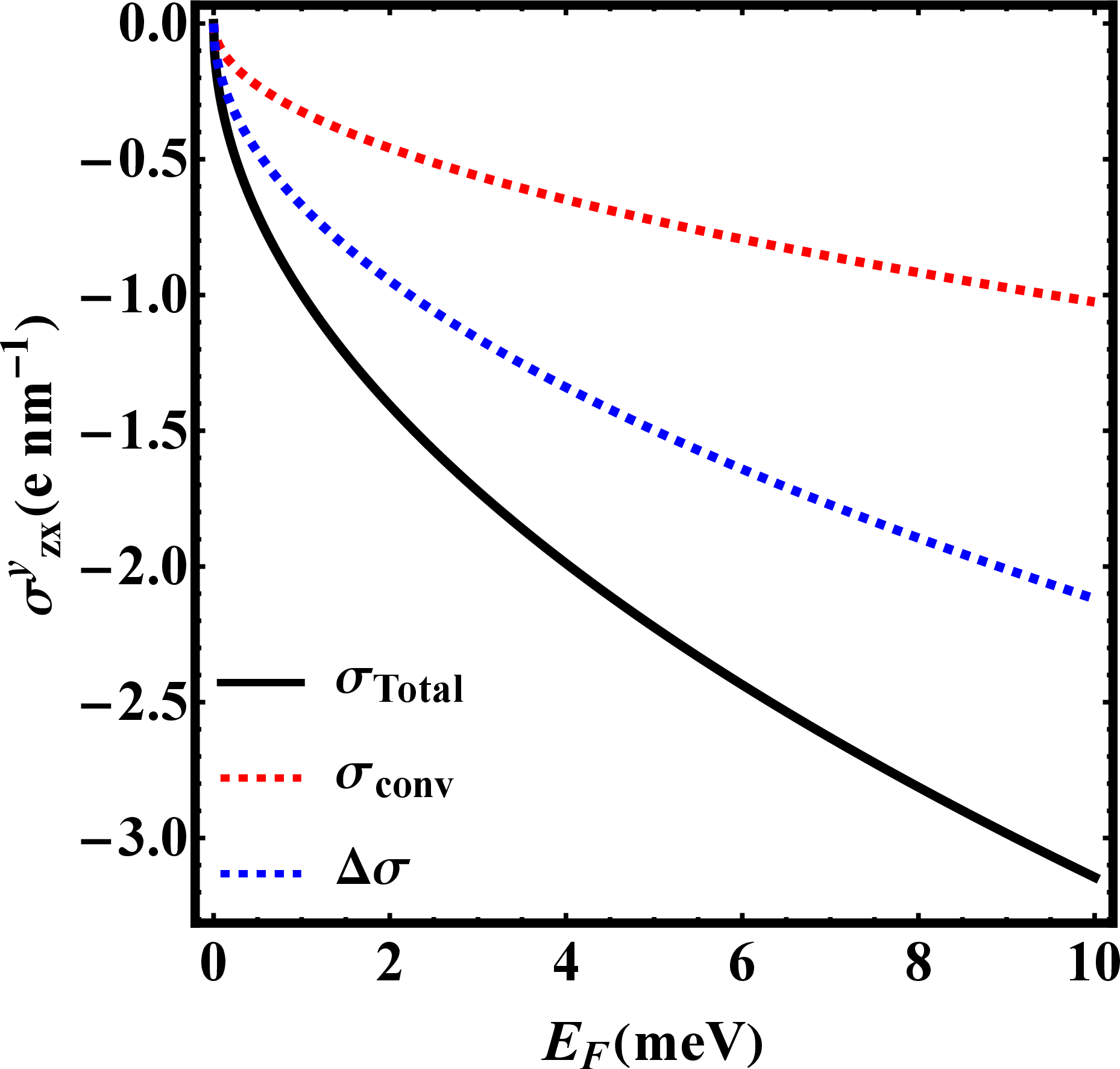
The orbital Hall conductivity is plotted in Fig. 2. For the regions in which the results can be directly compared, the orbital Hall conductivity of Ge is significantly larger than that of the bulk states of Bi\(_2\)Se\(_3\) as illustrated in Tab. 1. We compare our results with Bi\(_2\)Se\(_3\) due toits large orbital Hall effect and, its extensive use as a spin torque material [53]. In Ref. [53] Bi\(_2\)Se\(_3\) was shown to have a orbital Hall conductivity magnitude no larger than \(1.2\) e nm\(^{-1}\), which is exceeded in Ge for a Fermi energy \(>2\) meV.
Moreover, as shown in Fig. 2, the quantum correction \(\Delta\sigma\) is the dominant contribution to the orbital Hall conductivity. The dominance of the quantum correction is consistent with our previous results in Refs. [53], [88], and highlights the importance of including these corrections when calculating the orbital current. An important observation, is that the orbital Hall conductivity vanishes as \(\bar{\gamma} \rightarrow 0\). Now, this limit must be considered carefully as the limit \(\bar{\gamma} \rightarrow 0\) of the integral of \(\langle{\hat{\jmath}}^\alpha_\delta\rangle\) is different from the integral of the limit. All contributions to the intrinsic orbital and spin currents arise due to interband elements of the nonequilibrium density matrix and Berry connection, in the limit where \(\bar{\gamma} \rightarrow 0\) all states are degenerate so the interband elements of the nonequilibrium density matrix vanish. Additionally, the Hamiltonian becomes proportional to the identity matrix and the Berry connection also vanishes. This means that the OHE is driven entirely by spin-orbit coupling, in agreement with the general observation of Ref. [82]. It is important to note that in our calculation we have ignored the split-off band, since it is separated from the heavy and light hole bands by a large gap \(\sim325\) meV. However, in the absence of spin-orbit coupling, the split-off band will become degenerate with the light and heavy hole bands at \(\boldsymbol{k}=0\). As such, our observation that spin-orbit coupling is required for the OHE is restricted to our \(4\times 4\) model and does not necessarily generalise to the full \(6\times 6\) hole system.
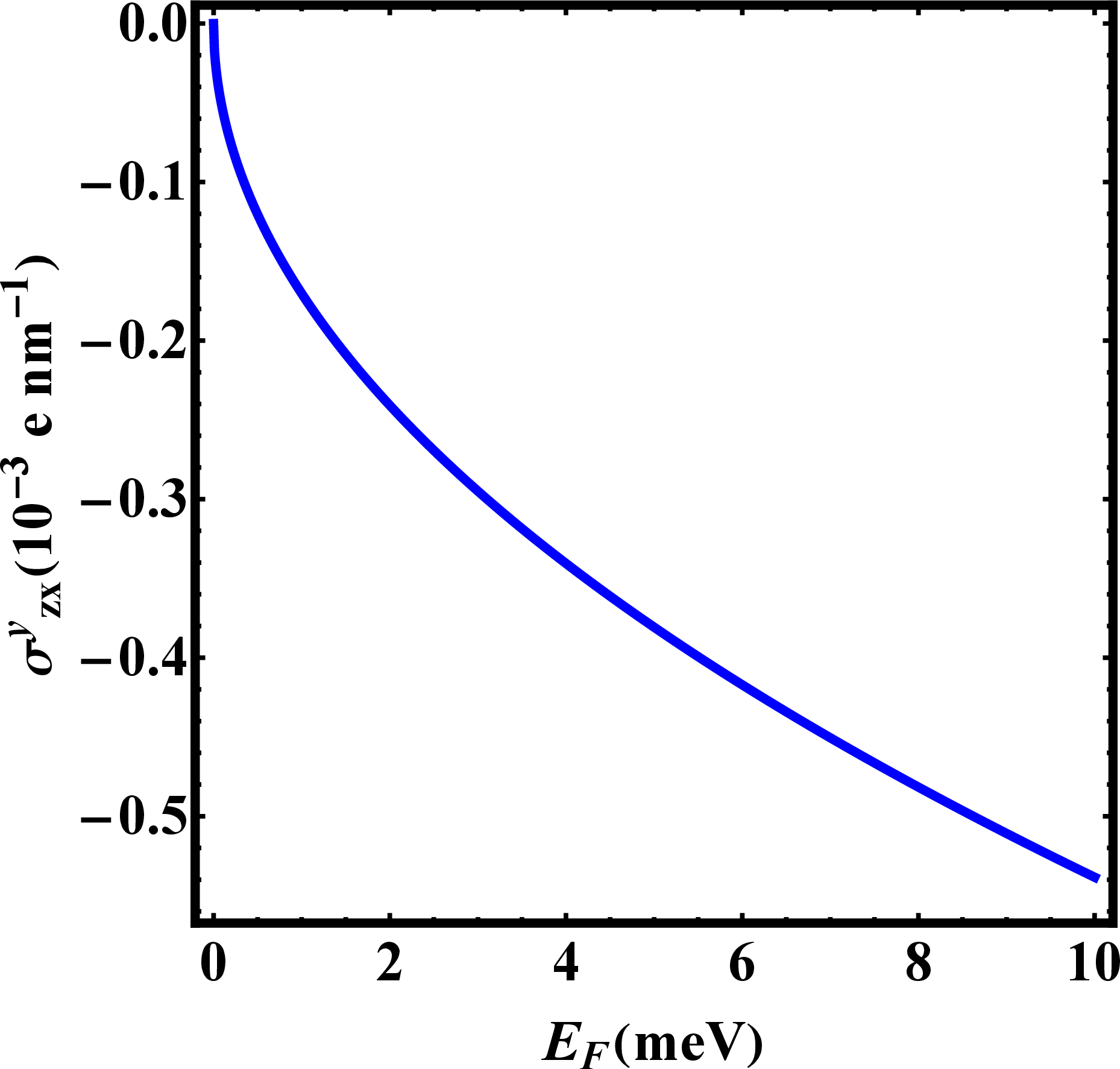
We have plotted the spin Hall conductivity vs the Fermi energy in Fig. 3, as shown in the figure we find the spin Hall conductivity to be 4 orders of magnitude smaller than the orbital Hall conductivity. Furthermore, we find the spin and orbital conductivities to have the same sign, this differs from the ab-initio calculation of Ref. [76]. At the moment, however, our results and the results of Ref. [76] cannot be compared directly, since Ref. [76] introduced the OAM from the perspective of atomic orbitals, which is somewhat different from the way it is determined in the modern theory. Furthermore, for completeness we indicate that Ref. [76] focussed on the conventional spin current, which can have opposite sign to the proper spin current[90]. However, the conventional and proper spin currents typically yield results that are close in magnitude.
4 Discussion↩︎
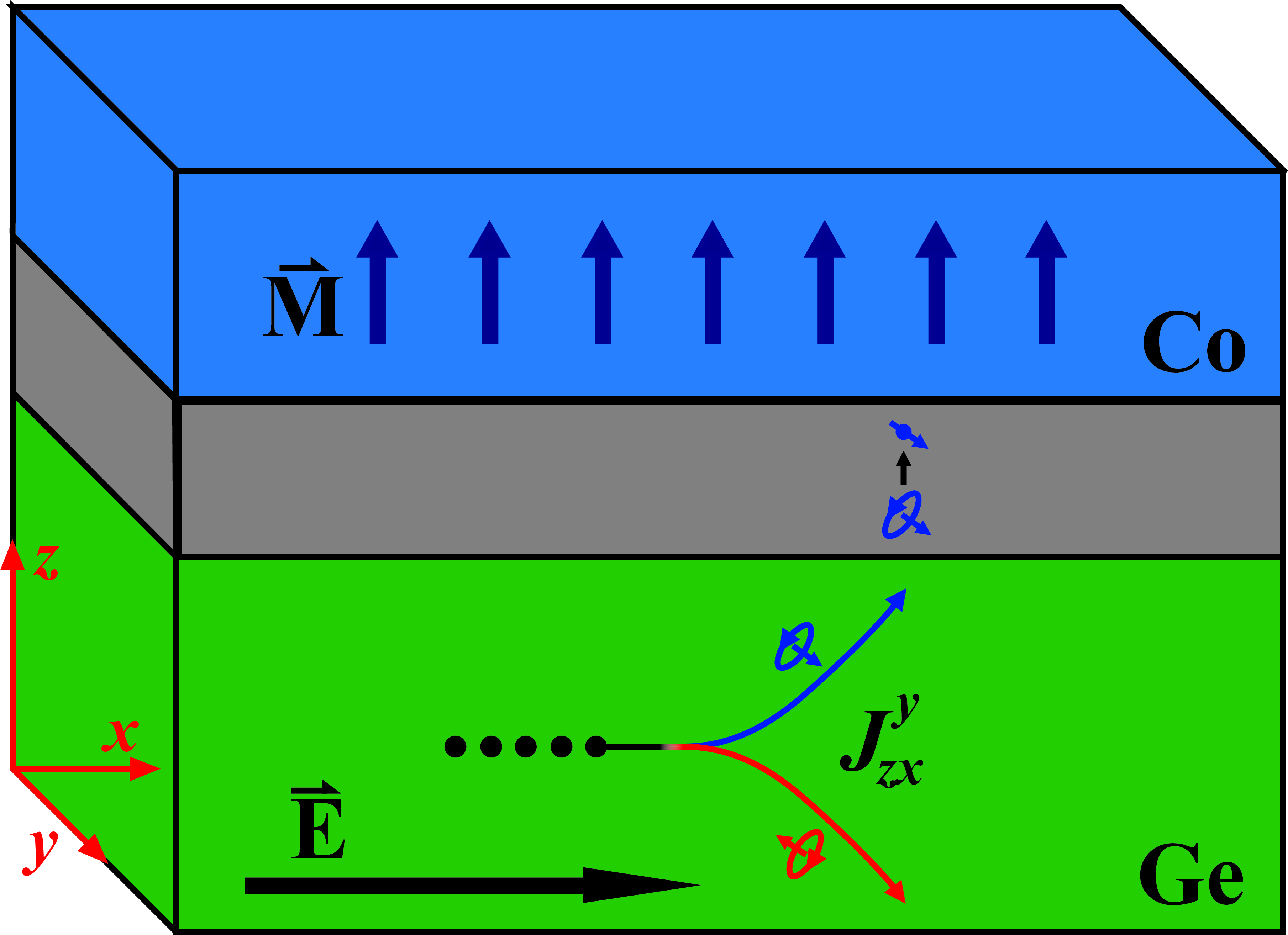
Orbitronics. Our main finding is that the OHE of holes in bulk Ge is of the same order of magnitude as the giant OHE due to Bi\(_2\)Se\(_3\) bulk states, and exceeds it by a factor of approximately \(2\). At the same time, Ge is grown to a high degree of purity resulting in ultrahigh quality samples, benefits from its proximity to Si microfabrication technologies, and exhibits substantial hole mobilities even in the bulk. The time of flight hole mobility in 3D Ge at 40K has been measured to be of the order of 100.000 cm\(^2\)/(Vs) [92], [93]. In contrast, the best bulk mobilities in Bi\(_2\)Se\(_3\) lie in the range 10-20.000 cm\(^2\)/(Vs) [94]–[97]. From this perspective Ge is an optimal material for orbitronic applications. We note also that, although efficient OAM injection via OHE requires a 3D structure, mobilities measured in 2D Ge structures are considerably higher than both of the above, offering the prospect of further improvement[78], [79]. Our study, taken together with the observations above, suggests the viability of Ge-metal interfaces, for example Ge/Co, where Co is a metal of choice in spintronic ferromagnetic structures [98], [99]. This interface, and its relatives, have featured in a number of studies [100]–[103], including a recent study linked to spin injection [100], but we are not aware of its use for orbitronic applications. Given the difference in magnitude of the spin and orbital Hall effects we can expect that for any significant orbital-to-spin conversion \(> 0.2\%\) the orbital Hall effect will dominate the torque in a Ge/ferromagnetic device. Fig. 4 shows a provisional sketch that illustrates one possible geometry for a Ge orbital torque device. The Ge/Co device depicted in Fig. 4 includes a hypothetical barrier layer, as these layers are often used to assist with orbital-to-spin conversion [13], [15], however, the barrier layer may not be necessary. In such a device the orbital Hall effect can be studied via the magnetisation dynamics in the ferromagnet [104].
Testbed for orbital Hall torque. Distinguishing orbital and spin effects is not possible using currently available experimental techniques, and at the moment the best one can do is to calculate these effects theoretically and determine whether one clearly dominates over the others. Similarly, distinguishing between angular momentum generated via different mechanisms is equally challenging. In addition to the spin Hall effect, a steady-state spin density can be generated in an electric field via the magneto-electric effect, also known as the Edelstein effect [105], [106]. Likewise, the orbital magneto-electric effect refers to the intrinsic generation of a steady state orbital polarization by an electric field [74], [107]–[118]. However, the spin- and orbital-Edelstein effects require gyrotropic symmetry, which is absent in zincblende materials. Given that the OHE is four orders of magnitude larger than the SHE, this suggests that in the bulk virtually all the angular momentum dynamics comes from the OHE. The dynamics near the interface need to be examined separately, since other mechanisms may contribute to angular momentum accumulation there [82], nevertheless we expect OHE to be a strong contributor there. Hence our results indicate 3D Ge structures are an ideal testbed for the strength of the orbital Hall torque[119].
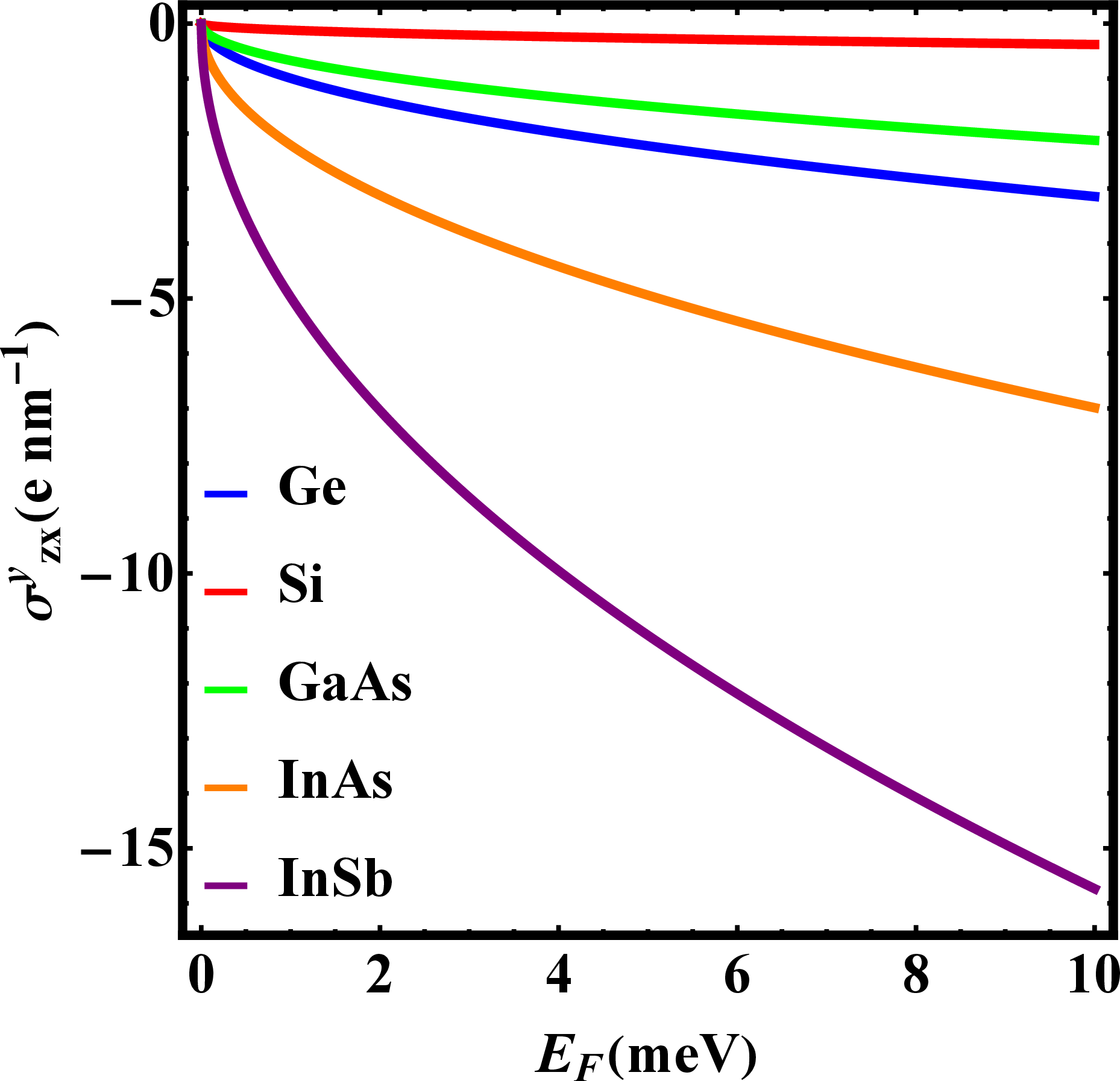
Comparison with other hole systems. We have plotted the orbital Hall conductivity vs the Fermi energy for a number of semiconductors in Fig. 5, we considered the most common semiconductors described by the Luttinger Hamiltonian: Si, Ge, GaAs, InAs and InSb. In all calculations we have used the spherical approximation, this is generally invalid for silicon, however, we still expect the actual orbital Hall conductivity to be of a similar magnitude. Of the semiconductors considered Ge has the third largest orbital Hall conductivity. Additionally, Ge has a hole mobility of at least an order of magnitude larger than the mobility of InAs or InSb [78], [79], [92], [120]–[122]. These factors along with Ge’s proximity to Si microfabrication make Ge the best semiconductor candidate for orbitronic applications.
Inversion symmetric structures and the modern theory. The primary technological motivation of the present work is to uncover the orbitronic properties of Ge by determining the OHE in Ge within the framework of the modern theory of orbital magnetisation, incorporating the quantum corrections, and studying the OHE and SHE on the same footing. At the moment there is no study of the OAM and OHE for the Luttinger Hamiltonian in the modern theory. A strong theoretical motivation for working within the modern theory is the need to understand (i) the OHE in inversion-symmetric spin-3/2 systems within this framework, as well as (ii) the role of spin-orbit coupling in giving rise to the OHE.
To illustrate this need we emphasise that our results are in sharp contrast to the earlier method introduced in Ref. [33], where a nominally similar calculation was performed for Si holes, which, however, neglected spin-orbit coupling. The Hamiltonian of Ref. [33] was expressed in terms of a pseudo-OAM operator, and the transport of this pseudo-OAM was investigated in the absence of spin-orbit coupling, yielding finite results. Nevertheless, if one were to calculate the OAM for this effective Hamiltonian according to the modern theory the result will immediately seen to be zero since spin-orbit coupling is absent. Within the modern theory the OAM in the Luttinger Hamiltonian is entirely due to the spin-orbit interaction encapsulated in the Luttinger parameters \(\gamma_2\) and \(\gamma_3\). Hence one cannot speak of OHE, or any OAM effects, in a Ge hole gas in the modern theory in the absence of spin-orbit coupling. This is consistent with the findings of a recent theory of angular momentum transport. [82] It follows that the pseudo-OAM contained in the basis envelope functions of Ref. [33], which can be regarded as a parent Hamiltonian of the Luttinger Hamiltonian, is a distinct physical quantity from the OAM of the modern theory. The approach of Ref. [33] is already of questionable validity for Si, where spin-orbit coupling is not negligible for hole systems, in fact it has been used very successfully for electrical spin manipulation in quantum computing. Such an approach would be entirely incorrect for Ge, where spin-orbit coupling is inherently strong, and has likewise been used to achieve fast EDSR [123] as well as two-qubit logic [124] in hole qubits. This motivated us to cast a fresh glance at the OHE in spin-3/2 hole systems in the context of the modern theory.
An additional motivation is the fact that studies within the modern theory often focus on inversion breaking systems[51], [74], [88], [125]–[129], which typically exhibit large values of the Berry curvature[129]. Yet, as is evident in this work, a large Berry curvature and OAM do not require inversion symmetry breaking [130]: they are large for holes in Ge, even with the Luttinger Hamiltonian in the spherical approximation. The correct symmetry analysis for the Berry curvature was performed in Ref. [131].
Nevertheless it is important to keep in mind the limitations of effective mass studies, whose applicability is restricted to the conduction and valence band extrema. The OHE for the full band structure of Ge was recently calculated using ab initio techniques in Ref. [76], while accounting fully for spin-orbit effects. In the regions where numerical comparison is possible our results are approximately one order of magnitude larger. However, a direct comparison is challenging at the moment, since Ref. [76] used a basis of atomic OAM states, and the OAM operator entering the orbital current is the atomic OAM operator. In our evaluation, the OAM is computed using the modern theory and the effective mass envelope functions, incorporating additional quantum corrections which we recently shown to be vital in this formulation.
These observations open up an important and interesting question for future research. At the moment two perspectives exist in the study of OAM in solids. One perspective, exemplified by Ref. [76], takes as its starting point the OAM of atomic states and constructs the overall OAM response of a solid to an electric field. The other perspective is provided by the modern theory, whose Bloch function formulation is used in this work, and which can also be cast in terms of Wannier functions[2], [65]–[70]. The quantities calculated using these methodologies are clearly related and lead to the same observable. Both approaches show that OAM conservation is not guaranteed. [132]–[134] Nevertheless their relationship has not been clarified to date. Determining where these perspectives intersect will be a task for future studies. In this context we note that the fundamental definition of the magnetic moment has also come under scrutiny recently [135].
5 Conclusions and Outlook↩︎
We have demonstrated that hole-doped Ge exhibits a giant orbital Hall effect, exceeding that of the bulk states in topological insulators, and making Ge an ideal material for orbitronic applications. The OHE response stems exclusively from spin-orbit coupling, is dominated by the quantum correction, and exceeds the spin-Hall effect by four orders of magnitude. The absence of spin and orbital Edelstein effects suggests Ge as a platform for testing the strength of the orbital Hall torque. Finally, our work shows that the OAM and OHE calculated within the framework of the modern theory of orbital magnetisation are strong for the Luttinger Hamiltonian even in the spherical approximation, providing an example of strong orbital dynamics in an inversion-symmetric system.
Acknowledgements. This work is supported by the Australian Research Council Discovery Project DP2401062 and Future Fellowship FT190100062. We are very grateful to Hyun Woo Lee, Kyoung-Whan Kim, Jung Hoon Han, Francesco Borsoi, Joe Salfi, and Henri Jaffres for stimulating discussions.