Theorem 7. The collection \(HB_0^d(n)\), \(n\ge 1\), with the compositions (12 )* forms a planar operad \(HB_0^d\).*
Bruhat operads
May 28, 2025
Abstract
We describe some planar operads built from the higher Bruhat orders and show that they admit a multiplication.
To the memory of Yuri Ivanovich Manin
M. Jourdan: Par ma foi, il y a plus de quarante ans
que je dis de la prose sans que j’en susse rien
Bourgeois gentilhomme
The present paper consists of three parts. The aim of the first part
(Sections [sec:plan-op] - [sec:op-higher-bruhat]) is to introduce some
planar operads builtbuild from higher Bruhat orders, cf. [1]. We call them Bruhat operads.
In the second part (Sections [sec:mult-cos-shifted] - [sec:ursa-major]) we show that the Bruhat operads are operads with multiplication in the sense of [2].
The third part is Appendix by Daria Poliakova with the proof that the Bruhat operad is compatible with Bruhat orderings.
Recall that a planar (sometimes called nonsymmetric) operad of sets \(\mathcal{O}\) consists of a family of sets \(\{\mathcal{O}(n)\}_{n\in \mathbb{Z}, n\geq 0}\), together with composition maps \[\gamma:\;\mathcal{O}(n)\times \mathcal{O}(n_1)\times\ldots\times \mathcal{O}(n_m)\to \mathcal{O}(\sum_i n_i)\] and a unit \(1\in \mathcal{O}(1)\) satisfying the associativity and the unit axiom as for a usual operad, except that we do not require an action of symmetric groups \(S(n)\) on \(\mathcal{O}(n)\), cf. [3], Def. 3.12 and Def. 1 below.
Let \(d, n\) be integers, \(1\leq d\leq n\). In [1] (cf. also [2]) certain posets \(B(n,d)\) called higher Bruhat orders have been introduced, their definition is recalled below in [sec:def-hbo].
One can describe them roughly as follows. \(B(n,1) = S(n)\) with the classical weak Bruhat order. The poset \(S(n)\) admits unique maximal and minimal elements, namely, the minimal element is the unit permutation \(e\), whereas the maximal one is the permutation \(\sigma_{max}\) of maximal length1. By definition \(B(n,2)\) is a certain quotient of the set of maximal (i.e. noncompressible2) chains in \(S(n)\) connecting \(e\) with \(\sigma_{max}\).
Afterwards one proceeds by induction on \(d\). Each \(B(n,d)\) is a poset admitting unique minimal and maximal elements, say \(b_{min}^d\) and \(b_{max}^d\), and \(B(n,d+1)\) is a certain quotient of the set of maximal chains in \(B(n,d)\) connecting \(b_{min}^d\) with \(b_{max}^d\).
A remarkable paper by Ziegler [4] contains a number of deep constructions and results on higher Bruhat orders. They are essential in our study.
Fix a positive integer \(d\). Denote \(\mathcal{O}(n) := B(nd, d)\). The first main result of the present paper, see Thm 7 below, says that the collection \(\mathcal{O} = \{\mathcal{O}(n)\}\) admits a structure of a planar operad, to be called the small Bruhat operad.
Our definition of multiplications \(\gamma\) is based on the following main construction.
Given two elements \(b\in B(n,d)\) and \(b'\in B(m,d)\) and an integer \(j\), \(0\leq j\leq n+m-d\), we define a new element \(b\circ_j b'\in B(n+m-d)\), see [sec:ins-higher-b].
The definition of the operations \(\circ_j\) is nontrivial and uses an important theorem by Ziegler, see Thm. 5 below.
We may include into the game elements of \(B(m,d)\) with \(d\) not dividing \(m\) as well. Namely, we define a planar operad \(\mathcal{O}' = \{\mathcal{O}'(n)\}\) which contains \(\mathcal{O}\) as a suboperad and called the big Bruhat operad. The sets \(\mathcal{O}'(n)\) are certain infinite unions of sets \(B(m,d)\) with fixed \(d\) and arbitrary \(m \geq d\).
This is the second main result of the present paper, see 8.
The contents of the paper is as follows. In Section 2 we recall the definition of planar operads. In Section 3 we discuss certain "Master planar operads" which serve as a combinatorial base for constructing the big Bruhat operad. In Section 4 we introduce the main operation of insertion. In Section 5 we discuss some operads related to symmetric groups which correspond to the case \(d = 1\) of our considerations. Section 6 contains the definitions of Bruhat operads.
Sections 7 - 10 are devoted to multiplicative structures.
The results if the present paper have been announced in [5], [6].
We are grateful to Jim Stasheff for useful remarks, to Denis Bashkirov for an interesting correspondence, to Vladimir Dotsenko, Alexander Voronov, and Ralph Kaufmann for interesting discussions, and especially to Dasha Polyakova for interesting discussions and corrections.
If \(X\) is a set, \({\cal P}(X)\) will denote the set of all its subsets.
For \(n\in \mathbb{Z}, n\geq 1\), \([n] := \{1, \ldots , n\}\).
For \(a\in \mathbb{R},
a + [n] := \{ a+1,\ldots a+n\}\).
By \({[n]}\choose d\) we denote the set of \(d\) element subsets of \([n]\).
Part I. OPERADS
Let \((K, \otimes)\) be a tensor category with unit object \(e\). Below we will be interested mostly in the category of sets with the monoidal structure given by the cartesian product.
Definition 1. A planar operad* in \(K\) consists of objects \({\cal O}(n)\) of \(K\) indexed by the natural numbers \(n\in {\mathbb{Z}}, n \geq 1\), with operations of composition*
\[\label{op1} \gamma_{k;n_1, \ldots, n_k}\,\colon\, {\cal O}(k)\otimes {\cal O}(n_1)\otimes \cdots \otimes {\cal O}(n_k)\to {\cal O}(n_1+ \cdots +n_k)\qquad{(1)}\] and a unit map \(I: e\longrightarrow{\cal O}(1)\).
The composition should be associative which means that
\[\label{com1} \gamma_{k; n_1, \ldots, n_k } \prod_1^k \gamma_{n_t;l_{m_1}^t, \ldots, l_{m_{n_t}}^t}= \gamma_{k; \sum_{j=1}^{n_1 }l^1_{m_j}, \ldots, \sum_{j=1}^{n_k }l^k_{m_j}},\qquad{(2)}\]
the composition \[{\cal O}(k) = {\cal O}(k)\otimes e\otimes \cdots \otimes e \longrightarrow {\cal O}(k)\otimes {\cal O}(1)\otimes \cdots \otimes {\cal O}(1)\overset\gamma\longrightarrow{\cal O}(k)\] should be equal to \(\text{Id}_{{\cal O}(k)}\), and the composition \[{\cal O}(n) = e\otimes {\cal O}(n) \longrightarrow{\cal O}(1)\otimes{\cal O}(n)\overset\gamma\longrightarrow{\cal O}(n)\] should be equal to \(\text{Id}_{{\cal O}(n)}\).
To define compositions (?? ) it is sufficient to define their particular cases, "insertions", or "blowups".
\[\label{compos-ins} \circ_i : {\cal O}(m)\otimes {\cal O}(n) \to {\cal O}(m+n-1)\tag{1}\] where \[a\circ_i b = \gamma_{m;1,\ldots,1,n,1,\ldots, 1}(a;I,\ldots, I,b,I,\ldots, I),\] \(1\leq i\leq m\), satisfying two identities:
for all \(a\in {\cal O}(l), b\in {\cal O}(m), c\in {\cal O}(n)\) we should have \[(a\circ_i b)\circ_{i-1+j} c = a\circ_i (b\circ_j c),\] \(1\leq i\leq l, 1\leq j\leq m\) (associativity), and \[(a\circ_i b)\circ_{k-1+m}c = (a\circ_k b)\circ_i c,\] \(1\leq i < k\leq l\) (commutativity), see [7], 5.9.4.
This criterion will be crucial for us.
Consider the following collection of sets \(M(n)\), \(n\ge 1\).
The set \(M(n)\) is consists of collections of integer numbers \(\mathbf{k}:=(k_0, k_1, \ldots, k_n)\), \(k_i\ge 0\).
We can imagine elements of \(M(n)\) as collections of black and white different points on the real line such that first (from left to right) we see \(k_0\) white points, then a black point, then \(k_1\) white points, then the second black point, then \(k_2\) white points, and so on until the \(n\)-th black point and \(k_n\) white points.
Let us define a family of maps \[\label{master1} \gamma_{n; l_1, \cdots, l_n}: \;M(n)\times M(l_1)\times \cdots\times M(l_n)\to M(\sum_{j=1}^n l_j)\tag{2}\] by the following rule.
For \(\mathbf{k}:=(k_0, k_1, \ldots, k_n)\in M(n)\), \(\mathbf{m}_1:=(m_0^1, m_1^1, \ldots, m_{l_1}^1)\in M(l_1),\cdots\), \(\mathbf{m}_n:=(m_0^n, m_1^n, \ldots, m_{l_n}^n) \in M(l_n)\), we define \[\gamma_{n; l_1, \cdots, l_n}(\mathbf{k}, \mathbf{m}_1, \cdots, \mathbf{m}_n) =\] \[(k_0+m_0^1, m_1^1, \cdots, m^1_{l_1-1}, k_1+m_{l_1}^1+m_0^2, m_1^2, \cdots, m_{l_2-1}^2, k_2+m_{l_2}^2+m_0^3, \cdots,\] \[\label{comp1} k_{n-1}+m_{l_{n-1}}^{n-1}+m_0^n, m_1^n, \cdots, m_{l_n-1}^n, k_{n}+m_{l_{n}}^n).\tag{3}\]
Geometrically the composition \(\gamma\) means that we insert the whole collection \(M(1)\) instead of the first black point in \(\mathbf{k}\), \(M(2)\) instead of the second black point in \(\mathbf{k}\), \(\ldots\), \(M(n)\) instead of the \(n\)-th black point in \(\mathbf{k}\), see the picture below.
The unit element is the tuple \(I=(0,0)\in M(1)\).
It is easy to check that the map (2 ) is associative and \(I\) is the unit. Thus we have
Lemma 1. The collection \(M = \{M(n), n\ge 1\}\), with the family of maps (2 ) is a planar operad of sets.
\(\square\)
Note that the sets \(M(n)\) are infinite.
For a given positive integer \(d\), and \(\mathbf{k}=(k_0, \cdots, k_n)\in M(n)\), consider the collection \[\mathbf{k}^d := (k_0, d, k_1, d, k_2, d, \cdots , k_{n-1}, d, k_n).\] The sum of these numbers will be denoted by \(|\mathbf{k}^d|\); it is equal to \(dn+\sum_j\;k_j\).
A sequence \(\mathbf{k^d}\) will be called a type.
Let us consider the set \(M(\mathbf{k}^d) = [dn +\sum_j k_j]\). Its elements will be called particles.
Subsets of \(M(\mathbf{k}^d)\) having the form of intervals \[k_j + dj + [d] = \{k_j+dj+1, \cdots, k_j+d(j+1)\}\] we will call teams, or nuclei, \(j=0, \cdots, n-1\). Elements of nuclei will be called protons; so each nucleus contains \(d\) protons.
Particles of \(M(\mathbf{k}^d)\) which do not belong to any nucleus will be called idles, or electrons.
The whole set \(M(\mathbf{k}^d)\) equipped with the collection of \(n\) nuclei inside it will be called a molecule of type \(\mathbf{k}^d\). Thus \(M(\mathbf{k}^d)\) contains \(|\mathbf{k}^d|\) particles, among them \(nd\) protons and \(\sum_j k_j\) electrons.
Obviously the type defines the molecule uniquely.
Denote by \(M^d(n)\) the set of all molecules with \(n\) nuclei and arbitrary number of electrons. We can identify \(M^1(n)\) with \(M(n)\), with nuclei (resp. electrons) corresponding to black (resp. white) points.
Define a collection of maps
\[\label{masterd} \gamma_{n; l_1, \ldots, l_n}:\;M^d(n)\times M^d(l_1)\times \cdots\times M^d(l_n)\to M^d(\sum_{j=1}^n l_j)\tag{4}\]
For molecules \(M(\mathbf{k})\in M^d(n)\), \(\mathbf{k} =(k_0, d, k_1,d, \ldots,d, k_n)\), \(M(\mathbf{m}_1)\in M^d(l_1)\), \(\mathbf{m}_1 =(m_0^1,d, m_1^1, d, \ldots, d, m_{l_1}^1),\ldots\), \(M(\mathbf{m}_n)\in M^d(l_n)\), \(\mathbf{m}_n = (m_0^n, d, m_1^n, d, \ldots, d, m_{l_n}^n)\), we set
\[\gamma_{n; l_1, \ldots, l_n}( M(\mathbf{k}), M(\mathbf{m}_1), \ldots, M(\mathbf{m}_n)) =\] \[M(k_0+m_0^1, d, m_1^1, d, \ldots, m^1_{l_1-1}, d, k_1+m_{l_1}^1+m_0^2, d, m_1^2, \ldots, m_{l_2-1}^2, d, k_2+m_{l_2}^2+m_0^3, d, \ldots,\] \[\label{compd1} d, k_{n-1}+m_{l_{n-1}}^{n-1}+m_0^n, d, m_1^n, \ldots, d ,m_{l_n-1}^n, d, k_{n}+m_{l_{n}}^n)).\tag{5}\]
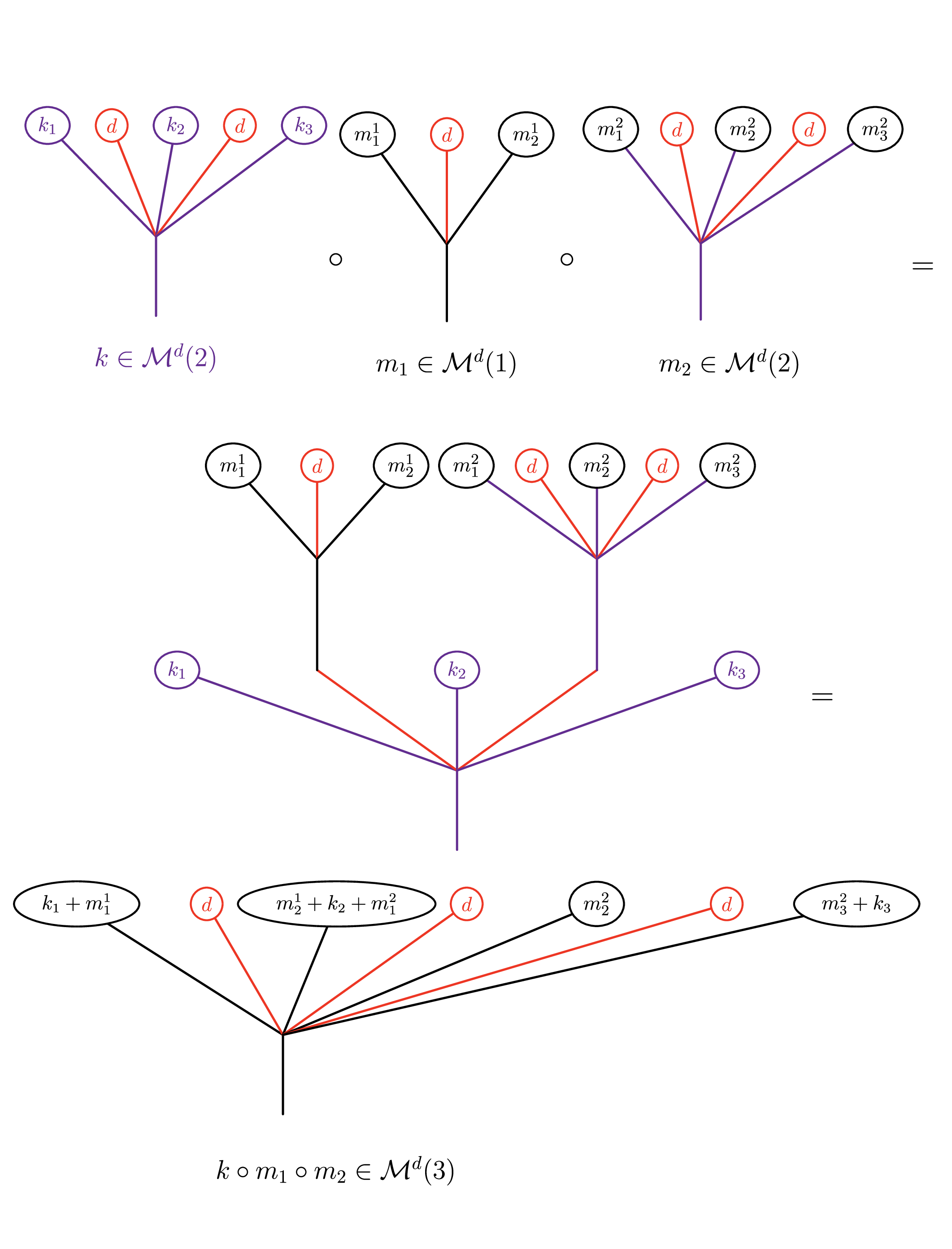
This operation means that instead of the \(j\)-th nucleus in \(M(\mathbf{k})\) we insert the molecule \(M(\mathbf{m}_j)\), \(1\leq j\leq n\).
Lemma 2. The collection \(M^d = \{M^d(n), n\ge 1\}\), with the family of maps (5 ) is a planar operad isomorphic to \(M^1\).
Proof Obvious. \(\Box\)
Note that the sets \(M^d(n)\) are infinite.
It is wellknown that the symmetric groups form an operad.
Namely, let \(S(n)\) be the group of permutations of the set \([n]=\{1, \cdots, n\}\).
The family of maps \[\label{symmop} \gamma_{k,n_1, \cdots, n_k}: S(k)\times S(n_1)\times \ldots \times S(n_k)\to S(n_1+\ldots +n_k)\tag{6}\] defined by sending
\[(\tau, \sigma_1, \ldots \sigma_k), \quad \tau\in S(k), \, \sigma_i\in S(n_i), \, i=1, \cdots , k,\] to the permutation of the set \([n_1+\cdots +n_k]\) obtained by applying \(\sigma_i\) to the \(i\)th interval \(n_1+\cdots +n_{i-1}+1, \ldots , n_1+\cdots +n_{i-1}+n_i\), and then permuting these intervals following \(\tau\).
The collection \(S = \{ S(n), n\ge 1\}\), with the above family of maps \(\gamma\) is a planar operad, and even more it is a symmetric operad.
We introduce another planar operad \(F\) on symmetric groups which is related to the master operad \(M^1\).
We define \(F(n)\) as a subset of the set of permutations of \(M^1(n)\).
Specifically, we consider collections \[\mathbf{k} = (k_0, 1, k_1, 1, k_2, \cdots, k_{n-1}, 1, k_n)\in M^1(n)\] with teams of size \(1\).
For any set \([n+\sum_{i=0}^n k_i]\) we consider permutations \(\sigma\in S(n+\sum_ik_i)\) which permute only nuclei and are identical on the electrons.
The set \(F(n)\) consists of all such permutations for all \(\mathbf{k}\in M^1(n)\).
Compositions
\[\gamma: F(k)\times F(n_1)\times \ldots \times F(n_k)\to F(n_1+\ldots +n_k)\] are defined as follows.
For \(\tau\in F(k)\), \(\sigma_i\in F(n_i)\), \(i=1, \ldots, k\), \[\gamma(\tau; \sigma_1, \ldots , \sigma_k)\] permutes \[\gamma(\mathbf{k}; \mathbf{m}_1, \ldots, \mathbf{m}_k), \quad \mathbf{k}\in M^1(k), \, \mathbf{m}_i\in M^1(n_i), i=1, \ldots, k,\] by permuting the blocks \(\mathbf{m}_i\) by \(\sigma_i\) and then permuting these blocks by \(\tau\).
We have
Proposition 2. The collection of \(F(n)\), \(n=1, \cdots\) with the above defined family of maps is a planar operad.
Proof follows from Lemma 2 for \(d = 1\). \(\Box\)
Remark 3. Restricting the operad \(F(n)\) to the subset of collections without idles gives us the operad \(S\) on symmetric groups \(S(n)\), \(n=1, \ldots\).
On a symmetric group \(S(n)\), there is a weak Bruhat order \(\prec\) which may be defined as follows: \(u\prec v\) iff the sets of inversions are nested, \(Inv(u)\subset Inv(v)\).
For example the weak Bruhat order for \(S(3)\) looks as follows:
\(e < (12) < (123) < (13)\) and \(e < (23) < (132) < (13)\).
Both operads \(S\) and \(F\) are compatible with weak Bruhat orders. Namely
Theorem 4. Let \(\tau, \tau'\in S(k)\) (resp. \(\tau, \tau'\in F(k)\)), \(\sigma_i, \sigma'_i\in S(n_i)\) (resp. \(\sigma_i, \sigma'_i\in F(n_i)\)), \(i=1, \ldots k\). If \(\tau\prec\tau'\) and \(\sigma_i\prec\sigma'_i\), \(i=1, \ldots, k\), then \[\gamma(\tau; \sigma_1,\ldots , \sigma_k)\prec \gamma(\tau'; \sigma_1',\ldots, \sigma_k').\]
We prove this theorem below in Section [sec:invsec], see [sec:proof-order].
Let us recall some definitions from [1].
Let \(d \leq n\) be two positive integers. Let \(Lin(n,d)\) denote the set of linear orders on the discrete Grassmannian \({[n]}\choose d\).
For a subset \(\mathbf{i} = \{i_1, \ldots, i_{d+1}\}\in {{[n]}\choose d+1}\), \(1\leq i_1<\cdots < i_{d+1}\leq n\), and \(1\leq k\leq d+1\) let us denote \(\widehat{\mathbf{i}}_k\) the sequence \(\mathbf{i}\) with \(i_k\) omitted.
Let us call its packet, and denote by \(P(\mathbf{i})\), the sequence \[P(\mathbf{i}) = (\widehat{\mathbf{i}}_{d+1}, \widehat{\mathbf{i}}_d, \ldots, \widehat{\mathbf{i}}_1).\]
Let us call an element \(\prec\in L(n,d)\) admissible if its restriction to each packet \(P(\mathbf{i})\) is either lexicographical, i.e. \[\widehat{\mathbf{i}}_{d+1}\prec \widehat{\mathbf{i}}_d \prec \ldots \prec \widehat{\mathbf{i}}_1\] or antilexicographical, i.e. \[\widehat{\mathbf{i}}_{d+1}\succ \widehat{\mathbf{i}}_d \succ \ldots \succ \widehat{\mathbf{i}}_1.\] Let \(A(n,d)\subset L(n,d)\) denote the subset of admissible linear orders.
The set \(B(n,d)\) of Bruhat orders for \({[n]}\choose d\) is defined as the quotient \(A(n,d)/\sim\) where \(\sim\) is an equivalence relation described in [1], no 2.
Each \(B(n,d)\) is a poset, to be denoted \(\mathcal{HB}^d(n)\). One of main results of [1] states that any order from \(\mathcal{HB}^d(n)\) can be included into a maximal chain joining the minimal order with the maximal one.
\(A(n,1) = B(n,1) = S(n)\) with the classical weak Bruhat order.
Alternatively \(B(n,d)\) may be defined as the set of minimal partial orders on \({[n]}\choose d\) whose restriction to each packet is either lexicographical or antilexocographical.
Recall that partial orders, anti-symmetric transitive binary relations, are partially ordered by the inclusion of ordered pairs of elements. If we consider the intersection of all partial orders that have the same restriction to every packet, we get a minimal partial orders on \({[n]}\choose d\) whose restriction to each packet is either lexicographical or antilexicographical.
Let \(a\in A(n,d)\). The collection of all \(\mathbf{i}\in\) \({[n]}\choose {d+1}\) such that \(P(\mathbf{i})\) is ordered anilexicographically forms the set of inversions \(Inv(a)\subset\) \({[n]}\choose {d+1}\). If \(a\sim a'\) then \(Inv(a) = Inv(a')\), so for \(\prec\in B(n,d)\) the set \(Inv(\prec)\subset\) \({[n]}\choose {d+1}\) is well defined.
This way we get a map
\(Inv:\;A(n,d) \longrightarrow{\cal P}\) \({[n]}\choose {d+1}\)
The set of inversions determines the order uniquely. So \(B(n,d)\) may be defined as the image of \(Inv\).
Ziegler [4], Th. 4.1(B), characterised the subsets of \({[n]}\choose {d+1}\) which appear as sets of inversions of Bruhat orders.
Theorem 5. **(Ziegler)* A subset \(I\subset {{[n]}\choose {d+1}}\) is the set of inversions \(Inv(\prec)\) of a Bruhat order \(\prec\) for \({[n]}\choose d\) if and only if for any \(\mathbf{i} \in {{[n]}\choose {d+2}}\) the intersection of \(I\) and the packet \(P(\mathbf{i})\) is either a beginning or an ending interval of \(P(\mathbf{i})\).*
The last condition means that there exists \(k\), \(0\leq k\leq d+2\) such that \(P(\mathbf{i})\cap I\) is equal to \((\widehat{\mathbf{i}}_k, \widehat{\mathbf{i}}_{k-1},\ldots, \widehat{\mathbf{i}}_1)\) or to \((\widehat{\mathbf{i}}_{d+2}, \widehat{\mathbf{i}}_{d+1},\ldots, \widehat{\mathbf{i}}_k)\). Here \(k=0\) (resp. \(k = d+2\)) means that \(P(\mathbf{i})\cap I = \emptyset\) (resp. \(P(\mathbf{i})\cap I = P(\mathbf{i})\)).
We will say that \(\mathbf{i}\) satisfies the Ziegler criterion, or simply that \(\mathbf{i}\) satisfies (Z), for \(I\).
Let us denote by \(Z(n,d+1)\) the set of subsets \(I\subset {{[n]}\choose {d+1}}\) such that for any \(\mathbf{i} \in {{[n]}\choose {d+2}}\), \(\mathbf{i}\) satisfies (Z) for \(I\). The above statements mean that \(Inv\) establishes a bijection \[Inv:\;B(n,d) \overset\sim\to Z(n,d+1).\]
Note that a maximal chain in the poset \(\mathcal{HB}^d(n)\) has the following chain of inversion sets. It starts with the empty set, and each consequent one is obtained by adding one more inversion. The length of such a chain is \([n]\choose d+1\), the cardinality of the inversion set for the maximal element of \(\mathcal{HB}^d(n)\).
We define the wire space \({\cal W}(n,1)\) as the topological space whose elements are collections of distinct real points \(x_1 < x_2 <\ldots < x_n\) on the real line together with a bijection \(\sigma:\;[n] \overset\sim\longrightarrow[n]\). We assign to \(x_i\) the number \(\sigma(i)\).
So \({\cal W}(n,1)\) is a subspace of \(({\mathbb{R}}^d)^{n!}\), and we consider it as equipped with the induced topology. We have an obvious bijection \[\pi_0({\cal W}(n,1))\overset\sim{=}S(n) = B(n,1),\] and all connected components of \({\cal W}(n,1)\) are contractible.
. Elements of this space are "arrangements of \(n\) pseudolines in \({\mathbb{R}}^2\)".
More precisely, an element of \({\cal W}(n,2)\) is the following collection of data.
(a) "Walls": two distinct vertical lines \(w_l = \{ x_l + iy, y\in {\mathbb{R}}\}, w_r = \{ x_r + iy, y\in {\mathbb{R}}\}, y_l < y_r\) in \({\mathbb{R}}^2\), each of them equipped with a collection of \(n\) distinct points: \[a_i = x_l + iy_j, y_n > \ldots > y_1,\;\] \[b_i = x_r + iz_j, z_1 > \ldots > z_n.\]
(b) "Wires": \(n\) wires, the \(j\)-th wire \(w_j\) being the graph of a smooth function connecting \(a_j\) with \(b_j\), \[f_j: \;[x_l, x_r] \longrightarrow{\mathbb{R}}, f(x_l) = y_j,\;f(x_r) = z_j.\] We require that for all \(j < k\) the wire \(w_j\) meets \(w_k\) exactly once.
We have a canonical bijection \[\pi_0({\cal W}(n,2))\overset\sim{=}B(n,2)\] and all connected components of \({\cal W}(n,2)\) are contractible. \(\Box\)
Proceeding in the same manner one can give a similar description of the higher Bruhat sets \(B(n,d)\) with pseudohyperplanes and get [4], [8] the bijection \[\pi_0({\cal W}(n,d))\overset\sim{=}B(n,d),\] where \({\cal W}(n,d)\) denote the collections of \(n\) pseudohyperplanes in \(\mathbb{R}^d\), such that any \(d\) of them intersect once in a single point.
To define an operad structure on higher Bruhat orders we use the following construction.
Let \(d, n, m\) be positive integers, \(n > d, m > d\), and \(j\) an integer such that \[0\leq j\leq n+m-d.\] Given two Bruhat orders \(\prec\) for \({[n]}\choose {d}\) and \(\prec'\) for \({[m]}\choose {d}\) we will define a new Bruhat order \(\prec\circ_j\prec'\) for \({[n+m-d]}\choose {d}\), to be called the \(j\)-th insertion of a \(\prec'\) into \(\prec\).
We define such an insertion by specifying its set of inversions.
Namely we define a subset \(I(\prec\circ_j\prec')\subset\) \({[n+m-d]}\choose {d+1}\) and afterwards prove that it satisfies (Z), whence it uniquely defines an order \(\prec\circ_j\prec'\).
Let \(Inv(\prec)\) and \(Inv(\prec')\) be the sets of inversions of \(\prec\) and \(\prec'\), respectively.
Consider a decomposition \[[n+m-d]=[ j]\cup ( j+[m]) \cup (j+m+[n-(j+d)]).\] We denote \(A:=[j]\), \(B:=j+[m]\), \(D = j + [d]\subset B\), and \(C:=j+m+[n-(j+d)]\).
(i) First, for a \(d+1\) element subset \(J=\{j_1, \cdots, j_{d+1}\}\subset B\), we say that \[\label{inv1} J\in I (\prec\circ_j\prec' ) iffJ-j=\{j_1-j, \cdots, j_{d+1}-j\}\in Inv(\prec').\tag{7}\]
(ii) Second, for a \(d+1\) element subset \[I=\{i_1, \cdots, i_{d+1}\}\subset A\cup D\cup C\]
we say that \[\label{inv2} I\in I(\prec\circ_j\prec')iff\phi^{-1}(I)\in Inv(\prec),\tag{8}\] where \[\phi: [n] \to A\cup D \cup C\] is the unique monotone bijection.
(iii) Third, let \(L=\{l_1, \cdots, l_{d+1}\} \subset [n+m-d]\) be none of types (i) or (ii). Denote \[L^+=L\cap (A\cup D\cup C)\] and \[L^-=L\cap (B\setminus D) = L\setminus L^+.\]
Thus \(L = L^-\coprod L^+\).
Let \[f:L^-\to D\] be the unique monotone map sending \(L^-\) to the rightmost elements of \(D\setminus L^+\).
Denote by \[\overline{L}=L^+\cup f(L^-)\subset A\cup D\cup C\] (the union is disjoint).
Example. If \(L\cap (j+[m])=\{a, b\}\), \(a\le j+d\), \(b>j+d\), then \[\overline{L}=\begin{cases} L\setminus b\cup \{j+d\}& if \quad a\neq j+d\cr L\setminus b\cup \{j+d-1\} & if\quad a=j+d. \end{cases}\]
\(\Box\)
Then we say that \[\label{inv3} L\in I (\prec\circ_j\prec' )iff\phi^{-1}(\overline{L}) \in Inv(\prec).\tag{9}\]
This three step construction defines a set \(I(\prec\circ_j\prec')\).
By definition \[\label{coprod-I} I (\prec\circ_j\prec') = I_1\coprod I_2\coprod I_3\tag{10}\] where \(I_1\) (resp. \(I_2\), \(I_3\)) are the subsets of elements satisfying (7 ) (resp. (8 ), (9 )).
Proposition 6. The set \(I(\prec\circ_j\prec')\) defined above satisfies (Z), whence \(I(\prec\circ_j\prec') = Inv(\prec\circ_j\prec')\) for the uniquely defined \(\prec\circ_j\prec'\in B(n+m-d,d)\).
This will be proven below, see [sec:ziegler-d].
Let \(W\) be a wiring diagram with \(m\) wires and \(U\) be a diagram with \(n\) wires (strands). Let us describe the insertion \(W\circ_j U\) following our construction of the insertion \(B(m,2)\circ_{j} B(n,2)\).
Pick the intersection point \(v\) of wires \(j+1\) and \(j+2\), and consider a small disc \(D_{j+1,j+2}\) with center at \(v\). Let us orient the boundary of this disc clockwise. Then the wire \(j+1\) first enters and leave the disc, and and \(j+2\) second enters and leave.
We do the insertion in two steps.
First, we place \(W\) inside a disc \(D_U\) with the clockwise oriented boundary such that beginning points of wires are clockwise \(1\), \(2\), etc and leaving points are clockwise \(1\), \(2\), etc. Then we replace the disc \(D_{j+1,j+2}\) with the center at \(v\) by the disc which contains \(U\) we identify the entering and leaving points of wire \(j+1\) with that of \(1\) and \(j+2\) with \(n\) (we shift numeration by adding \(j\) to indices of \([n]\) and shift by \(n+j\), the indices \(\{j+3, \cdots, m\}\) (they are outside of \(U\), as well as wires with indices \(\{1, \cdots, j\}\)).
Second, outside the disc, we extend the wire \(1\) of \(U\) as \(j+1\) in \(W\), and the wire \(m\) with \(j+2\), and wires \(2, \cdots, m-1\) we etend to be parallel to \(j+2\) in \(W\) and parallel between themselves.
The above insertion resembles the little disc operad, but we have to expand wires outside inserted discs while in the little disc operad one step of insertion is enough.
Let us show that the above insertion gives the same result as [sec:ins-higher-b].
First, we recall meaning of the inversion in wiring diagrams. Consider three wires with indices \(i<j<k\). Then this triple form an inversion if \(i\) first intersect \(k\), and no inversion if \(i\) first intersect \(j\).
Now, in the above insertion \(W\circ_j U\),
triples of wires with indices of \(\{j+1, \cdots, j+m\}\) have the same intersection as in \(U\), that is (5.1);
triples of wires with indices different of \(\{j+1, \cdots, j+m\}\) have the same intersection as in \(W\), that is (5.2);
a triple of wires with one index of \(\{j+1, \cdots, j+m\}\) has the same inversion as this index is \(j+2\) and the corresponding intersection is as in \(W\), that is as in (iii);
a triples with two indices of \(\{j+1, \cdots, j+m\}\) has the same intersection as we regard these two indices \(j+1\) and \(j+2\) in \(W\). In fact, \(j+1\) and \(j+2\) are parallel outside the disc \(D_{j+1,j+2}\)., that is as in (iii).
In dimension \(d\ge 2\) the items (5.1) and (5.2) can be interpreted geometrically in the language pseudohyperplane arrangements for \(B(n,d)\).
Namely, we remove pseudohyperplanes with indices \(j+1, \cdots , j+d\) from \(W\). In a small \(d\)-dimensional ball which has a center at the intersection of pseudohyperplanes with indices \(j+1, \cdots , j+d\) in \(W\), we insert the pseudohyperplane arrangement \(U\). Then we extend \(U\) outside the ball following the step (iii) the insertion construction. However, we do not have a geometric interpretation that, beyond the case \(d=2\). See also [9].
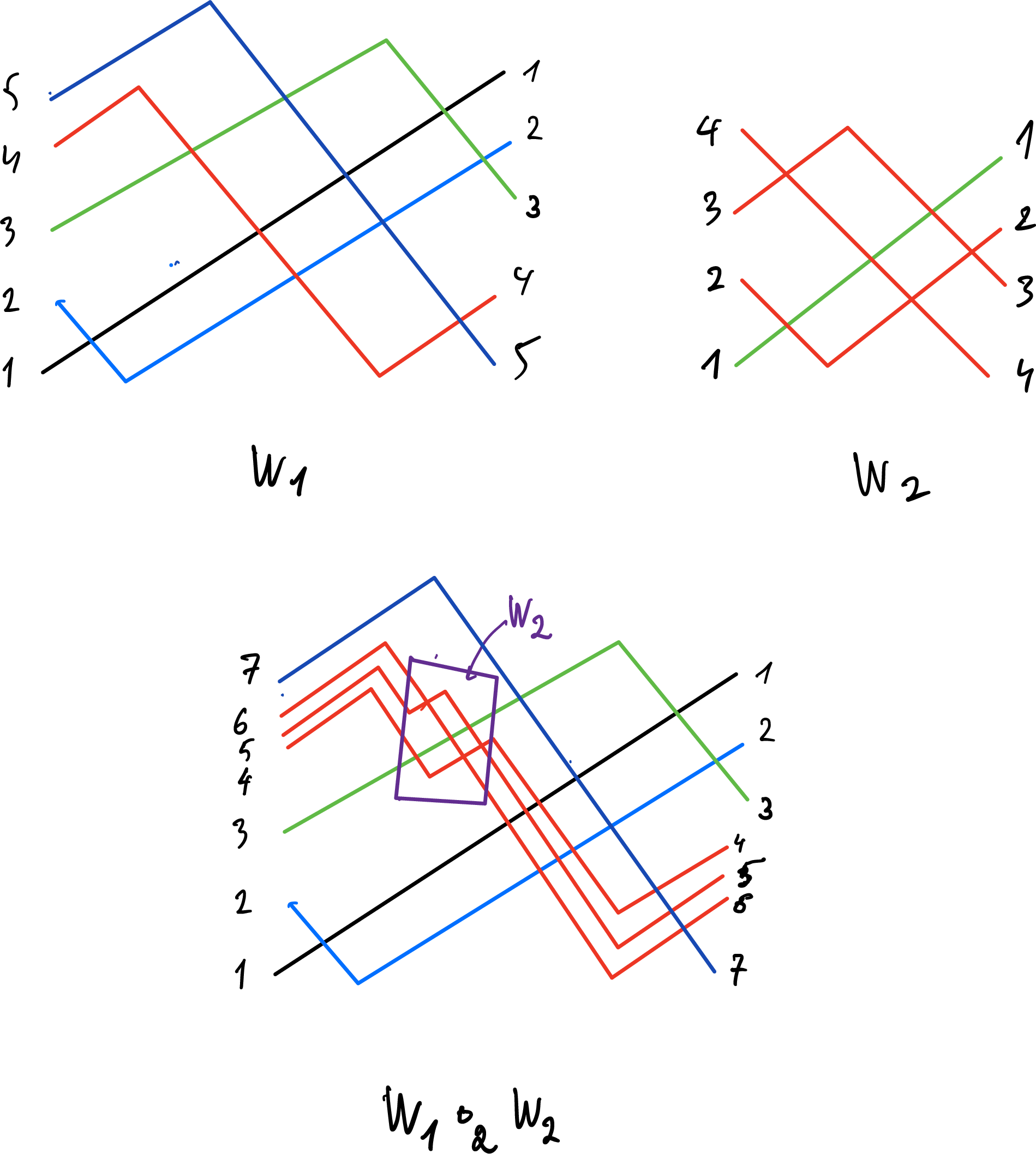
The picture below gives an example of an insertion.
We start with two elements \(w_1\in B(5,2)\) drawn as a collection of \(5\) wires, and \(w_2\in B(4,2)\) drawn as a collection of \(4\) wires.
In the picture below the element \(w_1\circ_2 w_2\in B(7,2)\) is drawn.
Corollary 1. Let \(\prec'\) be dominated by \(\prec''\), i.e.
\(Inv(\prec')\subset Inv(\prec'')\). Then \(Inv(\prec\circ_j\prec')\subset Inv(\prec\circ_j\prec'')\).
Proof. Let \[Inv (\prec\circ_j\prec'') = J_1\coprod J_2\coprod J_3\] be the decomposition (10 ) for \(Inv (\prec\circ_j\prec'')\). Then \(I_1\subset J_1\), whereas \(I_2 = J_2\) and \(I_3 = J_3\). \(\Box\)
Corollary 2. Let \(\prec\) be dominated by \(\widetilde{\prec}\), i.e.
\(Inv(\prec)\subset Inv(\widetilde{\prec})\). Then \(Inv(\prec\circ_j\prec')\subset Inv(\widetilde{\prec}\circ_j\prec')\).
Proof similar to the proof of the previous corollary.
follows from the above two corollaries since the map \(\gamma\) is a composition of insertions. \(\Box\)
For \(d=1\) or \(d=2\), the inclusion of the inversion sets, \(Inv(\prec)\subset Inv(\prec')\) implies the 1- and 2- Bruhat ordering \(\prec\) and \(\prec'\). Because of that, we get that our Bruhat operad is compatible with Bruhat orderings also for \(d=2\). For \(d\ge 3\), this is also true, see Appendix.
For a symmetric group \(S(k)\), a subset \(W\subset \Omega:=\{(i,j), i<j, i, j\in [k]\}\) is an inversion set of a permutation of \(S(k)\) if and only if for any \(i<j<l\) if \((i,j)\) and \((j,l)\in W\), then \((i,l) \in W\), and if \((i,l)\in W\), then at least one of \((i,j)\) and \((j,l)\in W\). This is nothing but Theorem 5.
Recall that the weak Bruhat order \(\tau\prec \tau'\) is defined by the inclusion \(Inv(\tau)\subset Inv(\tau')\).
A packet is a pair \((i,j)\), \(i<j\) and a weak Bruhat order is a linear order on \([n]\) such that for each pair \((i,j)\) either \(i\prec j\), or \(i\succ j\). This is nothing but an aritrary permutation of \([n]\).
Let \(\sigma\in S(n), \tau\in S(m)\), \(1\leq j \leq n\). Let us define \(\sigma\circ_j\tau\in S_{n+m-1}\) as follows.
We will use two decompositions \[[n] = [j-1]\cup \{ j\}\cup (j+[n-j]) = A\cup \{ j\}\cup B\] and \[[n] = [\sigma(j)-1]\cup \{\sigma(j)\}\cup (\sigma(j)+[n-\sigma(j)]) = A'\cup \{\sigma(j)\}\cup B'.\] Obviously \(\sigma\) induces an isomorphism \[\sigma: A\cup B \overset\sim\to A'\cup B'.\] Denote for brevity \(j':=\sigma(j)\).
Now let us stretch our decompositions to \[[n+m-1] = A\cup j - 1 + [m]\cup m + B\] and \[[n+m-1] = A'\cup j' - 1 + [m]\cup m + B'.\] As before, \(\sigma\) induces an isomorphism \[\sigma: A\cup m + B \overset\sim\to A'\cup m + B'.\] Moreover, \(\tau\) induces an isomorphism \[\tau: j - 1 + [m] \overset\sim\to j' - 1 + [m].\]
Now we define \(\rho := \sigma\circ_j\tau\in S(n+m-1)\) as follows:
\(\rho(x) = \sigma(x)\) if \(x\in A\cup m + B\),
\(\rho(x) = \tau(x)\) if \(x\in j - 1 + [m]\).
For weak Bruhat orders \(\prec\) and \(\prec'\) on \([n]\) and \([m]\), let \(\tau\) and \(\tau'\) be the corresponding permutations.
Due to the above construction, for \(j\in [n]\), the set \(Inv (\prec\circ_j\prec')\) consists of pairs \((j+l, j+k)\), \(l<k\le j+m\), if \((l,k)\in Inv (\tau')\) or pairs \((l, j+s)\), \(l<j\), \(s\le m\), if \((l,j)\in Inv(\tau)\), or \((j+t, k)\), \(t\le m\), \(j+t<k\) if \((j, k-m+1)\in Inv(\tau)\).
But such a set of inversions is exactly the inversion set of \(\tau\circ_j\tau'\). \(\Box\)
We demonstrate that the Ziegler criterion holds for the above defined set \(I(\prec\circ_j\prec')\).
Let \(L = \{l_1, \cdots , l_{d+2}\}\subset [n+m-d]\), \(l_1 < \ldots < l_{d+2}\). We use the notations of [sec:ins-higher-b].
(i) If \(L\subset B\) then the Ziegler condition for the packet \(P(L)\) holds true due to (7 ).
(ii) If \(L \subset A \cup D\cup C\) then the Ziegler condition for the packet \(P(L)\) holds true because of (8 ).
(iii) Now let \(L\) be not of the above two types. We define as before \[L^+ = L\cap (A\cup D\cup C),\] \[L^- = L\setminus L^+ = L\cap (B\setminus D).\]
Thus \(L=L^+\cup L^-\).
The packet \(P(L)\) takes the form \[P(L) = \{ L\setminus l_{d+2}, \cdots, L\setminus l_1\} = \{L_{d+2}, \ldots, L_1\}\]
(iii-a) Consider first the case \(L\cap B=\{l_2, \cdots, l_{d+2}\}\).
Due to (9 )
In such a case
\[\{\phi^{-1}(L_{d+2}), \ldots, \phi^{-1}(L_{1})\} =\] \[\{(l_1, j+1, \cdots, j+d), \ldots, (l_1, j+1, \cdots, j+d), L_1\}.\] Obviously, \(P(L)\) satisfies the Ziegler condition whether or not
\((l_1, j+1, \cdots, j+d)\) belongs to \(Inv(\prec)\) and \(L_1\) belongs to \(Inv(\prec')\).
(iii-b)
Let \[g:\;L^- \to D\] be the unique monotone map sending \(L^-\) to the rightmost elements of \(D\setminus L^+\). Denote by \[\overline{L}=L^+\cup g(L^-)\subset A\cup D\cup C\] (the union is disjoint).
For \(L\cap C=\{ l_{t+1}, \cdots, l_{d+2}\}\), there holds \[\overline{L\setminus l_{j}}= \overline{L}\setminus l_{j}, \quad j=t+1, \cdots, d+2.\]
For \(L^-=\{ l_{s+1}, \cdots , l_{t}\}\), there holds \[\label{delet1} \overline{L\setminus l_{j}}= \overline{L}\setminus g(l_{s+1}), \quad j=s+1, \cdots, t.\tag{11}\]
For \(L\cap (A\cup D)=\{l_{r+1}, \cdots, l_s\}\), we have \[\overline{L\setminus l_{j}}= \begin{cases} \overline{L}\setminus g(l_{s+1}), & if \quad l_j>g(l_{s+1})\cr \overline{L}\setminus l_j, & if \quad l_j<g(l_{s+1}). \end{cases}\]
For \(L\cap A=\{l_1, \cdots, l_r\}\), there holds \[\overline{L\setminus l_{j}}= \overline{L}\setminus l_j, \quad j=1, \cdots, r.\]
Thus, for such \(L\), the sets of the packet \(P(L)\) coincide with the sets of the packet \(P(\overline{L})\) except for \((t-s)\) sets corresponding to deleting from \(\overline{L}\) elements of \(g(L^-)\). Namely, sets of \(P(L)\) corresponding to deleting elements of \(L^-\) from \(L\), are the same, according to (11 ), and equal to \[\overline{L}\setminus g(l_{s+1}).\]
However, \(\overline{L}\setminus g(l_{s+1})\) is a set of the packet \(P(\overline{L})\) and the packet \(P(L)\), and sets of \(P(\overline{L})\) are the same at the interval ending interval of \(P(L)\) which starts at \(\overline{L}\setminus g(l_{s+1})\), and at the beginning interval which ends on the set obtained by deleting \(l_{t+1}\). Therefore, the Ziegler condition for \(P(L)\) holds true, since the beginning or ending interval of inversion sets of \(P(\overline{L})\) gives also the beginning or the ending interval of inversion sets of \(P(\overline{L})\), and the difference is the repeating set \(\overline{L}\setminus g(l_{s+1})\) in \(P(L)\).
\(\Box\)
More briefly:
(iii-a) If \(d+1\) elements of \(L\) are in \(B\) then the packet \(P(L)\) has a form \[P(L) = (M,\ldots,M, L_1).\] Such a packet obviously satisfies (Z).
(iii-b) There are at most \(d\) elements of \(L\) in \(B\).
Let \[g:\;L^- \to D\] be the unique monotone map sending \(L^-\) to the rightmost elements of \(D\setminus L^+\). Denote by \[\overline{L}=L^+\cup g(L^-)\subset A\cup D\cup C\] (the union is disjoint).
The packet \(P(L)\) has a form
\[P(L) = (\overline{L}_{d+2}, \cdots, \overline{L}_{t+1},\overline{L}_t,\overline{L}_t, \ldots, \overline{L}_t, \overline{L}_{t-s}, \overline{L}_{t-s-1},\ldots, \overline{L}_1)\] where \(s = Card(L^-\setminus D)\). Obviously such a collection satisfies the Ziegler criterion if the packet \(P(\overline{L})\) satisfies it. \(\Box\)
Lemma 3. The insertion \(\prec\circ_j\prec'\) is associative. That is \[(\prec\circ_j\prec')\circ_{j+j'}\prec''= \prec\circ_j(\prec'\circ_{j'}\prec'').\]
Proof. Consider a \(d+1\)-element subset \(L\) of \([n+m+m'-2d]\) obtained by insertion of \([m]\) instead of the team \(j+[d]\) into \([n]\) and \([m']\) instead of the team \(j+j'+ [d]\) into \([n+m-d]\). If \(L\) has a non-empty intersection with \(A\) or \(C\), then (8 ) and (9 ) gives the same \(\overline{L}\) for \((\prec\circ_j\prec')\circ_{j+j'}\prec''\) and \(\prec\circ_j(\prec'\circ_{j'}\prec'')\).
If \(L\subset (j+[m])\) then by (7 ), \(\overline{L}\) is defined by (7 9 ) for \(\prec'\circ_{j'}\prec''\), that is transformed following (7 ) or (9 ). Both transformation gives the same change of \(L\) for \((\prec\circ_j\prec')\circ_{j+j'}\prec''\), since \(L\) does not change in \(\prec\circ_j\prec'\), that is it is either inverse for both \(\prec\circ_j\prec'\) and shifted \(\prec'\) or not. \(\Box\)
The same arguments give the commutativity property.
Lemma 4. For a positive integer \(d\) and nonnegative integers \(k_0, k_1\),
there holds \[(\prec\circ_{k_0}\prec')\circ_{k_0+m+k_1}\prec''= (\prec\circ_{k_0+d+k_1}\prec'')\circ_{k_0}\prec'.\]
\(\Box\)
Fix a positive integer \(d\). In this Section we will define two planar operads. The first one, to be denoted \(HB_0^d\) and called the small (\(d\)-th) Bruhat operad, and the second one, to be denoted \(HB^d\) and called the big (\(d\)-th) Bruhat operad.
The operad \(HB_0^d\) will be a suboperad of \(HB^d\).
Denote \(HB_0^d(n) := B(nd,d)\).
Define composition maps
\[\label{compoper0} \gamma: HB_0^d(n)\times HB_0^d(m_1)\times \cdots \times HB_0^d(m_n)\to HB_0^d(m_1+\cdots +m_n)\tag{12}\] by the rule
\[\gamma(b_0; b_1, \ldots, b_n) =\] \[= (((b_0\circ_{0}b_1)\circ_{dm_1}\cdots )\circ_{dm_1\cdots + dm_{n-1}}b_n).\]
Proof. Follows from Proposition 6, Lemmata 3, 4, and 1 . \(\Box\)
We have \(HB_0^1(n) = B(n,1) = S(n)\); the insertion maps \[\circ_j:\;S(m)\times S(n) \longrightarrow S(m+n-1)\] are described in [sec:ins-perm]. The resulting operad \(HB_0^1\) appears in [10], Example 2.5, p. 21.
Denote by \(HB^d(n)\) an infinite set whose elements are triples
\[\alpha = (m, b, \mathbf{k})\] where \(m\) is an integer \(m > d\), \(b\in B(m,d)\), and \(\mathbf{k}\) is a type with \(|\mathbf{k}| = m\) such that the molecule \(M(\mathbf{k})\) has \(n\) nuclei, each of them containing \(d\) protons.
For notations see [sec:operad-molecules].
Define composition maps
\[\label{compoper} \gamma: HB^d(n)\times HB^d(m_1)\times \cdots \times HB^d(m_n)\to HB^d(m_1+\cdots + m_n)\tag{13}\] by the following rule. Let \(\alpha_0 = (m_0, b_0, \mathbf{k}_0)\in HB^d(n)\), \(\alpha_i = (m'_i, b_i, \mathbf{k}_i)\in HB^d(m_i), 1\leq i\leq n\). Let \[\mathbf{k}_0 = (k_0,d,k_1,\ldots,d,k_n)\] Then \[\gamma(\alpha_0; \alpha_1, \ldots, \alpha_n) =\] \[= (((b_0\circ_{k_0}b_1)\cdots )\circ_{k_0+m_1+k_1+\cdots +k_{n-2}+m_{n-1}}b_n).\]
Theorem 8. The collection \(HB^d(n)\) \(n\ge 1\) with the compositions (13 )* forms a planar operad \(HB^d\). We have an embedding of operads \(HB_0^d\subset HB^d\).*
Proof. Follows from Proposition 6, Lemmata 3, 4, and 1 . \(\Box\)
For \(d\le 2\), due to Corollary 1 these planar operads are compatible with the \(d\)-th Bruhat order.
Part II. MULTIPLICATION
Let \(\mathcal{O} = \{\mathcal{O}(n), n\geq 0\}\) be a planar operad in the category \(Sets\) of sets3. Recall that this means that we are given a collection of sets \(\mathcal{O}(n)\) together with composition maps \[\gamma: \mathcal{O}(n)\times \mathcal{O}(m_1)\times\ldots\times \mathcal{O}(m_n)\to \mathcal{O}(\sum_i m_i)\] and a unit element \(1\in\mathcal{O}(1)\) satisfying some identities.
Recall that defining an operadic composition is equivalent to defining a family of insertion, or blowing up, maps \[\label{ins} \circ_j:\;\mathcal{O}(n)\times\mathcal{O}(m)\to \mathcal{O}(n+m-1),\;0\leq j\leq n - 1,\tag{14}\] satisfying some simple identities, cf. [sec:part-comp].
Following [2], Def. 3.1, let us call an operad with multiplication a planar operad \(\mathcal{O}\) equipped with elements \(e\in \mathcal{O}(0), \mu\in \mathcal{O}(2)\) such that \[\mu\circ_0\mu = \mu\circ_1\mu\] and \[\mu\circ_0 e = \mu\circ_1 e = 1\in \mathcal{O}(1).\]
Change of notation. We warn the reader that to be coherent with our previous notation the numbering of insertions will be shifted by \(1\) from the numbering of [2]: they will start from \(\circ_0\), and not from \(\circ_1\) as in [2].
Below we will show that our small and big Bruhat operads are in fact operads with multiplication.
It is proven in [2] that an operad with multiplication \(\mathcal{O} = \{\mathcal{O}(n)\}\) gives rise to a cosimplicial set \(X = \{ X^n\}\) whose set of cosimplices \(X^n\) is \(\mathcal{O}(n)\), see [sec:cos-sets] below.
Moreover this cosimplicial set acquires a family of maps \[\cdot : X^m\times X^n \to X^{m+n}\] compatible, in an appropriate sense, with cofaces and codegeneracies, cf. (16 ) - (18 ) below. Finally it is equipped with a family of elements \(e_n\in X^n\) such that the collection of singletons \(Y = \{ e_n\}\) is a cosimplicial subset of \(X\).
We call such structures cosimplicial sets with multiplication, and in such a way we get an equivalence of the category of operads with multiplication and the category of cosimplicial sets with multiplication, cf. Thm. [sec:equiv-ops-cos] below.
Families of objects with insertions (14 ) appeared first (in an additive situation) in [11] under the name of pre-Lie systems, cf. op. cit., Section 5. It is proven in op. cit., Section 6 that a pre-Lie system gives rise to a graded Lie algebra, see [sec:graded-lie] below.
Sections 3 and 4 contain the main results of this paper. Recall that we have introduced two kinds of operads: small Bruhat operads \({\cal B}_d\) and big Bruhat operads \({\cal{BB}}_d\); the big one contains the small one as a suboperad.
In Section 3 we shew that \({\cal B}_d\) are operads with multiplication see Thm. [sec:small-bruhat-mult], whereas in Section 4 we shew that \({\cal{BB}}_d\) are operads with multiplication, see Thm. [sec:big-bruhat-mult].
Let \(Ass\) denote a planar operad with \(Ass(n)\) being a singleton \(\{ e_n\}\) for all \(n\), with a unique collection of compositions \(\gamma\) and \(1 = e_1\in Ass(1)\) satisfying the operadic identities.
An operad with multiplication is the same as a planar operad \(\mathcal{O}\) equipped with a morphism of planar operads \[\nu:\;Ass\to \mathcal{O},\] cf. [2], Rem. 3.2 (i).
Namely, given \(\nu\) as above, we define \(e:= \nu(e_0), \mu = \nu(e_2)\).
Abusing the notation we will denote by the same symbol \(e_n\) the element \(\nu(e_n)\in{\cal O}(n)\).
Let \((\mathcal{O}, e, \mu)\) be an operad with multiplication. Following [2], Section 3, (10), p. 13, we assign to it a cosimplicial set \(C({\cal O}) = C(\mathcal{O},\mu,e) = \{ C^n({\cal O})\}\) as follows.
We set \(C^n({\cal O}) := \mathcal{O}(n)\). Define the cofaces \(d^i: C^n({\cal O})\to C^{n+1}({\cal O})\) as follows:
\(d^0(x) = \mu\circ_1 x; d^i(x) = x\circ_{i-1}\mu, 1 \leq i \leq n\), \(d^{n+1}(x) = \mu\circ_0 x\)
Define the codegeneracies \(s^i: C^n({\cal O})\to C^{n-1}({\cal O})\) by \(s^i(x) = x\circ_{i}e\).
Let \((\mathcal{O}, e, \mu)\) be an operad with multiplication. We have operadic compositions \[\gamma_{2;m,n}:\;\mathcal{O}(2)\times\mathcal{O}(m)\times \mathcal{O}(n)\to \mathcal{O}(m+n),\] whence the maps \[\cdot :\;\mathcal{O}(m)\times \mathcal{O}(n)\to \mathcal{O}(m+n),\;\] \[x\cdot y = \gamma_{2;m,n}(\mu;x,y)\]
The multiplications \(\cdot\) are associative.
Cf. [12], Prop. 2, (5).
They induce associative multiplications on the corresponding cosimplicial set
\(X = F(\mathcal{O},\mu,e)\), i.e. a family of maps
\[\label{mult-cos} \cdot:\;X^m\times X^n \to X^{m+n}\tag{15}\]
which satisfy the following compatibilities with cofaces and codegeneracies:
\[\label{comp-cos-a} d^i(x\cdot y) = (d^ix)\cdot y\;\text{if}\;i\leq m,\;= x\cdot d^{i-m}y\;\text{if}\;i>m;\tag{16}\]
\[\label{comp-cos-b} s^i(x\cdot y) = (s^ix)\cdot y\;\text{if}\;i\leq m-1,\;= x\cdot s^{i-m}y\;\text{if}\;i\geq m\tag{17}\]
("Leibnitz rules"), and
\[\label{comp-cos-c} (d^{m+1}x)\cdot y = x\cdot d^0y.\tag{18}\]
cf. [2], Def. 2.1 and Rem. 3.2 (ii).
So we have two kinds of multiplications: \(\cdot\) and \(\circ_j\).
Moreover, in each \(X^n\) we have a distinguished element \(e_n\in X_n\) such that \[\label{units-a} d^i(e_n) = e_{n+1},\;s^i(e_n) = e_{n-1},\tag{19}\] and \[\label{units-b} e_n\cdot e_m = e_{n+m}.\tag{20}\]
For all \(m, n, i\) \[e_m\circ_i e_n = e_{m+n-1}\]
A cosimplicial set with multiplication is a cosimplicial set \(X\) equipped with a family of multiplications (15 ) satisfying the identities (16 ) - (18 ) and with a family of elements \(e_n\in X^n\) satisfying the identities (19 ) and (20 ).
Thus we have defined a functor \[F: Opmult \to Cosmult\] from the category of planar operads with multiplication to the category of cosimplicial sets with multiplication.
The functor \(F\) is an equivalence of categories. \(\Box\)
From now on till the end of this Section we will deal with a planar operad \(\mathcal{V} = \{V(n)\}\) in an additive tensor category. Following [11], Section 6 define operations \[\circ:\;V(m)\otimes V(n) \to V(m+n-1)\] by \[x_m\circ x_n = \sum_{i=0}^{m-1} (-1)^{(n+1)i} x_m\circ_i x_n.\] For example:
\[e_m\circ e_n= \begin{cases} me_{m+n-1} & \text{if} \, n \, \text{is} \, \text{odd},\cr e_{m+n-1} & \text{if} \, n \, \text{is} \, \text{even}, \, m\, \text{is} \, \text{odd},\cr 0 & \text{if} \, m\, \text{and} \, n\, \text{are}\, \text{even}. \end{cases}\]
Let us introduce a bracket \[[ , ]: V(m)\otimes V(n) \to V(m+n-1)\] by \[[x_m, x_n] = x_m\circ x_n - (-1)^{(m-1)(n-1)} x_n\circ x_m.\] Let us consider the graded space \(V[1] = \oplus_n V(n)\), with \(V(n)\) sitting in degree \(n+1\).
The results of [11], Section 6 say that \(V[1]\) with the above bracket \([ , ]\) becomes a graded Lie algebra.
Warning. The operation \(\circ\) is not associative, so the statement about a Lie algebra is not automatic.
The structures below appear first in [11], Section 7 for the Hochschild complex of an associative ring, and for an arbitrary operad with multiplication (in an additive category) in [12], Section 1.
Suppose in addition to the previous assumptions that \(\mathcal{V}\) is an operad with multiplication. Then we get two news:
(a) The collection \(V^\bullet = \{ V(n), n\geq 0\}\) becomes a cosimplicial set, whence we have differentials \[d: V(n) \to V(n+1)\] defined as usual as alternating sums of cofaces, \[d = \sum_{i=0}^{n+1} (-1)^id^i.\] Similarly we may define \[s: V(n) \to V(n-1)\] by \[s = \sum_{i=0}^{n-1} (-1)^is^i.\]
(b) We have associative multiplications \(\cdot: V(n)\otimes V(m) \to V(n+m)\).
Warning. The multiplication \(\cdot\) is not commutative in general but it is commutative up to a homotopy, see Theorem [sec:homot-g] below.
In particular we have an element \(\pi = 1\cdot 1\in V(2)\).
(i) \(\pi = d(1) = \mu\). (ii) \(V = \oplus_n V(n)\) equipped with the differential \(d\) is a DG associative algebra.
See [12], Section 1, Prop. 2 (5).
We have
(a) \(d(e_n) = 0\) if \(n\) is even, and \(d(e_n) = e_{n+1}\) if \(n\) is odd.
(b) \(s(e_n) = 0\) if \(n\) is even, and \(s(e_n) = e_{n-1}\) if \(n\) is odd.
Let us denote by \(H^\cdot(V)\) the cohomology of \(V = \oplus_n V(n)\) with respect to \(d\).
We have \[x_m\cdot x_n = (\pi\circ_0 x_m)\circ_{m}x_n.\] for all \(m, n\).
Cf. [11], Section 7, (22).
Now we have a fundamental
For all \(x_m\in V(m), x_n\in V(n)\) \[\label{homot-g-relation} - d(x_m\circ x_n) + (-1)^{n-1}dx_m\circ x_n + x_m\circ dx_n = (-1)^{n-1}(x_n\cdot x_m - (-1)^{mn}x_m\cdot x_n)\qquad{(3)}\]
Cf. [11], Section 7, Thm. 3; [12], Section 1, (9).
Moreover a trilinear operation \[h: V\otimes V\otimes V\to V[-2]\] is introduced in [12] such that for all \(x_m\in V(m), x_n\in V(n), x_k\in V(k)\) \[[x_m, x_n\cdot x_k] - [x_m, x_n]\cdot x_k - (-1)^{m(n+1)}x_n\cdot [x_m, x_k] =\] \[= (-1)^{m+n}(dh(x_m\otimes x_n\otimes x_k) - hd(x_m\otimes x_n\otimes x_k)),\] see op. cit. (8).
The Lie bracket \([ , ]\) induces a Lie bracket on \(H^\cdot(V)\).
It follows that \(H^\cdot(V)\) is a \(1\)-shifted Poisson, or Gerstenhaber, algebra.
Let us call a Gerstenhaber - Voronov (GV) algebra in an additive tensor category \(\mathcal{A}\) a complex \(V^\bullet\) in \(\mathcal{A}\) with a differential \(d\) of degree \(1\) equipped with three operations:
(i) a multiplication of degree \(0\) \[\cdot: V^\bullet\otimes V^\bullet \to V^\bullet\] making \(V^\bullet\) an associative DG algebra;
(ii) an operation of degree \(-1\) \[\circ: V^\bullet\otimes V^\bullet \to V^\bullet[-1]\] such that if we define a bracket \[[ , ]: V^\bullet\otimes V^\bullet \to V^\bullet[-1]\] by \[[x_n, x_m] = x_n\circ x_m - (-1)^{(n-1)(m-1)} x_m\circ x_n\] then \((V^\bullet[1], [ , ][1])\) becomes a graded Lie algebra;
(iii) an operation of degree \(-2\) \[h: V^\bullet\otimes V^\bullet\otimes V^\bullet \to V^\bullet[-2]\] such that \[[x_m, x_n\cdot x_k] - [x_m, x_n]\cdot x_k - (-1)^{m(n+1)}x_n\cdot [x_m, x_k] =\] \[= (-1)^{m+n+1}(dh(x_m\otimes x_n\otimes x_k) - hd(x_m\otimes x_n\otimes x_k)).\]
(iv) The identity \[- d(x_m\circ x_n) + (-1)^{n-1}dx_m\circ x_n + x_m\circ dx_n = (-1)^{n-1}(x_n\cdot x_m - (-1)^{mn}x_m\cdot x_n)\] should hold. \(\Box\)
If \(V^\bullet\) is a GV algebra then its cohomology \(H^\bullet(V^\bullet)\) will be a Gerstenhaber algebra.
The formula (?? ) resembles but should not be confused with the defining relation of a BV algebra.
Recall (cf. for example [13], Part II, Def. 2.1) that a Batalin - Vilkovisky (BV) algebra is a graded object \(B^\bullet = \{ B^n\}\) equipped with a differential of degree \(1\), a graded commutative and associative multiplication \(\cdot\) of degree \(0\), and a Lie bracket \([ , ]\) of degree \(-1\) such that if we forget \(d\), \(B^\bullet\) is a Gerstenhaber algebra, and
for all \(a\in B^m, b\in B^n\) \[\label{bv-relation} d(a\cdot b) - da\cdot b - (-1)^ma\cdot db = (-1)^m [a, b],\tag{21}\] compare this with (?? ).
Let \(d\) be a positive integer. Let \(B(m,d)\) denote the set of \(d\)-th Bruhat orders for the discrete Grassmanian \(G(n,d)\) of subsets of cardinality \(d\) in \([n] = \{1,\ldots,n\}\), cf. [14]. Recall the insertion operations \[\label{ins-bruhat} \circ_j:\;B(m,d)\times B(n,d)\to B(m+n-d,d), 0\leq j\leq m+n-d,\tag{22}\] introduced in [sec:ins-higher-b].
Based on these operations, a planar operad in \(Sets\), to be denoted
\(\mathcal{B}_d = \{\mathcal{B}_d(n)\}\) here, has been introduced in [sec:small-br-op], called the small Bruhat operad. By
definition \(\mathcal{B}_d(n) = B(nd,d)\).
The operadic compositions are defined in [sec:small-br-op]. Recall this formula: the map \[\gamma: {\cal B}_d(n)\times {\cal B}_d(m_1)\times \cdots \times {\cal B}_d(m_n)\to {\cal B}_d(m_1+\cdots +m_n)\] is given by \[\label{gamma-formula} \gamma(b_0; b_1, \ldots, b_n) = (((b_0\circ_{0}b_1)\circ_{dm_1}\cdots )\circ_{dm_1\cdots + dm_{n-1}}b_n)\tag{23}\] for \(b_0\in B(nd,d), b_i\in B(m_id, d), 1\leq i\leq n\).
Warning: the insertion operations corresponding to compositions \(\gamma\) should not be confused with the operations (22 ): we see from (23 ) that their numerotation is multiplied by \(d\).
Our aim in this Section will be to equip \(\mathcal{B}_d\) with a structure of an operad with multiplication.
the case \(d = 1\). The set \(B(n,1)\) is the symmetric group \(S(n) = Aut([n])\). It is equipped with the classical weak Bruhat order for which the minimal element is the identity permutation \(e_n\in S(n)\), and the maximal one is the permutation of the maximal length \((n,n-1, \ldots, 2,1)\).
We set \([0] = \emptyset\), \(\mathcal{B}_1(0) = S(0) = Aut([0])\); it is the singleton with the unique element \(e_0\).
The insertion operations are \[\circ_j: S(n)\times S(m) \to S(n+m-1),\] see [sec:ins-perm].
They make perfect sense for \(m = 0\) as well, whence the maps \[s^i := \circ_j: S(n) = S(n)\times S(0) \to S(n-1),\;0\leq j \leq n-1,\] which are the codegeneracies in the corresponding cosimplicial set.
For \(n = 3\) we have \[s^1(123) = s^2(123) = (12),\;s^3(123) = e.\] Here \((123)\) denotes as usually the cyclic permutation, taking \(1\) to \(2\), \(2\) to \(3\), and \(3\) to \(1\).
The triple \((\mathcal{B}_1, e_0, e_2)\) is an operad with multiplication in \(Sets\).
We can linearize this operad. For a set \(I\) let \(\mathbb{Z}I\) denote the free abelian group with base \(I\). We have an obious embedding of sets \(I\subset \mathbb{Z}I\).
Let \(\mathbb{Z}\mathcal{B}_1 = \{\mathbb{Z}\mathcal{B}_1(n)\}\) denote the planar operad in the tensor category \(Ab\) of abelian groups, with \(\mathbb{Z}\mathcal{B}_1(n) = \mathbb{Z}S(n)\), and operadic compositions induced by the compositions in \(\mathcal{B}_1\). Then \((\mathbb{Z}\mathcal{B}_1, e_0, e_2)\) will be an operad with multiplication in \(Ab\).
It gives rise to a GV algebra in \(Ab\), to be denoted by \({\mathbb{Z}}\mathbb{S}^\bullet\), with \({\mathbb{Z}}\mathbb{S}^n = \mathbb{Z}S(n)\).
Theorem 9. We have \(H^0({\mathbb{Z}}S^\bullet)={\mathbb{Z}}e_0\), and \(H^n({\mathbb{Z}}S^\bullet)=0\) for \(n>0\).
Set \(C^n={\mathbb{Z}}S(n)\), and write \(\delta^n=\sum_{i=0}^{n+1}(-1)^i d^i:C^n\to C^{n+1}\). For \(n\geq 1\) define the contracting homotopy \(h_n:C^n\to C^{n-1}\) on basis permutations \(\sigma=(\sigma_1,\ldots,\sigma_n)\) by \[h_n(\sigma)= \begin{cases} (\sigma_2-1,\ldots,\sigma_n-1),& \sigma_1=1,\\ 0,& \sigma_1\neq 1. \end{cases}\] For \(n=1\), the first case is understood as \(e_0\in S(0)\).
We claim that, for every \(n\geq 1\), \[\delta^{n-1}h_n+h_{n+1}\delta^n=\operatorname{id}_{C^n}.\] It is enough to check this on a basis element \(\sigma=(\sigma_1,\ldots,\sigma_n)\). We use the following description of the cofaces: \(d^0\sigma=(1,\sigma_1+1,\ldots,\sigma_n+1)\), \(d^{n+1}\sigma=(\sigma_1,\ldots,\sigma_n,n+1)\), and, for \(1\leq i\leq n\), \(d^i\sigma\) is obtained by splitting the \(i\)-th point of \(\sigma\).
First suppose that \(\sigma_1\neq 1\). Then \(h_n\sigma=0\). Among the cofaces of \(\sigma\), only \(d^0\sigma\) begins with \(1\). Hence \(h_{n+1}d^0\sigma=\sigma\) and \(h_{n+1}d^i\sigma=0\) for \(1\leq i\leq n+1\). Thus \((\delta^{n-1}h_n+h_{n+1}\delta^n)\sigma=\sigma\).
Now suppose that \(\sigma_1=1\), and put \(\overline{\sigma}=h_n\sigma=(\sigma_2-1,\ldots,\sigma_n-1)\). Then \(h_{n+1}d^0\sigma=\sigma\), and, for \(1\leq i\leq n+1\), \(h_{n+1}d^i\sigma=d^{i-1}\overline{\sigma}\). Therefore \[h_{n+1}\delta^n\sigma =\sigma+\sum_{i=1}^{n+1}(-1)^i d^{i-1}\overline{\sigma} =\sigma-\sum_{i=0}^{n}(-1)^i d^i\overline{\sigma} =\sigma-\delta^{n-1}\overline{\sigma}.\] Since \(\overline{\sigma}=h_n\sigma\), adding \(\delta^{n-1}h_n\sigma\) gives \(\sigma\). This proves the claim.
If \(z\in C^n\), \(n>0\), and \(\delta^n z=0\), then the claim gives \(z=\delta^{n-1}h_nz\). Thus every positive-degree cocycle is a coboundary, so \(H^n({\mathbb{Z}}S^\bullet)=0\) for \(n>0\). In degree zero, \(C^0={\mathbb{Z}}e_0\) and \(\delta^0(e_0)=d^0(e_0)-d^1(e_0)=e_1-e_1=0\). There is no incoming differential into \(C^0\), hence \(H^0({\mathbb{Z}}S^\bullet)={\mathbb{Z}}e_0\). \(\ \vrule width.1cm height.3cm depth0cm\)
Let now \(d\) be arbitrary. Recall that the sets \(B(m,d)\) are all ranged posets. Let \(e_{m,d}\in B(m,d)\) denote the minimal element. It is caracterized by the property \(Inv(e_{m,d}) = \emptyset\).
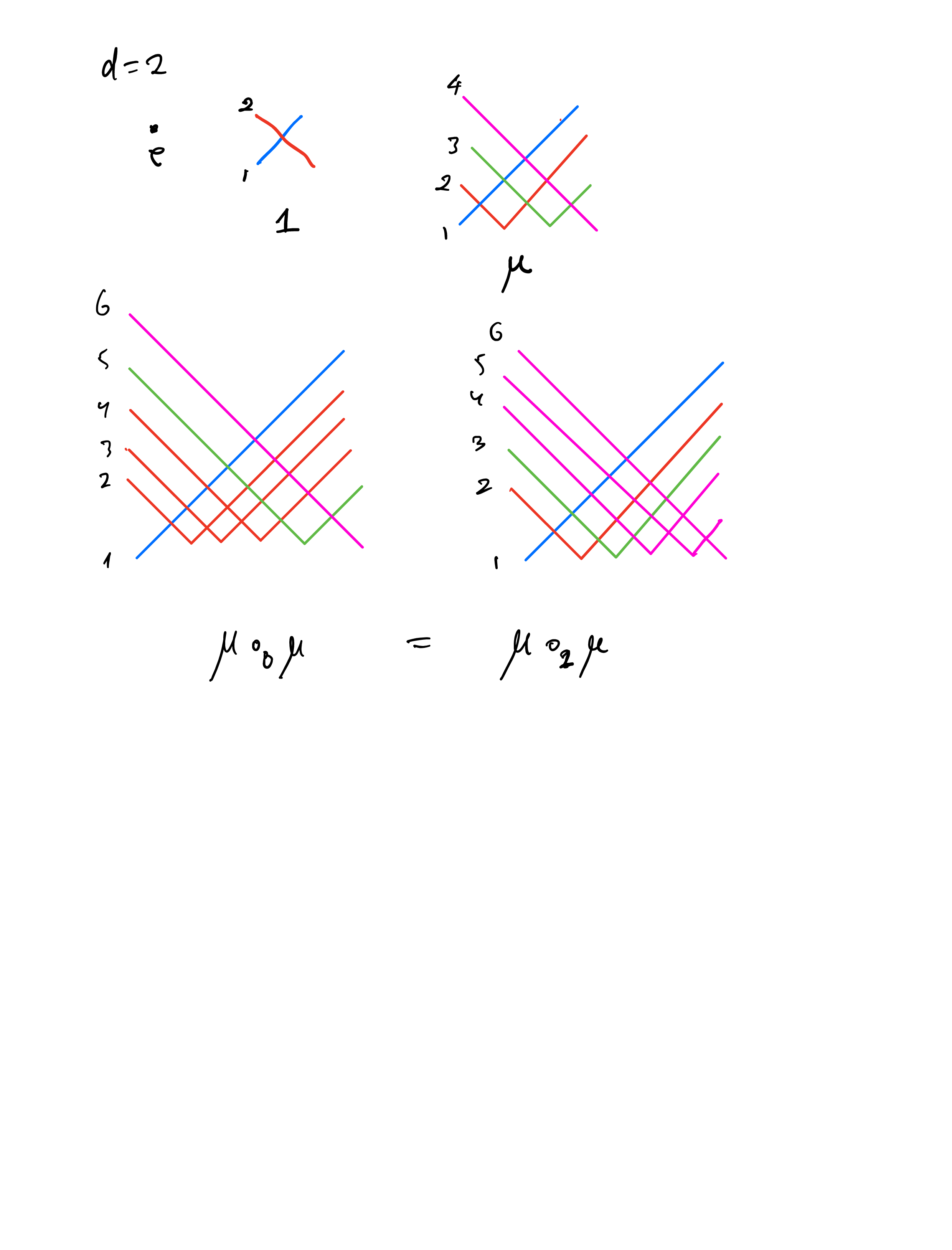
Elements of \(B(m,2)\) are chains connecting the trivial permutation \(e\in S(n) = B(n,1)\) with the maximal one (modulo some equivalence relation). They may be depicted by planar diagrams.
On Fig. 3 below some unit elements \(e_{m,2}\in B(m,2)\) are shewn.
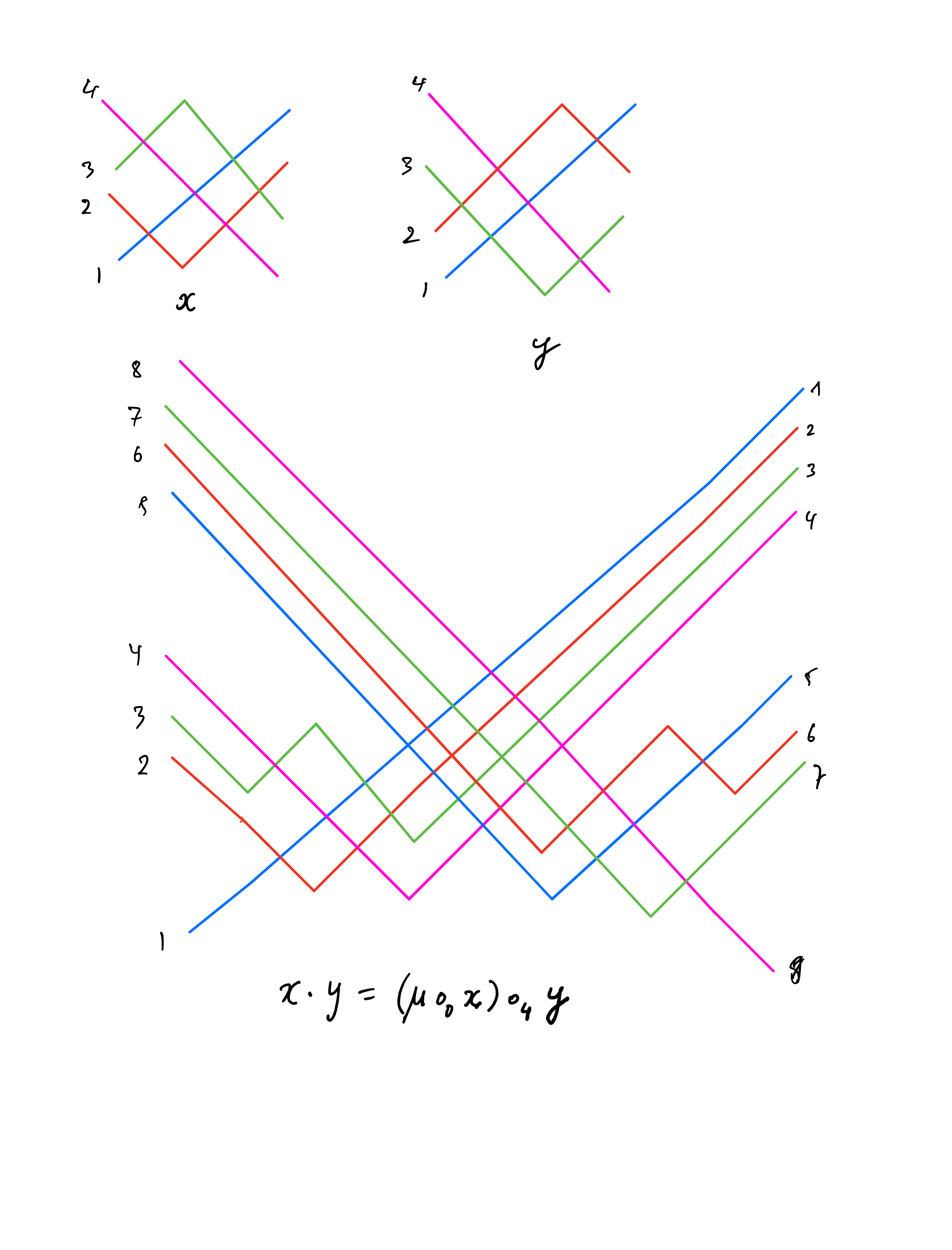
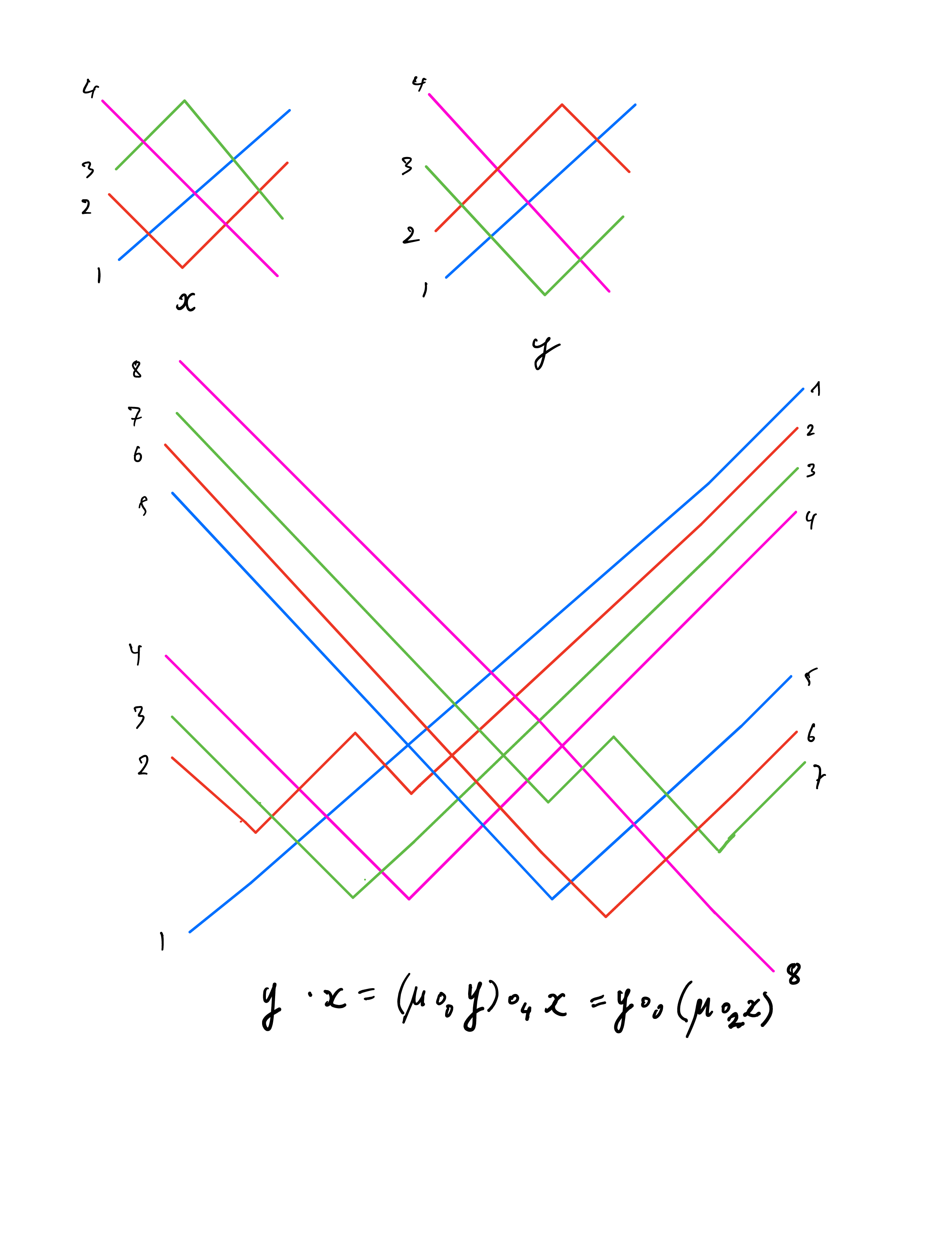
On Figures 4, 5 an example of the products \(x\cdot y\) and \(y\cdot x\) is shewn; we see that the multiplication is not commutative.
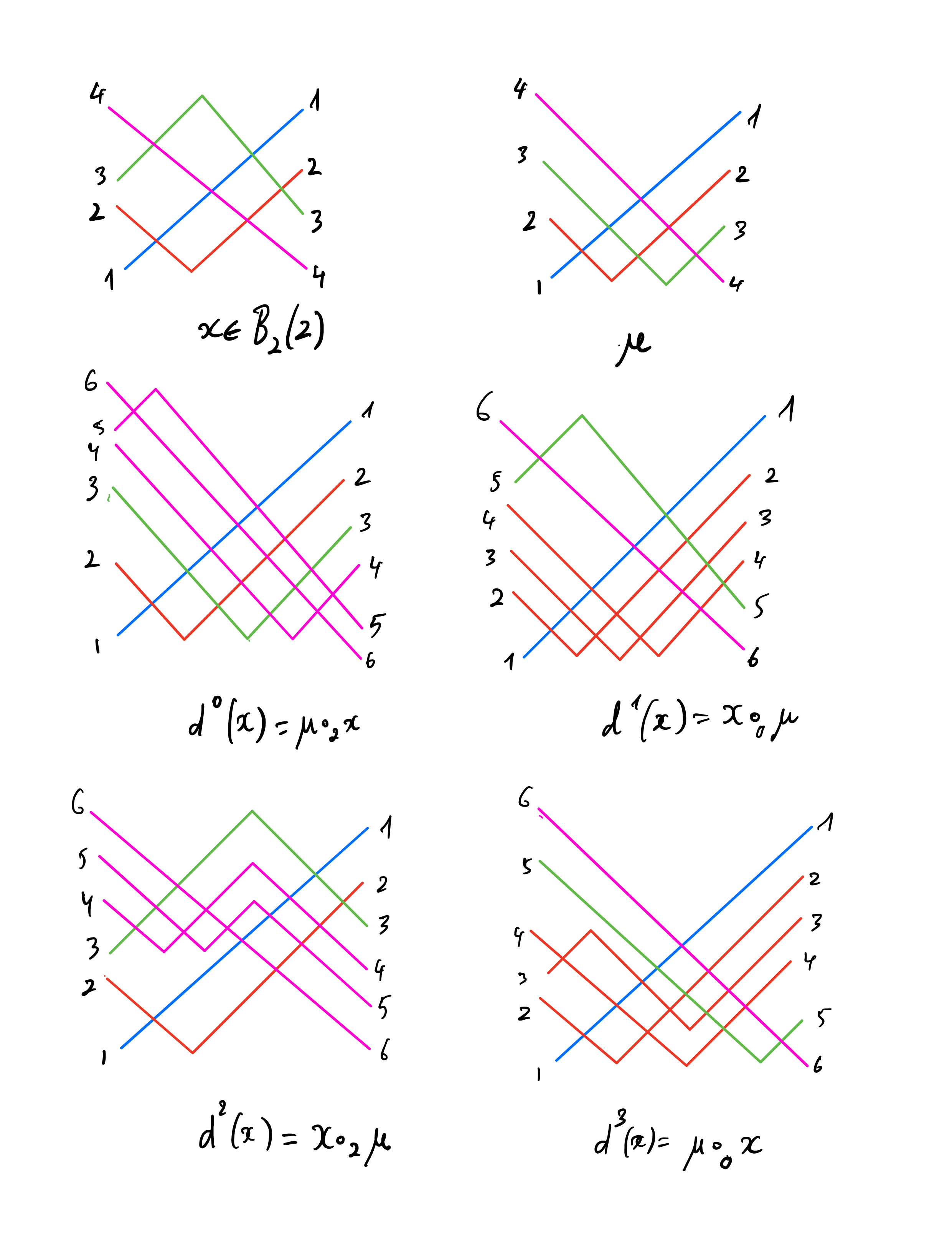
On Figure 6 all the cofaces of an element \(x\in{\cal B}_2(2)\) are shewn
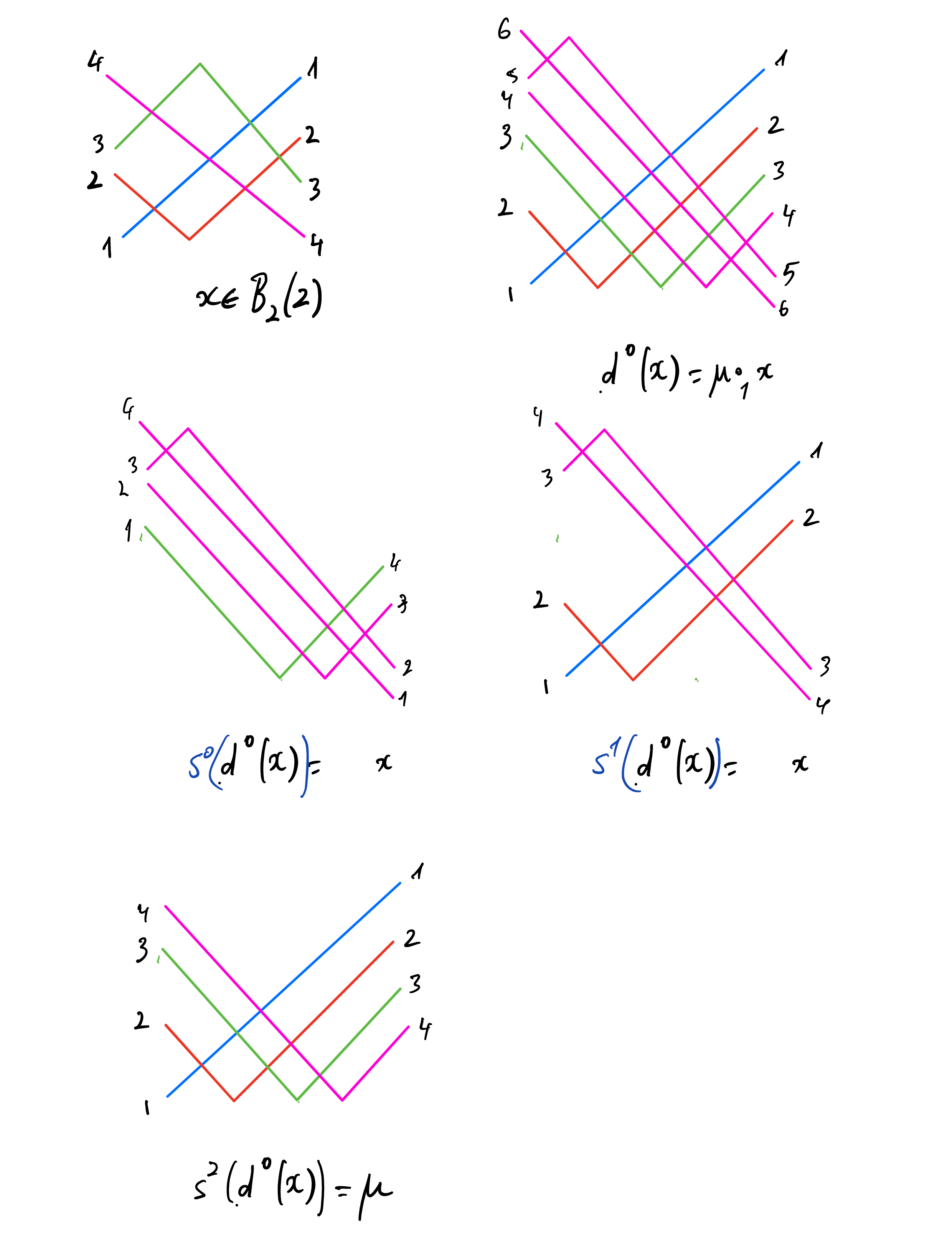
On Figure 7 all the codegeneracies of the element \(d^0(x)\in{\cal B}_2(3)\) are shewn
Denote \(e_n := e_{nd,d}\in B(nd,d) = \mathcal{B}_d(n)\). The triple \((\mathcal{B}_d, e_0, e_2)\) is an operad with multiplication.
Linearizing as for the case \(d = 1\) we get an operad \(\mathbb{Z}\mathcal{B}_d\) in \(Ab\).
Similarly using the elements \(e_{m,d}\) one defines a structure of an operad with multiplication on the big Bruhat operads from [sec:big-br-op].
Let us recall the necessary definitions. Let us call a type a sequence \[\mathbf{k} = (k_0,d,k_1,d,\ldots, k_{n-1},d,k_n)\] where \(k_i\) are nonnegative integers. We denote \(N = N(\mathbf{k}) := nd + \sum_{i=0}^n k_i\).
Consider the interval \[I := [N(\mathbf{k})] = \{1, \ldots, N(\mathbf{k})\};\] its elements will be called particles.
Inside \(I\) we have \(n\) subintervals of length \(d\) \[I_j = k_j + jd + [d],\;1\leq j\leq n\] called nuclei, whose elements are called protons. Elements of the complement \(I\setminus\cup_{j=1}^n I_j\) are called electrons.
This interval \(I\) together with the above decomposition into \(n\) nuclei of length \(d\) and \(N - nd\) electrons is called the molecule of type \(\mathbf{k}\) and denoted \(M(\mathbf{k})\).
Let \({\cal M}_d(n)\) denote the set of all molecules of all types containing \(n\) nuclei of length \(d\). It is shown in [sec:operad-molecules] that they form a planar operad \({\cal M}_d = \{{\cal M}_d(n), n\geq 0\}\), called the Master operad.
We did not use the set \({\cal M}_d(0)\) in op. cit. but our definition makes perfect sense for \(n = 0\) as well and unlike the case of small Bruhat operad this set is not a singleton. Obviously all \({\cal M}_d(n)\) are in bijection with \({\mathbb{N}}^{n+1}\).
For any \(n\) let \(e_n\in {\cal M}_d(n)\) denote the element with no electrons, i.e. of type \[\mathbf{k}_0(n) := (0,d,0,\ldots, 0,d,0)\] Then \(({\cal M}_d, e_0, e_2)\) is an operad with multiplication.
The \(d\)-th big Bruhat operad, to be denoted \({\cal{BB}}_d = \{{\cal{BB}}_d(n)\}\) here, is defined as follows, cf. [sec:big-br-op].
Elements of \({\cal{BB}}_d(n)\) are couples \((b,\mathbf{k})\) where \(\mathbf{k}\in {\cal M}_d(n)\), \(b\in B(m,d)\) with \(m = N(\mathbf{k})\).
Let \({\cal{BB}}^0_d(n)\subset {\cal{BB}}_d(n)\) denote the subset of couples of the form \((e_{m,d},\mathbf{k})\).
The collection \(\{{\cal{BB}}_d^0(n), n\geq 0\}\) is closed with respect to the operadic composition, so it forms a suboperad \({\cal{BB}}^0_d\subset {\cal{BB}}_d\). This suboperad is isomorphic to \({\cal M}_d\).
In particular we have the elements \[e_n = (nd, e_{nd,d}, \mathbf{k}_0(n))\in {\cal{BB}}_d^0(n)\subset {\cal{BB}}_d(n).\]
The triple \(({\cal{BB}}_d, e_0, e_2)\) is an operad with multiplication in \(Sets\).
Part III. APPENDIX by DARIA POLIAKOVA
The purpose of this Appendix is to prove the a strengthening of Corollary 5.4.
Elements of \(B(n,d)\) carry two natural orders. The first one is the dominance order, defined by inclusion of inversion sets. The second one is the flip order, whose covering relations are the increasing flips, i.e. the addition of one inversion. Corollaries 5.3 and 5.4 show that insertion respects the dominance order in the second and in the first argument, respectively. For Corollary 5.3 the corresponding statement for the flip order is immediate: one inversion in the second argument becomes one shifted inversion after insertion. For Corollary 5.4, an additional argument is required.
Theorem 10. The insertion operations are monotone for the flip order. Let \(\prec, \widetilde{\prec}\in B(n,d)\), let \(\prec',\prec''\in B(m,d)\), and let \(j\) be an admissible insertion place. Then \[\prec' \leq_{\mathrm{fl}} \prec'' \quad\Longrightarrow\quad \prec\circ_j\prec' \leq_{\mathrm{fl}} \prec\circ_j\prec'',\] and \[\prec \leq_{\mathrm{fl}} \widetilde{\prec} \quad\Longrightarrow\quad \prec\circ_j\prec' \leq_{\mathrm{fl}} \widetilde{\prec}\circ_j\prec' .\]
For the proof, recall the insertion construction from 5.8. Let \(\prec\in B(n,d)\), \(\prec'\in B(m,d)\), and \(0\leq j\leq n-d\). The insertion \(\prec\circ_j\prec'\in B(n+m-d,d)\) is defined by its inversion set. Identify \([n+m-d]=A\sqcup B\sqcup C\), where \(A=[j]\), \(B=j+[m]\), and \(C=j+m+[\,n-(j+d)\,]\), and let \(D=j+[d]\subset B\). We identify \([m]\) with \(B\) by translation by \(j\), and \([n]\) with \(A\sqcup D\sqcup C\) by the monotone bijection \(\phi:[n]\to A\sqcup D\sqcup C\). For \(L\in\binom{A\sqcup B\sqcup C}{d+1}\), consider three cases. If \(L\subset B\), then \(L\in\operatorname{Inv}(\prec\circ_j\prec')\) if and only if \(L-j\in\operatorname{Inv}(\prec')\). If \(L\subset A\sqcup D\sqcup C\), then \(L\in\operatorname{Inv}(\prec\circ_j\prec')\) if and only if \(\phi^{-1}(L)\in\operatorname{Inv}(\prec)\). Finally, in the remaining case, define \(\overline{L}\) by moving the elements of \(L\) that are in \(B\setminus D\) into the rightmost available positions of \(D\). Then \(L\in\operatorname{Inv}(\prec\circ_j\prec')\) if and only if \(\phi^{-1}(\overline{L})\in\operatorname{Inv}(\prec)\).
If \(\prec''\) is obtained from \(\prec'\) by an increasing flip adding \(F\in\binom{[m]}{d+1}\), then, by the case \(L\subset B\) in the definition of insertion, \(\prec\circ_j\prec''\) is obtained from \(\prec\circ_j\prec'\) by the single increasing flip adding \(j+F\subset B\); hence the monotonicity in the second argument follows by iteration. It remains to prove the monotonicity in the first argument, and again it is enough to assume that \(\widetilde{\prec}\) is obtained from \(\prec\) by one increasing flip, that is, \(\operatorname{Inv}(\widetilde{\prec})=\operatorname{Inv}(\prec)\sqcup\{K\}\), \(K\in\binom{[n]}{d+1}\). We then need to show that there is a sequence of increasing flips from \(\prec\circ_j\prec'\) to \(\widetilde{\prec}\circ_j\prec'\).
The strategy of our proof is as follows.
We first describe the set of flips that we need, and identify them with \(q\)-subsets of some set \(H\).
We then construct an element of \(B(|H|,q)\) by its inversion set, and check the Z-criterion.
We then choose a lift to an admissible order in \(A(|H|,q)\), and show that the flips can be performed in this order, i.e. that each newly obtained set satisfies the Z-criterion.
0.0.0.1 Step 1.
We need to describe the inversions that are in \(\operatorname{Inv}(\widetilde{\prec}\circ_j\prec')\) but not in \(\operatorname{Inv}(\prec\circ_j\prec')\); these are our flips of interest. Put \(K^\phi:=\phi(K)\subset A\sqcup D\sqcup C\), and set formally \(\overline{K^\phi}=K^\phi\). The flips of interest correspond to \[L \in \binom{A \sqcup B \sqcup C}{d+1}\] such that \(\overline{L} = K^\phi\). Let \(Q\) be the terminal segment of \(D\) occupied by elements of \(K^\phi\). If the last element of \(D\) is not in \(K^\phi\), then \(Q\) is empty and the only \(L\) with \(\overline{L}=K^\phi\) is \(K^\phi\) itself, so the statement follows. We thus assume that \(Q\) is not empty. To have \(\overline{L}=K^\phi\), we must have the elements of \(Q\) either already in \(Q\) in \(L\), or have them in \(B\setminus D\), so that we move them to \(Q\) when forming \(\overline{L}\). Set \[q = |Q|, \qquad H = Q \sqcup (B \setminus D).\] Then the flips of interest are in bijection with the \(q\)-subsets of \(H\). Indeed, let \(K^{-}\) denote the elements of \(K^\phi\) before \(H\), and let \(K^{+}\) denote the elements of \(K^\phi\) after \(H\). For any subset \(F \subset H\), set its extension \[\widetilde{F} := K^{-} \sqcup F \sqcup K^{+}.\] Then for every \(q\)-subset \(F\) of \(H\), \(\widetilde{F}\) is a \((d+1)\)-subset of \(A \sqcup B \sqcup C\) which bar-projects onto \(K^\phi\).
0.0.0.2 Step 2.
We now want to construct an element of \(B(|H|,q)\) by describing its inversion set. Let \(U = \{u_1 < \cdots < u_{q+1}\}\) be a \((q+1)\)-subset of \(H\). The \(q\)-subsets \[U_1 = U \setminus \{u_{q+1}\}, \ldots, U_{q+1} = U \setminus \{u_1\}\] are its packet, and their extensions \[\widetilde{U_i} = K^{-} \sqcup U_i \sqcup K^{+}\] are a contiguous segment in the packet of \[\widetilde{U} = K^{-} \sqcup U \sqcup K^{+}.\] By the previous step, all \(\widetilde{U_i}\) are in \(\operatorname{Inv}(\widetilde{\prec}\circ_j\prec')\), but not in \(\operatorname{Inv}(\prec\circ_j\prec')\). Since both \(\operatorname{Inv}(\widetilde{\prec}\circ_j\prec')\) and \(\operatorname{Inv}(\prec\circ_j\prec')\) satisfy the Z-criterion, it follows that \(\operatorname{Inv}(\prec\circ_j\prec')\) contains either only the prefix of \(P(\widetilde{U})\) before the segment of the \(\widetilde{U_i}\)’s, or only the suffix after that segment. Set \(\Theta\) to consist of all \(U\) such that, in the above dichotomy, it is the suffix.
We now need to show that \(\Theta\) satisfies the Z-criterion. First suppose that \(K^{-}\) is nonempty, and choose some \(a \in K^{-}\). A \((q+1)\)-subset \(U\) belongs to \(\Theta\) if and only if \[\widetilde{U} \setminus \{a\} = (K^{-} \setminus \{a\}) \sqcup U \sqcup K^{+}\] belongs to \(\operatorname{Inv}(\prec\circ_j\prec')\), since \((K^{-} \setminus \{a\}) \sqcup U \sqcup K^{+}\) goes after the segment of the \(\widetilde{U_i}\)’s in \(P(\widetilde{U})\). Now let \(V = \{v_1 < \cdots < v_{q+2}\}\) be some \((q+2)\)-subset of \(H\). By the reasoning above, \(V \setminus \{v_i\}\) belongs to \(\Theta\) if and only if \[\widetilde{V} \setminus \{a,v_i\} \in \operatorname{Inv}(\prec\circ_j\prec').\] In the packet of \(\widetilde{V} \setminus \{a\}\), the sets \(\widetilde{V} \setminus \{a,v_i\}\) form a contiguous segment, so by the Z-criterion for \(\operatorname{Inv}(\prec\circ_j\prec')\), either a beginning or a terminal segment of them belongs to \(\operatorname{Inv}(\prec\circ_j\prec')\), proving the Z-criterion for \(\Theta\). Finally, if \(K^{-}\) is empty, then \(K^{+}\) is nonempty, so one chooses some \(b \in K^{+}\) and runs essentially the same argument with \(b\).
0.0.0.3 Step 3.
We have shown that \(\Theta\) satisfies the Z-criterion; thus there exists an admissible order on the \(q\)-subsets of \(H\) whose inversion set is \(\Theta\). Let \[W_1, W_2, \ldots, W_r, \qquad r = \binom{|H|}{q},\] be one such order. We claim that the flips \(\widetilde{W_i}\) can be performed in that order, or, equivalently, that for any \(1 \leq t \leq r\), the set \[I_t = \operatorname{Inv}(\prec\circ_j\prec') \sqcup \{\widetilde{W_1}, \ldots, \widetilde{W_t}\}\] satisfies the Z-criterion. Let \(S\) be a \((d+2)\)-subset to be tested.
If \(P(S)\) does not contain any \(\widetilde{W_i}\), then the intersection of \(I_t\) with \(P(S)\) is the same as the intersection of \(\operatorname{Inv}(\prec\circ_j\prec')\) with \(P(S)\), which is either initial or terminal. If \(P(S)\) contains exactly one \(\widetilde{W_i}\), then the intersection of \(I_t\) with \(P(S)\) is either the same as for \(\operatorname{Inv}(\prec\circ_j\prec')\) if \(i > t\), or the same as for \(\operatorname{Inv}(\widetilde{\prec}\circ_j\prec')\) if \(i \leq t\), both of which are either initial or terminal.
Finally, suppose that \(P(S)\) contains \(\widetilde{W_i}\) and \(\widetilde{W_\ell}\) for \(i \neq \ell\). Then \(U = W_i \cup W_\ell\) is a \((q+1)\)-subset of \(H\). If \(U \in \Theta\), then by definition the suffix of \(P(\widetilde{U})\) after the segment of the \(\widetilde{U_i}\)’s is in \(\operatorname{Inv}(\prec\circ_j\prec')\), and the order \(W_1,\ldots,W_r\) inverts the lexicographic order on the packet of \(U\). Thus the already added elements in this packet form a terminal segment of this packet, and, together with the suffix, we obtain the terminal segment of the whole packet \(P(S)\). If \(U \notin \Theta\), then by definition the prefix of \(P(\widetilde{U})\) before the segment of the \(\widetilde{U_i}\)’s is in \(\operatorname{Inv}(\prec\circ_j\prec')\), and the order \(W_1,\ldots,W_r\) restricts to the lexicographic order on the packet of \(U\). Thus the already added elements in this packet form an initial segment of this packet, and, together with the prefix, we obtain the initial segment of the whole packet \(P(S)\).
This completes the proof. \(\ \vrule width.1cm height.3cm depth0cm\)
G.K.: Institute for Information Transmission Problems Russian Academy of Sciences, Russian Federation; koshevoyga@gmail.com
V.S.: Institut de Mathématiques de Toulouse, Université Toulouse III Paul Sabatier, 119 Route de Narbonne, 31062 Toulouse, France; Kavli IPMU, UTIAS, 5-1-5 Kashiwanoha, Kashiwa, Chiba, 277-8583 Japan; schechtman@math.ups-tlse.fr
D.P.: University of Hamburg, Bundesstrasse 55, 20146 Hamburg, Germany; polydarya@gmail.com
References↩︎
[1]
Yu. Manin and V. Schechtman, “Higher Bruhat orders related to the symmetric group,” Funct. Anal. Appl.20, no. 2 (1986), 148–-150.
[2]
J. E. McClure, J. H. Smith, A solution of Delignes’s Hochschild cohomology conjecture, Recent progress in homotopy theory(Baltimore, MD, 2000), 153 - 193,
Contemp. Math.293, Amer. Math. Soc., Providence, RI, 2002; arXiv:math/9910126.
[3]
J.P. May, The geometry of iterated loop spaces, Lect. Notes in Math.271, Springer, 1972.
[4]
G.M. Ziegler, Higher Bruhat orders and cyclic hyperplane arrangements, Topology32(2) (1993) 259–279.
[5]
G. Koshevoy, V. Schechtman, Bruhat operads, arXiv:2505.22347.
[6]
G. Koshevoy, V. Schechtman, Bruhat operads. II. Multiplicative structures, arXiv:2507.03988.
[7]
J.-L. Loday and Br. Vallette, Algebraic operads, Springer-Verlag, 2012.
[8]
V. Voevodsky and M. Kapranov, Free \(n\)-category generated by a cube, oriented matroids and higher Bruhat orders, Functional Anal.
Appl.2(1991) 50–52.
[9]
D. Bashkirov, Planar rooted line arrangements and an operad for the factorized scattering, arXiv:2412.14157.
[10]
I. Gàlvez-Carillo, R. Kaufmann, A. Tonks, Three Hopf algebras from number theory, physics and topology, and their common background I: operadic and simplicial aspects, Comm.
Number theory and Physics, 14, no. 1 (2020), 1 - 90.
[11]
M. Gerstenhaber, The cohomology structure of an associative ring, Ann. Math.78(1963), 267 - 288.
[12]
M. Gerstenhaber, A. Voronov, Homotopy \(G\)-algebras and moduli space operad, arXiv:hep-th/9409063.
[13]
V.Schechtman, Remarks on formal deformations and Batalin - Vilkovisky algebras, arXiv:math/9802006.
[14]
Yu. Manin and V. Schechtman, “Higher Bruhat orders related to the symmetric group,” Funct. Anal. Appl.20, no. 2 (1986), 148–-150.
where length means the usual length \(\ell\) in a Coxeter group, so \(\ell(\sigma_{max}) = n/(n-1)/2\).↩︎
which means a collection \(e < x_1 < \ldots < x_n < \sigma_{max}\) which cannot be included into a longer collection↩︎
or more generally in a tensor category whose objects are some structured sets, like topological spaces or abelian groups.↩︎