Dynamics of collective minds in online communities
January 01, 1970
Abstract
Collective discourse and action are driven by collective minds. These shared semantic representations and related processes shape societal responses to critical societal challenges such as climate change and political upheavals. In online communities, collective minds are susceptible to the influences of editorial practices and community dynamics, making them vulnerable to manipulation. However, understanding these influences is difficult because of the limits of experimenting with and predicting complex social systems. Here, we develop a computational model of collective minds, calibrated and validated with data from 400 million comments across five U.S. online news platforms and a survey. Our model enables us to quantitatively describe and experiment with different editorial agenda-setting practices and aspects of community dynamics to understand how they shape the collective mind. We find that some editorial influences can be reversed relatively rapidly, but others, such as amplification and reframing of certain topics, as well as community influences such as trolling and counterspeech, tend to persist and durably change the collective mind. These findings illuminate ways collective minds can avoid manipulation and pathways for communities to maintain healthy and authentic collective discourse amid ongoing societal challenges.
ow communities respond to diverse societal challenges, from economic crises to political upheavals [1]–[7], is shaped by their shared representations of current issues, continuously modified by a stream of internal and external influences [8]–[11], stanley2s015propaganda?. This dynamics is amplified in online communities [12]–[15], where understanding these influences is essential for maintaining healthy discourse and resisting manipulation. However, understanding is hindered by the limits of prediction of complex systems and the inability to conduct counterfactual experiments with human collectives [16], [17].
Here we use the term "collective minds" [9], [10] to describe and model a dynamic system of semantic networks of representations a community is sharing [18]–[20], and processes that generate and update these networks over time. This system does not necessarily imply a homogeneous group mind or a single cognitive entity. Rather, collective minds emerge from the dynamic interplay of a semantic network and processes on it. The network representation reflects how issues are connected in a particular community and how they and their relationships change over time as new information is introduced and discussed. The processes on this network include shared attention to different issues, discussions about these issues, updating of relationships between their representations through repeated co-occurrence and forgetting, and feedback from the resulting semantic network to future attention and discourse.
Different aspects of collective minds have been explored across numerous disciplines, yet our understanding of how various influences shape their dynamics remains limited. Traditional research on collective minds typically involved simple human experiments or observational studies of small groups [10], [21]. While these studies produced valuable qualitative insights, they did not capture the large-scale dynamics of collective processes. Research on semantic networks has mainly investigated structural properties related to individual language and memory [22], [23], with less emphasis on collective semantic dynamics arising from community interactions [20], [24]. Beyond individual semantic networks, large-scale textual analyses of semantic and topic networks partially capture collective semantic evolution [25], [26], although they often do not fully account for the dynamic shaping by internal and external influences. Similarly, generative models of online discussions have examined interactions between user behavior and conversational patterns [27], [28], but have not investigated the semantic relationships among topics that constitute collective minds. Influences from editorial agenda-setting [29], [30] and community dynamics [31], [32] have typically been studied independently, without modeling and integrating how they jointly shape collective semantic networks [33].
Here, we investigate how collective minds in online news communities can be influenced by different editorial agenda-setting practices and aspects of community dynamics, and how these influences can be reversed. We develop a computational model that represents collective minds as dynamic semantic networks responding to a constant influx of information (Fig. 1). The model is grounded in existing knowledge about the dynamics of semantic networks [34], dynamics of online communities [35], editorial policies [29], [30], [36], [37], and community influences [38]. To ensure that it accurately captures real-world dynamics, we calibrate and validate the model using semantic networks derived from longitudinal data comprising millions of comments posted in comment sections of online news sites across the US political spectrum (from Mother Jones, The Atlantic, and The Hill, to Breitbart and Gateway Pundit), verified through a survey (\(N = 1{,}022\)). Comment sections are a common venue for online citizen engagement. Over \(50\%\) of Americans comment on news articles monthly, and \(78\%\) read comments [39]. In this way, they express and share their representations of current events, shaping the collective minds of their communities. The comment sections act as microcosms of larger societal debates, although they can sometimes devolve into uncivil battlegrounds [40], [41].
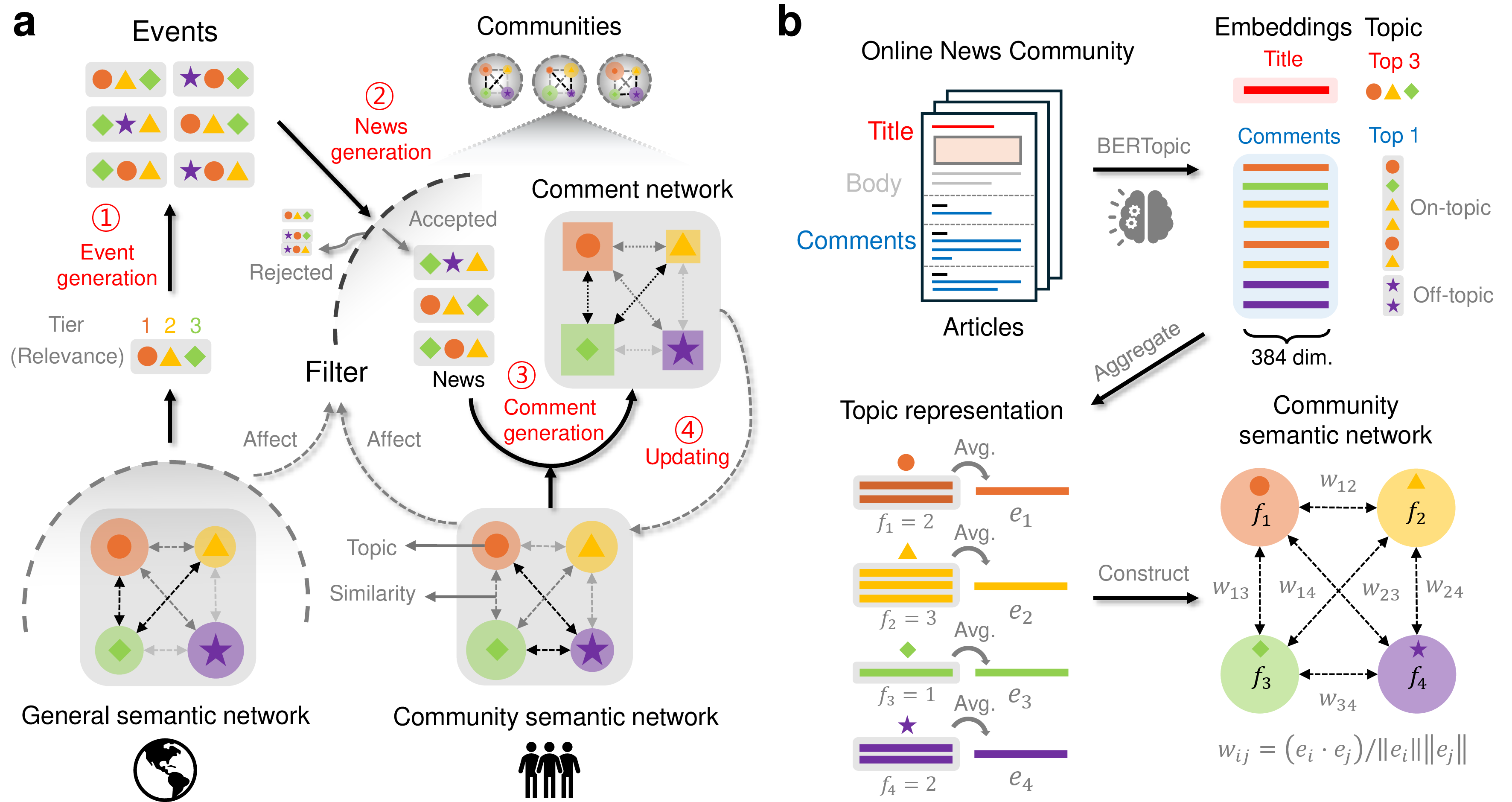
Our model is designed to capture the dynamics of online communities as simply as possible while still reflecting the essential components of these systems: external events, editorial boards, communities, and the feedback loops between them. We do not aim to provide an analytic solution or a predictive model in the narrow sense. Rather, the goal is to provide a flexible framework that can reproduce the primary statistical properties of empirical data and facilitate an exploration of how various influences shape collective minds.
We provide quantitative descriptions of how editorial and community-level influences shape collective minds over time (Table 1), which vary with community characteristics. We find that even brief influences can lead to enduring shifts in collective minds, and show that targeted, well-timed actions by platform designers and communities can reduce or even reverse those shifts (Figs. 2 and 3 and Discussion). We finally demonstrate our model’s validity by showing that it successfully reproduces dynamics observed in online news communities (Fig 4).
Model construction and empirical data collection↩︎
The world we live in generates a continuous stream of a variety of events. The editorial board of each news community curates these events and publishes them as news. Community members post comments about them, creating and evolving their collective mind. We model this process as an interplay of a general semantic network that characterizes the real world where events occur, a community semantic network that captures the characteristics of a specific community and its comments, and a community-specific editorial filter at the interface between the general and community semantic networks (Fig. 1).
The collective mind is the system of the community semantic network and internal and external processes that change the network’s structure over time. In the model, the semantic network is a complete graph with topics as nodes, topic frequency as node weights, and inter-topic similarity as edge weights (see Methods). Edge weights are updated using a Hebbian learning-inspired rule: topics that repeatedly co-occur in comments become more strongly associated, while less-reinforced associations decay over time. We cannot directly observe internal semantic networks, so we model the evolution of collective minds through the comments community members make. The semantic networks derived from these expressions serve as proxies for the underlying cognitive representations and processes. Also, it is important to note that comments reflect the views of those who actively post and may differ from the opinions of readers who do not comment. Prior research shows systematic differences between commenters and readers; we therefore interpret comments not as direct measures of community-wide beliefs but as influential expressions that help shape the collective mind on online platforms.
The model involves four processes (Fig. 1): (1) event generation: real-world events are generated and described as a tuple of \(N_w=3\) topics ordered from most to least relevant to the event (tiers \(1\), \(2\), and \(3\), respectively; for instance, adoption of new vaccine policy for COVID-19 might be ‘epidemics’, ‘vaccine’, and ‘government’), (2) news generation: the editorial filter of each community stochastically determines which events will get posted as news, affected by both general and community semantic networks, (3) comment generation: the community semantic network responds to the news by posting comments, constituting the comment network, and (4) updating of community semantic network: the comment network updates the community semantic network of the next time step through changes in topic frequencies and a Hebbian learning-inspired update of topic associations, in which co-occurring topics become more strongly associated while less reinforced associations decay over time (see Methods and SI Appendix, section 1 for details).
Two main control parameters determine the characteristics of the community. The filter strength, \(\lambda_f \in [0, 1]\), effectively functions as a gatekeeper that determines whether the news generation process is affected more by the general semantic network (low \(\lambda_f\)) or by the community semantic network (high \(\lambda_f\)), akin to less or more strong echo chambers (for extreme settings where the filter strength is \(\lambda_f>1\) beyond the typical range, see SI Appendix, section 2 and Fig.S1). The memory strength, \(\lambda_m \in [0, 1]\), controls the decay rate of the community semantic network during the update process. It determines how fast the community semantic network responds to change, effectively acting as its inertia. A high memory strength (e.g., \(\lambda_m=1\)) results in slower and weaker changes in the community semantic network, while a low memory strength (e.g., \(\lambda_m=0\)) leads to faster, more pronounced changes.
| Category | Influence | Description | Affected model process | Control parameter |
|---|---|---|---|---|
| Editorial agenda-setting | Amplification | Emphasizes topics currently deemed less important by the community. | News generation | Amplification strength (\(s_\mathrm{amp}\)) |
| Reframing | Distorts the narrative frame to link a particular topic to unrelated topics. | (Post-)News generation | Reframing probability (\(p_\mathrm{ref}\)) | |
| Alignment | Aligns news coverage with topics already emphasized by the community. | News generation | Filter strength (\(\lambda_{f}\)) | |
| Community dynamics | Trolls | A group of users promotes specific topics, often with malicious intent. | Comment generation | Troll strength (\(s_\mathrm{tr}\)) |
| Counterspeech | Users counteract trolls by increasing the volume of relevant comments. | Comment generation | Counterspeech strength (\(s_\mathrm{cs}\)) | |
| Membership turnover | Member replacement alters content and network structure. | Updating | Memory strength (\(\lambda_{m}\)) |
We calibrate our model’s initialization and validate its dynamics using comments and article titles posted in five US-based online news communities over 11 years, starting in 2012, including over \(400\) million comments and \(850\) thousand news articles (SI Appendix, Fig. S2, section 3, and tables S1-2). We use BERTopic [42], a topic modeling framework that employs a large language model (BERT) as a latent embedding model and provides topic embeddings and classifications for article titles and comments, which we then use to construct a semantic network for each community.The global semantic network can be represented as the average of the different community semantic networks (see also SI appendix, section 9). The process of data collection and the construction of a community semantic network are shown in Fig. 1b, and details of the topic modeling approach are described in the Methods and the SI Appendix, section 4. We validate the topic model on a total sample of \(N=1022\) participants representative of the U.S. public, using five tasks designed to assess the coherence of the discovered topics, how well comments and article titles are described by the model-assigned topics, and how similar pairs of topics and comments are. The results show a strong alignment between the model and human judgments (see the SI appendix, section 5, for details of each task, and Figs. S3-7 for detailed results).
These rich, quantitative empirical data enable us to construct our computational model based on well-founded choices rather than arbitrary assumptions. A notable example is the way we model comment generation: based on the observation that users typically post more comments related to the topics of the news (i.e., “on-topic" comments), but that some topics, such as politics and the economy, are always discussed regardless of the news (as modeled by comment multipliers, see SI Appendix, Fig. S8 and Methods). Further empirical insights that motivate our model formulation and functional choices are presented in the SI Appendix, section 6, and in Figs. S9-11.
Influences on collective minds↩︎
The computational model allows us to explore how editorial agenda-setting and community dynamics affect the collective mind of online news communities with varying levels of filter and memory strength. We implement six different editorial and community influences in Table 1 by tuning these parameters or modifying model components (see Method), and observe their effects on community semantic networks relative to baseline dynamics.
Editorial agenda-setting↩︎
News organizations largely determine what topics and challenges are worthy of people’s attention. In journalism research, this is commonly referred to as agenda setting [29]. Agenda setting can lead to various biases in the way news items are selected and presented [30], [37]. We investigate three different editorial agenda-setting practices that lead to such biases: amplification, reframing, and alignment.
Amplification↩︎
Consider the case where an editor overestimates the frequency of certain rare events, such as vaccine-related fatalities, that support conspiracy narratives which are not widely shared within the community. This represents amplification through editorial policies that emphasize topics the community currently deems less important. This exemplifies a form of selection bias by commission [37]. It can skew the perceived importance and urgency of these events within the community, leading to a distorted community semantic representation relative to the general semantic network.
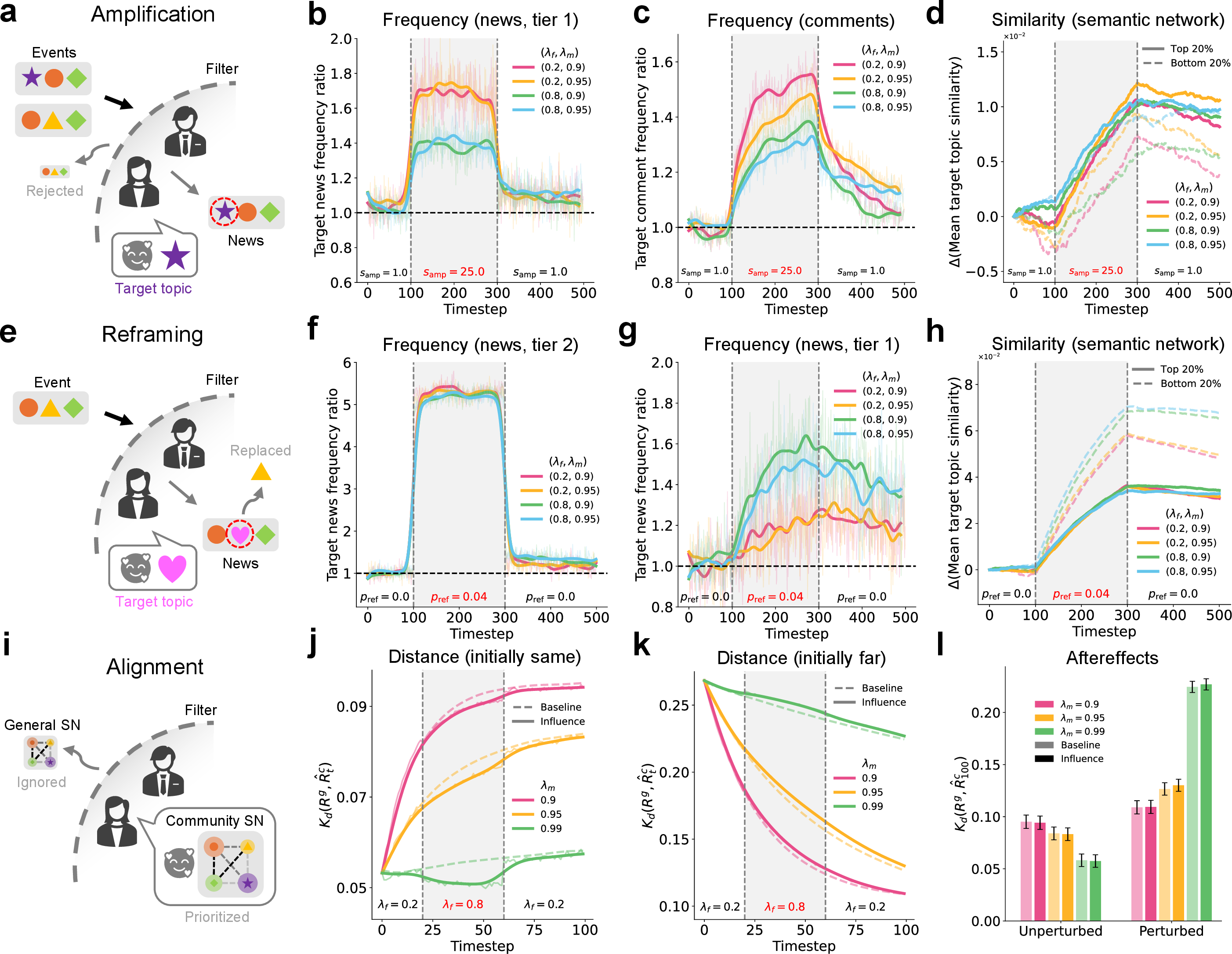
Amplification is implemented by increasing the target topic multiplier (\(s_{\text{amp}}\)) that subjectively amplifies the frequency of the target topic in the general semantic network during the filter process (Fig. 2a), hence exaggerating the target topic’s general popularity. We test the amplification effect by setting \(s_{\text{amp}}=25.0\) and measuring the ratio of the target topic frequency in news and comments between the influenced and baseline cases across different filter and memory strengths. This first directly affects the topic frequency in the news, and then indirectly affects the comment frequency and inter-topic similarity from the community semantic network.
When applied, amplification first affects the frequency of the target topic in the news, and, through the news, indirectly affects its frequency in the comments and its similarity to other topics in the community semantic network. These effects are weaker for communities with higher filter strength (blue and green lines in Fig. 2b and c, time steps \(t \in [100, 300]\)) because these communities are less sensitive to external influences from the general semantic network.
Once amplification is removed, communities with high filter and memory strength are more likely to retain their state because they remain strongly influenced by their modified community semantic network (Fig. 2c, for time steps \(t > 300\)). In turn, the target topic frequency in news also remains slightly elevated for communities with higher filter and memory strength (blue line, Fig. 2b). This suggests that an influence such as amplification can have a lasting effect on the community semantic network, especially in communities characterized by strong filtering.
Amplification also increases the similarity between the target topic and all other topics by co-appearing with them more frequently (Fig. 2d), especially for the initially more similar topics (top vs. bottom \(20\%\)), which have a higher chance of co-occurring in news.
Reframing↩︎
When an editor consistently links news about vaccines to government control or population surveillance, this might shape and reinforce a biased narrative about epidemics and the ways to counter them. This kind of narrative shift is often referred to as reframing, which involves distorting the narrative frame to link a particular topic to otherwise unrelated topics. While the concept of framing is multifaceted and complex [43], reframing can be seen as a form of presentation bias [30]. It occurs when the way information is presented influences the way it is interpreted, often by emphasizing certain aspects over others.
In our model, we implement a simple form of reframing by replacing a topic in one of the three tiers describing an already filtered event by a target topic (Fig. 2e), with probability \(p_{\text{ref}}\). In this example, we replace topics in tier \(2\) with the target topic (here, topic 25) with \(p_{\text{ref}}=0.04\). Here, changing tier \(2\) rather than tier \(1\) implies a subtle manipulation of the way an event is portrayed. As for amplification, reframing increases the target topic frequency in the news, and its effect lingers after the removal, more strongly with high filter and memory strength (Fig. 2f). Notably, as it indirectly increases the frequency of the comment semantic network (as in Fig. 2g, see SI Appendix, Fig. S12) which in turn affects the filter, the effect also spreads to the main tier \(1\), increasing the frequency of the target topic in that tier, especially for communities with high filter strength (Fig. 2j). These results suggest that even subtle reframing can substantially change the way events are described.
Unlike amplification, reframing ignores the existing semantic structure of both general and community semantic networks, as it affects post-filtering, and is uniformly associated with all other topics. In turn, due to the non-linear nature of the Hebbian learning rule we adopted for weight updates (see Methods), the reframing effect is stronger for topics that are initially less similar to the target topic (Fig. 2h).
Our approach to framing focuses on how topics are amplified, substituted, or aligned in the flow of news and comments, and is implemented using topic triplets at the article level. This offers a simplified but interpretable way to study reframing within the dynamics of collective minds. We acknowledge that framing can also involve deeper contextual and cultural dimensions, such as distinguishing between narratives around different conflicts or assigning divergent emotional valences to the same topic. Capturing these layers would require more complex, context-based topic representations, which go beyond the scope of the current study but represent a promising avenue for future extensions.
Alignment↩︎
In cases where the editorial board covers more news about the bad side effects of vaccines because the community shows great interest in it, while intentionally not publishing other news about vaccine safety. This is an example of alignment: editorial policies that line up news coverage with what the community already believes are the most important topics. This can be viewed as selection bias by omission [37], in the sense that certain events in the world are not presented to the community. As a result, individuals are exposed primarily to information that reinforces their existing beliefs, creating a feedback loop that strengthens those beliefs and excludes contradictory information.
In our model, alignment is represented by an increase in the filter strength (\(\lambda_f\)), which determines the news items selected for publication (Fig. 2i). Starting from \(\lambda_f=0.2\), we investigate how alignment affects the community semantic network as we increase \(\lambda_f\) to \(0.8\), and how quickly its effect can be reversed by reducing the filter strength again. We investigate the Kendall-tau rank distance between the general semantic network and the comment network (the current instantiation of the community semantic network) in two scenarios. In one scenario, the community semantic network is initially identical to the general one (Fig. 2j), and in the other, it is initially far from the general one (Fig. 2k).
In general, without external influences, the initially identical community semantic network diverges from the general semantic network over time due to the stochastic nature of the comment-generation process. In contrast, the initially far community semantic network moves closer to the general semantic network due to the event generation process (Fig. 1). The resulting baseline behavior is shown by dashed lines in Fig. 2j-k (see SI Appendix, Fig. S13 and section 7 for detailed descriptions of this behavior). When an influence is applied, the community semantic network deviates from its baseline behavior (Fig. 2j-k). The speed of this change increases with \(\lambda_m\) and decreases with \(\lambda_f\). When the influence is removed, the community semantic network returns to the baseline trajectory, but the speed of this return decreases with \(\lambda_m\) and increases with \(\lambda_f\). This behavior is consistent with all the influences that we tested.
The alignment works like friction for both, initially the same, and the initially far community semantic networks: it slows down the movement of the community semantic network relative to the general semantic network. Intuitively, this is because the alignment policy forces the community to focus on topics already prevalent in its semantic network, thereby reinforcing existing collective beliefs and resisting change.
This friction-like effect disappears instantly after the alignment is removed, and returns to its original trajectory, regardless of the memory strength (Fig. 2l). This fast recovery suggests that although the alignment can maintain the community’s semantic network in its current state, its effect is temporary and can be easily nullified by reverting the editorial policy.
Community dynamics↩︎
While agenda-setting influences how news items are selected or presented, indirectly affecting the community semantic network, community dynamics affect it more directly. We investigate the effects of membership turnover, trolls, and counterspeech.
Trolls↩︎
Continuing the vaccine example, consider a scenario where a group of users infiltrates a community and begins amplifying claims about vaccine fatality. Even without a factual basis, their coordinated actions can erode public trust in health institutions and steer discourse in divisive directions. Such efforts reflect a broader strategy by trolls—users who deliberately disrupt online.
Communities suffer from off-topic, inflammatory, or antagonistic messages that often aim to upset or manipulate others [44]. By promoting specific topics, trolls can manipulate community dynamics, steering discussions toward conflict and division [45], [46]. In doing so, they can bias the semantic representations of a community in subtle but lasting ways.
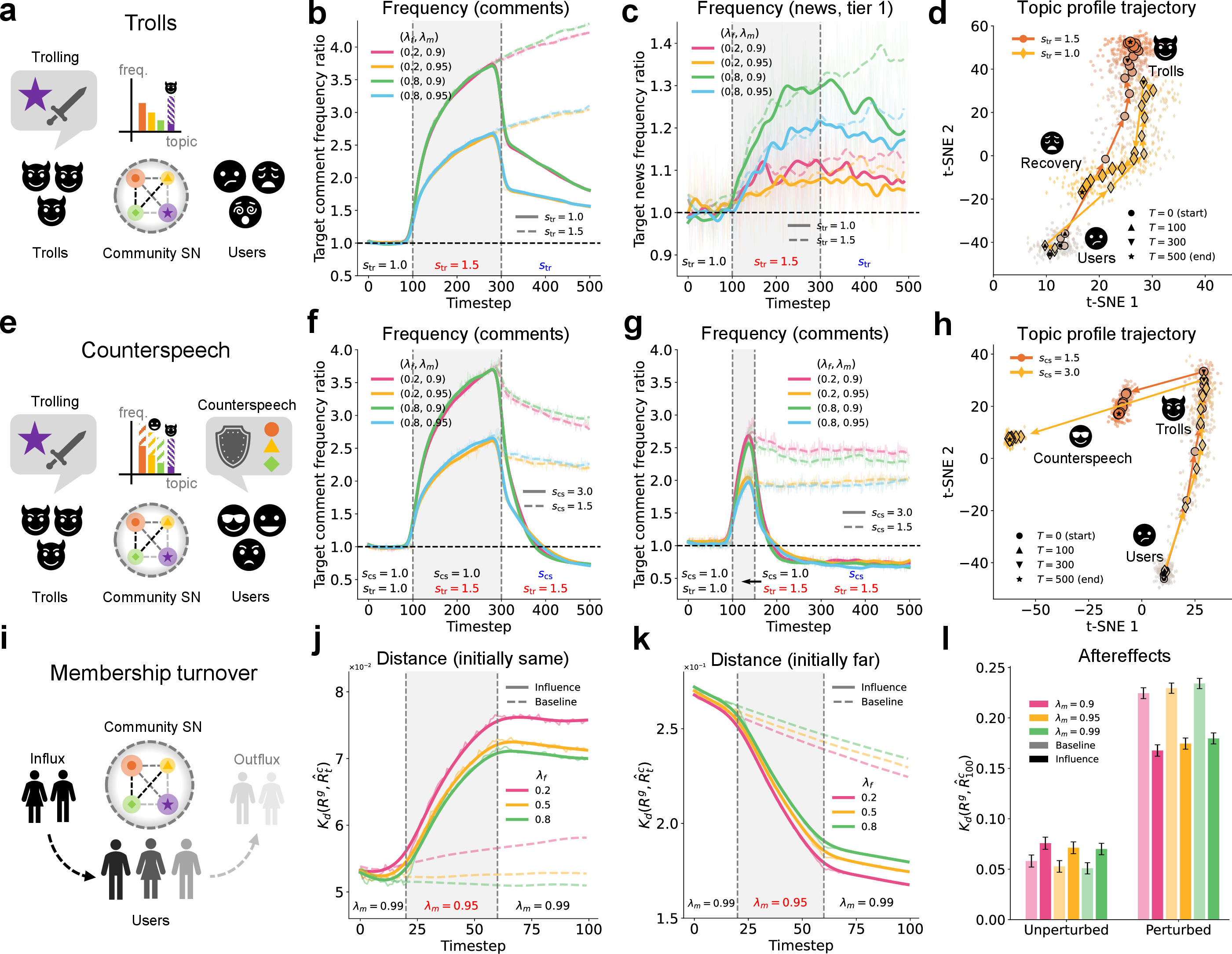
We model trolls through an additional troll multiplier (\(s_{\text{tr}}\)) that amplifies the frequency of comments about the target topic during the comment generation process, regardless of the content of the news, in addition to the comment multiplier (Fig. 3a). We test the effect of trolls by setting \(s_{\text{tr}}=1.5\) and measuring the ratio of the target topic frequency in comments and news between the influenced and baseline cases across different filter and memory strengths.
As expected, the trolls are more effective in intruding on the community semantic networks with lower memory strength, but it takes longer to reverse the damage inflicted on the communities with high memory strength (Fig. 3b). The frequency of news with the target topic is also affected, with a more pronounced effect in the community with high filter strength, as now the influenced target is the community (Fig. 3c). Accordingly, the combination of high filter strength and low memory (green line) is particularly vulnerable to trolls, as it is easily affected by the trolls, and editorial influences accelerate the effect. We can visually represent the effect of trolls on the comment network (the current response of the community semantic network) by plotting the trajectories of the comment topic profile in t-SNE space (Fig. 3d). The trajectory of the comment network experiences a sudden shift when trolls are introduced at \(t=100\) (upward triangle), and returns to its original position only if the trolls are removed at \(t=300\) (yellow line, downward triangle).
Taken together, these results suggest that, even though trolls do not directly influence the news, the feedback loop from comment sections to editorial decisions eventually indirectly affects the news the community receives. Because of that, trolls’ effects can be long-lasting even after they are removed from the community, especially in communities with high filter and memory strength.
Counterspeech↩︎
In response to exaggerated claims about vaccine fatality introduced by trolls, community members might deliberately promote evidence-based public health information about the benefits of vaccines. This kind of response aligns with what is broadly characterized as counterspeech—a community-initiated effort to address misinformation, incivility, or polarizing content [47]. Sometimes evoked by trolls [32], it often involves providing evidence-based responses, promoting constructive dialogue, encouraging mutual respect among participants, and making more relevant and meaningful contributions while ignoring harmful content. While the forms of counterspeech vary, it generally serves to redirect discussions towards more productive paths, mitigate disruptions, and reinforce shared norms within the community [48]–[50].
Among various types of counterspeech that users may put into action, we implement a simple strategy of posting more “on-topic" comments that are relevant to each news topic, as a counter to trolls’ indiscriminate spamming of a single target topic [51]. This strategy is implemented by adopting a counterspeech multiplier (\(s_{\text{cs}}\)) to the comment generation process, amplifying the frequency of on-topic comments (Fig. 3e) unless it’s a troll-targeted topic. We test the effect of counterspeech by first applying the influence of trolls at \(t=100\) (\(s_{\text{tr}}=1.5\)), then applying counterspeech at \(t=300\) (\(s_{\text{cs}}\)), while keeping the influence of trolls on. Here, we compare the cases with \(s_{\text{cs}}=1.5\) and \(3.0\) to see how the strength of counterspeech affects the community semantic network.
While the trolls are still active, counterspeech effectively dilutes the relative target topic frequency in the comments (Fig. 3f) and in news (SI Appendix, Fig. S12). However, we find that the same strength of multiplier (\(s_{\text{tr}}=s_{\text{cs}}=1.5\)) is insufficient. A much stronger multiplier (\(s_{\text{cs}}=3.0\)) is needed to nullify the trolls’ effect on the target topic. Furthermore, our findings underscore the importance of timing of influence, especially for weaker counterspeech (Fig. 3g), as the effect of trolls is suppressed more strongly and quickly when we initiate the counterspeech shortly (\(t=150\)) after the trolls invade (see SI Appendix, Fig. S12 for early removal of trolls).
Also, trajectory visualization of counterspeech (Fig. 3h) clearly shows that counterspeech is different from simple removal of trolls: it does not reverse the damage, but instead guides the community semantic network into a different direction proportional to \(s_{\text{cs}}\), boosting previously moderately frequent topics at the expense of very frequent and rare topics (SI Appendix, Fig. S14).
Membership turnover↩︎
When a significant number of new members join the community and others leave, the importance and perception of vaccine-related topics in the community can shift considerably. Such membership turnover may substantially reshape the community’s semantic network, as highlighted in [52], that turnover in online communities like Wikipedia can have both positive and negative impacts, depending on the balance between new and experienced members.
We can implement the effects of turnover by changing the memory strength (\(\lambda_m\)), which represents the forgetting of the past collective mind of communities as members change (Fig. 3i). We investigate how the community semantic network responds to member turnover by decreasing \(\lambda_m\) from \(0.99\) to \(0.95\) for a period, then reverting it. Similar to the amplification, we test the initially same (Fig. 3j) and far (Fig. 3k) community semantic networks and measure the Kendall-tau rank distance between the comment topic profile and general semantic network over time.
If a community experiences sudden and frequent membership fluctuations, its community semantic network will be more volatile and prone to random drift or external influences [53]. This vulnerability is best illustrated by the finding that the community semantic network, when experiencing membership fluctuations, accelerates its movement relative to the general one (Fig. 3j and k; see SI Appendix, section 7 for more details). Different from amplification, we find that these accelerated trajectories are maintained and not reverted after the termination of turnover, and thus a strong aftereffect remains (Fig. 3l). This suggests that the community semantic network may be more easily manipulated by external influences when the community is experiencing high turnover [54], and that the effect can be long-lasting.
Model validation↩︎
It is important to distinguish calibration from validation in our approach. Calibration refers to the empirically informed choices of distributional forms and functional assumptions that serve as inputs to the model, such as the frequency, similarity, and comment multiplier distributions (see SI Appendix, Table S4 and section 6). Validation, in contrast, concerns emergent properties of the model that are not directly imposed by these choices. We validate the model in the following three ways.
We demonstrate that our computational model accurately captures the statistical distributions observed in real online news communities and successfully reproduces diverse phenomena observed in the empirical data. We check the model’s validity in the following three ways.
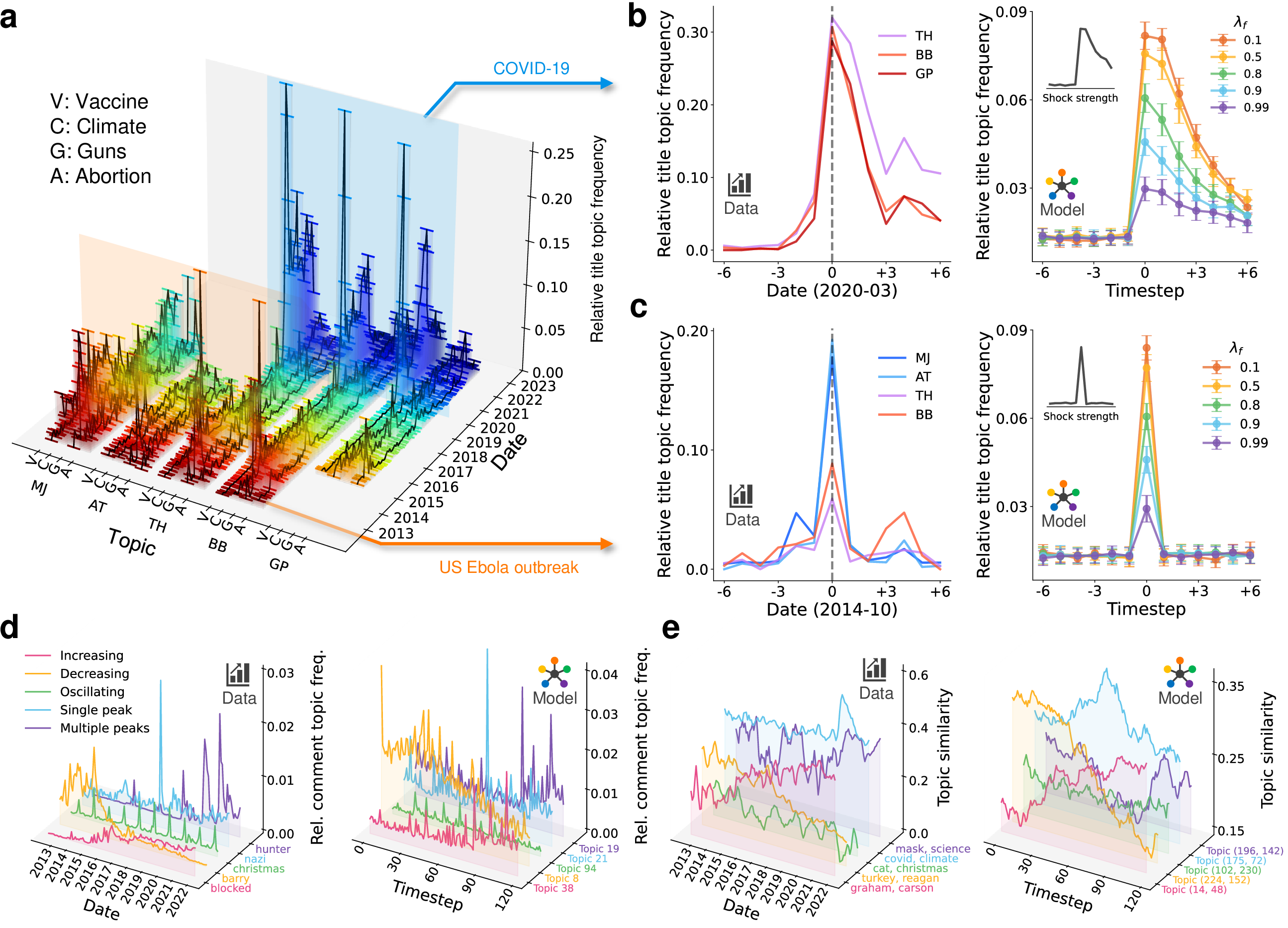
First, we show that the model can reproduce the topic frequencies in article titles posted in response to external events (Fig. 4a, b). We model external shocks by increasing the frequency of the relevant topics, and we tune the filter strength \(\lambda_f\) to reflect different levels of attention editors pay to the outside world during the shock. The model simulations show varying degrees of reactions that correspond to those observed in real online news communities during the US Ebola outbreak and the COVID-19 pandemic. We also show that model simulations can reproduce qualitative trends in comment topic frequency (Fig. 4c, d) and topic similarity (Fig. 4e, f), including increases, decreases, oscillations, and single- or multiple-peak patterns. Unlike prior models of topic popularity that impose life-cycle [55], [56] or built-in periodicity [57] to reproduce such patterns, our model naturally generates these trends from underlying dynamics without requiring explicit constraints.
Second, we quantitatively compare the real data and the model output in terms of the relative topic frequency of news titles and comments (SI Appendix, Fig. S15a-b), and the topic similarities (SI Appendix, Fig. S15c). Notably, the model results are time-averaged over 120 time steps, meaning the calibrated distributions are maintained throughout the model’s stochastic evolution, implying an emergent outcome rather than a built-in constraint. Each panel shares the same process; it first shows the fitting of the individual empirical data (left, thin dashed lines), choosing a representative exponent for each fitting (left, thick dashed lines), and then compares it with the long-term model output (right, scatter plot) that shows a good match with empirical representative fittings (right, thick dashed lines).
Benefiting from our model design and empirical calibration, the model output is in good agreement with the empirical data, specifically with the relative topic frequencies of news titles (a product of a log and a power-law with tier-specific exponents) and comments (power-law), and the inter-topic similarity distributions (log-normal) across all comparisons. Note that the model results are time-averaged over \(120\) time steps, so our model output consistently maintains the empirical distribution throughout its time evolution, without collapses or significant shifts, as we observed in the empirical data.
Third, we investigate the dynamics of the empirical comment network by characterizing it as a comment topic profile, which is a vector that represents the relative comment frequency of each topic at a given time, and track its time-series trajectory (SI Appendix, Fig. S16a and Methods). The dimensionality reduction technique t-SNE [58] reveals that the comment topic profiles of different communities, and with them the community semantic networks, are constantly moving, with each community having different trajectories, initial positions, and speeds. We find that this behavior is well explained by our model with different filters and memory strengths, all of which are attracted to the general semantic network (SI Appendix, Fig. S16b).
Discussion↩︎
Our computational model illuminates the mechanisms underlying the dynamics of online news communities. Tuning two main parameters — filter strength \(\lambda_f\) and memory strength \(\lambda_m\) — enables experimentation with editorial and community influences in online news communities with different characteristics, uncovers a number of nontrivial patterns, and helps develop practical recommendations.
Across all influences, we find a common pattern in how key parameters affect the model outcomes. Higher values of the filter strength \(\lambda_f\) dampen external shocks but, conversely, intensify their effect when the shock originates within the community. Higher values of memory strength \(\lambda_m\) make the community more resilient to the shock but also slow its recovery. The dual nature of each parameter implies that no single optimal parameter set can perfectly address all influences, demonstrating that remedies must be tailored to specific influences based on the community’s current characteristics. It also emphasizes the need for collective adaptation, adjusting these parameters as the situation demands. Depending on other properties of a particular real-world community (Table S4), these parameters could lead to different dynamic patterns. Although we believe that our results will generalize across a wide variety of communities, researchers should determine which communities to target based on their own real-world use cases.
Our results on the effects of editorial influences (Fig. 2) show that the effect of aligning news content with existing community preferences can be removed surprisingly quickly. Comparatively more subtle influences, such as amplification and reframing, can be much more transformative and potentially disruptive than the more obvious alignment. This echoes the findings that amplification can influence members’ representations and attitudes [59]–[61]. Also, our results illuminate the difference between two seemingly similar influences that both promote a target topic in news: amplification reinforces pre-existing relationships with other topics, while reframing establishes new connections with previously unrelated topics.
When it comes to influences due to community dynamics (Fig. 3), we find that small changes in community membership can have large consequences for collective minds, in line with studies showing that shifts in cultural output are driven by changes in community composition rather than by changes in individual minds [62], [63]. Furthermore, we find that the effect of trolls can be long-lasting even when they are removed, especially in communities with high filter and memory strength. Counterspeech can dilute the effect of trolls, but only when it is much stronger at promoting on-topic discussion than trolls are at promoting their target topics. We also find that it is important to start with counterspeech early on, as the longer the trolls are allowed to influence the discourse, the more difficult it is to nullify their impact. Finally, while both the removal of trolls and responding with counterspeech revert the relative frequency of the topics promoted by the trolls to their baseline, counterspeech response moves the community semantic network in a new direction.
How and whether communities effectively change their key parameters, such as filter and memory strength, over time, is a promising area for further research. While these parameters are modeling abstractions, they correspond to identifiable real-world processes. The effective filter strength can shift when editorial policies change — for example, when editors are incentivized to maximize engagement metrics such as view counts, they may increasingly favor stories aligned with community preferences, thereby increasing filter strength. Conversely, editorial guidelines mandating balanced coverage of underrepresented topics would decrease it. The effective memory strength can change through membership turnover — for instance, when a community loses members dissatisfied with its editorial direction and attracts a different audience, the incoming members bring different topic preferences, reducing the community’s effective memory. Platform design choices also modulate memory strength; for example, comment-ranking algorithms that surface only the most recent or popular comments, rather than preserving the full discussion history, limit exposure to past discourse patterns and thereby reduce memory strength [64], [65].
Together, our results suggest practical recommendations to communities on how to protect their genuine collective dynamics. On the level of editorial boards of online communities, regularly reporting detailed metrics on topic frequencies and their interconnections would allow the public and interested parties to detect when amplification, reframing, or disruptive community dynamics are producing persistent shifts in the collective semantic network. For example, the editorial board could transparently track and post statistics on the relative frequencies of different vaccine-related events they observed in the real world, vaccine-related news posted on the site, and topics discussed in news about vaccines. Such disclosures could help mitigate unwanted agenda-setting strategies and incentivize editors to maintain a balanced portrayal of issues. At the community level, maintaining core membership and fostering organized, immediate counterspeech against adversarial influences such as trolling can lead to changes in discourse that better reflect the authentic collective mind. For example, a swift collective response to expose misinformation about vaccines in the community can help counter adversarial attempts to undermine collective well-being.
To develop a useful model of the collective mind emerging from the underlying informational ecosystem of online communities, we deliberately kept the model computationally tractable and interpretable by adopting a simplified structure that focuses on prominent mechanisms capturing the fundamental interplay among external events, editorial agenda-setting, and community dynamics. Despite the stochastic nature of online communities and the role of uncontrollable external shocks, the model reproduces the statistical properties of empirical data (Fig. 4 and SI Appendix, Fig. S15) and provides explanatory insights into the mechanisms at work.
However, the framework is readily extensible to other types of digital platforms and can incorporate additional processes relevant to collective dynamics. On platforms such as Reddit and 4chan, each user can be modeled as a decentralized editor who aligns, amplifies, and reframes news about real-world events in line with their own preferences and the perceived semantic network of their followers. On platforms such as YouTube and TikTok, we can model multiple layers of filters in addition to the users themselves, including platform policies and diverse recommendation algorithms. The model can also be extended to incorporate other aspects of the dynamics of digital platforms, including the effects of several influences at once, the influence of group emotions [66], the interaction between communities, topic-level filter, and memory strengths, as well as feedback from the communities that may alter the general semantic network. In this paper, we examined the effects of different influences in isolation. However, real-world scenarios often involve multiple concurrent and interacting forces. Future explorations of the model could investigate these compound effects by applying combinations of influences simultaneously. We also assumed a unified internal structure within each community and did not model information flow between communities. Incorporating internal heterogeneity and cross-community interactions would allow the model to capture the dynamics of belief diversity, subgroup polarization, and the diffusion across community boundaries.
In summary, this work provides a foundation for a more rigorous understanding of different influences on collective minds. The model can help anticipate changes in community discourse that may result from different editorial policies, shifts in membership, and adversarial influences such as trolling. It also helps anticipate the benefits of editorial and community practices aimed at reducing echo chambers and countering toxic speech, such as more inclusive representation of events in the outside world and the use of counterspeech. Our results reveal the sources of both the fragility and the robustness of collective minds, informing a path toward healthier collective discourse and behavior.
Data Availability↩︎
The empirical data from online news communities is freely available to download through the Disqus API [67]. The data from the human survey results are available from the corresponding author upon reasonable request. All other data and code used in this study for analysis are available at https://github.com/nokpil/collmind [68].