Fine-Grained Behavior and Lane Constraints Guided Trajectory Prediction Method
March 27, 2025
Abstract
Trajectory prediction, as a critical component of autonomous driving systems, has attracted considerable attention in recent years. Existing prediction methods typically focus on extracting richer scene representations or introducing trajectory-level guidance through destinations, goals, or motion modes. However, future vehicle motion is continuously influenced by both evolving driving intentions and structured lane constraints. Such dynamic factors are difficult to characterize using coarse trajectory-level representations alone, which may limit prediction accuracy. To address this challenge, we propose BLNet, a novel fine-grained trajectory prediction framework that explicitly models behavioral evolution and lane topology constraints throughout the prediction horizon. Specifically, a dual-stream architecture is designed to generate timestamp-level behavior-state queries and lane queries, enabling future motion to be characterized from both behavioral and lane-constrained perspectives. The generated queries are supervised by dedicated auxiliary objectives and jointly guide multimodal trajectory generation. Furthermore, a two-stage decoder is introduced to first produce trajectory proposals and then perform point-level refinement by incorporating lane continuity and future motion features. Extensive experiments on the nuScenes and Argoverse benchmarks demonstrate the effectiveness of the proposed framework. The results show that BLNet achieves a favorable balance between prediction accuracy and inference efficiency while maintaining competitive forecasting performance.
Autonomous driving, dual-stream network, motion prediction, lane attention branch, behavior state attention branch.
1 Introduction↩︎
The prediction task has received significant attention from researchers [1]–[3] as an important intermediate step between the perception and decision-making processes. However, the complexity of traffic scenarios (e.g. complex lane constraints and traffic rules) and the uncertainty of the future trajectory modes of vehicles makes forecasting still a major challenge. Today, great success has been achieved in the field of trajectory prediction by utilizing rapidly evolving deep learning techniques. Some frameworks such as Graph Neural Networks (GNN) [4], Convolutional Neural Networks (CNN) [5], etc. are applied to mine the interactions between traffic elements. In addition, the attention mechanism [6] is gradually being widely used by predictive models. Due to its effective modeling of interaction features, the prediction performance is further improved.
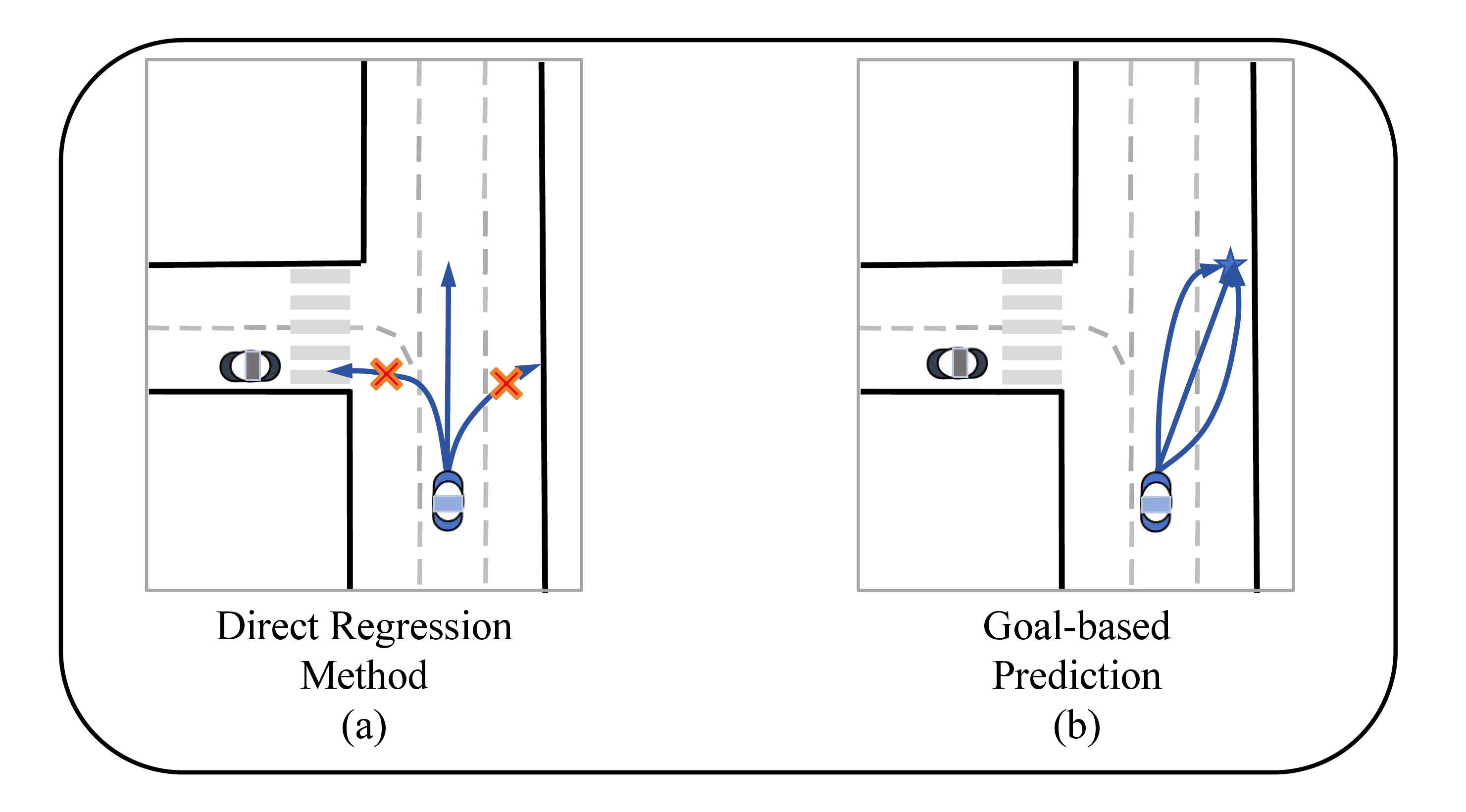
Most trajectory prediction networks fall into two categories: direct regression and goal-based methods. Direct regression prediction algorithms [7], [8] focus on extracting multi-agents interactions and complex scene constraints and directly regress to obtain predicted trajectories as shown in Fig. 1 (a). For example, HiVT [6] efficiently models the features of a large number of agents in a scene by local context extraction and global interaction modeling, respectively. A reusable multi-context gating fusion module is developed by Multipath++ [9] to extract interaction features and environment features in a scene. Although much progress has been made, without the guidance of a spatial prior, it is difficult for such algorithms to accurately predict the multimodality of future trajectories through a single feature-aggregated query, and some implausible future trajectories are thus generated. In order to solve the problem of modal uncertainty, many researchers begin to consider providing priori destinations for prediction, and thus goal-based prediction algorithms emerge as shown in Fig. 1 (b). Such algorithms [10]–[12] guide the network to generate a modal-determined trajectory by predicting the possible future destinations or target lanes. The destinations can be manually produced or dynamically predicted by the network. For example, DenseTNT [11] manually produces a large number of target points scattered in the map. However, the performance of prediction depends greatly on the number and quality of candidates. GOHOME [13] utilizes high-definition map graphics and sparse mapping to generate heatmap outputs to predict future target points for final prediction. Ltp[14] predicts the likelihood of each lane segment and from this, trajectories converging to the most probable lane segments are generated and selected. However, the future motion of a vehicle is dynamically changing and is driven by both its own intentions and the structure of the roadway. This leads to the fact that there can be different paths leading to the same goal. Trajectories generated solely from a single destination or a single lane segment tend to ignore detailed spatiotemporal interactions and lane constraints, which degrades model performance.
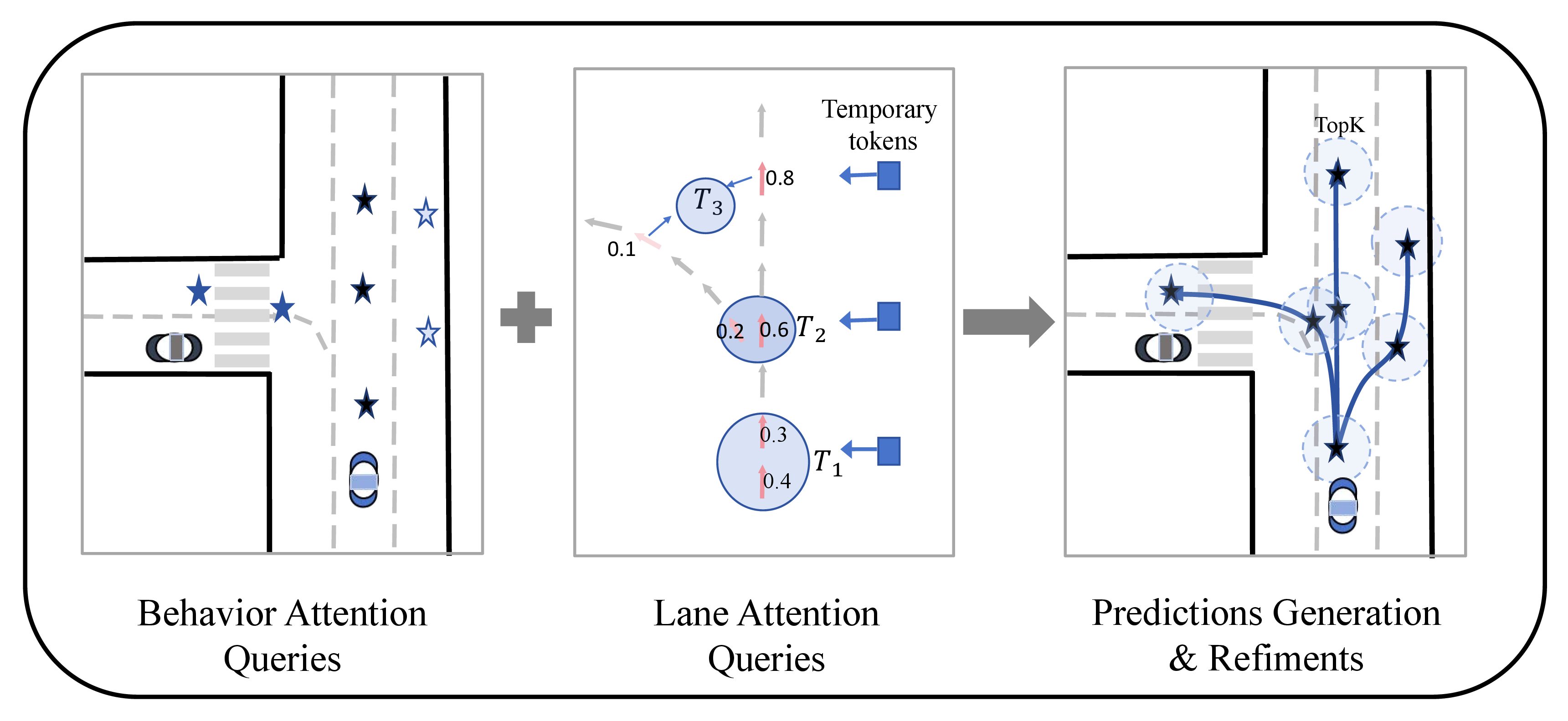
In order to solve the problems of the two types of methods mentioned above, we propose a novel attention based network as shown in Fig. 2. Inspired by objective factors affecting future trajectories, we simultaneously aggregate detailed lane information and driver intent information to predict dynamically evolving target future motions. Specifically, two attention branches are proposed to generate fine-grained behavior state queries and lane queries. The behavior state query reflects the motion intent of the target vehicle at each timestamp under the supervision of the ground truth location. Lane queries aggregate structured lane constraints under the supervision of the lanes that the vehicle will reach in each future timestamp. The two queries are aggregated and fed into a two-stage decoder. The two-stage decoder first predicts future trajectories and further refines the predictions at the point level to make them more reasonable by exploiting the future motion features and the continuity of lane constraints.
Based on the above discussion, our contribution is summarized below:
We propose a fine-grained trajectory prediction formulation that jointly models behavioral evolution and lane topology constraints throughout the prediction horizon. Specifically, timestamp-level behavior-state queries and lane queries are introduced to explicitly characterize future motion states, enabling trajectory prediction to be guided by both evolving driving intentions and structured lane constraints.
A new dual-stream attention network is proposed to acquire behavior state queries and lane queries. Under the supervision of two auxiliary loss functions, these queries are aligned to the vehicle future behaviors and the lane constraints at each timestamp, respectively.
In the decoder, the future motion and the continuity of lane constraints are further incorporated into the network to achieve point-level trajectory refinement.
Extensive experimental and ablation studies on the NuScenes and Argoverse benchmarks demonstrate the effectiveness of the proposed framework. The results show that BLNet achieves a favorable balance between prediction accuracy and inference efficiency while maintaining strong trajectory forecasting performance.
2 Related Works↩︎
2.1 Scene Feature Modeling↩︎
In order to obtain accurate predicted trajectories, it is usually necessary to have a fine-grained modeling of the traffic scenario. CNNs are widely used due to their superior ability to extract localized features. SoPhie [15] utilizes CNN to extract information from scene images. Multi-agent future interaction relationships and future planning information of controllable vehicles are modeled in PiP [8] using CNN. However, CNNs are limited by their convolutional blocks and ignore the detailed interaction relationships. In order to solve this problem, researchers try to utilize GCNs to obtain a relationship modeling of the nodes in the scene. Grip [4] and Grip++ [16] introduce a static graph and a dynamic graph structure to describe the interactions between transportation agents, respectively. Xu et al. [17] propose a transferable graph neural network that jointly performs motion forecasting and domain alignment. In recent years, transformers have begun to be introduced into the field of trajectory prediction to cope with spatiotemporal information processing. [12], [18]. HiVT [6] divides the problem into attention-based local context extraction and global feature interaction to achieve efficient trajectory prediction results. HPNet [19] models overlapping history frames using the attention mechanism to achieve a multi-frame prediction with continuity. In order to extract more interactions, the common transformer is further extended, e.g., by introducing relative position coding, combining the transformer with graph convolution, etc. [18], [20], [21]. For example, Zhou et al. [22] proposed a new edge-enhanced interaction module to model the relative position information between nodes in the scene. In this paper, we construct dual-stream attention branches to generate behavior state queries and lane queries at each future timestamp in parallel to guide trajectory prediction.
2.2 Direct Regression Prediction Method↩︎
This kind of method [18], [21], [23] mines the interaction features among agents and directly regresses to obtain the final predicted trajectory, as shown in Fig. 1 (a). Many attempts are made to mine more detailed interaction features. For example, Trajectron++ [24] uses a modular graph-structured recursive model to model dynamic interactions in the scene. Hdgt [25] achieves more accurate predictions by modeling the scenario as a heterogeneous graph with different nodes and edges. Simpl [18] designs a symmetric fusion transformer for efficient viewpoint-invariant scene modeling. Zhang et al. [26] explicitly model the edge information between traffic participants, making the network aware of the proximity relationship between them. However, due to the lack of spatial priors, these algorithms converge slowly when faced with multi-modal trajectory prediction. In addition, uncertainty in driving intentions can affect the predictive effectiveness of such algorithms, which in turn can produce some unreasonable predictions. Our algorithm reduces the impact of uncertainty by combining fine-grained behavior state and lane queries to guide predictions.
2.3 Goal-Based Prediction Method↩︎
This type of approach reduces the complexity of the prediction problem by decomposing the complex trajectory prediction problem into goal regression and trajectory regression, as shown in Fig. 1 (b). In terms of the types of regression destinations, goal-based methods can be categorized into goal-point-based prediction and goal-lane-based prediction.
As pioneers of the goal-point-based approaches, TNT [10] and DenseTNT [11] produce a large number of manual candidate target points. A function is first utilized to predict the probability of each point, and a number of the most likely points are selected to perform the trajectory completion. In order to get rid of a large number of redundant manual goal points for prediction efficiency, algorithms based on adaptive goal points have been proposed. MTR [27] proposes learnable spatial prior queries for simultaneous intent recognition and trajectory refinement. Adapt [12] enhances the accuracy of the endpoint-based prediction algorithm by a gradient-stopping training strategy. The prediction accuracy of such methods depends largely on the quality of the target point. For example, an unreasonable target point can lead to the generation of a trajectory that violates the lane constraints.
Vehicle trajectories on structured lanes are significantly affected by path constraints. Therefore, based on the guidance of a goal lane [14], we can get more reasonable predictions. Inspired by this, PGP [28] explores the trajectory of a vehicle from one lane node to another by training a strategy. Yet such an exploration also comes with a significant computational cost. GOHOME [13] obtains a heat map of the target lanes to guide trajectory prediction and reduce computational cost. Li et al. [29] propose a Dual-Stream Cross Attention to obtain the most likely K target lanes and concatenate them with the target encoding to predict future motion. However, lanes are highly structured and often do not fully reflect fine-grained driver intent, which in turn produces sub-optimal results.
In summary, while goal-based approaches can reduce forecasting uncertainty to some extent, the fact that the future trajectory of a goal is dynamically evolving and is often influenced by both its own intentions and structured lane constraints creates a challenge for forecasting. Thus, our method combines both fine-grained lane constraints and driver behavioral intentions.
3 Proposed Model↩︎
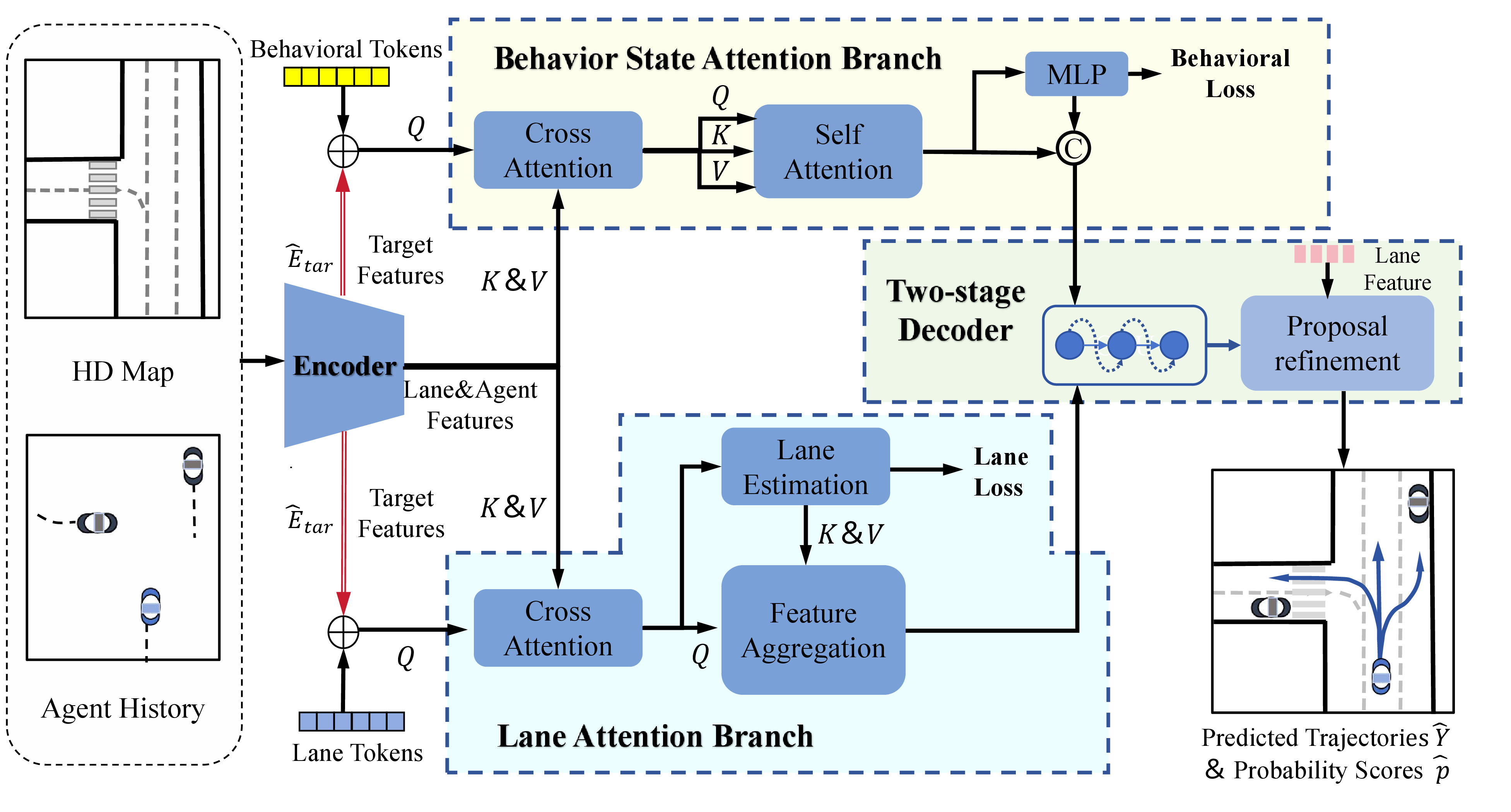
We propose a novel network framework that utilizes fine-grained behavioral and lane constraints to guide the trajectory predictions as shown in Fig. 3. In the following, we will first introduce the problem setup. Then, we will elaborate on the four components of the network in turn: the encoder, the behavior state attention branch, the lane attention branch, and the two-stage trajectory decoder. Finally, the model training details are introduced.
3.1 Problem Setup↩︎
Given the HD map information and historical observations of surrounding traffic participants, the objective of trajectory prediction is to estimate the future motion of a target vehicle over a prediction horizon of \(T_f\) timesteps. Specifically, the future trajectory is represented as
\[\mathcal{Y} \in \mathbb{R}^{T_f\times 2},\]
where \(T_f\) denotes the prediction horizon and each trajectory point contains the two-dimensional spatial coordinates of the target vehicle at the corresponding future timestamp. Based on the observed scene context, the proposed framework aims to generate accurate and feasible future trajectory predictions for the target agent.
3.2 Traffic Scene Vectorization and Encoding↩︎

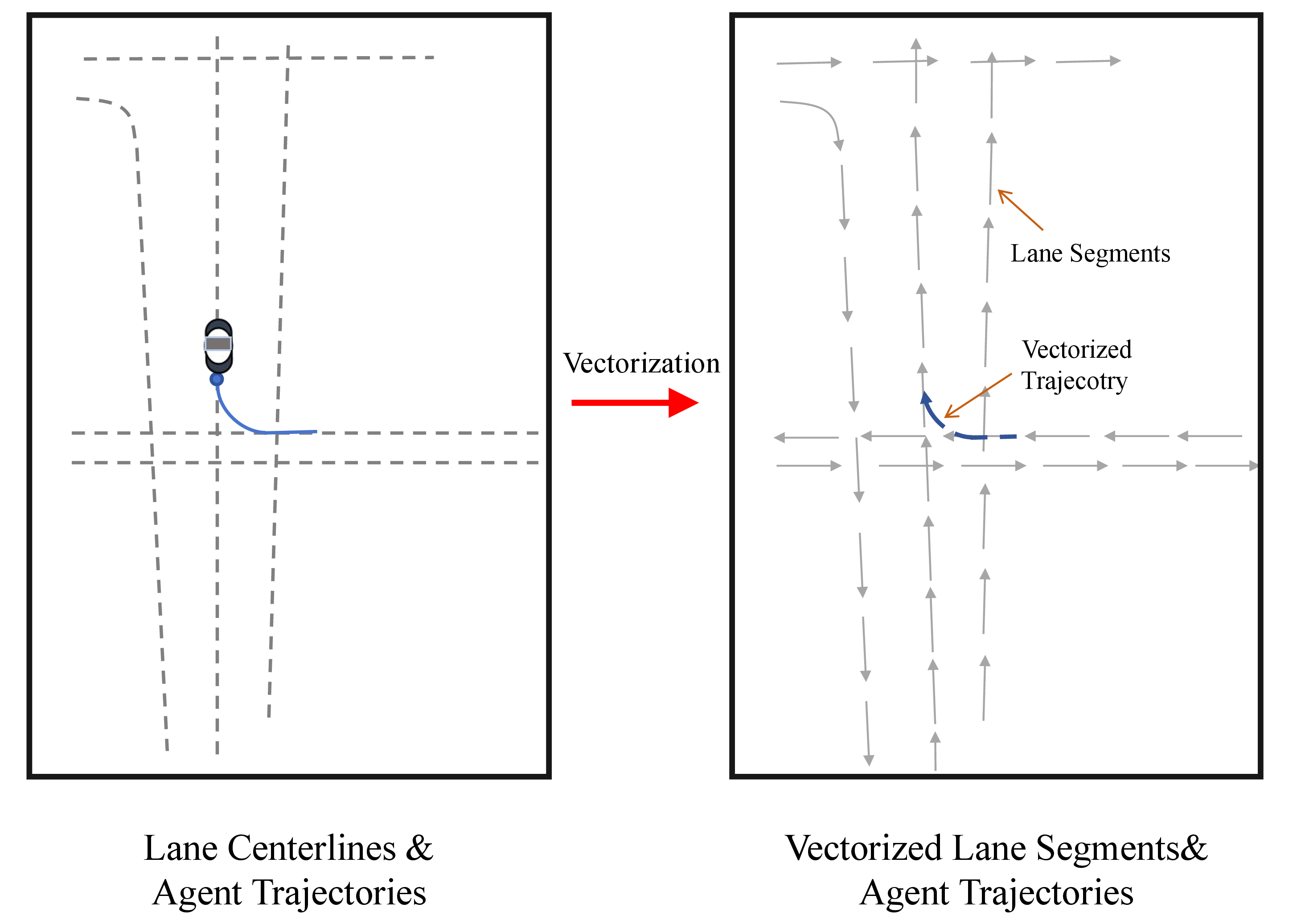
Inspired by Vectornet [7], we vectorize scene elements as shown in Fig. 5 to facilitate prediction networks to encode them to obtain high-dimensional features.
Map Vectorization: Specifically, lane centerlines are first subdivided into dense points and then partitioned into multiple local lane segments. Each local segment is subsequently converted into vector representations, yielding \(\mathcal{M}\in\mathbb{R}^{N_m\times S\times C_m}\), where \(N_m\) denotes the number of lane segments, \(S\) denotes the number of coordinate points within each segment, and \(C_m\) denotes the feature dimension. Each lane vector stores both geometric coordinates and semantic attributes including turn direction, intersection marker and traffic control flag, and records the connection relation with previous lane segments; connected vectors jointly describe the complete topology of the lane centerline. As this process does not rely on predefined road templates, straight roads, curved lanes, intersections, merges, and roundabouts can all be represented within the same vectorized framework.
Agents Vectorization: Similar to the processing of map information, historical observations of traffic participants are vectorized and formulated as \(\mathcal{H}\in\mathbb{R}^{N_v\times T_h\times C_v}\), where \(N_v\) denotes the number of traffic participants, \(T_h\) denotes the historical observation time domain, and \(C_v\) denotes the feature dimension. For each timestamp, the vector stores the coordinates of the start and end points of the motion segment together with agent attribute labels, which jointly characterize the local motion evolution of each target between consecutive observations and encode temporal motion patterns. Such a representation remains applicable across diverse traffic layouts, since it is defined purely based on real observed motion rather than preset road-shape assumptions. The full vector generation preprocessing procedure is detailed in Algorithm 4 in an algorithm-style manner.
The vectorized map representation \(\mathcal{M}\) and agent representation \(\mathcal{H}\) are first encoded into latent feature embeddings, yielding map features \(E_{\mathcal{M}}\subseteq \mathbb{R}^{N_m\times C_e}\) and agent features \(E_{\mathcal{H}}\subseteq \mathbb{R}^{N_v\times C_e}\), where \(C_e\) denotes the hidden feature dimension. Inspired by LaneGCN [30], we further model the interactions between lane segments and traffic participants through a bidirectional attention-based fusion architecture. Specifically, map features are treated as queries, while agent features serve as keys and values, yielding the interaction-enhanced map representations: \[\hat{E}_\mathcal{M} = \mathcal{I} \left( Q=E_\mathcal{M}, K=V=E_\mathcal{H} \right)\] Through this cross-attention operation, each lane representation is enriched with relevant agent motion information. Conversely, the interaction-enhanced map representations are further aggregated into agent features to obtain the interactive agent encodings: \[\hat{E}_\mathcal{H} = \mathcal{I} \left( Q=E_\mathcal{H}, K=V=\hat{E}_\mathcal{M} \right)\] The encoding corresponding to the target vehicle is denoted as \(\hat{E}_{tar}\). Finally, the interaction-enhanced map and agent representations are combined to form the overall scene encoding: \[\hat{E} = \left\{ \hat{E}_{\mathcal{M}}, \hat{E}_{\mathcal{H}} \right\}.\]
3.3 Behavior State Attention Branch↩︎
For traffic participants, driving intention is one of the key factors influencing future motion evolution [31]. Previous goal-point-based approaches [11], [12] reduce trajectory uncertainty by providing destination priors. However, future trajectories are inherently dynamic and continuously evolving, and different motion patterns may still emerge under the same destination. Therefore, relying solely on goal-level guidance may be insufficient to characterize the detailed evolution of future motion.
To address this issue, we propose a behavior state attention branch that provides fine-grained behavioral priors throughout the prediction horizon. Instead of directly representing future trajectories or destinations, similar to [32], the proposed learnable behavior tokens are designed to capture latent behavioral evolution patterns that may influence future motion generation. It should be noted that these tokens do not correspond to predefined semantic behaviors, but are automatically learned from data through end-to-end optimization. Considering the multi-modal nature of future trajectories, we assign \(K\) learnable tokens \(B_{tokens}\) to the target encoding to obtain the initial behavior queries \(\mathcal{Q}_{b}\): \[\mathcal{Q}_b = \hat{E}_{tar}+B_{tokens}\]
We use scene encoding \(\hat{E}\) as key and values to perform a cross attention calculation with \(\mathcal{Q}_{b}\) to obtain the interactive features: \[\hat{\mathcal{Q}}_{b} = \mathcal{I}(Q= \mathcal{Q}_{b},K= V= \hat{E})\] Subsequently, for each interactive behavior query \(\hat{\mathcal{Q}}_{b}\), interactions between different modalities are parsed utilizing a self-attention module. \[\hat{\mathcal{Q}}_{b,mode} = \mathcal{I}(Q= K= V=\hat{\mathcal{Q}_{b}})\] Unlike previous algorithms that only utilize goals to guide predictions, an MLP decodes the behavior queries to initial trajectory proposals \(\hat{\mathcal{Y}}_{coarse} \in \mathbb{R}^{T_f \times K \times 2}\). We follow the approach of previous algorithms and use a Winner-Takes-All training strategy, an auxiliary \(L_2\) loss \(\mathcal{L}_{behav}\) is used to supervise the quality of the generated initial trajectory proposal: \[\mathcal{L}_{behav} = \min_{k\in \left \{ 1,2,...,K \right \} }\frac{1}{T_f} \sum_{t=1}^{T_f} \left \|\hat{\mathcal{Y}}^{t,k}_{coarse} - \mathcal{Y}^t \right \|_2^2\] where \(\hat{\mathcal{Y}}^k_{coarse}\) denotes \(\hat{\mathcal{Y}}_{coarse}\) for the \(k-th\) modality. Finally, each proposal point is concatenated with the behavior query of its corresponding modality to obtain the final behavior representations \(\hat{\mathcal{Q}}_{b,out}\in\mathbb{R}^{K\times T_f\times C_b}\), where the original mode-level behavior queries are expanded into mode-time representations that simultaneously encode the corresponding motion mode and prediction timestamp. In this way, multimodal future motion hypotheses can be modeled using only \(K\) learnable behavior tokens, avoiding the need to explicitly construct \(K\times T_f\) behavior queries.
3.4 Lane Attention Branch↩︎
For vehicles traveling in structured road environments, future trajectories are not only influenced by driving intentions but are also constrained by lane topology. Moreover, lane constraints may vary throughout the prediction horizon, as different lane segments can influence vehicle motion at different future moments. Therefore, providing a single lane-level representation may be insufficient to characterize the evolving lane constraints associated with future trajectories.
To address this issue, we introduce a lane attention branch that provides fine-grained lane topology priors throughout the prediction horizon. Specifically, timestamp-level lane tokens are designed to capture lane-related constraints that may influence future motion at different prediction timestamps. Through interaction with lane features and supervision from future lane occupancy information, the proposed lane tokens learn latent lane topology representations relevant to future trajectory generation.
First, \(T_f\) learnable tokens \(L_{tokens}\) are assigned to the target encoding \(\hat{E}_{tar}\) to obtain the initial lane queries \(\mathcal{Q}_L \in \mathbb{R}^{T_f \times C_e}\):
\[\mathcal{Q}_L = \hat{E}_{tar}+L_{tokens}\] Then, these lane queries are fed into a cross attention module to aggregate comprehensive scene features: \[\mathcal{\hat{Q}}_L = \mathcal{I} \left ( Q=\mathcal{Q}_L,K=V=\hat{E} \right )\]
In the previous sections, we have obtained the encoded information \(\hat{E}_\mathcal{M}\) corresponding to each lane segment. We want each \(\mathcal{\hat{Q}}_L\) to aggregate the lane segment features that will be reached at its corresponding future moment. Inspired by [3], [33], a lane scoring module is designed to predict the lane probabilities at each future moment. Specifically, we first treat each \(\mathcal{\hat{Q}}_L\) as the key and value, map encoding as queries, and compute the query-lane interaction features \(\mathcal{I} _{\mathcal{L} ,\mathcal{M} }\). The \(\mathcal{I} _{\mathcal{L} ,\mathcal{M} }\), map encoding, and interactive lane queries are concatenated and fed into an attention mechanism to compute the query-lane scores:
\[\mathcal{S}^{m,t_f} _{\mathcal{L} ,\mathcal{M} } = \frac{\exp(\mathrm{MLP} (\mathcal{I}^{m,t_f} _{\mathcal{L},\mathcal{M} },\hat{E}^m_{\mathcal{M}},\mathcal{\hat{Q}}^{t_f}_L))}{\sum_{n=1}^{N_m} \exp(\mathrm{MLP} (\mathcal{I}^{n,t_f} _{\mathcal{L},\mathcal{M} },\hat{E}^n_{\mathcal{M}},\mathcal{\hat{Q}}^{t_f}_L))} \label{scores}\tag{1}\] where \(\mathcal{S}^{m,t_f} _{\mathcal{L} ,\mathcal{M} }\) denotes the attention score of \(t_f\)-th lane query for the \(m\)-th lane segment. We utilize a binary cross-entropy lane loss to supervise the attention scores: \[\mathcal{L}_{lane } = \sum_{t_f=1}^{T_f} \mathcal{L} _{CE} \left ( \mathcal{S}^{t_f} _{\mathcal{L} ,\mathcal{M} },\mathcal{S}^{t_f} _{GT} \right )\] where we assign a ground truth label of 1 to the nearest lane segment that the target vehicle arrives at the moment \(t_f\), and a label of 0 to the rest of the lane segments. We select and concatenate the top \(M\) lane segments features with the \(M\) highest attention scores for each query to obtain \(L^{t_f}_{con}\): \[L^{t_f}_{con} = \mathrm{Concat}\left ( top_M(\hat{E} _{\mathcal{M}}),top_M({\mathcal{S}^{t_f}}) \right )\] where \(top_M()\) denotes the selection function. \(L^{t_f}_{con}\) are treated as the keys and values to be aggregated into each lane query: \[\begin{align} \hat{\mathcal{Q} }^{t_f}_{lane} = \mathcal{I}(Q = \mathcal{\hat{Q}}^{t_f}_{L},K = V = L^{t_f}_{con}) \end{align}\] Under the supervision of the lane loss, our interactive lane queries are aligned with the lane segments that will be reached at the corresponding future moments, thus effectively guiding the prediction. Since each lane query aggregates the top-\(M\) most probable lane segments, it already captures multimodal lane topology information associated with the corresponding future timestamp. To facilitate fusion with the behavior-aware representations, the lane features are expanded using a simple MLP along the modal dimension to obtain lane-aware representations \(\hat{\mathcal{Q}}_{lane}\in\mathbb{R}^{K\times T_f\times C_l}\), which share the same mode-time structure as \(\hat{\mathcal{Q}}_{b,out}\).
3.5 Two-stage Decoder↩︎
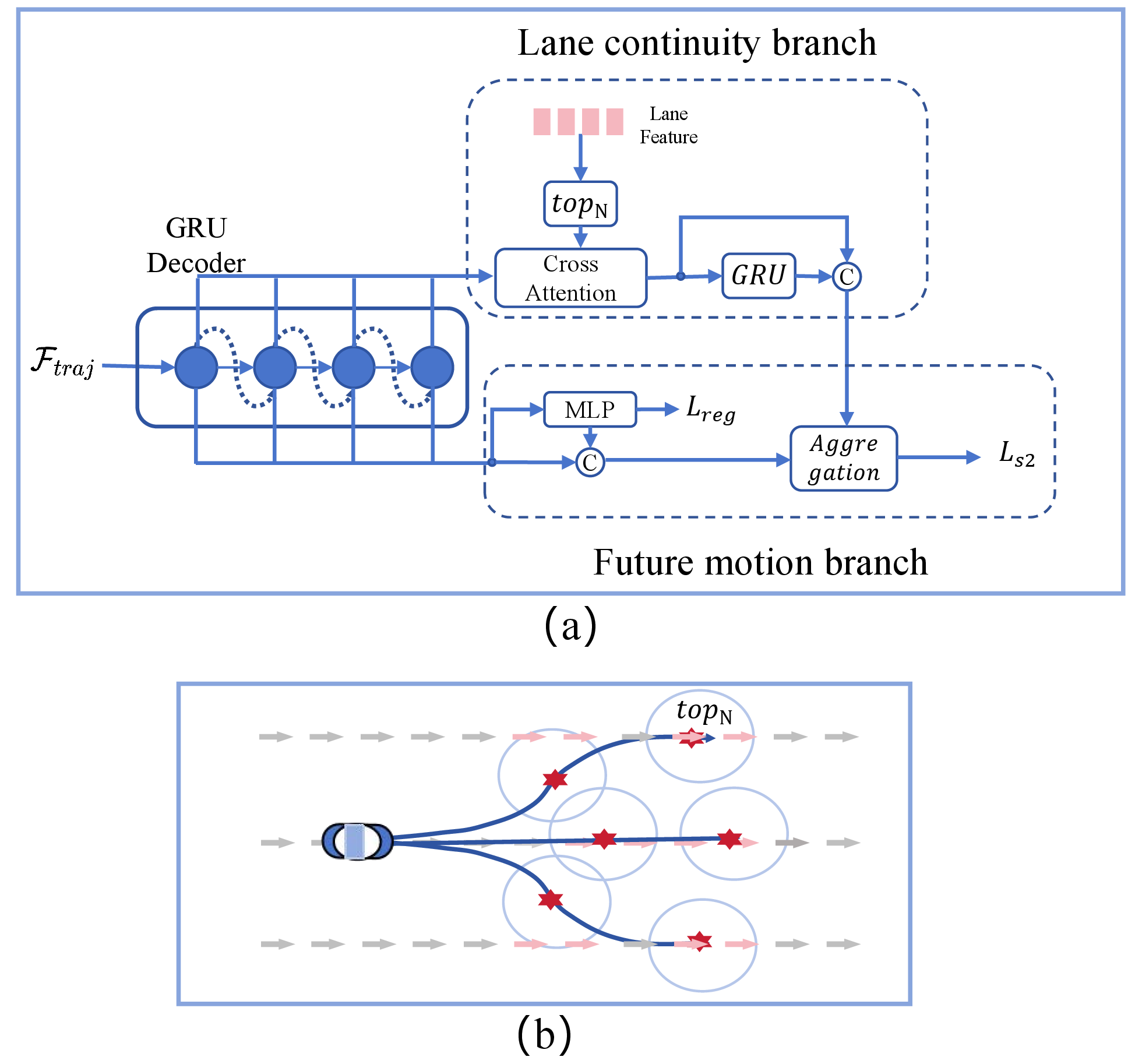
This section presents a two-stage decoder as shown in Fig. 7 (a). In the first stage, it predicts the trajectories of the target vehicles and the modal probabilities. Subsequently, In the second stage, the continuity of the lane constraints and future motion features are utilized to refine the trajectories to obtain the final prediction, the modal probabilities are also updated. For better presentation, a detailed pseudo-code for the two-stage decoder is given in Algorithm 6.

3.5.1 GRU-based predictor↩︎
In the first stage, we predict future trajectories using a Laplacian mixture density decoder. Specifically, the behavior-aware representations \(\hat{\mathcal{Q}}_{b,out}\) and lane-aware representations \(\hat{\mathcal{Q}}_{lane}\) are concatenated and projected by an MLP to obtain the trajectory features \(\mathcal{F}_{traj}\in\mathbb{R}^{K\times T_f\times C_{traj}}\): \[\mathcal{F}_{traj} = \mathrm{MLP} \left( \mathrm{Concat}\left( \hat{\mathcal{Q}}_{lane}, \hat{\mathcal{Q}}_{b,out} \right) \right). \label{mlpagg}\tag{2}\] In this way, future trajectory generation is jointly guided by latent behavioral evolution patterns and temporally varying lane topology constraints.
The target encoding \(\hat{E}_{tar}\) is then used as the initial hidden state of a GRU to recover future motion features: \[\mathcal{F}_{fut} = \mathrm{GRU} \left( \mathcal{F}_{traj}, h_0=\hat{E}_{tar} \right). \label{GRU1}\tag{3}\]
The recovered features \(\mathcal{F}_{fut}\) are fed into two stacked MLPs to predict the location and scale parameters of future trajectories. Meanwhile, the final-step behavior-aware and lane-aware representations of each modality are used to estimate the corresponding mode probabilities.
The multimodal prediction results are formulated as: \[\hat{\mathcal{Y}} = \sum_{k=1}^{K} \hat{p}_k \mathrm{Laplace} \left( \hat{\mathcal{Y}}_{\mu}^k, \hat{\mathcal{Y}}_{\sigma}^k \right),\] where \(\hat{p}_k\) denotes the probability of the \(k\)-th mode and satisfies \(\sum_{k=1}^{K}\hat{p}_k=1\). \(\hat{\mathcal{Y}}_{\mu}\in\mathbb{R}^{T_f\times K\times 2}\) and \(\hat{\mathcal{Y}}_{\sigma}\in\mathbb{R}^{T_f\times K\times 2}\) denote the predicted location and scale parameters of the corresponding Laplace distributions, respectively.
3.5.2 Trajectory refinement↩︎
In the second stage, we try to refine the predictions at the point-level. While fine-grained future behavioral intentions and lane constraints are provided in dual-stream attention networks, the uncertainty of the forecast still exists. This is mainly due to the fact that the prediction results depend heavily on the quality of the predicted lane and behavioral constraints. When the predicted lane constraints from the lane attention branch run counter to the multi-modal behavioral intentions provided by the behavior state attention branch at a certain time, some unreasonable proposals can be produced. To this end, we design a point-level refinement method using the continuity of lane constraints and future motion features.
Specifically, we first represent future motion features \(\mathcal{F}_{b}\) by concatenating the corresponding future prediction features with the proposal positions. \[\mathcal{F}_{b}^{t_f} = \mathrm{Concat}( \mathcal{F}_{fut}^{t_f},\hat{\mathcal{Y}}^{t_f} ) \label{behav}\tag{4}\] Inspired by the fact that the lane segments that vehicles travel through are continuous, we try to model the lane continuity into the network. For each trajectory point, we filter and aggregate the nearest \(N\) lane segment features as shown in Fig. 7 (b): \[\mathcal{F}^{t,k}_{lane} = \mathcal{I} \left ( Q=\mathcal{F}^{k,t_f} _{fut}, K=V=top_N(\hat{E}_\mathcal{M}) \right ) \label{lane}\tag{5}\] where \(\mathcal{F}^{t,k}_{lane}\) denotes the aggregated lane feature for trajectory points at moment \(t\) of \(k-th\) mode. Subsequently, we utilize a GRU to encode \(\mathcal{F}_{lane}\) in the temporal dimension to preserve the continuity of the passing lanes: \[\mathcal{F}'_{Lanecon} = GRU( \mathcal{F}_{lane}) \label{cont}\tag{6}\] Finally, future behavioral features \(\mathcal{F}_{b}\) and lane continuity features \(\mathcal{F}'_{Lanecon}\) are aggregated to predict the proposal deviations \(\Delta \mathcal{Y} = \mathcal{Y} - \hat{\mathcal{Y} }\) between proposals and ground truth. Modal probabilities are also re-predicted, using the last-moment future behavioral features combined with lane continuity features.
3.6 Model Training↩︎
We train the network in two stages. The first stage of the decoder is first trained by minimizing the regression loss \(\mathcal{L}_{reg}\) and classification loss \(\mathcal{L}_{cls}\) of the two auxiliary losses. \[\mathcal{L}_{s1} =\mathcal{L}_{reg}+\mathcal{L}_{cls}+ \lambda_L\mathcal{L}_{lane}+\mathcal{L}_{behav}\] where \(\lambda_L\) is the lane loss weight. The negative log-likelihood estimation is used to compute regression loss \(\mathcal{L}_{reg}\). We follow the approach of previous algorithms and use a Winner-Takes-All training strategy to focus on the mode \(k^*\) with the minimum average Euclidean distance to the ground truth among the K proposals: \[\mathcal{L}_{reg} = -\frac{1}{T_f} \sum_{t=1}^{T_f} \log P \left( \mathcal{Y}^{t} \;\middle|\; \hat{\mathcal{Y}}_\mu ^{t,k^*}, \hat{\mathcal{Y}}_\sigma^{t,k^*} \right)\] In addition, inspired by [6], a soft displacement error-based cross-entropy loss is adopted for multimodal trajectory classification: \[\mathcal{L}_{cls} = -\sum_{k=1}^{K} p_k \log(\hat{p}_k),\] where \(p_k\) is the soft target probability for the \(k\)-th trajectory mode, obtained by applying a softmax operation to the negative average displacement error (ADE): \[p_k = \frac{\exp(-d_k)}{\sum_{j=1}^{K}\exp(-d_j)},\] where \(d_k\) denotes the ADE between the \(k\)-th predicted trajectory mode and the ground truth: \[d_k = \frac{1}{T_f} \sum_{t=1}^{T_f} \left\| \hat{\mathcal{Y}}^{t,k}_{\mu} - \mathcal{Y}^t \right\|_2.\]
In the second training stage, all network components, including the encoder, dual-stream attention branches, first-stage decoder, and refinement module, remain trainable and are jointly optimized in an end-to-end manner. The loss function extends that of the first stage by additionally incorporating a deviation loss \(\mathcal{L}_{d}\) and a heading angle loss \(\mathcal{L}_{angle}\): \[\mathcal{L}_{s2} = \mathcal{L}_{s1} + \lambda_d \mathcal{L}_{d} + \lambda_a \mathcal{L}_{angle}.\] Similar to the first stage of training, we utilize Winner-Takes-All’s strategy to compute the deviation loss and heading angle loss for \(k*\)-modal proposals: \[\mathcal{L}_{d} = \frac{1}{T_f} \sum_{t=1}^{T_f} \left\|\Delta\mathcal{ \hat{Y}}^{ k^*,t} - \Delta\mathcal{Y}^{ k^*,t} \right \|_2^2\] \[\mathcal{L}_{angle} = -\frac{1}{T_f} \sum_{t=1}^{T_f} \cos\left (\hat{\theta} ^{ k^*,t} -\theta^t \right )\] where \(\Delta\mathcal{ \hat{Y}}^{ k^*,t}\) denotes the predicted deviation for the k*-mode. \(\hat{\theta} ^{ k^*,t}\) and \(\theta ^{t}\) represent the heading angle of the trajectory of the \(k*\)-mode and the ground truth heading angle at moment \(t\), respectively.
4 Experiments↩︎
4.1 Experiments Setup↩︎
4.1.1 Datasets↩︎
We validate the performance of our algorithm on two publicly available large datasets, nuScenes [34] and Argoverse [35].
Argoverse motion forecasting dataset contains a variety of compelling scenarios extracted from 1,006 driving hours in Miami and Pittsburgh, totaling 333,441 five-second sequences. The prediction task involves forecasting the subsequent three-second trajectory of the target agent based on its own trajectory and those of neighboring agents in the initial two seconds.
nuScenes is a dataset that features a wide array of complex lane scenes captured in urban environments in Boston and Singapore. It includes over 1000 driving scenarios, each lasting 20 seconds. The dataset is primarily focused on the prediction task, where the goal is to forecast trajectories for the upcoming 6 seconds based on observations from the preceding 2 seconds.
4.1.2 Evaluation Metrics↩︎
To evaluate the fit of the multimodal trajectories to the ground truth (GT), we utilize commonly used evaluation metrics:
Minimum average displacement error (\(minADE_K\)): the minimum of the mean L2 distance of the predicted k multimodal trajectories from GT:
\[minADE_K = \min \left( ( \frac{1}{T_f} \sum_{t=1}^{T_f} \left \| \hat{\mathcal{Y}}_\mu ^{t,k} -\mathcal{Y}^t \right \| _2 \right ) \quad k=1,2,...,K\]
Minimum final displacement error (\(minFDE_K\)): the minimum value of the L2 distance between the endpoints of the predicted k multimodal trajectories and the GT endpoint:
\[minFDE_K = \min \left( \left \| \hat{\mathcal{Y}}_\mu ^{T_f,k} -\mathcal{Y}^{T_f} \right \| _2 \right ) \quad k=1,2,...,K\] When \(K = 1\) in the above evaluation metrics, it indicates the calculation of ADE and FDE for the most likely trajectories.
Brier minimum Final Displacement Error (\(b-minFDE_K\)): This metric is similar to \(minFDE_K\), but additional \((1.0 -\hat{p}_K)^2\) is added to the endpoint loss.
4.2 Quantitative Analysis↩︎
In this section, we quantitatively compare the performance of the proposed model with other state-of-the-art algorithms.
4.2.1 Comparison with State-of-the-Arts in NuScenes↩︎
[h]
    \centering
    \caption{Comparison with other state of the art algorithms in the
     NuScenes dataset leaderboard. $\downarrow$: smaller is better.}
    \label{table:nu}
\begin{tabular}{l l c c c c c c}
\toprule
Model & Year & minFDE$_1$ $\downarrow$ & minADE$_5$ $\downarrow$ & minFDE$_5$ $\downarrow$ & minADE$_{10}$ $\downarrow$ & minFDE$_{10}$ $\downarrow$ & Param. (M)$\downarrow$ \\
\midrule
CoverNet \cite{phan2020covernet} & 2020 & 9.26 & 1.96 & -- & 1.48 & -- & 5.7 \\
Trajectron++\cite{salzmann2020trajectron++} & 2020 & 9.52 & 1.88 & -- & 1.51 & -- & 0.3 \\
Lapred \cite{kim2021lapred} & 2021 & 8.12 & 1.53 & 3.37 & 1.12 & 2.39 & 1.8 \\
PGP\cite{deo2022multimodal} & 2021 & 7.17 & 1.27 & 2.47 & 0.95 & 1.55 & 0.1 \\
AutoBot\cite{girgis2021latent} & 2022 & 8.19 & 1.37 & -- & 1.03 & -- & 1.5 \\
GOHOME\cite{gilles2022gohome} & 2022 & 6.99 & 1.42 & -- & 1.15 & -- & 0.4 \\
THOMAS \cite{gilles2021thomas} & 2022 & 6.71 & 1.33 & -- & 1.04 & -- & -- \\
ContextVAE\cite{xu2023context} & 2023 & 8.24 & 1.59 & 3.28 & -- & -- & 11.7 \\
Caspformer\cite{yadav2024caspformer} & 2024 & 6.70 & 1.15 & -- & -- & -- & -- \\
Caspnet++\cite{schafer2024caspnet++} & 2024 & 6.18 & 1.18 & -- & 0.93 & -- & -- \\
Efficient\cite{li2024efficient} & 2024 & 7.43 & 1.34 & -- & -- & -- & 0.4 \\
Goal-LBP\cite{yao2023goal} & 2024 & -- & 1.02 & 1.87 & 0.93 & 1.65 & -- \\
G2LTraj\cite{zhang2024g2ltraj} & 2024 & 8.30 & 1.40 & -- & 0.96 & -- & 0.3 \\
SemanticFormer\cite{sun2024semanticformer} & 2024 & 6.27 & 1.14 & -- & 0.87 & -- & -- \\
Unitraj\cite{feng2024unitraj} & 2024 & -- & 0.96 & -- & 0.84 & -- & 60.1 \\
FIM\cite{pei2025foresight} & 2025 & -- & 0.88 & -- & 0.79 & -- & -- \\
GC-GAT\cite{gulzar2025gc} & 2025 & -- & 1.19 & -- & 1.06 & -- & -- \\
Diffutory\cite{lan2025diffutory} & 2025 & -- & 1.21 & 2.32 & 0.97 & 1.64 & 1.80 \\
\textbf{Our Method} & -- & 6.67 & 1.16 & 2.18 & 0.91 & 1.44 & 0.6 \\
\bottomrule
\end{tabular}
As summarized in Table [table:nu], we comprehensively compare our proposed method with a collection of state-of-the-art trajectory prediction approaches published from 2020 to 2025 on the official NuScenes benchmark, covering classic baselines and recent top-performing solutions on the public leaderboard. Our method attains comparable prediction accuracy with mainstream approaches proposed between 2022 and 2024, including GOHOME (2022), THOMAS (2022), CaspNet++ (2024) and CaspFormer (2024). In terms of the top-10 multimodal prediction metrics, our method outperforms GC-GAT published in IEEE RAL 2025 and Diffutory published in IEEE TITS 2025. Specifically, our method achieves \(\text{minADE}_{10}\) of 0.91 and \(\text{minFDE}_{10}\) of 1.44, which surpass GC-GAT (\(\text{minADE}_{10}=1.06\)) and Diffutory (\(\text{minADE}_{10}=0.97\)), and also outperforms Goal-LBP on these two metrics. Although our performance is inferior to SemanticFormer, our approach still exhibits strong overall competitiveness and achieves acceptable prediction accuracy. Unitraj (2024) obtains the leading numerical results across several evaluation metrics. However, Unitraj is trained on a large-scale unified dataset containing 2 million trajectories aggregated from nuScenes, Argoverse and Waymo Open Motion Dataset, while our model and all other baselines are trained solely on the NuScenes dataset without cross-dataset data expansion. Notably, our method achieves far better prediction results than FIM on the Argoverse dataset, which demonstrates the stronger generalization performance of our framework across different traffic scenarios.
4.2.2 Comparison with State-of-the-Arts in Argoverse↩︎
[h]
    \centering
    \caption{Comparison with other state of the art algorithms in the Argoverse dataset leaderboard. $\downarrow$: smaller is better. }
    \label{table:arg}
    \resizebox{\textwidth}{!}{\begin{tabular}{l l c c c c c}
\toprule
Model & Year & minADE$_6$ $\downarrow$ & minFDE$_6$ $\downarrow$ & b-minFDE$_6$ $\downarrow$ & Param. (M)$\downarrow$ \\
\midrule
LaneGCN \cite{liang2020learning} & 2020 & 0.87 & 1.36 & 2.05 & 3.7 \\
SceneTrans \cite{ngiam2021scene} & 2022 & 0.80 & 1.23 & 1.90 & -- \\
HiVT \cite{zhou2022hivt} & 2022 & 0.77 & 1.17 & 1.84 & 2.3 \\
LTP \cite{wang2022ltp} & 2022 & 0.83 & 1.30 & 1.86 & 1.1 \\
Adapt \cite{aydemir2023adapt} & 2023 & 0.79 & 1.17 & 1.80 & 1.4 \\
GANet \cite{wang2023ganet} & 2023 & 0.80 & 1.16 & 1.79 & 5.0 \\
PBP \cite{afshar2024pbp} & 2023 & 0.86 & 1.33 & 1.98 & -- \\
QCNet \cite{zhou2023query} & 2023 & 0.73 & 1.07 & 1.69 & 7.7 \\
Prophnet \cite{wang2023prophnet} & 2023 & 0.77 & 1.14 & 1.73 & 9.3 \\
FFiNet \cite{kang2024ffinet} & 2024 & 0.76 & 1.12 & 1.73 & 6.2 \\
HPNet \cite{tang2024hpnet} & 2024 & 0.76 & 1.10 & 1.74 & 4.1 \\
HHLF \cite{jiao2024hierarchical} & 2024 & 0.81 & 1.25 & -- & -- \\
Multipath++ \cite{varadarajan2022multipath++} & 2022 & 0.79 & 1.21 & 1.79 & -- \\
Q-EANet \cite{chen2024q} & 2024 & 0.80 & 1.23 & 1.92 & 0.8 \\
SEPT \cite{lan2023sept} & 2024 & 0.73 & 1.06 & 1.69 & -- \\
SimpL \cite{zhang2024simpl} & 2024 & 0.79 & 1.18 & 1.81 & 1.6 \\
FutureNet-LOF \cite{wang2025futurenet} & 2025 & 0.73 & 1.03 & 1.66 & -- \\
VCIFormer \cite{li2025toward} & 2025 & 0.75 & 1.28 & -- & 1.3 \\
FIM \cite{pei2025foresight} & 2025 & 0.83 &  1.21 & 1.83 & -- \\
GoIRL \cite{pei2025goirl} & 2025 & 0.81 &  1.17 & 1.80 & -- \\
\textbf{Our Method} & -- & 0.75 & 1.11 & 1.78 & 2.3 \\
\bottomrule
\end{tabular}
}
Similar to the experiments conducted on the NuScenes dataset, we further validate the generalization performance of our proposed method on the Argoverse dataset, and the quantitative comparison results against various state-of-the-art approaches are summarized in Table [table:arg]. We select representative trajectory prediction algorithms published from 2020 to 2025 for comparison, covering classic baseline models and recent advanced methods proposed in top conferences and journals. Our method achieves competitive performance on three mainstream evaluation metrics including \(\text{minADE}_6\), \(\text{minFDE}_6\) and \(\text{b-minFDE}_6\). Our approach outperforms several recently proposed methods such as HHLF and VCIFormer. Specifically, we obtain a much lower \(\text{minFDE}_6\) than VCIFormer. We further compare our method with FIM and GoIRL published in 2025. Our method achieves \(\text{minADE}_6=0.75\) and \(\text{minFDE}_6=1.11\), which outperforms FIM (\(\text{minADE}_6=0.83\), \(\text{minFDE}_6=1.21\)) and GoIRL (\(\text{minADE}_6=0.81\), \(\text{minFDE}_6=1.17\)) as reported in their original papers. A few approaches including QCNet, SEPT and FutureNet-LOF achieve marginally better prediction accuracy via elaborate network designs. However, our method still demonstrates strong competitiveness.
4.3 Ablation Study↩︎
In order to analyze the contribution of each network module and determine the optimal network structure, we conduct extensive ablation experiments.
4.3.1 Contribution of each network component↩︎
The prediction performance of different network variants is summarized in Table 1, which systematically demonstrates the contribution of each component to the overall framework.
1. Baseline with Encoder Features (Row 1): Using encoder features alone generates rough predictions due to the lack of the guidance of the priors.
2. Behavior State Attention Branch (Row 2): Incorporating the behavior state attention branch introduces fine-grained driving intentions, therefore the prediction accuracy is boosted.
3. Lane Attention Branch (Row 4): The introduction of the lane attention branch further brings fine-grained lane constraints at each moment to the network to jointly guide the prediction and improve the prediction performance.
4. Decoder Design Comparison (Row 3): Replacing the GRU decoder with an LSTM leads to suboptimal results, indicating that GRU’s simpler architecture is more effective for trajectory decoding in this framework.
5. Refinement Module (Rows 5-6):
Adding future motion refinement (Row 5) reduces the \(minFDE\) metric (especially for \(minFDE_1\)) by aligning predictions with intent-aware features.
Further integration of the lane continuity constraint (Row 6) ensures the continuity of the trajectory, which in turn leads to the optimization of all evaluation metrics.
| Encoder | Behavior State Attention | Lane Attention | Decoder Type | Refinement | minFDE1 | minADE5 | minFDE5 | |
| Future Motion | Lane Continuity | |||||||
| \(✔\) | – | – | GRU | – | – | 7.52 | 1.26 | 2.50 |
| \(✔\) | \(✔\) | – | GRU | – | – | 7.28 | 1.21 | 2.36 |
| \(✔\) | \(✔\) | \(✔\) | LSTM | – | – | 7.12 | 1.19 | 2.31 |
| \(✔\) | \(✔\) | \(✔\) | GRU | – | – | 6.99 | 1.17 | 2.26 |
| \(✔\) | \(✔\) | \(✔\) | GRU | \(✔\) | – | 6.84 | 1.17 | 2.23 |
| \(✔\) | \(✔\) | \(✔\) | GRU | \(✔\) | \(✔\) | 6.67 | 1.16 | 2.18 |
4.3.2 Impact of different numbers of lane segments↩︎
In the Lane Attention Branch, top \(M\) lane segments with the highest probability scores are selected. We explore the effect of different number of lane segments \(M\). Table 2 shows the performance of our network with different number of lane segments \(M=\left \{ {1, 2, 3,4} \right \}\) . It can be seen that \(M=2\) achieves peak performance in multimodal-trajectory prediction (minADE5: 1.17, minFDE5: 2.26), while \(M=1\) attains the lowest minFDE1. Notably, further increasing \(M\) to 4 yields stagnant performance with marginally higher minFDE1. This suggests that moderate lane selection (\(M=2\)) optimally balances feature sufficiency, whereas excessive segments (\(M \geq 3\)) introduce redundant features without predictive benefits.
Similarly, in the Trajectory Refinement, nearest \(N\) lane segment features are selected for each trajectory point. From the prediction results in Table 3, we can conclude that selecting the nearest \(N=2\) lane segments yields optimal prediction performance across all metrics. While increasing \(N\) from 1 to 2 improves trajectory precision, further expansion to \(N \geq 3\) introduces redundant lane features that dilute the model’s focus, resulting in consistent performance degradation.
| The number of the Selected Lane Segments M | \(\boldsymbol{minFDE}_1\) | \(\boldsymbol{minADE}_5\) | \(\boldsymbol{minFDE}_5\) |
|---|---|---|---|
| 1 | 6.90 | 1.18 | 2.27 |
| 2 | 6.99 | 1.17 | 2.26 |
| 3 | 7.01 | 1.18 | 2.27 |
| 4 | 7.00 | 1.18 | 2.27 |
| The number of the Selected Lane Segments N | \(\boldsymbol{minFDE}_1\) | \(\boldsymbol{minADE}_5\) | \(\boldsymbol{minFDE}_5\) |
|---|---|---|---|
| 1 | 6.83 | 1.16 | 2.18 |
| 2 | 6.67 | 1.16 | 2.18 |
| 3 | 6.92 | 1.17 | 2.21 |
| 4 | 6.93 | 1.17 | 2.21 |
4.3.3 Effect of fine-grained queries↩︎
In contrast to previous algorithms that used only the goal prior to guide the entire trajectory prediction, our algorithm employs fine-grained queries. Therefore, we further explore the advantages of our proposed method, as shown in the Table 4. For a fair comparison, predictions guided by both fine-grained queries and only goal queries are not refined. It can be seen that the fine-grained queries achieve improvements over goal-based queries, with lower prediction errors across all key metrics (\(minFDE_1\), \(minADE_5\), \(minFDE_5\)). This highlights the effectiveness of fine-grained queries in capturing nuanced spatiotemporal details, enabling more precise trajectory predictions.
| Query Type | \(\boldsymbol{minFDE}_1\) | \(\boldsymbol{minADE}_5\) | \(\boldsymbol{minFDE}_5\) |
|---|---|---|---|
| Goal-based queries | 7.08 | 1.20 | 2.30 |
| Fine-grained queries | 6.99 | 1.17 | 2.26 |
4.3.4 Effect of the lane continuity↩︎
We explicitly model lane segment continuity in multimodal trajectory prediction using GRU networks, ensuring temporal coherence between connected lane segments. In contrast, the baseline method mirrors to [36], [37] directly aggregate all the nearby lane context without preserving the inherent continuity relationships of lane topology. We demonstrate the performance of the two algorithms across distinct traffic scenarios similar to UniTraj [38] as follows:
Straight driving: Characterized by a heading difference (end heading minus start heading) of less than 30\(^\circ\) and lateral displacement of less than 5m, with no persistent unidirectional drift trends.
Straight right/left: Characterized by a heading difference (end heading minus start heading) of less than 30\(^\circ\) but lateral displacement exceeding 5m, with no persistent unidirectional turn trends.
Right/left turn: Characterized by a heading difference (end heading minus start heading) exceeding 30\(^\circ\), regardless of lateral displacement magnitude or directional drift patterns.
As shown in Table 5, our lane continuity-aware BLNet model demonstrates consistent superiority over the baseline that neglects lane continuity across, validating the effectiveness of our proposed modeling strategy. In Straight Right/Left scenarios, our model achieves a substantial 0.95 m (10.1 %) reduction in \(FDE_1\), underscoring robust modeling of complex direction-changing behaviors. For Straight Driving scenarios, \(FDE_1\) and \(ADE_1\) are stably enhanced by 2.5–2.7%, reflecting superior precision for low-curvature, steady-state trajectories. While performing slightly worse than the baseline in Right/Left Turn scenarios in \(FDE_5\) , aggregated results validate comprehensive superiority: \(FDE_1\) (\(6.93 \rightarrow 6.67\)) and \(ADE_1\) (\(2.99 \rightarrow 2.89\)). Collectively, our algorithm boosts prediction accuracy in mainstream scenarios, while maintaining robust overall performance.
| Scenario | FDE\(_1\) | ADE\(_1\) | FDE\(_5\) | ADE\(_5\) | ||||
|---|---|---|---|---|---|---|---|---|
| 2-3 (lr)4-5 (lr)6-7 (lr)8-9 | Base | BLNet | Base | BLNet | Base | BLNet | Base | BLNet |
| Straight | 6.31 | 6.14 | 2.75 | 2.68 | 1.93 | 1.90 | 1.06 | 1.05 |
| Straight Right/Left | 9.45 | 8.50 | 3.95 | 3.63 | 3.30 | 3.14 | 1.57 | 1.54 |
| Right/Left Turn | 8.42 | 8.18 | 3.59 | 3.52 | 2.90 | 2.94 | 1.47 | 1.47 |
| Overall | 6.93 | 6.67 | 2.99 | 2.89 | 2.21 | 2.18 | 1.17 | 1.16 |
4.3.5 Effect of the Cross-Attention Mechanism↩︎
To further investigate the effectiveness of different components in aggregating contextual information, we replace the cross-attention module within the dual attention branch with alternative mechanisms. Specifically, we select two mainstream context-aggregating modules widely adopted in the trajectory prediction domain:
Multi-context gating (MCG) [9], [39]: Multi-context gating (MCG) achieves efficient fusion of multimodal information by stacking multiple Context Gating (CG) blocks: it transforms set elements and context vectors via MLPs, fuses them through element-wise multiplication in a permutation-invariant/equivariant manner, and then updates the context through pooling.
Relative interaction block (RIB) [30], [40]: RIB models the associations between elements by encoding explicit relative geometric features via MLPs, fuses these relational features with element characteristics through concatenation or multiplication, and updates element representations by aggregating context-aware interactive information, without relying on predefined graph structures.
To ensure efficiency and fairness in comparison, neither these variants nor the baseline model underwent additional refinement. This experimental design enables a focused evaluation of their intrinsic impact on the backbone’s overall performance. The comparative results are summarized in Table 6:
| Attention Type | \(ADE_1\) | \(FDE_1\) | \(ADE_5\) | \(FDE_5\) |
|---|---|---|---|---|
| MCG | 3.04 | 7.10 | 1.21 | 2.36 |
| RIB | 3.07 | 7.20 | 1.22 | 2.41 |
| Cross Attention | 3.00 | 6.99 | 1.17 | 2.26 |
Our cross-attention outperforms MCG and RIB across all metrics (e.g., 3.3% lower \(ADE_5\) and 4.2% lower \(FDE_5\) than MCG; 4.1% lower \(ADE_5\) and 6.2% lower \(FDE_5\) than RIB). Unlike MCG’s pooling-induced fine-grained loss and RIB’s reliance on explicit geometric features, cross-attention enables adaptive weighting of critical multimodal cues, confirming its superiority.
4.4 Qualitative Analysis↩︎
4.4.1 Multi-scenario Visualization↩︎
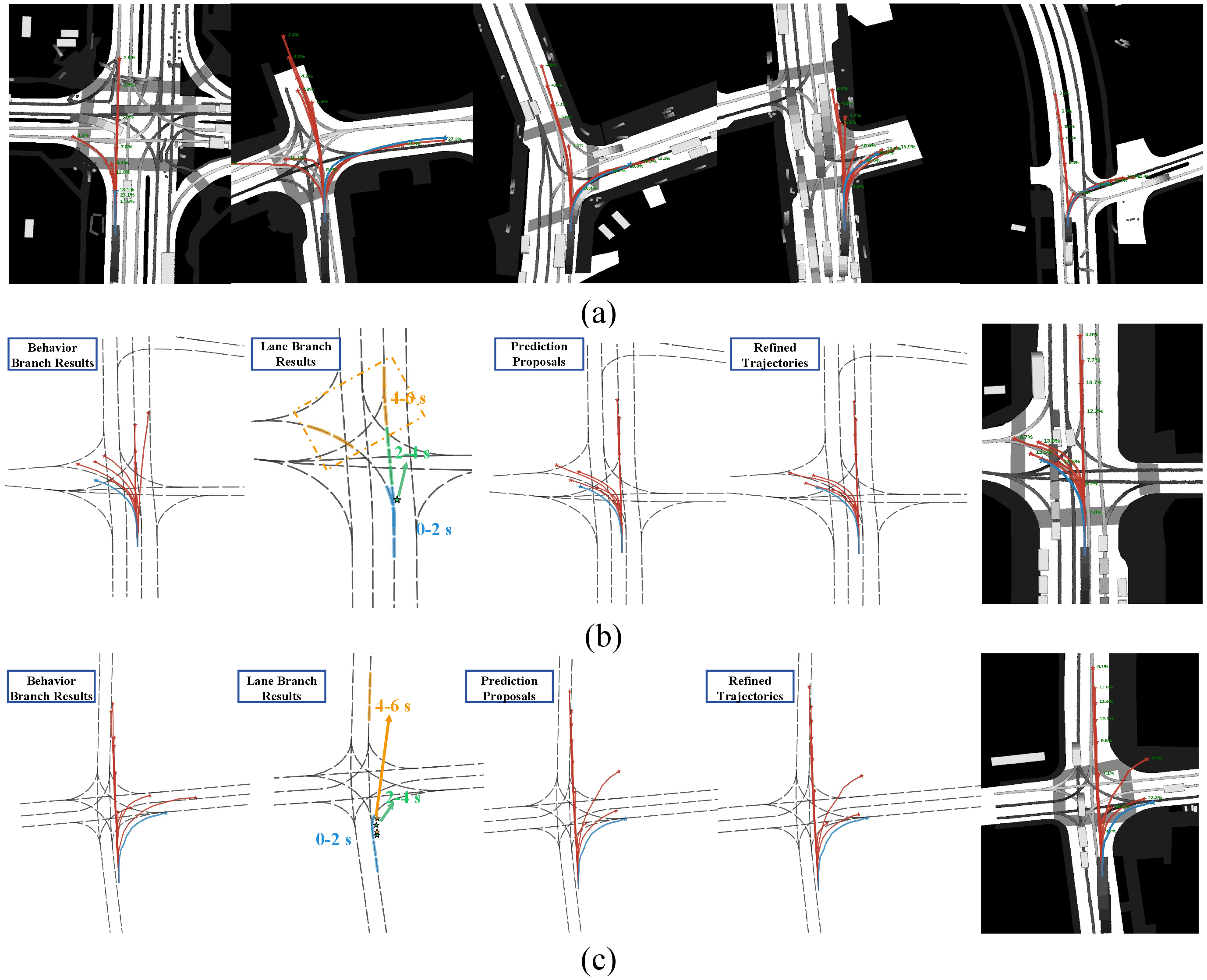
To further illustrate the effectiveness of the proposed framework, we provide qualitative visualization results as shown in Fig. 8. In all visualizations, the ground-truth future trajectory is represented by the blue curve, while the predicted trajectories are shown in red. For the lane attention branch visualization, directly displaying the predicted lane segments for every future timestamp would result in severe visual clutter. Therefore, for clarity, the predicted lane segments associated with different future horizons are grouped and color-coded according to their corresponding prediction intervals. Specifically, blue lane segments denote the lane candidates predicted for the 0–2 s horizon, green lane segments correspond to the 2–4 s horizon, and yellow lane segments indicate the 4–6 s horizon. When a lane segment is revisited by a later prediction interval, a star marker with the corresponding color is added beside the lane segment to indicate the subsequent traversal, thereby visualizing the temporal evolution of lane predictions throughout the forecasting horizon.
Fig. 8 (a) presents representative multimodal prediction results across diverse urban traffic scenarios. The predicted trajectories generally cover ground truth future motion patterns and remain consistent with the surrounding lane geometry, demonstrating that the proposed model can capture both motion diversity and lane-constrained trajectory evolution.
Fig. 8 (b) further decomposes the cascaded prediction process in a representative scenario. The behavior-state branch is able to generate diverse future motion hypotheses. Nevertheless, several trajectory modes are observed to drift toward unreasonable lane segments because no explicit lane topology constraints are imposed at this stage. The lane attention branch compensates for this limitation by predicting the lane segments likely to be occupied at different future timestamps and providing fine-grained lane guidance. As a result, the generated proposal becomes more consistent with the actual road structure. Afterward, the refinement module further adjusts the proposal using future motion features and lane continuity constraints, producing a final trajectory that more closely matches the ground-truth motion.
Fig. 8 (c) shows another representative case where the lane branch alone provides imperfect lane guidance. Specifically, the most probable lane segments predicted by the lane branch do not fully cover the actual future path of the target agent. Nevertheless, the behavior-state branch preserves a plausible motion mode that complements the missing lane guidance and enables the first-stage proposal to remain close to the ground-truth trajectory. After the refinement stage, the final prediction is further corrected and becomes more consistent with the actual future motion.
These visualizations demonstrate that the proposed dual-stream design does not simply rely on either behavioral intention or lane topology alone. Instead, the behavior-state branch and lane attention branch provide complementary guidance, while the refinement module further improves local trajectory consistency. This cascaded process enables BLNet to generate more accurate and physically reasonable predictions under different types of uncertainty.
4.4.2 Failure Case Analysis↩︎
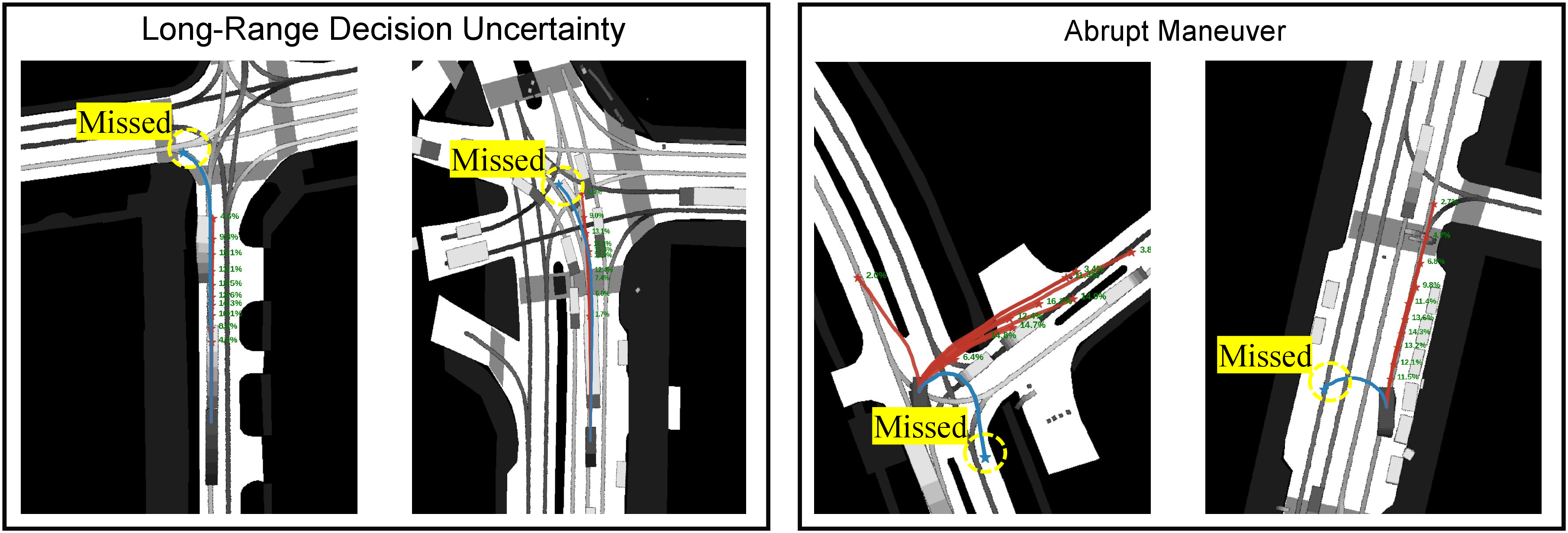
Although BLNet generally produces accurate and lane-consistent predictions, prediction errors may still occur in highly uncertain scenarios.
The left example of Fig. 9 presents a failure case that occurs far from a decision point. At this stage, the target vehicle remains relatively distant from the upcoming intersection, and the observed motion history provides insufficient cues regarding the final maneuver intention. Consequently, multiple future behaviors remain plausible, making it difficult for the model to accurately identify the correct future maneuver. Although the generated trajectories remain physically feasible, the dominant prediction deviates from the ground-truth future path. This example highlights the intrinsic difficulty of long-horizon prediction before decision regions, where future intentions have not yet been clearly expressed through observable motion patterns.
The right example of Fig. 9 illustrates a failure case involving an abrupt maneuver. In this scenario, the target vehicle performs a sudden large-direction change that is weakly represented in the training data. As a result, both the lane topology cues and historical motion patterns provide limited evidence for the future maneuver, causing the generated trajectory hypotheses to deviate from the ground truth. This example demonstrates the challenges posed by long-tail driving behaviors and rare maneuver patterns.
Overall, these failure cases indicate that the primary sources of prediction errors arise from early decision ambiguity and rare abrupt maneuvers. Addressing such challenges may require stronger intention reasoning capabilities and improved modeling of long-tail driving behaviors, which will be investigated in future work.
4.5 Discussion on Architectural Novelty↩︎
This section further discusses the architectural novelty of BLNet from the perspective of fine-grained trajectory prediction. Rather than relying on any individual architectural component, the proposed framework is built upon a unified formulation that jointly models behavioral evolution and lane topology constraints throughout the prediction horizon.
Fine-Grained Dual-Stream Token Design
BLNet adopts a target-agent-centric dual-stream architecture with timestamp-level behavioral state tokens and lane topology tokens. Each learnable token branch is supervised by dedicated auxiliary objectives, enabling behavioral evolution and lane topology constraints to be modeled explicitly and optimized simultaneously. Specifically, the behavioral-state branch focuses on capturing the dynamic evolution of driving intentions throughout the prediction horizon, while the lane branch characterizes the corresponding lane topology constraints that may influence future motion. Consequently, future trajectories are generated through the joint modeling of these two complementary factors, enabling future motion to be characterized through explicit behavioral evolution and lane topology constraints rather than a single motion hypothesis.
Point-Level Trajectory Refinement with Spatiotemporal Continuity
Instead of directly aggregating all nearby contextual information into queries, it fuses sequential lane continuity features and future motion features to achieve point-level trajectory refinement—with tangible performance gains validated by our ablation study (see Table 5). This design enables the predicted trajectories to better preserve local motion consistency and lane-following continuity and effectively reduces prediction errors in multiple driving scenarios.
Joint Supervision of Behavioral Evolution and Lane Constraints
To support the proposed fine-grained trajectory prediction formulation, BLNet introduces dedicated auxiliary supervision for the behavior-state and lane query branches. By jointly optimizing behavioral evolution and lane topology constraints, the proposed supervision strategy encourages consistent motion-state representations throughout the prediction horizon, thereby improving trajectory generation quality.
5 Conclusion and Future Work↩︎
In this study, we propose a novel trajectory prediction framework integrating fine-grained lane constraints and behavioral evolution via a dual-stream attention architecture. The model contains two complementary branches: one captures lane topology constraints, and the other learns latent behavioral patterns. We adopt a two-stage decoding strategy to generate trajectory proposals and refine trajectories with lane continuity and motion features. Experiments on nuScenes and Argoverse verify our framework’s effectiveness, with ablation studies confirming each module’s contribution.
Future work will further explore the quantitative correlation between the temporal distance to decision points and prediction performance. Potential optimization schemes will be studied to enhance model forecasting capability for scenarios where observations are obtained long before decision points with ambiguous driving intentions.
In addition, our lane-continuity refinement has two clear limitations in intersections, merging areas, lane-changing and map-uncertain scenarios. It only locally adjusts trajectories within nearby lane structures and cannot fix severely biased initial proposals from abrupt maneuvers. Moreover, it depends on accurate HD maps; ambiguous lane branches or defective map data will weaken its refinement effect. We will develop more robust refinement strategies jointly modeling lane ambiguity, unreliable map information and interactive behaviors to strengthen prediction generalization in these challenging scenarios.
Furthermore, the current learnable behavior and lane tokens rely purely on data-driven latent learning with limited interpretability, which may degrade performance on rare and long-tail traffic cases. Future work will introduce semantics-guided interpretable tokens to enhance robustness and generalization.
Wenyi Xiong received his B.E. degree in mechanical and electrical engineering from Central South University, Changsha, China, in 2021. He is currently working toward the Ph.D. degree in the College of Mechanical Engineering, Zhejiang University, Hangzhou, China.
His research interests include vehicle motion prediction, trajectory planning, and deep learning.
Jian Chen (Senior Member, IEEE) received the B.E. and M.E. degrees from Zhejiang University, Hangzhou, China, in 1998 and 2001, respectively, and the Ph.D. degree in electrical engineering from Clemson University, Clemson, SC, USA, in 2005. He was a Research Fellow with the University of Michigan, Ann Arbor, MI, USA, from 2006 to 2008, where he was involved in fuel cell modeling and control. From 2013 to 2024, he was a professor in the College of Control Science and Engineering, Zhejiang University. Currently, he is a professor in the School of Automation and Intelligent Manufacturing, Southern University of Science and Technology, Shenzhen, China. His research interests include modeling and control of fuel cell systems, visual servo techniques, battery management systems, and applied nonlinear control.
Qi Ziheng received his Bachelor’s degree in 2019 and Master’s degree in 2022, both from the College of Control Science and Engineering, Zhejiang University.
His research interests include vehicle dynamics, path planning, and tracking of autonomous vehicles.
References↩︎
This work is partially supported by Shenzhen Science and Technology Program under Grant No. JCYJ20250604144718024 and No. KQTD20221101093557010, and the Guangdong Provincial Key Laboratory of Fully Actuated System Control Theory and Technology under Grant 2024B1212010002.↩︎
\(^{1}\)Wenyi Xiong is with the School of Mechanical Engineering, Zhejiang University, Hangzhou 310027, China.↩︎
\(^{2}\)Jian Chen is with the Guangdong Provincial Key Laboratory of Fully Actuated System Control Theory and Technology, School of Automation and Intelligent Manufacturing, Southern University of Science and Technology, Shenzhen 518055, China. He is also with the School of Mechanical Engineering, Zhejiang University, Hangzhou 310058, China. (e-mail: chenj8@sustech.edu.cn).↩︎
\(^{3}\)Ziheng Qi is with Leapmotor Technology, Hangzhou 310052, China.↩︎