Long-range correlations in a locally constrained exclusion process
March 16, 2025
Abstract
We introduce a novel exclusion process with a simple local kinetic constraint that leads to a remarkable transition between a homogeneous phase with short-range correlations and a clustered phase with long-range correlations and spontaneous breaking of translation invariance. The metastable dynamics of particle clusters lead to a coarsening cascade and glassy dynamics, as well as an intriguing faster-is-slower effect where an increasing asymmetry in the flow direction leads to a decrease of the stationary current.
Lattice gas models have long been a cornerstone of statistical physics, providing a minimal yet powerful framework for studying transport phenomena, phase transitions, and non-equilibrium dynamics [1], [2]. Even in one dimension, interacting particle models with noisy dynamics have served as testbeds for understanding hydrodynamic behavior and anomalous transport on conserved mass, energy and other physical quantities [3]. A paradigmatic example of an exactly solvable lattice gas is the Asymmetric Simple Exclusion Process (ASEP) [4], [5], widely recognized as a fundamental model for one-dimensional transport processes with short-range interactions and one conservation law, viz. conservation of mass. The ASEP has found applications in diverse contexts, including ion conduction [6], single-file diffusion in porous media [7] and narrow channels [8], vehicular traffic flow [9], [10], biological transport processes through ion channels and along macromolecules and microtubuli [11], [12], and interface growth in the universality class of the Kardar-Parisi-Zhang equation [13]–[16].
Many stochastic systems, particularly in fields like traffic flow, granular matter, chemical reactions, and biological motion, involve interactions that extend beyond nearest neighbors. An eminent example of a lattice gas incorporating such interactions is the Katz-Lebowitz-Spohn (KLS) model [6], a driven kinetic Ising model with conserved magnetization. More recently, the facilitated exclusion process where particles are pushed forward by neighbors [17]–[21] has gained prominence. This process was originally introduced to study absorbing phase transitions with a conserved field. Once the transient states have died out the absorbing domain remains active and the facilitated exclusion process becomes equivalent to an exclusion process with extended particles with short-range stationary correlations [22], [23]. The hydrodynamic continuity equation was derived heuristically in [24] and recently proved rigorously [25], [26]. These models fall under a broader class of transport models with local kinetic constraints [27]–[29].
A notable feature of such one-dimensional conservative driven diffusive systems is the absence of stationary long-range correlations, as argued already a long time ago on the basis of a perturbative expansion around equilibrium [30]. Long-range correlations arise only through breaking of translation invariance e.g. by defects or boundaries. This picture echoes the well-known absence of phase transitions in one-dimensional equilibrium systems with short-range interactions and is now widely accepted. Indeed, the only one-dimensional driven diffusive systems for which phase transitions have been reported are not covered by the analysis of [30]. They involve either two or more conservation laws where particles can act as obstacles similar to defects that block the motion for the other species individually [31]–[33] or collectively [34]–[38] or they exhibit long-range interactions through a logarithmic interaction potential [39], [40] or induced by conditioning on atypical dynamics [41]–[44].
In this letter, we introduce a novel exclusion process with a minimal kinetic constraint depending on next-nearest neighbors. Specifically, a particle at site \(k\) can hop forward with rate \(q\geq 0\) only if the immediately preceding site \(k-1\) is empty, while hopping backward with rate \(1\) requires that both sites \(k-1\) and \(k-2\) are unoccupied. As a consequence, whenever two particles occupy adjacent sites, the forward hop for both is blocked. As shown below, this very simple constraint significantly alters both the dynamical and steady-state properties compared to standard exclusion models or the facilitated exclusion process. Our model combines several striking features in one spatial dimension with just a single type of particle. Controlled by the asymmetry parameter \(q\), it exhibits a transition between a homogeneous phase with short-range correlations and a clustered phase with metastable stationary dynamics, a coarsening cascade and glassy relaxation dynamics. These are known to occur under kinetic constraints [45], but unlike previously studied systems, our model also exhibits a non-trivial equilibrium state with long-range correlations and negative differential mobility [46], [47], also known as the faster-is-slower effect [48]. The equilibrium state is analytically accessible in the half-filled case, where the dynamics are reversible for all values of \(q\), with a phenomenology curiously similar to the three-species ABC model [49].
1 Basic Properties and stationary behaviour↩︎
1.1 The model↩︎
Consider \(N\) particles on a one-dimensional lattice with \(L\) sites and periodic boundary conditions. Each site \(k\) can host at most one particle, indicated by the occupation variable \(\eta_k\in\{0,1\}\). A complete particle configuration is denoted by \(\boldsymbol{\eta}=(\eta_1 ,\ldots ,\eta_L )\) with \(N=\sum_{i=1}^L \eta_i\). Particles jump randomly according to \[010 \xrightleftharpoons[1]{\text{ q }} 001, \quad with rate\quad q\geq 0\;.\] This model first appeared but was not actually explored in [27] as a limiting case of a general class of kinetically constrained exclusion processes. The special case \(q = 0\) corresponds to the facilitated totally asymmetric exclusion process (F-TASEP) [18] after a hole-particle symmetry transformation.
For densities exceeding half-filling (\(N > L/2\)), the configuration space fragments into multiple ergodic components, leading to a complete suppression of particle flow, similar to F-TASEP. However, unlike F-TASEP, the system does not have transient states and the active regime at and below half-filling exhibits novel behavior.
For densities below half-filling (\(N < L/2\)), the dynamics depend on \(q\). When \(q = 1\), the average current vanishes, and the system behaves diffusively. When \(q < 1\), the system reaches a steady state in polynomial time (\(\sim L^{3/2}\)) with a negative stationary current. In contrast, when \(q > 1\), the steady state is reached very slowly in super-exponential time (\(\sim e^{CL^2 }\)), and the current is positive. Interestingly, in this regime, the current is not solely determined by the local particle density as in the usual hydrodynamic behaviour [1] mentioned in the introduction but also depends on the system size and vanishes in the thermodynamic limit.
The half-filled case \(L=2N\) is particularly interesting: the configuration space splits into exactly two ergodic components, and the steady state is both analytically tractable and reversible for all \(q>0\). This will be demonstrated in the following section.
1.2 The Half-Filled System↩︎
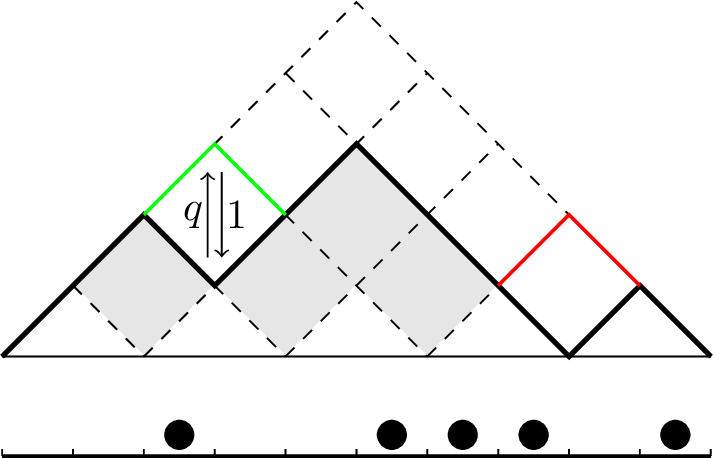
Consider a half-filled system with \(L=2N\), and define the height function as \[h_k = \sum_{i=1}^{k} (1 - 2\eta_i)\;,\quad k=1,\ldots ,L\;,\] with the convention \(h_0 = 0\). The half-filling condition ensures the height function remains continuous on the ring, satisfying \(h_L = 0\). The height function can be visualized as a path along the diagonals of a 2D lattice, where a hole corresponds to an upward-right step and a particle to a downward-right step (see Figure 1). Any site \(k_0\) where \[h( k_0 ) = h_{\text{min}} := \min_{k} h_k.\] attains its (global) minimum is called minimum site. We observe the following features:
\(\bullet\;\)The minimum height \(h_{\text{min}}\) is preserved under the dynamics. Once a site \(k\) achieves the global minimum \(h_{\min}=h_k\), it remains so unless another minimum exists at \(k-2\). Indeed, a particle at \(k\) can hop forward only if \(k-1\) is empty, implying that \(k-2\) must share the same minimum height. Similarly, new minima can form only if an adjacent site is already a minimum.
\(\bullet\;\)All minimum sites have the same parity. Between any two minimum sites \(k\) and \(\ell\), the number of “up” steps equals the number of “down” steps, forcing \(\ell-k\) to be even. Hence, the parity of minimum sites is invariant under the dynamics.
\(\bullet\;\)The configuration space splits into two connected classes. Configurations differ by whether their minimal sites occupy even or odd positions. Repeated backward jumps \(001 \to 010\) drive the system to one of two antiferromagnetic reference states, \(010101\ldots01\) or \(101010\ldots10\), revealing that states of different parity are not connected.
Steady State. Within each ergodic component, the stationary distribution is given by \[\label{invmeasure} \pi(\boldsymbol{\eta}) \;=\; \frac{1}{Z_{N} (q)}\,q^{\,E(\boldsymbol{\eta})}\;,\quad Z_{N} (q) =\sum_{\boldsymbol{\eta}} q^{E(\boldsymbol{\eta})}\;,\tag{1}\] where the energy of a half-filled configuration \(\boldsymbol{\eta}\) is \[\label{E} E(\boldsymbol{\eta}) \;=\; \frac{1}{2}\, \sum_{k=1}^{L}\!\Bigl(h_{k} (\boldsymbol{\eta})\;-\;h_{\min}(\boldsymbol{\eta}) \;-\;\tfrac{1}{2} \Bigr).\tag{2}\] The half-filled structure ensures that \(E(\boldsymbol{\eta})\) is both well-defined and translation invariant. Geometrically, if we shift the configuration so that it begins at a site of minimal height, the resulting path of \(h_k\) becomes a Dyck path [50]: it does not cross the horizontal axis and returns to zero at its endpoint. The energy \(E(\boldsymbol{\eta})\) then measures the area under this Dyck path in units of complete squares as illustrated in Fig. 1. We denote by \(\boldsymbol{\eta}^{k,k+1}\) the configuration after swapping the values of sites \(k\) and \(k+1\). If this belongs to the same ergodic component as \(\boldsymbol{\eta}\) it is easy to see that \[E(\boldsymbol{\eta}^{k,k+1} )=E(\boldsymbol{\eta})+\eta_k -\eta_{k+1}\] which implies detailed balance for the distribution \(\pi\) 1 .
Deriving a closed-form expression for the partition function \(Z_{N} (q)\) is a challenging combinatorial problem related to \(q\)-Catalan numbers [51]. Here we present a simple estimate of the leading order behaviour.
For \(q=1\), \(\pi\) is the uniform distribution on either ergodic component with \(Z_{N} (1) = \frac{1}{2} \binom{2N}{N} \simeq \frac{4^N}{\sqrt{4\pi N}}.\) For \(q>1\) the partition function is dominated by fully blocked ground states \(\boldsymbol{\eta}=(0\ldots 01\ldots 1)\) with the largest energy \(E(\boldsymbol{\eta})=\frac{1}{2} N(N-1)\), leading to a super-exponential weight \(q^{E(\boldsymbol{\eta})}\). Therefore the crude estimate \[N\max_{\boldsymbol{\eta}} q^{E(\boldsymbol{\eta})}\leq \sum_{\boldsymbol{\eta}} q^{E(\boldsymbol{\eta})} \leq {\binom{2 N}{N}} \max_{\boldsymbol{\eta}} q^{E(\boldsymbol{\eta})}\] implies that \(\frac{1}{N^2}\ln Z_{N} (q)\to \frac{1}{2}\ln q\), and a more detailed analysis based on Dyck path enumeration shows that \[Z_N (q)\simeq Nq^{N(N-1)/2} \prod_{k=1}^\infty (1-q^{-k} )^{-1}\quadas N\to\infty\;. \label{zasymp}\tag{3}\] Typical stationary configurations are small perturbations of the blocked ground states, which have energy \(0\) and stationary probability \(1/Z_N (q)\).
For \(q<1\) the two antiferromagnetic states with minimal energy \(E(\boldsymbol{\eta})=0\) are the ground state on each ergodic component. Denoting by \(\#_e \in\mathbb{N}_0\) the number of configurations \(\boldsymbol{\eta}\) with given energy \(E(\boldsymbol{\eta})=e\in \{ 0,\ldots ,N(N-1)/2\}\), we can write \(Z_N (q)=\frac{1}{2}\sum_{e=0}^{N(N-1)/2} \#_e q^e\). An analogous crude estimate as above then yields \[\frac{1}{N} \ln Z_N (q)\simeq \frac{1}{N} \max_e \big(\ln\#_e +e\ln q\big) \leq \frac{1}{N} \ln {\binom{2 N}{N}}\;,\] so \(Z_N (q)\) grows at most exponentially with \(N\). The negative energy contribution suppresses the fluctuations of the height functions, and typical configurations have a local antiferromagnetic structure.
1.3 Less than half filling↩︎
For \(L>2N\) it is easy to see that the system has only one ergodic component and we have a unique stationary distribution. This is not an equilibrium distribution for \(q\neq 1\) and we have no analytic expression. We expect and observe a non-zero stationary particle current which is positive for \(q>1\) and negative for \(q<1\). In the latter case, the system relaxes to stationarity on a usual time scale \(L^{3/2}\) and its large-scale relaxation is governed by a standard conservation law with a current that is a function of the local density. It can be well approximated by \((q-1) J_{F}(1-\rho)\) as shown in Figure 2, with \(J_{F}(\rho)\) being the facilitated TASEP current given by \(J_{F}(\rho) = \frac{(1-\rho)(2 \rho - 1)}{\rho}\) [19].
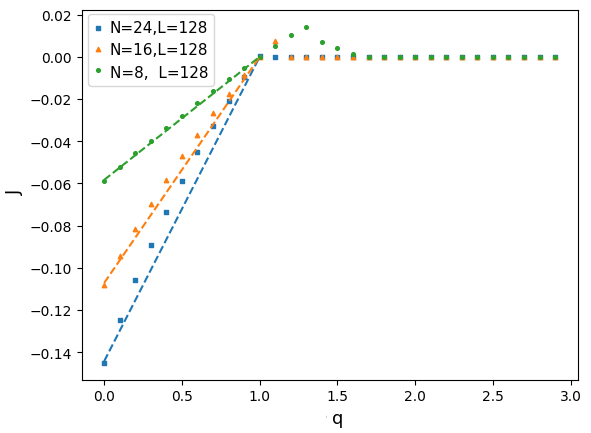
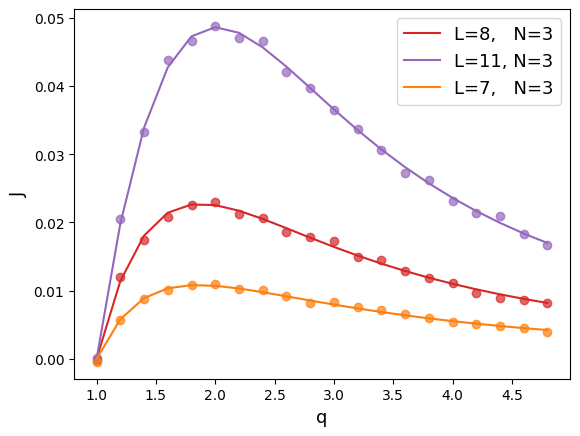

Figure 2: Stationary current as a function of \(q\) (left) and \(\rho\) (right). For \(q < 1\), the system exhibits an F-TASEP-like current of \((q-1) J_{F}(1-\rho)\) (dashed lines on the left). For \(q > 1\) the current vanishes in the thermodynamic limit with \(N/L\to\rho\in (0,1/2)\). Increasing \(q\) leads to a decrease in the current as shown in the left inset for \(N=3\) (full lines represent an exact solution) and on the right. For \(\rho =0\) with \(L\gg Nq^N\) particles can move freely and the current grows linearly as \((q-1)N/L\) (right)..
For \(q>1\) the behaviour of the system is far more intricate, particles drift to the right but neighbouring particles are blocked from jumping to the right. So typical stationary configurations consist of blocks of particles, which have to dissolve before a particle current can flow to the right. To achieve this, a block of \(M\) particles has to reach an antiferromagnetic state \(\boldsymbol{\eta}_M =(0,1,\ldots ,0,1)\), and the expected time for this can be estimated using the stationary probability \(1/Z_M (q)\) of such a state in a half-filled subsystem with \(2M\) sites. Since the exit rate from \(\boldsymbol{\eta}_M\) is \(q M+1\) and \(\pi (\boldsymbol{\eta}_M )=1/Z_M (q)\) with 3 this leads to a time scale \[\label{scale} S(q,M)=\frac{Z_M (q)}{q M+1} \simeq q^{M(M-1)/2-1}\tag{4}\] This implies the following features at stationarity: \(\bullet\;\)Metastability. Typical stationary configurations are local perturbations of a single block of \(N\) particles leading to metastable stationary dynamics on a time scale \(S(q,N-\frac{C}{1-q})\) with local corrections on the scale \(1/(1-q)\). This can be observed in the step-like time evolution of the stationary particle current, as is demonstrated in Figure 3, and indicates spontaneous breaking of translation invariance.
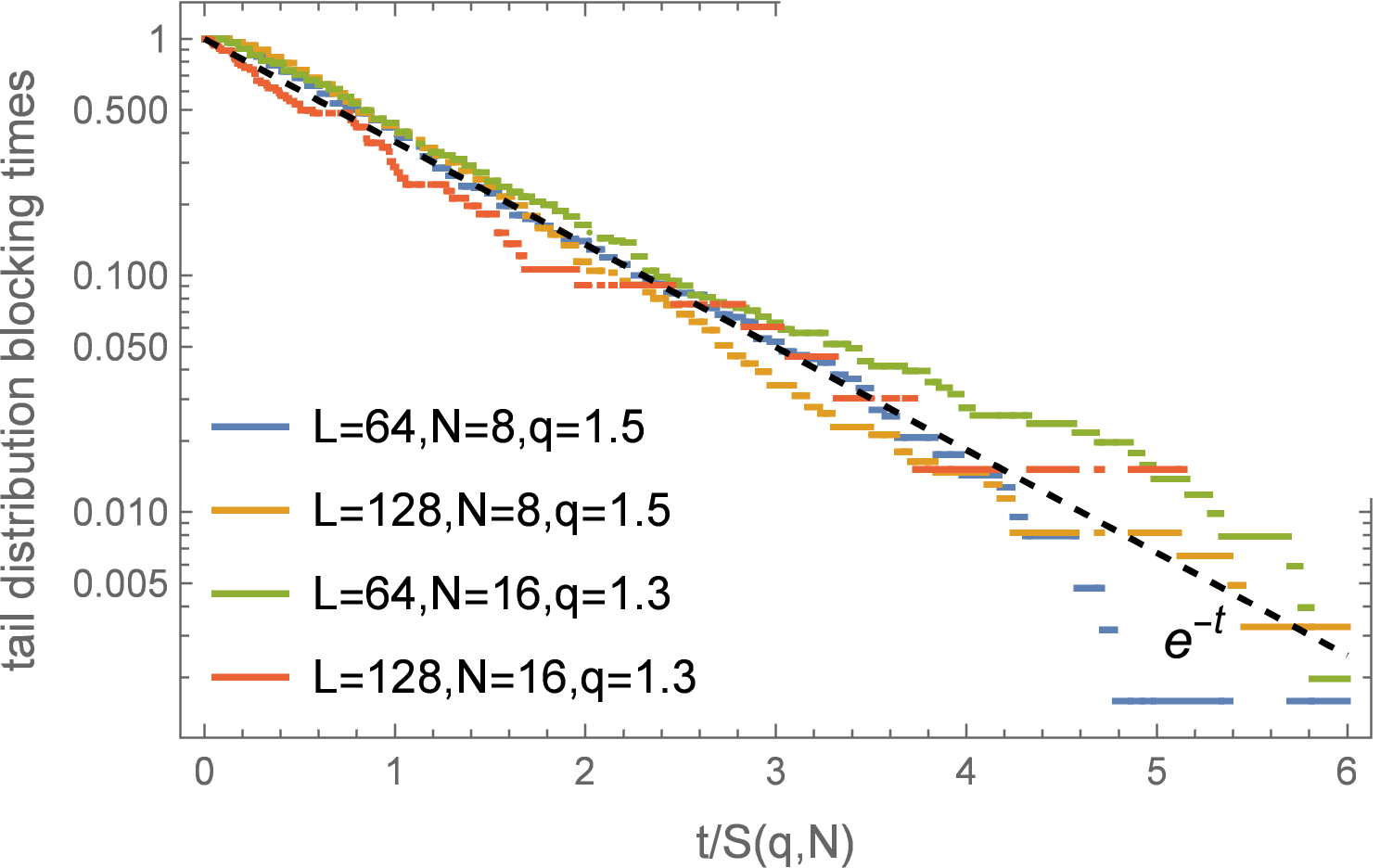
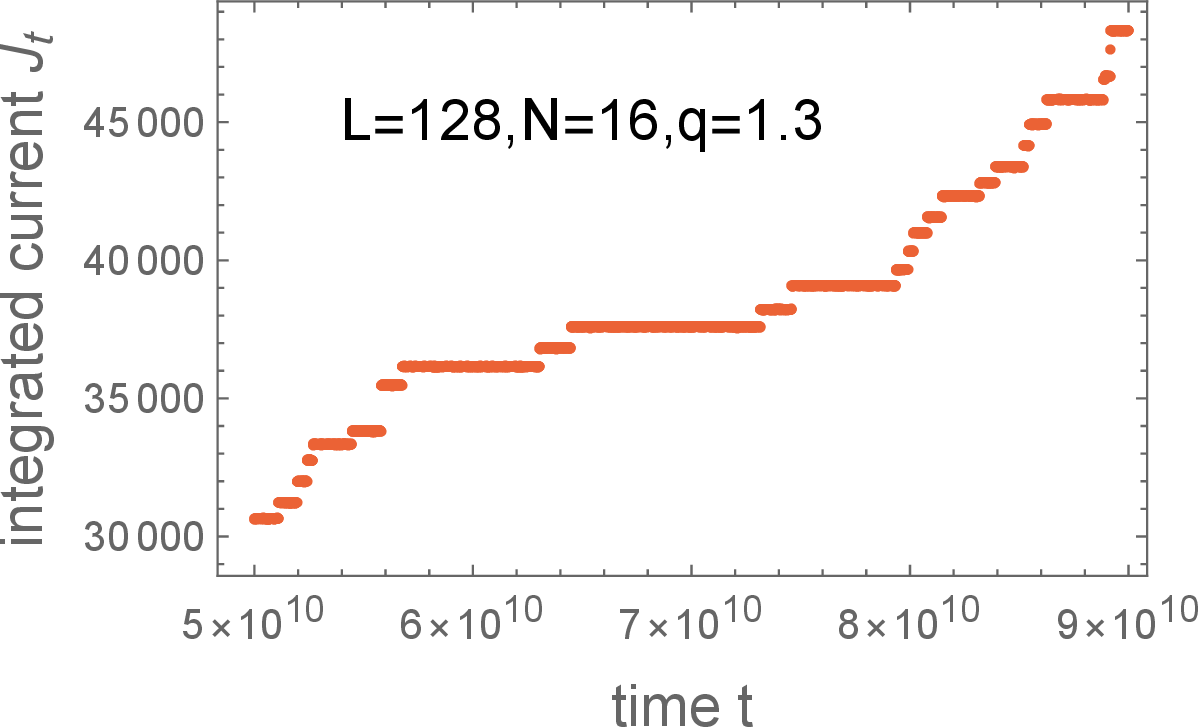
Figure 3: Metastability. A realization of the time evolution of the integrated current shows abrupt jumps, a characteristic of bottleneck-induced metastable dynamics (top right). The jump times for the stationary current are exponentially distributed on the scale \(S(q,N-\frac{C}{1-q})\) (cf. 4 ), which is consistent with numerical data (left)..
\(\bullet\;\)Negative differential mobility. An increasing asymmetry (\(q > 1\)) causes blocking times to grow super-exponentially, leading to a decrease in the stationary current. This counterintuitive effect, also known as faster-is-slower [48], occurs when higher individual particle speeds \(q-1\) hinder overall transport efficiency. In the thermodynamic limit (\(L, N \to \infty\) with \(N/L \to \rho\)), the current vanishes for any density \(\rho \in (0,1/2)\). Only at vanishing densities do particles have sufficient space to move independently, with a crossover occurring at approximately \(L \approx Nq^N\), as illustrated in Figure 2 (right).
2 Glassy dynamics for \(q>1\) and less than half filling↩︎
The stationary properties detailed above indicate a breakdown of the standard hydrodynamic approach based on a local stationarity and a current-density relation. The local kinetic constraint leads to the blocking mechanism explained above, which also dominates the dynamics of the model far from equilibrium, leading to the following properties:
\(\bullet\;\)Coarsening. Metastable clustered configurations exist on all scales and lead to a coarsening cascade when approaching the stationary state from homogeneous initial conditions (see Figure 4 right). On an infinite system the coarsening dynamics leads to an ever increasing average size \(m(t)\) of blocked clusters. It is analytically and numerically convenient to quantify the coarsening by the relative density of active particles \(a(t)\in [0,1]\) which are not blocked by other particles. We have \(a(t)\sim 1/m(t)\) decreasing in time with a rate given by the inverse metastable time scale \(S(q,m(t))\), leading to \[\label{aequ} \frac{d}{dt}a(t)\simeq -q^{-a(t)^{-2}/2+1} (1+q)\;.\tag{5}\]
\(\bullet\;\)Glassy dynamics. The solution decays asymptotically as \(a(t)\sim (\ln (1+q)t)^{-1/3}\) confirmed by numerical solutions with fitted initial condition in Figure 4 (left). In particular, this decay universally only depends on the parameter \(q\) and systems with different particle densities collapse after a transient initial phase. In finite systems the rescaled number of active particles \(A(t)/N\) coincides with \(a(t)\) very well even for moderate system sizes until the system reaches stationarity.
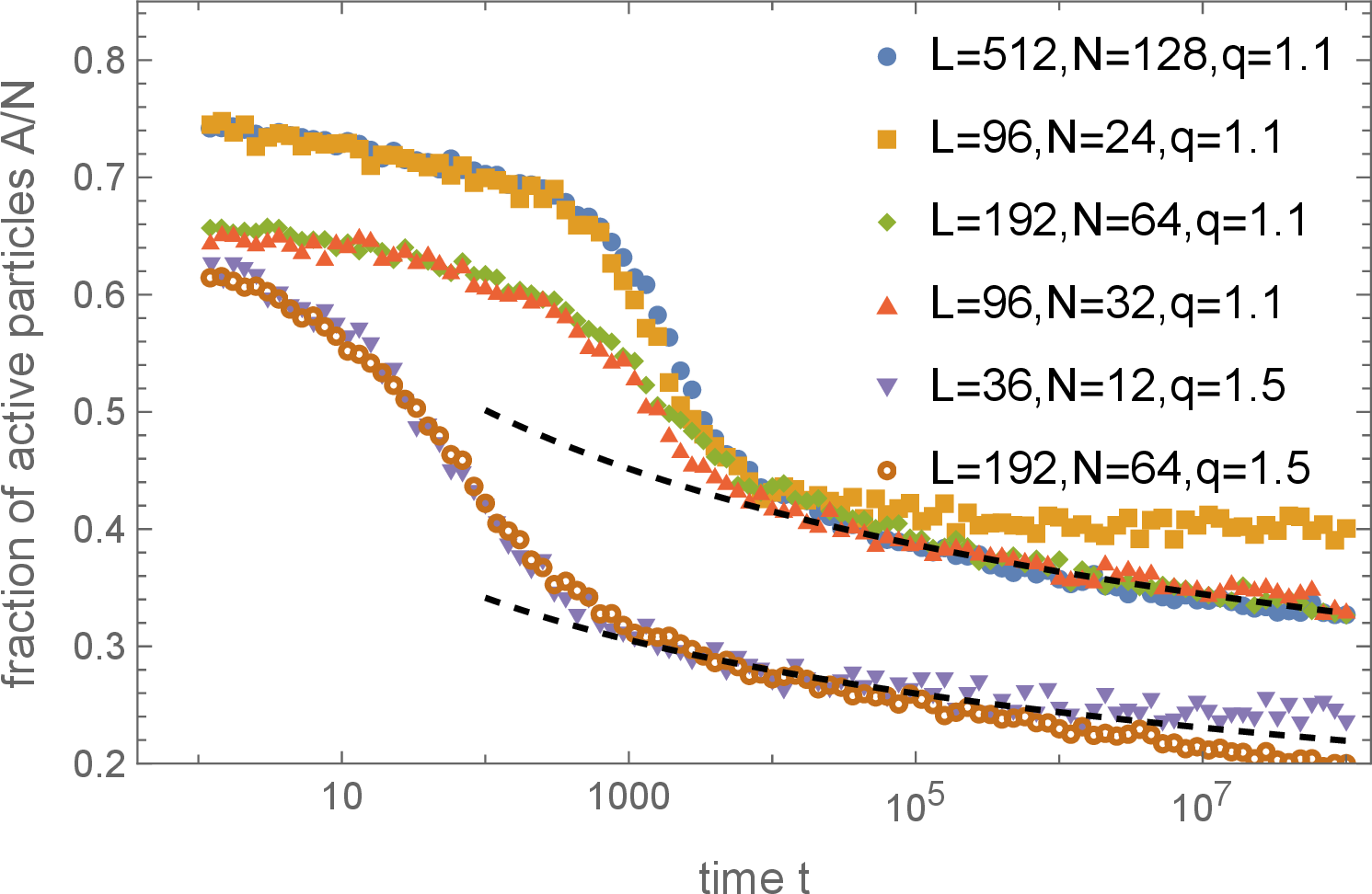

Figure 4: Coarsening cascades and glassy dynamics. The density of active particles \(a(t)\sim (\ln (1+q)t)^{-1/3}\) 5 decreases logarithmically slowly and only depends on the parameter \(q>1\) after a transient stage, which also depends on the particle density \(\rho\) (left). Finite systems deviate once \(a(t)\) reaches the stationary value (visible for \(L=36\) and \(96\)). Starting from a uniform initial conditions, accumulated density profiles show coarsening of particle clusters in a typical time evolution (right)..
3 Conclusions↩︎
The constrained ASEP studied in this Letter shows that the long-standing belief that there is no phase transition in translation invariant driven diffusive systems with one conserved quantity and short-range interactions is incorrect. It exhibits a phase transition from a homogeneous state with short-range correlations to a phase-separated state with long-range correlations that exhibits metastability, coarsening, glassy dynamics and a curious faster-is-slower phenomenon of the stationary current. These properties open up a pathway to investigating the breakdown of regular hydrodynamics due to building up long-range correlations that invalidate the assumption of local equilibrium, which is at the heart of deriving large-scale hydrodynamic behavior with a current that is a function of the local density [1].
The breakdown of hydrodynamics also puts into question the nature of stationary fluctuations as one approaches the transition point. In the hydrodynamic regime \(q<1\) they are expected on general grounds discussed in [13], [14] to belong to the universality class of the Kardar-Parisi-Zhang equation with dynamical exponent \(z=3/2\) , while at the transition point similar considerations suggest Edwards-Wilkinson universality with dynamical exponent \(z=2\), both being the lowest members of an infinite discrete series of dynamical universality classes whose dynamical exponents are given by the ratios of consecutive Fibonacci numbers [52]. For \(q=1\) the expected Edwards-Wilkinson universality is proved for the facilitated exclusion process in [53] which also gives a bound on the dynamical exponent in the weakly driven case that is consistent with KPZ scaling. An extension and sharpening of these results to the the present constrained ASEP and, more significantly, the nature of the fluctuations near the transition point for \(q>1\) is an open problem whose solution would elucidate more generally the fluctuation patterns at the onset of nonequilibrium phase separation in kinetically constrained dynamics.
Finally, we point out that the constrained exclusion process sheds new light on the celebrated positive-rates conjecture for cellular automata [54], which proposes that no phase separation in one-dimensional systems can occur unless certain transition probabilities vanish. Disproving this conjecture required a two-hundred page proof with a very intricately constructed counter example [55]. The present model with ergodic continuous-time dynamics provides a simple counter example to this conjecture, since in any discrete-time sampling of the continuous-time dynamics no transition probabilities vanish. Hence the role of zero transition probabilities for phase transitions in one dimension away from thermal equilibrium needs to be reconsidered.