The cones of \(\boldsymbol{g}\)-vectors
January 01, 1970
Abstract
This paper studies the wall-chamber structures of finite-dimensional (\(\tau\)-tilting infinite) algebras via generic decompositions of g-vectors. In particular, we examine regions outside the chambers. We show that the cones of g-vectors are rational and simplicial. Moreover, we prove that the open cone of a given g-vector coincides with the interior of its \(\operatorname{TF}\)-equivalence class if and only if the two have the same dimension. Furthermore, we establish that g-vectors satisfy the ray condition when they are sufficiently far from the origin. As an application, we generalize several results of Asai and Iyama concerning \(\operatorname{TF}\)-equivalence classes of g-vectors.
1 Introduction↩︎
Derksen and Fei [1] introduced generic decompositions of (projective) presentations to generalize Kac and Schofield’s results [2], [3] on the decompositions of quiver representations (see also [4], [5]). They constructed a notion of decomposition for g-vectors, named “generic decomposition” obtained from decompositions of general presentations. More precisely, if \(g=g_1\oplus g_2\oplus\ldots\oplus g_s\) is the generic decomposition of \(g\), then a general presentation in \(\operatorname{Hom}_{\Lambda}(g)\) can be expressed as a direct sum of general presentations in \(\operatorname{Hom}_{\Lambda}(g_i)\), for \(1\le i\le s\). This approach has also been applied to study the categorification of cluster algebras [6]–[8], g-vector fans [9]–[12], and wall-chamber structures [13]–[15]. Moreover, in our paper [16], we established that there is a natural correspondence between decompositions of generically \(\tau\)-regular components of representation varieties, in the sense of [4], and generic decompositions of g-vectors. This led us to provide a partial response to [17]. We also refer readers to [18]–[22] for recent significant works on generically \(\tau\)-regular components.
On the other hand, inspired by the works of King [23] and Bridgeland [24], Brüstle, Smith, and Treffinger [25] studied the wall-chamber structures of algebras. They showed that the open cone associated with any \(2\)-term silting complex must be a chamber. Subsequently, using \(\operatorname{TF}\)-equivalence classes, Asai [14] established the converse. More specifically, he proved that for a finite-dimensional algebra, the following sets are equivalent:
The set of all chambers of the wall-chamber structure of \(\Lambda\)
The set of all \(\operatorname{TF}\)-equivalence classes of dimension \(|\Lambda|\)
The set of all open cones associated with \(2\)-term silting complexes
Asai further demonstrated that the g-vector fan of \(\Lambda\) covers the entire ambient space if and only if \(\Lambda\) is \(\tau\)-tilting finite1, meaning it admits only finitely many \(\tau\)-tilting modules.
This naturally raises the problem of understanding the regions outside the chambers of the wall-chamber structure of (\(\tau\)-tilting infinite) finite-dimensional algebras. In this context, Asai and Iyama [15] investigated the relationship between \(\operatorname{TF}\)-equivalence classes of g-vectors and their generic decompositions. They showed that for a finite-dimensional algebra \(\Lambda\), and g-vectors \(g\) and \(h\), the condition \(\operatorname{ind}(g)=\operatorname{ind}(h)\) implies that \([g]_{\operatorname{TF}}=[h]_{\operatorname{TF}}\). Furthermore, if \(\Lambda\) is \(E\)-tame or hereditary, then \([g]_{\operatorname{TF}}=\operatorname{Cone}^{\circ}\{\operatorname{ind}(g)\}\). But in general, if \(g\) does not satisfy the ray condition (for example, see [15]), then \(\operatorname{Cone}^{\circ}\{\operatorname{ind}(g)\}\neq\operatorname{Cone}^{\circ}\{\operatorname{ind}(tg)\}\), for some \(t\in\mathbb{N}\). Nevertheless, Asai and Iyama [15] expect that \([g]_{\operatorname{TF}}=\operatorname{Cone}^{\circ}\{\operatorname{ind}(\mathbb{N}g)\}\).
For this reason, we focus on \(\operatorname{Cone}\{\operatorname{ind}(\mathbb{N}g)\}\) which is called the cone of \(g\). Due to technical reasons (for instance, see Theorem 28), we have modified the conjecture mentioned in the paragraph above, and proposed the following slightly modified version.
Conjecture 1. Let \(g\) be a g-vector. Then, \([g]_{\operatorname{TF}}^{\circ}= \operatorname{Cone}^{\circ}\{\operatorname{ind}(\mathbb{N}g)\}\).
The main purpose of this paper is to study the cones of g-vectors and provide answers to the above conjecture. As the first result, we confirm Conjecture 1 for tame g-vectors in any finite-dimensional algebra.
Theorem 2 (26). Let \(g\) be a tame g-vector. Then \[[g]_{\operatorname{TF}}=[g]^{\circ}_{\operatorname{TF}}=\operatorname{Cone}^{\circ}\{\operatorname{ind}(g)\}.\]
Secondly, for an arbitrary g-vector \(g\), we establish that the cone of \(g\) is a simplicial rational polyhedral convex cone. This allows us to prove Proposition 29, which provides a necessary condition for Conjecture 1.
Theorem 3 (27 and 5). Let \(g\) be a g-vector. Then, there exists \(t\in\mathbb{N}\) such that \(tg\) satisfies the ray condition (refer to [12]), and \[\operatorname{Cone}\{\operatorname{ind}(\mathbb{N}g)\}=\operatorname{Cone}\{\operatorname{ind}(tg)\}.\]
Thirdly, we establish the following theorem, which is closely related to [15], but does not require the ray condition.
Theorem 4 (28 and 7). For a g-vector \(g\), consider the following conditions.
(2) \(\scalebox{0.9}{\displaystyle \operatorname{dim}_{\mathbb{R}}\langle [g]_{\operatorname{TF}} \rangle_{\mathbb{R}}= \operatorname{dim}_{\mathbb{R}} \langle\operatorname{ind}(\mathbb{N}g)\rangle_{\mathbb{R}}}\). \(\scalebox{0.9}{\displaystyle [g]_{\operatorname{TF}}^{\circ}=\operatorname{Cone}^{\circ}\{\operatorname{ind}(\mathbb{N}g)\}}\). \(\scalebox{0.9}{\displaystyle \operatorname{dim}_{\mathbb{R}}W_g= |\Lambda|-|\operatorname{ind}(\mathbb{N}g)|}\). \(\scalebox{0.9}{\displaystyle W_g=\operatorname{Ker}\langle-,[g]_{\operatorname{TF}}\rangle}\).
Then, \[(1)\Longleftrightarrow(2)\Longleftarrow(2)+(4)\Longleftrightarrow(3).\]
Inspired by the proof of [15], we prove the following lemma, which does not require the ray condition and is crucial for demonstrating Theorem 4.
Lemma 1 (13). Let \(g\) be a g-vector. Then \[\operatorname{Cone}\{\operatorname{ind}(\mathbb{N}g)\}\cap [g]^{\circ}_{\operatorname{TF}}\subseteq\operatorname{Cone}^{\circ}\{\operatorname{ind}(\mathbb{N}g)\}\subseteq [g]_{\operatorname{TF}}.\] Especially, if \(g\in[g]^{\circ}_{\operatorname{TF}}\), then \[\operatorname{Cone}\{\operatorname{ind}(\mathbb{N}g)\}\cap [g]^{\circ}_{\operatorname{TF}}=\operatorname{Cone}^{\circ}\{\operatorname{ind}(\mathbb{N}g)\}.\]
Furthermore, we develop a tool that allows us to prove that each subset of \(\operatorname{TF}^{\mathrm{ss}}_{\mathbb{Z}}(\Lambda)\) has a minimal element (see Corollary 2). This tool also plays a crucial role in the proof of Theorem 31.
Proposition 5 (15). Let \(\theta,\eta\in K_0(\operatorname{proj}\Lambda)_{\mathbb{R}}\). If \(\eta\in\partial [\theta]_{\operatorname{TF}}\setminus [\theta]_{\operatorname{TF}}\), then \[\operatorname{dim}_{\mathbb{R}}\langle [\eta]_{\operatorname{TF}} \rangle_{\mathbb{R}}\lneqq\operatorname{dim}_{\mathbb{R}}\langle [\theta]_{\operatorname{TF}} \rangle_{\mathbb{R}}.\]
Subsequently, we break down Conjecture 1 into three simpler conjectures designed to provide more accessible paths for future investigations. Below, we provide evidence supporting this conjecture.
Conjecture 6. Let \(g\) be a g-vector. Then, the following conditions hold:
Rational points are dense in \([g]_{\operatorname{TF}}\).
\(\operatorname{dim}_{\mathbb{R}}\langle\operatorname{ind}(\mathbb{N}g)\rangle_{\mathbb{R}}=1\) if and only if \([g]_{\operatorname{TF}}=\mathbb{R}^{> 0}g\).
\(|\operatorname{TF}^{\mathrm{ss}}_{\mathbb{Z}}(g)|<\infty\) (see Definition 4).
The first condition is equivalent to the existence of a convex rational polyhedral cone within \([g]_{\operatorname{TF}}\) of dimension \(\operatorname{dim}_{\mathbb{R}}\langle[g]_{\operatorname{TF}}\rangle_{\mathbb{R}}\). So instead of \(\operatorname{ind}(\mathbb{N}g)\) (see Theorem 4), it is enough to find arbitrary g-vectors \(\{h^{1},h^{2},\ldots,h^{s}\}\) in \([g]_{\operatorname{TF}}\) such that \[\operatorname{dim}_{\mathbb{R}}\langle h^{i}\mid 1\le i\le s\rangle_{\mathbb{R}}=\operatorname{dim}_{\mathbb{R}}\langle [g]_{\operatorname{TF}}\rangle_{\mathbb{R}}.\] Moreover, the second condition states that Conjecture 1 holds for a g-vector \(g\) with \(\operatorname{dim}_{\mathbb{R}}\langle\operatorname{ind}(\mathbb{N}g)\rangle_{\mathbb{R}}=1\). Furthermore, the third condition means that there are only finitely many \(\operatorname{TF}\)-equivalence classes of g-vectors contained in \(\overline{[g]_{\operatorname{TF}}}\). We expect the first two conditions to follow from the third.
According to [14], we know that the condition \(\operatorname{dim}_{\mathbb{R}}\langle\operatorname{ind}(\mathbb{N}g)\rangle_{\mathbb{R}}=|\Lambda|\) implies that \(g\) belongs to the interior of the g-vector fan. Therefore, in this case, \(g\) is a tame g-vector and by Theorem 2, \([g]_{\operatorname{TF}}=\operatorname{Cone}^{\circ}\{\operatorname{ind}(g)\}\). Moreover, we establish the conjecture for cones of dimension \(|\Lambda|-1\).
Corollary 1 (7). Let \(g\) be a g-vector. If \(\operatorname{dim}_{\mathbb{R}}\langle\operatorname{ind}(\mathbb{N}g)\rangle_{\mathbb{R}}=|\Lambda|-1\), then \([g]_{\operatorname{TF}}^{\circ}=\operatorname{Cone}^{\circ}\{\operatorname{ind}(\mathbb{N}g)\}\).
2 Conventions↩︎
Throughout this paper, let \(\Lambda\) a basic finite-dimensional algebra over an algebraically closed field \(k\). By Morita equivalence, we may assume \(\Lambda=kQ/I\), where \((Q, I)\) is a bound quiver with \(n\) vertices. To simplify notation, we assume that \(Q\) is connected. In this setting, there are \(n\) simple modules up to isomorphism, typically denoted by \(\{S_{(1)},S_{(2)},\ldots,S_{(n)}\}\). The Grothendieck group of the category of finitely generated \(\Lambda\)-modules, denoted by \(K_{0}(\operatorname{mod}\Lambda)\), is a free abelian group of rank \(n\) with a basis \(\{[S_{(1)}],[S_{(2)}],\ldots,[S_{(n)}]\}\). Similarly, the Grothendieck group of the category of finitely generated projective \(\Lambda\)-modules, \(K_0(\operatorname{proj}\Lambda)\), is also a free abelian group of rank \(n\), with a basis consisting of the classes of projective modules \(\{[P_{(1)}],[P_{(2)}],\ldots,[P_{(n)}]\}\), where \(P_{(i)}\) is the projective cover of the simple module \(S_{(i)}\). The elements of \(K_0(\operatorname{mod}\Lambda)_\mathbb{R}\) and \(K_0(\operatorname{proj}\Lambda)_\mathbb{R}\) are viewed as vectors in \(\mathbb{R}^n\). Finally, we fix a complete set of primitive orthogonal idempotents \(\{e_1,\ldots,e_n\}\) corresponding to \(\{P_{(1)},\ldots, P_{(n)}\}\).
3 Preliminaries and background↩︎
An approach to studying the wall-chamber structures of finite-dimensional algebras is to explore \(\operatorname{TF}\)-equivalence classes. In this point of view, the stability spaces and the cones associated with \(\tau\)-rigid pairs play central roles. This section reviews key findings from [14], [15] regarding the relationships of these notions. Subsequently, the correspondence among the chambers and the cones of \(\tau\)-tilting pairs is also studied. This is what demonstrates the relationship between the wall-chamber structure and the g-vector fan [14]. Although most of these results are not used directly in the proofs of our main results, they are essential for understanding the themes of this paper.
Let \(\mathcal{C}\) be a full subcategory of \(\operatorname{mod}\Lambda\).
\(\mathcal{C}\) is called covariantly finite if every \(\Lambda\)-module \(X\) has a left \(\mathcal{C}\)-approximation, that is, there is a map \(X\rightarrow C\) with \(C\in\mathcal{C}\) such that for all \(C'\in\mathcal{C}\) the induced map \(\operatorname{Hom}(C,C')\rightarrow\operatorname{Hom}(X,C')\) is onto.
\(\mathcal{C}\) is called contravariantly finite if every \(\Lambda\)-module \(X\) has a right \(\mathcal{C}\)-approximation, that is, there is a map \(C\rightarrow X\) with \(C\in\mathcal{C}\) such that for all \(C'\in\mathcal{C}\) the induced map \(\operatorname{Hom}(C',C)\rightarrow\operatorname{Hom}(C',X)\) is onto.
\(\mathcal{C}\) is called functorially finite if it is both covariantly finite and contravariantly finite.
A full subcategory of \(\operatorname{mod}\Lambda\) is said to be a torsion class (respectively, a torsion-free class) if it is closed under quotients (respectively, sub-modules) and extensions. A pair \((\mathcal{T},\mathcal{F})\) forms a torsion pair if any of the following equivalent statements hold:
\(\mathcal{T}=\prescript{\perp}{}{\mathcal{F}}\) 2, and \(\mathcal{F}=\mathcal{T}^{\perp}\) 3.
\(\mathcal{T}\) is a torsion class, and \(\mathcal{F}=\mathcal{T}^{\perp}\).
\(\mathcal{F}\) is a torsion-free class, and \(\mathcal{T}=\prescript{\perp}{}{\mathcal{F}}\).
\(\operatorname{Hom}_{\Lambda}(\mathcal{T},\mathcal{F})=0\) and for each \(X\in\operatorname{mod}\Lambda\), there exists an exact sequence of the form: \[\begin{tikzcd}[cramped] 0 & T & X & F & {0,} \arrow[from=1-1, to=1-2] \arrow["a", from=1-2, to=1-3] \arrow["b", from=1-3, to=1-4] \arrow[from=1-4, to=1-5] \end{tikzcd}\] where \(T\in\mathcal{T}\) and \(F\in\mathcal{F}\).
In the above exact sequence, the morphism \(a\) is a right \(\mathcal{T}\)-approximation, and \(b\) is a left \(\mathcal{F}\)-approximation. Thus, torsion classes are contravariantly finite and torsion-free classes are covariantly finite.
Let \(X\) be a finite-dimensional module. Denote \(\operatorname{Fac}(X)\) (respectively, \(\operatorname{Sub}(X)\)) as the smallest full subcategory of \(\operatorname{mod}(\Lambda)\) that contains \(X\), closed under taking quotients (respectively, closed under submodules) and extensions. According to [27], for a torsion pair \((\mathcal{T},\mathcal{F})\) of \(\operatorname{mod}\Lambda\), the following statements are equivalent:
\(\mathcal{T}\) is functorially finite.
\(\mathcal{F}\) is functorially finite.
\(\mathcal{T}=\operatorname{Fac}M\), for some \(\tau\)-rigid module \(M\).
\(\mathcal{F}=\operatorname{Sub}(\tau M\oplus \nu P)\), for some \(\tau\)-tilting pair \((M,P)\).
Therefore, the map \[\begin{array}{rcl} \operatorname{\tau-rigid-pair}\Lambda &\longrightarrow &\operatorname{f-tors-pair}\Lambda, \\ (M, P)& \longmapsto &(\operatorname{Fac}M, \operatorname{Sub}(\tau M\oplus \nu P)) \end{array}\footnote{\nu is the Nakayama functor.}\] provides a bijection between \(\tau\)-tilting pairs and functorially finite torsion pairs.
In the following, we review the relationship among g-vector fan and the wall-chamber structure. To do so, we recall some basic facts regarding stability conditions and the cones associated with \(\tau\)-rigid pairs.
8 ([28]). For \(\theta\in\mathbb{R}^n\), define \[\begin{array}{l} \overline{\mathcal{T}_{\theta}}:=\{M\in\operatorname{mod}\Lambda\mid \langle\theta,[M']\rangle \ge 0, \text{for all factor module M' of M}\}, \\ \overline{\mathcal{F}}_{\theta}:=\{M\in \operatorname{mod}\Lambda\mid\langle\theta,[M']\rangle \le 0, \text{for all sub-module M' of M}\}, \\ \mathcal{T}_{\theta}:=\{M\in \operatorname{mod}\Lambda\mid \langle\theta,[M']\rangle > 0, \text{for all non-zero factor module M' of M}\}, \\ \mathcal{F}_{\theta}:=\{M\in \operatorname{mod}\Lambda\mid\langle\theta,[M']\rangle < 0, \text{for all non-zero sub-module M' of M}\}, \end{array}\] \[\begin{array}{l l} \mathcal{W}_{\theta}:= \overline{\mathcal{T}}_{\theta}\bigcap \overline{\mathcal{F}}_{\theta}, & W_\theta:=\langle\{[X]\mid X\in\mathcal{W}_{\theta}\}\rangle_{\mathbb{R}}. \end{array}\] Then, the pairs \((\overline{\mathcal{T}}_{\theta}, \mathcal{F}_{\theta})\) and \((\mathcal{T}_{\theta}, \overline{\mathcal{F}}_{\theta})\) are torsion pairs which are called semistable torsion pairs, and \(\mathcal{W}_{\theta}\) is a wide subcategory which is said to be \(\theta\)-semistable subcategory.
The stability space for \(X\in\operatorname{mod}(\Lambda)\) is \[\mathfrak{D}(X):=\{\theta\in\mathbb{R}^n\mid X\in\mathcal{W}_{\theta}\}.\] Any stability space of codimension \(1\) is called a wall, and any connected component of the space \[\mathfrak{R}=\mathbb{R}^n\setminus\overline{\bigcup_{X\in\operatorname{mod}(\Lambda)}\mathfrak{D}(X)}\] is said to be chamber.
Definition 1. Consider a subset \(\mathcal{X}\) of \(\mathbb{R}^{n}\). We say it is a convex cone, if for all \(x,y\in\mathcal{X}\) and \(u,v\in\mathbb{R}^{\ge 0}\), \(ux+vy\) belongs to \(\mathcal{X}\). Moreover, \(\mathcal{X}\) is called rational cone (respectively, polyhedral cone, simplicial cone), if there exist rational vectors (respectively, finitely many vectors, linearly independent vectors) \(\{x_i\}_{i\in I}\) such that \[\mathcal{X}=\operatorname{Cone}\{x_i\mid i\in I\}:=\sum_{i\in I}\mathbb{R}^{\ge 0}x_i.\]
An element of \(K_0(\operatorname{proj}\Lambda)\) is said to be g-vector. For a complex \[\mathcal{P}=\ldots\rightarrow P^{-1}\rightarrow P^0\rightarrow P^1\rightarrow\ldots,\] in \(\in K^b(\operatorname{proj}\Lambda)\), the g-vector of \(\mathcal{P}\) is defined as \[g^{\mathcal{P}}:=\sum_{i\in\mathbb{Z}}(-1)^i[P^i]\in K_0(\operatorname{proj}\Lambda)\cong\mathbb{Z}^n.\] Moreover, for the minimal projective presentation \(a:P^{-1}\rightarrow P^0\) of a module \(M\), the g-vector of \(M\) is defined as \[g^M:=g^{\mathcal{P}_a}\in K_0(\operatorname{proj}\Lambda),\] where \(\mathcal{P}_a\) is the corresponding \(2\)-term complex in \(K^b(\operatorname{proj}\Lambda)\). In this case, the g-vector of the complex \(\mathcal{P}_a\) is denoted by \(g^a\).
The g-vector fan of \(\Lambda\) is the union of open cones \[\mathfrak{C}^{\circ}_{(M,P)}:=\operatorname{Cone}^{\circ}\{g^{M_1},\ldots,g^{M_s},-g^{P_1},\ldots,-g^{P_r}\},\] where \((M,P)\) is a \(\tau\)-rigid pair, and \(M=M_1\oplus\ldots\oplus M_s\) and \(P=P_1\oplus\ldots\oplus P_r\) are the Krull-Schmidt decompositions of \(M\) and \(P\), respectively4.
The following result is a direct consequence of [14] and [29]. It was used by Asai [14] to establish the correspondence between the cones associated with \(\tau\)-tilting pairs and chambers in the wall-chamber structure. Later in this paper, we apply this result to prove Corollary 7.
Proposition 9. Let \(g\) be a g-vector. Then, the following statements are equivalent.
There exists a \(\tau\)-tilting pair \((M,P)\) such that \(g \in\mathfrak{C}^{\circ}_{(M,P)}\).
\(\mathcal{W}_g=\{0\}.\)
\(g\) lies in a chamber.
\(g\) is not on any wall.
In this case, \(g\) is (tame and) contained in \(\langle g^{M_i},-g^{P_j}\mid 1\le i\le s, 1\le j\le r \rangle_{\mathbb{N}}\), where \(M=M_1\oplus M_2\oplus\ldots\oplus M_s\) and \(P=P_1\oplus P_2\oplus\ldots\oplus P_r\) are Krull-Schmidt decompositions.
Example 1. Consider the following quiver \(Q\). \[\begin{tikzcd}[cramped,sep=scriptsize,scale=0.4] && 2 && \\ & 1 && 3 \arrow["\beta", from=1-3, to=2-4] \arrow["\alpha", from=2-2, to=1-3] \arrow["\gamma", from=2-4, to=2-2] \end{tikzcd}\] In Figure 1, we see three chambers and seven walls of the wall-chamber structure of the algebra \(kQ/\langle (\alpha\gamma\beta)^{3}\rangle\) where
(3) \(\scalebox{0.8}{\displaystyle \mathfrak{C}^{\circ}_{( { \tiny \begin{pmatrix} 2\\3\\1 \end{pmatrix} }\oplus { \tiny \begin{pmatrix} 2\\3 \end{pmatrix} }\oplus { \tiny \begin{pmatrix} 2 \end{pmatrix} }, { \tiny \begin{pmatrix} 0 \end{pmatrix} })}}\) \(\scalebox{0.8}{\displaystyle \mathfrak{C}^{\circ}_{( { \tiny \begin{pmatrix} 1\\2\\3 \end{pmatrix} }\oplus { \tiny \begin{pmatrix} 2\\3\\1 \end{pmatrix} }\oplus { \tiny \begin{pmatrix} 2 \end{pmatrix} }, { \tiny \begin{pmatrix} 0 \end{pmatrix} })}}\) \(\scalebox{0.8}{\displaystyle \mathfrak{C}^{\circ}_{( { \tiny \begin{pmatrix} 2\\3 \end{pmatrix} }\oplus { \tiny \begin{pmatrix} 2 \end{pmatrix} }, { \tiny \begin{pmatrix} 1\\2\\3 \end{pmatrix} })}}\).
By [25], this finite-dimensional algebra has only \(20\) \(\tau\)-tilting pairs. Therefore, by [14], its g-vector fan covers the whole of \(\mathbb{R}^3\).
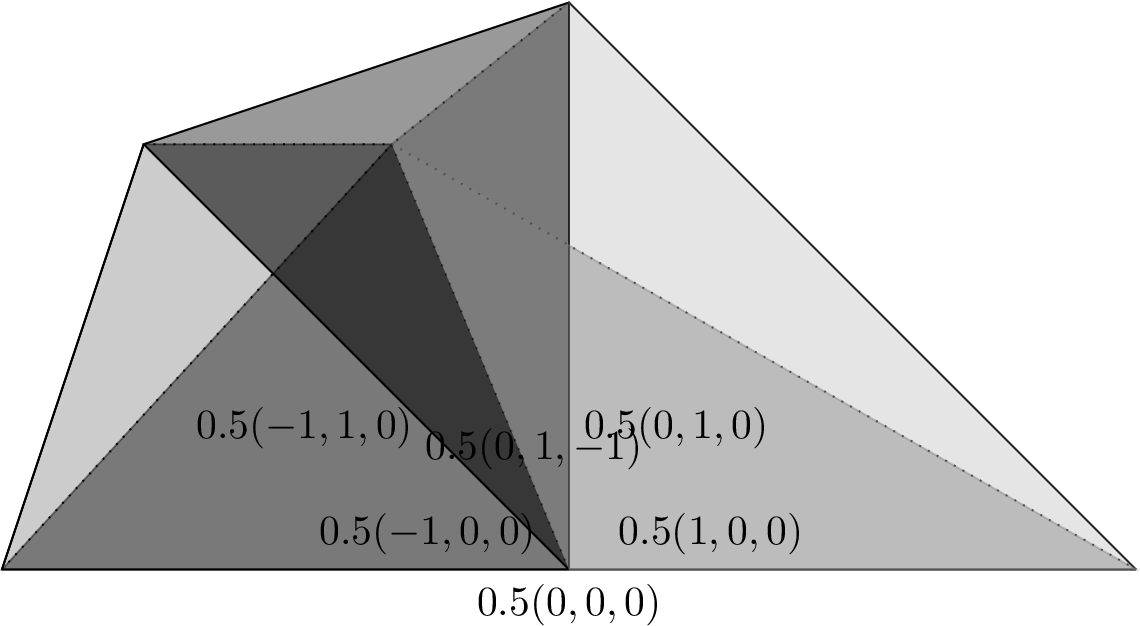
In this paper, we focus on points outside the g-vector fan. Based on the last proposition, we can assert that if a given g-vector does not belong to the g-vector fan, then the associated wide subcategories do not vanish. Therefore, following [14], we can assert that each g-vector outside the g-vector fan lies on a wall. Moreover, the following result reveals that the semistable torsion pairs associated with these g-vectors are no longer functorially finite.
Proposition 10. Let \(\theta\in\mathbb{R}^n\). Then, \(\theta\) belongs to \(\mathfrak{C}^{\circ}_{(M,P)}\), for some \(\tau\)-rigid pair \((M,P)\), if and only if \[\begin{array}{rl} \scalebox{0.95}{\displaystyle (\mathcal{T}_{\theta}, \overline{\mathcal{F}}_{\theta})=(\operatorname{Fac}M, M^{\perp})}, &\scalebox{0.95}{\displaystyle (\overline{\mathcal{T}}_{\theta}, \mathcal{F}_{\theta})=(\prescript{\perp}{}{\tau M}\cap P^{\perp},\operatorname{Sub}(\tau M\oplus\nu P))}. \end{array}\] Therefore, the torsion class \(\overline{\mathcal{T}}_{\theta}\) is functorially finite if and only if \(\theta\) belongs to the \(\operatorname{g}\)-vector fan of \(\Lambda\). In this case, \(\mathcal{W}_{\theta}=\prescript{\perp}{}{\tau M}\cap P^{\perp}\cap M^{\perp}\).
Torsion pairs associated with morphisms in \(\operatorname{proj}\Lambda\) play a crucial role in the study of generic decompositions, semistable torsion pairs, and \(\operatorname{TF}\)-equivalence classes. In the following, we recall this notion and review some foundational results (see, for instance, Proposition 12 and Lemma 6). Using these tools, we then provide a proof for our result in Theorem 20.
Remark 11. For a module \(X\), it is easy to check that \(\mathsf{T}(X):=\prescript{\perp}{}{(X^{\perp})}\) is the smallest torsion class, and \(\mathsf{F}(X):=(\prescript{\perp}{}{X})^{\perp}\) is the smallest torsion-free class containing \(X\).
Definition 2 ([15]). Let \(a\) be a morphism in \(\operatorname{proj}\Lambda\). Then, the pairs \((\overline{\mathcal{T}}_{a}, \mathcal{F}_{a})\) and \((\mathcal{T}_{a}, \overline{\mathcal{F}}_{a})\) where \[\begin{array}{l l l l} \mathcal{T}_a:=\mathsf{T}(\operatorname{Coker}a), & \overline{\mathcal{T}}_a:=\prescript{\perp}{}{\operatorname{Ker}\nu a}, & \mathcal{F}_a:=\mathsf{F}(\operatorname{Ker}\nu a), & \overline{\mathcal{F}}_a:=(\operatorname{Coker}a)^{\perp} \end{array}\] are torsion pairs.
Proposition 12 ([15]). Let \(g\) be a g-vector. Then \[\begin{array}{c c c c} \overline{\mathcal{T}}_g=\bigcup\limits_{a\in A}\overline{\mathcal{T}}_a, & \overline{\mathcal{F}}_g=\bigcup\limits_{a\in A}\overline{\mathcal{F}}_a, & \mathcal{T}_{g}=\bigcap\limits_{a\in A}\mathcal{T}_a, & \mathcal{F}_g=\bigcap\limits_{a\in A}\mathcal{F}_a, \end{array}\] where \(A\) is the set of every morphism \(a\in\operatorname{proj}(\Lambda)\) with \(g^a=tg\), for some \(t\in\mathbb{N}\).
4 \(\operatorname{TF}\)-equivalence classes↩︎
First, we review the notion of \(\operatorname{TF}\)-equivalence relation on \(K_0(\operatorname{proj}\Lambda)_{\mathbb{R}}\). Then, basic results concerning \(\operatorname{TF}\)-equivalence classes are studied. Subsequently, we study the relationship between the boundary and interior of the \(\operatorname{TF}\)-equivalence class of a given vector, which allows us to prove Proposition 15.
Definition 3 ([14]). Consider \(\theta, \eta\in K_0(\operatorname{proj}\Lambda)_{\mathbb{R}}\). We say \(\theta\) and \(\eta\) are \(\operatorname{TF}\)-equivalent provided that \(\overline{\mathcal{T}}_{\theta}=\overline{\mathcal{T}}_{\eta}\) and \(\overline{\mathcal{F}}_{\theta}=\overline{\mathcal{F}}_{\eta}\). The \(\operatorname{TF}\)-equivalence class of \(\theta\) is denoted by \([\theta]_{\operatorname{TF}}\).
Lemma 2 ([14]). Let \(\theta\) and \(\eta\) be in \(K_0(\operatorname{proj}\Lambda)_{\mathbb{R}}\). Then, \(\eta\) belongs to \(\overline{[\theta]_{\operatorname{TF}}}\) if and only if \(\overline{\mathcal{T}}_{\theta}\subseteq\overline{\mathcal{T}}_{\eta}\) and \(\overline{\mathcal{F}}_{\theta}\subseteq\overline{\mathcal{F}}_{\eta}\).
Proposition 13 ([14]). For \(\theta, \eta\in K_0(\operatorname{proj}\Lambda)_{\mathbb{R}}\), the following statements are equivalent.
\([\theta]_{\operatorname{TF}}=[\eta]_{\operatorname{TF}}\).
\(\{r\theta+(1-r)\eta\mid r\in[0,1]\} =:[\theta,\eta]\subseteq[\theta]_{\operatorname{TF}}\).
\(\forall\gamma\in[\theta,\eta], \mathcal{W}_{\eta}=\mathcal{W}_{\theta}.\)
Lemma 3 ([15]). Assume that \(\theta,\eta\in K_0(\operatorname{proj}\Lambda)_{\mathbb{R}}\) are \(\operatorname{TF}\)-equivalent. Then, for \(M\in\mathcal{T}_{\theta}\), there exists \(t\in\mathbb{N}\) such that \(M\in\mathcal{T}_{t\theta-\eta}\). Additionally, the similar assertions hold for \(\overline{\mathcal{T}}_{\theta}\), \(\overline{\mathcal{F}}_{\theta}\), \(\mathcal{F}_{\theta}\) and \(\mathcal{W}_{\theta}\).
Let \(\mathcal{X}\subseteq K_0(\operatorname{proj}\Lambda)_{\mathbb{R}}\). The set consisting of all points \(\eta\in\mathcal{X}\) that belong to some open subset of \(\langle\mathcal{X}\rangle_{\mathbb{R}}\) is said to be the (relative) interior of \(\mathcal{X}\), and denoted by \(\mathcal{X}^{\circ}\). Moreover, the boundary of \(\mathcal{X}\) is defined as \(\partial \mathcal{X}:=\overline{\mathcal{X}}\setminus \mathcal{X}^{\circ}\).
Remark 14. For \(0\neq\theta\in K_0(\operatorname{proj}\Lambda)_{\mathbb{R}}\), let \(\{\theta_1,\ldots,\theta_s\}\subseteq [\theta]_{\operatorname{TF}}\) be a basis for \(\langle [\theta]_{\operatorname{TF}} \rangle_{\mathbb{R}}\). Then, the convexity of \(\operatorname{TF}\)-equivalence classes implies that \[\operatorname{Cone}^{\circ}\{\theta_1,\ldots,\theta_s\}\subseteq [\theta]_{\operatorname{TF}}\] is an open subset of \(\langle [\theta]_{\operatorname{TF}} \rangle_{\mathbb{R}}\). Therefore, the interior of any (non-zero) \(\operatorname{TF}\)-equivalence class is not empty.
Lemma 4. Let \(\mathcal{X}\subseteq K_0(\operatorname{proj}\Lambda)_{\mathbb{R}}\) be a convex cone. If \(\eta\in \mathcal{X}^{\circ}\) and \(\gamma\in\overline{\mathcal{X}}\), then \[\{t\eta+(1-t)\gamma\mid t\in (0,1)\}=:(\eta,\gamma)\subseteq \mathcal{X}^{\circ}.\] Moreover, \(t\eta-\gamma\in\mathcal{X}^{\circ}\), for sufficiently large \(t\in\mathbb{N}\).
Proof. Consider an open ball \(\mathcal{B}\subseteq \mathcal{X}\) containing \(\eta\). Since \(\mathcal{X}\) is convex and \(\gamma\in\overline{\mathcal{X}}\), for \(\alpha\in (\gamma,\eta)\), there exists \(\gamma'\in \mathcal{X}^{\circ}\) near \(\gamma\) such that \[\alpha\in (\gamma',\mathcal{B}):=\{t\gamma'+(1-t)b\mid b\in\mathcal{B}, t\in (0,1)\}\subseteq \mathcal{X}.\] This subset is open in \(\langle \mathcal{X}\rangle_{\mathbb{R}}\). Therefore, \(\alpha\in\mathcal{X}^{\circ}\).
Since \(\mathcal{X}\) is a convex cone and \(\gamma,\eta\in\langle \mathcal{X}\rangle_{\mathbb{R}}\), we conclude that \((-\gamma,\eta)\cap\overline{\mathcal{X}}\neq\emptyset\). Thus, the second assertion follows from the first one. ◻
The following lemma later used to prove Corollary 3 and Lemma 12, which are crucial tools for establishing our main results.
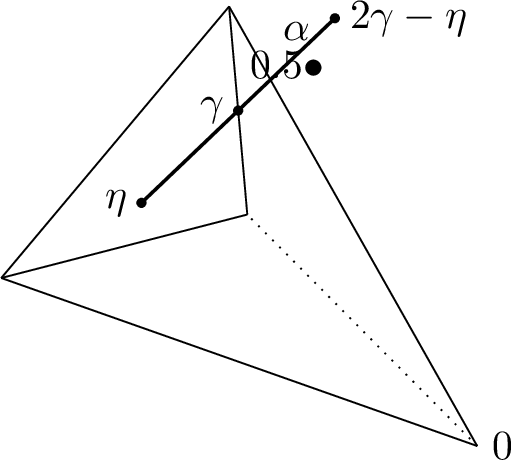
Lemma 5. Consider a convex cone \(\mathcal{X}\subseteq K_0(\operatorname{proj}\Lambda)_{\mathbb{R}}\). If \(\eta\in \mathcal{X}^{\circ}\) and \(\gamma\in\partial \mathcal{X}\), then for all \(t\in\mathbb{R}^{>0}\), we have \[(t\gamma-\eta,\gamma)\cap\overline{\mathcal{X}}=\emptyset.\]
Proof. We prove the assertion for \(t=2\). The remaining cases can be obtained, similarly. Let \(\alpha\in (2\gamma-\eta,\gamma)\cap\overline{\mathcal{X}}\) (see Figure 2). Then by Lemma 4, we have \[\gamma\in (\alpha,\eta)\subseteq \mathcal{X}^{\circ},\] which contradicts the assumption.
◻
Proposition 15. Let \(\theta,\eta\in K_0(\operatorname{proj}\Lambda)_{\mathbb{R}}\). If \(\eta\in\partial [\theta]_{\operatorname{TF}}\setminus [\theta]_{\operatorname{TF}}\), then \[\operatorname{dim}_{\mathbb{R}}\langle [\eta]_{\operatorname{TF}} \rangle_{\mathbb{R}}\lneqq\operatorname{dim}_{\mathbb{R}}\langle [\theta]_{\operatorname{TF}} \rangle_{\mathbb{R}}.\]
Proof. It follows from Lemma 2 that \([\eta]_{\operatorname{TF}}\) is included in \(\partial [\theta]_{\operatorname{TF}}\setminus [\theta]_{\operatorname{TF}}\). Thus, \(\langle [\eta]_{\operatorname{TF}} \rangle_{\mathbb{R}}\subseteq\langle [\theta]_{\operatorname{TF}} \rangle_{\mathbb{R}}\). Therefore, \[\label{eq305294877718} \operatorname{dim}_{\mathbb{R}}\langle [\eta]_{\operatorname{TF}} \rangle_{\mathbb{R}}=\operatorname{dim}_{\mathbb{R}}\langle [\theta]_{\operatorname{TF}} \rangle_{\mathbb{R}},\tag{1}\] implies that \(\langle [\eta]_{\operatorname{TF}} \rangle_{\mathbb{R}}=\langle [\theta]_{\operatorname{TF}} \rangle_{\mathbb{R}}\). Without loss of generality, assume that \(\theta\in [\theta]_{\operatorname{TF}}^{\circ}\) and \(\eta\in [\eta]_{\operatorname{TF}}^{\circ}\). Consider an open ball \(B\subseteq[\eta]_{\operatorname{TF}}\) containing \(\eta\). Then, 1 implies that \(B\cap (\eta,\theta)\neq\emptyset\). On the other hand, by Lemma 4, we have \((\eta,\theta)\subseteq[\theta]_{\operatorname{TF}}^{\circ}\), and so \(B\cap (\eta, \theta)=\emptyset\). This contradicts the equality 1 . ◻
Definition 4. Let \(\theta\) be an arbitrary vector. Then, we set \[\begin{array}{l l} \operatorname{TF}^{\mathrm{ss}}_{\mathbb{Z}}(\theta)= \{(\overline{\mathcal{T}}_h, \overline{\mathcal{F}}_h)\mid h\in K_0(\operatorname{proj}\Lambda), \overline{\mathcal{T}}_\theta\subseteq \overline{\mathcal{T}}_h, \overline{\mathcal{F}}_\theta\subseteq \overline{\mathcal{F}}_h\}, & \operatorname{TF}^{\mathrm{ss}}_{\mathbb{Z}}(\Lambda)=\bigcup\limits_{\scalebox{0.8}{\displaystyle \theta\in \mathbb{R}^n}}\operatorname{TF}^{\mathrm{ss}}_{\mathbb{Z}}(\theta). \end{array}\]
Remark 16. Let \(\theta\) be an arbitrary vector. Then, the following assertions hold.
\((\overline{\mathcal{T}}_0, \overline{\mathcal{F}}_0)= (\operatorname{mod}\Lambda, \operatorname{mod}\Lambda)\in \operatorname{TF}^{\mathrm{ss}}_{\mathbb{Z}}(\theta)\).
For all \(\gamma\in\overline{[\theta]_{\operatorname{TF}}}\), we have \(\operatorname{TF}^{\mathrm{ss}}_{\mathbb{Z}}(\gamma)\subseteq\operatorname{TF}^{\mathrm{ss}}_{\mathbb{Z}}(\theta)\).
\(\operatorname{TF}^{\mathrm{ss}}_{\mathbb{Z}}(\Lambda)\) is a partially ordered set ordered by inclusion.
Moreover, for a g-vector \(g\), \(|\operatorname{TF}^{\mathrm{ss}}_{\mathbb{Z}}(g)|=1\) if and only if \(g=0\).
Corollary 2. Let \(g\) be a g-vector. Then, each subset of \(\operatorname{TF}^{\mathrm{ss}}_{\mathbb{Z}}(\Lambda)\) has a minimal element.
Proof. Choose an arbitrary subset \(\mathcal{S}\) of \(\operatorname{TF}^{\mathrm{ss}}_{\mathbb{Z}}(\Lambda)\). If there is no minimal element in \(\mathcal{S}\), then one can find a strictly descending chain of the form \[\ldots\subsetneq (\overline{\mathcal{T}}_{\theta_2},\overline{\mathcal{F}}_{\theta_2})\subsetneq (\overline{\mathcal{T}}_{\theta_1},\overline{\mathcal{F}}_{\theta_1})\subsetneq (\overline{\mathcal{T}}_{\theta_0},\overline{\mathcal{F}}_{\theta_0}).\] Hence, by Proposition 15, we conclude that there exists the following strictly ascending chain of positive integers: \[\ldots>\operatorname{dim}_{\mathbb{R}}\langle[\theta_2]_{\operatorname{TF}}\rangle_{\mathbb{R}}>\operatorname{dim}_{\mathbb{R}}\langle[\theta_1]_{\operatorname{TF}}\rangle_{\mathbb{R}}>\operatorname{dim}_{\mathbb{R}}\langle[\theta_0]_{\operatorname{TF}}\rangle_{\mathbb{R}}.\] However, \(K_0(\operatorname{proj}\Lambda)_{\mathbb{R}}\) is of dimension \(n\). This leads to a contradiction. ◻
5 Generic decompositions and cones↩︎
Generic decomposition plays a central role in our study concerning \(\operatorname{TF}\)-equivalence classes and semistable torsion pairs. In this section, we provide some observations regarding the cones and \(\operatorname{TF}\)-equivalence classes of g-vectors. Specifically, using semistable torsion pairs and morphism torsion pairs, we prove (the second part of) Theorem 205. First, we recall the notion of generic decomposition and tameness of g-vectors6.
Let \(g\) be a g-vector. Set \(\operatorname{Hom}_\Lambda(g)\) for \(\operatorname{Hom}_\Lambda(P^{g-}, P^{g+})\), where \(g=[P^{g+}]-[P^{g-}]\), and \(P^{g+}\) and \(P^{g-}\) are finitely generated projective modules without any common non-zero direct summands. Based on [1], there exist finitely many g-vectors \(g_1,g_2,\ldots,g_s\) such that
for a general7 morphism \(a\) in \(\operatorname{Hom}_{\Lambda}(g)\), there are general morphisms \(a_i\in\operatorname{Hom}_{\Lambda}(g_i)\), \(1\le i\le s\) such that \(a=a_1\oplus a_2\oplus\ldots\oplus a_s\), and
for each \(1\le i\le s\), a general morphism of \(\operatorname{Hom}_{\Lambda}(g_i)\) is indecomposable.
In this case, we write \(g=g_1\oplus g_2\oplus\ldots\oplus g_s\). If a general morphism of \(\operatorname{Hom}_{\Lambda}(g)\) is indecomposable, \(g\) is said to be generically indecomposable. The set of all generically indecomposable direct summands of \(g\) is denoted by \(\operatorname{ind}(g)\). Additionally, we set \(\operatorname{ind}(\mathbb{N}g)\) for the set of all generically indecomposable direct summands of elements in the set \(\{tg\mid t\in\mathbb{N}\}\), and \(\operatorname{add}(g)\) for the set of all direct summands of direct sums of \(g\).
Definition 5. Let \(g\) be a g-vector. If \(2g=g\oplus g\), then \(g\) is called tame. Otherwise, it is said to be wild. Moreover, generically indecomposable tame g-vectors in \(\operatorname{ind}(g)\) are denoted by \(\operatorname{tame}(\operatorname{ind}(g))\).
Notation 17. Let \(g\) be a g-vector. Then, we define \[\begin{array}{l l} D_g:=\{h\in K_0(\operatorname{proj}\Lambda)\mid\exists s\in\mathbb{N}; g+sh=g\oplus sh\}, & D_{\mathbb{N}g}:=\bigcup_{t\in\mathbb{N}}D_{tg}. \end{array}\]
The following lemma is established by Asai and Iyama [15]. For the reader’s convenience, we include its proof here.
Lemma 6. Let \(g\) and \(h\) be g-vectors. Then, the following conditions are equivalent.
\(h\in D_g\).
There exists \(a\in\operatorname{Hom}_{\Lambda}(g)\) such that \(\mathcal{T}_{a}\subseteq\overline{\mathcal{T}}_h\) and \(\mathcal{F}_a\subseteq\overline{\mathcal{F}}_h\).
There exists \(a\in\operatorname{Hom}_{\Lambda}(g)\) such that \(\operatorname{Coker}a\in\overline{\mathcal{T}}_h\) and \(\operatorname{Ker}\nu a\in\overline{\mathcal{F}}_h\).
In this case, \(\overline{[h]_{\operatorname{TF}}}\cap K_0(\operatorname{proj}\Lambda)\subseteq D_g\).
Proof. By definition, the second and the third conditions are equivalent. Moreover, by [16], the first condition holds if and only if there exists \(s\in\mathbb{N}\), \(a\in\operatorname{Hom}_{\Lambda}(g)\) and \(b\in\operatorname{Hom}_{\Lambda}(sh)\) such that \(e(a,b)=e(b,a)=0\). On the other hand, by Proposition 12, the second condition is equivalent to the existence of \(s\in\mathbb{N}\), \(a\in\operatorname{Hom}_{\Lambda}(g)\) and \(b\in\operatorname{Hom}_{\Lambda}(sh)\) such that \(\mathcal{T}_a\subseteq\overline{\mathcal{T}}_b\) and \(\mathcal{F}_a\subseteq\overline{\mathcal{F}}_b\). Therefore, the equivalence of conditions \((1)\) and \((2)\) follows from [15]. ◻
Proposition 18. Let \(g\), \(g'\), \(h\) and \(h'\) be g-vectors. Then the following statements hold.
\([g]_{\operatorname{TF}}=[g']_{\operatorname{TF}}\) implies that \(D_{\mathbb{N}g}=D_{\mathbb{N}g'}\).
If both \(h\) and \(h'\) belong to the same \(\operatorname{TF}\)-equivalence class and \(D_{g}\), then \(th-h'\in D_g\) for some \(t\in\mathbb{N}\).
Proof. The first assertion follows directly from definition. We prove the second one. By Lemma 6, there is \(a\in\operatorname{Hom}_{\Lambda}(g)\) such that \(\operatorname{Coker}a\in\overline{\mathcal{T}}_h=\overline{\mathcal{T}}_{h'}\) and \(\operatorname{Ker}\nu a\in\overline{\mathcal{F}}_h=\overline{\mathcal{F}}_{h'}\). Therefore, by Lemma 3, there exists \(t\in\mathbb{N}\) such that \(\operatorname{Coker}a\in\overline{\mathcal{T}}_{th-h'}\) and \(\operatorname{Ker}\nu a\in\overline{\mathcal{F}}_{th-h'}\). Thus, again, by Lemma 6, \(th-h'\in D_{g}\). ◻
5.1 Cones↩︎
Definition 6. Let \(g\) be a g-vector. Then, the (open) cone of \(g\) is defined to be \[\operatorname{Cone}^{\circ}\{\operatorname{ind}(\mathbb{N}g)\}:=\bigcup_{t\in\mathbb{N}}\operatorname{Cone}^{\circ}\{\operatorname{ind}(tg)\}\subseteq\operatorname{Cone}\{\operatorname{ind}(\mathbb{N}g)\}^{\circ}.\]
In [15], it is established that there are strong connections among these cones, \(\operatorname{TF}\)-equivalence classes and generic decompositions of g-vectors. This observation led Asai and Iyama to pose [15], which is a main subject of our paper. This lemma relates the cone of a g-vector to its \(\operatorname{TF}\)-equivalence class, and is used repeatedly throughout the remainder of the paper.
Lemma 7. Let \(g\) be a g-vector and \(g=g_1\oplus g_2\oplus \ldots \oplus g_s\) its generic decomposition. Then \[\begin{array}{l l l l l} \scalebox{.9}{\displaystyle \overline{\mathcal{T}}_{g}=\bigcap\limits_{i=1}^{s}\overline{\mathcal{T}}_{g_i}},&\scalebox{.9}{\displaystyle \overline{\mathcal{F}}_{g}=\bigcap\limits_{i=1}^{s}\overline{\mathcal{F}}_{g_i}},&\scalebox{.9}{\displaystyle \mathcal{T}_{g}=\bigcup\limits_{i=1}^{s}\mathcal{T}_{g_i}},&\scalebox{.9}{\displaystyle \mathcal{F}_{g}=\bigcup\limits_{i=1}^{s}\mathcal{F}_{g_i}},&\scalebox{.9}{\displaystyle \mathcal{W}_{g}=\bigcap\limits_{i=1}^{s}\mathcal{W}_{g_i}}. \end{array}\] Moreover, \(\operatorname{Cone}^{\circ}\{\operatorname{ind}(\mathbb{N}g)\}\subseteq [g]_{\operatorname{TF}}\).
Lemma 8. Consider a g-vector \(g\). Then, for any \(t,t'\in\mathbb{N}\), \[\begin{array}{l l} \operatorname{Cone}^{\circ}\{\operatorname{ind}(tg)\}\subseteq\operatorname{Cone}^{\circ}\{\operatorname{ind}(t'tg)\}, & \operatorname{Cone}\{\operatorname{ind}(tg)\}\subseteq\operatorname{Cone}\{\operatorname{ind}(t'tg)\}. \end{array}\] Therefore, for all \(t\in\mathbb{N}\), \[\begin{array}{l l} \operatorname{Cone}\{\operatorname{ind}(\mathbb{N}tg)\}= \operatorname{Cone}\{\operatorname{ind}(\mathbb{N}g)\}, & \operatorname{Cone}^{\circ}\{\operatorname{ind}(\mathbb{N}tg)\}= \operatorname{Cone}^{\circ}\{\operatorname{ind}(\mathbb{N}g)\}. \end{array}\]
Proof. Assume that \(g=g_1\oplus g_2\oplus\ldots\oplus g_s\) is the generic decomposition of \(g\). Fix a g-vector \(h\in\operatorname{Cone}\{\operatorname{ind}(g)\}\). Then, for some non-negative integers \(u_i\), \(0\le i \le s\), we have \[u_0 h=u_1 g_1\oplus\ldots\oplus u_s g_s.\] Therefore, for an arbitrary positive integer \(t'\), \(t'u_0 h=t'u_1 g_1\oplus\ldots\oplus t'u_s g_s\). Thus, \(h\in\operatorname{Cone}\{\operatorname{ind}(t'g)\}\). Similarly, we can show that \(\operatorname{Cone}^{\circ}\{\operatorname{ind}(g)\}\) is included in \(\operatorname{Cone}^{\circ}\{\operatorname{ind}(t'g)\}\). Now, replace \(g\) with \(tg\) and complete the proof of the first part. Moreover, the second part follows immediately, from the definition and the first part. ◻
Theorem 19. Consider a g-vector \(g\). Then, \[\begin{array}{ll} \operatorname{Cone}\{\operatorname{ind}(\mathbb{N}g)\}= \bigcup\limits_{t\in\mathbb{N}}\operatorname{Cone}\{\operatorname{ind}(tg)\}, & \operatorname{Cone}\{\operatorname{ind}(\mathbb{N}g)\}^{\circ}= \operatorname{Cone}^{\circ}\{\operatorname{ind}(\mathbb{N}g)\}. \end{array}\] Moreover, \(\partial\operatorname{Cone}\{\operatorname{ind}(\mathbb{N}g)\}\subseteq \bigcup\limits_{t\in\mathbb{N}} \partial\operatorname{Cone}\{\operatorname{ind}(tg)\}\).
Proof. Obviously, the right-hand sides of the equations are included in the left-hand sides. For \(t_i\in\mathbb{N}\), \(1\le i\le s\), choose \(h_i\in\operatorname{ind}(t_ig)\). Then by Lemma 8, there exists \(t\in\mathbb{N}\) such that \(t_i|t\) and \(h_i\in\operatorname{Cone}\{\operatorname{ind}(tg)\}\), \(1\le i\le s\). Therefore, \[\operatorname{Cone}\{h_i\mid 1\le i\le s\}\subseteq\operatorname{Cone}\{\operatorname{ind}(tg)\}.\] Thus, \(\operatorname{Cone}\{\operatorname{ind}(\mathbb{N}g)\}\subseteq \bigcup\limits_{t\in\mathbb{N}}\operatorname{Cone}\{\operatorname{ind}(tg)\}\).
Now, let \(\theta\) be an arbitrary vector in \(\operatorname{Cone}\{\operatorname{ind}(\mathbb{N}g)\}^{\circ}\). Set \(\operatorname{dim}_{\mathbb{R}}\operatorname{Cone}\{\operatorname{ind}(\mathbb{N}g)\}=s\). Since \(\operatorname{Cone}\{\operatorname{ind}(\mathbb{N}g)\}\) is a convex cone, we conclude that there exist linearly independent vectors \(\theta_1\), \(\theta_2\), \(\ldots\), and \(\theta_s\) in \(\operatorname{Cone}\{\operatorname{ind}(\mathbb{N}g)\}\) such that \(\theta\in\operatorname{Cone}^{\circ}\{\theta_i\mid 1\le i\le s\}\). By the first equality and Lemma 8, it is easy to see that there exists \(t\in\mathbb{N}\) such that for all \(1\le i\le s\), \(\theta_i\in\operatorname{Cone}\{\operatorname{ind}(tg)\}\) and \(\operatorname{dim}_{\mathbb{R}}\operatorname{Cone}\{\operatorname{ind}(tg)\}=s\). This implies that \(\operatorname{Cone}^{\circ}\{\theta_i\mid 1\le i\le s\}\subseteq\operatorname{Cone}^{\circ}\{\operatorname{ind}(tg)\}\). Therefore, \(\theta\) must be included in \(\operatorname{Cone}^{\circ}\{\operatorname{ind}(\mathbb{N}g)\}\).
The last part follows immediately from the first part. ◻
Lemma 9. Consider g-vectors \(g\) and \(h\). If there is a g-vector in \[\operatorname{Cone}^{\circ}\{\operatorname{ind}(\mathbb{N}g)\}\cap \operatorname{Cone}^{\circ}\{\operatorname{ind}(\mathbb{N}h)\},\] then \(\operatorname{Cone}^{\circ}\{\operatorname{ind}(\mathbb{N}g)\}= \operatorname{Cone}^{\circ}\{\operatorname{ind}(\mathbb{N}h)\}\). In this case, there exist \(t,s\in\mathbb{N}\) such that \[\begin{array}{l l} \operatorname{add}(\mathbb{N}tg)\subseteq \operatorname{add}(\mathbb{N}h), & \operatorname{add}(\mathbb{N}sh)\subseteq \operatorname{add}(\mathbb{N}g). \end{array}\]
Proof. Based on Lemma 8, without loss of generality, we may assume that there is a g-vector in \(\operatorname{Cone}^{\circ}\{\operatorname{ind}(g)\}\cap \operatorname{Cone}^{\circ}\{\operatorname{ind}(h)\}\). Consider the generic decompositions \(g=g_1\oplus\ldots\oplus g_s\) and \(h=h_1\oplus\ldots\oplus h_t\). Then, there exist \(c_i,d_i\in\mathbb{N}\), \(1\le i \le s\) such that \(c_1g_1\oplus\ldots\oplus c_sg_s=d_1h_1\oplus\ldots\oplus d_th_t\). Hence, for each \(1\le i \le s\), \(c_i g_i\in\operatorname{add}(\mathbb{N}h)\), and so \(\operatorname{Cone}\{\operatorname{ind}(g)\}\subseteq\operatorname{Cone}\{\operatorname{ind}(\mathbb{N}h)\}\). Similarly, we can show that \(\operatorname{Cone}\{\operatorname{ind}(h)\}\subseteq\operatorname{Cone}\{\operatorname{ind}(\mathbb{N}g)\}\). ◻
The following result refines the second assertion of [15] (or Lemma 7). Asai and Iyama established that for any g-vector \(g\), we have \(\operatorname{Cone}^{\circ}\{\operatorname{ind}(\mathbb{N}g)\}\subseteq [g]_{\operatorname{TF}}\).
Corollary 3. Let \(g\), \(h_1\) and \(h_2\) be g-vectors. If \(h_1\oplus h_2\in[g]_{\operatorname{TF}}^{\circ}\), then \(\operatorname{Cone}^{\circ}\{h_1, h_2\}\subseteq [g]_{\operatorname{TF}}^{\circ}\). Therefore, \(g\in[g]_{\operatorname{TF}}^{\circ}\) if and only if \[\operatorname{Cone}^{\circ}\{\operatorname{ind}(\mathbb{N}g)\}\subseteq [g]^{\circ}_{\operatorname{TF}}.\]
Proof. By Lemma 7, we know that \(h_1\oplus h_2\) and \(th_1\oplus sh_2\) are \(\operatorname{TF}\)-equivalent, for all \(t,s\in\mathbb{N}\). Hence, \(t/(t+s)h_1+s/(t+s)h_2\in[g]_{\operatorname{TF}}\). Thus, \((h_1,h_2)\subseteq[g]_{\operatorname{TF}}\). On the other hand, by Lemma 5, \(\theta\in (h_1,h_2)\cap\partial[g]_{\operatorname{TF}}\) implies that \((\theta, h_2)\cap\overline{[g]_{\operatorname{TF}}}=\emptyset\). Therefore, \((h_1,h_2)\cap\partial[g]_{\operatorname{TF}}=\emptyset\). Thus, \((h_1,h_2)\subseteq [g]_{\operatorname{TF}}^{\circ}\). Hence, the assertions follow. ◻
Theorem 20. For any two arbitrary g-vectors \(g\) and \(h\), if \(\operatorname{ind}(g)=\operatorname{ind}(h)\), then they are \(\operatorname{TF}\)-equivalent. The converse holds if both are tame.
Proof. If \(\operatorname{ind}(g)=\operatorname{ind}(h)\), then by Lemma 7, \[[g]_{\operatorname{TF}}\supseteq\operatorname{Cone}^{\circ}\{\operatorname{ind}(g)\}=\operatorname{Cone}^{\circ}\{\operatorname{ind}(h)\}\subseteq [h]_{\operatorname{TF}}.\] So we have \([g]_{\operatorname{TF}}\cap [h]_{\operatorname{TF}}\neq\emptyset\). Hence, \([g]_{\operatorname{TF}}=[h]_{\operatorname{TF}}\).
Conversely, let \(g\) and \(h\) be tame and assume that \([g]_{\operatorname{TF}}=[h]_{\operatorname{TF}}\). Since \(g\) is tame, by Lemma 6, we have \([g]_{\operatorname{TF}}\cap K_0(\operatorname{proj}\Lambda)\subseteq D_{h}\). Applying Lemma 6 again, one can find \(b\in\operatorname{Hom}_{\Lambda}(h)\) such that \(\mathcal{F}_b\subseteq\overline{\mathcal{F}}_g= \overline{\mathcal{F}}_h\) and \(\mathcal{T}_b\subseteq\overline{\mathcal{T}}_g= \overline{\mathcal{T}}_h\). Hence, by Lemma 3, for some \(t\in\mathbb{N}\), \(\mathcal{F}_b\subseteq\overline{\mathcal{F}}_{tg-h}\) and \(\mathcal{T}_b\subseteq\overline{\mathcal{T}}_{tg-h}\). Therefore, \(tg-h\in D_{h}\), and consequently, \(s(tg-h)\oplus sh=stg\) for some \(s\in\mathbb{N}\). This implies that \(\operatorname{ind}(h)\subseteq\operatorname{ind}(g)\). Similarly, we can show \(\operatorname{ind}(g)\subseteq\operatorname{ind}(h)\). ◻
Remark 21. Let \(g\) be a g-vector. Then, there exist finitely many proper subsets \(H_1\), \(H_2\), \(\ldots\), and \(H_s\) of \(\operatorname{ind}(g)\) such that \[\begin{array}{cc} \partial \operatorname{Cone}\{\operatorname{ind}(g)\}= \bigcup\limits_{i=0}^{s}\operatorname{Cone}^{\circ}\{H_i\}, & \operatorname{Cone}^{\circ}\{H_i\}\cap\operatorname{Cone}^{\circ}\{H_j\}=\emptyset,\forall 1\le i\neq j\le s, \end{array}\] where we set \(H_0=\emptyset\) and \(\operatorname{Cone}^{\circ}\{H_0\}:=\{0\}\).
Consider an arbitrary non-zero vector \(\theta\) in \(\partial\operatorname{Cone}\{\operatorname{ind}(\mathbb{N}g)\}\). Then by Theorem 19, there exists \(t\in\mathbb{N}\) such that \(\theta\in \partial\operatorname{Cone}\{\operatorname{ind}(tg)\}\). Therefore, \(\theta\in\operatorname{Cone}^{\circ}\{H\}\), for some non-empty \(H\subsetneq\operatorname{ind}(tg)\). Moreover, since \(\langle H\rangle_{\mathbb{R}}\subseteq\langle \operatorname{ind}(\mathbb{N}g)\rangle_{\mathbb{R}}\), if the intersection \(\operatorname{Cone}^{\circ}\{H\}\cap\operatorname{Cone}^{\circ}\{\operatorname{ind}(\mathbb{N}g)\}\) is non-empty, then it contains a g-vector. Thus, by Lemma 9, we can conclude that \[\operatorname{Cone}^{\circ}\{H\}\subseteq \partial\operatorname{Cone}\{\operatorname{ind}(\mathbb{N}g)\}.\]
Lemma 10. Let \(g\) be a g-vector which is not generically indecomposable. Then, \(\partial\operatorname{Cone}\{\operatorname{ind}(g)\}\cap[g]_{\operatorname{TF}}\neq\emptyset\) implies that \(\operatorname{tame}(\operatorname{ind}(\mathbb{N}g))\neq\emptyset\).
Proof. Consider a g-vector \(h\) in \(\partial\operatorname{Cone}\{\operatorname{ind}(g)\}\cap[g]_{\operatorname{TF}}\). Then by the notation of Remark 21, \(h\) belongs to \(\operatorname{Cone}^{\circ}\{H_j\}\), for some \(1\le j\le s\). Consequently, by Lemma 6, for \(h'\in\operatorname{ind}(g)\setminus H_j\), we have \(h\in D_{h'}\). Therefore, \(\overline{[g]_{\operatorname{TF}}}\subseteq D_{h'}\). On the other hand, by Lemma 7, \(\operatorname{ind}(g)\subseteq\overline{[g]_{\operatorname{TF}}}\). Hence, \(h'\in D_{h'}\) and so \(th'\) is tame, for some \(t\in\mathbb{N}\). ◻
5.2 Reduced g-vectors↩︎
Lemma 11. Let \(g\) be a g-vector. Then there exists \(H\subseteq\operatorname{ind}(g)\) such that for all \(h\in H\), \(h\notin \operatorname{Cone}\{\operatorname{ind}(\mathbb{N}(H\setminus\{h\}))\}\) and \[\operatorname{Cone}^{\circ}\{\operatorname{ind}(\mathbb{N}H)\}=\operatorname{Cone}^{\circ}\{\operatorname{ind}(\mathbb{N}g)\}.\]
Proof. Assume that \(H_0:=\operatorname{ind}(g)=\{g_1,g_2,\ldots, g_s\}\). If \(g_1\in \operatorname{Cone}\{\operatorname{ind}(\mathbb{N}(H_0\setminus\{g_1\}))\}\), then \(g\in \operatorname{Cone}^{\circ}\{\operatorname{ind}(\mathbb{N}(H_0\setminus\{g_1\}))\}\cap\operatorname{Cone}^{\circ}\{\operatorname{ind}(\mathbb{N}g)\}\). Hence, by Lemma 9, removing \(g_1\) from \(H_0\) does not affect the cone. In this case, we set \(H_1=H_0\setminus\{g_1\}\); otherwise, \(H_1=H_0\). Next, if \(g_2\in \operatorname{Cone}\{\operatorname{ind}(\mathbb{N}(H_1\setminus\{g_2\}))\}\), then similarly to the previous step, it follows that removing \(g_2\) from \(H_1\) does not affect the cone. In this case, we set \(H_2=H_1\setminus\{g_2\}\); otherwise, \(H_2=H_1\). Applying this procedure successively to all elements of \(\operatorname{ind}(g)\), we can find \(H=H_s\subseteq\operatorname{ind}(g)\) as required. ◻
Definition 7. Let \(g\) be a non-zero g-vector. Then, we say \(g\) is reduced, provided that for any \(h\in \operatorname{ind}(g)\), \(h\notin \operatorname{Cone}\{\operatorname{ind}(\mathbb{N}(g-h))\}\).
Any generically indecomposable g-vector is reduced. Moreover, if \(g\) satisfies the ray condition (see [16]) and there are no duplicate generically indecomposable g-vectors in its generic decomposition, then \(g\) is reduced.
Remark 22. Let \(g\) be a g-vector. Then by Lemma 11, there exists a reduced version of \(g\), that is a direct summand of \(g\) and belongs to \(\operatorname{Cone}^{\circ}\{\operatorname{ind}(g)\}\).
23. Consider a g-vector \(g\). Let \(g^{(r)}\) be a reduced g-vector in \(\operatorname{Cone}^{\circ}\{\operatorname{ind}(\mathbb{N}g)\}\). Then, \(\operatorname{Cone}^{\circ}\{\operatorname{ind}(\mathbb{N}g^{(r)})\}=\operatorname{Cone}^{\circ}\{\operatorname{ind}(\mathbb{N}g)\}\). We call \(g^{(r)}\) a reduced version of \(g\).
Corollary 4. Let \(g\) be a g-vector. Then, \(g\in[g]_{\operatorname{TF}}^{\circ}\) if and only if a reduced version of \(g\) is in \([g]_{\operatorname{TF}}^{\circ}\).
Proof. Let \(g^{(r)}\) be a reduced version of \(g\). Then by Lemma 23, \[\operatorname{Cone}^{\circ}\{\operatorname{ind}(\mathbb{N}g)\}=\operatorname{Cone}^{\circ}\{\operatorname{ind}(\mathbb{N}g^{(r)})\}.\] Thus, the assertion follows from Corollary 3. ◻
Proposition 24. Let \(g\) be a reduced g-vector. Then, \(\operatorname{ind}(g)\) is linearly independent.
Proof. Let \(g=g_1\oplus g_2\oplus\ldots\oplus g_s\) be the generic decomposition of \(g\). Consider an equation \[a_1 g_1+a_2 g_2+\ldots+a_s g_s=b_1 g_1+b_2 g_2+\ldots+b_s g_s\] where \(a_i, b_i\in\mathbb{Z}^{\ge 0}\) and if \(a_i\neq 0\), then \(b_i=0\), for all \(1\le i\le s\). We can regard the above equation as \[a_1 g_1\oplus a_2 g_2\oplus \ldots\oplus a_s g_s=b_1 g_1\oplus b_2 g_2\oplus\ldots\oplus b_s g_s.\] If there are \(j\) and \(l\) such that \(a_j\neq 0\) and \(b_l\neq 0\), then \(a_j g_j\in\operatorname{add}(\mathbb{N}(g-g_j))\). The contradiction implies that all coefficients must be zero. ◻
Proposition 25. Let \(g\) be a g-vector. Then, there exists a reduced tame g-vector \(f\in\operatorname{add}(\mathbb{N}g)\) such that \(\operatorname{ind}(f)=\operatorname{tame}(\operatorname{ind}(\mathbb{N}g))\). Assume that \(f\) is a direct summand of \(g\). Then, for each \(t\in\mathbb{N}\), we can write \[\label{eq876140490630} tg=f_t\oplus h_t,\qquad{(1)}\] where
\(f^{\oplus t}\) is a direct summand of \(f_t\),
\(f_t\in\operatorname{Cone}^{\circ}\{\operatorname{ind}(f)\}\), and
\(h_t\) does not admit any direct summands contained in \(\operatorname{Cone}\{\operatorname{ind}(f)\}\).
Moreover, if \(f'_t\oplus h'_t\in[g]_{\operatorname{TF}}\), where \(0\neq h'_t\) and \(f'_t\) are direct summands of \(h_t\) and \(f_t\), respectively, then \(h'_t=h_t\).
Proof. From [16], we know that \(\operatorname{tame}(\operatorname{ind}(\mathbb{N}g))\) is linearly independent. Therefore, \(\operatorname{tame}(\operatorname{ind}(\mathbb{N}g))\) has only finitely many members. Thus, there exists a tame g-vector \(f'\in\operatorname{add}(\mathbb{N}g)\) such that \(\operatorname{ind}(f')=\operatorname{tame}(\operatorname{ind}(\mathbb{N}g))\). By removing duplicate generically indecomposable g-vectors from the generic decomposition of \(f'\), we obtain a reduced tame g-vector \(f\).
For \(t\in\mathbb{N}\), consider the decomposition \(tg=f_t\oplus h_t\), where \(f_t\) is the maximum direct summand of \(tg\) contained in \(\operatorname{Cone}\{\operatorname{ind}(f)\}\). Since \(f^{\oplus t}\) is a direct summand of \(tg\), we conclude that \(f^{\oplus t}\) is a direct summand of \(f_t\) and so \(f_t\in\operatorname{Cone}^{\circ}\{\operatorname{ind}(f)\}\).
To prove the last part, consider the decomposition \(h_t=h'_t\oplus h''_t\). If \(h''_t\neq 0\), by Lemma 6, we can show that \(f'_t\oplus h'_t\in D_{h''_t}\), and so \(\overline{[g]_{\operatorname{TF}}}\subseteq D_{h''_t}\). Therefore, \(h''_t\) belongs to \(D_{h''_t}\). Thus, \(sh''_t\) is tame, for some \(s\in\mathbb{N}\). Hence, \(h''_t\) lies in \(\operatorname{Cone}\{\operatorname{ind}(f)\}\). This leads to a contradiction. ◻
Lemma 12. Let \(g\) be a reduced g-vector and \(|\operatorname{ind}(g)|\ge 2\). Then, for any non-empty subset \(H\subsetneq\operatorname{ind}(g)\), \(\operatorname{add}(\mathbb{N}H)\subseteq\partial [g]_{\operatorname{TF}}\). Moreover, if \(g\in[g]_{\operatorname{TF}}^{\circ}\), then \[\operatorname{ind}(g)\subseteq\partial[g]_{\operatorname{TF}}\setminus[g]_{\operatorname{TF}}.\]
Proof. It follows from Lemma 7 that \(\operatorname{add}(\mathbb{N}H)\subseteq\overline{[g]_{\operatorname{TF}}}\). Thus, it is enough to show that \(\operatorname{add}(\mathbb{N}H)\cap [g]_{\operatorname{TF}}^{\circ}=\emptyset\). Let \(g=g_1\oplus g_2\oplus\ldots\oplus g_{s\ge 2}\) be the generic decomposition of \(g\). Take \(g_j\in\operatorname{ind}(g)\setminus H\). Then by Lemma 6, \(\operatorname{add}(\mathbb{N}H)\subseteq D_{g_j}\), and therefore, \(\operatorname{add}(\mathbb{N}H)\cap[g]_{\operatorname{TF}}^{\circ}\neq\emptyset\) implies that \(\overline{[g]_{\operatorname{TF}}}\subseteq D_{g_j}\). Consider \(h\in \operatorname{add}(\mathbb{N}H)\cap[g]_{\operatorname{TF}}^{\circ}\). Then, since \(g_j\in\overline{[g]_{\operatorname{TF}}}\) and \(h\in [g]_{\operatorname{TF}}^{\circ}\), by Lemma 4, \(f=th-g_j\in [g]_{\operatorname{TF}}\), for some \(t\in\mathbb{N}\). Thus, \[a(th-g_j)\oplus ag_j=ath\] for some \(a\in\mathbb{N}\). Therefore, \(ag_j\in\operatorname{add}(\mathbb{N}H)\subseteq\operatorname{Cone}\{\mathbb{N}H\}\). Since \(g\) is reduced, this leads to a contradiction.
By the first assertion, we know that \(\operatorname{ind}(g)\subseteq\partial[g]_{\operatorname{TF}}\). Let \(g_1\in[g]_{\operatorname{TF}}\). Since \(g_1\in D_{g-g_1}\), by Lemma 6, \(g\in D_{g-g_1}\). Therefore, by Proposition 18, we have \(tg_1-g\in D_{g-g_1}\), for some \(t\in\mathbb{N}\). Thus, there exists \(t'\in\mathbb{N}\) such that \[t'(tg_1-g)+(g-g_1)=t'(tg_1-g)\oplus(g-g_1).\] By Lemma 7, this implies that all g-vectors in \(\operatorname{Cone}^{\circ}\{tg_1-g,g-g_1\}\) are \(\operatorname{TF}\)-equivalent. On the other hand, by Lemma 5, we know that \[(g_1,tg_1-g)\cap\overline{[g]_{\operatorname{TF}}}=\emptyset.\] However, both \(g\) and \(g_1\) belong to \(\operatorname{Cone}^{\circ}\{tg_1-g,g-g_1\}\cap[g]_{\operatorname{TF}}\), which implies that \((g_1,tg_1-g)\subseteq [g]_{\operatorname{TF}}\). This leads to a contradiction. Therefore, we conclude that \(g_1\notin[g]_{\operatorname{TF}}\). Similarly, we can prove that \(g_i\notin [g]_{\operatorname{TF}}\), for all \(1\le i \le s\). ◻
6 Main results↩︎
This section presents our results regarding the cones of g-vectors and \(\operatorname{TF}\)-equivalence classes. We begin by demonstrating that Conjecture 1 holds for tame g-vectors. Additionally, we establish that the cones of g-vectors are rational and simplicial. Subsequently, we show that for any g-vector \(g\), there exists \(t\in\mathbb{N}\) such that \(tg\) satisfies the ray condition. As a consequence, we prove that the interior of the \(\operatorname{TF}\)-equivalence class and the open cone of a given g-vector coincide if and only if they are of the same dimension. Finally, we provide a necessary and sufficient condition for Conjecture 1 to hold.
6.1 Cones of g-vectors and \(\operatorname{TF}\)-equivalence classes↩︎
Theorem 26. Let \(g\) be a tame g-vector. Then \[[g]_{\operatorname{TF}}=\operatorname{Cone}^{\circ}\{\operatorname{ind}(g)\}.\]
Proof. Consider an arbitrary g-vector \(h\in [g]_{\operatorname{TF}}\). Using Lemma 6, one can show that \(h\in D_{\mathbb{N}h}\). Therefore, there exists \(s\in\mathbb{N}\) such that \(sh\) is tame. Now, by Theorem 20, we conclude that \(\operatorname{ind}(g)=\operatorname{ind}(sh)\). Hence, \(sh\in\operatorname{Cone}^{\circ}\{\operatorname{ind}(g)\}\) and we have \([g]_{\operatorname{TF}}\cap K_{0}(\operatorname{proj}\Lambda)_{\mathbb{Q}}\subseteq\operatorname{Cone}^{\circ}\{\operatorname{ind}(g)\}\). Consequently, it follows that \([g]_{\operatorname{TF}}\subseteq\operatorname{Cone}\{\operatorname{ind}(g)\}\).
Since the facets of \(\operatorname{Cone}\{\operatorname{ind}(g)\}\) are generated by rational vectors, rational points form dense subsets in each of them. Thus, it is sufficient to show that \[\partial\operatorname{Cone}\{\operatorname{ind}(g)\}\cap[g]_{\operatorname{TF}}\cap K_0(\operatorname{proj}\Lambda)=\emptyset.\] Consider a g-vector \(h\) in \(\partial\operatorname{Cone}\{\operatorname{ind}(g)\}\). Then by Remark 21, there exists \(H\subsetneq\operatorname{ind}(g)\) such that \(h\in\operatorname{Cone}^{\circ}\{H\}\). Hence, it follows from Theorem 20 that \(\operatorname{ind}(th)=H\), for some \(t\in\mathbb{N}\). Therefore \(th\) is tame. Since \(\operatorname{ind}(th)\neq\operatorname{ind}(g)\), again, it follows from Theorem 20 that \(th\notin [g]_{\operatorname{TF}}\). ◻
Unlike the tame case, if \(g\) does not satisfy the ray condition, the inequality \[\operatorname{Cone}\{\operatorname{ind}(\mathbb{N}g)\}\neq\operatorname{Cone}\{\operatorname{ind}(g)\}\] might happen (see [15]). In the following theorem, we show that there exists a finite set of rational generators for \(\operatorname{Cone}\{\operatorname{ind}(\mathbb{N}g)\}\). Therefore, it is rational and polyhedral.
Theorem 27. Let \(g\) be a g-vector. Then, there exists \(t\in\mathbb{N}\) such that \[\operatorname{Cone}\{\operatorname{ind}(\mathbb{N}g)\}=\operatorname{Cone}\{\operatorname{ind}(tg)\}.\]
Proof. First, note that if there is a tame g-vector in \(\operatorname{Cone}^{\circ}\{\operatorname{ind}(\mathbb{N}g)\}\), then the assertion follows from Theorem 26 and Lemma 9. Thus, we can assume that there is no tame g-vector in \(\operatorname{Cone}^{\circ}\{\operatorname{ind}(\mathbb{N}g)\}\). Consider the assumptions of Proposition 25. Without loss of generality, let \(f\) be a direct summand of \(g\). Then, \(\operatorname{Cone}\{\operatorname{ind}(f)\}\subseteq \partial\operatorname{Cone}\{\operatorname{ind}(\mathbb{N}g)\}\).
By Lemma 10, if \(f=0\), then for all \(t\in\mathbb{N}\), \[\partial\operatorname{Cone}\{\operatorname{ind}(tg)\}\cap \operatorname{Cone}^{\circ}\{\operatorname{ind}(\mathbb{N}g)\}=\emptyset.\] Choose \(t\in\mathbb{N}\) with \(\operatorname{dim}_{\mathbb{R}}\langle\operatorname{ind}(tg)\rangle_{\mathbb{R}}= \operatorname{dim}_{\mathbb{R}} \langle\operatorname{ind}(\mathbb{N}g)\rangle_{\mathbb{R}}\). Then, it is easy to see that \(\operatorname{Cone}^{\circ}\{\operatorname{ind}(\mathbb{N}g)\}=\operatorname{Cone}^{\circ}\{\operatorname{ind}(tg)\}\).
Now, assume that \(f\neq 0\). Choose a vector \(\theta\) in \(\partial\operatorname{Cone}\{\operatorname{ind}(\mathbb{N}g)\}\) such that \(g\) belongs to \((f, \theta)\). By Remark 21, there exist \(t\in\mathbb{N}\) and \(H\subsetneq\operatorname{ind}(tg)\) such that \(\theta\in\operatorname{Cone}^{\circ}\{H\}\subseteq \partial\operatorname{Cone}\{\operatorname{ind}(\mathbb{N}g)\}\). Therefore, there exists a g-vector \(h_1\in\operatorname{Cone}^{\circ}\{H\}\) such that \(g\) is contained in \(\operatorname{Cone}^{\circ}\{f,\operatorname{ind}(h_1)\}\). We may assume that \(g=f\oplus h_1\), and \(h_1\) does not admit any direct summands in \(\operatorname{Cone}\{\operatorname{ind}(f)\}\). Since \(h_t\) in the decomposition ?? is a direct summand of \(th_1\), by Lemma 4 and Corollary 3, we conclude that \(h_t\) must be in \(\partial\operatorname{Cone}\{(\operatorname{ind}(\mathbb{N}g))\}\), for all \(t\in\mathbb{N}\).
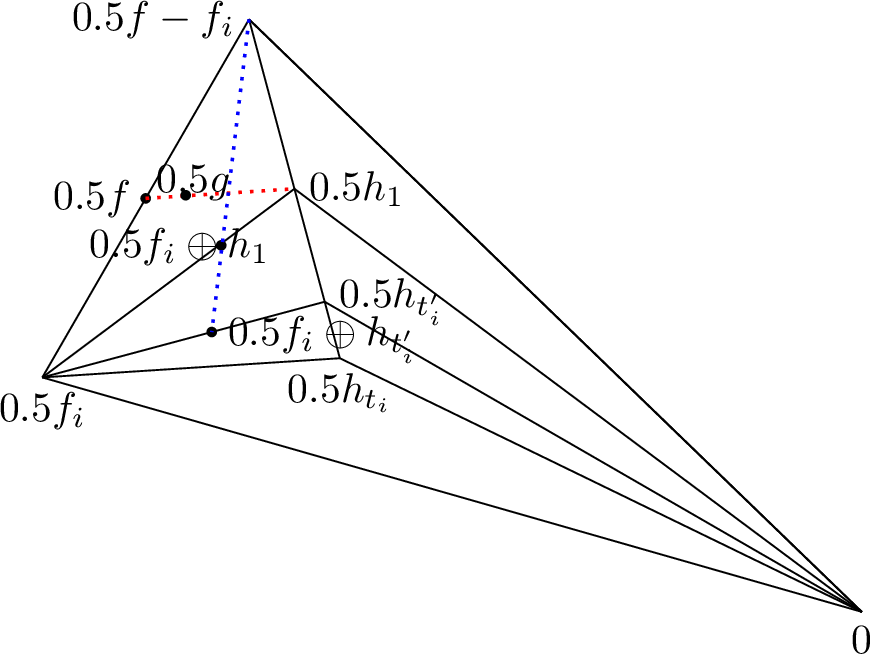
Consider the finite set \(\{f_i\mid i\in I\}\) consisting of all proper direct summands of \(f\). Then by Proposition 25, Remark 21 and Theorem 19, it is straightforward to show that \[\label{Qu2bf5hg5PSp} \scalebox{0.9}{\displaystyle \partial\operatorname{Cone}\{\operatorname{ind}(tg)\}\cap\operatorname{Cone}^{\circ}\{\operatorname{ind}(\mathbb{N}g)\}\neq\emptyset\iff f_i\oplus h_t\in \partial\operatorname{Cone}\{\operatorname{ind}(tg)\}\cap\operatorname{Cone}^{\circ}\{\operatorname{ind}(\mathbb{N}g)\}}\tag{2}\] for some \(i\in I\). In the following, for each \(i\in I\), we find \(t_i\in\mathbb{N}\) such that \(f_i\oplus h_{t_i}\in\partial\operatorname{Cone}\{\operatorname{ind}(\mathbb{N}g)\}\):
Assume that \(f_i\oplus h_1\in \operatorname{Cone}^{\circ}\{\operatorname{ind}(\mathbb{N}g)\}\), for some \(i\in I\). Then, similar to the above, we can find \(t'_i\in\mathbb{N}\), and direct summands \(f'\) of \(f\) and \(h'_{t'_i}\) of \(h_{t'_i}\) such that \(f'\oplus h'_{t'_i}\in \partial\operatorname{Cone}\{\operatorname{ind}(\mathbb{N}g)\}\) and \(f_i\oplus h_1\in\operatorname{Cone}^{\circ}\{(f-f_i),\operatorname{ind}(f'\oplus h'_{t'_i})\}\) (see Figure 3). Therefore, \(f_i\in\operatorname{Cone}\{\operatorname{ind}(f'\oplus h'_{t'_i})\}\). Hence, \[f_i\oplus h'_{t'_i}\in\operatorname{Cone}\{\operatorname{ind}(f'\oplus h'_{t'_i})\}\subseteq\partial\operatorname{Cone}\{\operatorname{ind}(\mathbb{N}g)\}.\] Since \(h_1\in\operatorname{Cone}\{\operatorname{ind}(f\oplus h'_{t'_i})\}\), by Proposition 25, we know that there exists \(t_i,c\in\mathbb{N}\) such that \(h_{t_i}\) is a direct summand of \(ch'_{t'_i}\). Thus, \[f_i\oplus h_{t_i}\in\operatorname{Cone}\{\operatorname{ind}(f_i\oplus h'_{t'_i})\}\subseteq\partial\operatorname{Cone}\{\operatorname{ind}(\mathbb{N}g)\}.\]
Note that since for \(a\in\mathbb{N}\), \(f_i\oplus h_{at}\) is a direct summand of \(f_i\oplus h_{t}\), if \(f_i\oplus h_{t}\) belongs to \(\partial\operatorname{Cone}\{\operatorname{ind}(\mathbb{N}g)\}\), then so is \(f_i\oplus h_{at}\). Hence, by 2 , for some \(\prod_{i\in I} t_i\mid t\), we have \(\partial\operatorname{Cone}\{\operatorname{ind}(tg)\}\cap\operatorname{Cone}^{\circ}\{\operatorname{ind}(\mathbb{N}g)\}=\emptyset\) and \(\langle\operatorname{ind}(\mathbb{N}g)\rangle_{\mathbb{R}}= \langle\operatorname{ind}(tg)\rangle_{\mathbb{R}}\). Therefore, \[\operatorname{Cone}\{\operatorname{ind}(\mathbb{N}g)\}= \operatorname{Cone}\{\operatorname{ind}(tg)\}.\]
◻
Corollary 5. Let \(g\) be a g-vector. Then, \(tg\) satisfies the ray condition, for some \(t\in\mathbb{N}\). Therefore, the cone of \(g\) is simplicial.
Proof. By Theorem 27, without loss of generality, we can assume that \(\operatorname{Cone}\{\operatorname{ind}(\mathbb{N}g)\}=\operatorname{Cone}\{\operatorname{ind}(g)\}\). We show that there exists a g-vector in \(\operatorname{Cone}^{\circ}\{\operatorname{ind}(g)\}\) satisfies the ray condition. Since \(\operatorname{Cone}\{\operatorname{ind}(g)\}\) is a rational polyhedral cone, there are finitely many g-vectors \(\{g_1,g_2,\ldots,g_s\}\) such that \(\{\mathbb{R}^{>0}g_1,\mathbb{R}^{>0}g_2,\ldots,\mathbb{R}^{>0}g_s\}\) is the complete set of pairwise distinct rays of \(\operatorname{Cone}\{\operatorname{ind}(g)\}\). Assume that for some \(t\in\mathbb{N}\) and \(1\le i\le s\), we have \(tg_i=h_1\oplus h_2\). Then by Lemma 7, \(g\in\operatorname{Cone}\{h_1,h_2\}\subseteq\operatorname{Cone}\{\operatorname{ind}(g)\}\). Since \(\mathbb{R}^{>0}g_i\) is a ray, we conclude that \(h_1,h_2\in\mathbb{R}^{>0}g\). Therefore, in this case, it follows from Lemma 6 that \(g_i\in D_{\mathbb{N}g_i}\). Thus, \(t_ig_i\) is tame and \(|\operatorname{ind}(t_ig_i)|=1\), for some \(t_i\in\mathbb{N}\). Hence, there exists \(t'\in\mathbb{N}\) such that for all \(1\le i\le s\), \(|\operatorname{ind}(t'g_i)|=1\). Thus, \[g':=t'\sum_{i=1}^{s}g_i=\bigoplus_{i=1}^{s}t'g_i\] satisfies the ray condition. Moreover, by [16], the set \(\{t'g_1, t'g_2,\ldots, t'g_s\}\) is linearly independent. Hence, \(\operatorname{Cone}\{\operatorname{ind}(g')\}=\operatorname{Cone}\{\operatorname{ind}(\mathbb{N}g)\}\) is simplicial. ◻
Corollary 6. Let \(g\) be a g-vector. Then, it admits a reduced version \(g'\) satisfying the ray condition and \(|\operatorname{ind}(g')|=\operatorname{dim}_{\mathbb{R}}\langle\operatorname{ind}(\mathbb{N}g)\rangle_{\mathbb{R}}\).
Lemma 13. Let \(g\) be a g-vector. Then \[\operatorname{Cone}\{\operatorname{ind}(\mathbb{N}g)\}\cap [g]^{\circ}_{\operatorname{TF}}\subseteq\operatorname{Cone}^{\circ}\{\operatorname{ind}(\mathbb{N}g)\}\subseteq [g]_{\operatorname{TF}}.\] Especially, if \(g\in[g]^{\circ}_{\operatorname{TF}}\), then \[\operatorname{Cone}\{\operatorname{ind}(\mathbb{N}g)\}\cap [g]^{\circ}_{\operatorname{TF}}=\operatorname{Cone}^{\circ}\{\operatorname{ind}(\mathbb{N}g)\}.\]
Proof. First, note that Lemma 7 along with Theorem 19 imply that \(\operatorname{Cone}^{\circ}\{\operatorname{ind}(\mathbb{N}g)\}\subseteq [g]_{\operatorname{TF}}\). Moreover, it is straightforward to check that if \(\operatorname{dim}_{\mathbb{R}}\langle\operatorname{ind}(\mathbb{N}g)\rangle_{\mathbb{R}}=1\), then \[\operatorname{Cone}\{\operatorname{ind}(\mathbb{N}g)\}\cap
[g]^{\circ}_{\operatorname{TF}}\subseteq\operatorname{Cone}^{\circ}\{\operatorname{ind}(\mathbb{N}g)\},\] and by Corollary 3, equality holds, if \(g\) belongs to \([g]_{\operatorname{TF}}^{\circ}\). Moreover, if there exists a tame g-vector in \([g]_{\operatorname{TF}}\), then the assertions follow from
Lemma 9 and Theorem 26. Otherwise, assume that \(\operatorname{dim}_{\mathbb{R}}\langle\operatorname{ind}(\mathbb{N}g)\rangle_{\mathbb{R}} \ge 2\) and there is no tame g-vector in \([g]_{\operatorname{TF}}\). We break down the proof into two
cases.
First case: Let \(\operatorname{tame}(\operatorname{ind}(\mathbb{N}g))=\emptyset\). Then by Lemma 10, we can see that for
all \(t\in\mathbb{N}\), \(\partial\operatorname{Cone}\{\operatorname{ind}(tg)\}\cap[g]_{\operatorname{TF}}=\emptyset\). Therefore, by Theorem 19, \(\partial\operatorname{Cone}\{\operatorname{ind}(\mathbb{N}g)\}\cap[g]_{\operatorname{TF}}= \emptyset\). Thus, \[\operatorname{Cone}\{\operatorname{ind}(\mathbb{N}g)\}\cap[g]_{\operatorname{TF}}= \operatorname{Cone}^\circ\{\operatorname{ind}(\mathbb{N}g)\}.\]
Second case: Let \(\operatorname{tame}(\operatorname{ind}(\mathbb{N}g))\neq\emptyset\). Fix the notation of Proposition 25. Based on Theorem 27, without loss of generality, we can assume that
\(\operatorname{Cone}\{\operatorname{ind}(\mathbb{N}g)\}=\operatorname{Cone}\{\operatorname{ind}(g)\}\),
\(f\) and \(h_1\) are direct summands of \(g\), and
\(f, h_1\in\partial\operatorname{Cone}\{\operatorname{ind}(g)\}\).
Now, let \[\label{eq459033724587} \partial\operatorname{Cone}\{\operatorname{ind}(g)\}\cap[g]_{\operatorname{TF}}^{\circ}\neq \emptyset.\tag{3}\] Then by Proposition 25, \(f'\oplus h_1\) is included in the above intersection, for some direct summand \(f'\) of \(f\). Therefore, since \(f\) and \(f'\oplus h_1\) are integer vectors, it is easy to see that there is a g-vector \(h'\in [g]_{\operatorname{TF}}\setminus\operatorname{Cone}\{\operatorname{ind}(g)\}\) such that \(f'\oplus h_1\in\operatorname{Cone}^{\circ}\{f,h'\}\). Additionally, by Lemma 6, \(f+sh'=f\oplus sh'\), for some \(s\in\mathbb{N}\). However, by Lemma 9, \[\operatorname{Cone}\{\operatorname{ind}(g)\}= \operatorname{Cone}\{\operatorname{ind}(\mathbb{N}(f\oplus sh'))\}.\] Since \(h'\notin\operatorname{Cone}\{\operatorname{ind}(g)\}\), this leads to a contradiction. Thus, 3 never holds.
Moreover, The second part is a direct consequence of the first part and Corollary 3. ◻
We now characterize precisely when the interior of the \(\operatorname{TF}\)-equivalence class coincides with the corresponding open cone of a given g-vector.
Theorem 28. For any g-vector \(g\), the following statements are equivalent.
\(\operatorname{dim}_{\mathbb{R}}\langle [g]_{\operatorname{TF}} \rangle_{\mathbb{R}}= \operatorname{dim}_{\mathbb{R}}\langle\operatorname{ind}(\mathbb{N}g)\rangle_{\mathbb{R}}\).
\([g]_{\operatorname{TF}}^{\circ}=\operatorname{Cone}^{\circ}\{\operatorname{ind}(\mathbb{N}g)\}\).
Proof. In the case that \(\operatorname{dim}_{\mathbb{R}}\langle [g]_{\operatorname{TF}} \rangle_{\mathbb{R}}= \operatorname{dim}_{\mathbb{R}}\langle\operatorname{ind}(\mathbb{N}g)\rangle_{\mathbb{R}}=1\), the assertion is clear. Let \(\operatorname{dim}_{\mathbb{R}}\langle [g]_{\operatorname{TF}} \rangle_{\mathbb{R}}= \operatorname{dim}_{\mathbb{R}}\langle\operatorname{ind}(\mathbb{N}g)\rangle_{\mathbb{R}}\ge 2\). Then, \(\operatorname{Cone}^{\circ}\{\operatorname{ind}(\mathbb{N}g)\}\) is an open subset of \([g]_{\operatorname{TF}}\). Thus, \(g\) belongs to \([g]_{\operatorname{TF}}^{\circ}\). Therefore, by Lemma 13, we have \(\operatorname{Cone}\{\operatorname{ind}(\mathbb{N}g)\}\cap [g]^{\circ}_{\operatorname{TF}}=\operatorname{Cone}^{\circ}\{\operatorname{ind}(\mathbb{N}g)\}\). Hence, \(\partial\operatorname{Cone}\{\operatorname{ind}(\mathbb{N}g)\}\cap[g]_{\operatorname{TF}}^{\circ}=\emptyset\). Thus, \((1)\) implies \([g]_{\operatorname{TF}}^{\circ}\subseteq\operatorname{Cone}^{\circ}\{\operatorname{ind}(\mathbb{N}g)\}\). Consequently, by Corollary 3, \((1)\) implies \((2)\). ◻
6.2 Equivalence of the two Conjectures↩︎
Proposition 29. Let \(g\) be a g-vector. If Conjecture 1 holds true, then \(\operatorname{TF}_{\mathbb{Z}}^{\mathrm{ss}}(g)<\infty\).
Proof. It follows from Theorem 27 that \([g]_{\operatorname{TF}}^{\circ}=\operatorname{Cone}^{\circ}\{\operatorname{ind}(tg)\}\), for some \(t\in\mathbb{N}\). Therefore, the assertion follows from Remark 21 and Lemma 7. ◻
Proposition 30. Consider a g-vector \(g\) with \(|\operatorname{TF}^{\mathrm{ss}}_{\mathbb{Z}}(g)|= 2\). Then, \(\operatorname{dim}_{\mathbb{R}}\langle\operatorname{ind}(\mathbb{N}g)\rangle_{\mathbb{R}}=1\). Moreover, if Conjecture 6(2) holds, then \(\operatorname{dim}\langle[g]_{\operatorname{TF}}\rangle_{\mathbb{R}}=1\).
Proof. Assume that \(\operatorname{dim}_{\mathbb{R}}\langle\operatorname{ind}(\mathbb{N}g)\rangle_{\mathbb{R}}\ge2\). Thus, there are linearly independent g-vectors \(g_1\) and \(g_2\) such that \(tg=g_1\oplus g_2\), for some \(t\in\mathbb{N}\). Consequently, by the assumption, \(g_1\) and \(g_2\) must be contained in \([g]_{\operatorname{TF}}\). Since \(g_2\in D_{g_1}\), we also have \(g\in D_{g_1}\). Therefore, \(t_1g_1\) is tame, for some \(t_1\in\mathbb{N}\). Similarly, \(t_2g_2\) is tame, for some \(t_2\in\mathbb{N}\). Hence, \(t_1t_2g\) is tame. Therefore, by Theorem 26, \([g]_{\operatorname{TF}}=\operatorname{Cone}^{\circ}\{\operatorname{ind}(tt_1t_2g)\}\). This implies that neither \(g_1\) nor \(g_2\) lies in \([g]_{\operatorname{TF}}\), which contradicts the assumption that \(|\operatorname{TF}^{\mathrm{ss}}_{\mathbb{Z}}(g)|= 2\). ◻
Proof. It is straightforward to check that if \([g]_{\operatorname{TF}}^{\circ}=\operatorname{Cone}^{\circ}\{\operatorname{ind}(\mathbb{N}g)\}\), then rational points are dense in \([g]_{\operatorname{TF}}\). Moreover, by Proposition 29, we can see that Conjecture 1 implies Conjecture 6(3). Additionally, Conjecture 6(2) follows obviously from Conjecture 1. Therefore, if Conjecture 1 holds, then so does Conjecture 6.
Conversely, assume that Conjecture 6 holds true. First, consider the case where \(\operatorname{dim}_{\mathbb{R}}\langle [g]_{\operatorname{TF}} \rangle_{\mathbb{R}}=1\). In this case, the assertion follows directly from Theorem 28. Next, using Proposition 15, we prove the remaining cases by induction on \(\operatorname{dim}_{\mathbb{R}}\langle [g]_{\operatorname{TF}} \rangle_{\mathbb{R}}\).
Assume that \(\operatorname{dim}_{\mathbb{R}}\langle [g]_{\operatorname{TF}} \rangle_{\mathbb{R}}\ge 2\). Then, according to Proposition 30 and Conjecture 6(3), there are finitely many g-vectors \(h^1,\ldots ,h^{s\ge 2}\in\partial [g]_{\operatorname{TF}}\setminus [g]_{\operatorname{TF}}\) such that \([h^i]_{\operatorname{TF}}\neq[h^j]_{\operatorname{TF}}\), for all \(0\le i\neq j\le s\), and \[\overline{[g]_{\operatorname{TF}}}\cap K_0(\operatorname{proj}\Lambda)_{\mathbb{Q}}\subseteq [g=h^{0}]_{\operatorname{TF}}\cup(\bigcup_{i=1}^{s}[h^i]^{\circ}_{\operatorname{TF}}).\]
From Proposition 15, we know that \(\operatorname{dim}_{\mathbb{R}}\langle [h^i]_{\operatorname{TF}} \rangle_{\mathbb{R}}\lneqq\operatorname{dim}_{\mathbb{R}}\langle [g]_{\operatorname{TF}} \rangle_{\mathbb{R}}\), for each \(1\le i\le s\). Thus, by induction hypothesis, \([h^i]_{\operatorname{TF}}^{\circ}=\operatorname{Cone}^{\circ}\{\operatorname{ind}(\mathbb{N}h^i)\}\). Next, take a reduced g-vector \(g'\in [g]^{\circ}_{\operatorname{TF}}\). Then by Conjecture 6(2) and Corollary 6, we can assume that \[\operatorname{dim}_{\mathbb{R}}\langle\operatorname{ind}(g')\rangle_{\mathbb{R}}= \operatorname{dim}_{\mathbb{R}} \langle\operatorname{ind}(\mathbb{N}g')\rangle_{\mathbb{R}} \ge2.\] Note that by Lemma 12, \(\operatorname{ind}(g')\subseteq\partial [g]_{\operatorname{TF}}\setminus[g]_{\operatorname{TF}}\). Therefore, the set \[I':=\{0\le i \le s\mid\operatorname{ind}(g')\cap [h^i]^{\circ}_{\operatorname{TF}}\neq\emptyset\}\] does not contain zero. Hence, by Lemma 9, there exists \(a\in\mathbb{N}\) such that \[\operatorname{ind}(\mathbb{N}ag')\subseteq\bigcup\limits_{i\in I'}\operatorname{ind}(\mathbb{N}h^i).\] Therefore, \(g'\in\operatorname{Cone}\{\bigcup_{i\in I'}\operatorname{ind}(\mathbb{N}h^i)\}\). On the other hand, by Lemma 6, for all \(i\neq j\in I'\), \(h^i\in D_{\mathbb{N}h^j}\). Thus, there exists \(t\in\mathbb{N}\) such that \[h^{I'}:=t\sum_{i\in I'}h^i=\bigoplus_{i\in I'}th^i.\] It is straightforward to check that \(g'\in\operatorname{Cone}\{\operatorname{ind}(\mathbb{N}h^{I'})\}\). Hence, for each reduced g-vector \(g'\in[g]_{\operatorname{TF}}^{\circ}\), there is a subset \(I'\) of \(\{1,\ldots,s\}\) such that \(g'\in\operatorname{Cone}\{\operatorname{ind}(\mathbb{N}h^{I'})\}\). Since \(\{1,\ldots,s\}\) has only finitely many subsets, the set \([g]_{\operatorname{TF}}^{\circ}\cap K_0(\operatorname{proj}\Lambda)_{\mathbb{Q}}\) can be covered by finitely many cones of dimension lower than or equal to \(\operatorname{dim}_{\mathbb{R}}\langle [g]_{\operatorname{TF}} \rangle_{\mathbb{R}}\). Thus, Conjecture 6(1) implies there exists a subset \(I'\subseteq\{1,\ldots,s\}\) such that \[\operatorname{dim}_{\mathbb{R}}\langle \operatorname{ind}(\mathbb{N}h^{I'}) \rangle_{\mathbb{R}}=\operatorname{dim}_{\mathbb{R}}\langle [g]_{\operatorname{TF}} \rangle_{\mathbb{R}}.\] Therefore, \(\operatorname{Cone}^{\circ}\{\operatorname{ind}(\mathbb{N}h^{I'})\}\cap [g]_{\operatorname{TF}}^{\circ}\neq\emptyset\). Since \(\operatorname{Cone}\{\operatorname{ind}(\mathbb{N}h^{I'})\}\subseteq \overline{[g]_{\operatorname{TF}}}\), we conclude that \(\operatorname{Cone}^{\circ}\{\operatorname{ind}(\mathbb{N}h^{I'})\}\subseteq [g]_{\operatorname{TF}}^{\circ}\). Thus, by Theorem 28, \[[g]_{\operatorname{TF}}^{\circ}=\operatorname{Cone}^{\circ}\{\operatorname{ind}(\mathbb{N}h^{I'})\}.\] ◻
Corollary 7. Let \(g\) be a g-vector. If \(\operatorname{dim}_{\mathbb{R}}W_g=|\Lambda|-\operatorname{dim}_{\mathbb{R}} \langle\operatorname{ind}(\mathbb{N}g)\rangle_{\mathbb{R}}\), then \([g]_{\operatorname{TF}}^{\circ}=\operatorname{Cone}^{\circ}\{\operatorname{ind}(\mathbb{N}g)\}\). The converse also holds, if moreover, \(W_{g}=\operatorname{Ker}\langle [g]_{\operatorname{TF}},-\rangle\). In particular, if \(\operatorname{dim}_{\mathbb{R}}\langle\operatorname{ind}(\mathbb{N}g)\rangle_{\mathbb{R}}=|\Lambda|-1\), then \[[g]_{\operatorname{TF}}^{\circ}=\operatorname{Cone}^{\circ}\{\operatorname{ind}(\mathbb{N}g)\}.\]
Proof. It is easy to see that \(W_g\subseteq\ker\langle h,-\rangle\), for all \(h\in[g]_{\operatorname{TF}}\). Thus, \[\label{401237755090} \operatorname{dim}_{\mathbb{R}}W_g\le|\Lambda|-\operatorname{dim}_{\mathbb{R}}\langle[g]_{\operatorname{TF}}\rangle_{\mathbb{R}}\le |\Lambda|-\operatorname{dim}_{\mathbb{R}} \langle\operatorname{ind}(\mathbb{N}g)\rangle_{\mathbb{R}}.\tag{4}\] Therefore, the first and second assertions follows from Theorem 28.
By Proposition 9, \(W_g\neq\{0\}\). Thus, by 4 , \[\operatorname{dim}_{\mathbb{R}}W_{g}=\operatorname{dim}_{\mathbb{R}}\operatorname{Ker}\langle\operatorname{ind}(\mathbb{N}g) ,-\rangle=1.\] Therefore, the last assertion is a consequence of the first one. ◻
Acknowledgment↩︎
The authors thank Sota Asai for pointing out a gap in the proof of Theorem 27 in an earlier draft of this manuscript. The first author received an INNS Research Fellowship, and this work was partially funded by the Iran National Science Foundation (INSF), Project No. 4003197.
References↩︎
\(\prescript{\perp}{}{\mathcal{F}}:=\{X\in\operatorname{mod}\Lambda\mid\operatorname{Hom}_{\Lambda}(X,\mathcal{F})=0\}\)↩︎
\(\mathcal{T}^{\perp}:= \{Y\in\operatorname{mod}\Lambda\mid\operatorname{Hom}_{\Lambda}(\mathcal{T},Y)=0\}\)↩︎
Since there is an appropriate bijection between \(\tau\)-tilting pairs and \(2\)-term silting complexes, one can define the notion of g-vector fan by considering g-vectors of \(2\)-term silting complexes.↩︎
For an overview of the notion of generic decomposition, (non-expert) readers are referred to [16].↩︎
“a general element of a variety \(\mathcal{X}\)” means an arbitrary element of a dense open subset of \(\mathcal{X}\).↩︎