Code Benchmarks Should Prioritize Rigor, Reliability, and Reproducibility


Abstract

Code-related benchmarks play a critical role in evaluating large language models (LLMs), yet their quality fundamentally shapes how the community interprets model capabilities. In the past few years, awareness of benchmark quality has grown. Yet, after a decade-scale (2014 - 2025) survey over 672 code benchmarks, we observed a lag between growing awareness and actual practice. For example, in 2025 alone, the number of benchmarks that ignore code coverage when providing test cases nearly matches the total count accumulated across the previous ten years. In response, we take a clear position: Code benchmarks must prioritize rigor in benchmark construction, reliability in evaluation, and reproducibility in release. To operationalize this position, we introduce a code benchmark guideline How2Bench with 55 checklists. Finally, our further human study also exposed that the current issues not only stem from the significant effort required, but also from a lack of awareness regarding their importance.

1 Introduction↩︎

Awareness is the beginning of action; action is the fulfillment of awareness. — Yangming Wang (1472 - 1529)

Large Language Models (LLMs) are increasingly evaluated on code benchmarks such as SWE-Bench [1] to measure their code generation, code reasoning, and debugging capabilities. These benchmarks play a critical role in shaping the understanding of LLMs’ true capabilities and limitations. However, the validity of conclusions drawn from these code benchmarks depends on the rigor, reliability, and reproducibility of the benchmarks themselves. When the benchmark construction is flawed, the validity of conclusions may not hold.

Encouragingly, awareness of benchmark quality has grown. Guidelines [2] and enhancing approaches [3][5] were proposed to provide the good practices and enhance the quality in certain aspects (e.g., code coverage [3], data contamination [6]). As a result, one might expect that benchmark construction practices have already become more rigorous over time.

However, our findings suggest the opposite. Through a large-scale survey of 672 code benchmarks across the last decade (2014 – 2025), we uncover a concerning trend: despite rising awareness of benchmark quality, the number of flawed benchmarks has continued to grow. For example, in 2025 alone, the number of benchmarks that ignore code coverage when providing test cases nearly matches the total count accumulated across the previous ten years. More empirical evidence includes:

46% benchmarks did not go through quality assurance check; 79.8% did not consider data contamination; 67.1% did not deduplicate the data points;

85.0% did not ensure a reliable judgement, such as ensuring a high code coverage when test suites are provided; 66.1% benchmark evaluation was one-pass, without repeating the experiment to avoid randomness;

38.2% of the benchmarks did not provide the essential information (e.g., prompts) for reproducibility; 80.0% did not provide the log information on the benchmarks; 14.7% are not open source, 2.2% only partially released;

In response, we take a clear position: Code benchmarks must prioritize rigor in benchmark construction, reliability in evaluation, and reproducibility in release as first-class objectives.

To operationalize this position, we introduce a comprehensive code benchmark guideline, How2Bench, comprising 55 rigor-oriented checklists, each annotated with its relative threat level to the benchmark validity. This checklist covers the entire lifecycle of benchmark development, from design and construction to evaluation, analysis, and release, as shown in Figure 1.

Upon the 55-item checklist, we revisited 672 code benchmarks, and quantified longitudinal trends in how benchmark practices have evolved. We observe a lag between growing awareness and actual practice. Although the yearly proportion of benchmarks that prioritize data quality and evaluation credibility has increased, the absolute number of flawed benchmarks continues to rise, largely due to the rapid overall growth in benchmark production.

In addition to these concerning trends, we also identify several positive signals:

During Benchmark Design: recent benchmarks increasingly focus on practical, real-world problems; notably, the number of project-level benchmarks in 2025 nearly tripled compared to 2024, and the distribution of code task types has become more diverse;

During Benchmark Construction: creators are showing stronger awareness of manual quality assurance: the number of benchmarks incorporating human verification more than doubled from 2024 to 2025;

During Benchmark Evaluation: benchmark creators increasingly include a larger and more diverse set of studied LLMs, improving the generalizability and robustness of reported findings;

During Benchmark Release: growing open-science engagement, with an upward trend in publicly released artifacts, prompts, and evaluation resources, reflecting stronger community commitment to transparency and reuse.

Human Study – To better understand whether the current situation stem from lack of awareness, resource constraints, or incentive misalignment, we conducted a human study involving 49 participants through questionnaires. All participants concurred on the necessity of having a checklist for benchmark construction to enhance quality. Interestingly, beyond admitting the its importance, the collected feedbacks also exposed gaps in awareness: 16% of participants were unaware of the necessity for data denoising; over 40% were not aware that the experimental setup and environment could impact the reproducibility and transparency.

The questionnaires results revealed that the current issues in flawed benchmark not only stems from the significant effort required to construct a rigorous and reliable benchmark, but also from a lack of awareness regarding how crucial a rigorous development process is to the quality of benchmarks and the reliability of evaluations. Without being aware of and addressing the quality of code-related benchmarks (as well as other kinds of LLM benchmarks), the reliability and reproducibility of benchmark results remain compromised, misleading research directions, and hindering meaningful progress.

This paper makes contributions in five aspects:

  • Novelty. We introduce How2Bench, a comprehensive set of guidelines packaged as a 55-criteria checklist that covers the lifecycle of code-related benchmark development.

  • Significance. How2Bench presents the first comprehensive set of actionable guidelines for developing high-quality benchmarks, striving to create a more reliable and transparent environment. The human study also highlighted the demand for such a detailed guideline.

  • Usefulness. How2Bench serves as a guideline for practitioners before/during developing code-related benchmarks, and a checklist for evaluating existing benchmarks after their release. For ease of use, we also provide a printable version of How2Bench on Appendix 15.

  • Generalizability. Most criteria listed in How2Bench can be adopted or adapted to other benchmarks such as Question-answering, mathematical reasoning, and multimodal benchmarks.

  • Long-term Impact. Our statistics alert the community to the severity and prevalence of non-standard practices in benchmark development. It ultimately improves the overall quality of benchmarks through propagation effects among them.

2 Related Work↩︎

2.1 Code Benchmarks↩︎

Benchmarks for coding tasks like code generation [7], [8], defect detection [9][11], and program repair [1], [12] are increasingly common, reflecting the growing needs for using LLMs for coding tasks. Recent studies have highlighted various issues with these benchmarks, ranging from design inconsistencies to scope and applicability limitations. For example,  [3] found that even some widely used benchmarks, such as HumanEval [7] and MBPP [8], contains a non-trivial proportion of bugs in implementation, documentation, and test cases. Our work, in comparison, introduces a detailed guideline that guides the benchmark development during the entire lifecycle.
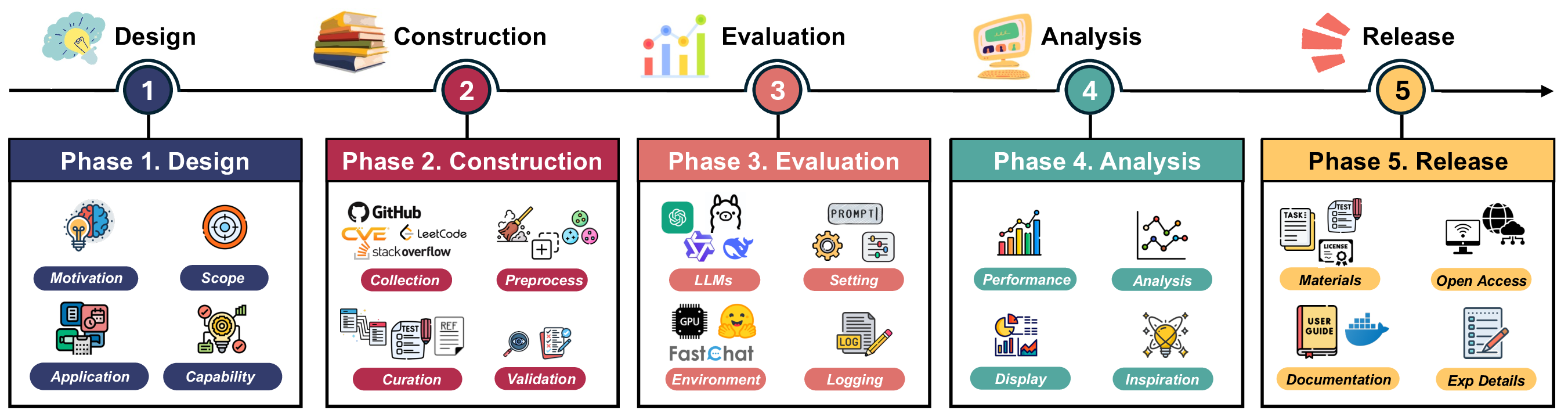
Figure 1: Lifecycle of Benchmark Development

2.2 Benchmark Surveys and Studies↩︎

Several recent surveys [13] and empirical studies have profiled the status quo of LLM development. These studies either explore the overall performance for certain areas, such as software engineering [14], [15], or investigate the capabilities of LLMs on specific tasks, such as code generation [16], [17] and test generation [18][20]. A survey [21] about how to evaluate LLMs was proposed to answer what/where/how to evaluate LLMs. This paper differs from these studies in its purpose and perspectives.

Assessments or guidelines for benchmarks [13], [22][24] are also constantly released. For example, BetterBench [24] is a related work assessing the AI benchmarks against 46 criteria. Then, it scored 24 AI benchmarks in various domains and ranked them. BetterBench differs from this paper in several key aspects: scope (general benchmarks vs. code-related benchmarks), lifecycle division (it addresses benchmark retirement, while How2Bench focuses on benchmark evaluation, analysis, and release), and objectives (scoring benchmarks vs. offering comprehensive guidelines for future benchmark development). Additionally, the study in this paper was conducted on a much larger scale (24 vs. 572 benchmarks), statistically highlighting the prevalent issues in existing benchmarks.

Unlike these surveys and guidelines, our work reveals a longitudinal trends before and after them came out.

3 Guideline Design↩︎

3.1 The Lifecycle of Benchmark Development↩︎

Code-related benchmark development comprises five typical phases (Phase 1 - 5), as shown in Figure 1, explained in detail as follows.

Phase 1. Design. At the beginning of benchmark development, it is vital to identify the motivation, the scope and the capabilities required by the application scenario of interest. To achieve this objective, one needs to carefully consider the application scenarios, making sure these scenarios align with real-world demands [25]. Also, it is necessary to assess whether other benchmarks already exist that address similar tasks, and to identify any shortcomings they may possess [26], [27]. Furthermore, this new benchmark should be designed to evaluate specific LLMs’ capabilities; the crafted tasks are expected to reflect these capabilities [28].

Phase 2. Construction. Benchmark Construction phase moves from design to execution. Typically, data is collected from public coding websites such as GitHub, LeetCode, and StackOverflow. This is followed by preprocessing, which includes filtering, cleaning (e.g., deduplication, denoising), and curation (e.g., aligning tests with corresponding code). The phase usually ends with a validation process, which can be manual or automated [26].

Phase 3. Evaluation. Once the benchmark is available, the next step is to apply it to LLMs, validating if it can effectively measure the intended LLM capabilities. Essential considering factors include selecting a representative array of LLMs, configuring settings like prompts and hyperparameters for consistency, choosing appropriate experimental environments to meet LLM requirements, and implementing thorough logging to ensure dependable and reproducible results.

Phase 4. Analysis. After evaluation, experimental results are analyzed, drawing conclusions on LLMs’ capabilities. This phase involves comparing each LLM’s performance to identify standout or underperforming models. Then, proper visual aids such as bar charts and tables can be used to display the experimental results, presenting clearer observation and deeper inspiration, such as the correlations between models, the correlations with related benchmarks, or performance in upper-/down-stream tasks [29]. Indeed, a thorough analysis helps pinpoint areas for improvement and guides future LLM enhancements.

Phase 5. Release. The final phase is to make the benchmark open-accessible. This phase involves meticulously preparing all materials associated with the benchmark, ensuring they are ready for open access to foster widespread adoption and collaboration. Clear, comprehensive documentation is provided to guide users on effectively utilizing the benchmark. Additionally, all logged experiment details are made available, enhancing the reproducibility and transparency of the benchmark.

3.2 Study Design↩︎

Our study consists of four steps (Figure 2). All steps are explained as follows.

Step 1. Guideline Construction. To begin with, we sketched the initial guidelines for each phase in the benchmark development lifecycle (Section 3.1, Figure 1) by reviewing existing literature [18], [24], [30], [31] and brainstorming. After that, we refined the guidelines through a series of interviews with various stakeholders, including model developers and benchmark builders, allowing for the addition, deletion, or modification of criteria based on expert feedback and practical insights. In order to allow more flexibility and increase the practicality of the guideline, we prioritized them with \(\bigstar\) \(\bigstar\) \(\bigstar\) (Highly important), \(\bigstar\) \(\bigstar\) (Important), and \(\bigstar\) (Optional). By doing so, the highly-recommended criteria are essential to comply with when setting up a new benchmark, while other criteria allow compromise, making the guideline simpler for benchmark developers to follow.

Step 2. Literature Profiling. This step begins by collecting related benchmarks according to their publication time, venue, and coding tasks, then employing techniques like snowballing to ensure a comprehensive collection. This step leads to 672 code-related benchmarks for study. The detailed statistics are available in Appendix 14. This step is followed by profiling each selected benchmark through a thorough review of corresponding papers and examination of the released artifacts or homepages associated with these benchmarks. The phase is completed by reporting statistics that highlight overall trends, pros, and cons identified during the profiling, providing a structured overview of existing benchmarks.

Step 3. Focused Case Study. After obtaining an overall impression of existing benchmarks, we selected 30 (= 5 * 6) representative benchmarks from the top-5 most frequent coding tasks (see Figure 9), with top-5 highly-cited benchmarks plus the latest 1 benchmark (Appendix 13). Each selected benchmark is then analyzed against How2Bench, examining how well they meet the established criteria, studying their overall statistics, and identifying both exemplary and poor cases. Insights and references from existing literature are also incorporated to enrich the analysis, providing a deeper understanding of the benchmarks’ performance and areas for improvement.

Step 4. Human Study. The final step is a human study that evaluates the importance and practicality of How2Bench. This involves designing a questionnaire by first initiating and iterating to gather diverse, logical insights, which is then distributed to a targeted audience. After collecting and filtering responses for quality, the data is analyzed to derive insights. See Appendix 12 for details.
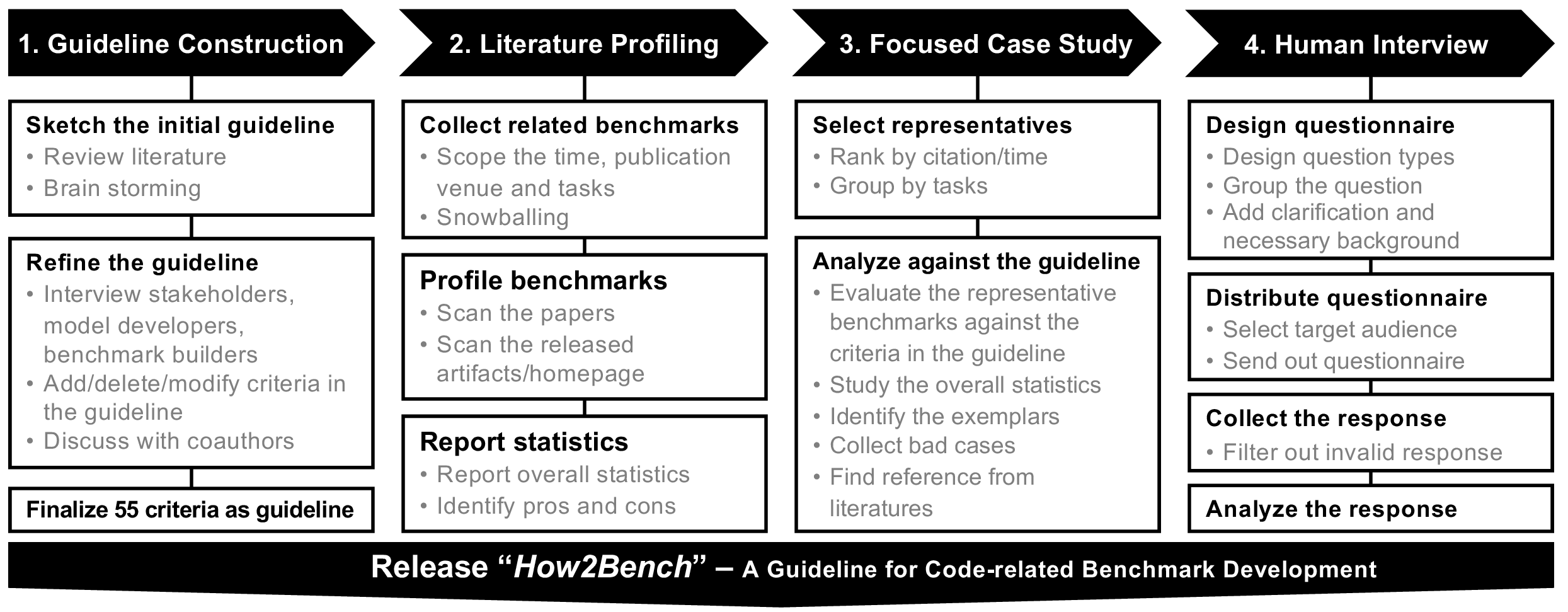
Figure 2: Workflow of study process

4 Guideline and Key Statistics↩︎

The completed guideline How2Bench with 55 criteria can be found in the Appendix. Each guideline contains: an actionable check criterion with necessary explanations; a priority indicator, divided into three levels in total, marking the importance of the checklist; and a checkbox for convenience.

4.1 Guideline for Benchmark Design↩︎

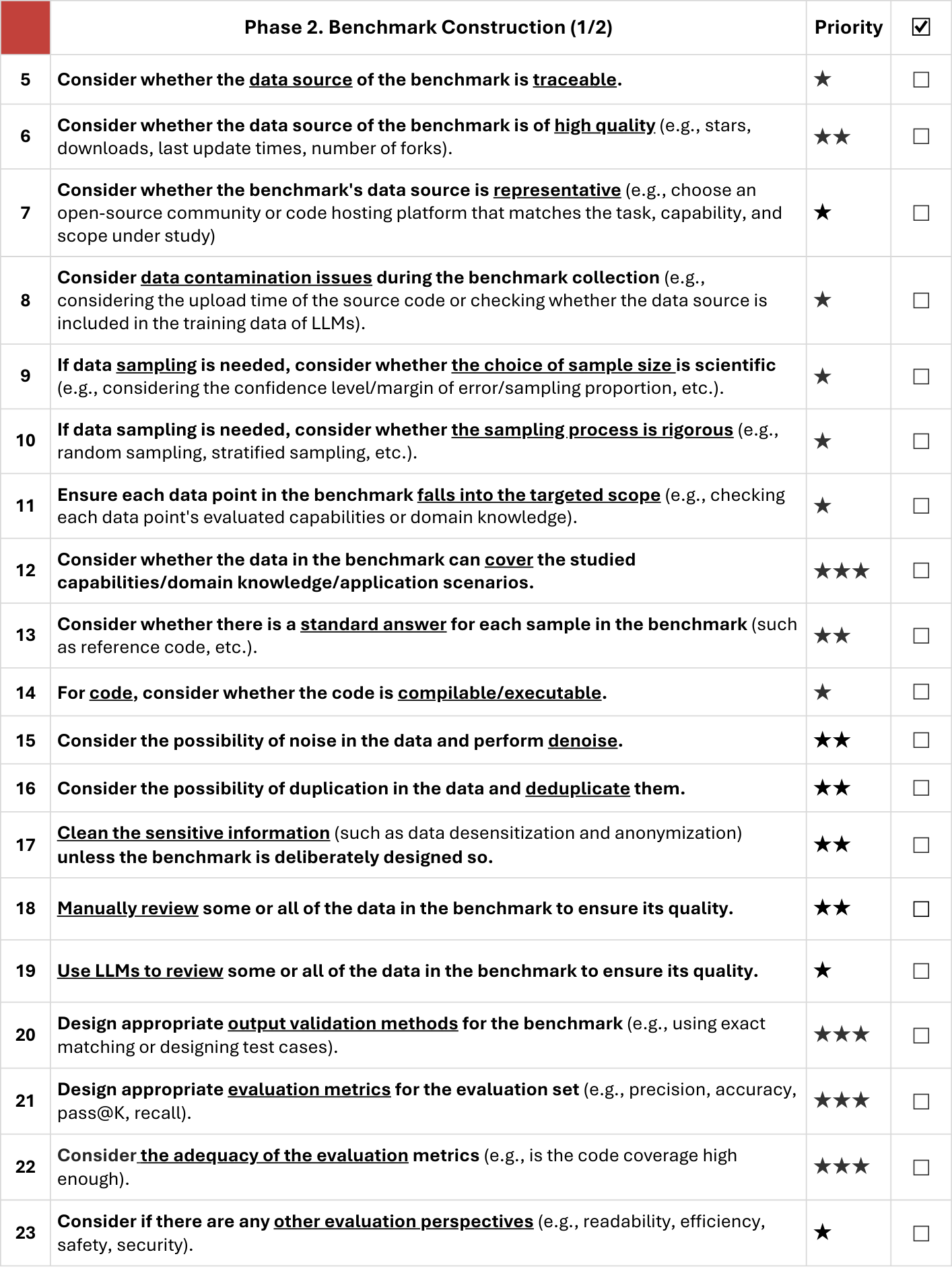
Explanation – For benchmark design, we listed four essential criteria, as shown in Figure 3. In particular, the guideline starts by recommending that benchmarks should initially assess if they are addressing a significant gap in existing research, ensuring the relevance and necessity of the benchmark. The scope of the benchmark is expected to be well-defined, clarifying the capabilities or characteristics being tested, how these relate to practical scenarios such as programming assistance or automated testing, and the relevance of these capabilities in real-world applications.

Key Statistics – According to our statistics among 672 benchmarks, apparent research bias can be observed in terms of coding tasks, programming languages, and code granularities (Appendix 11.1). For example, Code Generation is most prevalent coding task, with 235 benchmarks focusing on this area, according to 34.97% (235/672) of studied benchmarks, indicating a significant interest in generating code automatically. The second most prevalent is code reasoning 12.64% (85/672), followed by Program Repair and Defect Detection.

When examining the distribution of coding tasks by year (see Figure 10), we observe that benchmark growth accelerated most rapidly in the past two years (2024–2025), with code generation remaining the most frequently benchmarked task. At the same time, demand for code reasoning has increased substantially, rising from 19 benchmarks in 2024 to 61 in 2025. Benchmarks for program repair also increased over the same period, from 22 to 33.

Regarding the bias in programming language, Figure 11 shows that 409 (71.50%) benchmarks are in Python, followed by Java and C++, with 229 and 160, respectively. This observation consolidates the observation from previous works [14], [32] on a larger scale. When analyzed by year (Figure 12), the number of benchmarks for C/C++ and JavaScript has increased noticeably between 2024 and 2025. We also observe a sharp rise in Rust-related benchmarks: although only a few benchmarks existed for Rust since its release in 2015, 57 benchmarks were published in the past two years (27 in 2024 and 29 in 2025). These trends in programming language coverage reflect the evolving demand for LLMs across different languages, highlighting particularly the growing reliance on large models to generate, reason about, and maintain code in these languages.

Regarding the bias in granularity, a dramatic upward trend was observed in project-level benchmarks (Figure 16): between 2024 and 2025, the number of project-level benchmarks surged, increasing from 35 to 97 new benchmarks. Importantly, these numbers refer to benchmarks newly introduced in each year, rather than cumulative totals. This surge indicates a growing community focus on the real-world applicability and large-scale practical utility of LLMs.

Regarding the LLMs’ capability evaluated, during the focused case study (listed in Appendix 13), we identified that 20% benchmarks have not explicitly specified the capabilities (e.g., intention understanding, program synthesis) to be evaluated, and 23.3% have not specified application scenarios the benchmark targets.

Besides, we also identified a case in MBPP [8] where a case fell out of the target evaluation capabilities (Appendix 11.2). Indeed, clearly defining the application scenarios/scopes/capabilities could help benchmark constructors establish precise goals for the design and development of the benchmark, ensuring accuracy in the evaluation.

Severity – Current benchmarks exhibit an apparent imbalance in coding tasks and programming languages dominated by code generation and Python, leaving research blank to be filled. Also, even highly cited benchmarks may have samples that do not fall into the examined capabilities.

4.2 Guideline for Construction↩︎

Explanation – Figure 4 shows 19 criteria for benchmark construction. Essentially, for data source, the key considerations include verifying the traceability and quality of the data source, addressing potential data contamination [33], and ensuring that the data sampling processes are scientifically robust and rigorous. Also, for data representativeness, it also guides through specific checks to ensure the benchmark’s scope is strictly adhered to, such as making sure every data point falls within the targeted scope and that the data can cover all studied capabilities, domain knowledge, and application scenarios.

For data preprocessing and cleaning, it also stresses handling code-specific aspects, such as compilability and execution, along with cleaning and manually reviewing data for quality assurance. Output validation methods and evaluation metrics must be carefully designed and reviewed to ensure they effectively measure the benchmark’s goals. Lastly, it suggests considering additional evaluation perspectives, such as safety [34], [35] checks, ensuring the code does not contain sensitive information.

Key Statistics – According to our statistics (Appendix 11.3), the 572 benchmarks exhibit numerous irregularities in their implementation, which could significantly threaten the reliability of the benchmarks. Surprisingly, 67.1% of benchmarks did not deduplicate or did not mention. 79.8% benchmarks did not consider or handle data contamination threats. About 46.0% of the benchmarks did not go through any quality assurance checks such as manual checks and code execution. In particular, we summarized the commonly-used data quality assurance metrics and their frequency: manual check (45.8%), code execution (1.2%),others (e.g., heuristic rules, 6.4%).

Examining the trends by year (Figure 24), however, one positive development is the increasing prevalence of manual quality checks. The number of benchmarks with manual check guarantees doubled from 84 in 2024 to 193 in 2025, indicating that a growing share of code benchmarks now undergo partial or full human verification.

Also, since we focus on code-related benchmarks, which usually accompany test cases, code coverage also needs to be considered. According to the statistics over oracles (Figure 31), passing test cases (257 / 672 = 38.2%) and the exact match (193 / 672 = 28.7%) are the most common oracles used in code benchmarks. However, we observed that only 15.9% considered and reported code coverage (i.e., line coverage, branch coverage) explicitly in their papers, while 82.5% did not consider the code coverage when constructing the test suites for benchmark evaluation. The annual distribution (Figure 33) makes this trend even clearer: although many benchmarks in the past three years (2023–2025) did not consider code coverage, the sheer volume of benchmarks in 2025 means that the absolute number of such benchmarks is high, with 24, 77, and 123 benchmarks respectively for 2023, 2024, and 2025. This underscores that, despite growing awareness of evaluation rigor, a substantial number of benchmarks continue to provide incomplete testing, highlighting a persistent threat to the validity and reliability of benchmark-driven assessment. It severely affects the reliability of findings on these benchmarks, potentially misguiding future research and applications based on these flawed assessments.

Severity – Most benchmarks display severe loopholes in data preparation and curation, i.e., only 54% of benchmarks went through a quality assurance check, and only 20.2% of them considered and handled data contamination threats.

4.3 Guideline for Evaluation↩︎

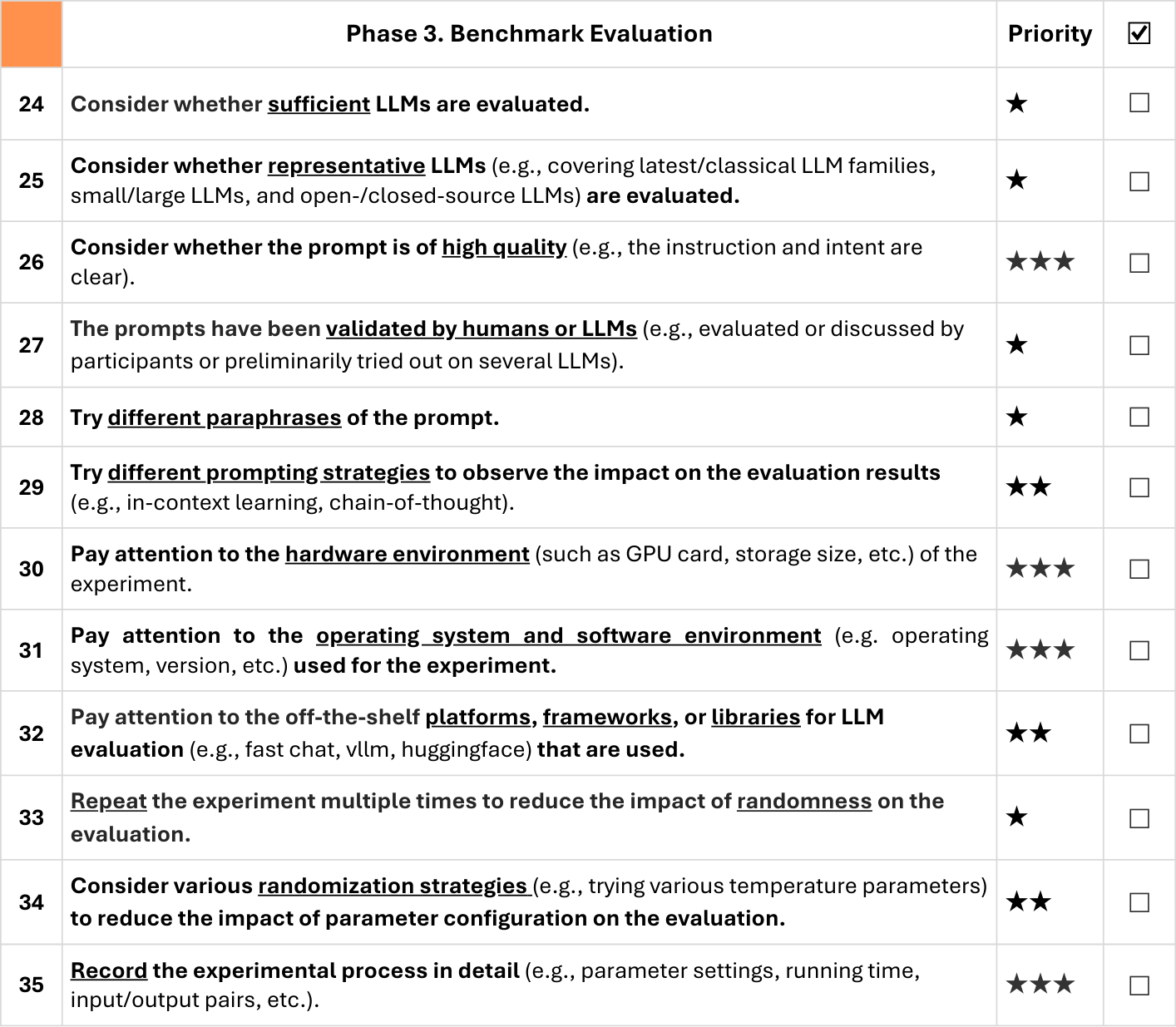
Explanation – Guidelines for benchmark evaluation focus on the rigorousness and reliability of the evaluation. How2Bench provides 12 criteria for benchmark evaluation, as shown in Figure 5. It mainly focuses on the comprehensive evaluation processes for benchmarks involving LLMs. For evaluation design, it stresses the importance of assessing a sufficient and representative range of LLMs to ensure the benchmark’s applicability across various model families and configurations, both open and closed-source. Figure 35 and Figure 37 show the distribution of numbers of LLMs studied and the most exercised LLMs.

Also, prompting has a direct impact on the quality of the LLMs’ output results [36][39]. As pointed out by a recent study, up to 40% performance gap could be observed in code translation when prompts vary [40].

Additionally, the experiment environment is essential for reproducibility and transparency. Indeed, the hardware, software, and platform environments used during experiments might influence the outcomes [41]. Furthermore, because of the nondeterministic nature of LLMs, experiments should be repeated, and randomization strategies should be used to mitigate the effects of randomness and parameter configuration biases. Lastly, meticulously documented logs of the experimental process is advised to facilitate transparency and reproducibility, detailing everything from parameter settings to the specific LLM pipelines such as vLLM [42] used.

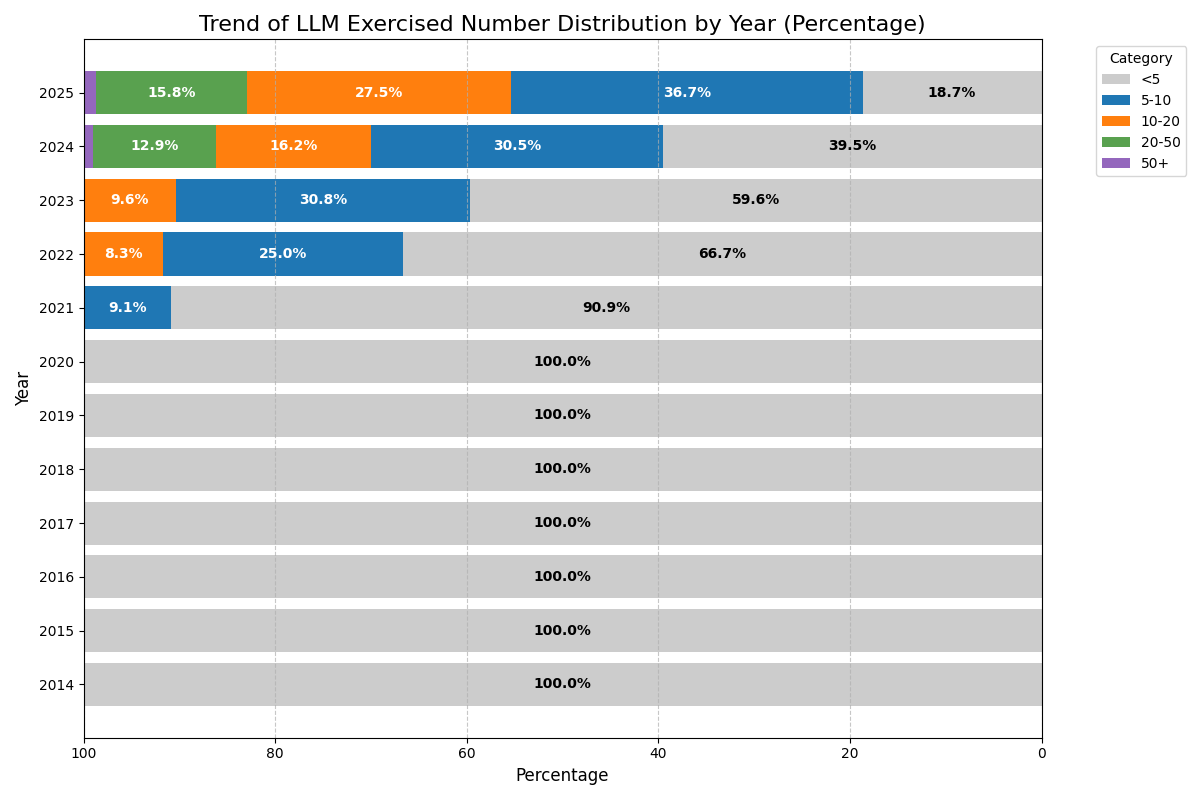
Key Statistics – Among the 672 benchmarks, 585 of them are evaluated over LLMs. As shown in Figure 35, most benchmarks were evaluated against six LLMs (10.0% = 59 / 585), followed by six LLMs. Encouragingly, increasing LLMs are being studied for code benchmarks. As shown in Figure 36, in 2024, 39.5% of benchmarks were evaluated against fewer than five LLMs, whereas in 2025, 64.2% of benchmarks (36.7% + 27.5%) were evaluated against 5 - 20 models. This shift indicates that benchmark studies are increasingly aiming for more comprehensive and generalizable evaluations. However, it also introduces substantially higher computational and financial costs, highlighting the trade-off between evaluation rigor and resource efficiency.

For reference, we listed the top 10 most studied LLM families in Figure 37. Among them, the GPT series from OpenAI is the most extensively studied, accounting for 76% (446/585), followed by Deepseek and Qwen.

The prompt quality also significantly impacts the LLM evaluation [40]. According to a recent study, up to 40% of performance variation could be observed in the code translation task [40]. So, carefully designing a prompt needs consideration. However, 76.7% representative benchmarks (Appendix 13) do not validate whether the prompts they used are well-designed (Appendix 11.4). Similarly, though 89.4% benchmarks were evaluated in a zero-shot manner, only 18.6% benchmarks were evaluated under few-shot, 3.7% under Chain-of-Thought and 1.0% under RAG (Figure 40). However, as shown in Figure 41, 76.7% representative benchmarks (Appendix 13) do not validate whether the prompt they used is well-designed.

Regarding the evaluation process, our statistics exposed that only 33.4% of benchmark evaluations have been repeated (Appendix 11.4). Also, regarding the transparency and matriculated documents, the observation is not optimistic – Only 6.3% benchmarks provided their experiment environment. More than 38% of benchmarks did not provide reproducible instructions such as prompts, examples for few-shot learning, or content for retrieval (Figure 48). Only half (50.5%) provide hyperparameters such as temperature for reproduction.

Severity – 66.6% of evaluations have not been repeated to eliminate the impact of randomness, and the trend grows from the year 2023 to 2025 (from 31 to 205).

4.4 Guideline for Evaluation Analysis↩︎

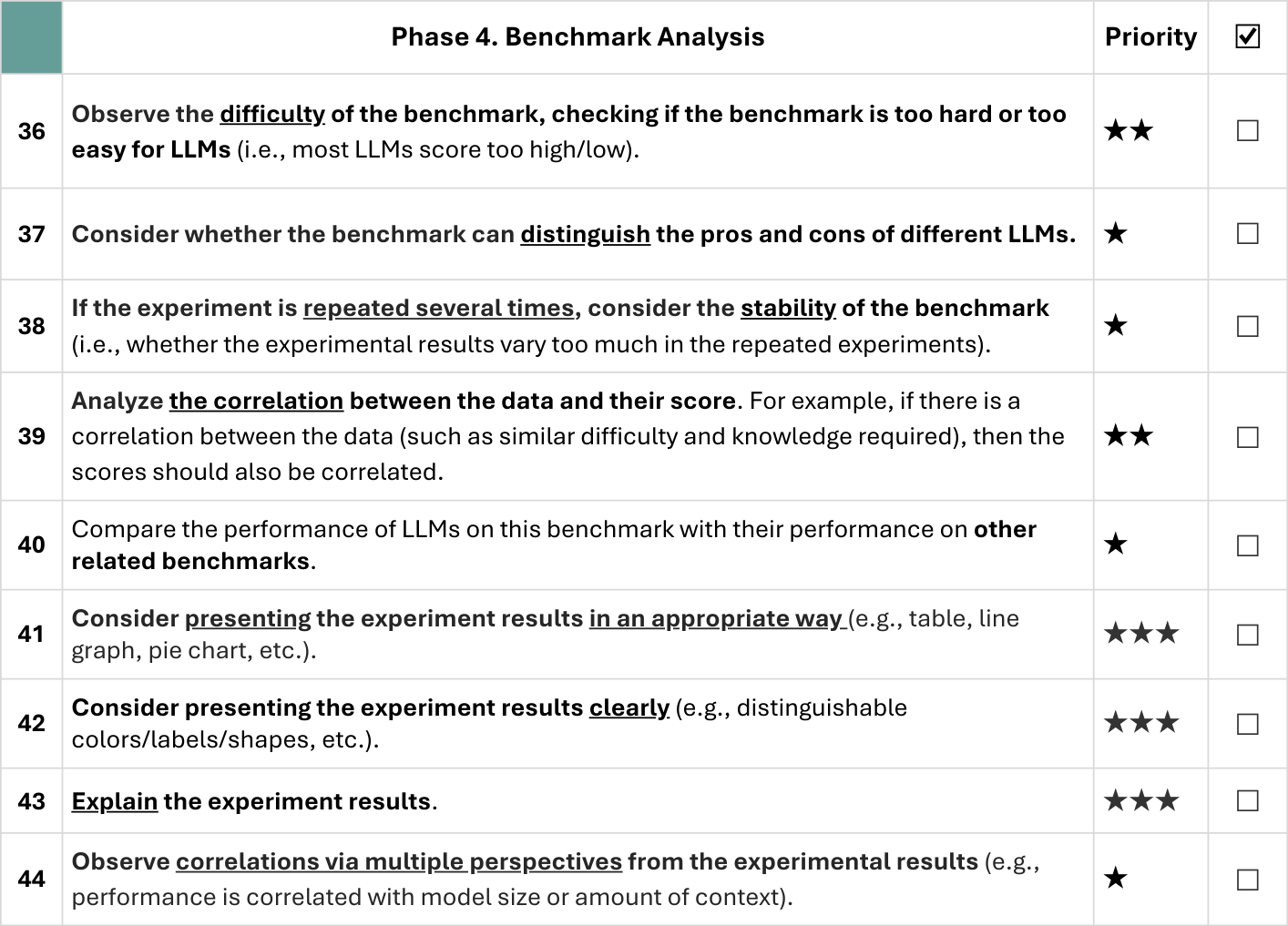
Explanation – The analysis of the experiment results is expected to be objective and comprehensive, hopefully providing insights or actionable advice. So, we listed 10 criteria for the evaluation analysis phase, as shown in Figure 6. Regarding the perspectives of analysis, inspired by classic measurement theory [30], we suggest four essential perspectives, including difficulty (whether a benchmark is appropriately challenging for LLMs), stability (whether the results are consistent through repeated trials), differentiability (whether benchmarks can differentiate the strengths and weaknesses of various LLMs), and inspiration (e.g., the correlations between the upper-/down-stream coding tasks and LLM scores).

Moreover, effective presentation of results using clear visual and textual descriptions could ensure the findings are understandable and actionable. The phase concludes with the suggestion to interpret and explain the results comprehensively, providing a basis for future enhancements.

Key Statistics – Because experimental analysis is relatively subjective and cannot be obtained through mechanical scanning, we focus on 30 representative focus benchmarks (Appendix 13), covering the highest cited and latest benchmarks in top-5 tasks. Figure 45 shows an example from CruxEval [43] where the experimental scores can hardly be read from the figures.

Also, explaining experiment results is crucial for other practitioners to understand what the outcomes mean in the context of the research questions. According to our statistics (Appendix 11.5), 70% of benchmarks have detailed explanations and analyses of their evaluation results, while still 30% have not. Indeed, an explanation contributes to the body of knowledge by making it possible to understand and compare results with previous studies, promoting transparency within the community.

Severity – The analysis of experimental data and the clarity of data presentation may receive less attention and be worth consideration. Even in papers cited 2k+ times like MBPP [8], there are instances ofunclear evaluation analysis and display.

4.5 Guideline for Benchmark Release↩︎

Explanation – Finally, releasing a benchmark for open access also needs careful consideration. We offered 10 suggestions for this step, as shown in Figure 7, to highlight essential steps for public release preparation, emphasizing accessibility and ethical compliance. This includes setting an appropriate license to clarify usage rights, conducting a thorough review to eliminate sensitive or harmful content such as the API keys to access LLMs, the personal emails or toxic code comments [44] unless they are a part of the benchmark, and ensuring reproducibility by making all related materials openly available. Detailed prompts and clear descriptions of the experimental setup are advised to facilitate replication. Additionally, providing user manuals and evaluation interfaces is crucial for effective user engagement with the benchmark, enhancing its reliability and value for the research community.

Key Statistics – The final step involves the release of the benchmark. The fundamental requirement for releasing a benchmark is that it must be open-sourced. However, surprisingly, we observed that 2.2% of the benchmarks are only partially open-sourced (e.g., missing some subjects or tests), and 14.7% are not open-sourced at all (e.g., links/web pages are no longer active). Furthermore, prompts, which are necessary for reproducibility, are not disclosed in 38.2% of the benchmarks (Figure 48), not to mention the lack of public information on experimental settings (Figure 39 and Figure 38) and experimental parameters (Figure 53). What is worse, 19.3% benchmarks do not set up licenses (Figure 54). The absence of licensing may lead to severe legal and ethical issues, potentially resulting in unauthorized use and distribution of proprietary technologies. Additionally, only 16.7% of the benchmarks make their logged experimental results publicly available (Appendix 11.6). Note that this conclusion about log availability are based on publicly accessible materials; logs are often missing for a combination of policy, privacy, and practicality reasons.

Fortunately, the recent years show a positive shift toward openness (Figure 47). From 2024 to 2025, the number of open-sourced benchmarks increased substantially, rising from 169 to 266, indicating growing community commitment to transparency, accessibility, and reproducibility.

Severity – The release of existing benchmarks exhibits several issues. For example, 16.8% of the benchmarks are either not open to public access or are only partially open-sourced. Only 47.4% of benchmarks are released with replicable prompts.

5 Human Study↩︎

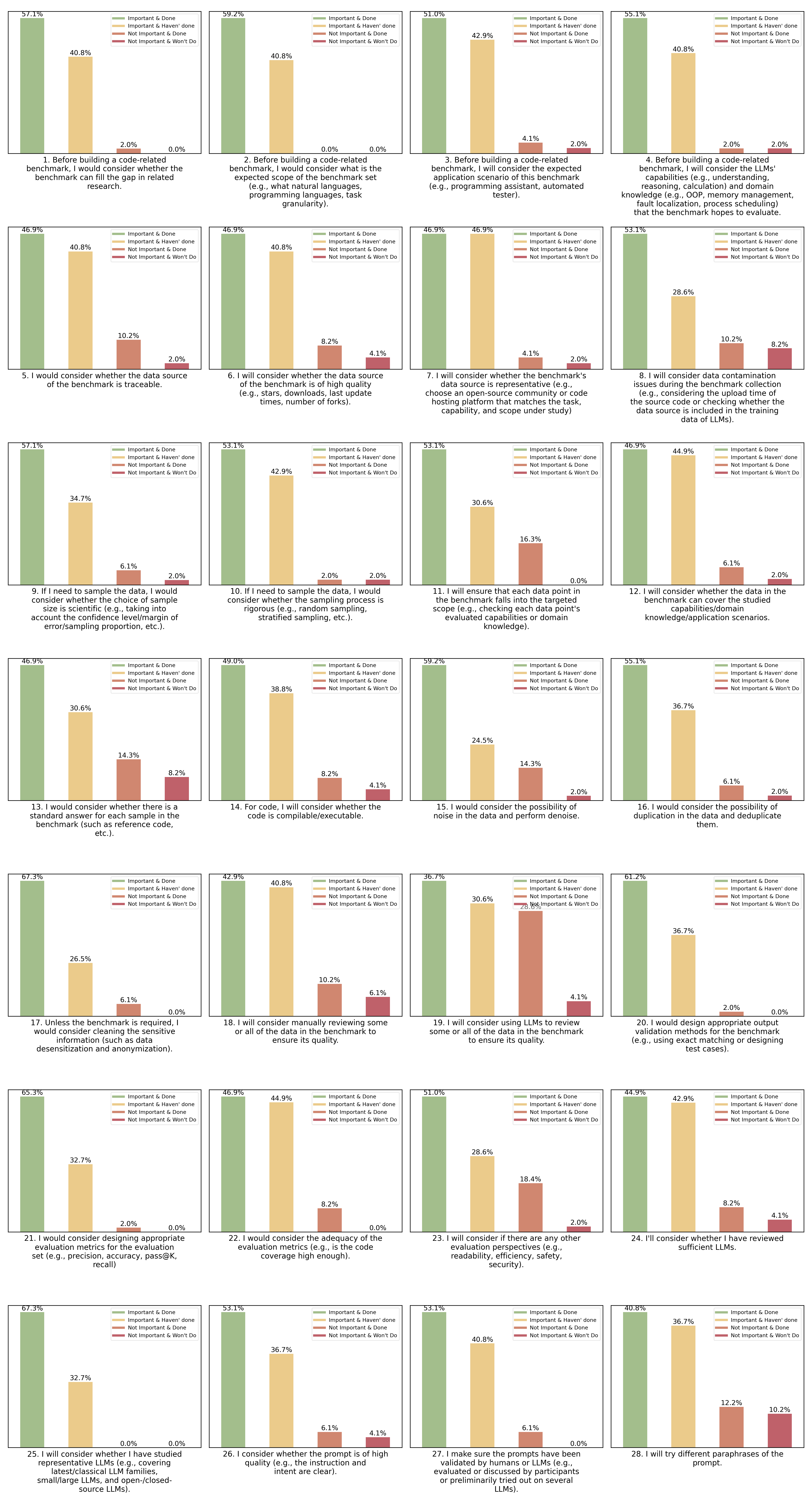
To delve deeper into the integration of knowledge and action, we surveyed 49 global researchers in AI (42.6%) and Software Engineering (57.14%), as shown in Figure 61. Each participant had published at least one research paper to ensure their research maturity, and half had constructed code benchmarks. See Appendix 12 for more details about the participants’ demographics and questions in questionnaires.

First, all participants agreed that having a checklist for benchmark construction would contribute to the quality of the benchmark. 47/55 criteria in How2Bench are deemed important by more 80% participants. Additionally, among the 21 participants who have constructed code-related benchmarks, 53 out of 55 criteria were deemed important by all benchmark developers; only two criteria (criteria 3 and 4 in Section 4) were considered unimportant by a few individuals (3 and 2 participants, respectively). Additionally, we received two valuable suggestions that draw importance to recording the time/monetary costs of constructing the benchmark and conducting the experiments.

However, we also identified some notable gaps in awareness. First, regarding the data preparation, more than 15% of participants were not aware that the selection of data should consider the target scope of the evaluation set (i.e., the data must be representative). 16% of participants were unaware of the need for data denoising, while half (8%) of these have already published at least one paper on benchmarking construction. This oversight can significantly affect the validity and generalizability of experimental results, underscoring the importance of a comprehensive understanding of data handling for reliable research outcomes.

Second, regarding evaluation replicability and reliability. Over 40% of participants believe that recording and publicizing the hardware and software environments, software versions, and libraries used in experiments is not important, with more than 20% still considering it unimportant despite already done so. This reveals a significant lack of awareness about the impact that experimental environments can have on the reliability, reproducibility, and stability of evaluation results. In fact, various studies have demonstrated that different experimental environments, parameters, and prompts can lead to substantial variations in outcomes [45][47].

6 Alternative Views↩︎

We clarify several seemingly natural but ultimately misleading ways to frame our work. Alternative View 1: Frame our work as a survey of code benchmarks. Our decade-scale analysis of 672 benchmarks may suggest that this paper is primarily a survey. While we do provide quantitative and qualitative observations, our main contribution is normative and prescriptive, not purely descriptive. Rather than cataloging existing work, we (i) expose systematic gaps between awareness and practice, and (ii) propose actionable standards and tooling directions for future benchmark design. Alternative View 2: Frame our work as a criticism of specific benchmarks or communities. Our intent is not to single out particular benchmarks or communities as bad. The issues we study are widespread and systemic. We emphasize structural incentives and use HOW2BENCH to offer a constructive, forward-looking path for community-wide improvement. Alternative View 3: Frame our work as a call for perfectionism or over-engineered benchmarks. Prioritizing rigor, reliability, and reproducibility does not mean that all checklists must be satisfied for a benchmark to be “acceptable”. HOW2BENCH is a structured checklist and prioritization tool, not a rigid standard. It makes trade-offs explicit, helps authors identify the most critical gaps, and supports transparent choices. Our goal is to shift the default toward more principled practices and clearer documentation, not to demand maximal rigor in every dimension.

7 Discussion↩︎

7.1 Trade-offs Between Benchmark Rigor and Development Efficiency↩︎

Despite all the above arguments, we admit that constructing rigorous benchmarks often entails a significant investment of time and human effort, which can lead to reduced efficiency in the development and evaluation process. Indeed, ensuring data quality, implementing thorough validation procedures, and designing comprehensive evaluation protocols requires non-trivial effort and may slow down the pace of research. It also echoed our human study. Through our human study, we found that researchers are often aware of the importance of several criteria (e.g., data denoise and repeating the experiments), but did not implement them due to time constraints or other limitations.

However, this trade-off between rigor and efficiency is necessary to guarantee the reliability, reproducibility, and scientific value of benchmark results. While faster, less rigorous benchmarks might accelerate short-term experimentation, they risk producing misleading or non-generalizable findings that ultimately hinder long-term progress. Therefore, each checklist in How2Bench is labeled with a priority: \(\bigstar\) \(\bigstar\) \(\bigstar\) (Highly important), \(\bigstar\) \(\bigstar\) (Important), and \(\bigstar\) (Optional). We hope the design of this indicator may better help benchmark developers balance efficiency with rigor.

7.2 Awareness and Action↩︎

It is also worth recapping the notable gaps in awareness of the importance of data preparation and reproducibility (Section 5). For example, 16% of participants were unaware of the need for data denoising; 40% of participants believe that recording and publicizing the hardware and software environments, software versions, and libraries used in experiments is not important. However, without being aware of and addressing the quality of LLM benchmarks, the reliability and reproducibility of benchmark results remain compromised. This observation should be a call to action for the research community to strengthen education and awareness around best practices in benchmark development.

7.3 Criteria on Literature Labeling↩︎

Labeling Process: Because the literature scanning and annotation (i.e., Step 2 in the study workflow) involve manual labeling, we summarize the concrete steps we followed when labeling the 672 benchmarks. First, Independent annotation by two primary annotators. For each benchmark paper, two primary annotators independently: (1) Skimmed the full paper and then carefully read sections likely to contain relevant information (e.g., Dataset/Data, Data Collection, Data Curation/Cleaning, Quality Control/Assurance). (2) Assigned each attribute a label from present, not mentioned. (3) Recorded textual evidence (exact sentences or locations) whenever an attribute was labeled as “present”, storing all evidence in a shared annotation sheet. Second, Conflict detection and resolution with additional annotators. After both primary annotators completed their labels, we automatically identified conflicts (e.g., one annotator labeled “has contamination check” as present while the other labeled it as absent). For each conflicted benchmark–attribute pair: The two primary annotators first re‑checked the paper and their evidence. If disagreement remained, two additional annotators joined the discussion to reach a consensus. Finally, Finalization and quality control. Only consensus labels were used in our descriptive statistics. We calculated inter-annotator agreement using Cohen’s kappa; it ranged from 0.76 to 0.92 across attributes.

Labeling Criteria: The manual annotation (e.g., determining whether a paper considers data denoising) follows the annotation criteria: (1) Criteria for checking whether data quality assurance is present: We labeled a benchmark as “considers data quality assurance” only if we identified a dedicated section, subsection, or explicit sentences describing how data quality was ensured. In the absence of such textual evidence, we labeled the benchmark as not considering data quality assurance. Annotators look for explicit discussion of how data quality is ensured. Typical evidence includes sections or sentences tagged as “Data Curation / Cleaning / Preprocessing”, “Quality Control / Quality Assurance”, etc., or detailed descriptions of construction and filtering procedures. (2) Criteria for data quality assurance by manual check: We mark a benchmark as using manual checks if it explicitly mentions human involvement in inspecting or validating data/labels, with keywords such as “manual”, “human”, “inspection”, “verification”, “review”, “spot check”, “random sampling”, “audt”, “sanity check”, “hand‑curated”, “human‑in‑the‑loop”, “expert”, “label correction”, “error analysis”, “case‑by‑case”. (3) Criteria for data quality assurance by code execution: We mark a benchmark as using code execution checks if it describes validating items by actually running code or tests, with keywords such as “execute/execution”, “run”, “compile”, “build”, “unit tests”, “test suite”, “pass/fail”. (4) Criteria for data quality assurance by LLM‑as‑judge: We mark a benchmark as using LLM‑as‑judge if it delegates evaluation or filtering to a model as a judge, with phrases like “LLM‑as‑a‑judge”, “LLM judge”, “model judge”, “[model name] as judge”. (5) Criteria for data contamination check: We mark a benchmark as checking for contamination if it explicitly examines or mitigates training–test overlap. We rely on terms such as: “data contamination”, “leakage”, “overlap”, “Jaccard similarity”, “time‑based split”, “cutoff date”, “post‑YYYY”. (6) Criteria for checking Data deduplication: We mark deduplication as present if the benchmark explicitly states with cues like: “deduplication”, “de‑dup”, “remove duplicates”, “duplicate removal”, “redundant”, “repetitive”. (7) Criteria for checking coverage considerations: For code coverage, we look for mentions of: “coverage”, “test adequacy”, “test strength”, “test suite quality”, ‘corner case(s)’’ or related phrasing.

8 Conclusion↩︎

Awareness of benchmark quality has grown. Yet, we observed a lag between growing awareness and actual practice after surveying 672 code benchmarks. This position paper argues that code benchmarks should prioritize rigor in benchmark construction, reliability in evaluation, and reproducibility in release as first-class objectives; users should actively scrutinize the quality and credibility of the evidence the benchmark designer provides for each claimed category. To operationalize this position, we introduce a code benchmark guideline How2Bench with 55 checklists. We hope this work serves as both a warning and a catalyst, encouraging the community to adopt stronger shared standards.

Acknowledgements↩︎

This work was supported by the National Natural Science Foundation of China (Grant No. 92582201, No. 62402113), the Hong Kong SAR Research Grant Council/General Research Fund (Ref No. 16210725), the Hong Kong SAR Research Grant Council/Theme-based Research Scheme (Ref No. T41-517/25-N), Guangdong Basic and Applied Basic Research Foundation (Grant No. 2024A1515010145), Taighde Éireann – Research Ireland under Grant Number. 13/RC/2094_2, and Research Grants Council of the Hong Kong Special Administrative Region, China (RGC Ref. No. SRFS2425-4S03 of the Senior Research Fellow Scheme).

Impact Statement↩︎

This position paper argues that code benchmarks should prioritize rigor in construction, reliability in evaluation, and reproducibility in release.

Reframing Benchmark Quality By analyzing a decade of code benchmark development (2014–2025), we present evidence that awareness of benchmark quality has not yet fully translated into a more rigorous practice. We argue that benchmark quality should not be treated as an informal best effort, but as a first-class obligation. Our proposed lifecycle-aware framework and 55-item checklist articulate a concrete, actionable standard for what constitutes a methodologically rigorous, reliable, and reproducible benchmark, providing a shared reference point for researchers, reviewers, and benchmark creators.

Shaping Community Norm This work advocates for a shift in community norms away from speed-driven benchmark releases and leaderboard-centric evaluation toward long-term reliability. By making evaluation rigor more explicit and measurable with the checklist (How2Bench), we aim to influence how benchmark papers are reviewed and how research contributions are rewarded.

Broader Influence on Machine Learning Evaluation. Although our empirical analysis focuses on code-related benchmarks, the core position advanced in this paper, i.e., benchmark progress should be constrained by methodological rigor, reliability, and reproducibility, extends to evaluation practices across machine learning, including vision, natural language processing, robotics, and multimodal AI. We hope this work advances a broader shift and serves as a warning toward rigorous evaluation, strengthening the transparency, comparability, and trustworthiness of benchmarks.

9 Appendix↩︎

The appendix is organized as follows:

  • Appendix 10 lists the checklist items in each benchmark development phase.

  • Appendix 11 lists all the statistics in the survey.

  • Appendix 12 explains the details of human study.

  • Appendix 13 lists all the benchmarks in focused study.

  • Appendix 14 lists all the surveyed benchmarks in a chronological order.

  • Appendix 15 shows the complete How2Bench with 55 checklists.

10 Detailed Guidance in How2Bench↩︎

We present the detailed guidance in each phase.
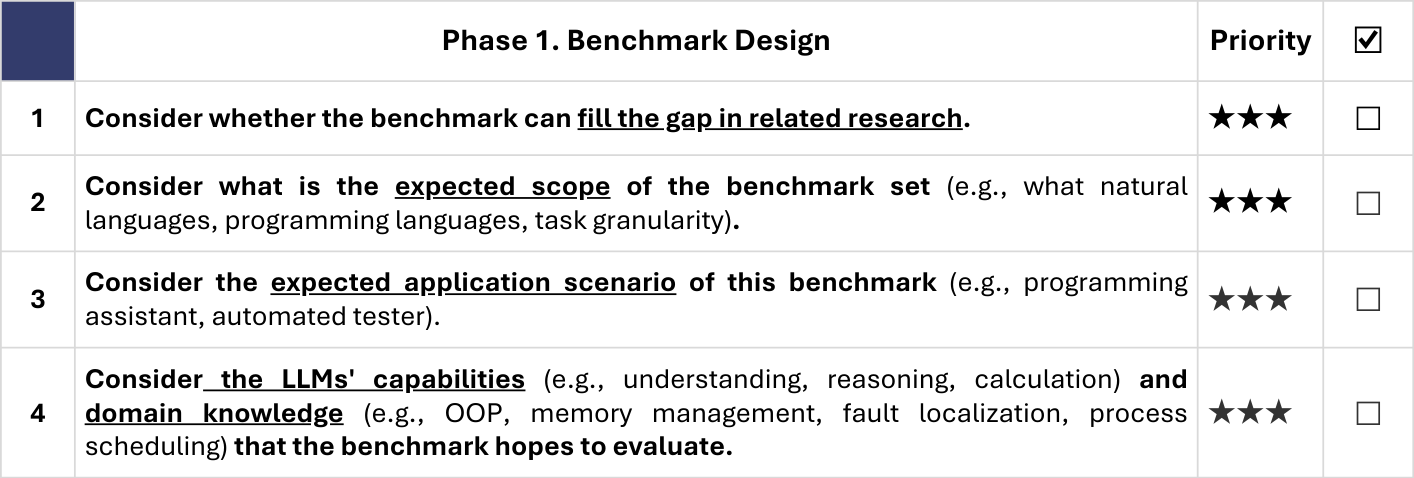
Figure 3: Guideline for Benchmark Design
Figure 4: Guideline for Benchmark Construction
Figure 5: Guideline for Benchmark Evaluation
Figure 6: Guideline for Evaluation Analysis
Figure 7: Guideline for Benchmark Release

11 Statistics of studied benchmarks↩︎

In this section, we conducted a comprehensive and detailed statistical analysis of the 572 benchmarks collected.

11.1 Profile of Studied Benchmarks↩︎

We first show the trend in the development of benchmarks from 2014 to 2025. As shown in Figure 8, the data shows a modest beginning, with only a handful of benchmarks created annually until 2017. From 2018 onwards, there has been a noticeable uptrend in benchmark creation, culminating in a significant jump to 210 benchmarks in 2024, and 316 benchmarks in 2025. This sharp increase indicates a recent heightened interest and demand for comprehensive code-related benchmarks for LLMs, reflecting the evolving complexities and expanding requirements of automated software engineering.
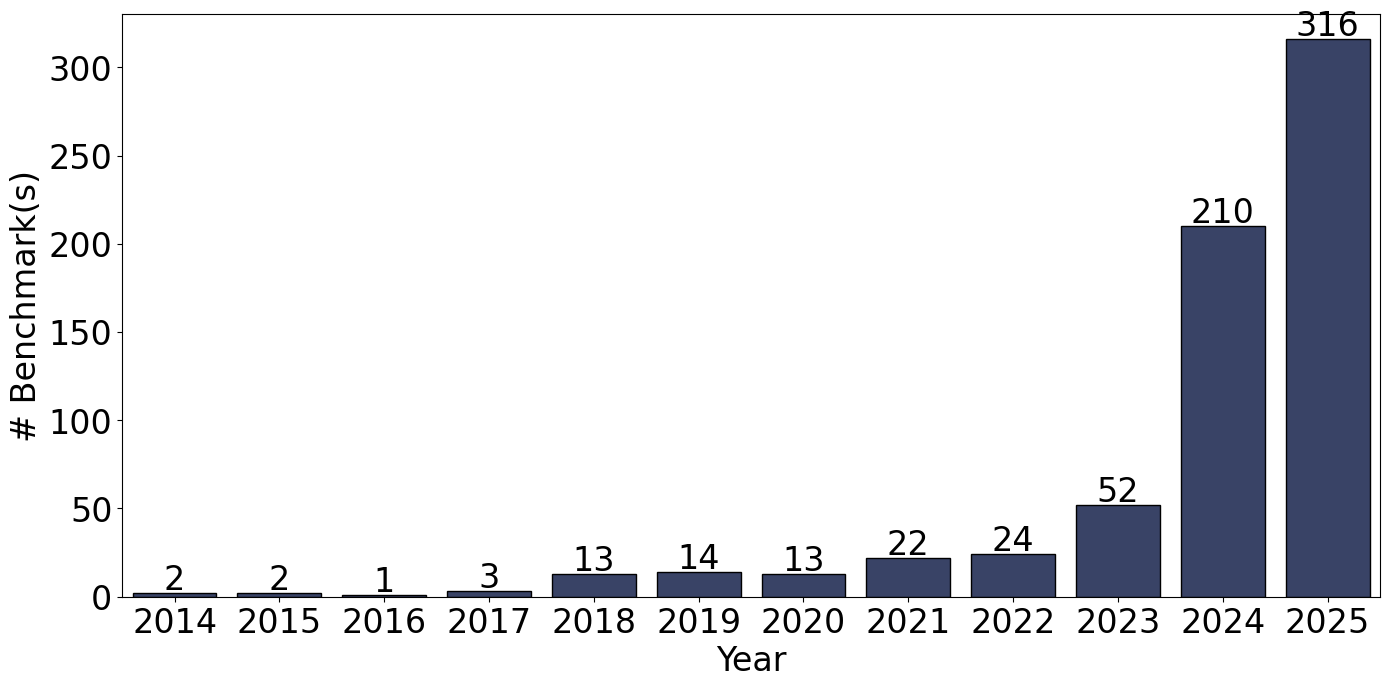
Figure 8: Benchmark Distribution over Years

Hierarchy of Benchmarks. Figure 59 visualizes the inheritance relationships among benchmarks, indicating that the benchmarks on the left serve as sources for those on the right. It highlights that 18% of benchmarks act as data sources, continuously benefiting the construction of subsequent benchmarks.

Figure 59 reveals that HumanEval [7], as the most significant source benchmark, benefits at least 15 downstream benchmarks, followed by MBPP [8] and CodeSearchNet [48]. From the right side of the figure, some benchmarks, like VulBench [10], incorporate methodologies or data from 4 previous benchmarks, and codeRagBench [49] integrates elements from 8 prior benchmarks.

This hierarchical structure among benchmarks also alerts us that the data quality of a benchmark not only affects its own credibility but can continue to impact others if it serves as a source. This underscores the importance of adhering to stringent guidelines during benchmark development and highlights the crucial role of establishing standards to ensure the integrity and utility of benchmark data across research and development efforts.

Coding Task. Regarding the coding tasks, Figure 9 illustrates the distribution of various coding tasks across benchmarks. It is clear that the task of Code Generation is most prevalent, with 235 benchmarks focusing on this area, according to 34.97% (235/672) of studied benchmarks, indicating a significant interest in generating code automatically. The second most prevalent is code reasoning 12.64% (85/672), followed by Program Repair and Defect Detection.

When examining the distribution of coding tasks by year (see Figure 10), we observe that benchmark growth accelerated most rapidly in the past two years (2024–2025), with code generation remaining the most frequently benchmarked task. At the same time, demand for code reasoning has increased substantially, rising from 19 benchmarks in 2024 to 61 in 2025. Benchmarks for program repair have also nearly doubled over the same period, increasing from 22 to 33.

These trends suggest a growing emphasis on LLMs’ reasoning capabilities as well as their role in code development and software maintenance, reflecting an evolving expectation of model competence beyond surface-level code synthesis.

Figure 9: Benchmark Distribution over Tasks
Figure 10: Benchmark Distribution over Tasks per Year

Programming Languages. Figure 11 shows the distribution of benchmarks across various programming languages. The overall trend indicates a strong preference for benchmarking Python, which leads with 409 (71.50%) benchmarks, followed by Java and C++, with 229 and 160, respectively. The graph also reveals a diverse range of languages being used. In total, 67 programming languages are studied by these 672 benchmarks. Though some programming languages, such as Kotlin, Swift, and Scala, are less frequently exercised, the benchmarks involving them are tailored to different application needs and technology environments. This distribution shows the existing benchmarks are dominated by three mainstream programming languages, leaving other programming languages less studied and benchmarked.
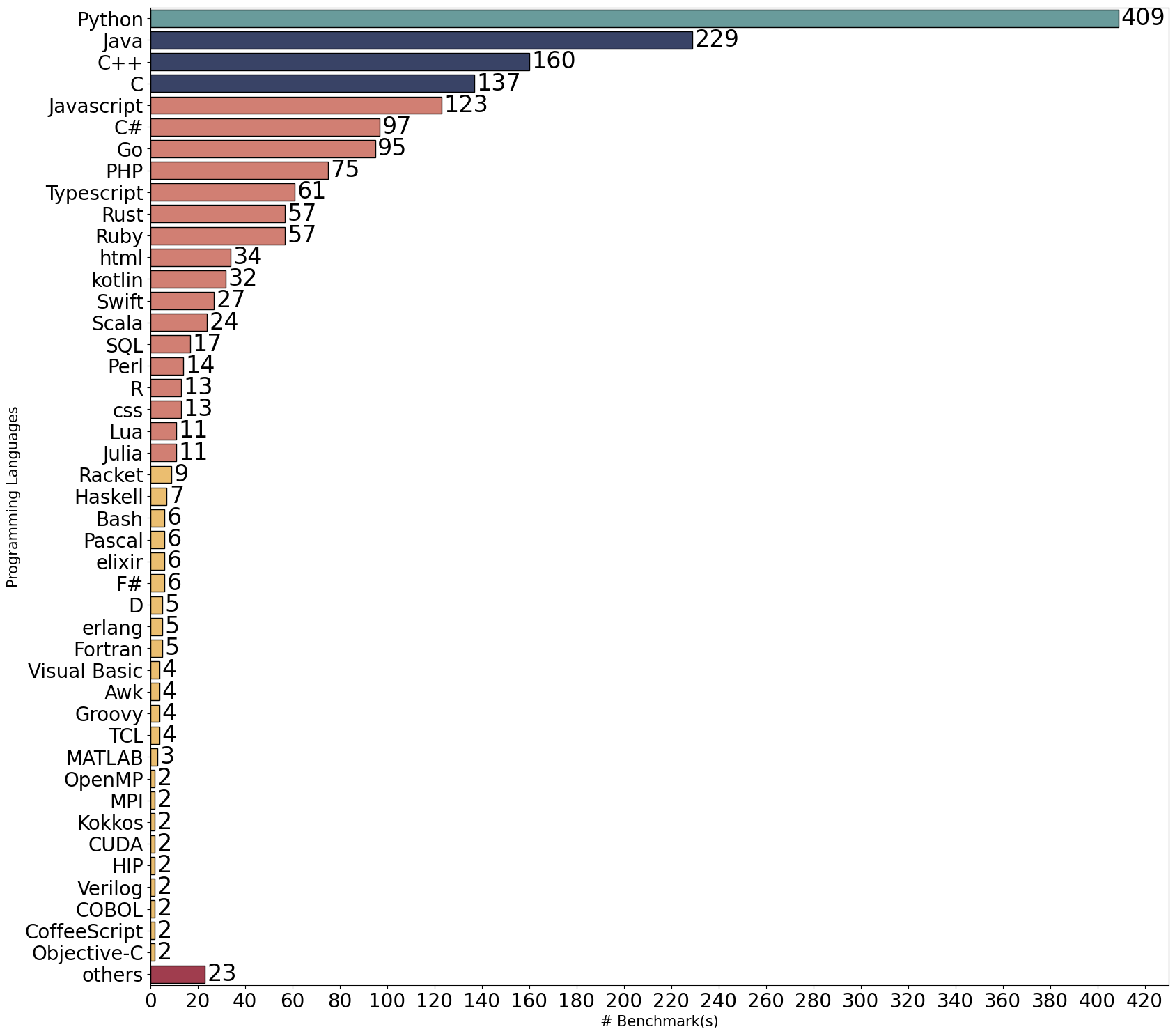
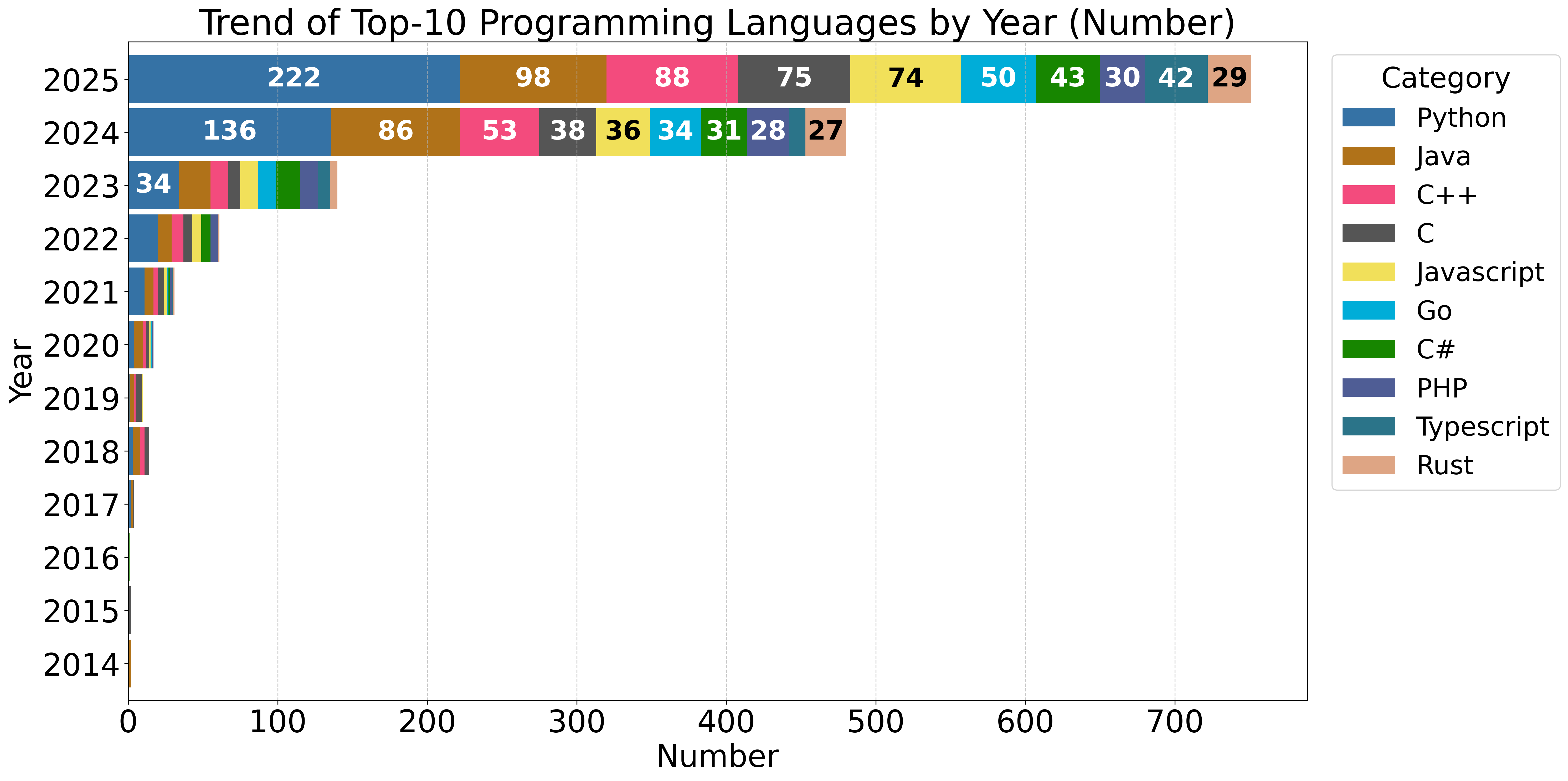
Figure 11: Benchmark Distribution over Programming Language
Figure 12: Benchmark Distribution over Programming Language per Year

When analyzed by year (Figure 12), the number of benchmarks for C/C++ and JavaScript has increased noticeably between 2024 and 2025. We also observe a sharp rise in Rust-related benchmarks: although only a few benchmarks existed for Rust since its release in 2015, 57 benchmarks were published in the past two years (27 in 2024 and 29 in 2025). These trends in programming language coverage reflect the evolving demand for LLMs across different languages, highlighting particularly the growing reliance on large models to generate, reason about, and maintain code in these languages.

Natural Language. Figure 13 illustrates the distribution of benchmarks for different natural languages. The bar chart overwhelmingly shows that English is the dominant language, with 577 (85.9%) benchmarks highlighting its ubiquity in research and development. Other languages have significantly fewer benchmarks, with 16 in Chinese and 15 in Russian. The category labeled “Other” includes 24 benchmarks spread across other natural languages, indicating some diversity but limited attention to non-English benchmarks. This distribution highlights the prominence of English in the global research community and also demonstrates the uneven representation of natural languages in the studied benchmarks.
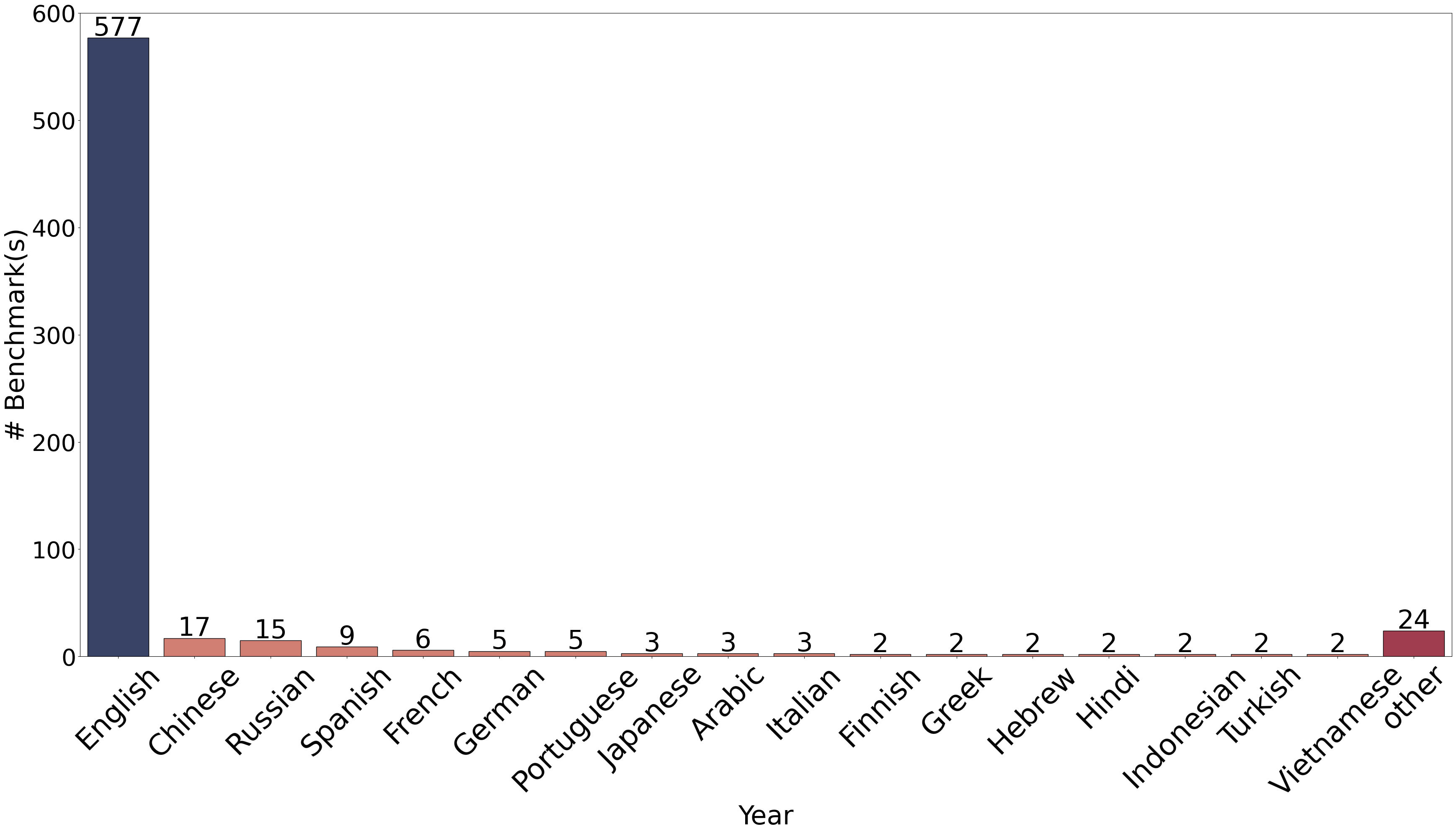
Figure 13: Benchmark Distribution over Natural Language

Modals in the benchmarks. Figure 14 presents the distribution of benchmarks according to the type of language used in their prompts. The chart shows that the majority, at 66.2%, of the benchmarks use a combination of natural language and programming Language, followed by PL only (13.7%) and NL only (18.2%).
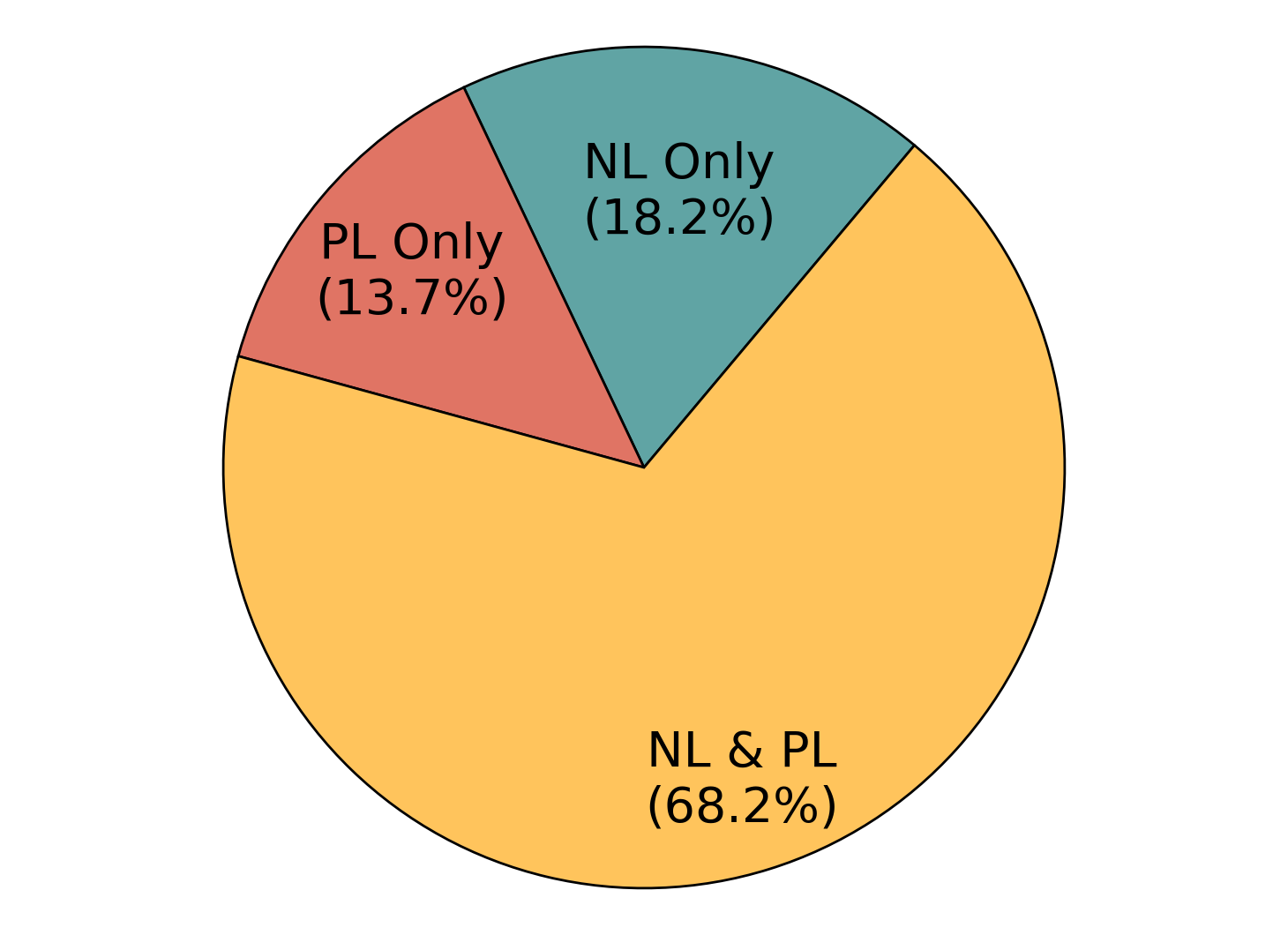
Figure 14: Benchmark Distribution over Modal in Prompt

Granularity. The code snippet in a code-related benchmark varies from statement-level (i.e., one line of code. For example, CoNaLa [50] and Math-QA [51]), function-level (i.e., a function unit of code. For example, HumanEval [7] and MBPP [8]), class-level (i.e., a class with multiple function units of code. For example, ClassEval [52]) and project-level (i.e., a project with multiple classes or modules. For example, DevEval [53] and JavaBench [32]).

Figure 15 illustrates the granularity levels at which benchmarks are typically conducted. The chart shows that the majority of benchmarks, comprising 66.9%, focus on the function level. Projects constitute 21.5% of the benchmarks. Class-level granularity is the least represented at only 3.4%.

When analyzed by year, an interesting phenomenon emerges (Figure 16): between 2024 and 2025, the number of project-level benchmarks surged, increasing from 35 to 95 new benchmarks. Importantly, these numbers refer to benchmarks newly introduced in each year, rather than cumulative totals. This surge indicates a growing community focus on the real-world applicability and large-scale practical utility of LLMs.
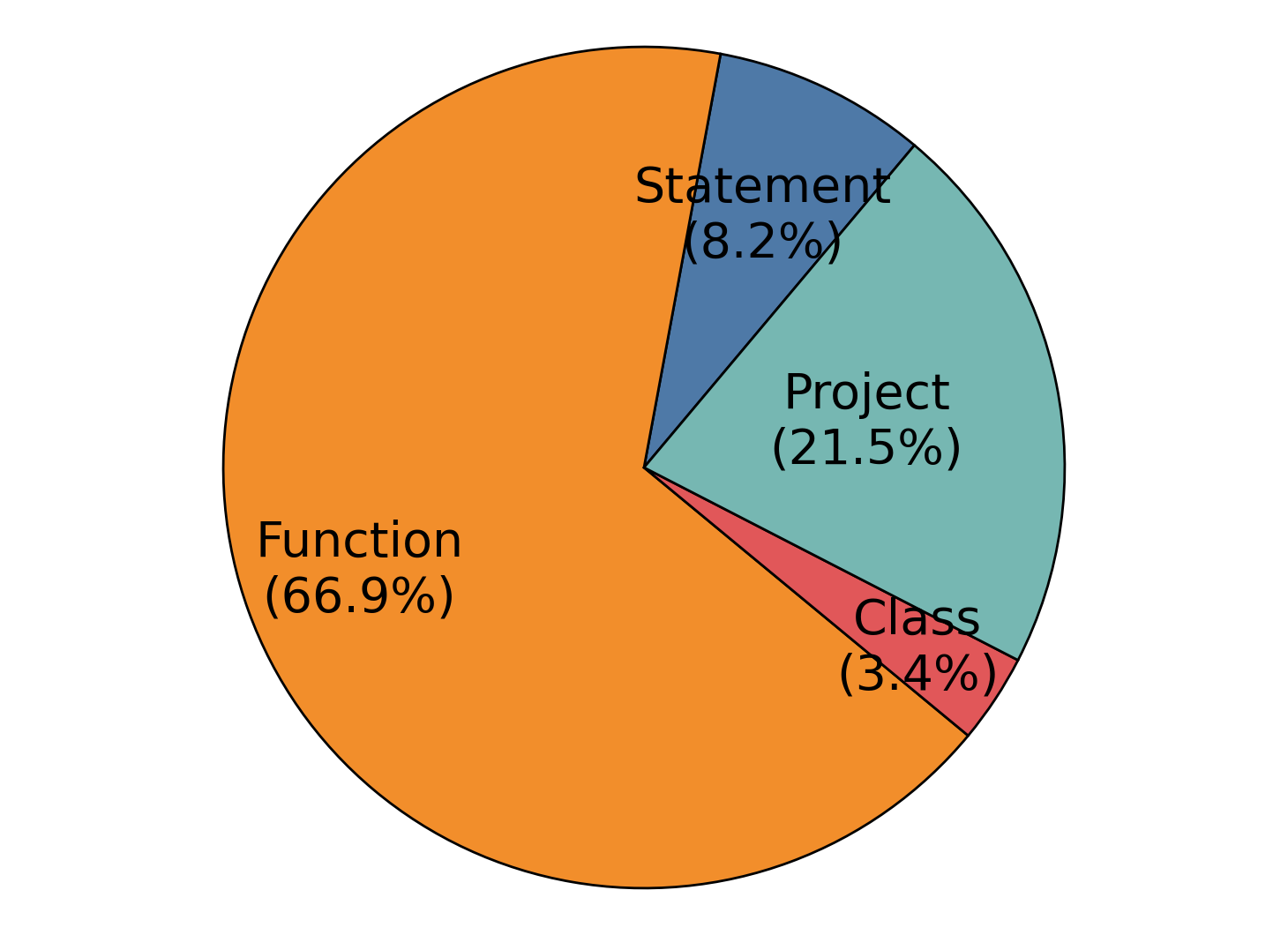
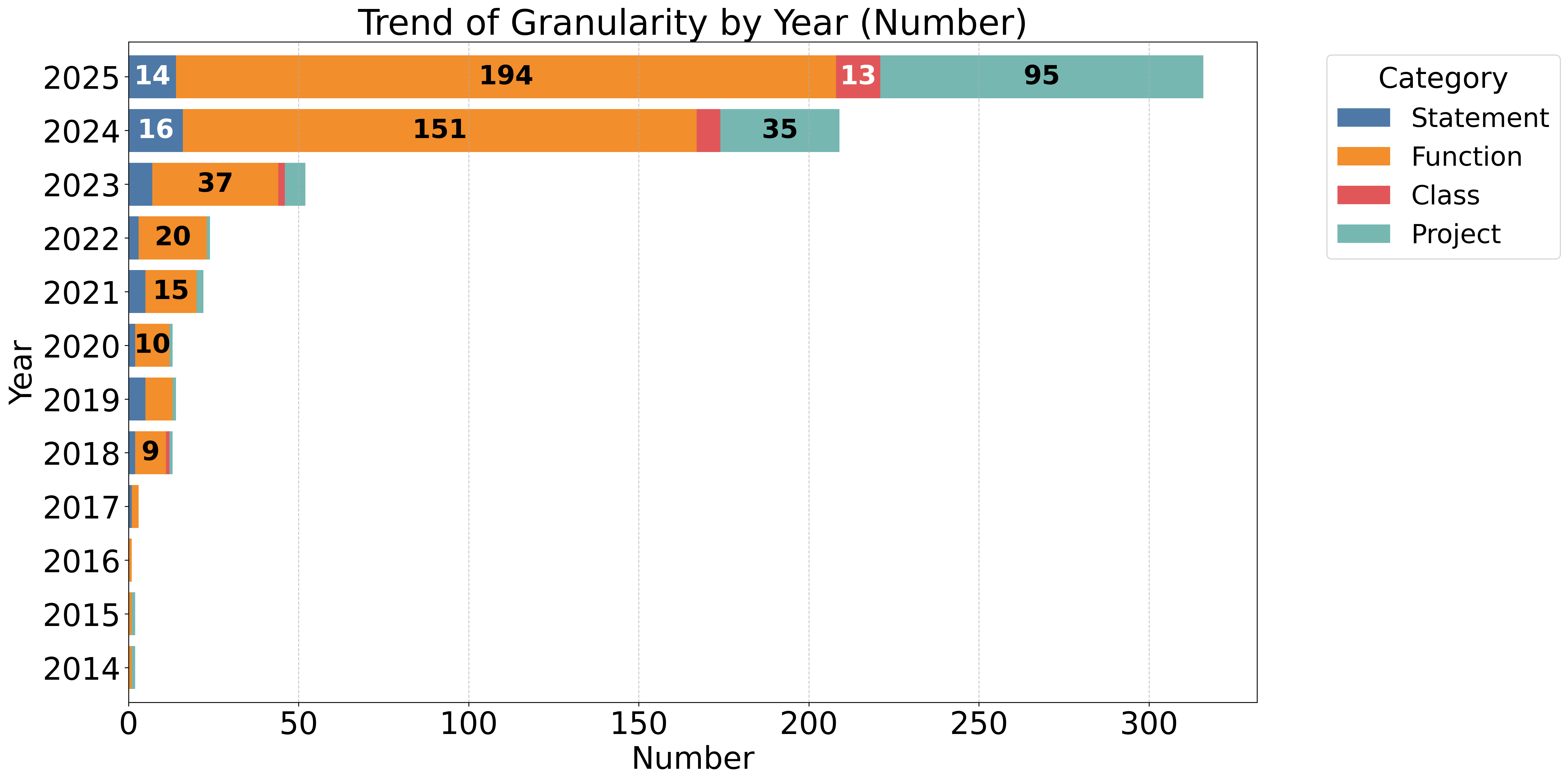
Figure 15: Benchmark Distribution over Granularity

11.2 Statistics about Benchmark Design↩︎

Design of Studied Capabilities. To understand whether benchmark developers recognize the capabilities of LLMs they aim to evaluate, we carefully analyzed 30 representative benchmarks (Appendix 13) to see if they clearly specify the capabilities being assessed by their benchmarks. As shown in Figure 17, 80% of benchmarks explicitly specify the capabilities (e.g., intention understanding, problem solving, testing, debugging capabilities)to be evaluated, while 20% do not. The statistics show that the most highly cited benchmarks clearly define the assessment capabilities.

Figure 17: Benchmark Distribution Over Capabilities Consideration

Furthermore, we investigated the 30 focused benchmarks and identified a case (Figure 18) from MBPP [8] where the case is likely to fall outside of the targeted capability of the benchmark. In particular, MBPP [8] aims to “measure the ability of these models to synthesize short Python programs from natural language descriptions” for “entry-level programmers”. As we can see from Figure 18, the prompt requires LLMs to “Write a function to calculate the dogs’ years.” Simply from this description, an entry-level programmer is unlikely to write a correct program without knowing the conversion equation from dogs’ year to dogs’ age. In other words, this case is more about assessing whether LLMs have acquired this specific knowledge rather than evaluating the most fundamental programming skills.

Figure 18: An Example of Out-of-capability Case from MBPP [8].

Design of Studied Application Scenarios. Similarly, to understand whether benchmark developers scoped the application scenarios of LLMs they aim to evaluate, we carefully analyzed 30 representative benchmarks (Appendix 13) to see whether they explicitly specify the application scenarios their benchmarks target. As shown in Figure 19, 76.7% representative benchmarks have clearly specified application scenarios (e.g., programming assistant), while the rest do not. Indeed, clearly defining the application scenarios could help benchmark constructors establish precise goals for the design and development of the benchmark, ensuring accuracy in the evaluation.
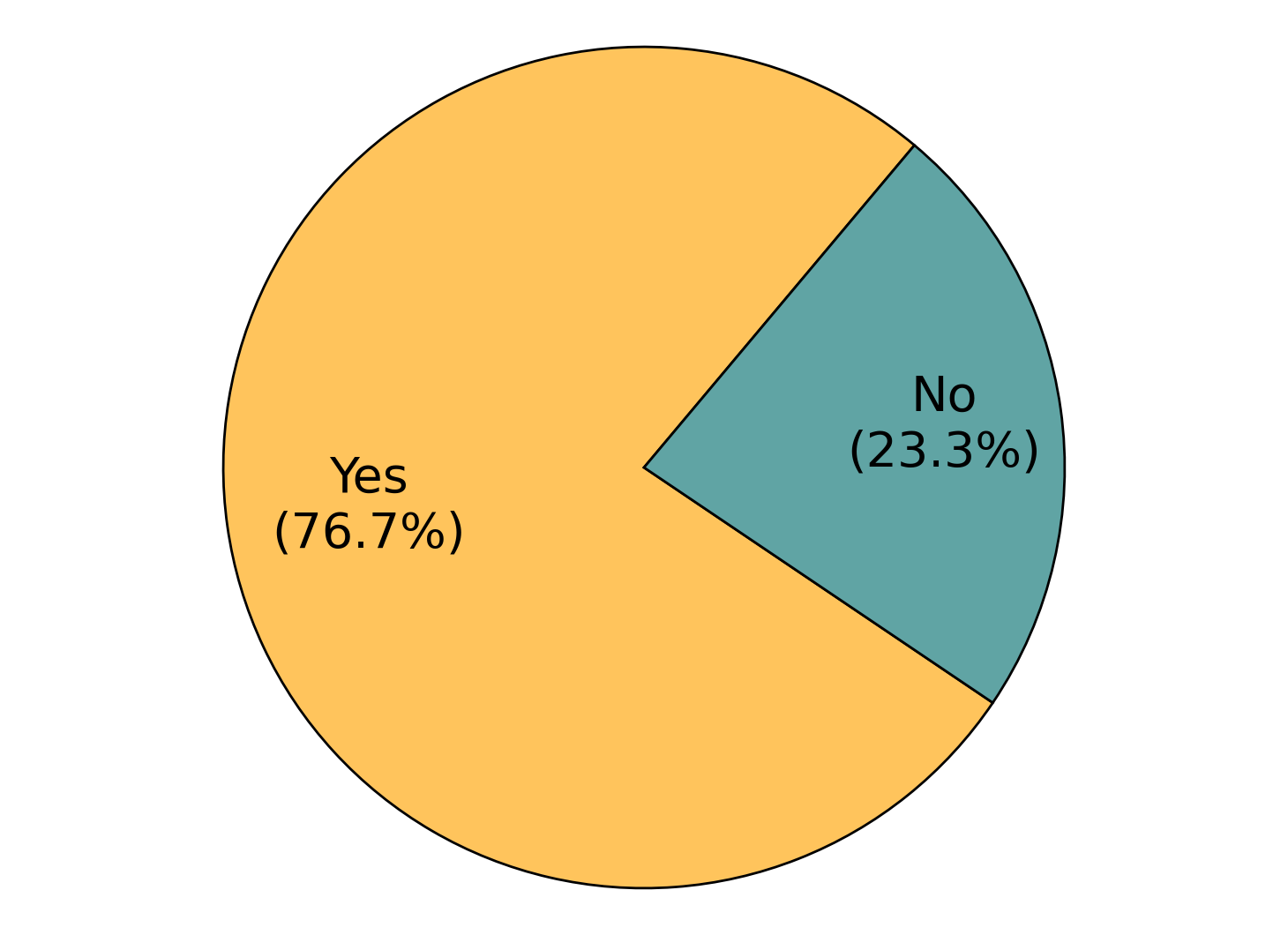
Figure 19: Benchmark Distribution Over Expected Application Scenario Consideration

11.3 Statistics about Data Preparation↩︎

11.3.1 Data Preprocessing↩︎

Data Deduplication. During benchmark preparation, data cleaning and preprocessing are necessary. However, as shown in Figure 20, only 32.9% benchmarks have deduplicated the collected data. More than half of them didn’t mention this process.

The yearly trend (Figure 21) shows that, although the number of benchmarks that applied deduplication increased slightly from 71 in 2024 to 93 in 2025, the total number of benchmarks in 2025 more than doubled compared to 2024. As a result, the absolute number of benchmarks that ignored or did not apply deduplication nearly doubled, highlighting a growing risk of duplicated data despite increased awareness.
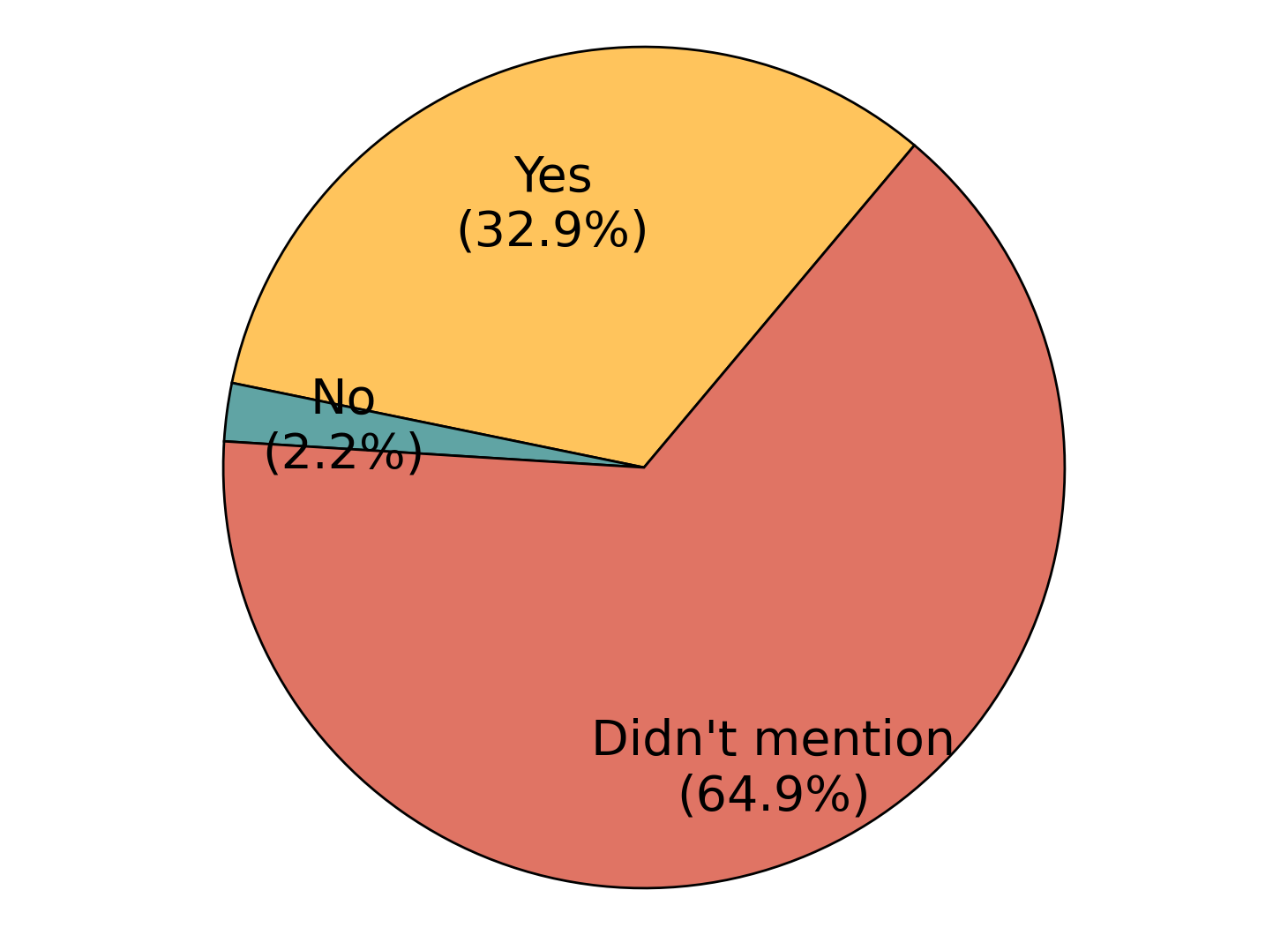
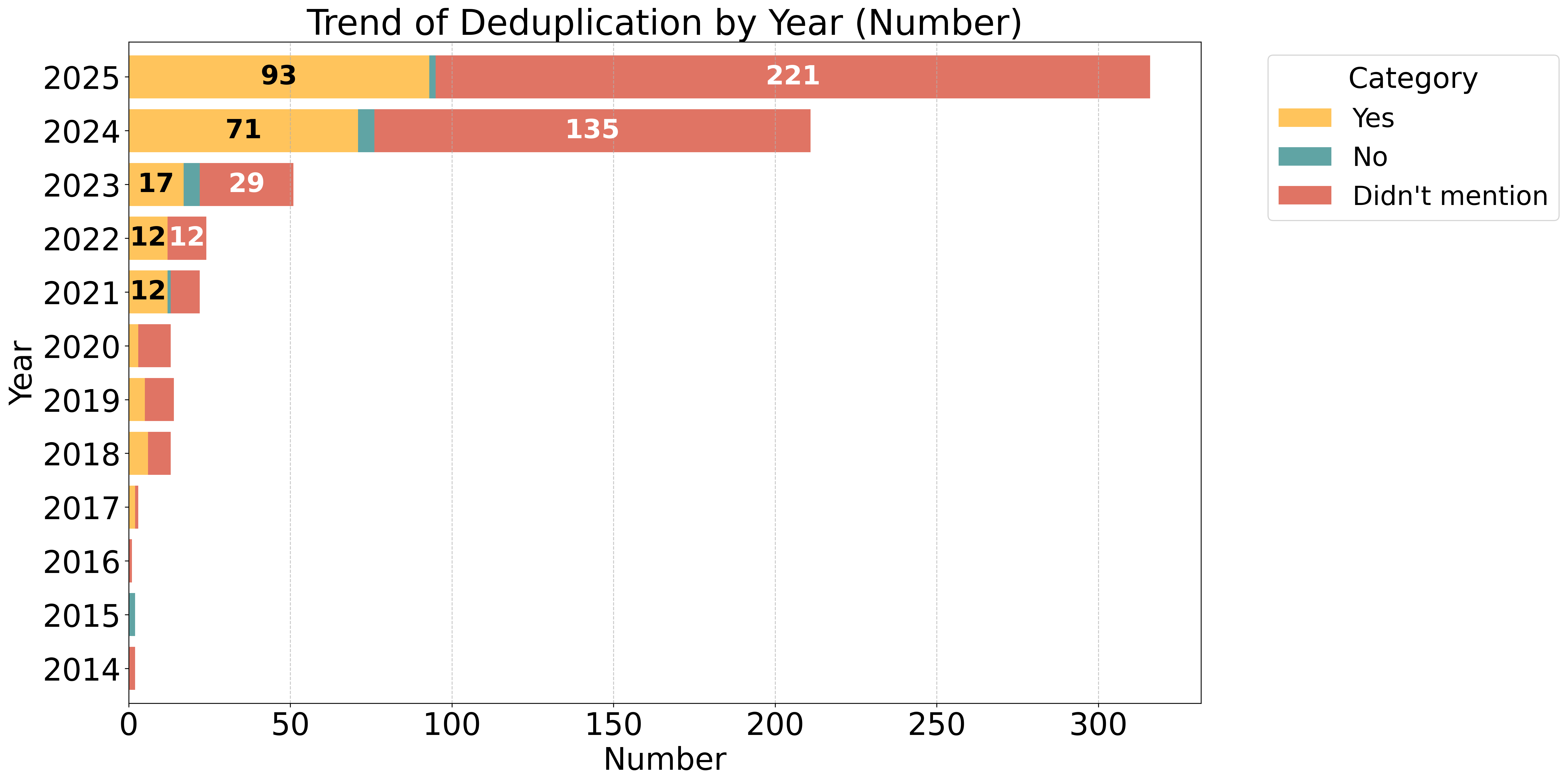
Figure 20: Benchmark Distribution over Deduplication

To investigate the situation, we went through the 30 representative benchmarks (Listed in Appendix 13) and found two duplicated subjects in MBPP [8]. Tasks with id 71 and 141 examined the same functionality, i.e., “Write a function to sort a list of elements.”, collected from the same source.

Figure 22: A Counterexample of Rule 16 from MBPP [8].

Data Quality Assurance. Ensuring data quality for the benchmark is essential. However, our statistics (Figure 23) show disappointing results. 46.0% of benchmarks do not take any measures for data quality assurance. Among those benchmarks that do incorporate data quality measures, the majority rely on manual checks, which account for 45.8%. Other countermeasurements, such as code execution, constitute only 1.2%. Additional methods, such as using download counts as a basis, are also employed (6.4%) .
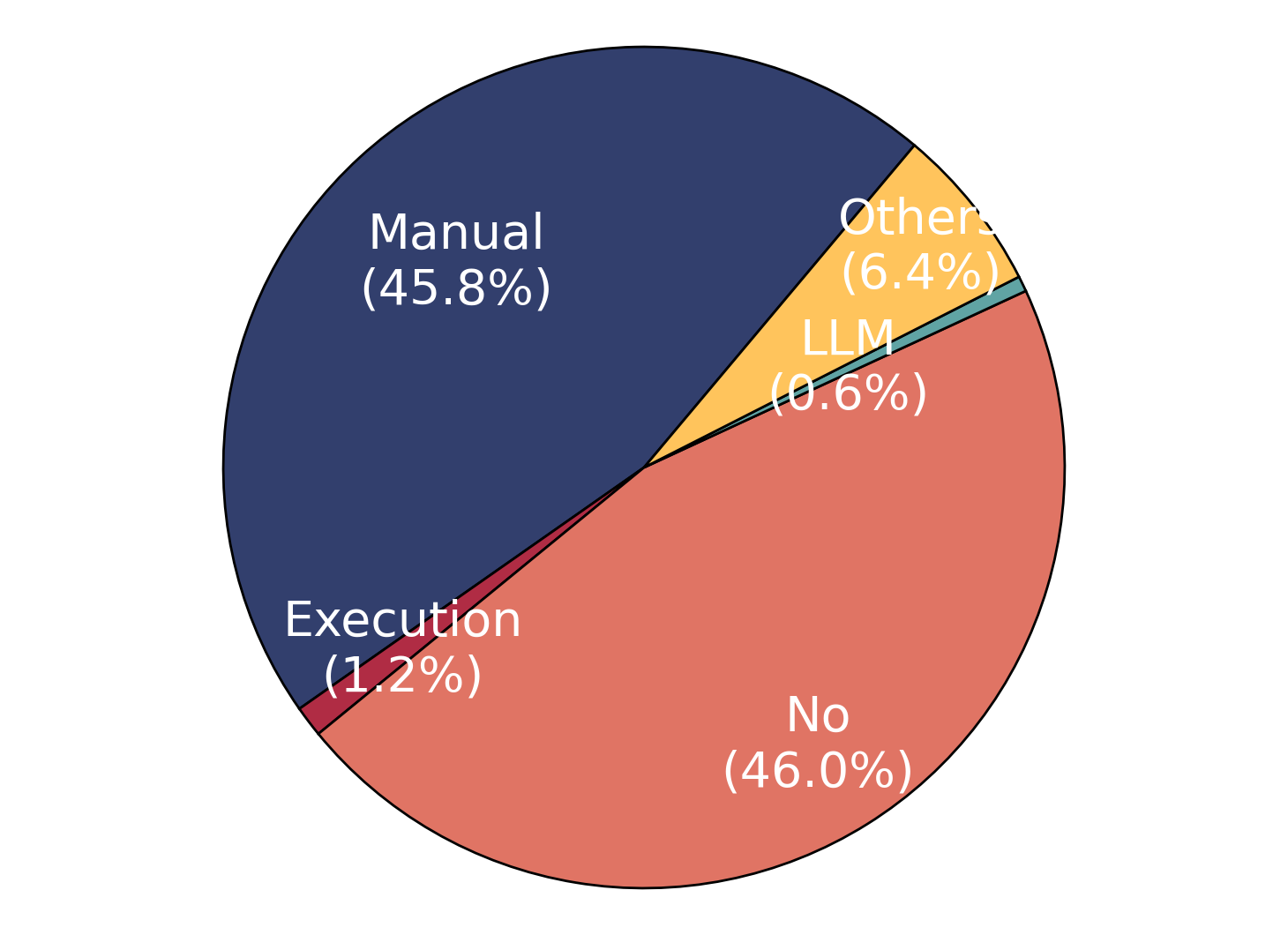
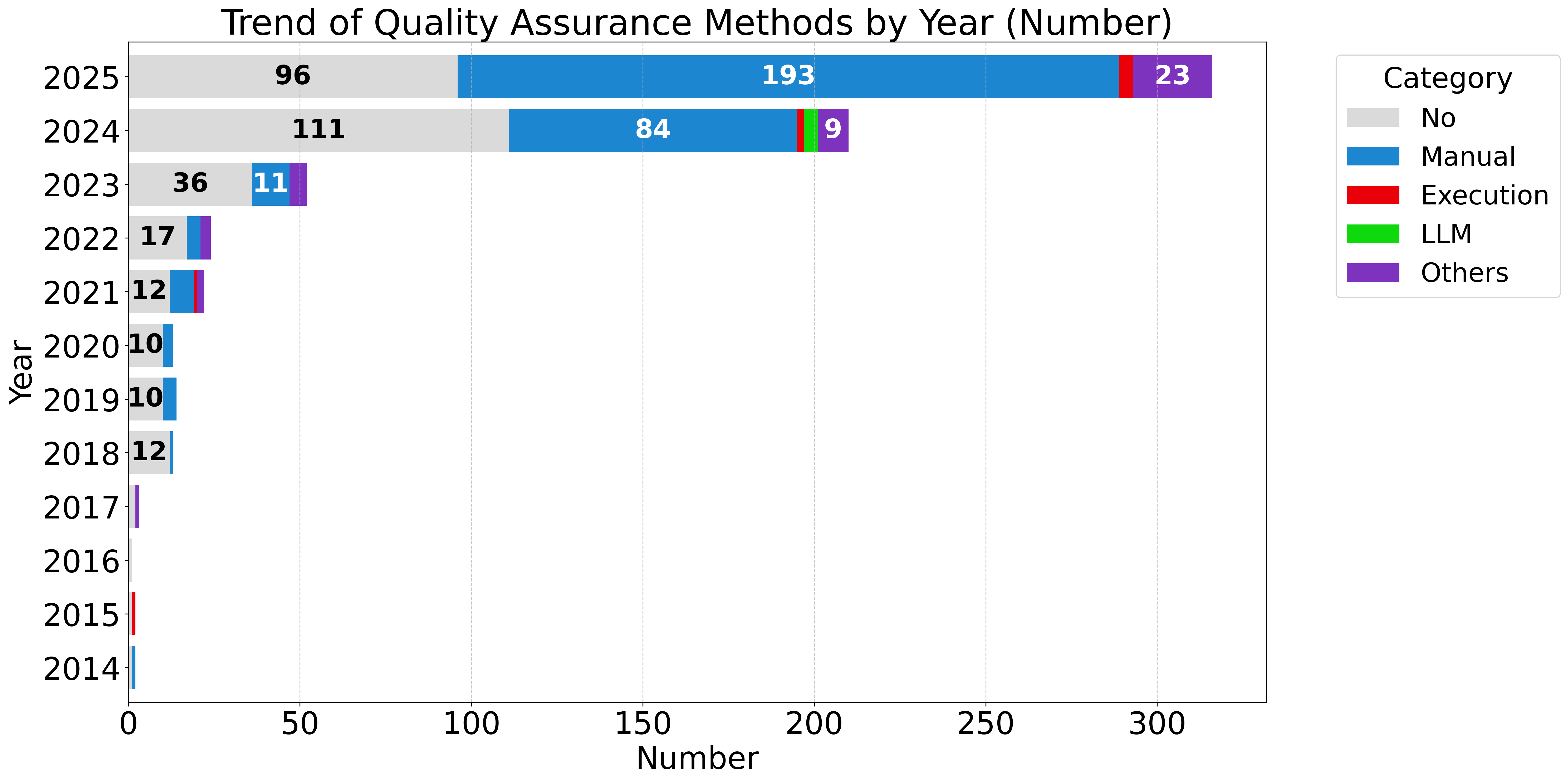
Figure 23: Benchmark Distribution over Quality Assurance Method

Examining the trends by year (Figure 24), one positive development is the increasing prevalence of manual quality checks. The number of benchmarks with manual check guarantees doubled from 84 in 2024 to 193 in 2025, indicating that a growing share of code benchmarks now undergo partial or full human verification.

Additionally, we dived into the 30 representative benchmarks (Listed in Appendix 13) and identified an example where the code cannot be executed successfully. As shown in Figure 25, the function swap() in line 7 has not been defined, so the execution of the code would fail if the code has been executed. This highlights a significant gap in ensuring the reliability and validity of benchmark data, underscoring the need for more rigorous and automated data quality assurance practices.

Figure 25: An Example from MBPP  [8] that failed to be executed.

Data Contamination Resolution. Data contamination [6], [54] threat has been widely discussed. A benchmark with contaminated data may yield overclaimed results, misleading the understanding of the LLMs’ capabilities. According to our statistics (Figure 26), most (79.8%) benchmarks were not aware of and have not taken any measures to alleviate data contamination, being vulnerable to data contamination threats. The yearly trend (Figure 27) further highlights the persistent neglect of data contamination in benchmark construction. From 2024 to 2025, the number of benchmarks that did not account for data contamination nearly doubled, increasing from 165 to 236, indicating that this risk persists or has become more widespread.

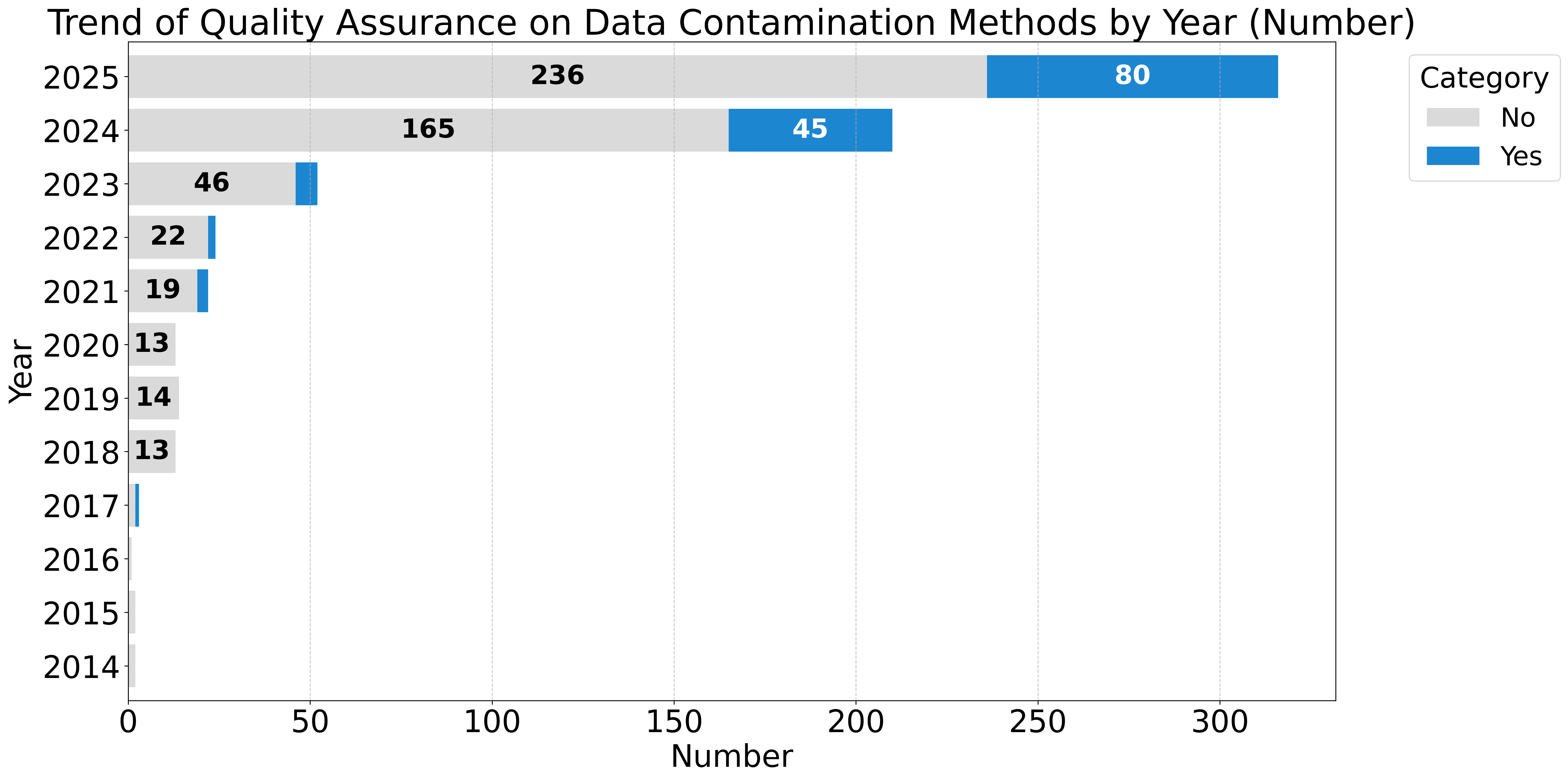
Figure 26: Benchmark Distribution over Quality Assurance on Data Contamination
Figure 27: Benchmark Distribution over Quality Assurance on Data Contamination per Year

11.3.2 Statistics about Data Curation↩︎

Ground truth solutions. Figure 28 shows that although the majority (89.1%) of benchmarks provide reference code as ground truth, there are 9.8% of benchmarks without reference code. Although it is not compulsory as long as object measurements (e.g., test cases) are provided, a reference code is still recommended. Indeed, if a benchmark provides reference code, its reliability tends to be better because it ensures that there are feasible solutions for the tasks involved. This guarantees that the tasks are theoretically and practically solvable, enhancing the benchmark’s usefulness and credibility in real-world applications.
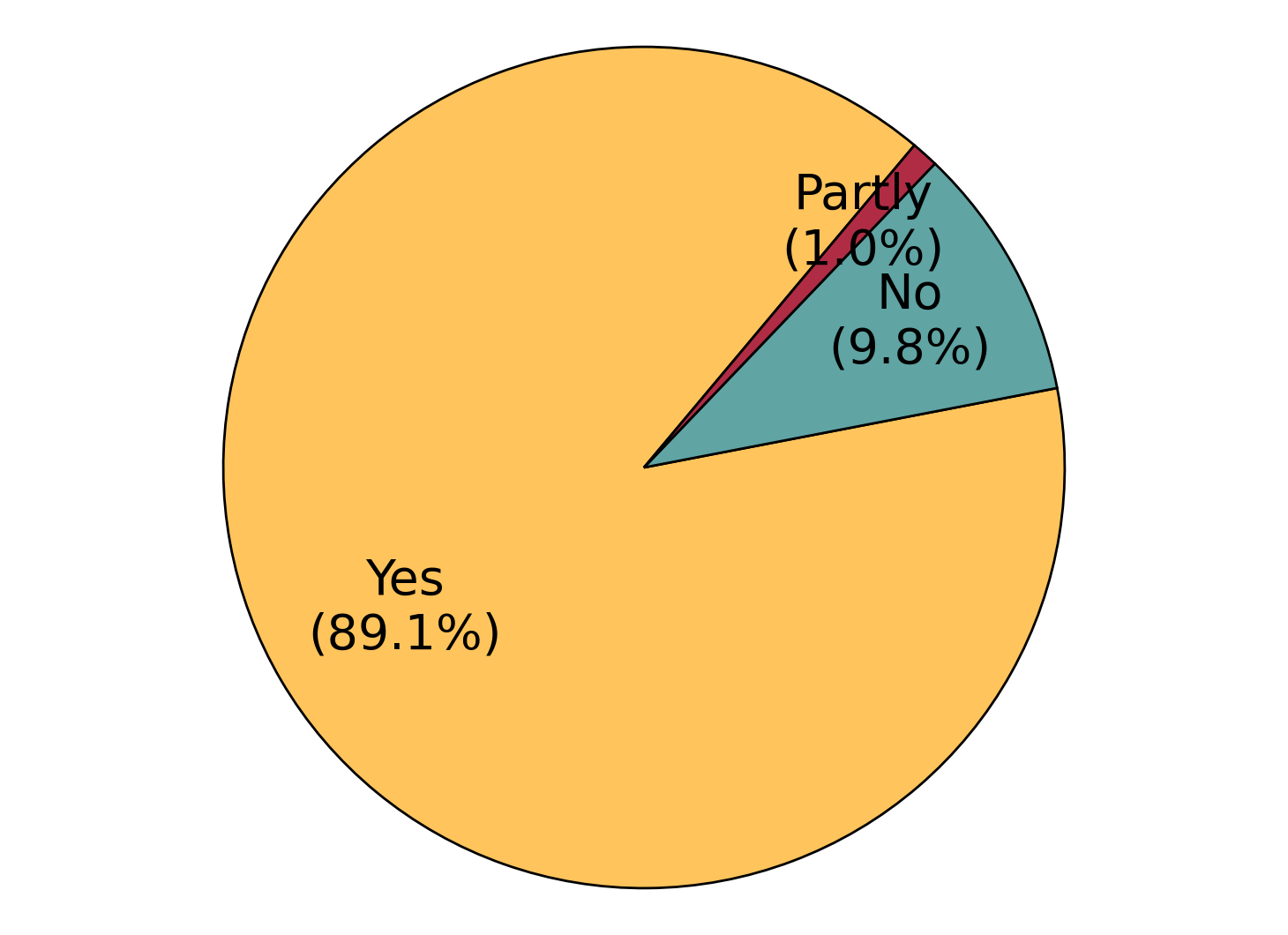
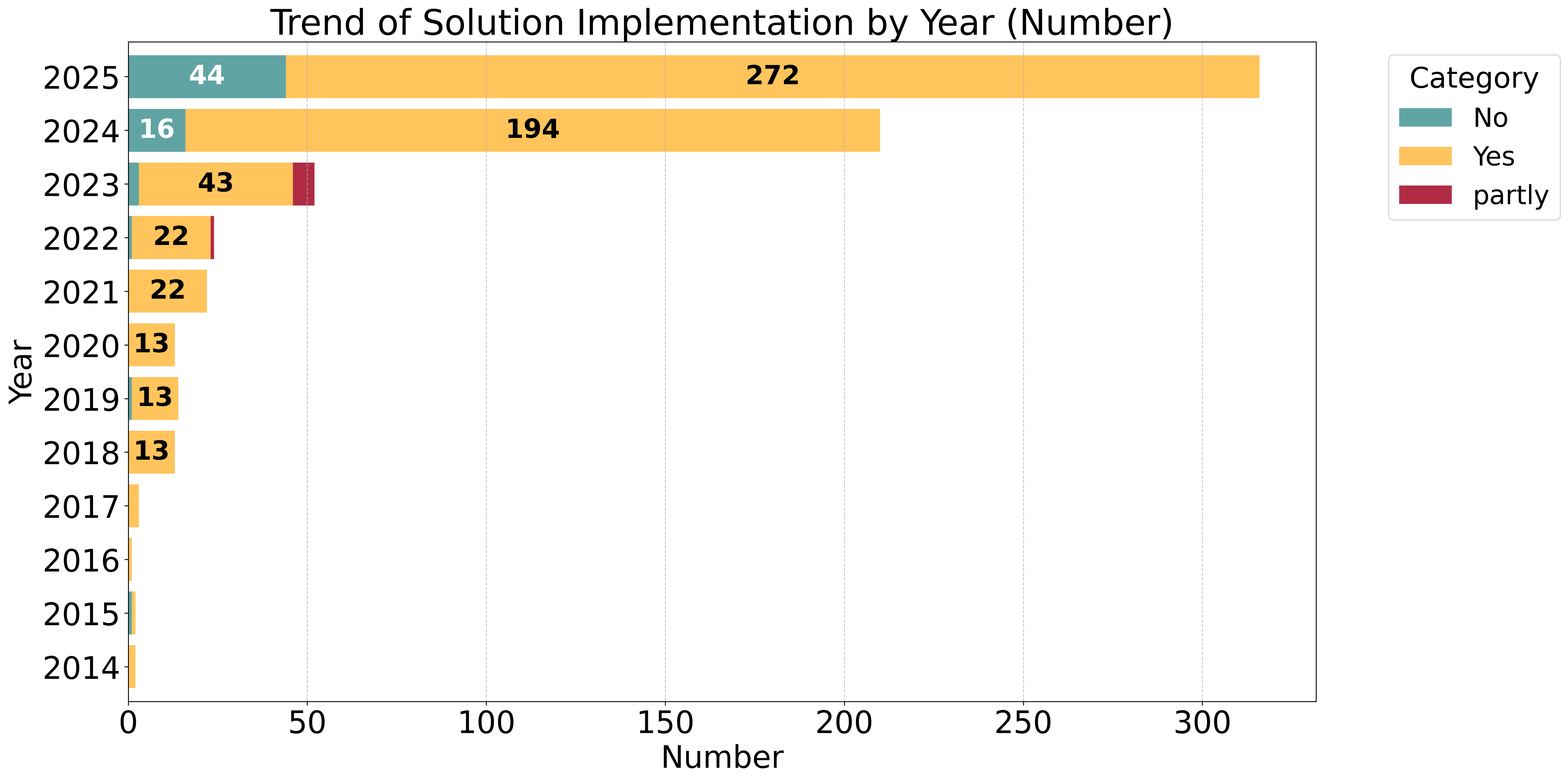
Figure 28: Benchmark Distribution over Solution
Figure 29: Benchmark Distribution over Solution per Year

From the year-by-year trend (Figure 29), the number of benchmarks without ground truth tripled in 2025, reaching 44 benchmarks. This may reflect a shift toward more open-ended and challenging benchmarks, where standard solutions do not yet exist or remain to be explored, highlighting the evolving nature of tasks designed for LLM evaluation.

Additionally, the correctness of the ground truth solution should also be noted. Figure 30 shows an incorrect code solution provided in HumanEval [7]. This should draw benchmark constructors’ attention to the correctness of the benchmark reference code.

Figure 30: An Example from HumanEval  [7] which shows an incorrect solution provided in the benchmark.

Oracle. An oracle [55] is a way to determine whether the output is correct or not. For example, assume the output of LLMs is in the form of code, then an oracle could be running tests against the code and see whether the code can pass all the tests. Figure 31 shows the distribution of types of oracle that are used in these benchmarks. Clear that passing test cases (257 / 672 = 38.2%) and the exact match (193 / 672 = 28.7%) are the most common oracles used in code benchmarks, followed by thresholds (i.e., similarities smaller than a specific threshold).
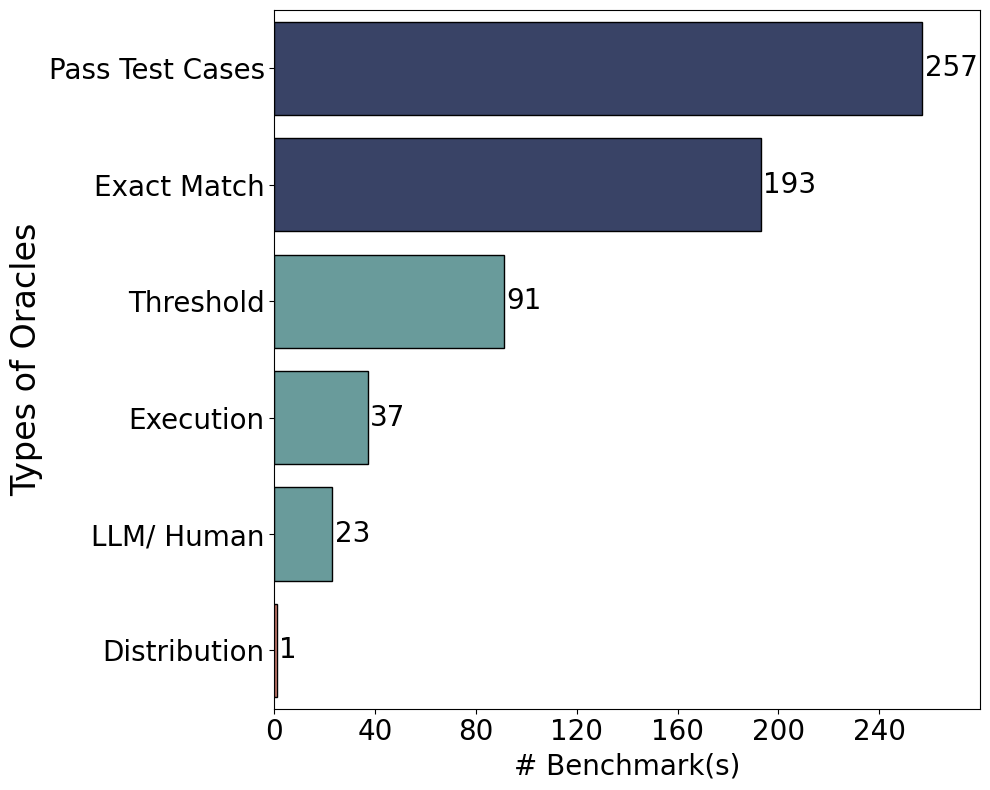
Figure 31: Benchmark Distribution over Test Oracle

Code coverage [56], as a common oracle for code-related benchmarks, measuring the ratio of covered code by tests, has been widely adopted to determine the output correctness. It should be considered whether a benchmark uses test case passing as a criterion for the correctness of the generated code. Otherwise, a test could be too weak to detect the existence of a defect in the generated code. For example, as pointed out by prior work [3], existing benchmarks such as HumanEval [7] and MBPP [8] still suffer from “insufficient tests”, allowing incorrect code to pass all the tests without capturing the bugs.

Despite its importance, as shown in Figure 32, among the benchmarks that use test cases as the oracle, only 13.6% considered and reported “test coverage” explicitly in their papers, while 85.0% ignored the test coverage.
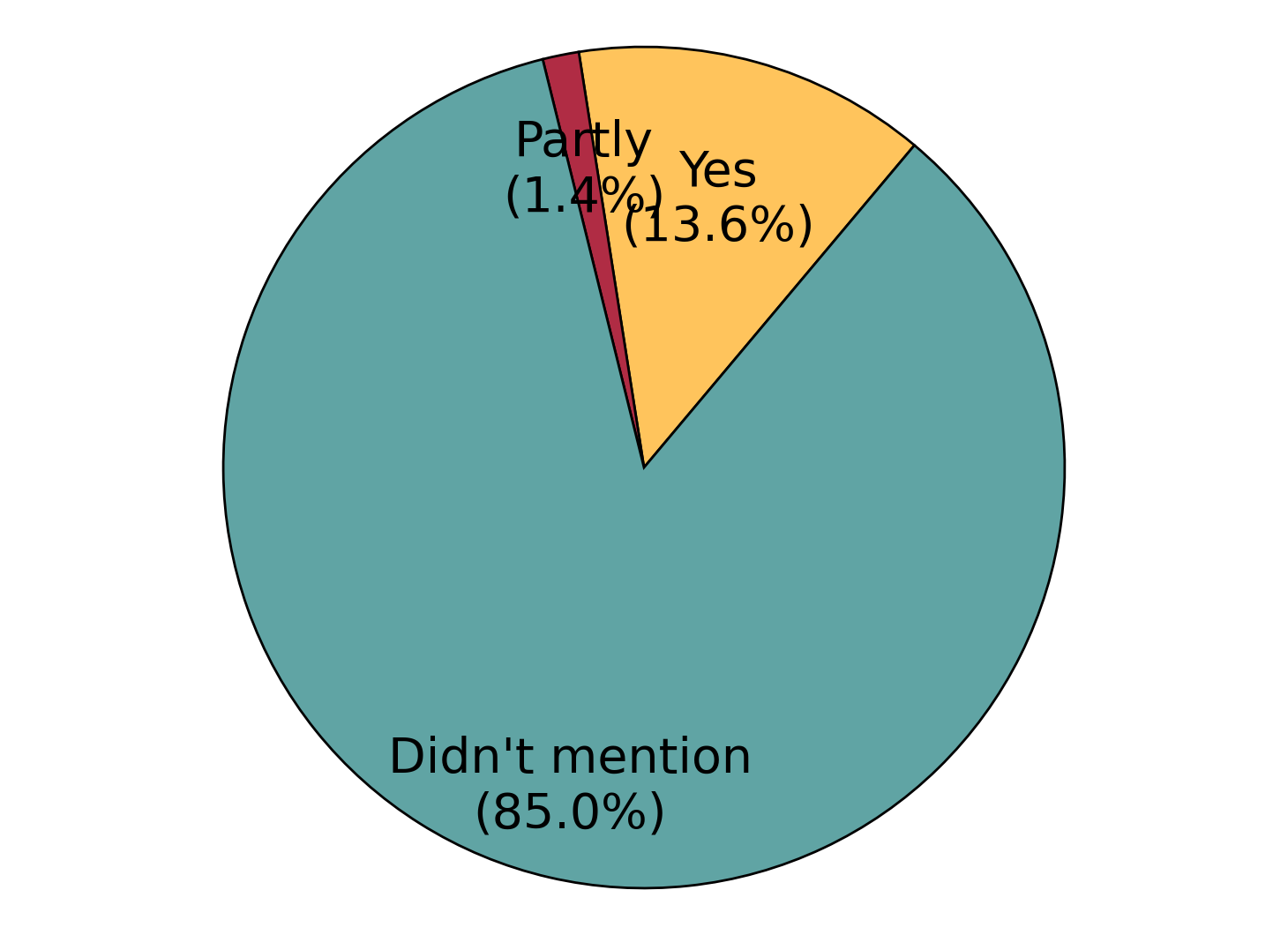
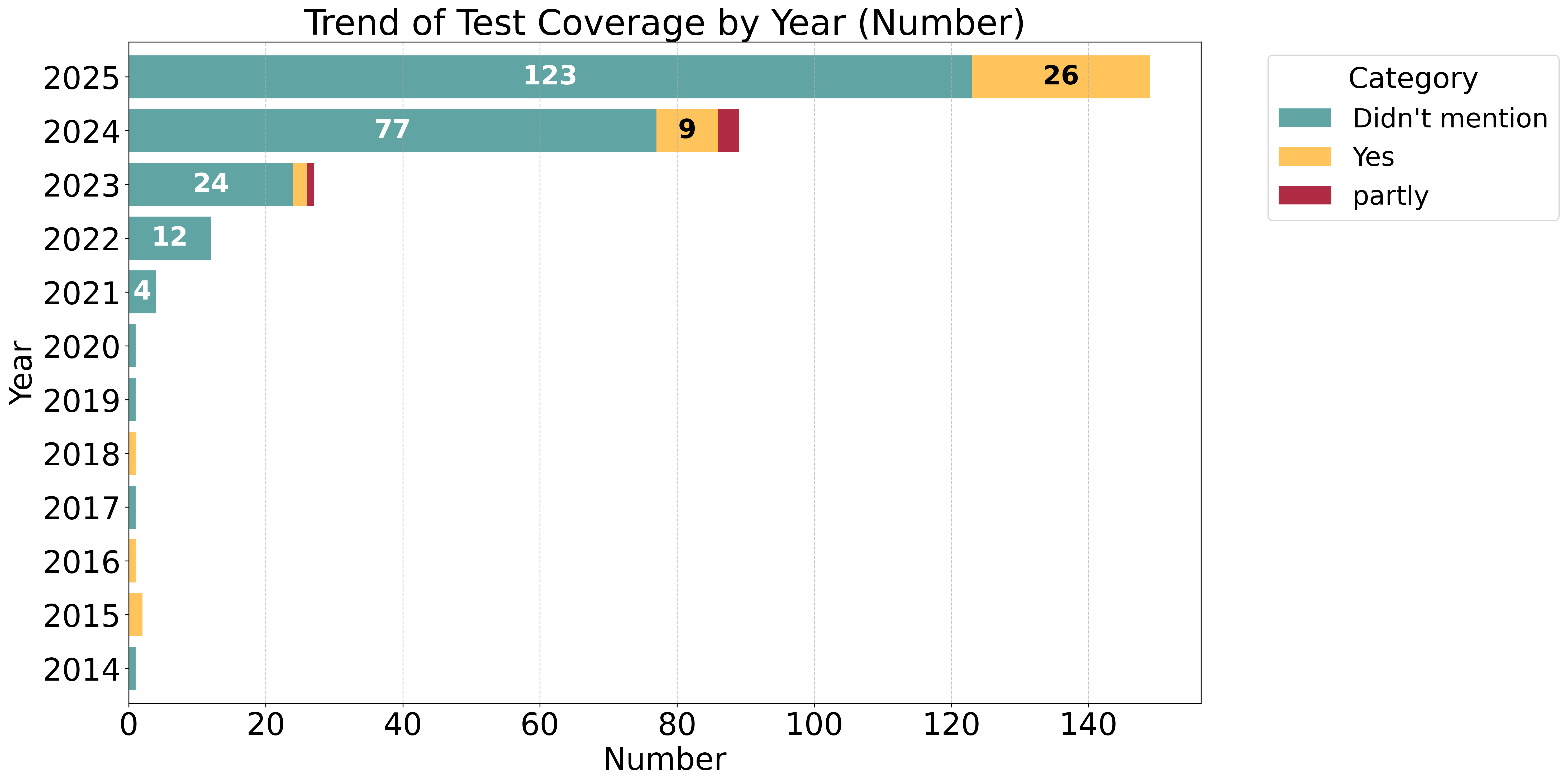
Figure 32: Benchmark Distribution over Test Coverage
Figure 33: Benchmark Distribution over Test Coverage per Year

The annual distribution (Figure 33) makes this trend even clearer: although many benchmarks in the past three years (2023–2025) did not consider code coverage, the sheer volume of benchmarks in 2025 means that the absolute number of such benchmarks is high, with 24, 77, and 123 benchmarks respectively for 2023, 2024, and 2025. This underscores that, despite growing awareness of evaluation rigor, a substantial number of benchmarks continue to provide incomplete testing, highlighting a persistent threat to the validity and reliability of benchmark-driven assessment.

Furthermore, we dived into 30 representative benchmarks (Listed in Appendix 13) and identified an example (Figure 34) from MBPP [8] where the test is incorrect. It alerts us that both the quality of the test and the test adequacy (e.g., code coverage) should be considered.

Figure 34: An Example of Incorrect Tests from MBPP [8].

11.4 Statistics about Evaluation↩︎

Studied LLMs. We summarize the number of LLMs that have been evaluated in each benchmark evaluation. Among the 672 benchmarks, 585 of them are evaluated over LLMs, so we show the statistics over them. As shown in Figure 35, most benchmarks were evaluated against six LLMs (10.0% = 59 / 585), followed by three LLMs.
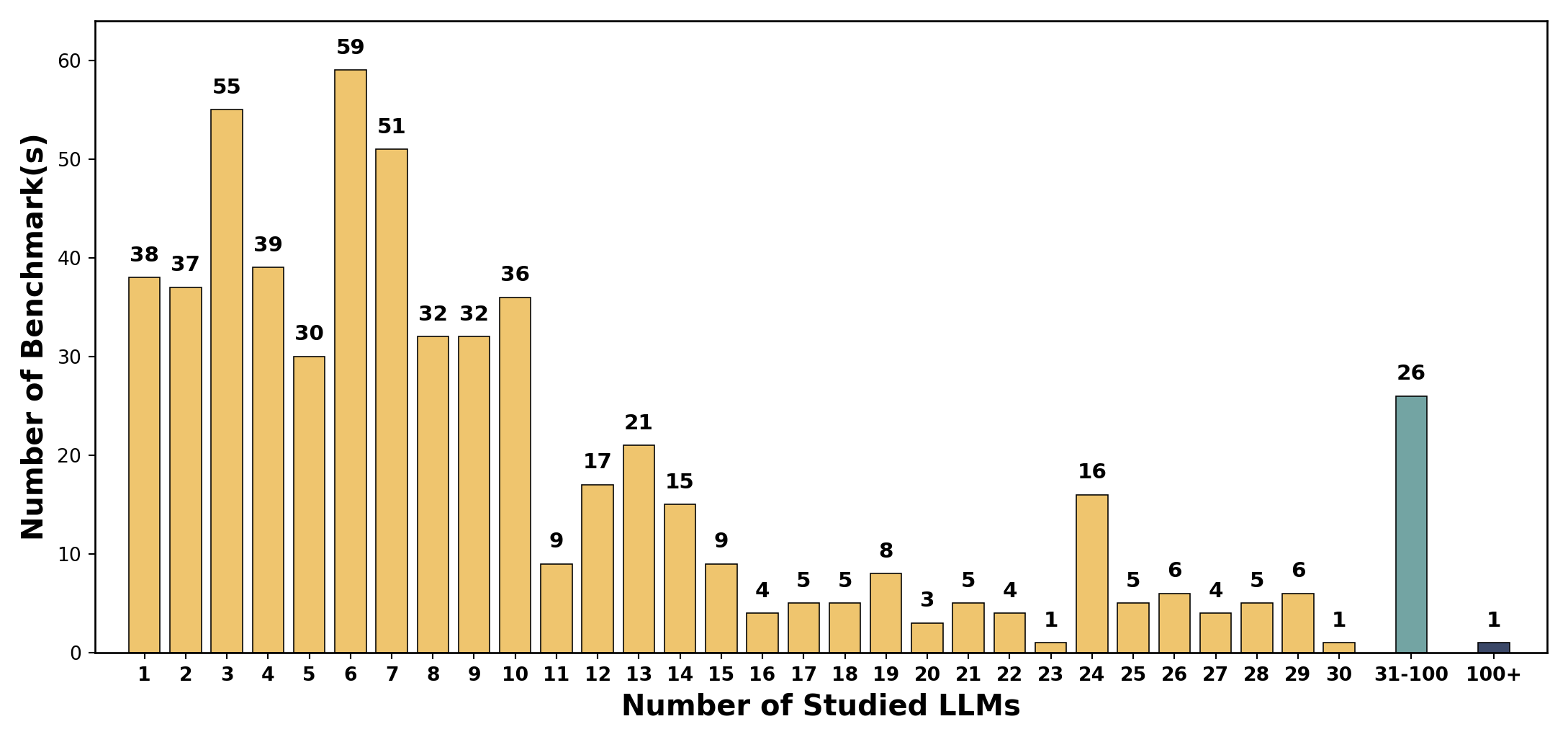
Figure 35: Benchmark Distribution over LLM Experimented
Figure 36: Benchmark Distribution over LLM Experimented Per Year

A positive trend also emerges when examining the year-by-year distribution (Figure 36). In 2024, 39.5% of benchmarks were evaluated against fewer than five LLMs, whereas in 2025, 64.2% of benchmarks (36.7% + 27.5%) were evaluated against 5–20 models. This shift indicates that benchmark studies are increasingly aiming for more comprehensive and generalizable evaluations. However, it also introduces substantially higher computational and financial costs, highlighting the trade-off between evaluation rigor and resource efficiency.

Additionally, we listed the top-10 LLMs by the number of code-related benchmarks they have been evaluated, as shown in Figure 37. GPT series leads significantly with 446 benchmarks, suggesting its widespread adoption and possibly its versatility or superior performance in handling code-related tasks. The rest, including DeepSeek, Qwen, and others, show varying degrees of involvement, with numbers ranging from 269 down to 64 benchmarks for Claude. This figure may provide a reference for choosing which model to evaluate. In addition, it is worth mentioning that different LLMs should be considered for different coding tasks.
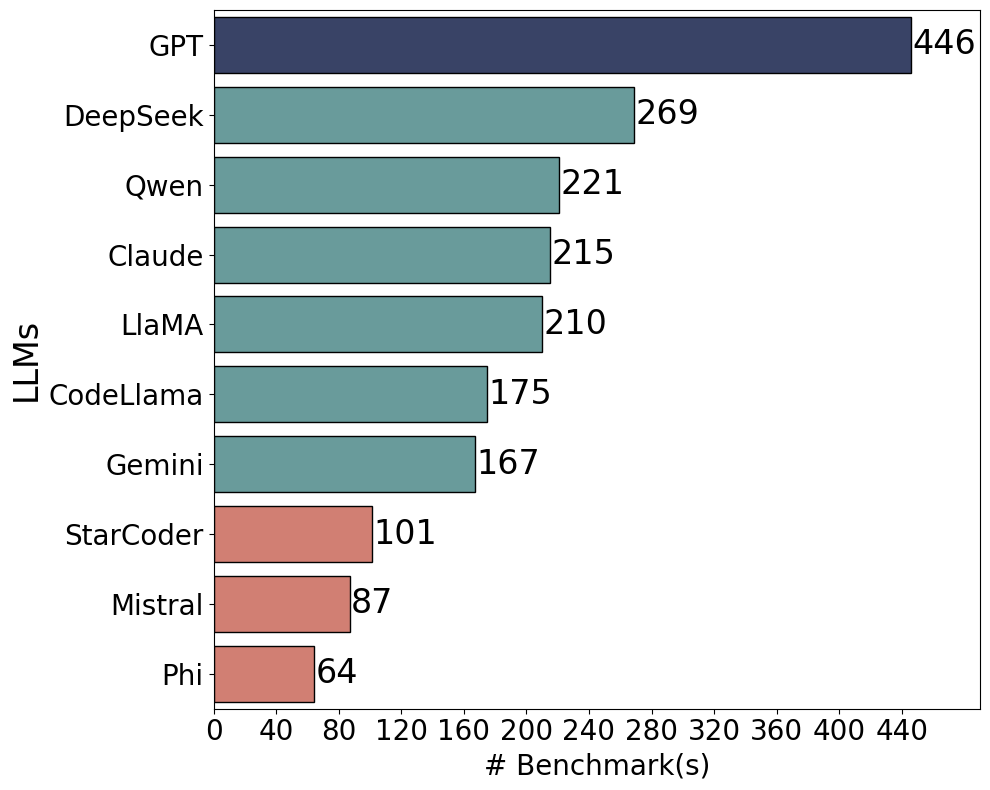
Figure 37: Top-10 Studied LLMs for Code-related Benchmarks

Experiment Environments. The experimental environment (such as the operating system and hardware) is important for the reproduction of the experiment. However, Figure 39 and Figure 38 highlight a significant gap. Only 24.6% of benchmarks document the devices used in their experiments, leaving a substantial 75.4% that do not. The situation appears even more dire when considering os, with only 6.3% of benchmarks documenting the OS used, while a staggering 93.7% neglect to record this information.
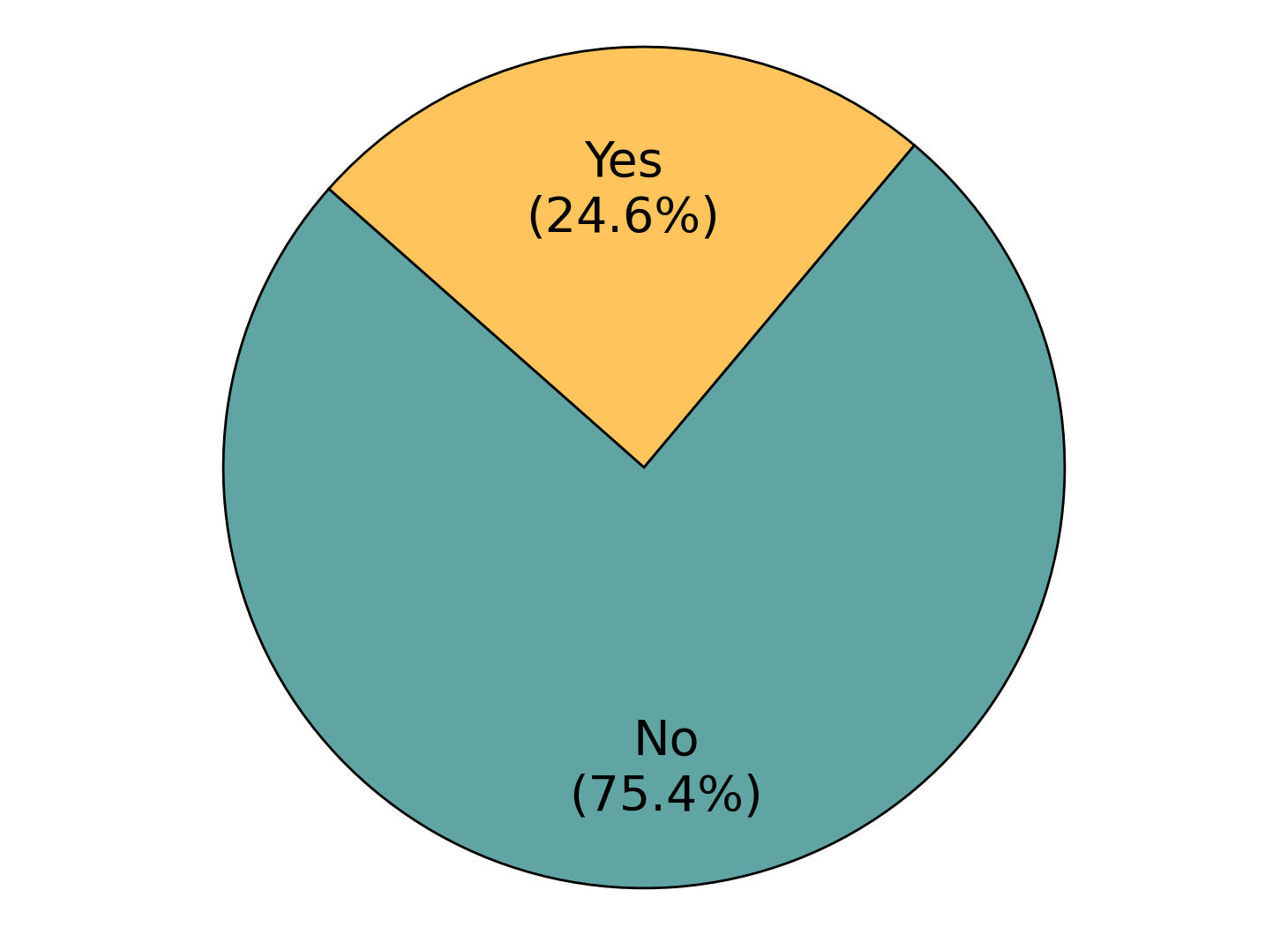
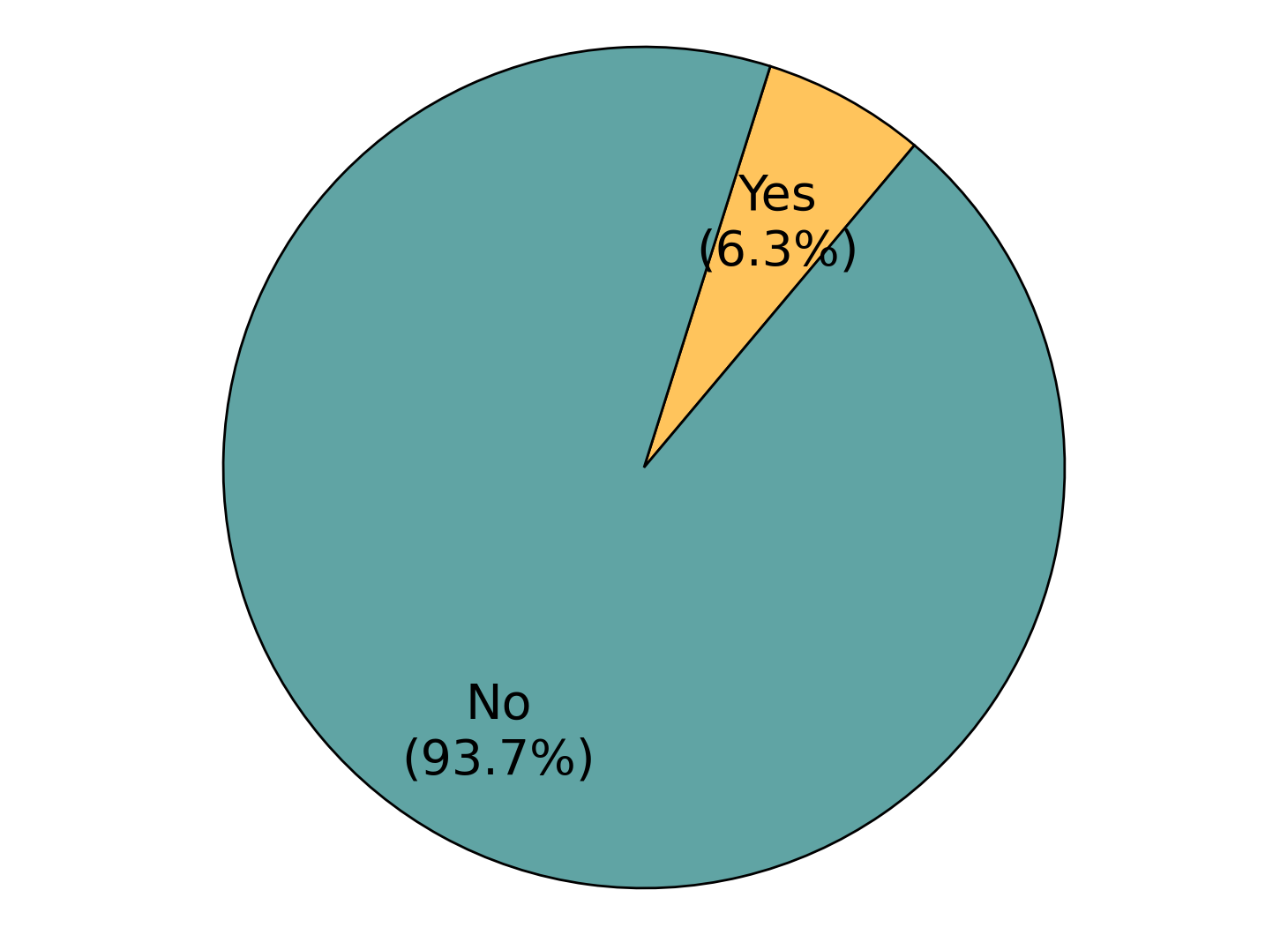
Figure 38: Benchmark Distribution over Recording Experiment Devices
Figure 39: Benchmark Distribution over Recording Experiment OS

Prompting and Prompting Strategies Prompting has a direct impact on the quality of the LLMs’ output results [36][38]. So, we summarized whether different prompting strategies have been evaluated and statistics the distribution. Figure 40 shows the usage of four kinds of prompts: zero-shot, few-shot, chain-of-thought, and retrievals (RAG). From Figure 40, we can see that a vast majority (89.4%) of benchmarks were evaluated in a zero-shot context setting, while only 18.6% of benchmarks were evaluated in a few-shot manner. Even fewer benchmarks were evaluated under the Chain-Of-Thought (CoT) and RAG settings, utilized by only 3.7% and 1.0%.
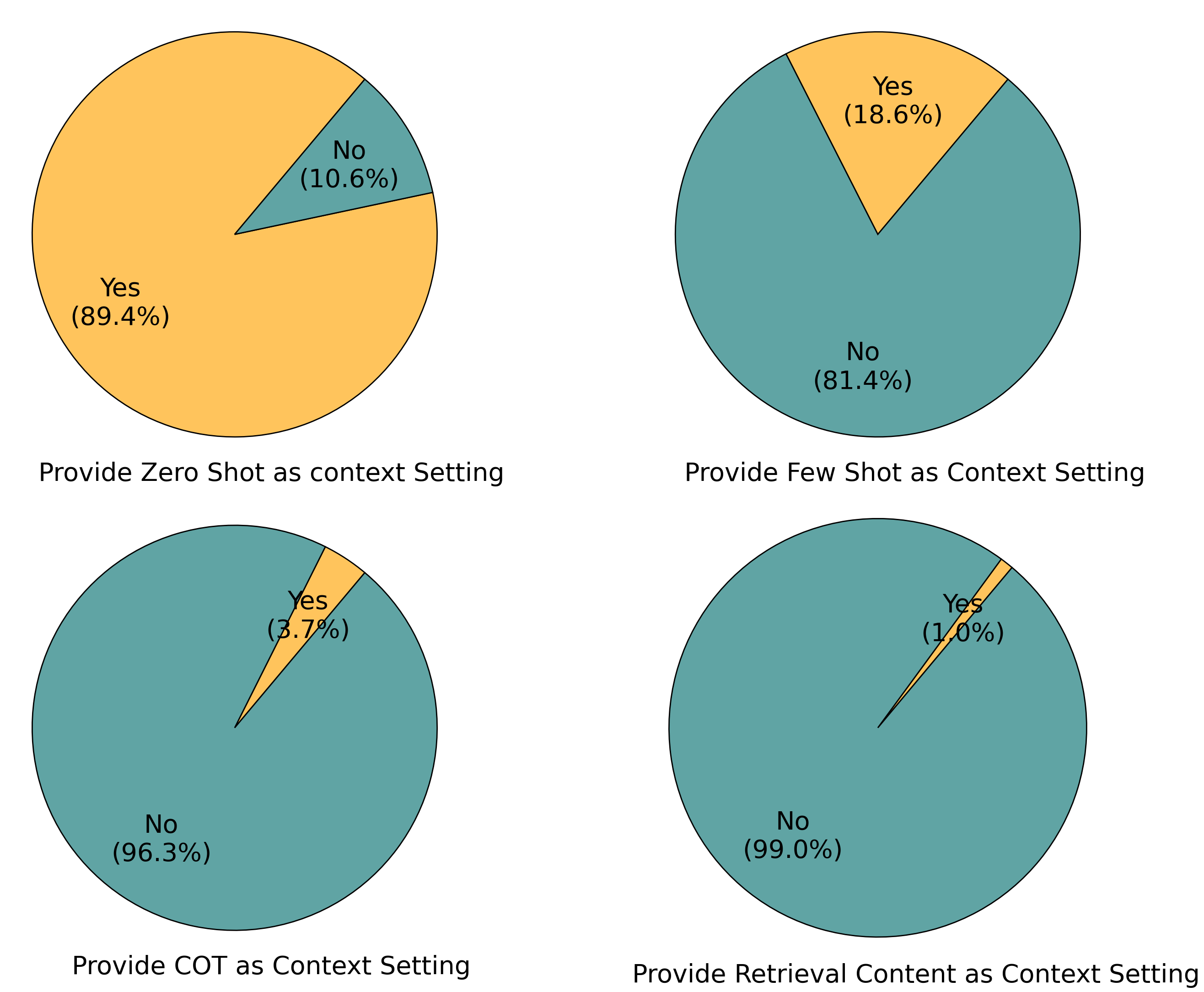
Figure 40: Benchmark Distribution over Context Setting

Prompt Quality The prompt quality also greatly impacts the LLM evaluation [40]. So, carefully designing a prompt needs consideration. However, as shown in Figure 41, 76.7% representative benchmarks (Appendix 13) do not validate whether the prompt they used is well-designed.
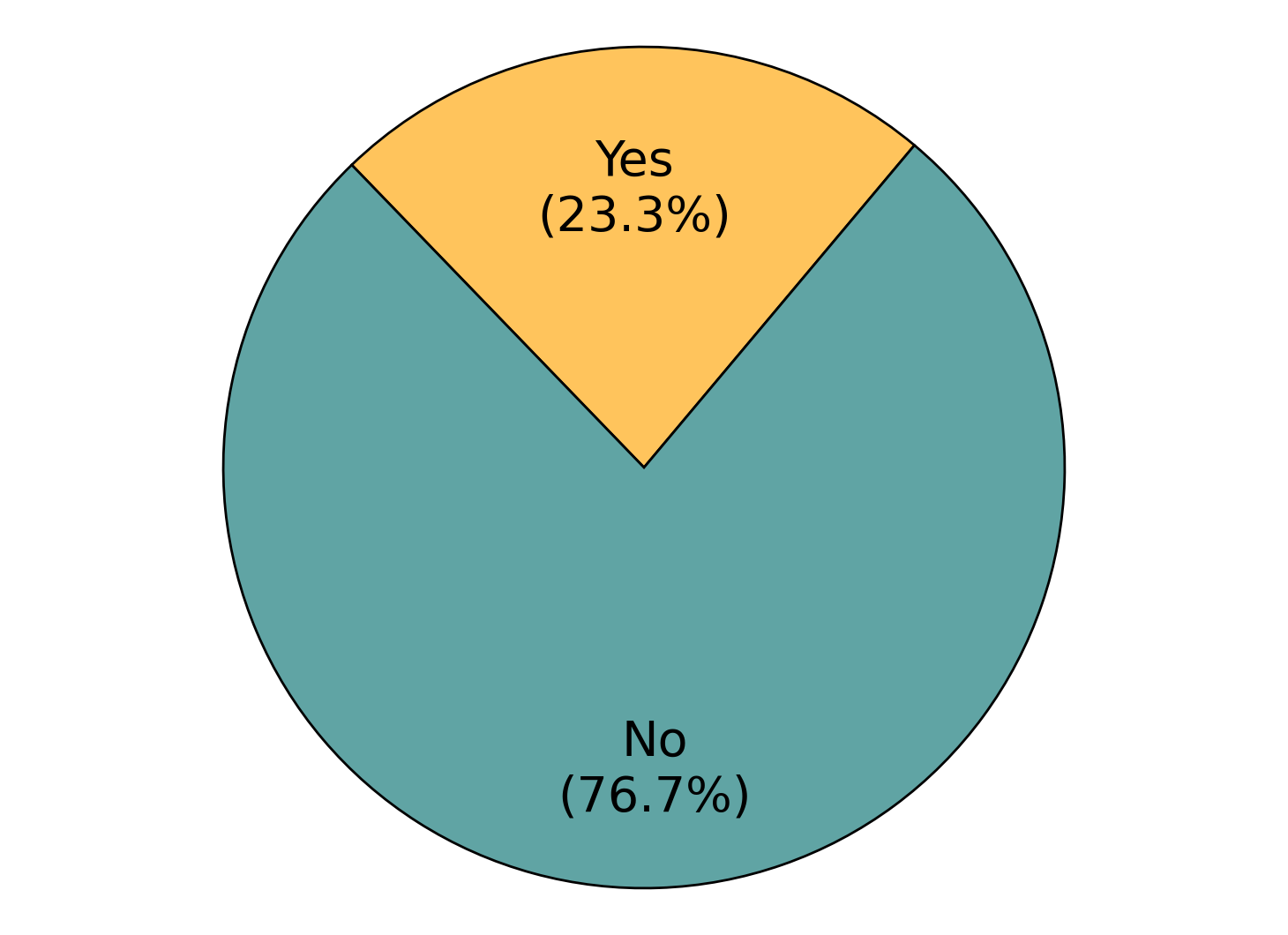
Figure 41: Benchmark Distribution Over Validation of Prompts

Repeated Experiment Given the random nature of LLMs, the experiments are expected to repeat, ensuring the stability and reliability of the results. However, as shown in Figure 42, only 33.4% benchmarks went through a repeated experiment, while a majority of 66.6% opted against repeating the experiment. This reflects a lack of awareness regarding the stability and reproducibility of evaluations.
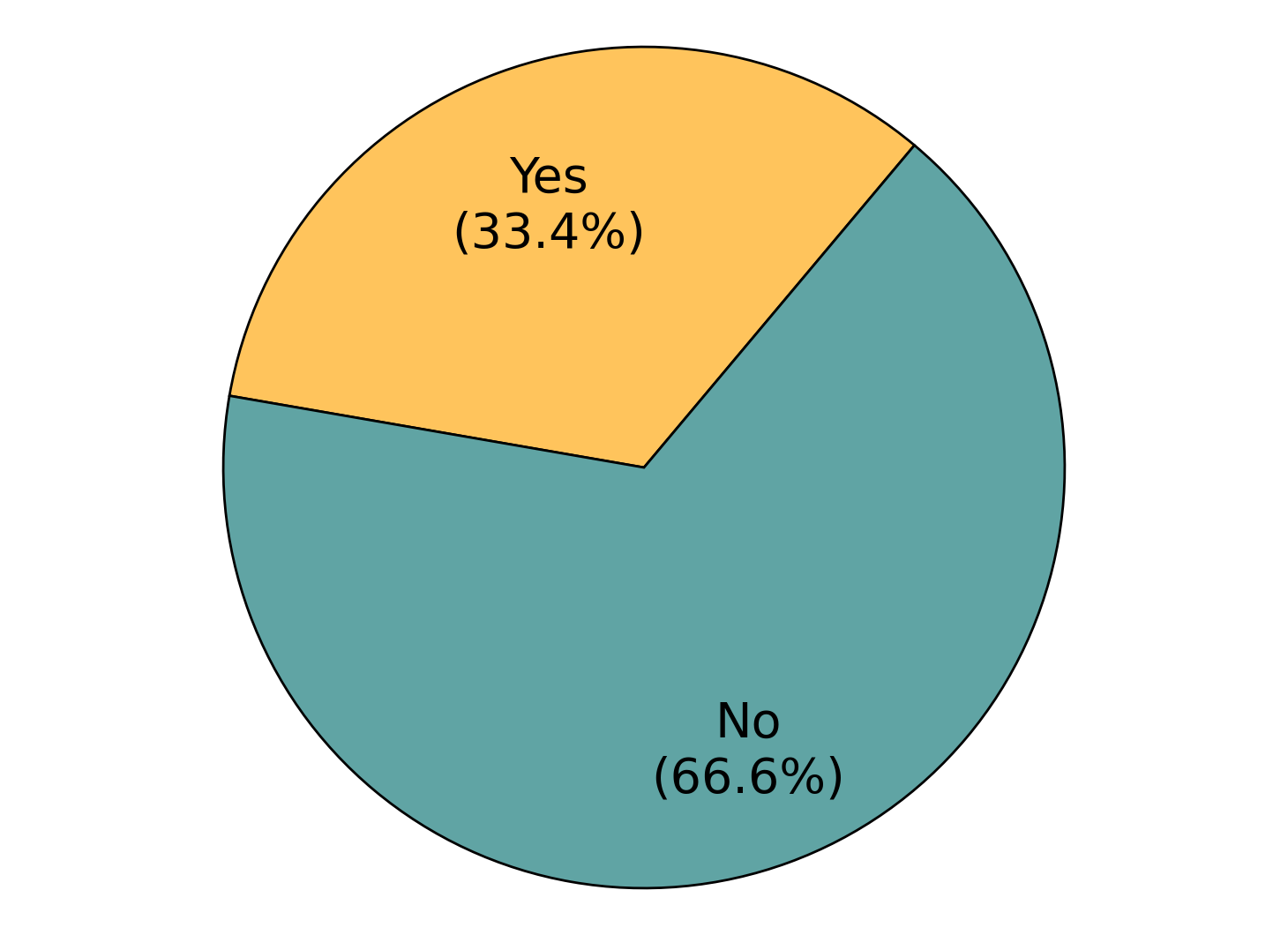
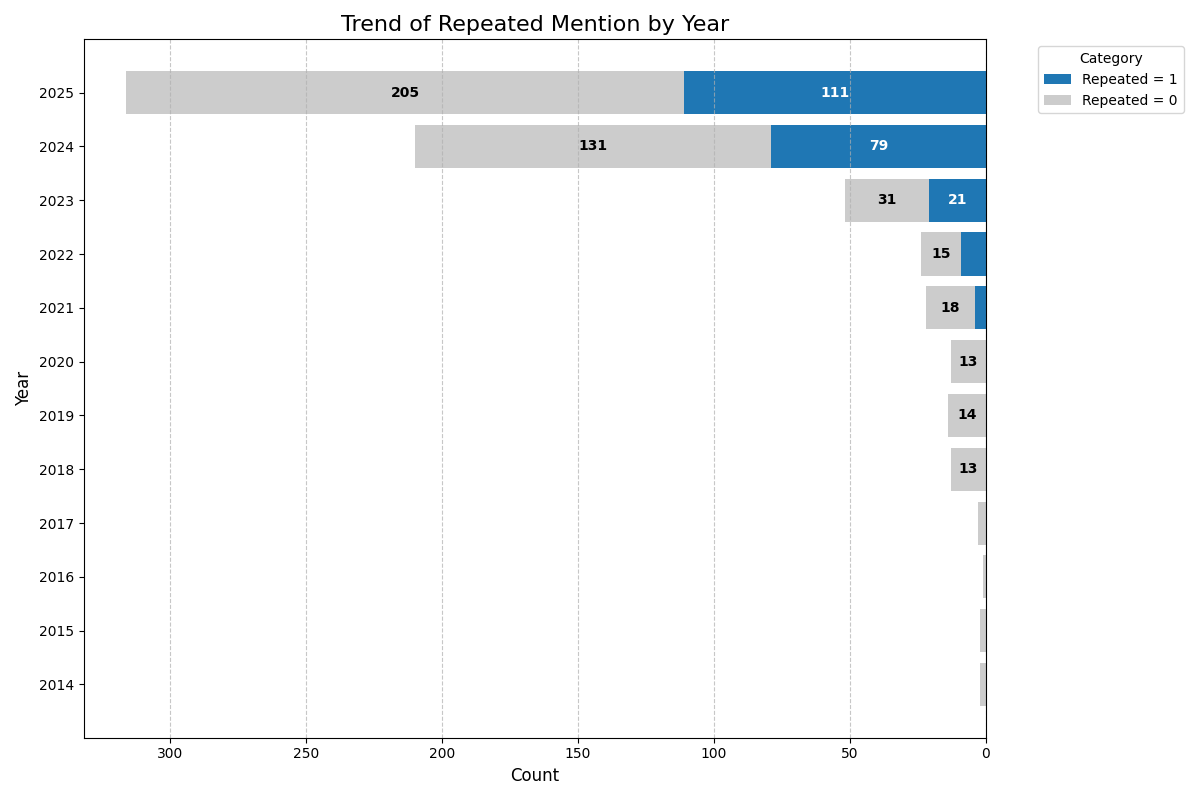
Figure 42: Benchmark Distribution over Repeating the Experiment
Figure 43: Benchmark Distribution over Repeating Count the Experiment Per Year

Examining trends year by year (Figure 43), the number of benchmark developers who repeated experiments increased in 2025 compared to 2023 and 2024 (31 in 2023, 79 in 2024, and 111 in 2025). However, because the total number of benchmarks grew substantially in 2024 and 2025, the absolute number of benchmarks without repeated experiments remains the highest, totaling 205 benchmarks, which accounts for 30.5% (205/672) of all benchmarks. This indicates that, despite increasing awareness of reproducibility, a significant fraction of benchmarks still lack repeated verification, posing a persistent risk to evaluation reliability.

11.5 Statistics about Analysis↩︎

Experiment Explanation. Explaining experiment results is crucial for other practitioners to understand what the outcomes mean in the context of the research questions. So, we investigate whether the representative benchmarks (Appendix 13) have explained the experiment results. As shown in Figure 44, 63.3% benchmarks have detailed explanations and analyses of their evaluation results, while still 36.7% have not. Indeed, an explanation contributes to the body of knowledge by making it possible to understand and compare results with previous studies, promoting transparency within the community.
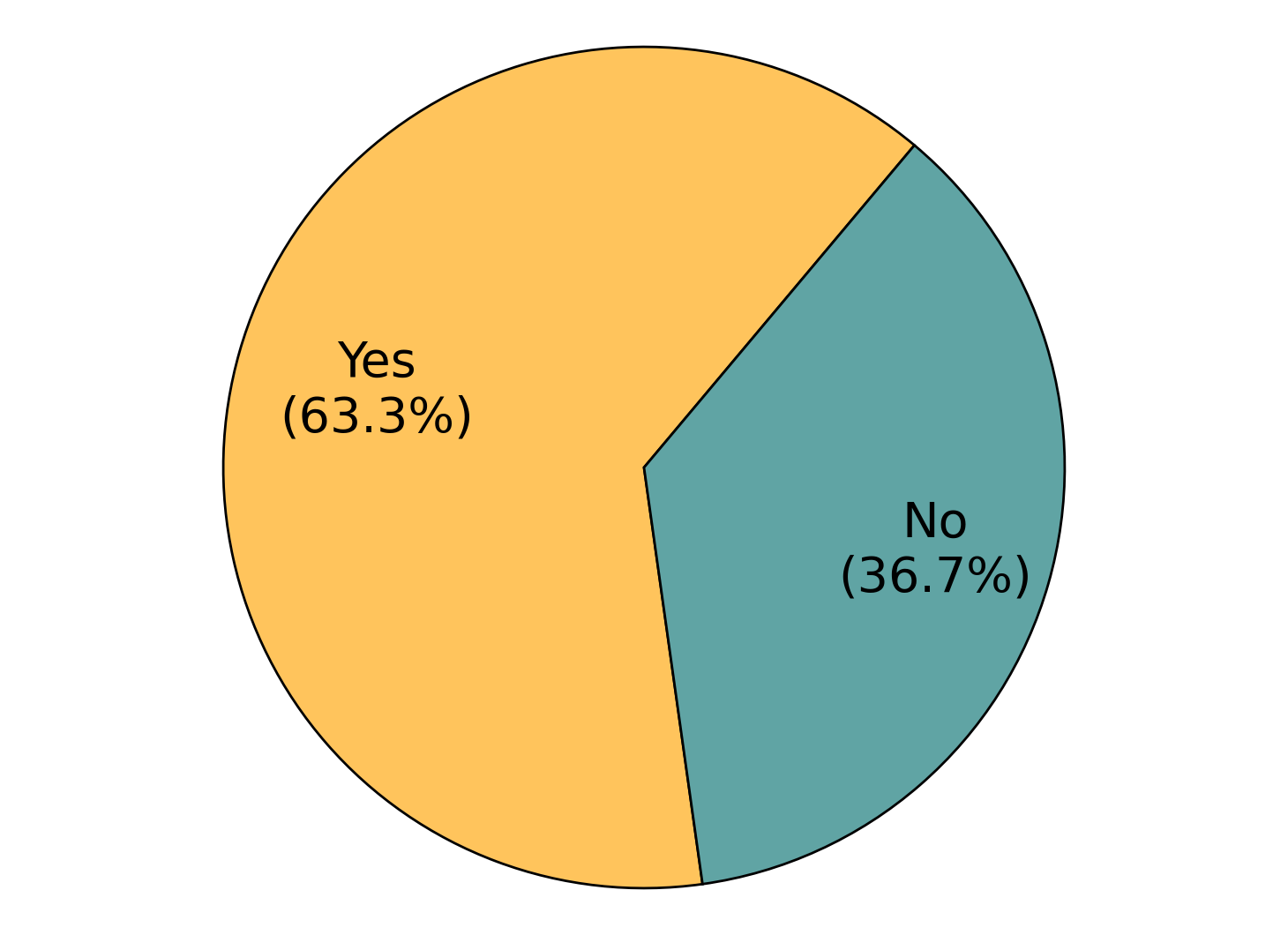
Figure 44: Benchmark Distribution Over Explaining the Experiment

A clear and precise presentation of experimental results is important for enabling robust interpretation and comparison across benchmarks. However, further examination of the 30 representative benchmarks (listed in Appendix 13) revealed notable deficiencies in result visualization. As shown in Figure 45, CruxEval [43] exhibits unclear experimental result presentation. Specifically, the scatter plot suffers from ambiguous labeling, poor readability of axis values, and inconsistent marker encoding, making it difficult for researchers to extract meaningful insights. Such presentation shortcomings obscure the performance relationships between methods and compromise the benchmark’s usability for fair evaluation. To address these issues, benchmarks should adopt standardized and well-documented visualization practices, ensuring results are interpretable, accessible, and reproducible.

Figure 45: An Example of Unclear Experiment Analysis and Display from CruxEval [43]

11.6 Statistics about Release↩︎

Data Accessibility. The fundamental requirement for releasing a benchmark is that it must be open-sourced. However, surprisingly, as shown in Figure 46, we observed that 2.2% of the benchmarks are only partially open-sourced (e.g., missing some subjects or tests), and 14.7% are not open-sourced at all (e.g., links/web pages are no longer active).
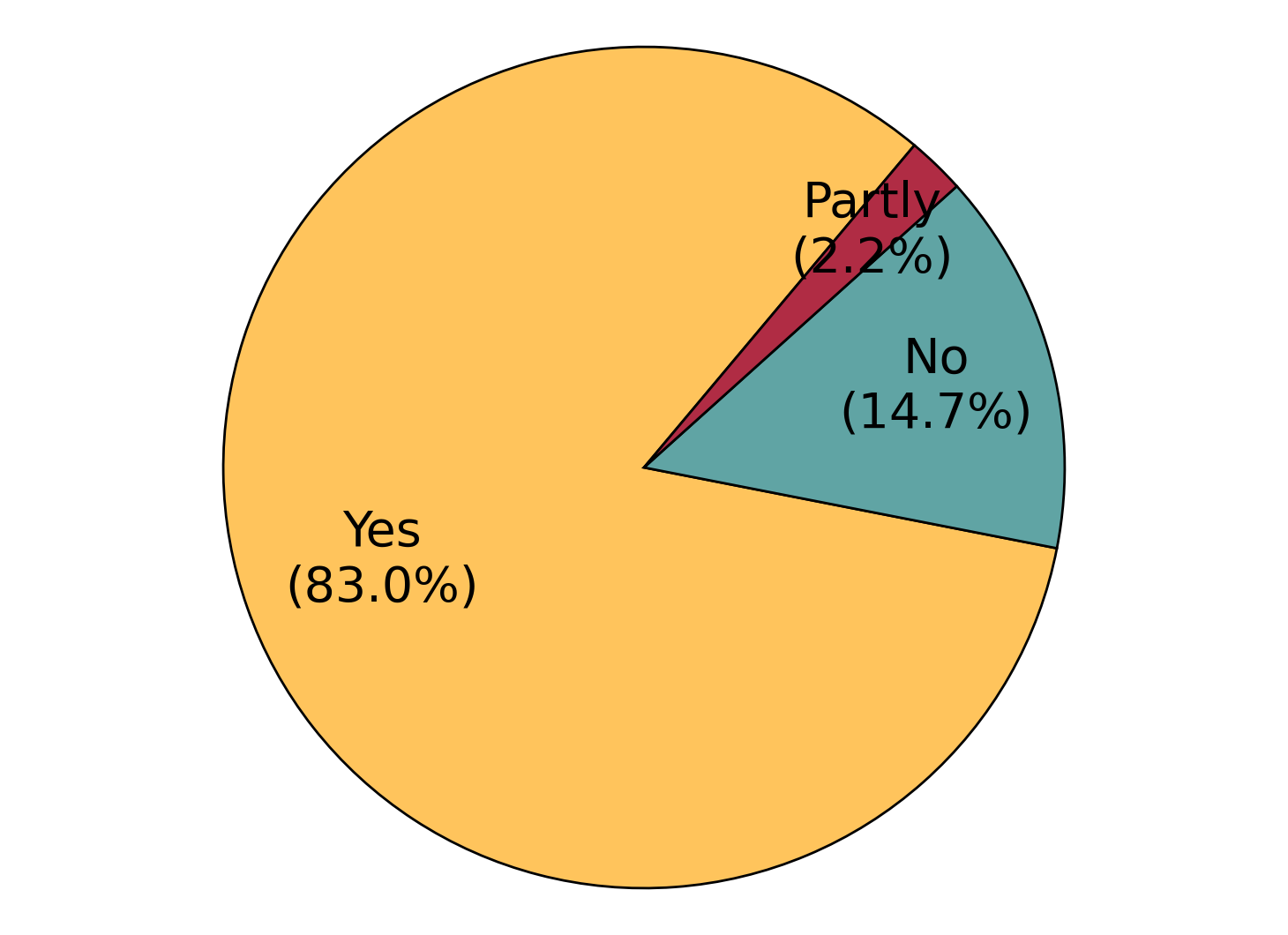
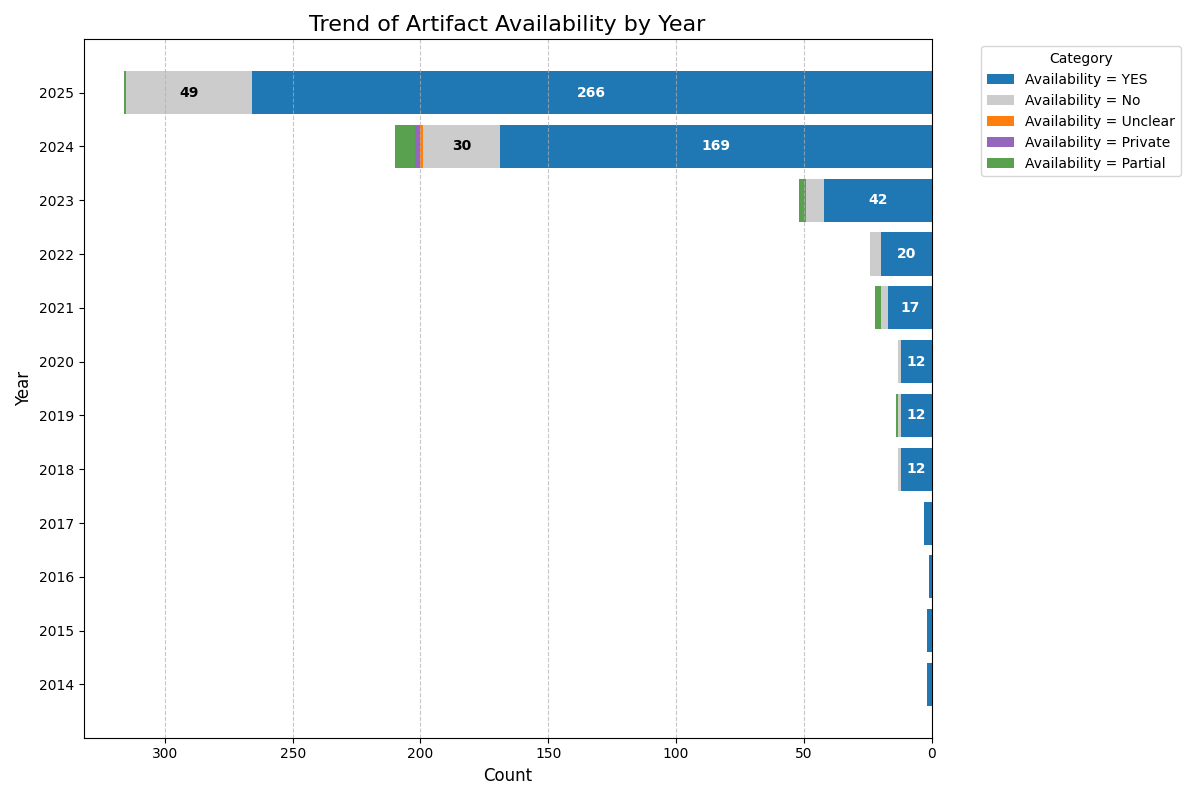
Figure 46: Benchmark Data Availability
Figure 47: Benchmark Data Availability Count Per Year

Fortunately, the year-by-year trend (Figure 47) shows a positive shift toward openness. From 2024 to 2025, the number of open-sourced benchmarks increased substantially, rising from 169 to 266, indicating growing community commitment to transparency, accessibility, and reproducibility.

Prompt Accessibility. Detailed prompts are essential for ensuring the reproducibility and transparency of code-related benchmarks. Yet, Figure 48 indicates that 38.2% of benchmarks do not provide detailed prompts, limiting the ability to accurately replicate and evaluate the performance of LLMs. Lack of prompt disclosure highlights a gap in benchmark design practices, as prompts are often indispensable for understanding model performance under specific conditions, raising concerns about the consistency and reproducibility of reported results.
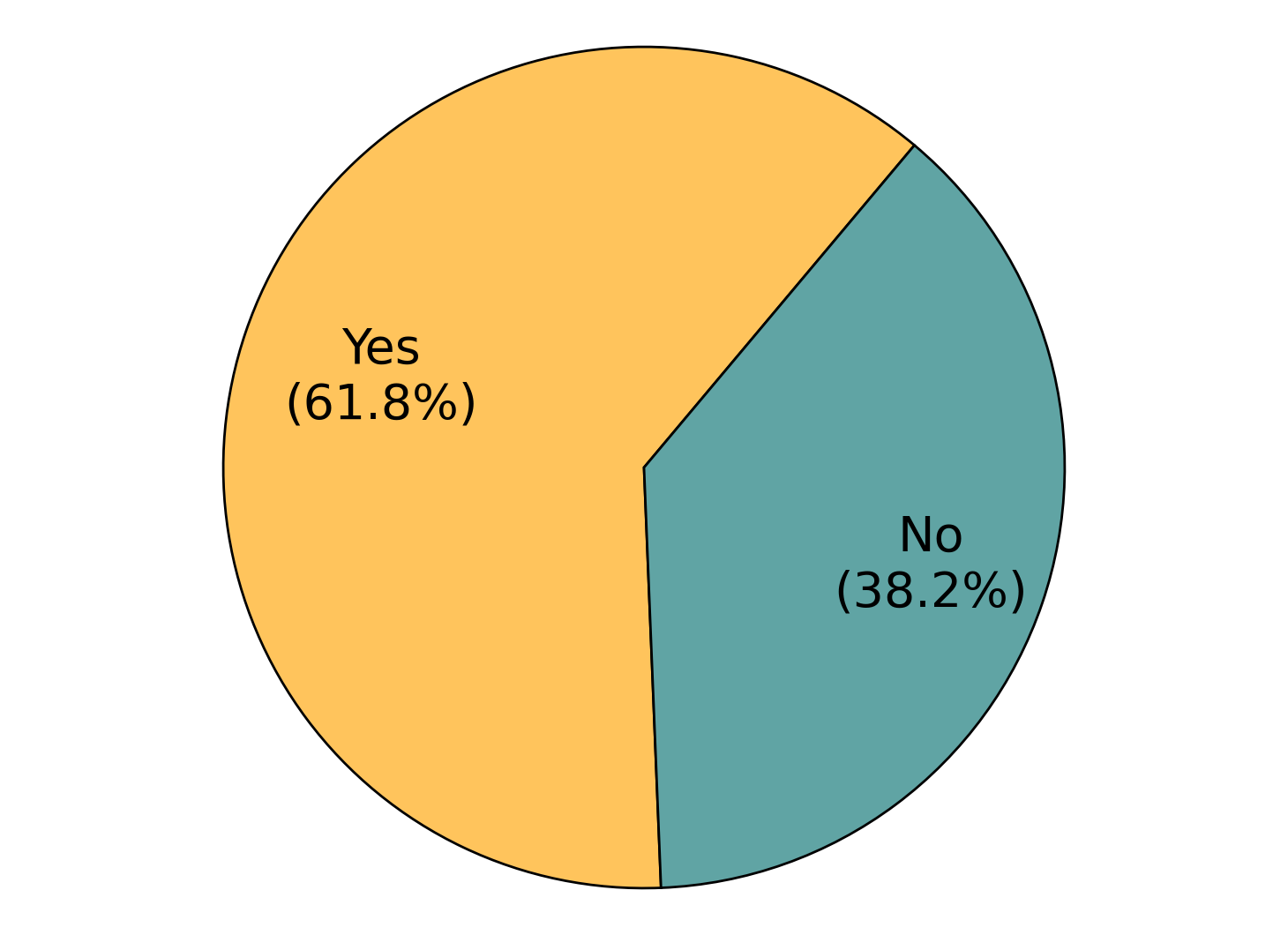
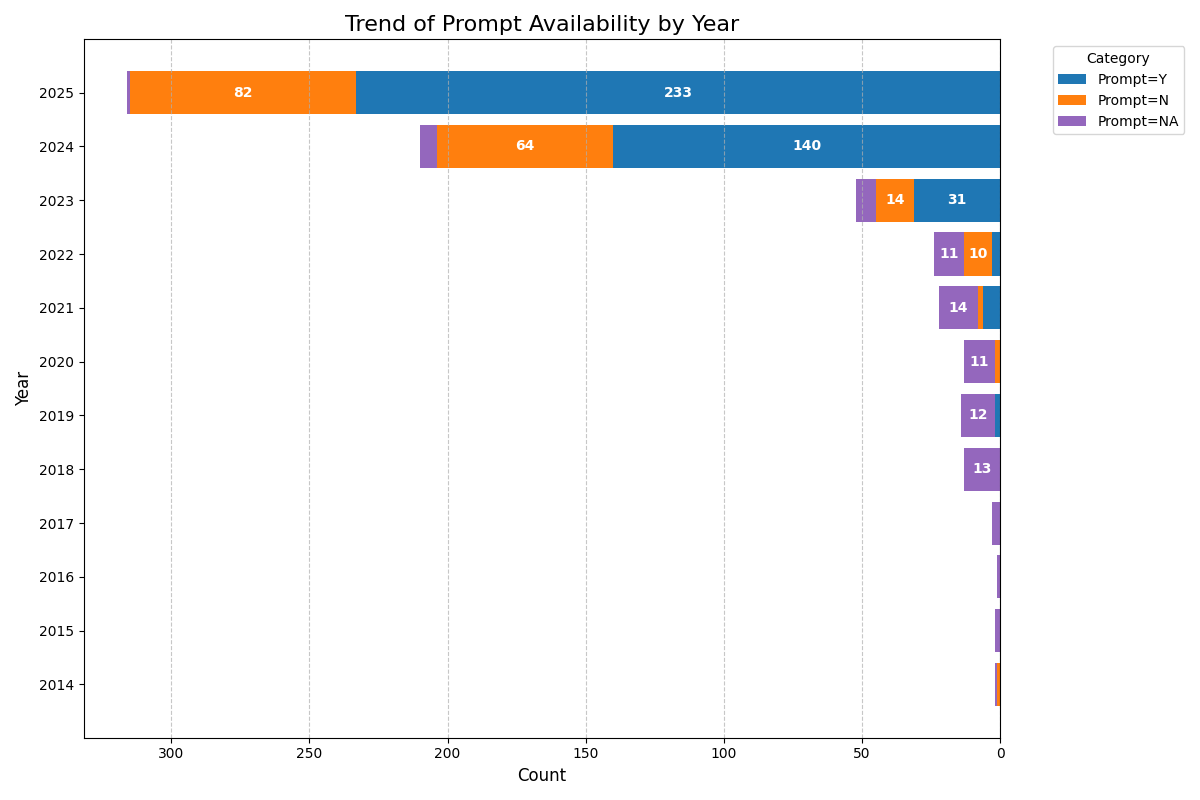
Figure 48: Availability of Prompts
Figure 49: Availability of Prompts Per Year

When examined on a year-by-year basis Figure 49, from 2024 to 2025, although the number of benchmarks that release prompts increased from 140 to 233, the number of benchmarks that do not release prompts also grew, from 64 to 82. This indicates that transparency has improved in absolute terms, but has not kept pace with the rapid growth in benchmark releases.

Logging Info Accessibility. Providing detailed logging information, including comprehensive experimental results, is essential for ensuring transparency, verifiability, and reproducibility in benchmarking research. However, as shown in Figure 50, only 16.7% of the benchmarks make their experimental results publicly available, while 80.0% fail to disclose this critical information. Alarmingly, an additional 3.3% provide only partial logging details, further complicating result verification. The absence of complete logging information creates significant barriers for researchers attempting to reproduce experiments or validate reported findings, thereby undermining the reliability of benchmarks. To address this, we emphasize the necessity of making detailed logging information, including intermediate results and metrics, publicly accessible to uphold rigorous scientific standards and foster trustworthy comparisons across models.
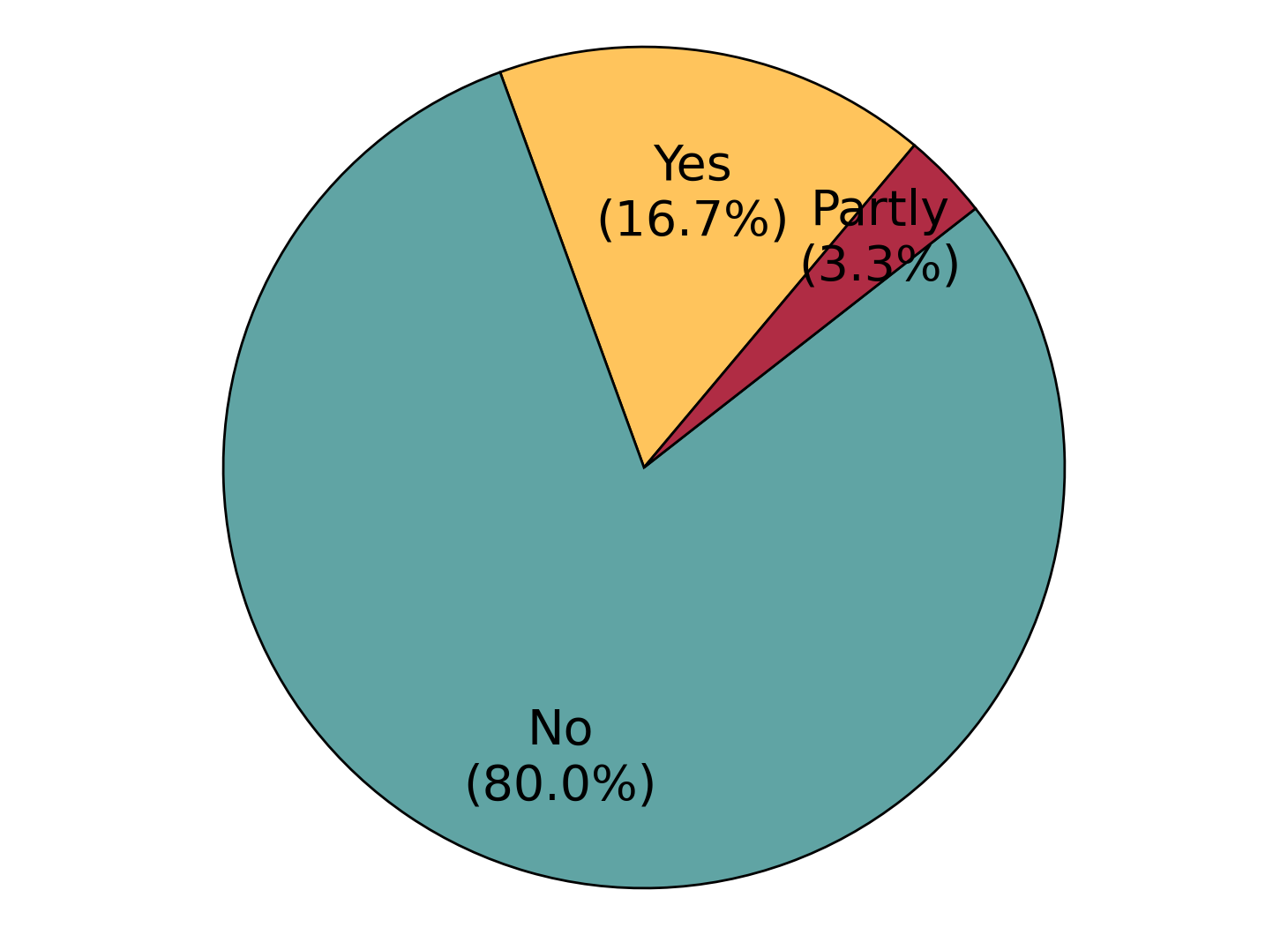
Figure 50: Availability of Logging Information

User Manual Accessibility. A high-quality user manual, such as a well-documented README file, is crucial for enhancing benchmark usability, enabling users to understand the dataset, execute provided scripts, and reproduce results efficiently. However, our analysis revealed that a significant number of benchmarks lack comprehensive user manuals, hindering accessibility and adoption. As depicted in Figure 51, poorly structured or incomplete manuals often omit essential components such as benchmark introductions, usage instructions, and evaluation scripts. This creates unnecessary barriers for researchers who rely on these manuals for setup and experimentation. To address this, we advocate for benchmarks to include clear, standardized user manuals that provide an overview of the benchmark, step-by-step execution guides, and troubleshooting instructions, ensuring a seamless and reproducible user experience.
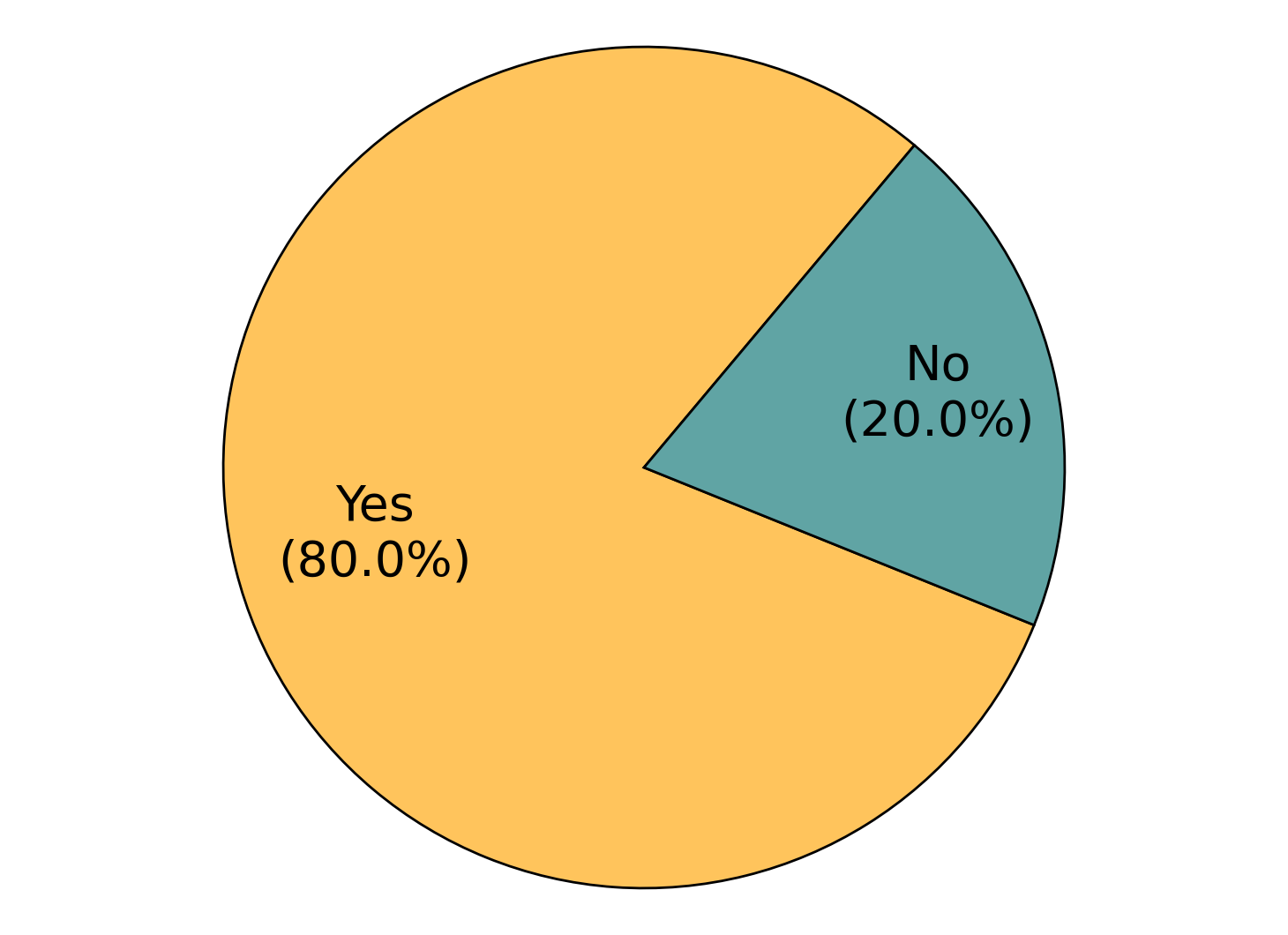
Figure 51: Availability of User Manual

Convenient Evaluation Interface Availability.

Providing convenient evaluation interfaces is essential for enhancing the usability and accessibility of benchmarks, enabling researchers to easily reproduce results and compare models. As shown in Figure 52, 20% of benchmarks fail to offer any evaluation interfaces, imposing significant barriers to usability. While a majority of benchmarks (80%) provide such interfaces, including command-line tools, Docker images, or scripts, the absence of standardized and user-friendly evaluation tools in a notable minority of cases highlights an area for improvement. Benchmarks without convenient evaluation interfaces require users to spend additional effort in setup and result verification, which can discourage adoption and hinder reproducibility. To address this, we emphasize the importance of releasing benchmarks with well-documented, ready-to-use evaluation pipelines to promote efficient, reliable, and fair benchmarking practices.
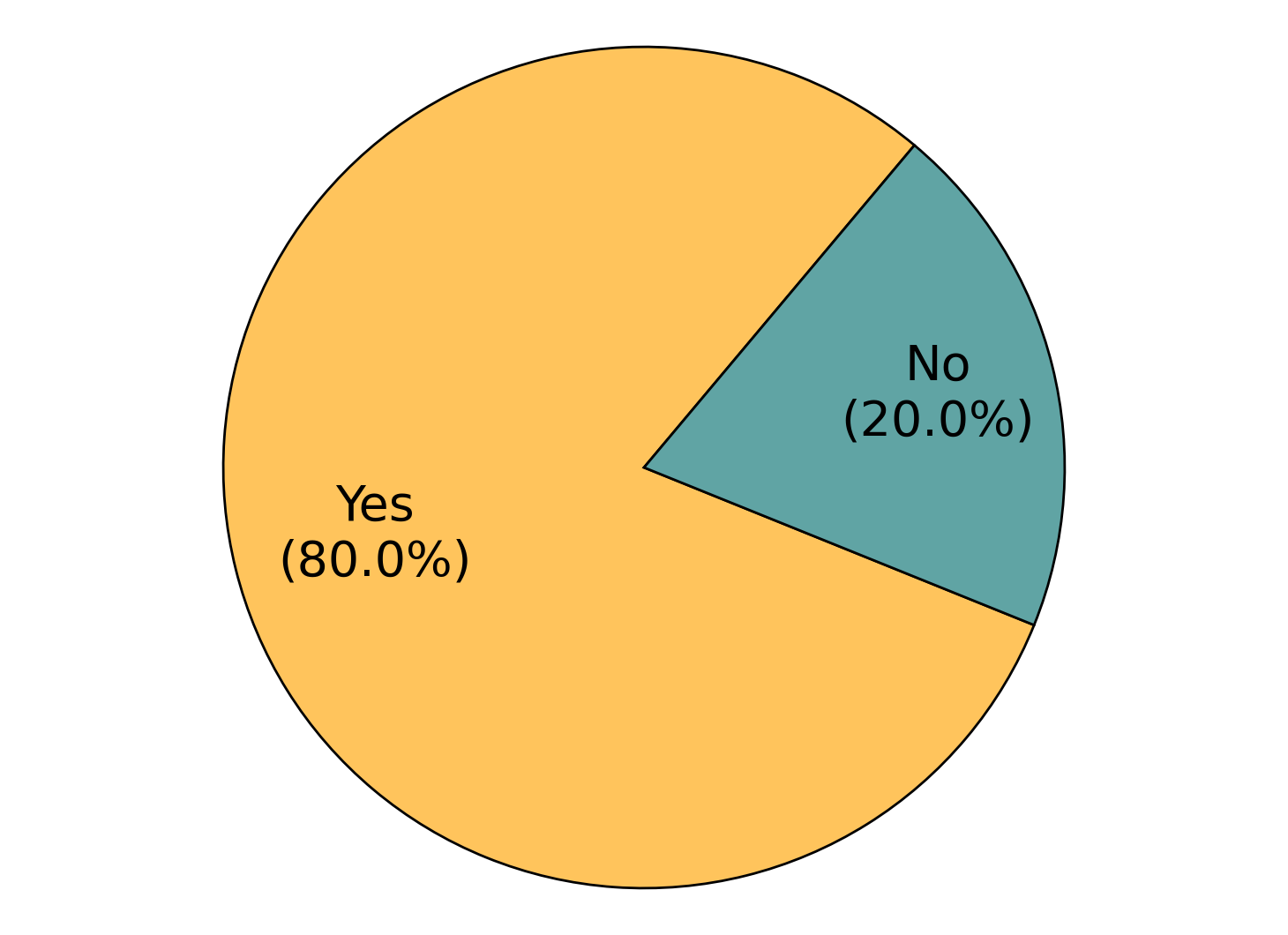
Figure 52: Availability of Convenient Evaluation Interfaces

Temperature Records. One critical parameter for benchmarking is the temperature setting, which influences stochasticity in LLMs. As shown in Figure 53, we observed that 49.5% of benchmarks fail to record the temperature setting, hindering reproducibility and fair evaluation. While 50.5% of benchmarks do document this parameter, the majority omission highlights an overlooked yet essential aspect of benchmark transparency.
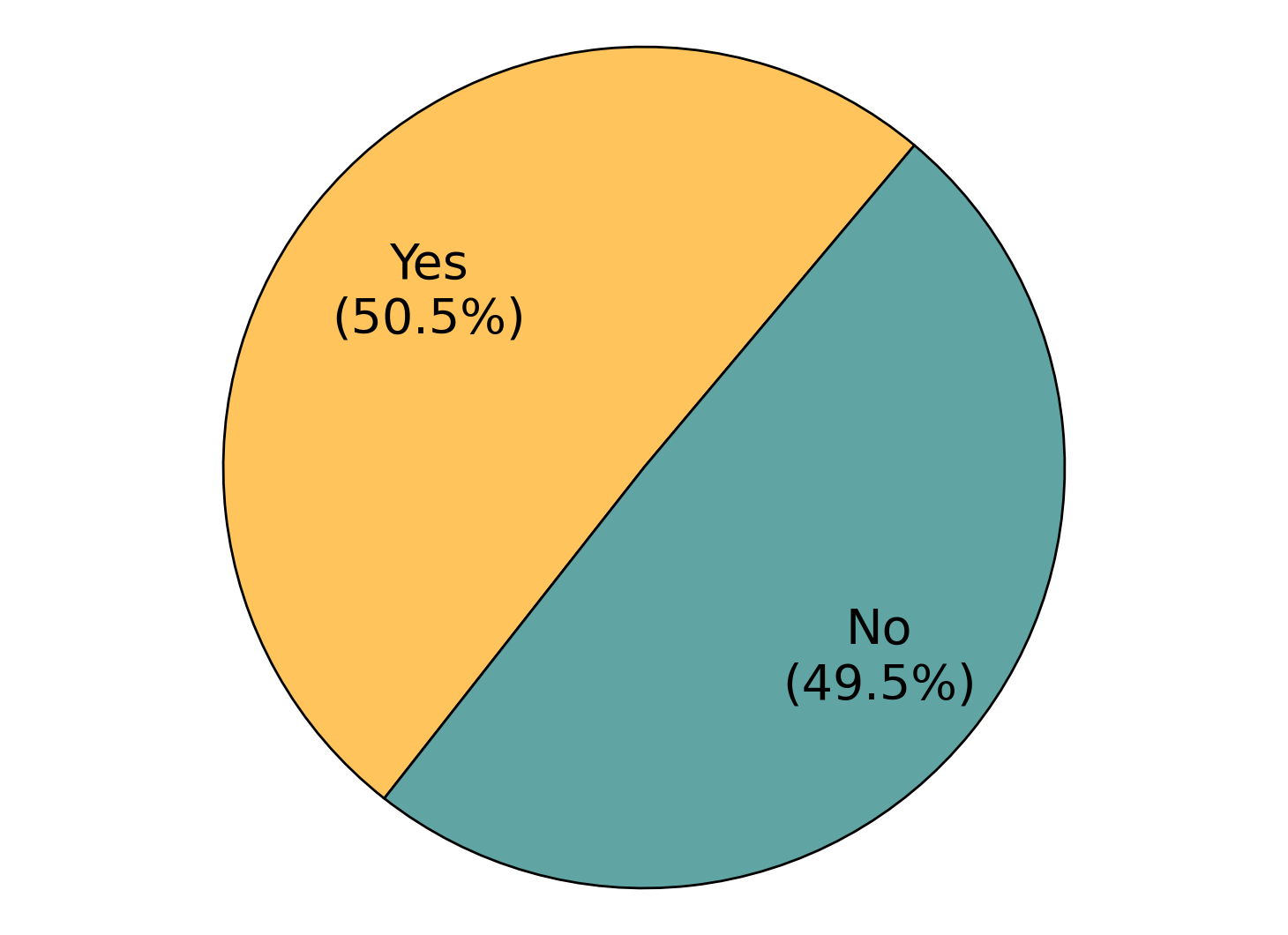
Figure 53: Benchmark Distribution over Recording Temperature

License Provision. Releasing benchmarks under a clear and accessible license is fundamental for legal compliance and ensuring open collaboration. Figure 54 reveals that 19.3% of benchmarks do not provide a license, limiting their usability and distribution. Encouragingly, 80.7% of benchmarks do include a license, but the lack of licensing in nearly one-fifth of the benchmarks raises concerns about widespread adoption and usage. These findings emphasize the need for standardized practices in benchmark releases to promote legal clarity and accessibility.
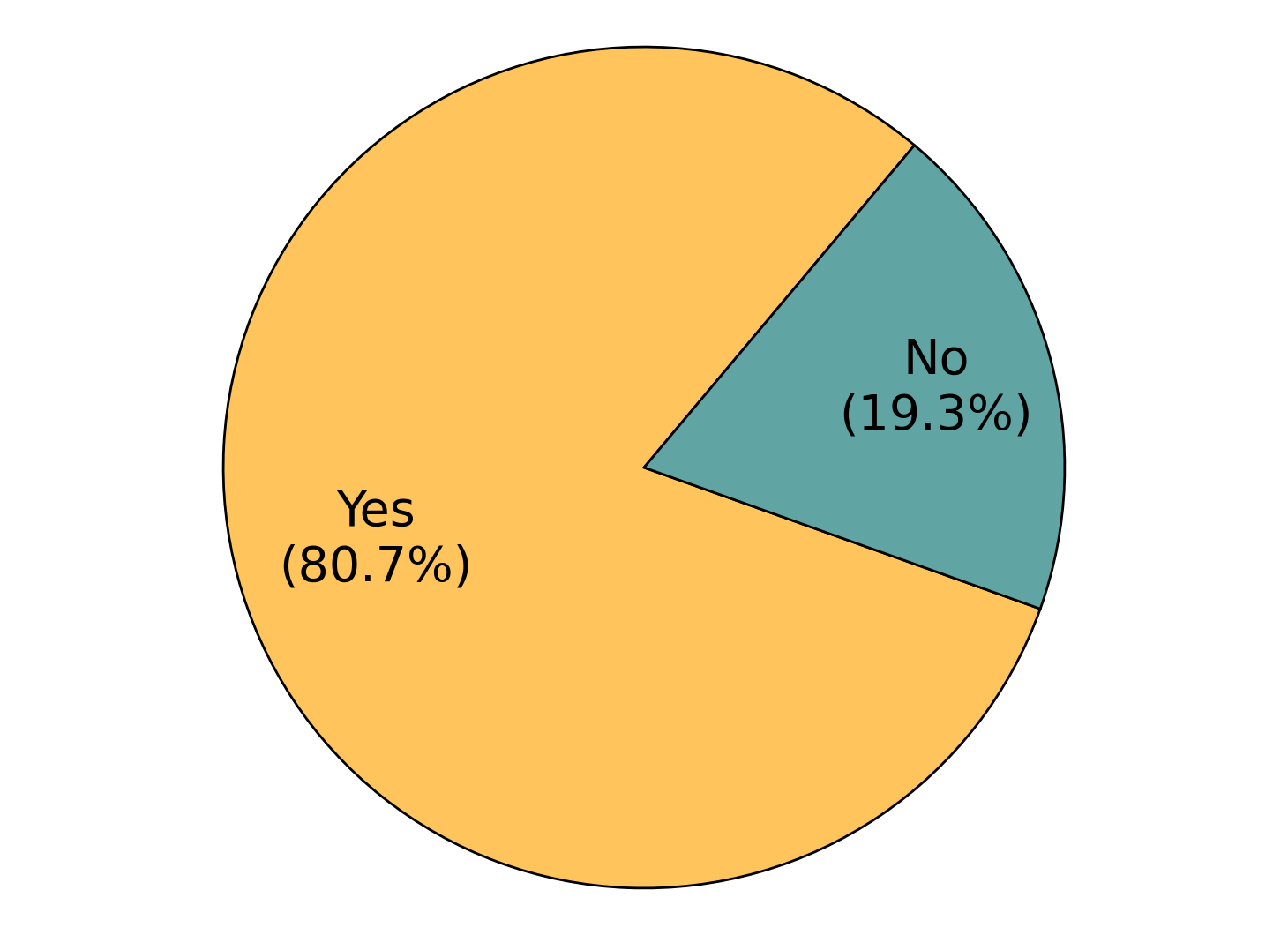
Figure 54: Provision of License

Data Security. Ensuring data security is a critical yet often overlooked aspect of benchmark development. Sensitive information, such as API keys, credentials, or private tokens, should never be included in benchmark releases. However, further investigation into 30 representative benchmarks (listed in Appendix 13) revealed instances of sensitive data leakage. As shown in Figure 55, XSemPLR [57] inadvertently included an API key in its release, a critical oversight that can expose resources to external exploitation.

Figure 55: An Example of API Key Leakage in Benchmark Release from XSemPLR [57].

Similarly, Figure 56 highlights an example from CrossVul [58], where personal names and email addresses were unintentionally disclosed. Such leakage poses risks of unauthorized access and resource misuse, potentially compromising systems and research integrity.

Figure 56: An Example of Name & Email Leakage in Benchmark Release from CrossVul [58].

Usability. Clear and comprehensive documentation is crucial for ensuring the usability of benchmarks, as poorly written instructions can significantly hinder adoption and reproducibility. We dived into the 30 representative benchmarks (listed in Appendix 13) and identified an example where the README file provided insufficient and unclear information. As shown in Figure 57, VulDeePecker [59] includes a less-than-ideal ReadMe file, which lacks essential usage instructions and evaluation guidelines, making the benchmark difficult to understand and deploy.

Figure 57: An Example of Unreadable and Hard-to-Use README in Benchmark Release from VulDeePecker [59].
Figure 58: A Good Example of Easy-to-Read README in Benchmark Release from APPS [60].

In contrast, Figure 58 highlights APPS [60], which provides well-structured and easy-to-follow documentation. The APPS benchmark includes step-by-step instructions for generating, evaluating, and analyzing results, enabling users to efficiently reproduce experiments.

These observations emphasize the importance of high-quality documentation for benchmarks to enhance accessibility, reduce friction in usage, and foster reproducible research.
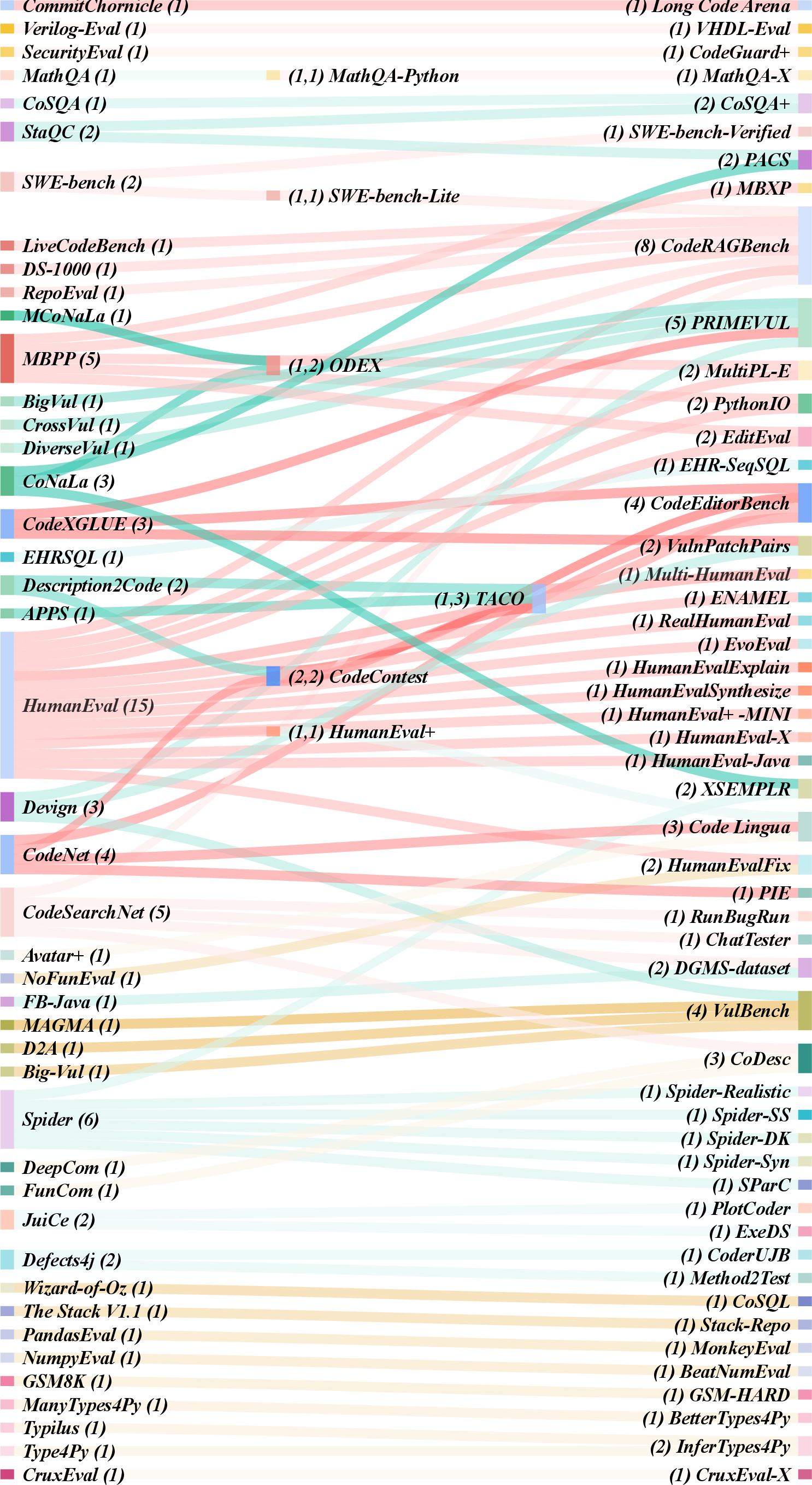
Figure 59: Relationships between Benchmarks

12 Details of Human Study↩︎

12.1 Interviewee Selection↩︎

The selection of interviewees is pivotal to ensuring the representativeness and relevance of the data collected. This involves identifying individuals with the knowledge or experience pertinent to the research theme.

To this end, we chose graduate students from SE or AI fields who have published at least one paper. This criterion ensures that participants have research experience and judgment capabilities. The focus on SE and AI fields is due to their likely interest in code benchmarks. Particularly, we aimed to recruit individuals who have published papers on code benchmarks to obtain firsthand feedback from experienced benchmark developers.

12.2 Survey Question Design↩︎

Questions. The body of the survey was divided into five stages of benchmark development (following Figure 1), with necessary background information provided for each stage. Each criterion in How2Bench was slightly modified to be in the first-person perspective, making it easier for interviewees to empathize and answer the questions from their own viewpoint. Finally, to facilitate comprehension, questions and instructions were translated into both English and Chinese.

Question Setting. To minimize the effort required from respondents, we designed single-choice questions with four options:

I found it important, and I have done it.

I found it important, although I haven’t done it.

I found it not important, but I have done it.

I found it not important, and I wouldn’t do it.

This format is intended to orthogonally explore the correlation between awareness and behavior.

12.3 Interview Process↩︎
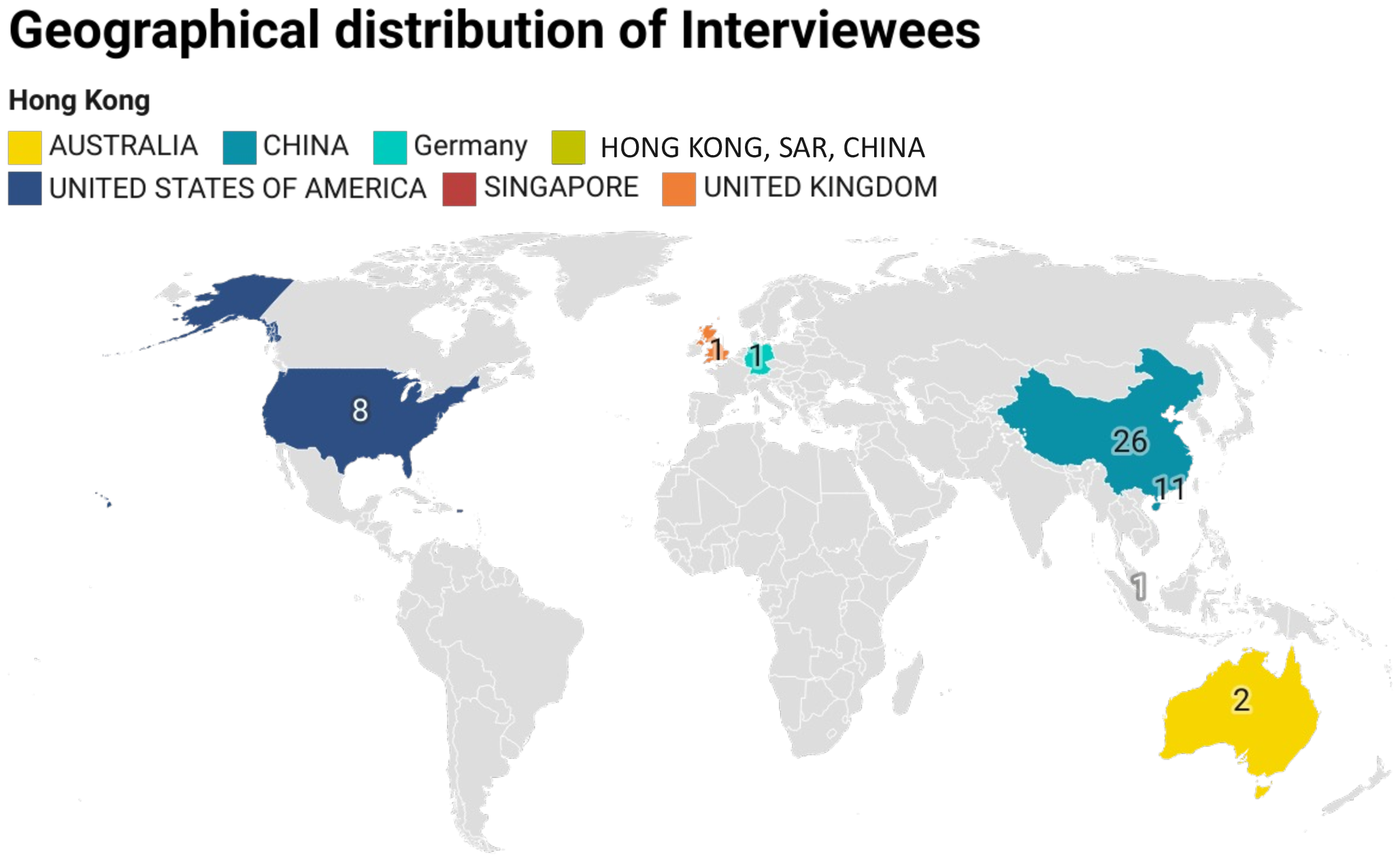
Figure 60: Geographical Distribution of Interviewees

Questionnaire Distribution The questionnaire was distributed via online platforms, targeting academic and professional networks related to SE and AI. The distribution started on October 27, 2024, and ended on November 27th, 2024, lasting one month.

Results Collection The responses were automatically collected through the online platform used for distribution.

Survey Screening Since the requirement was for participants who have published papers, responses from those selecting “No” to having published a paper were excluded. Also, incomplete surveys where not all questions were answered were also considered invalid and excluded from the analysis.

12.4 Interview Result Analysis↩︎

In total, we collected 50 responses. The respondents were from seven regions, including the United States, the United Kingdom, Germany, Australia, China, and others, as shown in Figure 60. Only one survey was invalid due to the respondent selecting “have not published a paper”, leaving 49 valid surveys for analysis. A breakdown of the respondents’ demographics is shown in Figure 61. The detailed responses for all 55 criteria in How2Bench are shown in Figure 62 and Figure 63.
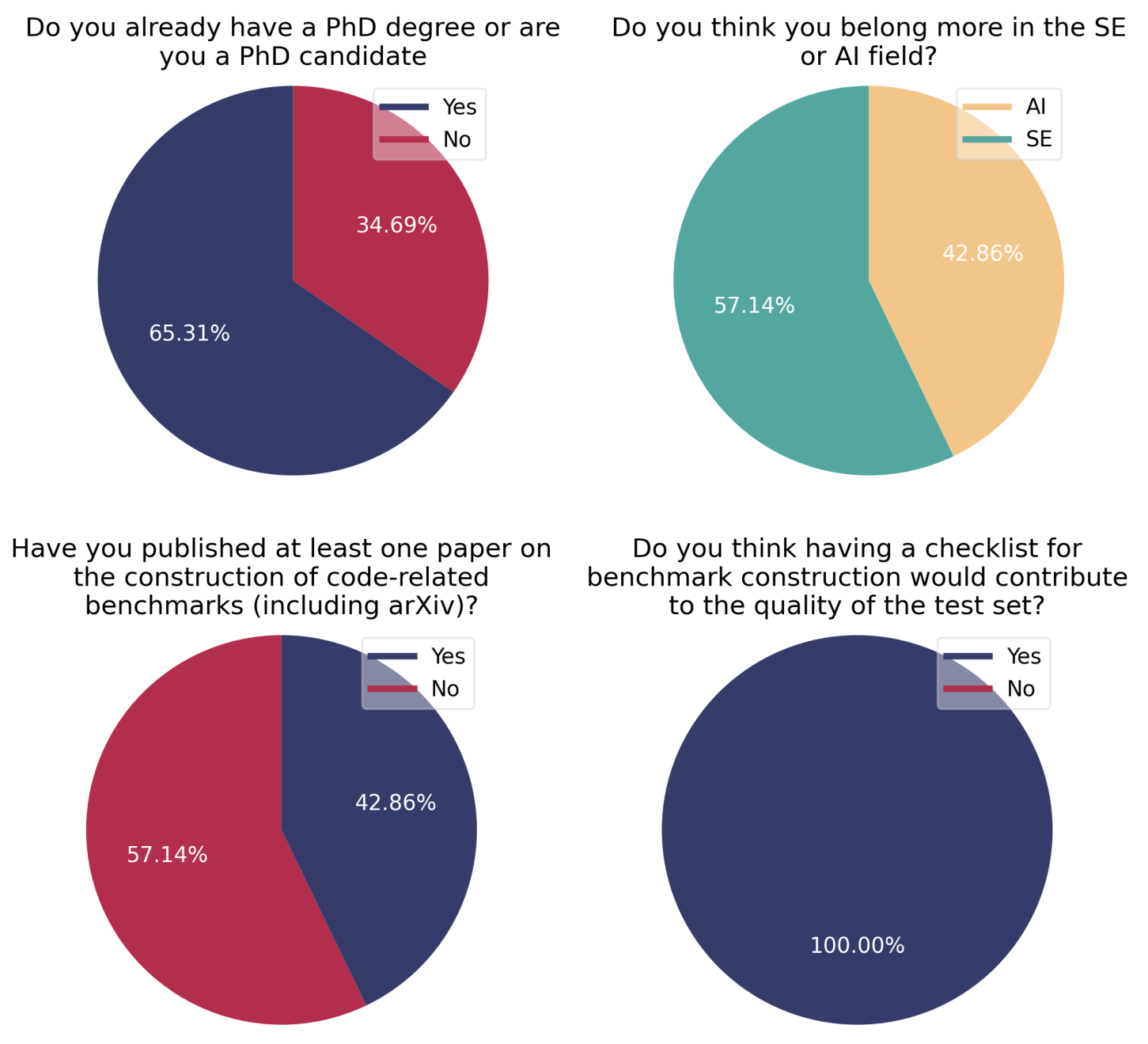
Figure 61: Demography of Interviewees
Figure 62: Results of Human Study (Questions 1 - 28
Figure 63: Results of Human Study (Questions 29 - 55

13 List of Studied Benchmarks (Focused Ones)↩︎

Code Generation: Five with top citations:

The latest one as of 31/12/2025:

Defect Detection: Five with top citations:

  • VulDeePecker [59]

  • Devign [64]

  • Chromium and Debian [65]

  • \(\mu\)VulDeePecker [66]

  • Synthetic Dataset [67]

The latest one as of 31/12/2025:

  • Pushkar et al. [68]

Program Repair: Five with top citations:

The latest one as of 31/12/2025:

  • BackportBench [73]

Code Summarization: Five with top citations:

  • CODE-NN [74]

  • Java-small/med/large [75]

  • code-summarization-public [76]

  • HumanEvalPack [77]

  • Shrivastava et al. [78]

The latest one as of 31/12/2025:

  • ContextCRBench [79]

Code Reasoning: Five with top citations:

The latest one as of 31/12/2025:

14 List of Studied Benchmarks (Full)↩︎

We collected and studied 672 code-related benchmarks. We then listed and grouped them by year.

2025:

2024:

2023:

2022:

2021:

2020:

2019:

2018:

2017:

2016:

2015:

  • MANYBUGS, INTROCLASS [70]

2014:

15 Guideline↩︎

Finally, for ease of printing and use, we organized the guideline How2Bench into a clear, color-coded checklist (4 pages in total) that is easy to print, attached at the end of the paper.

References↩︎

[1]
C. E. Jimenez et al., SWE-bench: Can language models resolve real-world github issues?” in The twelfth international conference on learning representations, 2024, [Online]. Available: https://openreview.net/forum?id=VTF8yNQM66.
[2]
M. Wu et al., “The bitter lesson learned from 2,000+ multilingual benchmarks.” 2025, [Online]. Available: https://arxiv.org/abs/2504.15521.
[3]
J. Liu, C. S. Xia, Y. Wang, and L. Zhang, “Is your code generated by chatGPT really correct? Rigorous evaluation of large language models for code generation,” in Thirty-seventh conference on neural information processing systems, 2023, [Online]. Available: https://openreview.net/forum?id=1qvx610Cu7.
[4]
R. Qiu, W. W. Zeng, H. Tong, J. Ezick, and C. Lott, “How efficient is LLM-generated code? A rigorous & high-standard benchmark,” arXiv preprint arXiv:2406.06647, 2024.
[5]
A. Yadav, H. Beniwal, and M. Singh, “PythonSaga: Redefining the benchmark to evaluate code generating LLMs,” in Findings of the association for computational linguistics: EMNLP 2024, 2024, pp. 17113–17126.
[6]
J. Cao, W. Zhang, and S.-C. Cheung, “Concerned with data contamination? Assessing countermeasures in code language model,” arXiv preprint arXiv:2403.16898, 2024.
[7]
M. Chen et al., “Evaluating large language models trained on code,” 2021, [Online]. Available: https://arxiv.org/abs/2107.03374.
[8]
J. Austin et al., “Program synthesis with large language models,” arXiv preprint arXiv:2108.07732, 2021.
[9]
R. Just, D. Jalali, and M. D. Ernst, “Defects4J: A database of existing faults to enable controlled testing studies for java programs,” in International symposium on software testing and analysis, ISSTA ’14, san jose, CA, USA - july 21 - 26, 2014, 2014, pp. 437–440, doi: 10.1145/2610384.2628055.
[10]
Z. Gao, H. Wang, Y. Zhou, W. Zhu, and C. Zhang, “How far have we gone in vulnerability detection using large language models,” CoRR, vol. abs/2311.12420, 2023, doi: 10.48550/ARXIV.2311.12420.
[11]
Y. Liu et al., “VulDetectBench: Evaluating the deep capability of vulnerability detection with large language models,” CoRR, vol. abs/2406.07595, 2024, doi: 10.48550/ARXIV.2406.07595.
[12]
N. Risse and M. Böhme, “Uncovering the limits of machine learning for automatic vulnerability detection,” in 33rd USENIX security symposium, USENIX security 2024, philadelphia, PA, USA, august 14-16, 2024, 2024, [Online]. Available: https://www.usenix.org/conference/usenixsecurity24/presentation/risse.
[13]
R. Koohestani, P. de Bekker, B. Koç, and M. Izadi, “Benchmarking AI models in software engineering: A review, search tool, and unified approach for elevating benchmark quality,” IEEE Transactions on Software Engineering, 2025.
[14]
X. Hou et al., “Large language models for software engineering: A systematic literature review,” CoRR, vol. abs/2308.10620, 2023, [Online]. Available: https://arxiv.org/abs/2308.10620.
[15]
J. Wang, Y. Huang, C. Chen, Z. Liu, S. Wang, and Q. Wang, “Software testing with large language models: Survey, landscape, and vision,” IEEE Transactions on Software Engineering, 2024.
[16]
S. Dou et al., “What’s wrong with your code generated by large language models? An extensive study,” arXiv preprint arXiv:2407.06153, 2024.
[17]
X. Yu, L. Liu, X. Hu, J. W. Keung, J. Liu, and X. Xia, “Fight fire with fire: How much can we trust ChatGPT on source code-related tasks?” arXiv preprint arXiv:2405.12641, 2024.
[18]
M. Schäfer, S. Nadi, A. Eghbali, and F. Tip, “An empirical evaluation of using large language models for automated unit test generation,” IEEE Transactions on Software Engineering, vol. 50, no. 1, pp. 85–105, 2024, doi: 10.1109/TSE.2023.3334955.
[19]
Z. Yuan et al., “Evaluating and improving chatgpt for unit test generation,” Proceedings of the ACM on Software Engineering, vol. 1, no. FSE, pp. 1703–1726, 2024.
[20]
Z. Yuan et al., “No more manual tests? Evaluating and improving chatgpt for unit test generation,” arXiv preprint arXiv:2305.04207, 2023.
[21]
Y. Chang et al., “A survey on evaluation of large language models,” ACM Transactions on Intelligent Systems and Technology, vol. 15, no. 3, pp. 1–45, 2024.
[22]
Q. Qian et al., “Benchmark^ 2: Systematic evaluation of LLM benchmarks,” arXiv preprint arXiv:2601.03986, 2026.
[23]
X. Hu et al., “Assessing and advancing benchmarks for evaluating large language models in software engineering tasks,” ACM Transactions on Software Engineering and Methodology, 2025.
[24]
A. Reuel, A. Hardy, C. Smith, M. Lamparth, M. Hardy, and M. J. Kochenderfer, “BetterBench: Assessing AI benchmarks, uncovering issues, and establishing best practices.” 2024, [Online]. Available: https://arxiv.org/abs/2411.12990.
[25]
J. P. Moriarty, “A theory of benchmarking,” Benchmarking: An International Journal, vol. 18, no. 4, pp. 588–611, 2011.
[26]
T. R. McIntosh et al., “Inadequacies of large language model benchmarks in the era of generative artificial intelligence,” IEEE Transactions on Artificial Intelligence, 2025.
[27]
V. M. Malode, “Benchmarking public large language model,” PhD thesis, Technische Hochschule Ingolstadt, 2024.
[28]
M. Hodak, D. Ellison, C. Van Buren, X. Jiang, and A. Dholakia, “Benchmarking large language models: Opportunities and challenges,” in Technology conference on performance evaluation and benchmarking, 2023, pp. 77–89.
[29]
W. R. Hendee and P. N. Wells, The perception of visual information. Springer Science & Business Media, 1997.
[30]
P. Suppes, J. L. Zinnes, et al., Basic measurement theory. 1962.
[31]
Z. Zheng et al., “A survey of large language models for code: Evolution, benchmarking, and future trends,” arXiv preprint arXiv:2311.10372, 2023.
[32]
J. Cao, Z. Chen, J. Wu, S.-C. Cheung, and C. Xu, “Can AI beat undergraduates in entry-level java assignments? Benchmarking large language models on JavaBench,” CoRR, vol. abs/2406.12902, 2024, doi: 10.48550/ARXIV.2406.12902.
[33]
O. Sainz, J. Campos, I. Garcı́a-Ferrero, J. Etxaniz, O. L. de Lacalle, and E. Agirre, NLP evaluation in trouble: On the need to measure LLM data contamination for each benchmark,” in Findings of the association for computational linguistics: EMNLP 2023, Dec. 2023, pp. 10776–10787, doi: 10.18653/v1/2023.findings-emnlp.722.
[34]
A. Wei, N. Haghtalab, and J. Steinhardt, “Jailbroken: How does llm safety training fail?” Advances in Neural Information Processing Systems, vol. 36, 2024.
[35]
Y. Yuan et al., “GPT-4 is too smart to be safe: Stealthy chat with LLMs via cipher.” 2024, [Online]. Available: https://arxiv.org/abs/2308.06463.
[36]
J. Wei et al., “Chain-of-thought prompting elicits reasoning in large language models,” in NeurIPS, 2022.
[37]
J. He, M. Rungta, D. Koleczek, A. Sekhon, F. X. Wang, and S. Hasan, “Does prompt formatting have any impact on LLM performance?” 2024, [Online]. Available: https://arxiv.org/abs/2411.10541.
[38]
M. Jin et al., “The impact of reasoning step length on large language models,” arXiv preprint arXiv:2401.04925, 2024.
[39]
J. Ye et al., “A comprehensive capability analysis of GPT-3 and GPT-3.5 series models.” 2023, [Online]. Available: https://arxiv.org/abs/2303.10420.
[40]
J. He, M. Rungta, D. Koleczek, A. Sekhon, F. X. Wang, and S. Hasan, “Does prompt formatting have any impact on LLM performance?” arXiv preprint arXiv:2411.10541, 2024.
[41]
H. Zhang and J. Huang, “Challenging GPU dominance: When CPUs outperform for on-device LLM inference,” arXiv preprint arXiv:2505.06461, 2025.
[42]
W. Kwon et al., “Efficient memory management for large language model serving with PagedAttention,” in Proceedings of the ACM SIGOPS 29th symposium on operating systems principles, 2023.
[43]
A. Gu, B. Rozière, H. Leather, A. Solar-Lezama, G. Synnaeve, and S. I. Wang, “Cruxeval: A benchmark for code reasoning, understanding and execution,” arXiv preprint arXiv:2401.03065, 2024.
[44]
C. Miller, S. Cohen, D. Klug, B. Vasilescu, and C. KaUstner, “"Did you miss my comment or what?": Understanding toxicity in open source discussions,” in Proceedings of the 44th international conference on software engineering, 2022, pp. 710–722, doi: 10.1145/3510003.3510111.
[45]
J. Xiao, Q. Huang, X. Chen, and C. Tian, “Large language model performance benchmarking on mobile platforms: A thorough evaluation.” 2024, [Online]. Available: https://arxiv.org/abs/2410.03613.
[46]
Y. E. Wang, G.-Y. Wei, and D. Brooks, “Benchmarking TPU, GPU, and CPU platforms for deep learning.” 2019, [Online]. Available: https://arxiv.org/abs/1907.10701.
[47]
Y. Wang et al., “Can machine learning pipelines be better configured?” in Proceedings of the 31st ACM joint european software engineering conference and symposium on the foundations of software engineering, 2023, pp. 463–475, doi: 10.1145/3611643.3616352.
[48]
H. Husain, H.-H. Wu, T. Gazit, M. Allamanis, and M. Brockschmidt, “CodeSearchNet challenge: Evaluating the state of semantic code search,” CoRR, vol. abs/1909.09436, 2019, [Online]. Available: http://arxiv.org/abs/1909.09436.
[49]
Z. Z. Wang et al., “CodeRAG-bench: Can retrieval augment code generation?” CoRR, vol. abs/2406.14497, 2024, doi: 10.48550/ARXIV.2406.14497.
[50]
P. Yin, B. Deng, E. Chen, B. Vasilescu, and G. Neubig, “Learning to mine aligned code and natural language pairs from stack overflow,” in International conference on mining software repositories, 2018, pp. 476–486, doi: https://doi.org/10.1145/3196398.3196408.
[51]
A. Amini, S. Gabriel, S. Lin, R. Koncel-Kedziorski, Y. Choi, and H. Hajishirzi, MathQA: Towards interpretable math word problem solving with operation-based formalisms,” in Proceedings of the 2019 conference of the north American chapter of the association for computational linguistics: Human language technologies, volume 1 (long and short papers), Jun. 2019, pp. 2357–2367, doi: 10.18653/v1/N19-1245.
[52]
X. Du et al., “ClassEval: A manually-crafted benchmark for evaluating LLMs on class-level code generation,” CoRR, vol. abs/2308.01861, 2023, doi: 10.48550/ARXIV.2308.01861.
[53]
J. Li et al., arXiv:2405.19856 [cs]DevEval: A Manually-Annotated Code Generation Benchmark Aligned with Real-World Code Repositories.” arXiv, May 2024, Accessed: May 31, 2024. [Online]. Available: http://arxiv.org/abs/2405.19856.
[54]
S. Golchin and M. Surdeanu, “Time travel in LLMs: Tracing data contamination in large language models,” CoRR, vol. abs/2308.08493, 2023, doi: 10.48550/ARXIV.2308.08493.
[55]
E. T. Barr, M. Harman, P. McMinn, M. Shahbaz, and S. Yoo, “The oracle problem in software testing: A survey,” IEEE transactions on software engineering, vol. 41, no. 5, pp. 507–525, 2014.
[56]
M. Ivanković, G. Petrović, R. Just, and G. Fraser, “Code coverage at google,” in Proceedings of the 2019 27th ACM joint meeting on european software engineering conference and symposium on the foundations of software engineering, 2019, pp. 955–963, doi: 10.1145/3338906.3340459.
[57]
Y. Zhang, J. Wang, Z. Wang, and R. Zhang, “XSemPLR: Cross-lingual semantic parsing in multiple natural languages and meaning representations,” in Proceedings of the 61st annual meeting of the association for computational linguistics (volume 1: Long papers), ACL 2023, toronto, canada, july 9-14, 2023, 2023, pp. 15918–15947, doi: 10.18653/V1/2023.ACL-LONG.887.
[58]
G. Nikitopoulos, K. Dritsa, P. Louridas, and D. Mitropoulos, “CrossVul: A cross-language vulnerability dataset with commit data,” in ESEC/FSE ’21: 29th ACM joint european software engineering conference and symposium on the foundations of software engineering, athens, greece, august 23-28, 2021, 2021, pp. 1565–1569, doi: 10.1145/3468264.3473122.
[59]
Z. Li et al., “VulDeePecker: A deep learning-based system for vulnerability detection,” in 25th annual network and distributed system security symposium, NDSS 2018, san diego, california, USA, february 18-21, 2018, 2018, [Online]. Available: https://www.ndss-symposium.org/wp-content/uploads/2018/02/ndss2018\_03A-2\_Li\_paper.pdf.
[60]
D. Hendrycks et al., “Measuring coding challenge competence with APPS,” NeurIPS, 2021.
[61]
Y. Li et al., “Competition-level code generation with AlphaCode,” Science, vol. 378, no. 6624, pp. 1092–1097, 2022, doi: 10.1126/science.abq1158.
[62]
N. Shinn, F. Cassano, A. Gopinath, K. Narasimhan, and S. Yao, “Reflexion: Language agents with verbal reinforcement learning,” in Advances in neural information processing systems 36: Annual conference on neural information processing systems 2023, NeurIPS 2023, new orleans, LA, USA, december 10 - 16, 2023, 2023.
[63]
S. Gunnu, S. Guttula, and H. Patel, “CIFE: Code instruction-following evaluation.” 2025, [Online]. Available: https://arxiv.org/abs/2512.17387.
[64]
Y. Zhou, S. Liu, J. K. Siow, X. Du, and Y. Liu, “Devign: Effective vulnerability identification by learning comprehensive program semantics via graph neural networks,” in Advances in neural information processing systems 32: Annual conference on neural information processing systems 2019, NeurIPS 2019, december 8-14, 2019, vancouver, BC, canada, 2019, pp. 10197–10207.
[65]
S. Chakraborty, R. Krishna, Y. Ding, and B. Ray, “Deep learning based vulnerability detection: Are we there yet?” IEEE Trans. Software Eng., vol. 48, no. 9, pp. 3280–3296, 2022, doi: 10.1109/TSE.2021.3087402.
[66]
D. Zou, S. Wang, S. Xu, Z. Li, and H. Jin, \(\mu\)VulDeePecker: A deep learning-based system for multiclass vulnerability detection,” CoRR, vol. abs/2001.02334, 2020, [Online]. Available: http://arxiv.org/abs/2001.02334.
[67]
V. J. Hellendoorn, C. Sutton, R. Singh, P. Maniatis, and D. Bieber, “Global relational models of source code,” in 8th international conference on learning representations, ICLR 2020, addis ababa, ethiopia, april 26-30, 2020, 2020, [Online]. Available: https://openreview.net/forum?id=B1lnbRNtwr.
[68]
C. Pushkar, S. Kabra, D. Kumar, and J. S. Challa, “Beyond single bugs: Benchmarking large language models for multi-vulnerability detection.” 2025, [Online]. Available: https://arxiv.org/abs/2512.22306.
[69]
M. Tufano, C. Watson, G. Bavota, M. D. Penta, M. White, and D. Poshyvanyk, “An empirical study on learning bug-fixing patches in the wild via neural machine translation,” ACM Trans. Softw. Eng. Methodol., vol. 28, no. 4, pp. 19:1–19:29, 2019, doi: 10.1145/3340544.
[70]
C. Le Goues et al., “The ManyBugs and IntroClass benchmarks for automated repair of C programs,” IEEE Trans. Software Eng., vol. 41, no. 12, pp. 1236–1256, 2015, doi: 10.1109/TSE.2015.2454513.
[71]
N. Jiang, K. Liu, T. Lutellier, and L. Tan, “Impact of code language models on automated program repair,” in 45th IEEE/ACM international conference on software engineering, ICSE 2023, melbourne, australia, may 14-20, 2023, 2023, pp. 1430–1442, doi: 10.1109/ICSE48619.2023.00125.
[72]
J. A. Prenner, H. Babii, and R. Robbes, “Can OpenAI’s codex fix bugs?: An evaluation on QuixBugs,” in 3rd IEEE/ACM international workshop on automated program repair, APR@ICSE 2022, pittsburgh, PA, USA, may 19, 2022, 2022, pp. 69–75, doi: 10.1145/3524459.3527351.
[73]
Z. Zhong, J. Huang, and P. He, “BackportBench: A multilingual benchmark for automated backporting of patches.” 2025, [Online]. Available: https://arxiv.org/abs/2512.01396.
[74]
S. Iyer, I. Konstas, A. Cheung, and L. Zettlemoyer, “Summarizing source code using a neural attention model,” in Proceedings of the 54th annual meeting of the association for computational linguistics, ACL 2016, august 7-12, 2016, berlin, germany, volume 1: Long papers, 2016, doi: 10.18653/V1/P16-1195.
[75]
U. Alon, S. Brody, O. Levy, and E. Yahav, “code2seq: Generating sequences from structured representations of code,” in 7th international conference on learning representations, ICLR 2019, new orleans, LA, USA, may 6-9, 2019, 2019, [Online]. Available: https://openreview.net/forum?id=H1gKYo09tX.
[76]
Y. Wan et al., “Improving automatic source code summarization via deep reinforcement learning,” in Proceedings of the 33rd ACM/IEEE international conference on automated software engineering, ASE 2018, montpellier, france, september 3-7, 2018, 2018, pp. 397–407, doi: 10.1145/3238147.3238206.
[77]
N. Muennighoff et al., “OctoPack: Instruction tuning code large language models,” in The twelfth international conference on learning representations, ICLR 2024, vienna, austria, may 7-11, 2024, 2024, [Online]. Available: https://openreview.net/forum?id=mw1PWNSWZP.
[78]
D. Shrivastava, H. Larochelle, and D. Tarlow, “Repository-level prompt generation for large language models of code,” in International conference on machine learning, ICML 2023, 23-29 july 2023, honolulu, hawaii, USA, 2023, vol. 202, pp. 31693–31715, [Online]. Available: https://proceedings.mlr.press/v202/shrivastava23a.html.
[79]
R. Hu et al., “Benchmarking LLMs for fine-grained code review with enriched context in practice.” 2025, [Online]. Available: https://arxiv.org/abs/2511.07017.
[80]
N. Jain et al., “LiveCodeBench: Holistic and contamination free evaluation of large language models for code,” CoRR, vol. abs/2403.07974, 2024, doi: 10.48550/ARXIV.2403.07974.
[81]
R. Xu et al., “CRUXEval-x: A benchmark for multilingual code reasoning, understanding and execution,” CoRR, vol. abs/2408.13001, 2024, [Online]. Available: https://doi.org/10.48550/arXiv.2408.13001.
[82]
M. A. M. Khan, M. S. Bari, X. D. Long, W. Wang, Md. R. Parvez, and S. Joty, “XCodeEval: An execution-based large scale multilingual multitask benchmark for code understanding, generation, translation and retrieval,” in Proceedings of the 62nd annual meeting of the association for computational linguistics (volume 1: Long papers), ACL 2024, bangkok, thailand, august 11-16, 2024, 2024, pp. 6766–6805, doi: 10.18653/V1/2024.ACL-LONG.367.
[83]
C. Liu and X. Wan, “CodeQA: A question answering dataset for source code comprehension,” in Findings of the association for computational linguistics: EMNLP 2021, virtual event / punta cana, dominican republic, 16-20 november, 2021, 2021, pp. 2618–2632, doi: 10.18653/V1/2021.FINDINGS-EMNLP.223.
[84]
J. Liu et al., “RepoQA: Evaluating long context code understanding,” CoRR, vol. abs/2406.06025, 2024, doi: 10.48550/ARXIV.2406.06025.
[85]
C. Liu, A. Ghazanfari, Y. Chen, and R. Jabbarvand, “Evaluating code reasoning abilities of large language models under real-world settings.” 2025, [Online]. Available: https://arxiv.org/abs/2512.14917.
[86]
K. Xu, Y. Mao, X. Guan, and Z. Feng, “Web-bench: A LLM code benchmark based on web standards and frameworks.” 2025, [Online]. Available: https://arxiv.org/abs/2505.07473.
[87]
Y. Qing et al., “EffiBench-x: A multi-language benchmark for measuring efficiency of LLM-generated code.” 2025, [Online]. Available: https://arxiv.org/abs/2505.13004.
[88]
W. Chi et al., “EDIT-bench: Evaluating LLM abilities to perform real-world instructed code edits.” 2025, [Online]. Available: https://arxiv.org/abs/2511.04486.
[89]
G. Chua, “Running in CIRCLE? A simple benchmark for LLM code interpreter security.” 2025, [Online]. Available: https://arxiv.org/abs/2507.19399.
[90]
J. Havare, S. Chaudhary, G. Ramakrishnan, K. Maharajan, and S. Tamilselvam, “A code comprehension benchmark for large language models for code.” 2025, [Online]. Available: https://arxiv.org/abs/2507.10641.
[91]
Y. Jiang, R. Yap, and Z. Liang, “OSS-bench: Benchmark generator for coding LLMs.” 2025, [Online]. Available: https://arxiv.org/abs/2505.12331.
[92]
M. Du et al., “CodeArena: A collective evaluation platform for LLM code generation.” 2025, [Online]. Available: https://arxiv.org/abs/2503.01295.
[93]
S. Rahman, A. Hameed, G. Srivastava, and S. M. Danish, “RefactorCoderQA: Benchmarking LLMs for multi-domain coding question solutions in cloud and edge deployment.” 2025, [Online]. Available: https://arxiv.org/abs/2509.10436.
[94]
I. Petrukha, Y. Kurliak, and N. Stulova, “SwiftEval: Developing a language-specific benchmark for LLM-generated code evaluation.” 2025, [Online]. Available: https://arxiv.org/abs/2505.24324.
[95]
D. Xie et al., “CoRe: Benchmarking LLMs code reasoning capabilities through static analysis tasks.” 2026, [Online]. Available: https://arxiv.org/abs/2507.05269.
[96]
S. Quan et al., “CodeElo: Benchmarking competition-level code generation of LLMs with human-comparable elo ratings.” 2025, [Online]. Available: https://arxiv.org/abs/2501.01257.
[97]
S. Rando et al., “LongCodeBench: Evaluating coding LLMs at 1M context windows.” 2025, [Online]. Available: https://arxiv.org/abs/2505.07897.
[98]
S. Ouyang, D. Huang, J. Guo, Z. Sun, Q. Zhu, and J. M. Zhang, “DSCodeBench: A realistic benchmark for data science code generation.” 2025, [Online]. Available: https://arxiv.org/abs/2505.15621.
[99]
L. Liang et al., “RustEvo2̂: An evolving benchmark for API evolution in LLM-based rust code generation.” 2025, [Online]. Available: https://arxiv.org/abs/2503.16922.
[100]
A. Yildiz, S. G. Teo, Y. Lou, Y. Feng, C. Wang, and D. M. Divakaran, “Benchmarking LLMs and LLM-based agents in practical vulnerability detection for code repositories.” 2025, [Online]. Available: https://arxiv.org/abs/2503.03586.
[101]
M. V. Syromiatnikov and V. M. Ruvinskaya, “UA-code-bench: A competitive programming benchmark for evaluating large language models code generation in ukrainian,” Informatics Culture Technology, vol. 2, pp. 308–314, Nov. 2025, doi: 10.15276/ict.02.2025.47.
[102]
H. Jiang, Y. Chen, Y. Cao, H. Lee, and R. T. Tan, “CodeJudgeBench: Benchmarking LLM-as-a-judge for coding tasks.” 2025, [Online]. Available: https://arxiv.org/abs/2507.10535.
[103]
G. Yang et al., “CODE-DITING: A reasoning-based metric for functional alignment in code evaluation.” 2025, [Online]. Available: https://arxiv.org/abs/2505.19502.
[104]
J. Qiu et al., “LoCoBench: A benchmark for long-context large language models in complex software engineering.” 2025, [Online]. Available: https://arxiv.org/abs/2509.09614.
[105]
M. Sheokand and P. Sawant, “CodeMixBench: Evaluating large language models on code generation with code-mixed prompts.” 2025, [Online]. Available: https://arxiv.org/abs/2505.05063.
[106]
Z. Ye, Z. Yan, J. He, T. Kasriel, K. Yang, and D. Song, “VERINA: Benchmarking verifiable code generation.” 2025, [Online]. Available: https://arxiv.org/abs/2505.23135.
[107]
J. Chen et al., “SecureAgentBench: Benchmarking secure code generation under realistic vulnerability scenarios.” 2025, [Online]. Available: https://arxiv.org/abs/2509.22097.
[108]
P. Xue et al., “ClassEval-t: Evaluating large language models in class-level code translation.” 2025, [Online]. Available: https://arxiv.org/abs/2411.06145.
[109]
K. Liu et al., “ProjectEval: A benchmark for programming agents automated evaluation on project-level code generation.” 2025, [Online]. Available: https://arxiv.org/abs/2503.07010.
[110]
J. Yang et al., “IFEvalCode: Controlled code generation.” 2025, [Online]. Available: https://arxiv.org/abs/2507.22462.
[111]
A. Wei et al., “CodeARC: Benchmarking reasoning capabilities of LLM agents for inductive program synthesis.” 2025, [Online]. Available: https://arxiv.org/abs/2503.23145.
[112]
K. Jain, G. Synnaeve, and B. Rozière, “TestGenEval: A real world unit test generation and test completion benchmark.” 2025, [Online]. Available: https://arxiv.org/abs/2410.00752.
[113]
R. Khojah, F. G. de Oliveira Neto, M. Mohamad, and P. Leitner, “The impact of prompt programming on function-level code generation.” 2025, [Online]. Available: https://arxiv.org/abs/2412.20545.
[114]
V. May, D. Misra, Y. Luo, A. Sridhar, J. Gehring, and S. S. R. Junior, “FreshBrew: A benchmark for evaluating AI agents on java code migration.” 2025, [Online]. Available: https://arxiv.org/abs/2510.04852.
[115]
J. Xu, B. Pang, J. Qu, H. Hayashi, C. Xiong, and Y. Zhou, “CLOVER: A test case generation benchmark with coverage, long-context, and verification.” 2025, [Online]. Available: https://arxiv.org/abs/2502.08806.
[116]
J. A. Prenner and R. Robbes, “ThrowBench: Benchmarking LLMs by predicting runtime exceptions.” 2025, [Online]. Available: https://arxiv.org/abs/2503.04241.
[117]
X. Guo, M. Wang, and J. Zhao, “QuanBench: Benchmarking quantum code generation with large language models.” 2025, [Online]. Available: https://arxiv.org/abs/2510.16779.
[118]
H. Zhu et al., “FrontendBench: A benchmark for evaluating LLMs on front-end development via automatic evaluation.” 2025, [Online]. Available: https://arxiv.org/abs/2506.13832.
[119]
Z. Peng et al., “SolEval: Benchmarking large language models for repository-level solidity code generation.” 2025, [Online]. Available: https://arxiv.org/abs/2502.18793.
[120]
L. Zhang et al., “SWE-bench goes live!” 2025, [Online]. Available: https://arxiv.org/abs/2505.23419.
[121]
L. Wang et al., “SWE-bench++: A framework for the scalable generation of software engineering benchmarks from open-source repositories.” 2025, [Online]. Available: https://arxiv.org/abs/2512.17419.
[122]
X. Wang, Z. Li, and Z. Ding, “Defects4Log: Benchmarking LLMs for logging code defect detection and reasoning.” 2025, [Online]. Available: https://arxiv.org/abs/2508.11305.
[123]
M. B. U. Ahmed, N. S. Harzevili, J. Shin, H. V. Pham, and S. Wang, “SecVulEval: Benchmarking LLMs for real-world c/c++ vulnerability detection.” 2025, [Online]. Available: https://arxiv.org/abs/2505.19828.
[124]
Z. Wei et al., “PATCHEVAL: A new benchmark for evaluating LLMs on patching real-world vulnerabilities.” 2025, [Online]. Available: https://arxiv.org/abs/2511.11019.
[125]
W. Wang et al., “VulnRepairEval: An exploit-based evaluation framework for assessing large language model vulnerability repair capabilities.” 2025, [Online]. Available: https://arxiv.org/abs/2509.03331.
[126]
Bytedance-Seed-Foundation-Code-Team et al., “FullStack bench: Evaluating LLMs as full stack coders.” 2025, [Online]. Available: https://arxiv.org/abs/2412.00535.
[127]
K. Yan, H. Guo, X. Shi, S. Cao, D. Di, and Z. Li, “CodeIF: Benchmarking the instruction-following capabilities of large language models for code generation.” 2025, [Online]. Available: https://arxiv.org/abs/2502.19166.
[128]
J. Chou et al., “AutoCodeBench: Large language models are automatic code benchmark generators.” 2025, [Online]. Available: https://arxiv.org/abs/2508.09101.
[129]
P. Xue et al., “TransLibEval: Demystify large language models’ capability in third-party library-targeted code translation.” 2026, [Online]. Available: https://arxiv.org/abs/2509.12087.
[130]
X. He et al., “SWE-perf: Can language models optimize code performance on real-world repositories?” 2025, [Online]. Available: https://arxiv.org/abs/2507.12415.
[131]
Z. Gong, Z. Sun, D. Huang, Q. Liang, J. M. Zhang, and D. Hao, “TRACY: Benchmarking execution efficiency of LLM-based code translation.” 2025, [Online]. Available: https://arxiv.org/abs/2508.11468.
[132]
D. Huang, J. M. Zhang, M. Harman, Q. Zhang, M. Du, and S.-K. Ng, “Benchmarking LLMs for unit test generation from real-world functions.” 2025, [Online]. Available: https://arxiv.org/abs/2508.00408.
[133]
H. Dong et al., “TypyBench: Evaluating LLM type inference for untyped python repositories.” 2025, [Online]. Available: https://arxiv.org/abs/2507.22086.
[134]
T. Liu et al., “LogicCat: A chain-of-thought text-to-SQL benchmark for complex reasoning.” 2025, [Online]. Available: https://arxiv.org/abs/2505.18744.
[135]
N. Huo et al., “BIRD-INTERACT: Re-imagining text-to-SQL evaluation for large language models via lens of dynamic interactions.” 2025, [Online]. Available: https://arxiv.org/abs/2510.05318.
[136]
H. Wang, Y. Song, X. Yin, and X. Chen, “Beyond SELECT: A comprehensive taxonomy-guided benchmark for real-world text-to-SQL translation.” 2025, [Online]. Available: https://arxiv.org/abs/2511.13590.
[137]
W. Luo et al., “Falcon: A comprehensive chinese text-to-SQL benchmark for enterprise-grade evaluation.” 2025, [Online]. Available: https://arxiv.org/abs/2510.24762.
[138]
Y. Li et al., “Agent bain vs. Agent McKinsey: A new text-to-SQL benchmark for the business domain.” 2026, [Online]. Available: https://arxiv.org/abs/2510.07309.
[139]
P. Rondon et al., “Evaluating agent-based program repair at google.” 2025, [Online]. Available: https://arxiv.org/abs/2501.07531.
[140]
J. Peng, L. Cui, K. Huang, J. Yang, and B. Ray, “CWEval: Outcome-driven evaluation on functionality and security of LLM code generation.” 2025, [Online]. Available: https://arxiv.org/abs/2501.08200.
[141]
L. Zhang et al., “DI-BENCH: Benchmarking large language models on dependency inference with testable repositories at scale.” 2025, [Online]. Available: https://arxiv.org/abs/2501.13699.
[142]
Z. Zhou et al., “Benchmarking and enhancing LLM agents in localizing linux kernel bugs.” 2025, [Online]. Available: https://arxiv.org/abs/2505.19489.
[143]
A. Daghighfarsoodeh et al., “Deep-bench: Deep learning benchmark dataset for code generation.” 2025, [Online]. Available: https://arxiv.org/abs/2502.18726.
[144]
W. Tao et al., “A large-scale empirical study of commit message generation: Models, datasets and evaluation,” Empir. Softw. Eng., vol. 27, no. 7, p. 198, 2022, doi: 10.1007/S10664-022-10219-1.
[145]
R. Koohestani, P. de Bekker, B. Koç, and M. Izadi, “Benchmarking AI models in software engineering: A review, search tool, and unified approach for elevating benchmark quality.” 2025, [Online]. Available: https://arxiv.org/abs/2503.05860.
[146]
W. Li et al., “FEA-bench: A benchmark for evaluating repository-level code generation for feature implementation.” 2025, [Online]. Available: https://arxiv.org/abs/2503.06680.
[147]
Z. Chen et al., “SolBench: A dataset and benchmark for evaluating functional correctness in solidity code completion and repair.” 2025, [Online]. Available: https://arxiv.org/abs/2503.01098.
[148]
F. Li, J. Jiang, J. Sun, and H. Zhang, “Evaluating the generalizability of LLMs in automated program repair.” 2025, [Online]. Available: https://arxiv.org/abs/2503.09217.
[149]
R. A. Dubniczky, K. Z. Horvát, T. Bisztray, M. A. Ferrag, L. C. Cordeiro, and N. Tihanyi, “CASTLE: Benchmarking dataset for static code analyzers and LLMs towards CWE detection.” 2025, [Online]. Available: https://arxiv.org/abs/2503.09433.
[150]
P. Wang et al., “CodeIF-bench: Evaluating instruction-following capabilities of large language models in interactive code generation.” 2025, [Online]. Available: https://arxiv.org/abs/2503.22688.
[151]
D. Zan et al., “Multi-SWE-bench: A multilingual benchmark for issue resolving.” 2025, [Online]. Available: https://arxiv.org/abs/2504.02605.
[152]
Y. Xiang, H. Yan, S. Ouyang, L. Gui, and Y. He, “SciReplicate-bench: Benchmarking LLMs in agent-driven algorithmic reproduction from research papers.” 2025, [Online]. Available: https://arxiv.org/abs/2504.00255.
[153]
M. S. Rashid et al., “SWE-PolyBench: A multi-language benchmark for repository level evaluation of coding agents.” 2025, [Online]. Available: https://arxiv.org/abs/2504.08703.
[154]
C. Wang, G. Qiu, X. Gu, and B. Shen, “APIRAT: Integrating multi-source API knowledge for enhanced code translation with LLMs.” 2025, [Online]. Available: https://arxiv.org/abs/2504.14852.
[155]
Y. Xia et al., “LeetCodeDataset: A temporal dataset for robust evaluation and efficient training of code LLMs.” 2025, [Online]. Available: https://arxiv.org/abs/2504.14655.
[156]
W. Yin et al., “CoCo-bench: A comprehensive code benchmark for multi-task large language model evaluation.” 2025, [Online]. Available: https://arxiv.org/abs/2504.20673.
[157]
C. Shen, C. Dilgren, P. Chiniya, L. Griffith, Y. Ding, and Y. Chen, “SecRepoBench: Benchmarking code agents for secure code completion in real-world repositories.” 2025, [Online]. Available: https://arxiv.org/abs/2504.21205.
[158]
S. Wang et al., “CodeFlowBench: A multi-turn, iterative benchmark for complex code generation.” 2026, [Online]. Available: https://arxiv.org/abs/2504.21751.
[159]
J. Yang et al., arXiv:2504.21798, accepted at NeurIPS 2025 (Spotlight)“SWE-smith: Scaling data for software engineering agents,” in Proceedings of the 39th annual conference on neural information processing systems (NeurIPS 2025 d&b spotlight), 2025, [Online]. Available: https://arxiv.org/abs/2504.21798.
[160]
Z. Lu et al., “WebGen-bench: Evaluating LLMs on generating interactive and functional websites from scratch.” 2025, [Online]. Available: https://arxiv.org/abs/2505.03733.
[161]
I. Badertdinov et al., SWE-rebench: An automated pipeline for task collection and decontaminated evaluation of software engineering agents,” in The thirty-ninth annual conference on neural information processing systems datasets and benchmarks track, 2025, [Online]. Available: https://openreview.net/forum?id=nMpJoVmRy1.
[162]
T. Hua et al., “ResearchCodeBench: Benchmarking LLMs on implementing novel machine learning research code,” in The thirty-ninth annual conference on neural information processing systems datasets and benchmarks track, 2025, [Online]. Available: https://openreview.net/forum?id=3k70Vt0YFS.
[163]
Z. Lin et al., WebUIBench: A comprehensive benchmark for evaluating multimodal large language models in WebUI-to-code,” in Findings of the association for computational linguistics: ACL 2025, Jul. 2025, pp. 15780–15797, doi: 10.18653/v1/2025.findings-acl.815.
[164]
L. Guo et al., “SWE-factory: Your automated factory for issue resolution training data and evaluation benchmarks.” 2026, [Online]. Available: https://arxiv.org/abs/2506.10954.
[165]
X. Li et al., “SafeGenBench: A benchmark framework for security vulnerability detection in LLM-generated code.” 2025, [Online]. Available: https://arxiv.org/abs/2506.05692.
[166]
Q. Zeng et al., “Evaluating generated commit messages with large language models.” 2025, [Online]. Available: https://arxiv.org/abs/2507.10906.
[167]
A. Pavel et al., SWE-MERA: A dynamic benchmark for agenticly evaluating large language models on software engineering tasks,” in Proceedings of the 2025 conference on empirical methods in natural language processing: System demonstrations, Nov. 2025, pp. 440–452, doi: 10.18653/v1/2025.emnlp-demos.30.
[168]
L. Zhang et al., “Function-to-style guidance of LLMs for code translation,” in Forty-second international conference on machine learning, 2025, [Online]. Available: https://openreview.net/forum?id=bLng6Z10Vx.
[169]
T. Bui et al., “VulCoCo: A simple yet effective method for detecting vulnerable code clones.” 2025, [Online]. Available: https://arxiv.org/abs/2507.16661.
[170]
L. Deng, Z. Jiang, J. Cao, M. Pradel, and Z. Liu, “NoCode-bench: A benchmark for evaluating natural language-driven feature addition.” 2025, [Online]. Available: https://arxiv.org/abs/2507.18130.
[171]
H. Li, “MRG-bench: Evaluating and exploring the requirements of context for repository-level code generation.” 2025, [Online]. Available: https://arxiv.org/abs/2508.02998.
[172]
K. Yan, Y. Chang, Z. Guo, Y. Mou, J. Ming, and J. Sun, “STEPWISE-CODEX-bench: Evaluating complex multi-function comprehension and fine-grained execution reasoning.” 2025, [Online]. Available: https://arxiv.org/abs/2508.05193.
[173]
H. Guo et al., “CodeFuse-CR-bench: A comprehensiveness-aware benchmark for end-to-end code review evaluation in python projects.” 2025, [Online]. Available: https://arxiv.org/abs/2509.14856.
[174]
J. Wang, D. Zan, S. Xin, S. Liu, Y. Wu, and K. Shen, “SWE-mirror: Scaling issue-resolving datasets by mirroring issues across repositories.” 2025, [Online]. Available: https://arxiv.org/abs/2509.08724.
[175]
X. Deng et al., “SWE-bench pro: Can AI agents solve long-horizon software engineering tasks?” 2025, [Online]. Available: https://arxiv.org/abs/2509.16941.
[176]
K. T. Pham, T. H. Nguyen, J. Jo, Q. V. H. Nguyen, and T. T. Nguyen, “Multilingual text-to-SQL: Benchmarking the limits of language models with collaborative language agents.” 2025, [Online]. Available: https://arxiv.org/abs/2509.24405.
[177]
Z. Zhang et al., “A benchmark for localizing code and non-code issues in software projects.” 2025, [Online]. Available: https://arxiv.org/abs/2509.25242.
[178]
X. Luo et al., “How many code and test cases are enough? Evaluating test cases generation from a binary-matrix perspective.” 2025, [Online]. Available: https://arxiv.org/abs/2510.08720.
[179]
J. Wang et al., Defects4C: Benchmarking large language model repair capability with C/C++ bugs,” in Proceedings of the 40th IEEE/ACM international conference on automated software engineering (ASE), Nov. 2025.
[180]
H. Ran, H. Zhang, and X. Tang, “GDPR-bench-android: A benchmark for evaluating automated GDPR compliance detection in android.” 2025, [Online]. Available: https://arxiv.org/abs/2511.00619.
[181]
L. Fu et al., “Automatically benchmarking LLM code agents through agent-driven annotation and evaluation.” 2025, [Online]. Available: https://arxiv.org/abs/2510.24358.
[182]
F. Mehralian, R. Shar, J. R. Rae, and A. Hashemi, “CodeAlignBench: Assessing code generation models on developer-preferred code adjustments.” 2025, [Online]. Available: https://arxiv.org/abs/2510.27565.
[183]
Y. Pipalani, H. Raj, R. Ghosh, V. Bhargava, and D. Dutta, “Go-UT-bench: A fine-tuning dataset for LLM-based unit test generation in go.” 2025, [Online]. Available: https://arxiv.org/abs/2511.10868.
[184]
K. Shehada et al., “Rethinking kernel program repair: Benchmarking and enhancing LLMs with RGym,” in NeurIPS 2025 workshop on evaluating the evolving LLM lifecycle: Benchmarks, emergent abilities, and scaling, 2025, [Online]. Available: https://openreview.net/forum?id=NY4wv5C39G.
[185]
Q. Zhang, P. Liu, P. Di, and C. Qian, “CodeFuse-CommitEval: Towards benchmarking LLM’s power on commit message and code change inconsistency detection.” 2025, [Online]. Available: https://arxiv.org/abs/2511.19875.
[186]
I. Dreyfuss et al., “PACIFIC: A framework for generating benchmarks to check precise automatically checked instruction following in code.” 2025, [Online]. Available: https://arxiv.org/abs/2512.10713.
[187]
J. Ding et al., “NL2Repo-bench: Towards long-horizon repository generation evaluation of coding agents.” 2026, [Online]. Available: https://arxiv.org/abs/2512.12730.
[188]
M. V. T. Thai, T. Le, D. N. Manh, H. P. Nhat, and N. D. Q. Bui, “SWE-EVO: Benchmarking coding agents in long-horizon software evolution scenarios.” 2026, [Online]. Available: https://arxiv.org/abs/2512.18470.
[189]
K. Fu et al., “Multi-docker-eval: A ‘shovel of the gold rush’ benchmark on automatic environment building for software engineering.” 2025, [Online]. Available: https://arxiv.org/abs/2512.06915.
[190]
A. Zhang et al., “CodeCriticBench: A holistic code critique benchmark for large language models.” 2025, [Online]. Available: https://arxiv.org/abs/2502.16614.
[191]
B. Cui, T. Ramesh, O. R. Hernandez, and K. Zhou, “Do large language models understand performance optimization?” CoRR, vol. abs/2503.13772, 2025, doi: 10.48550/ARXIV.2503.13772.
[192]
H. Y. Lin, C. Liu, H. Gao, P. Thongtanunam, and C. Treude, CodeReviewQA: The code review comprehension assessment for large language models,” in Findings of the association for computational linguistics: ACL 2025, Jul. 2025, pp. 9138–9166, doi: 10.18653/v1/2025.findings-acl.476.
[193]
P. Chambon, B. Roziere, B. Sagot, and G. Synnaeve, “BigO(bench) – can LLMs generate code with controlled time and space complexity?” 2025, [Online]. Available: https://arxiv.org/abs/2503.15242.
[194]
Z. Zeng et al., “Benchmarking and studying the LLM-based code review.” 2025, [Online]. Available: https://arxiv.org/abs/2509.01494.
[195]
X. Zheng, H. Lin, S. Cai, Z. Zheng, and Y. Liang, “UniCode: A framework for generating high quality competitive coding problems.” 2025, [Online]. Available: https://arxiv.org/abs/2510.17868.
[196]
S. Zhao, D. Wang, K. Zhang, J. Luo, Z. Li, and L. Li, “Is vibe coding safe? Benchmarking vulnerability of agent-generated code in real-world tasks.” 2025, [Online]. Available: https://arxiv.org/abs/2512.03262.
[197]
Y. Peng, J. Wan, Y. Li, and X. Ren, “COFFE: A code efficiency benchmark for code generation,” Proc. ACM Softw. Eng., vol. 2, no. FSE, Jun. 2025, doi: 10.1145/3715727.
[198]
J. Du et al., DependEval: Benchmarking LLMs for repository dependency understanding,” in Findings of the association for computational linguistics: ACL 2025, Jul. 2025, pp. 7150–7179, doi: 10.18653/v1/2025.findings-acl.373.
[199]
K. Vergopoulos, M. N. Mueller, and M. Vechev, “Automated benchmark generation for repository-level coding tasks,” in ICLR 2025 workshop on foundation models in the wild, 2025, [Online]. Available: https://openreview.net/forum?id=KzKuI0s2Op.
[200]
Y. Zhu et al., CVE-bench: A benchmark for AI agents ability to exploit real-world web application vulnerabilities,” in Forty-second international conference on machine learning, 2025, [Online]. Available: https://openreview.net/forum?id=3pk0p4NGmQ.
[201]
S. L. Nikiema, J. Samhi, A. K. Kaboré, J. Klein, and T. F. Bissyandé, “The code barrier: What LLMs actually understand?” 2025, [Online]. Available: https://arxiv.org/abs/2504.10557.
[202]
X. Shang et al., “An empirical study on the effectiveness of large language models for binary code understanding.” 2025, [Online]. Available: https://arxiv.org/abs/2504.21803.
[203]
M. Kim, S. Garg, B. Ray, V. Kumar, and A. Deoras, “CodeAssistBench (CAB): Dataset & benchmarking for multi-turn chat-based code assistance,” in The thirty-ninth annual conference on neural information processing systems datasets and benchmarks track, 2025, [Online]. Available: https://openreview.net/forum?id=2R6y4Ku9kG.
[204]
W. Peng, Y. Shi, Y. Wang, X. Zhang, B. Shen, and X. Gu, “SWE-QA: Can language models answer repository-level code questions?” 2025, [Online]. Available: https://arxiv.org/abs/2509.14635.
[205]
C. Miao et al., “RECODE-h: A benchmark for research code development with interactive human feedback.” 2025, [Online]. Available: https://arxiv.org/abs/2510.06186.
[206]
J. Chen et al., “CoReQA: Uncovering potentials of language models in code repository question answering.” 2025, [Online]. Available: https://arxiv.org/abs/2501.03447.
[207]
H. Wang et al., “Code-vision: Evaluating multimodal LLMs logic understanding and code generation capabilities.” 2025, [Online]. Available: https://arxiv.org/abs/2502.11829.
[208]
Y. He et al., “On benchmarking code LLMs for android malware analysis,” 2025, pp. 153–160, doi: 10.1145/3713081.3731745.
[209]
M. Sirlanci, C. Yagemann, and Z. Lin, “C2RUST-BENCH: A minimized, representative dataset for c-to-rust transpilation evaluation.” 2025, [Online]. Available: https://arxiv.org/abs/2504.15144.
[210]
A. Khatry et al., CRUST-bench: A comprehensive benchmark for c-to-safe-rust transpilation,” in Second conference on language modeling, 2025, [Online]. Available: https://openreview.net/forum?id=8xofWL61S9.
[211]
S. Li, J. Jiang, T. Zhao, and J. Shen, “OSVBench: Benchmarking LLMs on specification generation tasks for operating system verification.” 2025, [Online]. Available: https://arxiv.org/abs/2504.20964.
[212]
E. TS. Liu, A. Wang, S. Mateega, C. Georgescu, and D. Tang, “VADER: A human-evaluated benchmark for vulnerability assessment, detection, explanation, and remediation.” 2025, [Online]. Available: https://arxiv.org/abs/2505.19395.
[213]
M. K. Roy et al., “CodeSense: A real-world benchmark and dataset for code semantic reasoning.” 2025, [Online]. Available: https://arxiv.org/abs/2506.00750.
[214]
N. Oza, I. Govil, P. Gupta, D. Khandelwal, D. Garg, and P. Singla, “CETBench: A novel dataset constructed via transformations over programs for benchmarking LLMs for code-equivalence checking.” 2025, [Online]. Available: https://arxiv.org/abs/2506.04019.
[215]
J. Xiao et al., “DesignBench: A comprehensive benchmark for MLLM-based front-end code generation.” 2025, [Online]. Available: https://arxiv.org/abs/2506.06251.
[216]
J. Geng et al., “CoQuIR: A comprehensive benchmark for code quality-aware information retrieval.” 2025, [Online]. Available: https://arxiv.org/abs/2506.11066.
[217]
G. Duan, M. Liu, Y. Wang, C. Wang, X. Peng, and Z. Zheng, “A hierarchical and evolvable benchmark for fine-grained code instruction following with multi-turn feedback.” 2025, [Online]. Available: https://arxiv.org/abs/2507.00699.
[218]
L. Fu et al., “CoreCodeBench: Decoupling code intelligence via fine-grained repository-level tasks.” 2026, [Online]. Available: https://arxiv.org/abs/2507.05281.
[219]
R. Awal et al., “WebMMU: A benchmark for multimodal multilingual website understanding and code generation.” 2025, [Online]. Available: https://arxiv.org/abs/2508.16763.
[220]
D. Gnieciak and T. Szandala, “Large language models versus static code analysis tools: A systematic benchmark for vulnerability detection.” 2025, [Online]. Available: https://arxiv.org/abs/2508.04448.
[221]
R. Safdar, D. Mateen, S. T. Ali, M. U. Ashfaq, and W. Hussain, “Data and context matter: Towards generalizing AI-based software vulnerability detection.” 2025, [Online]. Available: https://arxiv.org/abs/2508.16625.
[222]
B. Y. Yamate, T. R. Neubauer, M. Fantinato, and S. M. Peres, “Text-to-SQL oriented to the process mining domain: A PT-EN dataset for query translation.” 2025, [Online]. Available: https://arxiv.org/abs/2509.09684.
[223]
J. Liu, C. Huang, Z. Guan, W. Lei, and Y. Deng, “E2Edev: Benchmarking large language models in end-to-end software development task.” 2025, [Online]. Available: https://arxiv.org/abs/2510.14509.
[224]
J. Tang et al., “From charts to code: A hierarchical benchmark for multimodal models.” 2026, [Online]. Available: https://arxiv.org/abs/2510.17932.
[225]
M. Rahman, S. Khatoonabadi, and E. Shihab, “Beyond synthetic benchmarks: Evaluating LLM performance on real-world class-level code generation.” 2025, [Online]. Available: https://arxiv.org/abs/2510.26130.
[226]
S. Sun, S. Zhang, J. Yan, J. Yan, and J. Zhang, “Co-evolution of types and dependencies: Towards repository-level type inference for python code.” 2025, [Online]. Available: https://arxiv.org/abs/2512.21591.
[227]
C. Pushkar, S. Kabra, D. Kumar, and J. S. Challa, “Beyond single bugs: Benchmarking large language models for multi-vulnerability detection.” 2025, [Online]. Available: https://arxiv.org/abs/2512.22306.
[228]
Y. Wang et al., “RepoTransBench: A real-world multilingual benchmark for repository-level code translation.” 2025, [Online]. Available: https://arxiv.org/abs/2412.17744.
[229]
D. Zheng et al., “Top general performance = top domain performance? DomainCodeBench: A multi-domain code generation benchmark.” 2025, [Online]. Available: https://arxiv.org/abs/2412.18573.
[230]
Y. Sun et al., “LLM4Vuln: A unified evaluation framework for decoupling and enhancing LLMs’ vulnerability reasoning.” 2025, [Online]. Available: https://arxiv.org/abs/2401.16185.
[231]
N. Raihan, A. Anastasopoulos, and M. Zampieri, “MHumanEval - a multilingual benchmark to evaluate large language models for code generation,” in Proceedings of the 2025 conference of the nations of the americas chapter of the association for computational linguistics: Human language technologies (volume 1: Long papers), Apr. 2025, pp. 11432–11461, doi: 10.18653/v1/2025.naacl-long.570.
[232]
Y. Gui et al., “WebCode2M: A real-world dataset for code generation from webpage designs,” in THE WEB CONFERENCE 2025, 2025, [Online]. Available: https://openreview.net/forum?id=aeP5nmlw5B.
[233]
Y. Zhao et al., CodeJudge-eval: Can large language models be good judges in code understanding?” in Proceedings of the 31st international conference on computational linguistics, Jan. 2025, pp. 73–95, [Online]. Available: https://aclanthology.org/2025.coling-main.7/.
[234]
Q. Peng, Y. Chai, and X. Li, HumanEval-XL: A multilingual code generation benchmark for cross-lingual natural language generalization,” in Proceedings of the 2024 joint international conference on computational linguistics, language resources and evaluation (LREC-COLING 2024), May 2024, pp. 8383–8394, [Online]. Available: https://aclanthology.org/2024.lrec-main.735/.
[235]
L. Zhang et al., CodeV: Issue resolving with visual data,” in Findings of the association for computational linguistics: ACL 2025, Jul. 2025, pp. 7350–7361, doi: 10.18653/v1/2025.findings-acl.384.
[236]
J. Guo et al., “CodeEditorBench: Evaluating code editing capability of large language models,” CoRR, vol. abs/2404.03543, 2024, doi: 10.48550/ARXIV.2404.03543.
[237]
J. Dai et al., MHPP: Exploring the capabilities and limitations of language models beyond basic code generation,” CoRR, vol. abs/2405.11430, 2024, doi: 10.48550/ARXIV.2405.11430.
[238]
K. Zhang, J. Li, G. Li, X. Shi, and Z. Jin, “CodeAgent: Enhancing code generation with tool-integrated agent systems for real-world repo-level coding challenges,” in Proceedings of the 62nd annual meeting of the association for computational linguistics (volume 1: Long papers), ACL 2024, bangkok, thailand, august 11-16, 2024, 2024, pp. 13643–13658, doi: 10.18653/V1/2024.ACL-LONG.737.
[239]
T. Y. Zhuo et al., “BigCodeBench: Benchmarking code generation with diverse function calls and complex instructions,” CoRR, vol. abs/2406.15877, 2024, doi: 10.48550/ARXIV.2406.15877.
[240]
S. Wang, L. Ding, L. Shen, Y. Luo, B. Du, and D. Tao, OOP: Object-oriented programming evaluation benchmark for large language models,” in Findings of the association for computational linguistics, ACL 2024, bangkok, thailand and virtual meeting, august 11-16, 2024, 2024, pp. 13619–13639, doi: 10.18653/V1/2024.FINDINGS-ACL.808.
[241]
E. Bogomolov et al., “Long code arena: A set of benchmarks for long-context code models,” CoRR, vol. abs/2406.11612, 2024, doi: 10.48550/ARXIV.2406.11612.
[242]
D. G. Paul, H. Zhu, and I. Bayley, “ScenEval: A benchmark for scenario-based evaluation of code generation,” in IEEE international conference on artificial intelligence testing, AITest 2024, shanghai, china, july 15-18, 2024, 2024, pp. 55–63, doi: 10.1109/AITEST62860.2024.00015.
[243]
Y. Xia, Y. Chen, T. Shi, J. Wang, and J. Yang, “AICoderEval: Improving AI domain code generation of large language models,” CoRR, vol. abs/2406.04712, 2024, doi: 10.48550/ARXIV.2406.04712.
[244]
T. Wu et al., “VersiCode: Towards version-controllable code generation,” CoRR, vol. abs/2406.07411, 2024, doi: 10.48550/ARXIV.2406.07411.
[245]
P. Vijayaraghavan et al., “VHDL-eval: A framework for evaluating large language models in VHDL code generation,” CoRR, vol. abs/2406.04379, 2024, doi: 10.48550/ARXIV.2406.04379.
[246]
S. Zhang et al., “NaturalCodeBench: Examining coding performance mismatch on HumanEval and natural user prompts,” CoRR, vol. abs/2405.04520, 2024, doi: 10.48550/ARXIV.2405.04520.
[247]
Y. Fu, E. Baker, and Y. Chen, “Constrained decoding for secure code generation,” CoRR, vol. abs/2405.00218, 2024, doi: 10.48550/ARXIV.2405.00218.
[248]
P. Haller, J. Golde, and A. Akbik, PECC: Problem extraction and coding challenges,” in Proceedings of the 2024 joint international conference on computational linguistics, language resources and evaluation, LREC/COLING 2024, 20-25 may, 2024, torino, italy, 2024, pp. 12690–12699, [Online]. Available: https://aclanthology.org/2024.lrec-main.1111.
[249]
Q. Shi, M. Tang, K. Narasimhan, and S. Yao, “Can language models solve olympiad programming?” CoRR, vol. abs/2404.10952, 2024, doi: 10.48550/ARXIV.2404.10952.
[250]
D. Nichols, J. H. Davis, Z. Xie, A. Rajaram, and A. Bhatele, “Can large language models write parallel code?” in Proceedings of the 33rd international symposium on high-performance parallel and distributed computing, HPDC 2024, pisa, italy, june 3-7, 2024, 2024, pp. 281–294, doi: 10.1145/3625549.3658689.
[251]
B. Athiwaratkun et al., “Multi-lingual evaluation of code generation models,” 2022, doi: 10.48550/ARXIV.2210.14868.
[252]
K. Li, Y. Tian, Q. Hu, Z. Luo, and J. Ma, “MMCode: Evaluating multi-modal code large language models with visually rich programming problems,” CoRR, vol. abs/2404.09486, 2024, doi: 10.48550/ARXIV.2404.09486.
[253]
C. Wu et al., “Plot2Code: A comprehensive benchmark for evaluating multi-modal large language models in code generation from scientific plots,” CoRR, vol. abs/2405.07990, 2024, doi: 10.48550/ARXIV.2405.07990.
[254]
C. Shi et al., “ChartMimic: Evaluating LMM’s cross-modal reasoning capability via chart-to-code generation,” CoRR, vol. abs/2406.09961, 2024, doi: 10.48550/ARXIV.2406.09961.
[255]
R. Tian et al., “DebugBench: Evaluating debugging capability of large language models,” in Findings of the association for computational linguistics, ACL 2024, bangkok, thailand and virtual meeting, august 11-16, 2024, 2024, pp. 4173–4198, doi: 10.18653/V1/2024.FINDINGS-ACL.247.
[256]
Z. Zhang, L. Xu, Z. Jiang, H. Hao, and R. Wang, “Multiple-choice questions are efficient and robust LLM evaluators,” CoRR, vol. abs/2405.11966, 2024, doi: 10.48550/ARXIV.2405.11966.
[257]
H. Yang et al., “Aligning LLMs through multi-perspective user preference ranking-based feedback for programming question answering,” CoRR, vol. abs/2406.00037, 2024, doi: 10.48550/ARXIV.2406.00037.
[258]
Y. Ding et al., “Vulnerability detection with code language models: How far are we?” CoRR, vol. abs/2403.18624, 2024, doi: 10.48550/ARXIV.2403.18624.
[259]
Z. Li, J. Zhang, C. Yin, Y. Ouyang, and W. Rong, “ProCQA: A large-scale community-based programming question answering dataset for code search,” in Proceedings of the 2024 joint international conference on computational linguistics, language resources and evaluation, LREC/COLING 2024, 20-25 may, 2024, torino, italy, 2024, pp. 13057–13067, [Online]. Available: https://aclanthology.org/2024.lrec-main.1143.
[260]
J. Gong, Y. Wu, L. Liang, Z. Zheng, and Y. Wang, “CoSQA+: Enhancing code search dataset with matching code,” CoRR, vol. abs/2406.11589, 2024, doi: 10.48550/ARXIV.2406.11589.
[261]
J. Huang et al., CoSQA: 20,000+ web queries for code search and question answering,” in Proceedings of the 59th annual meeting of the association for computational linguistics and the 11th international joint conference on natural language processing (volume 1: Long papers), Aug. 2021, pp. 5690–5700, doi: 10.18653/v1/2021.acl-long.442.
[262]
D. Zheng et al., “Towards more realistic evaluation of LLM-based code generation: An experimental study and beyond,” CoRR, vol. abs/2406.06918, 2024, doi: 10.48550/ARXIV.2406.06918.
[263]
N. L. Hai, D. M. Nguyen, and N. D. Q. Bui, “On the impacts of contexts on repository-level code generation.” 2024, [Online]. Available: https://arxiv.org/abs/2406.11927.
[264]
J. Ryu, S. Cho, G. Lee, and E. Choi, “EHR-SeqSQL : A sequential text-to-SQL dataset for interactively exploring electronic health records,” in Findings of the association for computational linguistics, ACL 2024, bangkok, thailand and virtual meeting, august 11-16, 2024, 2024, pp. 16388–16407, doi: 10.18653/V1/2024.FINDINGS-ACL.971.
[265]
R. Kumar, A. R. Dibbu, S. Harsola, V. Subrahmaniam, and A. Modi, “BookSQL: A large scale text-to-SQL dataset for accounting domain,” in Proceedings of the 2024 conference of the north american chapter of the association for computational linguistics: Human language technologies (volume 1: Long papers), NAACL 2024, mexico city, mexico, june 16-21, 2024, 2024, pp. 497–516, doi: 10.18653/V1/2024.NAACL-LONG.28.
[266]
I. Saparina and M. Lapata, AMBROSIA: A benchmark for parsing ambiguous questions into database queries,” CoRR, vol. abs/2406.19073, 2024, doi: 10.48550/ARXIV.2406.19073.
[267]
S. Yun et al., “Web2Code: A large-scale webpage-to-code dataset and evaluation framework for multimodal LLMs,” CoRR, vol. abs/2406.20098, 2024, doi: 10.48550/ARXIV.2406.20098.
[268]
B. LaBash, A. Rosedale, A. Reents, L. Negritto, and C. Wiel, RES-Q: Evaluating code-editing large language model systems at the repository scale,” CoRR, vol. abs/2406.16801, 2024, doi: 10.48550/ARXIV.2406.16801.
[269]
A. Yadav, H. Beniwal, and M. Singh, “PythonSaga: Redefining the benchmark to evaluate code generating LLMs,” in Findings of the association for computational linguistics: EMNLP 2024, miami, florida, USA, november 12-16, 2024, 2024, pp. 17113–17126, [Online]. Available: https://aclanthology.org/2024.findings-emnlp.996.
[270]
M. Du, A. T. Luu, B. Ji, Q. Liu, and S.-K. Ng, “Mercury: A code efficiency benchmark for code large language models,” in The thirty-eight conference on neural information processing systems datasets and benchmarks track, 2024.
[271]
R. Qiu, W. W. Zeng, H. Tong, J. Ezick, and C. Lott, “How efficient is LLM-generated code? A rigorous & high-standard benchmark,” CoRR, vol. abs/2406.06647, 2024, doi: 10.48550/ARXIV.2406.06647.
[272]
H. Mozannar et al., “The RealHumanEval: Evaluating large language models’ abilities to support programmers,” CoRR, vol. abs/2404.02806, 2024, doi: 10.48550/ARXIV.2404.02806.
[273]
Z. Zeng, Y. Wang, R. Xie, W. Ye, and S. Zhang, “CoderUJB: An executable and unified java benchmark for practical programming scenarios,” in Proceedings of the 33rd ACM SIGSOFT international symposium on software testing and analysis, ISSTA 2024, vienna, austria, september 16-20, 2024, 2024, pp. 124–136, doi: 10.1145/3650212.3652115.
[274]
C. S. Xia, Y. Deng, and L. Zhang, “Top leaderboard ranking = top coding proficiency, always? EvoEval: Evolving coding benchmarks via LLM,” CoRR, vol. abs/2403.19114, 2024, doi: 10.48550/ARXIV.2403.19114.
[275]
Y. Liu et al., “ML-bench: Large language models leverage open-source libraries for machine learning tasks,” CoRR, vol. abs/2311.09835, 2023, doi: 10.48550/ARXIV.2311.09835.
[276]
N. R. Pinckney, C. Batten, M. Liu, H. Ren, and B. Khailany, “Revisiting VerilogEval: Newer LLMs, in-context learning, and specification-to-RTL tasks,” CoRR, vol. abs/2408.11053, 2024, doi: 10.48550/ARXIV.2408.11053.
[277]
L. Fu et al., “CodeApex: A bilingual programming evaluation benchmark for large language models,” CoRR, vol. abs/2309.01940, 2023, doi: 10.48550/ARXIV.2309.01940.
[278]
J. Liu, C. S. Xia, Y. Wang, and L. Zhang, “Is your code generated by ChatGPT really correct? Rigorous evaluation of large language models for code generation,” in Advances in neural information processing systems 36: Annual conference on neural information processing systems 2023, NeurIPS 2023, new orleans, LA, USA, december 10 - 16, 2023, 2023.
[279]
Q. Zheng et al., “CodeGeeX: A pre-trained model for code generation with multilingual benchmarking on HumanEval-x,” in Proceedings of the 29th ACM SIGKDD conference on knowledge discovery and data mining, 2023, pp. 5673–5684, doi: 10.1145/3580305.3599790.
[280]
H. Yu et al., “CoderEval: A benchmark of pragmatic code generation with generative pre-trained models,” arXiv preprint arXiv:2302.00288, 2023.
[281]
S. Lu et al., “CodeXGLUE: A machine learning benchmark dataset for code understanding and generation,” in Proceedings of the neural information processing systems track on datasets and benchmarks 1, NeurIPS datasets and benchmarks 2021, december 2021, virtual, 2021.
[282]
V. Zhong, C. Xiong, and R. Socher, “Seq2SQL: Generating structured queries from natural language using reinforcement learning,” CoRR, vol. abs/1709.00103, 2017, [Online]. Available: http://arxiv.org/abs/1709.00103.
[283]
Y. Ding et al., “CrossCodeEval: A diverse and multilingual benchmark for cross-file code completion,” in Advances in neural information processing systems 36: Annual conference on neural information processing systems 2023, NeurIPS 2023, new orleans, LA, USA, december 10 - 16, 2023, 2023.
[284]
R. Bairi et al., “CodePlan: Repository-level coding using LLMs and planning,” Proc. ACM Softw. Eng., vol. 1, no. FSE, pp. 675–698, 2024, doi: 10.1145/3643757.
[285]
X. Tang, B. Qian, R. Gao, J. Chen, X. Chen, and M. B. Gerstein, “BioCoder: A benchmark for bioinformatics code generation with large language models,” Bioinformatics, vol. 40, no. Supplement_1, pp. i266–i276, 2024.
[286]
T. Liu, C. Xu, and J. J. McAuley, “RepoBench: Benchmarking repository-level code auto-completion systems,” in The twelfth international conference on learning representations, ICLR 2024, vienna, austria, may 7-11, 2024, 2024, [Online]. Available: https://openreview.net/forum?id=pPjZIOuQuF.
[287]
M. Singhal, T. Aggarwal, A. Awasthi, N. Natarajan, and A. Kanade, “NoFunEval: Funny how code LMs falter on requirements beyond functional correctness,” CoRR, vol. abs/2401.15963, 2024, doi: 10.48550/ARXIV.2401.15963.
[288]
Y. Ding et al., “CoCoMIC: Code completion by jointly modeling in-file and cross-file context,” in Proceedings of the 2024 joint international conference on computational linguistics, language resources and evaluation, LREC/COLING 2024, 20-25 may, 2024, torino, italy, 2024, pp. 3433–3445, [Online]. Available: https://aclanthology.org/2024.lrec-main.305.
[289]
Md. M. A. Haque, W. U. Ahmad, I. Lourentzou, and C. Brown, “FixEval: Execution-based evaluation of program fixes for programming problems,” in IEEE/ACM international workshop on automated program repair, APR@ICSE 2023, melbourne, australia, may 16, 2023, 2023, pp. 11–18, doi: 10.1109/APR59189.2023.00009.
[290]
M. Schall, T. Czinczoll, and G. de Melo, “CommitBench: A benchmark for commit message generation,” in IEEE international conference on software analysis, evolution and reengineering, SANER 2024, rovaniemi, finland, march 12-15, 2024, 2024, pp. 728–739, doi: 10.1109/SANER60148.2024.00080.
[291]
X. Hu et al., “InfiAgent-DABench: Evaluating agents on data analysis tasks,” in Forty-first international conference on machine learning, ICML 2024, vienna, austria, july 21-27, 2024, 2024, [Online]. Available: https://openreview.net/forum?id=d5LURMSfTx.
[292]
L. Li et al., “InfiBench: Evaluating the question-answering capabilities of code large language models.” 2024, [Online]. Available: https://arxiv.org/abs/2404.07940.
[293]
C. Si, Y. Zhang, Z. Yang, R. Liu, and D. Yang, “Design2Code: How far are we from automating front-end engineering?” CoRR, vol. abs/2403.03163, 2024, doi: 10.48550/ARXIV.2403.03163.
[294]
Z. Yang et al., “MatPlotAgent: Method and evaluation for LLM-based agentic scientific data visualization,” in Findings of the association for computational linguistics, ACL 2024, bangkok, thailand and virtual meeting, august 11-16, 2024, 2024, pp. 11789–11804, doi: 10.18653/V1/2024.FINDINGS-ACL.701.
[295]
K. Li et al., “InstructCoder: Instruction tuning large language models for code editing,” in Proceedings of the 62nd annual meeting of the association for computational linguistics, ACL 2024 - student research workshop, bangkok, thailand, august 11-16, 2024, 2024, pp. 50–70, [Online]. Available: https://aclanthology.org/2024.acl-srw.6.
[296]
Y. Huang et al., “Competition-level problems are effective LLM evaluators,” in Findings of the association for computational linguistics, ACL 2024, bangkok, thailand and virtual meeting, august 11-16, 2024, 2024, pp. 13526–13544, doi: 10.18653/V1/2024.FINDINGS-ACL.803.
[297]
D. Liao et al., “A 3-CodGen: A repository-level code generation framework for code reuse with local-aware, global-aware, and third-party-library-aware,” IEEE Transactions on Software Engineering, 2024.
[298]
J. Wei, G. Durrett, and I. Dillig, “TypeT5: Seq2seq type inference using static analysis,” in The eleventh international conference on learning representations, ICLR 2023, kigali, rwanda, may 1-5, 2023, 2023, [Online]. Available: https://openreview.net/forum?id=4TyNEhI2GdN.
[299]
A. Shypula et al., “Learning performance-improving code edits,” in The twelfth international conference on learning representations, ICLR 2024, vienna, austria, may 7-11, 2024, 2024, [Online]. Available: https://openreview.net/forum?id=ix7rLVHXyY.
[300]
Q. Zhang et al., “A critical review of large language model on software engineering: An example from ChatGPT and automated program repair,” CoRR, vol. abs/2310.08879, 2023, doi: 10.48550/ARXIV.2310.08879.
[301]
G. Lee et al., EHRSQL: A practical text-to-SQL benchmark for electronic health records,” CoRR, vol. abs/2301.07695, 2023, doi: 10.48550/ARXIV.2301.07695.
[302]
R. Cao et al., “Spider2-v: How far are multimodal agents from automating data science and engineering workflows?” CoRR, vol. abs/2407.10956, 2024, doi: 10.48550/ARXIV.2407.10956.
[303]
W. Wang et al., TESTEVAL: Benchmarking large language models for test case generation,” CoRR, vol. abs/2406.04531, 2024, doi: 10.48550/ARXIV.2406.04531.
[304]
Z. Yuan et al., “No more manual tests? Evaluating and improving ChatGPT for unit test generation,” CoRR, vol. abs/2305.04207, 2023, doi: 10.48550/ARXIV.2305.04207.
[305]
R. Pan et al., “Lost in translation: A study of bugs introduced by large language models while translating code,” in Proceedings of the IEEE/ACM 46th international conference on software engineering, 2024, doi: 10.1145/3597503.3639226.
[306]
D. HUANG, Y. QING, W. Shang, H. Cui, and J. Zhang, “EffiBench: Benchmarking the efficiency of automatically generated code,” in The thirty-eight conference on neural information processing systems datasets and benchmarks track, 2024, [Online]. Available: https://openreview.net/forum?id=30XanJanJP.
[307]
Q. Zhu et al., “DOMAINEVAL: An auto-constructed benchmark for multi-domain code generation,” CoRR, vol. abs/2408.13204, 2024, [Online]. Available: https://doi.org/10.48550/arXiv.2408.13204.
[308]
R. Aleithan, H. Xue, M. M. Mohajer, E. Nnorom, G. Uddin, and S. Wang, “SWE-bench+: Enhanced coding benchmark for LLMs.” 2024, [Online]. Available: https://arxiv.org/abs/2410.06992.
[309]
T. Chauvin, “Eyeballvul: A future-proof benchmark for vulnerability detection in the wild.” 2024, [Online]. Available: https://arxiv.org/abs/2407.08708.
[310]
J. Feng et al., “ComplexCodeEval: A benchmark for evaluating large code models on more complex code,” in Proceedings of the 39th IEEE/ACM international conference on automated software engineering, Oct. 2024, pp. 1895–1906, doi: 10.1145/3691620.3695552.
[311]
X. Wang et al., “BabelBench: An omni benchmark for code-driven analysis of multimodal and multistructured data.” 2024, [Online]. Available: https://arxiv.org/abs/2410.00773.
[312]
E. Dinella, S. Chandra, and P. Maniatis, “CRQBench: A benchmark of code reasoning questions.” 2024, [Online]. Available: https://arxiv.org/abs/2408.08453.
[313]
K. Deng et al., “R2C2-coder: Enhancing and benchmarking real-world repository-level code completion abilities of code large language models.” 2025, [Online]. Available: https://arxiv.org/abs/2406.01359.
[314]
L. Gong, S. Wang, M. Elhoushi, and A. Cheung, “Evaluation of LLMs on syntax-aware code fill-in-the-middle tasks.” 2024, [Online]. Available: https://arxiv.org/abs/2403.04814.
[315]
L. Chai et al., “McEval: Massively multilingual code evaluation.” 2024, [Online]. Available: https://arxiv.org/abs/2406.07436.
[316]
Q. Tao, T. Yu, X. Gu, and B. Shen, “Unraveling the potential of large language models in code translation: How far are we?” 2024, [Online]. Available: https://arxiv.org/abs/2410.09812.
[317]
G. Ou, M. Liu, Y. Chen, Y. Wang, X. Peng, and Z. Zheng, “RustRepoTrans: Repository-level code translation benchmark targeting rust.” 2025, [Online]. Available: https://arxiv.org/abs/2411.13990.
[318]
Z. Ma, S. An, B. Xie, and Z. Lin, “Compositional API recommendation for library-oriented code generation,” in Proceedings of the 32nd IEEE/ACM international conference on program comprehension, Apr. 2024, pp. 87–98, doi: 10.1145/3643916.3644403.
[319]
P. B. Chen et al., “BEAVER: An enterprise benchmark for text-to-SQL.” 2025, [Online]. Available: https://arxiv.org/abs/2409.02038.
[320]
F. Lei et al., “Spider 2.0: Evaluating language models on real-world enterprise text-to-SQL workflows.” 2025, [Online]. Available: https://arxiv.org/abs/2411.07763.
[321]
Y. Wu, P. He, Z. Wang, S. Wang, Y. Tian, and T.-H. Chen, “A comprehensive framework for evaluating API-oriented code generation in large language models.” 2024, [Online]. Available: https://arxiv.org/abs/2409.15228.
[322]
B. Zhang et al., “Benchmarking the text-to-SQL capability of large language models: A comprehensive evaluation.” 2024, [Online]. Available: https://arxiv.org/abs/2403.02951.
[323]
N. Mündler, M. N. Müller, J. He, and M. Vechev, “SWT-bench: Testing and validating real-world bug-fixes with code agents.” 2025, [Online]. Available: https://arxiv.org/abs/2406.12952.
[324]
J. Wang et al., “Is your AI-generated code really safe? Evaluating large language models on secure code generation with CodeSecEval.” 2024, [Online]. Available: https://arxiv.org/abs/2407.02395.
[325]
D. Zan et al., “SWE-bench-java: A GitHub issue resolving benchmark for java.” 2024, [Online]. Available: https://arxiv.org/abs/2408.14354.
[326]
A. P. S. Venkatesh, R. Sunil, S. Sabu, A. M. Mir, S. Reis, and E. Bodden, “An empirical study of large language models for type and call graph analysis in python and JavaScript.” 2025, [Online]. Available: https://arxiv.org/abs/2410.00603.
[327]
J. Liu et al., “M2rc-eval: Massively multilingual repository-level code completion evaluation.” 2024, [Online]. Available: https://arxiv.org/abs/2410.21157.
[328]
S. Liu et al., “MdEval: Massively multilingual code debugging.” 2025, [Online]. Available: https://arxiv.org/abs/2411.02310.
[329]
V. Bhargava, R. Ghosh, and D. Dutta, “CPP-UT-bench: Can LLMs write complex unit tests in c++?” 2024, [Online]. Available: https://arxiv.org/abs/2412.02735.
[330]
Y. Zhang et al., “Unseen horizons: Unveiling the real capability of LLM code generation beyond the familiar.” 2025, [Online]. Available: https://arxiv.org/abs/2412.08109.
[331]
J. Yang et al., “ExecRepoBench: Multi-level executable code completion evaluation.” 2024, [Online]. Available: https://arxiv.org/abs/2412.11990.
[332]
A. Zibaeirad and M. Vieira, “VulnLLMEval: A framework for evaluating large language models in software vulnerability detection and patching.” 2024, [Online]. Available: https://arxiv.org/abs/2409.10756.
[333]
Q. Zhang, Y. Shang, C. Fang, S. Gu, J. Zhou, and Z. Chen, “TestBench: Evaluating class-level test case generation capability of large language models.” 2024, [Online]. Available: https://arxiv.org/abs/2409.17561.
[334]
Z. Pan et al., “Codev-bench: How do LLMs understand developer-centric code completion?” 2024, [Online]. Available: https://arxiv.org/abs/2410.01353.
[335]
J. Yang et al., SWE-bench multimodal: Do AI systems generalize to visual software domains?” in The thirteenth international conference on learning representations, 2025, [Online]. Available: https://openreview.net/forum?id=riTiq3i21b.
[336]
F. Zhang et al., “HumanEval-v: Benchmarking high-level visual reasoning with complex diagrams in coding tasks.” 2025, [Online]. Available: https://arxiv.org/abs/2410.12381.
[337]
J. Bradbury and R. More, “Addressing data leakage in HumanEval using combinatorial test design,” Mar. 2025, pp. 587–591, doi: 10.1109/ICST62969.2025.10989022.
[338]
T. Ahmed, M. Hirzel, R. Pan, A. Shinnar, and S. Sinha, “TDD-bench verified: Can LLMs generate tests for issues before they get resolved?” 2024, [Online]. Available: https://arxiv.org/abs/2412.02883.
[339]
Z. Wang, G. Cuenca, S. Zhou, F. F. Xu, and G. Neubig, “MCoNaLa: A benchmark for code generation from multiple natural languages,” in Findings of the association for computational linguistics: EACL 2023, dubrovnik, croatia, may 2-6, 2023, 2023, pp. 265–273, doi: 10.18653/V1/2023.FINDINGS-EACL.20.
[340]
F. Cassano et al., “Multipl-e: A scalable and extensible approach to benchmarking neural code generation,” arXiv preprint arXiv:2208.08227, 2022.
[341]
Z. Wang, S. Zhou, D. Fried, and G. Neubig, “Execution-based evaluation for open-domain code generation,” arXiv preprint arXiv:2212.10481, 2022.
[342]
R. Li et al., TACO: Topics in algorithmic COde generation dataset,” CoRR, vol. abs/2312.14852, 2023, doi: 10.48550/ARXIV.2312.14852.
[343]
L. A. Agrawal, A. Kanade, N. Goyal, S. K. Lahiri, and S. K. Rajamani, “Monitor-guided decoding of code LMs with static analysis of repository context,” in Advances in neural information processing systems 36: Annual conference on neural information processing systems 2023, NeurIPS 2023, new orleans, LA, USA, december 10 - 16, 2023, 2023.
[344]
H. M. Babe, S. Nguyen, Y. Zi, A. Guha, M. Q. Feldman, and C. J. Anderson, “StudentEval: A benchmark of student-written prompts for large language models of code,” in Findings of the association for computational linguistics, ACL 2024, bangkok, thailand and virtual meeting, august 11-16, 2024, 2024, pp. 8452–8474, doi: 10.18653/V1/2024.FINDINGS-ACL.501.
[345]
W. Yan, Y. Tian, Y. Li, Q. Chen, and W. Wang, “CodeTransOcean: A comprehensive multilingual benchmark for code translation,” in Findings of the association for computational linguistics: EMNLP 2023, singapore, december 6-10, 2023, 2023, pp. 5067–5089, doi: 10.18653/V1/2023.FINDINGS-EMNLP.337.
[346]
M. Jiao, T. Yu, X. Li, G. Qiu, X. Gu, and B. Shen, “On the evaluation of neural code translation: Taxonomy and benchmark,” in 38th IEEE/ACM international conference on automated software engineering, ASE 2023, luxembourg, september 11-15, 2023, 2023, pp. 1529–1541, doi: 10.1109/ASE56229.2023.00114.
[347]
W. U. Ahmad, M. G. R. Tushar, S. Chakraborty, and K.-W. Chang, AVATAR: A parallel corpus for java-python program translation,” in Findings of the association for computational linguistics: ACL 2023, toronto, canada, july 9-14, 2023, 2023, pp. 2268–2281, doi: 10.18653/V1/2023.FINDINGS-ACL.143.
[348]
J. A. Prenner and R. Robbes, “RunBugRun - an executable dataset for automated program repair,” CoRR, vol. abs/2304.01102, 2023, doi: 10.48550/ARXIV.2304.01102.
[349]
Y. Chen, Z. Ding, L. Alowain, X. Chen, and D. A. Wagner, “DiverseVul: A new vulnerable source code dataset for deep learning based vulnerability detection,” in Proceedings of the 26th international symposium on research in attacks, intrusions and defenses, RAID 2023, hong kong, china, october 16-18, 2023, 2023, pp. 654–668, doi: 10.1145/3607199.3607242.
[350]
J. Li et al., “Can LLM already serve as A database interface? A BIg bench for large-scale database grounded text-to-SQLs,” in Advances in neural information processing systems 36: Annual conference on neural information processing systems 2023, NeurIPS 2023, new orleans, LA, USA, december 10 - 16, 2023, 2023, [Online]. Available: http://papers.nips.cc/paper\_files/paper/2023/hash/83fc8fab1710363050bbd1d4b8cc0021-Abstract-Datasets\_and\_Benchmarks.html.
[351]
D. Shrivastava, D. Kocetkov, H. de Vries, D. Bahdanau, and T. Scholak, “RepoFusion: Training code models to understand your repository,” CoRR, vol. abs/2306.10998, 2023, doi: 10.48550/ARXIV.2306.10998.
[352]
E. Nijkamp et al., “Codegen: An open large language model for code with multi-turn program synthesis,” arXiv preprint arXiv:2203.13474, 2022.
[353]
P. Yin et al., “Natural language to code generation in interactive data science notebooks,” in Proceedings of the 61st annual meeting of the association for computational linguistics (volume 1: Long papers), ACL 2023, toronto, canada, july 9-14, 2023, 2023, pp. 126–173, doi: 10.18653/V1/2023.ACL-LONG.9.
[354]
S. Garg, R. Z. Moghaddam, C. B. Clement, N. Sundaresan, and C. Wu, “DeepPERF: A deep learning-based approach for improving software performance,” CoRR, vol. abs/2206.13619, 2022, doi: 10.48550/ARXIV.2206.13619.
[355]
L. Gao et al., PAL: Program-aided language models,” in International conference on machine learning, ICML 2023, 23-29 july 2023, honolulu, hawaii, USA, 2023, vol. 202, pp. 10764–10799, [Online]. Available: https://proceedings.mlr.press/v202/gao23f.html.
[356]
M. Jin et al., “InferFix: End-to-end program repair with LLMs,” in Proceedings of the 31st ACM joint european software engineering conference and symposium on the foundations of software engineering, ESEC/FSE 2023, san francisco, CA, USA, december 3-9, 2023, 2023, pp. 1646–1656, doi: 10.1145/3611643.3613892.
[357]
S. G. Patil, T. Zhang, X. Wang, and J. E. Gonzalez, “Gorilla: Large language model connected with massive APIs,” CoRR, vol. abs/2305.15334, 2023, doi: 10.48550/ARXIV.2305.15334.
[358]
A. Eliseeva, Y. Sokolov, E. Bogomolov, Y. Golubev, D. Dig, and T. Bryksin, “From commit message generation to history-aware commit message completion,” in 38th IEEE/ACM international conference on automated software engineering, ASE 2023, luxembourg, september 11-15, 2023, 2023, pp. 723–735, doi: 10.1109/ASE56229.2023.00078.
[359]
P. Nie, R. Banerjee, J. J. Li, R. J. Mooney, and M. Gligoric, “Learning deep semantics for test completion,” in 45th IEEE/ACM international conference on software engineering, ICSE 2023, melbourne, australia, may 14-20, 2023, 2023, pp. 2111–2123, doi: 10.1109/ICSE48619.2023.00178.
[360]
M. Schäfer, S. Nadi, A. Eghbali, and F. Tip, “An empirical evaluation of using large language models for automated unit test generation,” IEEE Trans. Software Eng., vol. 50, no. 1, pp. 85–105, 2024, doi: 10.1109/TSE.2023.3334955.
[361]
Y. Hao et al., “AixBench: A code generation benchmark dataset,” CoRR, vol. abs/2206.13179, 2022, doi: 10.48550/ARXIV.2206.13179.
[362]
W. Oh and H. Oh, “PyTER: Effective program repair for python type errors,” in Proceedings of the 30th ACM joint european software engineering conference and symposium on the foundations of software engineering, ESEC/FSE 2022, singapore, singapore, november 14-18, 2022, 2022, pp. 922–934, doi: 10.1145/3540250.3549130.
[363]
M. Zhu, A. Jain, K. Suresh, R. Ravindran, S. Tipirneni, and C. K. Reddy, “XLCoST: A benchmark dataset for cross-lingual code intelligence,” CoRR, vol. abs/2206.08474, 2022, doi: 10.48550/ARXIV.2206.08474.
[364]
C. Lee, Y. Seonwoo, and A. Oh, CS1QA: A dataset for assisting code-based question answering in an introductory programming course,” in Proceedings of the 2022 conference of the north american chapter of the association for computational linguistics: Human language technologies, NAACL 2022, seattle, WA, united states, july 10-15, 2022, 2022, pp. 2026–2040, doi: 10.18653/V1/2022.NAACL-MAIN.148.
[365]
X. Deng, A. H. Awadallah, C. Meek, O. Polozov, H. Sun, and M. Richardson, “Structure-grounded pretraining for text-to-SQL,” in Proceedings of the 2021 conference of the north american chapter of the association for computational linguistics: Human language technologies, NAACL-HLT 2021, online, june 6-11, 2021, 2021, pp. 1337–1350, doi: 10.18653/V1/2021.NAACL-MAIN.105.
[366]
Y. Gan, X. Chen, Q. Huang, and M. Purver, “Measuring and improving compositional generalization in text-to-SQL via component alignment,” in Findings of the association for computational linguistics: NAACL 2022, seattle, WA, united states, july 10-15, 2022, 2022, pp. 831–843, doi: 10.18653/V1/2022.FINDINGS-NAACL.62.
[367]
S. Chandel, C. B. Clement, G. Serrato, and N. Sundaresan, “Training and evaluating a jupyter notebook data science assistant,” arXiv preprint arXiv:2201.12901, 2022.
[368]
D. Zan et al., “CERT: Continual pre-training on sketches for library-oriented code generation,” arXiv preprint arXiv:2206.06888, 2022.
[369]
D. Zan, B. Chen, Z. Lin, B. Guan, Y. Wang, and J.-G. Lou, “When language model meets private library,” arXiv preprint arXiv:2210.17236, 2022.
[370]
Y. Lai et al., DS-1000: A natural and reliable benchmark for data science code generation,” in International conference on machine learning, ICML 2023, 23-29 july 2023, honolulu, hawaii, USA, 2023, vol. 202, pp. 18319–18345, [Online]. Available: https://proceedings.mlr.press/v202/lai23b.html.
[371]
J. Huang et al., “Execution-based evaluation for data science code generation models,” CoRR, vol. abs/2211.09374, 2022, doi: 10.48550/ARXIV.2211.09374.
[372]
A. M. Mir, E. Latoskinas, S. Proksch, and G. Gousios, “Type4Py: Practical deep similarity learning-based type inference for python,” in 44th IEEE/ACM 44th international conference on software engineering, ICSE 2022, pittsburgh, PA, USA, may 25-27, 2022, 2022, pp. 2241–2252, doi: 10.1145/3510003.3510124.
[373]
Q. Liang et al., “Lyra: A benchmark for turducken-style code generation,” in Proceedings of the thirty-first international joint conference on artificial intelligence, Jul. 2022, pp. 4238–4244, doi: 10.24963/ijcai.2022/588.
[374]
Z. Li et al., “SySeVR: A framework for using deep learning to detect software vulnerabilities,” CoRR, vol. abs/1807.06756, 2018, [Online]. Available: http://arxiv.org/abs/1807.06756.
[375]
X. Ling et al., “Deep graph matching and searching for semantic code retrieval,” ACM Trans. Knowl. Discov. Data, vol. 15, no. 5, pp. 88:1–88:21, 2021, doi: 10.1145/3447571.
[376]
X. Chen, L. Gong, A. Cheung, and D. Song, “PlotCoder: Hierarchical decoding for synthesizing visualization code in programmatic context,” in Proceedings of the 59th annual meeting of the association for computational linguistics and the 11th international joint conference on natural language processing, ACL/IJCNLP 2021, (volume 1: Long papers), virtual event, august 1-6, 2021, 2021, pp. 2169–2181, doi: 10.18653/V1/2021.ACL-LONG.169.
[377]
B. Berabi, J. He, V. Raychev, and M. T. Vechev, “TFix: Learning to fix coding errors with a text-to-text transformer,” in Proceedings of the 38th international conference on machine learning, ICML 2021, 18-24 july 2021, virtual event, 2021, vol. 139, pp. 780–791, [Online]. Available: http://proceedings.mlr.press/v139/berabi21a.html.
[378]
M. Allamanis, H. Jackson-Flux, and M. Brockschmidt, “Self-supervised bug detection and repair,” in Advances in neural information processing systems 34: Annual conference on neural information processing systems 2021, NeurIPS 2021, december 6-14, 2021, virtual, 2021, pp. 27865–27876.
[379]
Y. Zheng et al., D2A: A dataset built for AI-based vulnerability detection methods using differential analysis,” in 43rd IEEE/ACM international conference on software engineering: Software engineering in practice, ICSE (SEIP) 2021, madrid, spain, may 25-28, 2021, 2021, pp. 111–120, doi: 10.1109/ICSE-SEIP52600.2021.00020.
[380]
Y. Gan, X. Chen, and M. Purver, “Exploring underexplored limitations of cross-domain text-to-SQL generalization,” in Proceedings of the 2021 conference on empirical methods in natural language processing, EMNLP 2021, virtual event / punta cana, dominican republic, 7-11 november, 2021, 2021, pp. 8926–8931, doi: 10.18653/V1/2021.EMNLP-MAIN.702.
[381]
C.-H. Lee, O. Polozov, and M. Richardson, “KaggleDBQA: Realistic evaluation of text-to-SQL parsers,” in Proceedings of the 59th annual meeting of the association for computational linguistics and the 11th international joint conference on natural language processing, ACL/IJCNLP 2021, (volume 1: Long papers), virtual event, august 1-6, 2021, 2021, pp. 2261–2273, doi: 10.18653/V1/2021.ACL-LONG.176.
[382]
M. Hazoom, V. Malik, and B. Bogin, “Text-to-SQL in the wild: A naturally-occurring dataset based on stack exchange data,” CoRR, vol. abs/2106.05006, 2021, [Online]. Available: https://arxiv.org/abs/2106.05006.
[383]
Y. Gan et al., “Towards robustness of text-to-SQL models against synonym substitution,” in Proceedings of the 59th annual meeting of the association for computational linguistics and the 11th international joint conference on natural language processing, ACL/IJCNLP 2021, (volume 1: Long papers), virtual event, august 1-6, 2021, 2021, pp. 2505–2515, doi: 10.18653/V1/2021.ACL-LONG.195.
[384]
M. Hasan et al., “CoDesc: A large code-description parallel dataset,” in Findings of the association for computational linguistics: ACL/IJCNLP 2021, online event, august 1-6, 2021, 2021, vol. ACL/IJCNLP 2021, pp. 210–218, doi: 10.18653/V1/2021.FINDINGS-ACL.18.
[385]
M. Tufano, S. K. Deng, N. Sundaresan, and A. Svyatkovskiy, METHODS2TEST: A dataset of focal methods mapped to test cases,” in 19th IEEE/ACM international conference on mining software repositories, MSR 2022, pittsburgh, PA, USA, may 23-24, 2022, 2022, pp. 299–303, doi: 10.1145/3524842.3528009.
[386]
B. Rozière, J. Zhang, F. Charton, M. Harman, G. Synnaeve, and G. Lample, “Leveraging automated unit tests for unsupervised code translation,” in The tenth international conference on learning representations, ICLR 2022, virtual event, april 25-29, 2022, 2022, [Online]. Available: https://openreview.net/forum?id=cmt-6KtR4c4.
[387]
B. Rozière, M.-A. Lachaux, L. Chanussot, and G. Lample, “Unsupervised translation of programming languages,” in Advances in neural information processing systems 33: Annual conference on neural information processing systems 2020, NeurIPS 2020, december 6-12, 2020, virtual, 2020.
[388]
S. Yan, H. Yu, Y. Chen, B. Shen, and L. Jiang, “Are the code snippets what we are searching for? A benchmark and an empirical study on code search with natural-language queries,” in 27th IEEE international conference on software analysis, evolution and reengineering, SANER 2020, london, ON, canada, february 18-21, 2020, 2020, pp. 344–354, doi: 10.1109/SANER48275.2020.9054840.
[389]
G. Heyman and T. V. Cutsem, “Neural code search revisited: Enhancing code snippet retrieval through natural language intent,” CoRR, vol. abs/2008.12193, 2020, [Online]. Available: https://arxiv.org/abs/2008.12193.
[390]
X. Yu et al., “Dataset and enhanced model for eligibility criteria-to-SQL semantic parsing,” in Proceedings of the 12th language resources and evaluation conference, LREC 2020, marseille, france, may 11-16, 2020, 2020, pp. 5829–5837, [Online]. Available: https://aclanthology.org/2020.lrec-1.714/.
[391]
T. Shi, C. Zhao, J. L. Boyd-Graber, H. D. III, and L. Lee, “On the potential of lexico-logical alignments for semantic parsing to SQL queries,” in Findings of the association for computational linguistics: EMNLP 2020, online event, 16-20 november 2020, 2020, vol. EMNLP 2020, pp. 1849–1864, doi: 10.18653/V1/2020.FINDINGS-EMNLP.167.
[392]
Y. Hu, U. Z. Ahmed, S. Mechtaev, B. Leong, and A. Roychoudhury, “Re-factoring based program repair applied to programming assignments,” in 2019 34th IEEE/ACM international conference on automated software engineering (ASE), 2019, pp. 388–398, doi: 10.1109/ASE.2019.00044.
[393]
P. Wang, T. Shi, and C. K. Reddy, “Text-to-SQL generation for question answering on electronic medical records,” in WWW ’20: The web conference 2020, taipei, taiwan, april 20-24, 2020, 2020, pp. 350–361, doi: 10.1145/3366423.3380120.
[394]
C. Watson, M. Tufano, K. Moran, G. Bavota, and D. Poshyvanyk, “On learning meaningful assert statements for unit test cases,” in ICSE ’20: 42nd international conference on software engineering, seoul, south korea, 27 june - 19 july, 2020, 2020, pp. 1398–1409, doi: 10.1145/3377811.3380429.
[395]
S. Liu, C. Gao, S. Chen, L. Y. Nie, and Y. Liu, ATOM: Commit message generation based on abstract syntax tree and hybrid ranking,” IEEE Trans. Software Eng., vol. 48, no. 5, pp. 1800–1817, 2022, doi: 10.1109/TSE.2020.3038681.
[396]
Y. Agarwal, D. Batra, and G. Bagler, “Building hierarchically disentangled language models for text generation with named entities,” in Proceedings of the 28th international conference on computational linguistics, COLING 2020, barcelona, spain (online), december 8-13, 2020, 2020, pp. 26–38, doi: 10.18653/V1/2020.COLING-MAIN.3.
[397]
S. Liu, Y. Chen, X. Xie, J. K. Siow, and Y. Liu, “Retrieval-augmented generation for code summarization via hybrid GNN,” in 9th international conference on learning representations, ICLR 2021, virtual event, austria, may 3-7, 2021, 2021, [Online]. Available: https://openreview.net/forum?id=zv-typ1gPxA.
[398]
G. Lin, W. Xiao, J. Zhang, and Y. Xiang, “Deep learning-based vulnerable function detection: A benchmark,” in Information and communications security - 21st international conference, ICICS 2019, beijing, china, december 15-17, 2019, revised selected papers, 2019, vol. 11999, pp. 219–232, doi: 10.1007/978-3-030-41579-2\_13.
[399]
T. Yu et al., “Spider: A large-scale human-labeled dataset for complex and cross-domain semantic parsing and text-to-SQL task,” in Proceedings of the 2018 conference on empirical methods in natural language processing, brussels, belgium, october 31 - november 4, 2018, 2018, pp. 3911–3921, doi: 10.18653/V1/D18-1425.
[400]
R. Agashe, S. Iyer, and L. Zettlemoyer, “JuICe: A large scale distantly supervised dataset for open domain context-based code generation,” in Proceedings of the 2019 conference on empirical methods in natural language processing and the 9th international joint conference on natural language processing, EMNLP-IJCNLP 2019, hong kong, china, november 3-7, 2019, 2019, pp. 5435–5445, doi: 10.18653/V1/D19-1546.
[401]
H. A. Nguyen, T. N. Nguyen, D. Dig, S. Nguyen, H. Tran, and M. Hilton, “Graph-based mining of in-the-wild, fine-grained, semantic code change patterns,” in Proceedings of the 41st international conference on software engineering, ICSE 2019, montreal, QC, canada, may 25-31, 2019, 2019, pp. 819–830, doi: 10.1109/ICSE.2019.00089.
[402]
G. Lin et al., “Software vulnerability discovery via learning multi-domain knowledge bases,” IEEE Trans. Dependable Secur. Comput., vol. 18, no. 5, pp. 2469–2485, 2021, doi: 10.1109/TDSC.2019.2954088.
[403]
T. Yu et al., “CoSQL: A conversational text-to-SQL challenge towards cross-domain natural language interfaces to databases,” in Proceedings of the 2019 conference on empirical methods in natural language processing and the 9th international joint conference on natural language processing, EMNLP-IJCNLP 2019, hong kong, china, november 3-7, 2019, 2019, pp. 1962–1979, doi: 10.18653/V1/D19-1204.
[404]
T. Yu et al., “SParC: Cross-domain semantic parsing in context,” in Proceedings of the 57th conference of the association for computational linguistics, ACL 2019, florence, italy, july 28- august 2, 2019, volume 1: Long papers, 2019, pp. 4511–4523, doi: 10.18653/V1/P19-1443.
[405]
R. S. Malik, J. Patra, and M. Pradel, “NL2Type: Inferring JavaScript function types from natural language information,” in Proceedings of the 41st international conference on software engineering, ICSE 2019, montreal, QC, canada, may 25-31, 2019, 2019, pp. 304–315, doi: 10.1109/ICSE.2019.00045.
[406]
A. LeClair, S. Jiang, and C. McMillan, “A neural model for generating natural language summaries of program subroutines,” in Proceedings of the 41st international conference on software engineering, ICSE 2019, montreal, QC, canada, may 25-31, 2019, 2019, pp. 795–806, doi: 10.1109/ICSE.2019.00087.
[407]
X. Hu, G. Li, X. Xia, D. Lo, and Z. Jin, “Deep code comment generation,” in Proceedings of the 26th conference on program comprehension, ICPC 2018, gothenburg, sweden, may 27-28, 2018, 2018, pp. 200–210, doi: 10.1145/3196321.3196334.
[408]
X. Hu, G. Li, X. Xia, D. Lo, S. Lu, and Z. Jin, “Summarizing source code with transferred API knowledge,” in Proceedings of the twenty-seventh international joint conference on artificial intelligence, IJCAI 2018, july 13-19, 2018, stockholm, sweden, 2018, pp. 2269–2275, doi: 10.24963/IJCAI.2018/314.
[409]
R. L. Russell et al., “Automated vulnerability detection in source code using deep representation learning,” in 17th IEEE international conference on machine learning and applications, ICMLA 2018, orlando, FL, USA, december 17-20, 2018, 2018, pp. 757–762, doi: 10.1109/ICMLA.2018.00120.
[410]
G. Lin et al., “Cross-project transfer representation learning for vulnerable function discovery,” IEEE Trans. Ind. Informatics, vol. 14, no. 7, pp. 3289–3297, 2018, doi: 10.1109/TII.2018.2821768.
[411]
Z. Yao, D. S. Weld, W.-P. Chen, and H. Sun, “StaQC: A systematically mined question-code dataset from stack overflow,” in Proceedings of the 2018 world wide web conference on world wide web, WWW 2018, lyon, france, april 23-27, 2018, 2018, pp. 1693–1703, doi: 10.1145/3178876.3186081.
[412]
C. Finegan-Dollak et al., “Improving text-to-SQL evaluation methodology,” in Proceedings of the 56th annual meeting of the association for computational linguistics, ACL 2018, melbourne, australia, july 15-20, 2018, volume 1: Long papers, 2018, pp. 351–360, doi: 10.18653/V1/P18-1033.
[413]
S. Iyer, I. Konstas, A. Cheung, and L. Zettlemoyer, “Mapping language to code in programmatic context,” in Proceedings of the 2018 conference on empirical methods in natural language processing, 2018, pp. 1643–1652, doi: 10.18653/v1/D18-1192.
[414]
Z. Liu, X. Xia, A. E. Hassan, D. Lo, Z. Xing, and X. Wang, “Neural-machine-translation-based commit message generation: How far are we?” in Proceedings of the 33rd ACM/IEEE international conference on automated software engineering, ASE 2018, montpellier, france, september 3-7, 2018, 2018, pp. 373–384, doi: 10.1145/3238147.3238190.
[415]
X. Gu, H. Zhang, and S. Kim, “Deep code search,” in Proceedings of the 40th international conference on software engineering, ICSE 2018, gothenburg, sweden, may 27 - june 03, 2018, 2018, pp. 933–944, doi: 10.1145/3180155.3180167.
[416]
D. Lin, J. Koppel, A. Chen, and A. Solar-Lezama, “QuixBugs: A multi-lingual program repair benchmark set based on the quixey challenge,” in Proceedings companion of the 2017 ACM SIGPLAN international conference on systems, programming, languages, and applications: Software for humanity, SPLASH 2017, vancouver, BC, canada, october 23 - 27, 2017, 2017, pp. 55–56, doi: 10.1145/3135932.3135941.
[417]
R. Gupta, S. Pal, A. Kanade, and S. K. Shevade, “DeepFix: Fixing common C language errors by deep learning,” in Proceedings of the thirty-first AAAI conference on artificial intelligence, february 4-9, 2017, san francisco, california, USA, 2017, pp. 1345–1351, doi: 10.1609/AAAI.V31I1.10742.
[418]
A. V. M. Barone and R. Sennrich, “A parallel corpus of python functions and documentation strings for automated code documentation and code generation,” in Proceedings of the eighth international joint conference on natural language processing, IJCNLP 2017, taipei, taiwan, november 27 - december 1, 2017, volume 2: Short papers, 2017, pp. 314–319, [Online]. Available: https://aclanthology.org/I17-2053/.
[419]
L. Mou, G. Li, L. Zhang, T. Wang, and Z. Jin, “Convolutional neural networks over tree structures for programming language processing,” in Proceedings of the thirtieth AAAI conference on artificial intelligence, february 12-17, 2016, phoenix, arizona, USA, 2016, pp. 1287–1293, doi: 10.1609/AAAI.V30I1.10139.
[420]
J. Svajlenko, J. F. Islam, I. Keivanloo, C. K. Roy, and M. M. Mia, “Towards a big data curated benchmark of inter-project code clones,” in 30th IEEE international conference on software maintenance and evolution, victoria, BC, canada, september 29 - october 3, 2014, 2014, pp. 476–480, doi: 10.1109/ICSME.2014.77.