PB-LLM: Partially Binarized Large Language Models
September 29, 2023
Abstract
This paper explores network binarization, a radical form of quantization, compressing model weights to a single bit, specifically for Large Language Models (LLMs) compression. Due to previous binarization methods collapsing LLMs, we propose a novel
approach, Partially-Binarized LLM (PB-LLM), which can achieve extreme low-bit quantization while maintaining the linguistic reasoning capacity of quantized LLMs. Specifically, our exploration first uncovers the ineffectiveness of naïve
applications of existing binarization algorithms and highlights the imperative role of salient weights in achieving low-bit quantization. Thus, PB-LLM filters a small ratio of salient weights during binarization, allocating them to higher-bit
storage, i.e., partially-binarization. PB-LLM is extended to recover the capacities of quantized LMMs, by analyzing from the perspective of post-training quantization (PTQ) and quantization-aware training (QAT). Under PTQ, combining
the concepts from GPTQ, we reconstruct the binarized weight matrix guided by the Hessian matrix and successfully recover the reasoning capacity of PB-LLM in low-bit. Under QAT, we freeze the salient weights during training, explore the
derivation of optimal scaling factors crucial for minimizing the quantization error, and propose a scaling mechanism based on this derived scaling strategy for residual binarized weights. Those explorations and the developed methodologies significantly
contribute to rejuvenating the performance of low-bit quantized LLMs and present substantial advancements in the field of network binarization for LLMs. The code is available at PB-LLM.
1 Introduction↩︎
Recently, large language models (LLMs) have gained significant traction in artificial intelligence. It can be attributed to the success of models such as ChatGPT [1], [2]. Following its lead, other LLMs such as OPT [3], BLOOM [4], and LLaMA [5] have emerged, proving that an increase in model size typically results in enhanced capabilities. As a result, models with tens to hundreds of billions of parameters have become the norm. However, their vast size poses considerable deployment challenges on memory-constrained devices. A model such as the LLAMA-65B (with 65 billion parameters) requires at least 130GB of memory for inference - a number that often exceeds the capacity of a single GPU or server.
Many methods have been proposed to reduce the memory consumption of LLMs [6]. Those methods can be categorized into weight quantization [7], network pruning [8], and low-rank factorization [9]. Among these compression paradigms, weight quantization is particularly prominent and widely adopted for LLMs. Since it preserves the original model architecture and leverages well-trained LLMs’ full-precision checkpoints, the compression process is greatly simplified [6]. However, state-of-the-art LLM quantization methods show a marked decline in quality beyond 4 bits [10].
More aggressive compression methods are required to push the LLM quantization into the lower bit range. The network binarization technique stands out, reducing the bit-width of weights to just one bit [11]–[14]. The binarized models take little storage and memory, and accelerate the inference by efficient bitwise operations. Compared to other aggressive compression technologies like high-sparsity pruning, network binarization has potent topological generics, as it only applies to parameters. Binarization is widely studied in academic research as a standalone compression technique, rather than simply a 1-bit specialization of quantization. Some SoTA binarization algorithms have even achieved full-precision performance on large-scale tasks, e.g., ReActNet [15] for ImageNet classification [16]. It is theoretically possible to significantly lower the LLM quantization if we generalize the idea of binarizing the weights of LLMs.
In this paper, we explore network binarization specifically for LLM quantization and propose Partially-binarized LLMs (abbreviated as PB-LLM). This methodology aims to achieve extreme quantization to the lowest possible bit, while
maintaining the language reasoning capacity inherent in LLMs. The explorations indicate that simple adaptations of existing binarization algorithms do not work well for LLM quantization. As a result of this realization, attention is directed towards the
salient-weight property of LLM quantization. In order to achieve the desired extreme low-bit quantization, salient weights must be fully exploited. We investigate the salient weights in aspects of their detection criteria and granularity, as well as the
storage costs. Then, we propose the partially binarized matrix, storing the salient weights in higher bits. After establishing the foundation of PB-LLM, the exploration extends to regain the lost reasoning capacity of the quantized LLMs, under
the frameworks of post-training quantization (PTQ) and quantization-aware training (QAT). In the view of PTQ, inspired by the concepts of GPTQ [17], we reconstruct the PB-LLM matrix guided by the Hessian matrix and successfully recover the reasoning capacity of PB-LLM in low-bit. In the view of QAT, salient weights are frozen throughout
the binarization process for efficient training. In addition, from the perspective of quantization error minimization, we explore how binarized LLMs should be scaled based on the ideal scaling factor. We scale the binarized weight based on the derived
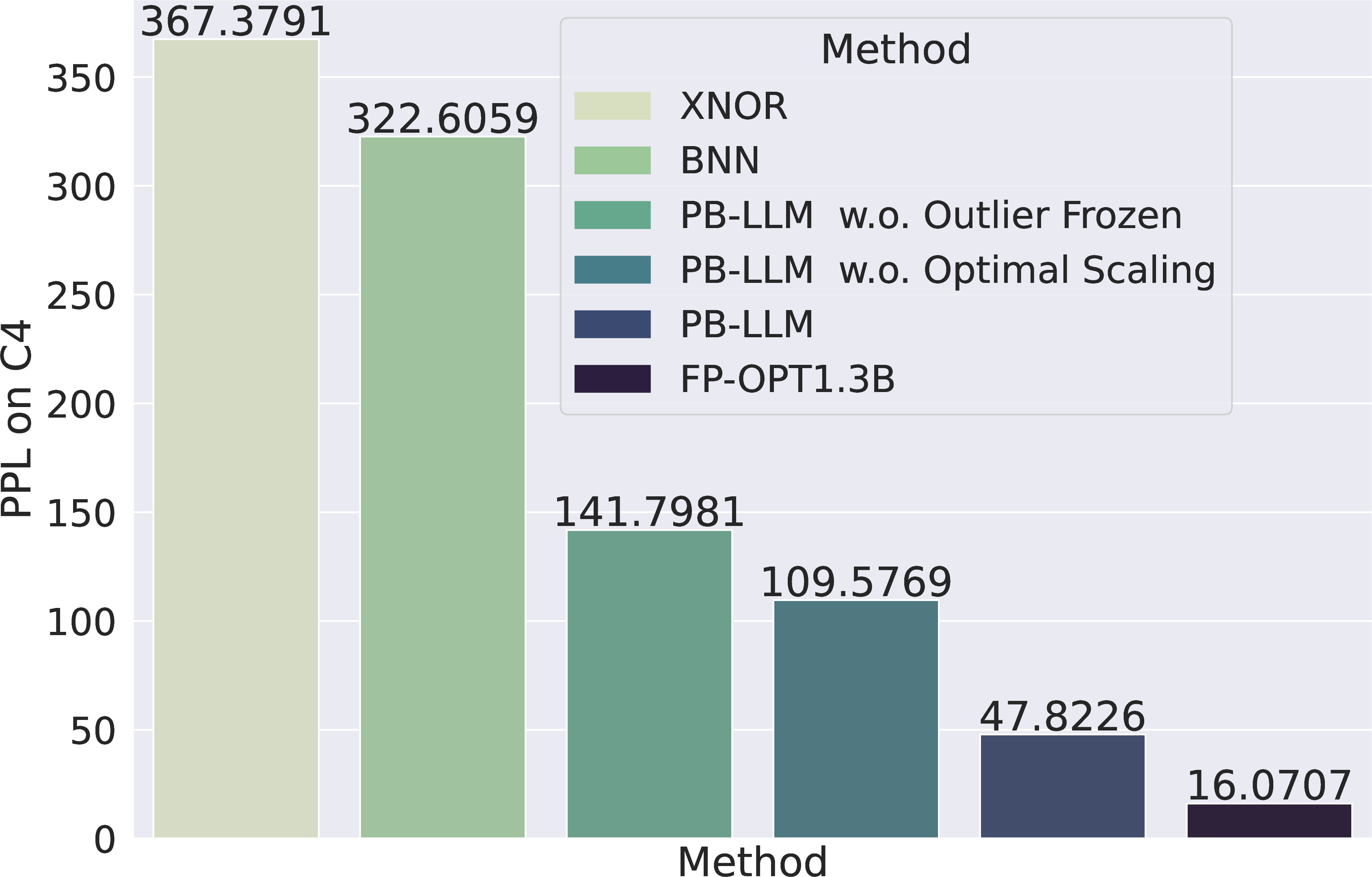
scaling strategy shown in Fig. 1. Low-bit quantized LLMs can significantly improve their performance with such explorations. Benefited from explorations of PTQ and QAT, PB-LLM can efficiently obtain an
extremely low-bit LLM with comparable reasoning capacity (see Fig. [fig:brief-performance]). The methodologies applied and the insights gained within this
study stand to contribute substantially to the advancement of knowledge and development in the field of network binarization for LLMs.

2 Related Work↩︎
2.1 Network Binarization.↩︎
Binarization uses the sign function to binarize weights and activations to \(\pm 1\). To eliminate the vanishing gradient issue caused by the sign function in the binarization, the straight-through estimator (STE) [18] is utilized for the network backpropagation. Based on this archetype, copious studies contribute to improving the performance of BNNs. Binarization techniques can be broadly classified into three categories: the enhancement of training objectives, the reduction of gradient mismatch, and the minimization of quantization errors [14], [19], [20]. To illustrate: Gradient Mismatch: [21] introduce double residual connections paired with full-precision downsampling layers. This approach addresses the gradient vanishing problem that arises due to binarization. Training Objectives: [22] focus on optimizing the loss function during training. They suggest aligning the spatial attention maps derived from both binary and real-valued convolutions. Quantization Error Minimization: [23] identify that the disparity in quantization between full-precision and binarized weights can impede the representational abilities of BNNs. As a solution, they introduce a scaling factor—determined by the L1 norm—for both weights and activation functions.
While binarization has proven successful in computer vision, its exploration in natural language processing remains limited. Existing methods [24]–[27] primarily target smaller language models (e.g., BERT-base [28] with 110M parameters) potentially hindering their generalization to larger ones (e.g., LLAMA-7B [5] with 7B parameters). We investigate binarization for LLMs comprehensively in this paper and propose PB-LLM, which is an attempt to compress LLMs using binarization.
2.2 Large Language Model Quantization.↩︎
Quantization, a prominent method in model compression, addresses the storage and computational overhead of deep learning models. Recent research efforts successfully apply quantization to compress Large Language Models (LLMs), including Quantization-Aware Training (QAT) and Post-Training Quantization (PTQ).
In the domain of QAT, innovative strategies like LLM-QAT [10] address challenges in acquiring training data for LLMs by leveraging pre-trained models for data-free distillation. Additionally, techniques such as QLORA [29] focus on parameter-efficient fine-tuning (PEFT), expediting model compression and inference acceleration. In PTQ, approaches range from quantizing only the weights of LLMs to jointly quantizing both weights and activations. Methods like GPTQ [17] and QuIP [30] optimize matrix multiplications and propose novel layer-wise quantization techniques achieving high compression rates. SqueezeLLM [31] and SpQR [32] identify weights that lead to particularly large quantization errors and subsequently storing them with higher precision to mitigate the accuracy degradation caused by weight quantization. AWQ [33] and OWQ [34] contend that when quantizing weights, it is crucial to account for the impact of activation outliers on weights. Norm Tweaking [35] addresses the issue of activation value deviation by training LayerNorm. For activation quantization, ZeroQuant [36] proposes a fine-grained quantization method that can be applied to both weights and activations. Methods like SmoothQuant [37] and Outlier Suppression [38], [39] shift the quantization challenge from activations to weights by proposing a mathematically equivalent per-channel scaling transformation. OmniQuant [40] further enhances performance by training the quantization parameters. RPTQ [41] proposed proposes performance improvement through grouped quantization after clustering similar channels. In this paper, our primary focus lies in the binarization of weights exclusively, employing both PTQ and QAT methodologies.
3 Partially Binarizing Large Language Models (PB-LLM)↩︎
In this section, we elaborate on the methodology of Partially Binarizing Large Language Models, named PB-LLM. To begin, a review of the foundational framework of binarized neural networks is presented, showcasing its applicability and
limitation to LLM quantization. Subsequently, a novel format for the quantized matrix is formulated, specifically tailored for the binarization of LLMs. Taking advantage of the proposed partially-binarized weight matrix, we delve into its potential in the
realms of post-training quantization and training-aware training for LLMs, to break the trade-off between bit-width and performance. It is crucial to note that, due to constraints in computational resources, the methodology exploration predominantly
utilizes OPT-1.3B [3] to perform the majority of experiments. Given the space constraints, this section primarily focuses on key aspects of the
methodology. For detailed discussions, exact result values, and specific implementation details in codes, readers are referred to the supplemental materials.
3.1 Preliminary: Network Binarization↩︎
To begin with, we briefly review the general concept of network binarization and binarized neural networks (BNNs) in [42], [43]. As most optimizable quantized structures of LLMs are linear layers (see Fig. 1) in LLMs, we use a one-layer Perceptron to show the training and inference processes of the BNN. The one-layer neural network is defined as \(f(\mathbf{x}) = (\mathbf{W})(\mathbf{a})\), where \(\mathbf{a}\in\mathbb{R}^{d_i}\) is the input activation and \(\mathbf{W}:\mathbb{R}^{d_i} \longmapsto \mathbb{R}^{d_o}\) stands for the weight matrix, with \(d_i\) and \(d_o\) representing the sizes of the input and output of the layer, respectively.
The goal of network binarization is to represent floating-point (FP) weights, denoted as \(\mathbf{W}_F\), and/or FP activations \(\mathbf{a}_F\) as 1-bit (i.e., ., \(\pm 1\)) values [19]. Networks utilizing this representation are referred to as BNNs. BNNs diverge from FP neural networks in their forward operations and in the approximation of backward gradients. In the forward propagation, the sign function is used for binarizing FP values of weights: \[\text{Forward:~~~} \texttt{sign}(x) = \left\{ \begin{array}{ll} +1 & \quad x \geq 0 \\ -1 & \quad x < 0. \end{array} \right. \label{eq:critic95new}\tag{1}\] Specifically, in the training process of binarized network, the BNN maintains FP latent weights \(\mathbf{W}_F\) for gradient updates, and the updated weight matrix \(\mathbf{W}_F\) is binarized into the binary weight matrix \(\mathbf{W}_B\) via the binarize function \(\texttt{sign}(\cdot)\), i.e. \(\mathbf{W}_B = \texttt{sign}(\mathbf{W}_F)\). Then the intermediate activation map (full-precision) of this layer is produced by \(\mathbf{A}_{F,o} = \mathbf{W}_B \mathbf{A}_{F,i}\). For inference efficiency, BNNs with 1-bit weights significantly reduce the memory cost of inference. Theoretically, BNNs can binarize both weights and activations to 1-bit, providing a 32x compression in memory cost and a 64x acceleration in inference speed, by replacing FP multiplications in conventional floating-point networks with Xnor-Bitcount operations. However, recent studies highlight that the weights of LLMs as the main contributor to memory overhead [31], and thus we primarily aim to curtail memory costs. Therefore, in this pivotal exploration of binarized LLMs, our attention is specifically centered on weight binarization, foregoing the simultaneous binarization of weights and activations.
In the backward propagation, the main challenge is that the pervasive sign functions are theoretically non-differentiable, and thus extremely destroy the gradient chain in the backward propagation. To address this problem, researchers
widely exploit the straight-through estimator (STE) [18] to numerically approximate the derivative of the whole BNN [19], i.e., \[\text{Backward:~~~} \frac{\partial\mathcal{L}}{\partial x}=
\left\{ \begin{array}{ll} \frac{\partial\mathcal{L}}{\partial \texttt{sign}(x)} & \quad \left | x \right | \leq 1 \\ 0 & \quad \left | x \right | > 1, \end{array} \right. \label{eidnckom}\tag{2}\] which makes the optimization of
BNN accessible.
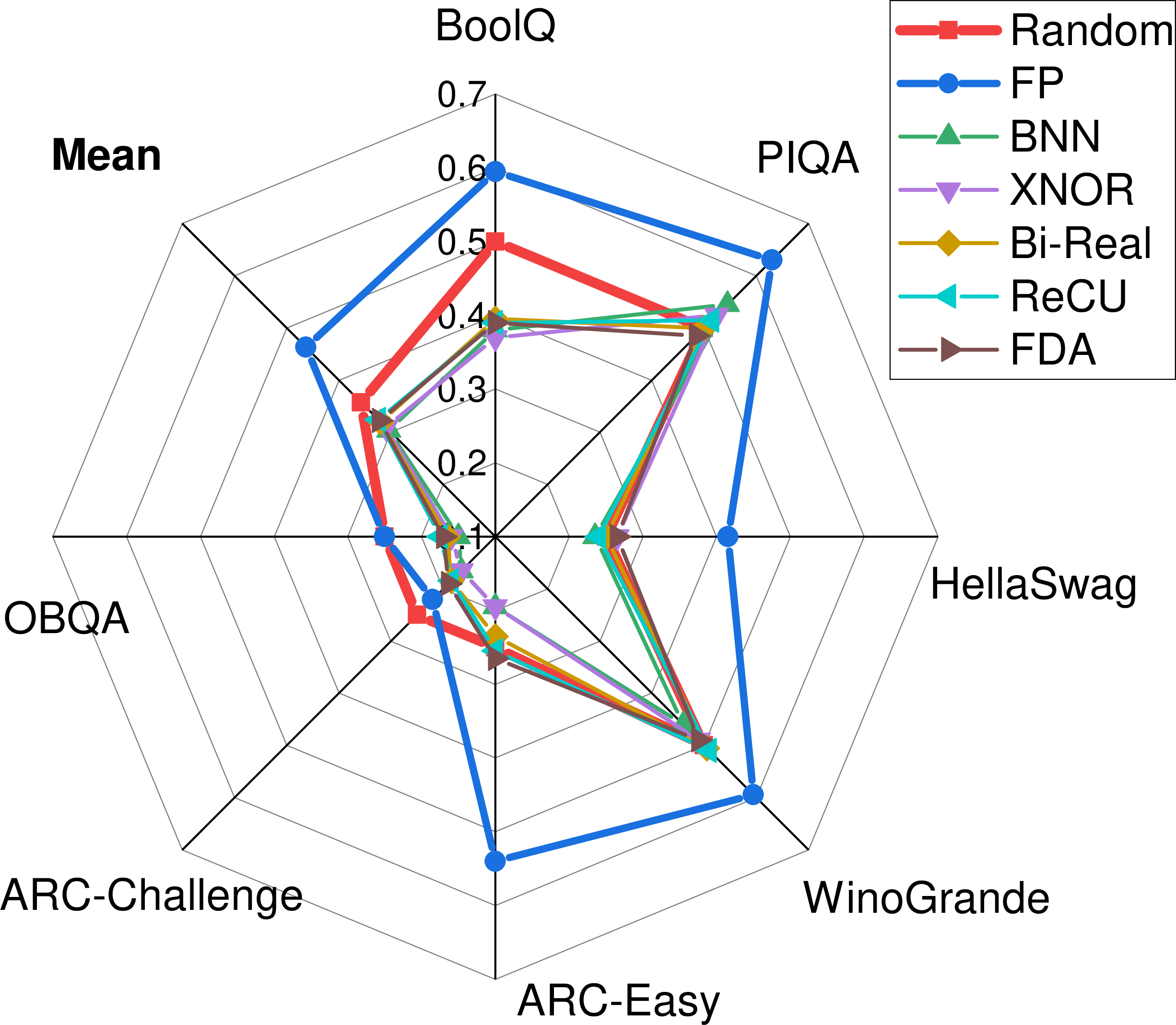
We first investigate the possibility of implementing binarization to LLM quantization. Specifically, following the binarization benchmark in BiBench [14], we generalize some representative binarization methods into LLM quantization scenarios. BNN [43], XNOR [23], Bi-Real [21], ReCU [44] and FDA [45] are re-implemented to quantize LLMs, particularly to OPT [3]. Training details are illustrated in the Sec. 4. The results evaluated on seven zero-shot common sense reasoning tasks are shown in Fig. 2. We can see that the LLMs binarized via the existing popular binarization algorithms perform worse than random guesses, showing that the existing binarization methods are not suitable for LLM binarization.
3.2 Partially Binarized Weight Matrix↩︎
In the low-bit quantization of Transformers, a significant challenge is managing the salient weights, as they can unnecessarily extend the quantization range [46]. Several outlier-aware quantization methods have been explored to tackle this issue [7], [31], [33], [38]. Notably, SqueezeLLM [31] provides a generalized methodology for handling outliers in weight values during 4-bit LLM post-training quantization. Concurrently,
AWQ [33] demonstrates that preserving only \(1\%\) of significant weights can benefit 4-bit LLM quantization.
Motivated by existing research, this study also seeks to optimize the treatment of salient weights while binarizing most of weights. We present Partially-Binarized LLMs (PB-LLM), a method involving the selective binarization of the LLMs’
weight matrix, wherein a minor fraction of weights is kept in high bits for enhanced language capacity.
3.2.1 Salient Weight: Criteria, Granularity, and Cost↩︎
Beyond the most straightforward method of choosing salient weights—selecting based on magnitude element-wise—we conduct a thorough investigation into salient weight detection from two perspectives: criteria and granularity. For criteria, we compare Magnitude- and Hessian-based methods, and for granularity, we explore both element-wise and column-wise approaches. In addition, we discuss the cost of storing matrix weights in a mixed-precision manner.
Criteria: Magnitude vs. Hessian. Beyond the identification of salient weights through magnitude, alternative criteria have also been examined. The Hessian metric emerges as a crucial factor in LLM quantization, as elucidated in [8], [17], [47], particularly in relation to post-training quantization for LLMs (details regarding the Hessian criteria for PTQ can be found in Sec. 3.3). However, we observe that the selection of salient weights, whether by magnitude or Hessian, does not significantly impact the efficacy of PTQ. Consequently, magnitude is elected as the preferred criterion for the identification of salient weights in both PTQ and QAT, primarily due to its simplicity and efficacy in distinguishing critical weight components.
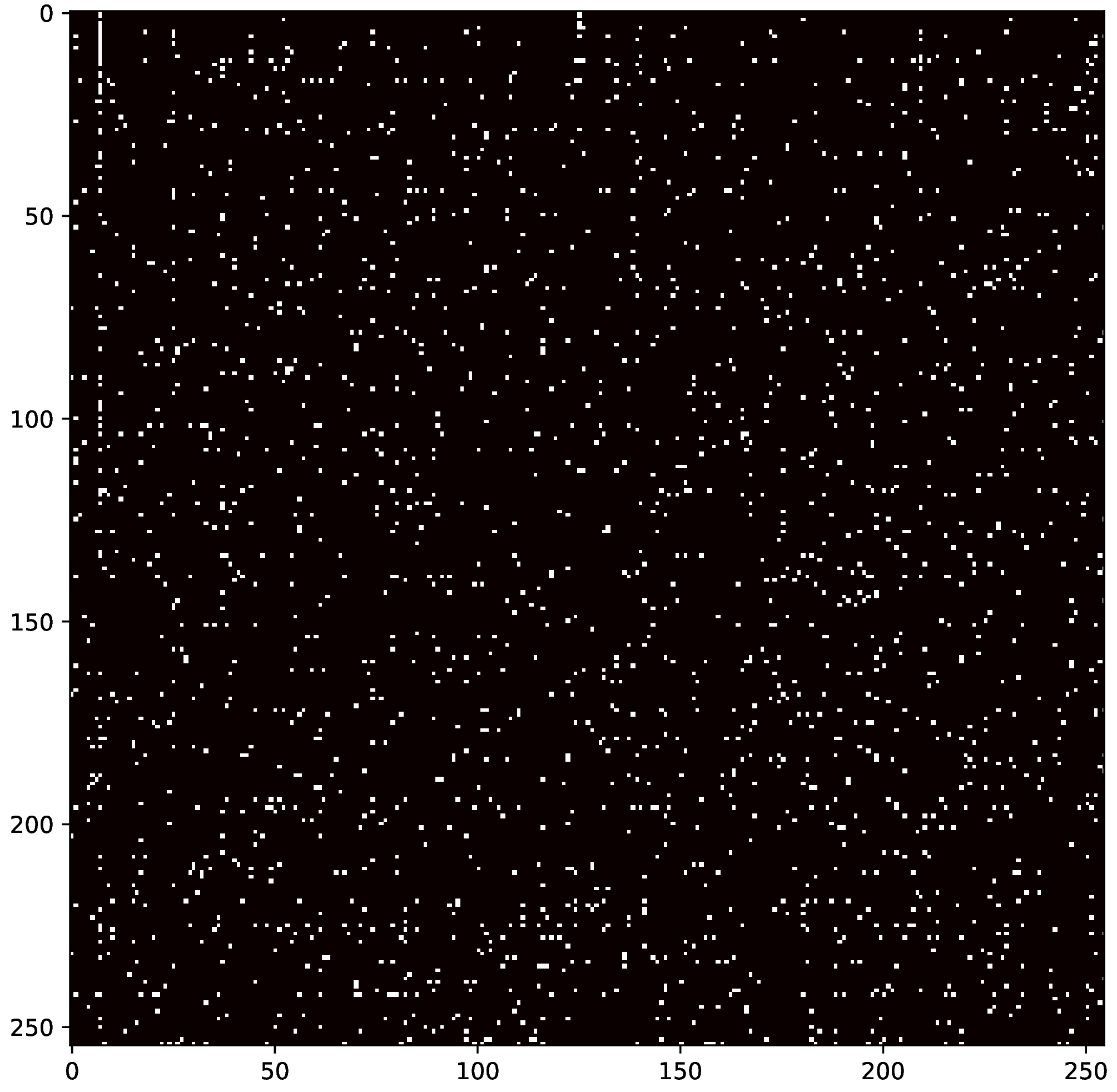
Granularity: Element-wise vs. Column-wise. Our investigations reveal that adopting a column-wise approach for selecting salient weights has the potential to impair the performance of binarization. Visualization of the salient weights’ distribution within the matrix, as depicted in Fig. 3 (where the white dots represent the filtered salient weights), disclosed a random and uniform scattering of these weights. Given the absence of any discernable column-wise pattern in the distribution of salient weights, a column-wise filtration method is deemed unsuitable. This scattered and uniform distribution necessitates an element-wise approach for effective filtration in the binarization process.
Salient Weight Storing Cost. The additional overhead for storing the salient weights is acceptable. The overall bit number, \(N_{bit}\) must adhere to the following condition: \[N_{bit} \leq \overbrace{1*r_{binary}}^{\text{for binary weights}}+\overbrace{N_{salient-bit}*(1-r_{binary})}^{\text{for salient weights}}+\overbrace{~~~~~~~~1~~~~~~~~}^{\text{for index storing, could be optimized}}, \label{eq:bitmap}\tag{3}\]
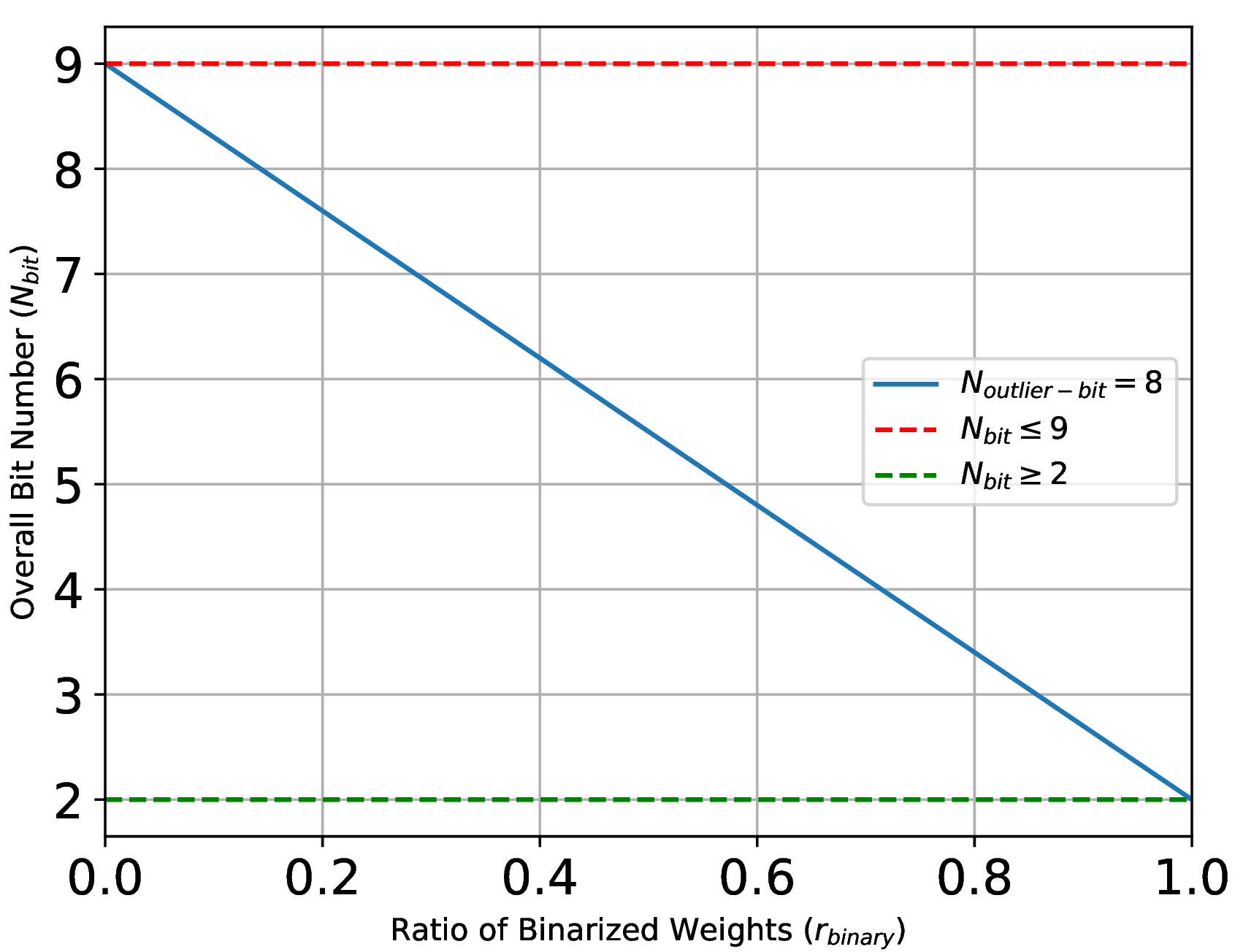
Here, \(r_{binary}\) denotes the ratio of the binarized weights, \(N_{salient-bit}\) represents the number of bits allocated for storing salient weights (e.g., 8 bits), and the additional 1 bit is allocated for using the bitmap mechanism [48] for index saving. It’s important to note that employing bitmap for index storage is not the most efficient method and can be optimized further using sparse matrix storage methods such as Compressed Sparse Row (CSR) or Compressed Sparse Column (CSC) [49]; hence the use of \(\leq\) instead of \(=\) in Eq. 3 . Given this research’s emphasis on the theoretical aspects of binarization for LLM quantization, we do not delve into saving the cost of storing the index. The relationship between the ratio of salient weights and the overall bit number is illustrated in Fig. 4, depicting that a lower ratio corresponds to a reduced overall bit number. For example, retaining \(10\%\) of weights in 8 bits and binarizing the remaining \(90\%\) equates to, at most, a 2.7-bit quantization.
3.3 Post-training Quantization for PB-LLMs↩︎
After defining the partially-binarized matrix format, the next step is to recover the performance (i.e., the reasoning capacity in the literature of LLMs) of the quantized PB-LLM. In this section, we explore the weight binarization
with post-training quantization (PTQ) methods. PTQ methods hold a prominent position in the realm of quantization techniques for LLMs due to their ease of implementation. They enable direct quantization of pre-trained LLMs without the need for a training
dataset and additional training overhead. Therefore, we first explore the weight binarization within the PTQ framework.
| Salient Fraction | 50% | 20% | 10% | 5% |
|---|---|---|---|---|
| RTN Magnitude | 24.5675 | 5892.0898 | 4889.0385 | 8023.1132 |
| RTN Hessian | 20.2512 | 2109.8522 | 7508.7788 | 6173.1611 |
| PB-GPTQ Magnitude | 18.3674 | 46.4093 | 895.0322 | 2880.6157 |
| PB-GPTQ Hessian | 17.7567 | 42.1157 | 165.6767 | 528.4877 |
| PB-GPTQ Magnitude g=128 | 18.0293 | 57.2164 | 1230.8537 | 2662.7114 |
| PB-GPTQ Hessian g=128 | 17.6000 | 45.9811 | 157.8825 | 646.3616 |
GPTQ [17] is the most efficient and effective method for weight quantization [6], capable of quantizing LLMs to 4-bit or even 2-bit. Therefore, we generalize the idea of GPTQ to the partial-binarization setting. Specifically, GPTQ quantizes the weights in LLM layer-by-layer to minimize the layer-wise quantization error: \[\mathop{\mathrm{arg\,min}}_{\hat{\mathbf{W}}} ||\mathbf{W}\mathbf{X} - \hat{\mathbf{W}}\mathbf{X}||_2^2\] GPTQ quantizes a weight \(w_q\) to \(\hat{w_q}\), calculates the compensation \(\delta_{-q}\) for remaining weights \(w_{-q}\), and then applies the compensation factor to the remaining weights: \[\delta_{-q}=\frac{w_q-\hat{w_q}}{[\mathbf{H}^{-1}]_{qq}}\cdot (\mathbf{H}^{-1})_{:,q}, \qquad {w}_{-q} := w_{-q} + \delta_{-q},\] where the \(\mathbf{H}\) is the Hessian matrix of the layer-wise quantization error with respect to the weights and \(w_q\) is the \(q\)-th value in flattened weight matrix \(\mathbf{W}\). In GPTQ, weights are quantized iteratively and the remaining weights are updated until all weights have been quantized.
We propose to use GPTQ to iteratively bianrize the un-salient weights and quantize the salient weights to higher bit, and then apply the compensation to the remaining weights. Specifically, we first detect the salient weights \(\mathbf{W}^{sal}\) and un-salient (to-be-binarized) weights \(\mathbf{W}^{unsal}\) in the weight matrix \(\mathbf{W}=\mathbf{W}^{sal}+\mathbf{W}^{unsal}\). Drawing inspiration from SparseGPT [8], we calculate the saliency metric, represented as \(v_i=w_i^2/[\mathbf{H}^{-1}]^2_{ii}\), for the purpose of detecting salient weights using Hessian criterion. The un-salient weights will be binarized to \(\hat{\mathbf{W}}^{unsal}\), and the salient weights will be quantized to higher bit \(\hat{\mathbf{W}}^{sal}\). We use asymmetric per-channel quantization for both salient and un-salient weights. For un-salient weight, we use the per-channel mean as zero point and calculate the optimal scaling factor \(\alpha\) for the un-salient weights using the method in Sec. 3.4.2. We use MinMax metric to calibrate the scaling factor and zero point for salient weights.
In the quantization process, we iteratively quantize the columns in the weight matrix \(\mathbf{W}\). For each column, we binarize the un-salient weights and quantize the salient weights, and then calculate the
compensation for remaining weights, and then apply the compensation factor to the remaining columns of weights. This process is repeated until all the weights are quantized. The proposed method is denoted as PB-GPTQ. We also explore the
fine-grained PB-GPTQ, which quantizes the weights in a group-wise manner. Specifically, the weight matrix is split into several groups, each group contains \(g\) columns. In each group, we detect the salient
weights and un-salient weights, and then calibrate to set the scaling factor and zero point using the weights in this group.
The results are listed in Tab. 1. PB-GPTQ is significantly better than RTN. We note that the Hessian-based PB-GPTQ exhibits a superior performance compared to the Magnitude criterion
PB-GPTQ. The group-wise PB-GPTQ performs better or worse than the non-group-wise PB-GPTQ, but the difference is not significant. Our analysis suggests that the disparity in scaling factors is not the primary
determinant of binarization performance; hence, the introduction of group-wise methodology does not yield an enhancement in binarization performance. Subsequently, our next endeavor will involve the application of QAT to reduce the error introduced by
weight binarization.
3.4 Quantization-aware Training for PB-LLMs↩︎
In order to further enhance the reasoning capacity of the Partially-Binarized Large Language Models (PB-LLM), we extend our exploration by employing Quantization-aware Training (QAT) to meticulously train the quantized models. Because LLM
training is difficult, we desire that PB-LLM training could be as efficient as possible. To realize efficient training for PB-LLM, we propose the Salient Weights Frozen and Optimal Scaling Factor for Binary Weights, targeting the
salient weights and binarized weights, respectively.
3.4.1 Salient Weights Frozen↩︎
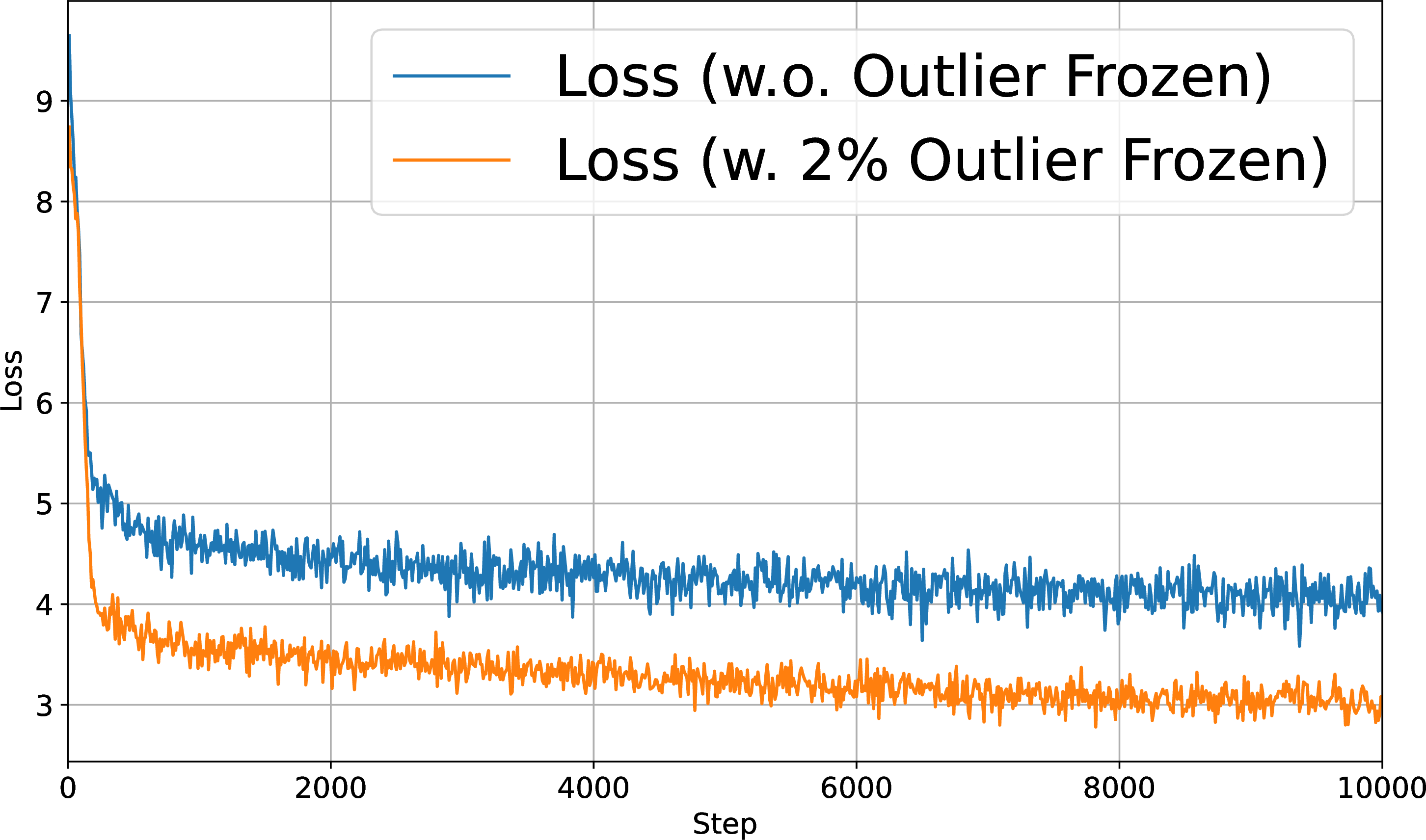
To leverage the value of pre-trained weights, we propose freezing the salient weights, determined by weight magnitude, prior to the weight binarization process. As illustrated in Fig. 1, we initially filter out a number of weights from a pre-trained weight matrix—e.g., \(2\%\) by magnitude—at the beginning of quantization-aware training, maintaining their fixed state throughout the training process. Examination of training efficiency (refer to Fig.5) suggests that these salient weights play a crucial role in LLM capacity. Maintaining the high bit representation of certain weights, thereby freezing them, aids in the training of quantized LLMs and reduces their optimization difficulty.
3.4.2 Optimal Scaling Factor for Binary Weights.↩︎
AWQ [33] enhances the weight-only quantization method for LLMs by optimizing scaling factors to mitigate the quantization error of quantized weights. Specifically, AWQ demonstrates that searching for empirically optimal scaling factors proves to be an effective strategy for reducing quantization errors and recovering the performance of the quantized models. Fortunately, in the context of LLM binarization, we have a better choice for scaling the binarized weights. There’s no need to search for optimal scaling factors as they can be analytically derived. Specifically, we apply a column-wise scaling factor to binarized weights to reduce the binarization error, i.e., enforcing \(\mathbf{w}_F=\alpha\bar{\mathbf{w}}_B\). The optimal values of scaling factor \(\alpha\) for the \(\bar{\mathbf{w}}_B\in\{-1,1\}\) can be calculated by minimizing the L2 error: \[\alpha^{\star} = \arg\min_{\alpha \in \mathbb{R}_{+}}\mathcal{J}(\alpha),~\text{in which}~\mathcal{J}(\alpha)=\Vert\mathbf{w}_F - \alpha\bar{\mathbf{w}}_B\Vert_2^2\] Following XNOR-Net [23], by expanding the below equation, we have \[\mathcal{J}(\alpha) = \alpha^2\bar{\mathbf{w}}_B^T\bar{\mathbf{w}}_B - 2\alpha\mathbf{w}_F^T\bar{\mathbf{w}}_B + \mathbf{w}_F^T\mathbf{w}_F\]
For the vector with \(\mathbf{w}_F\in \mathbb{R}^n\) we follow the traditional methods of binarizing weights [43] by taking the sign of real-valued weights: \[\bar{\mathbf{w}}_B^i = \texttt{sign}(\mathbf{w}_F^i) = \left\{ \begin{array}{ll} +1, & \quad
\mathbf{w}_F^i \geq 0; \\ -1, & \quad \mathbf{w}_F^i < 0. \end{array} \right. \label{ficzndow}\tag{4}\] In that case, \(\bar{\mathbf{w}}_B^T\bar{\mathbf{w}}_B = n_{\mathbf{w}_F}\), where \(n_{\mathbf{w}_F}\) is number of elements in \(\mathbf{w}_F\), and \(\alpha^{*}\) can be solved as: \[\alpha^{*} =
\frac{\mathbf{w}_F^T\bar{\mathbf{w}}_B}{n_{\mathbf{w}_F}}=\frac{\Vert \mathbf{w}_F \Vert_1}{n_{\mathbf{w}_F}}.\] A counterintuitive outcome emerges from the incorporation of salient-frozen and optimal-scaling mechanisms: directly deploying those two
mechanisms to pre-trained LLM even without any retraining or fine-tuning, still results in commendable performance. For instance, applying these techniques to OPT-1.3B with 50% salient weights (see Fig. 6)
reveals that the partially-binarized OPT-1.3B retains a small amount of language capacity, corroborating the importance of a small number of salient weights in LLM quantization. Consequently, implementing just these two techniques—Outlier Frozen and
Optimal Scaling Factor for Binary Weights—on pre-trained LLMs serves as an efficient starting point for training PB-LLM.
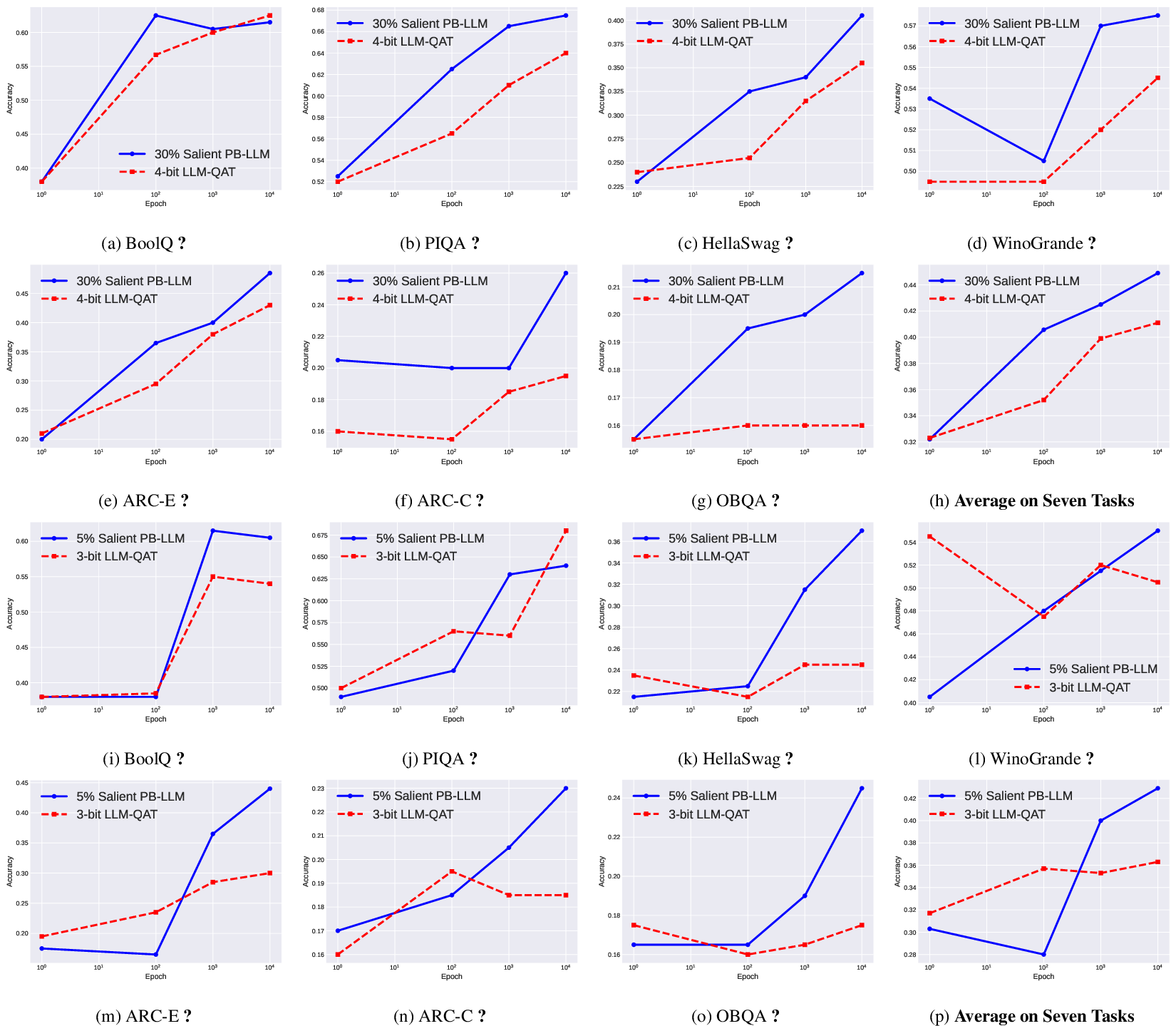
Both of the above-proposed mechanisms are very effective when used during quantization-aware training of PB-LLM. The consequential outcomes are delineated in Figs.[subfig1]-[subfig16]. Observations from the presented results elucidate that optimizing using the partially-binarized quantization format is notably
more straightforward compared to single-bit quantization. This empirical evidence corroborates the discussion regarding the rapid convergence property found in Sec.[sec:salient95weight95frozen], highlighting the efficacy and adaptability of our proposed methodology in optimizing LLMs within the constraints of partial binarization. From the perspective of QAT,
PB-LLM emerges as more efficient in training compared to existing LLM QAT methods. For instance, while models like LLM-QAT [10]
necessitate up to 100K iterations for adequate training, PB-LLM remarkably achieves recovery of the performance of quantized LLMs in merely around 1-10K iterations. This substantial reduction in required iterations represents a leap in
training efficiency, streamlining the path to achieving optimal performance in quantized LLMs with significantly reduced computational effort.
4 Experiments↩︎
Besides the exploration with OPT-1.3B in Sec. 3, we assess the effectiveness of PB-LLM by conducting experiments on LLaMA-7B [5] and presenting results on various tasks.
4.1 Experimental Setup↩︎
Dataset. In this study, the PB-LLM is trained using the RedPajama-simple-1B dataset, as the dataset for LLaMa training is not openly accessible. This dataset, RedPajama-1T, is structured to closely resemble the LLaMa paper
and serves as a transparent, open-source alternative to LLM training dataset. It amalgamates data from diverse sources including Commoncrawl, C4, GitHub, Wikipedia, Gutenberg Books3, ArXiv, and Stackexchange. RedPajama-simple-1B, representing a 0.1% subset
of RedPajama-1T, is substantially smaller than the typical datasets used for training other LLMs, making it a convenient choice for our experiments.
Training Details. In the training process of our quantized network, we commence with a pre-trained model for initialization. The optimization of the model is facilitated through the AdamW optimizer [50], applied with zero weight decay. We assign a batch size of 1 to each GPU and implement a learning rate of 2e-5, adhering to a cosine learning
rate decay strategy. We only fine-tune our PB-LLM for 10K iterations.
Evaluated Tasks. To eliminate the variance of evaluated performance, we evaluate the binarized LLMs on seven zero-shot common sense reasoning tasks, i.e., BoolQ [51], PIQA [52], HellaSwag [53], WinoGrande [54], ARC-Easy, ARC-Challenge [55], OBQA [56]. We also along eavulated the quantized moelds’ perplexity scores on WikiText2 [57] and C4 [58].
4.2 Results on LLaMA↩︎
| Method | BoolQ | PIQA | HellaSwag | WinoGrande | ARC-E | ARC-C | OBQA | Avg |
|---|---|---|---|---|---|---|---|---|
| FP LLaMA-7B | 76.8 | 79.3 | 76.1 | 70.0 | 73.0 | 48.0 | 57.6 | 68.7 |
| RTN | 71.2 | 77.3 | 72.7 | 66.9 | 68.8 | 46.4 | 52.8 | 65.2 |
| SmoothQuant | 67.7 | 76.0 | 69.4 | 66.7 | 66.9 | 43.0 | 50.6 | 63.0 |
| LLM-QAT | 75.5 | 78.3 | 74.0 | 69.0 | 70.0 | 45.0 | 55.4 | 66.6 |
| PB-GPTQ 10% | 62.3 | 55.9 | 27.7 | 49.3 | 29.3 | 20.1 | 10.6 | 36.5 |
| PB-GPTQ 30% | 73.5 | 74.9 | 47.5 | 64.9 | 61.3 | 32.4 | 25.2 | 54.2 |
| 10% | 68.9 | 67.8 | 68.1 | 67.4 | 58.7 | 42.9 | 50.6 | 60.6 |
| 30% | 75.7 | 78.0 | 74.3 | 69.7 | 69.0 | 45.6 | 55.8 | 66.9 |
| C4 | WIKI | PTB | |
|---|---|---|---|
| FP | 7.3435 | 5.6770 | 41.1509 |
| GPTQ 4b | 8.6977 | 8.1368 | 57.9951 |
| SparseGPT 50% | 15.5949 | 12.829483 | 505.1396 |
| PB-GPTQ 50% | 8.1466 | 6.3089 | 54.8674 |
| PB-GPTQ 20% | 20.6057 | 17.1929 | 280.4353 |
| PB-GPTQ 10% | 72.1115 | 85.7838 | 708.4120 |
| PB-GPTQ 5% | 401.6475 | 619.1054 | 1687.1815 |
r0.46
Experiments were conducted on LLaMA-7B. The results of employing PB-GPTQ and PB-LLM are illustrated in Tabs. 2 and 3. When employing PTQ,
PB-GPTQ exhibited commendable performance, particularly when the salient weight exceeded 30%. Nevertheless, a noteworthy decline in the performance of the quantized network was observed when the salient weight was reduced to 10%. On the other
hand, employing QAT resulted in a notable improvement in the performance. A comparison within a 4-bit quantization setting between PB-LLM 30% and LLM-QAT in Tab. 2 reveals superior performance by our
method. It is notable that PB-LLM is only fine-tuned for 10K iterations, whereas LLM-QAT underwent 100K iterations of training, showing its fast convergence property (refer to Sec. 3.2). The results under
PB-LLM 10% represent the outcomes of PB-LLM where 10% of salient weights are preserved. This demonstrates the potential for advancing LLM quantization towards a fully 1-bit state.
5 Conclusion↩︎
In conclusion, this work is the first to implement network binarization for LLM quantification, introducing the novel Partially-binarized LLM (PB-LLM) methodology. This approach is
meticulously designed to maintain linguistic reasoning capabilities of LLMs, even under extreme low-bit quantization. The research unearthed the significant role of salient weights in achieving extreme quantization and proposed innovative strategies like
optimal scaling for effective binarization. This framework is extended to recover the capacities of quantized LMMs, by analyzing from the perspective of post-training quantization (PTQ) and quantization-aware training (QAT). The methodology is a
significant stride in the realm of network binarization for LLMs.
6 Supplemental Materials↩︎
6.1 Exisiting Binarization Methods on LLM Quantization↩︎
| Method | BoolQ | PIQA | HellaSwag | WinoGrande | ARC-Easy | ARC-Challenge | OBQA | Mean |
|---|---|---|---|---|---|---|---|---|
| Random Performance | 0.5 | 0.5 | 0.25 | 0.5 | 0.25 | 0.25 | 0.25 | 0.36 |
| FP | 0.595 | 0.63 | 0.415 | 0.595 | 0.54 | 0.22 | 0.25 | 0.46 |
| BNN | 0.38 | 0.545 | 0.235 | 0.46 | 0.195 | 0.165 | 0.15 | 0.30 |
| XNOR | 0.37 | 0.525 | 0.265 | 0.49 | 0.195 | 0.165 | 0.16 | 0.31 |
| Bi-Real | 0.395 | 0.5 | 0.25 | 0.505 | 0.235 | 0.185 | 0.165 | 0.32 |
| ReCU | 0.39 | 0.515 | 0.24 | 0.51 | 0.255 | 0.185 | 0.175 | 0.32 |
| FDA | 0.39 | 0.485 | 0.265 | 0.49 | 0.265 | 0.19 | 0.17 | 0.32 |
We first investigate the possibility of implementing binarization to LLM quantization. Specifically, following the binarization benchmark in BiBench [14], we generalize some representative binarization methods into LLM quantization scenarios. BNN [43], XNOR [23], Bi-Real [21], ReCU [44] and FDA [45] are re-implemented to quantize LLMs, particularly to OPT [3]. Training details are illustrated in the Sec. 4. The results evaluated on seven zero-shot common sense reasoning tasks are shown in the above table. We can see that the LLMs binarized via the existing popular binarization algorithms perform worse than random guesses, showing that the existing binarization methods are not suitable for LLM binarization.
References↩︎
Equal contribution.↩︎