Proactively Reducing the Hate Intensity of Online Posts via Hate Speech Normalization
June 08, 2022
Abstract
Curbing online hate speech has become the need of the hour; however, a blanket ban on such activities is infeasible due to several geopolitical and cultural reasons. To reduce the severity of the problem, in this paper, we introduce a novel task, hate speech normalization that aims to weaken the intensity of hatred exhibited by an online post. The intention of hate speech normalization is not to support hate but instead to provide the users with a stepping stone towards non-hate while giving online platforms more time to monitor any improvement in the user’s behavior.
To this end, we manually curated a parallel corpus – hate texts and their normalized counterparts (a normalized text is less hateful and more benign). We introduce NACL, a simple yet efficient hate speech normalization model that
operates in three stages – first, it measures the hate intensity of the original sample; second, it identifies the hate span(s) within it; and finally, it reduces hate intensity by paraphrasing the hate spans.1 We perform extensive experiments to measure the efficacy of NACLvia three-way evaluation (intrinsic, extrinsic, and human-study). We observe that NACLoutperforms six baselines –
NACLyields a score of \(0.1365\) RMSE for the intensity prediction, \(0.622\) F1-score in the span identification, and \(82.27\) BLEU and \(80.05\) perplexity for the normalized text generation. We further show the generalizability of NACLacross other platforms (Reddit, Facebook, Gab). An interactive prototype of NACLwas put together for
the user study. Further, the tool is being deployed in a real-world setting at Wipro AI as a part of their mission to tackle harmful content on online platforms.
1 Introduction↩︎
Today, anyone with access to the Internet can learn, share, and participate in matters that concern them. However, anti-social behavior such as spreading fake news, cyberbullying, polarization, and posting hateful messages has increased with Internet penetration. While what constitutes hate speech is subjective, there is a common understanding of what underpins hate [1]. Hate speech can be understood as any communication in speech, writing, or behavior that attacks/discriminates or uses pejorative language against an individual or a group based on who they are. The attack is often targeted at religion, ethnicity, nationality, race, color, descent, gender, or other identity factors [2]. Our experiment aims to capture varying degrees and designs of hatefulness; we use hate as an umbrella term encompassing overlapping definitions of hate, abuse, and offense. Hate speech on social media usually consists of content that is often in violation of the terms of usage of the platform and leads to either flagging of content or banning of users or both. This has led to an influx of banned users turning over to less-restrictive platforms [3]. A cross-platform study of hateful users revealed how the banning of users could backfire for the platform and the Internet community at large. [4].
| Type | Sample | Int |
|---|---|---|
| Org | This {immigrant should be hung or shot ! Period ! An***}\(_{Span}\) . @user | 8 |
| This immigrant should be punished . @user | 4 | |
| Org | @user This {trashy wh*** gold digger}\(_{Span}\) at again trying be something that makes her think shes good ughhh not happening {h** bag pos}\(_{Span}\) | 9 |
| @user This money loving women at again trying be something that makes her think shes good ughhh not happening | 2 | |
| Org | {#BuildThatWall #BuildTheDamnWall #BuildThatWall BUILD THAT EFFEN WALL}\(_{Span}\) I’m sorry my Lord #Jesus but people are just deaf down here | 8 |
| Ask them to leave the nation. I’m sorry my Lord Jesus but people are just deaf down here | 4 | |
| Org | Women ... Can’t live with them ... {Can’t shoot them}\(_{Span}\) | 6 |
| Women ... Can’t live with them ... can’t speak to them | 3 |
Motivation and evidence. An alternative solution is to proactively counter [5] hate speech before it goes public. Systematic and proactive sensitization of online users can help them voice their opinions without directly propagating harm. In this case, we believe that promoting users with alternative scenarios nudges a change in attitude [6], [7]. Twitter and Instagram, among other platforms, have already rolled out the experimental prompts for ‘offensive posts with an option to revise before going public’ [8], [9]. These tools state that the material is objectionable and leave it to the users to build a more appropriate form. Based on experiments with such prompts, researchers at Twitter published findings [10] that prompted participants to eventually post fewer offensive tweets than non-prompted users in the control group. Such nudging should be more welcoming to the users than them getting banned from the platform without having an opportunity to improve.
Contribution I: Novel problem statement. Prompting users to change their texts to be completely non-hateful can be a significant behavioral shift and may backfire. Therefore, as an experiment, we take the first step of making the content less hateful and hope to build from there. Extending upon the idea of proactive prompts, we propose the novel task of hate speech normalization, which suggests a normalized counterpart of hateful content by weakening the overall hatred exhibited by the original content while retaining the underlying semantics. Additionally, in line with previous studies [10], we observe a significant reduction in user engagement (virality) for normalized sentences compared to the original one. Our hypothesis testing is detailed in Section 2.
Contribution II: New dataset. Note that our aim is not to render a hateful message into a non-hateful one; instead, it is the reduction of hatred. To this end, we manually curate a parallel corpus of hateful samples and their normalized versions, the first dataset of its kind. Our preliminary analysis of hateful samples suggests that, in general, only a few phrases within a sentence convey major hatred. Therefore, we first identify the hateful spans for each hateful sample and then normalize them to reduce overall hatred. Table 1 lists examples of such posts and their normalized counterparts.
Contribution III: Novel method. We then propose NACL, a Neural hAte speeCh normaLizer, which operates in three stages. It first measures
the intensity of hatred exhibited by an incoming sample by employing an attention-driven BiLSTM-based regression model. Following this, a BiLSTM-CRF module operates on the sample to extract the hateful spans from the source sample. In the last stage, we
incorporate and fine-tune a BART-based sequence-to-sequence model (seq2seq) [11] to normalize the identified hate spans with
feedback (reward/penalty) from the hate intensity predictor-driven discriminator module. The reward/penalty from the discriminator enforces the generator (BART model) to paraphrase the hate spans to reduce the hate intensity. For each stage, we compare our
results with various baselines. We develop an end-to-end system that can be efficiently deployed in the real-world environment. It achieves consistent performance in offline (intrinsic/extrinsic evaluations) as well as online evaluations (as observed by
annotators).
Contribution IV: Extensive evaluation and deployment. We perform an extrinsic evaluation on three standard state-of-the-art hate detection models where we measure the confidence of these models in classifying the normalized samples as
‘hate’ against the original unnormalized samples. We hypothesize that the models should have lower ‘hate’ confidence for the normalized (reduced hate) sample compared to the original one. We further compare NACLwith six
baselines and obtain a performance of \(0.136\) RMSE, \(0.622\) F1-score, and \(82.27\) BLEU in intensity prediction, span identification, and text
normalization, respectively.
In partnership with Wipro AI, we develop an interactive web interface and conduct an anonymized human evaluation on the outputs of NACLand other baselines. We observe that NACLreports better results in intrinsic evaluation,
higher reduction in confidence of hate detection models in extrinsic evaluation, and coherent and better outputs as evaluated by humans. We further show the generalizability of NACLacross three social media platforms – Reddit,
Facebook, and Gab.
Reproducibility: Being aware of the ethical considerations (Appendix 9) of dataset, we are restricting its release. Meanwhile, the models, source codes, annotation guidelines, the questionnaires used for human evaluation (c.f. Section 6.5), and web-tool (c.f. Section 6.7) is available at https://github.com/LCS2-IIITD/Hate_Norm.
2 Application and Target Audience↩︎
Target Audience. People initiate and engage in hateful conversation for a variety of reasons. There will always be users who intentionally and constantly spread hateful content. The majority of such users eventually get flagged and reported by the community for their anti-social behavior. However, despite intentionally engaging in hateful content, a section of online users are adaptive and can be nudged to change their opinions via empathy [12] and corrective behavior. Our tool is aimed at the latter set of user groups whose social engagements can be eventually guided to become non-hateful. Meanwhile, prompting tools and the adoption of suggestive texts can help the content moderators understand the linguistic behavior of offensive users and track any changes in user behavior against getting flagged/banned.
Evidence. A significant criticism for prompting and suggestive rectification is the debate of reduced expressive powers of the users. However, a recent study by Twitter [10] also revealed that encouraging users to reduce the publishing of offensive text had no significant impact on their ability to participate in the non-offensive conversation. This result is a big motivation for researchers exploring proactive methods of countering hateful/hurtful content, as we do in this paper. Though one can argue that normalized text is still hateful and prone to spreading harm, we hypothesize that in its normalized form with a reduction in intensity, the content should see a decline in the user engagement it receives (i.e., reduces its virality). We take inspiration from the virality prediction models on social media to test this hypothesis. In our setting, the virality of a post is expressed in terms of the total comments it receives. Since ours is a text-only dataset curated from different sources, we lack the availability of any network, temporal and other signals. Engineering various textual features (listed in Appendix 10) inspired by the work of [13] and [14], we train a user engagement prediction model (trained on Reddit dataset). We use it to predict the comment count for the hateful posts and their normalized counterpart present in our dataset. We use hateful and normalized samples as our control and alternate sets. We randomly sample \(300\) pairs of test cases for \(10\) iterations and record differences in median comment count per sampling iteration (depicted in Figure 1). We found the phenomenon (\(\Delta\) in the median virality of hate vs. normalized) to be statistically significant with a \(p\)-value of \(0.0027\) and effect-size of \(2.324\) on Welch’s t-test. Thus, we conclude that even if present online, the normalized form of a post is less likely to gain engagement and go viral. This evidence is in line with existing studies [10] which found that less offensive content is expected to catch fewer eyeballs.

3 Objective & Individual Stages↩︎
For a given hate sample \(t\), our objective is to obtain its normalized form \(t^\prime\) such that the intensity of hatred \(\phi_t\) is reduced i.e., \(\phi_{t^\prime} < \phi_t\). To achieve this, we divide the overall task into three stages.
Hate Intensity Prediction (HIP). The task of hate intensity prediction is to determine the extent (degree or intensity) of hatred in a message (inspired by the idea of measuring online toxicity2). Given a sample \(t\), it measures the intensity of hatred on a scale of \([1, 10]\), with \(10\) being the highest, i.e., \(\phi_t = HIP(t)\).
Hateful Span Identification (HSI). Hateful spans in a sentence are the portions of a sentence responsible for conveying hate [15]. The intuition behind this task is that we can achieve sentence-level normalization if we attempt to normalize these spans. A sample can have multiple, non-overlapping hate spans, and \(HSI(t)\) aims to find all such spans.
Hate Intensity Reduction (HIR). The objective of hate intensity reduction is to generate a new sample that preserves the original semantic but with weaker hate intensity. Intuitively, we first need to identify the threshold for strong vs weak hate. For our experiments, we set a threshold \(\tau = 5\). For each strong hate sample with \(\phi_t > \tau\), we aim to generate semantically similar sample \(t^\prime \approx t\), with the constraint \(\phi_{t^\prime} \le \tau\).

4 Proposed Methodology↩︎
We engineer a real-time system that can normalize hate speech on the fly. Our goal is to design a simple yet effective industry-level solution that can be deployed at scale. Interestingly from our experimentation, we observe that a simpler architecture produces comparable performance to a complex solution and is more industry-centric in terms of response time and performance.
Figure 2 illustrates a high-level overview of the NACLframework. We assume that NACLwill be called to action once a text is detected as hateful by a preexisting hate detection model. In our
case, we mimic it by only using hateful samples for training NACL(c.f. Section 5). Any future reference of the input sample would mean that it is already labeled as hate. In the first step, we compute the
hate intensity (\(\phi_t\)) of an input sample \(t\) and forward it for normalization only if it satisfies the condition, \(\phi_t > \tau\) (i.e., only
strongly hateful samples are subject to normalization). Next, the model predicts the hate spans within the incoming sample following the CONLL-2002 BIO notations [16]. Subsequently, NACLnormalizes each identified hate span through a generator module. Finally, the outputs of each generator are interleaved in the original span
sequence and fed to the discriminator to ensure the reduction of hate intensity (\(\phi \leq \tau\)). The pseudo-code is summarized in Appendix 12.
NACL-HIP Module: For hate intensity prediction, we employ a Bi-LSTM model. The intermediate representation is then passed through a self-attention layer connected to a fully-connected layer with linear activation to obtain
the input sample’s continuous hate intensity prediction. Table 3 shows various models and pre-trained embeddings we experimented with.
NACL-HSI Module: For the span detection model, we initially take as input a sequence of a hateful sample (\(X_i\)). For every token of the sequences, we have manually annotated span labeling
that represents the start and end of a hateful span in it. Our goal is to train our model to detect relevant hate spans represented by tags \((B, I, O)\) where ‘B’ represents the beginning of hate span, ‘I’ forms the
continuation of a hate span, and ‘O’ represents the non-hate tag. For our model, we use bidirectional LSTMs to capture the contextual representation of sequences. The hidden representations are then passed through a Time Distributed dense layer to flatten
the embedding structure. We further use a CRF model layer to fit our representations and produce the required tags for our sequences. The CRF layer models the conditional probability of each sequence \(p(s_1, ...., s_m|x_1, ....,
x_m)\) by defining a feature map \(\phi(x_1,...,x_m,s_1,...s_m) \in R^d\) that maps an entire sequence to a d dimensional feature vector. Then we can model the probability using the feature vector \(w \in R^d\) as follows: \[\begin{align} p(s|x;w)=\sum_s exp(w.\phi(x,s)),
\end{align}\] where s ranges across different sequences and x represents the POS tag. After getting the feature vector \(w^*\), we can find the most likely tag for a sentence \(s^*\)
by: \(s^*=argmax\) \(p(s|x;w*)\)
NACL-HIR Module: The hate intensity reduction model is a Generative Adversarial Network (GAN) based architecture, which employs both NACL-HIP and NACL-HSI as its assistive modules.
NACL-HIR accepts a hateful sample along with its span labels as identified by the HSI model. For NACL-HIR, we use a pre-trained BART [11] and fine-tune it for the hate normalization task. The BART-based seq-to-seq model generates the normalized spans based on the hate spans identified by the NACL-HSI module. The generated spans are
amalgamated with the rest of the sample tokens and forwarded to the HIP-based discriminator model.
The discriminator computes the hate intensity score \(\phi_{t^\prime}\) of the normalized text \(t^\prime\). Since our objective is to reduce the intensity of \(t^\prime\), we assign a reward/penalty \(R\) to the generator based on the hate intensity score \(\phi_{t^\prime}\) of the normalized sentence and the accepted
threshold value \(\tau\) as follows: \[\begin{align}
R_{t^\prime} = \tau - \phi_{t^\prime}
\end{align}\] Note that the threshold value is a hyperparameter. In this paper, we experiment with two threshold values (\(\tau=\{3,5\}\)) for the hate normalization. Table 5 shows that \(\tau=5\) is better suited for the NACL-HIR model. Therefore, for the rest of the experimentation, we continued with \(\tau=5\) as the threshold value for our model. If the computed hate intensity score is lesser than or equal to the threshold, the positive reward encourages the generator to continue predicting the similar normalized span;
otherwise, the negative reward penalizes the generator to improve its prediction. The generator consumes the reward into its loss function as follows: \[\begin{align}
\mathcal{L} = \ell + (1 - R)
\end{align}\] where \(\ell\) is the generator loss. Backpropagation aims to minimize the consolidated loss \(\mathcal{L}\) in order to generate semantically coherent normalized
samples with hate intensity lesser than equal to \(\tau\).
Some Engineering Observations. As stated at the beginning of this section, we aim to find a solution that not only performs well for the given problem statement but can also be deployed. Subsequently, we make a trade-off between efficiency and complexity at each modeling stage. For instance, adding additional BiLSTM layers for HIP did not significantly boost the performance; hence, we exclude them from the final modeling. Additionally, with HSI, simpler embedding solutions like Glove and ElMo performed comparably to BERT. We think the main reason for BERT’s low performance is that the BERT tokenizer splits the words into subtokens, which causes the spans to be distributed unequally across the subtokenized words. This skews the target values that belong to one of the tags (\(o_i \in (B, I, O)\)), resulting in the model overfitting. As we have limited data, the ELMO model performs better with this data and performs well for the problem. For both HSI and HIR, we make the obvious decision to use the optimized, distilled versions of the larger BERT and BART models (as supported by HuggingFace3), further reducing the number of parameters to train.
| Statistics | Value |
|---|---|
| Total samples | \(4423\) |
| Sample length | \(23\) (avg), \(112\) (max) |
| No. of samples with intensity scores | \(4423\) |
| Hate intensity range | 1 (min) – 10 (max) |
| No. of samples with spans | \(3027\) |
| No. of spans | \(5732\) |
| Avg length of spans (tokens) | \(3\) |
| No. of normalized samples | \(3027\) |
| Normalized sample length | \(21\) (avg), \(99\) (max) |
5 Dataset↩︎
We sourced and compiled a list of hateful instances from [17]–[22] by restricting our data creation to the hateful labels of the respective datasets. In total, we collected \(4423\) hateful samples and annotated them with hate intensity scores and hateful spans. At the end of the process, we observed \(1396\) samples as either implicit (no apparent hate span) or exhibiting hate intensity less than the threshold \(\tau\). Thus, our final gold dataset consists of \(3027\) parallel hateful and normalized samples, along with the intensity scores and hate spans in original ones (Table 2). Additionally, we annotated each normalized sample with its new hate intensity score. Two annotators were employed for this task.
Both annotators annotated all the available samples. In case of disagreement (\(11\%\) of cases), we employed a third annotator to break the tie. Overall the inter-annotator mean squared error for hate intensity was \(0.20\). In case of a disagreement on hate-span, if the non-overlap contains words like abuse or racial slurs, we added them to the span. In the rare case, if both annotators and third annotators were in disagreement over a span, the sample was dropped from the final dataset. Table 2 lists the overall statistics of the data curated and annotated. The detailed annotation guidelines are covered in Appendix 11. Table 1 shows a few examples of the original hate samples, along with their normalized forms and intensity scores for both sets.4 A bar graph representing the original and normalized hate intensity distributions is shown in Figure 3. It is evident that the intensity distribution mass in original samples shifts towards the weaker intensity in normalized samples.

Train and test sets: We split the annotated dataset in the \(70:15:15\) for the training (\(2119\)), validation (\(454\)), and testing (\(455\)). One may rightfully argue that such a small number of samples in the test set (\(S_A\)) may not be adequate to evaluate the modules. Therefore, we compiled another set of \(1,111\) hate samples from two sources, released by [23] and [24] as the secondary test set (\(S_B\)). Note that samples in \(S_B\) do not have gold normalized counterparts; therefore, the normalized samples generated from \(S_B\) cannot be used for intrinsic evaluations.
6 Evaluation and Analyses↩︎
We design a three-way evaluation framework. First, we perform an intrinsic evaluation to measure the model’s performance by traditional evaluation metrics. Second, we perform human evaluation where we ask human annotators to rate the quality of the
generated output (from our model and the generation baselines). Third, we employ state-of-the-art hate speech detection models to discriminate between the original and normalized hate samples for extrinsic evaluation. Additionally, we evaluate
NACLon datasets from three different platforms – Reddit, GAB, and Facebook. We further let human emulators supply their content in English and check in real-time the expected output for randomly supplied content. Both these external
evaluations help test the robustness of the model against a host of inputs possible in the real world. This is also the first step toward extending the evaluation for adversarial attacks, which we hope to study in the future.
6.1 NACL-HIR Baseline Methods↩︎
It should be noted that we lack accurate baselines due to the novelty of the proposed task. Therefore, we adopt six existing methods as baselines that we deem pertinent to our work.
Dictionary-based Normalization [25]: Inspired by the early work of [25], we define a dictionary-based model that learns the mapping between the hateful span and its corresponding normalized span from the training set. We employ tf-idf based cosine similarity to perform a lookup to select the closest normalized span for the hate span in the test sample.
Neutralizing Subjective Bias [26]: This style-transfer model aims to neutralize the subjective bias in news content by converting a piece of opinionated news into a neutral one. It utilizes an LSTM-based sequence-to-sequence model. We re-train the model for the hate normalization task, assuming the strongly hateful content as biased.
FGST [27]: Given a sentence with a polarity label (positive or negative), FGST generates a new sentence having a pre-defined sentiment intensity score. In our setting, we aim to generate a normalized text having \(\phi_t \leq \tau\).
Style Transformer [28]: Style Transformer is a transformer based architecture which generates a new sentence (for a given source sentence) without making any assumption about the latent representation of source sentence. We re-train the model for style transfer between original and normalized sentences.
Style Transfer (NPTCA) [29]: Style Transfer (NPTCA) generates a new sentence for a chosen sentence by assuming that different corpora possess a shared latent content distribution. It uses two constrained versions of auto-encoders (aligned and cross-aligned) to refine the alignment of these latent space distributions. We re-train the model for style transfer between original and normalized sentences.
Style Transfer (DRG) [30]: For a sentence, Style Transfer (DRG) generates a new sentence by modifying a specific attribute such as sentiment while keeping other attributes intact. It deletes phrases associated with the attribute in the original text and then retrieves new phrases associated with the target attribute and uses a sequence to sequence model to combine them. For our evaluations, we re-train the model for style transfer between original and normalized sentences.
| Model | Description | Evaluation Measure | ||
| Pearson \(\uparrow\) | Cosine Sim \(\uparrow\) | RMSE \(\downarrow\) | ||
| CNN | GLV | 0.2827 | 0.2613 | 3.175 |
| BiLSTM | 0.1939 | 0.2044 | 3.411 | |
| BiLSTM+CNN | 0.3600 | 0.3124 | 4.92 | |
| CNN | BERT | 0.2449 | 0.212 | 2.9823 |
| BiLSTM | 0.2613 | 0.2457 | 4.9414 | |
| BiLSTM+CNN | 0.3211 | 0.3375 | 3.691 | |
| BERT | Fine-tune | 0.5558 | 0.5927 | 1.7712 |
| ELMO | 0.4521 | 0.4141 | 0.9982 | |
| BERT (linear) | 0.766 | 0.973 | 0.136 | |
| BERT (sigmoid) | 0.704 | 0.968 | 0.148 | |
6.2 Intrinsic Evaluation↩︎
We compute Pearson correlation, cosine similarity and RMSE scores for HIP (Table 3); whereas, we adopt F1-score for HSI (Table 4). In the case of HIR, which is a generative task, we compute perplexity and BLEU scores (Table 5). The model hyperparameters are covered in Appendix [app:hyper]. We iteratively build our modules, starting independently with the HIP and HSI modules and then using only the best-performing ones for HIR.
For HIP, as shown in Table 3, BERT+BiLSTM models performs better than others. Using BERT+BiLSTM with a linear activation gives the best results with cosine similarity of \(0.973\), Pearson score of \(0.766\) and an RMSE of \(0.136\). Meanwhile, BERT+LSTM with a sigmoid activation (scaling intensity between 0-1 range) reports a cosine similarity of \(0.968\), Pearson score of \(0.704\) and RMSE of \(0.148\). As overall the linear activation beats sigmoid, for the rest of our experimentations, we use BERT+LSTM (linear) as our HIP model.
For HSI, BiLSTM+CRF yields the best F1 of \(0.622\) and best Recall of \(0.634\) with ELMo embeddings as reported in Table 4. Among others, the fine-tuned SpanBERT model stands the second-best with \(0.583\) F1 and highest precision with \(0.6913\). For the rest of our experimentation, we use ELMo+BiLSTM+CRF as our HSI model.
Finally, we report the performance of NACL-HIR module along with other baselines in Table 5. HIR yields the best perplexity score (a lower value is better) of \(80.05\) for the generated normalized sentences. In comparison, the dictionary-based baseline obtains the perplexity of \(92\). For reference, we also compute perplexity (\(64.66\)) for the reference (gold) normalized sentences. Moreover, we observe a similar trend in the BLEU scores as well. The NACL-HIR model achieves the highest BLEU (\(82.27\)).
The high BLEU score for HIR can be attributed to the fact that we mainly target hate spans for normalization, and a good portion of the original token (not containing hate) sequence gets preserved in the normalized sentence. Categorizing supervised and
unsupervised based on whether the method requires parallel data, we observe that supervised methods like Bias Neutralization and some unsupervised methods like FGST perform moderately well in comparison to NACL-HIR. We observe abysmal
performance from most unsupervised style transfer methods. This is mainly due to the lack of a large-scale corpus for training these models for our problem definition. Owing to which most of the generated sequences produce junk values. During the human
evaluation, we do not consider these unsupervised baselines except for FGST.
| Model | Description | Evaluation Measure | ||
| Precision \(\uparrow\) | Recall \(\uparrow\) | F1 Score \(\uparrow\) | ||
| CRF | GLV | 0.7013 | 0.3867 | 0.4985 |
| CRF | BERT | 0.6624 | 0.3335 | 0.4437 |
| BERT | Fine-tune | 0.6053 | 0.3676 | 0.4574 |
| SpanBERT | 0.7081 | 0.5413 | 0.6135 | |
| GLV | 0.491 | 0.458 | 0.470 | |
| BERT | 0.6471 | 0.4823 | 0.5526 | |
| ELMO | 0.619 | 0.634 | 0.622 | |
| SpanBERT | 0.6913 | 0.5041 | 0.5830 | |
| Supervised | Model | Evaluation Measure | |
| BLEU \(\uparrow\) | Perplexity \(\downarrow\) | ||
| Yes | Dictionary Model | 55.18 | 92 |
| Bias Neutralization | 39.48 | 90.38 | |
| FGST | 39.35 | 123.38 | |
| Style Transformer (ST) | 15.55 | 200.85 | |
| Style Transfer (NPTCA) | 0.93 | 1138.4 | |
| Style Transfer (DRG) | 0.84 | 199.58 | |
| -HSR (\(\tau\)=3) | 58.84 | 86.11 | |
| -HSR (\(\tau\)=5) | 82.27 | 80.05 | |
| Gold | 100 | 64.66 | |
6.3 Extrinsic Evaluation↩︎
Our hypothesis for extrinsic evaluation is that if a hate normalization model produces high quality normalized text with lower hate intensity score, then a hate speech detection method will exhibit less confidence in classifying the normalized text as hate. For this evaluation, we employ three widely-used hate speech detection methods – [2], [18], [31]. We train the methods on their respective datasets. For consistency, we map multiple granular hate labels into hate and non-hate labels. The original dataset provided by respective papers, is summarized in Appendix 16.
Evaluation on Test Sets \(\mathbf{S_A}\) and \(\mathbf{S_B}\): For each original sample \(t\) in \(S_{A}+S_{B}\), we extract \(\gamma(t, m)\), the softmax probability of the hate class as the confidence score, where \(m\) is the underlying hate detection method. Evidently, \(\gamma(\cdot) \in (0,1]\). Subsequently, we compute the confidence score, \(\gamma(t^\prime, m)\) for each generated normalized sample \(t^\prime\). Considering that hate speech normalization aims to reduce the hate intensity of samples instead of converting to non-hate, we restrict ourselves in analyzing a set of samples in \(M_m \subseteq S_{A}+S_{B}\) for which \(\gamma(t)\geq0.5 \text{ and } \gamma(t^\prime)\geq 0.5\), i.e., both the original and normalized samples are predicted as hate. Finally, we compute the average difference in confidence score, \(\Delta_c\), for each pair \((t,t^\prime)\) in \(M_m\) as, \[\Delta_c(t,t^\prime) = \frac{1}{|M_m|}\sum_{t \in M_m}\gamma(t) - \gamma(t^\prime) \label{eqn:confidence}\tag{1}\]
| Normalization Model | ||||||
| Hate detection method | FGST | Bias | ST | DRG | NPTCA | -HIR |
| [2] | \(0.00\) | \(0.03\) | \({0.03}\) | \(-0.02\) | \(-0.04\) | \({0.03}\) |
| [18] | \(0.04\) | \(0.00\) | \(0.00\) | \(0.35\) | \(0.21\) | \(0.26\) |
| [31] | \(0.04\) | \(-0.01\) | \(0.07\) | \({0.23}\) | \(0.04\) | \(0.03\) |
Table 6 reports the average difference in confidence scores for NACL-HIR and other baselines5. We observe
the consistency of NACL-HIR over other normalization models as it obtains confidence scores \(>0\) across all three hate detection methods. In comparison, Style Transfer DRG gives the highest performance in
two cases but reports a negative score in the third. It should be noted that all existing hate speech datasets are highly skewed against hateful labels [32]. Thus, detection models are prone to underperform for the hate class. Having considered that, extrinsic evaluation aimed at pointing out the general pattern in reduction of hatefulness post-normalization. Such behavior
is expected to manifest irrespective of the hate detection model deployed for production.
6.4 Error Analysis↩︎
Though NACLperforms better than other baselines across different evaluations, it does commit mistakes. Table 8 lists a few examples along with their original and predicted hate intensity scores. For the
first example, NACL-HIP correctly predicts the hate intensity score as \(10\); however, for the other three examples, it wrongly predicts the score. NACL-HIP assigns lesser intensity score to the
second utterance – the hatred is conveyed by a single word ‘qu**r,’ and most likely, our model does not assign adequate focus on it in the presence of the positive phrase ‘happy birthday’. In the third example, the predicted high score is possibly
because of the presence of three words -‘bi*ch’, ‘damn’, and ‘unfollow’. In comparison, we hypothesize that our model learns to associate color as a cue for hate, thus predicting a high hate intensity score for the last
example.
| # | Type | Example |
|---|---|---|
| 1. | Original | #LateNightThoughts how many Congressman {d***s did women s**k} to finally gain voting rights |
| Reference | #LateNightThoughts how many Congressman {did women approach} to finally gain voting rights | |
| Generated | #LateNightThoughts how many Congressman {did women s**k} to finally gain voting rights | |
| 2. | Original | {S**s are half breed trash}. No {filthy native} should be allowed to speak to any European. |
| Reference | No {native} should be allowed to speak to any European. | |
| Generated | {Mexicans are t**h}. No {disgusting native} should be allowed to speak to any person. |
| # | Example | Gold | Pred |
|---|---|---|---|
| 1. | b***h you’re a grown a** women @user | 10 | 10 |
| 2. | @user happy birthday qu**r | 8 | 4 |
| 3. | @user @user @user Man b***h am not gonna do a damn thing , if u don’t like what I got to say then unfollow me | 4 | 10 |
| 4. | firefighter is a job for white people | 2 | 8 |
We also encounter some misclassifications in hateful span identification, as shown in Table 10. In span identification, NACL-HIP commits three kinds of mistakes – (a) removes a token from hateful span
during prediction; (b) includes additional tokens as part of the hateful span; and (c) classifies non-hate spans as hate. The first kind of mistake can be observed from examples 1 and 2 in Table 10, while the second type
is shown in example 3. Similarly, example 4 reflects the third type of mistake.
Finally, Table 7 lists a couple of examples considering the hate normalization task. In the first example, NACL-HIR partially normalizes the hate sample, and as a consequence, the generated text
has low adequacy and fluency scores. Similarly, in the second, we see: (a) the generated sentence is relatively more fluent than the first; and (b) the intensity value is on the higher side due to the presence of phrases ‘Mexicans are t**h’ and
‘disgusting.’ We argue that the problem of partial normalization can be effectively addressed with more volume and variety of training samples.
| Overall Average | ||||||||
| Model | Tweet | Int \(\downarrow\) | Flu \(\uparrow\) | Adq \(\uparrow\) | Int \(\downarrow\) | Flu \(\uparrow\) | Adq \(\uparrow\) | |
| Original | @user B*** you shouldn’t be putting it out there c*** nu**et | 6 | - | - | 7.7 | - | - | |
| Dictionary | @user b*** you shouldn’t be putting it out | 5.72 | 3.45 | 3.45 | 4.38 | 1.08 | 3.09 | |
| FGST | you shouldn’t be putting it out there woman nu**et | 4.72 | 3.82 | 3.82 | 5.36 | 4.08 | 3.61 | |
| Bias Neut | @user you shouldn’t be putting it | 3.28 | 2.45 | 2.64 | 6.54 | 3.15 | 3.6 | |
| -HSR | @user you shouldn’t be putting it out there | 2.36 | 4.54 | 3.90 | 4.08 | 4.38 | 4.16 | |
| # | Gold Span | Predicted Span |
|---|---|---|
| 1. | Why do girls follow me ? All I do is make fun of them {for how dumb they are}\(_{Span}\) { #WomenS**}\(_{Span}\) | Why do girls follow me ? All I do is make fun of them for {how dumb they are }\(_{Span}\) {#WomenS**}\(_{Span}\) |
| 2. | {go f*** yourself you stupid ugly c***}\(_{Span}\) @user | go f*** yourself {you stupid ugly c***}\(_{Span}\) @user |
| 3. | Blac Chyna is {straight trash and an abomination to women}\(_{Span}\) everywhere . Dont @ me cause I dont care. {H** responsibly , b***es .}\(_{Span}\) | Blac Chyna is {straight trash and an abomination to women}\(_{Span}\) everywhere . {Dont @ me cause I dont care .}\(_{Span}\) {H** responsibly , b***es .}\(_{Span}\) |
| 4. | okay {b***h, f**k off}\(_{Span}\) its not your business {fall in a hole and get a**l f***d by satans horn! B***H}\(_{Span}\) @user | {okay b***h}\(_{Span}\), f**k off its not your business {fall in a hole and get a**l f***d by satans horn! B***H @user }\(_{Span}\) |
6.5 Human Evaluation↩︎
In order to check the viability of the overall system, aided by Wipro AI, we perform a human evaluation and assess the generated text from NACL-HIR and other baselines. We prepare a questionnaire to measure the qualitativeness of the
generated texts. Evaluation instructions are listed in Appendix 13. For a subset of hateful samples from our dataset, the human annotators are provided with four outputs corresponding to four high performing hate
normalization systems, i.e., Dictionary-based, Bias Neutralization, FGST, and NACL. To reduce bias, we anonymize the systems, randomly shuffled the outputs, and labeled them as A, B, C, D. Given an original sample, we ask \(20\) human annotators6 to evaluate the generated texts on three dimensions – hate intensity, adequacy, and fluency
[33]. Adequacy (the higher, the better) measures the semantic perseverance in the generated text, while fluency (the higher, the better) refers to the
linguistic smoothness in the target language. We modify the definition of adequacy to adopt it for the hate speech normalization task. A predicted sentence that does not reduce hate intensity is considered inadequate and should have a lower adequacy score.
We also provide the intensity of the original sample for reference. Finally, we aggregate the average intensity, adequacy, and fluency scores, as shown in Table 9. We present the average scores for one sample and the
overall average scores across all samples. On average, NACL-HIR outperforms others, with hate intensity of \(4.08\), fluency of \(4.38\), and adequacy of \(4.16\).
6.6 Platform-Independence Analysis↩︎
To further check the robustness of our tool, we extend the human evaluation to a cross-platform analysis of NACL. We evaluate on randomly selected 100 samples from Reddit, GAB and Facebook hateful posts, obtained from [34] (for first two) and [20]. We employ the same set of annotators and annotation process mentioned in Section 6.5 to evaluate the quality of NACLand two best baselines in terms of intensity, adequacy,
and fluency. Table 11 shows that NACLperforms convincing well compared to others across platforms.
| Reddit [34] | GAB [34] | Facebook [20] | |||||||
| Int \(\downarrow\) | Flu \(\uparrow\) | Adq \(\uparrow\) | Int \(\downarrow\) | Flu \(\uparrow\) | Adq \(\uparrow\) | Int \(\downarrow\) | Flu \(\uparrow\) | Adq \(\uparrow\) | |
| FGST | 5.12 | 2.26 | 1.63 | 5.70 | 2.32 | 1.43 | 6.08 | 2.9 | 1.45 |
| Bias | 3.28 | 2.02 | 1.01 | 3.89 | 1.82 | 1.02 | 6.47 | 2.41 | 1.06 |
| 3.25 | 3.8 | 1.92 | 3.29 | 4.25 | 2.71 | 3.2 | 4.05 | 2.6 | |
6.7 Deployment Details↩︎
As hate normalization aims to be deployed as a prompting system, we develop an interactive web interface for the same. The web service analyzes the composed text on the go; it reports the intensity of hate and upon finding the text hateful (\(\phi>\tau\)) it suggests a normalized text as an alternative. The web interface is developed in Flask7, and works in an auto-complete fashion. In Figure 4 (Appendix 15), we show the snapshots of the tool for four scenarios – no-hate (\(\phi\sim0\)), low-hate(\(\phi\le5\)), mild-hate (\(\phi\le7\)), and extreme-hate (\(\phi>7\)). The prototype is being rigorously tested for consistency and scalability by the Wipro AI team. Details of in the wild evaluation are listed in Appendix 15. A demo video of our tool is available on our Github.8
7 Related work↩︎
Hate Speech Detection: From the simple logistic regression to [2], [18] deep learning-based models [35], [36], the work on hate speech has diversified in volume [32], [37], languages [38], granularity and variety[39]. [40], and [41] put together a detailed survey of various hate speech detection methods and their shortcomings. In this work, we do not propose any new hate speech detection method. Our framework comes into use once a speech is detected as hateful. Thus, hate speech detection underpins the work of hate speech normalization.
Rephrasing Hateful Text: In the context of rephrasing offensive text, [25] led the initial work by building a rule-based system (29 hand-crafted rules) for rephrasing profane Chinese phrases/terms. We, too, tested such a tf-idf based mapping approach, but the limitations of such rule-based are in terms of out of vocabulary (OOV) phrases. In another work, [42] built an unsupervised text-transfer model for tackling offensive language across social media platforms. In the latest work on unsupervised text transfer for profanity, [43] employed a vocabulary-based approach to determine if a sentence should be considered as profane and then proceed to generate its non-offensive version. The works by both [43] and [42] are similar to our use case. However, they differ in that they employed an unsupervised approach that depended on classifiers or lexicons to capture the offensive/profane text and also aim at 180\(^{\circ}\) transformation into a non-offensive one. In contrast, our aim is the reduction of hate and not the complete absence of it. On the line of negativity reduction, [44] employed a tag-based approach for increasing the politeness of a question/answer (query) pair. [26] adopted the similar tag-based approach but for opinionated news sentences, which is closer to our task than a Q&A-based setup. Starting with [45], several studies (both supervised and unsupervised) showed successful rephrasing of a sentence by modifying its sentiment attribute. These methods [28]–[30], [46], [47] largely disentangled the sentiment attribute and then relied on a combination of select rephrase and attention mechanism to generate an output sequence. For our use case, we hope to learn the hateful-span attributes. Our experiments show that alternatively reducing bias or sentiment is inadequate for reducing hate intensity due to the subjective nature of hate speech. Additionally, we observed that unsupervised style transfer methods that rely on sizeable monolithic corpus hardly perform well when trained on low-volume datasets such as ours.
8 Conclusion and Future Scopes↩︎
To combat the severity of online hate speech, we proposed an alternative solution by introducing the novel task of hate speech normalization. To this end, we proposed NACL, a neural hate speech normalizer. We collected and manually
annotated a new dataset to support the task. We performed exhaustive evaluations to establish the model’s efficacy under different settings.
We observed two major challenges for the hate normalization task – first, the lack of parallel data to train more sophisticated generative models, and second, the presence of implicit hate in samples. Though the first hurdle can be addressed (albeit
expensive) by annotating more samples, handling the implicit hate is cumbersome [48]. In the current work, we
skipped over the implicit hateful samples due to the absence of explicit hate spans. In the future, we would like to put in rigorous effort to handle such cases and increase the size of the dataset. Additionally, it would be interesting to see how
NACLcan be extended to non-English texts.
The authors would like to acknowledge the support of the Prime Minister Doctoral Fellowship (SERB India), Ramanujan Fellowship (SERB, India), Infosys Centre for AI (CAI) at IIIT-Delhi, and ihub-Anubhuti-iiitd Foundation set up under the NM-ICPS scheme of the DST,India. We would also like to thank our industry partner Wipro AI. Wipro is an Indian multinational conglomerate with diverse businesses, coordinated the field study for possible deployment. We acknowledge the support of Shivam Sharma, Technical Lead, Wipro AI for the same. We thank all the human subjects for their help in evaluating our tool.
Appendix↩︎
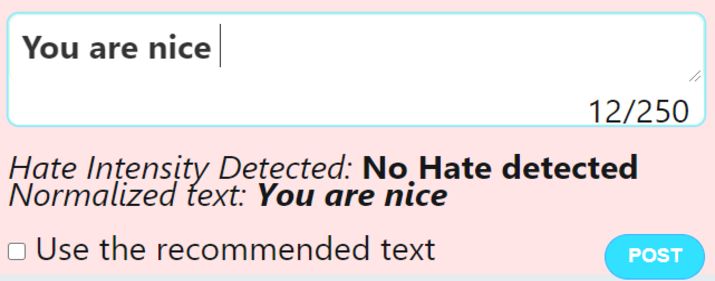
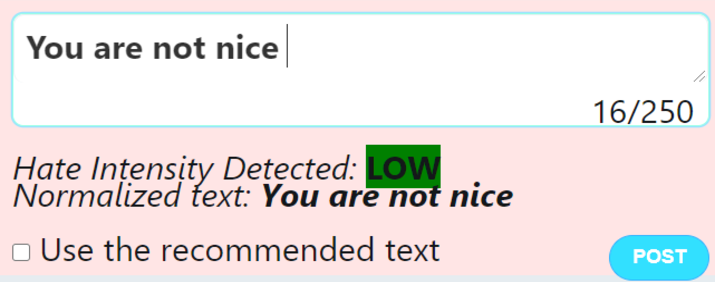
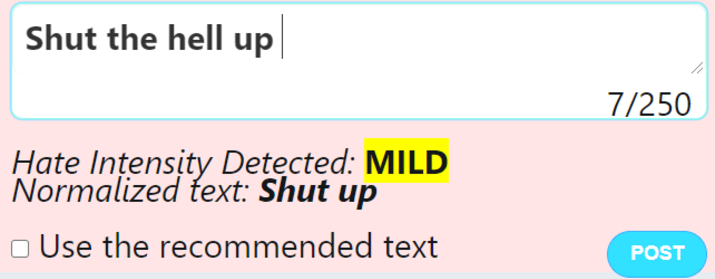
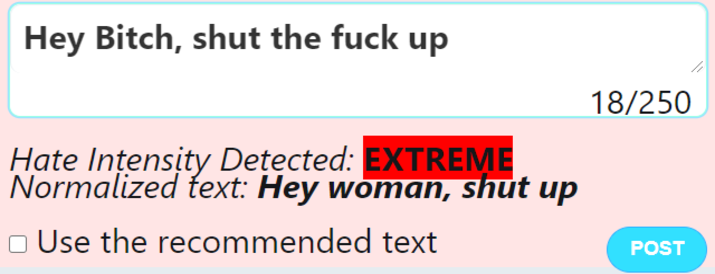
Figure 4: Snapshots of the web extension for four scenarios. NACLgenerates normalized text only if \(\phi_t > \tau\). The web framework detects hate as the user types in, and if any \(\phi_t > \tau.\), it shows the level of hate that is detected in the current text, and then recommends the normalized text to the user..
9 Ethical Implications↩︎
As pointed out by [49], style transfer techniques in NLP can be a force for both good and bad. While, on the one hand, they help turn the Internet into a more positive space [42], they can also be used to propagate a false/malicious narrative. Reiterating that, our research aims not to support the hateful users but rather to study an alternative approach to prompt users towards a less toxic enunciation of their opinions. Without forcing the users to jump from a negative to a positive space directly, we operate on the space in between as a stepping stone and study the theoretical effectiveness of such a technique (the practical effect is in parts highlighted by human evaluation in Section 6.5). Keeping in mind the nefarious use of the normalized hate speech (without the knowledge of online platforms about such a normalization), we will not be publicly releasing the parallel corpus. However, it shall be made available to researchers subject to their request for fair usage.
10 Features for Virality Prediction↩︎
The text-based features employed for predicting comment engagement (aka virality) of the data samples are listed below:
Complexity: Uniqueness of terms introduced as measured by the logarithm of term-frequency in the test samples.
Readability: LIX and RIX readability scores9.
Informativeness: Summation of the Tf-idf vectors of the words in the sample.
Polarity: Overall SentiNet10 polarity score of the test sample.
11 Dataset Annotation Guideline↩︎
For this experiment, we followed the definition proposed by [2] for hate speech and marked the hate span if it consists of any of the following explicit mentions:
A sexist or racist slur term, or an abusive term directly attacking a minority group/individual.
A phrase that advocated violent action or hate crime against a group/individual.
Negatively stereotyping a group/individual with unfounded claims or false criminal accusations.
Hashtag(s) supporting one or more of the points as mentioned earlier.
Additionally, the hate intensity of a sample was marked on a scale of \(1-10\), \(10\) being the highest based on:
Score\([8-10]\): The sample promotes hate crime and calls for violence against the individual/group.
Score\([6-7]\): The sample is mainly composed of sexist/racist terms or portrays a sense of gender/racial superiority on the part of the person sharing the sample.
Score\([4-5]\): Mainly consists of offensive hashtags, or most hateful phrases are in the form of offensive hashtags.
Score\([1-3]\): The sample uses dark humor or implicit hateful term.
12 Algorithm↩︎
Algorithm 5 shows the learning protocol of NACL.

13 Human Evaluation Guideline↩︎
After reading the original sample and the normalized counterparts, the annotators provided their input in the form of the following:
Intensity: The annotators assigned a hateful intensity score to each generated output on a scale of [1,10], \(10\) being the highest intensity.
Fluency: To understand how well constructed and readable the generated text is, the annotators scored each generated text on a range of [1,5], \(5\) being the highest fluency.
Adequacy: Additionally, to provide an idea of whether the desired meaning can be interpreted from the output, the annotators were asked to score each generated text on a range of [1,5], \(5\) being the highest. Since our task aims to perform normalization and not the conversion of hate to non-hate, if a sentence changes the sample’s polarity, then that can also be taken as a negative case from our intended perspective. The annotators were informed before that a normalized sample with its polarity reversed would have a minimum (\(1\)) adequacy even if it is fluent.
For reference, the intensity of the original sample was provided. The fluency and adequacy of the original sample were considered highest. To reduce the annotator’s bias, the annotators were unaware of which output text represented our system.
14 Hyperparameters↩︎
The models make use of Tensorflow 2.0 and Transformer 4.5.1 with Python 3 libraries, trained on Google Colab with Tesla P100-PCIE-16GB GPU.
For the HIP model, we employ a single Bi-LSTM layer (hdim=\(512\)) followed by a layer of self-attention. For this model, use the MSE loss and the Adam optimizer with linear activation. The input embedding is BERT dim=\(768\). The model is trained for \(10\) epochs with a batch size of \(32\).
For the HSI, we employ a \(2\) layer Bi-LSTM (hdim=\(512\)), using a batch size of \(32\), and the RELU activation function. As the final layer for the Span Model is a CRF, we take crf_loss and crf_accuracy as our loss and accuracy metric respectively, and Adam optimizer. The model is trained for \(5\) epochs with a batch size of \(32\).
For the HIR, we employ Facebook’s BART-base module, with a cross-entropy loss, RELU activation and Adam optimizer.
15 Deployment Details↩︎
The proposed web-interface can easily be made to work in cross platform settings to proactively curb hate speech, and the screenshot for the same is provided in Figure 4.
Again we evaluate the tool in the wild by asking \(25\) participants to write random hateful content on their own and rate the tool’s output. We extend the tool by including the interface of the Bias Neutralization
baseline – the tool shows the outputs of NACLand the baseline for a given input. Each participant is asked to input hateful content, assign an original intensity score, and subsequently evaluate the tools’ outputs considering fluency,
adequacy, and intensity. The normalization methods are anonymized for the participants. In total, we obtain \(100\) input samples, with an average normalized intensity score of \(3.24\).
Similar to earlier observations, we notice that NACLresults in more fluent sentences with higher reduction in intensity. This in-the-wild evaluation further supplements that NACLis not restricted to our dataset.
16 Extrinsic Evaluation↩︎
The distribution of hateful and non-hateful samples for the three hate speech detection models we use in our extrinsic evaluation.
| Model | # of tweets | Hate:Non-Hate |
|---|---|---|
| [2] | 12772 | 4750:8022 |
| [18] | 24783 | 20620:4183 |
| [31] | 59189 | 13551:45638 |
References↩︎
Disclaimer: This paper includes examples of hate speech which contain some profane words. These examples are only included for contextual understanding. We tried our best to censor vulgar, offensive, or hateful words. We assert that we do not support these views in any way.↩︎
https://www.perspectiveapi.com↩︎
For annotations and human evaluation, the texts were not masked and presented as-is.↩︎
Since we can’t generate the dictionary-driven normalized samples for test set in \(S_B\) in the absence of hateful spans (c.f. Section 6.1), we do not include it in our extrinsic evaluation.↩︎
Among \(20\) annotators, \(10\) were male, and \(10\) were female. The age of all the annotators ranged between 25-40 years. All of them were social media savvy.↩︎
A demo video of our tool https://github.com/LCS2-IIITD/Hate_Norm↩︎
https://readable.com/blog/the-lix-and-rix-readability-formulas/↩︎