EMNLP-Findings’20
UnifiedQA: Crossing Format Boundaries with a Single QA System
May 02, 2020
Abstract
Question answering (QA) tasks have been posed using a variety of formats, such as extractive span selection, multiple choice, etc. This has led to format-specialized models, and even to an implicit division in the QA community. We argue that such boundaries are artificial and perhaps unnecessary, given the reasoning abilities we seek to teach are not governed by the format. As evidence, we use the latest advances in language modeling to build a single pre-trained QA model, UnifiedQA, that performs well across 20 QA datasets spanning 4 diverse formats. UnifiedQA performs on par with 8 different models that were trained on individual datasets themselves. Even when faced with 12 unseen datasets of observed formats, UnifiedQA performs surprisingly well, showing strong generalization from its out-of-format training data. Finally, fine-tuning this pre-trained QA model into specialized models results in a new state of the art on 10 factoid and commonsense QA datasets, establishing UnifiedQA as a strong starting point for building QA systems.1
1 Introduction↩︎
Question answering is a common tool for assessing how well can computers understand language and reason with it. To this end, the NLP community has introduced several distinct datasets, with four popular QA formats illustrated in Fig. 1. For instance, some datasets expect the answer to be “yes” or “no”, or a unique answer span in the associated paragraph (as opposed to multiple or no spans). These differences have motivated their study in silos, often encoding QA format into the model architecture itself. Efforts to exploit multiple datasets remain largely restricted to a single format. For example, [1] limit consideration to multiple-choice datasets, while [2] focus their generalization study on extractive span prediction models. To the best of our knowledge, no single QA system targets, not to mention excels at, all of these formats.
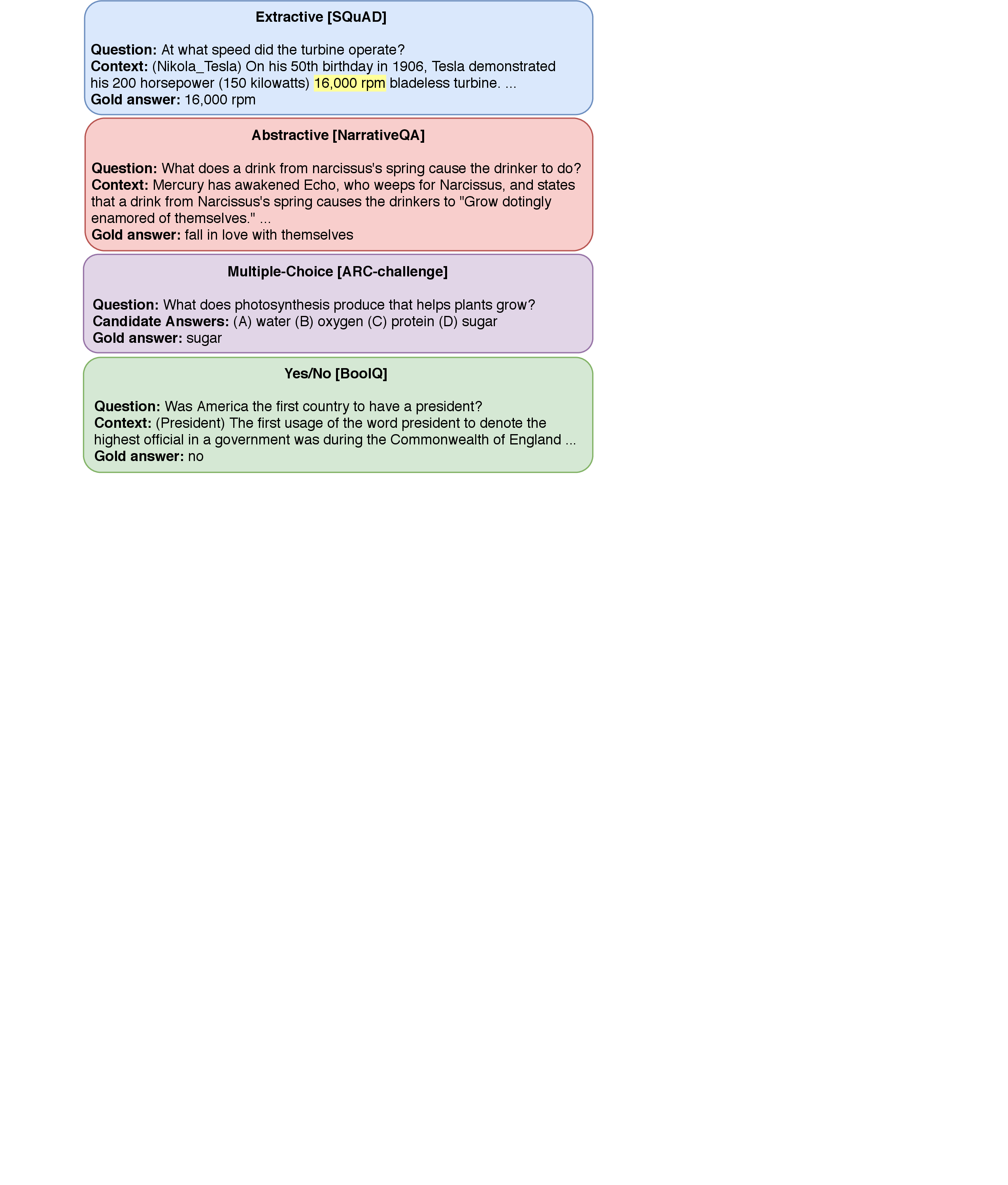

This raises the question: Can QA models learn linguistic reasoning abilities that generalize across formats? Our intuition is simple: while question format and relevant knowledge may vary across QA datasets, the underlying linguistic understanding and reasoning abilities are largely common. A multiple-choice model may, therefore, benefit from training on an extractive answers dataset. Building upon this intuition, we present a single pre-trained QA system, named UnifiedQA, that exploits information across 4 different QA formats to achieve strong performance across 20 different factoid and commonsense QA datasets listed in Fig. 2.
In this work, we advocate for a unifying view of QA formats by building a format-agnostic QA system. Our work leverages recent progress in text-to-text pre-trained neural models, specifically T5 [3] and BART [4], but with a strong focus on differing QA formats. This paradigm allows unifying many NLP models, which formerly had task-specific designs, into a single text-to-text framework. Previous work uses textual prefixes to explicitly define the task associated with each input instance [3], [5]; often such attempts to build a single model for multiple NLP tasks underperform the standard pre-training plus fine-tuning setup (a model per task) [3].
Our work narrows down the scope to tasks that stay within the boundaries of QA, demonstrating that a unified text-to-text paradigm can, in fact, be successful across different QA tasks and formats. We develop a single pre-trained QA model by training text-to-text models on a set of seed QA datasets of multiple formats, taking natural text as input, without using format-specific prefixes. Our experiments show that UnifiedQA can be applied as-is to different QA tasks, generalizes well to other unseen datasets (zero-shot), and with further fine-tuning achieves state-of-the-art results on many QA tasks including commonsense and factual datasets.
1.0.0.1 Contributions.
This work advocates for a unified view of different QA formats, and for building format-agnostic QA systems. To support this view, we present UnifiedQA, a single pre-trained QA system that works well on and generalizes to datasets with different formats (§6.2), while performing on par with state-of-the-art dedicated systems tailored to each dataset (§6.1). Additionally, fine-tuning UnifiedQA into specialized systems sets a new state of the art for 10 datasets (§6.3), establishing it as a powerful starting point for QA research. Our findings demonstrate that crossing QA format boundaries is not only qualitatively desirable but also quantitatively beneficial.
2 Related Work↩︎
Several QA efforts have studied generalization across datasets of a single format. For instance, in MultiQA, [2] study generalization and transfer, but only across extractive span selection datasets. Further, while they show strong leave-one-out style results, they find a single system performs substantially worse than one tuned to each dataset. In ORB, [6] propose a multi-dataset evaluation benchmark spanning extractive and abstractive formats. However, that study is limited to an evaluation of systems, falling short of addressing how to build such generalized models. The MRQA shared task [7] focuses on span-prediction datasets. Unlike all these efforts, our goal is to investigate transfer and generalization across different QA formats, as well as to build a single system that does this well.
Exploiting commonality across machine learning tasks has a rich history studied under transfer learning [8], [9]. [10] and [11] study transfer among various NLP tasks by casting them into a single QA format—an elegant transfer learning approach but orthogonal to the goal of this work. As noted earlier, [3] investigate the transfer between several diverse NLP tasks (machine translation, summarization, etc). Their key contribution is a text-to-text framework, and a powerful model called T5, that makes it easier to mix multiple tasks by encoding both inputs and outputs as text. They rely on textual prefixes to explicitly define the task corresponding to each input instance. While we build upon their framework, we narrow our focus to variations of QA. This allows us to achieve strong results while avoiding reliance on any format-specific prefixes. Our models learn to infer the format of each input question based on its content (e.g., whether the phrasing of the question demands a yes/no answer). Moreover, we are able to demonstrate generalization across QA tasks, which prior work failed to achieve presumably due to its focus on too broad a set of NLP tasks.
3 UnifiedQA: Multi-format Training↩︎
Suppose we would like to train a unified QA model that can operate over \(k\) formats \(F_1, F_2, \ldots, F_k\). For each format \(F_i\), suppose we have \(\ell_i\) datasets sets \(D^i_1, D^i_2, \ldots, D^i_{\ell_i}\) where \(D^i_j = (T^i_j, E^i_j)\) includes both training and evaluation examples. In some cases, the training set \(T^i_j\) may be empty or we may want to ignore it in order to treat \(D^i_j\) as an ‘unseen’, evaluation-only dataset and assess a model’s generalization to it.
We use the text-to-text paradigm to convert each training question \(q\) in format \(F_i\) into a plain-text input representation \(\mathit{enc}_i(q)\). This conversion uses a natural encoding process that will be described shortly (§3.1) for four common QA formats, and is easily extensible to other formats as well. We follow a simple approach of creating a mixed training pool consisting of all available training instances: \[\tilde{T} = \bigcup_{i=1}^k \bigcup_{j=1}^{\ell_i} \Big\{ \mathit{enc}_i(q) \mid q \in T^i_j \Big\}\] Training batches are drawn from this pooled data, \(\tilde{T}\), by including each \(q \in T^i_j\) with a probability proportional \(1 / |T^i_j|\). Each batch thus, on average, contains the same number of instances from each training set, regardless of its size. Similar treatments of task mixing have also been adopted by [12] and [3]. As our experiments will show, our multi-format mixing approach works well. It clearly highlights the value of training on out-of-format data and confirms our intuition that there are strong ties across QA formats in terms of the underlying reasoning abilities.2
Our unified question-answering system is based on the recent text-to-text frameworks, particularly, T5 [3] and BART [4]. We first define a unifying encoding of the instances across various formats (§3.1). We then introduce UnifiedQA(§3.2) that is a QA system trained on datasets in multiple formats, indicating new state-of-the-art results on 10 datasets and generalization to unseen datasets.
3.1 Text-to-Text Encoding↩︎
We convert each of our target datasets into a text-in/text-out format [3]–[5]. The question always comes first, followed by some additional information (context paragraph or candidate answers, or both). We use “\n” separators between different parts of
the input. This ensures having a human-like encoding while not making it overly-specific to a certain format. Our unified model incorporates the following four common question-answering formats. Specific datasets within them are deferred to Section 4.1.
questions \(Q\) include a context paragraph \(C\) (typically a paragraph) and require models to extract the answer as a substring from the context. In some datasets, ‘unanswerable’ can sometimes be the correct response.
questions \(Q\) require models to produce answers that are often not mere substrings of the provided context paragraph \(C\).
questions \(Q\) come with a set of candidate answers \(\{A_i\}\), of which generally exactly one is correct. In some cases, they also include a context paragraph \(C\).
questions \(Q\) expect a ‘yes’ or ‘no’ answer as the response and may include a context paragraph \(C\).
Table ¿tbl:tab:example:encodings? provides examples of the natural input and output encoding for each of these formats, where both input and output representations are raw text. There is no explicit information regarding a question
being an MC question or having exactly four candidate answers. Specifically, MC questions without any context paragraph are encoded as question \n (A) c1 (B) c2\(\ldots\) where c1, c1,
\(\ldots\) are the set of candidate answers (see the example from ARC dataset). If the question includes a context paragraph, it is appended after the candidate answers: question \n (A) c1 (B) c2\(\ldots\)\n paragraph, as shown in the example from the MCTest dataset. Questions in the other three formats (EX, AB, and YN) are encoded simply as question \n paragraph.
To re-emphasize, unlike prior work [3], we do not specify any task-, dataset-, or format-specific prefixes in the input representation. Whether the answer should be extracted or abstracted, and whether from the provided context paragraph or candidate answers (or the fact that these even are candidate answers) is expected to be inferred by the system.
3.2 UnifiedQA: The Pre-Trained Model↩︎
The specific pre-trained QA model we provide and use in all our experiments is trained on representative datasets for each of the 4 formats discussed earlier. We empirically chose the following 8 seed datasets for training UnifiedQA,3 based on their effectiveness in our pilot study (details deferred to Section 5) assessing which datasets are most valuable for out-of-format training:
EX: SQuAD 1.1, SQuAD 2.0
AB: NarrativeQA
MC: RACE, ARC, OBQA, MCTest
YN: BoolQ
One can easily use other combinations of formats and datsets to create variants of our UnifiedQA model, or extend it as future datasets become available or new formats are introduced.
Unless otherwise noted, we use the largest available T5 model (11B parameters) as the starting point for training our model and call the system UnifiedQA. We also report results of training our system with BART\(_\text{large}\), referred to as UnifiedQA\(_\text{BART}\)(see §6.3). Details on the parameters of the models used are deferred to Appendix 9.2. Similar to pre-trained language models, the resulting pre-trained QA model can be used as a starting point for fine-tuning on other QA datasets.
4 Formats and Datasets↩︎
4.1 Datasets↩︎
We evaluate UnifiedQA on 20 existing datasets that target different formats as well as various complex linguistic phenomena. Fig. 2 summarizes key properties of our datasets (whether it comes with a paragraph or answer candidates, whether the paragraph explicitly contains the answer, etc). Most importantly, they are grouped into several formats/categories as described below. Table 1 gives certain statistics of these datasets. We next provide a summary enumerating these datasets, with additional details deferred to Appendix 9.1.
4.1.0.1 Extractive QA (EX).
Among the datasets in this popular format, we adopt SQuAD 1.1 [14], SQuAD 2 [15], NewsQA [16], Quoref [17], ROPES [18].
4.1.0.2 Abstractive QA (AB).
The datasets used from this format are: NarrativeQA/NarQA [19], the open-domain version of NaturalQuestions/NatQA [20], and DROP [21].
| Dataset | Train set size | Eval. set size | Best published | 95% CI (%) | Input length | Output length |
|---|---|---|---|---|---|---|
| SQuAD 1.1 | 87\(k\) | 10\(k\) | 95.6 | 0.4 | 136.2 | 3.0 |
| SQuAD 2.0 | 130\(k\) | 11\(k\) | 91.2 | 0.5 | 139.9 | 2.6 |
| NewsQA | 76\(k\) | 4\(k\) | 66.8 | 1.4 | 606.6 | 4.0 |
| Quoref | 22\(k\) | 2\(k\) | 86.1 | 1.5 | 352.7 | 1.7 |
| Quoref-CS | - | 700 | 55.4 | 3.6 | 324.1 | 2.2 |
| ROPES | 10\(k\) | 1.4\(k\) | 61.1 | 2.5 | 169.1 | 1.4 |
| ROPES-CS | - | 974 | 32.5 | 3.0 | 182.7 | 1.3 |
| NarQA | 65\(k\) | 21\(k\) | 58.9 | 0.7 | 563.6 | 6.2 |
| NatQA | 79\(k\) | 3.6\(k\) | 42.2 | 1.6 | 607.0 | 2.2 |
| DROP | 77\(k\) | 9\(k\) | 89.1 | 0.6 | 189.1 | 1.6 |
| DROP-CS | - | 947 | 54.2 | 3.2 | 206.0 | 2.1 |
| RACE | 87\(k\) | 4\(k\) | 89.5 | 0.9 | 317.9 | 6.9 |
| OBQA | 4\(k\) | 501 | 80.0 | 3.3 | 28.7 | 3.6 |
| MCTest | 1.4\(k\) | 320 | 86.5 | 3.4 | 245.4 | 4.0 |
| ARC (easy) | 2\(k\) | 2\(k\) | 80.0 | 1.7 | 39.4 | 3.7 |
| ARC (chal.) | 1\(k\) | 1\(k\) | 67.8 | 2.9 | 47.4 | 5.0 |
| CQA | 9.7\(k\) | 1.2\(k\) | 79.1 | 2.2 | 26.8 | 1.5 |
| WG | 40.3\(k\) | 1.7\(k\) | 67.5 | 2.2 | 25.2 | 3.0 |
| PIQA | 16.1\(k\) | 3\(k\) | 79.4 | 1.4 | 49.6 | 20.2 |
| SIQA | 33.4\(k\) | 2.2\(k\) | 78.0 | 1.7 | 37.3 | 4.7 |
| BoolQ | 9\(k\) | 3\(k\) | 91.0 | 1.0 | 105.1 | 1.0 |
| BoolQ-CS | - | 461 | 71.1 | 4.0 | 108.9 | 1.0 |
| NP-BoolQ | 10\(k\) | 3\(k\) | 78.4 | 1.4 | 106.2 | 1.0 |
| MultiRC | - | 312 | 91.7 | 2.6 | 293.3 | 1.0 |
4.1.0.3 Multiple-choice QA (MC).
We use the following MC datasets: MCTest [22], RACE [23], OpenBookQA/OBQA [24], ARC [25], [26], QASC [27], CommonsenseQA/CQA [28], PIQA [29], SIQA [30], and Winogrande [31]. Several of the MC datasets do not come with accompanying paragraphs (such as ARC, QASC, OBQA). For most of this the work, we keep the questions as is with no additional retrieval (unless otherwise mentioned). One other variability among these datasets is their number of candidate answers. While many datasets have four candidates (see Fig. 2), others have more. Later (in §6.2) we will see that our approach generalizes to datasets with different numbers of candidates, even if such questions have not been seen during training.
4.1.0.4 Yes/No QA (YN).
The YN datasets we use are BoolQ [32] and a naturally-perturbed version of this dataset, BoolQ-NP [33], and the binary (yes/no) subset of MultiRC [34].
4.1.0.5 Contrast-sets.
Additionally, we use contrast-sets [35] for several of our datasets (denoted with “CS”): BoolQ-CS, ROPES-CS, Quoref-CS, DROP-CS. These evaluation sets are expert-generated perturbations that deviate from the patterns common in the original dataset.
4.2 Evaluation Metrics for Textual Output↩︎
We evaluate each dataset using the metric used most often for it in prior work. For the EX format, it’s the F1 score of the extracted span relative to the gold label. For the AB format, we use ROUGE-L metric [36]–[38]. For NatQA we use the exact-match metric, following [39]. For the MC format, we match the generated text with the closest answer candidate based token overlap and compute the accuracy. For the YN format, we follow [32] to measure if the generated output matches the correct ‘yes’ or ‘no’ label. In rare cases where the output is longer than one word (e.g., ‘yes it is’), we check if it contains the correct label but not the incorrect one.4
5 Pilot Study: Can Out-of-Format Training Help?↩︎
We first answer the question: Is the broad idea of benefiting from out-of-format training even viable? For instance, is our intuition correct that an MC dataset can, in practice, benefit from training on an EX dataset? Before discussing our main experimental results, we briefly report on a pilot study that assesses the following basic question: Given a training set \(T^i_1\) (the anchor dataset) of QA format \(F_i\), is there an out-of-format training set \(T^j_1\) of format \(F_j\) such that training jointly on \(T^i_1 \cup T^j_1\) improves performance relative to training only on \(T^i_1\)? To this end, we evaluate both on the matching evaluation set \(E^i_1\) as well as on ‘unseen’ data \(E^i_2, E^i_3, \ldots\) of the same format.
The results are summarized in Table ¿tbl:tab:pairwise95table?. The two rows in each individual table correspond to training on \(T^i_1\) (the anchor dataset) and on \(T^i_1 \cup X\), where \(X\) is an out-of-format dataset corresponding to \(T^j_1\) above. The columns represent various evaluation sets of format \(F_i\). For each column, ‘\(X = \ldots\)’ at the very bottom indicates the out-of-format dataset \(X\) that was the most helpful in improving performance on the evaluation set in that column.5
Consider the case of the anchor set \(T^i_1\) being BoolQ and the evaluation set being NP-BoolQ, both of format YN. Here, including out-of-format training data \(X{=}\)SQuAD2 boosts performance from 51% to as much as 59%. The gain may be less in other cases, but across all anchor and evaluation datasets, we generally observe that there is at least one out-of-format training set whose inclusion improves performance.
This pilot study thus provides a proof of concept that out-of-format training can indeed help a QA model in nearly every case. Of course, this study only shows the existence of such an out-of-format dataset, rather than provide a single unified model. Nevertheless, it helps identify representative training sets from each format that were most helpful. As alluded to earlier, we used this empirical data to guide which training sets to include when building UnifiedQA in Section 3.2.
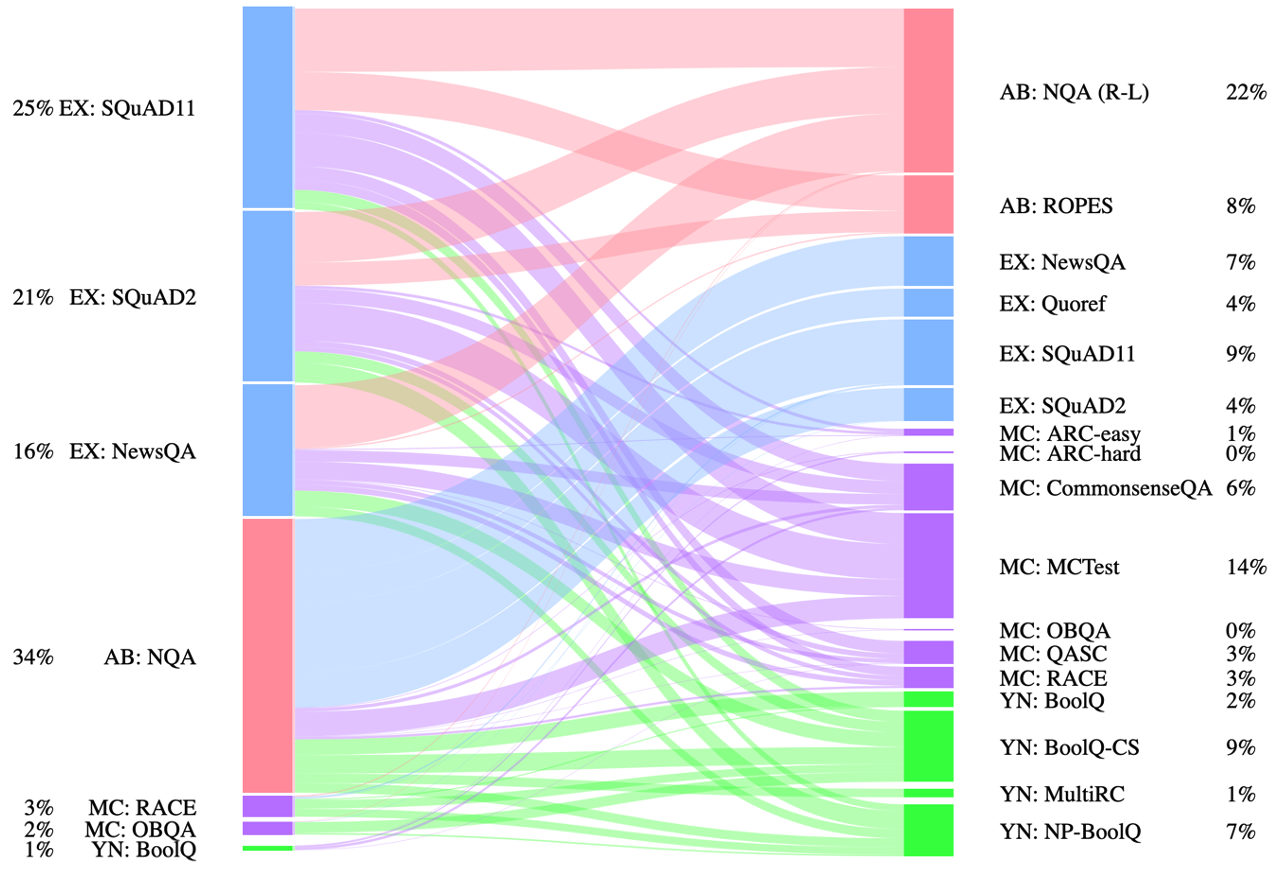
The experimental results from this case study are summarized in the aggregated plot shown in Fig. 3. In this bipartite graph, the datasets used for training are on the left hand side and the evaluation datasets are
on the right hand side. The weight of each edge \(w(\ell, r)\) indicates the contribution of a dataset \(\ell\) when used for training jointly with an anchor dataset \(d\), when evaluated on \(r\) (\(d\) and \(r\) have the same format.) Specifically,
\(w(\ell, r) = avg_{d} \Big[ S\big(\ell \cup d; r\big) - S\big(d; r\big) \Big],\)
where \(S(d, r)\) is the score achieved on \(r\) after training on \(d\). Since we only focus on gains from out-of-format training, we drop the
edges that are negative or between two datasets of the same format.
As expected, there are strong connections between the AB and EX datasets in Fig. 3 since their definitions are quite similar. Apart from the edge weight, the overall width of a dataset \(\ell\) on the left also depicts how much it contributes to out-of-format datasets. E.g., NQA (NarrativeQA) is the most helpful dataset and even helps multiple formats. Similarly our extractive datasets (SQuAD11.1, SQuAD 2, and NewsQA) are also relatively more helpful. While large datasets generally appear to help, RACE, another large-scale dataset, doesn’t help that much. The least helpful dataset in the mix is BoolQ which focuses on yes/no questions.
In a similar vein, the wider the dataset on the right hand side, the more it can be benefit from out-of-format datasets. Among these beneficiary datasets, all four formats are equally represented.
6 Experimental Results↩︎
We now discuss our main experimental results, evaluating UnifiedQA on seed datasets (used for training the system) as well as unseen datasets.
6.1 UnifiedQA vs. Dedicated Models↩︎
Is UnifiedQA, a single pre-trained multi-format QA system, as good as dedicated systems trained for individual datasets? We emphasize that the answer to this question is not as simple as it may seem, since earlier works have observed that a system addressing multiple tasks often underperforms a focused system [3].
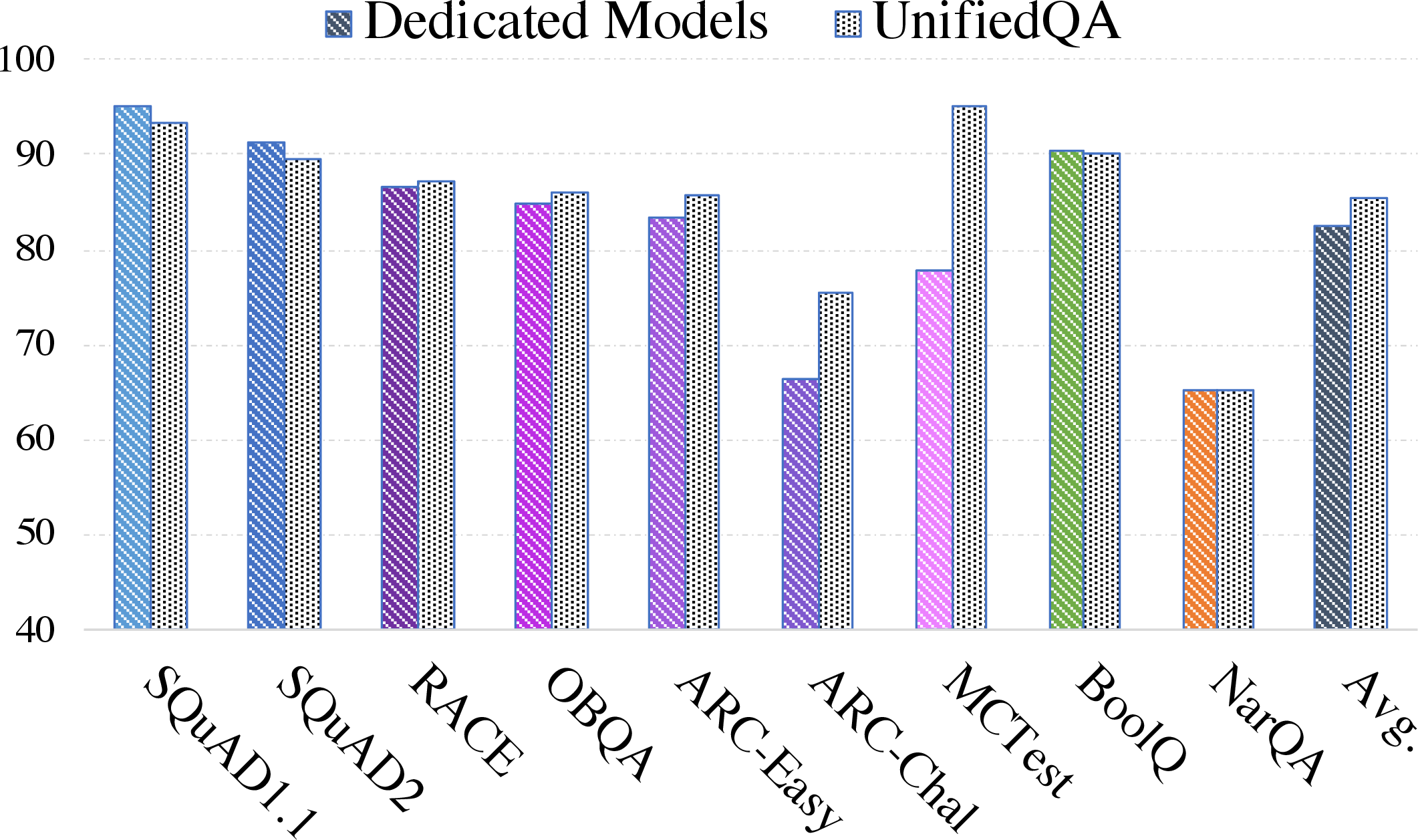
Fig. 4 summarizes the results of the relevant experiment. The gray bars belong to UnifiedQA(a single system for multiple datasets of different formats). The colored bars are different T5-based systems tailored to individual datasets (a different system for each dataset). The results show that UnifiedQA performs almost as good as individual T5 models targeted to each dataset. In some cases UnifiedQA performs even better than the single-dataset experts (e.g., on OBQA or NQA). On average (last column) UnifiedQA clearly outperforms the ensemble of dataset/format-specific systems. UnifiedQA thus offers flexibility across multiple QA formats while compromising almost nothing compared to dataset-specific experts.
6.2 Generalization to Unseen Datasets↩︎
We now explore whether UnifiedQA generalizes well to other, unseen datasets. Table ¿tbl:tab:generalization? summarizes the results of experiments where we evaluate various models on datasets that are not used to train them. It compares UnifiedQA(training on multiple formats) with training on various datasets of a single format (e.g., UnifiedQA[EX], built by training the model on only extractive datasets).
The first few rows of the table show T5 models trained for individual formats, followed by UnifiedQA. For completeness, we include the highest previous scores for each dataset; one must be careful when reading these numbers as the best previous numbers follow the fully supervised protocol (for NewsQA [40], Quoref [41], DROP [42], ROPES [18], QASC [27], CommonsenseQA [43] and x-CS datasets [35].)
We make three key observations: (1) On average (last column), UnifiedQA shows much stronger generalization across a wide range of datasets. (2) on 9 (out of 12) datasets, UnifiedQA shows a better generalization than any single-format expert. For example, while the system is trained on multiple-choice questions with 4 candidate answers, it works quite well on datasets with more than 4 candidate answers (QASC and CommonsenseQA have has 8 and 5 candidate answers per question, respectively). (3) Single-format experts are better at generalization only when the source and target datasets are very similar (for instance SQuAD and Quoref).
6.3 State-of-the-Art via Simple Fine-tuning↩︎
Fine-tuning of pre-trained language models has become the standard paradigm for building dataset-specific stat-of-the-art systems [44], [45]. The question we address here is: when it comes to QA, is there a value in using UnifiedQA as a starting point for fine-tuning, as opposed to a vanilla language model that has not seen other QA datasets before?
To address this question, we fine-tune each of UnifiedQA, T5, and BART on several datasets by selecting the best check point on the dev set, and evaluating on the test set. Table ¿tbl:tab:fine-tuning? summarizes the results of the experiments. The table shows two variants: UnifiedQA\(_\text{T5}\)and UnifiedQA\(_\text{BART}\). All results are based on the 11B version of T5.
The columns indicate the evaluation on the test set corresponding to the data that was used for training. For each dataset, the first line of the table reports the best previously published work. For several MC datasets that do not come with evidence paragraphs, we include two variants: one where we use them as-is and another that uses paragraphs fetched via an Information Retrieval (IR) system as additional evidence, indicated with “w/ IR” tags. We use the same IR sentences as used by the baselines: Aristo corpus for ARC and OBQA datasets [1], and 2-step IR for QASC [27]. For NatQA, following [39], we use the DPR retrieval engine [46] to augment each question with additional paragraphs.
We see that fine-tuning on UnifiedQA consistently dominates fine-tuning on T5 and BART, respectively. It also dominates the best previous scores on the datasets. Intuitively, since UnifiedQA has seen different formats, it should be positioned to achieve higher scores after a little fine-tuning, compared to fine-tuning on a vanilla T5 or BART model. This could be especially effective when a user has limited training data for a target QA task (also shown in Appendix 9.6.) This also highlights that the effectiveness of cross-format training is not limited only to T5, but is rather a general trend for text-to-text architectures.
6.4 Ablation: Training Set Contributions↩︎
We now perform a leave-one-out experiment to better understand the contribution of each seed dataset to UnifiedQA. We take the system from §3.2 and assess how strong the model is when individual seed training datasets are dropped from the union. The result of this experiment is summarized in Table ¿tbl:tab:leave:one:out?. It compares the performance of full UnifiedQA(the first row) with ablated variants that exclude one seed dataset at a time. The rows are sorted based on the last column: datasets with higher contributions appear first.
Looking at first few rows of the table, BoolQ, SQuAD 2.0, OBQA, NarQA are the top four contributing datasets, each with a different format. SQuAD 1.1 has the least importance, presumably because it is mostly covered by SQuAD 2.0.
This study suggests that in order to build an effective unified QA system, it suffices to have a relatively small set of datasets as long as the set includes representatives from each format.
7 Discussion↩︎
The key motivation for this work is the observation that nearly all prior efforts on QA research were limited to the boundaries defined by narrow formats. A format-specific design would not generalize across QA datasets with slightly different definitions (e.g., a model built for SQuAD would not work for RACE). Additionally, such a design would prevent us from benefiting from the labeled data available in other formats. We challenge this view by advocating for approaches that combine seemingly different datasets. We believe that developing QA systems targeted to a specific format is a conceptual barrier for progress in the field.
7.0.0.1 Factors affecting generalization.
Format is not the only factor affecting generalization across datasets. We additionally studied the value of other factors including dataset size and domain (vocabulary, topic, and style) in improving generalization. We observed that larger datasets often help with generalization, but not always (§5); e.g., RACE or OBQA show similar benefits (Fig. 3), even though RACE is much larger than OBQA. We observed a similar phenomenon with domain: similar domains help with transfer, but that is not always the case. For example, while BoolQ questions, similar to SQuAD, are accompanied with Wiki paragraphs, they barely benefit each other. Overall, the factors affecting generalization are not well-understood, leaving room for future investigations.
7.0.0.2 Unifying QA formats and text-to-text models.
While UnifiedQA is built based using existing text-to-text models [3], [49], we emphasize that the choice of tasks for multi-task learning plays a crucial role in achieving successful results. Previous studies [3] did not observe gains when mixing tasks that are very different. The key intuition is that a more coherent choice of tasks is more likely to succeed. Further, focusing on a coherent space of QA tasks/formats allows us to simplify the input by not requiring “prefixes” to explicitly define tasks/formats.
8 Conclusion↩︎
The question-answering community has fruitfully explored the design of strong models, but while staying within the boundaries of individual QA formats. We argued that such boundaries are artificial and can even limit the performance of systems, because the desired reasoning abilities being taught and probed are not tied to specific formats. Training data in one format should, in principle, help QA systems perform better even on questions in another format.
With this intuition in mind, we presented UnifiedQA, a single pre-trained QA system based on the text-to-text paradigm, seeking to bring unification across four common QA formats. We showed that even with its simple multi-format training methodology, UnifiedQA achieves performance on par with 8 dataset-specific expert models (§6.1), while also generalizing well to many unseen datasets of seen formats (§6.2). At the same time, we demonstrated that UnifiedQA is a strong starting point for building QA systems: it can achieve state-of-the-art performance by simply fine-tuning on target datasets (6.3).
We hope this effort will inspire a future line of work in the QA and NLP communities, moving towards more general and broader system designs. We leave extensions of UnifiedQA to other formats such as to direct-answer questions [50] as a promising avenue for future work.
Acknowledgments↩︎
The authors would like to thank Collin Raffel, Adam Roberts, and Nicholas Lourie for their help with the T5 framework and for providing feedback on an earlier version of this work. The authors would like to acknowledge grants by ONR N00014-18-1-2826 and DARPA N66001-19-2-403, and gifts from the Sloan Foundation and the Allen Institute for AI. Moreover, the authors would like to thank members of the Allen Institute for AI, UW-NLP, and the H2Lab at the University of Washington for their valuable feedback and comments. TPU machines for conducting experiments were provided by Google.
9 Appendices↩︎
9.1 Datasets: Details↩︎
We evaluate our UnifiedQA on 19 existing datasets that target various formats, as well as various complex linguistic phenomena. Table 2 shows different properties for our datasets (whether it comes with a paragraph, whether the paragraph explicitly contains the answer, whether there are candidate-answers as part of the input, etc.) Most importantly, they are grouped into several formats/categories described below. Table 1 gives summary statistics of these datasets.
9.1.0.1 Extractive QA (EX).
All the datasets in this format require models to extract the answer to a given question as a substring from a context paragraph. SQuAD 1.1 [14] contains questions about Wikipedia paragraphs. A later version of this dataset, SQuAD 2 [15], includes unanswerable questions which empirically makes the task much harder. For our evaluation, we use the development sets of SQuAD 1.1 and SQuAD 2. NewsQA [16] dataset focuses on paraphrased questions with predicate-argument structure understanding collected from news articles from CNN/DailyMail articles. Quoref [17] contains questions that require coreference resolution in Wikipedia articles and can even have disjoint spans as answers. ROPES [18] centers around situation understanding, where the model must under the causes and effects implicit in the given situation.
9.1.0.2 Abstractive QA (AB).
All the datasets in this format require models to produce answers that are often not mere substrings of the given context paragraph. NarrativeQA [19] focuses on understanding various events that happen in a given movie plot, based on summaries of their movie adaptations from various web resources. Many of the answers do not have high overlap with the context. DROP [21] contains questions that involve rudimentary mathematical skills (such as counting, addition, subtraction, maximum, minimum, etc.) and questions query multiple parts of the paragraph. The answer can be either a number or a date that can be inferred from the paragraph, or several spans from the context paragraph. Finally, we use an open-domain version of NaturalQuestions [20] where the paragraph that was used for creating the question is eliminated, and only the questions with short answers up to five tokens are taken. Instead, we follow [39] to use a DPR retrieval [46] engine to augment each question with an additional context paragraph. We call this dataset NatQA.
9.1.0.3 Multiple-choice QA (MC).
All the datasets in this format contain questions that come with candidate answers. MCTest [22] contains questions about simple, fictional stories. RACE [23] is a challenging set of English comprehension multiple choice exams given in Chinese middle and high schools. OpenBookQA [24], ARC [25], [26], QASC [27] are different MC tests focusing on elementary/high school-style science exams. We use several othern datasets that are often framed as commonsense reasoning benchmarks: CommonsenseQA [28] is geared towards activity/concept questions, PIQA [29] addresses physical interaction reasoning, SIQA [30] contains question that require social reasoning (motivations, reactions, event orders) and finally Winogrande [31] which a benchmark for hard pronoun resolution problems [51], [52].
Other than MCTest and RACE, the rest of the datasets do not come with accompanying paragraphs. On such datasets, occasionally a retrieval system is used to supplement each question with a relevant retrieved context paragraph. For most of this the work, we keep the questions as is with no additional retrieval (unless otherwise mentioned), except in §6.3 where we use IR to get numbers comparable to earlier work. One other variability among these datasets is their number of candidate answers. While many datasets have four candidates (see Figure 2), others have more. Later, in §6.2 we will see that our approach generalizes to datasets with different number of candidates, even if it’s not seen during training.
9.1.0.4 Yes/No QA (YN).
All the datasets in this format contain questions that could be responded with yes/no answers. One can think of these as multiple-choice questions with 2 candidates; however, they’re usually treated differently. Several examples we use are BoolQ [32] and a version of this dataset with natural-perturbations, BoolQ-NP [33], the subset of MultiRC [34] that have binary(yes/no) answers.
9.1.0.5 Contrast-sets.
Additionally, we use contrast-sets [35] for several of our datasets (denoted with “CS”): BoolQ-CS, ROPES-CS, Quoref-CS, DROP-CS. These evaluation sets are expert-generated perturbations that deviate from the patterns common in the original dataset.
9.2 Details on the experiments:↩︎
Below is several details on the experiments:
Models: we use two text-to-text frameworks: T5 and BART.
Model sizes: Most of the experiments are done on T5(11B) which has 11 billion parameters. We also report experiments with BART (large) with 440 million parameters.
Input/output size: For all experiments, we use token-limits of size 512 and 100 for inputs and outputs sequences, respectively.
# of iterations for pretraining on the seed datasets (§3): All models are trained for \(100k\) steps on the seed datasets.
Learning rates: we use 1e-3 and 1e-5, for T5 and BART, following the original works on each framework.
Batch sizes: We use batches of 8 and 120, for the T5 (11B) and BART models, respectively.
Infrastructure: In the experiments, we use v3-8 TPUs for T5 models, and eight 32GB GPUs for BART models.
Time spent to build UnifiedQA: pretraining UnifiedQAapproximately takes about 36 and 55 hours, on T5(11B) and BART models, respectively.
Finetuning on datasets (§6.3): the only hyperparameter we iterated over is the training steps. Each model was fine-tuned for 60\(k\) steps and checkpoints were saved every 2\(k\) steps. The model with the highest score on the dev set is our selected model.
9.3 UnifiedQA: Different Sizes↩︎
For completeness we’re also showing the scores of UnifiedQA of different sizes on each dataset. For these systems each row is a single system.
9.4 Comparison with the Dedicated Models: extended results↩︎
Here we summarize an extension of the results in §6.1. Table ¿tbl:tab:appendix:union:vs:single:dataset? summarizes the results of the relevant experiment. In the top portion of the table we have evaluations of T5 model fine-tuned for individual datasets, followed by UnifiedQA. As it can be observed from the table, UnifiedQA performs almost as good as the best single dataset experts. In some cases UnifiedQA performs even better than than the single-dataset experts (e.g., on OBQA or NQA.) On average (last column) UnifiedQA is doing much better dataset/format-specific systems. In conclusion, UnifiedQA offers flexibility across multiple QA formats while compromising almost nothing compared to dataset-specific experts.
9.5 Pairwise Mixing: extended results↩︎
Here we summarize an extension of the results in §5. The question addressed here is whether there is value in mixing datasets with different formats. We evaluated this by adding one dataset of a different format to four different datasets (one for each format). The results are summarized in Table ¿tbl:tab:appendix:pairwise95table?. The goal of each sub-table is to measure the within-format generalization one can gain via out-of-format training. Each sub-table has an anchor dataset, indicated in the first column. For example in the first table the anchor dataset is SQuAD. Rows of the table: Each table combines datasets of other formats with the anchor dataset (e.g., SQuAD + RACE, etc). The columns of the sub-tables contain evaluations on the dataset with the same format as the anchor dataset. For example, on the first table, the evaluation is done on SQuAD 1.1/2.0, NewsQA, Quoref which have the same format as SQuaD 1.1, the anchor dataset. The results show that one can achieve gains for question-answering in a certain format by incorporating resources in other formats. In the first two sub-tables, we see that NarQA (AB) and OBQA (MC) help a SQuAD models generalize better to other EX datasets. In the third table where the anchor dataset is NQA (AB), EX datasets help a NQA model generalize better to other AB datasets. In the 4th/5th subtable, EX and AB datasets help a RACE/OBQA (MC) models generalize better to other MC datasets. Similarly, in the final sub-table, MC dataset helps improve the scores on a YN datasets.
9.6 Extended Results of Fine-tuning on Winogrande↩︎
Here we provide extended result for the Winogrande dataset. The results are summarized in Table ¿tbl:tab:winograd:table?. The table include results of fine-tuning UnifiedQA\(_\text{T5}\)and UnifiedQA\(_\text{BART}\), as well as fine-tuning of the vanilla language models, T5 and BART. As it can be observed, on this dataset, fine-tuning UnifiedQA gives stronger results when the size of the training data is limited. With respect to the overall metric AUC, UnifiedQA has a slight edge over fine-tuning the vanilla language models.
References↩︎
A more sophisticated teaching curriculum [13] or approaches such as model distillation and teacher annealing [9] are likely to further improve the performance of the resulting unified model, bolstering the strength of our advocacy for a unified view of all QA formats. We leave their exploration to future work.↩︎
Future references to ‘seed dataset’ point to the QA datasets used in this section.↩︎
The evaluation code is available at the URL in Footnote 1.↩︎
Appendix 9.5 reports extended results, including the performance with various choices of \(X\).↩︎